


Abstract
This study examines model-based systems engineering (MBSE) within the context of vehicle development at the subsystem level. The investigation encompasses the examination of the transfer of requirements from the overarching system level—the vehicle level—to its constituent subsystems, the subsequent implementation of these requirements within the subsystems, and the generation of model-based test cases for the purpose of verification. A systematized literature review according to the key principles of PRISMA 2020 was conducted to address this research question. To this end, a set of criteria for a systematic analysis were developed and applied to the identified studies.
1. Introduction
The increasing complexity of modern vehicles gives rise to novel challenges for development processes in the automotive industry. Systems engineering has emerged as a central methodological foundation for systematically managing this complexity and coordinating interdisciplinary development efforts [1]. The transformation of the industry is driven by the continuous scarcity of resources, rising sustainability requirements, and the shift toward connected and autonomous mobility solutions. These factors demand new approaches to thinking and acting in vehicle development [2]. Autonomous vehicles enable the development of new mobility concepts such as Mobility-as-a-Service. However, currently established service systems—for example, wheelchair transportation, which today relies entirely on a human driver—must be fundamentally re-envisioned. Automated wheelchair securement in autonomous or shared vehicles introduces stringent requirements for system decomposition, interface specification, and verifiable interaction sequences at the subsystem level [3,4]. Recent reviews and patents emphasize the need for robust, testable interaction scenarios and traceable verification artifacts within this domain [3,4].
Automotive Software Process Improvement and Capability Determination (ASPICE) has established itself as the central standard for evaluating and improving development processes. It addresses software, hardware, and aspects of functional safety and cybersecurity. Traditional document-based approaches are reaching their limits under conditions of increasing complexity and new mobility requirements. For this reason, the use of model-based methods is becoming increasingly important in order to meet the required traceability, transparency, and process maturity requirements and to ensure ASPICE conformity [5,6,7].
The present study focuses on the implementation of MBSE at the subsystem level of vehicle development. The investigation encompasses the examination of the transfer of requirements from the overarching system level—the vehicle level—to its constituent subsystems, the subsequent implementation of these requirements within the subsystems, and the generation of model-based test cases for the purpose of verification.
In light of the identified challenges, there is a need for a model-based approach that facilitates the structured transition from system requirements at the subsystem level and enables the derivation of verifiable test cases. To systematically examine this need, the current state of research is first analyzed in this study.
The structure of this study is as follows: Section 2 provides a comprehensive survey of the current state of the art in systems engineering, with a particular emphasis on model-based systems engineering, requirements management, and model-based testing. The subsequent section delineates the criteria that were employed in the literature analysis. The Section 4 delineates the methodological approach according to the PRISMA 2020 framework for literature reviews. The Section 5 of this study presents the results of the analysis. The study’s conclusion offers a critical discussion of the findings and a summary of the conclusions.
2. State of the Art
As previously mentioned, the automotive industry is currently experiencing a period of transformation. This transformation is driven by three primary factors: increasing sustainability requirements, advancements in digital technology, and the increasing interdisciplinary integration of various fields of study. To address the resulting complexity, systems engineering provides methodological approaches, a standardized language, and supporting tools [8]. In the contemporary context, document-centric approaches are no longer adequate to address the intricacies inherent in modern systems. Consequently, a model-based approach is being adopted.
2.1. Fundamentals of Model-Based Systems Engineering (MBSE)
In the context of model-based systems engineering (MBSE), models function as the primary repository of information throughout the development process. Rather than relying on a multitude of documents, a consistent system model is employed as the “single source of truth.” This ensures traceability and consistency across all development artifacts. MBSE is defined as the formalized application of modeling to support requirements, design, analysis, verification, and validation throughout the entire system lifecycle [9].
The integration of MBSE into the development process is driven by multiple objectives. Firstly, the application of modeling facilitates enhanced management of system complexity by providing clear structuring and reducing uncertainty. Secondly, it promotes the automation of development activities such as simulation, code generation, and test case derivation. Additionally, MBSE fosters enhanced communication among stakeholders by leveraging standardized modeling languages such as Systems Modeling Language (SysML) and Unified Modeling Language (UML) [10]. The successful implementation of MBSE is conditioned upon the fulfillment of specific prerequisites, including the use of a formal modeling language, the utilization of appropriate tools, and adherence to systematic methodologies [8,11]. A contemporary trend in MBSE entails the increasing automation of verification and validation activities [9].
In the context of ASPICE, MBSE facilitates the efficient and traceable execution of development processes. ASPICE is a process model specifically designed for software and systems development in the automotive industry. It is recognized on an international scale and is used to evaluate the maturity of development processes. The assessment of process maturity and quality is based on a structured model comprising six maturity levels, ranging from “incomplete” to “optimizing,” which helps organizations systematically improve their processes [7].
2.2. Requirements in Model-Based Systems Engineering
Requirements delineate the specifications for a system prior to its existence. [12] Requirements can be described from the customer’s perspective—these are referred to as stakeholder requirements, which express the desires and needs of stakeholders regarding the system of interest. Conversely, system requirements specify the technical necessities required to realize the system of interest [8]. Requirements form a fundamental basis for the product, as they determine its quality. In order to achieve a product of the highest quality, it is essential that the requirements in question meet specific criteria, as has been demonstrated in the research by Droste and Merz (2019) [13,14].
- The information content is comprehensive.
- Sources are traceable and clearly referenced.
- Stakeholder requirements are consistent and free of contradictions.
- Design decisions are not made prematurely.
- Requirements are verifiable.
- Requirements contribute to achieving the defined objective.
Requirements serve as the foundation for system and test models. MBSE supports the structured capture and linking of requirements with system functions and architectures [15,16].
2.3. Model-Based Testing (MBT)
In parallel to model-based systems engineering, model-based testing (MBT) has emerged as a method to enhance quality assurance in complex systems more efficiently. MBT is a process that utilizes models to delineate the anticipated behavior of a system, thereby facilitating the automated generation of test cases. The objective is threefold: first, to enhance test coverage; second, to eliminate redundancies; and third, to expedite the overall testing process. A central challenge in this field lies in bridging the “semantic gap” between abstract test models and concrete test scripts. This often requires the use of adapter and transformation mechanisms. The employment of models is instrumental in the elimination of ambiguities and the assurance of testability. For MBT, the formulation of precise, complete, and consistent requirements is essential [13].
A significant aspect of model-based testing is the behavior diagram. SysML offers three types of behavior diagrams. These diagrams include the state diagram, the activity diagram, and the sequence diagram. Behavior diagrams are used to map informal specifications in the form of use cases. The term “use cases” refers to activities and actions that result from the interaction of the system with the user. It establishes a flexible connection to the structural elements (blocks) that encapsulate or own these behaviors [15]. One advantage of activity diagrams is that explicit states of the system do not need to be defined at the start of modeling. This information is implicitly contained in activity diagrams. Activity diagrams explicitly enable the analysis of control and object flows. Modeling object flows with the aid of ports allows input and output data to be modeled. It is therefore advisable to use activity diagrams to model system behavior and use them as a basis for generating test cases [17].
A sequence diagram is a modeling artifact that represents the flow of control and message exchange between interacting entities, known as lifelines, over time. It visualizes how actors and system components communicate, with time progressing along the vertical axis [15]. A use case can illustrate a variety of activities and actions, with a scenario representing a path within that use case. The individual paths can be depicted in sequence diagrams. Sequence diagrams are used to visualize paths, requirements, or systems from a dynamic perspective. They illustrate the sequence of activities or actions [18]. Based on these characteristics, test cases in the form of sequence diagrams are to be generated in this work.
3. Methodological Derivation of Evaluation Criteria
In order to facilitate a thorough examination of the extant scientific literature concerning requirements verification and test case generation, an internal as-is analysis was conducted as a preliminary measure. As part of the analysis of the current situation, a workshop was held with experts from the automotive industry. The workshop was held at the beginning of the literature review in order to narrow down the research to existing methodological gaps in automotive development practice and to compare it with the research needs in the full-text available literature. The current development of vehicles is carried out according to an internal, precisely defined, and standardized process. While this process is not yet fully based on the principles of systems engineering, it already reflects the initial approaches of this methodology. In the context under consideration, the vehicle is segmented at different system levels. The classification of the system is made into the following categories: the overall system, the main system, the subsystem, and the components. The focal point of this workshop centered on the subsystem level, with the construction group being evaluated from both a functional and mechanical standpoint. Four of the experts are from the department that works on the vehicle seating subsystem. The securing of wheelchairs and passengers is developed in the seat system department. Two of the experts are functional developers, one is a component developer, and one is a requirements developer, thus incorporating expertise from the functional, component, and requirements perspectives. The identification, implementation, and verification of requirements at the subsystem level is the responsibility of the function developers and component developers. Furthermore, an expert in the domain of requirements development at the overall system level was consulted to ensure a holistic perspective and to take into account the artifacts that flow into the subsystem. The five experts have extensive experience in the field of systems engineering, based on training and/or relevant education, as well as professional experience.
The objective of this investigation was to identify practice-relevant requirements and challenges associated with implementing a systematic development process at the subsystem level.
In the course of the analysis, artifacts directly related to requirements and their verification and validation were examined. Furthermore, insights derived from a year of practical experience contributed to the identification of challenges in integrating systems engineering, particularly MBSE.
At the inception of the workshop, an idealized development process founded on systems engineering principles was presented to establish a shared understanding of the methodological foundations. The current development processes within the company were then analyzed, with a particular focus on the transition from a separated product perspective—divided into function-driven and component-oriented approaches—toward a system-oriented development.
The analysis centered on the requirements that emerged throughout the development process. The investigation focused on the integration, implementation, and verification of requirements and related artifacts, such as requirement specifications, within the process. This inquiry particularly centered on the impact of new methods and tools introduced as part of the ongoing transformation.
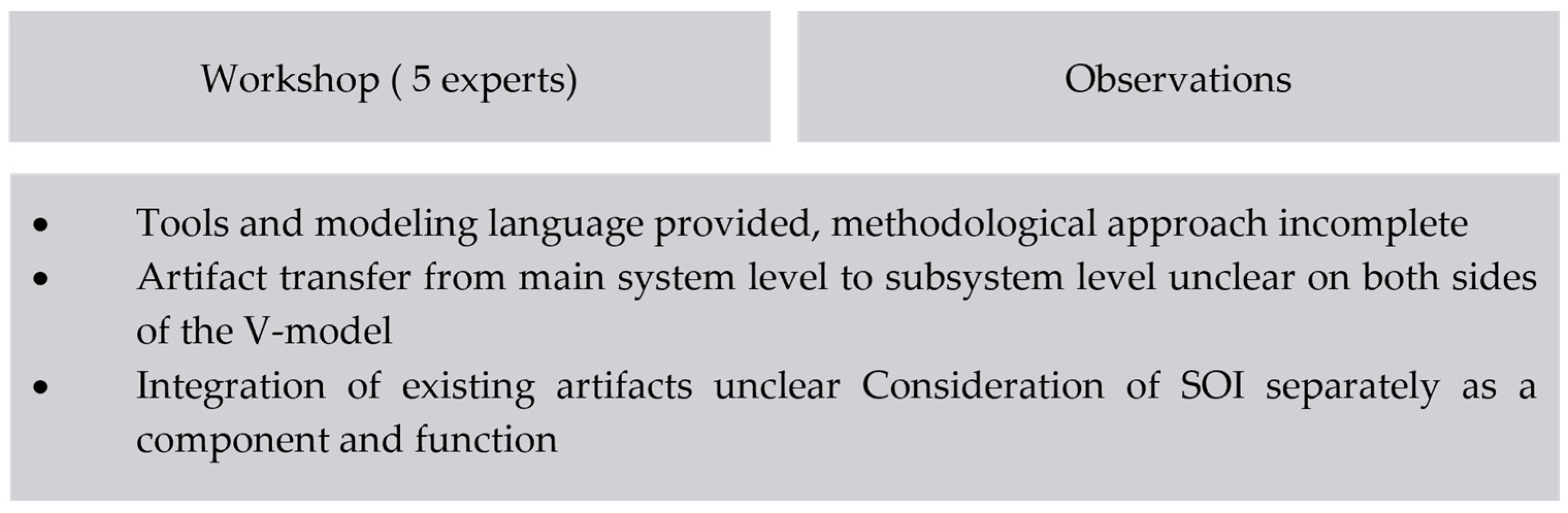
Figure 1 summarizes the results of the workshop and observations in a differentiated manner. The central finding is the identification of a methodological gap at the subsystem level. While processes at the “system of interest” (SOI) and main system levels are clearly defined and well established, methodological and tool-based support in the transition from the main system level to the subsystem level is not elaborated. Although the tools have been defined, they have yet to be fully integrated into the application process. The lack of continuity in this transition hinders end-to-end traceability and represents a key challenge for implementing a consistent model-based development process in accordance with ASPICE.
Figure 1.
Key findings from the workshops and observations.
Furthermore, existing artifacts—including legal requirements applicable to all vehicle platforms—must be incorporated into the systems engineering process.
Another identified gap pertains to the distinction between function-oriented and component-oriented perspectives. To establish a unified system perspective, these views must be integrated into a common communication basis across disciplines.
From this, the central research question can be derived:
How can a model-based methodology be designed to enable the structured transfer of requirements from the main system level to the subsystem level, their implementation, and their transformation into verifiable test cases while ensuring traceability and tool integration?
From this research question, initial methodological criteria can be derived, which serve both the development of a suitable procedural model and the analysis of the existing scientific literature. The fundamental requirements include the following:
- The approach must be based on a model-based process.
- The approach must be applicable at the subsystem level.
- Requirements must be verified within the process.
- Verification must be based on test cases.
Test cases are currently generated manually and document-centered. The goal is to generate test cases automatically. Sequence diagrams are to be used to represent the test cases. The advantages of this type of diagram are exploited by designing a test case in such a way that interfaces, messages, and timing aspects can be verified at the subsystem level [18].
In addition to these criteria, company-specific boundary conditions were defined in the analysis:
- The modeling language to be used is SysML.
- Activity diagrams are to be used for representing behavioral models.
- Implementation must be supported by defined tools—Codebeamer and Systems Modeler.
The boundary conditions include the tool landscape, but tool implementation is not included in the analysis during this research. The focus is on the tool-independent implementation of a model-based approach that considers requirements transfer, behavior modeling, and test case generation.
The workshop, the advantages of the diagram types, and the constraints of the development process resulted in five specific criteria, which are summarized in Table 1. The K1–K3 models are derived from the outcomes of the workshop, while K4 is grounded in the prevailing process and the constraints of the company. Additionally, K4 draws upon Section 2.3, which expounds on the merits of activity diagrams as a foundation for test case generation. As stated in Section 2.3, K5 is also derived from this section. In order to capitalize on the advantages offered by sequence diagrams, test cases are meticulously modeled. These criteria serve as the basis for the systematized analysis.
Table 1.
Summary of the criteria.
4. Methodical Steps for the Literature Review
This section outlines the individual methodological steps for systematized literature reviews according to PRISMA 2020. It systematically describes both the individual steps involved in literature research and the phases of analysis.
4.1. Method for Selection of Literature
To address the central research question, a systematized literature review was conducted over the course of one year until August 2025. The objective was to identify scholarly publications that focus on model-based approaches in systems engineering, with particular emphasis on requirements verification and test case generation. The methodological approach was informed by key principles of the PRSIMA 2020 statement. However, the review does not claim full systematic reproducibility.
At the beginning of this work process, an iterative exploratory search was conducted with the aim of gaining an overview of the subject areas. In the course of the research, the search procedure was continuously refined, whereby the relevance of certain concepts and terminologies became increasingly clear. The literature search was carried out using academic databases and platforms such as ScienceDirect, MDPI, SpringerLink, Wiley, INCOSE Proceedings, and IEEE Xplore. The search was conducted without the application of filters or presets. The search process was executed by employing the keywords. In addition to the platforms for literature, AI Copilot was also used to search for scientific literature. The literature search employing artificial intelligence encompassed German and English works in the domain of model-based systems engineering that utilized the designated keywords. The literature was identified using combinations of the following keywords:
- Model-Based Systems Engineering (MBSE)
- Requirements
- Test Case Generation
- Verification and Validation
- Model-Based Testing
- Automotive SPICE
These terms were entered into the database search fields and combined. Due to the iterative refinement of search terms, the exact search strings are not fully reproducible. However, the same core keywords were consistently applied across databases. The search strategy was based on Boolean logic, combining the keywords. Only studies whose full text was available and which were written in German or English were included in the literature review. The studies were selected by a single reviewer.
The selection process was guided by the PRISMA 2020 guidelines and based on predefined inclusion and exclusion criteria. The aim was to ensure a systematic and transparent selection of literature and to minimize potential bias. The inclusion criteria included, in particular, a thematic focus on requirements verification and test case generation, the language of publication, and the type of publication. Furthermore, it was evaluated whether the work was a review or a methodical approach.
Studies were excluded if they were either thematically irrelevant (“irrelevant topic focus”) or identified as duplicates.
The selection was carried out in a multi-stage process. First, the titles and abstracts of the identified articles were reviewed using defined keywords. Publications with potential relevance were then subjected to an in-depth review. The defined inclusion and exclusion criteria were consistently applied. Relevant data were extracted and summarized narratively. In the case of missing data, a corresponding declaration was made to clarify its absence. No assumptions were made.
The aim of the analysis was to identify methods that meet the criteria defined in Section 3 and thus contribute to answering the research question.
4.2. Description of the Analysis Steps
Following the narrowing down of relevant publications for the qualitative synthesis, a systematic analysis of the remaining sources was conducted. Where methodological details were incomplete, the information was extracted as stated without imputation. The analysis is structured into three steps:
- Categorization of the Publications
To establish a structured foundation, the publications were categorized by similarities in their modeling languages.
- 2.
- Analysis of Fundamental Methodological Steps
In the second step, the methodological procedures described in the publications were examined in detail. The objective was to assess the extent to which the proposed methods address the previously defined evaluation criteria.
- 3.
- Analysis of the Diagrams Used
Finally, a detailed analysis of the diagrams employed within the described methods was conducted, focusing on their specific functions within the respective contexts. Only those publications that met the evaluation criteria from the previous step were included in this analysis.
The analysis is not based on quantitative results, but on the characteristics and procedures of the methods. The result of each individual analysis step was documented in tabular form. These tables recorded both the fulfillment and non-fulfillment of the respective criteria.
The synthesis focuses on identifying common methodological patterns and analyzing deviations in the individual steps of the procedure and the use of diagrams in the individual studies. In view of the methodological heterogeneity of the included studies, a qualitative narrative synthesis was performed.
Methodological heterogeneity was analyzed qualitatively by considering differences in the language used, the methodological steps, and the diagrams employed. A sensitivity analysis was not conducted due to the fact that the synthesis did not include quantitative outcome data or statistical aggregation.
Possible bias was investigated by means of a qualitative assessment. The review analyzed officially published works, focusing on the completeness and transparency of the methodology, as well as the use of individual diagrams in the works.
A formal evaluation of the security or reliability of the evidence was not performed, as the analysis focuses on methodological approaches rather than outcome-based evidence.
The goal of this multi-level analysis is to determine whether an existing method is suitable for addressing the research question or whether a new methodological approach needs to be developed.
5. Results of the Literature Analysis
In this section, the methodological steps according to PRISMA 2020 are applied to conduct a structured and transparent literature analysis. The objective of this analysis is to identify literature and analyze it based on the defined criteria. It is therefore the intention of the present study to determine whether an extant method is available that meets all the criteria and thus also the research question.
5.1. Literature Selection
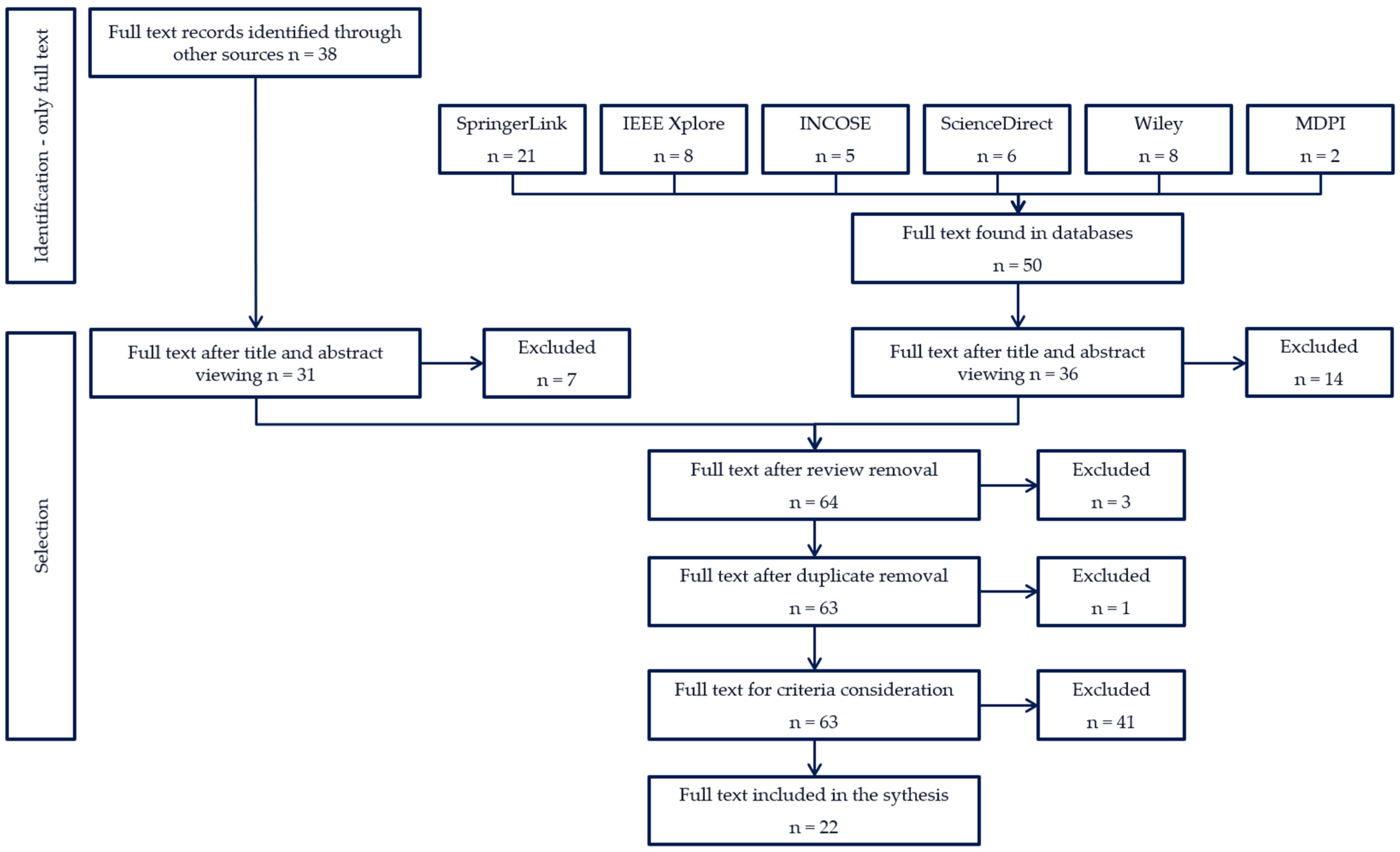
Initially, the keywords from Section 4.1 were searched for, ensuring that they were used in the title and abstract. In the course of the analysis, works that could be classified as systems engineering or model-based systems engineering and that satisfied one of the specified keywords were considered. In order to gain a comprehensive understanding of the subject matter, a total of 38 full-text works have been elaborated, which will subsequently be integrated into the analytical process. In the context of the iterative database search, a total of 50 full-text works were obtained. The selection process entailed two stages. Initially, the titles and abstracts were subjected to analysis. Subsequently, the review works and duplicates were eliminated. A total of 63 works were considered in the analysis of the criteria. However, following an initial review, 41 papers were eliminated, despite the initial assumption that they were relevant to the topic. During the primary review, it was observed that the documents were associated with requirements or model-based systems engineering. However, no additional overlap was identified beyond these initial connections. Following this multi-stage selection process, 22 scientific publications remained, which were then used as the basis for an in-depth analysis. The steps of the literature selection process were meticulously documented in a PRISMA flow diagram, illustrated in Figure 2.
Figure 2.
PRISMA flow chart for selecting publications.
5.2. Categorization of the Publications
Although the publications pursue different approaches, they can be differentiated based on key elements of model-based systems engineering (MBSE). For the categorization, the three core components of MBSE—method, modeling language, and tooling—were used as classification criteria [8].
5.2.1. Modeling Language
While the methods and tools varied significantly across the studies, the modeling languages used were more consistent and thus served as the primary basis for catego-rization. With regard to modeling languages, Systems Modeling Language (SysML) predominated, serving as the basis for modeling in 15 of the publications analyzed. Other languages were used to a much lesser extent. Natural language was used in an approach to automated test case generation based on textual requirements [19]. In one of the systems-of-systems contexts, a formal language was used in which a theoretical framework for the analysis and verification of requirements was developed [20]. In the present study, the Scenario Modeling Language for Kotlin (SMLK) was used in two interrelated works focusing on scenario-based modeling and test-driven specification [21,22]. The next category includes the Unified Modeling Language (UML), which has its origins in software engineering and forms the basis for SysML [11]. UML was used in three publications that employ activity, sequence, and state diagrams for model-based test case generation or transformation into formal structures [23,24,25]. The prevalence of SysML is evident in the diversity of approaches covered. These range from formal verification to simulation-based and scenario-oriented methods to virtual reality-supported validation approaches [5,17,26,27,28,29,30,31,32,33,34,35,36,37,38]. All methods based on SysML and thus compliant with K2 are marked as such in Table 2.
Table 2.
Result of the second analysis step.
5.2.2. Methodological Steps
Following the narrowing and language-based categorization of the literature, the second step of the analysis was conducted. The previously defined criteria for a methodology capable of addressing the research question were refined to their essential components and used as the foundation for the analysis. The focus is on verifying whether the K1 requirement “Requirements Verification at the Subsystem Level” and the K3 requirement “Model-based test case generation” are fulfilled.
All considered approaches are based on a model-based methodology. However, they differ in the modeling languages used and the specific methods applied for requirements verification. Three approaches focus on model-based verification without the generation of test cases. Examples of this are the formal verification of SysML activity diagrams using probabilistic model checking [26], the automated creation of simulation-capable scenarios based on SysML models [27], and the coupling of SysML models with a virtual reality environment for early validation of human–machine interactions [28]. In addition, a SysML-centered concept for capturing and relating requirements across the development lifecycle with dedicated stereotypes and a test classification/validation scheme emphasizes modeling and validation rather than automatic test generation [29]. Other work addresses model-based verification of the system architecture using rule-based validation in Cameo Systems Modeler [30] or the transformation of the architecture into simulation-capable models [31]. Complementary to these, completeness and consistency of specifications are assessed via the MBSE Grid with SysML traceability and verification metrics [33], and a company-scale Cyber MagicGrid framework structures V&V activities across levels using SysML pillars and governance, again without detailing concrete test-case generation algorithms [5].
Other publications integrate test case generation into their approaches to varying degrees. These include the manual derivation of test cases from scenario-based SMLK models [21] and the extended integration of this approach into a comprehensive MBSE framework that combines automated test cases and test-driven model creation [22]. UML-based methods generate test cases from activity diagrams [23], from the transformation of sequence diagrams to state diagrams [24], or by using a special description language for behavioral requirements [25]. Within SysML, several contributions also address test-case-centric workflows: manual specification of test cases and execution flows modeled and simulated in SysML with structured result documentation [34]; a transformation-driven pipeline that derives test cases from SysML behavior via state machines and event sequence diagrams and then to executable artifacts [17]; end-to-end generation and execution from SysML behavior models using toolchains like Rhapsody/ATG/TestConductor with sequence-diagram representations of tests [37]; and comprehensive MBT frameworks that import requirements, construct SysML/UML test models, auto-generate test cases and drivers, achieve coverage, and execute on the product or in simulation with traceability reporting [36].
Another part of the literature describes model-based methods throughout. These approaches combine the steps from requirements capture and modeling to automated test case generation and execution. This includes the verification of requirements using SysML constraint models and simulation [32]. The analysis of the completeness of requirement specifications using the MBSE grid approach is also part of this [33]. Other work focuses on rule-based validation of system architectures [30]. Variant evaluation methods combine requirements and constraint models to automatically check system variants, with the generated test cases supporting decision-making [35]. In addition, there are comprehensive development frameworks that map the entire V&V chain in a model-based manner. In these frameworks, test cases are automatically generated from state or sequence diagrams and executed [17,36,37,38].
A summary of the analysis is presented in Table 2. This table lists the reviewed sources along with the criteria used to evaluate the respective approaches. If a particular approach meets a given criterion, this is indicated accordingly.
The analysis reveals that methods employing modeling languages other than SysML often incorporate requirements verification at the subsystem level, including test case generation. In total, nine studies address requirements verification based on SysML, although they apply different strategies for conducting the verification—some of which do not involve test cases.
Six studies meet all three defined criteria and will be examined in greater detail in the subsequent phase of the analysis.
The final step of the analysis entails a detailed examination of the types of diagrams employed in the respective approaches. In order to verify the requirements, it is required to generate test cases. Behavioral diagrams, with a particular emphasis on activity diagrams, are designed for this process. In the contemporary vehicle development process, activity diagrams serve as the foundational element of behavioral models, which are derived from stakeholder requirements and subsequently reused at the subsystem level. Sequence diagrams are used as they allow interfaces, message flows, and timing aspects to be verified at the subsystem level. As outlined in Section 2.3, sequence diagrams represent the flow of control and message exchange between lifelines. These diagrams offer a dynamic perspective on system behavior. Given the potential for use cases to encompass a range of activities and alternative pathways, these individual scenarios can be represented through the use of sequence diagrams. These characteristics should be exploited and represent the form of test cases. The following criteria were utilized to guide the analysis:
K4: Use of activity diagrams as the basis for test case generation.
K5: Modeling test cases in the form of sequence diagrams.
These two criteria were applied exclusively to those studies that met all three primary criteria in the previous analysis step. Following a comprehensive review of 22 studies, six studies were identified as meeting all three criteria and were thus included in
Table 3
for further analysis of the diagram types employed.
Table 3.
Result of the third analysis step.
Three studies examine the use of activity diagrams as a form of representation for test cases, not as a basis for generating test cases [17,34,35]. According to Alt (2009), this is the only approach in which activity diagrams are used as a basis for test case generation [17]. In four papers, state machine diagrams serve as the starting point for generating test cases [36,37,38], with two of them representing the test cases as sequence diagrams [37,38].
Overall, the analysis shows that although the literature uses various types of diagrams for test case generation, no approach establishes a methodological connection in which activity diagrams are systematically used as a basis and sequence diagrams as a representation of the generated test cases. This result points to a significant methodological gap in the publications considered.
As demonstrated in Table 3, none of the reviewed studies fully meet both criteria. This finding suggests a methodological discrepancy in approaches that seek to utilize ac-tivity diagrams as a foundation for test case generation, concurrently modeling the test cases as sequence diagrams.
The three approaches that meet one of the two criteria represent complete methods that could be used as a basis for closing the gap. The first approach is characterized by the use of systematic test case generation based on SysML activity diagrams [17]. Schwencke (2020) has developed a procedure that aims to generate test cases automatically and map them in the form of sequence diagrams [37]. The third approach integrates a V&V framework and also uses sequence diagrams for the test cases [38]. The approach is integrated into Cameo Systems Modeler [38]. The insights gained regarding the automation of test execution could be incorporated into a methodical approach to closing the existing gap. The analysis has shown that, under certain circumstances, adjustments to the methodological approaches offer the potential to close the existing gap. However, this is not feasible in its current form.
5.3. Results of Synthesis
The analysis focused on the methodological characteristics of 22 model-based approaches and their compliance with the defined criteria. For this reason, no formal assessment of bias was conducted using standardized instruments, as this review does not analyze outcome-based characteristics or quantitative performance measures. Possible limitations may arise from the reliance on published methodological descriptions, which vary in terms of their completeness and level of detail. As a result, the results should be interpreted as a qualitative comparison of methods rather than an empirical assessment. The results were presented in tabular form, with the criteria that were met marked in Table 2 and Table 3.
As the analysis was focused on a criteria-based comparison of methods and did not include any empirical evaluation, no statistical syntheses, meta-analyses, or sensitivity analyses were performed as part of this analysis. Consequently, no investigation of statistical heterogeneity was conducted.
Given that the synthesis is founded upon a qualitative comparison of the methods, no assessment of reporting bias or certainty of evidence was conducted as a component of the analysis.
6. Discussion
The analysis indicates that none of the 22 reviewed studies fully meet the specified requirements and constraints. While the objective of these studies is to implement and/or verify requirements and related artifacts of subsystems, none of them satisfy all of the de-fined criteria. Six studies passed the preliminary evaluation based on the defined criteria of requirements verification at the subsystem level, use of SysML, and test case generation. However, these studies failed in the detailed assessment.
None of the studies meet both criteria, namely, the utilization of activity diagrams as the foundation for test case generation and the representation of test cases in the form of sequence diagrams. The transformation from activity diagrams to sequence diagrams is of central importance, as activity diagrams focus on control flow-oriented behavior and derivation logic, while sequence diagrams explicitly represent interaction- and time-related sequences between “life lines.” The latter are therefore particularly well suited as test sequences.
A single study utilizes activity diagrams to model system behavior, while two studies employ sequence diagrams to document test cases.
In consideration of these findings, the next step is to either adapt an existing method to meet the defined conditions or to develop a new approach that satisfies all specified requirements and constraints.
The evaluation criteria were derived from the outcomes of a workshop and observations of the development process. It should be noted that these requirements may vary depending on the subsystem under consideration. The necessity for additional tool support is contingent upon the complexity of the subsystem developed within the department.
The works under consideration are full-text published methodological approaches. The present analysis was focused on the automotive industry; further consideration of other industries could result in a different set of results. In the automotive industry, SySML is generally employed as the foundation for modeling. In the course of the analysis, other modeling languages, including UML, were considered; however, the analysis was primarily focused on SysML. This excludes methods based on UML, but it should be noted that changes to the methodological approach could also be implemented with SysML.
Despite the systematic approach adopted in accordance with PRISMA guidelines, the scope of literature covered remains constrained due to the exclusive focus on the automotive industry and the delineated criteria.
7. Conclusions
The objective of this study was to conduct a systematized analysis of the existing literature addressing model-based requirements verification and test case generation. In order to ensure a well-founded evaluation, a set of criteria for assessing the approaches was developed. These criteria were derived from a workshop and the accompanying observations. The analysis was conducted on a set of 96 publications, which were narrowed down to 22.
The analysis indicates that none of the reviewed studies adequately address requirements verification at the subsystem level while employing SysML diagrams, particularly activity diagrams, as the foundation for model-based test case generation and the integration of test cases in the form of sequence diagrams.
The discussion underscores that, in light of the findings from the analysis, the subsequent step involves either adapting an existing method or developing a new approach. This new approach would be expected to fulfill all identified requirements and constraints relevant to vehicle development at the subsystem level. In addition, it would comply with the conditions of an ASPICE-conformant development process. In order to develop the method, the focus is placed on the artifacts of development and how these can be integrated into a generally applicable framework independently of the tool. In the next step, the framework will be integrated into the defined tool landscape consisting of Codebeamer and Cameo Systems Modeler, using the tool properties to enable synchronization between the tools and automated test case generation.
Author Contributions
Conceptualization, J.W., and U.V.K.; methodology, J.W.; software, J.W.; validation, J.W. and U.V.K.; formal analysis, J.W.; investigation, J.W.; resources, J.W.; data curation, J.W.; writing—original draft preparation, J.W.; writing—review and editing, J.W. and U.V.K.; visualization, J.W.; supervision, D.C. and T.V.; project administration, J.W. All authors have read and agreed to the published version of the manuscript.
Funding
This research received no external funding.
Data Availability Statement
The data are unavailable due to privacy restrictions.
Conflicts of Interest
Author Dirk Clasen was employed by the company Volkswagen AG. The remaining authors declare that the research was conducted in the absence of any commercial or financial relationships that could be construed as a potential conflict of interest.
References
- Maurer, M.; Winner, H. (Eds.) Automotive Systems Engineering; Springer Seciende + Bussines Media: Berlin, Germany, 2013; ISBN 978-3-642-36454-9. [Google Scholar]
- Volkswagen Group. Hochautomatisiertes und Autonomes Fahren. Available online: https://www.volkswagen-group.com/de/hochautomatisiertes-und-autonomes-fahren-19029 (accessed on 21 October 2025).
- Klinich, K.D.; Manary, M.A.; Orton, N.R.; Boyle, K.J.; Hu, J. A Literature Review of Wheelchair Transportation Safety Relevant to Automated Vehicles. Int. J. Environ. Res. Public Health 2022, 19, 1633. [Google Scholar] [CrossRef] [Scilit] [PubMed]
- Klinich, K.D.; Manary, M.A.; Boyle, K.J.; Orton, N.R.; Hu, J. Development of an Automated Wheelchair Tiedown Restraint System; U.S. Department Of Transportation: Washington, DC, USA, 2022.
- Fanmuy, G.; Hassan, B. ASPICE compliance development of Cyber-Physical Systems by using Model-Based Systems Engineering. INCOSE Int. Symp. 2023, 33, 416–430. [Google Scholar] [CrossRef] [Scilit]
- Schmidt, S. Automobilindustrie im Umbruch—Handlungsmöglichkeiten und Perspektiven. ATZelektronik 2025, 20, 58. [Google Scholar] [CrossRef] [Scilit]
- VDA Working Group 13. Automotive SPICE Process Assessment/Reference Model; VDA: Berlin, Germany, 2023. [Google Scholar]
- Gräßler, I.; Oleff, C. Systems Engineering: Verstehen und Industriell Umsetzen; Springer: Berlin/Heidelberg, Germany, 2022; ISBN 978-3-662-64516-1. [Google Scholar]
- Madni, A.M.; Augustine, N. (Eds.) Handbook of Model-Based Systems Engineering; Springer Nature Switzerland AG: Cham, Switzerland, 2023; ISBN 978-3-030-93581-8. [Google Scholar]
- Böhm, W.; Broy, M.; Junker, M.; Vogelsang, A.; Voss, S. Praxisnahe Einführung von Model-based Systems Engineering: Vorgehen und Lessons Learnt; Fortiss: Munich, Germany, 2020. [Google Scholar]
- Alt, O. Modellbasierte Systementwicklung mit SysML; Carl Hanser Verlag GmbH & Co. KG: Munich, Germany, 2012; ISBN 978-3-446-43066-2. [Google Scholar]
- Herrmann, A. Grundlagen der Anforderungsanalyse: Standardkonformes Requirements Engineering; Springer Vieweg: Wiesbaden, Germany, 2022; ISBN 978-3-658-35459-6. [Google Scholar]
- Witte, F. Konzeption und Umsetzung Automatisierter Softwaretests: Testautomatisierung zur Optimierung von Testabdeckung und Softwarequalität; Springer Vieweg: Wiesbaden, Germany, 2023; ISBN 978-3-658-42660-6. [Google Scholar]
- Droste, O.; Merz, C. Testmanagement in der Praxis; Springer Vieweg: Berlin/Heidelberg, Germany, 2019. [Google Scholar] [CrossRef] [Scilit]
- OMG. Systems Modeling Language™ (SysML®) Version 1.7. Available online: https://www.omg.org/spec/SysML/ (accessed on 10 January 2026).
- Wendland, M.-F.; Schiederdecker, I.; Hoffmann, A. Modellbasiertes Testen mit Fokus!MBT; Objektspektrum: Troisdorf, Germany, 2010. [Google Scholar]
- Alt, O. Car Multimedia Systeme Modell-Basiert Testen mit SysML; Vieweg + Teubner Research: Wiesbaden, Germany, 2009; ISBN 978-3-8348-0761-8. [Google Scholar]
- Visual Paradigm. SysML: Modeling Scenarios with Sequence Diagram. Available online: https://www.visual-paradigm.com/guide/sysml/modeling-scenarios-with-sequence-diagram/ (accessed on 16 January 2026).
- Fischbach, J.; Frattini, J.; Vogelsang, A.; Mendez, D.; Unterkalmsteiner, M.; Wehrle, A.; Henao, P.R.; Yousefi, P.; Juricic, T.; Radduenz, J.; et al. Automatic Creation of Acceptance Tests by Extracting Conditionals from Requirements: NLP Approach and Case Study. J. Syst. Softw. 2022, 197, 111549. [Google Scholar] [CrossRef] [Scilit]
- Langford, G.O. Verification of Requirements: System of Systems Theory, Framework, Formalisms, Validity. INCOSE Int. Symp. 2017, 27, 780–795. [Google Scholar] [CrossRef] [Scilit]
- Wiecher, C.; Greenyer, J.; Korte, J. Test-Driven Scenario Specification of Automotive Software Components. In ACM/IEEE 22nd International Conference on Model Driven Engineering Languages and Systems Companion; IEEE: Piscataway, NJ, USA, 2019; pp. 12–17. [Google Scholar] [CrossRef] [Scilit]
- Wiecher, C.; Mandel, C.; Günther, M.; Fischbach, J.; Greenyer, J.; Greinert, M.; Wolff, C.; Dumitrescu, R.; Mendez, D.; Albers, A. Model-based analysis and specification of functional requirements and tests for complex automotive systems. Syst. Eng. 2024, 27, 728–744. [Google Scholar] [CrossRef] [Scilit]
- Rätz, A.; Koch, M. Testfälle Automatisch aus Modellen Generieren—Ein Großer Effizienzgewinn; Online-Ausgabe Testing; Objektspektrum: Troisdorf, Germany, 2009. [Google Scholar]
- Magnus, S.; Russ, T.; Krause, J. Anforderungs- und modellbasierte Testfallgenerierung und Testdurchführung unter Nutzung von Methoden zur Netzwerkanalyse. In 14. Fachtagung EKA—Entwurf komplexer Automatisierungssysteme; Institute for Automation and Communication e. V.: Magdeburg, Germany, 2016. [Google Scholar]
- Meinecke, K.; Land, K.; Jumar, U.; Vogel-Heuser, B.; Reider, M.; Ziegltrum, S. Anforderungsbasierter Test für die Validierung komplexer Automatisierungssysteme. Automatisierungstechnik 2021, 69, 417–429. [Google Scholar] [CrossRef] [Scilit]
- Ouchani, S.; Mohamed, O.A.; Debbabi, M. A formal verification framework for SysML activity diagrams. Expert Syst. Appl. 2014, 41, 2713–2728. [Google Scholar] [CrossRef] [Scilit]
- Kinay, S.; Bolat, U.; Gökdemir, B.Y.; Babacan, K.; Zengin, N.; Özkaya, E. Advancing MBSE for ADAS/AD: Automated Scenario Generation. In 2024 IEEE/SICE International Symposium on System Integration (SII); IEEE: Piscataway, NJ, USA, 2024. [Google Scholar] [CrossRef] [Scilit]
- Flanagan, S.L. Using VR to Validate and Visualize MBSE-Designed Interfaces. INCOSE Int. Symp. 2024, 34, 503–515. [Google Scholar] [CrossRef] [Scilit]
- Stechert, C. Modellierung Komplexer Anforderungen; Institut für Konstruktionstechnik, Technische Universität Braunschweig: Braunschweig, Germany, 2010. [Google Scholar]
- Caines, C.; Jaques, D.; Geiger, J. Standard Verification using Model Based Systems Engineering. INCOSE Int. Symp. 2022, 32, 179–186. [Google Scholar] [CrossRef] [Scilit]
- Cederbladh, J.; Krems, D. Early Validation of SysML Architectures by Extending MBSE with Co-Simulation using FMI and SSP. INCOSE Int. Symp. 2024, 34, 106–121. [Google Scholar] [CrossRef] [Scilit]
- Morkevicius, A.; Jankevicius, N. An approach: SysML-based automated requirements verification. In 2015 IEEE International Symposium on Systems Engineering (ISSE); IEEE: Piscataway, NJ, USA, 2015. [Google Scholar] [CrossRef] [Scilit]
- Bankauskaite, J.; Morkevicius, A. An Approach: SysML-based Automated Completeness Evaluation of the System Requirements Specification. In Proceedings of the 2018 Symposium for Young Scientists in Technology, Engineering and Mathematics, Gliwice, Poland, 28 May 2018; Volume 2147, pp. 66–72. Available online: https://ceur-ws.org/Vol-2147/ (accessed on 20 February 2025).
- Ramirez, C.; Thompson, A. Verification and Validation Test Framework Using a Model-Based Systems Engineering Approach. INCOSE Int. Symp. 2023, 33, 1091–1116. [Google Scholar] [CrossRef] [Scilit]
- Bankauskaite, J.; Strolia, Z.; Morkevicius, A. Automated trade study analysis based on dynamic requirements verification in the model-based system engineering. INCOSE Int. Symp. 2021, 31, 1256–1270. [Google Scholar] [CrossRef] [Scilit]
- Dahlweid, M.; Brauer, J.; Peleska, J. Model-Based Testing: Automatic Generation of Test Cases, Test Data and Test Procedures from SysML Models; AE Technical Paper 2015-01-2553; SAE International: Warrendale, PA, USA, 2015. [Google Scholar] [CrossRef] [Scilit]
- Schwencke, D. Modellbasierte Testfallgenerierung am Beispiel einer RBC-Funktion. Signal Draht 2020, 112, 36–45. [Google Scholar]
- Morkevicius, A.; Aleksandraviciene, A.; Strolia, Z. System Verification and Validation Approach Using the MagicGrid Framework. Insight 2023, 26, 51–59. [Google Scholar] [CrossRef] [Scilit]

Disclaimer/Publisher’s Note: The statements, opinions and data contained in all publications are solely those of the individual author(s) and contributor(s) and not of MDPI and/or the editor(s). MDPI and/or the editor(s) disclaim responsibility for any injury to people or property resulting from any ideas, methods, instructions or products referred to in the content. |
© 2026 by the authors. Published by MDPI on behalf of the International Institute of Knowledge Innovation and Invention. Licensee MDPI, Basel, Switzerland. This article is an open access article distributed under the terms and conditions of the Creative Commons Attribution (CC BY) license.