


Abstract
Background/Objectives: Double-J stents (DJS) cause clinically significant lower urinary tract symptoms (LUTS) in 58–80% of patients following ureteroscopy (URS). The distal vesical coil is regarded as the primary anatomical source of trigonal irritation and detrusor instability. The single-J stent (SJS) eliminates this element while preserving the proximal renal pigtail for anti-migration anchorage. This study aimed to evaluate the safety and patient-reported symptom outcomes of a modified SJS compared with standard DJS following elective URS for ureteric stone disease. Methods: A prospective, single-arm, within-patient feasibility study was conducted in 28 adults undergoing elective URS at Austin Health, Melbourne, Australia (Human Research Ethics Committee (HREC)/25658/Austin-2025; NCT07535580). A modified SJS was fashioned from a commercially available 7Fr Bander™ ureteral diversion stent (Cook Medical, G14780) by trimming the shaft to 28 cm and affixing a 7 cm Prolene retrieval suture (Ethicon NW807) to the blunt distal end. The primary outcome was a cystoscopically confirmed SJS migration rate at removal (pre-specified feasibility threshold ≤5%). Secondary outcomes included change in Ureteral Stent Discomfort Test (USDT) total and domain scores (paired analysis, n = 24), adverse events, and patient preference. Results: The clinically significant migration rate was 0% (0/28); 27/28 stent tips were freely floating within the bladder, with one asymptomatic tip at the ureteric orifice at the scheduled removal visit. Mean total USDT score decreased from 39.92 ± 2.00 (DJS) to 30.42 ± 1.73 (SJS)—a mean absolute reduction of 9.50 points (23.8%; p < 0.001), a magnitude consistent with clinically relevant change, although a USDT-specific minimum clinically important difference has not been independently validated. All six USDT domains improved significantly (all p ≤ 0.014). No adverse events were recorded. All 28 patients (100%) reported they would choose the SJS again. Conclusions: The modified SJS demonstrated a favourable safety profile and was associated with lower patient-reported symptom scores than the preceding DJS across all USDT domains in this uncontrolled within-patient comparison. Because stent design, stone burden, and dwell time differed between the two assessment phases, these differences should be regarded as hypothesis-generating and provide a feasibility basis for a prospective randomised controlled trial evaluating the SJS following URS.
1. Introduction
Ureteric stenting following ureteroscopy (URS) for stone disease is standard practice, yet the double-J stent (DJS) is associated with substantial patient morbidity. Between 58% and 80% of patients report clinically significant stent-related lower urinary tract symptoms (LUTS), including urinary urgency, frequency, dysuria, haematuria, and flank or suprapubic pain [1,2]. These symptoms impair quality of life (QoL) and drive considerable healthcare utilisation, with up to 32% of patients seeking unplanned medical review during the stenting period [3,4].
The distal vesical coil is widely regarded as the primary anatomical contributor to DJS-related LUTS, producing trigonal irritation, detrusor instability, and uretero-vesical reflux during voiding [5,6]. In their review of stent-related symptom aetiology, Miyaoka and Monga described how the distal coil irritates the vesicoureteric junction, disturbs ureteral peristalsis, and raises intravesical pressure—a combination of mechanisms that pharmacological strategies alone are poorly positioned to resolve [7]. The Clinical Research Office of the Endourological Society (CROES) Ureteroscopy Global Study found that post-URS stenting is near-universal in practice, placing stent-related symptom burden among the commonest iatrogenic complaints in endourology [8]. Multiple strategies—including alpha-blockade, anticholinergic therapy, and stent design modifications —have been investigated to mitigate these symptoms, with variable effect [9,10,11,12]. Beyond pharmacological approaches, altering the position of the distal stent component has also been examined. In a prospective single-blind multicentre randomised trial, Yoshida and colleagues found that complete intraureteral placement of a conventional double-J stent, in which no part of the stent sits within the bladder, significantly reduced pain and urinary symptom scores compared with conventional placement [13]. This provides randomised evidence that the intravesical stent component is a principal driver of morbidity, although it relies on repositioning an unmodified device rather than altering stent design.
A single-J stent (SJS) retains the proximal renal pigtail whilst eliminating the distal bladder loop, thereby preserving anti-migration anchorage without its principal source of bladder irritation. Prior case series and small cohort studies across post-URS, ileal conduit, and renal transplant contexts have reported successful SJS use [14,15,16,17,18], yet a device-level single-J modification has not, to our knowledge, been evaluated prospectively against the double-J stent within the same patients using a validated multidimensional symptom instrument in a post-URS population.
This study reports the first prospective, within-patient feasibility evaluation of a modified SJS against DJS following elective URS, using the Ureteral Stent Discomfort Test (USDT)—a validated, multidimensional patient-reported outcome measure (PROM)—as the primary symptom endpoint [19].
2. Materials and Methods
2.1. Study Design and Ethics
This was a prospective, single-arm, interventional feasibility study conducted at Austin Hospital and Heidelberg Repatriation Hospital (Austin Health, Melbourne, Australia) between October 2025 and January 2026. Ethics approval was obtained from the Austin Health Human Research Ethics Committee (Human Research Ethics Committee (HREC); Reference: HREC/25658/Austin-2025); approved 24 September 2025. All participants provided written informed consent prior to enrolment. The study was conducted in accordance with the Declaration of Helsinki (2013 revision). The study was registered retrospectively with ClinicalTrials.gov (NCT07535580) at the time of manuscript preparation; retrospective registration reflects the investigator-initiated, single-centre feasibility nature of the study. No protocol deviations occurred during the conduct of the trial, and the pre-specified primary outcome was unchanged from study conduct to registration.
2.2. Participants
Adults aged ≥ 18 years undergoing elective URS and stent exchange for unilateral ureteric stone disease were eligible. Recruitment occurred via the elective surgical booking list and outpatient urology clinic. Informed consent was obtained by telephone or in person at least 48 h prior to surgery, with final confirmation on the day of URS prior to anaesthesia. Exclusion criteria included single kidney, bilateral ureteric disease, prior ureteric stricture or reconstruction, active urinary tract infection (UTI) at the time of URS, immunocompromised state, and complex intra-operative findings (impacted stone, intramural stone, or significant intra-operative bleeding). Four enrolled patients underwent de novo SJS insertion without a preceding DJS, based on surgeon judgement regarding post-URS stenting requirements; these patients contributed to migration, safety, and preference outcomes but were excluded from paired USDT analysis.
2.3. Intervention: Modified Single-J Stent
A modified SJS was fashioned from a commercially available 7Fr Bander™ ureteral diversion stent (Cook Medical, G14780, Bloomington, IN, USA)—a device routinely used in cystectomy ileal conduit urinary diversion—by trimming the shaft to 28 cm from the distal end of the proximal pigtail coil. A 2-0 monofilament polypropylene (Prolene, NW807; Ethicon, Somerville, NJ, USA) suture was affixed to the transected distal end with a surgeon’s knot and trimmed to 7 cm, left to float freely within the bladder as a retrieval string for subsequent flexible cystoscopic removal. Full device preparation details and a photographic illustration of the modified stent are provided in Supplementary S1.
The SJS was inserted under direct vision or fluoroscopic guidance in standard retrograde fashion at the conclusion of URS, immediately following removal of the pre-existing DJS. DJS characteristics and the use of a ureteric access sheath were at the discretion of the operating surgeon per institutional practice. In cases where a ureteric access sheath had been used, it was withdrawn before SJS insertion, consistent with published data demonstrating urothelial injury risk associated with stent passage through an indwelling sheath [20]. No intra-operative ureteral injuries were recorded.
2.4. Outcome Measures
The primary outcome was the cystoscopically confirmed SJS migration rate at stent removal, classified as: tip freely floating in the bladder, tip at the ureteric orifice (UO), tip in the urethra, or tip not visualised. A migration rate of ≤5% was pre-specified as clinically acceptable based on prior feasibility data.
Secondary outcomes included: (i) change in USDT total and domain scores between the DJS phase (pre-operatively) and SJS phase (at stent removal); (ii) adverse events including culture-proven UTI, haematuria requiring medical attention, emergency department presentation, 30-day hospital readmission, and premature stent removal; (iii) stone clearance; (iv) patient preference (willingness to choose SJS again, yes/no). The USDT is a validated 13-item questionnaire assessing stent-related discomfort across six domains: Urinary Symptoms (max 30), Pain (max 6), Daily Life (max 5), Sexual Life (max 5), Medical Care/Analgesics (max 10), and QoL (max 5), with a maximum total score of 61. Higher scores indicate greater discomfort [19].
2.5. Stone-Free Reporting
Stone clearance was assessed intra-operatively using direct endoscopic visualisation and fluoroscopy at the conclusion of URS. Stone-free status was classified as Grade A (no residual stone or fragments visible endoscopically or fluoroscopically), Grade B (fragments ≤ 2 mm), or Grade C (fragments 2.1–4 mm). All 28 patients achieved Grade A stone-free status. Post-operative imaging was not performed given complete intra-operative endoscopic and fluoroscopic stone clearance in all cases.
2.6. Statistical Analysis
Continuous variables are reported as means ± standard deviation (SD) with ranges; categorical variables as frequencies and percentages. Normality was assessed using the Shapiro–Wilk test. As the majority of USDT delta score distributions were non-normally distributed (Shapiro–Wilk W range 0.39–1.00; p < 0.05 for most domains), all paired comparisons between DJS and SJS USDT scores were performed using the Wilcoxon signed-rank test. Associations between patient-level variables and USDT outcomes were assessed using Pearson correlation (continuous predictors) and Mann–Whitney U test (dichotomous predictors). Statistical significance was set at p < 0.05. The sample size of 28 was determined pragmatically to yield a preliminary migration rate estimate with sufficient precision to evaluate the pre-specified ≤5% feasibility threshold, consistent with accepted feasibility study methodology. The study was not designed or sized for superiority, equivalence, or non-inferiority conclusions. All analyses were performed using IBM SPSS Statistics, Version 28.0 (IBM Corp., Armonk, NY, USA).
3. Results
3.1. Patient Characteristics
All 28 enrolled patients completed the study protocol. Baseline demographics and stone characteristics are presented in Table 1. Mean age was 55.3 ± 15.2 years (range 29–82); 57.1% were male; mean body mass index (BMI) was 29.7 ± 7.0 kg/m2. Fourteen patients (50.0%) had hypertension, seven (25.0%) had diabetes mellitus, three (10.7%) had cardiovascular disease (CVD), and one (3.6%) had chronic kidney disease (CKD). Stone distribution was equally divided between right and left sides (n = 14 each). Mean stone size was 8.2 ± 2.4 mm (range 3–13 mm), with intrarenal (42.9%), proximal ureteric (32.1%), and distal ureteric (21.4%) locations predominating. Mean computed tomography (CT)-measured ureteral length was 24.8 ± 1.5 cm. A ureteric access sheath was utilised in 57.1% of cases; stone clearance was confirmed in all 28 patients (100%, Grade A). DJS stent sizes were 6Fr in 19 patients (79.2%) and 4.8Fr in five (20.8%), among the 24 patients who carried a pre-existing DJS. Mean DJS and SJS dwell times were 24.8 ± 10.9 days (range 13–57) and 16.0 ± 7.1 days (range 7–36), respectively.
Table 1.
Baseline patient demographics and stone characteristics (n = 28).
3.2. Primary Outcome—Stent Migration
Migration assessment by flexible cystoscopy was performed in all 28 patients at SJS removal. Twenty-seven of the twenty-eight patients (96.4%) had the stent tip freely floating within the bladder. In one patient (3.6%), the stent tip was identified at the UO at cystoscopy; this was clinically asymptomatic, unobstructed, and the stent was retrieved without difficulty or further intervention at the scheduled removal visit. No proximal migration above the ureteropelvic junction, urethral migration, or failure to visualise the stent occurred in any patient. The overall clinically significant migration rate was 0% (0/28), well within the pre-specified ≤5% threshold.
3.3. Secondary Outcomes—USDT Symptom Scores
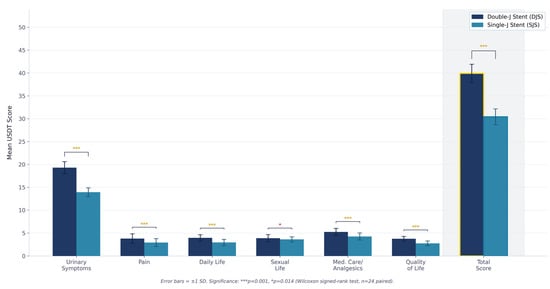
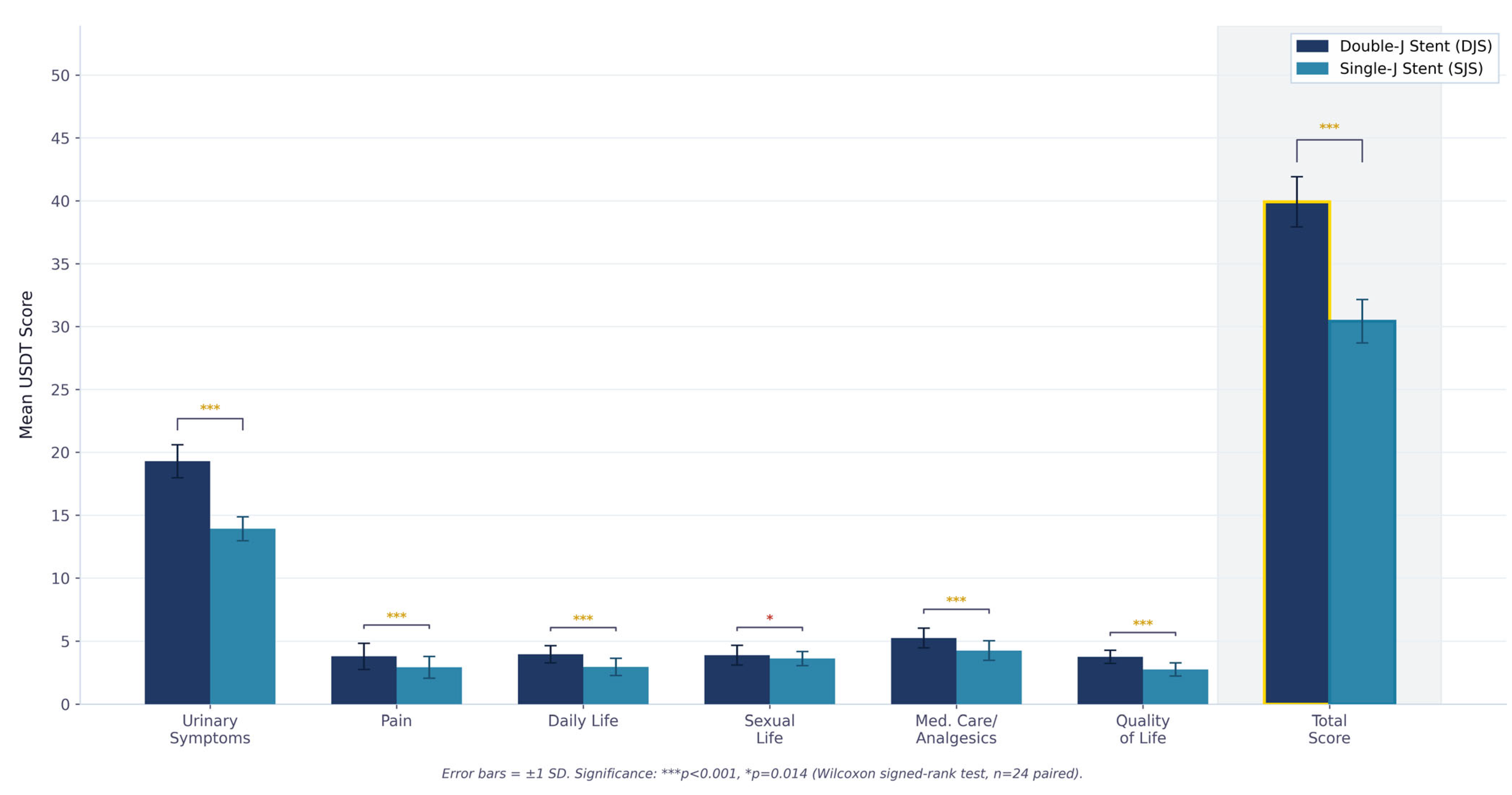
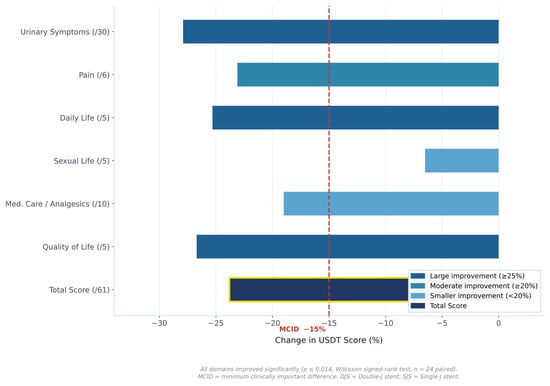
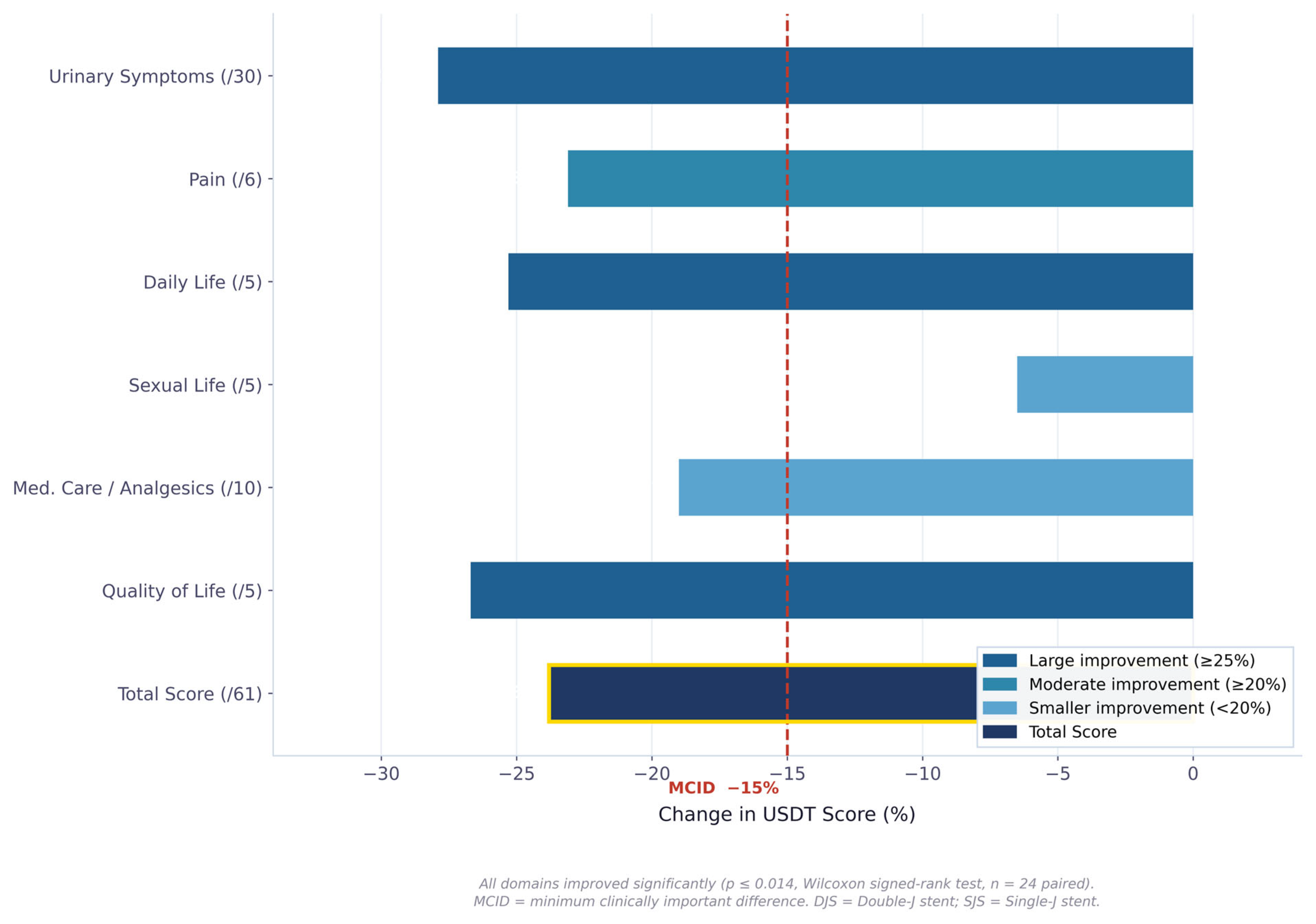
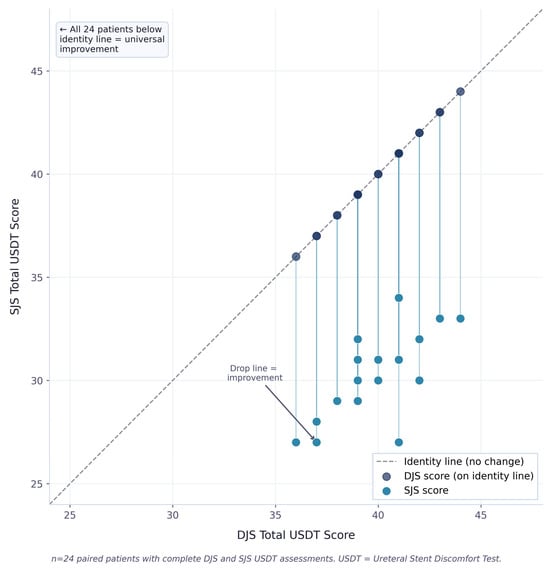
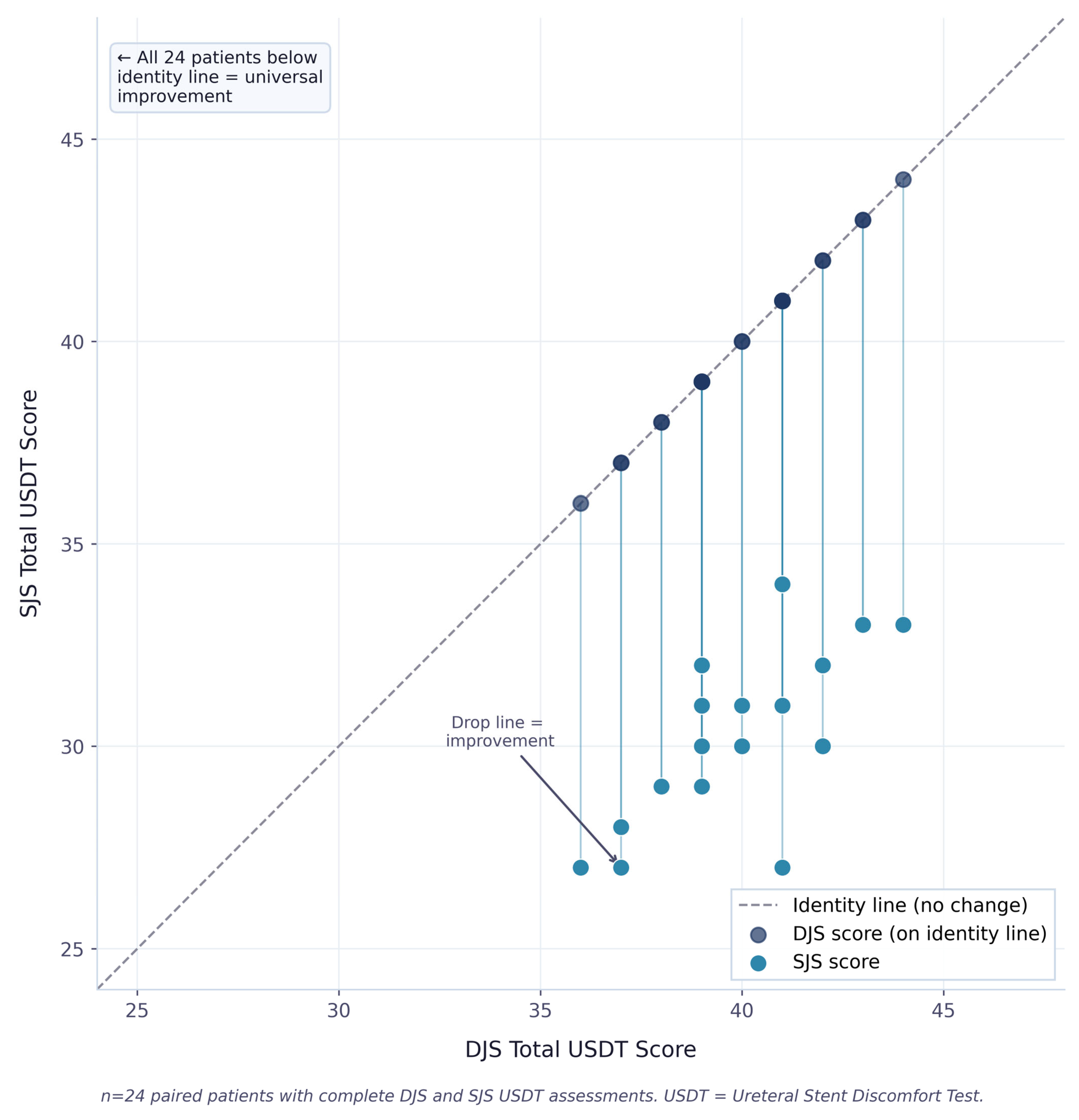
Paired USDT results for all 24 patients with complete data are summarised in Table 2 and illustrated in Figure 1 and Figure 2. Mean DJS total USDT score was 39.92 ± 2.00 (range 36–44) versus 30.42 ± 1.73 (range 27–33) with the SJS—a mean absolute reduction of 9.50 points (23.8%; p < 0.001). All six USDT domains demonstrated statistically significant improvement (all p ≤ 0.014). The greatest relative reductions were in Urinary Symptoms (−5.38 points, −27.9%; p < 0.001), QoL (−1.00 point, −26.7%; p < 0.001), and Daily Life (−1.00 point, −25.3%; p < 0.001). Sexual Life showed the smallest improvement (−0.25 points, −6.5%; p = 0.014). Individual patient paired scores are presented in Figure 3 and Supplementary S4.
Table 2.
USDT domain and total scores—DJS versus SJS (paired analysis, n = 24).
Figure 1.
USDT domain and total scores—DJS versus SJS (paired analysis, n = 24). Bars represent group means; error bars indicate ±1 SD. Significance brackets: *** p < 0.001, * p = 0.014 (Wilcoxon signed-rank test). DJS = double-J stent; SJS = single-J stent; USDT = Ureteral Stent Discomfort Test; SD = standard deviation.
Figure 2.
Percentage reduction in USDT domain and total scores (DJS to SJS, n = 24). The dashed vertical reference line at −15% indicates the minimum clinically important difference. All domains improved significantly (p ≤ 0.014). DJS = double-J stent; SJS = single-J stent; USDT = Ureteral Stent Discomfort Test; MCID = minimum clinically important difference.
Figure 3.
Individual paired USDT total scores for the 24 patients with complete DJS and SJS assessments. Each point represents one patient (DJS score on x-axis, SJS score on y-axis). Vertical drop lines indicate the magnitude of change from each patient’s DJS score to their corresponding SJS score. The dashed diagonal line represents the identity line (no change). All patients lie below the identity line, indicating universal improvement with the SJS. DJS = double-J stent; SJS = single-J stent; USDT = Ureteral Stent Discomfort Test.
3.4. Safety and Adverse Events
No adverse events were recorded in any of the 28 patients across the study period. There were no culture-proven UTIs, episodes of haematuria requiring medical attention, emergency department presentations, 30-day hospital readmissions, premature stent removals, intra-operative ureteric injuries, stent fractures, or stent encrustation. All 28 stents were successfully retrieved at the planned cystoscopic removal appointment.
3.5. Patient Preference
All 28 patients (100%) reported they would choose the SJS again if ureteric stenting were required in the future.
3.6. Correlation Analysis
Univariate correlation analysis of 16 pre-specified variables (Table 3) identified no statistically significant association between absolute or percentage USDT improvement and age, sex, BMI, height, weight, stone size, stone number, stone location, CT ureteral length, DJS dwell time, SJS dwell time, hypertension, diabetes mellitus, CVD, or CKD (all p > 0.05). The sole predictor of absolute point reduction was baseline DJS total score (Pearson r = −0.549, p = 0.005), consistent with regression to the mean; this relationship did not persist for percentage improvement (r = +0.233, p = 0.272). Full correlation outputs are presented in Supplementary S5.
Table 3.
Correlation analysis: 16 patient and stone variables versus USDT total score absolute improvement (paired n = 24).
4. Discussion
This prospective feasibility study shows that a modified SJS, fashioned from a commercially available Bander™ ureteral stent, can be inserted safely following URS, with a 0% clinically significant migration rate, and was associated with statistically significantly lower stent-related symptom scores than the preceding DJS across all six USDT domains. To our knowledge, this is the first prospective, within-patient feasibility study to evaluate a modified SJS against DJS in a pre-stented post-URS population using a validated, multidimensional PROM.
The 23.8% total USDT score reduction exceeds the approximate 15% minimum clinically important difference (MCID) applied in analogous stent symptom studies, noting that a formally validated USDT-specific MCID has not been independently established [19]. The benefit extended across all six domains, with the greatest improvements in Urinary Symptoms, QoL, and Daily Life—the domains most directly linked to trigonal and bladder neck irritation by the distal stent coil [5]. This breadth of domain-level response is consistent with the mechanism described by Miyaoka and Monga [7], in which the distal coil contributes to symptoms through trigonal contact, detrusor destabilisation, and altered ureteral peristalsis. Excision of this element removes the shared anatomical trigger across all three pathways simultaneously. The relatively modest improvement in Sexual Life (−6.5%) is mechanistically plausible: sexual discomfort arises partly from pelvic floor tension and ureteral stent positioning, which may not be fully alleviated by distal loop removal alone.
The 0% migration rate warrants specific consideration. Migration has historically been the central safety concern deterring wider SJS adoption, and the rationale for the DJS distal coil was precisely its anti-migration function [21]. Our data suggest that a correctly positioned proximal pigtail, combined with a Prolene retrieval suture providing distal anchorage within the bladder, confers sufficient positional stability for dwell periods of up to 36 days. This aligns with prior transplant, post-URS, and ileal conduit series [14,15,16,17,18]. The one patient with the tip resting at the ureteric orifice—whilst entirely asymptomatic—serves as a practical reminder that stent tip position carries clinical relevance and that cystoscopic confirmation of position at the time of removal is warranted [22].
The Fast Track Stent (FaST) trial [15] and Bosio et al. [14] similarly reported lower symptom burden with loopless or external stenting versus DJS. The tight DJS score clustering in our cohort (SD ± 2.00, range 36–44) reflects a ceiling effect but also demonstrates the USDT’s sensitivity to mechanistic differences even in moderately symptomatic patients.
Tinoco et al. concluded that the SJS evidence base, while directionally consistent, lacked the prospective controlled data needed to support practice-level recommendations [23], a gap the current dataset begins to address.
Our findings sit alongside the randomised data of Yoshida and colleagues, who reported that complete intraureteral placement of a conventional double-J stent reduced pain and urinary symptom scores relative to standard placement, an effect subsequently attributed in post hoc analysis principally to improved daytime frequency [13,24]. Both that technique and the present single-J modification are founded on the same principle, that the intravesical portion of the stent is the dominant source of symptoms. They differ in execution. Complete intraureteral placement repositions an unmodified device entirely within the ureter, whereas the modified single-J eliminates the distal bladder loop at the device level while retaining proximal anchorage and a free-floating retrieval suture. The convergence of a randomised repositioning study and the present device-modification feasibility study on the same mechanistic conclusion lends coherence to the wider evidence base and supports a definitive randomised comparison of single-J and double-J stents as the appropriate next step.
USDT improvement showed no significant association with 15 of the 16 patient-level variables examined, including comorbidities, stone anatomy, and dwell time. The single exception was baseline DJS score, whose association with absolute improvement is consistent with regression to the mean rather than with a subgroup effect. This pattern indicates that the observed benefit was not confined to a favourable subgroup, and it is consistent with, although it cannot by itself establish, a contribution from device modification, given that stone clearance and dwell time also differed between the two phases.
Selecting a validated PROM as the primary outcome was deliberate: stent-related symptom profiles vary considerably between patients in ways that standard clinical endpoints fail to detect, justifying multidimensional instruments for this class of intervention [25]. Using each patient as their own control also limits the inter-individual symptom variability that has historically made stent comparison trials difficult to interpret.
Several limitations must be acknowledged. First, causal inference is precluded: the observed USDT improvements cannot be partitioned into contributions from stone clearance, shorter dwell time, and stent design modification, as all three differ systematically between assessment phases. Second, the open-label design introduces expectation bias, as participants were aware of which stent they carried; future trials should incorporate blinded PROM administration and matched dwell times. Third, the study was not designed or sized for equivalence or non-inferiority conclusions, and insufficient case numbers for CVD and CKD precluded subgroup analysis. Fourth, the single-centre setting may limit generalisability to centres with differing fluoroscopic expertise. A prospective, double-blind randomised controlled trial is warranted to establish the SJS as a standard-of-care alternative.
5. Conclusions
The modified SJS demonstrated a favourable safety profile and lower patient-reported symptom scores than the preceding DJS across all USDT domains, a difference that was consistent across patient demographics, comorbidities, and stone characteristics but derives from an uncontrolled within-patient comparison. A 0% clinically significant migration rate, an absence of recorded complications, and universal patient preference for the SJS support the feasibility and safety of proceeding to a definitive randomised controlled trial, in which stent design can be isolated from stone burden and dwell time. Pending such evaluation, the SJS warrants consideration as an alternative to the DJS in suitable patients undergoing URS for ureteric stone disease.
Supplementary Materials
The following supporting information can be downloaded at: https://www.mdpi.com/article/10.3390/siuj7040049/s1. S1: Modified Single-J ureteral stent—device preparation. S2: USDT questionnaire domain definitions and scoring framework. S3: Full USDT domain results with exact Wilcoxon statistics. S4: Individual patient USDT scores—DJS and SJS (n = 24 paired; n = 28 SJS). S5: Correlation analysis—full statistical output. S6: Individual patient procedural and migration data. S7: STROBE Checklist for Observational Studies (Cohort) [26].
Author Contributions
Conceptualisation, V.B., J.I. and A.T.; methodology, V.B., J.I. and A.T.; formal analysis, V.B.; investigation, V.B.; resources, J.I. and A.T.; data curation, V.B.; writing—original draft preparation, V.B.; writing—review and editing, J.I. and A.T.; visualisation, V.B.; supervision, J.I. and A.T.; project administration, V.B. All authors have read and agreed to the published version of the manuscript.
Funding
This research received no external funding. The Cook Medical Bander™ ureteral stent was obtained through standard institutional supply channels; no industry sponsorship, provision of free materials, or financial support from Cook Medical or any other commercial entity was associated with this study. The APC is funded by the Société Internationale d’Urologie (SIU).
Institutional Review Board Statement
The study was conducted in accordance with the Declaration of Helsinki (2013 revision) and approved by the Human Research Ethics Committee of Austin Health (protocol code HREC/25658/Austin-2025; date of approval: 8 September 2025).
Informed Consent Statement
Informed consent was obtained from all subjects involved in the study. Written informed consent was obtained from all individual participants prior to any study-related procedures, using an approved Participant Information and Consent Form (PICF).
Data Availability Statement
The data presented in this study are available in the supplementary material. The anonymised dataset is additionally available on reasonable request from the corresponding author, subject to applicable ethical and legal requirements and Austin Health data governance policies.
Acknowledgments
The authors thank all patients who volunteered to participate, as well as the nursing, theatre, and administrative staff at the Department of Urology, Austin Hospital and Heidelberg Repatriation Hospital, for their support throughout the study period.
Conflicts of Interest
The authors declare no conflicts of interest.
References
- Damiano, R.; Autorino, R.; De Sio, M.; Giacobbe, A.; Palumbo, I.M.; D’Armiento, M. Effect of tamsulosin in preventing ureteral stent-related morbidity: A prospective study. J. Endourol. 2008, 22, 651–656. [Google Scholar] [CrossRef] [Scilit]
- Joshi, H.B.; Stainthorpe, A.; MacDonagh, R.P.; Keeley, F.X.; Timoney, A.G. Indwelling ureteral stents: Evaluation of symptoms, quality of life and utility. J. Urol. 2003, 169, 1065–1069. [Google Scholar] [CrossRef] [Scilit] [PubMed]
- Nabi, G.; Cook, J.; N’Dow, J.; McClinton, S. Outcomes of stenting after uncomplicated ureteroscopy: Systematic review and meta-analysis. BMJ 2007, 334, 572. [Google Scholar] [CrossRef] [Scilit] [PubMed]
- Byrne, R.R.; Auge, B.K.; Kourambas, J.; Munver, R.; Delvecchio, F.; Preminger, G.M. Routine ureteral stenting is not necessary after ureteroscopy and ureteropyeloscopy: A randomized trial. J. Endourol. 2002, 16, 9–13. [Google Scholar] [CrossRef] [Scilit] [PubMed]
- Fischer, K.M.; Louie, M.; Mucksavage, P. Ureteral stent discomfort and its management. Curr. Urol. Rep. 2018, 19, 64. [Google Scholar] [CrossRef] [Scilit] [PubMed]
- Diatmika, A.A.N.O.; Djojodimedjo, T.; Kloping, Y.P.; Hidayatullah, F.; Soebadi, M.A. Comparison of ureteral stent diameters on ureteral stent-related symptoms: A systematic review and meta-analysis. Turk. J. Urol. 2022, 48, 30–40. [Google Scholar] [CrossRef] [Scilit] [PubMed]
- Miyaoka, R.; Monga, M. Ureteral stent discomfort: Etiology and management. Indian J. Urol. 2009, 25, 455–460. [Google Scholar] [CrossRef] [Scilit] [PubMed]
- Pace, K.T.; Kroczak, T.; Wijnstok, N.J.; Kamphuis, G.M.; Esen, T.; Toutziaris, C.; Silva, B.; de la Rosette, J.J. Same session bilateral ureteroscopy for multiple stones: Results from the CROES URS Global Study. J. Urol. 2017, 198, 130–137. [Google Scholar] [CrossRef] [Scilit] [PubMed]
- Beddingfield, R.; Pedro, R.N.; Hinck, B.; Kreidberg, C.; Feia, K.; Monga, M. Alfuzosin to relieve ureteral stent discomfort: A prospective, randomized, placebo controlled study. J. Urol. 2009, 181, 170–176. [Google Scholar] [CrossRef] [Scilit] [PubMed]
- He, F.; Man, L.-B.; Li, G.-Z.; Liu, N. Efficacy of α-blocker in improving ureteral stent-related symptoms: A meta-analysis of both direct and indirect comparison. Drug Des. Devel. Ther. 2016, 10, 1783–1793. [Google Scholar] [CrossRef] [Scilit] [PubMed]
- Dellis, A.E.; Keeley, F.X., Jr.; Manolas, V.; Skolarikos, A.A. Role of α-blockers in the treatment of stent-related symptoms: A prospective randomized control study. Urology 2014, 83, 56–62. [Google Scholar] [CrossRef] [Scilit] [PubMed]
- Deliveliotis, C.; Chrisofos, M.; Gougousis, E.; Papatsoris, A.; Dellis, A.; Varkarakis, I.M. Is there a role for alpha1-blockers in treating double-J stent-related symptoms? Urology 2006, 67, 35–39. [Google Scholar] [CrossRef] [Scilit] [PubMed]
- Yoshida, T.; Inoue, T.; Taguchi, M.; Matsuzaki, T.; Murota, T.; Kinoshita, H.; Matsuda, T. Efficacy and safety of complete intraureteral stent placement versus conventional stent placement in relieving ureteral stent related symptoms: A randomized, prospective, single blind, multicenter clinical trial. J. Urol. 2019, 202, 164–170. [Google Scholar] [CrossRef] [Scilit] [PubMed]
- Bosio, A.; Alessandria, E.; Agosti, S.; Vitiello, F.; Vercelli, E.; Bisconti, A.; Piana, P.; Fop, F.; Gontero, P. Pigtail suture stents significantly reduce stent-related symptoms compared to conventional double J stents: A prospective randomized trial. Eur. Urol. Open Sci. 2021, 29, 1–9. [Google Scholar] [CrossRef] [Scilit] [PubMed]
- Bach, P.; Reicherz, A.; Teichman, J.; Dahlkamp, L.; von Landenberg, N.; Palisaar, R.-J.; Noldus, J.; von Bodman, C. Short-term external ureter stenting shows significant benefit in comparison to routine double-J stent placement after ureterorenoscopic stone extraction: A prospective randomized trial—the Fast track stent study (FaST). Int. J. Urol. 2018, 25, 717–722. [Google Scholar] [CrossRef] [Scilit] [PubMed]
- Ooms, L.S.S.; Spaans, L.G.; Betjes, M.G.H.; Ijzermans, J.N.M.; Terkivatan, T. Minimizing the number of urological complications after kidney transplant: A comparative study of two types of external ureteral stents. Exp. Clin. Transplant. 2017, 15, 143–149. [Google Scholar] [CrossRef] [PubMed]
- Lai, D.; He, Y.; Dai, Y.; Li, T.; Chen, M.; Li, X. A long-forgotten indwelling single-J stent in a transplant kidney. J. Coll. Physicians Surg. Pak. 2014, 24, S152–S154. [Google Scholar] [CrossRef] [Scilit] [PubMed]
- Yang, K.; Li, X.; Wang, G. A “bridge” technique to replace the obstructed single-J stent in the patient with ileal conduit urinary diversion: A case report. Transl. Androl. Urol. 2021, 10, 532–535. [Google Scholar] [CrossRef] [Scilit] [PubMed]
- Joshi, H.B.; Newns, N.; Stainthorpe, A.; MacDonagh, R.P.; Keeley, F.X.; Timoney, A.G. Ureteral stent symptom questionnaire: Development and validation of a multidimensional quality of life measure. J. Urol. 2003, 169, 1060–1064. [Google Scholar] [CrossRef] [Scilit] [PubMed]
- Traxer, O.; Thomas, A. Prospective evaluation and classification of ureteral wall injuries resulting from insertion of a ureteral access sheath during retrograde intrarenal surgery. J. Urol. 2013, 189, 580–584. [Google Scholar] [CrossRef] [Scilit] [PubMed]
- Ramachandra, M.; Mosayyebi, A.; Carugo, D.; Somani, B.K. Strategies to improve patient outcomes and QOL: Current complications of the design and placements of ureteric stents. Res. Rep. Urol. 2020, 12, 303–314. [Google Scholar] [CrossRef] [Scilit] [PubMed]
- Bao, X.; Sun, F.; Yao, H.; Wang, D.; Liu, H.; Tang, G.; Wang, X.; Zhou, Z.; Wu, J.; Cui, Y. Distal end of double-J ureteral stent position on ureteral stent-related symptoms: A systematic review and meta-analysis. Front. Surg. 2022, 9, 990049. [Google Scholar] [CrossRef] [Scilit] [PubMed]
- Tinoco, C.L.; Martins, L.; Costa, F.; Cardoso, A.; Araújo, A.S.; Capinha, M.; Pinto, L.; Coutinho, A.; Oliveira, C.; Marques, V.; et al. Single-J versus double-J stents after ureterorenoscopy for renal stones: A randomized comparison of safety and tolerability. Cent. Eur. J. Urol. 2025, 78, 192–198. [Google Scholar] [CrossRef] [Scilit] [PubMed]
- Matsuzaki, T.; Yoshida, T.; Murota, T.; Nakao, K.; Taguchi, M.; Kinoshita, H.; Matsuda, T. Complete intraureteral stent placement relieves daytime urinary frequency compared with conventional placement in patients with an indwelling ureteral stent: Post-hoc analysis of a randomized, controlled trial. Sci. Rep. 2020, 10, 15892. [Google Scholar] [CrossRef] [Scilit] [PubMed]
- Desai, A.C.; Harper, J.D.; Maalouf, N.M.; Henry Lai, H.H.; Scales, C.D., Jr.; Yang, H.; Tasian, G.E.; McCune, R.D.; Al-Khalidi, H.R.; Kirkali, Z.; et al. Postoperative symptom severity and time course after bilateral ureteroscopy with stents: Results from the Study to Enhance Understanding of Stent-associated Symptoms. Urology 2025, 207, 37–44. [Google Scholar] [CrossRef] [Scilit] [PubMed]
- von Elm, E.; Altman, D.G.; Egger, M.; Pocock, S.J.; Gøtzsche, P.C.; Vandenbroucke, J.P.; STROBE Initiative. The Strengthening the Reporting of Observational Studies in Epidemiology (STROBE) statement: Guidelines for reporting observational studies. Lancet 2007, 370, 1453–1457. [Google Scholar] [CrossRef] [Scilit] [PubMed]

Disclaimer/Publisher’s Note: The statements, opinions and data contained in all publications are solely those of the individual author(s) and contributor(s) and not of MDPI and/or the editor(s). MDPI and/or the editor(s) disclaim responsibility for any injury to people or property resulting from any ideas, methods, instructions or products referred to in the content. |
© 2026 by the authors. Published by MDPI on behalf of the Société Internationale d’Urologie. Licensee MDPI, Basel, Switzerland. This article is an open access article distributed under the terms and conditions of the Creative Commons Attribution (CC BY) license.