


Highlights
What are the main findings?
- In individuals with interstitial lung disease, early chronic respiratory failure is associated with a higher overall mortality risk and an increased incidence of cardiovascular disease.
- Incident cardiovascular events are associated with a higher and earlier death risk in people without chronic respiratory failure but not in those with it. This indicates that chronic respiratory failure plays a role in mortality risk.
What are the implications of the main findings?
- There is a need for structured respiratory function assessment and closer cardiovascular surveillance in people with interstitial lung disease, particularly in those developing chronic respiratory failure.
Abstract
Background/Objective. Interstitial lung diseases (ILD) may be associated with chronic respiratory failure (CRF) and/or cardiovascular diseases (CVD) such as Pulmonary Hypertension, Ischemic Heart Diseases, Heart Failure, and Atrial Arrhythmias. Our research questions were: Does early CRF affect the mortality risk, and timing of the above CVD? Do CVD influence mortality in people with ILD? Methods. We conducted a seven-year, retrospective, observational, multicentre study comparing participants with ILD and early CRF (Cohort 1) and those with ILD alone (Cohort 2) (2392 participants in each cohort). We also assessed the effect of early CVD on mortality risk. Results. The cumulative incidence of death was 65.84% and 38.27% (p < 0.01), while that of any CVD was 79.31% and 46.19% (p < 0.01) for Cohorts 1 and 2, respectively. The time to and cumulative incidence of each of the above CVD were higher in Cohort 1 than in Cohort 2 (all p < 0.001). Incident cardiovascular events were associated with a higher and earlier risk of death in people without but not in those with ILD and early CRF, indicating that CRF plays a role in mortality rates, regardless of those of CVD. Conclusions. Our study suggests an association between chronic respiratory failure, cardiovascular events, and mortality, although it cannot prove causality. These findings indicate the need for structured lung function assessment and closer cardiovascular surveillance in people with ILD, particularly in those developing chronic respiratory failure.
1. Introduction
Interstitial lung diseases (ILD) are characterized by inflammation and/or fibrosis of the lung interstitium, resulting in impaired gas exchange, progressive dyspnoea, and cough. In advanced cases, chronic respiratory failure (CRF) may also occur [1,2,3,4,5,6]. In addition, ILD has been associated with an increased risk of cardiovascular diseases (CVD) including pulmonary hypertension (PH), ischemic heart disease (IHD), heart failure (HF), and atrial arrhythmias (AA), regardless of known cardiovascular risk factors [1,7,8,9,10,11,12,13,14,15,16,17]. However, the timing of CVD onset after an ILD diagnosis remains unclear. The additional role of CRF in the risk and timing of CVD, and the overall and CVD-related mortality risk of these individuals, is not clear either.
Real-world data (RWD) is becoming increasingly important for healthcare decisions when randomized controlled trial (RCT) data are lacking. RWD can potentially serve as an alternative to clinical cohort studies for assessing the potential risks or lifestyle factors that cannot be randomized [18].
This large, long-term, retrospective, observational, multicentre RWD study had two aims: (1) to compare the cumulative incidence and time to a CVD diagnosis in individuals with ILD with or without CRF; and (2) to assess the role of CVD in the mortality risk of individuals with ILD.
2. Materials and Methods
2.1. Participants
We used data from the TriNetX Analytics Network (TriNetX LLC, Cambridge, MA, USA), a Global Collaborative Network [19,20,21,22]. Data were extracted from the network, which contains information on over 200 million individuals, 600 thousand of whom were coded as having ILD. Details, as well as the basis of Data Analysis, are shown in the Supplementary Materials. For this study, no specific time interval was selected for data extraction, and the analyses were not anchored to a predefined calendar date. As the network data are aggregated and anonymized, Ethical Committee approval and informed consent were waived. The study adhered to the Declaration of Helsinki and was approved by the Local Review Board (CTSM-RC-2/2025, December 2025).
2.2. Cohorts
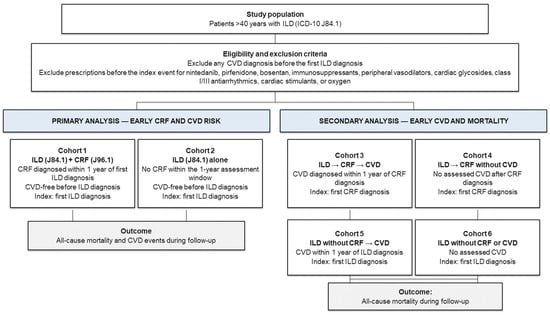
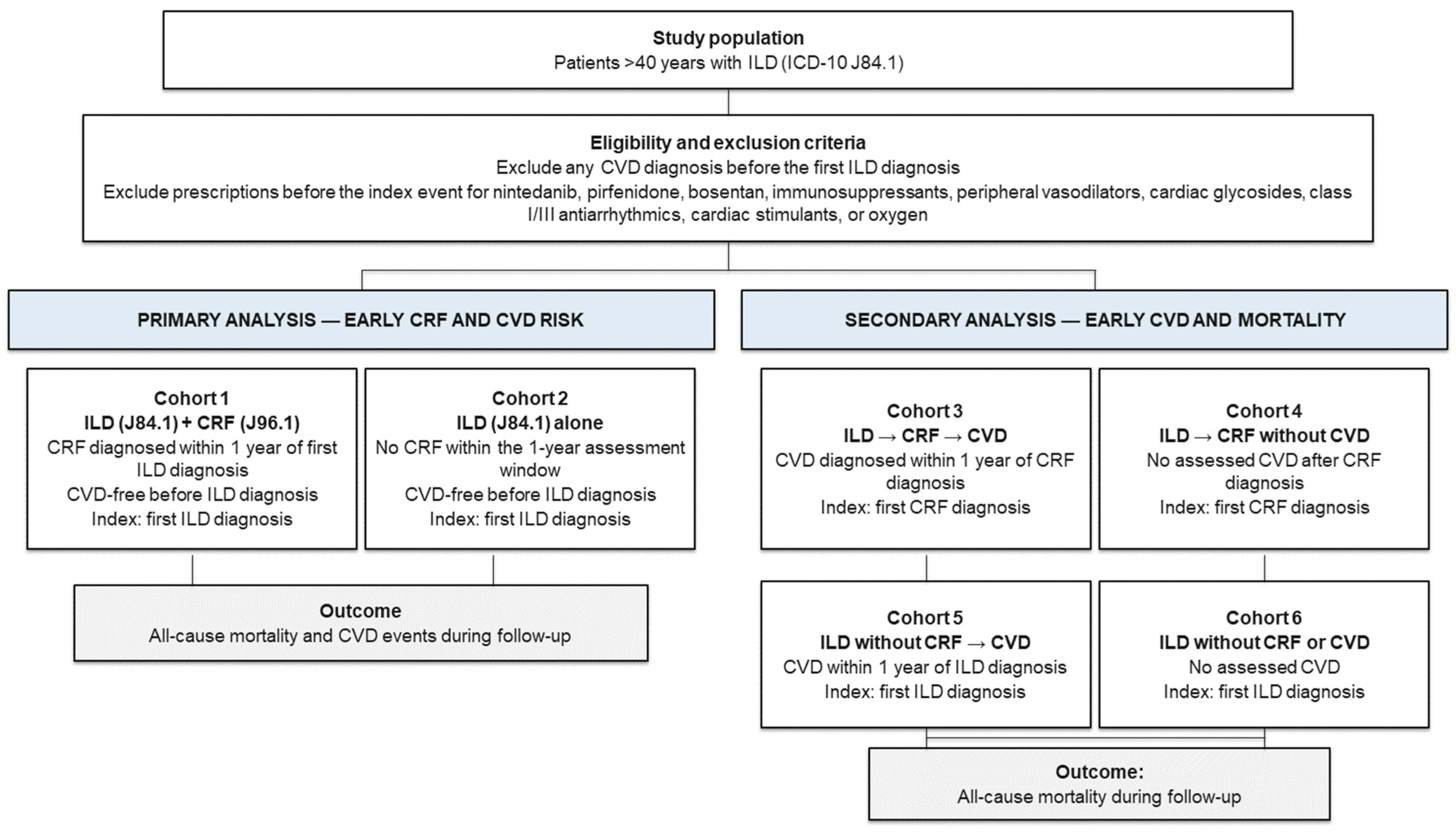
To evaluate the role of CRF in people with ILD on CVD and mortality risk, we identified two main cohorts of people older than 40 years, excluding those with any CVD diagnoses before the first ILD diagnosis:
- Cohort 1: individuals who were first diagnosed with ILD (International Classification of Diseases (ICD) version 10: J84.1), and then with CRF (J96.1) within one year.
- Cohort 2: individuals with an ILD diagnosis alone.
To further support the fact that we were analyzing a population of patients that were free of CVD at the time of their initial diagnosis of ILD we excluded individuals who had undergone any of the following therapies before receiving an ILD diagnosis: nintedanib (RxNorm code: 1592737), pirfenidone (RxNorm code: 1592254), bosentan (RxNorm code: 75207), immunosuppressants (ATC code: L04), peripheral vasodilators (ATC code: T04), cardiac glycosides (ATC code: C01A), antiarrhythmics, class I and III (ATC code: C01B), and cardiac stimulants (ATC code: C01C). We also excluded oxygen administration (RxNorm code: 7806) to include only people who had developed CRF after the ILD diagnosis. To establish a reliable link between CRF and CVD, we selected individuals who developed CRF within a year of their initial ILD diagnosis.
In both cohorts, the index day was defined as the date of the first ILD diagnosis.
To assess the impact of early CVD on the risk of death, four additional cohorts were examined.
- Cohort 3: Individuals with ILD who were subsequently diagnosed with CRF, followed by any of the assessed CVD within one year of the CRF diagnosis.
- Cohort 4: Individuals with ILD who were subsequently diagnosed with CRF without CVD.
In both cohorts, the index day was defined as the date on which the CRF diagnosis was coded for the first time.
- Cohort 5: Individuals with ILD who did not have CRF and who developed any of the assessed CVD within one year of ILD diagnosis.
- Cohort 6: Individuals with ILD without CRF or any CVD.
In these two cohorts, the index day was defined as the date on which the ILD diagnosis was coded for the first time.
To ensure that the base population in this second analysis was as similar as possible to that in the main analysis, patients who had received the aforementioned treatments before the index event were excluded.
The complete cohort construction workflow is shown in Figure 1.
Figure 1.
Cohort Construction Diagram.
Further details can be found in the Supplementary Materials.
2.3. Covariates
Age, sex, comorbidities, body-mass index (BMI) and the following medications: corticosteroids for systemic use (Anatomic Therapeutic Chemical (ATC): H02), other cardiac preparations (C01E), antihypertensives (C01), diuretics (C03), beta blocking agents (C07), calcium channel blockers (C08), agents acting on the renin-angiotensin system (C09), lipid modifying agents (C10), anti-inflammatory and antirheumatic products (M01). Further details are provided in the Supplementary Materials.
2.4. Outcomes
Coded CVD were defined as follows:
- PH: pulmonary hypertension (I27.0)/cor pulmonale (I27.9);
- IHD: ischaemic heart diseases (I20–I25);
- HF: heart failure (I50), hypertensive heart disease (I11);
- AA: unspecified atrial fibrillation (I48.91), unspecified atrial flutter (I48.92).
Mortality data in TriNetX are obtained from multiple sources, including electronic health records, claims data, the Social Security Administration Master Death File, and obituary databases. As deaths occurring outside healthcare settings may be underreported in electronic health records, TriNetX supplements mortality ascertainment with third-party data sources where available. This results in variable completeness across healthcare organizations.
Furthermore, healthcare utilization was assessed as an additional descriptive outcome to evaluate potential differences in the intensity of healthcare contact between the cohorts.
2.5. Statistical Analysis
All analyses were generated with the TriNetX platform software on 23 June 2026. Continuous baseline variables are reported as mean ± standard deviation (SD), whereas categorical variables are presented as absolute frequencies and percentages (%) of the study population.
To minimise the potential influence of confounding factors, propensity score matching (PSM) was performed. A 1:1 matching procedure was implemented using the integrated TriNetX PSM algorithm, based on a greedy nearest-neighbour method with a caliper width equal to 0.1 of the pooled SD of the logit-transformed propensity score. Cohorts were considered adequately balanced when the standardised mean difference (SMD) for each covariate was below 0.1. In the matching process, we included the following variables: age at the index event, gender, BMI, nicotine dependence, primary hypertension, diabetes mellitus, chronic kidney disease, rheumatoid arthritis with rheumatoid factor, other rheumatoid arthritis, systemic sclerosis [scleroderma], dermatopolymyositis, systemic lupus erythematosus (SLE) and diseases of the musculoskeletal system and connective tissue, as well as corticosteroids for systemic use.
Statistical significance (p value) was assessed using the t-test for continuous variables and Fisher’s exact test for categorical variables. Outcome comparisons at 2500 days following the index event were performed using the Compare Outcomes Analytic tool (see Supplementary Materials), available within the platform. Results are reported as risk estimates and hazard ratios (HRs) with corresponding 95% confidence intervals (CIs). Kaplan–Meier (KM) analyses were performed using the Cox proportional hazards model implemented in the TriNetX platform. The proportional hazards assumption was assessed using a test based on scaled Schoenfeld residuals, as implemented in the R survival package underlying the TriNetX analytics platform. When evidence of non-proportional hazards was observed, the reported HR was interpreted as an overall summary measure of the relative hazard over the follow-up period rather than as a constant effect over time.
CVD and mortality were assessed over a 2500-day time window, beginning one day after the index event.
This time period was selected to ensure that a statistically valid proportion of participants would be available at the end of the period.
In every analysis, we narrowed the prindex event window to 5 years to better capture conditions potentially related to the index event while excluding distant, unrelated factors. Participants with a first diagnosis coded up to 20 years before the date of analysis were included in the analysis.
Due to the high mortality rate of ILD and CRF, a competing-risk analysis was conducted on cohorts 1 and 2, accounting for all-cause mortality as a competing risk factor for CVD outcomes. For each outcome, the cumulative incidence function (CIF) was estimated using the Aalen–Johansen method, with death and the cardiovascular outcome treated as mutually exclusive competing events. Results are shown as cumulative incidence estimates at the end of the observation period, whereas causspecific and subdistribution HRs were not estimated. As comparisons between Cohorts 3–4 and 5–6 directly assessed all-cause mortality, a competing-risk analysis was not applicable to these comparisons. Further details can be found in the Supplementary Materials.
Furthermore, two sensitivity analyses were performed to evaluate the robustness of the findings with regard to the onyear exposure ascertainment window selected, and to examine the potential influence of immortal time bias. First, the exposure ascertainment period was extended from one to three years after the index event. The analyses were then repeated using the same cohort definitions, PSM criteria and statistical approach as in the primary analysis. This analysis assessed whether extending the exposure ascertainment period affected the magnitude and direction of the observed associations.
Secondly, a landmark analysis was performed using the same cohort definitions, index event and PSM procedure as in the primary analysis. Follow-up for outcome assessment began 365 days after the index event and continued until 2500 days after the index event. Data on individuals who had experienced the relevant outcome prior to the landmark time were excluded from the analysis of that outcome. This approach was intended to assess the consistency of the primary findings after the first year following the index event had been excluded, during which the exposure ascertainment period had been established.
The threyear exposurwindow analysis and the landmark analysis were considered as complementary sensitivity analyses. The former assessed the influence of the selected exposure ascertainment interval, while the latter assessed the consistency of the findings after a common onyear landmark. However, neither analysis alone was sufficient to exclude immortal time bias.
3. Results
Following PSM, cohorts 1 and 2 comprised 2392 participants each. The demographic, anthropometric, and clinical characteristics of these cohorts are shown in Table 1, while the prmatching data and propensity score density functions are shown in the Table S1 and Figure S1 (Supplementary Material), respectively. Following matching, the mean follow-up time was 1091.3 days (median 800) for Cohort 1 and 1100.9 days (median 829) for Cohort 2, with a well-balanced gender distribution.
Table 1.
Baseline demographic, anthropometric, clinical characteristics, and medications of populations in the study.
3.1. Overall Survival and Incidence of CVD
3.1.1. Overall Survival
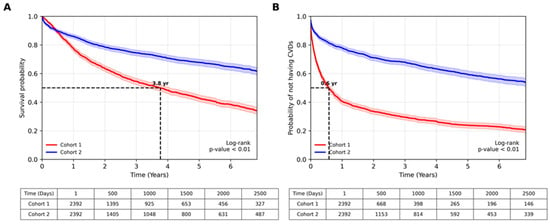
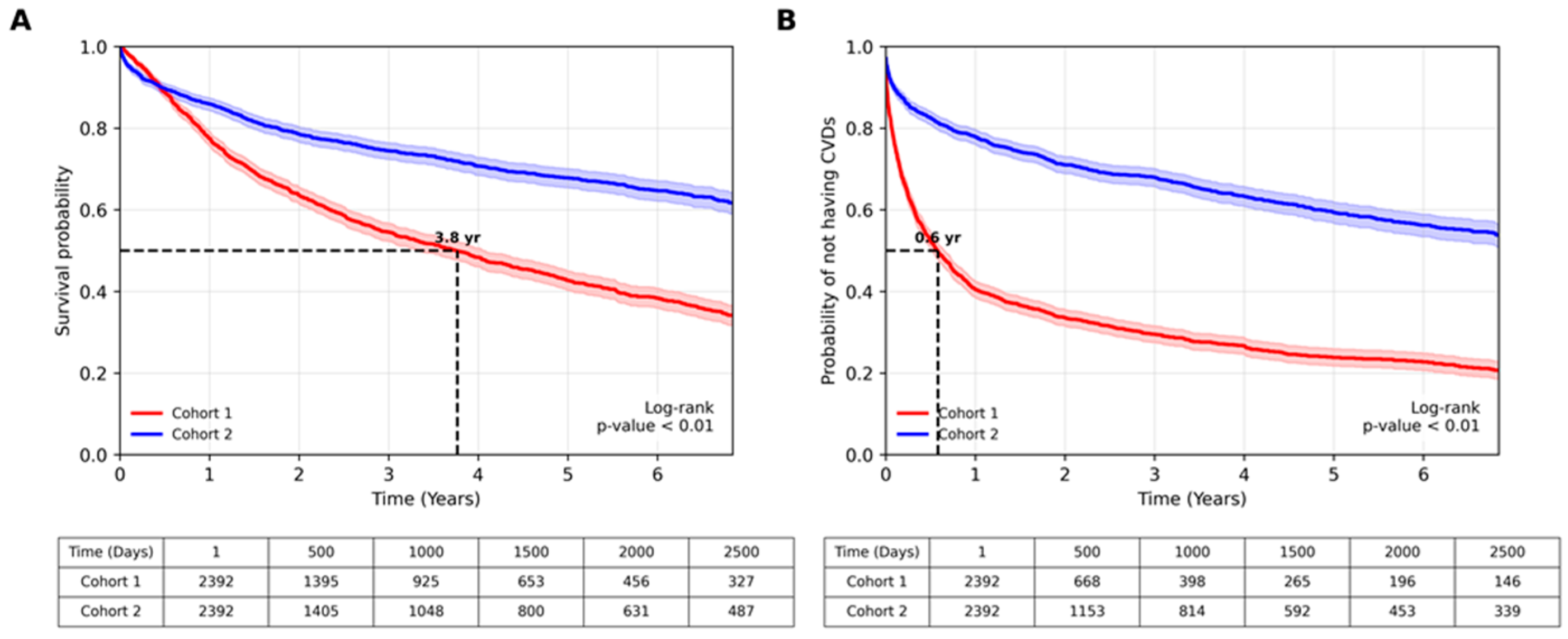
By the end of the observation period, the cumulative incidence of death was 65.84% and 38.27% in Cohorts 1 and 2, respectively (p < 0.01). The median survival time was 3.8 years in Cohort 1, whereas in Cohort 2 it exceeded the duration of the study follow-up. Early CRF was associated with a significantly increased risk of death (HR = 2.01; 95% CI: 1.82–2.21) (Figure 2A).
Figure 2.
Kaplan–Meier curves for death (panel (A)) and CVD (panel (B)) risks in ILD participants with (Cohort 1) and without early CRF (Cohort 2).
3.1.2. CVD
The cumulative incidence of any CVD was 79.31% and 46.19% for Cohorts 1 and 2, respectively (p < 0.01) (median time to any CVD: 0.6 years in Cohort 1; longer than study time in Cohort 2). Early CRF was associated with a higher risk of any CVD (HR = 2.92; 95% CI: 2.67–3.19) (Figure 2B).
Significant deviations from the proportional hazards assumption were observed for both overall death and CVD risk, indicating that the HR between the two cohorts was not constant over time (p = 0.000).
3.2. Specific CVD
3.2.1. Pulmonary Hypertension
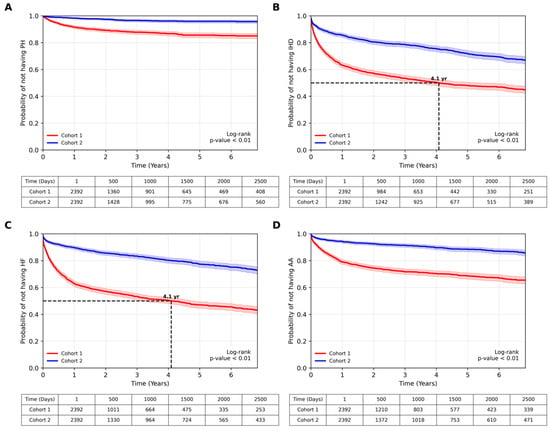
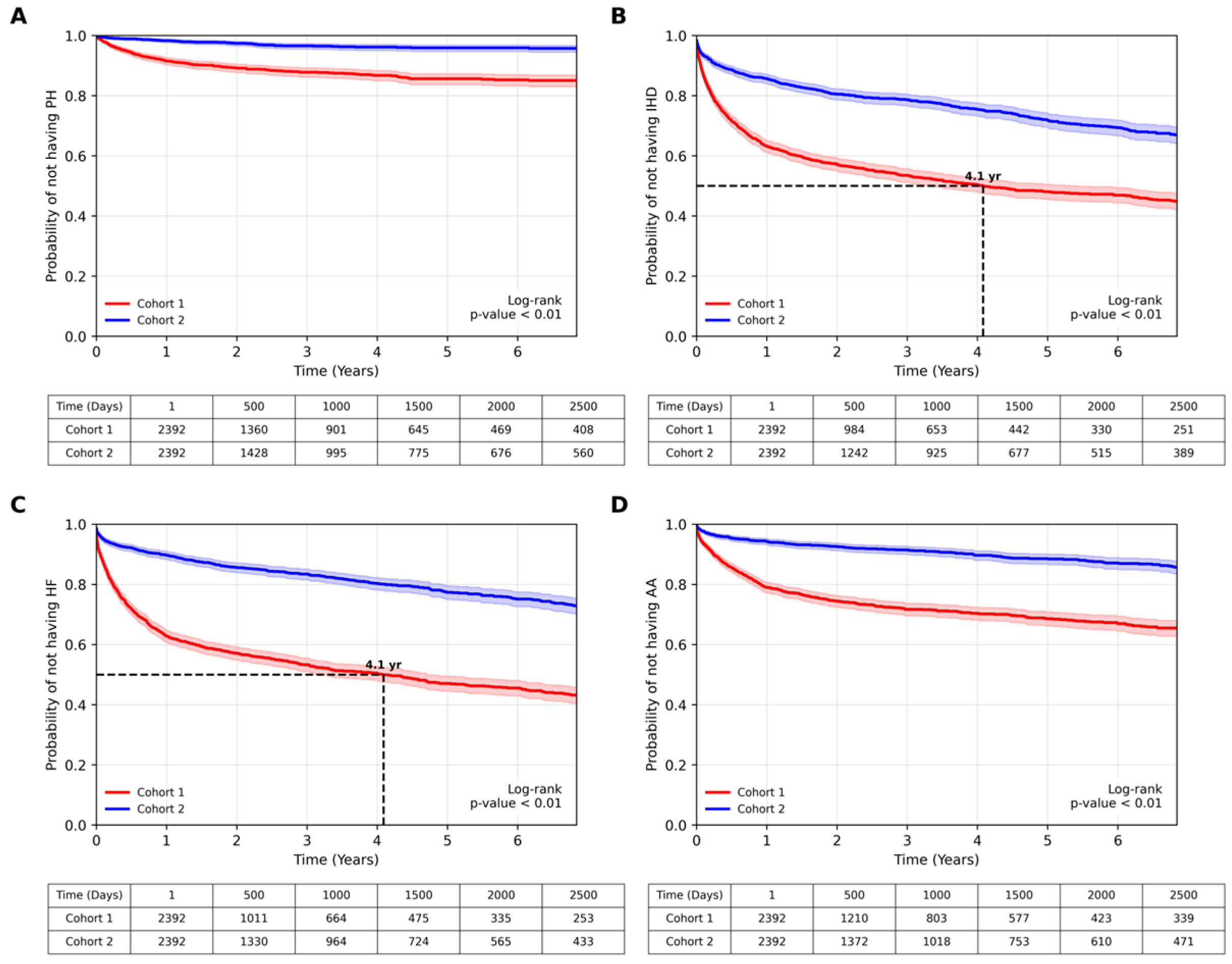
By the end of the follow-up period, the cumulative incidence of PH was significantly higher in Cohort 1 than in Cohort 2 (14.97% vs. 4.29%, p < 0.01). The steeper Kaplan–Meier (KM) curve observed in Cohort 1 suggests an earlier onset of PH as compared to Cohort 2. In both cohorts, the median time to PH diagnosis exceeded the observation period. Early CRF was associated with an increased risk of PH (HR = 3.91; 95% CI: 2.96–5.16). No significant violation of the proportional hazards assumption was detected (p = 0.20) (Figure 3A).
Figure 3.
Kaplan–Meier curves of participants in Cohort 1 and Cohort 2 for PH (panel (A)), IHD (panel (B)), HF (panel (C)) and AA (panel (D)). Abbreviations: PH: Pulmonary Hypertension; IHD: Ischemic Heart Disease; HF: Heart failure; AA: Atrial Arrhythmias.
3.2.2. Ischemic Heart Disease
The cumulative incidence of IHD was significantly higher in Cohort 1 than in Cohort 2 (55.11% vs. 33.04%, p < 0.01). The median time to IHD diagnosis was 4.1 years in Cohort 1, whereas in Cohort 2 it exceeded the study duration. The KM curve for Cohort 1 was steeper, indicating an earlier onset of IHD. Early CRF was associated with a higher risk of IHD (HR = 2.34; 95% CI: 2.10–2.61). However, the proportional hazards assumption was not met (p < 0.001), suggesting that the HR varied over time (Figure 3B).
3.2.3. Heart Failure
The cumulative incidence of HF was markedly higher in Cohort 1 than in Cohort 2 (56.79% vs. 27.11%, p < 0.01). The median time to HF diagnosis was 4.1 years in Cohort 1, which was longer than the study duration in Cohort 2. The steeper KM curve in Cohort 1 indicates an earlier occurrence of HF. Early CRF was associated with an increased risk of HF (HR = 3.15; 95% CI: 2.80–3.54). However, a significant deviation from the proportional hazards assumption was observed (p < 0.001), indicating that the HR was not constant over time (Figure 3C).
3.2.4. Atrial Arrhythmias
The cumulative incidence of AA was significantly higher in Cohort 1 than in Cohort 2 (35.52% vs. 14.29%, p < 0.01). In both cohorts, the median time to AA diagnosis exceeded the study duration. The steeper KM curve in Cohort 1 suggests an earlier onset of AA. Chronic respiratory failure was associated with a higher risk of AA (HR = 3.17; 95% CI: 2.70–3.72). However, the proportional hazards assumption was violated (p = 0.012), indicating that the HR changed over time (Figure 3D).
3.3. Role of CVD in Survival
Cohorts 3 and 4 comprised 322 participants each, while Cohorts 5 and 6 comprised 20,372 participants each. After matching, baseline characteristics were well balanced in both comparisons. The pr and post-matching characteristics are reported in Tables S2 and S3 (Supplementary Material), while propensity score density functions are shown in the Figure S2 and Figure S3 (Supplementary Material), respectively.
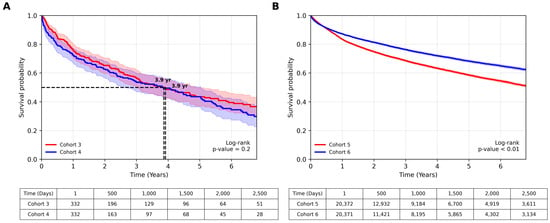
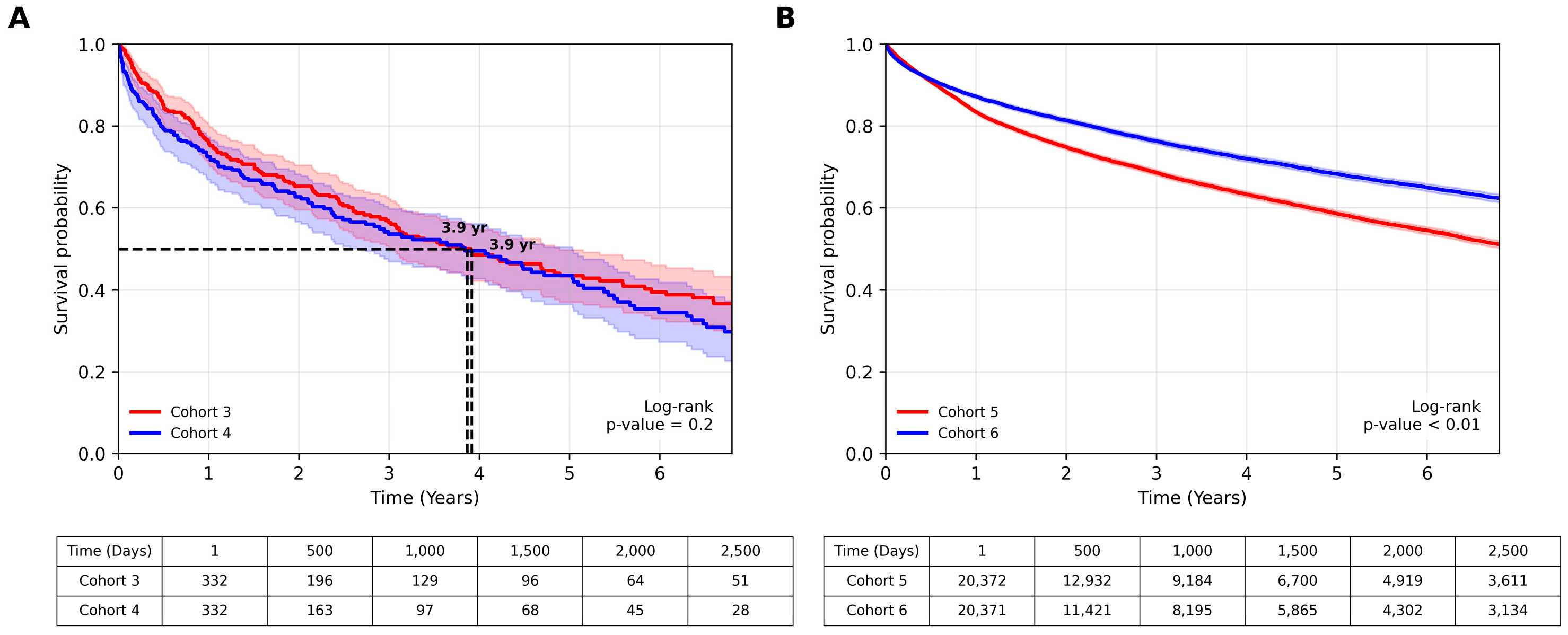
No significant difference in cumulative mortality was observed between Cohorts 3 and 4 at the end of the follow-up period (63.30% vs 70.19%, p = 0.20). The median time to death was 3.9 years in Cohort 3 and 3.8 years in Cohort 4. The estimated HR for death was 0.86 (95% CI: 0.69–1.08). There was no evidence of violation of the proportional hazards assumption (p = 0.65) (Figure 4A).
Figure 4.
The Kaplan–Meier curves of death. Panel (A) shows ILD participants with CRF and CVD (Cohort 3), as compared with participants with ILD and CRF only (Cohort 4). Panel (B) shows participants with ILD and CVD (Cohort 5), as compared with participants with ILD alone (Cohort 6).
Among participants without CRF, the cumulative mortality rate was significantly higher in Cohort 5 than in Cohort 6 (48.94% vs. 37.76%, p < 0.01). In both cohorts, the median survival time exceeded the 2500-day study period. The steeper KM curve in Cohort 5 indicates that deaths occurred earlier than in Cohort 6. The estimated HR was 1.37 (95% CI: 1.32–1.42). However, the proportional hazards assumption was violated (p = 0.001), suggesting that the HR varied over time (Figure 4B).
The full set of results from the KM analysis, including confidence intervals at the end of the time window, is reported in Table S4 (Supplementary Materials). The distributions of follow-up duration after PSM for each comparison are shown in Figure S4 (see Supplementary Materials).
3.4. Healthcare Utilization
Healthcare utilization, as measured by the median number of healthcare encounters, was higher in patients with a greater disease burden across all three analyses. The median number of encounters was 40 versus 20 in Cohort 1 versus Cohort 2, 47 versus 16 in Cohort 3 versus Cohort 4, and 36 versus 14 in Cohort 5 versus Cohort 6 (all p < 0.001).
3.5. Competing Risk Analysis
Competing-risk analyses using the Aalen–Johansen method estimated the cumulative incidence of cardiovascular outcomes in presence of all-cause mortality as a competing event. In Cohort 1, the cumulative incidence of any CVD at the end of the observation window was 72.4%, compared to 16.1% for death. The corresponding estimates in Cohort 2 were 39.9% and 20.1%, respectively. For specific cardiovascular outcomes in Cohort 1, the cumulative incidences of HF and IHD were 49.2% and 47.2%, respectively, as compared to 30.4% and 32.3% for death. In contrast, the cumulative incidence of death exceeded that of AA and PH in Cohort 1, with estimates of 44.6% versus 27.2% for AA and 55.3% versus 13.5% for PH, respectively. In Cohort 2, the corresponding estimates were 34.9% versus 9.9% for AA and 34.8% versus 2.9% for PH. These findings describe the absolute probability of experiencing each event in presence of the competing event during the observation window. The higher cumulative incidence of CVD than death for some outcomes, or the reverse for others, should not be interpreted as evidence of causality or as a direct measure of the association between CRF and CVD. The full results of the competing risks analysis and the comparison with the KM analysis results are reported in Table S5 (Supplementary Materials).
3.6. Sensitivity Analysis
Extending the exposure ascertainment period from one to three years after the index event increased the number of participants in the exposed cohorts after PSM, from 2392 to 4128 in Cohort 1, from 387 to 560 in Cohort 3, and from 23,560 to 38,174 in Cohort 5. Baseline characteristics remained comparable between matched cohorts. Pr and post-matching characteristics are reported in Table S6, Table S7, and Table S8, respectively, in the Supplementary Materials, while propensity score density functions are shown in the Figure S5, Figure S6 and Figure S7 (Supplementary Material), respectively.
The associations between CRF and CVD outcomes remained directionally consistent with those observed in the primary analysis. For any CVD, the reported HR was 2.90 (95% CI, 2.72–3.10; p < 0.001), whereas the corresponding estimate for all-cause mortality was 2.01 (95% CI, 1.86–2.17; p < 0.001). The association with mortality remained elevated after extending the exposure ascertainment window. These findings support the consistency of the observed associations across the one and three year exposure ascertainment windows, although they do not establish that the resultson are unaffected by immortal time bias.
The associations between early CVD and subsequent mortality were also directionally consistent with the primary analysis, with HRs of 0.74 (95% CI, 0.62–0.89; p < 0.001) in Cohorts 3 and 4 and 1.17 (95% CI, 1.14–1.21; p < 0.001) in Cohorts 5 and 6. The complete results are reported in Table S9 in the Supplementary Materials.
In the landmark analysis, follow-up began one year after the index event, and the same cohort definitions and PSM procedure as in the primary analysis were retained. Patients who had experienced the corresponding outcome before the landmark time were excluded from the analysis of that outcome.
The associations remained directionally consistent with the primary analysis, with higher hazard estimates for cardiovascular outcomes among patients with CRF diagnosed within one year of ILD diagnosis. HRs were 2.93 (95% CI, 1.95–4.39) for PH, 1.82 (95% CI, 1.52–2.17) for IHD, 2.48 (95% CI, 2.08–2.96) for HF, 2.28 (95% CI, 1.80–2.87) for AA, and 2.04 (95% CI, 1.75–2.39) for all the cardiovascular events. The HR for all-cause mortality was 2.24 (95% CI, 1.99–2.52). All reported risk comparisons and log-rank tests were statistically significant (all p < 0.001), whereas proportionality tests were not statistically significant for any outcome (p > 0.05). The associations between early CVD and subsequent mortality were also directionally consistent with the primary analysis. The comparison between Cohorts 3 and 4 was not statistically significant (HR 0.79, 95% CI 0.60–1.05; p = 0.11), whereas the comparison between Cohorts 5 and 6 remained statistically significant (HR 1.45, 95% CI 1.38–1.51; p < 0.001). Proportional-hazards tests were not statistically significant for either comparison (p > 0.05).
These findings indicate that the direction and magnitude of the observed associations were broadly consistent after excluding the first year following the index event. However, this landmark analysis does not by itself establish the absence of immortal time bias, as the interpretation remains dependent on the cohort definitions, the timing of exposure classification, and the exclusion of events before the landmark.
4. Discussion
In individuals with ILD, early CRF is associated with higher and earlier overall mortality HR and higher cumulative incidence of CVD. However, incident cardiovascular events may be associated with higher and earlier HR of death in people with ILD without CRF, but not in those with CRF. This indicates that CRF plays an independent role in mortality rates, regardless of those of CVD.
While our results indicating an association between ILD and CVD are not new based on previous, smaller observational studies [1,7,12,13,14,15,16,17], this study’s strengths lie in its multicentric nature, its use of RWD, and its large sample size (TriNetX). The TriNetX database enables largscale analyses of the prevalence, incidence, and timing of events in large populations and has been used in studies examining various comorbid health conditions [19,20,21,22,23,24,25]. We took particular care when selecting participants, avoiding not only those with any reported CVD or CRF diagnosis on the day of the event or in previous years, but also those taking medications potentially indicated for these conditions.
In our study, participants with early CRF had a higher and earlier overall mortality risk. Previous studies have reported a median survival time of between 2.5 and 3.5 years for people with ILD and CRF. Survival was longer for people with ILD without CRF, and depended on the ILD subtype, the extent of fibrosis, and the presence of incident cardiovascular events [2,26].
In our study, the cumulative incidence of PH was higher in participants with early CRF, suggesting that early CRF may be associated with an increased risk of PH. The PH cumulative incidence in ILD varies by disease severity and diagnostic method. In overall ILD populations, the pooled prevalence of PH has been reported to be approximately 36% by right heart catheterization and 34% by echocardiography [1,17,27]. Longitudinal data from individuals listed for lung transplantation have shown that the prevalence of PH increases from 39% at listing to 86% at the time of transplant, with a median interval of 8–9 months [28]. In people with ILD without CRF, PH may be absent or mild, but as hypoxaemia develops, the risk and prevalence of PH increase [17,27,28]. The PH cumulative incidence in our study is lower than that reported in studies specifically assessing pulmonary artery pressures or evaluating individuals with very severe disease. Interestingly, the sensitivity analysis revealed a significantly higher HR for PH than the primary analysis (HR = 5.42, 95% CI: 4.32–6.93, p < 0.001). This may reflect the progressive nature of ILD-related pulmonary vascular remodelling: individuals who survive longer after the onset of CRF are more likely to develop overt PH over time. The competing risk analysis also showed that death is a significant factor in the occurrence of PH. This suggests that some individuals with severe respiratory impairment may die before PH can be diagnosed. Consequently, the lower HR observed in the primary analysis may underestimate the true burden of PH to some extent due to the high early mortality rate among the most clinically fragile participants.
The cumulative incidence of IHD was higher in our participants and occurred at an earlier stage in those with early CRF. The prevalence of IHD in individuals with ILD is reported to be significantly higher than in the general population [14]. In a cohort undergoing coronary CT angiography, significant IHD was identified in 42.8% of participants with ILD at a median of 5 months post-ILD diagnosis [29]. Our data confirm these observations in individuals e with ILD alone. As the prevalence and timto-diagnosis in people with ILD and CRF are not precisely reported in the literature, our results are valuable as they provide substantial additional information in this population.
Our results are particularly relevant in the context of HF. The cumulative incidence of HF was 56.79% vs. 27.11% in Cohorts 1 and 2, respectively. HF prevalence in these individuals is reported as approximately 1.41 per 100,000 people globally, with higher rates observed in older adults and in individuals with advanced ILD [30]. HF risk is reported to be significantly increased, particularly in individuals with progressive fibrosing phenotypes, with an adjusted HR of 1.43 as compared to individuals without lung disease [31]. However, the time to HF onset in ILD patients is not precisely reported [1,30]. Our results expand the knowledge in this field by providing definitive timing of diagnosis.
The cumulative incidence of AA at the end of the observation period was 35.52% vs. 14.29% in Cohorts 1 and 2, respectively. In large cohort studies, ILD has been independently associated with an increased risk of AA in individuals with more severely reduced lung volumes [31]. Time to onset varies, but arrhythmias can develop within a few years of ILD diagnosis, with the risk increasing as lung function declines and CRF develops [32]. Our study shows that the time to AA diagnosis is longer than the 2500-day study period (6.8 years) for both cohorts.
Our study provides interesting and original insights into the impact of CVD on mortality risk. The presence of any CVD was associated with a significantly higher HR of mortality in ILD participants without CRF, whereas no statistically significant association was observed in those with CRF. However, these findings should not be interpreted as evidence that the effect of CVD on mortality differs according to CRF status, as no formal interaction analysis was performed. Chronic respiratory failure is considered the principal direct cause of death in individuals with ILD [1,2].
Thus, although CRF promotes the development of CVD (Figure 2 and Figure 3), the absence of a statistically significant association between CVD and mortality among participants with CRF may indicate that the additional contribution of CVD to mortality is more difficult to detect in this population.
The same may not apply in the absence of CRF. One possible explanation for the lack of a statistically significant difference in survival between participants with CRF with or without CVD is the limited sample size and consequent reduced statistical power. However, another possible explanation emerges from a comparison of Figure 1 and Figure 3. This reveals that the median time to the diagnosis of any CVD in people with ILD and CRF was 3.8 years. In contrast, the median time to death in participants with both ILD and CVD was 3.9 years. While this temporal relationship may be consistent with a potential contribution of CVD to overall mortality, it does not establish a causal relationship. These data are consistent with previous reports that CVD, particularly IHD and HF, is independently associated with increased all-cause mortality in people with ILD [33].
Regarding the competing risk analysis, the Aalen–Johansen estimates were lower than the corresponding primary estimates because the competing-risk analysis accounts for death as an event that precludes a subsequent recorded CVD diagnosis. The competing risk results describe absolute event probabilities in the presence of competing mortality and should not be interpreted as relative effect estimates or as evidence of causal robustness.
Interestingly, healthcare utilisation, as measured by the number of office visits, also increased in line with disease severity and complexity, reflecting the greater clinical needs of patients with more advanced disease and/or multimorbidity.
Limitations
This is a retrospective study, with the limitations of such studies. Due to the nature of administrative data, which only reports coded diagnoses, the lack of physiological and radiological data is an important limitation. Characteristics such as forced vital capacity, carbon monoxide diffusion capacity, oxygen requirement, radiological extent of fibrosis, ILD subtype, left ventricular function or cardiac imaging, potential phenotypes, gender, age, physiology index (GAP), history of exacerbations, antifibrotic treatment, or right heart catheterization data would be central to risk stratification.
There may be a significant selection bias due to the exclusion of people on nintedanib, pirfenidone and immunosuppressants. These drugs are standard of care in progressive fibrosing ILD and CTD-ILD. Excluding them is likely to exclude the most actively managed individuals and limits generalizability of the findings to the wider ILD population. These exclusions may have preferentially eliminated people with more severe or progressive disease and this may affect generalizability and selection bias.
CRF is a disease severity marker. The observed association between CRF and CVD may be confounded by the severity of the underlying lung disease or systemic inflammation that might not be fully captured by the available covariates.
Another potential limitation of this study is the risk of immortal time bias, given that exposure classification depended on the occurrence of CRF following the index event. To address this potential bias, two complementary sensitivity analyses were performed: extension of the exposure ascertainment window to three years and a onyear landmark analysis. The consistency of the results across these analyses and the primary analysis supports the robustness of the observed associations. However, as exposure classification remained dependent on an event occurring after the index event, these sensitivity analyses cannot completely eliminate the possibility of immortal time bias, and residual bias cannot be ruled out.
In addition, potential differences in coding habits by providers, as well as in availability of diagnostic and therapeutic facilities, may have influenced coded diagnoses. Nevertheless, the TriNetX Analytics Network represents real-world conditions, and our results are supported by a vast sample and long observation.
5. Conclusions
Our study shows potential associations between chronic respiratory failure, cardiovascular events, and mortality. However, it cannot prove causality or demonstrate that aggressive cardiovascular treatment improves outcomes for people with ILD. Chronic respiratory failure is associated with higher and earlier overall mortality and higher and earlier CVD risk. These findings emphasize the importance of structured respiratory assessment and closer cardiovascular surveillance for individuals with ILD, particularly those experiencing chronic respiratory failure.
Supplementary Materials
The following supporting information can be downloaded at: https://www.mdpi.com/article/10.3390/arm94060079/s1, Table S1: Pre and post-matching data for Cohorts 1 and 2; Table S2: Pre and post-matching data for Cohorts 3 and 4; Table S3: Pre and post-matching data for Cohorts 5 and 6; Table S4: The full set of results from the KM analysis, including confidence intervals at the end of the time window; Table S5: Competing risk analysis results compared with Kaplan-Meier results; Table S6: Pre and post-matching data for Cohorts 1 and 2; Table S7: Pre and post-matching data for Cohorts 3 and 4; Table S8. Per and post matching data for Cohorts 5 and 6; Table S9: Sensitivity analysis results; Figure S1: Cohort 1 and Cohort 2 propensity score density function, before and after matching; Figure S2: Cohort 3 and Cohort 4 propensity score density function, before and after matching; Figure S3: Cohort 5 and Cohort 6 propensity score density function, before and after matching; Figure S4: The distribution of follow-up duration after PSM for each comparison; Figure S5: Cohort 1 and Cohort 2 propensity score density function, before and after matching; Figure S6: Cohort 3 and Cohort 4 propensity score density function, before and after matching; Figure S7: Cohort 5 and Cohort 6 propensity score density function, before and after matching.
Author Contributions
Conceptualization, R.M.; methodology, G.R.; formal analysis, G.R.; data curation, G.R.; writing—original draft preparation, N.A.; writing—review and editing, R.M., M.V., M.T.L.R., N.A., V.T., G.R. and R.B.; visualization, G.R.; supervision, R.M., M.V., M.T.L.R., N.A., V.T., G.R. and R.B. All authors have read and agreed to the published version of the manuscript.
Funding
This work was supported by the “Ricerca Corrente” funding scheme of the Ministry of Health (Italy). The funders had no role in the study design, data collection, analysis, decision to publish, or preparation of the manuscript.
Institutional Review Board Statement
The study was conducted in accordance with the Declaration of Helsinki, and approved by the Institutional Review Board of Maugeri Institute (protocol code RC02/2025 on December 2025) for studies involving humans.
Informed Consent Statement
Patient consent was waived due to nature of aggregated data. Written informed consent has been obtained from the patient(s) to publish this paper.
Data Availability Statement
As the TriNetX network used aggregated and anonymized data, Ethics Committee approval and informed consent requirements were waived. Due to the nature of data, data sharing is not applicable to this article.
Acknowledgments
The authors thank Laura Comini for technical assistance.
Conflicts of Interest
The authors declare no conflicts of interest.
Abbreviations
The following abbreviations are used in this manuscript:
| AA | atrial arrhythmias |
| BMI | body mass index |
| CI | confidence interval |
| CKD | chronic kidney disease |
| CRF | chronic respiratory failure |
| CVD | cardiovascular diseases |
| HF | heart failure |
| HRs | hazard ratios |
| IHD | ischemic heart diseases |
| ILD | interstitial lung diseases |
| KM | Kaplan Meyer |
| PH | pulmonary hypertension |
| PSM | propensity score matching |
| RWD | real-world data |
| SD | standard deviation |
| SLE | systemic lupus erythematosus |
References
- Wijsenbeek, M.; Suzuki, A.; Maher, T.M. Interstitial lung diseases. Lancet 2022, 400, 769–786. [Google Scholar] [CrossRef] [Scilit] [PubMed]
- Maher, T.M. Interstitial lung disease: A Review. JAMA 2024, 331, 1655–1665. [Google Scholar] [CrossRef] [Scilit] [PubMed]
- Lederer, D.J.; Martinez, F.J. Idiopathic pulmonary fibrosis. N. Engl. J. Med. 2018, 378, 1811–1823. [Google Scholar] [CrossRef] [Scilit] [PubMed]
- Richeldi, L.; Collard, H.R.; Jones, M.G. Idiopathic pulmonary fibrosis. Lancet 2017, 389, 1941–1952. [Google Scholar] [CrossRef] [Scilit] [PubMed]
- Raghu, G.; Remy-Jardin, M.; Richeldi, L.; Thomson, C.C.; Inoue, Y.; Johkoh, T.; Kreuter, M.; Lynch, D.A.; Maher, T.M.; Martinez, F.J.; et al. Idiopathic pulmonary fibrosis (an Update) and progressive pulmonary fibrosis in adults: An Official ATS/ERS/JRS/ALAT Clinical Practice Guideline. Am. J. Respir. Crit. Care Med. 2022, 205, e18–e47. [Google Scholar] [CrossRef] [Scilit] [PubMed]
- Antoniou, K.M.; Distler, O.; Gheorghiu, A.M.; Moor, C.C.; Vikse, J.; Bizymi, N.; Galetti, I.; Brown, G.; Bargagli, E.; Allanore, Y.; et al. ERS/EULAR clinical practice guidelines for connective tissue diseasassociated interstitial lung disease developed by the task force for connective tissue diseasassociated interstitial lung disease of the European Respiratory Society (ERS) and the European Alliance of Associations for Rheumatology (EULAR) Endorsed by the European Reference Network on rare respiratory diseases (ERN-LUNG). Ann. Rheum. Dis. 2026, 85, 22–60. [Google Scholar] [CrossRef] [Scilit] [PubMed]
- Li, Y.; Tan, W.; Zhang, Y.; Cao, F.; Wu, Z.; Jiao, Y.; Niu, J. Cardiovascular disease in idiopathic pulmonary fibrosis: A systematic review and meta-analysis of observational studies. Front. Med. 2025, 12, 1653435. [Google Scholar] [CrossRef] [Scilit] [PubMed]
- Hubbard, R.B.; Smith, C.; Le Jeune, I.; Gribbin, J.; Fogarty, A.W. The association between idiopathic pulmonary fibrosis and vascular disease: A population-based study. Am. J. Respir. Crit. Care Med. 2008, 178, 1257–1261. [Google Scholar] [CrossRef] [Scilit] [PubMed]
- Dalleywater, W.; Powell, H.A.; Hubbard, R.B.; Navaratnam, V. Risk factors for cardiovascular disease in people with idiopathic pulmonary fibrosis: A population-based study. Chest 2015, 147, 150–156. [Google Scholar] [CrossRef] [Scilit] [PubMed]
- Raghu, G.; Amatto, V.C.; Behr, J.; Stowasser, S. Comorbidities in idiopathic pulmonary fibrosis patients: A systematic literature review. Eur. Respir. J. 2015, 46, 1113–1130. [Google Scholar] [CrossRef] [Scilit] [PubMed]
- King, C.S.; Nathan, S.D. Idiopathic pulmonary fibrosis: Effects and optimal management of comorbidities. Lancet Respir. Med. 2017, 5, 72–84. [Google Scholar] [CrossRef] [Scilit] [PubMed]
- Vancheri, C.; Cottin, V.; Kreuter, M.; Hilberg, O. IPF, comorbidities and management implications. Sarcoidosis Vasc. Diffuse Lung Dis. 2015, 32, 17–23. [Google Scholar]
- van Cleemput, J.; Sonaglioni, A.; Wuyts, W.A.; Bengus, M.; Stauffer, J.L.; Harari, S. Idiopathic pulmonary fibrosis for cardiologists: Differential diagnosis, cardiovascular comorbidities, and patient management. Adv. Ther. 2019, 36, 298–317. [Google Scholar] [CrossRef] [Scilit] [PubMed]
- Clarson, L.E.; Bajpai, R.; Whittle, R.; Belcher, J.; Abdul Sultan, A.; Kwok, C.S.; Welsh, V.; Mamas, M.; Mallen, C.D. Interstitial lung disease is a risk factor for ischaemic heart disease and myocardial infarction. Heart 2020, 106, 916–922. [Google Scholar] [CrossRef] [Scilit] [PubMed]
- Hu, Z.; Wang, H.; Huang, J.; Yang, G.; Luo, W.; Zhong, J.; Zheng, X.; Wei, X.; Luo, X.; Xiong, A. Cardiovascular disease in connective tissue diseasassociated interstitial lung disease: A systematic review and meta-analysis of observational studies. Autoimmun. Rev. 2024, 23, 103614. [Google Scholar] [CrossRef] [Scilit] [PubMed]
- Selman, M.; Buendia-Roldan, I.; Pardo, A. Decoding the complexity: Mechanistic insights into comorbidities in idiopathic pulmonary fibrosis. Eur. Respir. J. 2025, 65, 2402418. [Google Scholar] [CrossRef] [Scilit] [PubMed]
- Ang, H.L.; Schulte, M.; Chan, R.K.; Tan, H.H.; Harrison, A.; Ryerson, C.J.; Khor, Y.H. Pulmonary hypertension in interstitial lung disease: A systematic review and meta-analysis. Chest 2024, 166, 778–792. [Google Scholar] [CrossRef] [Scilit] [PubMed]
- Liu, F.; Panagiotakos, D. Real-world data: A brief review of the methods, applications, challenges and opportunities. BMC Med. Res. Methodol. 2022, 22, 287, Erratum in BMC Med. Res. Methodol. 2023, 23, 109. https://doi.org/10.1186/s12874-023-01937-1. [Google Scholar] [CrossRef] [Scilit] [PubMed]
- Ludwig, R.J.; Anson, M.; Zirpel, H.; Thaci, D.; Olbrich, H.; Bieber, K.; Kridin, K.; Dempfle, A.; Curman, P.; Zhao, S.S.; et al. A comprehensive review of methodologies and application to use the real-world data and analytics platform TriNetX. Front. Pharmacol. 2025, 16, 1516126. [Google Scholar] [CrossRef] [Scilit] [PubMed]
- Vitacca, M.; Riboni, G.; Paneroni, M.; Tibollo, V.; Bellazzi, R.; Capelli, A.; Ambrosino, N. Timing of cardiovascular events in people with COPD with and without chronic respiratory failure. Respir. Med. 2025, 249, 108429. [Google Scholar] [CrossRef] [Scilit] [PubMed]
- Vitacca, M.; Riboni, G.; Paneroni, M.; Tibollo, V.; Bellazzi, R.; Ambrosino, N. Prevalence, timing and mutual relationships of acute and chronic respiratory failure in people with chronic obstructive pulmonary disease. J. Clin. Med. 2026, 15, 5595. [Google Scholar] [CrossRef] [Scilit] [PubMed]
- Palchuk, M.B.; London, J.W.; Perez-Rey, D.; Drebert, Z.J.; Winer-Jones, J.P.; Thompson, C.N.; Esposito, J.; Claerhout, B. A global federated real-world data and analytics platform for research. JAMIA Open 2023, 6, ooad035. [Google Scholar] [CrossRef] [Scilit] [PubMed]
- Chang, R.; Yen-Ting Chen, T.; Wang, S.I.; Hung, Y.M.; Chen, H.Y.; Wei, C.-C.J. Risk of autoimmune diseases in patients with COVID-19, A retrospective cohort study. EClinicalMedicine 2023, 56, 101783. [Google Scholar] [CrossRef] [Scilit] [PubMed]
- Wang, W.; Wang, C.Y.; Wang, S.I.; Wei, J.C. Long-term cardiovascular outcomes in COVID-19 survivors among non-vaccinated population: A retrospective cohort study from the TriNetX US collaborative networks. EClinicalMedicine 2022, 53, 101619, Correction in EClinicalMedicine 2023, 59, 101968. [Google Scholar] [CrossRef] [Scilit] [PubMed]
- Kasperkiewicz, M.; Vorobyev, A.; Bieber, K.; Kridin, K.; Ludwig, R.J. Risk of comorbid autoimmune diseases in patients with immunobullous disorders: A global largscale cohort study. J. Am. Acad. Dermatol. 2023, 89, 1269–1271. [Google Scholar] [CrossRef] [Scilit] [PubMed]
- Varghese, A.E.; Jackson, C.D.; Lanfranco, J. What is interstitial lung disease? JAMA 2025, 334, 746. [Google Scholar] [CrossRef] [Scilit] [PubMed]
- Olsson, K.M.; Corte, T.J.; Kamp, J.C.; Montani, D.; Nathan, S.D.; Neubert, L.; Price, L.C.; Kiely, D.G. Pulmonary hypertension associated with lung disease: New insights into pathomechanisms, diagnosis, and management. Lancet Respir. Med. 2023, 11, 820–835. [Google Scholar] [CrossRef] [Scilit] [PubMed]
- Nathan, S.D.; Kim, H.C.; King, C.S.; Aryal, S.; Thomas, C.; Kattih, Z.; Shlobin, O.A.; Khangoora, V.; Chandel, A. Serial pulmonary hemodynamics in patients with idiopathic pulmonary fibrosis listed for lung transplant. Am. J. Respir. Crit. Care Med. 2025, 211, 984–991. [Google Scholar] [CrossRef] [Scilit] [PubMed]
- Kwak, H.S.; Kim, H.C.; Koo, H.J.; Lee, S.W.; Lee, P.H.; Kim, T.O. Incidence and clinical impact of coronary artery disease confirmed by coronary CT angiography in patients with interstitial lung disease. BMC Pulm. Med. 2025, 25, 88. [Google Scholar] [CrossRef] [Scilit] [PubMed]
- Lu, R.L.; Huang, Q.; Yu, T.T.; Liu, D.Z.; Hong, X.P. The global burden of heart failure attributable to interstitial lung diseases: Insights from the global burden of disease study 2021. BMC Cardiovasc. Disord. 2025, 25, 262. [Google Scholar] [CrossRef] [Scilit] [PubMed]
- Eckhardt, C.M.; Balte, P.P.; Barr, R.G.; Bertoni, A.G.; Bhatt, S.P.; Cuttica, M.; A Cassano, P.; Chaves, P.; Couper, D.; Jacobs, D.R.; et al. Lung function impairment and risk of incident heart failure: The NHLBI Pooled Cohorts Study. Eur. Heart J. 2022, 43, 2196–2208. [Google Scholar] [CrossRef] [Scilit] [PubMed]
- Cheng, Y.J.; Qu, L.P.; Liao, Y.J.; Lu, S.L.; Lin, M.P.; He, Q.; Fu, J.-B.; Li, J.-C.; Duan, W.-J.; Liu, L.-J. Incident arrhythmias in relation to ventilatory parameters and pulmonary disease: Evidence from two prospective cohort studies. BMC Med. 2025, 23, 493. [Google Scholar] [CrossRef] [Scilit] [PubMed]
- Carter, P.; Lagan, J.; Fortune, C.; Bhatt, D.L.; Vestbo, J.; Niven, R.; Chaudhuri, N.; Schelbert, E.B.; Potluri, R.; Miller, C.A. Association of cardiovascular disease with respiratory disease. J. Am. Coll. Cardiol. 2019, 73, 2166–2177. [Google Scholar] [CrossRef] [Scilit] [PubMed]

Disclaimer/Publisher’s Note: The statements, opinions and data contained in all publications are solely those of the individual author(s) and contributor(s) and not of MDPI and/or the editor(s). MDPI and/or the editor(s) disclaim responsibility for any injury to people or property resulting from any ideas, methods, instructions or products referred to in the content. |
© 2026 by the authors. Published by MDPI on behalf of the Polish Respiratory Society. Licensee MDPI, Basel, Switzerland. This article is an open access article distributed under the terms and conditions of the Creative Commons Attribution (CC BY) license.