Introduction
Developmental reading and spelling disorders are among the most common learning impairment (4-5% of the population,
Consensus Conference ISS, 2011), with severe school consequences (
Snowling, 1991). Over the past two decades, the understanding of these disturbances has grown thanks to cognitive models describing the normal processing of written language.
The two route model, originally formulated to describe reading (
Coltheart et al., 1980;
Patterson et al., 1985) and later adapted for spelling (
Beauvois & Dérouesné, 1981;
Baxter & Warrington, 1985;
Harris & Coltheart, 1986;
Patterson, 1986), assume the existence of at least two procedure: a lexical procedure, along which words are processed as a whole (direct access) and a sub-lexical one, based on orthographic-tophonological conversion rules in reading (and phonological-to-orthographic conversion rules in spelling) that exploits the systematic correspondences between phoneme-to-grapheme and vice versa. The sub-lexical spelling procedure is furthermore characterized by an acoustic-to-phonological conversion process that preventively segments and identifies the phonological string to be converted (
Patterson, 1986). Accordingly to this approach, studies on developmental dyslexia and dysgraphia described two main forms: a phonological and a surface disorder. Some children are selectively impaired in using the grapheme-to-phoneme conversion rules. Accordingly, they are impaired in reading novel words and pseudowords. This disturbance is generally called phonological dyslexia (e.g.,
Temple & Marshall, 1983). Other children make appropriate use of orthographic-to-phonological conversion rules and show a selective deficit in lexical access, with impaired reading of irregular words (e.g., yacht). Such a deficit is generally called surface dyslexia (e.g.
Castels & Coltheart, 1993).
Similarly, developmental spelling deficits have been fractionated into phonological (e.g.,
Campbell & Butterwoth, 1985;
Snowling et al., 1986,
Temple, 1986) and surface dysgraphia (e.g.,
Temple, 1985,
1986). In phonological dysgraphia, correct spelling is possible for over-learned words, but not for less frequent or novel words and for pseudowords. In surface dysgraphia, there is an impaired spelling of irregular words and homophones (e.g. [diar] can be transcribed as either “dear” or “deer”). In both cases the correct transcription cannot be immediately deduced by applying the conversion rules. Errors are, for the most, phonologically plausible.
The distinction between phonological and surface disorders was developed on data from English and French, two language with quite irregular orthography. Generalization of this model (and of the predicted disorders) to language with more shallow orthographies such as Italian requires same considerations and a closer look at Italian orthography.
In Italian in the oral-to-written direction, the almost unique unpredictable condition is the site of word stress in three-syllable (or longer) words. However, stimuli allowing to test the lexical processing may be generated through pseudo-homophone contrasts. Italian dyslexic children are impaired in tasks with these stimuli, such as comprehension of sentence with pseudo-homophone contrasts (i.e. “l’ago” (the needle) or “lago”(lake), suggesting non-proficient use of the lexical procedure (
Job et al., 1983;
Zoccolotti et al., 1999). Moreover, Italian dyslexic children have a selective deficit in judging the orthographic correctness of phonologically plausible pseudowords (e.g., the stimulus ” *quore”
1, that is homophonic to the correct word ”cuore”, [kwore] (heart)). This difficulty is indicative of a prevalent reliance on a phonological procedure and a scarce use of the lexical one in performing the task (
Marinelli et al., 2009;
Angelelli et al., 2010). Moreover, different approaches such as eye movement recording and vocal reaction times have also been successfully used to study the reading processes in dyslexic children. Eye movement recording showed highly fractionated text analysis, with a robust effect of word length (
De Luca et al., 1999;
De Luca et al., 2002). Consistent results were obtained from vocal RTs to different length single words (
Zoccolotti et al., 1999;
Spinelli et al., 2005;
Zoccolotti et al., 2005). Overall, psycholinguistic analysis of errors, eye movement recording and vocal RTs, indicated prevalent reliance on sub-lexical procedure. Thus, the efficiency of the lexical processing seems to be poor in Italian dyslexics, and they prevalently suffer from surface dyslexia (
Zoccolotti et al., 1999;
Marinelli et al., 2009).
Regarding spelling, the grapheme-to-phoneme correspondence is fairly regular in Italian; however, as in most other regular orthographies (e.g., Serbo-Croatian, Czech), there is a certain degree of ambiguity in the oral-to-written direction. For instance, the phonemic group [kw] may be transcribed by the orthographic sequences QU, CU, (for example, the Italian term for “rate” [kwota], is written “quota” and not “*cuota”, whereas [kwoio], (lether) is spelt “cuoio” and not “*quoio”); no definite rule allows choosing among these alternatives and reference to a lexical entry is required (for a detailed description see also
Zoccolotti et al., 2005).
Using a spelling task that capitalizes on these oral-to-written ambiguities, a series of studies (
Angelelli et al., 2004;
Angelelli et al., 2010;
Angelelli et al., 2010) reported a majority of surface dysgraphia in Italian dyslexic children, i.e. a selective impairment in writing unpredictable transcription words and many phonologically plausible errors.
What about the phonological forms of dyslexia and dysgraphia? The high correspondence between grapheme-to-phoneme in reading (and vice-versa in spelling) would suggest that the acquisition of such knowledge must be easy to learn in regular orthographies; indeed, in language such as Italian, cases with a deficient acquisition of the sub-lexical strategy are quite rare.
In fact, cross-linguistic studies indicate that literacy acquisition is not the same across languages and the facility depends on the degree of orthographic consistency of different languages. As to reading,
Seymour et al. (
2003), comparing the reading acquisition in different European languages, found that Italian children, at the end of their first year in primary school, were able to read in a proper way approximately 95% of a list of familiar words. Also regarding spelling (for reviews, see
Caravolas, 2004) data support the view that, the sublexical procedure is acquired more rapidly in regular than in opaque orthographies. As regards Italian language two recent study comparing spelling (
Marinelli et al., 2015) and reading (Marinelli et al., in revision) acquisition in Italian and English primary school children found greater accuracy in spelling and reading among Italian children than English children: former were very accurate after only 2 years of schooling, while among English children the performance was still poor after 5 years of schooling. Orthographic consistency produced not only quantitative, but also qualitative differences, with larger frequency and regularity effects in English than in Italian children, index of larger reliance on larger grain size in English sample.
Even Orsolini et al. (
2003) found that by the fourth month of school 50% of Italian children were able to read approximately 80% of words correctly. For what regards spelling a recent study investigating spelling skills in firstto eighth-grade Italian normal readers (
Notarnicola et al., 2012) found that spelling along the sub-lexical conversion procedure was acquired quite early and ceiling effect was present for regular stimuli jet by third grade. Similarly, a study examining reading acquisition in Italian children from 2
ndto 8
thgrade (
Tressoldi, 1996) found very low percentage of errors already in the 2
nd grade and smaller of 5% by 3
rd grade. Overall, in consistent orthographies, conversion rules are easily acquired by almost children.
However, also in a very consistent orthography such as Italian, children may fail in the acquisition of phoneme-to-grapheme mapping. Literature reports a case of phonological dyslexia: Marco, a 12 –year-old Italian boy with a very evident deficit in reading pseudowords compared to words (
Sartori & Job, 1983). With regard to developmental dysgraphia, a recent study (
Angelelli et al., 2016) on Italian dyslexic children described long-lasting phonological spelling difficulties in those with a history of Language delay (LD). In particular, LD children were more sensitive to acoustic-to-phonological variables, showing relevant failure especially in spelling stimuli containing geminate consonants but also polysyllabic stimuli and those containing non-continuant consonants. Error analysis confirmed these results, with LD children producing a higher rate of phonological errors respect to NoLD children and controls. It could be worth to further investigate the uncommon cases suffering from phonological dysgraphia, taking into account potentially relevant factors such as concomitant deficits of phoneme discrimination, processing and representation.
The goal of the present study is to analyze the phenomenology of reading and spelling deficits of an Italian child suffering from a major deficit for phonological processing. As a comparison, the spelling and reading performances of child suffering from the specular disorder (i.e., surface dyslexia and dysgraphia) were also analyzed. Additionally, due to the specific difficulty of phonological dyslexic and dysgraphic children in dealing with geminate consonants, the processing of doubled consonants has been examined more deeply, with the aim to identify if the locus of the deficit may be phoneme discrimination, phoneme representation and manipulation and/or phoneme-to-grapheme conversion (and vice versa).
Method
Participants
The participant was A.S., a 10-year-old boy attending the fifth grade of southern Italy primary school. The child had great difficulty in reading and spelling when tested with a standard examination (see paragraph 2.3) although his intelligence, assessed with the Coloured Progressive Matrices of Raven (1984), was perfectly adequate for his age (score of 24, above the 10º percentile for this age level according to
Pruneti et al., 1996).
A.S was indicated by his teachers as having significant difficulty in reading and spelling but he received neither support for that problem. In fact, although his parents had been informed of A.S’s poor performance, they did not take into account any rehabilitation program as they underestimated the seriousness of the problem and attributed to excessive teachers’ worrying.
A.S. was very willing and collaborative in performing the various tests. On the discourse level no language problems were detectable, however parents referred a delayed development of language.
A.S’s reading and spelling performance was compared to that of one child of the same age, G.S. The two boys were schoolmates and shared the reputation of problematic children. G.S., in fact, had marked reading and spelling deficits associated with normal socioeducational conditions and normal intelligence (score of 24 at the Coloured Progressive Matrices of Raven, above the 10º percentile for this age level according to
Pruneti et al., 1996). G.S. was very collaborative in performing the various tests.
Reading assessment
Reading level was evaluated with a standard achievement test: the MT Reading Test (
Cornoldi & Colpo, 1998). In this test, children were asked to read two passages. Speed (time in seconds per syllable) and accuracy (number of errors relative to the amount of text read) were measured from the reading of the first passage, which was read aloud with a time limit of 4 minutes. Comprehension was evaluated with the second passage, which could be read aloud or silently as preferred and without a time limit; after reading the passage, the child was required to answer ten multiple choice questions.
The nature of the reading disturbance of the dyslexic participants was also examined by additional tasks. The Words and Non-word Reading test (
Zoccolotti et al., 2005) was administered. The test consists in four lists of words (varying for frequency and length) and two of pseudo-words (varying for length). Thirty stimuli per list were given; number of errors and reading speed were scored. The participants were required to read the stimuli aloud as quickly and accurately as possible. Number of errors and time (sec per list) were recorded and converted to z scores according to standard reference data (
Zoccolotti et al., 2005).
Additionally, four tests of the Developmental Dyslexia and Dysgraphia Battery (
Sartori et al., 1995) were adopted. In the Graphemes subtest participants were asked to name 21 single letters. It is useful to evaluate the efficiency of the transition from the grapheme to its phoneme. In the Lexical Decisions subtest children were required to read 48 stimuli and indicate if they were words or pseudowords. Homophones comprehension was assessed by 24 questions which required a choice among four possible answers (e.g.: “the needle (l’ago) is made of… water, wood, earth, metal”), two of them were possible if the target was processed phonologically. In order to answer the question correctly, children must be able to distinguish between “l’ago” (the needle) and “lago” (lake). Scoring is calculated with the following formula (
Sartori, 1984): (homophonic errors / homophonic errors + correct answers) x 100. If a child scores around 50, he/she is not capable of distinguishing homophones, giving prove to rely on phonological processing. In the Correction of Homophones subtest children are asked to read 20 words of which only 8 are correct. The incorrect stimuli have been produced by inserting an apostrophe (e.g. “l’ametta” instead of “lametta” (blade)) or by segmentations of words (e.g. “di vano” instead of “divano” (sofa)). Both tests with pseudo-homophones were used to assess efficiency of lexical processing. Reading speed and number of errors were recorded in tests 1 and 3, while only the number of errors were recorded in the other two tests.
Spelling Assessment
Spelling abilities were tested through a standard spelling test (
Angelelli et al., 2016), composed of four sections:
Section A: regular words with complete one-sound-to-one-letter correspondence (N=70). Words were selected with different sources of phonetic-phonological complexity: (i) words made up of continuant sounds only (fricative, liquid or nasal consonants) versus words also containing non-continuant (plosive) consonants; (ii) words made up only of consonant-vowel (CV) syllables versus words also containing consonant clusters and doubled consonants; (iii) disyllabic versus polysyllabic words. Different sources of phonetic-phonological complexity were used in order to determine variables influencing both segmentation and identification of phonemic string to be converted (for instance, continuant phones are, by nature, easiest to segment, and hence to identify, than noncontinuant phones).
Section B: regular words requiring application of context-sensitive sound-to-spelling rules (N=10). In Italian, context-sensitive rules are required when spelling of a consonant depends on the following sound. For instance, the phoneme [k], is spelled C when followed by a consonant (e.g., CLIMA ([klima], climate) or by A, O, U (e.g., CASA [kaza], home) and CH when followed by E or I (e.g., BARCHE [barke], boats).
Section C: words with unpredictable transcriptions along phonological-to-orthographic conversion routine (N=55). This section includes: (i) words containing the phonemic group [kw], which in Italian may be transcribed by orthographic sequences QU, CU, or CQU; (ii) words containing syllables [t e], e, dʒe , which may or may not require an I (e.g., [entsa], science, is spelt SCIENZA and not *SCENZA, while [ena], scene, is spelt SCENA and not *SCIENA); (iii) words containing plosive phones followed by liquid consonants [r] which are homophones to their doubled pairs (e.g., FEBBRE, fever and not *FEBRE, but LIBRO, book, and not *LIBBRO); (iv) words containing segments [lj] - [ʎ and [nj] - [ɲ], that are homophonous in most Italian variants to the extent that [biljardo/biʎardo], billiards, is spelt BILIARDO and not *BIGLIARDO, while [folja/foʎa], leaf, is spelt FOGLIA and not *FOLIA; similarly [opinjone/opiɲone], opinion, is spelt OPINIONE and not *OPIGNONE, while [oɲuno/onjuno], everyone, is spelt OGNUNO and not *ONIUNO.
Section D: pseudowords with one-sound-to-one-letter correspondence (N=25). Items were controlled for different sources of phonetic-phonological complexity, as were words in Section A: (i) continuance of sounds (pseudowords with continuant versus non-continuant consonants); syllabic structure (pseudowords with consonant-vowel (CV) syllables versus pseudowords also containing doubled consonants; and length (disyllabic versus 3-4 syllable pseudowords). Similarly to Section A, phonetic/phonological variables are introduced in order to account for variables influencing acoustic-to-phonological analysis that is preliminary to an effective phonological-to-orthographic conversion procedure.
Words and pseudowords were given in separate sequences and in a single quasi-randomized order. The examiner read each item aloud in a neutral tone, i.e., without emphasizing presence of clusters, doubled consonants or possible orthographic ambiguities. Children were asked to repeat each item before writing it down (so that the examiner could ensure that they had understood the item). When children failed to repeat or upon their request, the examiner read stimulus again. They were permitted to write in either capital or lower case letters. No feedback was provided on accuracy of written response. Final responses were counted, irrespective of correctness of first attempt. Children were tested individually. The number of correct spellings on each of the four sections of task was counted for every participant.
The DDO test allow also to perform an error analysis, in order to identify nature of spelling errors, irrespective of section of test in which they emerged. Errors were coded as:
-Phonologically plausible errors (impaired spellings along lexical route): spelling errors that can be pronounced to sound like target words; these errors arise from over reliance on phoneme-to-grapheme conversion routine (e.g., “*cuota” instead of ”quota” (rate));
-Phonologically non-plausible errors (inaccurate spellings via sublexical routine): errors causing a change in phonemic makeup of a word reflecting difficulties in phonemic segmentation, phoneme-to-grapheme encoding or a phonological/graphemic buffer disorder. This category included the following error subtypes:
-Errors based on minimal distance features: substitutions of consonants or vowels with other consonants or vowels that differs only in one single distinctive feature [e.g., sonority, “fino”(until) instead of “vino”(wine); continuance, “pesta”(crush) instead of “festa”(holiday)]. Doubling of a single consonant or of dedoubling of a doubled consonant were also considered in this category;
-Other errors: non-minimal-distance substitutions (e.g., “*balo” instead of “baco” (worm)), omissions (e.g., “*vsone” instead of “visone”(mink)), insertions (e.g., “*manrmo” instead of “marmot”(marble)) and letter transpositions (e.g., “*patro” instead of “prato”(field)).
-Context-sensitive sound-to-spelling errors: errors in application of context-sensitive sound-to-spelling rules (e.g. “*adago” instead of “adago” (slow) or “sceda” instead of “scheda”(card)).
For both quantitative and qualitative data, the performance of each participant was compared to reference data (
Angelelli et al., 2016).
Phonological Awareness Assessment
Phonological awareness was evaluated with a blending test (
Di Filippo et al., 2005). The test consisted in asking the child to repeat aloud the whole word (or pseudowords) which results from the blend of “sounds” emitted at a frequency of one per second, for a total of 19 words and 19 pseudowords (composed of 5-6 letters). For each item, both the number of correct blended pairs of phonemes and the number of the whole correct blended items were recorded. Before the test itself, a number of warm-up tests were run to help the child understanding the nature of the main test.
Processing of doubled consonants
Additionally, due to the A.S. difficulty’s in dealing with doubled consonants, the child was tested with an experimental protocol prepared ad hoc. The aim was investigating if phonological difficulties in processing stimuli with doubled consonants were due to inefficiencies of: i) phoneme discrimination, ii) phoneme manipulation, iii) phoneme-to-grapheme conversion (and vice-versa).
We selected 20 pairs of real words differing for the presence of doubled vs single consonants (e.g., “pala-palla” (shovel-ball)). We also created 20 pairs of pseudowords (one with a doubled consonant, and one without, e.g., “pasupassu”), for a total of 80 stimuli. In both the word and the pseudoword pairs, half of the doubled consonant were continuant phones (i.e., the fricatives [f], [v], [s], [S], the liquid [l], [r] and the nasal consonants [n], [m], [ñ], [N]) that are susceptible to prolongation) and half non-continuant consonants (plosive consonants, such as [p], [b], [t], [d]). In fact, acousticto-phonological analysis is subject to acoustic-to-phonological quality of phones in dyslexic children (especially for those with a phonological deficit,
Angelelli et al., 2016). It is easier to isolate, segment and identify continuant phones than non-continuant phones (see also
Luzzatti et al., 2000 for coherent data on aphasic patients).
All the selected stimuli were presented in four tasks. In particular, in order to examine the acoustic-to-phonological discrimination, as well as the phonological buffer and retrieval of the phonological output, a repetition task was used. In this case, A.S. listened each stimulus and after repeated it. The ability of manipulate phones was examined through phoneme segmentation and blending tasks. In the blending task, words or pseudowords were presented phoneme-by-phoneme at a rate of one per second. At the end of the sequence, the child was asked to repeat aloud the whole stimuli. On the contrary, in the segmentation task, the examiner pronounced the whole stimulus and the child was asked to segment into the single phonemes constituting the stimulus. The phoneme-to-grapheme conversion skills were tested through an acoustic-to-visual matching task: the child listened a stimulus and was asked to choose the correspondent transcription between a pair of stimuli, one containing the doubled consonants, the other one did not. The stimuli appeared in a sheet in front of him. To avoid attentional lapses, each task was performed in a different day.
Only attended errors regarding doubled consonants processing were computed; while other errors were not analysed.
2 Self-correction were accepted.
Procedure
Children were tested individually in a quiet room. Parents were informed on the screening activity and authorized the participation to the study by signing the appropriate informed consent paperwork.
Data analysis
Regarding reading performance, the number of errors and the reading speed were analysed respect to proper normative data and transformed into z scores. The performance on Single words and nonword -reading test (
Zoccolotti et al., 2005) was futhermore analysed by applying a Multivariate Logistic Regression Analysis (
Aitkin et al., 1989) in order to compare accuracy reached in words vs pseudowords. The dependent variable was the accuracy to each item (1 = passed, 0 = failed); independent variables were lexicality (1 = words; 0 = pseudowords), word length (number of letters), presence of clusters (1 = item with cluster; 0 = item without cluster) and presence of doubled consonants (1 = item with doubled consonants; 0 = item without doubled consonants).
An error analysis was also performed on children reading performance at Words and Nonword Reading test (
Zoccolotti et al., 2005). In particular errors were coded in: 1) stress errors; 2) visual/phonological errors (more than 50% of letter in common with the target stimuli) producing a pseudoword; 3) visual/phonological errors (more than 50% of letter in common with the target stimuli) producing an existing word; 4) words semantically related to the target words.
With regard to the spelling task, the number of items transcribed correctly in the four sections of the test were computed and transformed in z score according to normative data (
Angelelli et al., 2016). In addition, the spelling performance was analysed by Multivariate Logistic Regression Analysis (
Aitkin et al., 1989). Based on psycholinguistic models that assume two independent spelling procedures, the ability of each participant in spelling regular words was compared with that in spelling words with an unpredictable orthography (as a marker for the lexical spelling route) and pseudowords (as a marker for the sub-lexical spelling routine). Two logistic regression analyses were applied to the profile of each participant: the first compared regular words versus words with unpredictable transcription; the second, regular words versus pseudowords. The units were the items of the spelling test (125 for the first comparison, 95 for the second one); the dependent variable was dichotomous (pass or fail).
Potentially relevant variables such as frequency, length (number of letters), cluster presence (1=item with cluster; 0=item without cluster) and the presence of doubled consonants (1=item with doubled consonants; 0=item without doubled consonants) were checked in both analyses. As reported in the spelling session, errors were also classified according to
Angelelli et al. (
2016). For each participant the number of errors for each typology was compared to normative data.
3Regarding the experimental paradigm on doubled consonants processing, accuracy in the different tasks was compared by a Multivariate Logistic Regression Analysis (
Aitkin et al., 1989). The dependent variable was the accuracy of A.S. in processing each item (1 passed, 0 fail), and the independent variable was the task (repetition vs segmentation, blending and acoustic-to-visual matching respectively; segmentation vs blending and acoustic-to-visual matching; blending vs acoustic-to-visual matching). Additionally, in order to assess the effects of lexicality and acoustic-to-phonological variables on accuracy, lexicality (1 = words; 0 = pseudowords), presence of continuant sounds (1 = item with continuant consonants; 0 = item with non continuant consonants) and presence of doubled consonants (1 = item with doubled consonants; 0 = item without doubled consonants) entered in the analysis as independent variables. Moreover, analysis were replicated separately for words and pseudowords in order to check for different pattern in lexical vs non lexical stimuli.
Results
Reading
A.S. did not manage to finish reading the passage in the fixed time, making a high number of errors (27 errors, his performance was 3.40 standard deviations below the normative sample), which is almost 4 times the number made by normal readers of same age (according to normative data). He read with a speed of 0.75 sill./sec. against the 3.77 sill/sec expected for his age and grade (on average he was -2.42 standard deviations below the normative sample). In fact, he read very slowly, taking several pauses over 5 seconds due to difficulty in decoding complex graphemes. Overall, his performance placed him, both for speed and accuracy, in the category of children requiring “immediate help”. On the comprehension task, after a long (30 minutes) and arduous process, Albert managed to extract from the text the information necessary to reply correctly to 8 out of 10 questions (z = 0.18).
G.C. made 20 errors when reading his passage (z = 2.27); on average he read 2.15 syllables in one second (z = -1.3). His comprehension skills were impaired (only 4 correct answers out of 10; z = -1.64). Comparison to normative data, his performance fell in the category of children requiring “immediate help for speed, accuracy and comprehension.
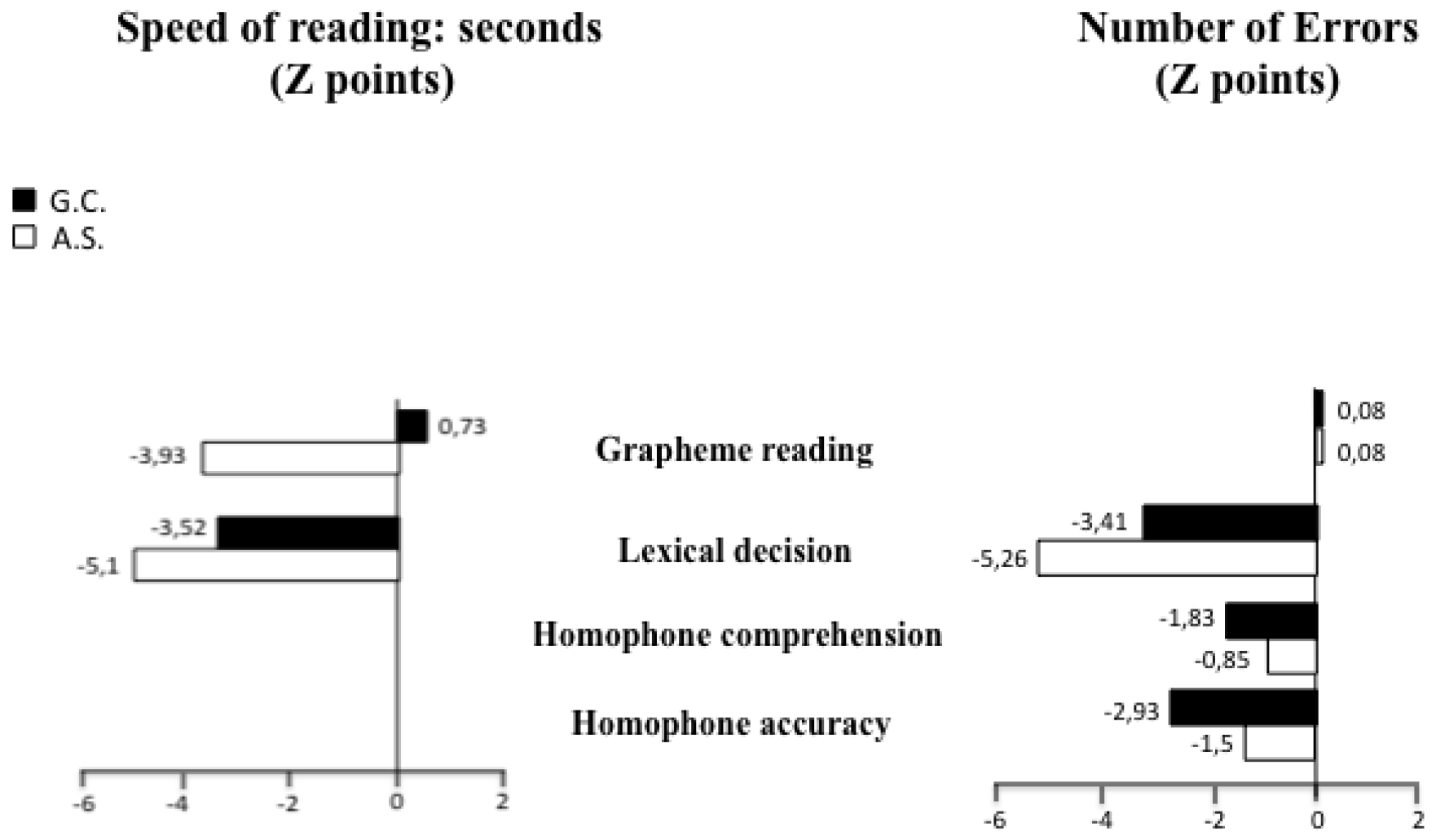
A.S.’s performance in grapheme reading was impaired for speed, taking 24 seconds without, however, making any errors. His performance was 3.93 standard deviations below that of controls.
He also underperformed on lexical decision task (approximately - 5 standard deviations below norms for both errors and time). Here A.S. made 17 misjudgments and took twice the time of controls (193 seconds).
However, in pseudo-homophone tasks, A.S performed as controls both in comprehension (z = -0.85, only 2 homophonic errors) and correction (z = 1.5, only 3 errors), showing discrete lexical access.
Single word and pseudoword reading was impaired for all stimuli categories and for both speed and accuracy (see table 2). However, it is interesting to note that A.S. scored 67% on words and 33% on pseudowords. The difference between the performance on words and pseudowords is 34%. When comparison is limited to long words and pseudowords, the difference becomes 38%, which is very close to the critical threshold proposed by
Sartori (
1984) as an indication of phonological dyslexia.
The logistic regression analysis (see
Table 2), confirmed a significant lexical effect (χ
2 = 8.13, p < .01), with pseudoword spelled significantly worse than words. He showed a word length effect too (p < .01).
On the contrary, G.C.’ grapheme reading was normal for errors and time. He took 10 seconds (z= -0.73), without making any error.
He underperformed on lexical decision task, approximately 3.5 standard deviations below controls, for both errors (12 misjudgments) and time (he concluded the test in 159 seconds, almost twice the time taken controls).
G.C had also difficulties on pseudo-homophone comprehension (z= -1.83 SD) and correction (z= -2.93 SD). In the comprehension task, in fact, he chose the homophonic alternative in 61.9% of cases, showing a main reliance on phonological processing (he interpreted both “s’offre” (he offers) and “soffre” (he suffers) as “sta male” (he is sick); both “vera” (true) and “v’era” (there was) as “reale” (real)). The limited number of non-homophonic alternatives (n= 2) showed that the performance itself was valid and that there was no general comprehension problem (
Sartori, 1984). G.C. made a total of 5 misjudgments on pseudo-homophone correction, for example accepting “di vano” for “divano” (sofa), “lerba” insead of “l’erba” (grass).
In single word and pseudoword reading, G.C. was below the mean for accuracy in all stimuli categories (see
Table 2). The logistic regression analysis showed not significant effect of lexicality (χ
2 = 1.70, ns): words and psudowords were comparably impaired. The only variable that significantly affected his performance was stimulus length (p< .01).
From a qualitative point of view, we can observe that A.S. did not commit any stress errors. He made prevalently visual/phonological errors (sharing more than 50% of letters with the target stimuli) leading to pseudowords (31.6%) and word substitutions semantically/visually related to the target word (10.6%). It is clear that A.S. had difficulties in phonological decoding, that tried to compensate by an attempt to retrieve the whole word phonology. Morphological errors and errors producing a word unrelated to the target were both about 1.5%.
At the contrary, G.C. made many stress errors (4.2%; note that in the test there were few words irregularly stressed, then this percentage is relevant). The percentage of visual/phonological errors (sharing more than 50% of letters with the target stimuli) leading to pseudowords, and word substitution (semantically or visually related) were substantially lower than those reported by A.S. (20% and 3.9% respectively for the two errors). Also for G.C., morphological errors and errors producing existing words, unrelated to the target, were both about 1.5%.
Brief summary
The patterns of reading impairment that emerged from children’s performance are complex but suggest that A.S. is affected by phonological dyslexia while G.C. suffers from surface dyslexia.
Different characteristic emerged for the two children about the nature of their reading deficits. A.S. performed adequately on pseudo-homophone tests but was impaired on the other tasks, including the reading of single graphemes. A lexicality effect emerged when reading lexical vs non lexical stimuli: pseudowords, in fact, were read significantly worse than words. From a qualitative point of view, he made no stress errors, indicating a certain command of lexical procedure, and numerous lexicalizations, suggested an incorrect attempt to use the lexical procedure. On the contrary, G.C. displayed the characteristic of surface dyslexia. In fact, the performance on the various tests are indicative of reliance on phonological rather than lexical procedure. He underperformed on pseudo-homophone tests (correction and comprehension), indicating lexical reading deficit, but single grapheme reading was normal. Moreover, no lexical effect was present: word and pseudoword reading was comparably impaired. The analysis of reading errors confirmed a sub-lexical pattern, as he made many stress and visual-semantic errors.
Spelling
Compared to normative data, A.S. had greater difficulty in spelling pseudowords (z = -10.17) and regular words (z = -8.81 for words with one-sound-to-one-letter correspondence and z = -2.43 for words requiring syllabic conversion). The performance was not adequate neither in spelling words with unpredictable transcription (z = -3.64).
However, results at the logistic regression analyses showed that A.S. had a comparable level of accuracy on both regular and unpredictable transcription words (X2= 5.34, ns). However, he presented a significant lexical effect (X2= 5.80, p < .05): pseudowords were spelled worse than regular words. With regards to other variables taken into consideration, none appears to have a significant effect with the exception of presence of doubled consonants (p< .0001).
On the contrary, G.C.’s level of accuracy on spelling regular words and pseudowords was good (z= -0.69 and z= -0.17 respectively), but his performance on unpredictable transcription words and words with syllabic conversion was impaired (z = -2.24 and z = -6.71 respectively). Logistic regression analysis confirmed a significantly effect of regularity (X2= 10.15, p <.01): words with unpredictable transcription were spelled significantly worse than regular words, while accuracy on words and pseudowords was comparable (X2= 1.80, ns). No other variables affected spelling.
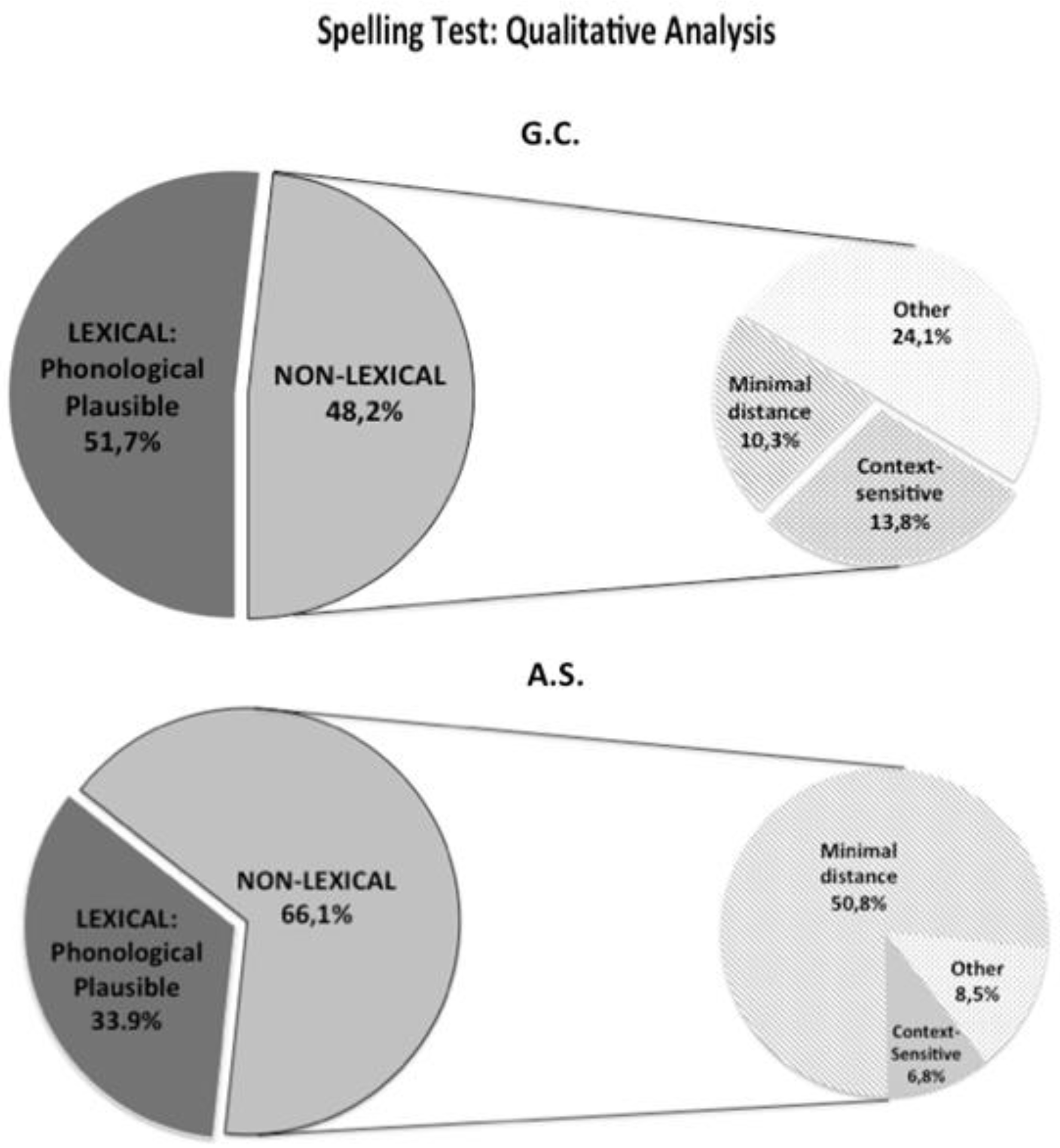
As reported in
Figure 2, A.S. committed prevalently phonological errors (66.1%). In particular, the most were minimal distance errors (50.8%; z = 20.97) and in particular doubling of a single consonant or dedoubling a doubled consonant. He also made many syllabic conversion errors (6.8%, z = 4.74) and simple conversion ones (8.5%, z = 3.84). Also phonologically plausible errors were not negligible (33.9%, z = 3.39).
On the contrary, most of the errors made by G.C. were phonologically plausible (51.7%, z = 2.12). However, minimal distance (10.3%, z = 1.41), syllabic conversion (13.8%, z = 4.74) and simple conversion (24.1%, z = 5.71) errors were also present.
Brief summary
Both the quantitative and the qualitative spelling analyses suggest a major impairment of the sub-lexical procedure in A.S. He presented greater difficulty with pseudowords compared to regular words and made numerous minimal distance misspellings, in particular on doubled consonants. However, in comparison to controls, it appears that the lexical procedure was not wholly efficient either.
On the contrary, G.C. suffered from an inefficient use of the lexical spelling procedure, while the sub-lexical one was better. In fact, he showed a selective impairment in spelling unpredictable transcription words, whose correct spelling require access to lexical orthographic representations. Moreover, error analysis revealed a prevalence of phonologically plausible errors, confirming a good knowledge and command of phonological processes.
Phonological Awareness
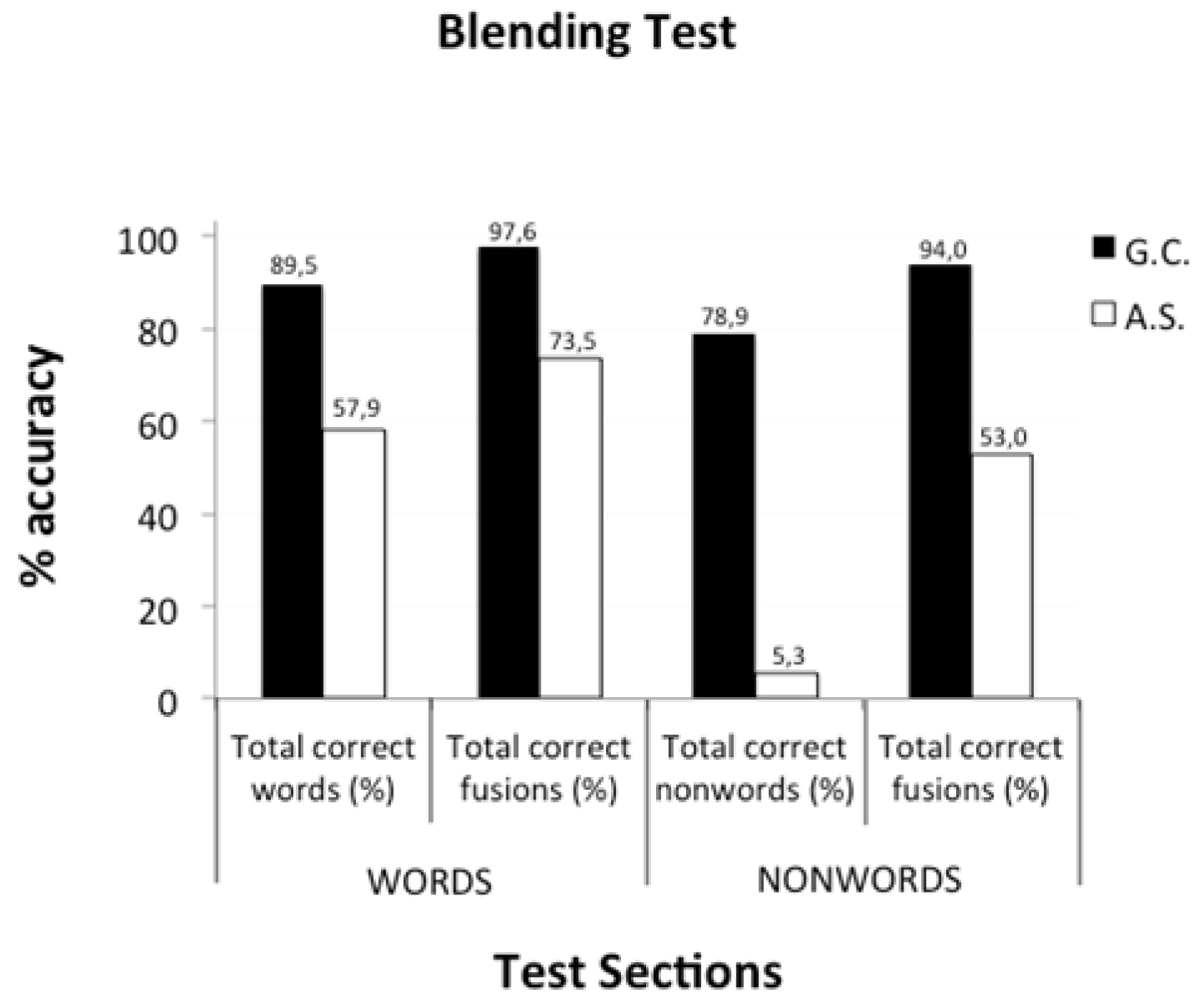
A.S.’s phonological awareness was impaired. In the word condition, he only managed to correctly produce 11 out of 19 items (58%) and made 61 blends out of 83 (73.5%). His performance was 1.6 standard deviation below controls on both items. With pseudowords, A.S. was significantly worse: he produced only 1 pseudoword correctly out of 19 (5.3%) and 44 blends out of 83 (53%). His performance was 4 standard deviations below controls.
On the contrary, G.C.’s performance was spared for each blending measure examined.
Experimental tasks on doubled consonants processing
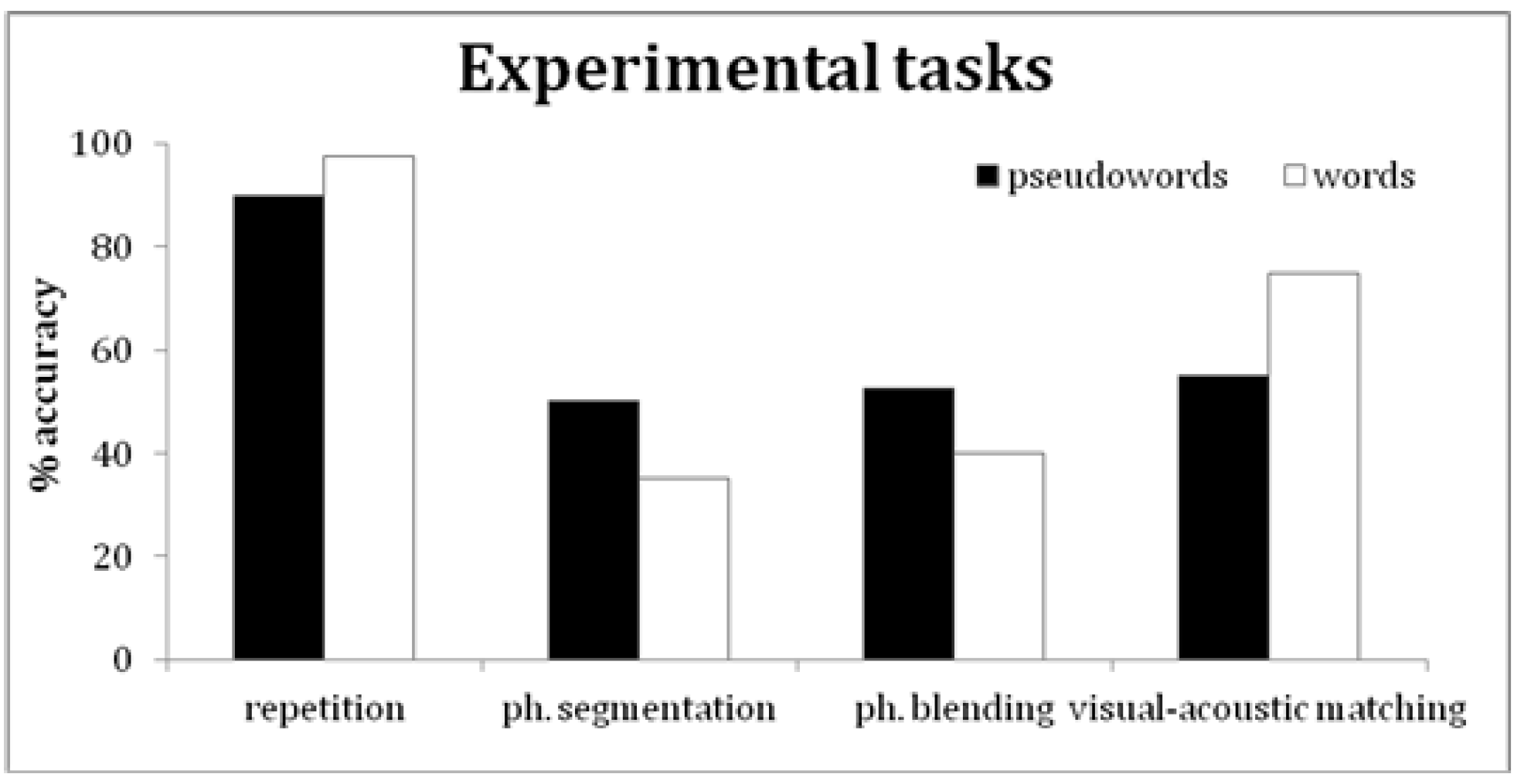
Accuracy of A.S. on the various tasks tapping doubled consonants processing was higher for repetition (93.7%) respect to phoneme segmentation (42.5%), phoneme blending (46.3) and visual-acoustic matching (65%). Logistic analysis confirmed significantly higher accuracy in the repetition than in each other task (at least p < .0001). Phoneme segmentation and blending did not differ (X2 = 0.24, ns) but both were performed with lower accuracy compared to visual-acoustic matching (at least p < .01). In each analysis the presence of doubled consonants significantly affected performance (at least p < .01), except for the analyses comparing repetition vs visual-acoustic matching and repetition vs phoneme blending. In fact during the repetition task, the child had similar performance with stimuli containing doubled vs single consonants (95% and 92% respectively). Similarly, in the visual-acoustic matching task, he reached 70% and 60% of accuracy with stimuli containing single vs doubled consonants. On the contrary, in meta-phonological tasks (phoneme segmentation and blending), accuracy depended from the presence of doubled consonants. In fact, in segmentation A.S. tended to produce always stimuli without geminate: he obtained 80% of accuracy on stimuli containing single consonants and only 5% on stimuli with doubled ones (that tended to segment always without geminate). In blending task, he tended to produce the stimuli with geminate: the accuracy was 63% and 30% on stimuli with doubled vs single consonants, respectively. A significant lexicality affect emerged in the comparison between repetition and visual-acoustic matching (p < .05).
In order to deeply examine the lexicality effect, separate analysis on words and pseudowords were carried out. Accuracy of A.S. on the various experimental tasks, separately for words and pseudowords, is reported in
Figure 4.
With words, all tasks‘ comparisons were significant (at least p < .05; for the direction of effect see the later paragraph), except for phoneme blending and segmentation that were performed with similar accuracy. The unique controlling variable significant was the presence of doubled consonants in phoneme segmentation vs repetition and visual-acoustic matching comparisons (X2 = 9.48, p < .05; X2 = 5.57, p < .01; respectively). With pseudowords, the performance in visual-acoustic matching worsened and reached an accuracy similar to that highlighted in meta-phonological tasks (phoneme bending and segmentation). The presence of doubled consonants affected the performance in each comparison (at least p < .05), except for the analyses comparing visualacoustic matching vs repetition and phoneme blending. Moreover, comparing visual-acoustic matching vs repetition and phoneme segmentation, also continuance of sounds was significant (at least p < .05).
Brief summary
A.S.’ performance in tasks tapping doubled consonants processing highlighted that difficulties were not limited to phoneme-grapheme mapping (investigated through a visual-acoustic matching test), but interested also phoneme bending and phoneme segmentation abilities. Then, it seems that the ability to represent and manipulate phonemes was impaired. On the contrary, repetition was good showing normal sensory elaboration as well as normal phonological output retrieval. Performance in the visual-acoustic matching worsened with pseudowords, probably due to the impossibility to compensate phonological difficulty through lexical processing. Moreover, with non lexical stimuli, also the presence of non continuant consonants significantly affected A.S.’ performance.
Discussion
The study reports the case of a child suffering from developmental phonological dyslexia and dysgraphia, as for control a second case displaying the characteristics of surface dyslexia and dysgraphia.
Most Italian dyslexic children have been described as suffering from surface dyslexia (
Marinelli et al., 2009,
Zoccolotti et al., 1999) and dysgraphia (
Angelelli et al., 2004,
Angelelli et al., 2010), since they showed a prevalent reliance on phonological procedure as highlighted by impaired lexical reading and defective irregular word spelling, with many phonological plausible errors. The reading and spelling performance of G.C. was coherent with a diagnosis of surface dyslexia and dysgraphia. G.C. showed a selective impairment in spelling words with unpredictable transcription, made mostly phonologically plausible errors with better transcription of regular one-phoneme-to-one-grapheme stimuli. Similarly, in reading G.C. relied on phonological rather than lexical procedure: he underperformed in task tapping the lexical procedure such as correction and comprehension of pseudo-homophones. Moreover, his phonological awareness was adequate, as demonstrated by good meta-phonological abilities. On the contrary, A.S.’s deficits seemed prevalently due to significant inefficiencies of the sub-lexical procedure. This would indicate, on the one hand, that also in a relatively shallow language, the acquisition of phoneme-to-grapheme mapping may be difficult in some children, despite the its easiness in normal development (e.g.,
Orsolini et al., 2003;
Tressoldi, 1996;
Seymour et al., 2003;
Marinelli et al., 2015, Marinelli et al., in revision). Given the significant difficulties that A.S. was still having in the fifth year of primary school, we consider possible that he might have adopted a lexical strategy to compensate his problems. This strategy, however, deprived by normal sub-lexical procedure development, remained incomplete. In fact, A.S. performed adequately on homophone tests, but underperformed on the other tasks being poor also in single graphemes reading. He showed a lexicality effect in reading, with worse performance in pseudoword compared to stimuli with a lexical status such as words. His reading errors were mainly phonological errors, i.e. inefficiencies of the grapheme-to-phoneme conversion (that in almost case generate pseudowords), while no lexical errors (i.e. stress errors), were detectable. In pseudoword reading A.S. made also numerous lexicalizations, as well as visual and semantic errors (words semantically and visually related to the target word). This could suggest incorrect attempts to overuse the lexical procedure in order to compensate phonological decoding difficulties. In spelling, both the quantitative and the qualitative analyses, suggested a main impairment along the phonological procedure: he had greater difficulty with pseudowords compared to regular words and made numerous minimal distance misspellings. The phenomenology of A.S.’ spelling deficit is coherent with what found in a recent study (
Angelelli et al., 2016) examining developmental dysgraphia in Italian dyslexic children with a history of Language Delay (LD). These children produced a higher rate of phonological errors respect to children without LD and controls and were more sensitive to acoustic-to-phonological variables, showing relevant failure especially in spelling stimuli containing geminate consonants but also polysyllabic stimuli and those containing non-continuant consonants. In this study we did not directly test A.S. linguistic skills, however we can suppose, retrospectively, a history of language delay.
To summarize, in Italian, the high consistence of orthographic mapping render the acquisition of the phoneme-to-grapheme and grapheme-to-phoneme conversion rules very easy. In fact almost all children master the phonological processing very early (
Orsolini et al., 2003), and Italian dyslexic and dysgraphic children show prevalently a defective lexical procedure acquisition (
Angelelli et al., 2010). However, also the acquisition of sub-lexical mapping may be difficult, especially in children with concomitant language weakness. For this reason it is very important for therapists and teachers to take into consideration this possibility and to promote a strengthening of reading and spelling skills in children with a history of language deficit. Moreover, an open question remains if cases of phonological reading and spelling deficits might occur also in absence of a history of language deficit.
Regarding the A.S.’s difficulty in processing stimuli with doubled consonant, results highlighted that phonetic-to-phonological variables such as the presence of doubled consonants and also continuance of sounds affected the phonological-to-orthographic (and vice versa) conversion (for coherent data see
Angelelli et al., 2016). Also the lexical status of stimuli affected the performance, with better performance on words compared to pseudowords. This latter phenomenon might be due to greater difficulties in retaining stimuli without lexical status (absent in the phonological lexicon), as well as to the impossibility to compensate phonological decoding difficulties by a lexical support. Moreover, results highlighted also that phonological difficulty in processing stimuli with doubled consonants was not limited to phoneme-to-grapheme (and vice versa) conversion. A.S., in fact, underperformed not only in the visual-acoustic matching but also in tasks requiring phonological awareness such as phoneme segmentation and phoneme blending.
However, the spared performance in repetition seemed to exclude the possibility of acoustic discrimination deficits, as well as deficits in the phonological output retrieval. On the other hand,
Marinelli et al. (
2011) failed to find a deficit in repetition in Italian dyslexic children (while the performance in reading the same stimuli presented visually was severally impaired). Data were coherent with those on English dyslexic children (
Ramus, 2003) reporting that a phonological deficit can appear in absence of sensory disorders.
The question regarding the functional locus of phonological reading and spelling deficits remain debated. Some authors support the hypothesis of a primary sensorial deficit which involves the elaboration of both linguistic and non linguistic stimuli (
Tallal et al., 1996); others support the hypothesis of a phonological coding/decoding impairment, relative to the extraction of phonological invariants from an acoustic flow (e.g.,
Liberman, 1998). Alternatively the locus of phonological spelling and reading difficulties may be linked to phonological awareness deficits. In the present study we have deeply examined only the ability to process stimuli with doubled consonants, and data do not support a sensory impairment (as highlight by the good performance of A.S. in the repetition task) but indicate both phonological awareness and phonological-to-orthographic conversion deficits.
Moreover, it is interesting to note that both children showed concomitant dyslexia and dysgraphia as well as a closer parallelism between reading and spelling deficits. Comorbidity and identical direction of the two deficits suggested the use of the same strategy for reading and spelling. Regarding lexical deficits, several studies (see
Angelelli et al., 2010 for data on Italian children) have found, through an item-by-item analysis, that when children have the orthographic representation of a word in their lexicon, they use the lexical procedure regardless of the task (reading or spelling). Conversely, when this representation is unavailable, both reading and spelling are impaired. Data support the hypothesis of a unique orthographic lexicon, used for both reading and spelling in dyslexic and dysgraphic children as well as in young normal reader (
Allport & Funnell, 1981;
Behrmann & Bub, 1992;
Coltheart & Funnell, 1987). Regarding phonological deficits, it is clear that children that do not master the phonological processing have impaired performance in both oral-to-written and written-to-oral conversion, and that performance will be affected by the same variables in reading and spelling. These findings also have educational/clinical implications, because it appears that training reading ability can improve spelling ability, and vice versa. This can be advantageous for learning (
Conrad, 2008;
Ehri, 1980;
Ehri & Wilce, 1986;
Share, 2004) and rehabilitation. In fact, several developmental studies, have reported generalization of reading treatment effects to spelling and vice versa (
Brunsdon et al., 2002; Lorusso et al., 2004;
Lorusso et al., 2006;
Brunsdon et al., 2005).
In conclusion the present study examined a rare case of phonological dyslexia and dysgraphia in Italian, a very consistent orthography, highlighting the role of concomitant deficits of phoneme representation and phoneme manipulation.