


Abstract
Branched poly(vinyl alcohol) (PVA) was synthesized via chemical modification of linear PVA with epichlorohydrin in an alkaline aqueous medium under conditions preventing crosslinking. Branching was confirmed by IR and Heteronuclear Single Quantum Coherence (HSQC) spectroscopy, as well as by viscometric analysis. An iterative procedure is proposed for refining the branching factor (g) and the viscosity-average molecular weight of the branched macromolecules. Coil diameters determined by viscometry and dynamic light scattering showed satisfactory agreement. While an increase in the viscosity-average molecular weight of branched PVA enhances its surface activity in the low-adsorption region, the branched geometry itself hinders subsequent adsorption due to steric shielding of the interface. This correlates with wetting behavior on Teflon: lightly branched PVA requires a higher concentration to induce wetting inversion than its linear counterpart but further increase in molecular weight shifts the inversion point to lower concentrations due to a higher density of hydroxyl groups. Concurrently, the concentration dependence of the work of adhesion degenerates with increasing molecular weight. Despite their reduced adsorption capacity, the specific geometry of branched PVA macromolecules provides effective steric stabilization of micrometer-sized particles during styrene suspension polymerization. These results demonstrate that chain branching in PVA is a powerful tool for tuning its adsorption properties, stabilizing ability, and interfacial activity.
1. Introduction
Polyvinyl alcohol (PVA) is water-soluble [1,2], non-toxic [3,4], biocompatible [5,6,7] and is the initial polymer for obtaining a number of hydrogels, primarily for biomedical purposes [8,9,10,11,12]. The surface tension-reducing properties of PVA and its adsorption at interphase boundaries [13,14] have generated interest in the use of aqueous solutions of this polymer as a stabilizer in suspension polymerization [15,16], and the tendency to form ordered regions upon cooling opens the way to obtaining physical gels [17,18,19,20,21,22]. In addition, PVA can be crosslinked by a number of reagents, such as polybasic carboxylic acids, borates, potassium persulfate [23], bis(hydroxyethyl)sulfone [24], formaldehyde [25], glyoxal [26], glutaric dialdehyde [27], and epichlorohydrin [28,29,30], as well as by the radical polymerization reaction with preliminary chemical modification of hydroxyl groups by reagents containing unsaturated groups [31,32]. The variety of methods for producing PVA gels is significantly expanded due to its ability to form interpolymer mixtures with natural polysaccharides [33,34,35,36,37].
Another approach to modifying PVA involves chain grafting. This process allows for targeted adjustments to the adhesive, colloidal, and physical–mechanical properties of materials based on it [38,39,40]. At the same time, the PVA chain branching with the formation of water-soluble polymers with increased hydroxyl group density within the macromolecular coil has received significantly less attention, limited to isolated studies [41,42,43,44,45]. Thus, branched polymers, including branched PVA (br-PVA), hold promise for developing composite materials with high mechanical strength [46], alternative to metal–organic framework (MOF) protective films [47], and stabilized dispersions of electrically conductive polymers [48]. Herewith, the PVA chain branching may be of interest for stabilizing particles in suspension polymerization, influencing the adsorption properties of this polymer along with traditional factors such as the residual content of acetate groups [49,50], average molecular weight [51], and concentration and temperature [52], which determine the morphology and size of the resulting micrometer-sized particles [53].
Therefore, this article is devoted to establishing the colloidal behavior of br-PVA of various molecular weights, recently synthesized via chemical modification of linear PVA (l-PVA) with epichlorohydrin in alkaline medium [54,55]. br-PVA had a reduced ability for adsorption at interphase boundaries (at significant concentration), but at the same time effectively stabilized micrometer-sized particles (polystyrene) during styrene suspension polymerization. Thus, the branching of the PVA chain promotes steric shielding of the adsorbent surface already at a low degree of surface filling and prevents further adsorption of macromolecules. This circumstance can be used to ensure the effectiveness of the mechanism of steric stabilization of particles by br-PVA chains adsorbed on the surface. The branched geometry of synthesized macromolecules has led to a number of fundamental features of colloid–chemical properties, significantly distinguishing them from those typical for traditional l-PVA.
2. Materials and Methods
2.1. Materials
Linear polyvinyl alcohol PVA-1799 (“TexHim”, Moscow, Russia, degree of hydrolysis 99–100%, ≈ 80 kDa), epichlorohydrin (“Kemstor”, Moscow, Russia, 99.8%), NaOH (“Khimmed”, Moscow, Russia, 99%), distilled styrene (“LabStore”, Moscow, Russia, 99%), benzoyl peroxide (“Sigma-Aldrich”, St. Louis, MO, USA, 75% with water content 25%) and distilled toluene (“RusKhim”, Moscow, Russia, 99%) were used in obtaining the interfacial tension isotherms (Section 2.2.4).
2.2. Methods
2.2.1. Characterization of br-PVA
Viscosity measurements of aqueous solutions of the original l-PVA and br-PVA were performed on the Ubellode viscometer VPZh-4 (“Labtex”, Moscow, Russia, d = 0.62 mm; K = 0.01 mm2·s−2). Viscometric measurements were carried out at a dissolved PVA concentration of up to 0.025 g·mL−1 at a temperature of 25 °C, performing five independent measurements at each experimental point. The structure of l-PVA and br-PVA was studied by HSQC spectroscopy (Bruker Avance 500, D2O solution), as well as by recording IR spectra (Nicolet-380) from tablets obtained by pressing 1 mg of polymer with 100 mg of potassium bromide. The size of macromolecular coils in aqueous solutions of br-PVA was determined by dynamic laser light scattering (DLS) using Photocor Complex (Photocor, Moscow, Russia). Measurements of the size distribution and zeta potential of polystyrene particles were performed using a Zetasizer Nano ZS (Malvern, UK).
2.2.2. Surface Tension of br-PVA Aqueous Solutions
Surface tension isotherms were obtained by the Du Noüy ring detachment method on a Kruss K6 tensiometer (Hamburg, Germany) at a temperature of 25 °C. Measurements were carried out for aqueous solutions of PVA in the range of macromolecular concentrations from 2 g·dL−1 to 6.25·10−2 g·dL−1. Measurements at each concentration were carried out 5 times.
2.2.3. Isotherms of Teflon Surface Wetting with Aqueous Solutions of PVA
Measurements of contact angles of wetting on the stationary Teflon surface were carried out after automated (using a microsyringe “LabStore” (Moscow, Russia)) application of drops of l-PVA and br-PVA aqueous solutions with the macromolecular concentration from 2 g·dL−1 to 6.25·10−2 g·dL−1 in a volume of 2–3 μL. The measurements were repeated five times on the KRUSS GmbH goniometer (Hamburg, Germany).
2.2.4. Isotherms of Interfacial Tension at the “PVA Aqueous Solution—Toluene” Phase Boundary
The interfacial tension measurements at the “PVA aqueous solution—toluene” phase-boundary were performed with hanging drops of water and aqueous solution of PVA on the Teclis Tracker tensiometer (Teclis-Scientific, Civrieux-d’Azergues, France, accuracy ±0.1 mJ·m−2) at a temperature of 25 ± 1 °C. The interfacial tension steady-state value corresponding to a given concentration of PVA was determined from the dynamic interfacial tension value at the point in time when it ceased to change (Center for Collective Use of INEOS RAS). Toluene was used as a model for styrene because its surface properties are nearly identical. However, unlike styrene, toluene is not prone to side reactions, such as polymerization and oxidation, affecting the measured interfacial tension values.
2.2.5. Scanning Electronic Microscopy of Latex
Scanning electron microscopy (SEM) was used to visualize polystyrene micrometer-sized particles obtained by styrene suspension polymerization in the presence of br-PVA as a steric stabilizer (see Section 2.4). Micrographs were obtained on the S-570 scanning electron microscope (Hitachi, Hitachinaka, Japan). A stabilized dispersion of polymer microspheres was diluted 50-fold with distilled water. Then, a sample was taken and placed on the object table. After the dispersion had been dried for 24 h at 25 °C, micrographs were recorded at an accelerating voltage of 1 kV.
2.3. Synthesis of br-PVA
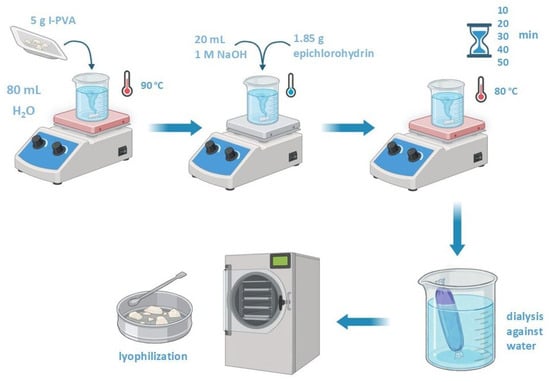
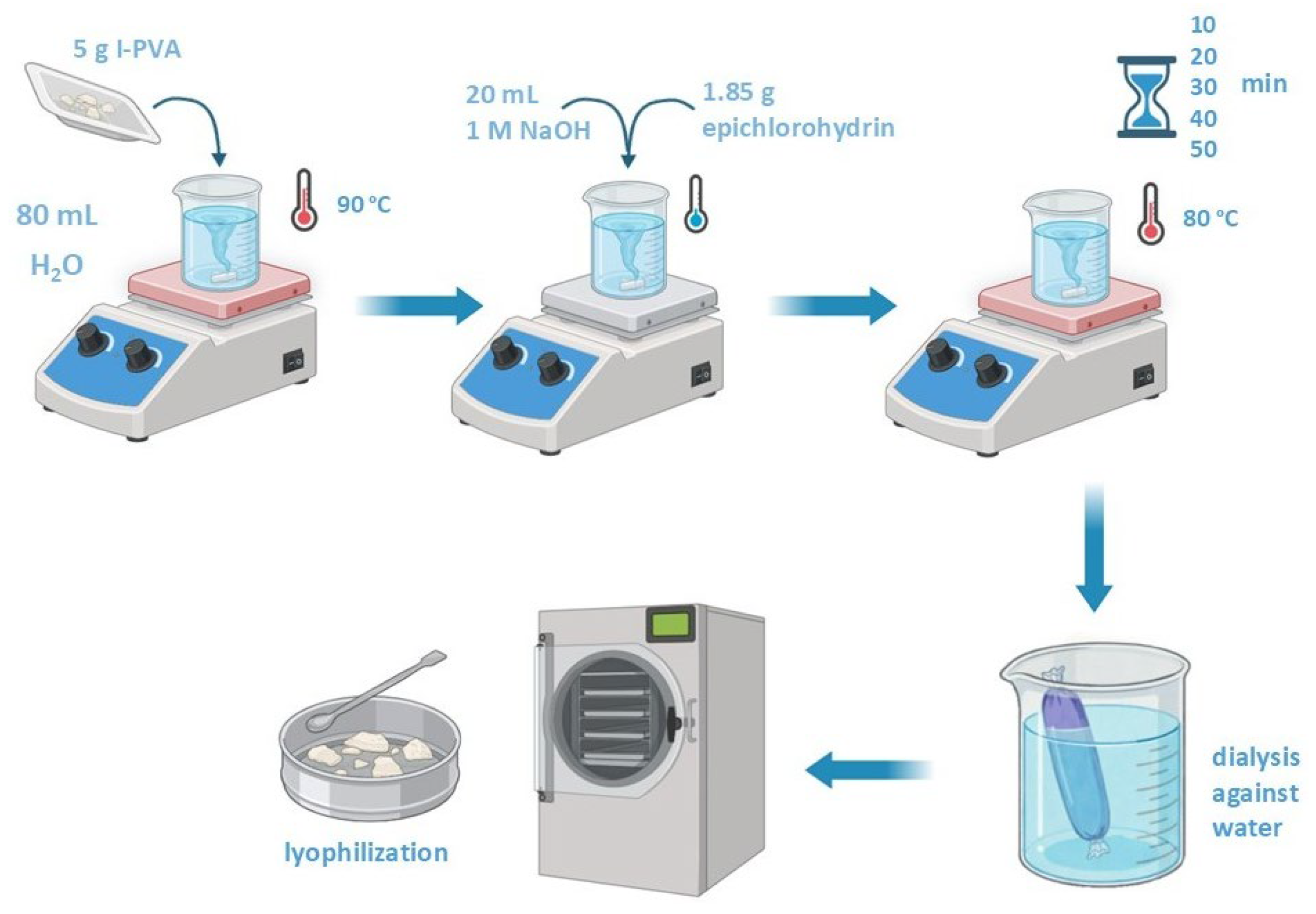
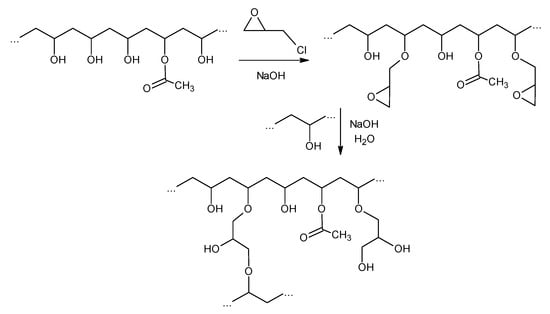
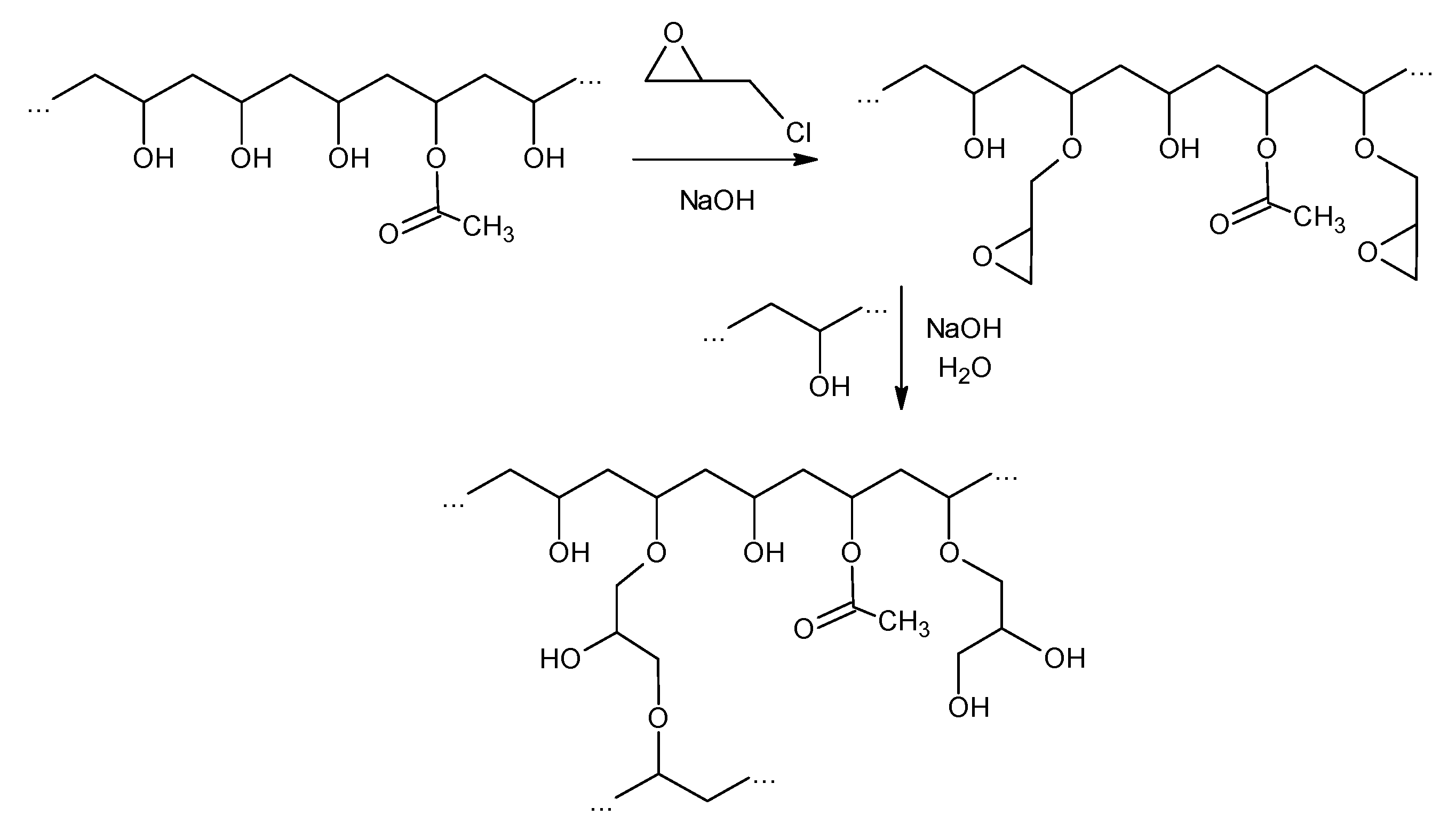
A total of 5 g of l-PVA (PVA-1799) were dissolved in 80 mL of distilled water under stirring and heating to 90 °C. The prepared solution was cooled down to 50 °C and 1.85 g (0.02 mol) of epichlorohydrin and 20 mL of an aqueous NaOH solution with a concentration of 1 mol·L−1 were successively added. Chemical modification of PVA with epichlorohydrin was carried out at 80 °C for 10, 20, 30, 40 and 50 min, followed by polymer product purification by dialysis against water and lyophilization (Martin Christ Alpha 1-4LD lyophilizer (Osterode am Harz, Germany)) [48]. The synthesis process for br-PVA is illustrated in Figure 1.
Figure 1.
The process of br-PVA synthesis.
2.4. Use of PVA for Micrometer-Sized Particles Stabilization in Styrene Suspension Polymerization
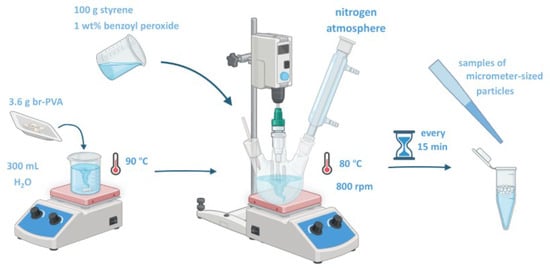
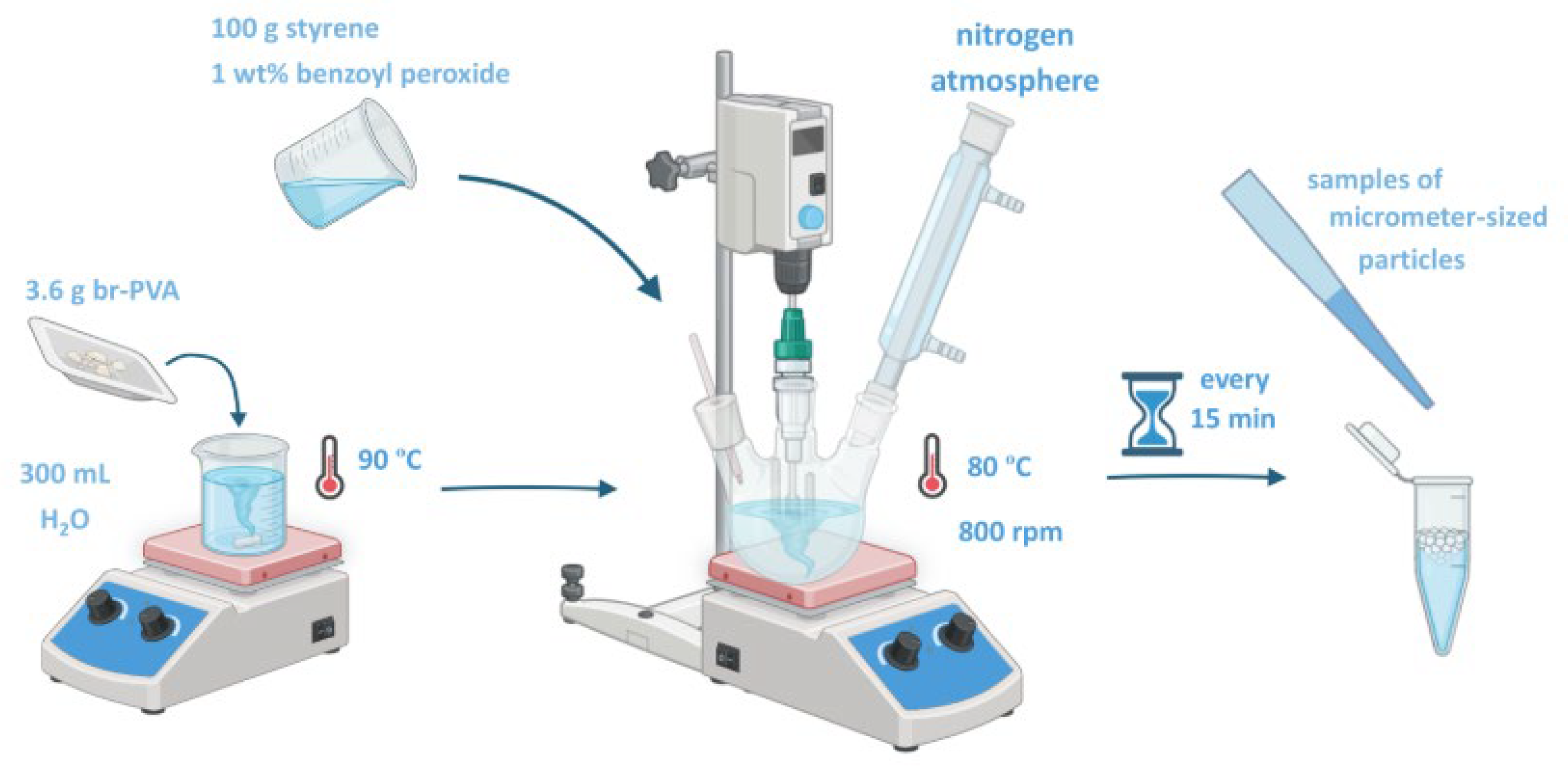
A total of 3.6 g of br-PVA obtained by chemical modification of l-PVA for 50 min, as described in Section 2.3, were dissolved in 300 mL of distilled water under heating at 90 °C and stirring. Then, 100 g of styrene containing 1 wt% of dissolved initiator (benzoyl peroxide) were dispersed in the resulting solution by stirring. Polymerization was carried out in a nitrogen atmosphere at 80 °C and keeping a constant stirring (800 rpm). Samples of the reaction system were taken every 15 min, isolating and weighing polystyrene micrometer-sized particles. Suspension polymerization of styrene was also carried out under similar conditions in the presence of l-PVA. Figure 2 illustrates the process of synthesizing polystyrene micrometer-sized particles via suspension polymerization of styrene.
Figure 2.
Suspension polymerization of styrene in the presence of br-PVA as a stabilizer.
3. Results and Discussion
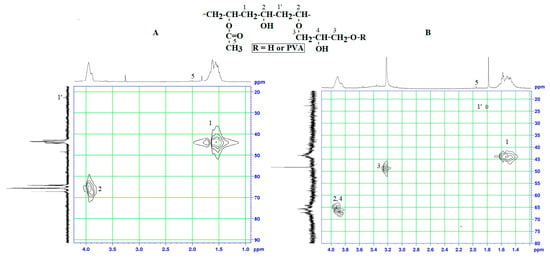
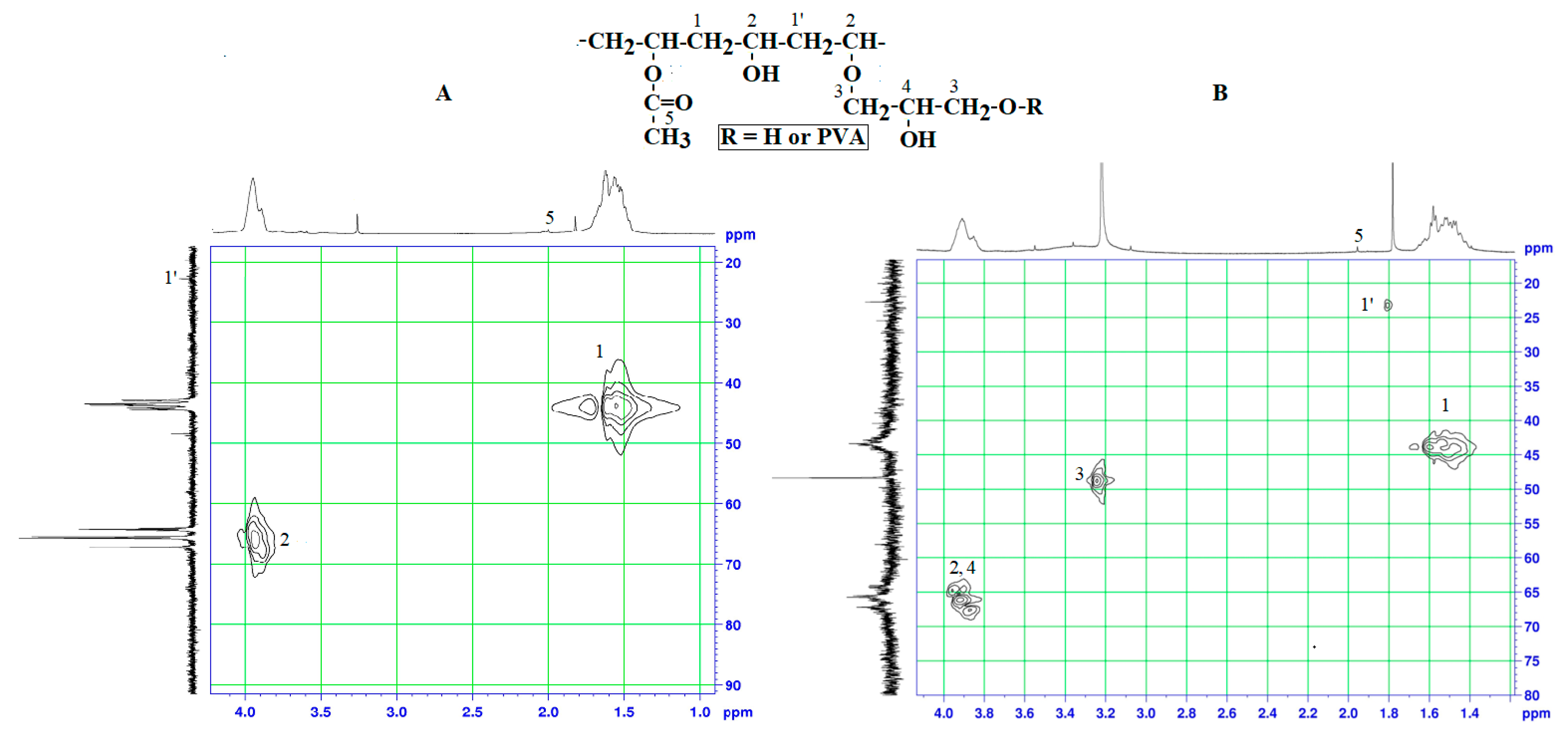
The reaction of PVA with epichlorohydrin in alkaline aqueous media is known to produce gels with a low density of chemical crosslinking, averaging approximately three crosslinks per macromolecule [56]. This circumstance creates an opportunity to suppress crosslinking by selecting suitable conditions for intensification of hydrolysis of glycidyl groups introduced into the chain, as well as by isolating branched macromolecular products from the reaction system before it loses its ability to flow viscously [54]. The resulting polymers were water-soluble, which excluded the formation of a three-dimensional macromolecular network. According to HSQC and IR spectroscopy data, the obtained macromolecular products exhibit all the typical signals characteristic of l-PVA, as well as signals indicating the polymer chain branching. The group of signals with chemical shifts in the region of 1.4–1.7 ppm refers to CH2 groups of PVA units of different stereochemical configurations (Figure 3). The signal at 1.8 ppm corresponds to the CH2 protons of the br-PVA chain units (Figure 3B). Multiplets with chemical shifts of 3.8–4.0 ppm (Figure 3) belong to protons of CH groups in different environments [57]. A low-intensity signal with the chemical shift at about 1.95 ppm corresponds to protons of methyl fragments of residual acetyl groups [58]. The signals with chemical shifts of 45 ppm and 65 ppm in the 13C NMR spectrum are typical for PVA and correspond to the CH2 and CH groups in the main chain, respectively [59]. The expanded signal of protons with the chemical shift at 3.22 ppm and the corresponding signal of carbon atoms with the chemical shift at 48.36 most likely belong to methylene groups of chain-branching units (Figure 3B), as well as to CH groups of a small number of units fused head-to-head. The low-intensity signals at 1.83 ppm and 3.26 ppm in the 1H NMR spectrum of the initial l-PVA (Figure 3A) are presumably attributed to the CH2 groups of head-to-head units [60]. For protons of PVA hydroxyl groups and water, which are in state of rapid exchange, the signals appear in the region of chemical shifts of 4.5–5.0 ppm. Thus, the intense signals at 1.8 ppm and 3.22 ppm in the 1H NMR spectrum, along with their correlated signals in the 13C NMR spectrum, correspond to the CH2 and CH fragments of the chain-branching units in PVA.
Figure 3.
HSQC spectra of l-PVA—(A) and br-PVA—(B) (solvent D2O).
Chain branching also leads to a noticeable broadening of the lines in the 1H and 13C NMR spectra of branched PVA compared to its linear analog (Figure 3). This broadening results from a decrease in spin–spin relaxation time, caused by reduced segmental mobility due to a higher density of units within the macromolecular coils and the formation of denser hydration shells.
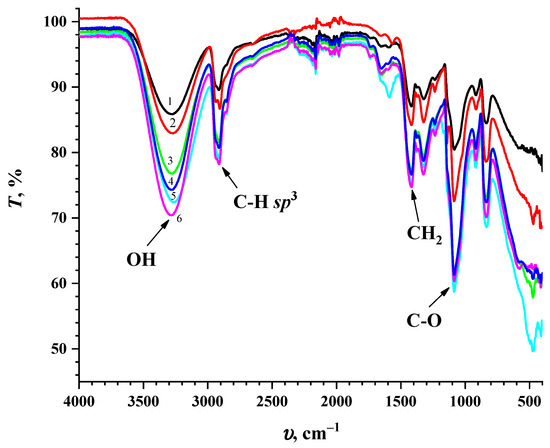
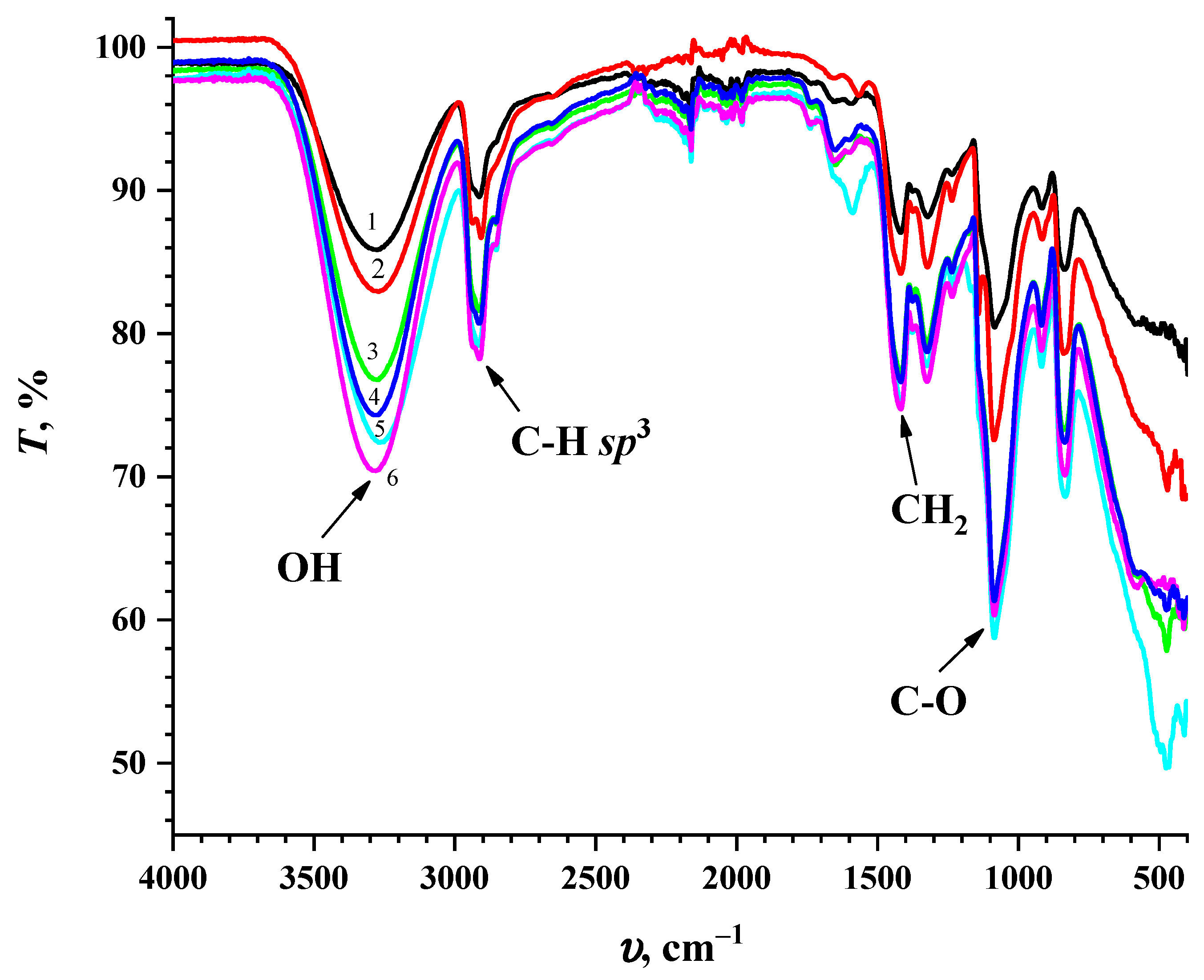
The IR spectra of l-PVA and its chain-branching products, isolated after chemical modification of varying durations, are shown in Figure 4.
Figure 4.
IR spectra of l-PVA—1 [48] and br-PVA obtained after 2—10 min; 3—20 min; 4—30 min; 5—40 min; and 6—50 min of modification with epichlorohydrin in an aqueous NaOH solution.
The IR spectra of linear and branched PVA contain all the signals characteristic of these polymers [61,62,63,64,65]. The broad intense band at 3500–3100 cm−1 corresponds to O-H stretching vibrations involved in hydrogen bonding. The peaks at about 2900 cm−1 correspond to asymmetric and symmetric stretching vibrations of C(sp3)-H bonds belonging to CH2 groups. The absorption bands at 1450–1400 cm−1 are due to bending vibrations of CH2 groups, and the absorption at about 1100 cm−1 is due to stretching vibrations of C-O bonds. With increasing duration of chemical modification, the intensity of the O–H stretching band increases (Figure 4). This reflects a higher density of hydroxyl groups within the macromolecular coils resulting from chain branching. This finding agrees with the broadening of the NMR lines following chain branching (Figure 3). The band intensity of C-O stretching vibrations also increases significantly (Figure 4). This is attributed to the introduction of ether groups and additional hydroxyl groups into the chain of br-PVA formed during chemical modification of the original l-PVA with epichlorohydrin in an aqueous NaOH. The increase in intensity of the absorption bands at 3100–3500 cm−1 and ~1100 cm−1 with longer modification times therefore correlate with the occurrence of chain branching (Figure 5).
Figure 5.
Mechanism of PVA chemical modification with epichlorohydrin in an aqueous NaOH solution.
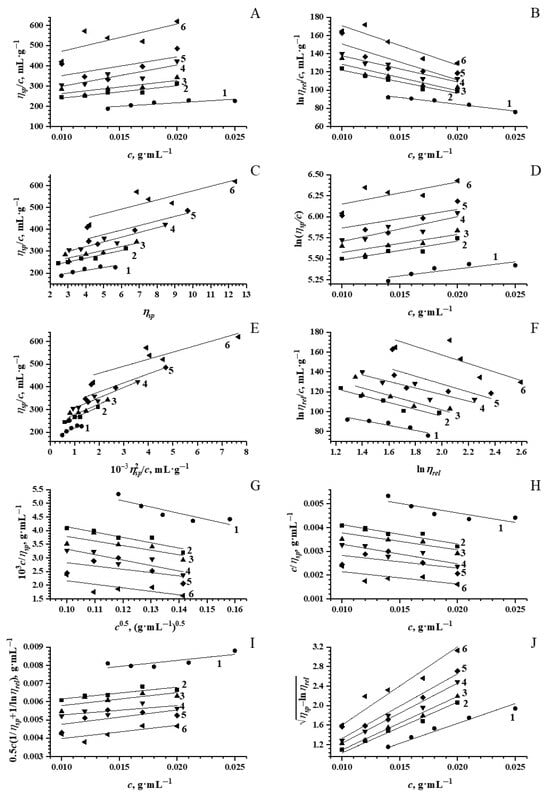
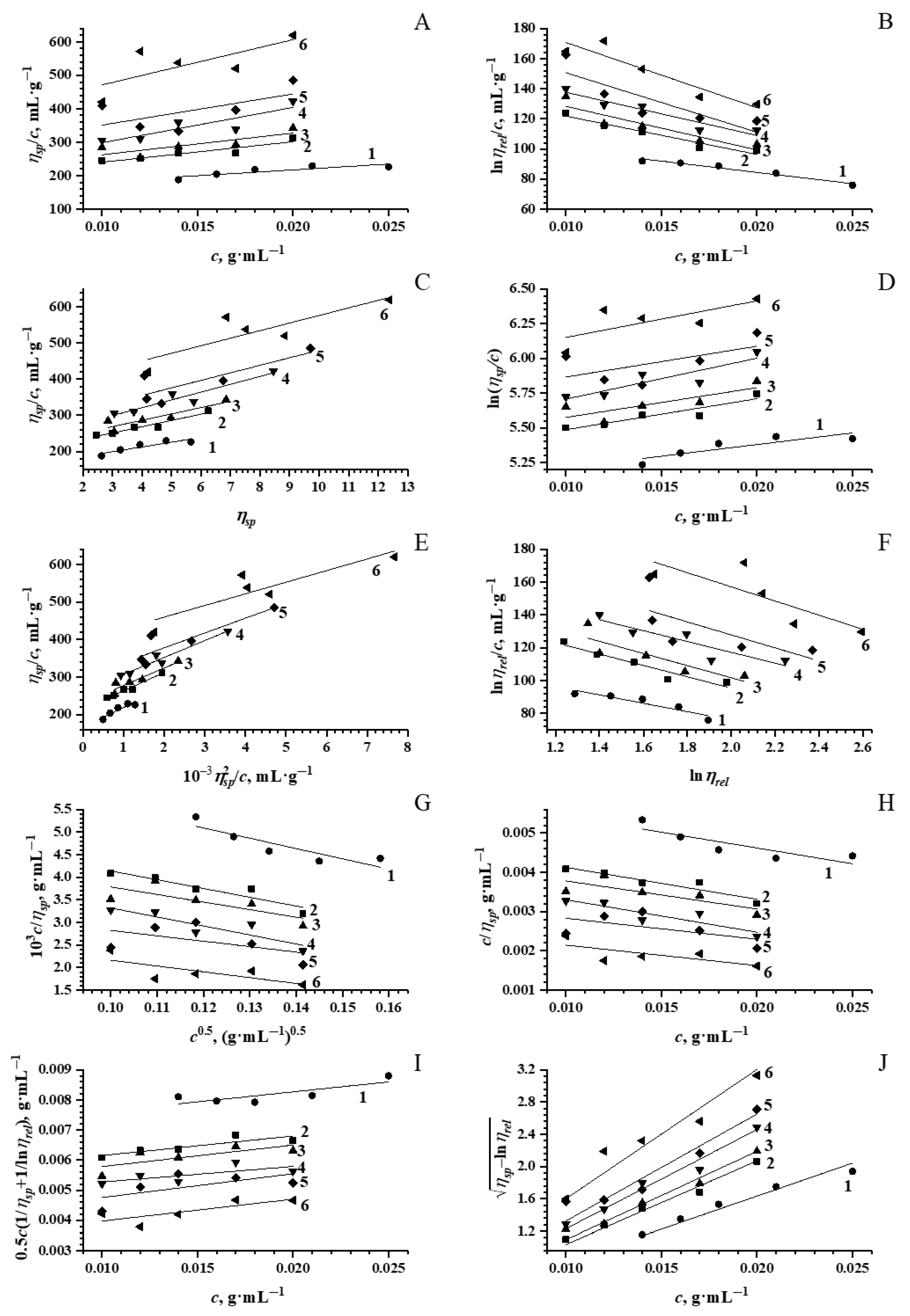
As shown earlier, the branching of PVA chain is accompanied by an increase in the reaction system viscosity over time [54]. Therefore, for aqueous solutions of the initial linear PVA and branched samples synthesized after 10, 20, 30, 40, and 50 min of modification, the viscosity was measured as a function of polymer concentration. These experimental dependences were approximated by ten different equations [66,67,68,69,70,71,72,73,74,75], mainly describing the dependence of relative or specific viscosity of polymer solutions on their concentration (Figure 6, Table 1).
Figure 6.
Viscosity dependences of br-PVA aqueous solutions on concentration, presented in linear coordinates corresponding to the following equations: (A)—Huggins [67]; (B)—Kraemer [68]; (C)—Schulz, Blaschke [69]; (D)—Martin [70]; (E)—Kreisa [71]; (F)—Arrhenius–Rother–Hoffmann [72]; (G)—Fuoss [73]; (H)—Heller (I) [74]; (I)—Heller (II) [74]; (J)—Solomon–Ciutǎ [48,75] (1—76.8 kDa (l-PVA); 2—107.2 kDa; 3—116.1 kDa; 4—136.9 kDa; 5—153.1 kDa; 6—201.6 kDa).
Table 1.
Parameters of the equations describing the dependence of br-PVA aqueous solutions’ viscosity on their concentration (Figure 6) (R2—determination coefficient; KH—Huggins constant; KKm—Kraemer constant; KSB—Schulz–Blaschke constant; KM—Martin constant; KKr—Kreisa constant; KARH—Arrhenius–Rother–Hoffmann constant; KF—Fuoss constant; KHe1, KHe2—Heller constants) [66].
As can be seen (Table 1), the best approximation accuracy is achieved using the Kremer and especially the Solomon–Ciutǎ equations. The Solomon–Ciutǎ [75] Equation (1) not only allows us to achieve the unprecedentedly high accuracy of experimental data description (Figure 6J, Table 1) but also does not contain any constants, directly linking the relative viscosity, characteristic viscosity, and concentration of linear and branched PVA solutions [48].
where , , stand for the characteristic, relative and specific viscosities of PVA aqueous solutions; c is the concentration of PVA solution.
Since PVA formed as a result of chemical modification and is a branched polymer, then the direct substitution of characteristic viscosity of its aqueous solution () into the Mark–Kuhn–Houwink Equation (2) leads to underestimated values of viscosity-average molecular weight ().
where is calculated at i-th iteration, is the characteristic viscosity calculated at i-th iteration for an aqueous solution of l-PVA with a equal to that of br-PVA (the value of [η]br was calculated in accordance with Equation (1) (Figure 6J, Table 2) and then inserted into Equation (2) at zero iteration), and a = 0.77 and K = 0.02 mL·g−1 are the constants in the Mark–Kuhn–Houwink equation for l-PVA solutions in water [76,77].
Table 2.
Refinement of the of br-PVA isolated after chemical modification of l-PVA with epichlorohydrin in an aqueous NaOH solution for a given time (τ) by the iteration method.
Therefore, it is necessary, by using the Zimm–Kilb Equation (3) [78,79], to recalculate the characteristic viscosity of br-PVA solution into the characteristic viscosity of a hypothetical l-PVA solution, which has the same as the branched polymer.
where is characteristic viscosity of br-PVA solution, calculated in accordance with Equation (1) and is the ratio of gyration root-mean-square radii for branched and l-PVA macromolecules of equal molecular mass in θ-solvent, calculated at i-th iteration.
-factor for statistically branched macromolecules with trifunctional branching nodes was calculated using Equation (4) obtained by fourth-degree polynomial approximating of tabular data given in [80,81] (Supplementary Materials).
where and are g-factor and the number of branches on average per chain, respectively, calculated at the i-th iteration, respectively.
The random introduction of short side 1,2-diol groups (formed by hydrolysis of glycidyl fragments) is unlikely to significantly affect the root-mean-square radius of gyration of the macromolecules. Therefore, any substantial change in this parameter can be attributed solely to the presence of a small number of long-chain branches (Figure 5). Thus, assuming that the main contribution to the increase in molecular weight of chemically modified PVA is made by long-chain branches, it is possible to estimate value according to Equation (5):
where is average number of long-chain branches corresponding to the i-th iteration, and is the of br-PVA isolated after τ minutes of chemical modification, calculated at (i − 1) iteration using Equation (2) and − of the initial l-PVA.
At the same time, short-chain branches cannot significantly affect the molecular weight of the modified products either, since only 17.6 mol % of epichlorohydrin (relative to the hydroxyl groups) was used, and a substantial portion of it underwent hydrolysis [55]. The contribution of short branches in the PVA chains to the of the resulting macromolecules is discussed in the Supplementary Materials.
The value of b(i) calculated from Equation (5) represents the average branching density per original linear PVA macromolecule.
The need for an iterative procedure arises from the fact that Equation (2) underestimates , and consequently the number of branches per macromolecule (Table 2). At the same time, two iterations are already sufficient to obtain converging values of (Table 2). In this case, the values of of PVA calculated, taking into account corrections for chain branching, differ by no more than 9.4% from those determined without taking them into account, which is a consequence of the low density of long branches. As can be seen, the average branching density per original linear PVA macromolecule () does not exceed 1.61. At the same time, the proposed iterative method can be useful for calculating the of any randomly branched macromolecules if the average multiplicity of increase in molecular weight of chains per branching is known from the mechanism of their formation. The method described here for calculating for br-PVA is likely more accurate than the previously used method, which assumed a value of of 0.95 for all branched PVA macromolecules [48]. The main characteristics of the synthesized br-PVA macromolecules are provided in the Supplementary Materials, along with Table 1 and Table 2.
The calculated values of and can be used to estimate the average diameter of the macromolecular chains in aqueous solution by using the fundamental Flory–Fox viscosity Equation (6) [82]:
where is the Flory viscosity constant, taken as 2.1·1023 mol−1 when the characteristic viscosity is expressed in mL·g−1, and is the average diameter of the macromolecular coils in aqueous solution determined by viscometry.
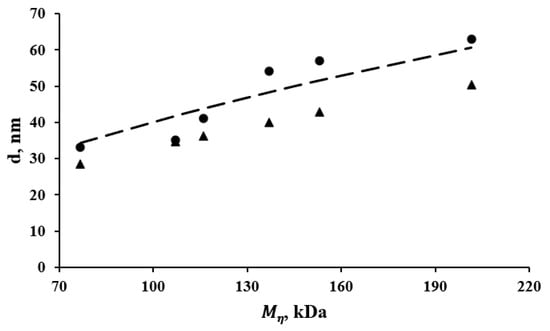
Dynamic light scattering was used as an independent method to determine the average diameter of the macromolecular coils of branched PVA in aqueous solution. The results obtained showed satisfactory agreement with the viscometry data (Figure 7).
Figure 7.
Average diameters () of branched PVA macromolecular coils in aqueous solution as a function of viscosity-average molecular weight , determined by viscometry (triangles) and dynamic light scattering (circles). The dashed line represents the fit to the DLS data using the equation .
The dependence of the average coil diameter on the viscosity-average molecular weight can be fitted by Equation (7).
The constants α and β in Equation (7) are 0.045 and 0.59, respectively, which are similar to solutions of linear flexible chains polymers (like 1,4-polybutadiene, 1,4-polyisoprene, polyisobutylene, polystyrene and poly(α-methylstyrene)) in thermodynamically good organic solvents of different polarities [83]. Thus, the viscosity-average molecular weights and the corresponding coil sizes determined by viscometry are in satisfactory agreement with the results obtained from dynamic light scattering (Figure 7).
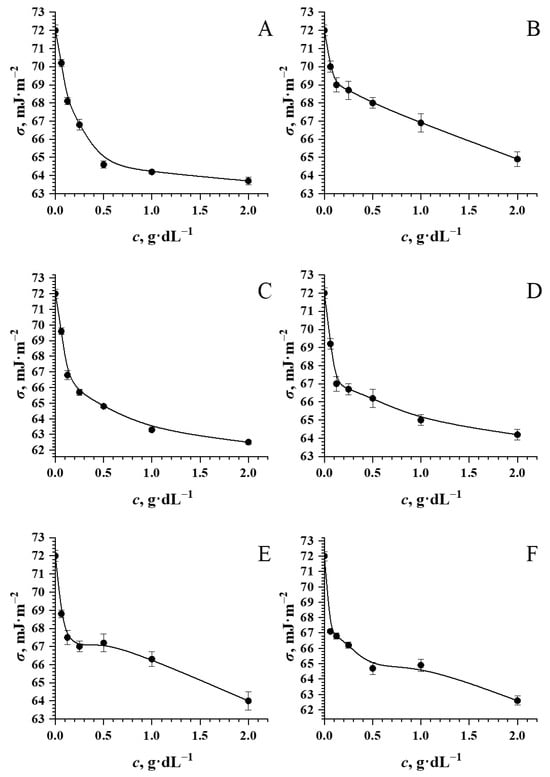
When dissolved in water, the synthesized macromolecules of br-PVA contributed to a moderate decrease in surface tension from 72 mJ·m−2 to 62–64 mJ·m−2 (Figure 8).
Figure 8.
Surface tension isotherms of aqueous solutions of br-PVA with : (A)—76.8 kDa (l-PVA); (B)—107.2 kDa; (C)—116.1 kDa; (D)—136.9 kDa; (E)—153.1 kDa; (F)—201.6 kDa (circles represent experimental data points).
So, if the adsorption of the initial l-PVA satisfactorily obeys the Langmuir isotherm, then significant deviations are observed for br-PVA macromolecules (Supplementary Materials). However, in the region of low adsorbate concentrations, the Henry adsorption equilibrium constant () can be calculated using Equation (8) (see Supplementary Materials):
where is Henry’s adsorption equilibrium constant, is the universal gas constant, [K] is the temperature, and [mol·m−3] is the concentration of br-PVA in an aqueous solution.
After plotting tangents to the surface tension isotherms (Figure 8) in the region of low br-PVA concentrations in aqueous solution, the values of were calculated using Equation (8). As can be seen, the value of , which is a measure of the surface activity of br-PVA in an infinitely diluted aqueous solution, increases rapidly with increasing (Figure 9).
Figure 9.
Dependence of br-PVA aqueous solutions in “ vs. ” coordinates (circles represent experimental data points).
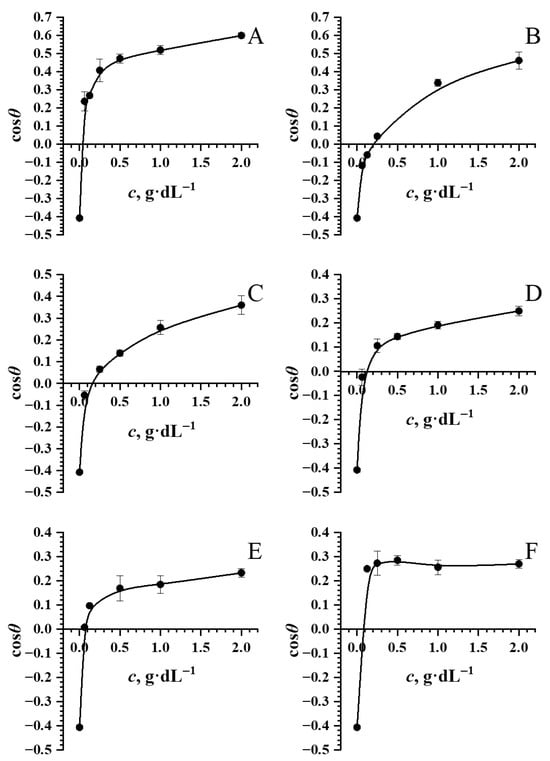
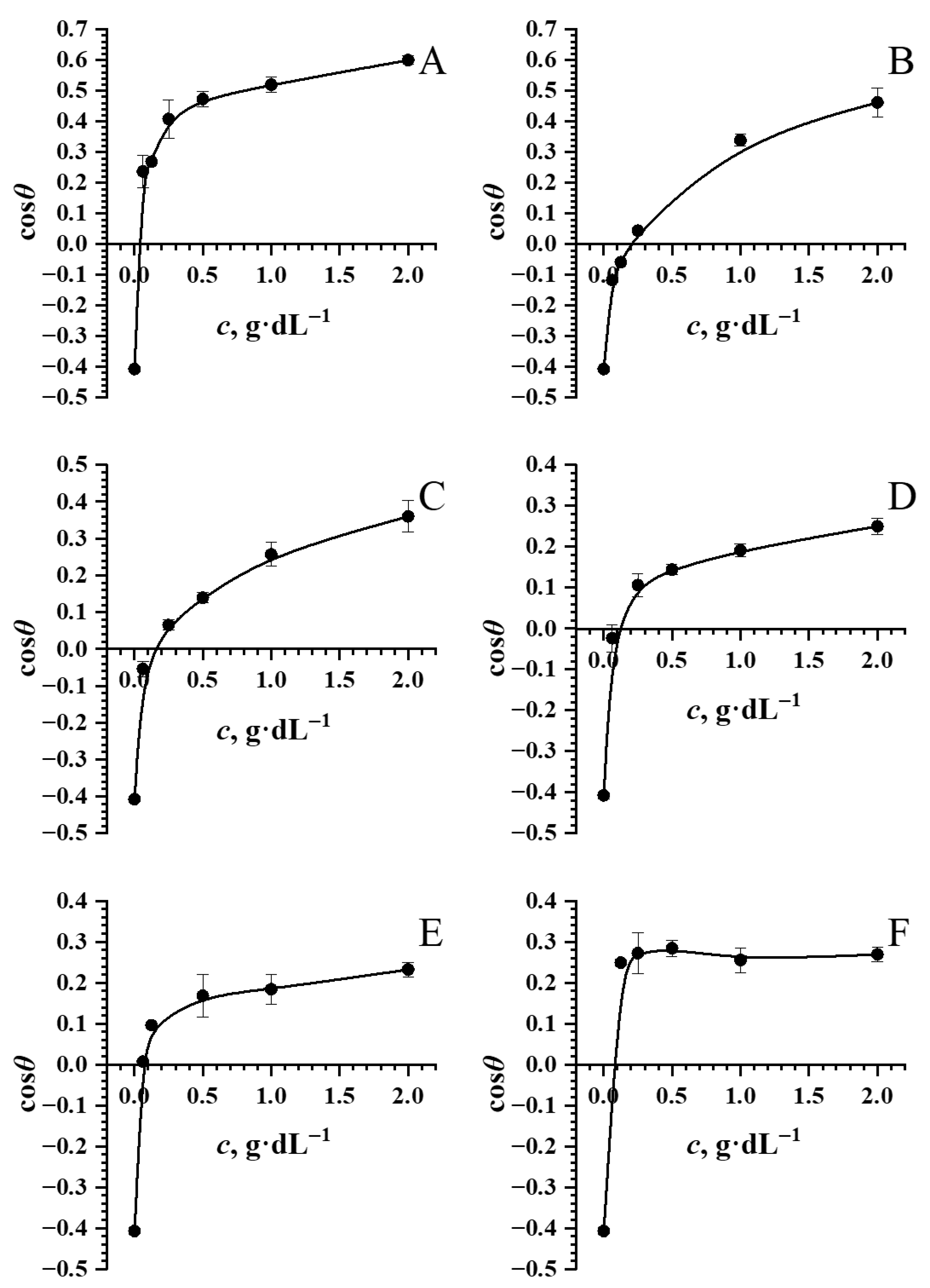
The increase in surface activity () of br-PVA is a consequence of the decrease in its solubility in water with increasing molecular weight. This circumstance also limits the concentration range of br-PVA aqueous solutions to 2 g·dL−1, within which the surface tension isotherm can be constructed. It is also seen that l-PVA, despite having the lowest surface activity (), most effectively reduces surface tension in the concentration range up to 0.5 g·dL−1 (Figure 8). For br-PVA samples with exceeding 153.1 kDa, the surface tension isotherms exhibit a distinct concentration range where surface tension remains almost constant before decreasing again at higher concentrations (Figure 8E,F). The above circumstances suggest that as the of PVA increases due to chain branching, the ability to adsorb a small amount of it will increase due to a decrease in solubility in water. However, the adsorbed macromolecules of br-PVA prevent its further adsorption, probably as a result of adsorbent surface shielding. Thus, there is a sequence of stages of interphase boundary modification by br-PVA and subsequent adsorption of br-PVA on the surface modified by it. This assumption is consistent with the change in the values of wetting inversion points and profile isotherms of Teflon wetting with aqueous solutions of br-PVA as its increases (Figure 10). Typical examples of photographs of PVA aqueous solutions droplets applied to Teflon surfaces are given in the Supplementary Materials.
Figure 10.
Isotherms of Teflon wetting with aqueous solutions of br-PVA with expressed by changing the cosθ values as a function of the polymer concentration for the systems used: (A)—76.8 kDa (l-PVA); (B)—107.2 kDa; (C)—116.1 kDa; (D)—136.9 kDa; (E)—153.1 kDa; (F)—201.6 kDa (θ—the contact angle of Teflon wetting with PVA aqueous solution, circles represent experimental data points).
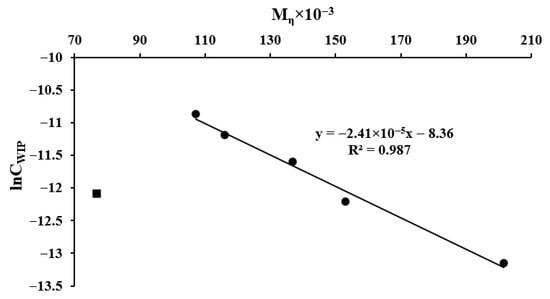
Thus, the inversion point of Teflon wetting with an aqueous solution of l-PVA (76.8 kDa) is 0.043 g·dL−1 (5.60·10−6 mol·L−1) and increases abruptly to 0.204 g·dL−1 (1.9·10−5 mol·L−1) upon transition to br-PVA with an average viscosity molecular weight of 107.2 kDa, and then exponentially decreases to 0.039 g·dL−1 (1.93·10−6 mol·L−1) with an increase in molecular weight to 201.6 kDa caused by chain branching (Figure 11).
Figure 11.
Dependence of Teflon wetting inversion point (CWIP) [mol·L−1] on the of br-PVA in an aqueous solution (the rectangle and circle correspond to the linear and branched PVA).
The increase in the WIP upon transition from the initial linear PVA to branched PVA with of 107.2 kDa is attributed to a sharp decrease in the adsorption capacity of the branched polymer. As discussed above, this decrease results from shielding of the interface by a small number of primarily adsorbed branched macromolecules. The subsequent exponential decrease in WIP with increasing of br-PVA (from 107.2 kDa to 201.6 kDa) is attributed to the higher density of polar hydroxyl groups resulting from chain branching. On the contrary, in the region of high concentrations of br-PVA, its ability to induce Teflon hydrophilization decreases significantly; this is presumably associated with a decrease in polymer adsorption rate due to the above-mentioned effect of surface shielding. In this case, the adsorption of br-PVA may take place at phase-boundary “aqueous solution of br-PVA—“air”” and “aqueous solution of br-PVA—Teflon”. The latter circumstance allows us to explain the nature of concentration dependences of adhesion () and wetting () works of aqueous solutions of br-PVA with different on Teflon surface, calculated according to Equations (9) and (10), respectively (Figure 12):
where is surface tension at the phase-boundary “aqueous solution of br-PVA—“air”” and is the contact angle of the Teflon surface with aqueous solutions of br-PVA.
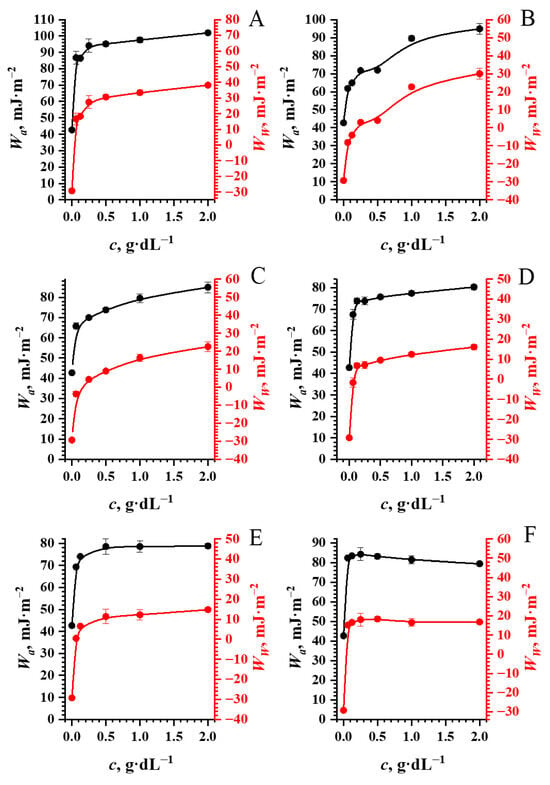
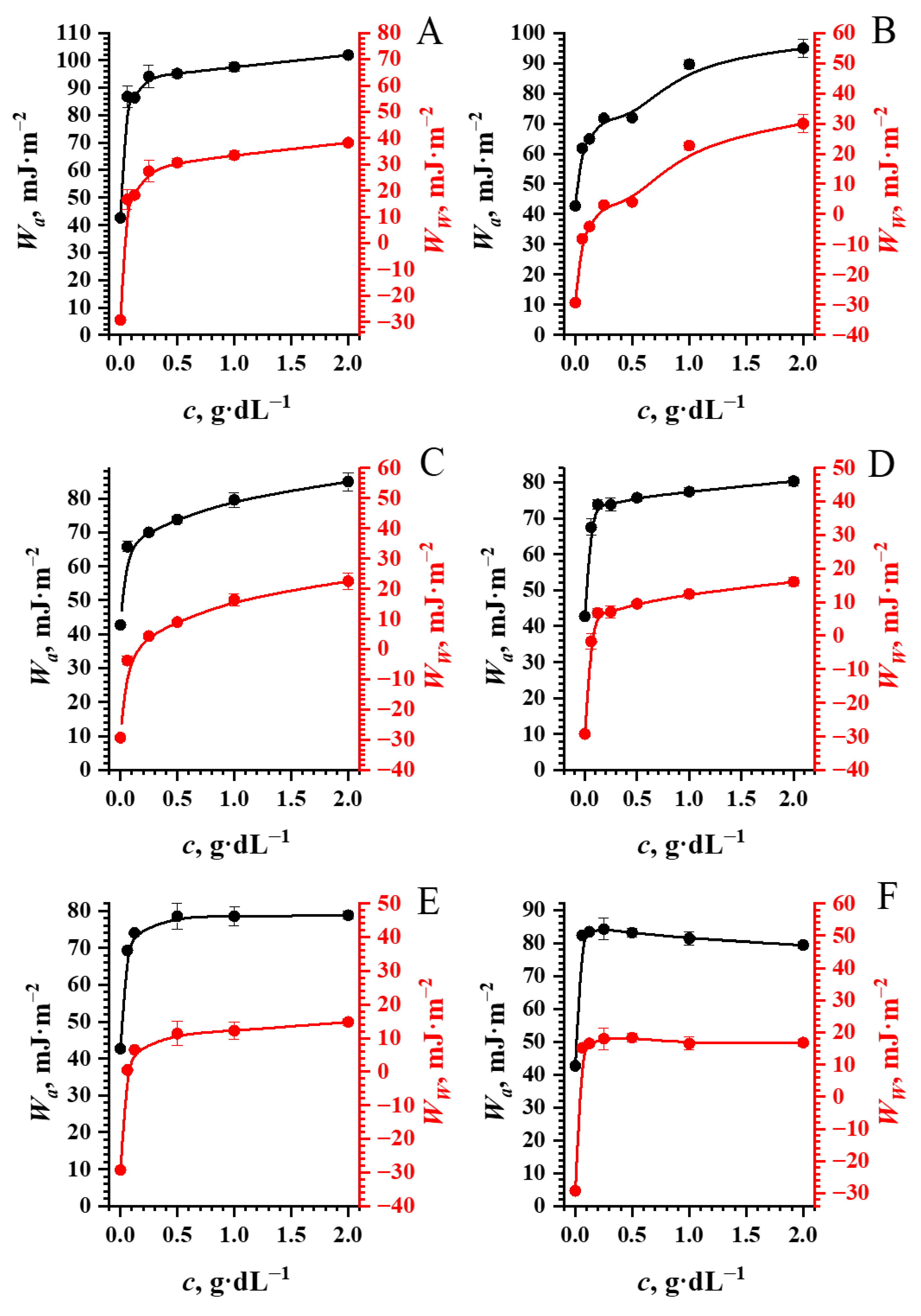
Figure 12.
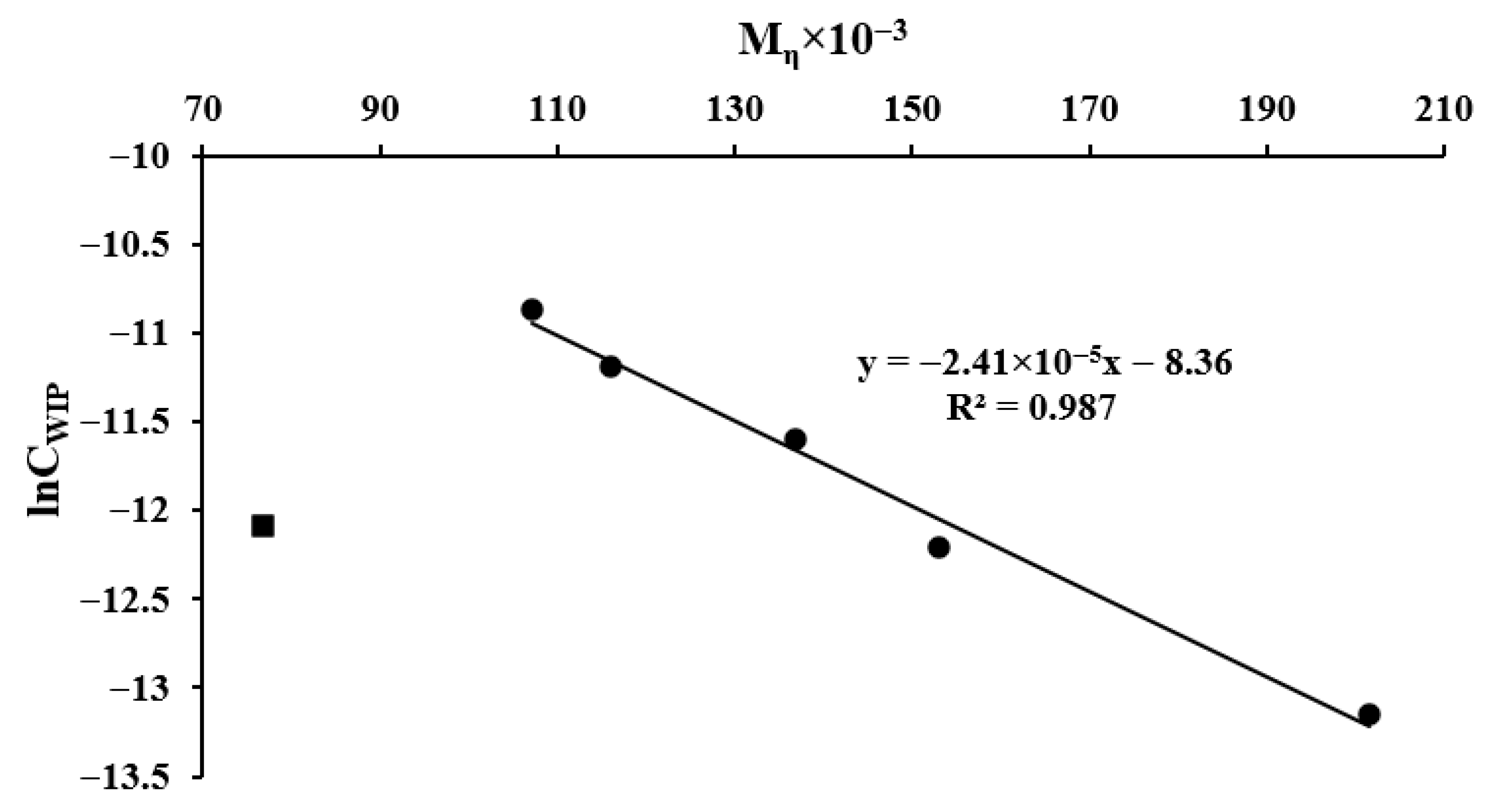
Concentration dependences of adhesion () and wetting () works on Teflon surface of aqueous solutions of br-PVA with different : (A)—76.8 kDa (l-PVA); (B)—107.2 kDa; (C)—116.1 kDa; (D)—136.9 kDa; (E)—153.1 kDa; (F)—201.6 kDa (left axis (black): adhesion work Wa; right axis (red): wetting work Ww. Black and red lines represent the calculated adhesion work Wa and wetting work Ww, respectively. Circles represent experimental data points).
As can be seen in Figure 12, with an increase in the at the concentration of macromolecules exceeding 0.0625 g·dL−1, a tendency towards degeneration of the concentration dependence of adhesion and wetting works of br-PVA aqueous solutions on Teflon surface is observed. If for l-PVA and br-PVA with a relatively low (up to 136.9 kDa) the values of cosθ increases with the macromolecule concentration in an aqueous solution faster than the surface tension at the phase-boundary “aqueous solution of br-PVA—“air”” () decreases, then, with an increase in , the increase in cosθ is compensated by a decrease in . The latter aspect leads to (or —c” dependencies taking practically the shape of a plateau (horizontally oriented) (Figure 12E,F). In this case, the change in cosθ value with the macromolecule concentration in solution is determined by the decrease in surface tension at the phase-boundary “aqueous solution of br-PVA—“air”” () and “aqueous solution of br-PVA—Teflon” () in accordance with the Young equation:
where is surface tension at the phase-boundary “Teflon—“air””; —surface tension at the phase-boundary “aqueous solution of br-PVA—Teflon”.
Thus, the cosθ value decreases significantly with increasing (Figure 10), mainly due to the increase in (Figure 8, Figure 10 and Figure 12). Therefore, with an increase in PVA as a result of chain branching, a decrease in its adsorption ability at the phase-boundary “aqueous solution of br-PVA—Teflon” is observed while maintaining significant adhesion work of br-PVA aqueous solutions on Teflon surface.
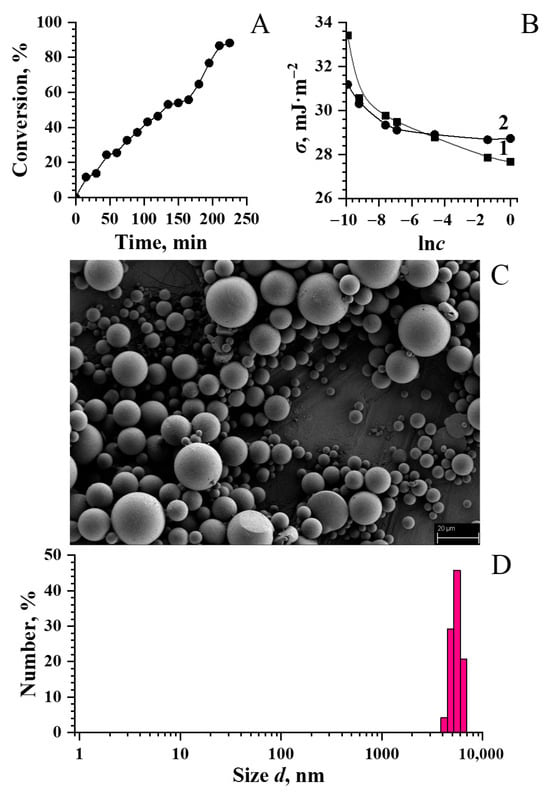
For linear polymers, increasing molecular weight typically promotes adsorption at the interface [84]. In contrast, for branched polymers, molecular weight growth resulting from chain branching may suppress adsorption due to shielding of the adsorbent surface by initially adsorbed branched macromolecules. However, this shielding effect, while reducing the overall adsorbability, can be advantageous for the steric stabilization of micrometer-sized particles. The latter circumstance, along with the high adhesion work on non-polar surfaces (Figure 12F), which is almost independent of concentration of aqueous solutions of br-PVA with the of 201.6 kDa, makes this polymer a promising candidate for use as a steric stabilizer in suspension polymerization. Therefore, in this work, br-PVA with the of 201.6 kDa was used as a stabilizer in styrene suspension polymerization. The kinetic curve of styrene polymerization obtained by the gravimetric method (Figure 13A) is typical for the process of suspension polymerization of this monomer [85,86] and is consistent with a slight acceleration of the reaction caused by the development of gel-effect [87]. Despite the fact that br-PVA reduces the interfacial tension to a relatively lesser extent than its linear analog (Figure 13B), suspension polymerization results in the formation of dispersion with a moderate width of micrometer-sized particle distribution by diameter (Figure 13C,D). The number-average size of the polystyrene micrometer-sized particles, as determined by DLS, was 5.4 μm, with a PDI of 0.007. The electrokinetic potential of the polystyrene micrometer-sized particles stabilized with br-PVA was small in absolute value and negative (~9 mV). This result is consistent with the nonionic nature of the reagents and stabilizer used. Consequently, the contribution of the electrostatic stabilization mechanism is negligible, and the attained colloidal stability of the polystyrene micrometer-sized particles is presumably attributed to the steric mechanism.
Figure 13.
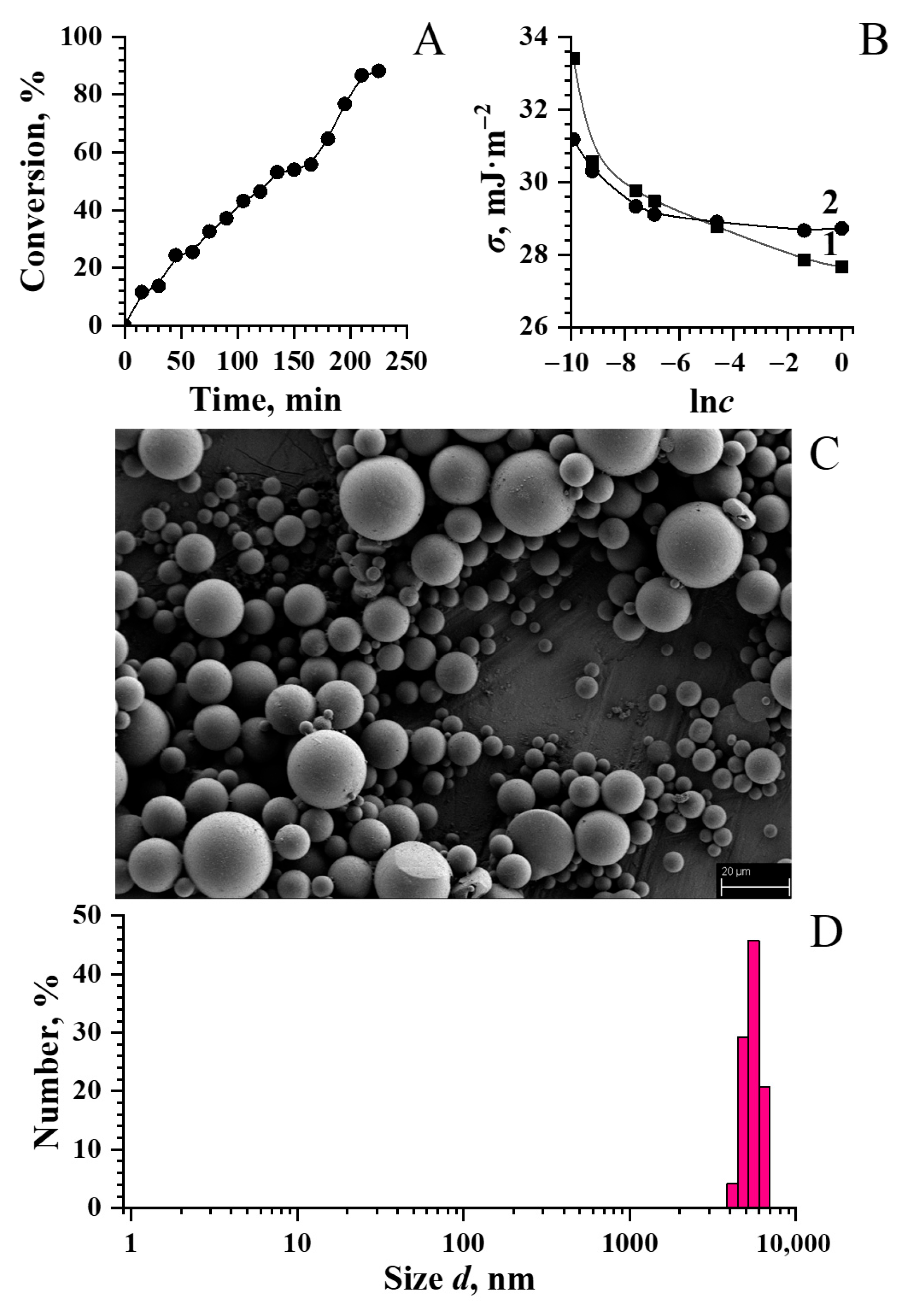
Styrene suspension polymerization in the presence of br-PVA ( = 201.6 kDa) as a stabilizer: (A)—kinetic curve (t = 80 °C, benzoyl peroxide concentration 1 wt% based on monomer); (B)—interfacial tension isotherms “aqueous solution of PVA–toluene” (1—l-PVA PVA-1799; 2—br-PVA ( = 201.6 kDa) (c is expressed in g·dL−1)); (C)—SEM of the obtained polystyrene micrometer-sized particles; (D)—the number distribution of polystyrene micrometer-sized particles by diameter, based on DLS data (circles and squares represent experimental data points).
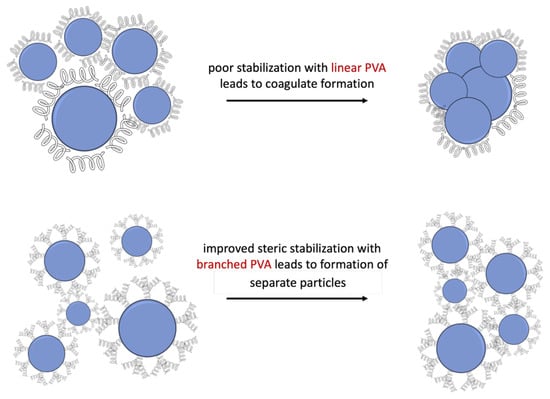
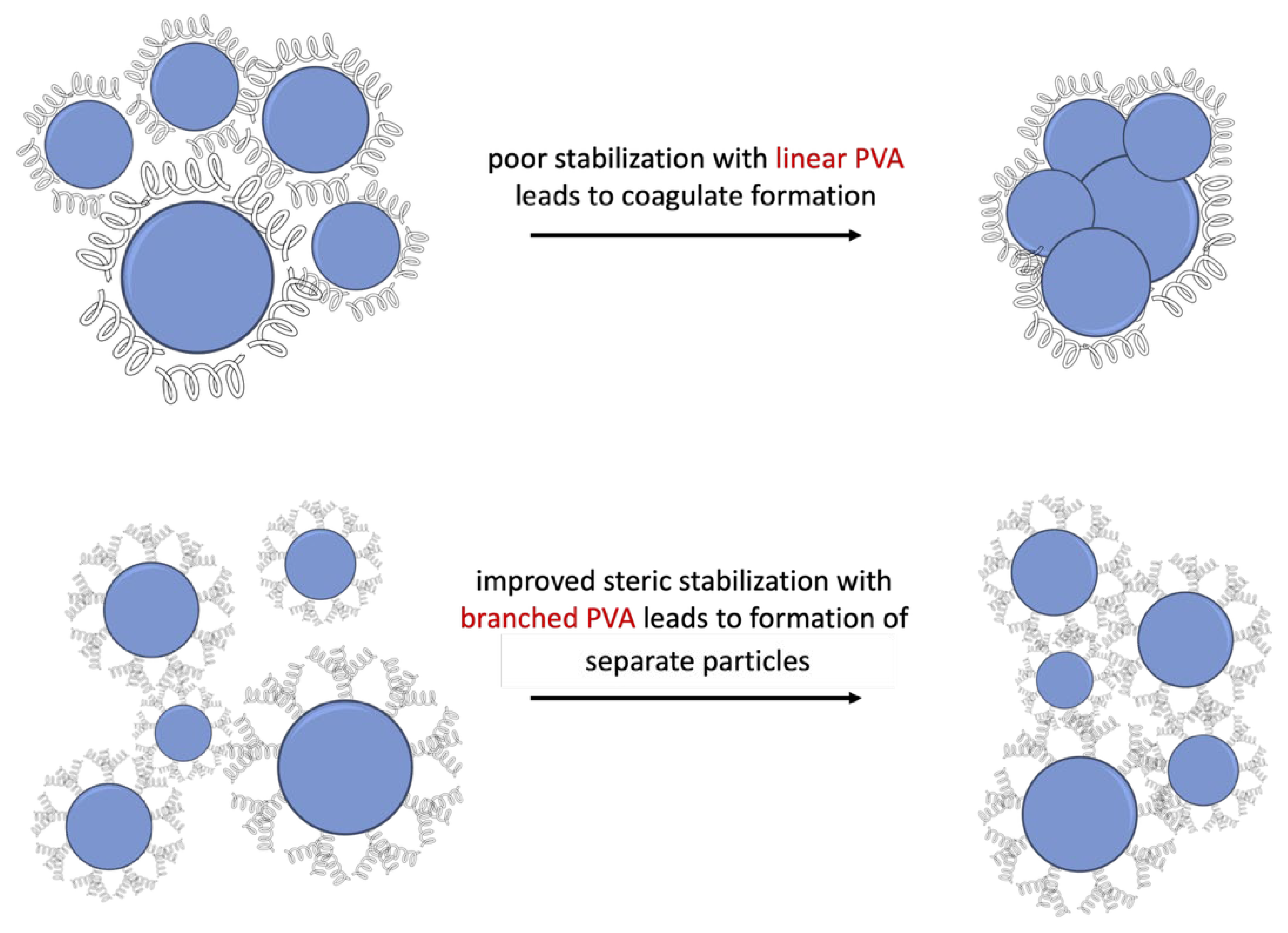
As noted above, the successful suspension polymerization of styrene in the presence of br-PVA arises most likely from shielding of the interface by adsorbed macromolecules, which promotes steric stabilization of the resulting particles. At the same time, for the water–toluene phase-boundary, the difference in the capacity of linear and br-PVA to reduce the interfacial tension is largely leveled, probably due to its mobility and the ability of macromolecules to reside in both the aqueous and organic phases near the interface. Thus, linear and br-PVA monotonically reduced the interfacial tension at the phase-boundary “water—toluene” from 35.8 mJ·m−2 to 27.9 mJ·m−2 and 28.7 mJ·m−2, respectively, at the polymer concentration of 0.25 g·dL−1. At the same time, l-PVA with a degree of hydrolysis above 99% proved ineffective as a stabilizer in styrene suspension polymerization, leading to coagulation. This contrasts with l-PVA of a lower hydrolysis degree (87–89%), which effectively stabilizes polystyrene micrometer-sized particles due to its higher surface activity [51]; the residual acetate groups in such polymers can even form pseudomicellar aggregates that promote colloidal stabilization [88,89,90], similar to other typical amphiphilic copolymers [91]. Remarkably, br-PVA (201.6 kDa)—even with a hydrolysis degree exceeding 99%—enables successful suspension polymerization, yielding stable micrometer-sized particles, as schematically shown in Figure 14.
Figure 14.
Schematic representation of the process of suspension polymerization of styrene in the presence of l-PVA (top) and br-PVA (bottom).
This indicates that br-PVA provides more effective steric stabilization against coagulation than its linear analog, despite its lower degree of adsorption capacity at high concentrations. Thus, br-PVA represents a promising candidate for the colloidal stabilization of nano- and micrometer-sized particles in aqueous media.
4. Conclusions
IR spectroscopy and HSQC methods were used to identify characteristic signals indicating the chain branching of l-PVA upon its chemical modification with epichlorohydrin in an aqueous sodium hydroxide. With increasing modification time of l-PVA, the of its chain-branching products increases systematically. An iterative procedure was proposed to account for the effect of branching density on . It was found that the concentration dependence of the viscosity of br-PVA aqueous solutions obeys the Solomon–Ciutǎ equation. The average diameters of the macromolecular coils of both linear and branched PVA determined by viscometry and dynamic light scattering were found to be in satisfactory agreement. Despite an increase in the surface activity () of PVA in infinitely dilute solutions with increasing (due to chain branching), its ability for subsequent adsorption decreases significantly, even at a low adsorbate concentration. This effect is attributed to the formation of an adsorption layer built by branched macromolecules shielding the interphase surface. It has been established that in the region of low concentrations, the increase in the of PVA caused by chain branching was accompanied by Teflon hydrophilization due to the increase in density of polar hydroxyl groups in the surface layer. Thus, with a small density of PVA chain branching, the wetting inversion point of Teflon with its aqueous solutions increases significantly as a result of the decrease in adsorb ability compared to the linear polymer, and then decreases exponentially with the increase in the . On the contrary, in the region of high concentrations of br-PVA, the decrease in its ability to hydrophilize the Teflon surface is observed with the increase in . At the same time, the increase in caused by PVA chain branching leads to the degeneration of concentration dependence of adhesion and wetting works on Teflon surface. This latter feature, together with the formation of a shielding adsorption layer of branched macromolecules, may promote effective steric stabilization of particles even at low br-PVA concentrations, making it attractive for suspension polymerization. The feasibility of using br-PVA as a steric stabilizer was demonstrated in the suspension polymerization of styrene.
Supplementary Materials
The following supporting information can be downloaded at https://www.mdpi.com/article/10.3390/colloids10030041/s1. Figure S1. Fourth-degree polynomial approximation of the g-factor dependence on the number of trifunctional branches. Figure S2. Surface tension isotherms of aqueous solutions of polyvinyl alcohol with viscosity-average molecular weights: 1–76.8 kDa (l-PVA); 2–107.2 kDa; 3–116.1 kDa; 4–136.9 kDa; 5–153.1 kDa; 6–201.6 kDa, presented in “σ-vs.lnc” coordinates. Figure S3. Micrographs of stationary droplets of aqueous solutions of the initial linear polyvinyl alcohol—A, as well as branched polyvinyl alcohol obtained during 10 min—B, 30 min—C and 50 min—D of chemical modification (droplets are applied to the Teflon surface). The concentrations of macromolecules in aqueous solution were (1) c = 0 g·dL−1; (2) c = 0.0625 g·dL−1; (3) c = 0.125 g·dL−1; (4) c = 0.5 g·dL−1; (5) c = 1.0 g·dL−1. Table S1. Main characteristics of the synthesized br-PVA macromolecules. Figure S4. Dependence of the total conversion of epichlorohydrin (p) on time at 80 °C (reagent concentrations are given in Section 2.3 of the article). The derivation of equation (8) is also given based on the fundamental Gibbs adsorption equation and the Henry adsorption isotherm [92,93].
Author Contributions
Conceptualization, A.V.G., V.P.M. and Y.O.M.; methodology, A.V.G., O.A.R., V.A.D., I.Y.G., I.A.G., V.P.M. and Y.O.M.; validation, A.V.G. and A.M.N.; formal analysis, A.V.G., A.V.A., I.I.K., O.A.R., I.A.G., V.P.M. and Y.O.M.; investigation, A.V.G., I.I.K., D.A.K., A.M.N., G.D.M., E.S.B., A.M.S., A.V.A., V.A.Z., O.A.R., S.O.S., I.I.L., M.V.M., V.A.D. and I.Y.G.; resources, V.P.M.; data curation, A.V.G. and I.A.G.; writing—original draft preparation, A.V.G., G.D.M. and Y.O.M.; writing—review and editing, all authors.; visualization, A.V.G., A.M.N., V.A.Z., M.V.M. and I.I.L.; supervision, V.P.M. and Y.O.M.; project administration, V.P.M. and Y.O.M.; funding acquisition, A.V.G., A.M.N., I.Y.G., V.P.M. and Y.O.M. All authors have read and agreed to the published version of the manuscript.
Funding
This research was funded by the Russian Science Foundation grant No. 25-69-00012, https://rscf.ru/project/25-69-00012 (accessed on 10 March 2026).
Data Availability Statement
The data presented in this study are available on request from the corresponding author or other co-authors.
Conflicts of Interest
The authors declare no conflicts of interest.
Abbreviations
The following abbreviations are used in this manuscript:
| br-PVA | branched poly(vinyl alcohol) |
| HSQC | heteronuclear single quantum coherence |
| l-PVA | linear poly(vinyl alcohol) |
| MOF | metal–organic frameworks |
| viscosity-average molecular weight | |
| PVA | poly(vinyl alcohol) |
| SEM | scanning electron microscopy |
References
- Hassan, C.M.; Trakampan, P.; Peppas, N.A. Water Solubility Characteristics of Poly(Vinyl Alcohol) and Gels Prepared by Freezing/Thawing Processes. In Water Soluble Polymers; Amjad, Z., Ed.; Springer: Boston, MA, USA, 2002. [Google Scholar] [CrossRef] [Scilit]
- Petkovšek, M.; Kržan, A.; Šmid, A.; Žagar, E.; Zupanc, M. Degradation of water soluble poly(vinyl alcohol) with acoustic and hydrodynamic cavitation: Laying foundations for microplastics. npj Clean Water 2023, 6, 35. [Google Scholar] [CrossRef] [Scilit]
- DeMerlis, C.C.; Schoneker, D.R. Review of the oral toxicity of polyvinyl alcohol (PVA). Food Chem. Toxicol. 2003, 41, 319–326. [Google Scholar] [CrossRef] [Scilit]
- Alonso-López, O.; López-Ibáñez, S.; Beiras, R. Assessment of Toxicity and Biodegradability of Poly(vinyl alcohol)-Based Materials in Marine Water. Polymers 2021, 13, 3742. [Google Scholar] [CrossRef] [Scilit]
- Pohan, G.; Mattiassi, S.; Yao, Y.; Zaw, A.M.; Anderson, D.E.J.; Cutiongco, M.F.A.; Hinds, M.T.; Yim, E.K.F. Effect of Ethylene Oxide Sterilization on Polyvinyl Alcohol Hydrogel Compared with Gamma Radiation. Tissue Eng. Part A 2020, 26, 1077–1090. [Google Scholar] [CrossRef] [Scilit]
- Alexandre, N.; Ribeiro, J.; Gärtner, A.; Pereira, T.; Amorim, I.; Fragoso, J.; Lopes, A.; Fernandes, J.; Costa, E.; Santos-Silva, A.; et al. Biocompatibility and hemocompatibility of polyvinyl alcohol hydrogel used for vascular grafting—In vitro and in vivo studies. J. Biomed. Mater. Res. A 2014, 102, 4262–4275. [Google Scholar] [CrossRef] [Scilit]
- Ji, D.; Zhang, Z.; Sun, J.; Cao, W.; Wang, Z.; Wang, X.; Cao, T.; Han, J.; Zhu, J. Strong, Tough, and Biocompatible Poly(vinyl alcohol)-Poly(vinylpyrrolidone) Multiscale Network Hydrogels Reinforced by Aramid Nanofibers. ACS Appl. Mater. Interfaces 2024, 16, 25304–25316. [Google Scholar] [CrossRef] [Scilit]
- Rahman Khan, M.M.; Rumon, M.M.H. Synthesis of PVA-Based Hydrogels for Biomedical Applications: Recent Trends and Advances. Gels 2025, 11, 88. [Google Scholar] [CrossRef] [Scilit]
- Zhong, Y.; Lin, Q.; Yu, H.; Shao, L.; Cui, X.; Pang, Q.; Zhu, Y.; Hou, R. Construction methods and biomedical applications of PVA-based hydrogels. Front. Chem. 2024, 12, 1376799. [Google Scholar] [CrossRef] [Scilit]
- Quispe-Siccha, R.M.; Medina-Sandoval, O.I.; Estrada-Tinoco, A.; Pedroza-Pérez, J.A.; Martínez-Tovar, A.; Olarte-Carrillo, I.; Cerón-Maldonado, R.; Reding-Bernal, A.; López-Alvarenga, J.C. Development of Polyvinyl Alcohol Hydrogels for Controlled Glucose Release in Biomedical Applications. Gels 2024, 10, 668. [Google Scholar] [CrossRef] [Scilit]
- Wang, M.; Bai, J.; Shao, K.; Tang, W.; Zhao, X.; Lin, D.; Huang, S.; Chen, C.; Ding, Z.; Ye, J. Poly(vinyl alcohol) Hydrogels: The Old and New Functional Materials. Int. J. Polym. Sci. 2021, 2021, 2225426. [Google Scholar] [CrossRef] [Scilit]
- Jin, S.G. Production and Application of Biomaterials Based on Polyvinyl alcohol (PVA) as Wound Dressing. Chem. Asian J. 2022, 17, e202200595. [Google Scholar] [CrossRef] [Scilit]
- De Feijter, J.A.; Benjamins, J. Adsorption behavior of PVA at the air—Water interface I. Applicability of the Gibbs adsorption equation. J. Colloid Interface Sci. 1981, 81, 91–107. [Google Scholar] [CrossRef] [Scilit]
- Ospanova, Z.B.; Mussabekov, K.B.; Aidarova, S.B.; Miller, R.; Asadov, M. Surface tension time and concentration dependencies of multifarious surfactants-based systems containing polyvinyl alcohol. J. Chem. Technol. Metall. 2019, 54, 503–507. [Google Scholar]
- Ormondroyd, S. The influence of poly(vinyl alcohol) suspending agents on suspension poly(vinyl chloride) morphology. Brit. Polym. J. 1988, 20, 353–359. [Google Scholar] [CrossRef] [Scilit]
- Wang, H.; Gao, Y.; Yin, Z.; Qin, J.; Zhao, Y.; Zhang, G. Synthesis of Highly Expandable Poly(methacrylimide) (PMI) Precursor Beads Through Optimized Suspension Polymerization of MAA-MAN-tBMA Copolymers. Polymers 2025, 17, 89. [Google Scholar] [CrossRef] [Scilit]
- Peppas, N.A.; Merrill, E.W. Development of semicrystalline poly(vinyl alcohol) hydrogels for biomedical applications. J. Biomed. Mater. Res. 1977, 11, 423–434. [Google Scholar] [CrossRef] [Scilit]
- Chen, Y.; Li, J.; Lu, J.; Ding, M.; Chen, Y. Synthesis and properties of Poly(vinyl alcohol) hydrogels with high strength and toughness. Polym. Test. 2022, 108, 107516. [Google Scholar] [CrossRef] [Scilit]
- Pazos, V.; Mongrain, R.; Tardif, J.C. Polyvinyl alcohol cryogel: Optimizing the parameters of cryogenic treatment using hyperelastic models. J. Mech. Behav. Biomed. Mater. 2009, 2, 542–549. [Google Scholar] [CrossRef] [Scilit]
- Wan, W.; Bannerman, A.D.; Yang, L.; Mak, H. Poly(Vinyl Alcohol) Cryogels for Biomedical Applications. In Polymeric Cryogels; Okay, O., Ed.; Springer: Cham, Switzerland, 2014. [Google Scholar] [CrossRef] [Scilit]
- Kolosova, O.Y.; Vasil’ev, V.G.; Novikov, I.A.; Sorokina, E.V.; Lozinsky, V.I. Cryostructuring of Polymeric Systems: 67. Properties and Microstructure of Poly(Vinyl Alcohol) Cryogels Formed in the Presence of Phenol or Bis-Phenols Introduced into the Aqueous Polymeric Solutions Prior to Their Freeze–Thaw Processing. Polymers 2024, 16, 675. [Google Scholar] [CrossRef] [Scilit]
- Panieraki, A.; Mahmoodi, N.; Anthony, C.; Dyson, R.J.; Thomas-Seale, L.E.J. Exploring the Mechanical Properties of Bioprinted Multi-Layered Polyvinyl Alcohol Cryogel for Vascular Applications. J. Manuf. Mater. Process. 2025, 9, 173. [Google Scholar] [CrossRef] [Scilit]
- Zakrzewska, A.; Nakielski, P.; Truong, Y.B.; Gualandi, C.; Velino, C.; Zargarian, S.S.; Lanzi, M.; Kosik-Kozioł, A.; Król, J.; Pierini, F. “Green” Cross-Linking of Poly(Vinyl Alcohol)-Based Nanostructured Biomaterials: From Eco-Friendly Approaches to Practical Applications. Wiley Interdiscip. Rev. Nanomed. Nanobiotechnol. 2025, 17, e70017. [Google Scholar] [CrossRef] [Scilit]
- Kumeta, K.; Nagashima, I.; Matsui, S.; Mizoguchi, K. Crosslinking of poly(vinyl alcohol) via bis(β-hydroxyethyl) sulfone. Polym. J. 2004, 36, 472–477. [Google Scholar] [CrossRef] [Scilit]
- Han, B.; Li, J.; Chen, C.; Xu, C.; Wickramasinghe, S.R. Effects of degree of formaldehyde acetal treatment and maleic acid crosslinking on solubility and diffusivity of water in PVA membranes. Chem. Eng. Res. Des. 2003, 81, 1385–1392. [Google Scholar] [CrossRef] [Scilit]
- Panigrahi, D.; Kumar, S.; Dhar, A. Modulating chain conformations of polyvinyl alcohol through low cost and nontoxic glyoxal crosslinker: Application in high performance organic transistors. Org. Electron. 2019, 65, 193–200. [Google Scholar] [CrossRef] [Scilit]
- Gadhave, R.V.; Mahanwar, P.A.; Gadekar, P.T. Effect of glutaraldehyde on thermal and mechanical properties of starch and polyvinyl alcohol blends. Des. Monomers Polym. 2019, 22, 164–170. [Google Scholar] [CrossRef] [Scilit]
- Sreedhar, B.; Chattopadhyay, D.K.; Karunakar, M.S.H.; Sastry, A.R.K. Thermal and surface characterization of plasticized starch polyvinyl alcohol blends crosslinked with epichlorohydrin. J. Appl. Polym. Sci. 2006, 101, 25–34. [Google Scholar] [CrossRef] [Scilit]
- Garnica-Palafox, I.M.; Sánchez-Arévalo, F.M.; Velasquillo, C.; García-Carvajal, Z.Y.; García-López, J.; Ortega-Sánchez, C.; Ibarra, C.; Luna-Bárcenas, G.; Solís-Arrieta, L. Mechanical and structural response of a hybrid hydrogel based on chitosan and poly(vinyl alcohol) cross-linked with epichlorohydrin for potential use in tissue engineering. J. Biomater. Sci. Polym. Ed. 2013, 25, 32–50. [Google Scholar] [CrossRef] [Scilit]
- Shui, T.; Chae, M.; Bressler, D.C. Cross-Linking of Thermally Hydrolyzed Specified Risk Materials with Epoxidized Poly(Vinyl Alcohol) for Tackifier Applications. Coatings 2020, 10, 630. [Google Scholar] [CrossRef] [Scilit]
- Giménez, V.; Reina, J.A.; Mantecón, A.; Cádiz, V. Unsaturated modified poly(vinyl alcohol). Crosslinking through double bonds. Polymer 1999, 40, 2759–2767. [Google Scholar] [CrossRef] [Scilit]
- Drozdova, M.G.; Zaytseva-Zotova, D.S.; Akasov, R.A.; Golunova, A.S.; Artyukhov, A.A.; Udartseva, O.O.; Andreeva, E.R.; Lisovyy, D.E.; Shtilman, M.I.; Markvicheva, E.A. Macroporous modified poly(vinyl alcohol) hydrogels with charged groups for tissue engineering: Preparation and in vitro evaluation. Mater. Sci. Eng. C 2017, 75, 1075–1082. [Google Scholar] [CrossRef] [Scilit]
- Deng, H.; Su, J.; Zhang, W.; Khan, A.; Alizadeh Sani, M.; Goksen, G.; Kashyap, P.; Ezati, P.; Rhim, J.-W. A review of starch/polyvinyl alcohol (PVA) blend film: A potential replacement for traditional plastic-based food packaging film. Int. J. Biol. Macromol. 2024, 273, 132926. [Google Scholar] [CrossRef] [Scilit]
- Tian, H.; Yan, J.; Rajulu, A.V.; Xiang, A.; Luo, X. Fabrication and properties of polyvinyl alcohol/starch blend films: Effect of composition and humidity. Int. J. Biol. Macromol. 2017, 96, 518–523. [Google Scholar] [CrossRef] [Scilit]
- Elgharbawy, A.S.; El Demerdash, A.-G.M.; Sadik, W.A.; Kasaby, M.A.; Lotfy, A.H.; Osman, A.I. Synthetic Degradable Polyvinyl Alcohol Polymer and Its Blends with Starch and Cellulose—A Comprehensive Overview. Polymers 2024, 16, 1356. [Google Scholar] [CrossRef] [Scilit]
- Gherman, S.P.; Biliuță, G.; Bele, A.; Ipate, A.M.; Baron, R.I.; Ochiuz, L.; Șpac, A.F.; Zavastin, D.E. Biomaterials Based on Chitosan and Polyvinyl Alcohol as a Drug Delivery System with Wound-Healing Effects. Gels 2023, 9, 122. [Google Scholar] [CrossRef] [Scilit]
- Vu, T.H.N.; Morozkina, S.N.; Olekhnovich, R.O.; Podshivalov, A.V.; Uspenskaya, M.V. Study on Fabrication and Properties of Polyvinyl Alcohol/Chitosan Nanofibers Created from Aqueous Solution with Acetic Acid and Ethanol by the Electrospinning Method. Polymers 2024, 16, 3393. [Google Scholar] [CrossRef] [Scilit]
- He, J.; Zhang, L. Polyvinyl alcohol grafted poly(acrylic acid) as water-soluble binder with enhanced adhesion capability and electrochemical performances for Si anode. J. Alloys Compd. 2018, 763, 228–240. [Google Scholar] [CrossRef] [Scilit]
- Bozhilova, S.; Lazarova, K.; Ivanova, S.; Karashanova, D.; Babeva, T.; Christova, D. Colloidal Aqueous Dispersions of Methyl (meth)Acrylate-Grafted Polyvinyl Alcohol Designed for Thin Film Applications. Coatings 2022, 12, 1882. [Google Scholar] [CrossRef] [Scilit]
- Jiang, L.; Yan, C.; Zhai, Y.-M.; Luo, F.; Meng, H.; Yin, B.; Zhang, K.; Yang, M.-B. Highly-toughened PLLA/PVA biodegradable blends: Graft copolymer tailored crystallization and phase morphology. Polymer 2024, 312, 127606. [Google Scholar] [CrossRef] [Scilit]
- Baudry, R.; Sherrington, D.C. Facile Synthesis of Branched Poly(vinyl alcohol)s. Macromolecules 2006, 39, 5230–5237. [Google Scholar] [CrossRef] [Scilit]
- Congdon, T.R.; Notman, R.; Gibson, M.I. Synthesis of star-branched poly(vinyl alcohol) and ice recrystallization inhibition activity. Eur. Polym. J. 2017, 88, 320–327. [Google Scholar] [CrossRef] [Scilit]
- Morishima, Y.; Irie, Y.; Iimuro, H.; Nozakura, S.I. Short Branching in Poly(vinyl alcohol). I. Syntheses of the Model Polymers. Polym. J. 1975, 7, 481–489. [Google Scholar] [CrossRef] [Scilit]
- Nozakura, S.-I.; Morishima, Y.; Iimuro, H.; Irie, Y. Short branching in poly(vinyl alcohol). II. NMR spectroscopy of model polymers of short-branched poly(vinyl alcohol). J. Polym. Sci. Polym. Chem. Ed. 1976, 14, 759–766. [Google Scholar] [CrossRef] [Scilit]
- Morishima, Y.; Irie, Y.; Iimuro, H.; Nozakura, S. Short branching in poly(vinyl alcohol). III. Some properties of model polymers of short-branched poly(vinyl alcohol). J. Polym. Sci. Polym. Chem. Ed. 1976, 14, 1267–1275. [Google Scholar] [CrossRef] [Scilit]
- Moreno Betancourth, J.; Sueldo Occello, V.; Farias, E.D.; Pfaffen, V.; Brunetti, V. Chemometric optimization of PVA nanocomposites: Synergistic effects of CNT, Cu, HEC-Ac, and hyperbranched polymers on mechanical properties. Materialia 2025, 42, 102480. [Google Scholar] [CrossRef] [Scilit]
- Wang, Y.; Cheng, F.; Huang, Y.; Cai, C.; Fu, Y. Vertically-oriented growth of MgMOF layer via heteroepitaxial guidance for highly stable magnesium-metal anode. Energy Storage Mater. 2023, 61, 102911. [Google Scholar] [CrossRef] [Scilit]
- Grivin, A.V.; Kraynik, I.Y.I.; Fedko, I.S.; Nechaeva, A.M.; Markova, G.D.; Baranov, O.V.; Suvorov, D.S.; Zakharova, V.A.; Raitman, O.A.; Polunin, S.V.; et al. The Kinetics of the Synthesis of Polyaniline Nanoparticles Stabilized by Branched Polyvinyl Alcohol. Macromol. Chem. Phys. 2025, 226, e00283. [Google Scholar] [CrossRef] [Scilit]
- Mendizabal, E.; Castellanos-Ortega, J.R.; Puig, J.E. A method for selecting a polyvinyl alcohol as stabilizer in suspension polymerization. Colloids Surf. 1992, 63, 209–217. [Google Scholar] [CrossRef] [Scilit]
- Georgiev, V.; Mitrinova, Z.; Genchev, N.; Gers-Barlag, A.; Jaunky, G.; Denkov, N.; Tcholakova, S. Surface and foam properties of polyvinyl alcohol solutions. Colloids Surf. A Physicochem. Eng. Asp. 2024, 681, 132828. [Google Scholar] [CrossRef] [Scilit]
- Olayo, R.; García, E.; García-Corichi, B.; Sánchez-Vázquez, L.; Alvarez, J. Poly(vinyl alcohol) as a stabilizer in the suspension polymerization of styrene: The effect of the molecular weight. J. Appl. Polym. Sci. 1998, 67, 71–77. [Google Scholar] [CrossRef]
- Bhattacharya, A.; Ray, P. Studies on surface tension of poly(vinyl alcohol): Effect of concentration, temperature, and addition of chaotropic agents. J. Appl. Polym. Sci. 2004, 93, 122–130. [Google Scholar] [CrossRef] [Scilit]
- Winslow, F.H.; Matreyek, W. Particle Size in Suspension Polymerization. Ind. Eng. Chem. 1951, 43, 1108–1112. [Google Scholar] [CrossRef] [Scilit]
- Semenova, M.V.; Osadchenko, S.V.; Mezhuev, Y.O.; Shtilman, M.I.; Semenova, I.N. Synthesis of hemocompatible materials based on branched polyvinyl alcohol. Russ. J. Appl. Chem. 2016, 89, 1286–1291. [Google Scholar] [CrossRef] [Scilit]
- Semenova, M.V.; Mezhuev, Y.O.; Osadchenko, S.V.; Shtilman, M.I. Kinetic features of the reaction of polyvinyl alcohol with epichlorohydrin in an alkaline medium. Russ. J. Gen. Chem. 2017, 87, 1047–1052. [Google Scholar] [CrossRef] [Scilit]
- Bo, J. Study on PVA hydrogel crosslinked by epichlorohydrin. J. Appl. Polym. Sci. 1992, 46, 783–786. [Google Scholar] [CrossRef] [Scilit]
- Rotman, S.G.; Moriarty, T.F.; Nottelet, B.; Grijpma, D.W.; Eglin, D.; Guillaume, O. Poly(Aspartic Acid) Functionalized Poly(ε-Caprolactone) Microspheres with Enhanced Hydroxyapatite Affinity as Bone Targeting Antibiotic Carriers. Pharmaceutics 2020, 12, 885. [Google Scholar] [CrossRef] [Scilit]
- Riyajan, S.A. Environmentally Friendly Novel Maleated Poly(vinyl alcohol) Grafted 1,4-Butanediol Modified with Biopolymer for Encapsulation of Capsaicin. J. Polym. Environ. 2019, 27, 2637–2649. [Google Scholar] [CrossRef] [Scilit]
- Katsuraya, K.; Hatanaka, K.; Matsuzaki, K.; Amiya, S. Assignment of finely resolved 13C NMR spectra of poly(vinyl alcohol). Polymer 2001, 42, 9855–9858. [Google Scholar] [CrossRef] [Scilit]
- Lomas, J.S. 1H NMR Spectra of Ethane-1,2-diol and Other Vicinal Diols in Benzene: GIAO/DFT Shift Calculations. Magn. Reson. Chem. 2012, 51, 32–41. [Google Scholar] [CrossRef] [Scilit]
- Awada, H.; Daneault, C. Chemical Modification of Poly(Vinyl Alcohol) in Water. Appl. Sci. 2015, 5, 840–850. [Google Scholar] [CrossRef] [Scilit]
- Jose, J.; Al-Harthi, M.A.; AlMa’adeed, M.A.A.; Bhadra Dakua, J.; De, S.K. Effect of graphene loading on thermomechanical properties of poly(vinyl alcohol)/starch blend. J. Appl. Polym. Sci. 2015, 132, 41827. [Google Scholar] [CrossRef] [Scilit]
- Blout, E.R.; Karplus, R. The Infrared Spectrum of Polyvinyl Alcohol. J. Am. Chem. Soc. 1948, 70, 862–864. [Google Scholar] [CrossRef] [Scilit]
- Jipa, I.; Stoica, A.; Stroescu, M.; Dobre, L.-M.; Dobre, T.; Jinga, S.; Tardei, C. Potassium sorbate release from poly(vinyl alcohol)-bacterial cellulose films. Chem. Pap. 2012, 66, 138–143. [Google Scholar] [CrossRef] [Scilit]
- Zhang, H.; Li, H.; Yang, F.; Wang, T.; Gao, J.; Jiang, T. Preparation of cross-linked polyvinyl alcohol nanospheres and the synthesization of low-fouling modified membranes. Sep. Purif. Technol. 2011, 77, 162–170. [Google Scholar] [CrossRef] [Scilit]
- Masuelli, M.A. Intrinsic Viscosity Determination of High Molecular Weight Biopolymers by Different Plot Methods. Chia Gum Case. J. Polym. Biopolym. Phys. Chem. 2018, 6, 13–25. [Google Scholar] [CrossRef] [Scilit]
- Huggins, M.L. The viscosity of dilute solutions of long-chain molecules. IV. Dependence on concentration. J. Am. Chem. Soc. 1942, 64, 2716–2718. [Google Scholar] [CrossRef] [Scilit]
- Pavlov, G.M.; Gosteva, A.A. Current Analysis of Huggins and Kraemer Plots for Determining the Intrinsic Viscosity of Macromolecules and the Corresponding Dimensionless Parameters. Polym. Sci. Ser. A 2022, 64, 586–590. [Google Scholar] [CrossRef] [Scilit]
- Schulz, G.; Blaschke, F. Eine Gleichung zur Berechnung der Viscositätszahl für sehr kleine Konzentrationen, [Molekulargewichtsbestimmungen an makromolekularen Stoffen, IX]. J. Prakt. Chem. 1941, 158, 130–135. [Google Scholar] [CrossRef] [Scilit]
- Martin, A.F. Abstr. In Proceedings of the 103rd Meeting of the American Chemical Society, Memphis, TN, USA, 20–24 April 1942; p. 1-c ACS. [Google Scholar]
- Kreisa, J. Beitrag zur Bestimmung von Grenzviskositätszahlen aus einer einzigen Messung. Collect. Czech. Chem. Commun. 1960, 25, 1507–1510. [Google Scholar] [CrossRef] [Scilit]
- Hoffmann, M. Über die Konzentrationsabhängigkeit der Viskosität von Lösungen unverzweigter und verzweigter Fadenmoleküle. 1. Mitteilung. Die Konzentrationsabhängigkeit der Viskösität von Lösungen unverzweigter Fadenmoleküle. Makromol. Chem. 1957, 24, 222–244. [Google Scholar] [CrossRef] [Scilit]
- Fuoss, R.M. Viscosity Function for Polyelectrolytes. J. Polym. Sci. 1948, 3, 603–604. [Google Scholar] [CrossRef] [Scilit]
- Heller, W. Treatment of Viscosity Data on Polymer Solutions. J. Coll. Sci. 1954, 9, 547–573. [Google Scholar] [CrossRef] [Scilit]
- Solomon, O.F.; Ciutǎ, I.Z. Détermination de la viscosité intrinsèque de solutions de polymères par une simple détermination de la viscosité. J. Appl. Polym. Sci. 1962, 6, 683–686. [Google Scholar] [CrossRef] [Scilit]
- Nesterov, A.E. Spravochnik po Fizicheskoi Khimii Polimerov [Handbook of Physical Chemistry of Polymers]; Naukova Dumka: Kiev, Ukraine, 1984; Volume 1, 376p. [Google Scholar]
- Small, P.A. Long-Chain Branching in Polymers. In Macroconformation of Polymers; Springer: Berlin/Heidelberg, Germany, 2005. [Google Scholar] [CrossRef] [Scilit]
- Zimm, B.H.; Kilb, R.W. Dynamics of branched polymer molecules in dilute solution. J. Polym. Sci. 1959, 37, 19–42. [Google Scholar] [CrossRef] [Scilit]
- Kurata, M.; Fukatsu, M. Unperturbed Dimension and Translational Friction Constant of Branched Polymers. J. Chem. Phys. 1964, 41, 2934–2944. [Google Scholar] [CrossRef] [Scilit]
- Grechanovskii, V.A. Degree of Branching in Polymeric Chains. Russ. Chem. Rev. 1969, 38, 987–1000. [Google Scholar] [CrossRef] [Scilit]
- Matsuoka, S.; Cowman, M.K. Equation of State for Polymer Solution. Polymer 2002, 43, 3447–3453. [Google Scholar] [CrossRef] [Scilit]
- Fox, T.G., Jr.; Flory, P.J. Intrinsic Viscosity—Temperature Relationships for Polyisobutylene in Various Solvents. J. Am. Chem. Soc. 1951, 73, 1909–1915. [Google Scholar] [CrossRef] [Scilit]
- Fetters, L.J.; Hadjichristidis, N.; Lindner, J.S.; Mays, J.W. Molecular Weight Dependence of Hydrodynamic and Thermodynamic Properties for Well-Defined Linear Polymers in Solution. J. Phys. Chem. Ref. Data 1994, 23, 619–640. [Google Scholar] [CrossRef] [Scilit]
- Janardhan, R.; Gedam, P.H.; Sampathkumaran, P.S. The effect of polymer molecular weight in the adsorption process. J. Colloid Interface Sci. 1990, 140, 391–400. [Google Scholar] [CrossRef] [Scilit]
- Tefera, N.; Weickert, G.; Bloodworth, R.; Schweer, J. Free radical suspension polymerization kinetics of styrene up to high conversion. Macromol. Chem. Phys. 1994, 195, 3067–3085. [Google Scholar] [CrossRef] [Scilit]
- Vent, D.P.; Savel’yanov, V.P.; Lopatin, A.G.; Safin, M.A. Applied kinetics of styrene suspension polymerization. Theor. Found. Chem. Eng. 2014, 48, 332–336. [Google Scholar] [CrossRef] [Scilit]
- Danicher, L.; Gramain, P. Preparation of polystyrene-co-divinylbenzene microspheres with controlled sizes by polymerization of stabilized microsuspensions. React. Polym. 1993, 20, 111–121. [Google Scholar] [CrossRef] [Scilit]
- Atanase, L.I.; Riess, G. Poly(Vinyl Alcohol-Co-Vinyl Acetate) Complex Formation with Anionic Surfactants Particle Size of Nanogels and Their Disaggregation with Sodium Dodecyl Sulfate. Colloids Surf. A Physicochem. Eng. Asp. 2010, 355, 29–36. [Google Scholar] [CrossRef] [Scilit]
- Atanase, L.I.; Bistac, S.; Riess, G. Effect of Poly(Vinyl Alcohol-Co-Vinyl Acetate) Copolymer Blockiness on the Dynamic Interfacial Tension and Dilational Viscoelasticity of Polymer–Anionic Surfactant Complex at the Water–1-Chlorobutane Interface. Soft Matter 2015, 11, 2665–2672. [Google Scholar] [CrossRef] [Scilit]
- Atanase, L.I.; Riess, G. Thermal Cloud Point Fractionation of Poly(vinyl alcohol-co-vinyl acetate): Partition of Nanogels in the Fractions. Polymers 2011, 3, 1065–1075. [Google Scholar] [CrossRef] [Scilit]
- Torres-Martínez, J.G.; Pérez-Alvarez, M.; Jiménez-Regalado, E.J.; St Thomas, C.; Alonso-Martínez, F. Behavior Study of a Thermo-responsive Hydrophobically Associative Water-soluble Terpolymer in Laboratory Test with Heavy Crude Oil. J. Appl. Polym. Sci. 2022, 139, e52860. [Google Scholar] [CrossRef] [Scilit]
- Majd, M.M.; Kordzadeh-Kermani, V.; Ghalandari, V.; Askari, A.; Sillanpää, M. Adsorption isotherm models: A comprehensive and systematic review (2010–2020). Sci. Total Environ. 2022, 812, 151334. [Google Scholar] [CrossRef] [Scilit]
- Bermúdez-Salguero, C.; Gracia-Fadrique, J. Analysis of Gibbs adsorption equation and thermodynamic relation between Gibbs standard energies of adsorption and micellization through a surface equation of state. J. Colloid Interface Sci. 2011, 355, 518–519. [Google Scholar] [CrossRef] [Scilit]

Disclaimer/Publisher’s Note: The statements, opinions and data contained in all publications are solely those of the individual author(s) and contributor(s) and not of MDPI and/or the editor(s). MDPI and/or the editor(s) disclaim responsibility for any injury to people or property resulting from any ideas, methods, instructions or products referred to in the content. |
© 2026 by the authors. Licensee MDPI, Basel, Switzerland. This article is an open access article distributed under the terms and conditions of the Creative Commons Attribution (CC BY) license.