


Abstract
Recent benchmarks increasingly report that large language models (LLMs) exhibit human-like causal reasoning abilities, including counterfactual inference and intervention planning. However, many such evaluations rely on domains that are heavily represented in training data and embed strong semantic cues, raising the possibility that apparent causal competence may reflect semantic pattern recombination rather than structure-sensitive causal reasoning. Drawing on human developmental theories of causal induction, this perspective argues that genuine causal understanding requires robustness to novelty and reliance on conditional structure rather than semantic familiarity. To illustrate the testability of this claim, the paper includes a pilot demonstration using synthetic causal micro-worlds. Identical numerical evidence was presented to a LLM under two conditions: semantically meaningful variable labels and non-semantic coded labels. Across paired cases, the model reliably selected the correct causal structure when labels were meaningful, but frequently misidentified or exhibited instability in causal model selection under coded labels, despite producing locally coherent explanations. These divergences emerged most clearly in diagnostically ambiguous settings requiring suppression of misleading marginal associations. The results align with the claim that semantic scaffolding can support and stabilize apparent causal competence in LLMs without implying structure-sensitive reasoning.
1. Introduction
Large language models (LLMs) today are able to solve an impressive range of tasks that once seemed to require distinctively human cognition. In causality research, prominent benchmark reports claim that GPT-4 and related models achieve very high accuracy on counterfactual reasoning, causal discovery, and actual causality judgments [1]. These results could be interpreted to suggest that LLMs can navigate the full scope of Pearl’s “ladder of causation” [2], moving beyond probabilistic associations to solve tasks requiring interventional logic (e.g., “what will happen if we do X?”) and counterfactual analysis (e.g., what if Athlete A, rather than Athlete B, had won the last Olympics?). At the same time, however, emerging research cautions that strong benchmark LLM performance can mask important differences in underlying mechanisms [3]. The novelty of this article lies in directly anchoring claims about LLM causal performance to empirically grounded accounts of how causal understanding develops and functions in humans, rather than treating benchmark success as evidence of causal reasoning in its own right.
Cognitive science suggests that LLMs, while adept at reproducing patterns that resemble human causal attributions, may display systematic weaknesses when tasks require updating, generalization, or revision beyond linguistic pattern completion [4]. Related critiques from linguistics and philosophy argue that training on linguistic form alone does not yield the kind of understanding humans achieve when reasoning is grounded in perception, action, and feedback from the world, rather than in decontextualized descriptions of facts and hypotheses [3,5]. From this perspective, it may be feasible to suspect that seemingly impressive LLM performance on causal reasoning benchmarks might fail to generalize to settings involving unfamiliar or decontextualized causal structures, ambiguous evidence, or the need to decide which intervention to perform next—contexts that require causal model revision or “debugging,” not merely fluent causal description.
The present discussion seeks to bridge this gap by introducing a developmental interpretation of what “causal understanding” entails, as studied in developmental psychology. Human developmental science does not treat causal competence as a binary property that an individual either possesses or lacks. Instead, it conceptualizes causal understanding as an achievement built incrementally through developmental experiences, ranging from first-person action and observation of others’ actions to increasingly abstract causal models that support intervention, hypothesis testing, and revision. The synthesis offered by Goddu and Gopnik [4] is particularly useful in this regard, as it makes the stages of this developmental trajectory explicit and ties them to interventionist accounts of causation.
The central claim advanced here is that a category error may underlie how benchmark success on causal tasks among LLMs is often interpreted. Much of what current causal benchmarks measure may be better characterized as causal knowledge retrieval or causal language competence, rather than causal understanding in the developmental sense elaborated above. Because LLMs are trained on linguistic products generated by humans who already possess causal understanding, they can produce fluent causal explanations while bypassing the developmental mechanisms that give rise to such understanding in humans [6]. To assess whether this claim is empirically testable rather than purely conceptual, the current analysis includes a small pilot inquiry using synthetic causal tasks (Section 4). This pilot is not intended as a definitive evaluation, but as a proof-of-concept demonstration probing whether benchmark-style success plausibly coexists with brittleness when models are required to commit to explicit causal structure.
The contribution of this analysis is deliberately narrow in scope and aligned with the goals of a perspective article. First, it uses a human developmental trajectory as an interpretive framework for assessing what current causal benchmarks do and do not justify. Second, it identifies predictable evaluation weaknesses that can inflate benchmark-to-capability inferences. Third, it outlines a developmentally grounded evaluation roadmap for generative AI that prioritizes novelty control, informative intervention selection, and surprise-triggered model revision. Although the literature directly addressing causal translation and intervention competence in LLMs remains limited, this reflects the emergent nature of the problem space rather than an absence of foundational work. Accordingly, the present contribution synthesizes established insights from causal modeling, cognitive development, and LLM evaluation to articulate a coherent problem formulation and set of evaluation targets. The novelty of the paper lies not in introducing new causal theory, but in integrating these strands into a unified framework that connects benchmark performance, developmental interpretation, and concrete system-design implications.
2. A Human Developmental Account of Causal Understanding
Contemporary accounts of causation in psychology, philosophy and statistics converge on an interventionist intuition: X is a cause of Y if intervening on X changes Y, under suitable background conditions [7]. Causal understanding, according to this view, is not merely describing patterns and sequences. Rather, it represents difference-making relations and uses interventions to reveal underlying causal structure. Developmental psychologists ask how humans acquire this competence from infancy throughout childhood [8], as described in this section.
2.1. Embodied Intervention and Early Causal Learning
Early in life, causal learning is tightly coupled to the infant’s own engagement with the surroundings. Evidence from early reaching and contingency paradigms suggests that infants learn robustly when their own movements produce effects, whereas passive exposure to the same effects lead to weaker learning [9]. This matters a great deal from the human developmental standpoint because it foregrounds a basic fact: early causal learning is not primarily “learning from descriptions” but, instead, from active engagement, where actions generate immediate, interpretable feedback.
As infants develop, causal learning expands beyond the first-person case to incorporate others’ actions. Children learn from demonstrations and increasingly treat observed actions as structured evidence [10]. This generalization is not cosmetic; rather, it changes what counts as evidence in drawing causality. So, interventions are no longer private events tied only to one’s own body but, instead, they involve actions that human or non-human agents in general can perform to reveal causal structure. This developmental trajectory matters because it highlights that early causal competence is grounded in action–outcome contingencies rather than linguistic description.
2.2. Decontextualization and Depersonalization from “I Cause” to “It Causes”
A hallmark of later causal competence is depersonalization: a shift from agent-centered causality (e.g., “I caused it”; “she made it happen”) to a more decontextualized and impersonal causal structure (e.g., “it is caused by X”). Goddu and Gopnik [4] frame this as a transition toward decontextualized, agent-independent causal representation. By the preschool years, children can infer causal structures that transcend particular actors and, consequently, can design interventions to distinguish among competing causal hypotheses.
The blicket detector paradigm [11] provides a clear empirical window into this shift. Critically, success on this task depends on selecting interventions that discriminate between competing causal models, not merely recalling associative patterns. In a typical experimental setup, children are shown a “detector” (a machine that activates only when certain objects, labeled “blickets,” are placed upon it). A researcher might place Object A and Object B on the machine together to trigger activation, then place Object A alone to produce no activation. From this evidence, children seem to perform a form of causal “screening off,” whereby they infer that Object A is not a cause of the activation, while the causal status of Object B remains unresolved. Crucially, when the evidence is ambiguous, children generate novel, targeted interventions (such as testing Object B in isolation) to resolve the remaining uncertainty and identify the causal structure. It should be emphasized here that this “screening off” represents a commitment to a causal structure that supports counterfactual discrimination. In the blicket setup, specifically, the child must implicitly represent that the effect can be generated by one “candidate cause” even when another candidate is held fixed, and then choose an intervention whose outcome would rule out a competing hypothesis. In other words, the logic in operation here is diagnostic whereby the point of testing B alone is that it would separate two causal models that are equally compatible with the initial co-occurrence evidence.
By contrast, an LLM confronted with a verbal description may succeed by mapping the description onto a familiar explanation template (e.g., “if A+ B activates but A alone does not, infer B”), without maintaining a world-facing causal model that it can use to select the next informative test. This occurs because, in benchmark form, the “intervention” is typically already provided as text; as such, the model’s job is to narrate the implied relation, rather than to generate the diagnostic action that would reveal it. The significance here is the children’s use of a “diagnostic inference” move of treating intervention as a tool for discovery. This represents a fundamental shift in which causal relations are viewed as stable, objective properties of the world rather than merely an outcome of an agent’s behavior. This developmental transition clarifies that causal understanding is more than the ability to describe who or what may have been responsible for an outcome. Rather, it is the capacity to construct causal models under novelty, choose interventions that reduce uncertainty, and generalize structure beyond specific actors and episodes [12].
2.3. Prediction Error as a Motivator for Exploration
Another notable consideration in human causal development is the element of “surprise.” Children do not simply register violations of expectation; instead, they often use anomalies as cues to explore and revise causal hypotheses. Goddu and Gopnik [4] argue that, in human causal learning, prediction error is not merely minimized but serves a generative role in shaping causal attributions. Specifically, it can instead be a resource to utilize for hypothesis revision (or “debugging”) when a causal attribution fails. Using prediction errors to debug and revise the causal attribution is profound developmentally because it changes the “learning loop.” Developmentally, failure in causal attribution triggers additional evidence-seeking, and evidence-seeking subsequently refines interventions. Therefore, causal competence in humans grows through cycles of prediction, violation, and targeted exploration, likely involving iterative debugging processes.
2.4. The Developmental Asymmetry
These three strands of human causal attribution development converge on a developmental asymmetry that matters for interpreting LLM benchmarks. Human causal understanding, as noted thus far, emerges through starting with self-generated interventions, learning to interpret others’ actions as causal, constructing impersonal causal models, and using prediction error strategically to update those models through exploration. LLMs do not appear to engage in these processes in the developmental sense. They lack bodies, they perform no actions on the world, they receive no direct feedback about interventions, and they do not treat surprise as a cue to explore. Their primary data stream is linguistic output generated by humans who already possess impersonal causal models of the world. The result is a clean interpretive warning that pattern completion, even when sophisticated, is not the same as causal understanding as built through human development. The pilot demonstration in Section 4 is intended to illustrate this distinction empirically, using controlled label manipulation to assess whether semantic scaffolding stabilizes causal model selection when numerical evidence is held constant.
3. What Language-Based Causal Benchmarks Measure, and Why That Can Mislead
Causal reasoning benchmarks often map, at least rhetorically, onto Pearl’s ladder [2]. They include associational tasks (e.g., predicting outcomes from correlations), interventional tasks (e.g., predicting outcomes under manipulation), and counterfactual tasks (e.g., judging what would have happened under different conditions). This structure invites a straightforward interpretation: if a model answers the higher-rung questions correctly, then it has climbed up the ladder to get there. A human developmental lens urges a sharper question: what, exactly, is being measured, and how does benchmark success relate to the kinds of causal representations and intervention strategies that characterize human causal understanding?
Most benchmarks present causal problems entirely in language [1]. Variables, candidate hypotheses, and evidence are given as descriptions, and the LLMs must produce linguistic responses that align with human expectations. In that format, high performance can potentially reflect the ability to retrieve and recombine causal information already present in the training distribution, and to narrate causal relations fluently. This potential benchmark-to-capability mismatch motivates three measurement limitations that follow directly from the developmental account.
3.1. Potential LLM Limitation 1: Genuinely Novel Causal Systems vs. Training Saturation
Benchmark tasks typically draw from domains already saturated in the training corpus, such as physics problems, medical case studies, and social narratives [1]. In contrast, human developmental paradigms utilize genuine novelty to isolate causal induction (the ability to infer underlying causal structure from sparse evidence) from mere recall (who or what caused an event). The blicket detector paradigm illustrates this logic: children must discover a latent causal mechanism through observation and intervention without prior linguistic exposure to the system [4].
Conversely, when an LLM evaluates counterfactual reasoning in common, heavily documented scenarios (e.g., traffic accidents), it operates within well-trodden linguistic patterns [3,13]. Because the training corpus contains an enormous range of variants and narrative templates for such causal relations, strong performance can reflect high-dimensional pattern recombination rather than discovery. This highlights a structural asymmetry: human learners must bootstrap causal understanding from ignorance, whereas LLMs can often leverage distributional familiarity [14]. This concern is not only theoretical. For one, recent causal-discovery evaluations show that LLM performance can appear strong when variable names carry rich semantic cues, yet can collapse when the same variables are replaced with non-semantic random identifiers or permuted labels, suggesting reliance on name-level priors rather than structure-driven causal analysis [15]. In evaluation terms, novelty control means holding constant the causal structure while stripping away semantic cues and prior narrative familiarity, so that correct answers must be earned from conditional dependencies, intervention logic, and model revision rather than retrieval.
To move beyond this, benchmarks should shift toward procedurally generated environments, including synthetic settings in which causal laws are generated anew each episode, thereby ensuring that success depends on interventionist logic and adaptation under novelty rather than semantic familiarity.
3.2. Potential LLM Limitation 2: Designing Interventions
Benchmarks usually ask LLMs for judgments about scenarios rather than asking the model to propose experiments [1,6]. Children, in contrast, spontaneously generate interventions to distinguish competing hypotheses, systematically varying one feature at a time and using outcomes to revise causal models [16,17,18]. This matters because intervention design is not an optional add-on in understanding causal attribution. It operationalizes the interventionist notion of causation as difference-making under manipulation. If the evaluation never asks the system, “What would you do to tell these hypotheses apart?”, then it is not testing a central piece of causal understanding as developed in children.
3.3. Potential LLM Limitation 3: Surprise-Driven Model Revision
When children encounter violations of expectation, they often explore anomalies intensely and treat surprise as a “debugging cue” to revise their causal models [4,19]. LLMs minimize prediction error during training, but they do not have an inference-time mechanism that leverages surprise to update theories through exploratory action [3,5]. Fine-tuning in LLMs differs from the developmental processes in humans because it is typically an offline, developer-managed update driven by curated training data, rather than a learner-initiated cycle in which surprise triggers self-directed exploration and model revision.
3.4. What Benchmark Success Does and Does Not Endorse
It should be articulated here that these potential limitations do not make current benchmarks uninformative. They, in fact, clearly show that LLMs can retrieve, synthesize, and articulate human causal knowledge encoded in language, often at an impressive level. What they do not suggest, however, is the stronger inference that benchmark success alone demonstrates causal understanding in the human developmental sense (i.e., building causal models through experience, selecting interventions to test competing hypotheses, and revising those models when predictions fail). In other words, benchmark success has clear interpretive boundaries, and the critique is most useful insofar as it motivates sharper evaluation and design targets, as illustrated in the pilot demonstration below.
Table 1 summarizes these benchmark-to-capability mismatches. For each dimension of causal competence emphasized in developmental research, the table identifies typical benchmark properties, the corresponding developmental capacity, and the evaluation gap that arises when benchmarks do not explicitly test that capacity.
Table 1.
Benchmark Task Properties vs. Developmental Causal Competencies: Outlines the comparison of typical language-based causal benchmark properties with the developmental causal competencies emphasized in human causal learning research. The column on the right identifies evaluation gaps that arise when benchmarks do not explicitly test the corresponding developmental capacity.
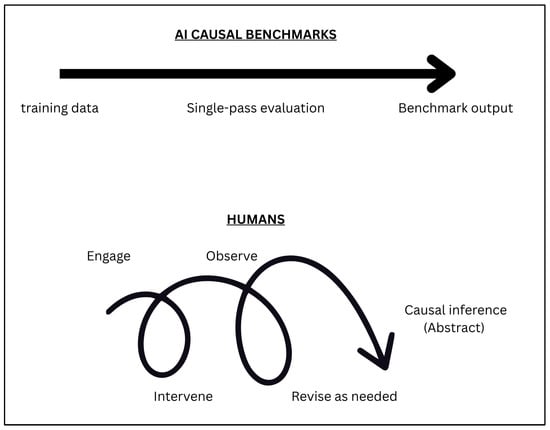
As Table 1 illustrates, current benchmarks appear to be well suited to measuring causal language fluency and knowledge retrieval, but they leave untested the core developmental capacities (i.e., novelty-driven induction, intervention design, and surprise-triggered revision) that characterize human causal understanding. To illustrate the structural differences outlined in Table 1, Figure 1 presents these two trajectories schematically: the linear, single-pass path characteristic of current AI benchmarks, and the recursive, spiral-like process of human causal development.
Figure 1.
Causal attribution trajectories. AI benchmarks (top) follow a linear, single-pass path. Human development (bottom) proceeds through recursive cycles of engagement and revision, reflecting the developmental capacities outlined in Table 1, progressing toward generalizable causal models.
The pilot demonstration in the following section provides an initial empirical test of one such gap: whether semantic scaffolding, rather than structure-sensitive reasoning, stabilizes LLM causal model selection.
4. Pilot Demonstration: Semantic Labeling and Causal Model Selection in LLMs
4.1. Purpose and Rationale
A pilot demonstration is presented here not to benchmark large language models (LLMs) exhaustively, nor to estimate performance differences statistically, but to test a specific theoretical claim advanced in this paper: that apparent causal reasoning competence in LLMs may depend in part on semantic scaffolding, and that removing such scaffolding can destabilize causal model selection even when numerical evidence and task structure are held constant. This initial inquiry is intended to evaluate whether the proposed mechanism is empirically tractable and merits more systematic, resource-intensive investigation.
Developmental research on causal induction emphasizes that robust causal understanding requires sensitivity to conditional structure and the ability to suppress misleading associations, particularly in ambiguous settings. By analogy, if LLM causal reasoning is genuinely structure-based rather than driven by semantic pattern completion, performance should remain stable when meaningful variable labels are replaced with arbitrary identifiers. Since systematic investigations into these nuanced details will be resource intensive, the pilot here has been designed to be illustrative rather than evaluative, and no claims of generalization are being made beyond the worthiness of this line of future inquiries.
4.2. The Pilot Design Overview
The pilot employed a within-item label-ablation design with a single manipulated factor, label type, which was either: (a) semantically meaningful variable labels (contextual condition); or (b) non-semantic alphanumeric labels (coded condition). All numerical evidence, task instructions, and causal hypotheses were held constant across conditions. Five fictitious datasets (Datasets 1–5; Supplementary File S1) were created under a medical researcher’s supervision and used for the current pilot inquiry. Each dataset consisted of a compact dataset summarizing marginal and conditional probabilities generated from the same underlying causal micro-world.
Each micro-world was intentionally built to be diagnostically ambiguous, with marginal associations between the intermediate variable and outcome being confounded by a shared cause, making conditional probabilities the discriminant cue. For clarity, it should be emphasized here that the datasets were not designed to confuse LLMs arbitrarily; rather, they were designed to stress-test causal discrimination under logical ambiguity.
Each dataset was presented to the model twice (i.e., once in a semantically meaningful dataset packaging and once in a coded, non-semantic dataset packaging). The pilot was intentionally designed to target diagnostically ambiguous cases, in which marginal associations are misleading and correct inference requires conditioning and proportional judgment.
4.3. Task Structure
For each dataset, the model was presented with: (1) a brief description of two competing causal hypotheses (M1 vs. M2), differing only in the proposed cause of a focal outcome variable; (2) a numbered evidence pack consisting of marginal and conditional probabilities; and (3) a fixed prompt instructing the model to select the more plausible causal model and then propose a single diagnostic intervention that would distinguish the two models, including predicted outcomes under each hypothesis. Supplementary File S1 includes the actual protocols utilized. Theoretically, the causal attribution responses should be identical (with the exception of the variable names) for each dataset, between the semantic and coded conditions.
4.4. Models and Execution
All queries were conducted using Claude.ai’s Sonnet 4.5 [20] in temporary chat sessions that do not carry over information from one chat session to another, in order to circumvent across-inquiry “memory” effects. Each dataset was evaluated in a fresh chat session, and semantic versus coded versions were counterbalanced in order across items. As noted earlier, the datasets were fictitious and generated, under the guidance of a medical researcher, for methodological demonstration purposes only. No real-world or human data were used.
4.5. Evaluation Criteria
Responses were evaluated qualitatively along three dimensions. The first, causal model selection, assessed whether the model selected the correct underlying causal structure (i.e., the model consistent with conditional rather than marginal evidence). The second, stability, assessed whether the model maintained a single causal hypothesis and reasoned consistently in accordance with that hypothesis across logical explanation and intervention steps; instability was observed when the model’s causal judgment shifted or contradicted its own stated diagnostic criteria, rather than reflecting misunderstanding or random error. The third, reasoning quality, assessed whether the justification appropriately prioritized conditional evidence over marginal associations and whether the proposed intervention targeted the discriminating causal pathway.
Together, these criteria were designed to detect a specific failure mode: cases in which an LLM articulates correct causal logic yet fails to apply it consistently when semantic scaffolding is removed. The pilot was not intended to estimate effect sizes or support statistical inference, but rather to examine systematic patterns of divergence across label conditions and assess whether the hypothesized disparities between human causal learning and LLM-based causal reasoning are empirically tractable.
4.6. Results Summary
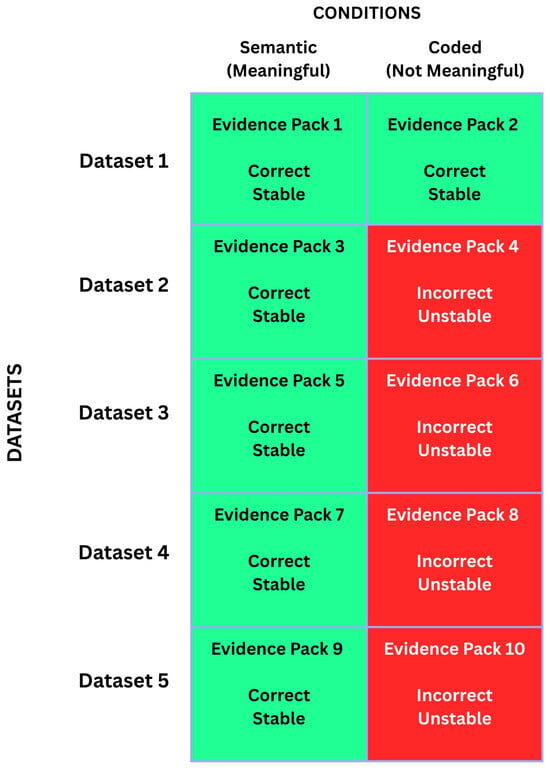
Across five paired datasets, Claude.ai selected the correct causal structure in all five semantic (contextual) conditions, with stable causal model selection in each case. In contrast, under coded (non-semantic) labeling, the model selected the correct causal structure in only one of five cases, with instability observed in four of the five coded conditions. Table 2 summarizes the full pilot results.
Table 2.
Summary of Pilot Demonstration Outcomes Across Label Conditions.
As further represented in Figure 2, in the semantic conditions, the model consistently interpreted marginal associations as confounded and prioritized conditional evidence between competing causal hypotheses. In the coded (non-semantic) conditions, the model selected the incorrect causal structure in most cases, exhibiting instability in causal model selection, as well, despite producing fluent and locally coherent explanations and citing the same numerical evidence (verbatim responses are available in Supplementary File S3).
Figure 2.
Graphic summary of Pilot Demonstration Outcomes Across Label Conditions.
Importantly, failures in the coded, not semantically meaningful condition did not reflect simple misunderstanding or incoherence. In several cases, the model explicitly articulated the correct diagnostic criterion (e.g., that a genuine causal effect should persist after conditioning) in the logical reasoning yet failed to adhere to that criterion when making its final causal judgment. Supplementary File S3 provides the complete outputs generated by Claude.ai for all ten evidence packs. Overall, the results show that removing semantically meaningful context destabilized causal model selection, despite identical numerical evidence and articulated causal criteria. This pattern motivates further investigation into how semantic scaffolding stabilizes causal reasoning in LLMs and how this reliance differs from human causal learning.
4.7. Interpretation and Scope
The results presented here are consistent with the paper’s central hypothesis that semantic grounding plays a critical role in causal reasoning in LLMs, particularly in settings that require suppression of misleading cues or use of conditional evidence. When semantically meaningful context was removed, causal reasoning remained fluent and formally articulated, yet causal model selection became unstable. This pattern points to a sensitivity to label abstraction rather than to a failure of causal reasoning per se, and suggests that semantic scaffolding may compensate for limits in structure-sensitive inference under ambiguity. These findings support the plausibility of the hypothesized mechanisms underlying human versus LLM-based causal attributions.
Several constraints of this pilot are important to acknowledge. The demonstration was conducted using a single model, Claude.ai, and does not establish whether the observed pattern generalizes across architectures, training regimes, or model scales. In addition, the analysis relies on a small set of synthetic cases selected for their diagnostic value, rather than attempting to map performance boundaries or estimate effect sizes. These choices were intentional. The aim of the present inquiry is to articulate and motivate a developmentally grounded hypothesis about differences between human causal learning and LLM-based causal reasoning, and to show that this hypothesis can be probed empirically in a controlled manner.
One “happy” exception was observed for Evidence Pack 2, the sole coded case in which the model selected the correct causal model. This prompt involved a structurally simple scenario in which the diagnostic conditional pattern was redundantly instantiated. In this case, causal “screening-off” (i.e., conditional independence given the common cause) could perhaps be recovered without reliance on semantic scaffolding. By contrast, in other datasets where proportional judgment and suppression of misleading marginal cues were required, causal model selection deteriorated under coded labeling. This pattern, incidentally, is consistent with the hypothesis that semantic context is not strictly necessary for causal inference but, instead, it becomes increasingly important as ambiguity and structural complexity increase. This exception is aligned with developmental accounts reviewed in Section 2, which emphasize that causal screening-off is substantially easier in structurally simple or redundantly diagnostic cases, but becomes fragile as ambiguity and competing cues increase [4].
Systematic evaluation of the current hypothesis would require coordinated examinations across multiple models, carefully controlled synthetic environments, and explicit manipulation of structural ambiguity, noise, and intervention informativeness. Such an undertaking would be substantially more resource intensive and is better pursued once the conceptual distinctions and evaluation targets are clearly specified. The value of the present contribution, therefore, lies in making those distinctions explicit and in demonstrating that the ideas being presented in this manuscript warrant systematic investigation.
5. Developmentally Grounded Research Agenda
The pilot demonstration above underscores that the concerns raised here are not merely speculative but, rather, empirically tractable. This motivates a research agenda focused on benchmark designs that explicitly control for semantic scaffolding while testing structure-sensitive causal inference. Section 3 and Section 4 have argued and illustrated that current causal benchmarks may permit an interpretive leap from fluent causal description to claims of causal learning competence. The present section turns that critique into a constructive agenda, which involves evaluation and design targets that more directly probe novelty-driven induction, intervention selection, and surprise-triggered revision. These are the very capacities emphasized in developmental accounts of causal understanding in humans.
5.1. Benchmarks for Causal Learning Under Novelty
First, benchmarks inspired by human development should test causal learning under novelty, not merely causal talk in familiar domains [4,16,19]. Blicket-like tasks provide a template, as follows: present a novel causal system, provide sparse and sometimes confounded evidence, and evaluate whether the agent can infer latent causal structure, generate interventions that disambiguate hypotheses, and update beliefs when predictions fail. For AI evaluation, such tasks can be implemented in synthetic environments that generate genuinely new causal mechanisms on each episode. The benchmark should reward intervention selection strategies and adaptive testing behavior, not only final-answer accuracy. If surprise is a driver of learning in children, then sensitivity to surprise should be an explicit target of benchmark evaluation.
5.2. Hybrid Architectures That Separate Language from Causality
A second direction is architectural. LLMs are excellent at retrieving and explaining human knowledge. Formal causal modeling tools, by contrast, are explicitly designed for principled intervention and counterfactual reasoning, particularly under conditions of confounding and distribution shift [5,21,22,23]. A central practical limitation, therefore, is not only whether an LLM can describe causal relations in fluent language, but whether those descriptions can be reliably translated into a formal representation that supports intervention and prediction (e.g., a directed acyclic graph or structural causal model). Natural-language causal statements are often underspecified with respect to variables, scope conditions, temporal order, and implied counterfactuals, and they frequently conflate correlation, mechanism, and policy (“do X”) claims. As a result, two outputs that appear similarly “causal” to readers may map to different graphs, different adjustment sets, and different interventional predictions. This translation step thus constitutes a bottleneck for evaluating causal reasoning in LLMs: a model can generate plausible causal narratives while remaining brittle when required to commit to explicit variables, edges, and intervention targets.
From an evaluation standpoint, this translation challenge implies that assessing causal competence requires more than judging the fluency or plausibility of causal explanations. At minimum, a causal claim should involve explicit identification of variables and their measurement proxies, commitment to a causal structure with directionality, acknowledgement of plausible confounders together with a rationale for adjustment or identification, and an articulated intervention query (“what if we do X?”) paired with a predicted directional effect and stated assumptions. Without such commitments, causal language remains underspecified, allowing superficially convincing explanations that cannot be meaningfully tested, compared, or used for intervention.
A human developmentally inspired design would therefore treat the LLM as a communicative and retrieval component, while delegating intervention logic and hypothesis testing to explicit causal modules or agents optimized for active learning [3]. This division of labor clarifies evaluation: language quality can be assessed without treating it as proof of causal learning, and causal competence can be assessed without relying exclusively on language completion benchmarks. The pilot inquiry outlined in Section 4, though indirectly, probes this bottleneck by contrasting performance on semantically rich prompts versus coded or label-based prompts that reduce narrative affordances and force more explicit variable handling.
5.3. Interactive Settings as an Analogue of Embodiment
Finally, embodiment should be treated as a design question rather than a “human-inspired buzzword.” Developmental evidence suggests that mature causal competence is typically built through active experience with closed-loop interaction, including acting, observing consequences, confronting surprise, and revising models through exploration—rather than through passive observation alone [4,8]. This distinction aligns with concerns that systems trained primarily on linguistic form may lack grounding in perception and action [5]. For LLMs, that analogue could be robotics, simulated environments, or interactive tools that can intervene, observe outcomes, and update causal hypotheses based on feedback.
To reiterate, the point is not at all that AI must be human. Rather, causal understanding, in the developmental sense motivating the current dialogue, is forged through an interactive loop of intervention, feedback, surprise, and revision. Text-only training can yield fluent causal language, but it cannot by itself demonstrate competence in that loop—precisely what the proposed benchmarks and hybrid designs aim to evaluate.
6. Why the Distinction Matters
The difference between causal knowledge retrieval and causal understanding development is not merely a superficial debate. It has practical consequences for deployment, evaluation, and scientific claims, as explained throughout the current analysis. In deployment, fluent causal language can create an illusion of competence that fails where causal reasoning matters most [5,6], often in novel, high-stakes, distribution-shifting settings [3]. A system may produce convincing causal explanations while lacking the capacity to identify confounds in a new environment, propose discriminating tests, or revise its causal model in response to unexpected or surprising outcomes [4]. This combination of plausible narrative plus weak discovery could be risky.
In evaluation, the pilot results point to the perspective that language-only benchmarks can missteer scientific effort. If benchmark scores are treated as direct indicators of causal competence, optimization pressure will favor systems that are better at causal discourse [1,3,5]. Though useful in many ways, it is not to be equated with building systems that can discover causal structure under novelty, plan interventions, let alone update models when predictions fail [4,21,22]. Developmentally grounded benchmarks would make this gap visible and, therefore, better align research priorities [14,24]. The developmental lens also improves conceptual clarity. Instead of treating “understanding causality” as a yes-or-no binary property, it encourages component-level inquiry. Current LLMs appear to be strong at retrieving and articulating human causal knowledge, yet they seem less adept, by design, at the humanlike developmental reasoning that build causal understanding, including intervention-based learning, exploration driven by expectancy violation, and shifts toward impersonal causal representations [4].
7. Conclusions
Developmental psychology suggests that human causal understanding is built, not retrieved. Such understanding emerges through self-generated intervention, curiosity and exploration driven by experiencing prediction success and error, and a transition from agent-centered “somebody did X” contingencies to depersonalized causal models that support hypothesis testing and purposeful experimentation. Current LLM causal benchmarks are largely language-based and, therefore, well suited to measuring how fluently systems can reproduce and synthesize mature human causal discourse. The current analysis proposes a developmental interpretation principle to be introduced into the ways in which LLMs draw causal attributions. We must keep in mind that benchmark success should be interpreted primarily as evidence of causal knowledge retrieval and causal language competence, unless the evaluation also tests novelty, intervention design, or surprise-driven model revision.
Separating these constructs would permit us to appreciate what LLMs do well without overclaiming human-like causal reasoning. Benchmarks and systems should, therefore, be designed to test and support causal learning in interactive loops, whether through embodied agents, simulated environments, or hybrid architectures that couple language with explicit causal inference. Moving the benchmark from the rhetoric of causal literacy to the rigor of causal discovery development is more than a technical adjustment; rather, it is contended to be the essential threshold for a truly productive science of machine intelligence. Overall, the conceptual analysis and illustrative pilot here suggest that apparent causal reasoning in LLMs may be stabilized by semantic grounding, highlighting the need for benchmarks that distinguish fluent explanation from structure-sensitive causal inference.
Supplementary Materials
The following supporting information can be downloaded at: https://www.mdpi.com/article/10.3390/make8030057/s1, File S1: Datasets for the Evidence Packs; File S2: Claude.ai Prompts for Semantically Meaningful vs. Coded/Not Semantically Meaningful Conditions; File S3: Outputs Generated by Claude.ai.
Funding
The open access fee was supported by the grant from the Robin Hood Foundation (Grant Number A1N-5A000000IYl2QAA) as well as by the City University of New York Central Office’s research grant to the Computing & Cognition Collaborative (C3) project, headed by the author.
Institutional Review Board Statement
Not applicable.
Informed Consent Statement
Not applicable.
Data Availability Statement
All data used in this study were synthetically generated for methodological demonstration purposes (Supplementary File S1). Full model outputs for the pilot demonstration are provided in Supplementary File S3.
Acknowledgments
This paper is based on a project developed by the author in partial fulfillment of the requirements for the Certificate in Machine Learning and Artificial Intelligence at Massachusetts Institute of Technology. The author would like to thank Mari Hirano for her assistance in designing the pilot study, including the synthetic datasets. Google Gemini 2.5 Flash was periodically consulted for grammar and clarity checks. The author is solely responsible for the content, interpretations, and conclusions presented in this work.
Conflicts of Interest
The author declares no conflicts of interest.
References
- Kıcıman, E.; Ness, R.O.; Sharma, A.; Tan, C. Causal Reasoning and Large Language Models: Opening a New Frontier for Causality; Transactions on Machine Learning Research (TMLR): New York, NY, USA, 2024; Available online: https://openreview.net/forum?id=mqoxLkX210 (accessed on 14 January 2026).
- Pearl, J.; Mackenzie, D. The Book of Why: The New Science of Cause and Effect; Basic Books: New York, NY, USA, 2018. [Google Scholar]
- Mahowald, K.; Ivanova, A.A.; Blank, I.A.; Kanwisher, N.; Tenenbaum, J.B.; Fedorenko, E. Dissociating language and thought in large language models. Trends Cogn. Sci. 2024, 28, 517–540. [Google Scholar] [CrossRef] [Scilit] [PubMed]
- Goddu, M.K.; Gopnik, A. The development of human causal learning and reasoning. Nat. Rev. Psychol. 2024, 3, 319–339. [Google Scholar] [CrossRef] [Scilit]
- Bender, E.M.; Koller, A. Climbing towards NLU: On meaning, form, and understanding in the age of data. In Proceedings of the 58th Annual Meeting of the Association for Computational Linguistics; Association for Computational Linguistics: Stroudsburg, PA, USA, 2020; pp. 5185–5198. [Google Scholar] [CrossRef] [Scilit]
- Zečević, M.; Willig, M.; Dhami, D.S.; Kersting, K. Causal parrots: Large language models may talk causality but are not causal. arXiv 2023, arXiv:2308.13067. [Google Scholar] [CrossRef] [Scilit]
- Gopnik, A.; Wellman, H.M. Reconstructing constructivism: Causal models, Bayesian learning mechanisms, and the theory theory. Psychol. Bull. 2012, 138, 1085–1108. [Google Scholar] [CrossRef] [Scilit] [PubMed]
- Hood, B.M.; Cole-Davies, V.; Dias, M. Looking and search measures of object knowledge in preschool children. Dev. Psychol. 2003, 39, 61–70. [Google Scholar] [CrossRef] [PubMed]
- Rovee-Collier, C. Dissociations in infant memory: Rethinking the development of implicit and explicit memory. Psychol. Rev. 1997, 104, 467–498. [Google Scholar] [CrossRef] [PubMed]
- Bandura, A.; Ross, D.; Ross, S.A. Transmission of aggression through imitation of aggressive models. J. Abnorm. Soc. Psychol. 1961, 63, 575–582. [Google Scholar] [CrossRef] [Scilit] [PubMed]
- Sobel, D.M.; Yoachim, C.M.; Gopnik, A.; Meltzoff, A.N.; Blumenthal, E.J. The Blicket Within: Preschoolers’ Inferences About Insides and Causes. J. Cogn. Dev. 2007, 8, 159–182. [Google Scholar] [CrossRef] [Scilit] [PubMed]
- Sobel, D.M.; Tenenbaum, J.B.; Gopnik, A. Children’s causal inferences from indirect evidence: Backwards blocking and Bayesian reasoning in preschoolers. Cogn. Sci. 2004, 28, 303–333. [Google Scholar] [CrossRef] [Scilit]
- Binz, M.; Schulz, E. Using cognitive psychology to understand GPT-3. Proc. Natl. Acad. Sci. USA 2023, 120, e2218523120. [Google Scholar] [CrossRef] [Scilit] [PubMed]
- Chollet, F. On the measure of intelligence. arXiv 2019, arXiv:1911.01547. [Google Scholar] [PubMed]
- Dong, J.; Liu, Y.; Aloui, A.; Tarokh, V.; Carlson, D. CARE: Turning LLMs Into Causal Reasoning Expert. arXiv 2025, arXiv:2511.16016. [Google Scholar] [CrossRef] [Scilit]
- Cook, C.; Goodman, N.D.; Schulz, L.E. Where science starts: Spontaneous experiments in preschoolers’ exploratory play. Cognition 2011, 120, 341–349. [Google Scholar] [CrossRef] [Scilit]
- Schulz, L.E.; Bonawitz, E.B. Serious fun: Preschoolers engage in more exploratory play when evidence is confounded. Dev. Psychol. 2007, 43, 1045–1050. [Google Scholar] [CrossRef] [Scilit]
- Gopnik, A.; Sobel, D.M. Detecting blickets: How young children use information about novel causal powers in categorization and induction. Child Dev. 2003, 71, 1205–1222. [Google Scholar] [CrossRef] [Scilit]
- Stahl, A.E.; Feigenson, L. Observing the unexpected enhances infants’ learning and exploration. Science 2015, 348, 91–94. [Google Scholar] [CrossRef] [Scilit]
- Anthropic. Claude 4.5 Sonnet [Large Language Model]. 2025. Available online: https://claude.ai (accessed on 7 January 2026).
- Pearl, J. Causality: Models, Reasoning, and Inference; Cambridge University Press: Cambridge, UK, 2000. [Google Scholar]
- Woodward, J. Making Things Happen: A Theory of Causal Explanation; Oxford University Press: Oxford, UK, 2003. [Google Scholar]
- Schölkopf, B.; Locatello, F.; Bauer, S.; Ke, N.R.; Kalchbrenner, N.; Goyal, A.; Bengio, Y. Toward causal representation learning. Proc. IEEE 2021, 109, 612–634. [Google Scholar] [CrossRef] [Scilit]
- Lake, B.M.; Ullman, T.D.; Tenenbaum, J.B.; Gershman, S.J. Building machines that learn and think like people. Behav. Brain Sci. 2017, 40, e253. [Google Scholar] [CrossRef] [Scilit]

Disclaimer/Publisher’s Note: The statements, opinions and data contained in all publications are solely those of the individual author(s) and contributor(s) and not of MDPI and/or the editor(s). MDPI and/or the editor(s) disclaim responsibility for any injury to people or property resulting from any ideas, methods, instructions or products referred to in the content. |
© 2026 by the author. Licensee MDPI, Basel, Switzerland. This article is an open access article distributed under the terms and conditions of the Creative Commons Attribution (CC BY) license.