


Abstract
This study investigates the incorporation of toner residue (TR), derived from post-consumer printing cartridges, as an alternative filler in styrene–butadiene rubber (SBR) composites, with emphasis placed on solid waste valorization and the promotion of a circular economy. TR consists predominantly of fine particles containing thermoplastic polymers, carbon black, metal oxides, and additives, exhibiting functional potential as a partially reinforcing filler material. Composites containing 0 to 50 phr of TR were prepared and characterized in terms of rheometric properties, dispersion degree, elemental composition by X-ray fluorescence (XRF), crosslink density, scanning electron microscopy (SEM), infrared spectroscopy, Shore A hardness, abrasion resistance, tensile strength, and tear resistance. Rheometric results indicated modifications in vulcanization kinetics and a reduction in maximum torque for formulations with high TR contents, suggesting a possible diluent effect or interference with elastomeric network formation. Conversely, moderate TR concentrations promoted increased hardness, improved tensile strength, and higher crosslink density, associated with adequate particle dispersion within the matrix, as confirmed by SEM analysis. However, excessive TR loading led to increased abrasion loss and an overall reduction in mechanical performance. It is concluded that TR demonstrates technical feasibility as a partial substitute for conventional fillers in SBR composites, with potential industrial application, such as in footwear sole prototypes, combining functional performance with environmental impact mitigation.
1. Introduction
The intensification of waste generation from electrical and electronic equipment (WEEE) represents one of the major contemporary environmental challenges. According to the Global E-waste Monitor 2024, global electronic waste production has exceeded 62 million metric tons annually, with projections indicating continued growth over the coming decades [1,2]. Among these waste streams, residual toner powder stands out as a complex material composed predominantly of thermoplastic polymers (styrene–acrylates), carbon black, silica, and metal oxides such as iron (Fe), zinc (Zn), nickel (Ni), titanium (Ti), and calcium (Ca) [3,4]. It is estimated that approximately 500 thousand metric tons of this material are discarded globally each year, most of which are directed to landfills or incineration facilities without adequate treatment [5]. Such indiscriminate disposal contributes to soil and water contamination, primarily due to the release of heavy metals and persistent organic compounds present in its formulation [6,7,8].
The environmental concern associated with toner residue (TR) is further exacerbated by its micrometric particle size (typically 5–15 μm), which facilitates atmospheric dispersion and potential bioaccumulation in ecosystems [9]. X-ray fluorescence analyses confirm the presence of elements such as Fe (7.1%), Si (2.0%), Ti (0.45%), and Zn (0.22%), each associated with specific environmental implications: while Fe may alter soil pH and promote oxidation reactions, Ni exhibits recognized toxicity and bioaccumulation potential within food chains [10,11]. Ti, often present as TiO2 nanoparticles, has demonstrated the ability to affect aquatic organisms through phototoxicity and oxidative stress mechanisms [7,12]. Furthermore, elevated Zn concentrations may induce phytotoxic effects, impairing plant development and soil fertility [6].
Paradoxically, however, the carbon-rich composition (approximately 89.5%) and silica content of TR confer properties comparable to those of conventional reinforcing fillers widely used in the rubber industry, such as carbon black (CB) and precipitated silica [13,14]. Carbon black may originate from atmospheric sources, also referred to as elemental carbon from combustion, or from industrial production via the controlled pyrolysis of hydrocarbons. Atmospheric carbon black is primarily generated by the incomplete combustion of fossil fuels and biomass. As a short-lived climate pollutant (SLCP), it has a high warming potential during its residence time in the atmosphere, although this period typically ranges from only a few days to weeks. It is widely recognized as the second largest anthropogenic contributor to global warming, after carbon dioxide (CO2), with an estimated total radiative forcing of +1.1 W m−2 [15,16]. Industrial carbon black, in contrast, is a high-purity solid material produced under controlled conditions and is essentially insoluble in water and organic solvents. Reference regulatory assessments have concluded that it is not bioaccumulative in organisms, as its physicochemical properties, particularly aggregate sizes in the range of 80–810 nm, prevent diffusion across biological membranes, and that it does not meet the criteria for a PBT (Persistent, Bioaccumulative, and Toxic) substance [17,18]. The industrial carbon black used in this study (and likewise present in the toner residue as the main constituent, accounting for 89.57% carbon) falls within this category. Therefore, its intrinsic nature does not represent the primary vector of environmental impact for the materials developed.
Industrial carbon black, with an annual production exceeding 14 million metric tons, is extensively employed as a filler in elastomers, providing mechanical strength, electrical conductivity, and thermal stability [19]. Precipitated silica, with a global production of approximately 2 million metric tons per year, is valued for its anti-slip performance, wear resistance, and contribution to energy efficiency in high-performance applications [20,21]. Nevertheless, both materials are associated with production processes that entail significant environmental impacts: CB production via the pyrolysis of aromatic hydrocarbons generates approximately 2.5 metric tons of CO2 per metric ton of product, whereas precipitated silica synthesis requires high energy input and produces alkaline effluents that are difficult to treat [22,23].
In this context, the valorization of toner residue as an alternative filler for elastomeric composites emerges as a strategy aligned with the principles of circular economy and industrial sustainability [24,25]. Recent literature demonstrates significant advances in the utilization of TR across diverse applications. Parthasarathy [3] reviewed the challenges and emerging trends in toner recycling, highlighting its conversion into value-added nanomaterials, electrodes for energy storage devices, and construction materials. Utrera-Barrios et al. [24] developed recyclable and self-healable elastomeric composites using waste toner cartridges, demonstrating enhanced mechanical performance through supramolecular interactions. More recently, Siddiq et al. [26] investigated the modification of asphalt binders with toner and recycled low-density polyethylene (LDPE), reporting a 32% improvement in Marshall stability and a 27% reduction in carbon footprint.
In the field of natural rubber composites, previous studies have indicated that TR incorporation promotes strong filler–matrix interactions, enhancement of mechanical properties, and a significant contribution to the vulcanization process, attributed to the presence of metal oxides that may act as activators or co-accelerators [27,28]. Hejna et al. [27] proposed a sustainable method for modifying carbon black with waste printer ink (WPI) and investigated the incorporation of the modified CBs into natural rubber (NR) composites. Their results demonstrated that WPI utilization can reduce viscosity and cure rate while enabling a broad tunability of mechanical and thermal properties in the resulting materials, maintaining adequate performance and highlighting environmental advantages by reducing the consumption of virgin CB. Yordanova et al. [28] investigated the potential reuse of discarded toner powder by conducting physicochemical characterization of residual toner samples and discussing the environmental risks associated with improper disposal. They further evaluated the feasibility of employing toner powder as a filler and coloring agent in rubber manufacturing processes, proposing sustainable reuse pathways for this printing equipment waste.
The literature reveals a limited number of studies employing elastomeric matrices for the incorporation of toner residues. Notably, only the work of Dębek [29], has investigated the use of post-consumer toners as fillers in rubber blends, including the characterization of recycled powder and its incorporation into different elastomeric formulations, such as styrene–butadiene rubber (SBR), nitrile rubber (NBR), and ethylene–propylene–diene monomer (EPDM). The author evaluated the influence of toner on rheological behavior, vulcanization parameters, and the final properties of the vulcanizates, demonstrating the potential of this residue as an alternative filler material. Nevertheless, a significant gap remains regarding systematic investigations specifically focused on the application of TR in synthetic SBR matrices.
Styrene–butadiene rubber (SBR) is the most widely produced synthetic elastomer on a global scale, with an estimated annual production of approximately 5.5 million metric tons, attributable to its favorable technological properties, such as high abrasion resistance, good flexibility, thermal stability, and excellent processability [30,31]. Approximately 70% of its production is directed to the tire industry, and it is also extensively employed in the manufacture of industrial hoses, conveyor belts, sports footwear, anti-vibration components, and various automotive parts [32,33]. Its molecular structure, composed of styrene units (approximately 23.5 wt%) randomly distributed along the butadiene chain, provides an appropriate balance between rigidity and elasticity, rendering it particularly suitable for applications requiring mechanical performance combined with flexibility [34].
In this context, the present study seeks to address these gaps through a systematic and comprehensive investigation of toner residue performance as a reinforcing filler in SBR composites. The distinguishing features of this research include: (i) systematic evaluation over a broad TR concentration range (0 to 50 phr) in an SBR 1502 matrix; (ii) multi-technique characterization encompassing vulcanization rheometry, X-ray fluorescence, crosslink density determination, scanning electron microscopy, FTIR-ATR spectroscopy, and mechanical properties (hardness, tensile strength, tear resistance, and abrasion resistance); (iii) quantitative analysis of filler dispersion within the polymer matrix; and (iv) development and characterization of a functional prototype (footwear sole) demonstrating technical feasibility and industrial applicability. This integrated approach enables a holistic understanding of the phenomena involved in the sustainable valorization of TR in high-performance elastomeric composites.
The relevance of this investigation extends beyond the purely scientific domain, strategically aligning with the Sustainable Development Goals (SDGs) established by the United Nations 2030 Agenda [35]: SDG 6 (Clean Water and Sanitation)—by preventing contamination of water resources resulting from improper TR disposal; SDG 9 (Industry, Innovation and Infrastructure)—through the proposal of new industrial applications for electronic waste; SDG 12 (Responsible Consumption and Production)—by promoting material reuse and closing production cycles; and SDG 13 (Climate Action)—by reducing impacts associated with the production of conventional reinforcing fillers and minimizing greenhouse gas emissions arising from e-waste incineration [36,37].
In this manner, the results obtained are expected to contribute not only to the advancement of scientific knowledge in the field of polymeric materials and composite science, but also to the development of sustainable, economically viable, and high value-added technological solutions for the rubber industry, while simultaneously promoting the mitigation of critical environmental liabilities and strengthening the circular economy within the elastomer manufacturing sector.
2. Materials and Methods
2.1. Material
Styrene–butadiene synthetic rubber (SBR 1502), with a Mooney viscosity greater than 49.0 (measured at 100 °C) and a bound styrene content of 23.5 wt%, was supplied by DLP Indústria e Comércio de Borracha e Artefatos LTDA. located in Poloni-SP, Brazil. The toner residue (TR) was provided by an electronic equipment recycling company located in Presidente Prudente. The residue was subjected to a sieving process to obtain a particle size fraction finer than 60 mesh. All vulcanization reagents, including zinc oxide, stearic acid, polyethylene glycol (PEG 4000), sulfur, and accelerators such as dibenzothiazyl disulfide (MBTS) and tetramethylthiuram disulfide (TMTD), were commercially acquired with purity levels above 95%. Table 1 presents the formulation employed for the preparation of the SBR/TR composites.
Table 1.
Formulation of SBR/TR compounds.
2.2. Compound Preparation
The compounds were prepared using a two-roll open mill, following the guidelines of ASTM D3182-21a [38], with a friction ratio of 1:1.25. Formulations containing 0, 10, 20, 30, 40, and 50 phr of toner residue were produced. Styrene–butadiene rubber was first introduced into the mill, followed by the reaction activators (zinc oxide and stearic acid), the plasticizer (polyethylene glycol 4000), and toner residue as filler. After homogenization for 20 min, the mixture was allowed to rest for 24 h at room temperature (23 °C). Subsequently, the compound was reintroduced into the mill for the incorporation of the crosslinking agent (sulfur) and the vulcanization accelerators (MBTS and TMTD). Following an additional 15 min of mixing, the compound was allowed to rest for 2 h at room temperature. Upon completion of these steps, the composite was subjected to rheometric analysis and subsequently compression-molded in a hot press to produce test specimens.
2.3. Methodologies
2.3.1. Rheometric Analysis
The rheological parameters were determined using an oscillating disk rheometer manufactured by Team Equipamentos do Brasil. The tests were conducted in accordance with ASTM D2084-17 [39], consisting of subjecting the composite to an oscillation arc of 1° at a constant temperature of 160 °C. After obtaining the rheometric parameters, the SBR/TR compounds were subjected to compression molding. This procedure was performed using a Mastermac press, model Vulcan 400/20-1, manufactured by Mastermac, São Paulo in Brazil, with a maximum pressure of 210 kgf·cm−2, in conjunction with a 1010/1020 steel mold measuring 150 × 150 × 2 mm.
2.3.2. Analysis of the Degree of Filler Dispersion in the Polymer Matrix
The uniformity of filler particle distribution within a rubber matrix is characterized by the degree of dispersion. High uniformity indicates a consistent distribution in terms of particle size and morphology. This condition can enhance several mechanical properties of rubber, including wear resistance, abrasion resistance, and fracture strength [40]. The quantitative evaluation of the degree of toner residue dispersion in rubber compounds can be performed through the application of Equation (1):
where L represents the degree of filler dispersion in the polymer matrix; ML is the minimum torque; MH is the maximum torque; and the subscripts c and g denote the filled compound and the pure gum, respectively.
2.3.3. X-Ray Fluorescence Analysis of Toner Residue
The elemental composition of the toner residue will be determined by energy-dispersive X-ray fluorescence (EDXRF) using a Shimadzu EDX-7000 spectrometer, manufactured in Japan, equipped with a Rh tube and a Si(Li) detector, manufactured Shimadzu Corporation, in Tokio, Japan. The solid sample is irradiated with X-rays, and the elements are identified based on the characteristic energies emitted during fluorescence. Analyses may be conducted under air or vacuum conditions to improve the detection of light elements, with the use of collimators and filters to optimize signal acquisition. Parameters such as voltage (up to 50 kV), current, and acquisition time are adjusted according to the matrix and target elements. The spectra are processed using the instrument’s software (calibration and fundamental parameters method), providing rapid, non-destructive, and semi-quantitative results [41].
2.3.4. Crosslink Density Determined by the Swelling Method
The crosslink density of the composites was determined using the swelling technique. Test specimens with an approximate mass of 0.25 ± 0.05 g were prepared and immersed in toluene for a period of five days. After immersion, the specimens were removed, gently dried to eliminate excess solvent, and weighed. Subsequently, they were oven-dried at 80 °C for 24 h and weighed again. The recorded values corresponding to the initial mass of the specimen, the mass of the solvent-swollen specimen, and the mass after oven drying were used to calculate the volume fraction of rubber in the swollen sample. The crosslink density was then determined using Equation (2), as proposed by Paul Flory and John Rehner [42,43]. The adopted values for the molar volume of toluene (V0) and the Flory–Huggins interaction parameter (χ) for styrene–butadiene rubber in toluene were 106.3 cm3·mol−1 and 0.393, respectively.
where ν is the crosslink density (mol·cm−3); ρB is the rubber density (g cm−3); and VB is the volume fraction of rubber in the swollen state, determined from the mass increase due to swelling.
2.3.5. Scanning Electron Microscopy
The surface morphology of the fractured composites was examined using a Carl Zeiss EVO LS15 scanning electron microscope operated at 20 kV and manufactured in Jena, Germany. The samples were sputter-coated with a thin gold layer using a Quorum Q150R ES sputter coater.
2.3.6. Fourier Transform Infrared Spectroscopy in Attenuated Mode
FTIR spectroscopy was performed using a Bruker Invenio spectrometer, manufactured in Ettlingen, Germany, operating in attenuated total reflectance (ATR) mode over the spectral range of 4000–400 cm−1, with a spectral resolution of 4 cm−1 and 32 scans.
2.3.7. Determination of Composite Density
The density of the composites was determined in accordance with ASTM D297-21 [44], using ethyl alcohol with a density of 0.79 g·cm−3 as the immersion medium. The density was calculated according to Equation (3):
where ρ is the density of the sample (g·cm−3); ρL represents the density of ethanol at the analysis temperature (g·cm−3); mA is the mass of the sample in air (g); and mB is the mass of the sample immersed in the liquid (g).
2.3.8. Hardness Testing
The surface hardness of the composites was evaluated in accordance with ASTM D2240-15 [45], using an analog durometer manufactured by Digimess., manufactured by Digimess, São Paulo, Brazil. The test was conducted on the Shore A scale, with a range from 0 to 100 and a resolution of 1 Shore A unit.
2.3.9. Abrasion Resistance Testing
The abrasion loss was determined using Equation (4), in accordance with ASTM D5963-04 [46]. The test was performed using a MaqTest apparatus (Maqtest, Franca, SP, Brazil), with an abrasion path of 40 m and a pressure of 5 N applied to the specimen in contact with the cylinder.
where PA represents the abrasion loss (mm3/40 m); Δm is the mass loss of the composite (mg); S0 is the theoretical sandpaper abrasion index on the standard rubber (200 ± 20 mg); S is the actual sandpaper abrasion index on the standard rubber (mg); and ρ is the density of the composite (mg·mm−3).
2.3.10. Tensile and Tear Resistance Testing
Tensile and tear tests were performed using a universal testing machine manufactured by Biopdi, São Carlos-SP, Brazi, operating at a crosshead speed of 500 mm·min−1, equipped with a 5 kN load cell and an internal strain transducer. For the tensile strength tests, five replicates of Type A specimens (dumbbell-shaped specimens with a straight cross-section) were employed, in accordance with ASTM D412-16 [47]. For the tear resistance tests, five replicates of Type C specimens (right-angle tear specimens) were used, following ASTM D624-00 [48].
3. Results and Discussion
3.1. Rheometric Analysis
The rheometric parameters analyzed in this study included minimum torque (ML), maximum torque (MH), torque difference (ΔM), scorch time (ts), optimum cure time (t90) and cure rate index (CRI), with the aim of evaluating the effect of toner residue on the curing kinetics of the SBR matrix. The results are presented in Table 2.
Table 2.
Rheometric parameters of the SBR/TR composites.
The minimum torque is related to the compound’s viscosity and the mobility of the polymer chains prior to vulcanization. As shown in Table 2, a progressive decrease in ML values was observed with increasing toner content, ranging from 6.41 dN·m for the unfilled gum to 4.83 dN·m for the compound containing 50 phr of toner. This reduction can be attributed to the fact that the toner may act as an internal lubricant due to its composition, facilitating material flow during the initial stages of curing, which also contributes to the observed increase in scorch time.
The maximum torque indicates the degree of crosslinking achieved at the end of the vulcanization process. A significant reduction in MH values is observed as the toner content increases, decreasing from 32.00 dN·m (0 phr) to 17.68 dN·m (50 phr). This behavior is associated with the presence of silicon dioxide in the filler, which can act as an inert filler and may interact with vulcanization agents, particularly accelerators, thereby reducing the sulfur crosslinks between polymer chains in the matrix and consequently lowering MH values. Recent studies have also reported this behavior for untreated silica, whose acidity can interfere with SBR vulcanization by adsorbing basic accelerators, prolonging cure time and decreasing crosslink density [49], hindering polymer chain packing and contributing to the reduction in maximum torque. The ΔM is directly related to the extent of crosslinking during vulcanization. As shown in Table 2, ΔM values decrease with increasing RT concentration, from 25.59 dN·m (0 phr) to 12.85 dN·m (50 phr). This reduction suggests a lower crosslink density, possibly caused by the interference of inorganic fillers, such as silica, present in the toner. Literature reports indicate that non-functionalized silica particles can interact with basic vulcanization accelerators, delaying sulfur crosslink formation and hindering the efficient packing of polymer chains [50].
The scorch time, defined as the point at which vulcanization begins, showed a tendency to increase with the amount of toner added. The tS values ranged from 2.35 min (0 phr) to 5.20 min (50 phr). This result indicates that the presence of toner delays the onset of the curing reaction, possibly by acting as a physical barrier to the diffusion of crosslinking agents or through chemical interactions between toner components and formulation ingredients that retard the activation of the vulcanization system. Table 2 also presents the values of t90, showing that the filled composites exhibited a significant increase in these values, ranging from 4.19 min (0 phr) to 8.26 min (50 phr). This parameter represents the time required to achieve 90% vulcanization, and its increase indicates that the curing process was slower in composites with higher toner content. This supports the hypothesis that the residue hinders the formation of crosslinks in the polymer matrix due to the presence of silica, which consumes part of the accelerators in the process.
The cure rate index (CRI) reflects the speed of the vulcanization reaction. In the present study, CRI values decreased with increasing filler content, indicating that the toner residue significantly slows the curing kinetics. It is believed that toner components, such as silica and heavy metals (Fe, Ti, Zn), chemically interact with the accelerators, reducing their effectiveness [51]. Additionally, the increased particulate filler may create physical barriers to the diffusion of vulcanizing agents, further delaying the propagation of the reactions [52].
3.2. Analysis of the Degree of Toner Residue Dispersion in the SBR Matrix
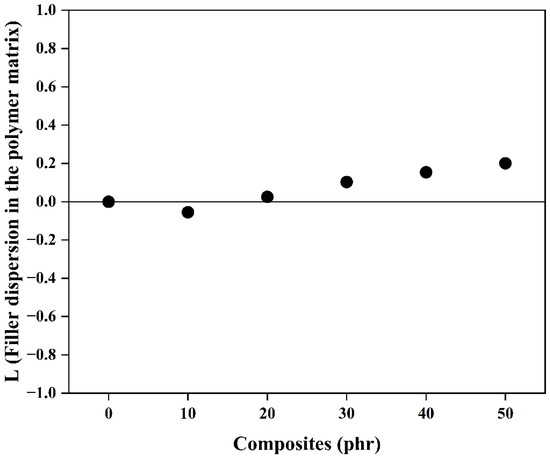
The parameter L, calculated from rheometric data, was interpreted in this study as an indirect indicator of filler incorporation/dispersion behavior and, therefore, should be analyzed with caution. Although the obtained values suggest acceptable behavior for part of the formulations, this parameter alone does not constitute definitive evidence of homogeneous dispersion within the system. When analyzed in conjunction with scanning electron microscopy results and abrasion performance, it is observed that composites with low and intermediate toner contents exhibit more favorable conditions, whereas formulations with 40–50 phr show more pronounced signs of particle agglomeration and interfacial discontinuity. This indicates that increasing the filler content may compromise dispersion uniformity as well as the surface performance of the material.
Based on the minimum and maximum torque data presented in Table 2, the values of parameter L, associated with the degree of toner dispersion in the matrix, are shown in Figure 1. Lower L values, compared to the unfilled composite, indicate better dispersion of the toner within the matrix. It can be observed that the degree of filler dispersion remained satisfactory across all concentrations, suggesting a uniform distribution of toner and a low incidence of filler–filler agglomerates, which could compromise the mechanical properties of the composites. Furthermore, lower viscosity tends to reduce the minimum torque due to the temporary high plasticity of the compound, promoting filler dispersion and enhancing the interaction between the filler and the matrix. This effective dispersion improves interfacial interactions, generating additional physical bonds between the filler and the polymer matrix, thereby contributing to an increase in the overall crosslink density of the composite.
Figure 1.
Toner residue dispersion in the SBR matrix.
3.3. X-Ray Fluorescence Analysis of the Toner Residue
X-ray fluorescence (XRF) analysis was employed in this study to identify the elemental composition of the toner residue, revealing a predominance of carbon along with inorganic elements such as iron, silicon, titanium, and zinc. However, it is important to emphasize that this technique provides only elemental information and does not allow determination of the specific chemical form of these species, their oxidation state, particle size, or potential for migration. Thus, although the presence of metallic elements may suggest a possible influence on the behavior of the elastomeric system, it is not possible to conclusively state, based solely on XRF results, that these species act as activators in the vulcanization process. Likewise, the data obtained from this technique, when considered in isolation, are not sufficient to support inferences regarding toxicological safety, leaching risk, or migration potential of the constituents present in the residue. Therefore, the XRF results should be interpreted in this study as a preliminary characterization of the elemental nature of the material, and complementary analyses are required for any more specific conclusions regarding the chemical role or toxicological impact of these species.
XRF analysis, presented in Table 3, allowed for the identification of the elemental composition of the toner residue, revealing a predominance of carbon at 89.57%, which confirms the predominantly carbonaceous nature of the material. This result is consistent with the typical composition of commercial toners, whose matrix is primarily formed by thermoplastic polymeric resins, such as polyesters and styrene-acrylate copolymers, responsible for the melting and adhesion properties during the printing process. The significant iron content (7.10%) is directly associated with the use of iron oxides as magnetic pigments in toners, particularly in electrophotographic systems, where these particles play a crucial role in controlling and directing the powder during printing. This relatively high content indicates that the residue retains functional characteristics typical of industrial toners even after disposal.
Table 3.
X-ray fluorescence of the toner residue.
The silicon content (2.02%) can be attributed to the incorporation of mineral fillers, such as silica, which are frequently employed to improve powder flow, reduce particle agglomeration, and control the rheological properties of the toner. The presence of titanium (0.45%), possibly in the form of titanium dioxide (TiO2), suggests the use of white pigments or optical control agents, commonly included in commercial formulations to adjust contrast and enhance thermal stability.
Elements such as sulfur, zinc, calcium, and strontium, detected in smaller proportions, may be associated both with toner additives and with residues from the manufacturing process, such as stabilizers, curing agents, or contaminants related to the raw materials used. Zinc, in particular, may indicate the presence of compounds such as zinc oxide, which is widely employed as an activator in elastomeric systems, a factor that is relevant from the perspective of reusing the residue in rubber matrices.
Traces of tin, chromium, manganese, and copper, although present at very low concentrations, are consistent with metallic impurities or residues originating from the mechanical and electronic components of the printer cartridges. The low concentration of these elements is a positive indicator for the potential reuse of the residue, as it reduces the risks of toxicity and undesired interference with the final properties of the composites.
3.4. Determination of Crosslink Density by the Swelling Method
The parameter ν obtained from swelling analysis, based on the Flory–Rehner equation, was interpreted in this study as an apparent network density parameter rather than as a direct and precise measure of the chemical sulfur crosslink density. In filled elastomeric systems, swelling behavior may be influenced not only by the chemical structure of the matrix, but also by the presence of insoluble filler, the bound rubber fraction, filler–matrix interactions, and additional physical constraints on solvent diffusion. Therefore, the ν values were discussed with caution, as indicators of apparent network densification and restrictions on molecular mobility, with their interpretation carried out in an integrated manner alongside rheometric, morphological, and mechanical results.
The crosslink density of the composites shows a progressive increase with the incorporation of toner residue, as observed in Table 4. The reference composite, SBR/RT0, exhibits a crosslink density of 0.94 × 10⁻⁴ mol·cm−3, whereas systems containing 10, 20, 30, 40, and 50 phr of toner residue display increasing values, reaching 1.28 × 10⁻⁴ mol·cm−3 for the SBR/RT50 composite. This behavior indicates that the addition of toner residue effectively enhances the degree of crosslinking of the elastomeric matrix, suggesting an active role of the residue in the vulcanization process.
Table 4.
Crosslink density of the SBR/RT composites.
Such an effect can be associated with the presence of inorganic species detected by XRF, such as iron, zinc, and sulfur, which may act as catalytic agents, secondary activators, or sites for physicochemical interactions during the formation of crosslinks in SBR. It can be inferred that the toner does not act merely as an inert filler but contributes to the restriction of polymer chain mobility, either through filler effects or through interfacial interactions between the organic fraction of the toner and the elastomeric matrix.
Furthermore, the organic fraction of the toner, composed predominantly of polymeric resins, may enhance compatibility with SBR, contributing to better dispersion of the residue and, consequently, to a more homogeneous distribution of crosslinks within the elastomeric network. This hypothesis is consistent with the systematic increase in crosslink density values, with no indication of saturation or decline at the higher filler loadings.
3.5. Scanning Electron Microscopy (SEM)
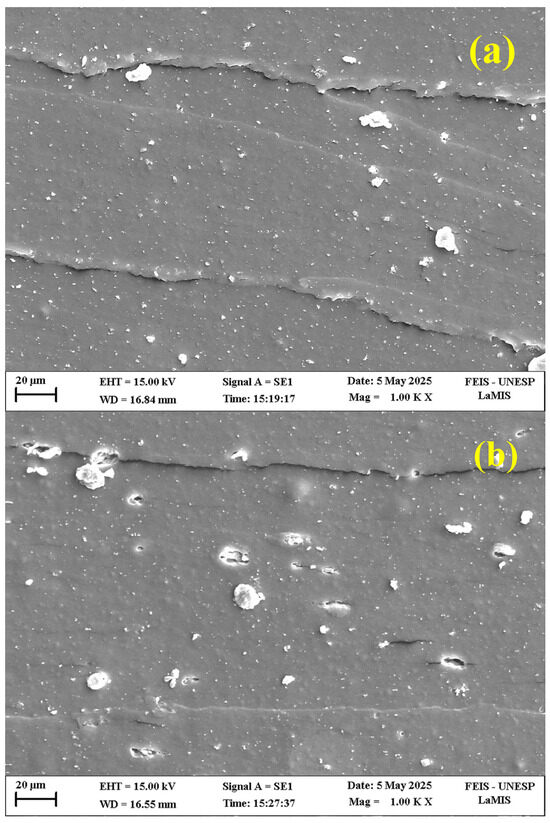
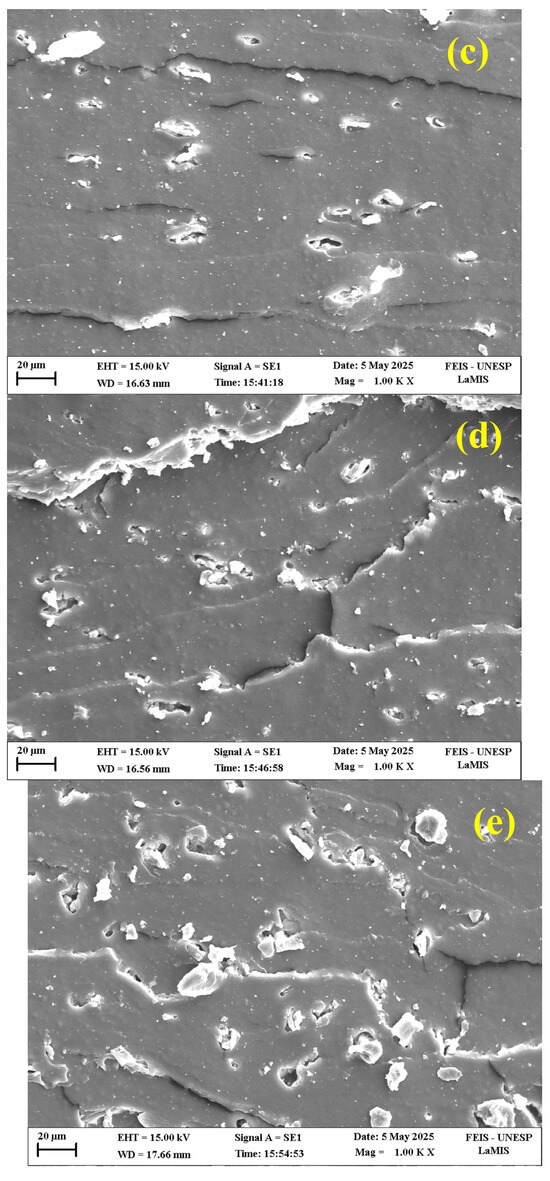
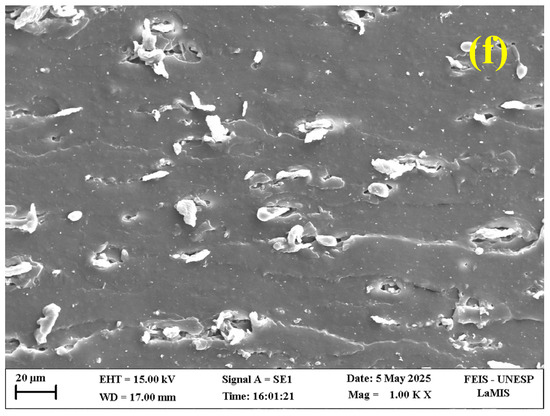
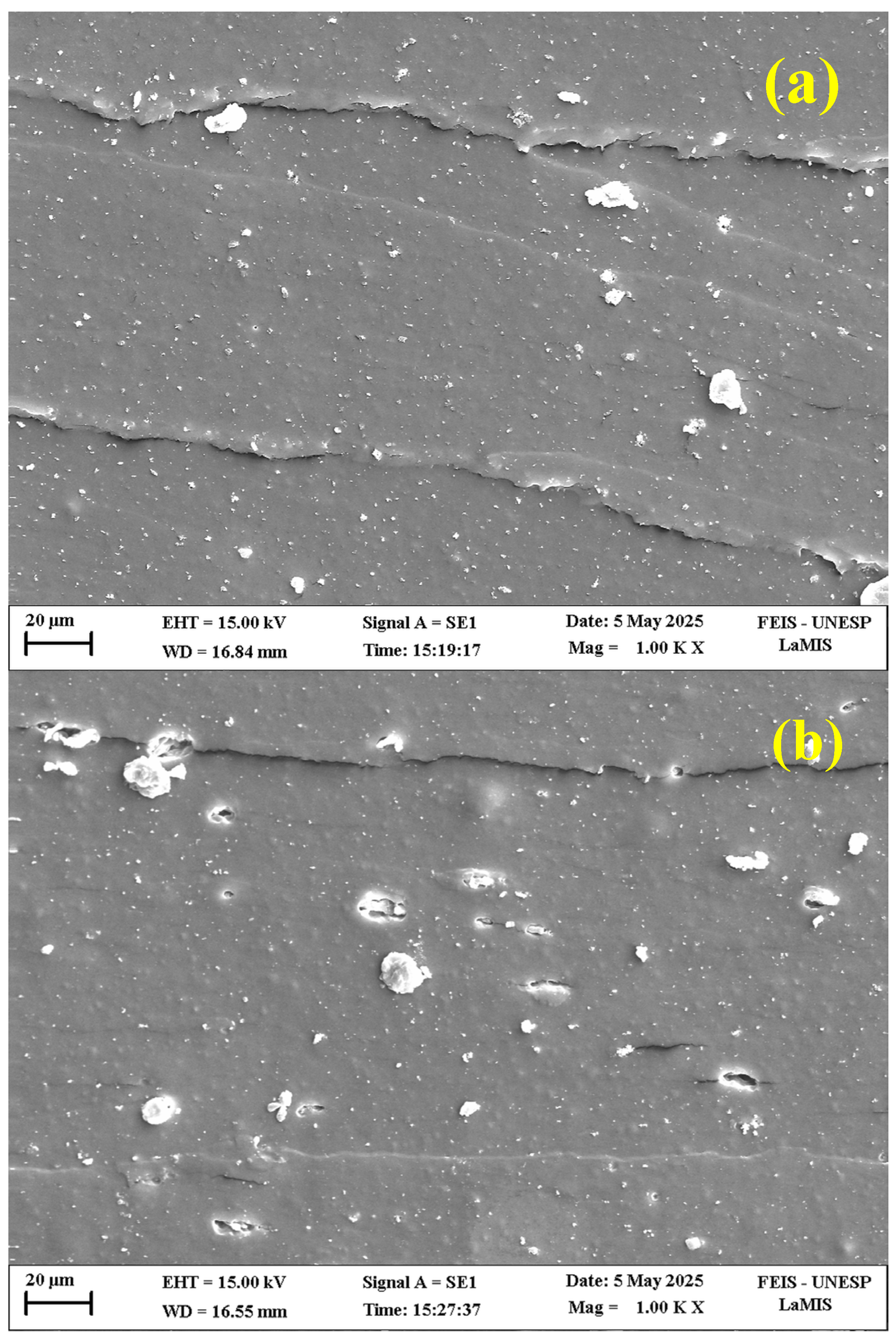
The SEM images obtained from the fracture regions of the specimens subjected to the tensile test (Figure 2) reveal significant changes in surface morphology with increasing concentrations of toner residue (RT). In the unfilled sample (Figure 2a), a relatively smooth surface is observed, typical of homogeneous ductile fracture, with no agglomerates or roughness, as expected in composites composed solely of the pure polymer matrix. With the introduction of 10 phr of RT (Figure 2b), small, dispersed inclusions become apparent, showing good incorporation into the matrix and indicating the onset of filler–matrix interaction.
Figure 2.
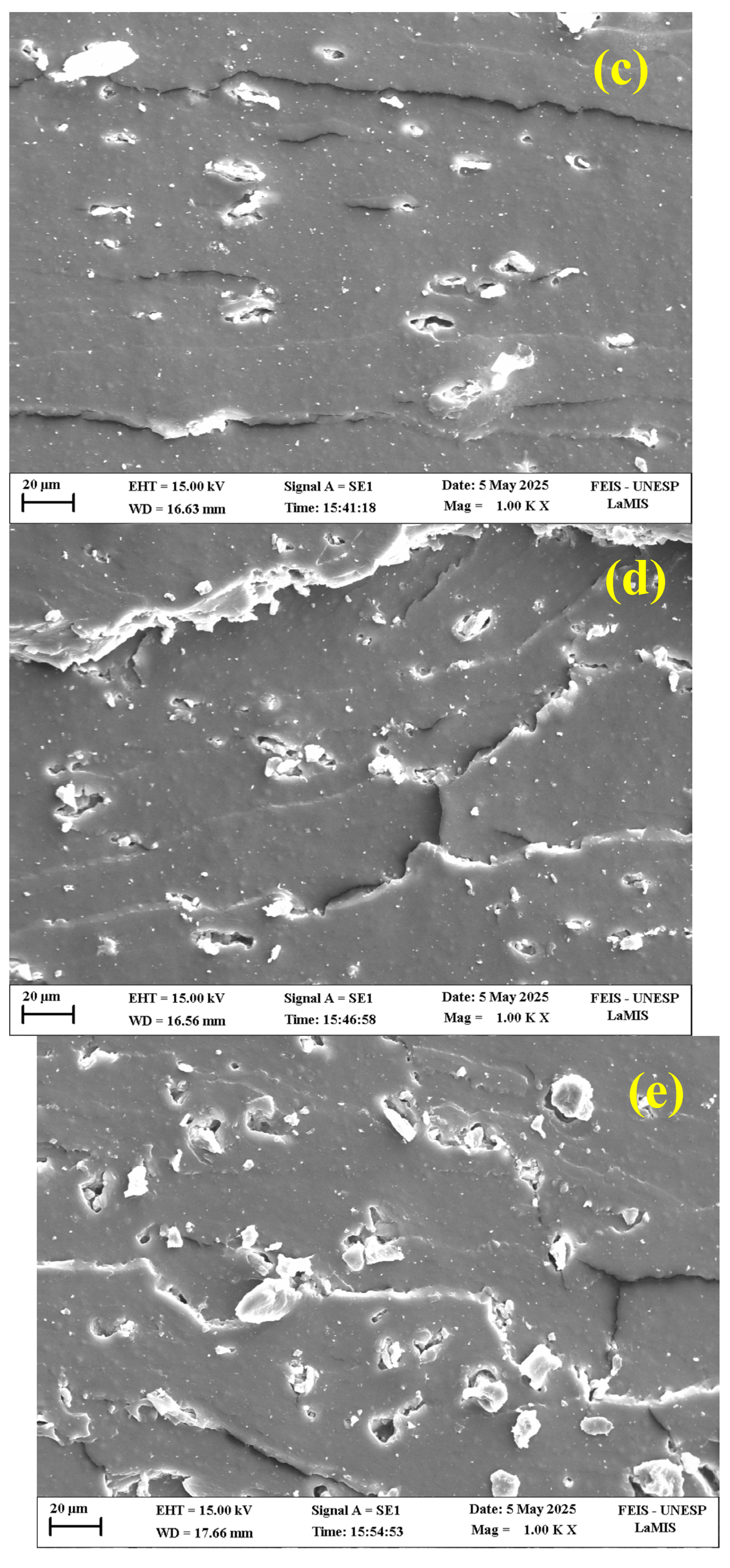
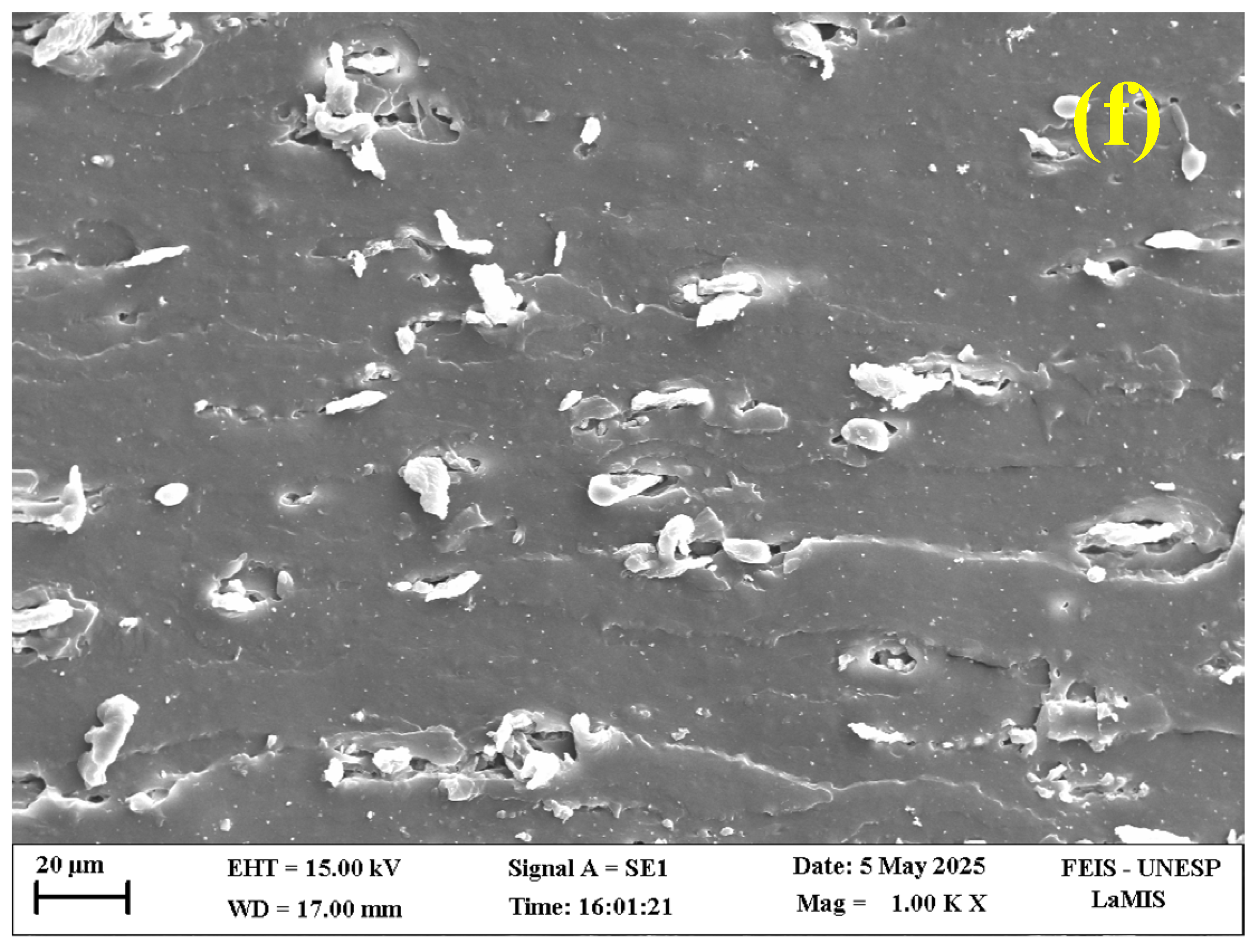
SEM images at a 20 µm scale and 1.0 K× magnification of the toner residue; fracture regions of the tensile test specimens of the composites containing (a) 0 phr, (b) 10 phr, (c) 20 phr, (d) 30 phr, (e) 40 phr, and (f) 50 phr of toner residue.
As the toner content increases to 20 and 30 phr (Figure 2c,d), the number of visible particles on the surface rises, and there is evidence of improved anchoring and dispersion of the RT. The presence of irregular fractures and the reduction in smooth zones suggest partial stress transfer between the matrix and the toner particles, which aligns with the positive mechanical results observed in these formulations.
However, in the samples containing 40 and 50 phr (Figure 2e,f), more pronounced agglomerates and areas of filler detachment can be observed, indicating matrix saturation and a possible loss of dispersion efficiency. These agglomerates can act as stress concentration points, promoting the initiation of fractures and compromising mechanical performance, particularly regarding abrasion resistance and deformation. This phenomenon is common in systems with high particulate loading and has been reported by authors such as Ismail et al. (2002) [53] and Choudhury (2008) [54], who noted that excessive filler loading can impair both dispersion and interfacial cohesion [55]. Recent studies have also shown that, at high loadings, particles tend to form SEM-visible agglomerates, reducing the reinforcement efficiency within the elastomeric matrix [56]. Therefore, the morphological analysis confirms that the RT concentration directly affects the structural homogeneity of the composites, with intermediate loadings (20–30 phr) being optimal for achieving a balance between dispersion, interfacial adhesion, and mechanical properties.
3.6. Attenuated Total Reflectance–Fourier Transform Infrared (ATR-FTIR) Spectroscopy Analysis
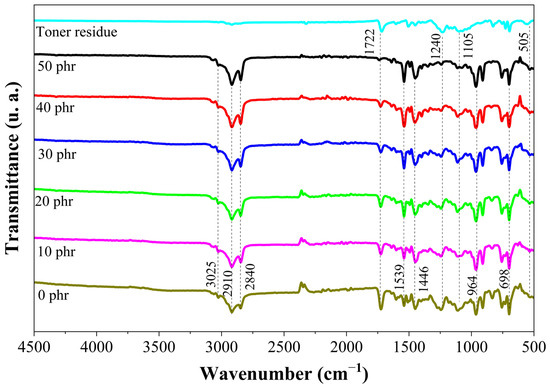
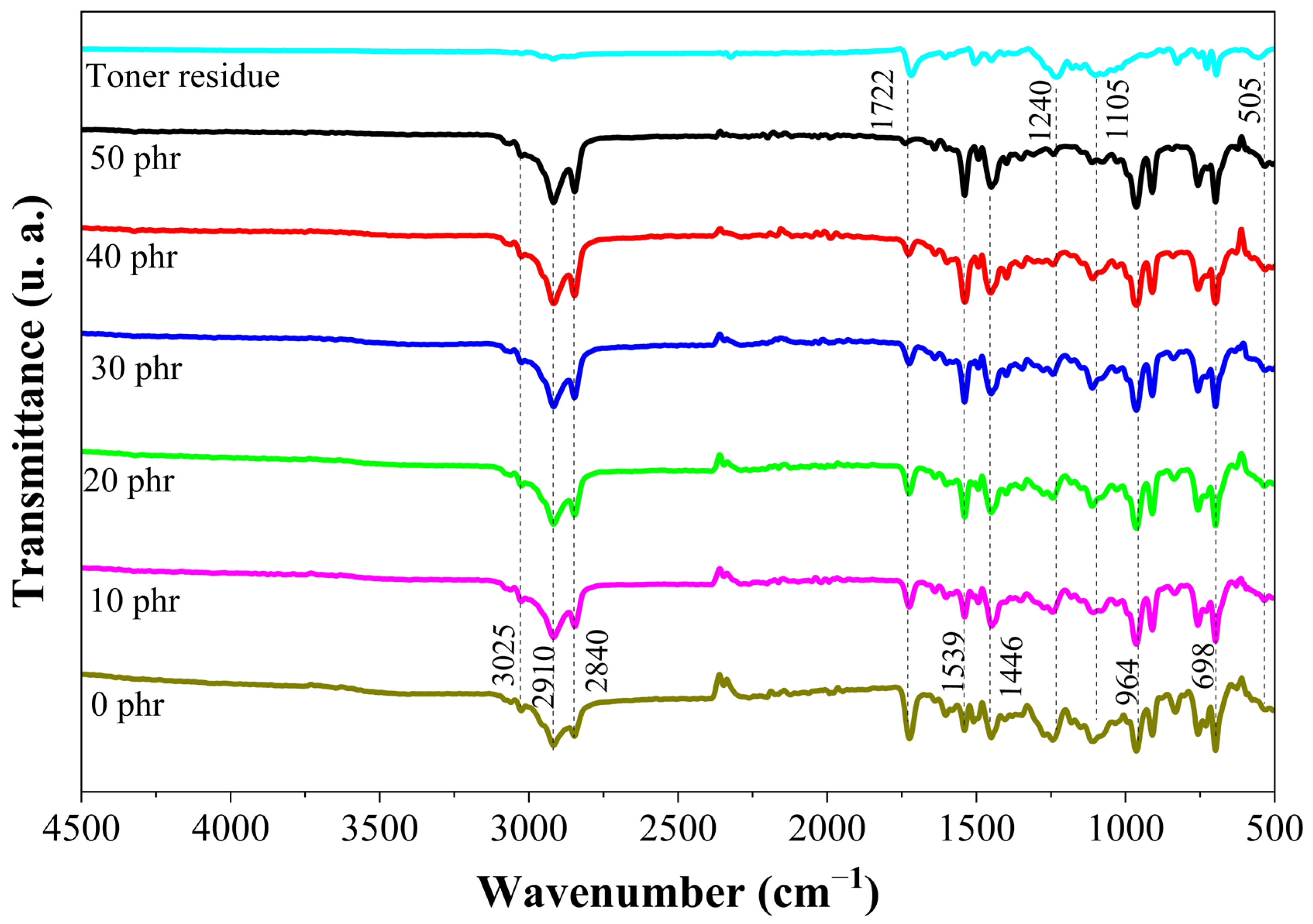
The bands observed in the FTIR spectrum of the toner residue, shown in Figure 3, are typical of organic polymeric materials combined with inorganic fillers and pigments, fully consistent with the known composition of commercial toners. This hybrid character directly reflects the multiphase formulation of these materials, which are widely used in electrophotographic printing processes.
Figure 3.
FTIR spectra of toner residue and SBR composites. The dashed line is to connect the common stalls between the curves.
The region between 3000 and 2800 cm−1 is associated with aliphatic C–H stretching vibrations, indicating the presence of polymeric chains based on thermoplastic resins, such as polyesters and styrene-acrylates, commonly used as the polymer matrix in toners [57]. These bands reflect the organic fraction of the material, which is responsible for thermoplastic behavior and thermal fusion during the printing process [58,59]. The bands located between 1730 and 1700 cm−1 are attributed to carbonyl (C=O) stretching [60], characteristic of ester groups, further confirming the presence of polyester resins or acrylic copolymers [61]. This functional group is particularly relevant as it contributes to adhesion properties and the compatibility of the toner when incorporated into elastomeric matrices [62].
In the 1600–1500 cm−1 range, bands related to aromatic C=C vibrations are observed, associated both with styrenic structures and the presence of carbon black, a material containing graphitic domains with aromatic character [57]. This region confirms the contribution of carbon both as a reinforcing phase and as a pigmentation agent in the toner [58,59]. The bands observed between 1450 and 1370 cm−1 correspond to bending vibrations of CH2 and CH3 groups, reinforcing the predominantly hydrocarbon nature of the material [57,58]. The region between 1200 and 1000 cm−1 is associated with C–O–C stretching, typical of ester and ether linkages, again consistent with the polymeric resins used in the toner formulation [60,61]. Additionally, bands below 900 cm−1 may be related to out-of-plane vibrations of aromatic rings and contributions from inorganic fillers, such as metal oxides (Fe3O4, SiO2, and TiO2), frequently used in commercial toners as magnetic agents, triboelectric control additives, and for thermal stability. In general, the set of bands confirms that the toner residue consists of an organic–inorganic hybrid material, composed of polymeric resin, carbon black, and metal oxides. This composition supports its potential use as a functional filler in elastomeric composites, contributing both to mechanical reinforcement and to additional properties such as thermal absorption and chemical stability.
The FTIR spectra of vulcanized SBR composites containing toner residue (0–50 phr) predominantly exhibited the characteristic bands of the SBR matrix. Signals attributable to aromatic C–H stretching at 3025 cm−1, aliphatic C–H vibrations at 2910 and 2840 cm−1, as well as bands at 1446 cm−1 (CH2 bending), 964 cm−1 (=C–H trans-1,4-butadiene), and 698 cm−1 (out-of-plane aromatic C–H) were observed [63], confirming the preservation of the elastomer’s spectral signature across all formulations [58,59].
With the incorporation of toner residue, the emergence and intensification of bands associated with the resins present in the toner were observed, notably the ester carbonyl (C=O) stretching at 1722 cm−1, as well as bands at 1240 cm−1 (C–O–C) and approximately 1105 cm−1 (C–O) [57]. The intensity of these bands increases consistently with the amount of incorporated residue, highlighting the organic contribution of the toner to the composite composition [58]. Additionally, the presence of a band at 505 cm−1, attributed to Fe–O stretching, confirms the incorporation of inorganic constituents, particularly iron oxides typical of commercial toners [64]. Overall, the FTIR results indicate that the toner residue is incorporated into the composites as a dispersed phase containing both organic and inorganic components, and the evolution of relative band intensities is consistent with increasing RT content, without clear evidence of the formation of new dominant functional groups beyond those already present in the SBR matrix and in the toner residue itself [65].
3.7. Analyses of Density, Hardness, and Abrasion of the Composites
Table 5 presents the average values of density, Shore A hardness, and abrasion loss of SBR composites with different proportions of TR. A progressive increase in composite density is observed as the TR content rises, from 1.06 g·cm−3 (SBR/TR0) to 1.08 g·cm−3 (SBR/TR50). This behavior can be attributed to the higher intrinsic density of the toner residue compared to the neat polymer matrix, indicating good incorporation of the residue into the composite.
Table 5.
Density, Hardness, and Abrasion Loss Values of SBR/RT Composites.
Regarding Shore A hardness, a progressive increase is also observed with increasing TR content, from 50 ± 1 to 56 ± 1. This behavior suggests that TR acts as a reinforcing filler by restricting the mobility of the polymer chains, thereby making the material stiffer [66].
Regarding abrasion resistance, the values reveal non-linear behavior. Up to 20 phr toner residue, there is a reduction in abrasion loss (from 158.11 to 138.84 mm3/40 m), indicating an improvement in resistance. However, above this concentration, a gradual increase in abrasion loss is observed, reaching 202.17 mm3/40 m at 50 phr TR. This phenomenon may be associated with possible particle agglomeration at high loadings, acknowledging that values higher than those of neat SBR indicate a greater potential for particle generation during use, in accordance with the literature on microplastics released from soles [67,68,69].
Therefore, the results indicate that the addition of toner leads to a continuous increase in properties such as density and hardness, while abrasion resistance exhibits optimal behavior at intermediate concentrations (10–20%), suggesting an ideal incorporation limit to achieve a balance between stiffness and wear resistance.
3.8. Tensile Strength Analysis of the Test Specimens
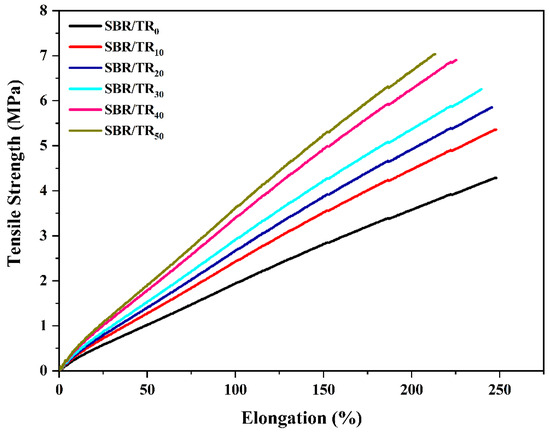
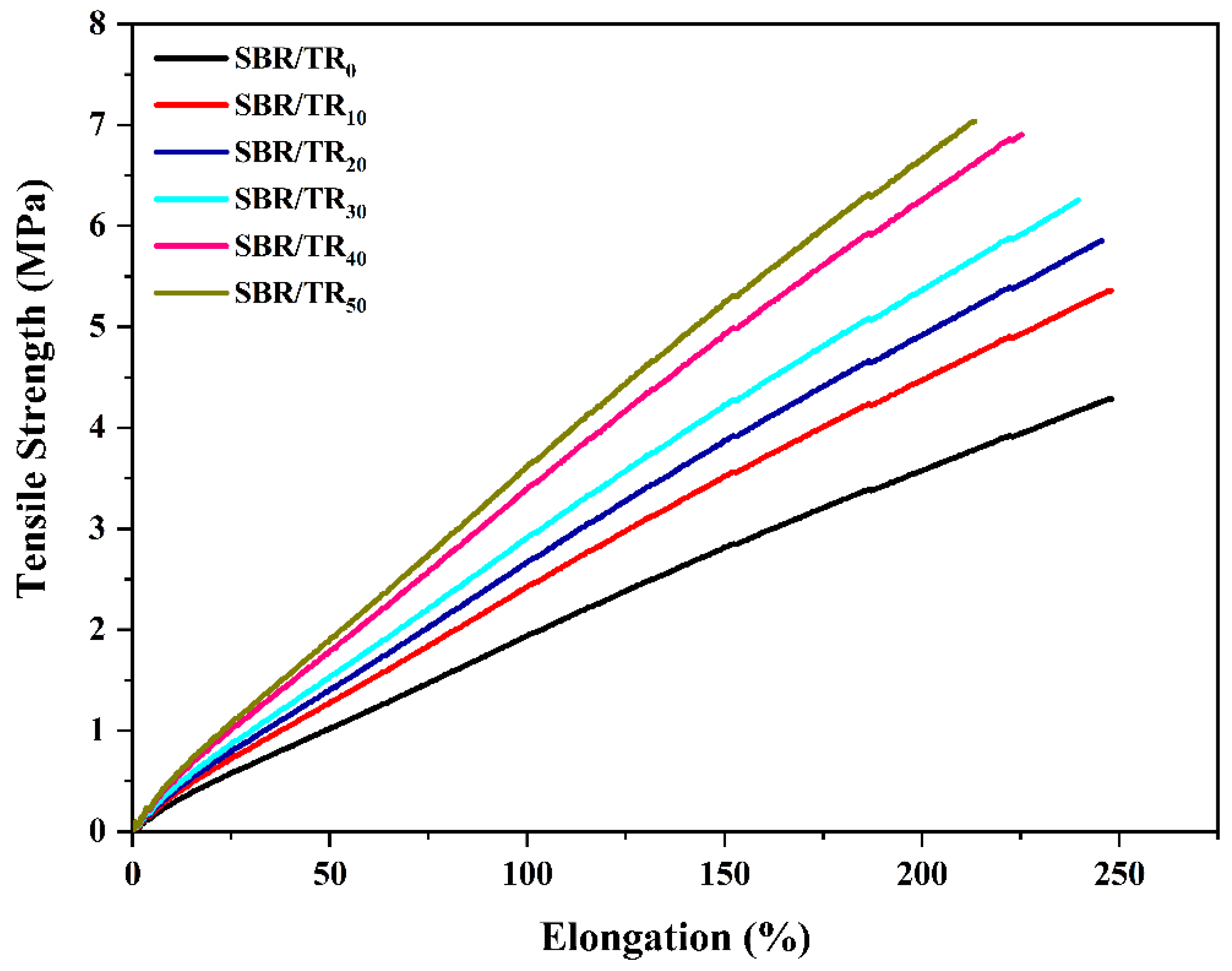
Figure 4 shows the stress–strain curves obtained from the tensile tests of the SBR/TR composites. It is observed that the mechanical behavior of the composites is strongly influenced by the content of toner residue incorporated into the elastomeric matrix.
Figure 4.
Tensile Strength Curves.
An increase in maximum stress is observed with increasing toner content, with the formulation containing 50 phr exhibiting the highest tensile strength, characterizing a typical behavior of a reinforced system. The residue acts as a reinforcing filler, promoting stress transfer between the SBR matrix and the dispersed particles, restricting chain mobility and contributing to a greater capacity to withstand loads before failure, possibly due to adequate matrix–filler interfacial interaction.
The quantitative data presented in Table 6 complement the qualitative analysis of the curves in Figure 4 by providing the values of stress and strain at break. It is observed that the tensile strength consistently increases with the toner residue content, rising from 4.28 ± 0.23 MPa for the neat formulation to 7.06 ± 0.29 MPa for the composite containing 50 phr of residue. This behavior confirms the role of toner residue as a mechanical reinforcing agent in the SBR matrix. Regarding elongation at break, the composites maintain high levels of stretch, characteristic of elastomeric materials, even with increasing filler content. Although there is a gradual reduction in elongation with higher toner content, the values remain elevated, indicating that the reinforcement provided by the residue does not significantly compromise the material’s flexibility.
Table 6.
Tensile Strength at Break Results.
For contextualization with conventional fillers, SBR composites reinforced with carbon black exhibit substantially higher reinforcement levels than unfilled SBR. For example, using N330 carbon black at 30–60 phr, reported tensile strengths range from ~17.9 to 22.0 MPa and Shore A hardness from ~57 to 74, along with a pronounced increase in moduli (e.g., M100 ~2.0–3.1 MPa and M300 ~8.9–14.6 MPa), highlighting the highly reinforcing nature of this grade [70]. Similarly, typical values for SBR filled with N660 at 60 phr include tensile strength of ~20.4 MPa and Shore A hardness of ~67, with M300 around ~18.1 MPa [71]. In comparison, in the present study, the incorporation of RT increased the tensile strength at break from 4.28 MPa (SBR/RT0) to 7.06 MPa (SBR/RT50), along with an increase in hardness from 50 to 56 Shore A, indicating a semi-reinforcing/functional behavior and potential for partial replacement of conventional fillers, albeit below the typical benchmark of industrial carbon black. It should be noted that differences in formulation (SBR grade, curing system, and mixing conditions) affect direct comparisons; however, the literature values provide a useful order-of-magnitude reference.
3.9. Tear Strength Analysis
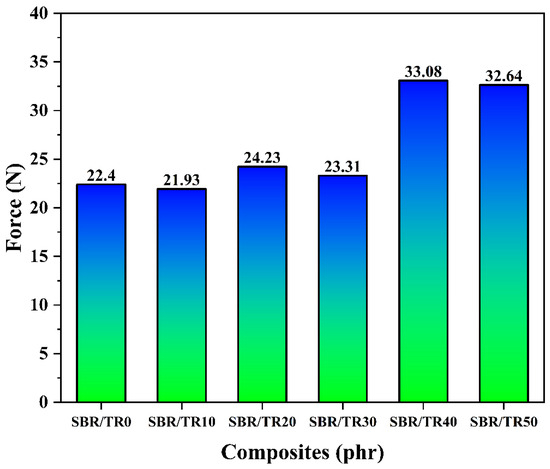
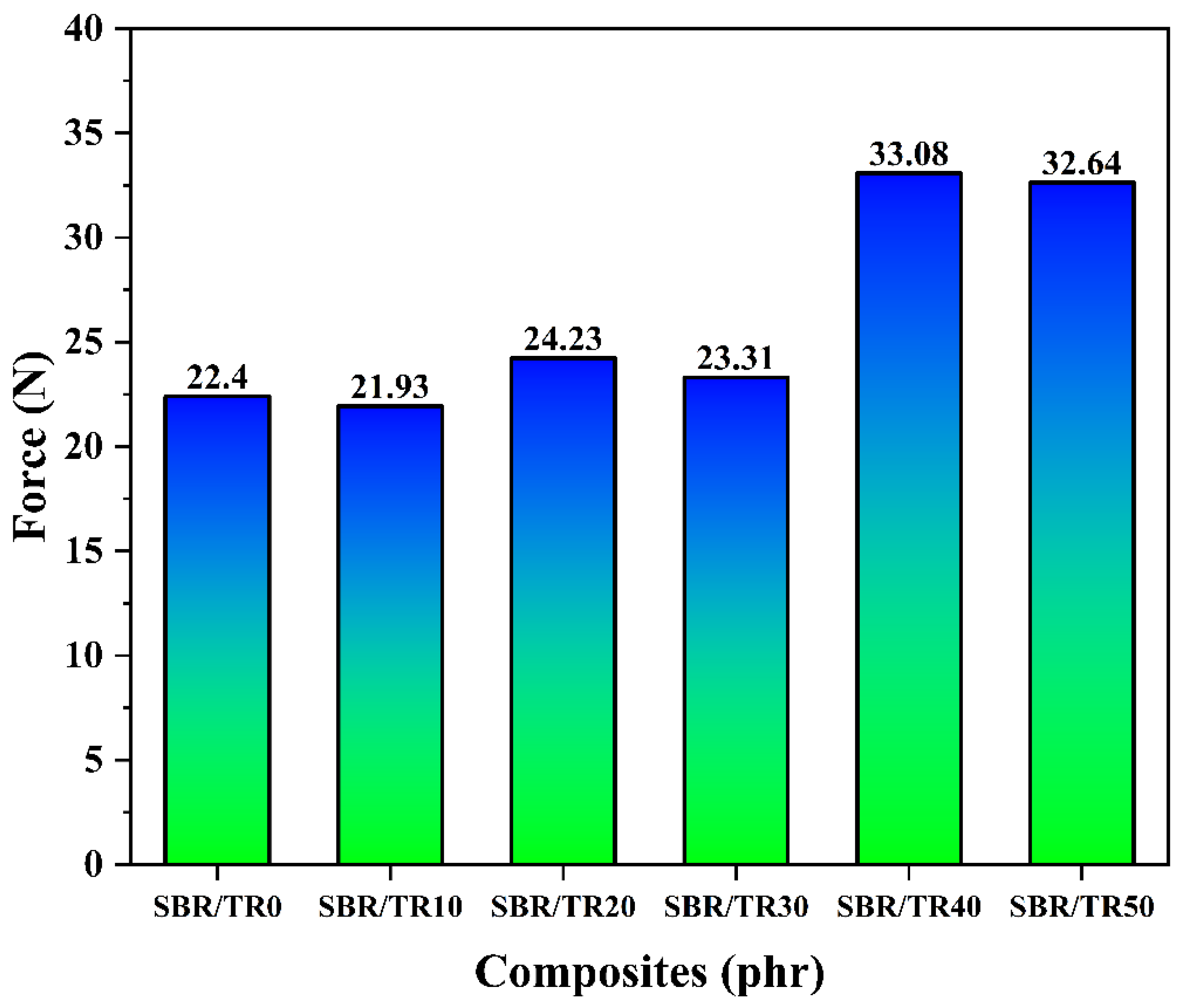
Figure 5 presents the maximum force values recorded in the tear strength tests for SBR composites containing different TR contents. It is observed that the composites with higher toner content exhibited the best performance, with the formulation containing 40 phr reaching the highest force value (33.08 N), closely followed by the 50 phr formulation (32.64 N). In the composites with lower toner contents (0, 10, 20, and 30 phr), the force values range from 21.93 N to 24.23 N, indicating more modest performance. These results suggest that toner, when incorporated at higher proportions, significantly contributes to the improvement of the matrix’s structural cohesion, hindering tear propagation.
Figure 5.
Bar chart of tear strength.
This reinforcement may be related to the efficient dispersion of toner particles at higher contents (up to a certain limit), which acts as a physical barrier against crack propagation. However, the slight decrease observed in the 50 phr formulation compared to the 40 phr formulation may indicate the onset of matrix saturation or particle agglomeration, which, although not severely compromising tear strength, points to a technical limit in residue incorporation. This behavior, in which tear strength gradually increases with filler loading up to a threshold, has been observed in other studies with elastomers, reflecting network interaction effects between filler and matrix [72].
4. Composite Application
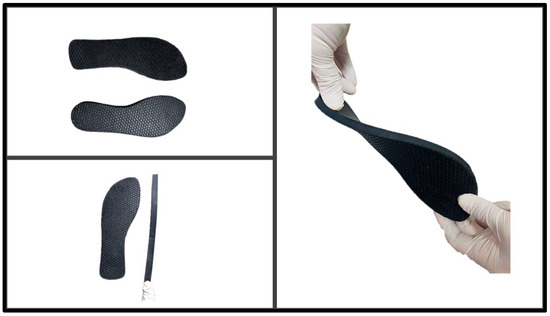
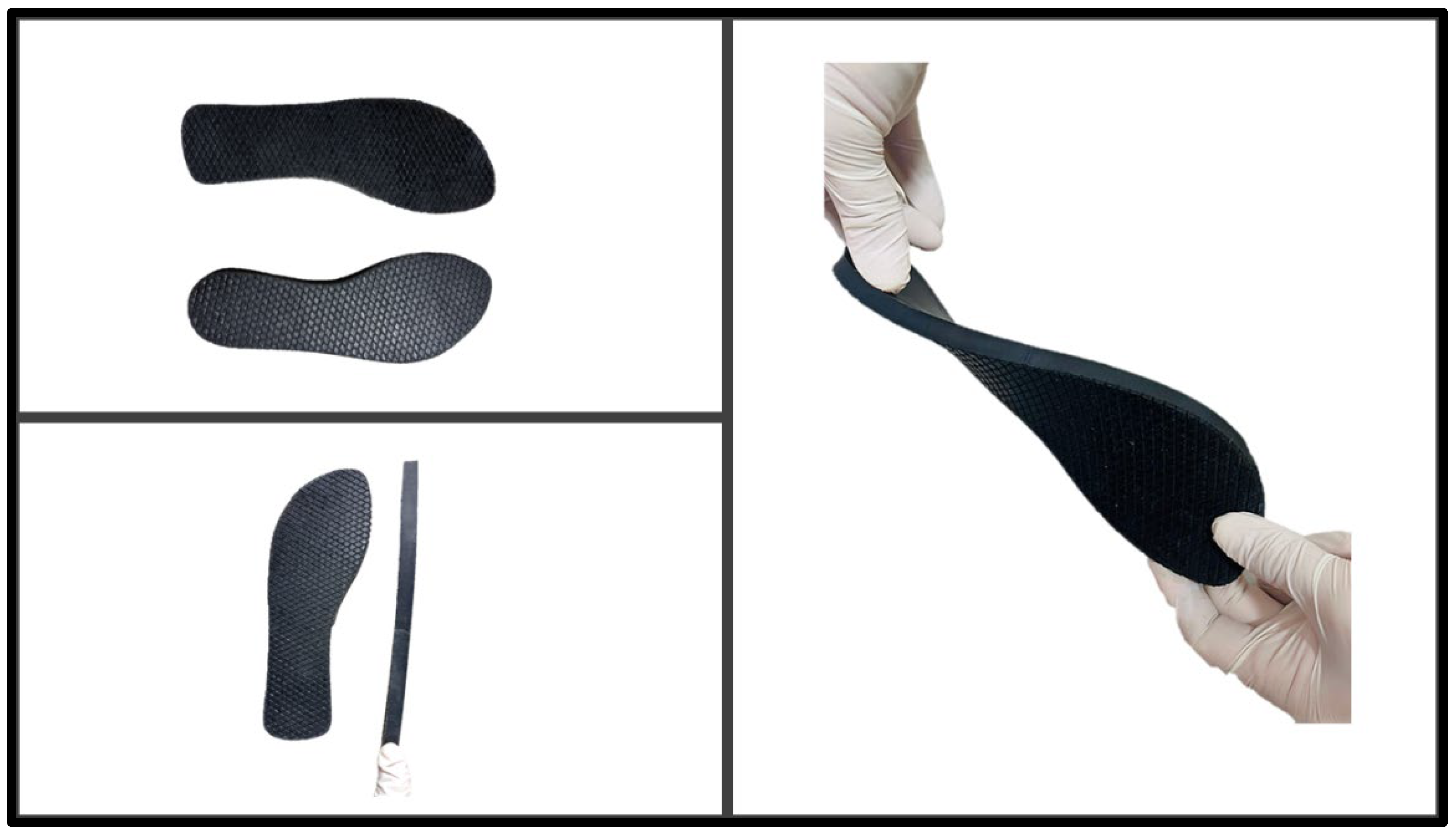
Based on the mechanical results presented, particularly hardness and tear strength, the composite containing 40 phr of toner residue proved to be one of the most promising among the tested formulations. Therefore, this formulation was selected for the fabrication of a shoe sole prototype, as illustrated in Figure 6.
Figure 6.
Fabrication of a shoe sole prototype containing 40 phr of toner residue.
The final product exhibits good flexibility, structural strength, and surface finish, which are desirable characteristics for everyday footwear applications. The textured surface provides improved ground grip, while the tear and abrasion resistance ensures material durability during use. Furthermore, the incorporation of toner residue, a byproduct of the printing industry, reinforces the sustainable potential of the proposed approach by promoting the reuse of solid waste in value-added products. Therefore, its application in flip-flop soles or insoles represents a technically viable alternative, whose environmental merit is primarily grounded in the valorization of electronic waste and the principles of the circular economy, contributing to the diversion of toner from landfills and to the reduction in demand for virgin fillers. It should be noted, however, that reducing abrasion loss remains an objective for future studies, aiming to minimize microplastic generation throughout the footwear life cycle.
5. Conclusions
The incorporation of toner residue as an alternative filler in styrene–butadiene rubber composites proved to be a technically viable approach that is aligned with the principles of the circular economy, as it promotes the valorization and reintegration of post-consumer waste into a new, higher value-added production cycle. The results showed that intermediate RT loadings, particularly in the range of 30 to 40 phr, provide significant improvements in mechanical properties, such as hardness, tensile strength, and tear resistance, associated with adequate filler dispersion and an increase in crosslink density. However, it is noteworthy that the formulation containing 40 phr, although presenting the best overall performance balance, still exhibits higher abrasion loss compared to formulations with lower filler contents, representing a critical point for improvement. In this context, the optimization of abrasion resistance becomes a priority for future studies, not only from a mechanical performance perspective but also with the aim of mitigating microplastic generation throughout the product life cycle, especially in applications such as footwear soles. Thus, the development of compatibilization strategies, filler surface modification, or fine-tuning of the elastomeric formulation represents a promising pathway to simultaneously maximize material performance and sustainability.
Author Contributions
D.d.S.S.: conceptualization, methodology, investigation, data curation, formal analysis, validation, visualization, and writing—original draft. M.C.C.d.O.B.: methodology, formal analysis, validation, and writing—review and editing. R.H.d.S.: methodology, investigation, validation, and writing—review and editing. M.J.d.S.: software, formal analysis, visualization, and writing—review and editing. G.T.d.A.S.: investigation, formal analysis, data curation, and visualization. L.M.S.e.S.: resources, technical support, and writing—review and editing. N.L.C.: investigation and data curation. C.T.H.: conceptualization, methodology, formal analysis, supervision, writing—review and editing, and acting as co-supervisor of the research. G.P.C.: methodology, investigation, writing—original draft, and writing—review and editing. L.F.P.: resources, project administration, and writing—review and editing. F.C.C.: resources, project administration, and writing—review and editing. R.J.d.S.: conceptualization, funding acquisition, project administration, supervision, writing—review and editing, and acting as research advisor and principal investigator. All authors have read and agreed to the published version of the manuscript.
Funding
This research was funded by the Conselho Nacional de Desenvolvimento Científico e Tecnológico (CNPq), under Process No. 306108/2024-0 and Fundação de Amparo à Pesquisa do Estado de São Paulo (FAPESP), under Process No. 2024/4118-0.
Institutional Review Board Statement
Not applicable.
Informed Consent Statement
Not applicable.
Data Availability Statement
The data used and/or analyzed during the present study are available from the corresponding author upon reasonable request.
Acknowledgments
Universidade Virtual do Estado de São Paulo (UNIVESP).
Conflicts of Interest
The authors declare no conflict of interest.
References
- UNITAR—United Nations Institute for Training and Research. Sustainable Cycles (SCYCLE) Programme. The Global E-Waste Monitor 2024—Electronic Waste Rising Five Time Faster than Documented E-waste Recycling: UN. Available online: https://ewastemonitor.info/the-global-e-waste-monitor-2024/ (accessed on 20 February 2026).
- UNITAR—United Nations Institute for Training and Research. The Global E-Waste Monitor 2020: Quantities, Flows, and the Circular Economy Potential. Available online: https://ewastemonitor.info/wp-content/uploads/2020/11/GEM_2020_def_july1_low.pdf (accessed on 20 February 2026).
- Parthasarathy, M. Challenges and emerging trends in toner waste recycling: A review. Recycling 2021, 6, 57. [Google Scholar] [CrossRef] [Scilit]
- Islam, T.; Huda, N. Reverse logistics and closed-loop supply chain of Waste Electrical and Electronic Equipment (WEEE)/E-waste: A comprehensive literature review. Resour. Conserv. Recycl. 2018, 137, 48–75. [Google Scholar] [CrossRef] [Scilit]
- Bhoi, V.N.; Shah, T. E-waste: A new environmental challenge. Int. J. Adv. Res. Comput. Sci. Softw. Eng. 2014, 4, 442–447. [Google Scholar]
- Ivan, F.X.; Mac Aogáin, M.; Ali, N.A.B.M.; Tiew, P.Y.; Poh, T.Y.; Setyawati, M.I.; Bello, D.; Demokritou, P.; Ng, K.W.; Chotirmall, S.H. Occupational exposure to printer toner-emitted nanoparticles at printing facilities influences air and airway microbiomes. NanoImpact 2025, 39, 100575. [Google Scholar] [CrossRef] [Scilit]
- Babar, S.; Gavade, N.; Shinde, H.; Gore, A.; Mahajan, P.; Lee, K.H.; Bhuse, V.; Garadkar, K. An innovative transformation of waste toner powder into magnetic g-C3N4-Fe2O3 photocatalyst: Sustainable e-waste management. J. Environ. Chem. Eng. 2019, 7, 103041. [Google Scholar] [CrossRef] [Scilit]
- Perkins, D.N.; Drisse, M.-N.B.; Nxele, T.; Sly, P.D. E-waste: A global hazard. Ann. Glob. Health 2014, 80, 286–295. [Google Scholar] [CrossRef] [Scilit]
- Salhofer, S.; Tesar, M. Assessment of removal of components containing hazardous substances from small WEEE in Austria. J. Hazard. Mater. 2011, 186, 1481–1488. [Google Scholar] [CrossRef] [Scilit]
- Gaikwad, V.; Kumar, U.; Pahlevani, F.; Piadasa, A.; Sahajwalla, V. Thermal transformation of waste toner powder into a value-added ferrous resource. ACS Sustain. Chem. Eng. 2017, 5, 11543–11550. [Google Scholar] [CrossRef] [Scilit]
- Kumar, U.; Goonetilleke, D.; Gaikwad, V.; Pramudita, J.C.; Joshi, R.K.; Sharma, N.; Sahajwalla, V. Activated carbon from e-waste plastics as a promising anode for sodium-ion batteries. ACS Sustain. Chem. Eng. 2019, 7, 10310–10322. [Google Scholar] [CrossRef] [Scilit]
- Aydemir, C.; Özsoy, S.A. Environmental impact of printing inks and printing process. J. Graph. Eng. Des. 2020, 11, 11–18. [Google Scholar] [CrossRef] [Scilit]
- Khalaf, E.S.A. A comparative study for the main properties of silica and carbon black Filled bagasse-styrene butadiene rubber composites. Polym. Polym. Compos. 2023, 31, 09673911231171035. [Google Scholar] [CrossRef] [Scilit]
- Zhu, J.; Birgisson, B.; Kringos, N. Polymer modification of bitumen: Advances and challenges. Eur. Polym. J. 2014, 54, 18–38. [Google Scholar] [CrossRef] [Scilit]
- Bond, T.C.; Doherty, S.J.; Fahey, D.W.; Forster, P.M.; Berntsen, T.; DeAngelo, B.J.; Flanner, M.G.; Ghan, S.; Kärcher, B.; Koch, D.; et al. Bounding the role of black carbon in the climate system: A scientific assessment. J. Geophys. Res. Atmos. 2013, 118, 5380–5552. [Google Scholar] [CrossRef] [Scilit]
- OEHHA—Office of Environmental Health Hazard Assessment. Atmospheric Black Carbon Concentrations. California Environmental Protection Agency. 2022. Available online: https://oehha.ca.gov/climate-change/epic-2022/climate-change-drivers/atmospheric-black-carbon-concentrations (accessed on 19 March 2026).
- Government of Canada. Screening Assessment for the Challenge—Carbon Black (CAS RN 1333-86-4). Environment Canada/Health Canada, 2011. Available online: https://www.canada.ca/en/environment-climate-change/services/evaluating-existing-substances/screening-assessment-forchallenge-carbon-black-chemical-abstracts-service-registry-number-1333-86-4-environm.html (accessed on 19 March 2026).
- OECD—Organisation for Economic Co-operation and Development. SIDS Initial Assessment Profile: Carbon Black. SIAM 22, HPV Chemicals Programme, 2006. Available online: https://hpvchemicals.oecd.org/ui/handler.axd?id=5a53a150-3bb8-4296-9286-ee930e09de8c (accessed on 19 March 2026).
- Hamed, G.R.; Hatfield, S. On the role of bound rubber in carbon-black reinforcement. Rubber Chem. Technol. 1989, 62, 143–156. [Google Scholar] [CrossRef] [Scilit]
- Taiye, M.A.; Hafida, W.; Kong, F.; Zhou, C. A review of the use of rice husk silica as a sustainable alternative to traditional silica sources in various applications. Environ. Prog. Sustain. Energy 2024, 43, e14451. [Google Scholar] [CrossRef] [Scilit]
- Wang, M.-J. Effect of polymer-filler and filler-filler interactions on dynamic properties of filled vulcanizates. Rubber Chem. Technol. 1998, 71, 520–589. [Google Scholar] [CrossRef] [Scilit]
- Rosner, F.; Bhagde, T.; Slaughter, D.S.; Zorba, V.; Stokes-Draut, J. Techno-economic and carbon dioxide emission assessment of carbon black production. J. Clean. Prod. 2024, 436, 140224. [Google Scholar] [CrossRef] [Scilit]
- Salami, B.A.; Oyehan, T.A.; Gambo, Y.; Badmus, S.O.; Tanimu, G.; Adamu, S.; Lateef, S.A.; Saleh, T.A. Technological trends in nanosilica synthesis and utilization in advanced treatment of water and wastewater. Environ. Sci. Pollut. Res. 2022, 29, 42560–42600. [Google Scholar] [CrossRef] [Scilit] [PubMed]
- Utrera-Barrios, S.; Martínez, M.; Mas-Giner, I.; Verdejo, R.; López-Manchado, M.; Santana, M.H. New recyclable and self-healing elastomer composites using waste from toner cartridges. Compos. Sci. Technol. 2023, 244, 110292. [Google Scholar] [CrossRef] [Scilit]
- Daniel-Mkpume, C.C.; Ahaiwe, R.C.; Ifenatuorah, C.L.; Ike-Eze, I.C.E.; Aigbodion, V.S.; Egoigwe, S.V.; Okonkwo, E.G. Potential end of life application of African star apple shell and waste toner powder as composite filler materials. J. Mater. Cycles Waste Manag. 2022, 24, 680–691. [Google Scholar] [CrossRef] [Scilit]
- Siddiq, M.U.; Anwar, M.K.; Almansour, F.H.; Javed, J.; Qurashi, M.A. Performance Evaluation of Waste Toner and Recycled LDPE-Modified Asphalt Pavement: A Mechanical and Carbon Assessment-Based Optimization Approach Towards Sustainability. Sustainability 2025, 17, 7003. [Google Scholar] [CrossRef] [Scilit]
- Hejna, A.; Wiśniewska, P.; Kowalkowska-Zedler, D.; Korol, J.; Kosmela, P.; Marć, M.; Ezzati, P.; Szostak, M.; Saeb, M.R. Waste printer ink as modifier for natural rubber/carbon black composites: No haste, use waste. Sustain. Mater. Technol. 2023, 38, e00765. [Google Scholar] [CrossRef] [Scilit]
- Yordanova, D.; Angelova, S.; Dombalov, I. Utilisation options for waste toner powder. J. Environ. Sci. 2014, 3, 140–144. [Google Scholar]
- Dębek, C. Possibilities of using post-consumer toners in rubber mixtures. Elastomers 2018, 22, 19–37. [Google Scholar]
- Holden, G. Thermoplastic elastomers. In Applied Plastics Engineering Handbook; William Andrew Publishing: Norwich, NY, USA, 2024; pp. 97–113. [Google Scholar] [CrossRef] [Scilit]
- Morton, M. (Ed.) Rubber Technology, 3rd ed.; Springer: New York, NY, USA, 1999. [Google Scholar] [CrossRef] [Scilit]
- Dick, J.S. (Ed.) Rubber Technology: Compounding and Testing for Performance; Carl Hanser Verlag GmbH Co KG: Munich, Germany, 2020. [Google Scholar]
- Rodgers, B. (Ed.) Rubber Compounding: Chemistry and Applications; CRC Press: Boca Raton, FL, USA, 2015. [Google Scholar] [CrossRef] [Scilit]
- Mark, J.E.; Erman, B.; Roland, M. (Eds.) The Science and Technology of Rubber; Academic Press: Cambridge, MA, USA, 2013. [Google Scholar] [CrossRef] [Scilit]
- Krannich, A.-L.; Reiser, D. United nations sustainable development goals 2030. In Encyclopedia of Sustainable Management; Springer International Publishing: Cham, Switzerland, 2023; pp. 3862–3867. [Google Scholar] [CrossRef] [Scilit]
- Schroeder, P.; Anggraeni, K.; Weber, U. The relevance of circular economy practices to the sustainable development goals. J. Ind. Ecol. 2019, 23, 77–95. [Google Scholar] [CrossRef] [Scilit]
- Kirchherr, J.; Reike, D.; Hekkert, M. Conceptualizing the circular economy: An analysis of 114 definitions. Resour. Conserv. Recycl. 2017, 127, 221–232. [Google Scholar] [CrossRef] [Scilit]
- ASTM International. Standard Practice for Rubber—Materials, Equipment, and Procedures for Mixing Standard Compounds and Preparing Standard Vulcanized Sheets, D3182-21a; ASTM: West Conshohocken, PA, USA, 2021. [Google Scholar]
- ASTM International. Standard Test Method for Rubber Property—Vulcanization Using Oscillating Disk Cure Meter, D2084-17; West ASTM: Conshohocken, PA, USA, 2017. [Google Scholar]
- Coran, A.Y. Vulcanization. In Science and Technology of Rubber, 3rd ed.; Mark, J.E., Ed.; Elsevier: Amsterdam, The Netherlands, 2005; pp. 321–366. [Google Scholar] [CrossRef] [Scilit]
- Silva, G.M.; Morais, M.C. Aplicações da técnica de fluorescência de raios X (FRX) na análise de materiais. Rev. Bras. De Ensino De Ciência E Tecnol. 2020, 13, 9–25. [Google Scholar]
- Flory, P.J.; Rehner, J. Statistical mechanics of cross-linked polymer networks. J. Chem. Phys. 1943, 11, 512–520. [Google Scholar] [CrossRef] [Scilit]
- Hiranobe, C.T.; Ribeiro, G.D.; Torres, G.B.; dos Reis, E.A.P.; Cabrera, F.C.; Job, A.E.; Paim, L.L.; dos Santos, R.J. Cross-Linked Density Determination of Natural Rubber Compounds by Different Analytical Techniques. Mater. Res. 2021, 24, e20210041. [Google Scholar] [CrossRef] [Scilit]
- ASTM International. Standard Test Method for Rubber—Determination of Specific Gravity (Density) of Vulcanized Rubber, D297-21; ASTM: West Conshohocken, PA, USA, 2021. [Google Scholar]
- ASTM International. Standard Test Method for Rubber Property—Durometer Hardness, D2240-15; ASTM: West Conshohocken, PA, USA, 2015. [Google Scholar]
- ASTM International. Standard Test Method for Rubber Property—Abrasion Resistance (Rotary Drum Abrader), D5963-04; ASTM: West Conshohocken, PA, USA, 2004. [Google Scholar]
- ASTM International. Standard Test Methods for Vulcanized Rubber and Thermoplastic Elastomers—Tension, D412-16; ASTM: West Conshohocken, PA, USA, 2016. [Google Scholar]
- ASTM International. Standard Test Method for Tear Strength of Conventional Vulcanized Rubber and Thermoplastic Elastomers, D624-00; ASTM: West Conshohocken, PA, USA, 2000. [Google Scholar]
- Kalantari, M.; Abdi, R.; Katbab, A.A. Investigating the viscoelastic and hysteresis behavior of nano silica/carbon black hybrid reinforced styrene-butadiene rubber vulcanizates via surface silanization. Polym. Eng. Sci. 2023, 63, 2309–2320. [Google Scholar]
- Ramier, J.; Chazeau, L.; Gauthier, C.; Guy, L.; Bouchereau, M.N. Influence of silica and its different surface treatments on the vulcanization process of silica filled SBR. Rubber Chem. Technol. 2007, 80, 183–193. [Google Scholar] [CrossRef] [Scilit]
- Alves, J.F.; Silva, A.B.; Souza, D.R. Effects of inorganic fillers on sulfur vulcanization of SBR: Adsorption of accelerators and cure kinetics. J. Appl. Polym. Sci. 2018, 135, 45892. [Google Scholar] [CrossRef] [Scilit]
- Hosseini, S.M.; Razzaghi-Kashani, M. Vulcanization kinetics of nano-silica filled styrene butadiene rubber: Effect of filler loading on cure rate and diffusion constraints. Polymer 2014, 55, 6765–6775. [Google Scholar] [CrossRef] [Scilit]
- Ismail, H.; Nordin, R.; Noor, A.M. The effect of filler loading on curing and mechanical properties of natural rubber/recycled rubber powder blends. Int. J. Polym. Mater. 2005, 54, 9–20. [Google Scholar] [CrossRef] [Scilit]
- Choudhury, A. Isothermal crystallization and mechanical behavior of ionomer treated sisal/HDPE composites. Mater. Sci. Eng. A 2008, 491, 492–500. [Google Scholar] [CrossRef] [Scilit]
- Wang, X.; Leng, Y.; Han, X. Morphological effects of filler loadings in rubber composites: Formation of agglomerates and stress concentration points. J. Appl. Polym. Sci. 2023, 140, e49244. [Google Scholar] [CrossRef] [Scilit]
- Nandiyanto, A.B.D.; Ragadhita, T.; Fiandini, M. Interpretation of Fourier transform infrared spectra (FTIR): A practical approach in the polymer/plastic thermal decomposition. Indones. J. Sci. Technol. 2023, 8, 113–126. [Google Scholar]
- Noriman, N.Z.; Ismail, H.; Rashid, A.A. Characterization of styrene butadiene rubber/recycled acrylonitrile-butadiene rubber (SBR/NBRr) blends: The effects of epoxidized natural rubber (ENR-50) as a compatibilizer. Polym. Test. 2010, 29, 200–208. [Google Scholar] [CrossRef] [Scilit]
- Fernández-Berridi, M.J.; González, N.; Mugica, A.; Bernicot, C. Pyrolysis-FTIR and TGA techniques as tools in the characterization of blends of natural rubber and SBR. Thermochim. Acta 2006, 444, 65–70. [Google Scholar] [CrossRef] [Scilit]
- Shimba, A.; Morimoto, M.; Sato, E.; Kimura, F. Characterization of Microstructure in Styrene-Butadiene Rubber by FT-IR Spectroscopy Using Single Reflection ATR. Anal. Sci. 2002, 17, i1503–i1506. [Google Scholar]
- Rekam, M.; Manikumar, R.; Rao, N. Comparative FTIR analysis of liquid and cured forms of ortho-unsaturated polyester resin and flame-retardant resin investigating chemical structure transformations. China Petrol. Proc. Petrochem. Technol. Catalyst Res. 2024, 24, 91–116. [Google Scholar]
- Sahajwalla, V.; Gaikwad, V. O presente e o futuro da reciclagem de plásticos de resíduos eletrônicos. Curr. Opin. Green Sustain. Chem. 2018, 13, 102–107. [Google Scholar] [CrossRef] [Scilit]
- Peinado, C.; Alonso, A.; Catalina, F.; Schnabel, W. Using linear and branched polysilanes for the photoinitiated polymerization of a commercial silicone-acrylate resin: A real time FTIR study. J. Photochem. Photobiol. A Chem. 2001, 141, 267–273. [Google Scholar] [CrossRef] [Scilit]
- Kumar, A.; Mohanty, S.; Gupta, V.K. Butadiene rubber: Synthesis, microstructure, and role of catalysts. Rubber Chem. Technol. 2021, 94, 393–438. [Google Scholar] [CrossRef] [Scilit]
- Salama, W.; El Aref, M.; Gaupp, R. Spectroscopic characterization of iron ores formed in different geological environments using FTIR, XPS, Mössbauer spectroscopy and thermoanalyses. Spectrochim. Acta Part A Mol. Biomol. Spectrosc. 2015, 136, 1816–1826. [Google Scholar] [CrossRef] [Scilit]
- Ristić, M.; Krehula, S.; Reissner, M.; Musić, S. 57Fe Mössbauer, XRD, FT-IR, FE SEM Analyses of Natural Goethite, Hematite and Siderite. Croat. Chem. Acta 2017, 90, 499–506. [Google Scholar] [CrossRef] [Scilit]
- Lee, S.-W.; Choi, J.H.; Lee, W.K. Reinforcement effects of inorganic fillers on mechanical properties of styrene–butadiene rubber. J. Appl. Polym. Sci. 2015, 132, 42521. [Google Scholar] [CrossRef] [Scilit]
- Lee, T.Y.; Kim, L.; Kim, D.; An, S.; An, Y.J. Microplastics from shoe sole fragments cause oxidative stress in a plant (Vigna radiata) and impair soil environment. J. Hazard. Mater. 2022, 429, 128306. [Google Scholar] [CrossRef] [Scilit]
- Manabe, S.; Shimizu, Y.; Yoshitomi, T.; Fujinuma, R.; Kobayashi, M. Release of Microplastics from Shoe Outsoles into the Environment by Walking and Jogging, and Ingestion of Shoe Outsole Microplastics by Goldfish. Microplastics 2025, 4, 92. [Google Scholar] [CrossRef] [Scilit]
- Zhang, Y.; Xu, J.; Zhou, X. Influence of filler agglomeration on abrasion resistance of rubber composites: Correlation with particle dispersion and mechanical integrity. Compos. Sci. Technol. 2019, 169, 18–26. [Google Scholar] [CrossRef] [Scilit]
- Berki, P.; Göbl, R.; Karger-Kocsis, J. Structure and properties of styrene-butadiene rubber (SBR) with pyrolytic and industrial carbon black. Polym. Test. 2017, 61, 404–415. [Google Scholar] [CrossRef] [Scilit]
- Berki, P.; Karger-Kocsis, J. Comparative properties of styrene-butadiene rubbers (SBR) containing pyrolytic carbon black, conventional carbon black, and organoclay. J. Macromol. Sci. Part B 2016, 5, 749–763. [Google Scholar] [CrossRef] [Scilit]
- Ansorge, S.; Papailiou, K. Mechanical properties of silicone rubber under high loadings of alumina trihydrate filler. J. Elastomers Plast. 2015, 48, 319–336. [Google Scholar] [CrossRef] [Scilit]

Disclaimer/Publisher’s Note: The statements, opinions and data contained in all publications are solely those of the individual author(s) and contributor(s) and not of MDPI and/or the editor(s). MDPI and/or the editor(s) disclaim responsibility for any injury to people or property resulting from any ideas, methods, instructions or products referred to in the content. |
© 2026 by the authors. Licensee MDPI, Basel, Switzerland. This article is an open access article distributed under the terms and conditions of the Creative Commons Attribution (CC BY) license.