


Abstract
Ultra-high-performance concrete exhibits excellent mechanical performance but relies on a high binder content, resulting in substantial carbon emissions. This study investigates sustainable ultra-high-performance concrete incorporating sewage sludge ash, aiming to balance mechanical performance, environmental safety, and life-cycle impacts within an integrated material system. High volumes of sewage sludge ash were incorporated into ultra-high-performance concrete under autoclave curing, with mixture proportions designed based on particle packing theory. Fresh properties, mechanical performance, shrinkage behavior, microstructural characteristics, heavy-metal leaching, as well as life-cycle environmental and economic impacts were systematically evaluated. The incorporation of porous sewage sludge ash modified the pore structure of ultra-high-performance concrete, thereby enabling a substantial reduction in cement content. At a sewage sludge ash replacement level of 60%, life-cycle assessment results indicate a 42.7% reduction in carbon emissions while maintaining a compressive strength of approximately 147 MPa under autoclave curing, remaining within a practically viable range for ultra-high-performance concrete. This confirms that sewage sludge ash can be safely incorporated into ultra-high-performance concrete, delivering a favorable sustainability–performance trade-off alongside significant environmental and economic benefits.
1. Introduction
Ultra-high-performance concrete (UHPC) is an advanced cementitious composite composed of three primary components: a binder system (typically cement and silica fume) [1,2], fine aggregates [3,4], and steel fibers [5]. Through optimized particle packing and fiber-induced reinforcement and toughening mechanisms, UHPC exhibits ultra-high compressive strength [6], remarkable ductility, and a highly densified microstructure, which collectively contribute to its superior mechanical performance and durability [7,8]. Nevertheless, the high consumption of cementitious binders [9], fine aggregates, and steel fibers leads to a material demand that significantly exceeds that of conventional concrete [10,11]. For instance, steel fibers alone can account for a significant fraction of the total mixture [12]. Although various optimization strategies, including lowering steel fiber content and incorporating alternative materials such as basalt fine aggregates [13] and CRT glass [14], have shown promise, achieving the required dense particle packing still necessitates a relatively high binder content [15,16]. Consequently, UHPC often requires nearly twice the cement content of ordinary concrete [17,18]. Despite its low water-to-binder ratio and reduced porosity at 28 days [19], cement hydration often remains limited to 30–40%, indicating that a substantial fraction of the cement primarily functions as an inert filler. Given that cement production contributes approximately 7% of global CO2 emissions [20,21,22], replacing cement with supplementary cementitious materials (SCMs) such as fly ash and glass powder in UHPC is increasingly urgent. However, the increasing demand for SCMs, coupled with cleaner industrial processes, has progressively reduced the availability of these conventional by-products [23]. Consequently, identifying alternative waste-derived binders capable of enabling higher cement replacement levels has become a critical research frontier with significant environmental and economic potential [24,25].
Sewage sludge, an inevitable by-product of municipal and industrial wastewater treatment, contains complex constituents, including organic contaminants, heavy metals, and pathogenic microorganisms [26,27]. With ongoing urbanization and the expansion of wastewater treatment capacity, global sludge production has increased by approximately 5–10% annually, reaching about 50 million tons in the United States and 70 million tons in China [28,29,30]. As conventional disposal routes face increasing environmental and regulatory constraints, high-temperature calcination has been widely adopted as an effective treatment method to reduce sludge volume and eliminate pathogens [31,32]. However, this process generates large quantities of sewage sludge ash (SSA), which may retain potentially hazardous heavy metals (e.g., Cr, Ni, Cu, Zn, and Pb) depending on wastewater composition and combustion conditions [33,34,35]. Improper management of SSA therefore poses substantial environmental and health risks, making its safe and large-scale reuse a critical global challenge [36,37,38]. In this context, incorporating SSA into cement-based materials has been widely explored as a promising pathway for waste valorization and carbon reduction.
In Europe, North America, and other regions, extensive research has been conducted on the physicochemical properties, reactivity, and application potential of sewage sludge ash (SSA) in cementitious systems [39,40]. European studies have shown that SSA is primarily composed of inorganic oxides such as SiO2, Al2O3, and Fe2O3 and exhibits limited but measurable pozzolanic reactivity under appropriate conditions, leading to its consideration as a potential supplementary cementitious material (SCM) [41,42]. However, unlike conventional SCMs such as fly ash or slag, SSA is a highly heterogeneous multiphase material whose reactivity is strongly dependent on calcination temperature and mineralogical composition, resulting in pronounced variability in engineering performance among different SSA sources [43].
In North America and Asia, research has largely focused on the environmental safety and engineering applicability of SSA [44,45], including solidification/stabilization efficiency, heavy-metal leaching behavior, and life-cycle environmental impacts in cement-based systems [46,47]. Although cement-based stabilization techniques can effectively suppress heavy-metal leaching and reduce clinker consumption under appropriate mix design and curing conditions [48,49], the porous and irregular morphology of SSA particles leads to high water absorption, impaired workability, and significant strength loss at high replacement levels [50,51]. As a result, the SSA replacement ratio in mortar and conventional concrete is typically limited to below 30% [52,53,54].
Owing to its extremely low porosity and highly densified microstructure, UHPC provides a favorable matrix for stabilizing heavy metals contained in SSA while enabling reduced cement consumption, making it a promising platform for waste-derived resource recovery [55,56,57]. Previous studies under standard curing conditions have shown that incorporating low SSA contents (<30%) into UHPC is feasible without compromising fundamental performance [58]; however, achieving higher replacement levels while preserving the characteristic strength and toughness of UHPC remains challenging. In this context, autoclave curing has emerged as a potential strategy [59,60], as the combined effects of high temperature and pressure can accelerate cement hydration [61], activate pozzolanic reactions [62,63], and refine the interfacial transition zone and pore structure [64,65,66]. Despite these advantages, a systematic understanding of high-volume SSA incorporation into UHPC under autoclave curing—particularly regarding its coupled effects on mechanical performance, heavy-metal immobilization, shrinkage behavior, and life-cycle environmental impacts—remains limited. Consequently, comprehensive investigations of SSA utilization in UHPC systems are still lacking compared with studies on mortar and conventional concrete.
This study systematically examines the feasibility of incorporating SSA into UHPC under autoclave curing. SSA was used as a partial cement replacement to produce environmentally friendly UHPC. The influence of different SSA replacement levels on the macro-mechanical and physical properties was thoroughly evaluated. To clarify the underlying mechanisms, the microstructure was characterized using multiple techniques: X-ray diffraction (XRD) for phase composition and hydration products, mercury intrusion porosimetry (MIP) for pore structure, and scanning electron microscopy (SEM) for morphology and interfacial transition zones. In addition, a life-cycle assessment (LCA) was conducted to assess the environmental and economic impacts of using varying SSA proportions. The results demonstrate a promising pathway for the sustainable use of this hazardous waste and provide useful insights for developing eco-friendly UHPC.
2. Materials and Methods
2.1. Raw Materials and Their Characteristics
Ordinary Portland cement (P.O 42.5), silica fume [67], and SSA [68] constituted the cementitious materials used in this study. The SSA used in this study was prepared from raw sludge obtained from a Shenzhen wastewater treatment plant. The processing involved drying, calcination at 800 °C for 2 h, cooling, followed by ball milling and sieving. The cement was an early-strength ordinary Portland cement (P.O 42.5) supplied by Conch, and the silica fume, purchased from Xi’an Linyuan Micro Silicon Powder Co., Ltd., Xi’an, China, appeared as a gray ultrafine powder. Table 1 summarizes the chemical compositions of the cement, silica fume, and SSA as determined by X-ray fluorescence (XRF) spectrometry. Compared with cement, SSA contains significantly lower CaO but higher proportions of SiO2, Al2O3, and Fe2O3, indicating its inherent pozzolanic reactivity [69,70].
Table 1.
Chemical composition and physical properties of cement, silica fume, and SSA.
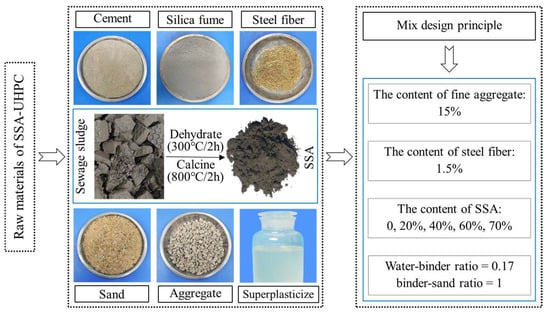
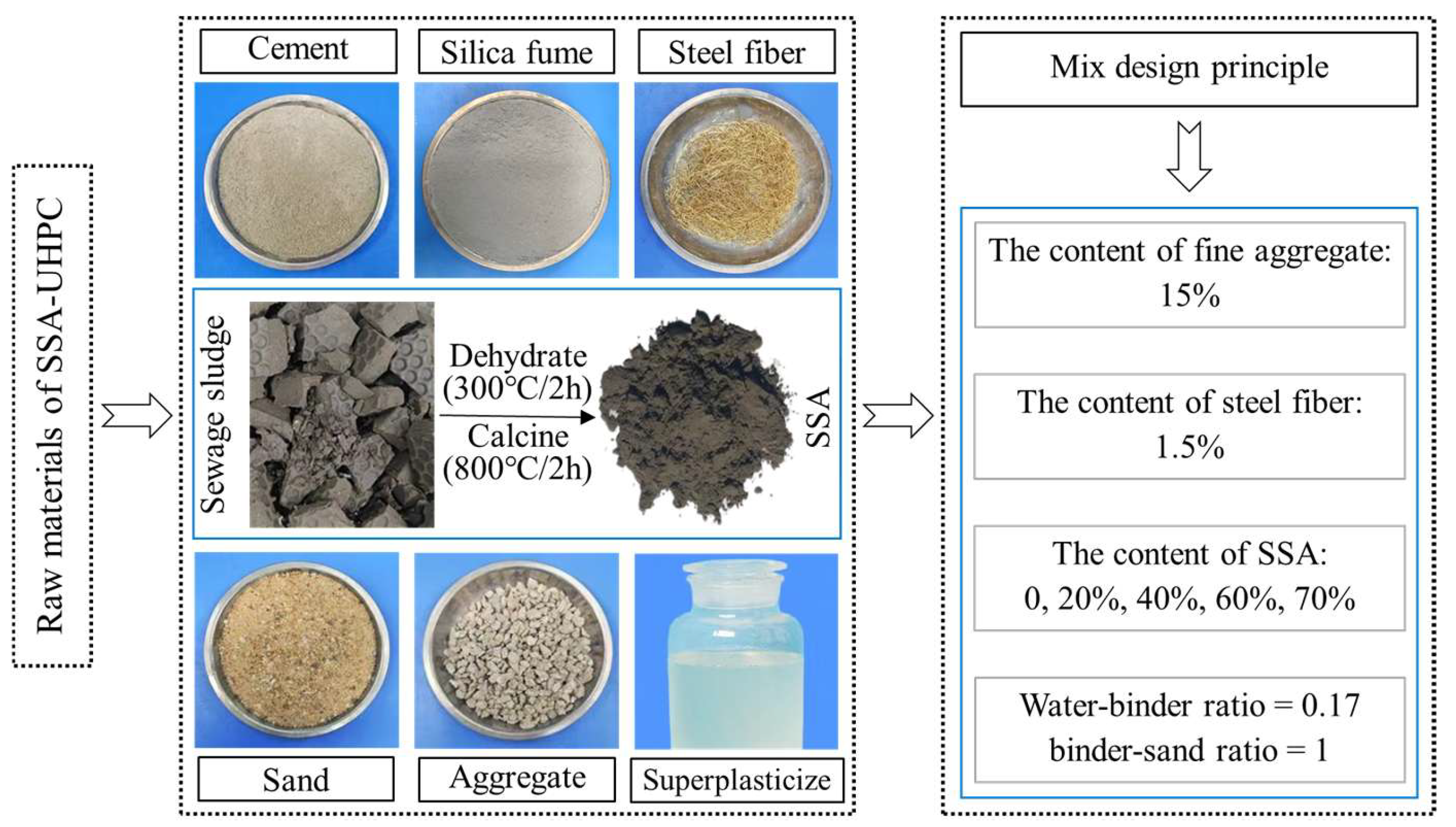
The UHPC mixtures utilized natural river sand (0–1.18 mm) and basalt fine aggregate (3–5 mm) as fine aggregates, with respective apparent densities of 2.5 g/cm3 and 2.9 g/cm3. A polycarboxylate-ether-based high-performance superplasticizer was used, exhibiting a solid content of 24.7%, a water-reduction rate above 25%, and a light-yellow color. Straight micro steel fibers (13 mm length, 0.12 mm diameter, tensile strength 2850 MPa) served as reinforcement. The raw materials and corresponding mix proportions for the SSA-incorporated UHPC are presented in Figure 1.
Figure 1.
Design principles of raw materials and mixtures for eco-friendly UHPC.
2.2. Mix Proportion Design
2.2.1. Mix Proportion Design Scheme
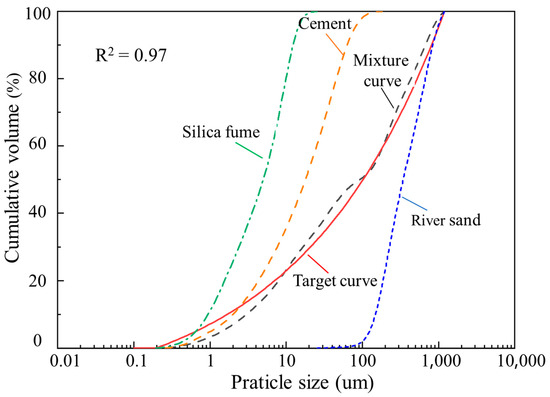
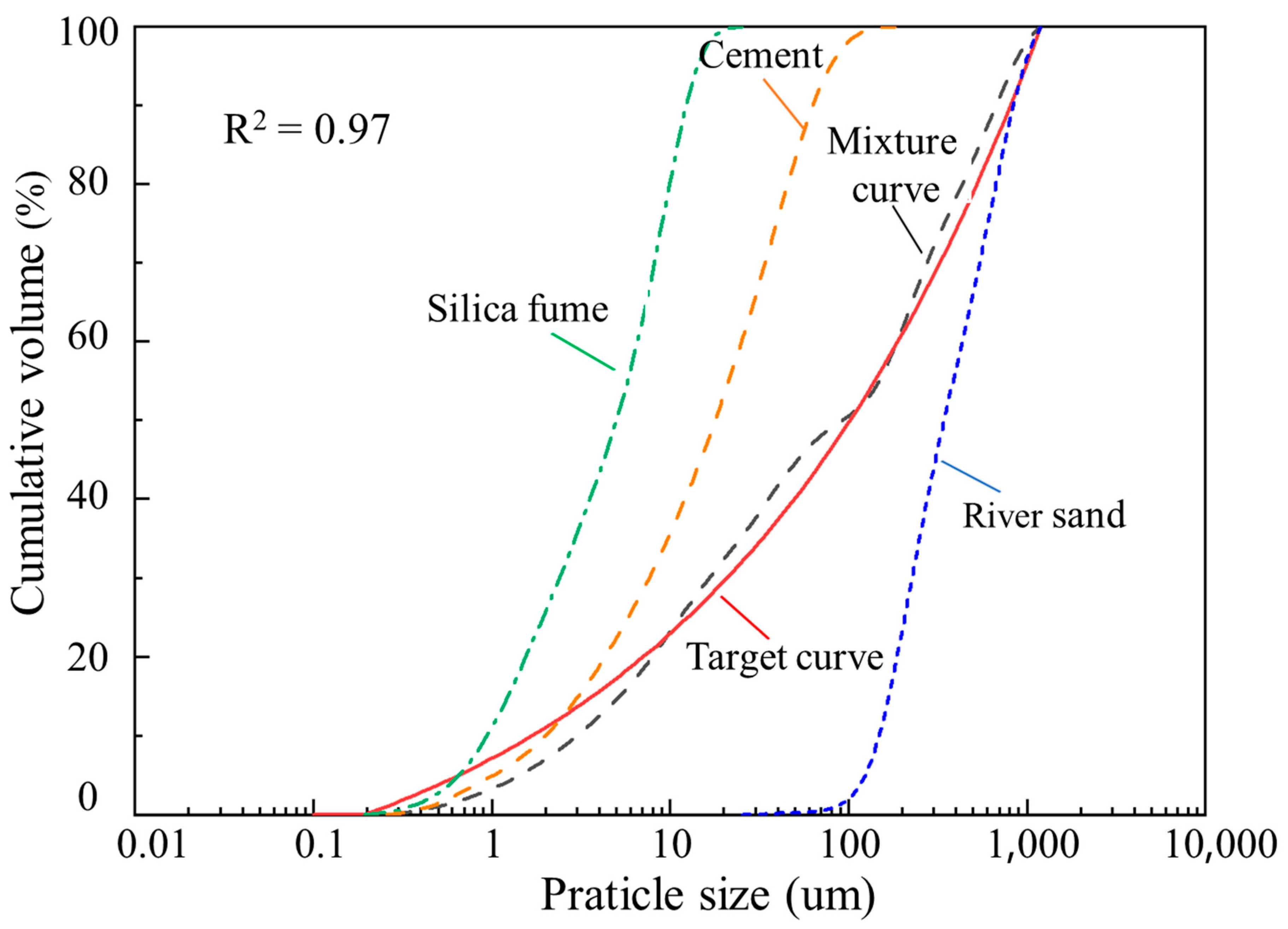
Based on the modified MAA model, the mix proportions were designed by iteratively adjusting the ratios of cement, silica fume, and sand in the UHPC system. When the mass ratio of cement:silica fume:sand reached 1:0.25:1.25, the coefficient of determination (R2) between the designed and target particle size distribution curves increased to 0.97, as shown in Figure 2, indicating a high degree of agreement and an optimized theoretical packing condition for UHPC mix design. It should be noted that the R2 value derived from the modified Andreasen–Andersen model reflects particle size distribution optimization at the design level, whereas the effectiveness of particle packing in the hardened UHPC matrix is subsequently evaluated through mechanical performance, porosity measurements, and microstructural characterization.
Figure 2.
Particle distribution and stacking curves of UHPC raw materials.
2.2.2. Theoretical Basis of Mix Design
A modified Andreasen and Andersen (MAA) model was utilized in the UHPC mix design, based on particle packing theory, thus targeting optimal packing density. This design approach adjusts the proportions of constituent materials to fit a designed particle size distribution curve as closely as possible to a target curve, thereby maximizing the packing density of the UHPC matrix. The MAA model is expressed as follows in Equation (1).
where P(D) is the cumulative fraction of particles smaller than size D (%), D is the current particle size (μm), Dmin and Dmax denote the minimum and maximum particle sizes (μm), respectively, and q is the distribution modulus.
In the modified MAA model, the distribution modulus q primarily depends on the content of fine particles in the system. Given the high proportion of fines in UHPC, q typically ranges from 0.2 to 0.25 [1], In this study, a value of 0.23 was selected.
Therefore, the essence of UHPC mix design is to align the designed particle size distribution curve (Pdc) with the target particle size distribution curve (Ptc). The quality of this alignment is evaluated using the coefficient of determination (R2), where an R2 value closer to 1 indicating a denser particle packing state. The calculation formula for R2 is given by Equation (2).
2.2.3. Experimental Mix Proportion Design
A 15% fine aggregate replacement ratio was adopted as the baseline mixture for evaluating UHPC incorporating high-volume SSA. The corresponding mix proportions are presented in Table 2. Mixtures designated as SU-0, SU-20, SU-40, SU-60, and SU-70 correspond to SSA replacement levels of 0%, 20%, 40%, 60%, and 70% by cement mass, respectively. All mixtures were prepared with a constant water-to-binder ratio of 0.17 and a superplasticizer dosage of 2.7% by mass of binder.
Table 2.
Design of UHPC mix proportions with different SSA replacement ratios.
2.3. Specimen Preparation and Curing
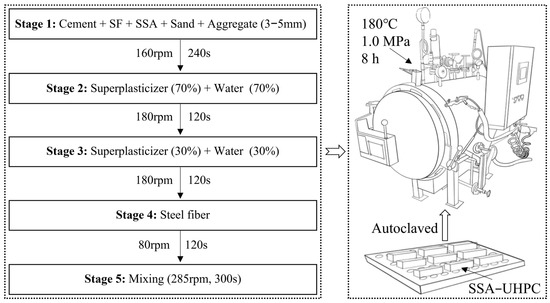
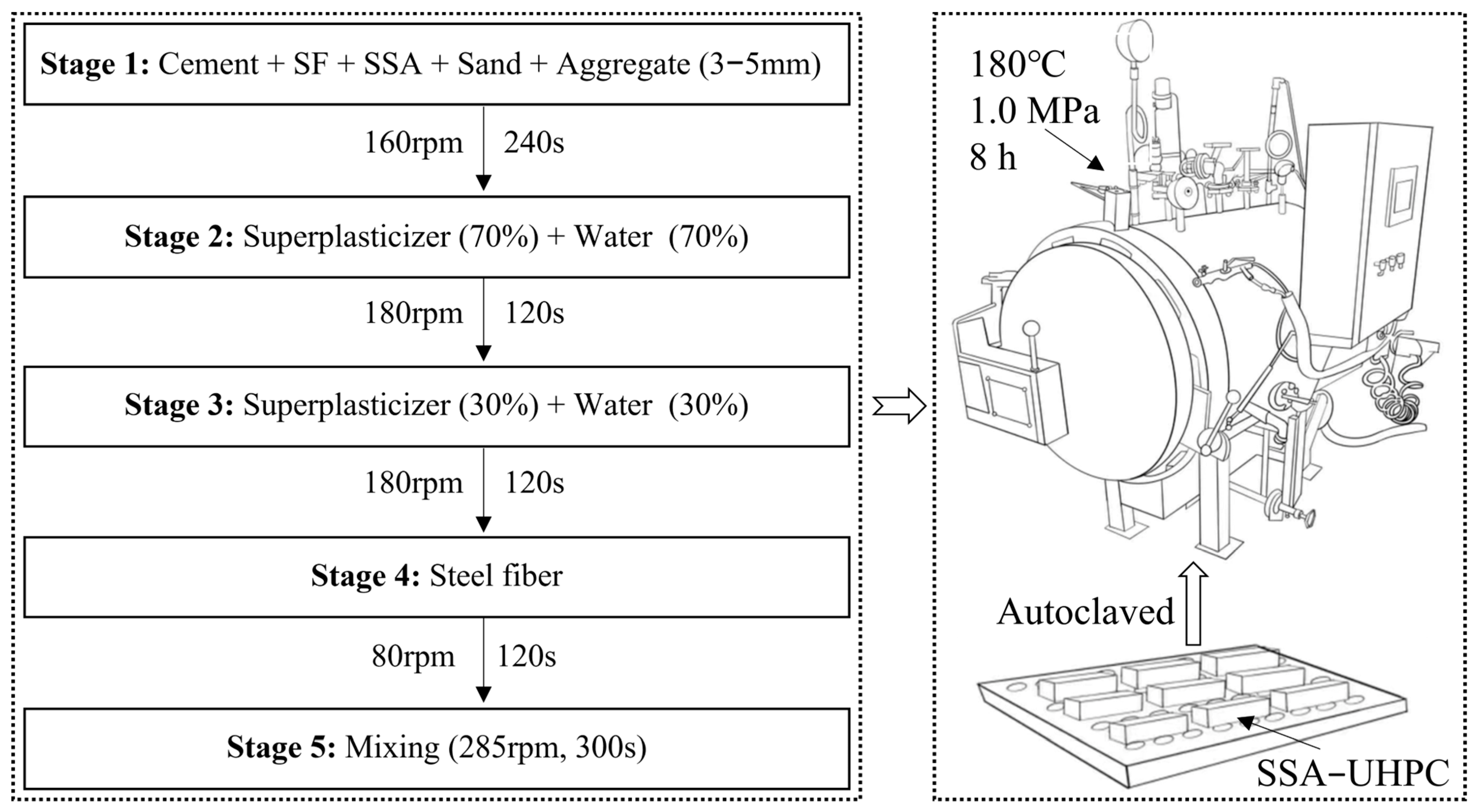
The preparation process of high-volume SSA UHPC using a CAJ–20L planetary mixer frome Shenzhen Yiyi Automation Co., Ltd., Shenzhen, China and autoclave is illustrated in Figure 3. To prevent fiber agglomeration, steel fibers were gradually introduced over 120 s while maintaining a mixing speed of 80 rpm. After mixing, the fresh UHPC was immediately cast into 160 mm × 40 mm × 40 mm prism molds.
Figure 3.
Preparation of UHPC for recovery of high-content SSA by autoclave curing.
After demolding, all UHPC specimens were cured in an autoclave under identical high-temperature, saturated steam conditions (90 °C for 48 h). This curing regime was consistently applied to specimens used for mechanical testing, microstructural analysis, and shrinkage measurements.
The flowability of UHPC was measured using the slump flow test according to the Chinese standard GB/T 2419–2005 [71]“Methods of Testing Cement Mortar—Flow”. The fresh UHPC mixture was placed into a circular mold in two stages: the first fill reaching to two-thirds of the mold height, and the second fill exceeding the mold height by 2 cm. After uniform tamping, the mold was subjected to 25 jolts at a frequency of 1 Hz. The flow diameter (or spread) was determined by measuring the mixture in two perpendicular directions and calculating the average.
2.4. Experimental Methods
2.4.1. Mechanical Properties
Mechanical tests were performed in accordance with the Chinese standard GB/T 17671–2021 [72] “Method of Testing Cement Mortar Strength”. Flexural and compressive strength tests were carried out using an electromechanical testing machine (SANS, maximum capacity 300 kN). The three-point bending and compressive tests were conducted at loading rates of 50 N/s and 2400 N/s, respectively. Under autoclave curing conditions, compressive and flexural strengths were measured after 2 days. For each mix design, triplicate specimens were tested for flexural strength, and the average values of both compressive and flexural strengths are reported.
Hardened density and water absorption of UHPC were tested according to ASTM C642–13 [73]. Given that UHPC containing SSA is classified as hazardous waste, toxicity assessment was necessary to evaluate the leaching behavior of heavy metals over 150 days. The leaching potential of heavy metals (Cr, Ni, Cu, Zn, Pb) from hardened SSA-UHPC was assessed using the US EPA TCLP method. The concentrations of these metals in the leachate were quantified by ICP–OES from Guoyao Ronghui Instrument Service Co., Ltd., Shanghai, China.
The shrinkage test followed ASTM C157–17 [74], utilizing a vertical length comparator. Prismatic specimens measuring 25 mm × 25 mm × 285 mm were prepared, and three replicates were tested for each mix design.
2.4.2. Microstructural Characterization
XRD was used to analyze hydration products of UHPC using a Bruker D8 ADVANCE diffractometer (from Guoyi Quantum Instrument Service Co., Ltd., Hefei China) with an angular resolution of 0.0001°. Cu Kα radiation was employed with a working voltage of 40 kV and current of 40 mA. The scanning range was from 5° to 65° (2θ). Porosity and particle size distribution of cement and SSA were measured using a Micromeritics Autopore IV 9620 high-performance automatic mercury intrusion porosimeter from Shanghai Ruice Electronic Technology Co., Ltd., Shanghai, China. Fibers were removed prior to testing. SEM and backscatter electron imaging (BSE) were employed to observe the microstructure of UHPC specimens.
2.5. Life-Cycle Assessment
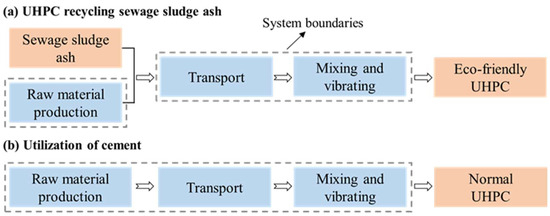
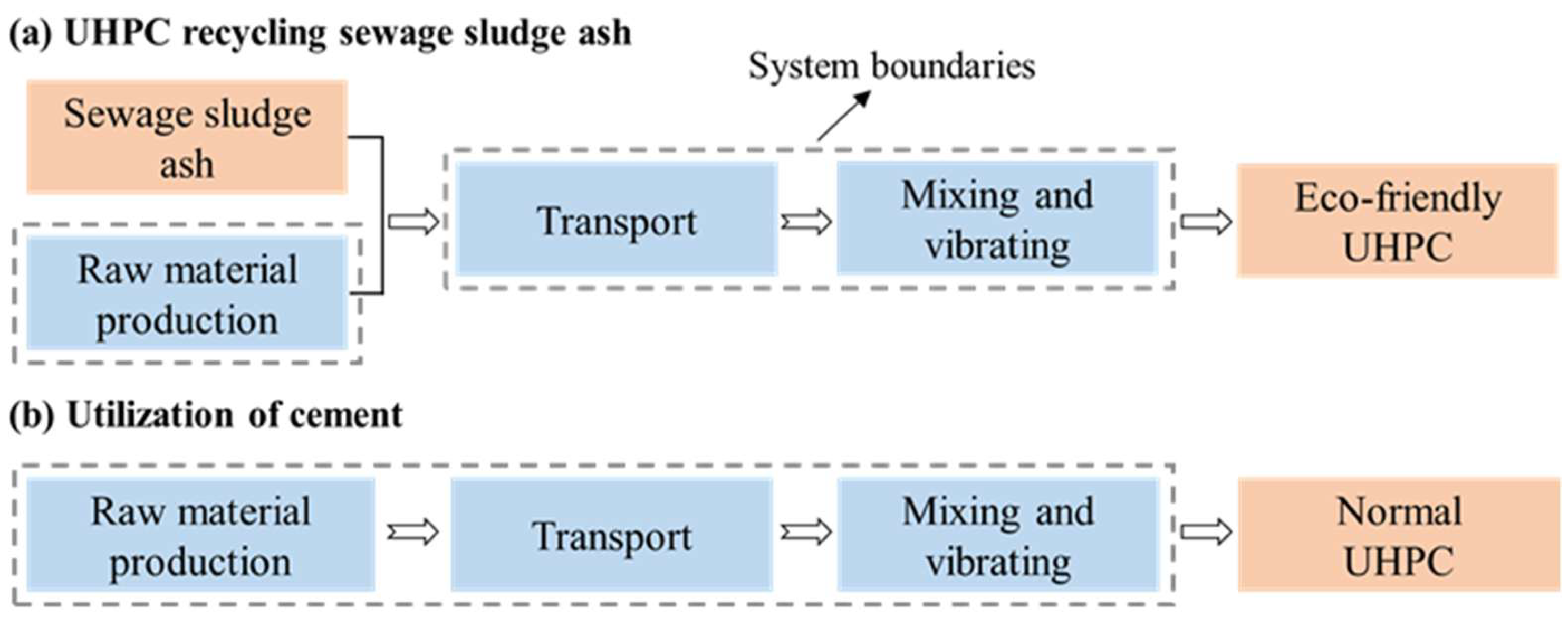
A LCA was performed to evaluate the environmental and economic impacts of UHPC produced with SSA compared to conventional UHPC. Consistent with standard practice for waste-derived materials, the production of SSA itself was excluded from the system boundary, which is illustrated in Figure 4 for both production pathways. Primary LCA data were sourced from the Ecoinvent database (version 3.5) and US Environmental Protection Agency reports, while transportation data were taken from the literature [75]. The assessment focused on carbon emissions, energy consumption, and production costs. All analyses were performed using SimaPro software (Version 9.3) in accordance with the principles and framework of ISO 14040:2006 [76], entitled “Environmental management, LCA, principles and framework” [77].
Figure 4.
The system boundaries adopted in the LCA, including the life-cycle stages considered under the two production scenarios.
3. Results and Discussion
3.1. Physical Properties
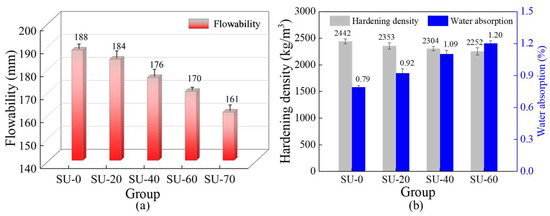
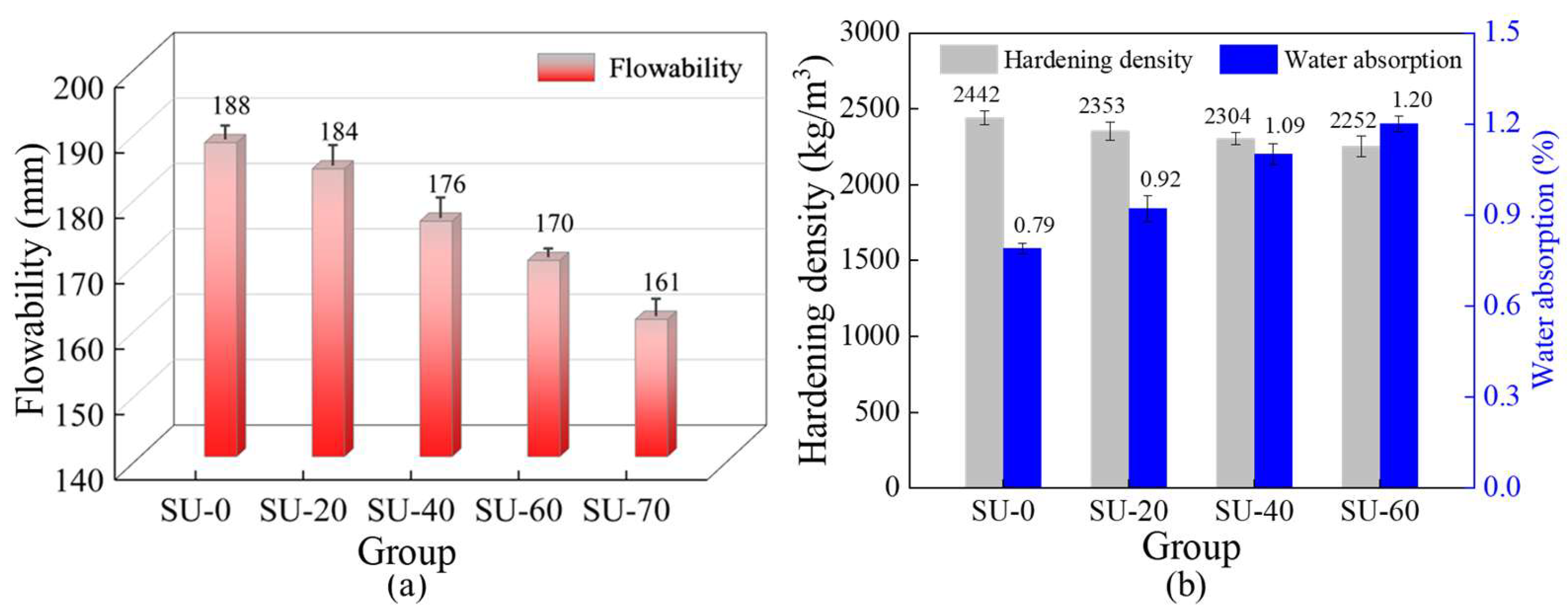
The flowability of UHPC with different SSA replacement ratios is illustrated in Figure 5a. As the SSA content increased from 0% to 70%, the flow diameter continuously decreased from 188 mm to 161 mm, indicating a significant adverse effect of SSA incorporation on UHPC flowability.
Figure 5.
Physical properties of UHPC with different SSA content: (a) Flowability performance; (b) hardening density and water absorption.
This behavior can be primarily attributed to the intrinsic characteristics of SSA and its interaction with the UHPC particle system. Owing to its irregular morphology and highly porous surface formed during sludge calcination, SSA exhibits a high specific surface area and strong water absorption capacity [78]. This reduces the amount of free water available for lubrication, thereby effectively decreasing the local water-to-binder ratio [79]. Consequently, the rheological resistance of the fresh mixture increases, resulting in diminished flowability. At high SSA replacement levels, especially at 70%, the elevated fine-particle content of UHPC further intensifies interparticle friction, thereby amplifying workability loss. These mechanistic interpretations are in good agreement with the observations reported by Chang et al. [24]. Despite the reduction in flowability at high SSA content, the high compressive strength of the reference mixture confirms that the modified Andreasen–Andersen particle packing design yields a dense and mechanically efficient UHPC matrix, supporting the rational incorporation of SSA.
Figure 5b shows that increasing SSA replacement results in a gradual decrease in hardened density accompanied by a concomitant increase in water absorption. Compared with the SU-0 reference mixture, the hardened density decreases by 3.6%, 5.7%, and 7.8% at SSA replacement levels of 20%, 40%, and 60%, respectively, while water absorption increases from 0.79% to 1.20% as the SSA content rises from 0% to 60%. These trends can be attributed to the intrinsic characteristics of SSA, including its relatively larger particle size and lower pozzolanic reactivity, which limit hydration product formation and hinder matrix densification, consistent with observations reported in the literature [80].
Beyond the absolute values of water absorption, pore structure characteristics play a more critical role in governing durability-related transport processes. MIP results and SEM/BSE observations indicate that, despite an increase in total porosity, the pore system of SSA-incorporated UHPC remains dominated by gel pores with limited capillary–pore connectivity. Because fluid transport and ion penetration are governed primarily by pore connectivity rather than by the total amount of absorbed water, the observed increase in water absorption is not expected to directly translate into pronounced degradation of freeze–thaw resistance or chloride-ingress resistance under high-pressure autoclave curing conditions [81].
Nevertheless, given that UHPC is typically designed for service in aggressive environments, the combined effects of increased water absorption and altered pore structure warrant further investigation. Accordingly, future studies incorporating dedicated durability tests—such as freeze–thaw cycling and chloride penetration measurements—are necessary to comprehensively assess the long-term service-life performance of SSA-based UHPC.
3.2. Mechanical Performance
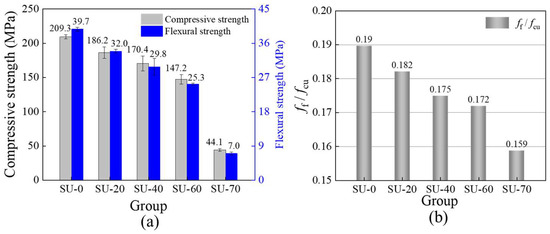
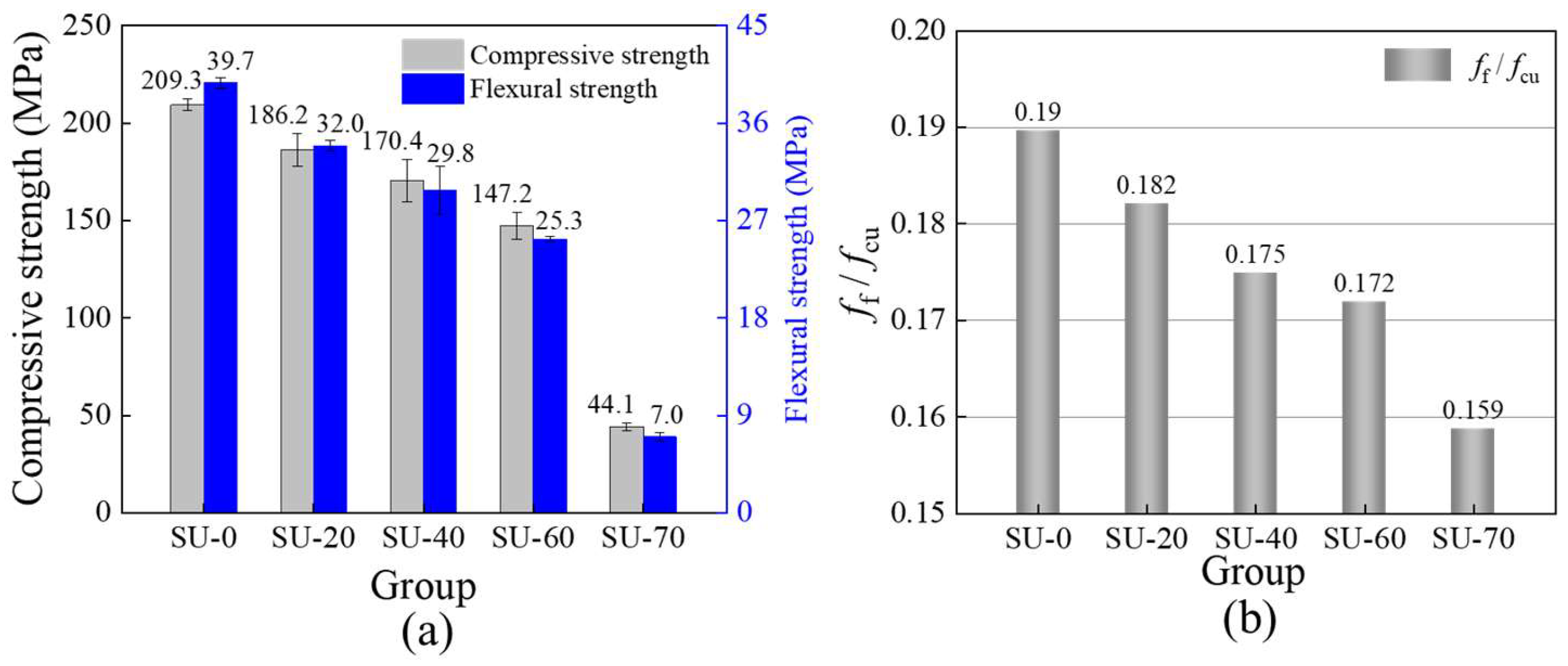
Figure 6 illustrates the variations in compressive strength and flexural strength of UHPC as SSA replacement level under autoclave steam-curing conditions. The results show that strengths exhibit a decreasing trend with increasing SSA replacement ratio, consistent with trends observed in ordinary concrete incorporating SSA [65]. Compared to the SU-0 group, compressive strength decreased by 11.0%, 18.6%, 29.7%, and 78.9%, while flexural strength decreased by 14.6%, 24.9%, 36.3%, and 82.4% at SSA replacement ratios of 20%, 40%, 60%, and 70%, respectively. Previous studies indicate that SSA replacement above 10% elevates UHPC porosity, which is a critical factor for strength degradation [56].
Figure 6.
Mechanical strength of UHPC with different sewage sludge ash replacement ratio: (a) Compressive strength and flexural strength; (b) ratio of flexural strength to compressive strength.
Notably, under autoclave curing conditions, the mechanical response of SSA-incorporated UHPC exhibits a pronounced threshold behavior rather than a monotonic linear degradation with increasing replacement level. At an SSA replacement ratio of 60%, UHPC still achieves a compressive strength of approximately 147 MPa and a flexural strength of 25.3 MPa, satisfying the fundamental mechanical requirements for UHPC applications [82]. This indicates that autoclave curing can partially compensate for the strength loss associated with high SSA contents, thereby extending the feasible replacement level well beyond the limits commonly reported for conventionally cured UHPC, which are typically below 30% [83,84].
However, when the SSA replacement ratio is further increased to 70%, both compressive and flexural strengths decrease abruptly, indicating a clear breakdown of the load-bearing cementitious skeleton. At a 60% SSA replacement level, sufficient hydration products are still generated under high-temperature and high-pressure curing to form a continuous and percolated cementitious network, enabling effective stress transfer despite significant cement dilution. In contrast, at a 70% replacement level, the cement content becomes insufficient to sustain the formation of a continuous hydration network, even under autoclave curing conditions. The excessive dilution of reactive clinker phases, combined with the inherently limited reactivity of SSA, leads to a critical reduction in load-bearing C–S–H phases. Concurrently, microstructural observations and porosity analyses reveal increased pore connectivity and interfacial defects, which severely compromise the mechanical integrity of the matrix. As a result, the UHPC system transitions from a dense and mechanically efficient composite to a discontinuous and structurally inefficient material, explaining the drastic collapse in mechanical performance. These results demonstrate that, under autoclave curing, a 60% SSA replacement ratio represents a critical upper bound for maintaining UHPC-grade mechanical performance, whereas further increases in SSA content exceed the structural tolerance of the system and lead to a rapid loss of load-bearing capacity.
The ratio of flexural strength to compressive strength (ff/fcu) of UHPC is shown in Figure 6b. Typically, this ratio ranges between 0.15 and 0.20 for UHPC. As the SSA replacement ratio increases from 20% to 70%, the ratio exhibits a decreasing trend but remains within the acceptable range for normal UHPC. This indicates that SSA incorporation has a more pronounced weakening effect on flexural strength than on compressive strength. Gu et al. [85,86] reported similar findings for ff/fcu in SSA-containing UHPC cured under standard 28-day conditions. Overall, these results demonstrate that the mechanical performance of SSA-incorporated UHPC under autoclave curing is governed by a balance between hydration dilution, pore structure evolution, and curing-induced densification, with 60% SSA representing a critical upper limit for maintaining engineering-level mechanical performance.
3.3. Heavy-Metal Leaching Characteristics
SSA contains various heavy metals [87]. It should be emphasized that lead, nickel and other heavy metals are not intentionally introduced as functional components in ultra-high-performance concrete; rather, they are naturally present as constituents of waste-derived materials incorporated into the cementitious composite. Accordingly, the proposed utilization strategy is based on the solidification and stabilization of lead within the UHPC matrix, rather than the uncontrolled use of lead-containing materials without appropriate environmental safeguards.
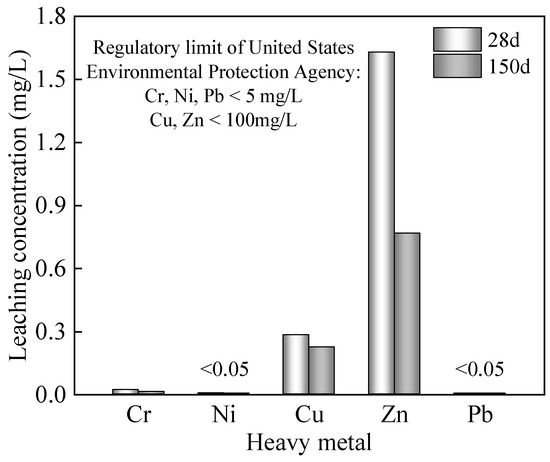
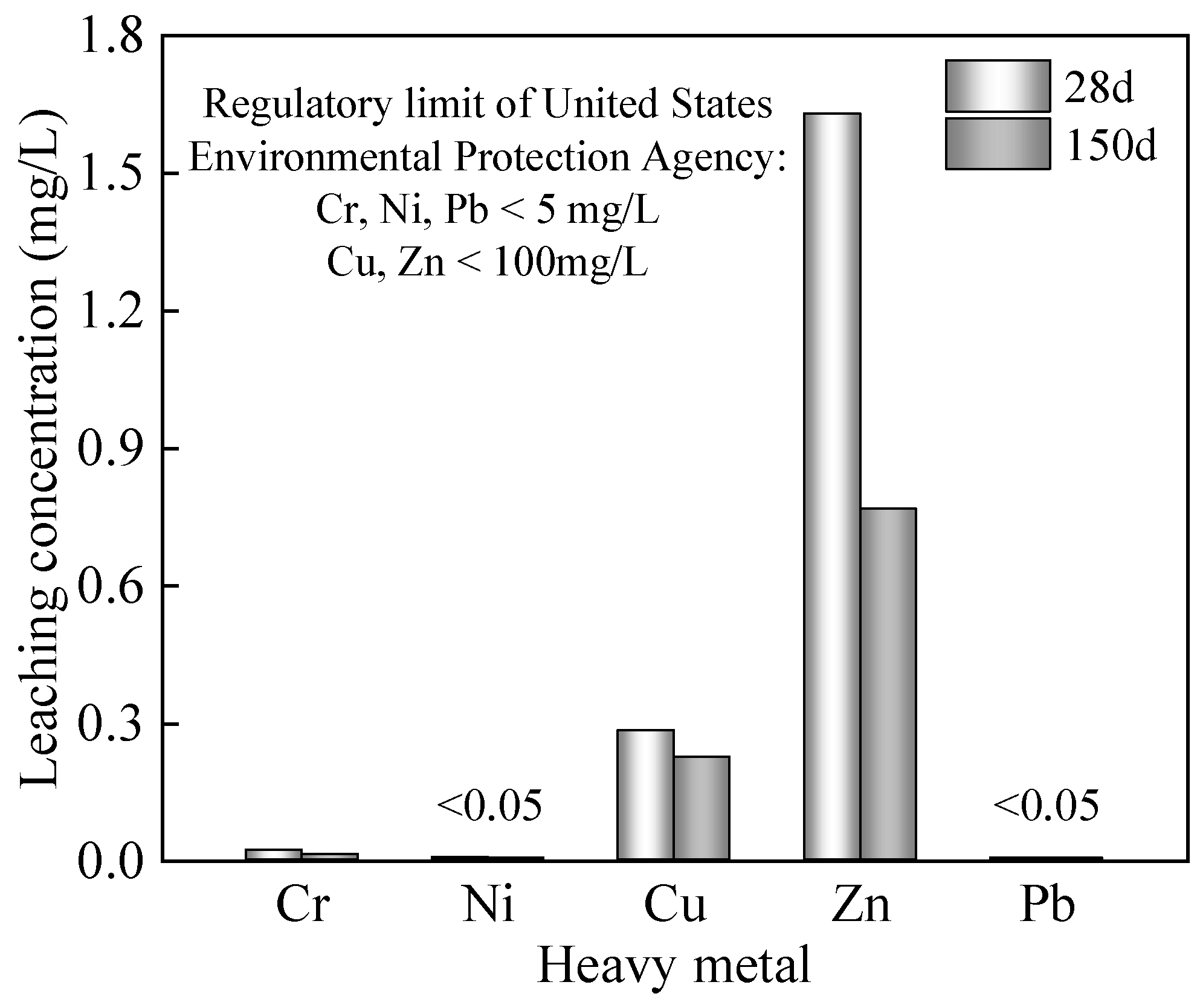
To ensure the safety of UHPC with high SSA content, UHPC specimens with a 60% SSA replacement ratio were selected, and heavy-metal leaching tests were conducted using the Toxicity Characteristic Leaching Procedure (TCLP) according to U.S. EPA Method 1311 [88]. Figure 7 presents the concentrations of heavy metals leached from UHPC specimens after 8 h of autoclave curing at curing ages of 28 and 150 days. The concentrations of lead (Pb), nickel (Ni), chromium (Cr), copper (Cu), and zinc (Zn) in the leachate were all significantly lower than the corresponding limits specified in GB 5085.3–2007 “Identification Standards for Hazardous Wastes—Corrosivity and Toxicity Tests” [89], indicating that UHPC effectively inhibits the release of heavy metal ions. Although SSA contains trace amounts of Pb, leaching tests confirm that Pb is effectively immobilized within the UHPC matrix. These results suggest that, when appropriate mix design and curing conditions are employed, SSA-incorporated UHPC can be considered environmentally safe for practical applications.
Figure 7.
Results of heavy-metal leaching.
Beyond physical encapsulation, chemical interactions play a critical role in stabilizing heavy metals within the UHPC matrix. While Cu and Pb can retard cement hydration by altering the morphology of C3S and C2S phases and adsorbing onto cement particle surfaces [90], continued hydration and matrix densification during curing promote the long-term immobilization of these metals. The progressive decrease in leaching concentrations with curing age demonstrates that heavy-metal stabilization is governed by the combined effects of physical confinement and chemical binding. These findings confirm that UHPC with 60% SSA exhibits acceptable environmental safety and highlight its potential as a sustainable route for the high-volume utilization of sewage sludge ash.
3.4. Microstructural Characteristics
3.4.1. XRD Analysis
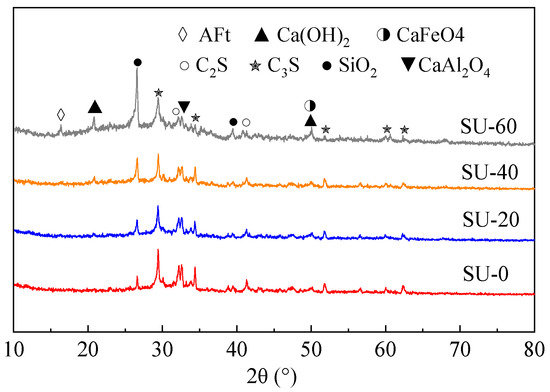
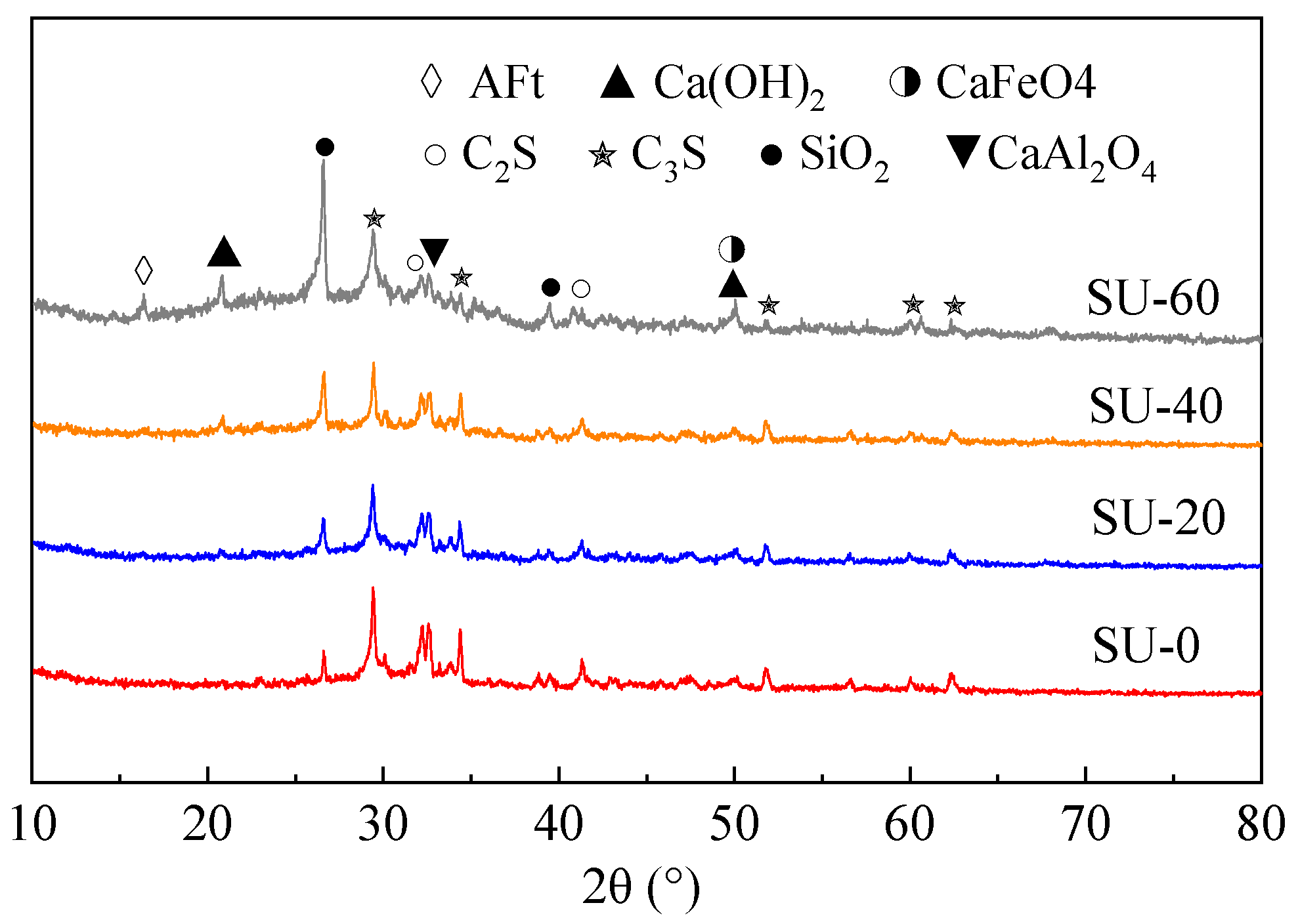
To clarify the influence of SSA replacement on the hydration behavior of UHPC, XRD analysis was conducted on autoclave-cured specimens. The corresponding diffraction patterns and quantitative phase results are presented in Figure 8. Compared with the reference mixture (SU-0), SSA-blended UHPC shows more pronounced SiO2 diffraction peaks, which reflects the higher inherent SiO2 content of SSA. Because this SiO2 is predominantly crystalline and exhibits low pozzolanic activity, it does not participate substantially in the hydration process, leading to its accumulation in the matrix. Even after autoclave curing, distinct diffraction peaks of C2S and C3S remain observable, which is attributed to the low water-to-binder ratio that limits clinker hydration. As the SSA dosage increases, the clinker content is progressively diluted, resulting in a gradual decrease in the relative amounts of C2S and C3S [23].
Figure 8.
XRD analysis of UHPC hydration products with different SSA substitution rates.
Furthermore, a substantial portion of Ca(OH)2 remains contained within the dense C–S–H gel or larger pores of UHPC, which restricts its availability for further reaction. With increasing SSA content, aluminum species released from SSA can accelerate the interaction between cement aluminates and gypsum [24], thus favoring the conversion of AFt to AFm. Nevertheless, under the low water-to-binder ratio characteristic of UHPC, the overall formation of AFt remains constrained.
3.4.2. SEM Analysis
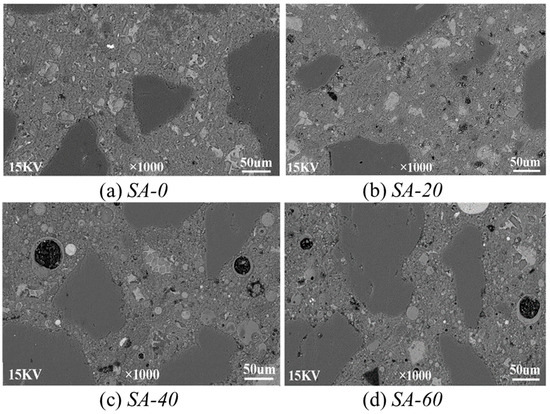
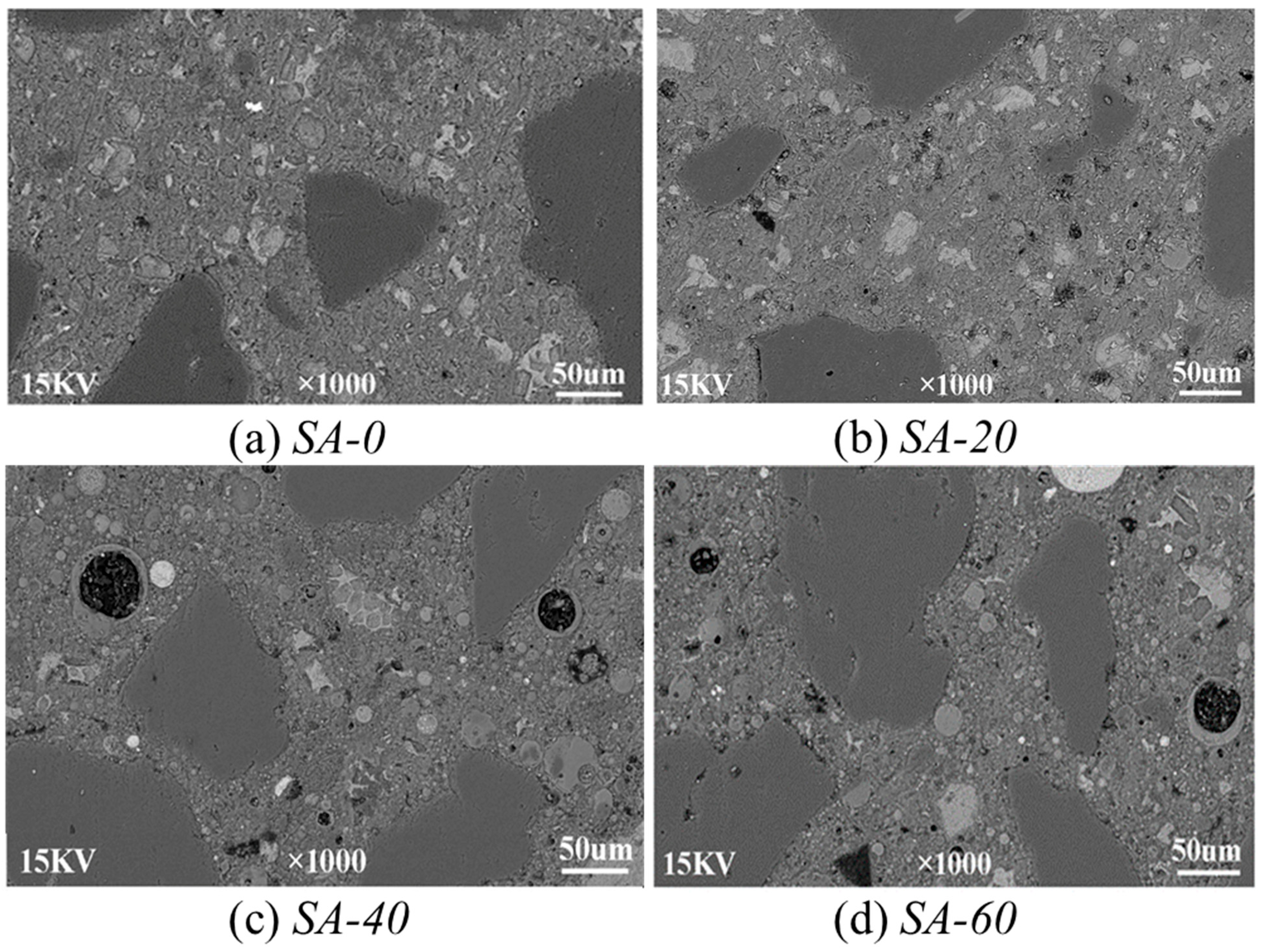
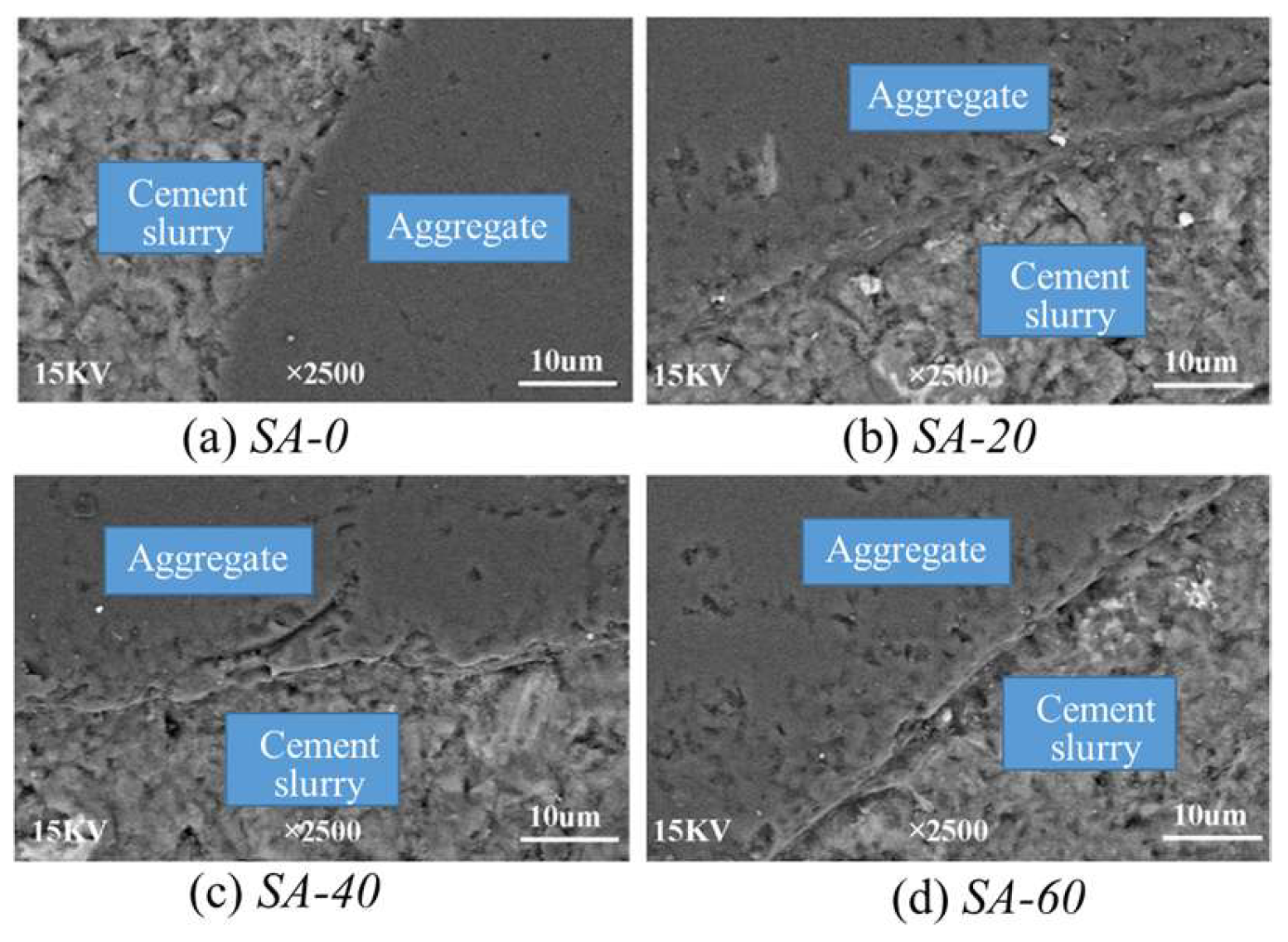
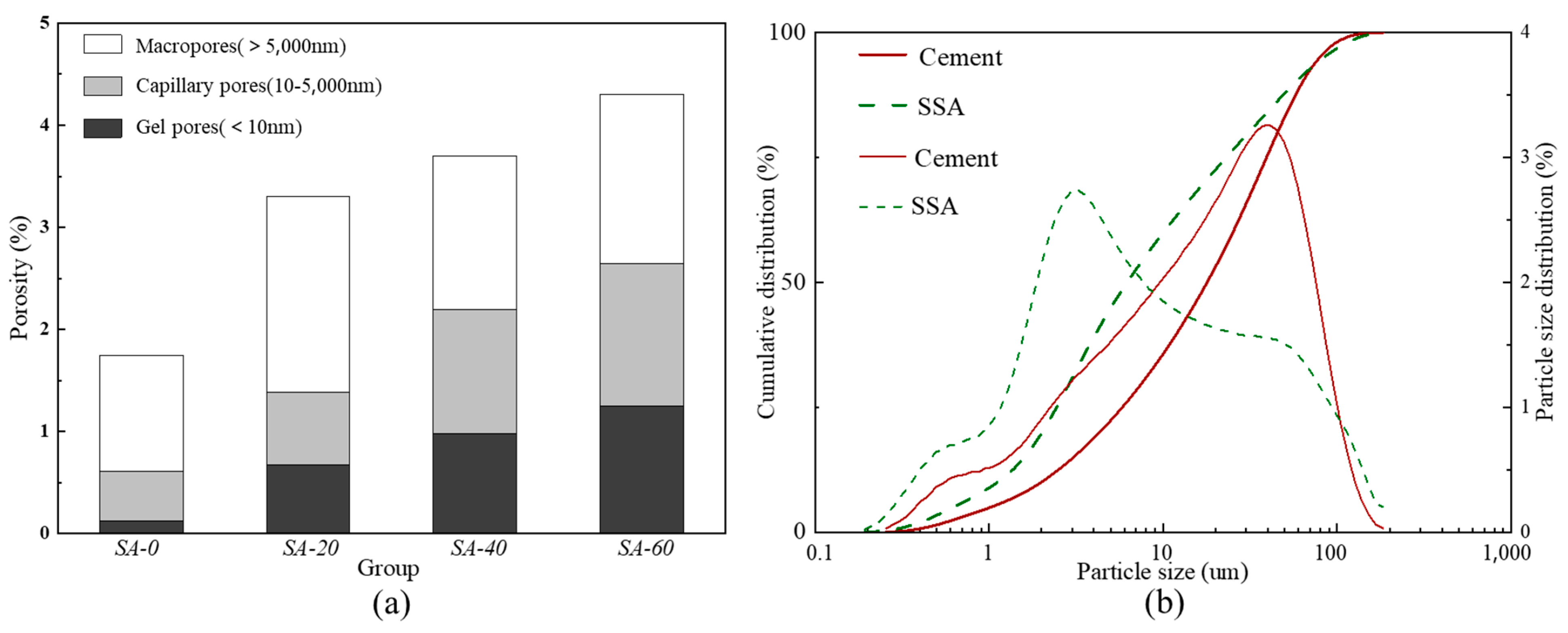
Figure 9 presents the BSE images of UHPC with varying SSA replacement levels. As the SSA replacement level increases, the number of pores within the UHPC matrix gradually rises. Combined with the XRD analysis, the progressive reduction in the amorphous phase with increasing SSA can be attributed to the decreased formation of C–S–H gel. Consequently, higher SSA contents lead to increased porosity. As the SSA replacement ratio increased from 0% to 60%, the total porosity of UHPC increased from 1.8% to 4.7%, accompanied by a pronounced shift in pore size distribution from macropores toward gel pores. At the same replacement level, the compressive strength decreased by 29.7% relative to the reference mixture. Although an increase in porosity generally leads to strength degradation, the observed reduction in compressive strength cannot be attributed solely to the change in total porosity. At high SSA replacement levels, the dilution of cement clinker significantly reduces the formation of load-bearing C–S–H gel, thereby weakening the solid skeleton of the matrix. Consequently, the combined effects of increased porosity and reduced intrinsic matrix strength result in a non-linear relationship between porosity and compressive strength.
Figure 9.
BSE images of UHPC with different SSA replacement ratios.
A rigorous regression analysis correlating individual MIP-derived pore parameters with mechanical properties would require a larger number of data points and is therefore beyond the scope of the present study; nevertheless, the quantitative trends reported here provide clear evidence of the strong coupling between pore structure evolution and strength degradation in SSA-incorporated UHPC.
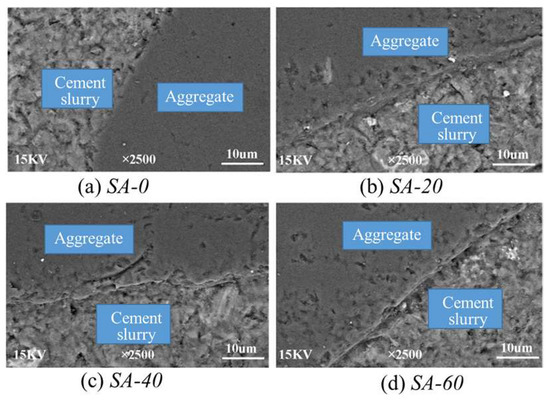
Figure 10 illustrates the morphology of the interfacial transition zone (ITZ) in UHPC incorporating different SSA replacement levels. Overall, no pronounced changes in ITZ characteristics were observed with increasing SSA content. This relative stability can be primarily attributed to the autoclave steam-curing regime adopted in this study, under which elevated temperature and pressure markedly accelerate cement hydration. During this process, both silica fume and SSA participate in pozzolanic reactions with Ca(OH)2, leading to the formation of additional C–S–H gel and enhanced matrix densification.
Figure 10.
Interface transition zones of UHPC with different SSA replacement ratios.
3.4.3. MIP Analysis
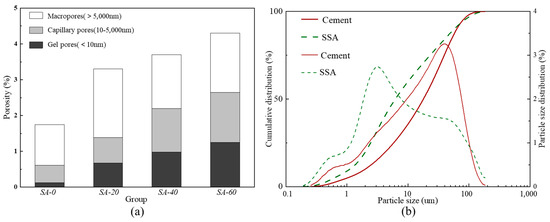
Figure 11 illustrates the porosity of UHPC and the particle size distributions of cement and SSA at different SSA replacement ratios. As shown, the inclusion of SSA increases the porosity of UHPC. Specifically, porosity values corresponding to SSA replacement levels of 0%, 20%, 40%, and 60% are 1.8%, 3.3%, 3.7%, and 4.7%, respectively. Increasing the SSA replacement from 20% to 40% resulted in a relatively small porosity increase of only 0.4%, which is considered minor and statistically insignificant. This limited change can be attributed to the finer particle size distribution of SSA compared to cement. As shown in Figure 11b, approximately 45% of SSA particles fall within the 10–5000 nm size range, which may contribute to pore filling and refinement of the UHPC matrix. Consistent with this observation, the results in Section 3.3 show that, with increasing SSA content, the proportion of macropores decreases while the fraction of gel pores increases. Specifically, as the SSA replacement level increases from 0% to 60%, the macropore volume fraction decreases from 63.3% to 38.5%, whereas the gel pore fraction increases from 6.9% to 29.1%. These trends suggest that SSA plays different roles depending on the replacement level. At low-to-moderate replacement levels (20–40%), SSA mainly acts as a physical filler associated with pore structure refinement. At higher replacement levels (≥60%), the dilution of cement clinker becomes more pronounced, which is accompanied by increased porosity and reduced mechanical strength.
Figure 11.
Porosity of UHPC with different SSA replacement ratios and particle size distribution of cement and SSA: (a) Porosity; (b) particle size distribution of cement and SSA.
The reduction in shrinkage observed with increasing SSA replacement may be related to the combined effects of reduced cement content, potential hydration retardation associated with trace heavy metals in SSA, and the porous nature of SSA particles, which may provide an internal curing effect. Together, these factors are likely to contribute to the restrained shrinkage development in SSA-incorporated UHPC.
3.5. Shrinkage Behavior of UHPC Incorporating SSA
It should be noted that the curing conditions adopted for shrinkage measurements were identical to those used for mechanical and microstructural tests, ensuring methodological consistency across different performance evaluations. Specifically, this study investigated the shrinkage behavior of ultra-high-performance concrete under autoclave steam-curing conditions, with a curing temperature of 90 °C and a curing duration of 48 h, while the demolding time was defined as 0 day.
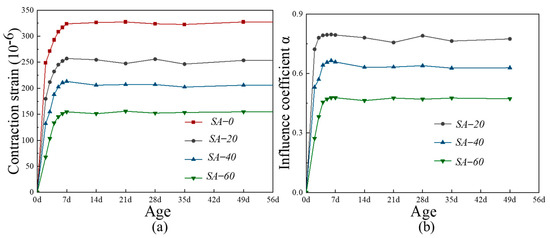
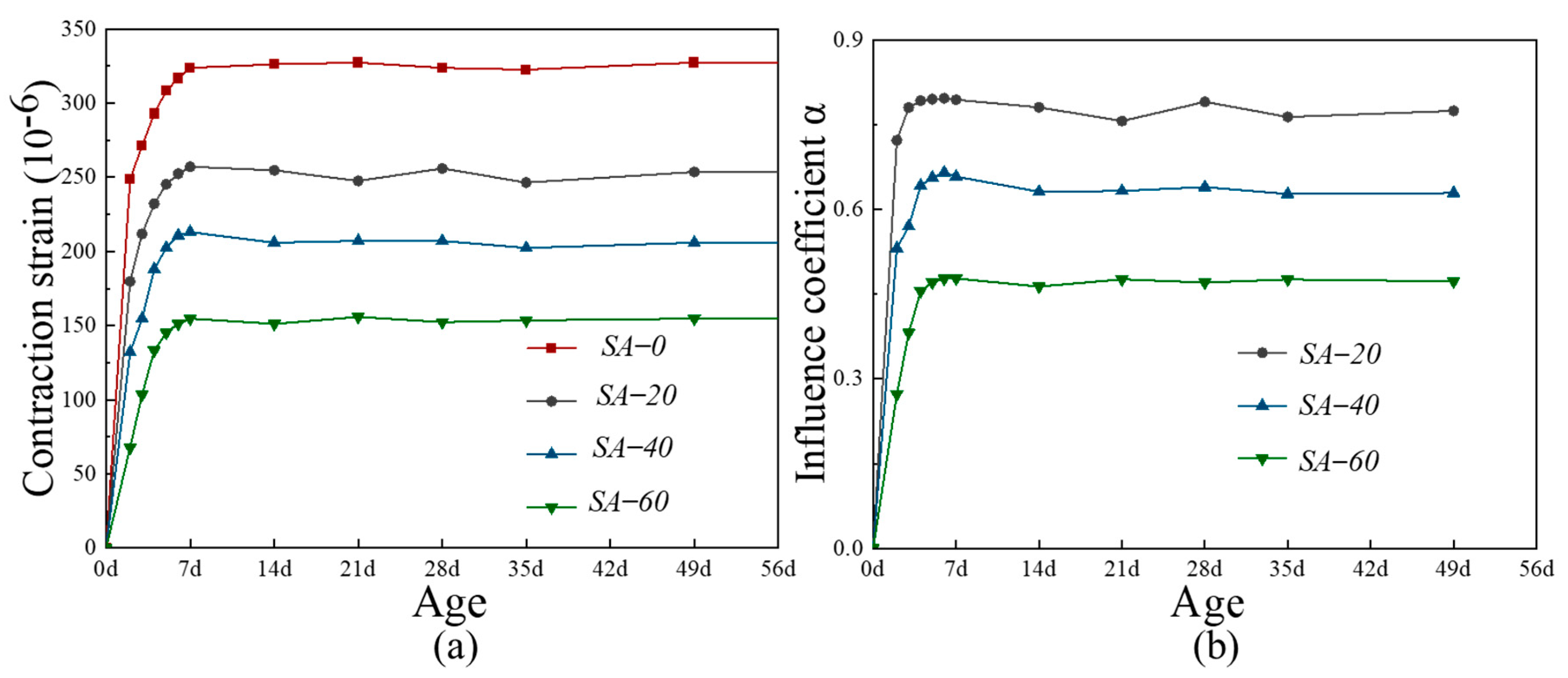
The comparative shrinkage performance of UHPC with varying SSA substitution ratios is shown in Figure 12a. Shrinkage strain of UHPC gradually decreases with increasing SSA replacement level. At SSA replacement ratios of 20%, 40%, and 60%, shrinkage strain decreased by 22.5%, 37.1%, and 52.7%, respectively, compared to the control group. This trend suggests that SSA incorporation is associated with a progressive suppression of shrinkage development. The reduction in shrinkage observed with increasing SSA replacement is consistent with recent studies highlighting the role of pore structure regulation and internal curing in mitigating autogenous shrinkage.
Figure 12.
Shrinkage performance of UHPC: (a) Shrinkage performance of UHPC with different SSA replacement ratios; (b) influence coefficient of shrinkage performance of UHPC with different SSA replacement ratios.
This behavior can be attributed to the combined effects of cement dilution, hydration retardation, and internal curing. Shrinkage in UHPC is primarily governed by autogenous shrinkage associated with cement hydration, whereas drying shrinkage plays a minor role [91]. Increasing SSA replacement reduces cement content and hydration degree, thereby suppressing autogenous shrinkage. Meanwhile, trace heavy metals in SSA (e.g., Cu and Pb) further retard hydration by modifying silicate phases or hindering cement particle dissolution. In addition, the porous SSA particles can act as internal curing reservoirs, gradually releasing absorbed water and alleviating self-desiccation and capillary stresses. These mechanisms act synergistically, leading to a progressive reduction in shrinkage with increasing SSA content.
To quantitatively evaluate how SSA and tailings affect the shrinkage performance of UHPC, an influence coefficient was introduced; its calculation is given in Equation (4). This coefficient reflects the extent to which solid waste incorporation alters the shrinkage development rate of UHPC. Based on Equation (4), Figure 12b illustrates the variation in the influence coefficient for UHPC incorporating SSA.
where is Influence coefficient, is shrinkage strain of UHPC incorporating SSA, is shrinkage strain of control UHPC [92,93].
As shown in Figure 12b, the influence coefficients of SSA-incorporated UHPC under steam curing are 0.72, 0.53, and 0.27 at 2 days for substitution rates of 20%, 40%, and 60%, respectively, indicating a pronounced suppression of early-age shrinkage. After 7 days, the coefficients stabilize at 0.79, 0.66, and 0.48. These results demonstrate that SSA incorporation effectively restrains early shrinkage in steam-cured UHPC, primarily due to the retardation of early cement hydration, consistent with the preceding analysis [94]. The strong reduction in early-age shrinkage is mainly attributed to hydration retardation induced by SSA, particularly associated with trace heavy metals such as Cu and Pb, which delay hydration product formation and mitigate early self-desiccation. As hydration progresses and the UHPC matrix gradually densifies, the relative contribution of hydration retardation diminishes, leading to a partial recovery of shrinkage development at later ages. In parallel, the porous structure of SSA particles provides a secondary internal curing effect by gradually releasing absorbed water, thereby alleviating capillary stresses and contributing to sustained, albeit less pronounced, shrinkage mitigation at later ages. Overall, these observations confirm that the shrinkage behavior of SSA-incorporated UHPC under steam-curing conditions is governed by the combined effects of early-age hydration retardation and time-dependent internal curing.
3.6. Environmental and Economic Benefits
As SSA is classified as a waste material, its purchase cost is excluded from the assessment. The system boundary covers raw material production, transportation, grinding, screening, and mixing processes.
Conventional UHPC consists of silica fume, superplasticizer, steel fibers, sand, aggregate, water, and cement. In the SSA-blended UHPC, cement is partially replaced by SSA to evaluate its influence on the environmental performance of the material.
Only the carbon emissions, energy consumption, and economic cost associated with the transportation and processing of SSA are considered. Data related to material production and processing were obtained from the Ecoinvent database and relevant literature (Table 3). Under local conditions in Shenzhen, assuming a transportation distance of 20 km, transporting one ton of material results in 80 kg of CO2 emissions, an energy consumption of 15 MJ, and a cost of 27.6 USD. In addition, mixing one cubic meter of UHPC produces 14.2 kg of CO2 emissions, requires 39.8 MJ of energy, and incurs a cost of 2.5 USD [94,95,96].
Table 3.
The carbon emissions, energy consumption, and costs for producing one ton of each raw material.
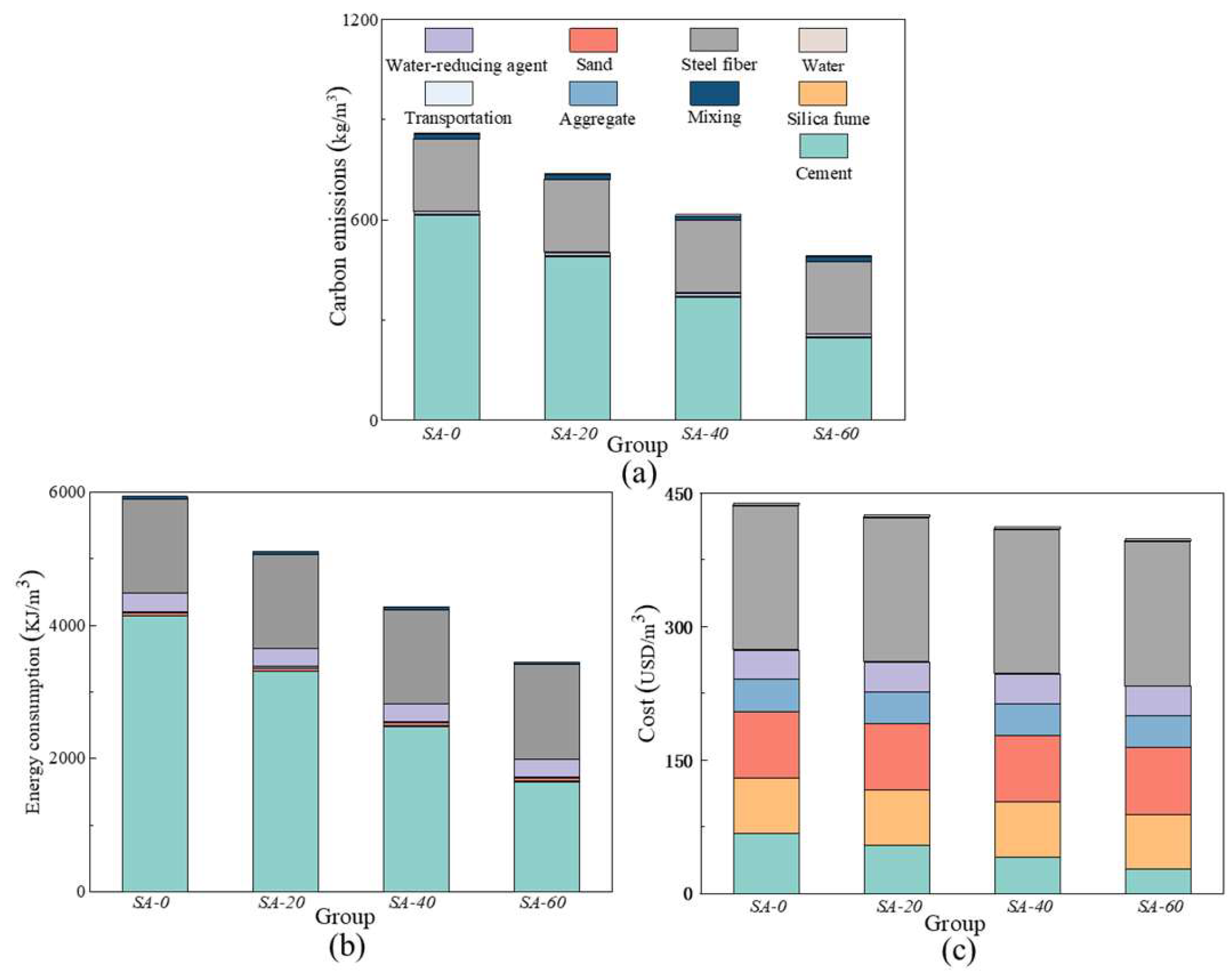
This study evaluates the environmental and economic performance of low-carbon UHPC using a LCA framework. As shown in Figure 13, three key metrics were considered: carbon emissions, energy consumption, and production cost. Compared with conventional UHPC, replacing cement with SSA at 20%, 40%, and 60% by mass reduces carbon emissions by 14.2%, 28.5%, and 42.7%, respectively. This progressive decrease highlights the significant potential of SSA in decarbonizing high-performance concrete production. In parallel, energy consumption shows corresponding declines of 14.0%, 27.9%, and 41.9%, indicating improved energy efficiency across the production chain. Economically, the use of SSA also lowers production costs by 3.1%, 6.1%, and 9.2% at the same replacement levels, underscoring its dual benefit in enhancing sustainability while offering a cost-effective alternative to conventional cement. These results confirm that SSA can be effectively integrated into UHPC as a supplementary cementitious material, providing a scalable pathway for reducing the environmental footprint and improving the economic viability of advanced construction materials.
Importantly, when interpreted in conjunction with the experimental results, the environmental benefits associated with SSA incorporation are realized through a controlled and quantifiable reduction in mechanical performance, rather than an unbounded degradation. At a 60% SSA replacement level, UHPC continues to satisfy fundamental mechanical requirements while achieving substantial reductions in carbon emissions and energy demand. These results highlight a critical sustainability–performance trade-off, whereby high-volume SSA utilization shifts UHPC design from a strength-maximization paradigm toward a performance-optimized, low-carbon strategy. Similar trade-offs have been reported in the recent literature, indicating that optimized mix design and curing strategies can enable significant emission reductions while maintaining engineering feasibility.
Overall, the results indicate that high-volume SSA incorporation in UHPC leads to a systematic sustainability–performance trade-off, rather than isolated or incidental effects. Although increasing SSA content results in reduced mechanical strength, UHPC containing up to 60% SSA retains engineering-level performance under autoclave curing and simultaneously benefits from reduced shrinkage, effective heavy-metal immobilization, and substantial reductions in carbon emissions, energy consumption, and production cost. These findings suggest that high-volume SSA utilization provides a viable pathway for developing low-carbon UHPC that balances mechanical integrity, dimensional stability, and environmental safety.
Figure 13.
LCA of UHPC-incorporating SSA: (a) Carbon emissions; (b) energy consumption; (c) economic cost.
4. Conclusions
This study systematically evaluated the feasibility of producing eco-friendly UHPC incorporating high-volume SSA under autoclave curing. Based on the experimental results, the following conclusions can be drawn:
- (1)
- The flowability and mechanical performance of UHPC were strongly governed by the SSA replacement ratio. Increasing SSA content led to a monotonic reduction in flowability, mainly due to its porous structure and high water absorption capacity. Nevertheless, UHPC incorporating up to 60 wt% SSA still maintained sufficient flowability for practical applications and achieved a compressive strength of 147 MPa under autoclave curing, indicating that 60 wt% represents a practical upper replacement limit for balancing workability and mechanical performance.
- (2)
- Increasing the SSA content resulted in a reduction in hardened density and an increase in water absorption; however, both parameters remained within acceptable ranges for UHPC. Leaching test results demonstrated that mixtures containing 60% SSA complied with the Chinese regulatory standard GB 5085.3-2007, confirming the effective immobilization of heavy metals and the environmental safety of the material.
- (3)
- Microstructural analyses revealed that higher SSA replacement ratios led to increased porosity and reduced contents of calcium hydroxide, C-S-H gel, and the amorphous phase. SSA particles were also observed to partially fill pore spaces. These microstructural characteristics are consistent with the observed macroscopic trends of reduced mechanical strength and increased water absorption.
- (4)
- The incorporation of SSA markedly improved the environmental and economic performance of UHPC. Compared with conventional mixtures, reductions of up to 42.7% in carbon emissions, 41.9% in energy consumption, and 9.2% in production costs were achieved, demonstrating the potential of SSA as a viable supplementary material for developing low-carbon and resource-efficient cementitious composites.
Author Contributions
Funding acquisition, Z.C., X.S. and S.Z.; Investigation, S.Z. and Z.C.; Conceptualization, S.Z., Z.C., D.C. and J.Z.; Project administration, D.L., X.S. and J.Z.; Resources, S.Z., Z.C., D.C. and D.L.; Writing—Original draft, S.Z. and Z.C.; Writing—Review and editing, S.Z., S.S. and Z.C. All authors have read and agreed to the published version of the manuscript.
Funding
This research was funded by the Shenzhen Science and Technology Program (grant number CJGJZD20220517141800001) and the Science and Technology Program of CCCC First Harbor Engineering Co., Ltd. (grant number 2025-7-2).
Data Availability Statement
The original contributions presented in the study are included in the article, further inquiries can be directed to the corresponding author/s.
Conflicts of Interest
Authors Shenghuan Zeng and Shouwang Sun were employed by the Shenzhen Expressway Engineering Testing Co., Ltd. In addition, Zhonglu Cao was employed by the CCCC Tianjin Port Engineering Institute Co., Ltd. In addition, Da Li was employed by the Shenzhen Branch of China Construction Third Engineering Bureau Group Co., Ltd. The remaining authors declare that the research was conducted in the absence of any commercial or financial relationships that could be construed as a potential conflict of interest.
References
- Du, J.; Meng, W.; Khayat, K.H.; Bao, Y.; Guo, P.; Lyu, Z.; Abu-Obeidah, A.; Nassif, H.; Wang, H. New development of ultra-high-performance concrete (UHPC). Compos. Part B Eng. 2021, 224, 109220. [Google Scholar] [CrossRef] [Scilit]
- Liu, T.; Wei, H.; Zou, D.; Zhou, A.; Jian, H. Utilization of waste cathode ray tube funnel glass for ultra-high performance concrete. J. Clean. Prod. 2020, 249, 119333. [Google Scholar] [CrossRef] [Scilit]
- Liu, T.; Wei, H.; Zhou, A.; Zou, D.; Jian, H. Multiscale investigation on tensile properties of ultra-high performance concrete with silane coupling agent modified steel fibers. Cem. Concr. Compos. 2020, 111, 103638. [Google Scholar] [CrossRef] [Scilit]
- Lao, J.-C.; Huang, B.-T.; Fang, Y.; Xu, L.-Y.; Dai, J.-G.; Shah, S.P. Strain-hardening alkali-activated fly ash/slag composites with ultra-high compressive strength and ultra-high tensile ductility. Cem. Concr. Res. 2022, 165, 107075. [Google Scholar] [CrossRef] [Scilit]
- Wei, H.; Liu, T.; Zhou, A.; Zou, D.; Liu, Y. Multiscale insights on enhancing tensile properties of ultra-high performance cementitious composite with hybrid steel and polymeric fibers. J. Mater. Res. Technol. 2021, 14, 743–753. [Google Scholar] [CrossRef] [Scilit]
- Wei, H.; Liu, T.; Zhou, A.; Zou, D.; Li, Y. Toughening static and dynamic damping characteristics of ultra-high performance concrete via interfacial modulation approaches. Cem. Concr. Compos. 2022, 136, 104879. [Google Scholar] [CrossRef] [Scilit]
- Jia, Z.; Cunha, S.; Aguiar, J.; Chen, B. Eco-concrete with recycled aggregate functionalized with phase change materials: Physical and mechanical behavior. Constr. Build. Mater. 2025, 471, 140777. [Google Scholar] [CrossRef] [Scilit]
- Zhou, A.; Yu, Z.; Wei, H.; Tam, L.-H.; Liu, T.; Zou, D. Understanding the Toughening Mechanism of Silane Coupling Agents in the Interfacial Bonding in Steel Fiber-Reinforced Cementitious Composites. ACS Appl. Mater. Interfaces 2020, 12, 44163–44171. [Google Scholar] [CrossRef] [Scilit]
- Zhang, Y.-X.; Zhang, Q.; Xu, L.-Y.; Hou, W.; Miao, Y.-S.; Liu, Y.; Huang, B.-T. Transfer learning for intelligent design of lightweight Strain-Hardening Ultra-High-Performance Concrete (SH-UHPC). Autom. Constr. 2025, 175, 106241. [Google Scholar] [CrossRef] [Scilit]
- Abdellatief, M.; Murali, G.; Dixit, S. Leveraging machine learning to evaluate the effect of raw materials on the compressive strength of ultra-high-performance concrete. Results Eng. 2025, 25, 104542. [Google Scholar] [CrossRef] [Scilit]
- Guo, P.; Mahjoubi, S.; Liu, K.; Meng, W.; Bao, Y. Self-updatable AI-assisted design of low-carbon cost-effective ultra-high-performance concrete (UHPC). Case Stud. Constr. Mater. 2023, 19, e02625. [Google Scholar] [CrossRef] [Scilit]
- Li, P.P.; Yu, Q.L.; Brouwers, H.J.H. Effect of coarse basalt aggregates on the properties of Ultra-high Performance Concrete (UHPC). Constr. Build. Mater. 2018, 170, 649–659. [Google Scholar] [CrossRef] [Scilit]
- Zhou, A.; Wei, H.; Liu, T.; Zou, D.; Li, Y.; Qin, R. Interfacial technology for enhancement in steel fiber reinforced cementitious composite from nano to macroscale. Nanotechnol. Rev. 2021, 10, 636–652. [Google Scholar] [CrossRef] [Scilit]
- Jalal, P.S.; Yadav, A.; Srivastava, V.; Tiwari, A.K. Cathode Ray Tube Glass as an Aggregate: A Step Towards Greener Concrete. J. Environ. Nanotechnol. 2024, 13, 226–233. [Google Scholar] [CrossRef] [Scilit]
- Huang, B.-T.; Wu, J.-Q.; Yu, J.; Dai, J.-G.; Leung, C.K.; Li, V.C. Seawater sea-sand engineered/strain-hardening cementitious composites (ECC/SHCC): Assessment and modeling of crack characteristics. Cem. Concr. Res. 2021, 140, 106292. [Google Scholar] [CrossRef] [Scilit]
- Lin, C.; Wang, S.; Chen, M.; Lu, Y. Experimental study on the mechanical properties of different fiber-reinforced seawater sea-sand engineered cementitious composites. Constr. Build. Mater. 2021, 304, 124562. [Google Scholar] [CrossRef] [Scilit]
- Zhou, A.; Qiu, Q.; Chow, C.L.; Lau, D. Interfacial performance of aramid, basalt and carbon fiber reinforced polymer bonded concrete exposed to high temperature. Compos. Part A Appl. Sci. Manuf. 2020, 131, 105802. [Google Scholar] [CrossRef] [Scilit]
- Han, H.; Xue, X.; Hou, D.; Li, W.; Han, H.; Han, Y. Effect of Polyethylene and Steel Fibers on the Fracture Behavior of Coral Sand Ultra-High Performance Concrete. J. Compos. Sci. 2025, 9, 493. [Google Scholar] [CrossRef] [Scilit]
- Liu, T.; Li, K.; Zhou, A.; Yu, Z.; Qin, R.; Zou, D. Atomic insight into the functionalization of cellulose nanofiber on durability of epoxy nanocomposites. Nano Res. 2022, 16, 3256–3266. [Google Scholar] [CrossRef] [Scilit]
- Liu, T.; Mao, J.; Zhu, Y.; Zhou, J.; Zhou, A.; Guo, H.; Zhang, Y. Recycling shield soil dreg into green cementitious material for ultra-high performance concrete: Bridging waste management and sustainable construction. Sustain. Mater. Technol. 2025, 44, e01373. [Google Scholar] [CrossRef] [Scilit]
- Abu Taqa, A.; Ebead, U.A.; Mohsen, M.O.; Aburumman, M.O.; Senouci, A.; Maherzi, W.; Qtiashat, D. Experimental Assessment of the Strength and Microstructural Properties of Fly Ash-Containing Basalt Fiber-Reinforced Self-Compacting Sustainable Concrete. J. Compos. Sci. 2025, 9, 79. [Google Scholar] [CrossRef] [Scilit]
- Zhong, H.; Zhang, M. Engineered geopolymer composites: A state-of-the-art review. Cem. Concr. Compos. 2022, 135, 104850. [Google Scholar] [CrossRef] [Scilit]
- Chen, Z.; Poon, C.S. Comparative studies on the effects of sewage sludge ash and fly ash on cement hydration and properties of cement mortars. Constr. Build. Mater. 2017, 154, 791–803. [Google Scholar] [CrossRef] [Scilit]
- Xia, Y.; Shi, D.; Wang, J.; Zhao, Y.; Yu, K.; Liu, Y.; Cui, H.; Wang, L. Value-added recycling of cathode ray tube funnel glass into high-performance radiation shielding concrete. Resour. Conserv. Recycl. 2023, 199, 107252. [Google Scholar] [CrossRef] [Scilit]
- Yang, Y.; Zhao, X.; Chow, C.L.; Lau, D. Enhancing the confinement of steel reinforced concrete using hexagonal auxetic structures. Thin-Walled Struct. 2025, 218, 113907. [Google Scholar] [CrossRef] [Scilit]
- Chang, Z.; Long, G.; Xie, Y.; Zhou, J.L. Pozzolanic reactivity of aluminum-rich sewage sludge ash: Influence of calcination process and effect of calcination products on cement hydration. Constr. Build. Mater. 2022, 318, 126096. [Google Scholar] [CrossRef] [Scilit]
- Zhou, A.; Gao, P.; Zhou, C.; Yu, J.; Zhang, B. Novel low-carbon eco-concrete filled-FRP tubes under axial compression: Experimental behavior and analytical model. Eng. Struct. 2024, 319, 118773. [Google Scholar] [CrossRef] [Scilit]
- Liu, Z.; Yuan, X.; Zhao, Y.; Chew, J.W.; Wang, H. Concrete waste-derived aggregate for concrete manufacture. J. Clean. Prod. 2022, 338, 130637. [Google Scholar] [CrossRef] [Scilit]
- Wang, X.; Yu, R.; Shui, Z.; Song, Q.; Zhang, Z. Mix design and characteristics evaluation of an eco-friendly Ultra-High Performance Concrete incorporating recycled coral based materials. J. Clean. Prod. 2017, 165, 70–80. [Google Scholar] [CrossRef] [Scilit]
- Mejdi, M.; Saillio, M.; Chaussadent, T.; Divet, L.; Tagnit-Hamou, A. Hydration mechanisms of sewage sludge ashes used as cement replacement. Cem. Concr. Res. 2020, 135, 106115. [Google Scholar] [CrossRef] [Scilit]
- Zhou, A.; Qin, R.; Chow, C.L.; Lau, D. Structural performance of FRP confined seawater concrete columns under chloride environment. Compos. Struct. 2019, 216, 12–19. [Google Scholar] [CrossRef] [Scilit]
- Lao, J.-C.; Ma, R.-Y.; Xu, L.-Y.; Li, Y.; Shen, Y.-N.; Yao, J.; Wang, Y.-S.; Xie, T.-Y.; Huang, B.-T. Fly ash-dominated High-Strength Engineered/Strain-Hardening Geopolymer Composites (HS-EGC/SHGC): Influence of alkalinity and environmental assessment. J. Clean. Prod. 2024, 447, 141182. [Google Scholar] [CrossRef] [Scilit]
- Shi, D.D.; Huang, B.T.; Zhang, Z.L.; Xu, L.Y.; Dai, J.G. Upcycling GFRP wastes from end-of-life wind turbine blades into Ultra-High-Strength Geopolymer Concrete (UHSGC). Resour. Conserv. Recycl. 2025, 222, 108453. [Google Scholar] [CrossRef] [Scilit]
- Kwon, E.; Ahn, J.; Cho, B.; Park, D. A study on development of recycled cement made from waste cementitious powder. Constr. Build. Mater. 2015, 83, 174–180. [Google Scholar] [CrossRef] [Scilit]
- Malladi, R.C.; S, A.A.; Chandran, G.; Selvaraj, T. Upcycling of construction and demolition waste: Recovery and reuse of binder and fine aggregate in cement applications to achieve circular economy. Clean. Eng. Technol. 2024, 24, 100864. [Google Scholar] [CrossRef] [Scilit]
- Olsson, J.A.; Miller, S.A.; Kneifel, J.D. A review of current practice for life cycle assessment of cement and concrete. Resour. Conserv. Recycl. 2024, 206, 107619. [Google Scholar] [CrossRef] [Scilit]
- Li, X.; Lv, X.; Zhou, X.; Meng, W.; Bao, Y. Upcycling of waste concrete in eco-friendly strain-hardening cementitious composites: Mixture design, structural performance, and life-cycle assessment. J. Clean. Prod. 2022, 330, 129911. [Google Scholar] [CrossRef] [Scilit]
- Ottosen, L.M.; Thornberg, D.; Cohen, Y.; Stiernström, S. Utilization of acid-washed sewage sludge ash as sand or cement replacement in concrete. Resour. Conserv. Recycl. 2022, 176, 105943. [Google Scholar] [CrossRef] [Scilit]
- Lv, T.; Zhang, J.; Zhao, M.; Yang, J.; Hou, D.; Dong, B. Utilization of sintered sludge ash with different mechanical–thermal activation parameters as a supplementary cementitious material: Mechanical properties and life cycle assessment of cement-based paste. Materials 2024, 17, 4101. [Google Scholar] [CrossRef] [Scilit]
- Zhao, X.; Chow, C.L.; Lau, D. Mechanical enhancement induced by high interfacial interlocking in cement-based composite mixed with waste printed circuit boards. Constr. Build. Mater. 2025, 499, e24263. [Google Scholar] [CrossRef] [Scilit]
- Lv, T.; Zhang, J.; Hou, D.; Long, W.-J.; Dong, B. Frost resistance and sustainability of seawater-mixed sintered sludge cement paste. Dev. Built Environ. 2024, 17, 100325. [Google Scholar] [CrossRef] [Scilit]
- Bahmani, H.; Mostafaei, H.; Rostampour, M.A. Utilization of Stone Quarry Sludge in the Development of Environmentally Friendly High-Strength Concrete. J. Compos. Sci. 2025, 9, 648. [Google Scholar] [CrossRef] [Scilit]
- Tole, I.; Delogu, F.; Qoku, E.; Habermehl-Cwirzen, K.; Cwirzen, A. Enhancement of the pozzolanic activity of natural clays by mechanochemical activation. Constr. Build. Mater. 2022, 352, 128739. [Google Scholar] [CrossRef] [Scilit]
- Zhou, Y.-F.; Li, J.-S.; Lu, J.-X.; Cheeseman, C.; Poon, C.S. Recycling incinerated sewage sludge ash (ISSA) as a cementitious binder by lime activation. J. Clean. Prod. 2020, 244, 118856. [Google Scholar] [CrossRef] [Scilit]
- Danish, A.; Ozbakkaloglu, T. Greener cementitious composites incorporating sewage sludge ash as cement replacement: A review of progress, potentials, and future prospects. J. Clean. Prod. 2022, 371, 133364. [Google Scholar] [CrossRef] [Scilit]
- Fonseca, S.; Gómez, A.; Rincón Prat, S.L. Comparative Life Cycle Assessment of Pyrolysis and Hydrothermal Carbonization for Sewage Sludge Treatment in Colombia. Sustainability 2025, 18, 254. [Google Scholar] [CrossRef] [Scilit]
- Feitosa, M.C.A.; Ferreira, S.R.M.; Delgado, J.M.P.Q.; Silva, F.A.N.; Oliveira, J.T.R.; Oliveira, P.E.S.; Azevedo, A.C. Use of Sewage Sludge for the Substitution of Fine Aggregates for Concrete. J. Compos. Sci. 2023, 7, 21. [Google Scholar] [CrossRef] [Scilit]
- Krejcirikova, B.; Ottosen, L.M.; Kirkelund, G.M.; Rode, C.; Peuhkuri, R. Characterization of sewage sludge ash and its effect on moisture physics of mortar. J. Build. Eng. 2019, 21, 396–403. [Google Scholar] [CrossRef] [Scilit]
- Świerczek, L.; Cieślik, B.M.; Konieczka, P. Challenges and opportunities related to the use of sewage sludge ash in cement-based building materials—A review. J. Clean. Prod. 2021, 287, 125054. [Google Scholar] [CrossRef] [Scilit]
- Zhou, A.; Wei, H.; Guo, H.; Zhang, W.; Liu, T.; Zou, D. Mechanical performance and environmental potential of concrete with engineering sediment waste for sustainable built environment. Resour. Conserv. Recycl. 2022, 189, 106742. [Google Scholar] [CrossRef] [Scilit]
- Li, K.; Liu, T.; Zhang, B.; Zhou, A.; Han, S. Axial compressive behavior of low-alkalinity seawater sea-sand concrete column reinforced with hydrophobic longitudinal SFCBs and FRP hoops. Eng. Struct. 2024, 315, 118446. [Google Scholar] [CrossRef] [Scilit]
- Fu, B.; Lin, L.; Zhou, X.; You, X.; Deng, D. Effect of incorporating recycled macro fibres on the properties of ultra-high-performance seawater sea-sand concrete. J. Build. Eng. 2024, 83, 108460. [Google Scholar] [CrossRef] [Scilit]
- Cyr, M.; Coutand, M.; Clastres, P. Technological and environmental behavior of sewage sludge ash (SSA) in cement-based materials. Cem. Concr. Res. 2007, 37, 1278–1289. [Google Scholar] [CrossRef] [Scilit]
- Liu, J.; Qin, R.; Hu, N.; Chow, C.L.; Lau, D. Overcoming chloride ions-induced deterioration in compressive strength of mortar by graphene oxide: Experimental study and molecular dynamics simulation. Case Stud. Constr. Mater. 2024, 20, e03134. [Google Scholar] [CrossRef] [Scilit]
- Xia, Y.; Liu, M.; Zhao, Y.; Chi, X.; Lu, Z.; Tang, K.; Guo, J. Utilization of sewage sludge ash in ultra-high performance concrete (UHPC): Microstructure and life-cycle assessment. J. Environ. Manag. 2022, 326, 116690. [Google Scholar] [CrossRef] [Scilit]
- Guo, S.; Dong, R.; Chang, Z.; Xie, Y.; Chen, G.; Long, G. Performance and microstructure of sustainable cementitious materials mixed by municipal sewage sludge ash, slag, and fly ash. Constr. Build. Mater. 2022, 367, 130028. [Google Scholar] [CrossRef] [Scilit]
- Chen, H.; Zhao, X.; Astudillo, J.C.; Leung, K.M.; Chow, C.L.; Lau, D. Upcycling used engine oil into concrete: Ecological and mechanical performances in coastal applications. Constr. Build. Mater. 2025, 483, 141605. [Google Scholar] [CrossRef] [Scilit]
- Qian, L.-P.; Xu, L.-Y.; Huang, B.-T.; Dai, J.-G. Pelletization and properties of artificial lightweight geopolymer aggregates (GPA): One-part vs. two-part geopolymer techniques. J. Clean. Prod. 2022, 374, 133933. [Google Scholar] [CrossRef] [Scilit]
- Zdeb, T.; Tracz, T.; Adamczyk, M. Physical, mechanical properties and durability of cement mortars containing fly ash from the sewage sludge incineration process. J. Clean. Prod. 2022, 345, 131055. [Google Scholar] [CrossRef] [Scilit]
- Zhou, A.; Chen, J.; Li, K.; Liu, T.; Lu, J.-X.; Zou, D.; Li, Y. Developing green and economical low-alkalinity seawater sea sand concrete via innovative processing underground sediment. J. Clean. Prod. 2024, 443, 140927. [Google Scholar] [CrossRef] [Scilit]
- Zhao, Q.; Cui, C.; He, B.; Ding, X. Investigation of the mechanism of slow hydration in low w/c ratio RPC matrix under long-term autoclaved curing. Constr. Build. Mater. 2020, 237, 117660. [Google Scholar] [CrossRef] [Scilit]
- Sun, H.; Que, Z.; Wei, H.; Zhou, A.; Peng, X.; Cui, W.; Wang, X. Tunning matrix rheology and mechanical performance of ultra-high performance concrete using cellulose nanofibers. Nanotechnol. Rev. 2022, 11, 1570–1582. [Google Scholar] [CrossRef] [Scilit]
- Wang, Z.; Chen, Y.; Xu, L.; Zhu, Z.; Zhou, Y.; Pan, F.; Wu, K. Insight into the local C-S-H structure and its evolution mechanism controlled by curing regime and Ca/Si ratio. Constr. Build. Mater. 2022, 333, 127388. [Google Scholar] [CrossRef] [Scilit]
- Zhou, A.; Zhang, W.; Wei, H.; Liu, T.; Zou, D.; Guo, H. A novel approach for recycling engineering sediment waste as sustainable supplementary cementitious materials. Resour. Conserv. Recycl. 2021, 167, 105435. [Google Scholar] [CrossRef] [Scilit]
- Zhou, Y.-F.; Li, J.-S.; Lu, J.-X.; Cheeseman, C.; Poon, C.S. Sewage sludge ash: A comparative evaluation with fly ash for potential use as lime-pozzolan binders. Constr. Build. Mater. 2020, 242, 118160. [Google Scholar] [CrossRef] [Scilit]
- Xue, H.; Mao, S.; Wang, L.; Deng, Z. Influence of Steel Fiber and Rebar Ratio on the Flexural Performance of UHPC T-Beams. J. Compos. Sci. 2025, 9, 545. [Google Scholar] [CrossRef] [Scilit]
- Qian, L.-P.; Xu, L.-Y.; Huang, B.-T.; Li, Y.; Lan, J.; Gong, F.; Guan, H. Functionalization of waste-derived artificial aggregates: A state-of-the-art review. Resour. Conserv. Recycl. 2024, 212, 107999. [Google Scholar] [CrossRef] [Scilit]
- Chang, Z.; Long, G.; Zhou, J.L.; Ma, C. Valorization of sewage sludge in the fabrication of construction and building materials: A review. Resour. Conserv. Recycl. 2020, 154, 104606. [Google Scholar] [CrossRef] [Scilit]
- Kaish, A.; Odimegwu, T.C.; Zakaria, I.; Abood, M.M.; Nahar, L. Properties of concrete incorporating alum sludge in different conditions as partial replacement of fine aggregate. Constr. Build. Mater. 2021, 284, 122669. [Google Scholar] [CrossRef] [Scilit]
- Regalla, S.; Kumar, N.S. Experimental investigations on performance efficiency characteristics of ultra-high-performance concrete (UHPC) with enhanced sustainable mineral admixtures. J. Struct. Integr. Maint. 2025, 10, 2538978. [Google Scholar] [CrossRef] [Scilit]
- GB/T 2419-2005; Test Method for Fluidity of Cement Mortar; Standards Press of China: Beijing, China. 2005.
- GB/T 17671–2021; Cement Mortar Strength Test Method (ISO Method); Standards Press of China: Beijing, China. 2021.
- ASTM C642-13; Standard Test Method for Density, Absorption, and Voids in Hardened Concrete; ASTM International: West Conshohocken, PA, USA, 2013.
- ASTM C157/C157M-17; Standard Test Method for Length Change of Hardened Hydraulic-Cement Mortar and Concrete; ASTM International: West Conshohocken, PA, USA, 2017.
- Tu, H.; Wang, T.; Xu, L.; Chi, Y.; Liu, C.; Huang, L.; Yu, M. Fracture performance of low-carbon ultra high performance concrete under cyclic loading. Constr. Build. Mater. 2025, 502, 144416. [Google Scholar] [CrossRef] [Scilit]
- ISO 14040:2006; Environmental Management—Life Cycle Assessment—Principles and Framework.; International Organization for Standardization: Geneva, Switzerland. 2006.
- Gu, C.; Ji, Y.; Yao, J.; Yang, Y.; Liu, J.; Ni, T.; Zhou, H.; Tong, Y.; Zhang, X. Feasibility of recycling sewage sludge ash in ultra-high performance concrete: Volume deformation, microstructure and ecological evaluation. Constr. Build. Mater. 2022, 318, 125823. [Google Scholar] [CrossRef] [Scilit]
- Zhou, A.; Kang, J.; Qin, R.; Hao, H.; Liu, T.; Yu, Z. Weaving the next-level structure of calcium silicate hydrate at the submicron scale via a remapping algorithm from coarse-grained to all-atom model. Cem. Concr. Res. 2024, 180, 107501. [Google Scholar] [CrossRef] [Scilit]
- Anastasiadou, K.; Christopoulos, K.; Mousios, E.; Gidarakos, E. Solidification/stabilization of fly and bottom ash from medical waste incineration facility. J. Hazard. Mater. 2012, 207–208, 165–170. [Google Scholar] [CrossRef] [Scilit]
- Clavier, K.A.; Paris, J.M.; Ferraro, C.C.; Townsend, T.G. Opportunities and challenges associated with using municipal waste incineration ash as a raw ingredient in cement production—A review. Resour. Conserv. Recycl. 2020, 160, 104888. [Google Scholar] [CrossRef] [Scilit]
- Addai-Nimoh, A.; Wei, J.; Khayat, K.H. Multi-Scale Experimental Investigation of UHPC Rheology: From Cement Paste to Fiber-Reinforced Mortar Scale. J. Compos. Sci. 2025, 9, 638. [Google Scholar] [CrossRef] [Scilit]
- Liu, Y.; Deng, H.; Jiang, Z.; Tian, G.; Wang, P.; Yu, S. Research on influence laws of aggregate sizes on pore structures and mechanical characteristics of cement mortar. Constr. Build. Mater. 2024, 442, 137606. [Google Scholar] [CrossRef] [Scilit]
- Li, J.-S.; Guo, M.-Z.; Xue, Q.; Poon, C.S. Recycling of incinerated sewage sludge ash and cathode ray tube funnel glass in cement mortars. J. Clean. Prod. 2017, 152, 142–149. [Google Scholar] [CrossRef] [Scilit]
- Lu, J.-X.; Zhou, Y.; He, P.; Wang, S.; Shen, P.; Poon, C.S. Sustainable reuse of waste glass and incinerated sewage sludge ash in insulating building products: Functional and durability assessment. J. Clean. Prod. 2019, 236, 117635. [Google Scholar] [CrossRef] [Scilit]
- Sidhu, A.S.; Siddique, R.; Singh, G. Review on the effect of sewage sludge ash on the properties of concrete. Constr. Build. Mater. 2024, 449, 138296. [Google Scholar] [CrossRef] [Scilit]
- Prem, P.R.; Bharatkumar, B.H.; Iyer, N.R. Mechanical properties of ultra high performance concrete. World Acad. Sci. Eng. Technol. 2012, 68, 676–685. [Google Scholar]
- Prabhakar, A.K.; Mohan, B.C.; Tay, T.S.; Lee, S.S.-C.; Teo, S.L.-M.; Wang, C.-H. Incinerated Sewage Sludge Bottom Ash- Chemical processing, Leaching patterns and Toxicity testing. J. Hazard. Mater. 2021, 402, 123350. [Google Scholar] [CrossRef] [Scilit]
- U.S. EPA Method 1311; Toxicity Characteristic Leaching Procedure (TCLP); U.S. Environmental Protection Agency: Washington, DC, USA. 1992.
- GB 5085.3-2007; Identification Standards for Hazardous Wastes—Identification for Extraction Toxicity; Standards Press of China: Beijing, China. 2007.
- Yazıcı, H.; Deniz, E.; Baradan, B. The effect of autoclave pressure, temperature and duration time on mechanical properties of reactive powder concrete. Constr. Build. Mater. 2013, 42, 53–63. [Google Scholar] [CrossRef] [Scilit]
- Ahmad, M.; Hussain, Z.; Akbar, M.; Hussain, A.; Lin, Z.; Alzara, M.; Yosri, A.M. Self-sensing capabilities in steel fiber-reinforced concrete for shrinkage resistance and structural health monitoring. Sci. Rep. 2025, 15, 42816. [Google Scholar] [CrossRef] [Scilit]
- Ciesielczuk, T.; Głowacki, M.; Rosik-Dulewska, C.; Poluszyńska, J. Extraction of heavy metals and phosphorus from sewage sludge ashes. J. Ecol. Eng. 2025, 26, 185–196. [Google Scholar] [CrossRef] [Scilit]
- Wang, F.-H.; Zhang, F.; Chen, Y.-J.; Gao, J.; Zhao, B. A comparative study on the heavy metal solidification/stabilization performance of four chemical solidifying agents in municipal solid waste incineration fly ash. J. Hazard. Mater. 2015, 300, 451–458. [Google Scholar] [CrossRef] [Scilit]
- Yoo, D.Y.; Kim, S.; Kim, M.J. Comparative shrinkage behavior of ultra-high-performance fiber-reinforced concrete under ambient and heat curing conditions. Constr. Build. Mater. 2018, 162, 406–419. [Google Scholar] [CrossRef] [Scilit]
- Gu, C.; Ji, Y.; Zhang, Y.; Yang, Y.; Liu, J.; Ni, T. Recycling use of sulfate-rich sewage sludge ash (SR-SSA) in cement-based materials: Assessment on the basic properties, volume deformation and microstructure of SR-SSA blended cement pastes. J. Clean. Prod. 2021, 282, 124511. [Google Scholar] [CrossRef] [Scilit]
- Perez, O.F.A.; Florez, D.R.; Vergara, L.M.Z.; Benavides, K.V.H. Innovative use of agro-waste cane bagasse ash and waste glass as cement re-placement for green concrete. Cost analysis and carbon dioxide emissions. J. Clean. Prod. 2022, 379, 134822. [Google Scholar] [CrossRef] [Scilit]

Disclaimer/Publisher’s Note: The statements, opinions and data contained in all publications are solely those of the individual author(s) and contributor(s) and not of MDPI and/or the editor(s). MDPI and/or the editor(s) disclaim responsibility for any injury to people or property resulting from any ideas, methods, instructions or products referred to in the content. |
© 2026 by the authors. Licensee MDPI, Basel, Switzerland. This article is an open access article distributed under the terms and conditions of the Creative Commons Attribution (CC BY) license.