


Abstract
Chemically amplified resist performance is governed by the combined effects of polymer structure, molecular characteristics, thermal behavior, and processing conditions. In this study, methacrylate-based photoresist polymers were prepared under different chain-transfer-agent (CTA)-mediated polymerization conditions using a multifunctional three-arm RAFT agent, TMP-CEPA3, while maintaining the same nominal HEMA:TCDMA:MAMA feed composition. HTM CTA 0, HTM CTA 8, and HTM CTA 16 exhibited comparable incorporated monomer compositions, similar weight-average molecular weights, and narrow dispersities, allowing their thermal and lithographic behaviors to be compared without large compositional differences. Thermal analysis showed no monotonic dependence of glass-transition behavior or thermal response on TMP-CEPA3 loading. FT-IR spectroscopy revealed spectral changes after UV exposure and PEB that were consistent with photoacid-mediated chemical changes involving the MAMA-derived acid-labile groups. Negative-tone lithographic evaluation showed a strong dependence on post-exposure baking (PEB) temperature. At 90 °C, all three formulations produced discernible patterns, with HTM CTA 0 and HTM CTA 8 showing slightly clearer pattern definition than HTM CTA 16. Line-pattern evaluation over nominal feature sizes of 10–80 μm likewise showed favorable pattern formation for CTA 0 and CTA 8. Overall, increasing TMP-CEPA3 loading did not systematically improve patterning behavior, indicating that resist behavior is governed by the combined effects of polymerization conditions, polymer characteristics, and lithographic processing parameters.
1. Introduction
Chemically amplified resists (CARs) have played a central role in advanced photolithography because a single photochemical event can initiate multiple acid-catalyzed reactions during post-exposure baking (PEB), thereby providing high photosensitivity and substantial chemical contrast [1,2,3,4,5,6]. In polymeric CAR systems, however, lithographic performance is governed not only by the efficiency of the photochemical reaction but also by the physicochemical characteristics of the resist polymer, including its chemical composition, molecular architecture, molecular-weight distribution, segmental mobility, and interactions with the developer [1,2,3,4,7,8]. These parameters affect film formation, acid diffusion, thermal response, and the dissolution behavior of the exposed and unexposed regions [9]. In organic-solvent-based negative-tone imaging, exposure-generated acid and subsequent thermal treatment induce chemical changes in the resist polymer that modify its polarity and developer affinity, allowing the unexposed regions to be preferentially removed while the exposed regions remain [3,4,10]. Consequently, sufficient lithographic contrast requires a coordinated balance between the chemical response of the functional groups and the physical behavior of the polymer matrix rather than optimization of a single structural parameter.
Methacrylate-based copolymers are particularly useful as CAR matrices because a variety of functional groups can be incorporated into a common carbon–carbon backbone to independently tune polarity, rigidity, thermal properties, and acid responsiveness [3,4,11,12]. In the present system, 2-hydroxyethyl methacrylate (HEMA), tetrahydrodicyclopentadienyl methacrylate (TCDMA), and 2-methyl-2-adamantyl methacrylate (MAMA) provide complementary functions. HEMA introduces pendant hydroxyl groups that increase polarity and can participate in intermolecular interactions and hydrogen bonding [13]. TCDMA contains a bulky cycloaliphatic structure that can contribute to polymer rigidity and hydrophobic character. MAMA contains an acid-labile adamantyl-derived protecting group and therefore provides an exposure-responsive polarity-switching functionality [14,15]. Following photoacid generation and PEB, acid-catalyzed cleavage of the MAMA-derived protecting group alters the chemical environment of the polymer and increases the contribution of polar functionalities [16,17]. The HEMA/TCDMA/MAMA combination was selected to provide complementary functionalities required for the negative-tone resist system. HEMA provides polar hydroxyl groups and intermolecular interactions, TCDMA introduces a bulky cycloaliphatic moiety that contributes to rigidity and hydrophobic character, and MAMA provides the acid-labile functionality responsible for the exposure-induced polarity change. The selected feed composition was used as a common working composition to maintain these complementary functionalities while enabling direct comparison among the different polymerization conditions. In particular, the relatively high MAMA fraction was intended to provide sufficient acid-responsive functionality, while HEMA and TCDMA were retained to balance polarity, intermolecular interactions, and the physical characteristics of the polymer matrix. The same monomer feed composition was therefore maintained for all samples so that the effects associated with the different TMP-CEPA3/V-65 polymerization conditions could be examined without intentionally varying the monomer formulation.
In negative-tone development with an organic solvent, these changes can reduce the affinity of the exposed region for the developer and promote dissolution contrast [3,4]. Changes in the hydroxyl-group environment and intermolecular association may further influence the physical stability and developer response of the exposed film. Because the relative amounts of these functional groups can themselves strongly affect thermal and lithographic behavior, maintaining a comparable copolymer composition is essential when examining the influence of macromolecular architecture or polymerization conditions [18]. More broadly, studies of structurally organized materials have shown that material behavior can depend not only on composition but also on the spatial organization of constituent units and defects [19]. Although the material system considered in that study is distinct from polymeric photoresists, it provides a broader illustration of structure–property coupling in functional materials.
In addition to chemical composition, polymer architecture has attracted considerable interest as a means of controlling the physical behavior of photoresist materials. Conventional linear polymers can exhibit substantial intermolecular interpenetration and chain entanglement, particularly as molecular weight increases, whereas branched, star-shaped, and molecular-brush architectures can possess more compact dimensions and different hydrodynamic and segmental characteristics [20,21,22,23,24]. Such architectural differences have motivated the development of multiarm polymers as potential resist materials, with the expectation that their compact structures may favor more uniform film and dissolution behavior [23,24,25]. Reversible addition–fragmentation chain-transfer (RAFT) polymerization is particularly attractive for preparing such architectures because thiocarbonylthio chain-transfer agents can mediate radical polymerization over a broad range of vinyl monomers while providing control over chain growth and molecular architecture. When a multifunctional RAFT agent is employed, polymer chains can be propagated from or associated with a multifunctional core, providing access to branched or multiarm structures [26,27]. However, the polymer characteristics obtained by RAFT polymerization depend not only on the amount of chain-transfer agent but also on monomer conversion, initiator concentration, radical flux, chain-transfer kinetics, and termination processes [20,21,22,27,28]. Therefore, an increase in multifunctional CTA loading does not necessarily result in a simple or monotonic change in molecular weight or in the properties relevant to lithography.
Although star-shaped and other branched polymers have been proposed as attractive photoresist architectures, the architectural advantages anticipated from reduced chain interpenetration do not necessarily translate directly into superior lithographic performance. Pattern formation ultimately involves several interconnected processes, including photoacid generation, acid-catalyzed chemical transformation, segmental mobility during PEB, intermolecular interactions, and dissolution in the developer [3,4,24,25]. A polymer architecture that favors one of these processes may simultaneously alter another. Moreover, comparisons among photoresist polymers are often complicated by simultaneous changes in monomer composition and molecular weight, making it difficult to isolate the contribution of the polymerization architecture itself. In particular, systematic comparisons of CTA-free and multifunctional-CTA-mediated methacrylate photoresists having comparable incorporated monomer compositions and similar molecular-weight ranges remain limited. Clarifying this relationship is important for determining whether the introduction of a multifunctional CTA inherently improves lithographic behavior or whether successful pattern formation instead depends on a broader balance among polymer structure, thermal response, exposure-induced chemical changes, and processing conditions.
In this study, a series of methacrylate-based photoresist polymers was prepared under different CTA-mediated polymerization conditions while maintaining a fixed nominal HEMA:TCDMA:MAMA feed ratio of 28.3:32.0:39.7. Three formulations, designated HTM CTA 0, HTM CTA 8, and HTM CTA 16, were compared to investigate how the introduction and amount of the multifunctional TMP-CEPA3 chain-transfer agent are associated with changes in polymer and lithographic characteristics. The incorporated monomer compositions were determined by 1H NMR spectroscopy, and the molecular-weight distributions were evaluated by gel permeation chromatography. Thermogravimetric analysis and differential scanning calorimetry were used to examine the thermal responses of the polymers, while FT-IR spectroscopy was employed to investigate exposure-induced chemical changes associated with the acid-responsive functionalities and hydroxyl-group environment. Finally, negative-tone pattern formation was evaluated over a range of PEB temperatures. Previous studies have explored star-shaped, hyperbranched, and multiarm polymers for photoresist and photoimaging applications [24,25,28]. In contrast, the present study focuses on a HEMA/TCDMA/MAMA negative-tone resist system prepared under different polymerization conditions involving the trifunctional TMP-CEPA3 RAFT agent, while maintaining comparable incorporated compositions and molecular-weight ranges. Rather than attributing the observed behavior to a verified three-arm architecture, we examine whether differences in the TMP-CEPA3/V-65 polymerization conditions are accompanied by changes in thermal response and PEB-dependent pattern formation.
2. Materials and Methods
2.1. Materials
The base methacrylate monomers, including 2-hydroxyethyl methacrylate (HEMA) and tetrahydrodicyclopentadienyl methacrylate (TCDMA) were purchased from Tokyo Chemical Industry (Tokyo, Japan), whereas 2-methyl-2-adamantyl methacrylate (MAMA) was purchased from Sigma-Aldrich (St. Louis, MO, USA). Trimethylolpropane (TMP) was purchased from Sigma-Aldrich (St. Louis, MO, USA). The trithiocarbonate-based RAFT precursor, 4-cyano-4-[(dodecylsulfanylthiocarbonyl)sulfanyl]pentanoic acid (CEPA), was used to synthesize the acid-stable 3-arm chain transfer agent. CEPA was purchased from Sigma-Aldrich (St. Louis, MO, USA). N, N′-dicyclohexylcarbodiimide (DCC), and 4-dimethylaminopyridine (DMAP) were purchased from Sigma-Aldrich (St. Louis, MO, USA). These materials were employed as the coupling agent and catalyst, respectively. 2,2’-Azobis(2,4-dimethylvaleronitrile) (V-65) was purchased from FUJIFILM Wako Pure Chemical Corporation (Osaka, Japan). Propylene glycol monomethyl ether acetate (PGMEA) was purchased from Sigma-Aldrich (St. Louis, MO, USA). N-((trifluoromethylsulfonyl)oxy)-5-norbornene-2,3-dicarboximide (NDI) was used as the photoacid generator (PAG) for the chemically amplified photoresist formulations. Propylene glycol monomethyl ether acetate (PGMEA) and diethylene glycol monoethyl ether (DGME) were used as formulation solvents. n-Butyl acetate (n-BA) was used as the organic developer for negative-tone imaging, and n-hexane was used as the rinsing solvent after development. These solvents were purchased from DUKSAN (Seoul, Republic of Korea). All reagents and solvents were used without further purification unless otherwise specified.
2.2. Synthesis of the 3-Arm Chain-Transfer Agent (TMP-CEPA3)
The 3-armed CTA (TMP-CEPA3) was synthesized via an esterification reaction connecting a central core to three RAFT agent functionalities. First, the core molecule, trimethylolpropane (TMP, 0.80 g, 6.0 mmol), the RAFT precursor, 4-cyano-4-(dodecylsulfanylthiocarbonyl) sulfanylpentanoic acid (CEPA, 5.60 g, 13.9 mmol), and the catalyst, 4-dimethylaminopyridine (DMAP, 0.22 g, 1.8 mmol), were introduced into a dried jacketed reactor. The reactor was thoroughly deoxygenated and maintained under anhydrous conditions by performing three consecutive vacuum nitrogen purging cycles, after which the system was cooled to 0 °C. Anhydrous tetrahydrofuran (THF, 200 mL) was then added to the reactor, and the mixture was stirred for 30 min. Subsequently, a coupling agent solution containing N, N′-dicyclohexylcarbodiimide (DCC, 5.52 g, 26.7 mmol) dissolved in 20 mL of dichloromethane (DCM) was added dropwise to the reaction mixture at 0 °C. During this addition, a white precipitate of dicyclohexylurea (DCU) was formed as a byproduct. To complete the reaction, the temperature was gradually raised to 25 °C, and the mixture was allowed to continuously react for 48 h. After the reaction was completed, the white precipitate was removed by filtration, and the volatile solvents (THF and DCM) were evaporated under reduced pressure. The obtained crude product was redissolved in DCM and washed sequentially with a 0.5 N aqueous HCl solution and a saturated aqueous NaHCO3 solution to completely remove any residual basic compounds. Finally, the DCM layer was evaporated, and the crude material was purified by silica gel column chromatography using a mixture of ethyl acetate and n-hexane (1:8) as the eluent, yielding the highly hydrophobic target product, TMP-CEPA3.
2.3. Preparation of Methacrylate Polymers with Different CTA Loadings
A series of methacrylate-based photoresist polymers with different CTA loadings was synthesized while maintaining a fixed nominal HEMA:TCDMA:MAMA feed ratio of 28.3:32.0:39.7. HEMA (4.6 g), TCDMA (8.8 g), and MAMA (11.6 g) were introduced into a dried jacketed reactor together with PGMEA and stirred to obtain a homogeneous monomer solution. Separately, V-65 and, where applicable, the 3-arm chain-transfer agent (TMP-CEPA3) were dissolved in PGMEA and added to the monomer mixture.
Three polymerization conditions were employed to prepare the methacrylate-based polymers with different TMP-CEPA3 loadings. The samples were designated HTM CTA 0, HTM CTA 8, and HTM CTA 16, where “HTM” denotes the HEMA/TCDMA/MAMA copolymer system. The CTA designation refers to the TMP-CEPA3 loading condition used during polymerization and does not indicate the number of polymer arms or a confirmed polymer architecture. HTM CTA 0 was prepared without TMP-CEPA3, whereas HTM CTA 8 and HTM CTA 16 were prepared with 0.20 and 0.40 g of TMP-CEPA3, respectively (Table 1). For HTM CTA 0, polymerization with 0.02 g of V-65 did not provide sufficient polymer formation under the employed conditions; therefore, the V-65 loading was increased to 0.20 g to obtain the CTA 0 polymer. Accordingly, the CTA 0 sample was prepared by conventional free-radical polymerization under a higher initiator loading, whereas CTA 8 and CTA 16 were synthesized in the presence of the multifunctional TMP-CEPA3 chain-transfer agent.
Table 1.
Summary of the polymerization conditions and structural interpretation of HTM CTA 0, HTM CTA 8, and HTM CTA 16.
The reaction mixture was heated to 55 °C and stirred for 20 h. After polymerization, the reaction was quenched in an ice-water bath. The resulting polymer solution was diluted with THF and concentrated under reduced pressure. The crude polymer was then redissolved in THF and precipitated by dropwise addition into approximately eight volumes of heptane. The precipitated polymer was collected by filtration and dried under vacuum at 40 °C.
Except for the initiator and CTA amounts described above, the same polymerization and purification procedure was applied to all three formulations.
2.4. Characterization
Proton nuclear magnetic resonance (1H NMR) measurements were performed using a 400 MHz Ascend 400 spectrometer (Bruker, Middlesex County, MA, USA) with CDCl3 as the solvent and 64 scans. Molecular weight distributions were determined by gel permeation chromatography (GPC, Waters, Worcester County, MA, USA) using THF as the mobile phase. The mobile phase flow rate was set to 0.1 mL min−1, and the GPC system was equipped with KS-801, KS-802, and KS-803 columns, along with a differential refractive index (RI 804) detector. The glass transition temperatures (Tg) of the polymers were determined by means of differential scanning calorimetry (DSC, Q20 from TA Instruments Ltd., New Castle, DE, USA) in the range of 40–200 °C at a heating rate of 5 °C min−1 under a nitrogen atmosphere. Thermogravimetric analysis (TGA, Q50, TA Instruments, New Castle, DE, USA) was performed from 30 to 400 °C at a heating rate of 10 °C min−1 under a nitrogen atmosphere. The first-stage thermal event was determined from the initial major weight-loss region of the TGA curves. FT–IR spectra of the photoresist films containing polymer and PAG (NDI) were recorded using a FT-200 spectrophotometer (Horiba, Kyoto, Japan) before exposure and after UV exposure followed by post-exposure baking (PEB). The film preparation procedure was identical to that used for the lithographic evaluation. Pattern images were captured using an optical microscope (BX53M, OLYMPUS, Shinjuku, Japan) at various magnifications.
2.5. Patterning Evaluation
Photoresist solutions were prepared by dissolving 0.5 g of each polymer and 25 mg of N-((trifluoromethylsulfonyl)oxy)-5-norbornene-2,3-dicarboximide (NDI) as the photoacid generator (PAG) in a mixed solvent of PGMEA and DGME at a volume ratio of 7:3. The mixtures were stirred for 4 h at room temperature to ensure complete dissolution.
The resulting photoresist solutions were spin-coated onto bare 1 × 1 cm silicon wafers at 1000 rpm for 1 min. The coated films were subsequently soft-baked on a hot plate at 80 °C for 1 min to remove residual solvent. After cooling, a photomask was aligned with each coated wafer, and the films were exposed to a 365 nm UV light source at a dose of 30 mJ cm−2. To investigate the effect of post-exposure baking temperature on pattern formation, the exposed films were subjected to PEB at 60, 70, 80, or 90 °C for 1 min. The wafers were then developed by immersion in n-butyl acetate for 10 s, followed by rinsing with n-hexane. Finally, the patterned films were hard-baked at 80 °C for 1 min. The resulting negative-tone patterns were examined by optical microscopy to evaluate the influence of PEB temperature on pattern formation. The same photomask pattern was used for all formulations. For each processing condition, one patterned wafer was prepared, and multiple regions of the same wafer were examined by optical microscopy. The optical microscopy images presented in the patterning results are representative observations from these measurements; independent wafer-level replicate experiments were not performed. Accordingly, the optical microscopy results are interpreted qualitatively rather than as a statistical assessment of reproducibility.
3. Results and Discussion
3.1. Structural and Molecular Characteristics of Polymers Prepared Under Different CTA Conditions
To investigate the influence of the multifunctional chain-transfer agent on the structural and molecular characteristics of the methacrylate-based photoresist polymers, three samples were prepared using a fixed nominal HEMA:TCDMA:MAMA feed ratio of 28.3:32.0:39.7 under different TMP-CEPA3 conditions. As summarized in Table 1, HTM CTA 0, HTM CTA 8, and HTM CTA 16 represent three different polymerization conditions distinguished by the presence and amount of TMP-CEPA3 and by the initiator loading. These sample designations refer to the polymerization conditions rather than to a confirmed number of polymer arms. For the CTA-containing formulations, V-65 (0.02 g) was used together with 0.20 or 0.40 g of TMP-CEPA3 for HTM CTA 8 and HTM CTA 16, respectively. In contrast, polymerization of the CTA-free formulation required a higher V-65 loading (0.20 g) to obtain sufficient polymer formation. Thus, HTM CTA 0 served as a CTA-free reference sample prepared by conventional free-radical polymerization under a higher initiator loading, whereas HTM CTA 8 and HTM CTA 16 were prepared in the presence of the multifunctional TMP-CEPA3 RAFT agent.
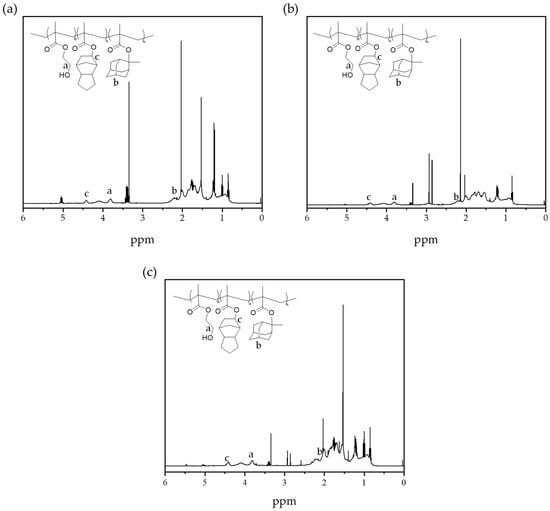
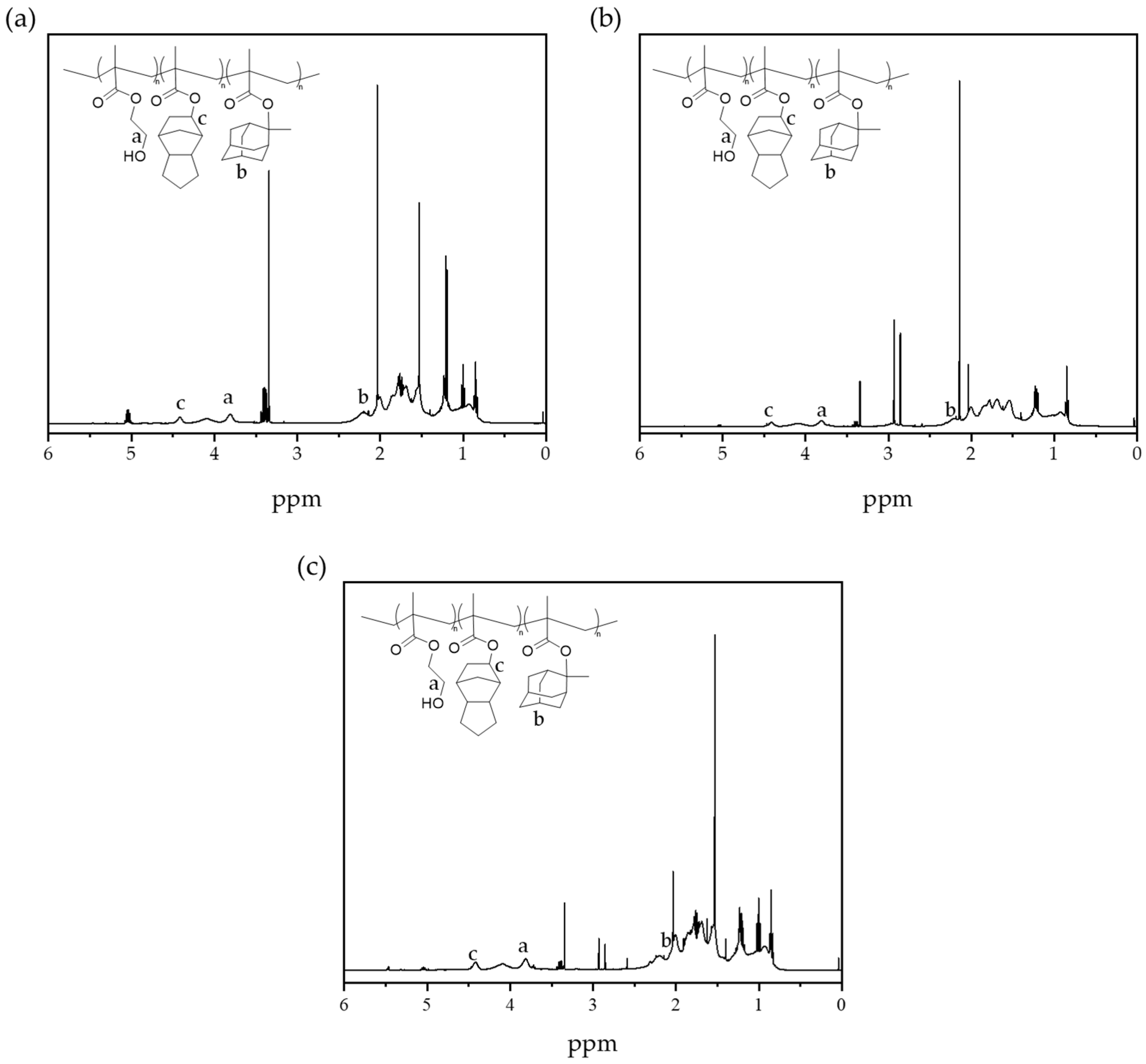
The chemical structures and incorporated monomer compositions of the synthesized polymers were examined by 1H NMR spectroscopy (Figure 1). All three samples exhibited characteristic proton resonances attributable to HEMA, TCDMA, and MAMA, confirming the incorporation of the three methacrylate components. Analysis of the characteristic 1H resonances provided approximate estimates of the incorporated HEMA:TCDMA:MAMA compositions. The estimated HEMA:TCDMA:MAMA ratios were approximately 3.0:2.8:4.2 for HTM CTA 0, 3.0:3.3:4.0 for HTM CTA 8, and 3.0:2.8:3.9 for HTM CTA 16, respectively (Table 2). Because some resonances are partially overlapped in the polymer spectra, the calculated ratios are used here to compare the overall copolymer compositions rather than to interpret small compositional differences quantitatively. Despite this limitation, the estimated compositions were broadly comparable among the three polymerization conditions. Consequently, subsequent differences in thermophysical or lithographic behavior are unlikely to originate primarily from large differences in the incorporated monomer composition.
Figure 1.
1H-NMR spectra of the methacrylate polymers prepared under different CTA conditions: (a) HTM CTA 0, (b) HTM CTA 8, and (c) HTM CTA 16. The labels a–c denote the characteristic proton signals corresponding to the labeled protons in the inset structures.
Table 2.
Nominal monomer feed ratios, 1H NMR-determined copolymer compositions, weight-average molecular weights (Mw), and dispersities (Đ) of HTM CTA 0, HTM CTA 8, and HTM CTA 16.
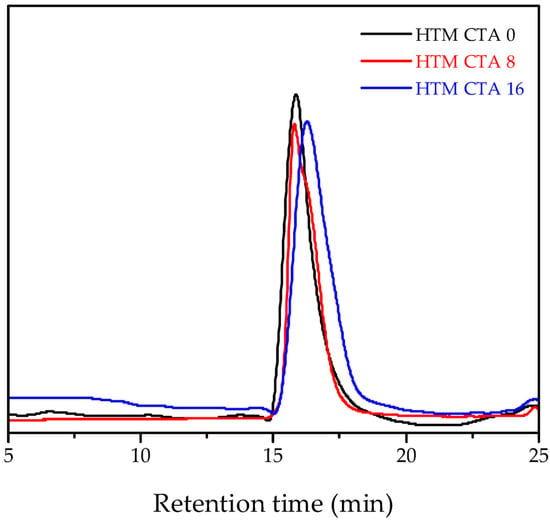
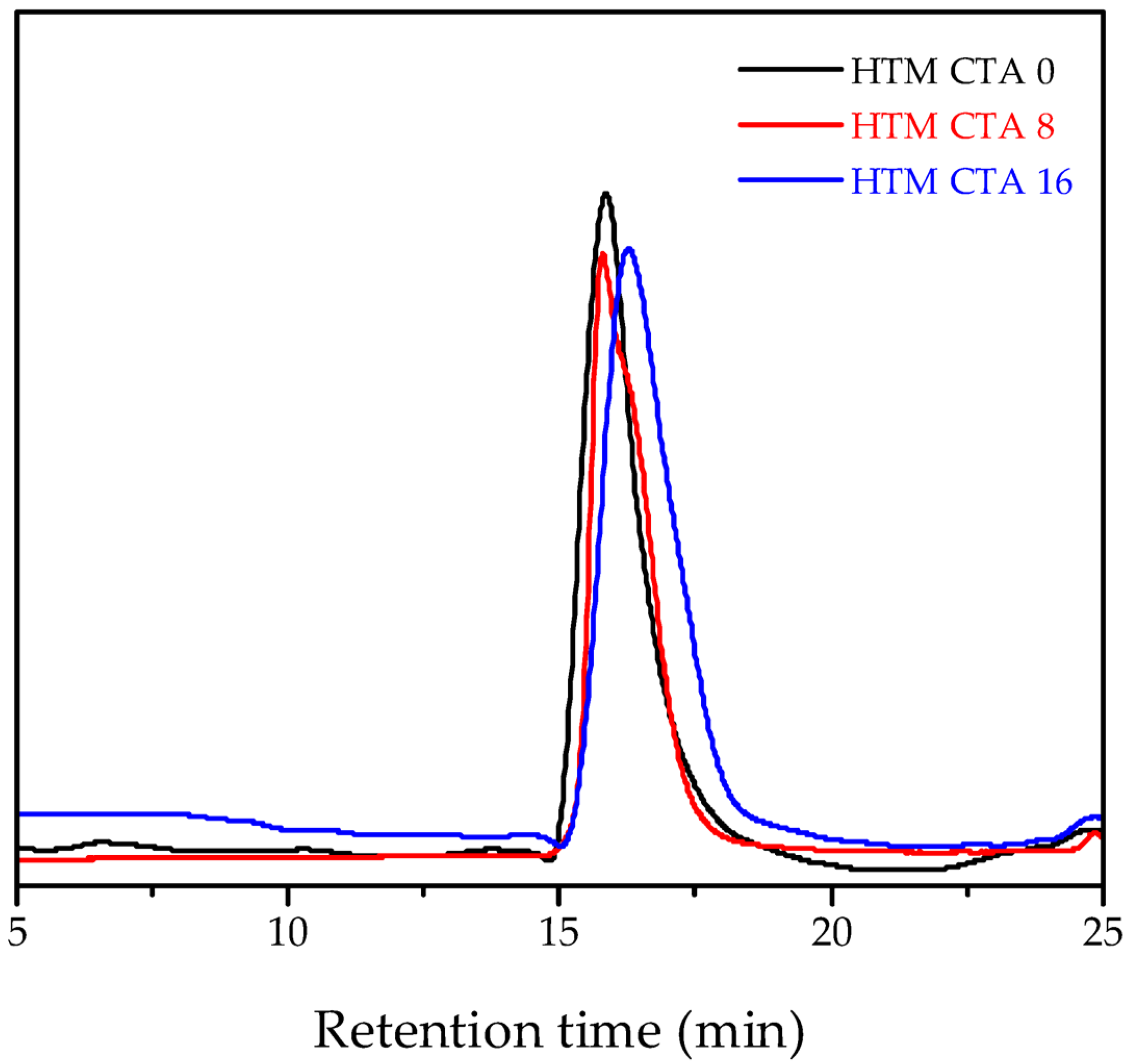
The molecular-weight characteristics were further evaluated by gel permeation chromatography (GPC), as summarized in Table 2 and Figure 2. The weight-average molecular weights (Mw) of HTM CTA 0, HTM CTA 8, and HTM CTA 16 were 35.0, 36.8, and 33.0 kg mol−1, respectively, while the corresponding dispersities (Đ) were 1.16, 1.16, and 1.17. All three polymers therefore exhibited relatively narrow molecular-weight distributions within a similar molecular-weight range. Notably, increasing the amount of TMP-CEPA3 from the CTA 8 to CTA 16 condition did not produce a pronounced monotonic decrease in Mw under the employed polymerization conditions. Although HTM CTA 8 and HTM CTA 16 exhibited relatively narrow molecular-weight distributions, the final GPC data alone do not establish controlled RAFT behavior in the present ternary methacrylate system. Molecular-weight evolution with conversion, polymerization kinetics, chain-end fidelity, and chain-extension experiments were not evaluated in this study. Therefore, the present results are interpreted as characteristics of polymers prepared in the presence of the trifunctional TMP-CEPA3 RAFT agent, rather than as direct evidence of controlled/living RAFT polymerization.
Figure 2.
Gel permeation chromatography (GPC) traces of HTM CTA 0 (black line), HTM CTA 8 (red line) and HTM CTA 16 (blue line).
The similar molecular-weight range of the CTA-free and CTA-containing polymers should also be interpreted with consideration of the different initiator loading used for HTM CTA 0. Because the CTA-free polymerization required a tenfold higher amount of V-65 than the CTA-containing formulations, the molecular-weight characteristics of HTM CTA 0 cannot be attributed solely to the absence of TMP-CEPA3. The increased initiator loading may have influenced the radical concentration and termination behavior during polymerization. Accordingly, the present samples are more appropriately regarded as polymers prepared under different CTA-mediated polymerization conditions rather than as a series exhibiting simple CTA-dependent molecular-weight control.
Overall, the 1H NMR and GPC results demonstrate that HTM CTA 0, HTM CTA 8, and HTM CTA 16 possess comparable incorporated monomer compositions and similar molecular-weight ranges with narrow dispersities. These characteristics provide a useful basis for examining whether the differences in polymerization conditions and the introduction of the multifunctional TMP-CEPA3 agent are accompanied by changes in the thermophysical and subsequent pattern-forming behavior of the photoresist polymers. It should be noted that the present characterization, based on 1H NMR spectroscopy and conventional GPC, does not independently establish a defined three-arm star architecture for the CTA-containing polymers or exclude the presence of linear or partially initiated species. Therefore, HTM CTA 8 and HTM CTA 16 are described herein as methacrylate polymers prepared in the presence of the trifunctional TMP-CEPA3 RAFT agent, rather than as structurally verified three-arm star polymers. A matched linear RAFT analogue prepared using a monofunctional RAFT agent under comparable initiator and molecular-weight conditions was not included in the present study. Therefore, the current comparison does not independently separate the effects of RAFT mediation, polymer architecture, initiator concentration, and other polymerization variables. Accordingly, the observed differences are interpreted in terms of the overall polymerization conditions rather than being attributed specifically to a three-arm architecture.
3.2. Thermophysical Properties of Polymers Prepared Under Different CTA Conditions
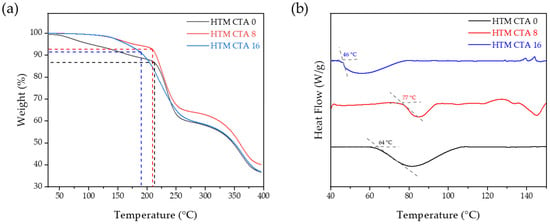
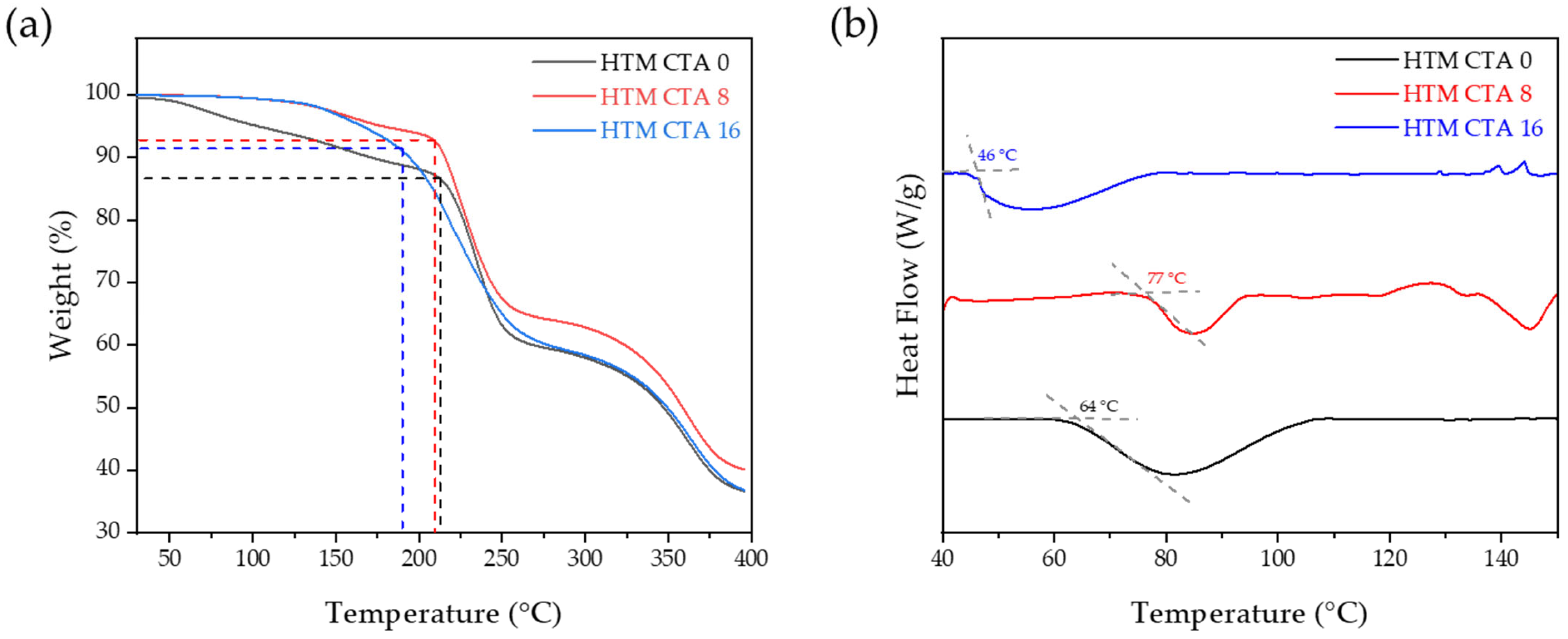
The thermophysical properties of HTM CTA 0, HTM CTA 8, and HTM CTA 16 were investigated by thermogravimetric analysis (TGA) and differential scanning calorimetry (DSC), as shown in Figure 3. Because the three polymers exhibited comparable incorporated HEMA:TCDMA:MAMA compositions and similar molecular-weight ranges, the thermal behavior was interpreted primarily in relation to the different CTA-mediated polymerization conditions.
Figure 3.
Thermal analysis of polymers prepared under different CTA conditions: (a) TGA curves showing the first thermal weight-loss event and (b) DSC thermograms showing the glass-transition temperatures (Tg) of HTM CTA 0, HTM CTA 8, and HTM CTA 16. The dashed lines indicate the positions used to identify the first thermal weight-loss event in the TGA curves and the Tg values in the DSC thermograms.
The TGA curves of the three polymers displayed similar multistep weight-loss behavior, although differences were observed in the temperature region corresponding to the first thermal weight-loss event (Figure 3a). This initial event is tentatively associated with thermal cleavage or degradation of the acid-labile pendant groups, whereas the subsequent major weight loss at higher temperature is mainly attributed to degradation of the polymer backbone. No simple monotonic shift in the first thermal event was observed with increasing CTA loading, indicating that the thermal response cannot be explained solely by the amount of TMP-CEPA3 introduced during polymerization.
The DSC thermograms (Figure 3b) showed glass-transition temperatures (Tg) of approximately 64, 77, and 46 °C for HTM CTA 0, HTM CTA 8, and HTM CTA 16, respectively. The highest Tg was observed for HTM CTA 8, whereas HTM CTA 16 exhibited the lowest Tg, indicating that Tg did not vary monotonically with TMP-CEPA3 loading. Because the three polymers remained within a relatively narrow molecular-weight range, the observed differences cannot be explained by molecular weight alone. In addition, HTM CTA 0 was prepared using a tenfold higher V-65 loading than the TMP-CEPA3-containing samples, which may have influenced radical concentration and termination behavior during polymerization. Therefore, the observed Tg differences are interpreted cautiously as reflecting differences among the overall polymerization conditions. The present data do not allow the non-monotonic Tg variation to be assigned specifically to polymer architecture or any other single molecular factor.
Overall, the TGA and DSC results indicate that the thermal behavior varies among the different polymerization conditions but does not follow a simple CTA-loading-dependent trend.
3.3. Exposure-Induced Chemical Changes Revealed by FT-IR Spectroscopy
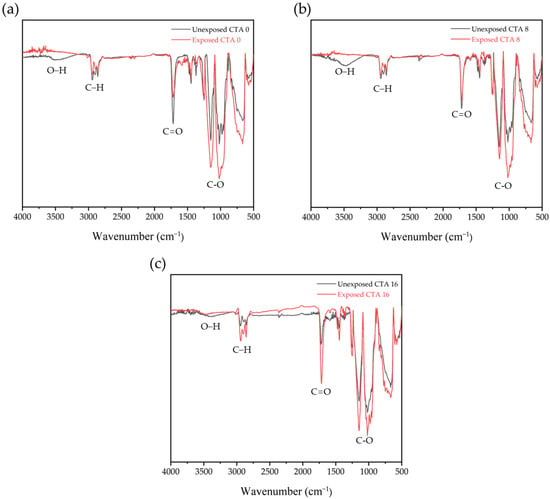
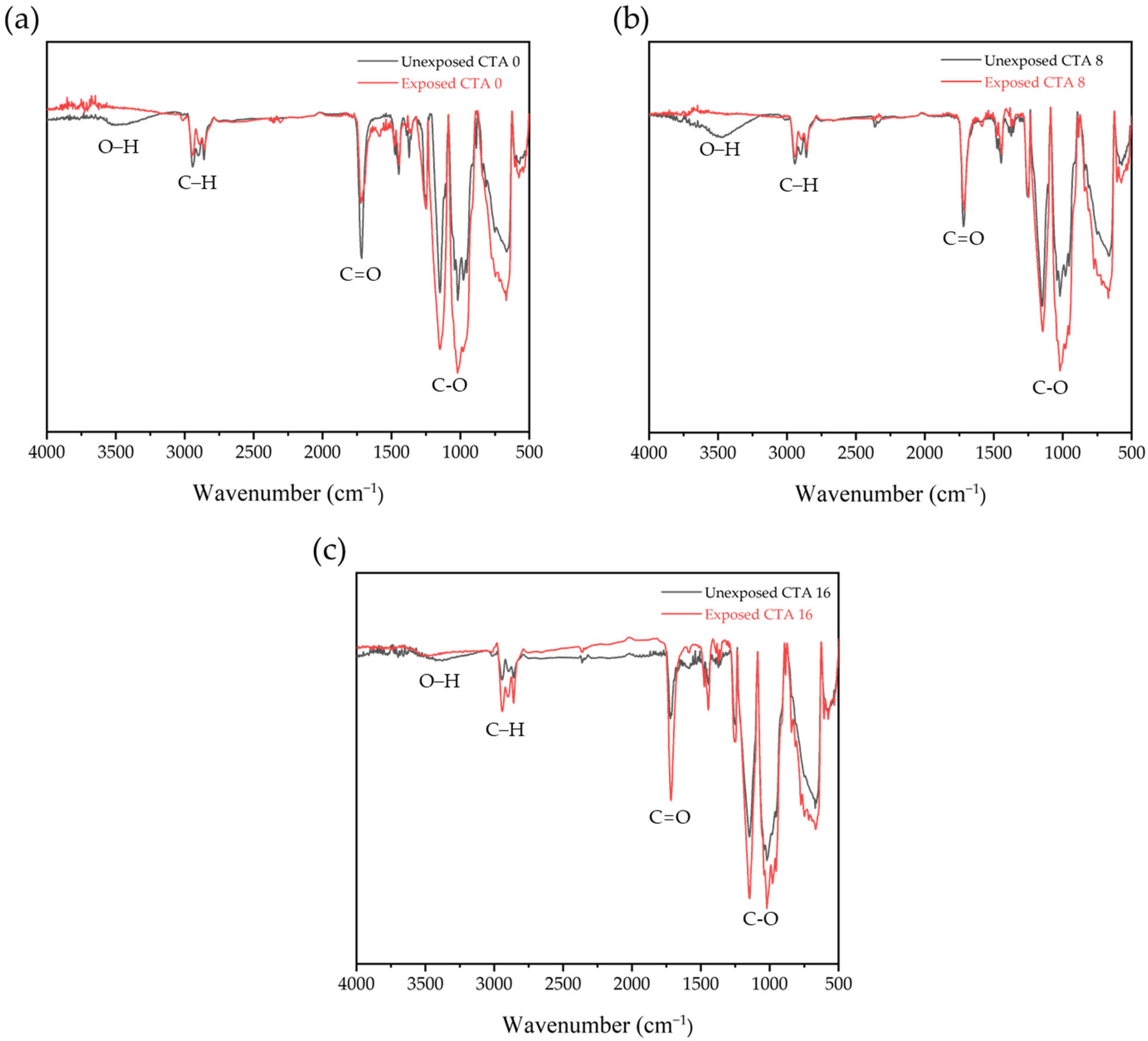
The chemical response of the synthesized polymers to UV exposure and subsequent PEB was further examined by FT-IR spectroscopy (Figure 4). For all three samples, the spectra recorded before exposure and after UV exposure followed by PEB showed noticeable changes in the absorption bands associated with the hydroxyl (O–H), aliphatic C–H, carbonyl (C=O), and C–O stretching regions, indicating that exposure induced chemical changes after UV exposure and PEB in the resist films.
Figure 4.
FT-IR spectra of photoresist films containing PAG (NDI) before exposure and after UV exposure followed by PEB: (a) HTM CTA 0; (b) HTM CTA 8; and (c) HTM CTA 16. The spectra show changes in the O–H, C–H, C=O, and C–O regions.
These spectral changes are consistent with acid-catalyzed deprotection of the MAMA-derived acid-labile groups following photoacid generation. In addition, changes in the O–H stretching region suggest modification of the hydroxyl-group environment, which may reflect enhanced intermolecular interactions and the development of a hydrogen-bonded network after exposure. Such exposure-induced changes are considered to be associated with reduced solubility of the exposed regions and are therefore relevant to the negative-tone imaging behavior.
Although all three polymers exhibited qualitatively similar FT-IR responses upon exposure, the observed spectral changes are consistent with the photoacid-induced chemical changes under each CTA condition. These results support the interpretation that the synthesized polymers remained chemically responsive to lithographic processing regardless of the CTA-mediated polymerization condition.
3.4. Negative-Tone Patterning Behavior
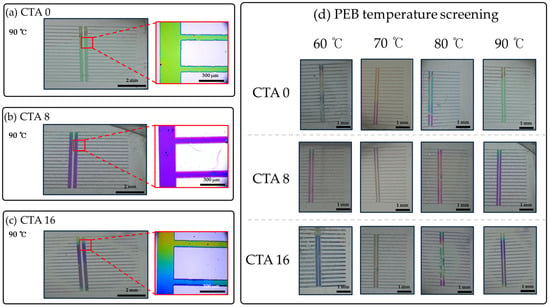
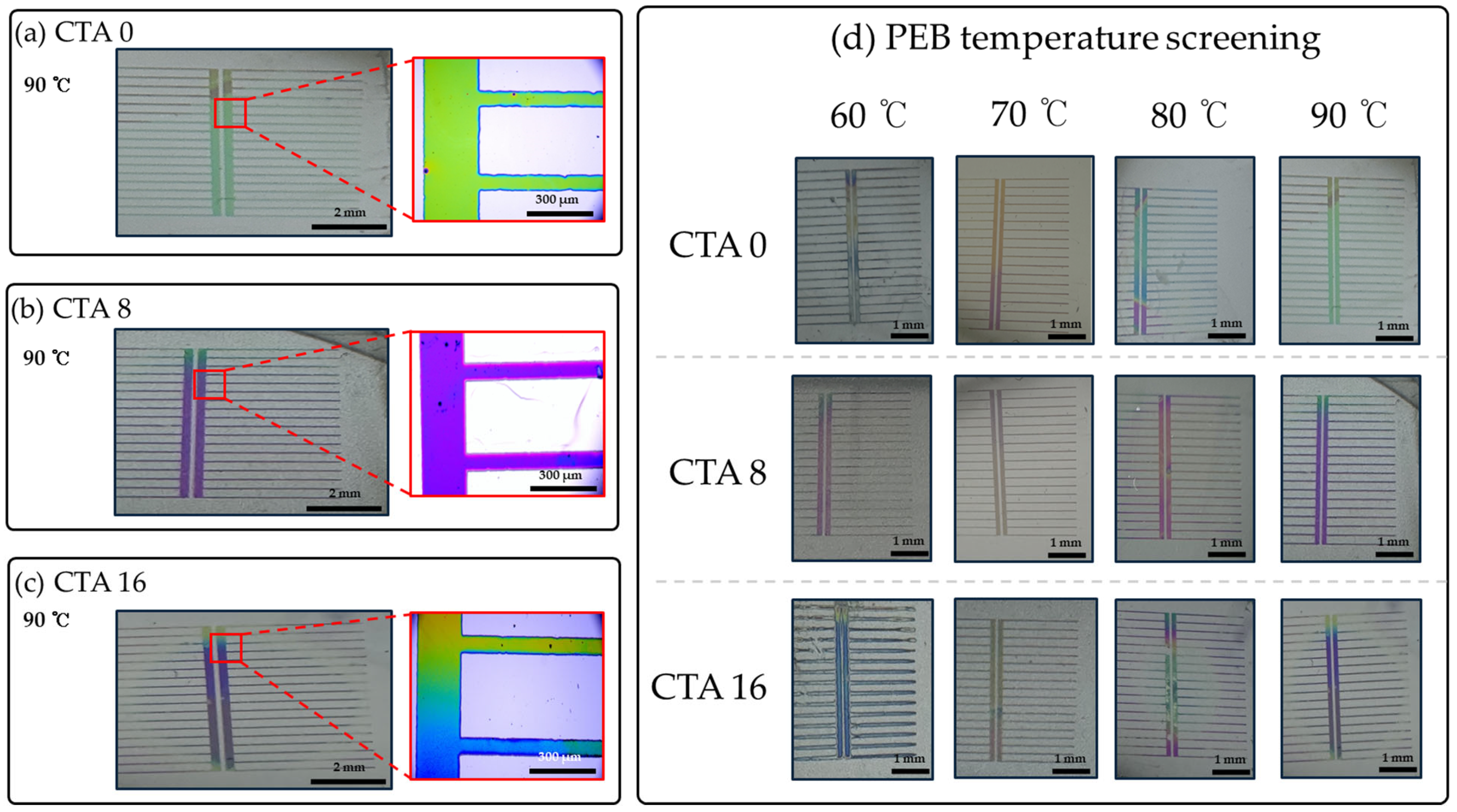
The negative-tone patterning behavior of HTM CTA 0, HTM CTA 8, and HTM CTA 16 was preliminarily assessed by optical microscopy at PEB temperatures ranging from 60 to 90 °C (Figure 5). The present evaluation focuses on pattern formation under the investigated processing conditions rather than on a comprehensive patterning behavior characterization.
Figure 5.
Optical microscopy images of negative-tone patterns obtained from HTM CTA 0, HTM CTA 8, and HTM CTA 16 after post-exposure baking (PEB) at 60, 70, 80, and 90 °C for 1 min. (a–c) Representative pattern images of HTM CTA 0, HTM CTA 8, and HTM CTA 16, respectively, at 90 °C; (d) PEB-temperature screening from 60 to 90 °C. The red dashed boxes and lines indicate the regions shown in the enlarged views. The observed colors in the optical microscopy images are not used as quantitative indicators.
All three formulations exhibited PEB-temperature-dependent changes in pattern formation, demonstrating the important role of thermal treatment in generating sufficient dissolution contrast. At a PEB temperature of 90 °C, discernible negative-tone patterns were successfully obtained for all three polymers. Among them, HTM CTA 0 and HTM CTA 8 exhibited slightly clearer and better-defined pattern features than HTM CTA 16. These results indicate that an appropriate PEB temperature is critical for pattern development, whereas the patterning behavior does not show a simple dependence on the amount of TMP-CEPA3 used during polymer synthesis.
The different patterning behaviors cannot be explained simply by differences in copolymer composition or molecular weight, because all three polymers exhibited comparable incorporated monomer ratios, similar Mw values, and narrow dispersities. Moreover, FT-IR analysis showed spectral changes after UV exposure and PEB that were consistent with photoacid-induced chemical changes in all three samples, indicating that the acid-responsive functionality remained active regardless of the CTA condition. Therefore, the observed differences in pattern formation are likely related to the combined effects of the overall polymerization conditions, resulting polymer characteristics, thermal response, and polymer–developer interactions rather than to the acid-labile functionality alone.
Notably, both the CTA-free HTM CTA 0 and the CTA-containing HTM CTA 8 exhibited favorable pattern definition under the selected processing conditions. These observations indicate that increasing TMP-CEPA3 loading does not necessarily lead to improved patterning behavior. Because HTM CTA 0 was synthesized using a higher V-65 loading than the CTA-containing formulations, the observed differences should be interpreted in terms of the overall polymerization conditions rather than CTA content alone. Overall, these results emphasize the importance of jointly optimizing polymer characteristics and processing conditions, particularly the PEB temperature, for achieving favorable pattern formation.
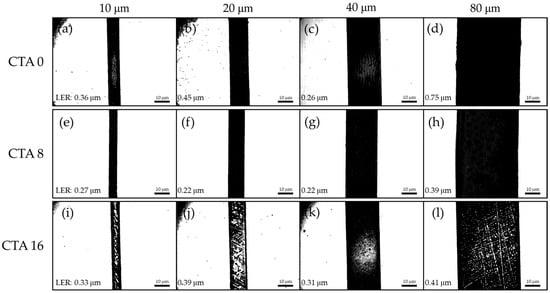
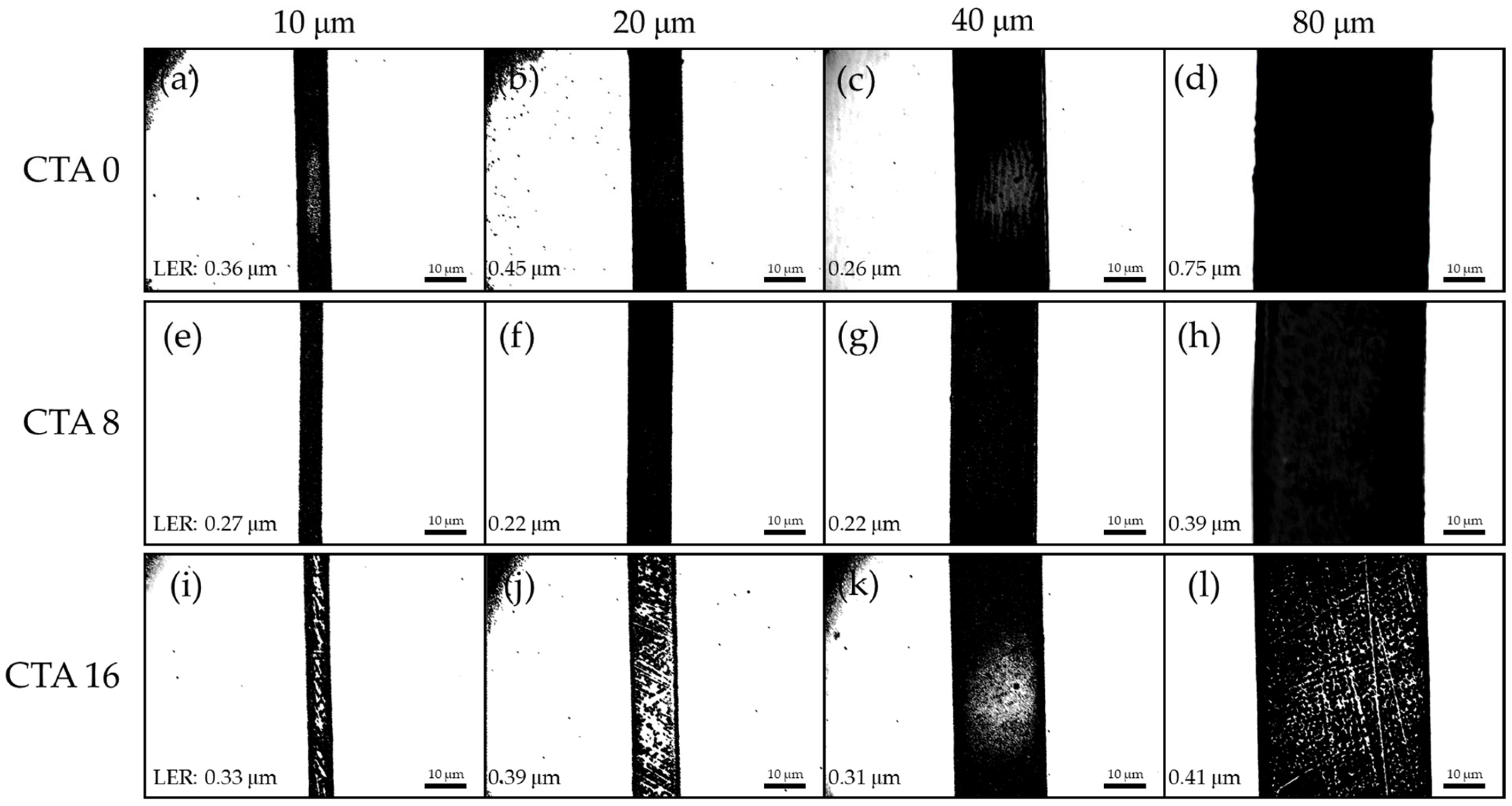
To further compare the pattern-forming capability of the synthesized resists, line patterns with nominal mask dimensions of 10, 20, 40, and 80 μm were examined under identical selected PEB conditions (Figure 6). All three formulations successfully generated negative-tone line patterns over the investigated feature sizes. In the representative optical microscopy images, HTM CTA 0 and HTM CTA 8 showed somewhat clearer and more continuous line features than HTM CTA 16 under the examined conditions. In particular, the comparison indicates that increasing the TMP-CEPA3 content did not produce a systematic improvement in pattern fidelity. Rather, the lithographic behavior appears to depend on the combined effects of polymerization conditions and processing parameters. These results are consistent with the PEB screening in Figure 5 and demonstrate that favorable pattern formation can be achieved for both the CTA-free and CTA-mediated polymer systems under appropriately selected processing conditions.
Figure 6.
Optical microscopy images of negative-tone line patterns obtained under identical selected PEB conditions at nominal mask dimensions of 10, 20, 40, and 80 μm: (a–d) HTM CTA 0, (e–h) HTM CTA 8, and (i–l) HTM CTA 16.
The LER values shown in Figure 6 further indicate feature-size-dependent differences among the three formulations. HTM CTA 8 exhibited relatively low LER values of 0.27, 0.22, 0.22, and 0.39 μm at nominal line widths of 10, 20, 40, and 80 μm, respectively. In comparison, HTM CTA 0 showed LER values of 0.36, 0.45, 0.26, and 0.75 μm, whereas HTM CTA 16 showed values of 0.33, 0.39, 0.31, and 0.41 μm. Thus, HTM CTA 8 generally showed the lowest edge roughness across the investigated feature sizes, while the relative behavior of HTM CTA 0 and HTM CTA 16 varied with line width. These results further indicate that increasing TMP-CEPA3 loading does not produce a simple monotonic improvement in pattern fidelity.
Accordingly, the present results should be regarded as a preliminary comparative assessment of negative-tone patterning behavior under the investigated conditions, rather than as a comprehensive evaluation of patterning behavior including sensitivity, contrast, dose dependence, and wafer-level reproducibility.
Taken together, Figure 5 and Figure 6 show that all three polymers are capable of negative-tone pattern formation when an appropriate PEB condition is employed. At 90 °C, HTM CTA 0 and HTM CTA 8 showed slightly more distinct pattern definition than HTM CTA 16, while the feature-size-dependent line-pattern evaluation revealed generally favorable pattern formation for both CTA 0 and CTA 8. Because the three polymers possess comparable incorporated monomer compositions and similar molecular-weight ranges, these differences cannot be attributed simply to compositional or molecular-weight variations. Instead, they may reflect the combined influence of the polymerization conditions, polymer-chain characteristics, thermal response, and polymer–developer interactions. Importantly, no systematic improvement in patterning behavior was observed with increasing TMP-CEPA3 loading, indicating that the introduction of a multifunctional CTA alone is not sufficient to determine patterning performance.
4. Conclusions
In this study, the influence of multifunctional chain-transfer agent (CTA)-mediated polymerization conditions on the structural characteristics, thermal properties, and lithographic behavior of methacrylate-based photoresist polymers was investigated. A series of methacrylate-based polymers was prepared using different TMP-CEPA3 conditions while maintaining a comparable HEMA:TCDMA:MAMA monomer composition. The synthesized polymers exhibited similar incorporated monomer ratios and narrow molecular-weight distributions, providing a suitable platform for evaluating the effect of CTA-mediated polymerization conditions on resist performance.
The thermal analyses revealed that the introduction of TMP-CEPA3 did not result in a simple monotonic variation in thermal properties. The observed differences in glass-transition behavior and thermal response were attributed to the combined effects of polymerization conditions and the resulting polymer characteristics rather than to CTA loading alone. FT-IR analysis showed spectral changes after UV exposure and PEB that were consistent with photoacid-induced chemical responsiveness, including changes associated with the acid-labile MAMA groups and hydroxyl-group environments.
Negative-tone lithographic evaluation demonstrated that the PEB temperature strongly influenced pattern formation. At 90 °C, all three polymers successfully produced distinguishable negative-tone patterns, with HTM CTA 0 and HTM CTA 8 showing slightly clearer pattern definition than HTM CTA 16. Further evaluation using line patterns with different nominal feature sizes confirmed that both CTA 0 and CTA 8 provided favorable pattern-forming behavior, although the detailed pattern uniformity depended on the feature size. Importantly, increasing the TMP-CEPA3 loading did not result in a systematic improvement in the observed patterning behavior under the investigated conditions. These observations indicate that resist performance is governed by a balance among polymerization conditions, polymer characteristics, thermal response, and lithographic processing parameters rather than by multifunctional CTA loading alone.
Overall, this work demonstrates that the introduction of a multifunctional CTA does not by itself guarantee improved patterning behavior. Instead, the present results suggest that successful pattern formation within the investigated system depends on balanced control of polymerization conditions, molecular characteristics, chemical response, and processing parameters. These findings provide useful guidance for the rational optimization of methacrylate-based photoresist systems prepared under different CTA-mediated polymerization conditions. Because a matched linear RAFT analogue was not included, the present results do not allow a specific architectural effect to be isolated.
Author Contributions
Conceptualization, N.C., Y.C. and J.K.; methodology, N.C., Y.C. and J.K.; formal analysis, Y.C. and J.K.; investigation, Y.C., J.K. and E.P.; resources, Y.C.; data curation, E.P.; writing—original draft preparation, N.C., Y.C. and J.K.; writing—review and editing, N.C., Y.C. and J.K.; visualization, Y.C. and J.K. All authors have read and agreed to the published version of the manuscript.
Funding
This work was supported by the Korea Institute of Energy Technology Evaluation and Planning (KETEP) and the Ministry of Climate, Energy & Environment (MCEE) of the Republic of Korea (No. RS-2024-00394769). This work was supported by the Soonchunhyang University Research Fund.
Institutional Review Board Statement
Not applicable.
Data Availability Statement
The original contributions presented in the study are included in the article; further inquiries can be directed to the corresponding author.
Acknowledgments
ChatGPT-3.5 (OpenAI, San Francisco, CA, USA) was used to assist with language editing, grammatical correction, and improving the clarity of the manuscript. All scientific content, data interpretation, and conclusions were reviewed and verified by the authors, who take full responsibility for the final content of the manuscript.
Conflicts of Interest
The authors declare no conflicts of interest.
References
- Sanders, D.P. Advances in Patterning Materials for 193 nm Immersion Lithography. Chem. Rev. 2010, 110, 321–360. [Google Scholar] [CrossRef] [Scilit]
- Moon, S.-Y.; Kim, J.-M. Chemistry of photolithographic imaging materials based on the chemical amplification concept. J. Photochem. Photobiol. C Photochem. Rev. 2007, 8, 157–173. [Google Scholar] [CrossRef] [Scilit]
- Seung-Hyun, L.; Jong Keun, P.; Thomas, C.; Jibin, S.; Cecily, A.; Kathleen, O.C.; George, G.B. Understanding dissolution behavior of 193nm photoresists in organic solvent developers. In Proceedings of the SPIE—The International Society for Optical Engineering, Marlborough, MA, USA, 27 April 2012; Volume 8325. [Google Scholar]
- Ko, Y.H.; Lee, H.; Kim, H.; Kim, S.; Ahn, C.; Hur, S.-M.; Kwak, Y.; Kim, M. Chemical Structure–Physicochemical Property Relationships of Copolymers Utilizable for Negative-Tone Photoimaging via Chemical Amplification. ACS Appl. Mater. Interfaces 2024, 16, 15286–15297. [Google Scholar] [CrossRef] [Scilit]
- Reichmanis, E.; Nalamasu, O.; Houlihan, F.M. Organic Materials Challenges for 193 nm Imaging. Acc. Chem. Res. 1999, 32, 659–667. [Google Scholar] [CrossRef] [Scilit]
- Ito, H. Chemical amplification resists: Inception, implementation in device manufacture, and new developments. J. Polym. Sci. Part A Polym. Chem. 2003, 41, 3863–3870. [Google Scholar] [CrossRef] [Scilit]
- Kim, J.; Lee, C.-J.; Lee, D.-G.; Lee, G.-H.; Hyeon, J.; Choi, Y.; Cho, N. Controlling the Dissolution Behavior of (Meth)acrylate-Based Photoresist Polymers in Tetramethylammonium Hydroxide by Introducing Adamantyl Groups. Materials 2025, 18, 381. [Google Scholar] [CrossRef] [Scilit]
- Rao, A.; Kang, S.; Vogt, B.D.; Prabhu, V.M.; Lin, E.K.; Wu, W.-L.; Muthukumar, M. Effect of Deprotection Extent on Swelling and Dissolution Regimes of Thin Polymer Films. Langmuir 2006, 22, 10009–10015. [Google Scholar] [CrossRef] [Scilit]
- Rodríguez-Cantó, P.J.; Nickel, U.; Abargues, R. Understanding Acid Reaction and Diffusion in Chemically Amplified Photoresists: An Approach at the Molecular Level. J. Phys. Chem. C 2011, 115, 20367–20374. [Google Scholar] [CrossRef] [Scilit]
- Toru, F.; Toru, T.; Toshiro, I. Recent progress of negative-tone imaging with EUV exposure. In Proceedings of the Proc. SPIE, Tokyo, Japan, 29 October 2015; p. 942505. [Google Scholar]
- Yu, H.; Liu, S.; Fu, H.; Cui, Z.; Zhang, L.; Tian, J. POSS and PAG Dual-Containing Chemically Amplified Photoresists by RAFT Polymerization for Enhanced Thermal Performance and Acid Diffusion Inhibition. Appl. Sci. 2024, 14, 7722. [Google Scholar] [CrossRef] [Scilit]
- Lee, C.-J.; Kim, J.; Lee, G.-H.; Hyeon, J.; Choi, Y.; Cho, N. Swelling Behavior of Acrylate-Based Photoresist Polymers Containing Cycloaliphatic Groups of Various Sizes. Materials 2024, 17, 5465. [Google Scholar] [CrossRef] [Scilit]
- Lee, J.; Aoai, T.; Kondo, S.i.; Miyagawa, N.; Takahara, S.; Yamaoka, T. Negative-working photoresist of methacrylate polymers based on the transesterification of the 2-hydroxyethyl group in the presence of an acid. J. Polym. Sci. Part A Polym. Chem. 2002, 40, 1858–1867. [Google Scholar] [CrossRef] [Scilit]
- Ogata, T.; Matsumaru, S.; Shimizu, H.; Naotaka, K.; Hada, H.; Shirai, M. Effects of Protecting Group on Resist Characteristics of Acryl Polymers for 193 nm Lithography. J. Photopolym. Sci. Technol. 2004, 17, 483–488. [Google Scholar] [CrossRef] [Scilit]
- Nozaki, K.; Yano, E. New Protective Groups in Alicyclic Methacrylate Polymers for 193-nm Resists. J. Photopolym. Sci. Technol. 1997, 10, 545–550. [Google Scholar] [CrossRef] [Scilit]
- Kang, S.H.; Prabhu, V.M.; Vogt, B.D.; Lin, E.K.; Wu, W.-l.; Turnquest, K. Effect of copolymer composition on acid-catalyzed deprotection reaction kinetics in model photoresists. Polymer 2006, 47, 6293–6302. [Google Scholar] [CrossRef] [Scilit]
- Kang, S.; Vogt, B.D.; Wu, W.-l.; Prabhu, V.M.; VanderHart, D.L.; Rao, A.; Lin, E.K.; Turnquest, K. Characterization of Compositional Heterogeneity in Chemically Amplified Photoresist Polymer Thin Films with Infrared Spectroscopy. Macromolecules 2007, 40, 1497–1503. [Google Scholar] [CrossRef] [Scilit]
- Park, J.; Lee, S.-G.; Vesters, Y.; Severi, J.; Kim, M.; De Simone, D.; Oh, H.-K.; Hur, S.-M. Molecular Modeling of EUV Photoresist Revealing the Effect of Chain Conformation on Line-Edge Roughness Formation. Polymers 2019, 11, 1923. [Google Scholar] [CrossRef] [Scilit]
- Zhu, G.; Gao, L.; Wang, Y.; Tlusty, T.; Yan, L.-T. Programmable Potentials Choreograph Defects in a Colloidal Crystal Shell. Phys. Rev. Lett. 2024, 132, 048201. [Google Scholar] [CrossRef] [Scilit]
- Chiefari, J.; Chong, Y.K.; Ercole, F.; Krstina, J.; Jeffery, J.; Le, T.P.T.; Mayadunne, R.T.A.; Meijs, G.F.; Moad, C.L.; Moad, G.; et al. Living free-radical polymerization by reversible addition-fragmentation chain transfer: The RAFT process. Macromolecules 1998, 31, 5559–5562. [Google Scholar] [CrossRef] [Scilit]
- Favier, A.; Charreyre, M.-T. Experimental Requirements for an Efficient Control of Free-Radical Polymerizations via the Reversible Addition-Fragmentation Chain Transfer (RAFT) Process. Macromol. Rapid Commun. 2006, 27, 653–692. [Google Scholar] [CrossRef] [Scilit]
- Mayadunne, R.T.A.; Jeffery, J.; Moad, G.; Rizzardo, E. Living Free Radical Polymerization with Reversible Addition−Fragmentation Chain Transfer (RAFT Polymerization): Approaches to Star Polymers. Macromolecules 2003, 36, 1505–1513. [Google Scholar] [CrossRef] [Scilit]
- Perrier, S.b. 50th Anniversary Perspective: RAFT Polymerization—A User Guide. Macromolecules 2017, 50, 7433–7447. [Google Scholar] [CrossRef] [Scilit]
- Zheng, X.; Ji, C.; Liu, J.; Liu, R.; Mu, Q.; Liu, X. Novel Star Polymers as Chemically Amplified Positive-Tone Photoresists for KrF Lithography Applications. Ind. Eng. Chem. Res. 2018, 57, 6790–6796. [Google Scholar] [CrossRef] [Scilit]
- Lee, D.; Kim, S.; Ha, J.; Choi, H.; Im, K.; Kim, M. Rational Design of Degradable Multiarm Polymers Applicable for Photoimaging Materials. Chem. Mater. 2026, 38, 1808–1820. [Google Scholar] [CrossRef] [Scilit]
- Li, H.; Liu, J.; Zheng, X.; Ji, C.; Mu, Q.; Liu, R.; Liu, X. Synthesis of chemically amplified photoresist polymer containing four (Meth)acrylate monomers via RAFT polymerization and its application for KrF lithography. J. Polym. Res. 2016, 23, 102. [Google Scholar] [CrossRef] [Scilit]
- Sohn, H.-S.; Cha, S.-H.; Lee, W.-K.; Kim, D.-G.; Yun, H.-J.; Kim, M.-S.; Kim, B.-D.; Kim, Y.-H.; Lee, J.-W.; Kim, J.-S.; et al. Synthesis of ArF photoresist polymer composed of three methacrylate monomers via reversible addition-fragmentation chain transfer (RAFT) polymerization. Macromol. Res. 2011, 19, 722–728. [Google Scholar] [CrossRef] [Scilit]
- Chochos, C.; Ismailova, E.; Brochon, C.; Leclerc, N.; Tiron, R.; Sourd, C.; Bandelier, P.; Foucher, J.; Ridaoui, H.; Dirani, A.; et al. Hyperbranched Polymers for Photolithographic Applications—Towards Understanding the Relationship between Chemical Structure of Polymer Resin and Lithographic Performances. Adv. Mater. 2009, 21, 1121–1125. [Google Scholar] [CrossRef] [Scilit]

Disclaimer/Publisher’s Note: The statements, opinions and data contained in all publications are solely those of the individual author(s) and contributor(s) and not of MDPI and/or the editor(s). MDPI and/or the editor(s) disclaim responsibility for any injury to people or property resulting from any ideas, methods, instructions or products referred to in the content. |
© 2026 by the authors. Licensee MDPI, Basel, Switzerland. This article is an open access article distributed under the terms and conditions of the Creative Commons Attribution (CC BY) license.