


Highlights
What are the main findings?
- Analytical expressions for two-hop detection error probability (DEP) and outage probability are derived under the multi-UAV relay-assisted covert communication system with a realistic altitude-dependent Nakagami-m fading model.
- A joint altitude and power optimization scheme with maximum channel capacity relay selection (MCRS) is proposed to address the non-convex coupling between UAV geometry positions and time-varying characteristics of the fading channels.
What are the implications of the main findings?
- The integration of MCRS with multi-UAV networks provides spatial diversity gains, effectively mitigating non-ignorable small-scale fading of UAV channels in dense urban environment.
- The proposed multi-UAV relay method outperforms conventional benchmarks, enhancing covert performance of UAV-assisted communication systems in dense urban environments.
Abstract
Unmanned aerial vehicles (UAVs) are pivotal for 6G ubiquity, yet their open line-of-sight channels increase vulnerability to interception, posing new challenges for covert communication. This paper proposes a joint optimization scheme for multi-UAV relay-assisted covert communication system with the maximum channel capacity relay selection (MCRS) criterion. Distinct from conventional single-UAV approaches, this scheme uniquely couples UAV geometric positions with the time-varying characteristics of the wireless channels, exploiting spatial diversity from UAV relays to mitigate small-scale fading in dense urban environment, and jointly optimizes the transmit power and UAVs’ altitude. Specifically, we first designed an optimal relay selection strategy and derived analytical expressions for detection error and outage probabilities over altitude-dependent Nakagami-m fading channels. Furthermore, we maximized the effective covert rate by jointly optimizing the UAVs’ hovering altitude and adaptive transmit power of source and relays, subject to covert constraints. Extensive numerical results demonstrate a near-perfect match between the derived theoretical expressions and Monte Carlo simulations and validate the accuracy of our theoretical model. Compared against conventional single-UAV and multi-fixed-altitude UAV benchmark schemes, simulations demonstrate that the joint optimization scheme with relay selection proposed significantly enhances the covert performance of UAV-assisted communication systems.
1. Introduction
With the rapid evolution of wireless technologies, the sixth-generation (6G) communication network is expected to realize a fully connected digital ecosystem, facilitating the transmission of confidential and sensitive data on an unprecedented scale [1]. However, the broadcast characteristic of wireless channels and the increasingly open architecture of 6G networks render the system highly susceptible to eavesdropping and malicious attacks, posing significant security challenges [2]. Traditional security methods, such as physical layer security (PLS) and encryption, primarily aim to protect the transmission content from eavesdropping. However, with the exponential growth of computing power, encryption algorithms face the inevitable risk of being cracked in the future. Furthermore, once a transmission is detected by adversaries, both the information and the transmitter become vulnerable to attacks [3]. Consequently, covert communication has garnered significant attention as a novel security technology that conceals the very existence of signal transmission from malicious wardens. It offers enhanced security for diverse scenarios, including Internet-of-Things (IoT) sensing collection, deep sea exploration, and space-air-ground-sea integrated networks [4].
As aerial platforms, unmanned aerial vehicles (UAVs) can effectively enhance the wireless communication quality and extend the coverage of networks. Owing to their low cost, high mobility, and flexible deployment, UAVs are widely recognized as pivotal devices in wireless systems. They are extensively applied in fields ranging from civilian services like smart agriculture to critical missions such as emergency response and disaster management [5,6,7]. Furthermore, when direct communication links between remote users are obstructed, or when operating in complex urban environments prone to strong reflection and multipath effects, UAVs can establish air-to-ground (A2G) links to improve communication quality [8,9]. However, while the line-of-sight (LoS) channels provided by UAVs offer superior transmission quality, they also render the signals more susceptible to detection by malicious wardens [10], which introduces significant challenges to UAV-assisted covert communication. Consequently, extensive research has been devoted to this emerging field.
In [11], a single-UAV relay network over Rician fading channels is investigated, where the authors derive analytical solutions for outage probability and design a power allocation strategy to boost the effective throughput. Integrating interweave cognitive ratio technology, Ref. [12] proposes a random selection of channel use (RSCU) scheme to optimize the flight altitude and block length for a UAV, serving as a secondary base station. In [13], an angle-based location optimization method is introduced, compared to the traditional distance optimization scheme, providing a new geometric perspective for the covert deployment of UAV base stations. Focusing on the impact of blockages, Ref. [14] investigates single-UAV relay system with ground obstructions, solving the covert transmission problem by analyzing blockage effects and jointly optimizing block length and UAV hovering positions. To further enhance performance, Ref. [15] examines a system aided by dual-UAV under the finite block length regime, concurrently adjusting the power allocation and 3D trajectories of both UAVs to obtain the maximum average covert rate. Addressing the coverage limits of single-hop networks, Ref. [16] investigates end-to-end covert transmission in multi-hop MIMO UAV relay networks. A global beamforming strategy is proposed to suppress energy leakage at each hop, thereby maximizing the max-min rate. In [17], a scenario involving multiple UAV base stations and a UAV jammer is constructed; the authors resolve fairness issues in the presence of multiple wardens by jointly optimizing user connection policy, bandwidth partitioning, and 3D deployment. Furthermore, Ref. [18] proposes a novel architecture employing IRS-equipped UAVs as relays, utilizing a deep reinforcement learning algorithm with multi-agent to achieve distributed cooperative covertness. In the framework of integrated sensing and communication, Ref. [19] explores an adaptive role-switching strategy for UAVs between base station and friendly jammer roles to counter mobile wardens. And for large-scale multi-UAV relay networks, Ref. [20] employs a hierarchical multi-agent reinforcement learning algorithm to solve interference management and power control problems, maximizing effective throughput.
The existing research on UAV-assisted covert communication has gradually evolved from single-UAV architectures to cooperative dual-UAV and multi-UAV cluster scenarios, where performance is typically enhanced through the joint optimization of power, altitude, trajectory, and resource allocation. However, current studies primarily focus on the geometric topology of UAVs, paying scant attention to the non-convex coupling between the large-scale path loss (determined by the physical distribution of UAVs) and time-varying channels. This oversight is particularly critical in dense urban environments, where complex signal reflection, blockage, and diffusion caused by urban structures of varying heights lead to non-ignorable small-scale fading [7]. In networks with multi-relay configurations, relay selection serves as an effective mechanism to combat such fading by achieving spatial diversity gain [21]. Beyond single-relay selection, more generalized policies involving the selection of multiple active relays or coordinated multi-point transmission have been explored to further boost system capacity and reliability [22,23]. However, in UAV-aided covert communication systems, single-relay selection remains a fundamental baseline. Therefore, this paper proposes a joint optimization scheme for multi-UAV relay-assisted covert communication with maximum channel capacity relay selection (MCRS). This approach enhances system performance by effectively addressing the non-convex coupling between UAV geometric topology and time-varying channels. Specifically, the main contributions are highlighted as follows:
- We design an optimal relay selection scheme and perform a rigorous theoretical analysis. Analytical expressions for two-hop detection error probability (DEP) and outage probability are derived over an altitude-dependent Nakagami-m channel model.
- We construct a joint optimization problem with the relay selection scheme. By jointly optimizing the hovering altitude and adaptive transmit power of source and UAV relays, we maximize the effective covert rate subject to strict covert constraints.
- Extensive numerical results are provided to validate the accuracy of the theoretical derivations. Comparative analysis demonstrates that the proposed joint altitude and power optimization scheme with relay selection outperforms benchmark schemes, effectively enhancing covert performance of the UAV-aided communication systems in dense urban environment.
The remainder of this paper is organized as follows: Section 2 describes the system model and performance metrics; Section 3 analyzes the detection performance at Willie for both the source and the UAV relay; Section 4 discusses the effective covert rate under the MCRS scheme and details the proposed joint optimization algorithm; numerical results and discussions are presented in Section 5 to validate the theoretical analysis and evaluate system performance; and, finally, Section 6 concludes the paper.
2. System Model and Performance Metrics
2.1. Communiction Scenario and Assumptions
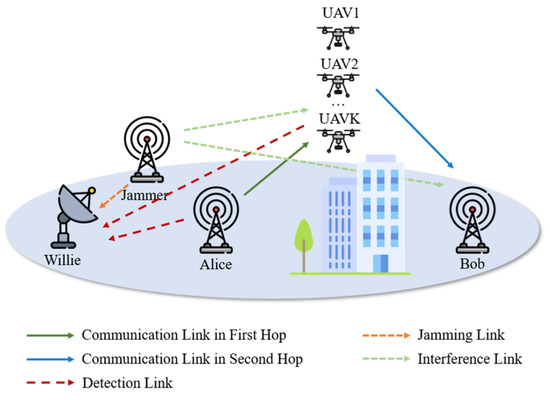
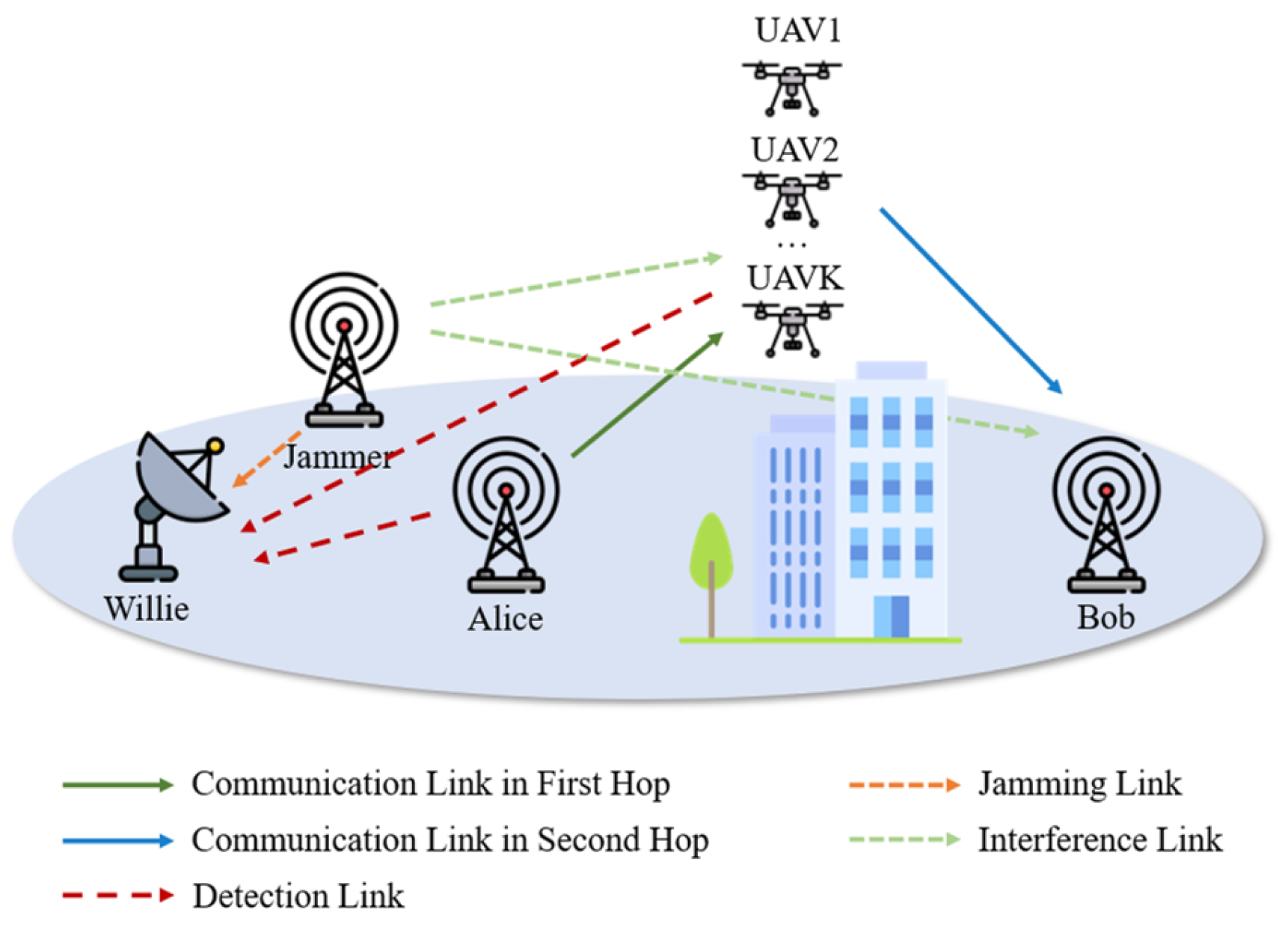
As shown in Figure 1, we investigate a multi-UAV relay-assisted covert communication system in dense urban environments. The system comprises a transmitter (Alice), a legitimate receiver (Bob), a malicious warden (Willie), a friendly jammer (Jammer), and half-duplex decode-and-forward (DF) UAV relays, denoted as . Due to severe blockage and shadowing effects, the direct communication link from Alice to Bob is assumed to be unavailable. Consequently, Alice will transmit covert signals to Bob via a specific relay , chosen from the available UAV cluster through a relay selection scheme. It is important to note that the term ‘multi-UAV-aided’ in this paper refers to the exploitation of selection diversity from a group of candidate UAV relays rather than simultaneous joint transmission by multiple UAVs. Given the half-duplex operation of the UAVs, the transmission is conducted in two time slots: the first link from Alice to UAV-relay and the second link from UAV relay to Bob. Throughout both time slots, Willie attempts to identify potential signal transmission. Simultaneously, the friendly Jammer continuously broadcasts Gaussian jamming signals to confuse Willie’s detection. We assume that UAVs operate in a quasi-static hovering state at a fixed altitude, , during the transmission period. This assumption aligns with the operational characteristics of rotary-wing UAVs, which are capable of flying to a fixed location and hovering to perform data transmission. This hovering mechanism allows for tractable channel modeling and stability in air-to-ground links [11,24]. Alice, Bob, Willie, Jammer, and UAV relays are all equipped with a single antenna.
Figure 1.
Covert communication system with multi-UAV relays.
2.2. Channel Model
All wireless channels are characterized by large-scale path loss and small-scale fading. Specifically, the channel fading coefficients between the given nodes is expressed as [11]
where denotes the channel power gain at a reference distance of 1 m, is the distance, and represents the path loss exponent. represents the normalized small-scale fading with = 1. Consequently, represents the average channel power.
For UAV-assisted communications, the line-of-sight (LoS) probability depends on the elevation angle and is modeled as [25]
where is the elevation angle, with being the UAV altitude. The path loss exponent is thus derived according to the probabilistic LoS/non-line-of-sight (NLoS) links as [25]
where , , , and are environmental constants. Note that, for ground-to-ground channels, where , the path loss exponent is determined by substituting .
In dense urban environments, signal propagation encounters severe reflection and scattering. To capture these composite LoS/NLoS characteristics ranging from severe to weak fading, a quasi-static altitude-dependent Nakagami-m fading model is adopted to characterize small-scale fading [7,26]. The probability density function (PDF) and cumulative distribution function (CDF) of the channel gain are given by [26]
where is the gamma function and is the lower incomplete gamma function. Crucially, the fading severity parameter is determined by the elevation angle as [26]
where and are environmental constants. Notably, when , the model simplifies to Rayleigh fading, which is used for ground-to-ground channels. We assume a quasi-static block fading model, where channel coefficients stay invariant within a coherence block and vary independently across blocks. The channel noise is modeled as additive white Gaussian noise (AWGN) with variance .
2.3. Relay Selection Schemes
Relay selection effectively mitigates deep fading by exploiting spatial diversity [21]. Given the quasi-static fading assumption adopted in this work, we propose the maximum channel capacity relay selection (MCRS) scheme, which selects the optimal UAV relay, maximizing the instantaneous channel capacity from Alice to Bob within a coherence block. The selection criterion is expressed as
where is the instantaneous end-to-end channel capacity from Alice to Bob, which can be calculated as [7]
where and represent the instantaneous channel capacity from Alice to and to Bob, respectively, with and denoting the signal-to-interference-plus-noise ratio. Thus, the optimal relay selection can be equivalently reformulated as
2.4. Performance Metrics
We evaluate system performance using two key metrics: detection error probability (DEP) and effective covert rate. DEP, denoted as , quantifies the probability that Willie makes an erroneous decision regarding the presence of signal transmission. Given the half-duplex mode of the relays, Willie performs detection in every time slot respectively, facing a binary hypothesis testing: when the null hypothesis is true, Alice or the UAV relay does not transmit signal; when the alternative hypothesis is true, Alice or the UAV relay transmits signal. Consequently, DEP comprises false alarm and missed detection , where refers to the probability that Willie decides when is true, and refers to the probability that Willie decides when is true. and denote corresponding binary decisions. According to [3], the total detection error probability, , is given by
Furthermore, our objective is the maximization of the effective covert rate , which is defined similarly to [11] as
where denotes the end-to-end target transmission rate, and represents the outage probability. When the channel capacity, , from Alice to Bob falls below the target rate, , transmission outage occurs, and Bob cannot reliably recover the messages.
3. Detection Performances Analysis
3.1. Detection at Willie
According to the analysis in Section 2.4, in the first time slot, Willie will first try to determine whether Alice transmits signal. The signal Willie received from Alice in the -th channel use can be expressed as
where and represent the channel fading coefficients between Jammer and Willie and Alice and Willie, respectively, represents the transmit power of Alice, and , are the signal transmitted by the friendly Jammer and Alice, and is the AWGN at Willie with its variance, .
We assume that Willie employs a radiometer detector to determine whether communication occurs, thus Willie’s binary decisions rule is given by [4]
where and denote corresponding binary decisions, is the detection threshold, and represents the average power received by Willie over channel uses. In our work, it is assumed that the block length is large, that is, the number of channel uses is infinite, [27], thus we have
Similarly, in the second time slot, Willie will try to determine whether the selected UAV relay transmits signal. Under the same detection framework, the average power Willie received from can be determined as
where represents the transmit power of .
3.2. Detection Performance at Willie of Alice
As shown in the following theorem, we first derive Willie’s detection error probability (DEP) of Alice in the first time slot.
Theorem 1.
The detection error probability at Willie of Alice can be determined as
where
,
, and
.
Proof.
According to Equation (10), the detection error probability of Alice can be obtained as
We calculate false alarm first; based on the decisions rule in Section 3.1, we have
where represents the probability density function (PDF) of the variable , with representing the channel gain between the Jammer and Willie. Since the friendly Jammer and Willie are both ground nodes, Nakagami-m fading is simplified as Rayleigh fading, with its cumulative distribution function (CDF) given by
where . Thus, we have
where .
Similarly, we can calculate Willie’s missed detection at the first hop as
Thus, we have
where , , and .
Substituting (20) and (22) into (17), we can obtain as Equation (16), which completes the proof. □
It is observed that changes with the detection threshold . To ensure the covert performance, it is assumed that Willie always detects with the optimal detection threshold to achieve the minimum DEP. As observed, when , is always 1, implying Willie fails to detect any transmission. Thus, we only need to focus on the case . Similar to the analysis in [4], we first differentiate with respect to and set the derivative to 0, thus we obtain the optimal detection threshold as
Substituting Equation (23) into (16), the minimum DEP at Willie of Alice is determined as
3.3. Detection Performance at Willie of UAV Relay
In the second time slot, the selected UAV relay decodes the signal received from Alice and forwards it to Bob. As shown in the following theorem, we can derive the detection error probability at Willie of the selected UAV relay .
Theorem 2.
The detection error probability at Willie of the selected UAV relay can be determined as
where
,
,
,
, gamma function
, lower incomplete gamma function
, and
is the confluent hypergeometric function of the first kind.
Proof.
Similarly to the analysis of , we still have
where can also be obtained as
and is given by
At this time, the channel from to Willie is air-to-ground link, thus it is subject to Nakagami-m fading. According to Equations (4) and (5), we have
where
Assuming , , , the integral can be simplified as
where is the confluent hypergeometric function of the first kind, and its series is defined as .
Substituting Equations (27), (30), and (32) into (29) and (26), (25) is obtained. □
Since the DEP at Willie of the selected UAV relay involves complex gamma and confluent hypergeometric functions, the derivative of Equation (25) is a complex transcendental equation, making it difficult to obtain the analytical solution for the optimal detection threshold . However, given the convexity of with respect to , we employ a one-dimensional numerical search to efficiently determine the optimal detection threshold and its corresponding minimum DEP .
4. Covert Rate Maximization
4.1. Outage Probability Under MCRS Scheme
According to the analysis in Section 2.4, to evaluate the effective covert rate, we need to derive the outage probability first.
Theorem 3.
Under the MCRS scheme based on the maximum channel capacity, the system transmission outage probability
can be determined as
where
Moreover, , , gamma function , and lower incomplete gamma function .
Proof.
According to Equation (8), can be determined as
We assume that , according to the relay selection scheme proposed in Equation (9), is further obtained as
where represents the success probability of transmission in the first hop of Alice and represents the success probability of transmission in the second hop of UAV relay under the condition of . Then, we have
where . Similarly, can be determined as
Substituting Equations (38) and (39) into (37), (33) follows. □
4.2. Joint Optimization Scheme
According to the definitions in Section 2.4, DEP and quantify the probability that Willie makes an erroneous decision regarding the presence of signal transmission. Thus, our objective is maximizing the effective covert rate as possible while ensuring sufficiently high DEP and at Willie. Due to the independence of the channel, the MCRS scheme achieving the maximum end-to-end channel capacity of Alice and Bob may select the relay with the largest channel gain , which makes it the most vulnerable to detect. The covert constraint must hold for every potential relay, , to ensure covert performance. Therefore, the joint optimization of Alice’s transmit power, , UAV relays’ adaptive transmit power, , and the UAV relays’ hovering altitude is formulated as
where denotes the covert requirement, and represent the covert constraints, denotes the maximum allowed transmit power, and and indicates the altitude range of UAV relays.
Since this optimization problem involves non-convex coupling between the decision variables and the complex objective function containing gamma functions, confluent hypergeometric functions, and integral terms of Nakagami-m fading channel, a direct global closed form solution is intractable. However, we observe a hierarchical dependency: for a fixed altitude, , the geometric parameters and path losses are determined. Consequently, the problem decouples into two sub-problems:
- Inner Adaptive Power Optimization: For a fixed , with increasing transmit power, the effective covert rate increases, while the DEP and decreases. Thus, the optimal powers, and , are the maximum allowed power, satisfying the covert constraints. Specifically, is obtained by inverting , according to Equation (24), and is found via bisection search such that . This adaptive power allocation allows relays with better channel conditions or lower detection risks to transmit at higher power.
- Outer Altitude Optimization: With the optimal powers determined, the problem reduces to a univariate optimization over . Although the objective function exhibits unimodal behavior, as numerically validated in Section 5.1, the intricate analytical expressions involving integrals and special functions may introduce numerical fluctuations. Consequently, we employ a robust coarse-to-fine search strategy (grid search followed by golden section search) to identify the optimal hovering altitude, . It mitigates the risk of converging to a local optimum. And golden section search is performed within this refined interval with high precision and low computational cost.
The specific joint optimization scheme is shown in Algorithm 1.
| Algorithm 1 Joint Optimization Scheme Under MRCS |
| Input: Numbers of the relays, K, maximum power, covert requirement, , positions of all nodes , environment parameters, , in Equations (1)–(3) and (6), altitude range of the UAVs , jamming power ; noise power of Willie, Bob and UAVs ; numbers of grid points for coarse search; |
| Output: Optimal altitude, , optimal transmit powers, and , maximum effective covert rate ; |
| 1: Initialize: Construct the coarse search grid set , where |
| 2: for each do |
| 3: Calculate optimal transmit power for Alice according to Equation (24) ; |
| 4: for each relay to do |
| 5: Calculate optimal transmit power, , for relay, , through the bisection search such that the individual covert constraint is satisfied; |
| 6: end |
| 7: Calculate the system outage probability and effective covert rate under the MCRS scheme according to Equations (11) and (33); |
| 8: end |
| 9: Find ; |
| 10: Define refined search interval, , and perform golden section search within to maximize , repeating steps 3–7 for each iteration; |
| 11: Return: |
The computational complexity of the proposed joint optimization scheme primarily depends on the number of UAV relays, , and the iterations required for the two-stage search strategy. Specifically, in the inner power optimization, determining Alice’s transmit power takes constant time , while optimizing the transmit power for relays via bisection search requires operations, where is the number of iterations for the bisection search. For the outer altitude optimization, the algorithm evaluates the objective function times during the coarse grid search and times during the golden section search. In each evaluation, calculating the system outage probability and effective covert rate involves traversing all relays, with a complexity of . Therefore, the total computational complexity of Algorithm 1 is represented as . Given the limited search space of altitude and transmit power, the search parameters , , and are typically small constants. is limited in practical UAV clusters. Consequently, the proposed algorithm exhibits low computational overhead and is suitable for real-time implementation on UAV platforms with limited processing resources.
5. Numerical Results and Discussions
5.1. Numerical Results
Numerical simulations are provided in this section to validate our theoretical model and evaluate the critical parameters’ impact on the system’s covert performance. Specifically, we demonstrate that the proposed joint altitude and power optimization scheme with MCRS scheme significantly enhances covert performance by effectively addressing the non-convex coupling between the UAV geometric topology and the time-varying characteristics of the wireless channels. The simulation setup is configured as follows: Alice, Bob, Willie, and the friendly Jammer are assumed to be stationed at coordinates [0, 0, 0], [800, 0, 0], [−400, 0, 0], and [−200, 50, 0] in meters, respectively. Regarding the UAV relays, are distributed with equal spacing of 50 m along the perpendicular bisector of the Alice–Bob link. The channel power gain at a reference distance of 1 m is , the noise power is , the jamming power is , and the maximum allowed transmit power is . The UAV altitude range is set to [10, 600] in meters. Unless otherwise specified, the number of relays, , is 5, the target transmission rate is , and the covert requirement is . Other parameters related to channel and environment referring to the classic dense urban environment are set to , , , , and [11,27,28]. For comparison, we consider two benchmark schemes: (1) traditional single UAV relay-assisted covert communication system that performs joint altitude and transmit power optimization; (2) multi-fixed-altitude UAV relay-assisted covert communication system employing the MCRS scheme but optimizing only the transmit power.
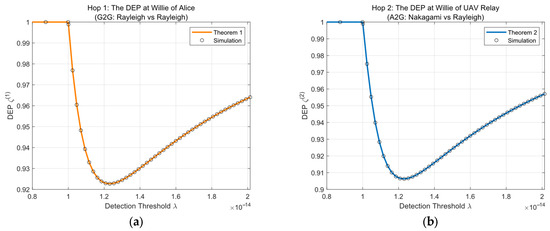
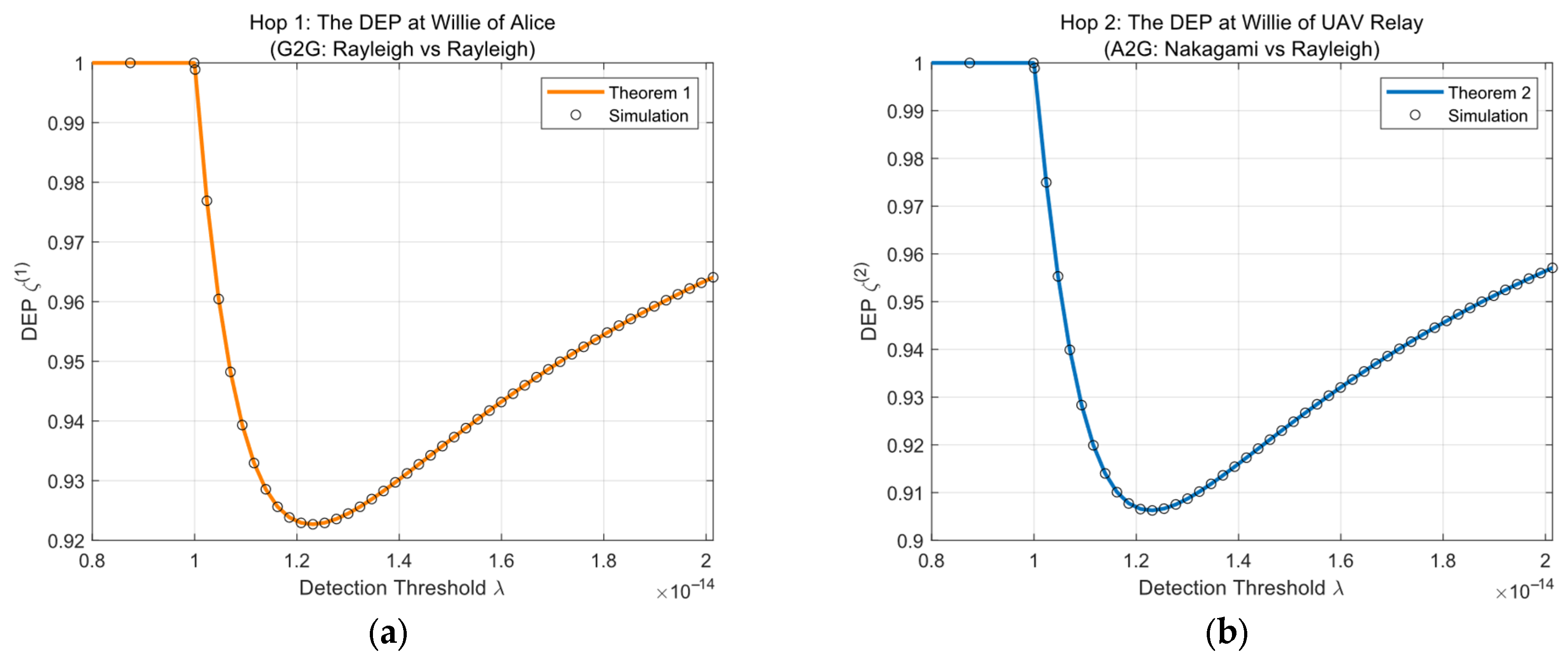
Figure 2 illustrates the theoretical and Monte Carlo simulated detection error probabilities (DEPs) of both the first and second hops versus the detection threshold, , with parameters , , and . The DEP of the second hop takes the closest UAV to Willie as an example. As observed, the simulation results show perfect agreement with the theoretical curves derived in Theorems 1 and 2, thereby validating the accuracy of our analytical model. Furthermore, both and exhibit a convex trend, initially decreasing and then increasing as increases. This confirms the existence of an optimal detection threshold that minimizes Willie’s DEP, consistent with the analysis in Section 3. This behavior stems from the trade-off between the false alarm and missed detection . Specifically, as increases, when is small, DEP mainly determined by decreases and when is large, DEP mainly determined by increases. Additionally, a comparison between the DEP of the two hops reveals a critical insight: although the UAV is physically farther from Willie than Alice, the second hop achieves a lower minimum DEP. This is so because that the high LoS probability of air-to-ground links significantly improve signal quality at Willie, making the transmission more vulnerable despite the larger distance.
Figure 2.
The detection error probability (DEP) at Willie: (a) the DEP at Willie of Alice; (b) the DEP at Willie of the UAV relay (taking the closest UAV to Willie as an example).
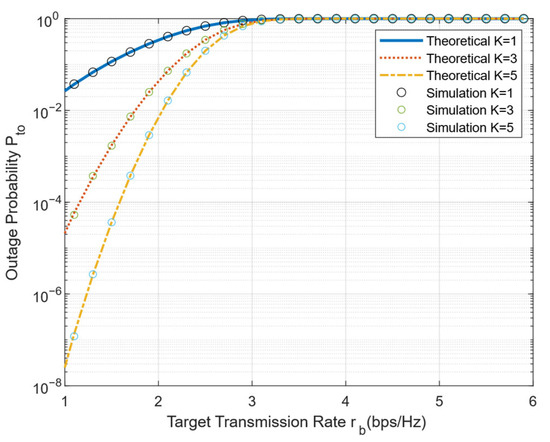
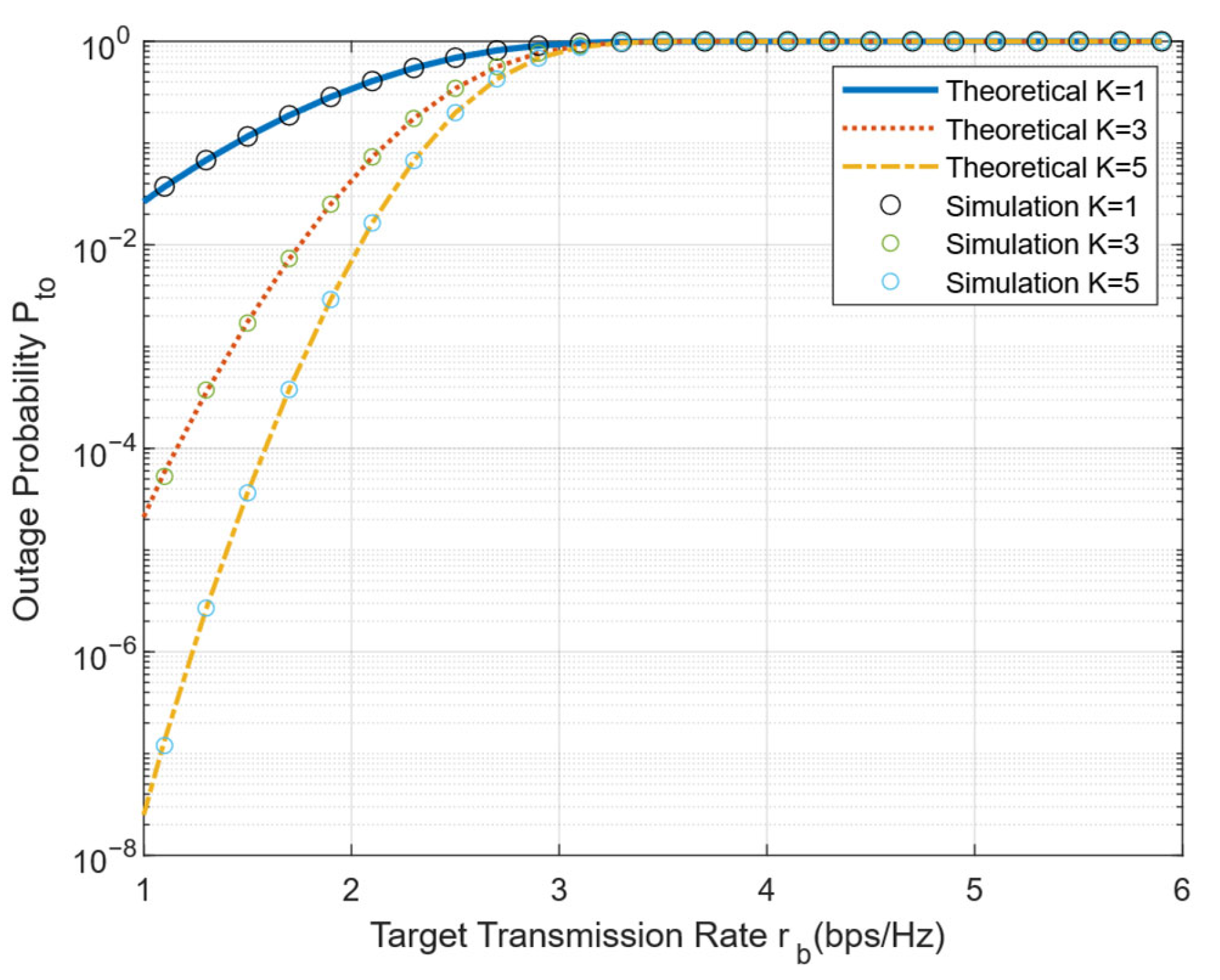
Figure 3 presents the outage probability, , versus the target transmission rate for different numbers of UAV relays , with the same transmit power, . The theoretical curves align perfectly with the Monte Carlo simulation results, corroborating the accuracy of the derived expression in Equation (33). And as expected, increases monotonically with . This is because a higher target rate imposes a stricter condition on the channel capacity (), making the transmission outage occurs more likely. In addition, as observed, for a fixed , increasing the number of relays significantly reduces the outage probability. This improvement is attributed to the spatial diversity gain exploited by the relay selection scheme. As increases, the probability that all relay links simultaneously experience deep fading diminishes, effectively mitigating the small-scale fading in dense urban environment.
Figure 3.
Outage probability vs. target transmission rate.
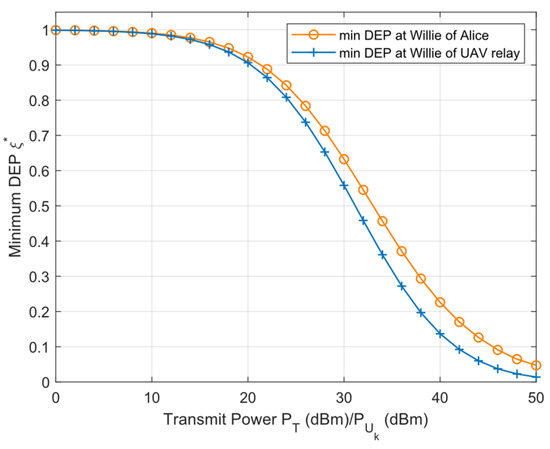
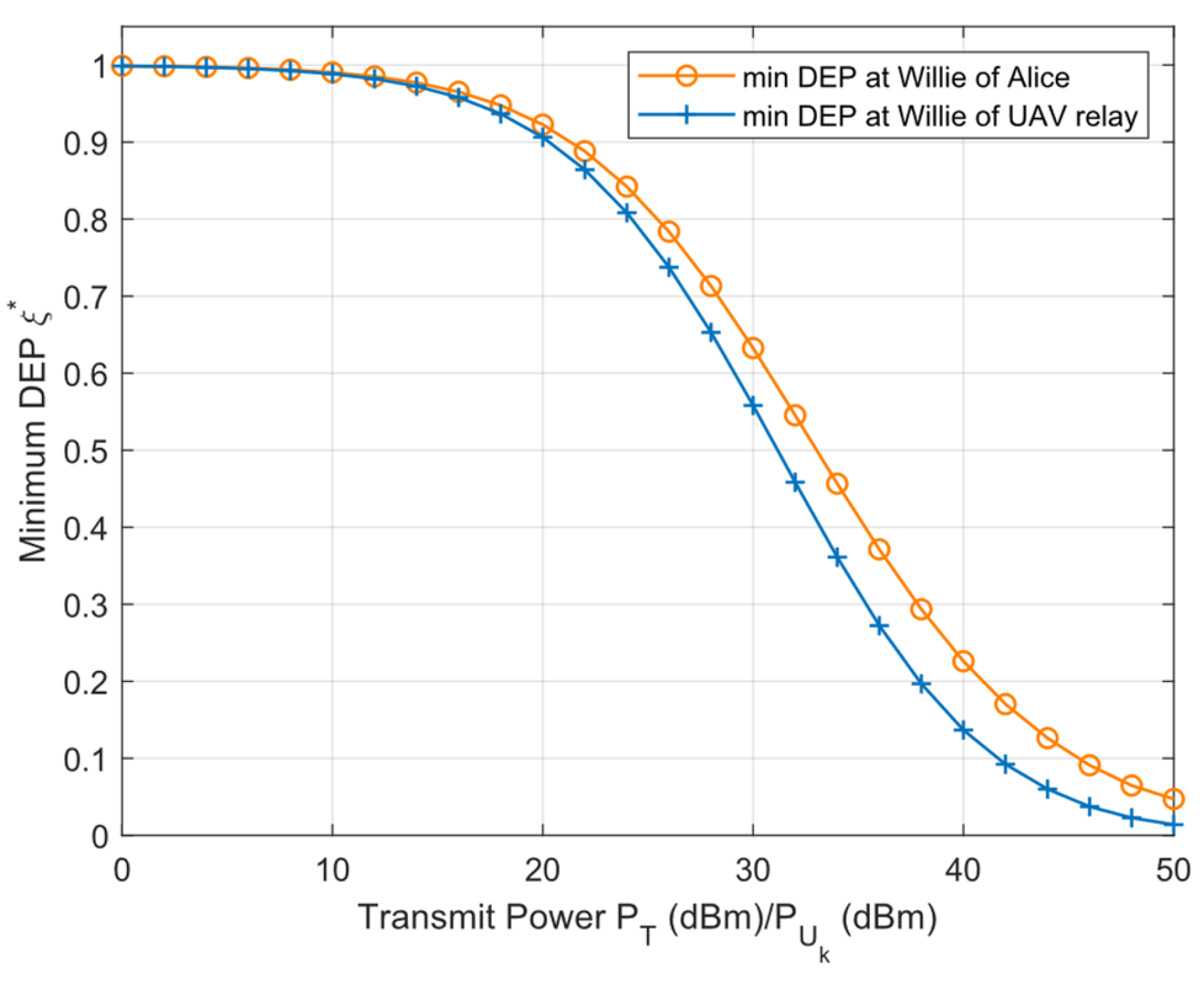
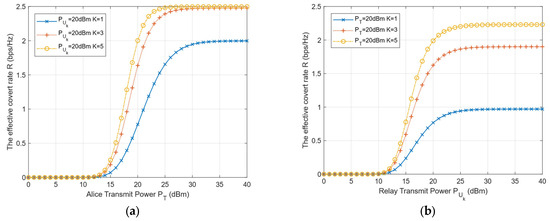
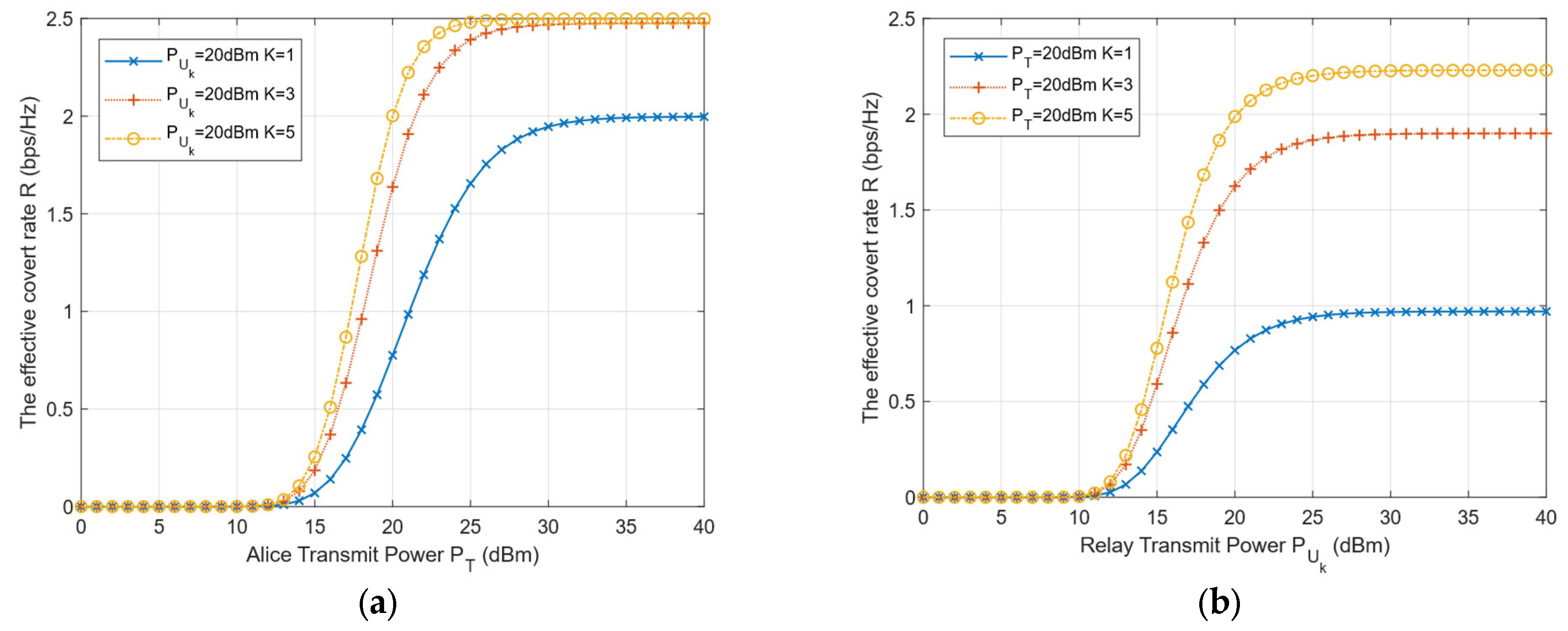
Next, we investigate the impact of transmit powers, and , on the minimum DEP and the effective covert rate. Figure 4 demonstrates that the minimum DEP for both time slots decreases monotonically as the corresponding transmit power increases. This is because higher signal strength improves the signal-to-interference-plus-noise ratio at Willie, enabling easier detection of the signal transmission. Figure 5 illustrates the variation in the effective covert rate with transmit powers. Initially, the covert rate increases. This is attributed to the enhanced channel capacity caused by higher signal strength, which reduces the outage probability for a fixed . However, as the transmit power continues to increase, the covert rate eventually saturates. This is because when the transmit power is sufficiently large, the outage probability is dominated by another hop, preventing further rate improvement. Notably, in the curve with respect to , and converge to the same saturation level. This occurs because the fixed is set high enough such that the second-hop outage probability is very small. Consequently, as increases, the effective covert rate asymptotically approaches the target rate .
Figure 4.
The minimum detection error probability at Willie vs. transmit powers.
Figure 5.
The effective covert rate vs. transmit powers: (a) the effective covert rate vs. ; (b) the effective covert rate vs. .
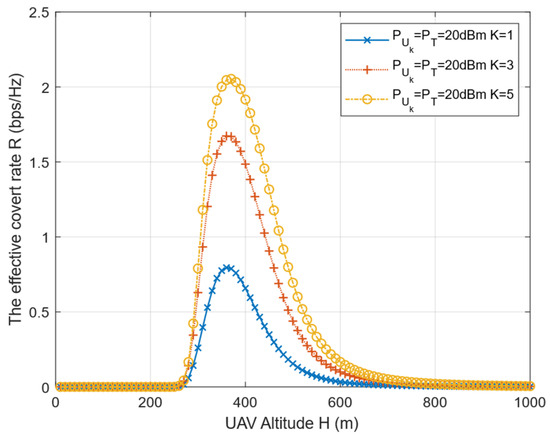
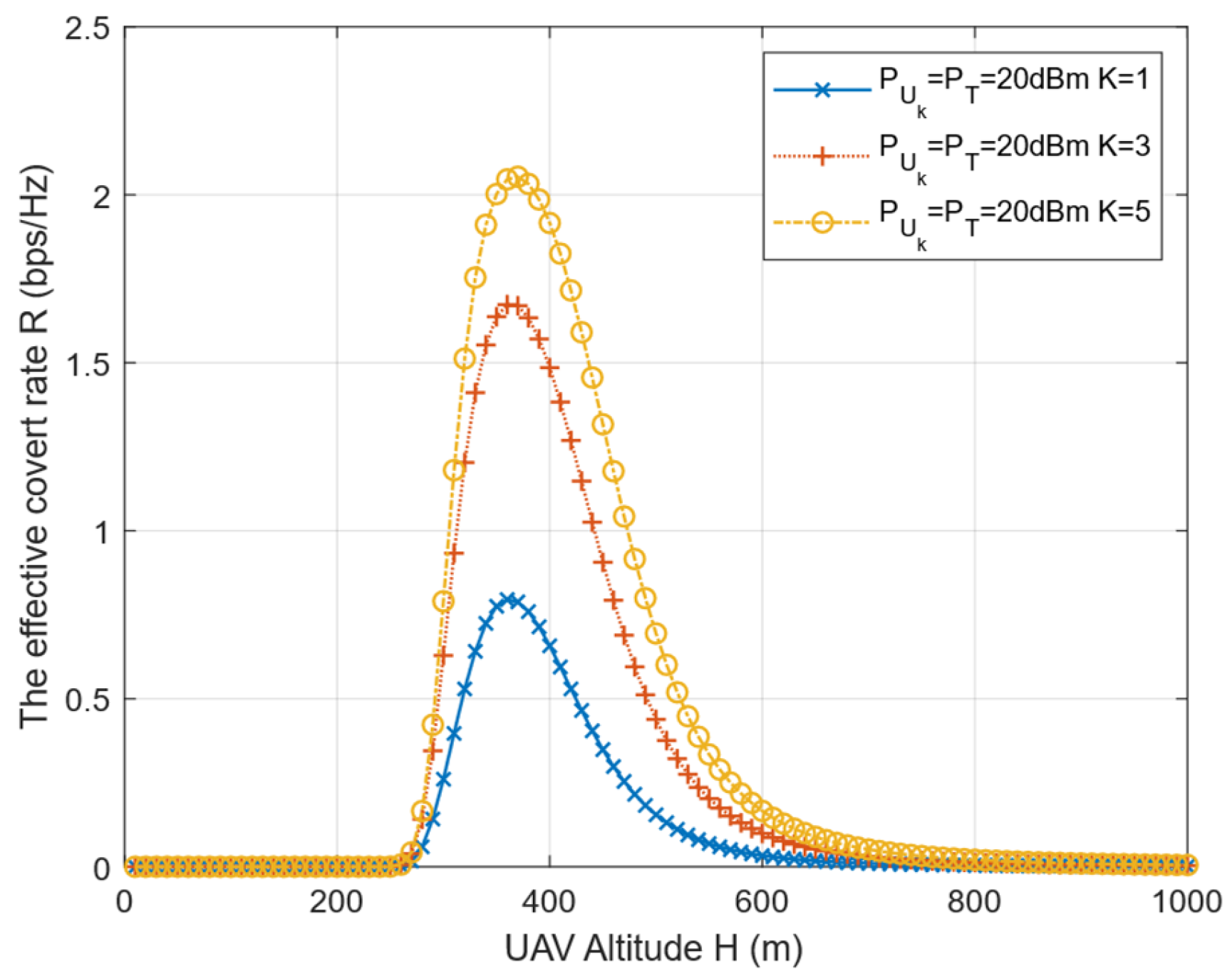
Then, we examine the influence of UAV hovering altitude, , on the effective covert rate. As observed in Figure 6, with the increase in UAV altitude, the effective covert rate first increases and then decreases. The reason is that, initially, as the altitude, , increases, the elevation angles between the UAV and ground nodes Alice and Bob increases. This leads to a higher LoS probability, which significantly enhances channel quality and reduces the system outage probability. However, as continues to increase, the increased link distance becomes the dominant factor. The resulting large-scale path loss degrades the channel capacity, causing the outage probability to rise and the effective covert rate to decline. Consequently, there exists an optimal altitude that maximizes performance, underscoring the necessity of altitude optimization in UAV-assisted covert communication.
Figure 6.
The effective covert rate vs. UAV altitude.
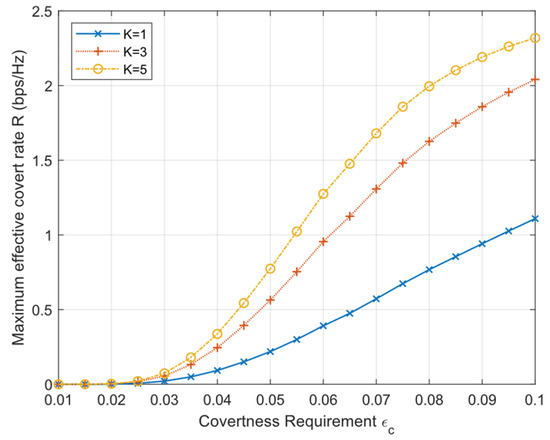
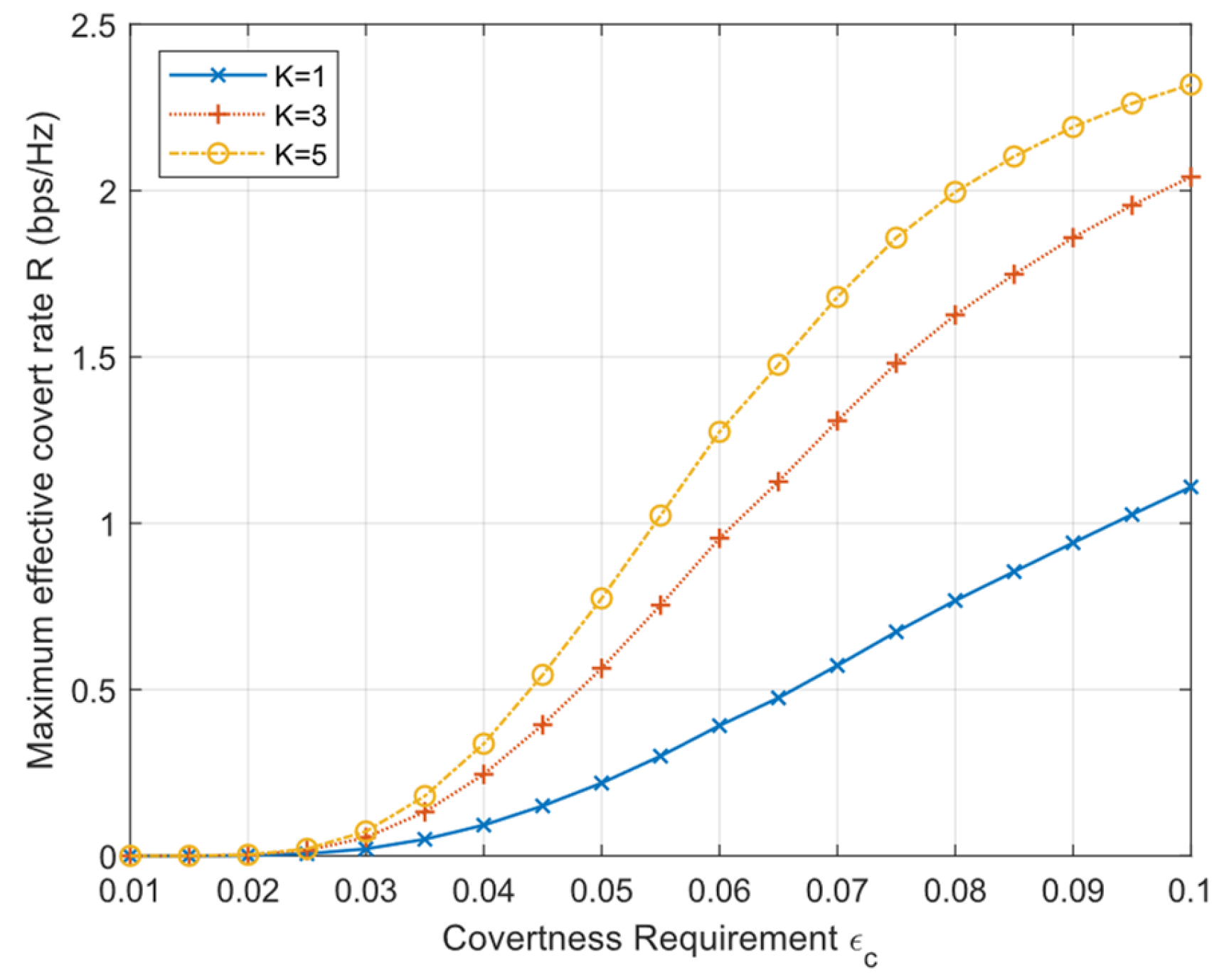
By jointly optimizing altitude and power with the MCRS scheme, Figure 7 plots the maximized effective covert rate against the covertness requirement for varying numbers of UAV relays. It is observed that the maximum effective covert rate increases monotonically with . This is because a larger , implying a relaxation of the covert constraints, allows Alice and the UAV relays to transmit at higher power levels, thereby improving the SINR at receivers and boosting the effective covert rate. Furthermore, for a fixed , the performance improves significantly as the number of relays increases. As discussed in Figure 3, a larger provides higher spatial diversity gain, reducing the likelihood that all relay paths experience deep fading simultaneously. Consequently, the MCRS scheme effectively enhances the covert performance of the UAV-aided covert communication systems in dense urban environments.
Figure 7.
Maximum effective covert rate under the scheme vs. .
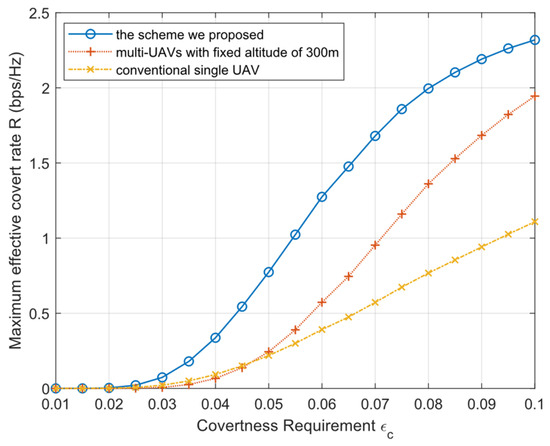
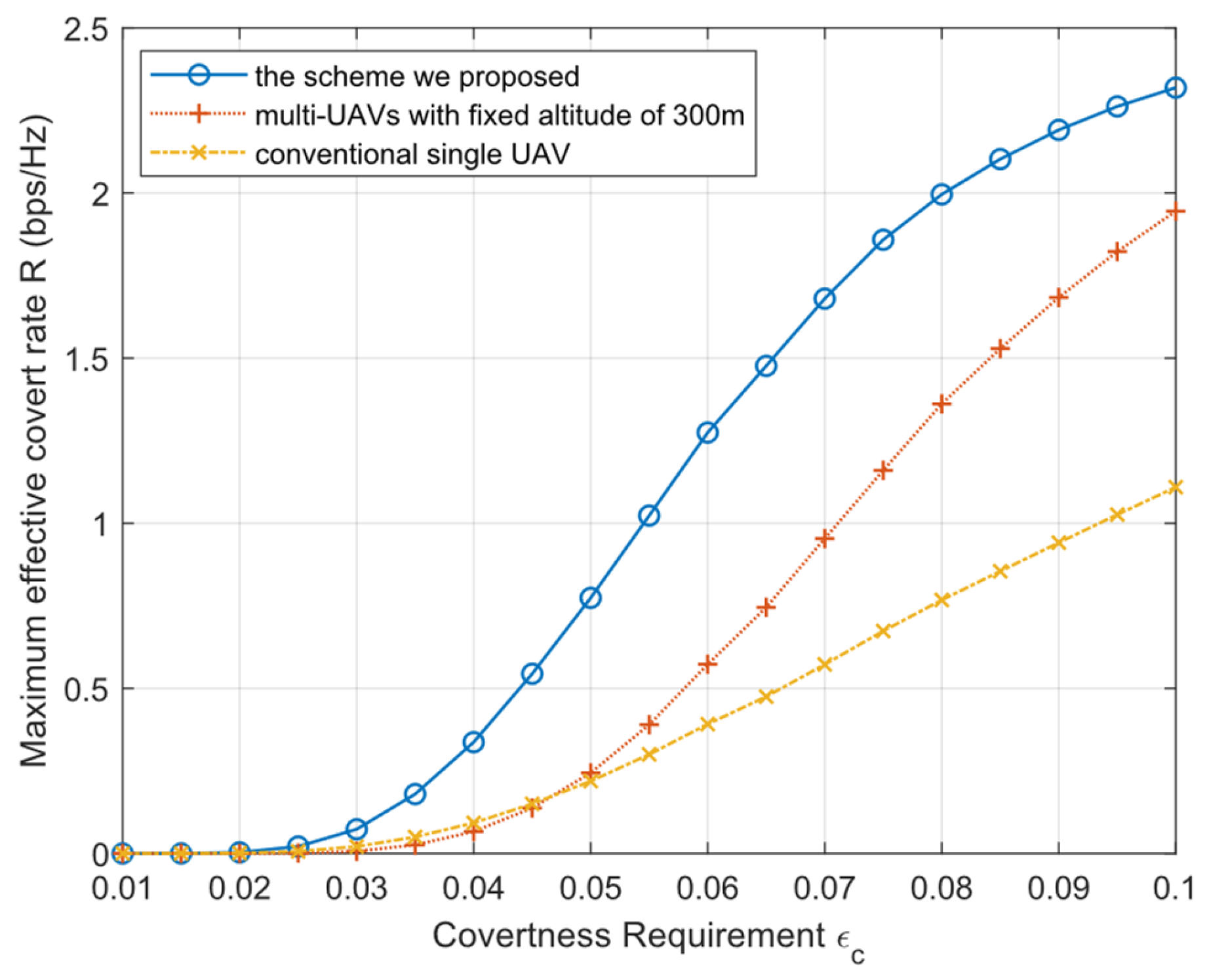
Finally, we compare the scheme we proposed with two benchmark schemes: the traditional single UAV relay system and the multi-UAV system with fixed altitude () in Figure 8. As expected, the maximum effective covert rates for all three schemes improve as the covert requirement is relaxed. Crucially, our proposed scheme achieves the highest maximum effective covert rate under identical constraints. This superiority stems from two key factors. First, compared to the single UAV relay assisted system, our scheme introduces spatial diversity via optimal relay selection, which effectively combats the small-scale fading in dense urban environment. Second, unlike the fixed-altitude benchmark, our approach optimizes the UAV hovering altitude to strike the best balance between path loss and LoS probability. The simulation results demonstrate that the proposed scheme in this paper effectively enhances the covert performance of the UAV-aided covert communication systems by addressing the non-convex coupling between UAV geometric topology and the wireless channels time-varying characteristics.
Figure 8.
Maximum effective covert rate comparison.
5.2. Discussions on Model Robustness and Potential Extensions
While the numerical results in Section 5.1 establish a foundational theoretical baseline, it is crucial to assess the robustness and potential extensions of the proposed scheme under realistic network conditions. Accordingly, this section provides a comprehensive discussion on the system sensitivity to non-ideal factors, considerations for more capable wardens and mobile jammers, and its potential extensions to frameworks with multiple active UAV relays.
Similarly to most existing studies [24], this work assumes perfect channel state information (CSI). However, in practical UAV networks, acquiring instantaneous and perfect CSI is challenging due to estimation errors () and feedback delays. Such imperfections introduce uncertainty into SINR calculation, potentially leading to suboptimal relay selection and inaccurate transmit power, thereby increasing the outage probability at Bob. Nevertheless, while the absolute effective covert rate may decrease, the core insights and conclusions of this study remain qualitatively valid under imperfect CSI. This robustness is attributed to two factors. First, despite potential suboptimal relay selection, the inherent spatial diversity gains provided by multi-UAV relays remains effective in mitigating small-scale fading compared to single-UAV systems. Second, as analyzed in Figure 6, the optimal UAV altitude is primarily determined by the physical trade-off between LoS probability and link distance. Since these geometric characteristics are relatively stable and less sensitive to instantaneous CSI fluctuations, the existence of an optimal altitude persists. Therefore, the fundamental conclusions in Figure 8 remain intact, demonstrating that the proposed joint optimization framework effectively enhances covert performance with good robustness against CSI imperfections.
Beyond channel impairments, the capabilities of the warden significantly influence covert performance. This work assumes a standard passive warden employing an optimal radiometer detector. However, in more adversarial scenarios, a multi-antenna Willie could employ beamforming to suppress friendly jamming signals or enhance signal reception from the source, thereby substantially reducing DEP. Similarly, learning-based wardens could extract intricate signal signatures, transforming the detection threshold into a complex decision boundary. Under such capable wardens, the covert constraints in Equation (40) would be stricter, necessitating lower transmit power or higher hovering altitude to increase path loss. Although these inevitably reduce the effective covert rate, our proposed joint optimization framework remains applicable for balancing detection performance and transmission rate with enhanced covert performance. It establishes an essential analytical foundation and serves as a methodological springboard for addressing the system security requirements facing more sophisticated wardens.
Regarding the friendly Jammer, this work employs a fixed ground-based node to provide stable jamming. While deploying a UAV-mounted mobile jammer could degrade the detection performance at Willie through adaptive positioning, it also introduces significant trade-offs. First, a mobile jammer faces severe energy constraints, as limited onboard power must be partitioned between propulsion and communication, reducing its energy efficiency for jamming compared to fixed ground nodes. Second, the predominantly line-of-sight (LoS) nature of air-to-air channels implies an increase in the interference at the UAV relays. This could degrade the signal-to-interference-plus-noise ratio (SINR) at the relays in Equation (38), thereby potentially reducing the effective covert rate. Consequently, incorporating mobile jammers into our joint optimization framework remains a promising direction for future research.
As highlighted in Section 1, the proposed MCRS scheme, which selects a single optimal relay, serves as a fundamental baseline for UAV-assisted covert communication. This approach exhibits excellent scalability: as validated in Figure 3, increasing the number of candidate UAVs () significantly reduces the outage probability by exploiting spatial diversity gains. While this study focuses on the single-relay selection scenario, it can be viewed as a specialized case within the broader design space of generalized UAV selection and distributed transmission policies [23]. The framework provides a clear theoretical foundation for extensions to multiple active relays. Although employing multiple active relays could further enhance the total transmission rate, deriving analytical expressions for DEP and outage probability becomes significantly more complex. Moreover, from a covert perspective, multiple simultaneous transmissions increase the aggregate radiated power received by wardens, potentially rendering the covert signal more vulnerable to detection. Consequently, this study establishes a crucial theoretical foundation, and exploring the trade-offs in the multiple active UAV relays scenario remains a promising direction for future research.
6. Conclusions
This work proposes a joint altitude and power optimization scheme incorporating maximum channel capacity relay selection (MCRS) for UAV-assisted covert communication. This approach enhances system covert performance by effectively addressing the complex coupling between the UAV geometric topology and time-varying channel characteristics. Specifically, we analyzed the system model in detail and derived analytical expressions for the two-hop detection error probability (DEP) and outage probability. Based on these derivations, we formulated an optimization problem in order to maximize the effective covert rate subject to strict covert constraints, which is solved via an adaptive hierarchical algorithm. Extensive numerical simulations validated the accuracy of our theoretical model. Furthermore, comparisons with benchmark schemes demonstrated that the proposed method outperforms traditional single-UAV and fixed-altitude multi-UAV systems, proving its effectiveness in improving covert performance in dense urban environments. Future research will extend this work, using it as a baseline to explore more complex scenarios, including imperfect CSI, more capable wardens, mobile jammers, and multiple active relays.
Author Contributions
Conceptualization, M.Y., Y.H. and J.L.; methodology, M.Y. and Y.H.; software, M.Y.; validation, M.Y.; formal analysis, M.Y.; investigation, M.Y.; resources, Y.H. and J.L.; data curation, M.Y.; writing—original draft preparation, M.Y.; writing—review and editing, M.Y., Y.H. and J.L.; visualization, M.Y.; supervision, Y.H. and J.L.; project administration, Y.H. and J.L. All authors have read and agreed to the published version of the manuscript.
Funding
This research received no external funding.
Data Availability Statement
The data presented in this study are contained within the article. For any further information or inquiries, please contact the corresponding author.
Conflicts of Interest
The authors declare no conflicts of interest.
References
- Gao, C.; Yang, B.; Zheng, D.; Jiang, X.; Taleb, T. Cooperative Jamming and Relay Selection for Covert Communications in Wireless Relay Systems. IEEE Trans. Commun. 2024, 72, 1020–1032. [Google Scholar] [CrossRef] [Scilit]
- Jin, L.; Hu, X.; Lou, Y.; Zhong, Z.; Sun, X.; Wang, H.; Wu, J. Introduction to Wireless Endogenous Security and Safety: Problems, Attributes, Structures and Functions. China Commun. 2021, 18, 88–99. [Google Scholar] [CrossRef] [Scilit]
- Chen, X.; Sheng, M.; Zhao, N.; Xu, W.; Niyato, D. UAV-Relayed Covert Communication Towards a Flying Warden. IEEE Trans. Commun. 2021, 69, 7659–7672. [Google Scholar] [CrossRef] [Scilit]
- Liu, Y.; Wu, H.; Su, W.; Shen, Y.; Jiang, X. Joint Relay and Mode Selection for Covert Communication in Wireless Relay Systems. IEEE Trans. Commun. 2025, 73, 4553–4569. [Google Scholar] [CrossRef] [Scilit]
- Zeng, Y.; Xu, X.; Zhang, R. Trajectory Design for Completion Time Minimization in UAV-Enabled Multicasting. IEEE Trans. Wirel. Commun. 2018, 17, 2233–2246. [Google Scholar] [CrossRef] [Scilit]
- Yang, F.; Qin, X.; Gong, S.; Deng, N.; Xing, C.; Zhao, N. A Survey of Covert UAV Communications. Chin. J. Aeronaut. 2025, 38, 103493. [Google Scholar] [CrossRef] [Scilit]
- Gao, L.; Wang, S.; Hou, Y.; Xu, W.; Niu, K. Relay Selection and Optimal Deployment for mmWave-FD UAV-Assisted 6G Communication Systems over N-Rayleigh Channels. Sci. China Inf. Sci. 2025, 68, 202301. [Google Scholar] [CrossRef] [Scilit]
- Chen, X.; An, J.; Zhao, N.; Xing, C.; da Costa, D.B.; Li, Y.; Yu, F.R. UAV Relayed Covert Wireless Networks: Expand Hiding Range via Drones. IEEE Netw. 2022, 36, 226–232. [Google Scholar] [CrossRef] [Scilit]
- Jiao, L.; Chen, X.; Xu, L.; Deng, N.; Zhao, N.; Wang, X. UAV-Relayed Finite-Blocklength Covert Communication with Channel Estimation. IEEE Trans. Veh. Technol. 2024, 73, 9032–9037. [Google Scholar] [CrossRef] [Scilit]
- Jiang, X.; Chen, X.; Tang, J.; Zhao, N.; Zhang, X.Y.; Niyato, D.; Wong, K.-K. Covert Communication in UAV-Assisted Air-Ground Networks. IEEE Wirel. Commun. 2021, 28, 190–197. [Google Scholar] [CrossRef] [Scilit]
- Zhang, R.; Chen, X.; Liu, M.; Zhao, N.; Wang, X.; Nallanathan, A. UAV Relay Assisted Cooperative Jamming for Covert Communications Over Rician Fading. IEEE Trans. Veh. Technol. 2022, 71, 7936–7941. [Google Scholar] [CrossRef] [Scilit]
- Wang, B.; Zhang, Y.; Chu, F.; Ding, G.; Xu, R. Analysis and Optimization of UAV-Assisted Covert Communications in Interweave Cognitive Radio Networks. IEEE Trans. Cogn. Commun. Netw. 2025, 11, 3188–3201. [Google Scholar] [CrossRef] [Scilit]
- Wang, D.; Zhao, X.; Shen, W.; Li, Z.; Cheng, N.; Qin, H.; Cao, L. Optimal Transmit Power and Hovering Location for UAV Covert Communication in IoT Systems. IEEE Internet Things J. 2024, 11, 26118–26130. [Google Scholar] [CrossRef] [Scilit]
- Wang, J.; Wang, C.; Xing, C.; Yang, Z.; Zhao, N.; Niyato, D. Covert Air-Ground Relaying with Blockages. IEEE Trans. Wirel. Commun. 2025, 24, 8347–8360. [Google Scholar] [CrossRef] [Scilit]
- Liu, P.; Si, J.; Li, Z.; Al-Dhahir, N.; Gao, Y. Joint 3-D Trajectory and Power Optimization for Dual-UAV-Assisted Short-Packet Covert Communications. IEEE Internet Things J. 2024, 11, 17388–17401. [Google Scholar] [CrossRef] [Scilit]
- Chen, J.; Wang, J.; Bai, L.; Hou, X.; Wang, J.; Sun, G.; Niyato, D. MIMO-Enabled Holistic Covert Flying Ad Hoc Networks. In Proceedings of the 2025 IEEE/CIC International Conference on Communications in China (ICCC), Shanghai, China, 10–13 August 2025; pp. 1–6. [Google Scholar] [CrossRef] [Scilit]
- Mao, H.; Liu, Y.; Xiao, Z.; Han, Z.; Xia, X.-G. Joint Resource Allocation and 3-D Deployment for Multi-UAV Covert Communications. IEEE Internet Things J. 2024, 11, 559–572. [Google Scholar] [CrossRef] [Scilit]
- Ren, X.; Gao, A.; Xu, T.; Zhang, J. UAV-mounted Multi-Functional IRSs for Covert Wireless Communications. In Proceedings of the 2024 IEEE Globecom Workshops (GC Wkshps), Cape Town, South Africa, 8–12 December 2024; pp. 1–6. [Google Scholar] [CrossRef] [Scilit]
- Yuan, W.; Wu, J.; Shi, Y. Multi-UAV Collaborative Covert Communications: An ISAC-based Approach. J. Radars 2025, 14, 797–808. [Google Scholar] [CrossRef]
- Seong, H.; Kim, T.; Song, J.; Lee, H. Hierarchical Multi-Agent Reinforcement Learning-Based UAV Control for Wireless Covert Communications. In Proceedings of the 2025 IEEE 22nd Consumer Communications & Networking Conference (CCNC), Las Vegas, NV, USA, 10–13 January 2025; pp. 1–6. [Google Scholar] [CrossRef] [Scilit]
- Su, Y.; Sun, H.; Zhang, Z.; Lian, Z.; Xie, Z.; Wang, Y. Covert Communication with Relay Selection. IEEE Wirel. Commun. Lett. 2021, 10, 421–425. [Google Scholar] [CrossRef] [Scilit]
- Chen, J.; Zhai, K.; Wang, Z.; Liu, Y.; Jia, J.; Wang, X. CoMP and RIS-Assisted Multicast Transmission in a Multi-UAV Communication System. IEEE Trans. Commun. 2024, 72, 3602–3617. [Google Scholar] [CrossRef] [Scilit]
- Bithas, P.; Moustakas, A. Generalized UAV Selection with Distributed Transmission Policies. IEEE Trans. Commun. 2023, 71, 741–756. [Google Scholar] [CrossRef] [Scilit]
- Wang, C.; An, J.P.; Xing, C.W.; Zhao, N. A Review of Covert Communication Technologies for Space Information Networks. Sci. Sin. Inform. 2024, 54, 1319–1349. (In Chinese) [Google Scholar] [CrossRef] [Scilit]
- Zhou, Y.; Wang, Y.; Ma, Z.; Fan, P.; Xiao, M. Physical Layer Authentication for UAV Communications Under Rayleigh and Rician Channels. IEEE Trans. Wirel. Commun. 2025, 24, 2722–2733. [Google Scholar] [CrossRef] [Scilit]
- Gao, M.; Xu, G.; Song, Z.; Cheng, Y.; Niyato, D. Performance Analysis of Random 3D mmWave-Assisted UAV Communication System. IEEE Trans. Veh. Technol. 2024, 73, 19169–19185. [Google Scholar] [CrossRef] [Scilit]
- Wu, P.; Yuan, X.; Hu, Y.; Schmeink, A. UAV-Enabled Covert Autonomous Vehicular Communication: Joint Trajectory and Resource Allocation Design. IEEE Trans. Intell. Transp. Syst. 2025, 26, 21769–21783. [Google Scholar] [CrossRef] [Scilit]
- Al-Hourani, A.; Kandeepan, S.; Lardner, S. Optimal LAP Altitude for Maximum Coverage. IEEE Wirel. Commun. Lett. 2014, 3, 569–572. [Google Scholar] [CrossRef] [Scilit]
Disclaimer/Publisher’s Note: The statements, opinions and data contained in all publications are solely those of the individual author(s) and contributor(s) and not of MDPI and/or the editor(s). MDPI and/or the editor(s) disclaim responsibility for any injury to people or property resulting from any ideas, methods, instructions or products referred to in the content. |
© 2026 by the authors. Licensee MDPI, Basel, Switzerland. This article is an open access article distributed under the terms and conditions of the Creative Commons Attribution (CC BY) license.