
Article

Topology Reconstruction Algorithm Design for Multi-Node Failure Scenarios in FANET
1
School of Information Science and Technology, Beijing University of Technology, Beijing 100124, China
2
College of Computer Science, Beijing University of Technology, Beijing 100124, China
3
AsiaInfo Technologies (China) Inc., Beijing 100094, China
*
Authors to whom correspondence should be addressed.
Drones 2026, 10(3), 159; https://doi.org/10.3390/drones10030159
Submission received: 26 January 2026 / Revised: 16 February 2026 / Accepted: 25 February 2026 / Published: 26 February 2026

Highlights

What are the main findings?
  • A collaborative reconstruction strategy based on geometric overlapping regions and a comprehensive node importance evaluation mechanism is proposed, which guides the cooperative reconstruction strategy to select low-criticality nodes for performing reconstruction tasks.
  • An improved Artificial Potential Field (APF) algorithm that incorporates dynamic influence zones and a composite repulsion model to ensure safe and efficient path planning in complex three-dimensional environments is proposed.
What is the implication of the main finding?
  • The collaborative reconstruction strategy significantly optimizes resource efficiency and safeguards network backbone integrity, achieving approximately 40% energy savings compared to independent repair methods.
  • The improved APF algorithm ensures robust autonomous survivability in critical mission scenarios, achieving over 97% path planning success rates even in dynamic, highdensity obstacle environments with severe network disruptions.

Abstract

With the advancement of UAV (Unmanned Aerial Vehicle) technology, flying ad-hoc networks (FANETs), composed of multiple coordinating UAVs, demonstrate tremendous application potential in disaster relief, environmental monitoring and intelligent logistics. However, inherent resource constraints and unpredictable operating environments make UAV failures a frequent and critical challenge. Particularly in mission-critical applications, simultaneous or consecutive failures of multiple UAVs can severely disrupt network topology, leading to catastrophic consequences such as network fragmentation and service interruptions. Furthermore, traditional topology reconstruction algorithms suffer from high computational overhead and significant communication delays. Primarily designed for single-node failure recovery, they are ill-equipped to address the challenge of concurrent multi-node failures. To address these challenges, this paper proposes a topology reconstruction algorithm tailored for multi-node failure scenarios in FANETs. The core objective of this algorithm is to minimize communication overhead and secondary damage to the network during the reconstruction process while ensuring basic reconstruction results, thereby improving the system’s energy efficiency and robustness. The proposed framework integrates three key phases: First, overlapping communication coverage areas among neighbors of failed nodes are leveraged to define first and second regions, enabling rapid identification of connection restoration candidate positions and avoiding computationally intensive global calculations. Second, a comprehensive importance evaluation mechanism is constructed based on the topological and functional attributes of node, categorizing nodes into different importance types. For failed nodes of varying importance, differentiated search ranges and retry strategies are employed to ensure the most suitable nodes are selected for reconstruction tasks. Third, the inflexibility of repulsion ranges in traditional artificial potential field (APF) method is addressed by introducing dynamic repulsion influence zones and a composite repulsion model. The improved APF algorithm enhances safety in high-speed scenarios and reduces the probability of UAVs becoming trapped in local minima. Finally, extensive simulations validate that the proposed algorithm accurately identifies critical network nodes and promptly implements effective reconstruction measures to minimize network damage.

1. Introduction

Driven by advancements in unmanned aerial vehicle (UAV) technology, flying adhoc networks (FANETs)—composed of multiple UAVs working in coordination—have demonstrated significant application potential in various fields such as disaster relief, environmental monitoring, remote sensing, border patrol, and smart logistics [1,2,3,4,5], thanks to their advantages of flexible deployment, wide coverage, and relatively low cost [6,7]. Ensuring the robustness and continuous service capability of such networks in complex, dynamic, or even hostile environments is of critical importance [8]. However, the inherent resource constraints of UAV nodes (such as energy and computational power) and the unpredictability of their operational environments (such as electromagnetic interference, physical attacks, equipment failures [9], and adverse weather conditions) make node damage a common and highly challenging form of network failure [10]. Especially in mission-critical applications, scenarios involving the simultaneous or sequential failure of multiple nodes can result in severe damage to the network topology, potentially leading to network fragmentation, service interruptions, and other catastrophic consequences [11].
In the face of node failures, particularly multiple node failures, rapidly and efficiently reconfiguring the network topology to restore network connectivity and critical services is a key technology for enhancing the survivability and mission capability of unmanned aerial vehicle (UAV) networks [12,13]. Traditional topology reconstruction methods, such as centralized optimization based on full-network state information or complex distributed negotiation protocols [14], although theoretically capable of obtaining optimal or suboptimal solutions, often fail to meet the stringent requirements of UAV networks for real-time performance and low energy consumption due to their high computational overhead, communication latency, and heavy reliance on global information [15]. Especially in resource-constrained UAV networks with rapidly changing topologies, the applicability of these methods is significantly limited [16]. Furthermore, ensuring robust consensus tracking in nonlinear multi-agent systems under quantized sampled-data constraints and communication delays remains a significant theoretical challenge [17]. Consequently, designing lightweight, responsive, and adaptable topology reconstruction mechanisms that can restore network functionality with minimal cost and maximum speed after node failures (especially multiple node failures) is urgent. Crucially, while existing research has primarily focused on single-node failure recovery, lightweight, low-overhead reconstruction mechanisms for the challenging scenario of concurrent multiple-node failures remain underexplored. This is precisely the key to ensuring the survivability of UAV networks in extreme environments.
In response to the above challenges, this paper proposes a topology reconstruction algorithm for multi-node failure scenarios in FANETs. The core objective of this algorithm is to significantly reduce the computational complexity and communication overhead of the reconstruction process while ensuring basic reconstruction effectiveness, thereby improving the system’s real-time response capability and energy efficiency. The main contributions of this paper are summarized as follows:
  • A deployment position determination strategy based on coverage intersection is designed. It utilizes the overlapping communication coverage among neighbors of the failed node to quickly identify candidate locations for connectivity restoration, thereby avoiding computationally complex global calculations.
  • A node importance classification and action node selection mechanism based on multidimensional node attributes is proposed. This mechanism dynamically categorizes nodes into different types based on their topological structure and functional attributes, prioritizing low-importance nodes for network reconstruction tasks to minimize impact on core network functions.
  • This paper enhances the traditional artificial potential field (APF) method and proposes an adaptive lightweight path planning approach tailored for different types of obstacles. This method employs the same path strategy for different obstacles to reduce the complexity of algorithm and balance energy optimization with real-time performance requirements.
The rest of the paper is organized as follows. Section 2 delves into relevant research on FANETs reconstruction algorithms; Section 3 introduces the system model and problem addressed in this paper; Section 4 describes the proposed topology reconstruction algorithm in detail; Simulation experiment design and result analysis are presented in Section 5; Finally, the entire paper is summarized in Section 6. In addition, for ease of reference, all notations used in this paper are listed in the Nomenclature section at the end of the manuscript.

2. Related Work Review and Analysis

2.1. Review of Related Works

In FANET, topology reconstruction is a core challenge for maintaining network robustness, and various innovative approaches have been proposed to address it. YU et al. combined evolutionary game theory to propose an adaptive dynamic reconfiguration mechanism. By adjusting connection probabilities through pivotal nodes and updating strategies via public goods games, they effectively enhanced swarm cooperation rates and topological robustness [18]. Alam et al. designed the JTFR algorithm, which integrates trajectory control, frequency allocation, and routing. Utilizing a multi-agent deep reinforcement learning framework to collaboratively optimize link utility, it significantly reduced latency and energy consumption [19]. Gaydamaka et al. developed a topology organization algorithm based on a virtual coordinate system. In Global Navigation Satellite System (GNSS)-denied environments, it maintains topology through coordinate mapping and periodic beacons, supporting efficient swarm merging and splitting [20]. Hong et al. proposed the topology-aware routing protocol TARU, which achieves adaptive routing optimization by correlating formation control with topology status and dynamically estimating link lifetime, thereby reducing neighbor-awareness delay and packet loss rate [21]. Matracia et al. examined UAV-assisted disaster communication networks from a topological perspective, analyzing performance boundaries of different UAV platforms and providing theoretical guidance for post-disaster deployment [22]. Liu et al. proposed an alternating optimization and greedy algorithm for relay transmission problems, minimizing relay counts while enhancing transmission rates and supporting distributed position adjustments [23]. Alam et al. conducted a comprehensive review of multi-UAV network topology control algorithms, systematically classifying and analyzing their performance and applicable scenarios [24].
Recently, the academic community has proposed several novel solutions for structural optimization and self-healing capabilities of UAV swarm networks. Gou et al. [25] proposed a distributed robust topology control scheme that uses the Enhanced Edge Search Algorithm (SBT-RESA) to pre-eliminate critical nodes to achieve bi-connectivity. However, this method is essentially a preventative strategy, focusing on static topology hardening, and cannot effectively cope with dynamic coverage gaps caused by the simultaneous failure of multiple nodes. He et al. [26] attempted to use metaheuristic algorithms to perform multi-objective global optimization of the FANET topology to reduce interference, but this usually involves high iterative computation costs, making it difficult to meet the real-time response requirements in disaster scenarios. For the recovery of hierarchical swarms, Feng et al. [27] designed a hierarchical distributed recursive self-healing algorithm (LDRSA) that uses child nodes to recursively fill gaps in parent nodes. Although it maintains the hierarchical structure, its cascading movement mechanism leads to huge cumulative movement overhead in the network.
Regarding node selection strategies, researchers have focused on addressing the challenges of assessing the importance of failed nodes and determining reconstruct priorities. Abbasi et al. proposed the distributed actor recovery algorithm (DARA), which restores connectivity through cascading movements while optimizing mobility overhead [28]. However, this approach relies on precise location information and fails to distinguish between functional differences among nodes. Cao et al. [29] proposed a dual-reference node-based energy-saving topology management mechanism (DEBGR-DRN) that attempts to restore connectivity by adjusting transmission power rather than physical movement. However, this method is limited by the maximum power of the hardware and cannot repair physical isolation beyond the communication range. Khalilpour Akram et al. designed the dVAP algorithm to distribute the detection of critical cut nodes, ranking them based on the impact of node removal on network partitioning. However, it does not account for node dynamics or functional states [30]. Younis et al. developed the RIM algorithm, enabling rapid selfhealing through inward migration of a faulty node’s neighbors. But this approach may create coverage holes and does not incorporate node importance hierarchies [31]. Cao et al. explored the theory of multi-layer network percolation, revealing the cascading failure mechanism driven by the combined effects of connectivity and dependency links [32]. This research provides a theoretical foundation for understanding network vulnerability.
Path planning, as the critical execution step for achieving topological reconfiguration, directly impacts the mission efficiency of unmanned aerial vehicles (UAVs). Souto et al. combined Q-learning with urban environmental factors to optimize UAV paths, achieving multi-objective collaborative planning but neglecting multi-vehicle coordination issues [33]. Wu et al. improved the artificial potential field method by employing virtual force vector control to address local minima and unreachable objectives, though it exhibits high parameter sensitivity [34]. Alam et al. proposed the Joint Topology Control and Routing (JTCR) protocol, integrating virtual force control and fuzzy clustering to optimize coverage and communication, though its adaptability to 3D environments remains limited [35]. Du et al. developed the Dynamic Artificial Potential Field (DAPF) algorithm, introducing relative velocity-based adaptive safety distance adjustments to enhance dynamic obstacle avoidance, yet lacking multi-UAV coordination mechanisms [36]. Liu et al. achieved dual connectivity control for sensor networks via virtual forces, theoretically guaranteeing connectivity but limited to 2D scenarios [37]. Sun et al. improved traditional APF by refining repulsive field functions, significantly enhancing target reachability but with limited adaptability to dynamic obstacles [38]. Jayaweera et al. proposed the D-APF algorithm for ground mobile target tracking, enabling precise 3D tracking but exhibiting response delays for high-speed targets [39]. Pan et al. combined leader-follower models with rotational potential fields to address local minima issues in multi-UAV formation control, yet their approach lacks robustness to leader failures [40]. Wu et al. employed virtual core concepts to optimize swarm control, resolving local minima through perturbation components and backtracking filling methods, but their solution exhibits insufficient vertical optimization [41]. Furthermore, Luo et al. [42] used virtual force fields to maintain the K-connectivity of Integrated Sensing and Communication (ISAC) UAV swarms in unknown 3D terrain. However, when dealing with large topological holes caused by large-scale node failures, the convergence speed relying solely on virtual forces is slow. Zhang et al. [43] proposed a stealth path planning algorithm based on an improved APF-Rapidly-exploring Random Tree. Although the path asymptotic optimality is guaranteed through RRT sampling, its complex reconnection computation burden is too heavy and unsuitable for the rapid reconfiguration task of resource-constrained micro UAVs.
In summary, existing research has made significant progress in areas of topology reconstruction, node selection, and path planning. However, there are three limitations: most studies focus on isolated problems rather than holistic solutions; the integration of functional status and topological importance is often neglected in node selection strategies; and path planning methods lack adaptability and coordination capabilities in three-dimensional dynamic environments. To more clearly define the research motivation of this paper, the following section will conduct an in-depth analysis of the limitations of existing work.

2.2. Gap Analysis and Motivation

Despite extensive research on enhancing FANET reliability, comprehensive solutions for multi-node failures in resource-constrained environments remain insufficient. Existing reconstruction approaches primarily fall into three categories: logical reconstruction, single-node physical reconstruction, and continuous control. However, each exhibits specific limitations when addressing complex damage scenarios.Table 1 provides a multidimensional qualitative comparison of the representative reconstruction strategies.
First, logical reconstruction methods—such as the topology control based on evolutionary games proposed by Yu et al. [18] and the topology-aware routing (TARU) proposed by Hong et al. [21]—primarily focus on optimizing logical link connection probabilities or packet forwarding paths. While these approaches effectively address link instability caused by channel interference, they cannot physically reconstruct communication coverage gaps resulting from node destruction. Similarly, while power adjustment-based methods [29] avoid mobile energy consumption, they often fail when faced with large-scale spatial gaps caused by physical damage to nodes, as they exceed the signal coverage limit.
Second, classic distributed physical repair algorithms like DARA [28] and RIM [31] restore connectivity through node movement but were primarily designed for single-node failures. DARA employs a cascading movement strategy that can trigger network-wide “ripple effects,” leading to excessive cumulative movement distances. Although Feng et al.’s recursive self-healing algorithm [27] introduced a layered mechanism, it was still hampered by the high cost of such cascading movements. RIM uses an inward contraction strategy that, while computationally lightweight, ignores node functional heterogeneity (e.g., remaining energy and load), making critical backbone nodes prone to premature energy depletion due to excessive movement. Furthermore, deep reinforcement learning-based methods (such as JTFR [19]) typically incur high computational costs for training and inference, while methods based on centralized relay deployment [23] or global topology optimization [26] heavily rely on global information from ground stations, making it difficult to meet the real-time requirements for rapid response to sudden large-scale failures in denied environments. Although the method proposed by Gou et al. [25] enhances robustness, it focuses on preventative mitigation rather than post-disaster reconstruction.
Notably, extensive research in [33,34,36,38,39,40,41] has deeply explored UAV three-dimensional path planning and obstacle avoidance based on improved artificial potential field (APF) or Q-learning methods. However, these studies primarily address executionlevel navigation problems under known destination points—i.e., how to safely move from point A to point B—without addressing decision-level strategic issues: specifically, which node should move to where after network damage to maximize global recovery efficiency, and some hybrid algorithms [43] sacrifice computational real-time performance in pursuit of path optimization, making them unsuitable for disaster recovery where every second counts.
Given this gap, this paper aims to propose a hierarchical coupled collaborative reconstruction framework. Unlike existing work, this study explicitly addresses concurrent multinode failure scenarios by designing a coverage-intersection-based collaborative deployment strategy to minimize the number of action nodes. It introduces a multi-dimensional importance evaluation mechanism that integrates topological and functional attributes to protect high-value nodes. Furthermore, it deeply couples upper-layer reconfiguration decisions with an improved APF execution layer. This design aims to achieve secure and efficient network reconfiguration in complex environments while ensuring computational lightness.

3. System Model and Problem Formulation

3.1. System Model

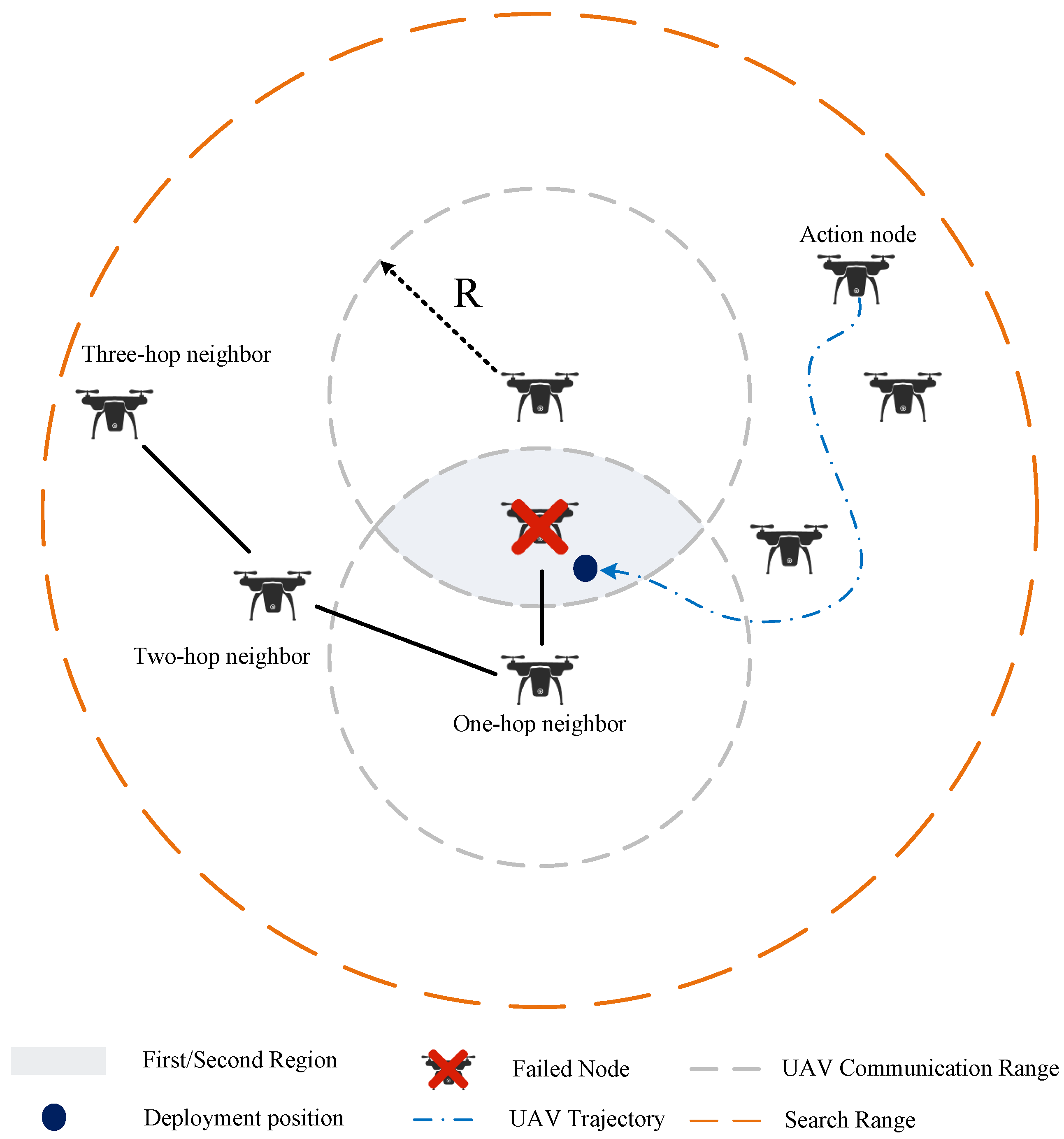
The system model considered in this paper is a Flying Ad-Hoc Network (FANET) operating in three-dimensional space, composed of a set of unmanned aerial vehicle (UAV) nodes denoted as V = { n 1 , n 2 , , n n , , n N } , as illustrated in Figure 1. Each node n i has a position defined by the coordinate vector p i = ( x i , y i , z i ) T R 3 . The communication range of each node is modeled as a spherical region centered at p i with radius R, representing its maximum communication range. The set of points covered by node n i is defined as
C i = { p R 3 | | p p i | | R } ,
where | | · | | denotes the Euclidean norm, p is the point within the C i , N represents the number of nodes in the network.
In the network, a communication link exists between n i and n j , if the distance between them is less than R, i.e., | | p i p j | | < R . The set of all such links at time t forms the edge set E ( t ) , which is defined as
E ( t ) = { ( n i , n j ) | | p i ( t ) p j ( t ) | | R , i j } .
This set represents the active communication links between all pairs of distinct nodes that are within communication range at time t. Due to the mobility of UAV nodes, the positions p i ( t ) change over time, causing the connectivity between nodes—and hence the edge set E ( t ) —to be time-varying. The dynamic topology is therefore captured by the time-varying graph G ( t ) = ( V , E ( t ) ) . To formalize the description of the topology reconstruction problem and establish a theoretical foundation for subsequent algorithm design, we introduce the following core geometric concepts. For node n i , its neighborhood set at time t is N i ( t ) = { n j V | | p i ( t ) p j ( t ) | | R , j i } .
In addition, the network layer employs the OLSR (Optimized Link State Routing) protocol. Nodes maintain local topology tables through periodic link state exchanges, providing the essential information foundation for subsequent local computation of topological properties such as betweenness centrality, each node is equipped with a GPS module capable of sensing its own position and attitude information. The network employs an air-to-air (A2A) channel model, suitable for communication scenarios between UAVs that primarily rely on line-of-sight transmission. Nodes possess autonomous mobility, constrained by maximum velocity v max and maximum acceleration a max . Onboard energy is primarily consumed by communication and propulsion systems, with propulsion energy expenditure closely tied to distance traveled and speed. Node energy gradually depletes over mission duration and cannot be replenished.

3.2. Problem Analysis

In FANETs, topological connectivity is crucial for ensuring inter-node communication, collaboration, and smooth mission execution. However, UAVs are energy-limited and vulnerable to various attacks or disruptions, such as network attacks and node failures. These incidents can damage single or multiple nodes, severely disrupting the UAV network topology and impeding mission execution. Therefore, it is crucial to be able to quickly reconfigure the topology so as to restore the network coverage and guarantee the smooth execution of the mission.
The main goal of this paper is to explore how to ensure that the network topology can be quickly restored after the nodes run out of energy or fail in FANET, minimizing the impact on the network. In order to address this problem, we divide it into three parts:
  • P 1 : Deployment Position Determination
    The core objective of deployment position determination is to identify the optimal deployment position while ensuring network connectivity. This paper transforms the problem into a convex optimization problem by defining the first region and the second region. The interior point method is employed to solve for the position that minimizes the sum of distances from the action node to all relevant neighboring nodes, thereby ensuring connection reliability while optimizing network communication efficiency.
  • P 2 : Action Node Selection
    Action node selection is an important part in the network reconstruction process. This paper constructs a comprehensive importance evaluation model based on nodes’ topological attributes (degree centrality, betweenness centrality, closeness centrality) and functional attributes (load level, remaining energy ratio), categorizing nodes into four types: A, B, C, and D. For failed nodes of varying importance, differentiated search ranges and retry strategies are employed to ensure the most suitable nodes are selected for reconstruction tasks while minimizing secondary network impacts.
  • P 3 : Path Planning Enhancement
    Path planning must ensure that action nodes safely and efficiently reach their deployment positions. The inflexibility of repulsion ranges in traditional APF method is addressed by introducing dynamic repulsion influence zones and a composite repulsion model. The improved APF algorithm enhances safety in high-speed scenarios and reduces the probability of nodes becoming trapped in local minima.

3.3. Algorithm Framework Overview

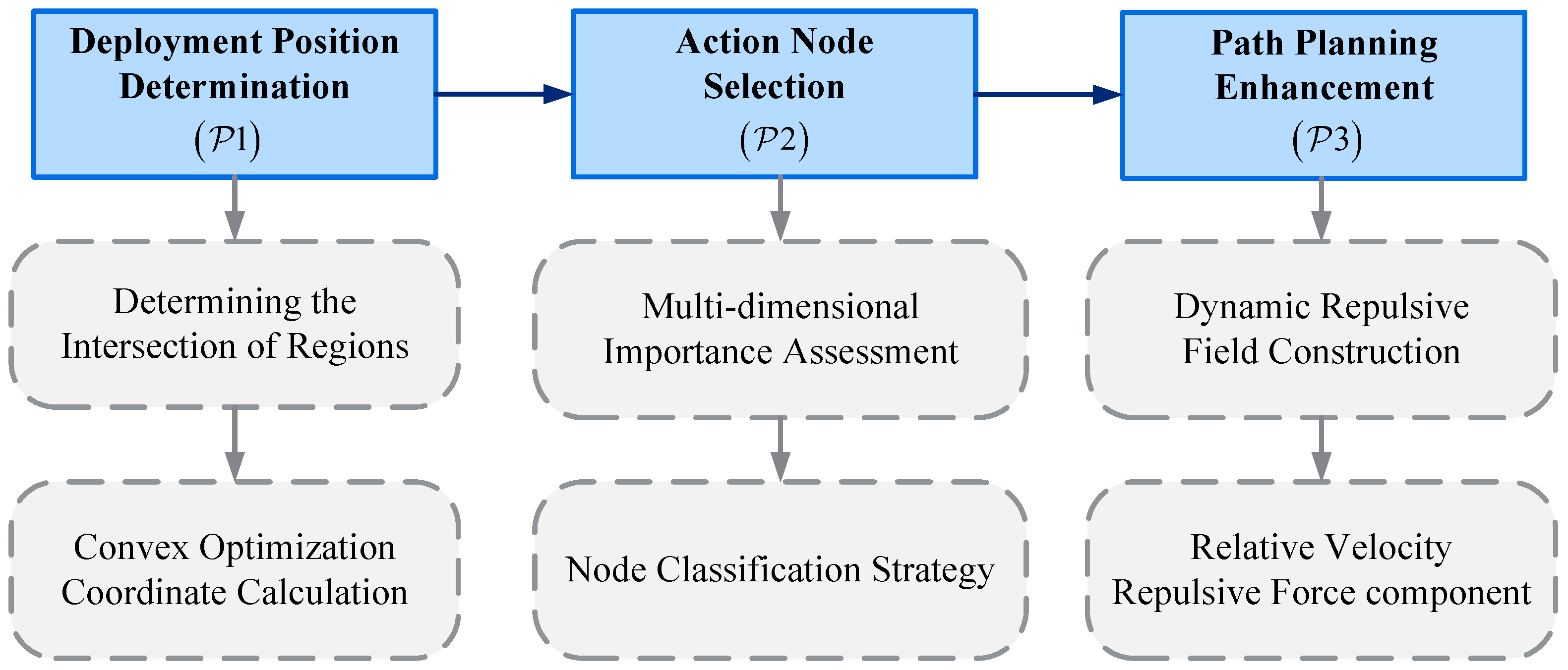
To achieve efficient and robust topology reconstruction, the proposed algorithm is implemented in three logically sequential phases, as illustrated in Figure 2:
  • Deployment Position Determination (Section 4.1): Based on the intersection of communication coverage from the failed node’s neighbors, the algorithm calculates the geometrically optimal deployment position. This step transforms the connectivity restoration problem into a convex optimization problem, minimizing the mobility cost while ensuring coverage. Consequently, it determines the precise geometric coordinates required for network reconfiguration.
  • Multidimensional Importance Assessment and Node Selection (Section 4.2): The system evaluates the comprehensive importance I of candidate neighboring nodes based on topological attributes (e.g., degree, betweenness) and functional attributes (e.g., energy, load), categorizing nodes into four classes: A, B, C, and D. Based on specific failure scenarios (singlenode or multi-node failures), the algorithm follows the principle of protecting core high-value nodes and prioritizing low-importance nodes to select the most suitable action node for repair tasks, thereby determining the optimal agent node for executing the reconfiguration task.
  • Path Planning via Improved APF (Section 4.3): After determining the action node and target location, to ensure safe and rapid node arrival, we employ an Improved Artificial Potential Field (APF) method incorporating dynamic influence zones and tangential forces. This generates collision-free flight trajectories, enabling collision-free path generation and navigation control from the current position to the target location.
Through the coordinated operation of these three steps, this methodology enables rapid repair of damaged topologies without compromising core network functionality.

4. Detailed Design of Algorithm

This section presents the detail design of the mathematical modeling and implementation of the three phases outlined in Section 3. The first part determines the deployment position based on the coverage area of the failed nodes. The second part determines the action nodes based on the importance of the failed nodes themselves. Finally, the third part is responsible for planning the path for the action nodes to reach the deployment position.

4.1. Deployment Position Determination

During FANET fault recovery, the deployment position of action nodes directly determines the effectiveness of restoring network connectivity, making it a critical step in the entire reconstruction process. A reasonable deployment position should not only ensure the reconstruction of the failed node’s original communication relationships but also optimize network performance requirements, such as minimizing node mobility energy consumption, communication latency, and disruption to the original topology.
Based on these considerations, this section focuses on the problem of determining deployment positions. First, we propose a geometric modeling strategy that precisely delineates feasible deployment regions for mobile nodes by intersecting the communication coverage areas of failed node neighbors. Subsequently, we formulate the selection of optimal deployment points within this region as a unified convex optimization problem, solving it using an interior-point method-based framework. This approach provides a consistent and scalable deployment position determination scheme for both single-node and multi-node failure recovery scenarios.

4.1.1. Delineation of UAV Coverage Areas

For a failed node n i , its set of neighboring nodes is denoted as N i = { n 1 , n 2 , , n k , , n K } . The intersection of the coverage ranges of all its neighboring nodes constitutes a continuous area defined as the first region R i ( 1 ) :
R i ( 1 ) = n j N i C j = { p R 3 | | p p j | | R , , n j N i } ,
where each point within R i ( 1 ) can communicate with all nodes in N i simultaneously.
Considering the potential failure of multiple nodes, let H = { n f 1 , n f 2 , , n f h , , n f H } denote the set of failed nodes. Deploying a dedicated action node into each first region R f h ( 1 ) would require H nodes, which is inefficient and introduces significant overhead to the network.
To enable efficient restoration with a minimal number of nodes, the concept of a second region R ( S ) is introduced. For each non-empty subset S of failed nodes with cardinality | S | 2 , if the intersection of their first regions is non-empty, this common region is defined as a second region R ( S ) :
R ( S ) = n f h S R f h ( 1 ) , S H .
The action node n a deployed at any point within R ( S ) can simultaneously restore connectivity for all failed nodes in the subset S, as it can communicate with all neighbors of every node in S.
Based on the above definitions, this paper defines scenarios without the R ( S ) as local single-node failures; when the R ( S ) exists, they are defined as local multi-node failures. Furthermore, if set S contains c nodes, the failure scenario can be described as a local c-node failure situation.

4.1.2. Calculation of Deployment Position

The core problem of determining the optimal position for action nodes to reconstruct one or more failed nodes can be summarized as a unified optimization model. The objective is to cover all failures in the H by deploying action nodes to one of two types of regions:
  • Deploying action node to the R i ( 1 ) corresponding to a single failure node to reconstruct only that node;
  • Deploying action node to the R ( S ) corresponding to a subset S H to reconstruct multiple nodes simultaneously.
This approach minimizes the number of the deployed action nodes M a (where M a H ), thereby reducing the impact on network topology and performance.
For a given subset S H , the set of all neighboring nodes that the action node must connect to in order to reconstruct all nodes in S is the union of the neighbors of each failed node in S:
N S = N f 1 N f 2 N f H = { n 1 , n 2 , , n L } .
Let P S = { p 1 , p 2 , , p L } be the set of positions of these L nodes. The feasible region for the action node’s position q to reconstruct the set S is then defined by the constraints:
| | q p l | | R , l = 1 , 2 , , L .
The overall reconstruction problem involves identifying one or more such feasible subsets S and their corresponding regions R ( S ) such that their union covers all failures in H with the minimum number of action nodes.
The optimal target position q * is defined as the point within R ( S ) that minimizes the total Euclidean distance to all nodes in P S , thereby promoting energy-efficient communications. This yields the following unified convex optimization problem:
minimize q R 3 l = 1 L | | q p l | | subject to | | q p l | | 2 R 2 , l = 1 , , L , q R ( S ) .
where
  • Single Node Failure (H = 1): When H = 1 , the set N S is simply the neighbor set of the single failed node ( L = K ), and the feasible region R ( 1 ) is the first region of that node.
  • Multiple Node Failures (H > 1): When H > 1 , the failed nodes share a common reconstruction region ( R ( S ) ), the set N S is the union of neighbors from multiple nodes.

4.2. Action Node Selection

In FANET, nodes exhibit significant heterogeneity due to their distinct positions within the network topology and their varying functional states. This heterogeneity is directly reflected in a series of node-related attributes, which can be broadly categorized into two types: topological attributes that characterize a node’s structural features within the network, and functional attributes that reflect a node’s real-time state and resource status. These different attributes collectively determine the importance of an individual node to the overall performance and robustness of the network. For example, the failure of a hub node located at the core of the network would cause far greater disruption to network connectivity than the failure of an edge leaf node.
Therefore, this subsection evaluates the each node importance in the network based on its topological and functional attributes. Subsequently, nodes are classified according to their importance within the network. Finally, distinct action node selection rules are formulated for different types of node failures.

4.2.1. Calculation of Node Importance

In FANETs, degree centrality, betweenness centrality, and closeness centrality are the topological attributes of each node, while functional attributes consist of load and remaining energy of node. The former focuses on the geographical significance of nodes in the network, while the latter emphasizes their importance in the overall performance of the network. In this section, the calculation of node importance is introduced based on their topological and functional attributes.
  • Degree Centrality
Node degree is the most basic indicator for identifying important nodes: the more neighbors a node has, the higher its degree centrality, indicating its greater importance. In a UAV network, the node degree D of node i can be obtained by calculating the number of nodes connected to node i in the adjacency matrix A = [ a i j t ] n × n . The normalized degree centrality of node i at time t is expressed as:
C D i t = 1 N 1 · i j N a i j t ,
where C D i t denotes the degree centrality of node i at time t, a i j t = 1 if a communication link exists between node i and node j, and a i j t = 0 otherwise, N represents the total number of nodes in the network, and N 1 denotes the maximum number of connections that each single node can have(i.e., connections to all other nodes). After normalization, the degree centrality value ranges from [ 0 , 1 ] .
  • Betweenness Centrality
The betweenness centrality of a node is a key metric in network analysis, quantifying the importance of a node by measuring the number of shortest paths through it. The higher the betweenness centrality of a node, the greater its influence in controlling the flow of information or resources within the network.In real-world networks such as UAV networks or social networks, hub nodes are often the most critical. Therefore, we calculate the number of shortest paths that each node participates in to analyze the importance of nodes in the entire network. The normalized betweenness centrality of node i at time t is expressed as follows:
C B i t = 1 2 ( N 1 ) ( N 2 ) · s k i N n s k i n s k .
where n s k represents the number of shortest paths connecting node s and node k, and n s k i represents the number of paths passing through node i among the shortest paths connecting node s and node k.
  • Closeness Centrality
Closeness centrality is a measure used in network analysis to quantify the speed at which a node interacts with other nodes in a network. It is calculated based on the average shortest path length from a node to all other nodes in the network. Nodes with higher closeness centrality are considered more central, with shorter average distances to other nodes, indicating greater accessibility and influence within the network. Assuming d i j t is the number of hops from node i to node j at time t, the average distance d i t from node i to all remaining nodes in the network is expressed as:
d i t = 1 N 1 · i j N d i j t .
Evidently, a smaller d i t implies the average distance from node i to all other nodes in the network is shorter. To some extent, this indicates that the topological structure of node i is more important. Therefore, the reciprocal of d i t is denoted as C C i t and defined as the closeness centrality of node i in the network, the normalized closeness centrality of node i is expressed as:
C C i t = C C i t C C max t = N 1 C C max t · i j N d i j t ,
where C C i t denotes the normalized closeness centrality of node i, and C C max t denotes the maximum closeness centrality among all nodes at time t.
  • Load Degree
Define the load level L D i t of node i at time t as the ratio of the number of services cached in the MAC layer interface queue L i t to the maximum number of services in the interface queue L max . Then, the node load degree can be obtained as:
L D i t = L i t L max .
  • Residual Energy Ratio
Let the residual energy of node i at time t be E i t , and the initial energy of the node be E 0 . Then, the residual energy ratio of the node i is E D i t :
E D i t = E i t E 0 .
  • Comprehensive Importance
The comprehensive importance of a node needs to fully consider the topological and functional importance. Therefore, the comprehensive importance I i t of node i at time t and the sum of these weight coefficients are expressed as:
I i t = α 1 C D i t + α 2 C B i t + α 3 C C i t + α 4 L D i t + α 5 E D i t ,
α 1 + α 2 + α 3 + α 4 + α 5 = 1 ,
where α 1 , α 2 , α 3 represents the weight coefficient for topology importance, and α 4 , α 5 represents the weight coefficient for functional importance.
Notably, this paper leverages the extensibility of the OLSR protocol by encapsulating I i t within the reserved field of standard TC messages for broadcast. This enables nodes to obtain the global ranking of the aforementioned comprehensive importance I i t in a distributed environment. Specifically, each node in the network can synchronize and maintain a local copy of the importance list by receiving TC messages. This allows nodes to autonomously determine their node type (e.g., Type A) without transmitting raw functional attribute data.

4.2.2. Classification of UAVs

After calculating the importance of each node in the network, this paper proposes a classification method based on node importance. Specifically, all nodes are divided into four categories:
  • Type A nodes: the most important nodes, accounting for the top P A of the total number, are considered the most critical core nodes in the network.
  • Type B nodes: relatively important, accounting for P A to ( P A + P B ) of the total number.
  • Type C nodes: generally of moderate importance, accounting for ( P A + P B ) to ( P A + P B + P C ) of the total number;
  • Type D nodes: least important, accounting for the bottom P D of the total number.
N A , N B , N C , and N D represent the subsets of the aforementioned four node categories A, B, C, and D, respectively. P A , P B , P C , and P D denote the proportions of nodes A, B, C, and D within the network, respectively. Clearly, these subsets are mutually exclusive and completely constitute the entire network node set, that is:
N = N A N B N C N D P A + P B + P C + P D = 1 ,
where the intersection of any two of N A , N B , N C , and N D is empty, the value of P A , P B , P C , and P D can be dynamically adjusted based on network conditions and specific requirements.

4.2.3. Selection of Action Node

The node failures primarily fall into two categories: local single-node failures and local multi-node failures. Consequently, the selection of action nodes is influenced not only by the type of failed node but also constrained by the nature of the node failure.
  • Single node failure scenario
When a local single-node failure occurs, the action node selection strategy must be determined based on the type of failed node. Different node types have distinct search ranges, as outlined below:
  • Type A Node Failure: Its action nodes can search for Type B, C, or D nodes among its three-hop neighbors;
  • Type B Node Failure: Its action node can search from Type C or D nodes among its two-hop neighbors;
  • Type C Node Failure: Its action node can only search from Type D nodes among its two-hop neighbors;
  • Type D Node Failure: Does not trigger the active reconstruction mechanism.
After determining the search range of action node, specific action nodes must be further selected from this range. The principle adopted in this paper is: under energy constraints, prioritize selecting nodes with the lowest importance as action nodes to avoid excessive consumption of high-importance nodes in the network.
Let the remaining energy of node n a at time t be denoted as E a t , and the energy consumption required for its movement to target deployment position q * be denoted as E move ( q * ) . To ensure the action node retains basic communication and flight capabilities after completing the reconstruction task, its energy must satisfy the following constraint:
E a t E move ( q * ) γ E 0 ,
where E 0 denotes the node’s initial energy, and q * represents the target deployment position of the action node, calculated as (7), γ is an energy factor that can be dynamically adjusted based on different scenarios. And the reconstruction strategies for different node types are shown in Table 2.
  • Multiple node failure scenario
When multiple nodes fail locally within a network, the selection strategy for action nodes requires further refinement beyond the single-node failure strategy. Since simultaneous failures of multiple nodes significantly increase the complexity of network reconstruction, systematic extensions and constraints are necessary in terms of search scope, candidate node types, and reconstruction levels.
Firstly, in a local multi-node failure scenario, the search range for action nodes is defined as the union of all failed nodes’ search ranges. For instance, when both a Type A node and a Type B node fail simultaneously within a local region, the search range for action nodes encompasses the union of the Type A node’s three-hop neighbors and the Type B node’s two-hop neighbors.
Secondly, regarding action node type determination, the types of action nodes available in a local multi-node failure scenario adhere to the criticality principle, governed by the highest-priority failed node. For instance, when a Type A node, a Type B node, and a Type C node fail simultaneously, since the Type A node holds the highest importance, the permissible action node types in this scenario follow the selection rules for Type A nodes-namely, Type B, Type C, and Type D nodes.
Thirdly, to prevent excessive reconstruction costs or unfeasible reconstruction strategies, this paper introduces a reconstruction level downgrade mechanism. When a local multi-node failure scenario involves a Type D node, the failure situation is automatically downgraded for processing. For example:
  • In a scenario of local dual-node failure, if one of the nodes is a Type D node, the failure condition is automatically downgraded to a local single-node failure and handled according to the single-node failure reconstruction strategy;
  • In a scenario of local triple-node failure, if one of the nodes is a Type D node, the failure condition is automatically downgraded to a local dual-node failure and processed according to the dual-node failure reconstruction rules;
  • Other scenarios follow the same principle.
It is important to emphasize that in all scenarios involving multiple local node failures, the action node must still satisfy the same energy constraint as in the case of a single local node failure, namely Equation (17).
Through this hierarchical, scenario-specific action node selection strategy, this paper effectively balances network reconstruction efficiency, node energy consumption, and overall network stability while ensuring the feasibility of repairs.

4.3. Path Planning Enhancement

This section addresses the challenge of enabling action nodes to move reliably and rapidly to the deployment position, which is a typical UAV path planning problem, and This paper proposes to solve this problem using an improved APF algorithm.

4.3.1. Traditional APF

The APF method is a path planning technique that simulates a virtual force field. Its core concept involves constructing an abstract artificial potential field U t o t a l ( p ) within the UAV’s operational environment. This potential field is formed by the superposition of an attractive force field U a t t ( p ) and a repulsive force field U r e p ( p ) . Within this potential field, the UAV experiences the resultant force of attraction and repulsion. The attractive force originates from target points, while the repulsive force stems from obstacles. The UAV’s movement direction is determined by the negative gradient direction of this resultant force.
In traditional APF, the gravitational potential field function is typically defined as a quadratic function of the distance between the UAV and the target point
U a t t ( p ) = 1 2 ξ ρ 2 ( p , p g ) ,
where p and p g denote the position vectors of the UAV and the target point, respectively. ρ ( p , p g ) = | | p p g | | represents the Euclidean distance between them, and ξ is the gravitational scale coefficient. and the corresponding gravitational force is then given by
F a t t ( p ) = U a t t ( p ) = ξ ( p g p ) .
In traditional APF, the traditional repulsive potential function is expressed as:
U r e p ( p ) = 1 2 η 1 ρ ( p , p o ) 1 ρ 0 2 if ρ ( p , p o ) ρ 0 0 if ρ ( p , p o ) > ρ 0 ,
where p o denotes the obstacle position, ρ 0 represents the fixed repulsive range, and η is the repulsive scale coefficient. The corresponding repulsive force is the negative gradient of the repulsive potential field:
F r e p ( p ) = U r e p ( p ) = η 1 ρ ( p , p o ) 1 ρ 0 · 1 ρ 2 ( p , p o ) if ρ ( p , p o ) ρ 0 0 if ρ ( p , p o ) > ρ 0 ,
The traditional APF exhibits fundamental limitations in obstacle avoidance and this section aims to improve the traditional APF by addressing the inherent contradictions arising from the fixed exclusion radius ρ 0 :
  • Safety hazards in high-speed scenarios: When encountering rapidly approaching obstacles, the fixed perception threshold lacks flexibility. It fails to provide sufficient maneuvering buffer space commensurate with relative velocity, resulting in inadequate physical response and high collision risk.
  • Planning constraints in dense environments: In low-speed, densely obstructed scenarios, an overly conservative exclusion range restricts path planning space, increasing the probability of the algorithm becoming trapped in local optima.

4.3.2. Improved Repulsive Field Model Based on Dynamic Influence Zone

To overcome this theoretical bottleneck, this section proposes a dynamic influence zone construction method based on spatio-temporal risk assessment. This approach establishes a “risk-driven spatial reconstruction” navigation principle. By constructing a relative kinematic model, it maps temporal urgency and spatial proximity into a unified risk field. This mechanism enables UAVs to dynamically adjust the influence range of the potential field based on threat severity: when detecting high-risk collision trends, the algorithm proactively expands the perception boundary to reserve sufficient temporal and spatial margins for evasive maneuvers; conversely, under safe and controllable conditions, it automatically contracts the influence zone to maintain precise path planning control. This adaptive strategy aims to eliminate perception blind spots in static force fields at a fundamental level, thereby inherently enhancing the algorithm’s adaptability to dynamic and dense environments.
  • Relative Kinematics Modeling and Collision Prediction
To overcome the descriptive barriers between static and dynamic obstacles, this paper first establishes a unified kinematic model based on relative velocity vectors. Let the position and velocity of the UAV be denoted as p u , v u R 2 , and the state of obstacle i is p o , i , v o , i R 2 (for static obstacles, set v o , i = 0 ). The relative position p r and relative velocity vectors v r are defined as follows:
p r = p o , i p u , v r = v o , i v u .
By incorporating the theory of the Closest Point of Approach (CPA), the algorithm can predict the collision trajectory between two objects at a future time based on their current relative motion state. Assuming uniform linear motion, the predicted closest approach time t c and its corresponding minimum distance D c can be precisely derived by solving for the extrema of the relative distance function D 2 ( t ) = p r + v r · t 2 . This model implicitly filters targets moving backward (i.e., p r · v r 0 ), ensuring computational resources focus solely on obstacles exhibiting a collision tendency toward each other. This enables precise solution as follows:
t c = p r · v r v r 2 + ϵ if p r · v r e l < 0 0 otherwise ,
D c = p r + v r · t c .
  • Spatio-temporal Coupled Risk Assessment Function
Building upon this foundation, this paper abandons the traditional approach of manually tuning sensitivity parameters and instead designs a normalized, parameter-free risk coefficient η d [ 0 , 1 ] . This coefficient employs a nonlinear mapping mechanism to deeply integrate the urgency dimension in time with the intrusion depth dimension in space. The physical significance of this mathematical model lies in constructing a spatiotemporally coupled risk field:
η d ( t c , D c ) = exp ( α · t c ) · 1 1 + exp β · ( ρ s D c ) · I ( t c > 0 ) ,
where α and β are key hyperparameters that determine the topological structure of the risk field. Their physical significance and effects are as follows:
  • Time decay factor α : controls the rate at which risks dissipate over time. A larger α value indicates that the algorithm pays less attention to distant potential collisions, exhibiting stronger “myopic” characteristics and tending to address only imminent threats. Conversely, a smaller α value grants the algorithm a longer temporal horizon, enabling it to provide early warnings for future potential conflicts.
  • Spatial sensitivity factor β : determines the “hardness” or steepness of the gradient of the spatial safety boundary. A larger β value narrows the transition zone of the Sigmoid activation function, making the algorithm extremely sensitive to behaviors encroaching on the safe radius ρ s . This results in risk assessment exhibiting a step-like, hard-constrained characteristic. Conversely, a smaller β value smooths the risk transition, allowing for flexible avoidance within a certain buffer zone.
By appropriately configuring α and β , this model simulates a risk field with well-defined boundary characteristics: when a collision is imminent ( t c 0 ) or the predicted distance breaches the safety threshold ( D c < ρ s ), the risk coefficient η d rapidly approaches its saturation value of 1, thereby triggering the system’s emergency response.
  • Dynamic Reconstruction of the Range of Repulsive Forces
Driven by this risk coefficient η d ( t c , D c ) , the influence range of the repulsive field is no longer a static scalar but a dynamic variable ρ v that elastically expands or contracts based on the severity of environmental threats. This mechanism endows the UAV with a biological-like stress response capability: When confronting high-speed, dynamic threats, the repulsive field expands proactively, enabling the UAV to perceive potential field gradients at a distance and initiate evasive maneuvers, thereby securing greater maneuvering buffer space. Conversely, in low-risk or static, confined environments, the repulsive field contracts appropriately, allowing the UAV to traverse complex areas with higher path smoothness while maintaining safety.
To quantify this scaling behavior, Δ ( η d ) is defined as the dynamic adjustment factor, which performs weighted interpolation between the expansion threshold q p and contraction threshold q n based on risk coefficients:
Δ ( η d ) = q p · η d q n · ( 1 η d ) .
Furthermore, the calculation formula for the dynamic influence range ρ v is simplified to the sum of the baseline detection radius ρ 0 and the dynamic adjustment factor, constrained by the physical safety threshold ρ s :
ρ v = max ρ s , ρ 0 + Δ ( η d ) .
  • Composite Repulsive Force Calculation Model
After determining the dynamic influence range ρ v , the total repulsive force F r e p of i-th obstacle experienced by the UAV within this range is composed of the superposition of two independent component vectors
F r e p i = F r e p p , i + F r e p v , i .
The position-based repulsive force component F r e p p o s provides a radial pushing force, ensuring a safe distance is maintained from obstacles
F r e p p , i ( ρ ) = η p 1 ρ 1 ρ v 1 ρ 2 · d d if ρ ρ v 0 if ρ > ρ v ,
The repulsive force component F r e p v , i based on relative velocity provides lateral steering force for dynamic obstacle avoidance, enabling the UAV to naturally navigate around obstacles
F r e p v , i ( ρ ) = η v 1 ρ 1 ρ v · v r · n ^ if ρ ρ v 0 if ρ > ρ v ,
where η p is the positional repulsion coefficient, η v is the velocity repulsion coefficient, ρ = p r , and n ^ is the unit vector perpendicular to the relative velocity v r , whose direction is determined by the following equation, and ensures the UAV always navigates around obstacles from the safe side
n ^ = sign d × v r z · v r , y v r , x v r .

4.3.3. Collaborative Computation and Motion Control for UAVs

Integrating the above improved models, the resultant force F t acting on the UAV in the environment is the vector sum of the total gravitational force and the total repulsive force generated by all obstacles
F t = F a t t + i = 1 Q F r e p i ,
where Q denotes the total number of obstacles, and F r e p i represents the total repulsive force generated by the i-th obstacle.
Ultimately, the movement direction of the action node is determined by the direction of this resultant force. Its motion control model can be simplified as
v d = v n · F t | | F t | | ,
where v d represents the UAV’s desired velocity vector, while v n denotes its current speed magnitude. By continuously calculating and tracking F t , the action node autonomously, safely, and efficiently completes the flight mission from the starting point to the destination.
By integrating the improved repulsive field and the collaborative motion control, the action node can autonomously navigate to the target position q * , thereby completing the network restoration process.

4.4. Complexity and Overhead Analysis

To validate the real-time applicability of the proposed algorithm in resource-constrained FANET environments, this section conducts a quantitative theoretical analysis of its communication overhead and computational complexity.
Regarding communication overhead, this algorithm fully leverages the proactive discovery mechanism of the underlying OLSR routing protocol by employing an implicit piggybacking strategy. Specifically, the scalar-form composite importance computed by nodes is encapsulated within the reserved extension field of standard Topology Control (TC) messages for broadcast across the entire network. Since TC messages are fundamental signaling required by OLSR for network topology maintenance, this strategy introduces no additional control packets. Compared to reactive reconstruction methods requiring frequent interactive probe packets, the incremental communication overhead of this approach is a negligible constant-order increase equivalent to a single packet length, i.e., communication complexity is O ( 1 ) . This effectively conserves valuable wireless bandwidth resources.
In terms of computational complexity, the total overhead is determined by the cumulative effort across three phases: deployment location determination, node importance evaluation, and path planning. First, deployment location determination involves solving a convex optimization problem strictly constrained within the local neighbor set of the failed node. Let the number of local neighbors be K. Since K is much smaller than the total number of nodes N in the network and the optimization variable dimension is fixed at three, based on the convergence properties of the interior point method, the complexity of this stage is independent of the global network scale and is denoted as O ( 1 ) . Second, node importance evaluation is dominated by the update of betweenness centrality. The time complexity of computing betweenness centrality in an unweighted graph using the Brandes algorithm is O ( N · E ) (where E is the number of edges). Although this represents a computational bottleneck, the proposed distributed mechanism enables parallel distribution of this task across all network nodes. For typical FANET scales ( N 200 ), processing time per node remains within the millisecond range. Third, path planning using the improved artificial potential field method computes the repulsive forces of obstacles (Q in number) within the perception range at each time step, with linear complexity O ( Q ) .
In summary, since the number of local neighbors K and local obstacles Q are negligible relative to the network scale, the overall computational complexity of this algorithm is primarily dominated by topology property computation:
T t o t a l = O ( 1 ) + O ( N · E ) + O ( M ) O ( N · E )
This result indicates that the algorithm’s time complexity grows polynomially with network size. Compared to globally centralized reconstruction algorithms with exponential complexity, our method significantly reduces computational latency while maintaining reconstruction quality, demonstrating excellent scalability and real-time performance.

4.5. Discussion on Limitations and Applicability

Although the proposed reconstruction framework demonstrates significant advantages in multi-node failure scenarios, certain limitations exist regarding its applicability boundaries and environmental assumptions. Acknowledging these constraints is crucial for the algorithm’s practical deployment:
  • Constraints of Network Sparsity: The core of deployment location determination relies on the existence of a non-empty intersection region R ( S ) among neighbors of failed nodes. In extremely sparse networks, if node spacing approaches the maximum communication radius R, such an intersection region may not exist. In such cases, the collaborative reconstruction strategy degrades into independent single-node repairs or fails to find feasible solutions. Therefore, this algorithm is not recommended for extremely sparse wide-area surveillance tasks with low node density or lacking redundancy.
  • Sensitivity to highly dynamic topologies: Node importance evaluation relies on the accuracy of k-hop local topology information. If network topology or node functional states (e.g., energy levels and queue lengths) changes faster than the information update cycle (e.g., in hypersonic drone swarms or high-latency communication environments), computed importance values I i t may be based on outdated data, leading to suboptimal action node selection. Consequently, this algorithm is best suited for FANETs with moderate maneuvering speeds, rather than hypersonic combat scenarios.

5. Simulation and Analysis

To comprehensively evaluate the performance of the proposed algorithm in terms of network recovery efficiency, resource efficiency, and path planning success, extensive simulation experiments are conducted and discussed in this section. Notably, this section simulates a small quadcopter drone with hovering capabilities. The communication distance is set at 150 m based on the performance of a typical drone’s WiFi module in an open environment; the safety distance is set at 10 m to cover GPS positioning errors (typically 2–5 m), communication latency, and mechanical braking distance, ensuring physical safety under non-ideal positioning conditions. The relevant parameters of the algorithm are listed in Table 3.

5.1. Validation of Node Criticality Assessment and Classification

This subsection aims to validate the accuracy and effectiveness of the node comprehensive importance assessment method proposed in Section 4.2 through simulation experiments. To verify the impact of varying node attribute weights on node classification and quantify the actual contribution of different node types to network performance, this section designs experiments including node attribute sensitivity analysis, node classification mechanism verification, and targeted node deletion experiments. Specifically, Section 5.1.1 will first explore the intrinsic evolution mechanism of node classification results by traversing node attribute weight configurations. Subsequently, an equal proportion of Type A, B, and C nodes are sequentially removed from the network, and the resulting performance degradation metrics (such as global efficiency, largest connected component, and robustness index) are compared in Section 5.1.2 and Section 5.1.3. The analysis proceeds in three stages: First, node attribute sensitivity analysis and classification mechanism validation will uncover the intrinsic regulatory mechanisms of weight configuration on classification outcomes. Second, at a fixed network scale, we establish baseline differences in the impact of node failures across types. Finally, we extend the experiments to networks of varying scales to validate the universality and stability of this importance ranking method under changing network sizes. Through this stepwise analysis, we aim to demonstrate that the evaluation model accurately identifies critical nodes within networks, thereby providing a robust theoretical foundation for developing differentiated reconstruction strategies.

5.1.1. Verification of Node Attribute Weight Sensitivity and Analysis

To validate the robustness of the proposed comprehensive importance assessment model under varying weight configurations and to intuitively reveal the regulatory mechanism of weights on node classification outcomes, this section designs a targeted mechanism verification experiment. It should be noted that, given the node importance assessment model encompasses five specific node attributes, conducting an exhaustive analysis across the entire parameter space would result in excessive computational complexity and lack of intuitiveness. Therefore, this experiment adopts a simplified strategy aimed at verifying the algorithm’s responsiveness to shifts in preferences between topological and functional attributes at a macro level, rather than conducting micro-level analysis of individual metrics. Specifically: - Degree centrality, betweenness centrality, and closeness centrality are grouped into the “topological attribute group,” assigned a total weight α (each metric within the group receives an equal weight of α / 3 ); The remaining energy and load metrics are grouped into the “functional attribute group,” assigned a total weight β (each metric within the group receives an equal weight of β / 2 ), satisfying α + β = 1 . We traverse α within the interval [ 0 , 1 ] to observe the evolutionary trends of Type A (core nodes), Type B (backbone nodes), and Type C (relay nodes) across different attribute dimensions. Additionally, in the statistical presentation of topological metrics, we selected the most representative degree centrality (reflecting local connectivity) and betweenness centrality (reflecting global relaying capability) as observation targets. Although closeness centrality is also computed, it is not listed separately to maintain analytical conciseness. This is because its trend is highly correlated with betweenness centrality, and the aforementioned two metrics sufficiently capture the reshaping effect of topological weight changes on node roles.
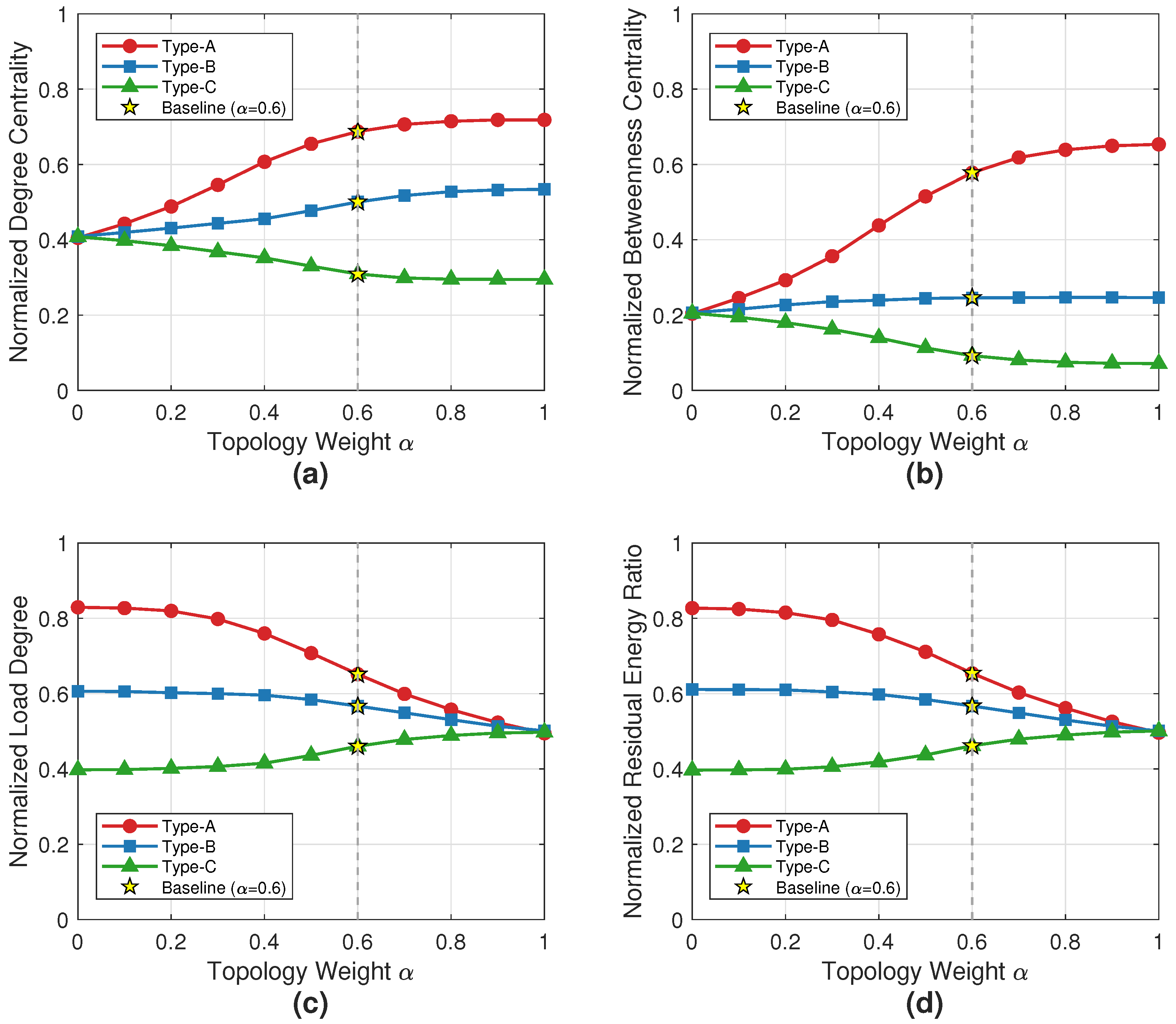
The experimental results shown in Figure 3 clearly validate the decisive influence of weight adjustment on node classification. Regarding topological properties (Figure 3a,b), as the topological weight α increases from 0.0 to 1.0, the three node classes exhibit a pronounced “stratification” evolution. The average degree and average betweenness centrality of Type A nodes climbed from 0.41 and 0.20 to 0.72 and 0.65, respectively, exhibiting a robust monotonic increasing trend. This confirms that increasing α effectively drives the algorithm to precisely identify topological hubs within the network. Conversely, the topological metrics of Type C nodes exhibited a reverse monotonic decrease (e.g., the degree decreased from 0.21 to 0.07). This divergence reveals an internal “crowding-out effect” within the algorithm: as topological demands increase, nodes originally classified as Type A but occupying mediocre topological positions are downgraded, while genuinely central nodes are filtered upward. Consequently, Type C nodes become a collection of eliminated topological edge nodes. Type B nodes maintain a stable intermediate status, serving as an effective buffer and transitional layer.
Regarding functional attributes (Figure 3c,d), the data exhibits an evolution logic diametrically opposed to topological attributes, further validating the model’s decoupled control capability across different properties. As α increases (i.e., functional weight β decreases), the average load and energy of Type A nodes significantly drop from an extremely high level of 0.83 to 0.49. This indicates that when the algorithm no longer prioritizes functional attributes, high-energy nodes lose their “protective umbrella,” are reassigned randomly, and ultimately converge to the network average (approximately 0.5). Interestingly, the average energy of Type C nodes counter-trend increases from 0.40 to 0.50. The underlying mechanism is that as the selection criteria shift toward topology, high-energy yet geographically remote premium nodes are forced to overflow from Types A and B into Type C, thereby elevating the average functional level of Type C. This outcome strongly demonstrates that the experiment is not merely a numerical fit but authentically reflects the algorithm’s dynamic trade-off process under multi-objective constraints.
In summary, this validation experiment confirms that the proposed model can sensitively and logically adjust node classification results through weight modifications. Balancing topological connectivity requirements with network lifespan constraints, we identify α = 0.6 as an optimal equilibrium point. Under this configuration, Type A nodes maintain exceptionally high topological centrality while retaining significantly above-average energy states. This effectively avoids extreme scenarios such as “premature failure of critical nodes” or “longevity nodes with no transmission paths.” Therefore, subsequent simulation experiments in this paper will consistently adopt the configuration of α = 0.6 (i.e., each topological sub-indicator weighted at 0.2) and β = 0.4 (i.e., each functional sub-indicator weighted at 0.2).

5.1.2. Impact of Different Node Type Deletions Under Fixed Network Scale

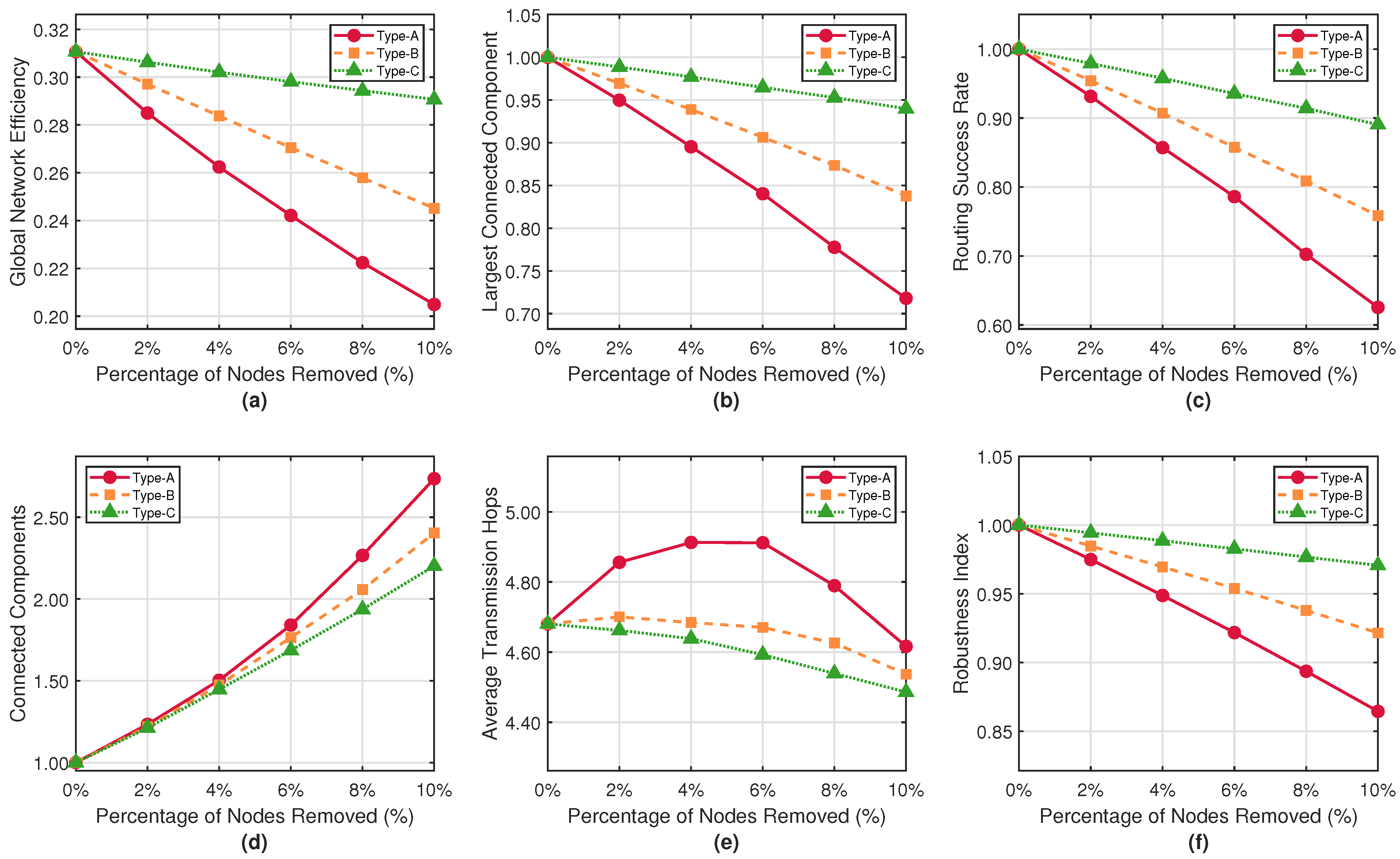
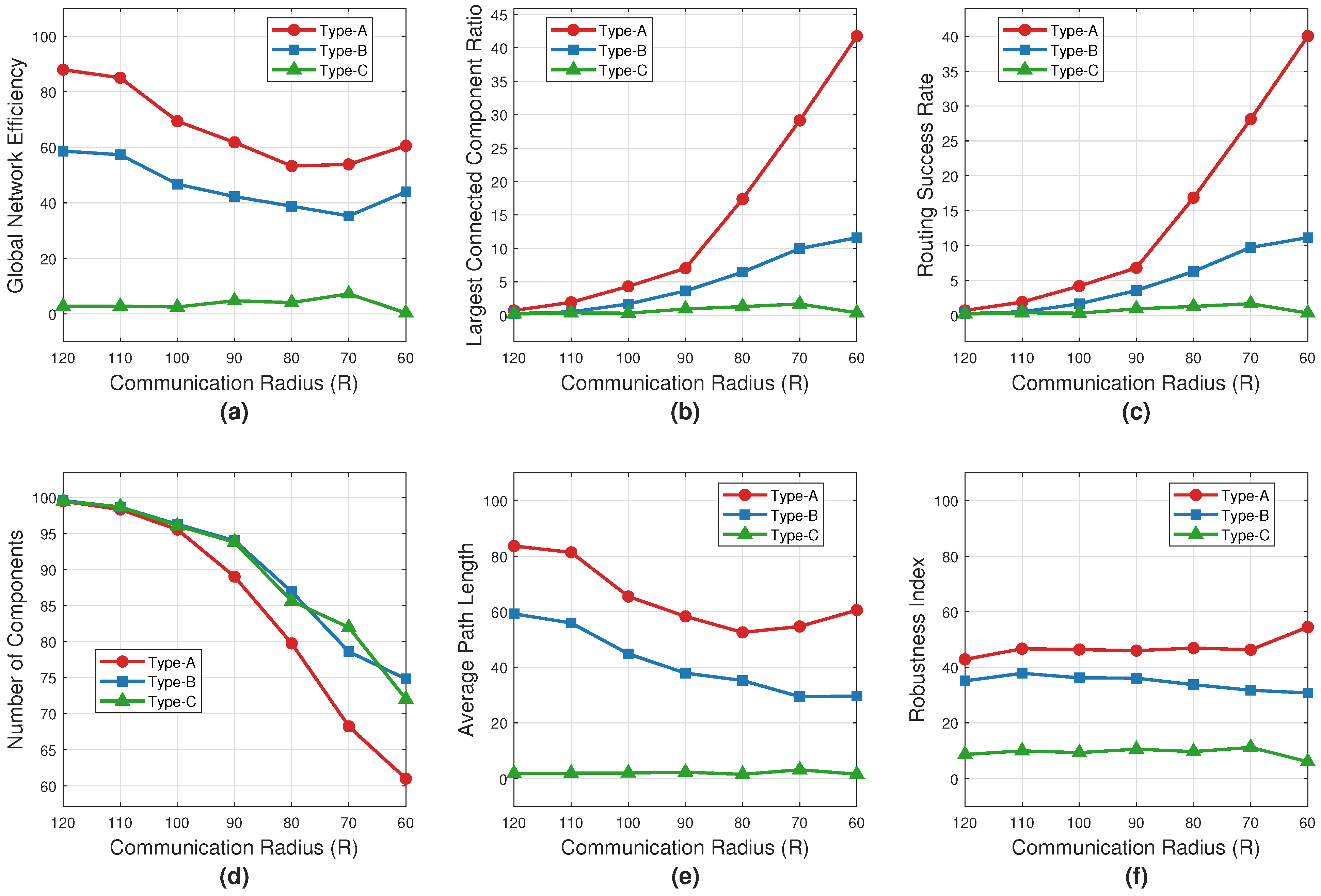
This subsection performs targeted node deletions on Type A, Type B, and Type C nodes under identical network scales and node deletion ratios. The resulting changes in network performance are compared and analyzed, with relevant findings presented in Figure 4.
This strategy adheres to a “one-to-one” repair principle, implying that rectifying X faulty nodes requires X action nodes. However, the impact of removing different node types varies significantly. As shown in Figure 4a, deleting Type A nodes causes the most pronounced decline in global network efficiency, while removing Type C nodes has the least effect. This indicates that high-importance nodes play a dominant role in information forwarding. Specifically, when 10% of nodes are removed, deleting Type A nodes causes the global network efficiency to drop from the initial 0.311 to 0.205, a decrease of 34.0%. In contrast, removing the same proportion of Type C nodes only reduces efficiency to 0.291, representing a mere 6.4% decline. This clearly demonstrates that high-importance nodes perform critical relay functions in network information transmission, and their failure significantly reduces overall transmission efficiency.
Analyzing network connectivity and routing performance (Figure 4b,c, removing Type A nodes causes rapid declines in the proportion of the largest connected component and routing success rate, leading to earlier structural breakdowns in the network. In contrast, removing Type C nodes allows the network to maintain relatively good connectivity and communication reliability. This indicates that critical nodes possess irreplaceable importance in sustaining the connectivity structure of FANETs. Experimental data show that when removing 4% of nodes, deleting Type A nodes reduces the largest connected component ratio from 1.000 to 0.895, while removing Type C nodes only lowers it to 0.977; Regarding routing success rate, under identical conditions, removing Type A nodes caused the success rate to drop from 1.000 to 0.857, while removing Type C nodes only reduced it to 0.958. Notably, when 10% of nodes were removed, deleting Type A nodes lowered the routing success rate to 0.626—a 37.5% decrease—indicating that critical node failures severely compromise the network’s end-to-end communication capability.
Furthermore, Figure 4d shows that at the same deletion ratio, removing Type A nodes significantly increases the number of connected components, making the network more susceptible to fragmentation. In contrast, Type B and Type C nodes have relatively weaker impacts on network structural stability. When removing 8% of nodes, deleting Type A nodes increases the number of connected components from 1.000 to 2.267, whereas deleting Type C nodes only increases it to 1.937. This demonstrates that critical nodes play a decisive role in maintaining network integrity, and their failure rapidly fragments the network into multiple isolated subnetworks.
The trend in average transmission hops (Figure 4e) further demonstrates that critical node failures force data to traverse longer paths, increasing communication overhead. When removing 2% of nodes, deleting Type A nodes increases the average hop count from 4.6805 to 4.8560, while deleting Type C nodes slightly reduces it to 4.6619. This reflects that when critical nodes fail, the optimal paths originally traversing them are disrupted, forcing packets to take detours. This increases network transmission latency and energy consumption.
The robustness index derived from multiple metrics, as shown in Figure 4f, exhibits the largest decline when Type A nodes are removed, significantly exceeding the decreases for Type B and Type C nodes. When removing 6% of nodes, deleting Type A nodes reduces the robustness index from 1.000 to 0.922, whereas deleting Type C nodes only lowers it to 0.983. Under the most severe condition of removing 10% of nodes, deleting Type A nodes reduced the robustness index to 0.864, significantly lower than the 0.926 for Type B nodes and 0.971 for Type C nodes. In summary, simulation results validate that the proposed node importance assessment method effectively identifies critical nodes in FANET, providing a basis for subsequent differentiated node failure mitigation strategies.

5.1.3. Differential Impact of Deleting Different Node Types Across Network Scales

In the previous subsection, we verified the differential impact of removing nodes of varying importance on network performance under a fixed network size of 50. The results indicate that the failure of Type A nodes causes the most significant disruption to network structure and performance. To further validate the applicability and robustness of this conclusion across varying network scales, this section expands the analysis from the 50-node baseline to networks of 75, 100, 125, and 150 nodes. Under identical deletion ratios, Type A, B, and C nodes were removed respectively, and the resulting changes in network performance were compared and analyzed.
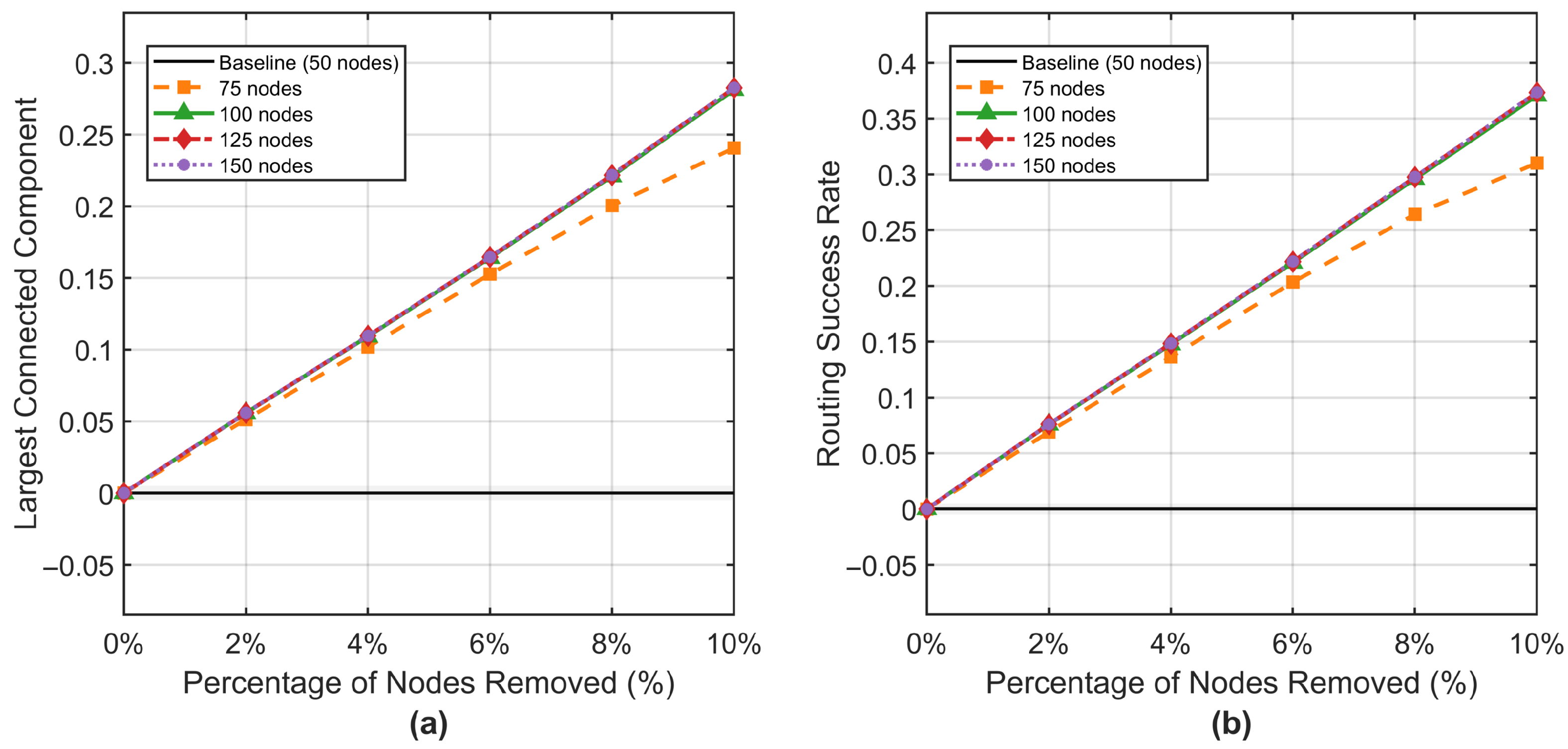
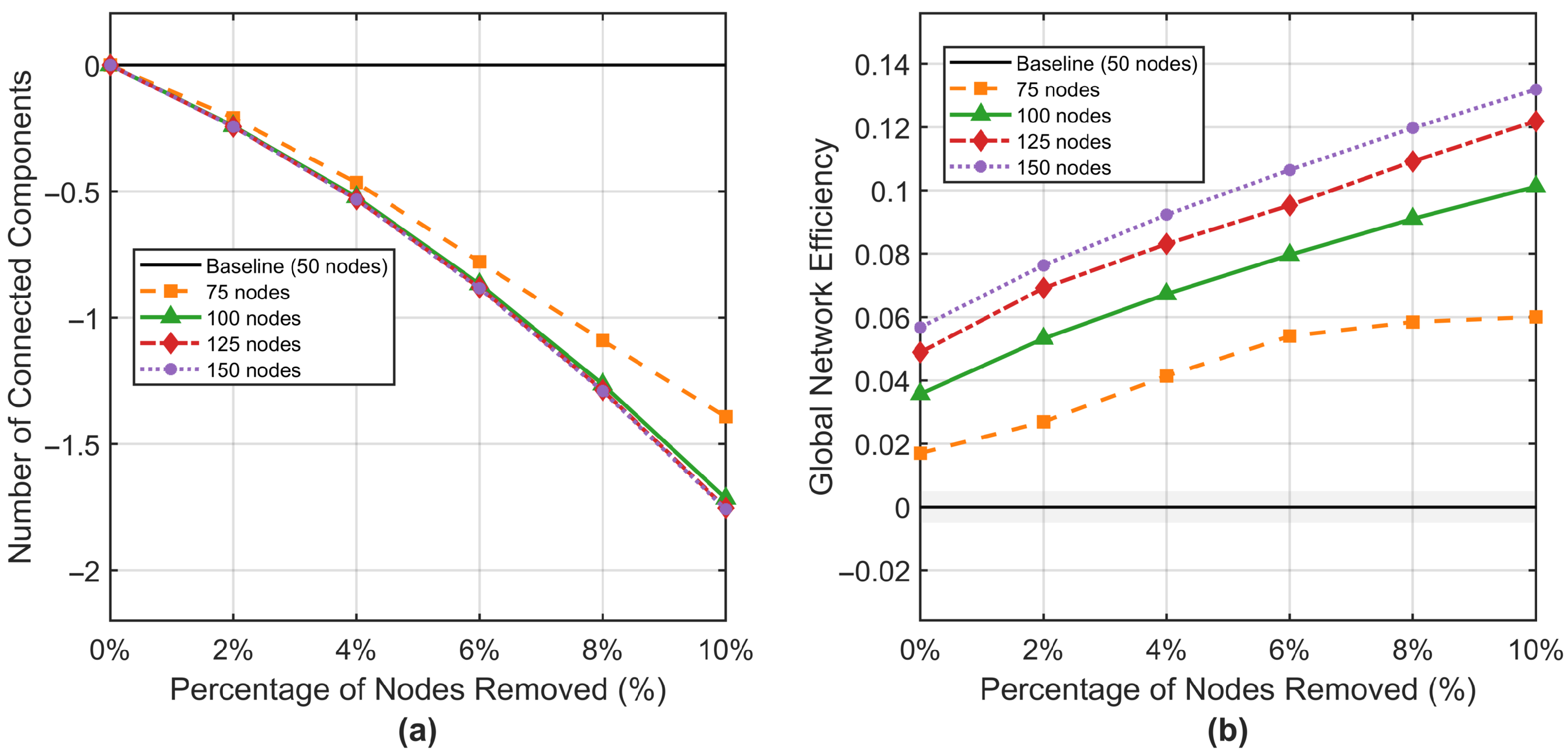
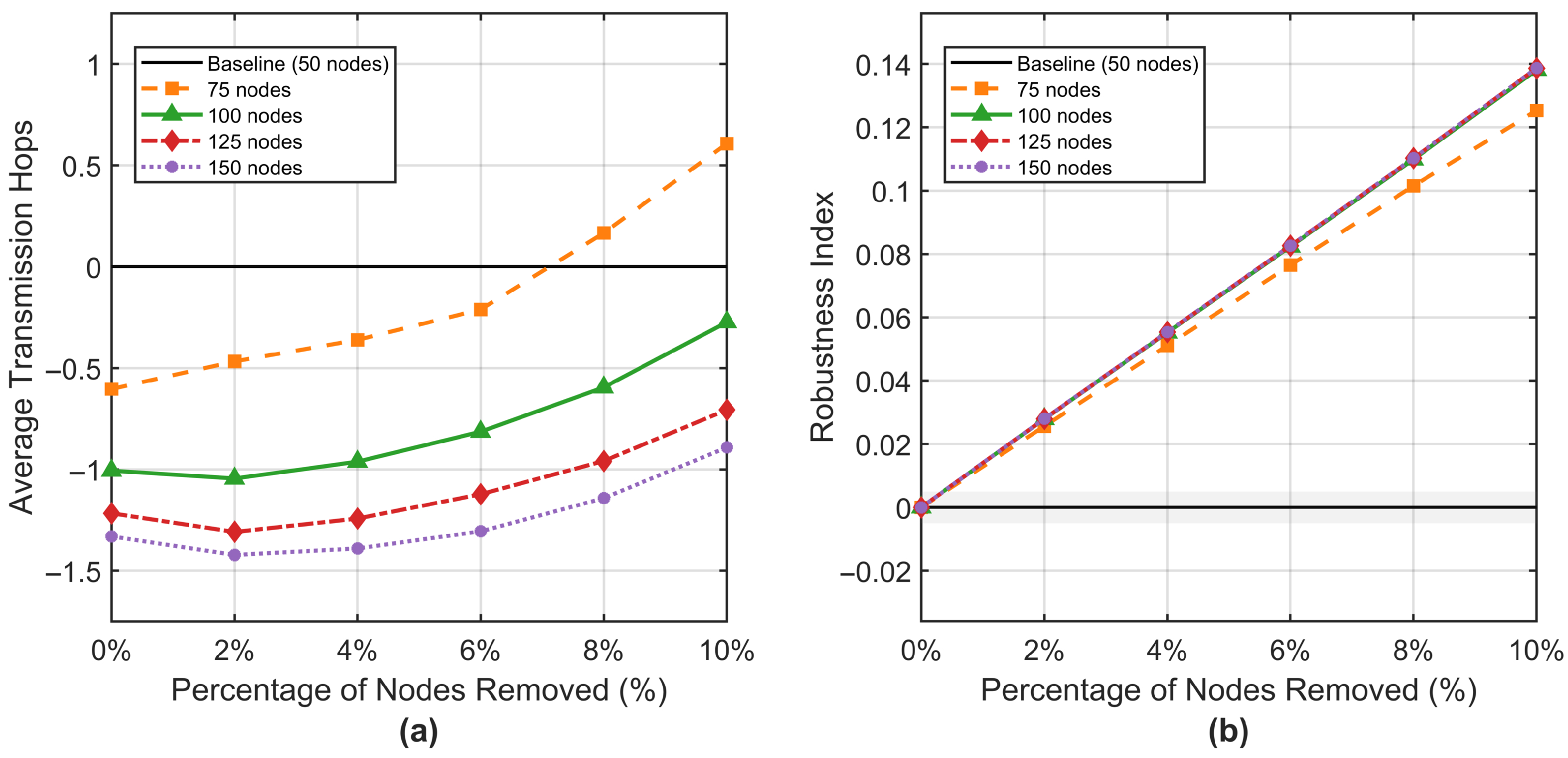
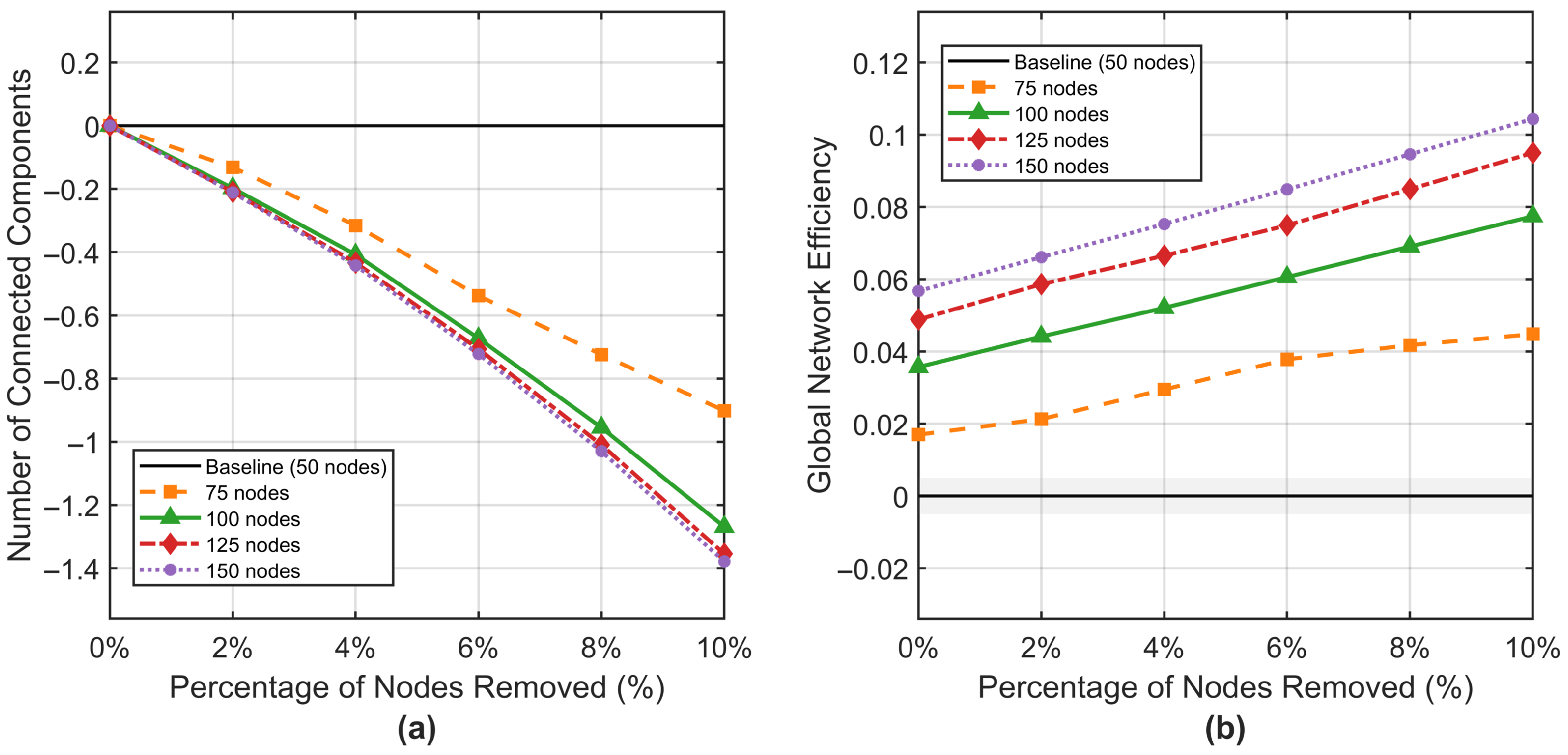
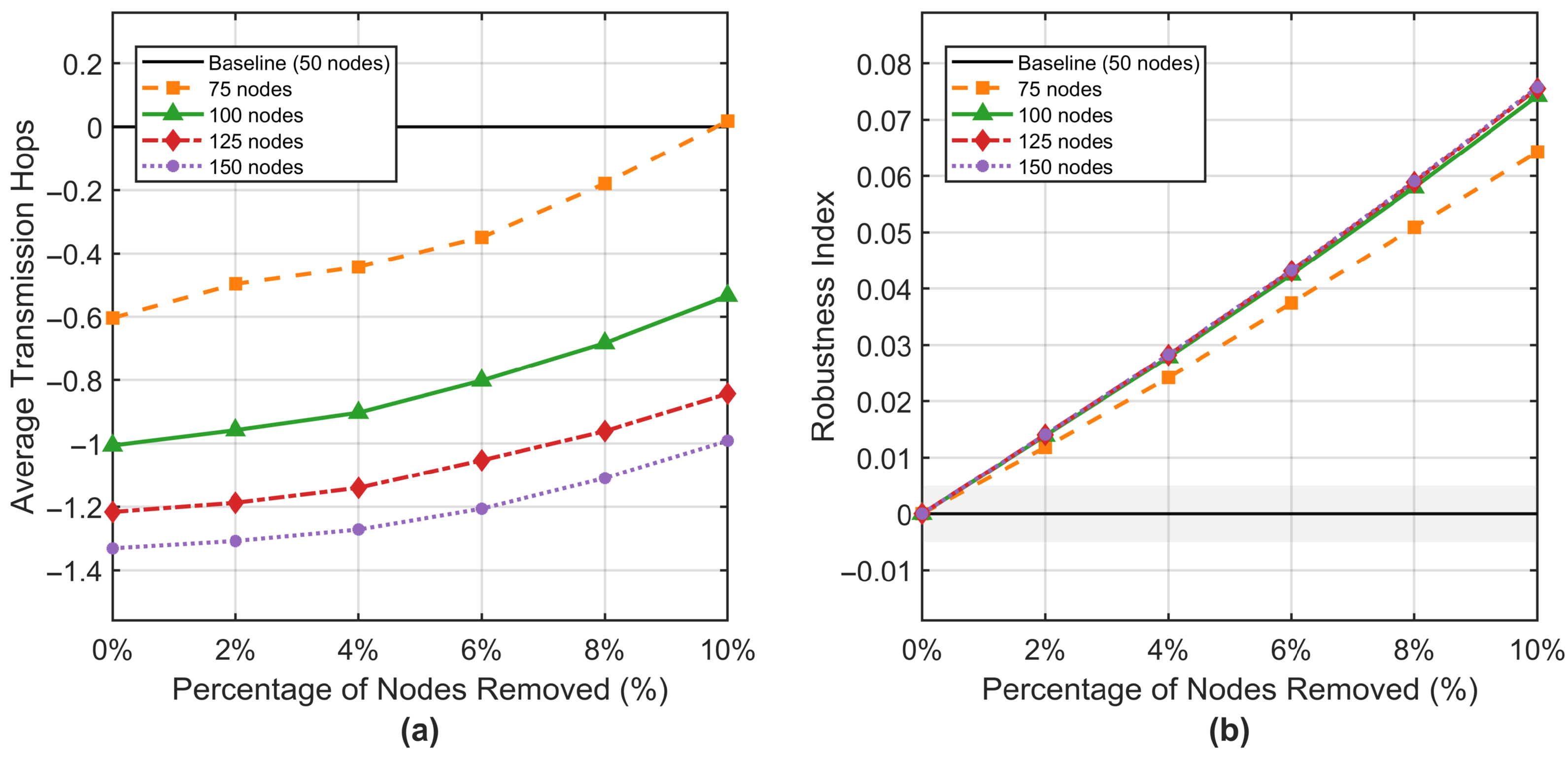
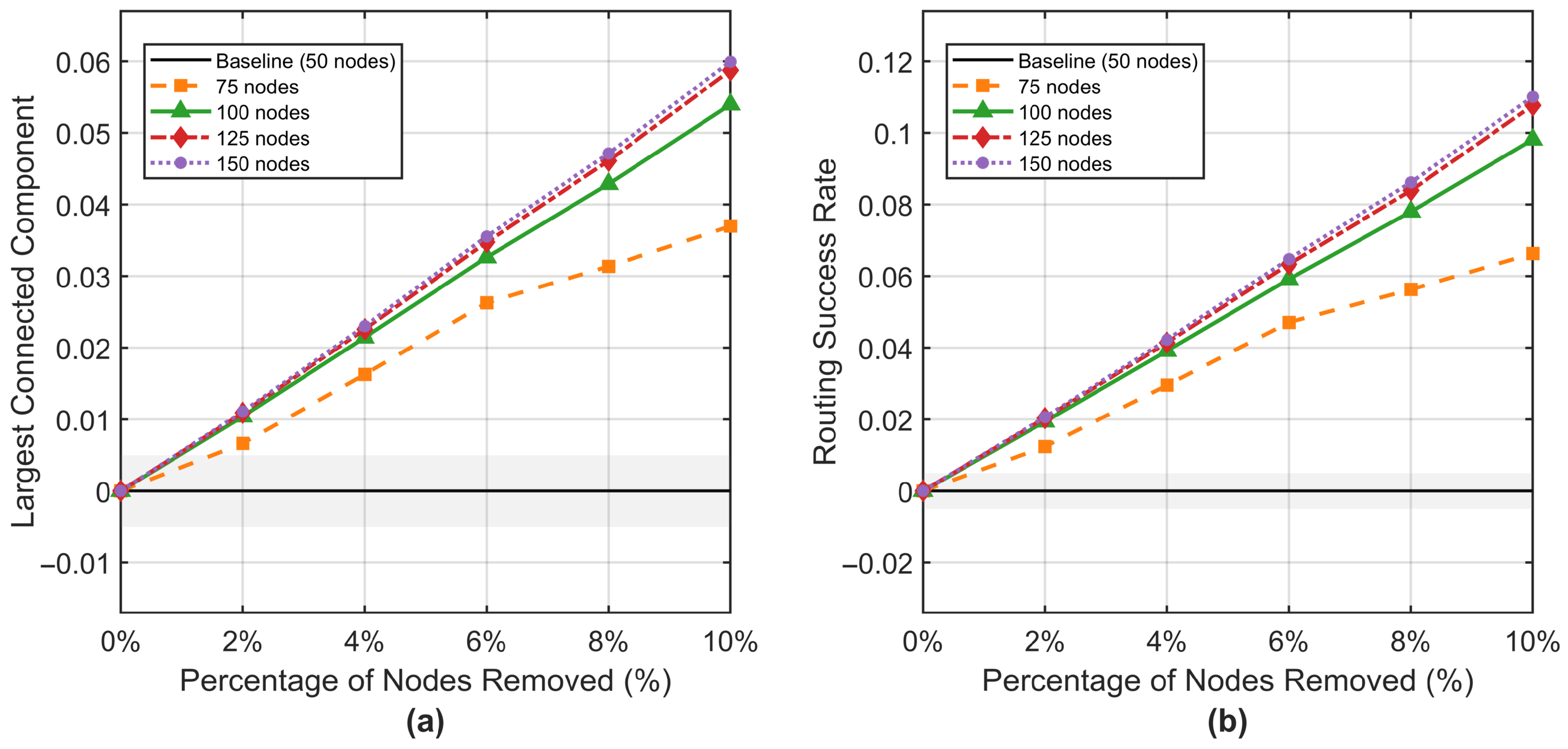
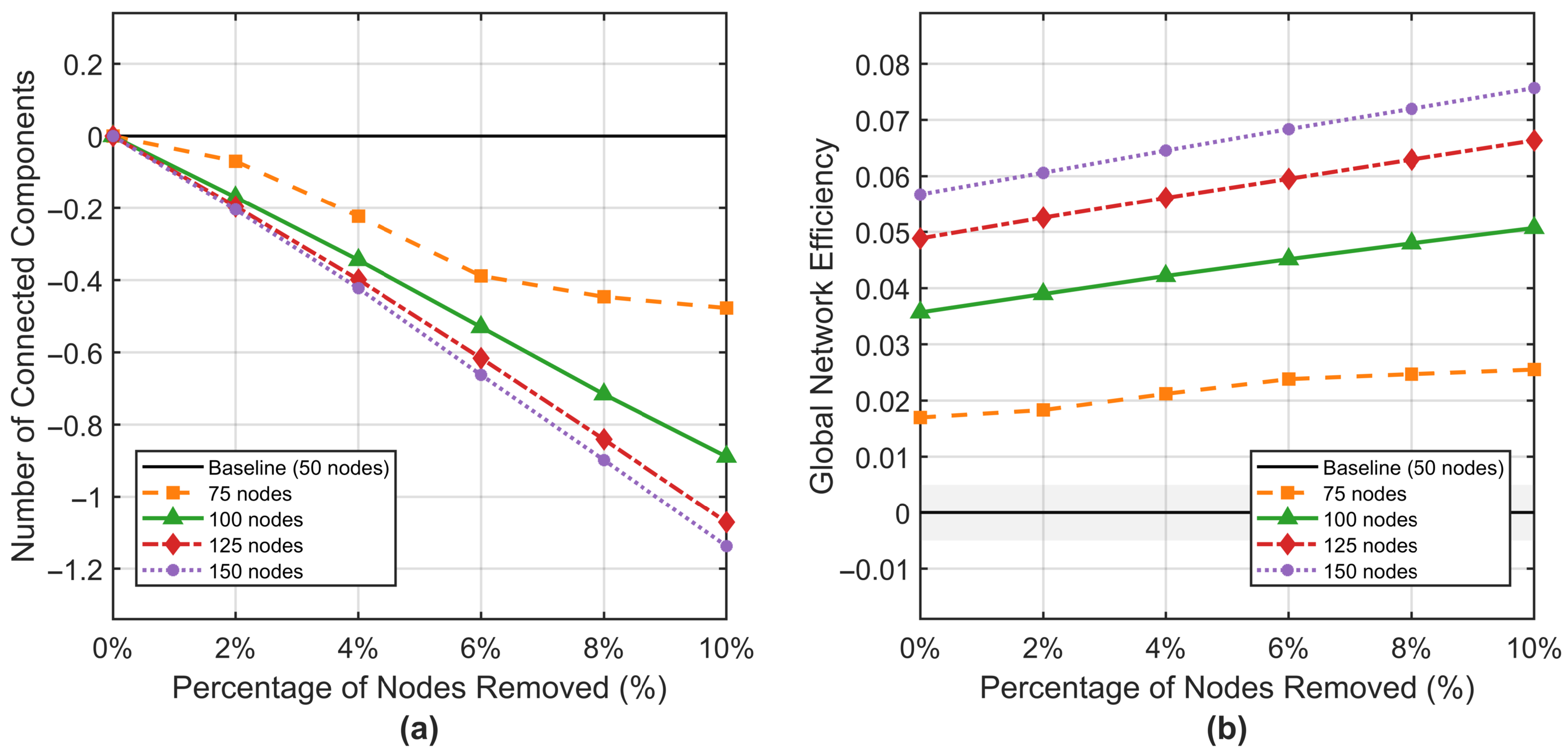
For Type A nodes, removal operations exerted the most pronounced impact on network performance. As shown in Figure 5, regarding connectivity metrics, the rate of performance decline moderated as network scale increased. When removing 10% of Type A nodes, the difference in largest connected component ratio increases from 0.13 in the 75-node network to 0.16 in the 150-node network, while the difference in routing success rate rises from 0.19 to 0.24. This indicates that larger networks exhibit stronger fault tolerance in terms of redundant paths and structural connectivity. As shown in Figure 6 and Figure 7, the difference in global network efficiency increased from 0.06 in the 75-node network to 0.13 in the 150-node network. The difference in average transmission hops changed from −0.60 to −0.89, while the difference in robustness index increased from 0.13 to 0.14. These data changes indicate that as network scale increases, the network’s tolerance for Type A node failures significantly enhances. This is primarily due to large-scale networks possessing higher node degrees and richer redundant paths. Specifically, removing 10% of Type A nodes from a 50-node network caused declines of 33.69%, 27.62%, and 36.48% in global network efficiency, proportion of maximum connected components, and routing success rate, respectively. However, when the network expanded to 150 nodes, the magnitude of decline for these metrics significantly decreased, with some metrics showing almost no further degradation. This further confirms the crucial role of network scale effects in mitigating the impact of core node failures.
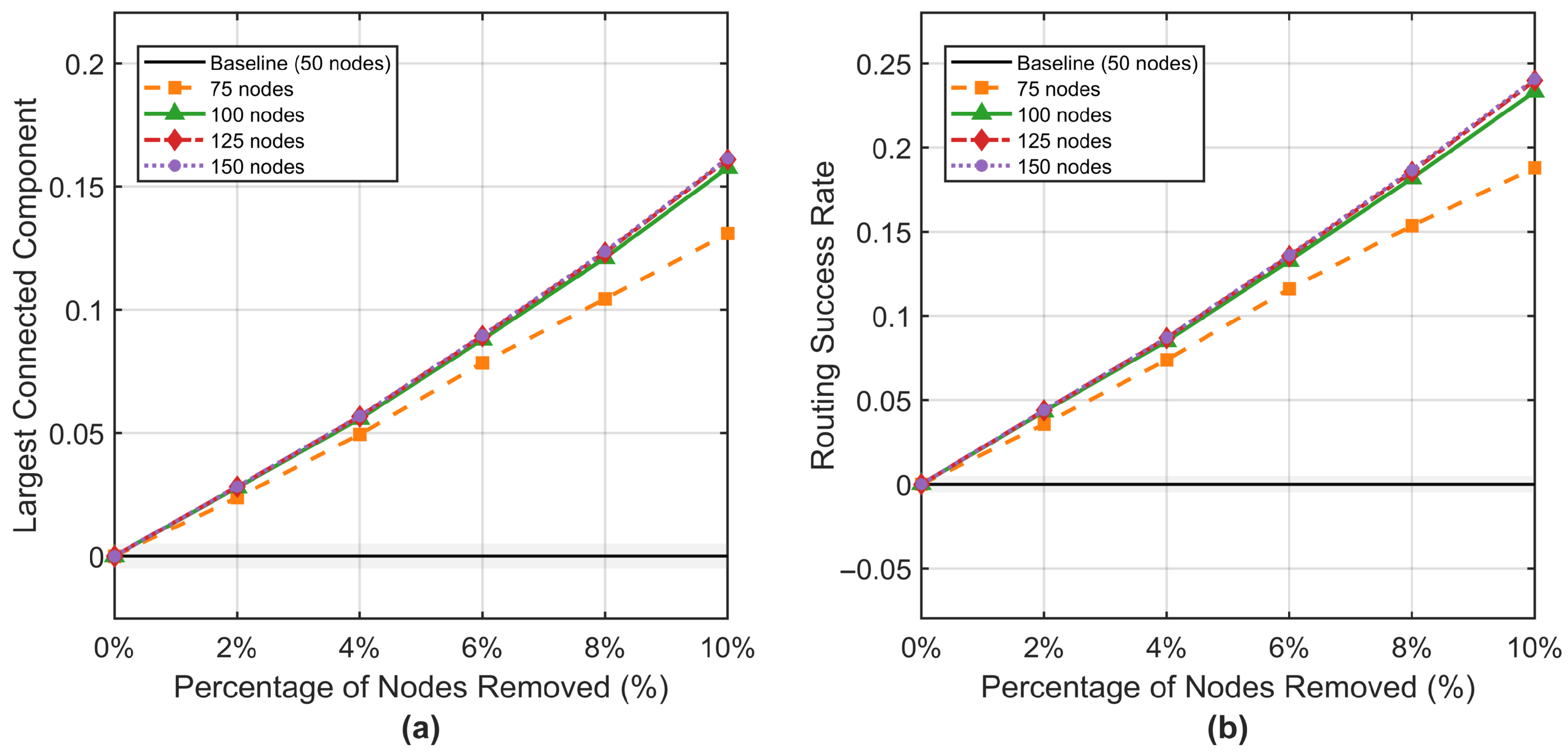
For Type B nodes, the overall trend aligns with Type A nodes, though the magnitude of performance degradation is markedly weaker. As shown in Figure 8, regarding connectivity metrics, removing 10% of Type B nodes increases the difference in largest connected component ratio from 0.04 in a 75-node network to 0.06 in a 150-node network, while the difference in routing success rate rises from 0.07 to 0.11. This indicates that while Type B nodes affect network connectivity, their positions are relatively less critical. Large-scale networks can better compensate for the impact of failures in such nodes. As shown in Figure 9 and Figure 10, the difference in global network efficiency increases from 0.04 to 0.10, the difference in average transmission hops changes from 0.02 to −0.99, and the difference in robustness index increases from 0.06 to 0.08. These metrics indicate that Type B nodes play a supplementary role in transmission efficiency. Their failure does not necessitate fundamental path reconfiguration, and large-scale networks can further mitigate this impact through path redundancy. When 10% of Type B nodes are removed from a 50-node network, network efficiency and routing success rates decline by approximately 20.73% and 23.65%, respectively. However, at scales of 125 nodes and above, these declines shrink to around 5%, with the network connectivity structure remaining largely stable. This indicates that while Type B nodes exert some influence on network performance, their criticality and disruptive potential are significantly lower than those of core nodes.
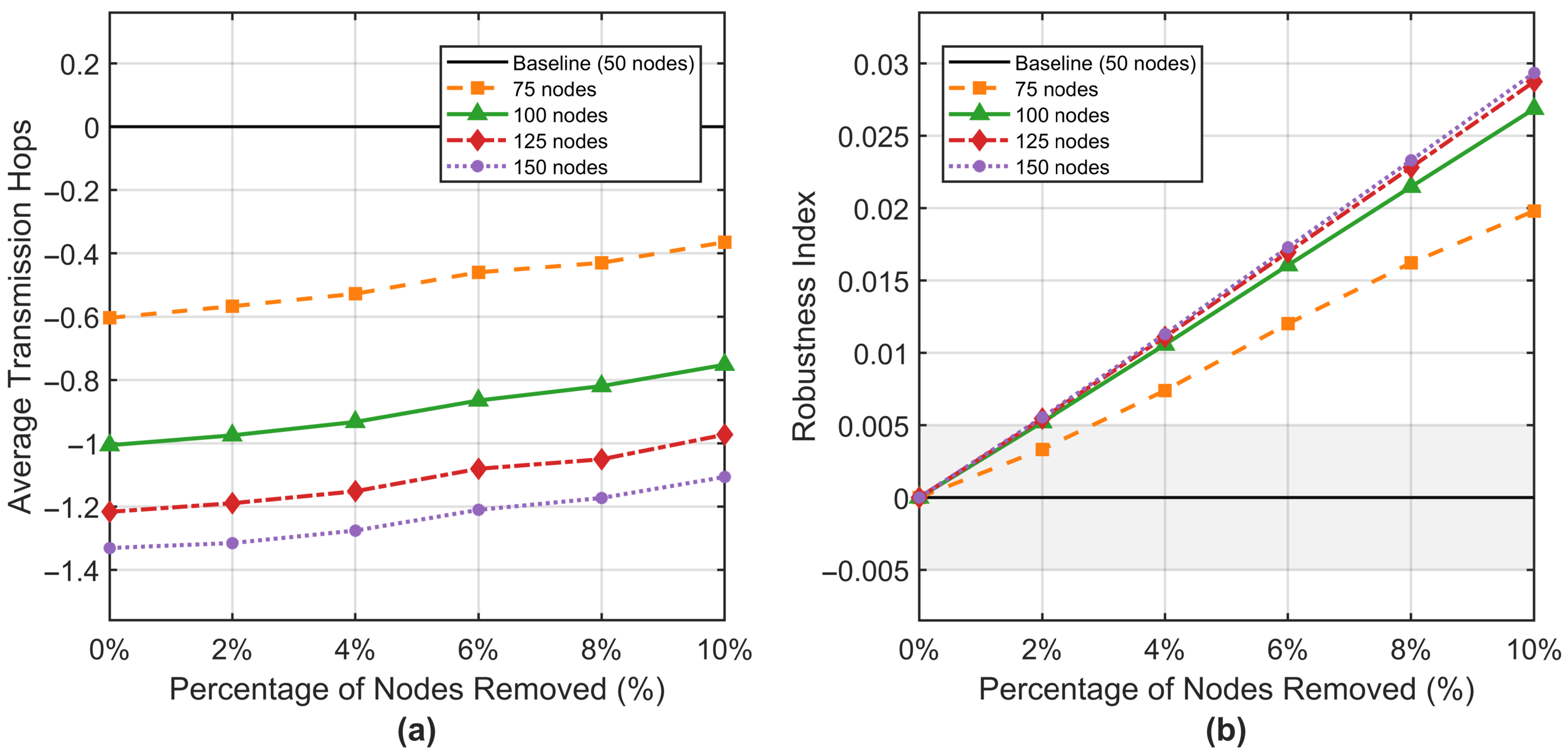
For Type C nodes, the impact of removal operations on network performance exhibits strong stability across different scales. As shown in Figure 11, regarding connectivity metrics, the difference in the proportion of the largest connected component remains 0.06 when removing 10% of Type C nodes across all scales, indicating that Type C node failures have negligible effect on this metric. The difference in routing success rate increases from 0.07 to 0.11, yet the overall impact remains limited. As shown in Figure 12 and Figure 13, the difference in global network efficiency increases from 0.03 to 0.08, the difference in average transmission hops changes from −0.36 to −1.11, and the difference in robustness index increases from 0.02 to 0.03. Even when removing 10% of Type C nodes from a 50-node network, the declines in network efficiency and routing success rate were only 6.34% and 10.70%, respectively. This impact is further significantly mitigated in larger-scale networks. This indicates that Type C nodes are predominantly located at the network periphery, and their failure has limited impact on the overall network structure and routing performance.
Comparing results across different scales reveals that while larger networks exhibit enhanced overall robustness, the degradation sequence caused by node failures remains consistent: Type A nodes > Type B nodes > Type C nodes. This phenomenon demonstrates that the node importance-based classification method proposed earlier is not only effective in fixed-scale networks but also exhibits good stability and applicability when network scale varies. This provides a reliable basis for designing adaptive fault-tolerance and recovery mechanisms targeting critical nodes in subsequent research.

5.2. Evaluation of Network Topology Reconstruction Efficiency

After identifying key differences between various nodes, this subsection aims to comprehensively evaluate the overall effectiveness of the topology reconstruction strategies proposed in Section 4.1 and Section 4.2 in restoring network connectivity and functionality. Experiments simulate the two most common failure scenarios in UAV networks: local single-node failures and local multi-node failures.
To quantify the performance advantages of the proposed multi-node cooperative repair mechanism, we employ a two-stage incremental evaluation approach. First, for single-node failure scenarios, this section analyzes the reconfiguration mechanism’s response capability to failures of nodes with varying importance, validating the algorithm’s effectiveness in fundamental recovery tasks. Second, for complex multi-node failure scenarios, we define the following two comparison strategies to verify the proposed approach’s ability to balance network survivability and resource utilization efficiency. It is important to emphasize that to ensure fairness in comparison, both strategies employ the same optimization solver (see Section 4.1.2) when computing specific deployment coordinates. The sole distinction lies in the selection logic for repair regions:
  • Independent Reconstruction Strategy: This strategy decouples multi-node failures into multiple independent single-node failures for processing. For X faulty nodes, the algorithm strictly restricts deployment searches to their respective “primary regions ( R ( 1 ) ),” ignoring any overlap between regions. Consequently, this strategy adheres to a “one-to-one” repair principle, meaning repairing X faulty nodes necessarily consumes X action nodes.
  • Collaborative Reconstruction Strategy: This strategy prioritizes searching the “second region ( R ( S ) )” between faulty nodes. When overlapping coverage regions exist, the algorithm computes deployment points within these intersection areas. This leverages the geometric center effect to achieve “many-to-one” or “few-to-many” repairs (i.e., repairing X faults with Y active nodes, where X Y ), maximizing network resource conservation.

5.2.1. Reconstruction Efficiency Analysis in Localized Single Node Failure Scenarios

This section evaluates the overall effectiveness and differentiated performance of the proposed reconstruction mechanism under single-node failure scenarios across varying network vulnerabilities (where smaller node communication radii indicate greater network fragility). Simulation results demonstrate that multiple critical network performance metrics show significant improvement after introducing the reconstruction mechanism, validating its overall effectiveness in addressing local node failures.
From an overall trend perspective, the reconstruction mechanism exhibits stable reconstruction effects on parameters such as the proportion of the largest connected component and the number of connected components, as shown in Figure 14a,b. When the communication radius is small, the network is particularly sensitive to critical node failures. Taking a communication radius of 60 as an example, repairing Type A nodes restores the maximum connected component ratio to approximately 41.8% and achieves a connected component count recovery rate of about 61.0%, indicating that reconstruction operations effectively mitigate network structural fragmentation caused by critical node failures. As the communication radius increases, the recovery rate of the largest connected component ratio gradually decreases, dropping to 4.3% and 0.7% at communication radii of 100 and 120, respectively. However, the recovery rate of the number of connected components remains above 95%, indicating that the reconstruction mechanism can continuously suppress topological fragmentation under different network density conditions.
As shown in Figure 14c–e, the reconstruction effectiveness exhibits significant dependence on the network’s initial connectivity state regarding parameters such as average path length, global efficiency, and routing success rate. At a communication radius of 60, the recovery rates for average path length and global efficiency after repairing Type A nodes are both approximately 60%, while the routing success rate recovers to about 40.0%. This demonstrates that repairing critical nodes can significantly improve communication path structure and enhance end-to-end transmission performance. As the communication radius increases, the number of alternative paths in the network grows substantially, gradually mitigating the impact of single-node failures on communication performance. This leads to a rapid decline in the recovery rates of the aforementioned parameters. When the communication radius reaches 100 or higher, the potential for recovery in these performance metrics becomes significantly constrained.
Further comparison across node types reveals a strong positive correlation between reconstruction benefits and node importance. Type A nodes exhibit the highest reconstruction benefits across all communication radii, followed by Type B nodes. In contrast, failures of Type C nodes cause limited disruption to overall network performance, resulting in lower reconstruction benefits. Taking a communication radius of 60 as an example, Type C nodes achieve recovery rates of only 0.36% for global efficiency and 0.31% for routing success rate, contributing minimally to overall performance improvement. This result indicates that the reconstruction mechanism exhibits distinct response characteristics to different failure events.
In summary, this reconstruction mechanism maximizes the reconstruction benefits for critical nodes while avoiding costly operations on low-value nodes. This achieves an optimal balance between network performance recovery and resource consumption. This characteristic validates the “sacrifice pawns to protect the rook” strategy, establishing a robust experimental foundation and practical motivation for designing collaborative reconstruction strategies targeting multi-node failures.

5.2.2. Reconstruction Efficiency Analysis in Localized Multiple Node Failure Scenarios

Based on benchmark analysis of single-node failures, this section further quantifies the performance gap between the proposed collaborative reconstruction mechanism and traditional independent reconstruction strategies under complex multi-node failure scenarios (e.g., dual-node and triple-node cluster failures). From the macro perspective of resource utilization efficiency, the cooperative strategy demonstrates overwhelming advantages. As shown in the energy consumption comparison subplots in Figure 15 and Figure 16, the energy consumption curve of the cooperative strategy consistently remains significantly lower than that of the independent strategy in both dual-node and triple-node failure scenarios. Particularly in the three-node failure scenario with a communication radius of 120 m depicted in Figure 16, energy consumption plummeted from 0.471 for the independent strategy to 0.275 for the collaborative strategy—a reduction of 41.7%. This “1-for-N” resource replacement mechanism demonstrates that, for equivalent reconstruction tasks, the cooperative strategy can significantly extend the network’s sustained operational capability while consuming only about 60% of the kinetic energy and occupying 33% of the nodes.
Regarding connectivity metrics reflecting network survivability, the cooperative strategy exhibits a pronounced “performance reversal” phenomenon in sparse network environments. As shown in Figure 16, when the communication radius shrinks to 60 m, the cooperative reconstruction achieves the largest connected component recovery rate of 29.78%, significantly surpassing the independent reconstruction’s 25.73%. This indicates that cooperative nodes in the intersection region effectively adsorb more edge fragments. Similarly, the cooperative strategy achieves a 27.36% routing success rate recovery at this radius, outperforming the independent strategy’s 24.09%, proving its reconstructed topology is more conducive to end-to-end communication. Furthermore, the number of components count metric corroborates this finding. Figure 15 and Figure 16 demonstrate that the collaborative strategy achieves higher component recovery rates than the independent strategy at low radius. For instance, with three node failures and a 70 m radius, the collaborative approach surpasses the independent strategy by 4.97%. This indicates that multiple nodes undergoing independent reconstruction may operate independently in sparse environments, leading to persistent network fragmentation. In contrast, collaborative nodes act as “super glue”, effectively curbing the exacerbation of network topology fragmentation.
Benefiting from centralized deployment locations, the collaborative strategy also excels in enhancing transmission efficiency. As shown in Figure 15, with two node failures and a communication radius of 70 m, cooperative reconstruction achieved 58.71% global efficiency recovery, significantly outperforming the 45.46% achieved by independent reconstruction. Additionally, the average path length data in Figure 16 indicates that the cooperative strategy achieved a 5.97% higher recovery rate than the independent strategy at a radius of 90 m. This mechanism arises because while independent reconstruction fills voids, the dispersed locations of new nodes may cause data transmission detours. In contrast, collaborative nodes are positioned at the geometric center of the local topology, inherently reducing relay hop counts and thereby optimizing overall communication efficiency.
Finally, the robustness indices in Figure 15 and Figure 16 exhibit noteworthy nonlinear fluctuations, reflecting the interplay between physical redundancy and topological criticality. For most radius (e.g., >80 m), the independent strategy deploys 2–3 nodes, increasing the total physical nodes and link redundancy, yielding slightly higher robustness than the cooperative strategy. However, under extreme fragility conditions (three node failures at a 60 m radius), the cooperative strategy’s robustness (51.08%) paradoxically surpasses the independent strategy (47.23%). This anomaly arises because connectivity becomes a prerequisite for robustness in extremely sparse networks. While independent reconstruction increases node count, these nodes may exist in isolation within sparse environments, failing to form an effective backbone support. In contrast, the cooperative node, though a single point, forcibly connects three subnets through its “geometric hub effect”. At extremely low densities, the structural value of maintaining backbone connectivity outweighs the mere numerical redundancy value. In summary, the proposed strategy achieves energy savings through dual optimization—“trading space for resources” and “trading position for performance”—while also providing the optimal solution for sustaining network viability in extreme harsh environments. This represents a paradigm shift from “resource-intensive” reconstruction to “geometrically intensive” reconstruction.

5.3. Comprehensive Performance Evaluation of the Improved APF in Complex Environments

To comprehensively validate the robustness and overall task performance of the improved APF algorithm, this section designed two categories of high-intensity 3D simulation experiments. The experiments first focused on the algorithm’s core improvement—its ability to respond to time-varying threats in dynamic environments—conducting stress tests on both dynamic obstacle density and velocity (S1, S2). Subsequently, the experiments returned to fundamentals, verifying the algorithm’s capability to overcome 3D local minima in high-density static environments (S3). To eliminate survivor bias inherent in traditional algorithms—which solely count successful samples—all experiments incorporate a penalization metric. This mechanism assigns failed missions a path length penalty equal to twice the ideal straight-line distance and a zero effective flight speed, thereby providing a more objective reflection of the algorithm’s true performance across diverse scenarios. Relevant parameters for the simulation scenarios in this subsection are shown in Table 4.

5.3.1. Comprehensive Performance Evaluation in Dynamic Environments

In order to evaluate the robustness and overall performance of the improved algorithm in extremely dynamic environments, this section constructs two sets of high-intensity three-dimensional dynamic simulation experiments: the Dynamic Obstacle Density Stress Test (Scenario 1) and the Dynamic Obstacle Velocity Stress Test (Scenario 2). In Scenario 1, the obstacle flight speed is fixed at 15 m/s, with the number of obstacles incrementally increased from 100 to 145 to simulate highly congested dynamic airspace. In Scenario 2, the number of obstacles is fixed at 120, while their flight speed is incrementally increased from 10 m/s to 55 m/s to test the algorithm’s response capability to high-speed threats. The simulation environment was configured as a 400 m × 100 m × 100 m tunnel-like space. The UAV speed was set at 30 m/s, with a safety distance of 5 m. If the minimum distance between the UAV and an obstacle surface fell below the safety distance, obstacle avoidance was deemed unsuccessful. All obstacles moved in uniform linear motion, and their generation logic ensured they would intrude upon the UAV’s predefined trajectory, thereby forcibly triggering evasive maneuvers.
First, in the stress test targeting dynamic obstacle density (Scenario 1), the improved APF algorithm demonstrated exceptional adaptability, maintaining robustness despite increasing environmental congestion. As shown by the task success rate curve in Figure 17a, the success rate of the improved algorithm remained consistently high at 97.17% as the number of obstacles increased from 100 to 145, with fluctuations throughout the process staying below 3%. This result directly demonstrates that the CPA-based spatio-temporal prediction mechanism can effectively filter out genuine threats from high-density dynamic interference. In contrast, the traditional APF algorithm exhibits significant performance degradation with increasing crowding, with its success rate fluctuating downward from 76% to 67.73%, making it highly susceptible to becoming trapped within dynamic force fields. The average path length in Figure 17b further demonstrates that the improved algorithm maintains a stable path length between 410 m and 415 m, only about 3.5% longer than the ideal straight line. This indicates that it ensures high survivability without sacrificing path efficiency. In contrast, the traditional algorithm’s high failure rate causes its average cost to surge to 500 m to 530 m. Moreover, the safety margin analysis in Figure 17c shows the improved algorithm consistently maintains a minimum obstacle clearance distance exceeding 7.3 m, significantly higher than the traditional algorithm’s 4.6 m, demonstrating superior active defense capabilities, and the average speed shown in Figure 17d indicates that the improved algorithm can complete tasks at high speed and with high efficiency while ensuring safety.
Secondly, in the pressure test targeting obstacle flight speeds (Scenario 2), experimental data reveals the improved algorithm exhibits high insensitivity to absolute speed variations of obstacles during high-speed interactions. Figure 18a shows that the improved APF algorithm maintains an exceptionally high success rate of 96.9% to 98.5% across the entire velocity spectrum from 10 m/s to 55 m/s. Moreover, the average path length in Figure 18b consistently remains within the optimal range of 400 m to 410 m. indicating the algorithm’s ability to generate stable avoidance trajectories regardless of obstacle speed. Notably, the traditional APF algorithm exhibits a counterintuitive rebound in success rate (from 56% to 94%) in Figure 18a. However, this does not represent performance improvement but rather a classic fast-pass effect: when obstacles move extremely fast, their dwell time window on the drone’s flight path drastically shortens. Consequently, the traditional algorithm fails to react before the obstacle passes, resulting in a “lucky” clearance. The safety margin data in Figure 18c reveals the truth: even at the maximum speed of 55 m/s, the traditional algorithm’s minimum safe distance (13.7 m) remains lower than that of the improved algorithm (14.3 m). In the low-speed, high-stalling zone at 10 m/s, the traditional algorithm achieves only a 3.5 m safe distance (collision occurred), with a success rate of just 56%. Simultaneously, the average flight speed on the right side of Figure 18d indicates that the improved algorithm maintains a stable speed between 28 m/s and 29 m/s across all speeds. In contrast, the traditional algorithm’s effective speed drops to 17 m/s at low speeds, demonstrating its complete inability to handle low-speed, high-stasis dynamic blockade scenarios. The improved algorithm, however, exhibits adaptability across the entire speed range.

5.3.2. Comprehensive Performance Evaluation in Static Conditions

After verifying the algorithm’s dynamic obstacle avoidance capabilities, to ensure the improved algorithm does not compromise its ability to avoid static obstacles due to the introduction of dynamic prediction mechanisms, this section conducted static density gradient tests within a 500 × 500 × 500 m space. The number of obstacles was incrementally increased from 50 to 150, focusing on validating the improved algorithm’s global planning and obstacle avoidance performance in complex static environments. Additionally, the drone’s speed was set to 30 m/s, with a safety distance of 5 m.
Combined with the macro task dimension illustrated in Figure 19, the improved APF algorithm demonstrated significant advantages in alleviating static trap issues. The task success rate curve on the of Figure 19a visually reflects the algorithm’s escape capability: during the initial phase with fewer obstacles (50), the improved algorithm achieved a success rate of 97.5%, markedly higher than the traditional algorithm’s 90.6%. As obstacle density increases, connectivity in static space deteriorates sharply, forming numerous U-shaped or C-shaped traps. The traditional APF algorithm, lacking tangential guidance, easily becomes trapped in these three-dimensional local minima, causing its success rate to decline rapidly. Under extreme conditions with 150 obstacles, its success rate drops to only 73.97%. In contrast, the improved algorithm, leveraging its introduced tangential guidance force and rotational potential field mechanism, effectively guides the UAV to glide over deadlock regions along static obstacle surfaces. It maintains a high success rate of 92.33% even at maximum density. The average path length curves in Figure 19b further validate the planning quality: due to the high failure rate of the traditional algorithm, its average path length surged from an initial 871 m to 1004 m; while the improved algorithm’s curve remains low and stable, increasing only slightly from 816 m to 858.6 m. This demonstrates that when encountering static obstacle blockages, the improved algorithm can plan smoother, higher-quality trajectories closer to the geometric shortest path, avoiding the ineffective wandering and oscillations common in traditional algorithms.
Based on the microflight characteristics in Figure 19, the improved algorithm also demonstrates superior smoothness in motion control within static environments. Figure 19c illustrates the variation in minimum safe distance. Under extreme conditions with 150 obstacles, the improved algorithm maintained a minimum obstacle avoidance distance of 11.27 m, slightly outperforming the traditional algorithm’s 10.31 m. This demonstrates that its repulsive field model retains sufficient repulsive strength even in congested, static, narrow spaces. The average flight speed curve in Figure 19d vividly demonstrates the algorithm’s ability to overcome static oscillations. Throughout the density increase process, its average flight speed consistently remained within the high range of 27.2 m/s to 28.8 m/s. In contrast, the traditional APF algorithm’s speed curve plummeted from 26.7 m/s to 21.8 m/s. This pronounced decay reveals how the traditional algorithm frequently exhibits oscillatory behavior—abrupt stops, turns, and re-accelerations—when encountering dense static obstacles. The improved algorithm, however, effectively suppresses such stalling and jitter near static obstacles through smooth resultant force control, achieving efficient shuttle flight.
In summary, through extreme stress testing in both dynamic and static scenarios, the enhanced APF algorithm has demonstrated its comprehensive capabilities in complex three-dimensional environments. In dynamic scenarios, the algorithm overcomes traditional methods’ insensitivity to relative velocity through its CPA prediction mechanism, maintaining nearly 98% success rates under high-speed and high-density threats. In static scenarios, it effectively mitigates 3D deadlock issues using tangential guidance forces, reducing failure rates in extremely congested environments by approximately 18.4 percentage points. Quantitative data indicates that regardless of environmental conditions, the comprehensive cost (combining path length and time expenditure) of the improved algorithm in completing tasks is reduced by 20% to 30% compared to traditional algorithms. This demonstrates that the algorithm not only possesses survivability in high-speed dynamic games but also retains global optimization capabilities in complex static structures, making it highly applicable.
The key data and figure indexes of the above simulation experiments are summarized in Table 5.

6. Conclusions and Future Work

To address the challenges faced by FANETs during mission execution, including network topology damage and communication interruptions caused by node energy constraints and concurrent multi-node failures, this paper proposes a topology reconstruction algorithm designed for multi-node failure scenarios in FANETs. First, overlapping communication coverage areas between the neighbors of the failed node are used to define first and second regions, thereby quickly identifying candidate locations for connection restoration and avoiding computationally intensive global computation. Second, a comprehensive importance assessment model is constructed based on node topology and functional attributes, classifying nodes into different importance levels. For failed nodes of different importance, differentiated search ranges and retry strategies are employed to ensure the selection of the most suitable node for the reconstruction task. Finally, by introducing a dynamic exclusion influence region and a composite exclusion model, the problem of a fixed exclusion range in the traditional APF method is addressed. The improved APF algorithm enhances safety in high-speed scenarios and reduces the probability of UAVs getting trapped in local minima.
Simulation results show that the importance assessment model proposed in the first part can accurately identify key nodes in the network and maintains consistent patterns across different network sizes. In multi-node failure scenarios, the collaborative reconstruction strategy proposed in the second part, compared to the traditional independent reconstruction strategy, exhibits stronger connectivity recovery capabilities in sparse network environments and reduces energy consumption by approximately 40% under the same reconstruction task, achieving a significant improvement in resource utilization. Finally, the improved APF algorithm proposed in the third part maintains a stable success rate of over 97% in dynamic high-density obstacle and high-speed threat scenarios, representing an improvement of approximately 20% to 40% compared to traditional algorithms, and generates smoother and shorter paths.
We acknowledge that this research is currently in the theoretical validation phase. While the proposed cooperative reconfiguration strategy and improved APF algorithm have been validated through extensive simulations under realistic kinematic and communication constraints, the importance of real-world validation is fully recognized. Future work will focus on bridging the gap between simulation and physical implementation. Specifically, a small-scale drone swarm testbed (e.g., using quadcopters equipped with ZigBee or WiFi modules) is planned to be developed to validate the algorithms’ performance in real-world environments. Priority will be given to addressing practical challenges that simulations struggle to fully capture, such as communication latency, GPS positioning errors, and environmental wind disturbances. Additionally, we aim to design safe ’soft-failure’ protocols to physically test the topology reconstruction mechanism without risking hardware damage.

Author Contributions

Conceptualization, J.-W.C., H.-M.C., S.L., S.W. and H.L.; methodology, J.-W.C.; software, J.-W.C.; validation, J.-W.C.; formal analysis, J.-W.C.; investigation, J.-W.C.; resources, H.-M.C., S.L., S.W. and H.L.; data curation, J.-W.C.; writing—original draft preparation, J.-W.C.; writing—review and editing, H.-M.C., S.L., S.W. and H.L.; visualization, J.-W.C.; supervision, H.-M.C., S.L., S.W. and H.L.; project administration, H.-M.C., S.L., S.W. and H.L.; funding acquisition, H.-M.C., S.L., S.W. and H.L. All authors have read and agreed to the published version of the manuscript.

Funding

This research was funded by BJUT Project 40042001202218, BJUT Project 47042B00202302, and in part by the National Natural Science Foundation of China under Grant 62371014.

Data Availability Statement

The original contributions presented in the study are included in the article, further inquiries can be directed to the corresponding author.

Conflicts of Interest

The authors declare no conflicts of interest. Author Shoufeng Wang is employed by AsiaInfo. The company had no role in the design of the study; in the collection, analyses, or interpretation of data; in the writing of the manuscript; or in the decision to publish the results.

Nomenclature

The following notations are used in this manuscript:
NThe total number of nodes in the FANET
A t The network adjacency matrix at time t
E ( t ) The edge set at time t
C D i t The normalized degree centrality of node i at time t
C B i t The normalized betweenness centrality of node i at time t
C C i t The normalized closeness centrality of node i at time t
L i t The number of services in the MAC queue of node i at time t
L max The maximum capacity of the MAC queue
L D i t The load degree of node i at time t
E i t The residual energy of node i at time t
E 0 The initial energy of a node
E D i t The residual energy ratio of node i at time t
I i t The comprehensive importance of node i at time t
α 1 , α 2 , α 3 , α 4 , α 5 Weight coefficients for comprehensive importance
N A , N B , N C , N D Subsets of nodes classified as Type A, B, C, and D, respectively
n a The selected action node
HThe set of failed nodes, H = { n f 1 , n f 2 , , n f H }
N i The set of neighboring nodes of node i
C j The communication coverage area (a sphere) of node n j
R i ( 1 ) The first region for failed node n i
R ( S ) The second region for a subset of failed nodes S H
N S The union of neighbor sets for all failed nodes in subset S
P S The set of positions of all nodes in N S
p i The position vector of node i
RThe communication radius of a UAV node
q * The optimal deployment position
ξ The attractive scale coefficient in traditional APF
η The repulsive scale coefficient in traditional APF
γ Energy Constraint Factor
ρ 0 The fixed repulsive influence range in traditional APF
ρ v The dynamic repulsive influence range
ρ s The absolute safety distance
α The time decay factor
β The spatial sensitivity factor
η p The positional repulsive coefficient
η v The velocity repulsive coefficient
q p The expansion threshold
q n The contraction threshold
v u The velocity vector of the UAV
v o The velocity vector of an obstacle
F t The total force vector acting on the UAV
v n The current speed of the UAV
v d The desired velocity vector of the UAV

References

  1. Hewett, R.; Puangpontip, S. On Controlling Drones for Disaster Relief. Procedia Comput. Sci. 2022, 207, 3703–3712. [Google Scholar] [CrossRef]
  2. Rabta, B.; Wankmüller, C.; Reiner, G. A Drone Fleet Model for Last-Mile Distribution in Disaster Relief Operations. Int. J. Disaster Risk Reduct. 2018, 28, 107–112. [Google Scholar] [CrossRef]
  3. Tang, Z.; Jiao, Y.; Wang, X.; Pan, X.; Peng, J. Research on Scheduling Return Communication Tasks for UAV Swarms in Disaster Relief Scenarios. Drones 2025, 9, 567. [Google Scholar] [CrossRef]
  4. Grando, L.; Jaramillo, J.F.G.; Leite, J.R.E.; Ursini, E.L. Systematic Literature Review Methodology for Drone Recharging Processes in Agriculture and Disaster Management. Drones 2025, 9, 40. [Google Scholar] [CrossRef]
  5. Dukkanci, O.; Koberstein, A.; Kara, B.Y. Drones for Relief Logistics Under Uncertainty After an Earthquake. Eur. J. Oper. Res. 2023, 310, 117–132. [Google Scholar] [CrossRef]
  6. Almansor, M.J.; Din, N.M.; Baharuddin, M.Z.; Ma, M.; Alsayednoor, H.M.; Al-Shareeda, M.A.; Al-asadi, A.J. Routing Protocols Strategies for Flying Ad-Hoc Network (FANET): Review, Taxonomy, and Open Research Issues. Alex. Eng. J. 2024, 109, 553–577. [Google Scholar] [CrossRef]
  7. Pasandideh, F.; Costa, J.P.J.D.; Kunst, R.; Hardjawana, W.; de Freitas, E.P. A Systematic Literature Review of Flying Ad Hoc Networks: State-of-the-Art, Challenges, and Perspectives. J. Field Robot. 2023, 40, 955–979. [Google Scholar] [CrossRef]
  8. Bakirci, M. A Novel Swarm Unmanned Aerial Vehicle System: Incorporating Autonomous Flight, Real-Time Object Detection, and Coordinated Intelligence for Enhanced Performance. Trait. Signal 2023, 40, 2063–2078. [Google Scholar] [CrossRef]
  9. Zou, Y.; Xia, H.; Yang, X.; Li, P.; Yi, Y. Dynamics Model of a Multi-Rotor UAV Propeller and Its Fault Detection. Drones 2025, 9, 176. [Google Scholar] [CrossRef]
  10. Gangopadhyay, S.; Jain, V.K. A Position-Based Modified OLSR Routing Protocol for Flying Ad Hoc Networks. IEEE Trans. Veh. Technol. 2023, 72, 12087–12098. [Google Scholar] [CrossRef]
  11. Yan, S.; Feng, J.; Pan, F. A Distributed Task Allocation Method for Multi-UAV Systems in Communication-Constrained Environments. Drones 2024, 8, 342. [Google Scholar] [CrossRef]
  12. Chen, Z.; Cheng, N.; Yin, Z.; He, J.; Lu, N. Service-Oriented Topology Reconfiguration of UAV Networks with Deep Reinforcement Learning. In Proceedings of the 14th International Conference on Wireless Communications and Signal Processing (WCSP), Nanjing, China, 1–3 November 2022; pp. 753–758. [Google Scholar]
  13. Wu, K.; Chin, K.-W.; Soh, S. Multi-UAVs Network Design Algorithms for Computed Rate Maximization. IEEE Trans. Mob. Comput. 2024, 23, 8965–8980. [Google Scholar] [CrossRef]
  14. Kurenda, M.; Wojtowicz, K.; Sibilski, K.; Djabin, J.; Kochan, J.; Wojciechowski, P.; Marut, A. Real-Time Control of Multiple Multirotor Platforms Interconnected in a Mesh Network. In Proceedings of the 2024 IEEE International Workshop on Technologies for Defense and Security (TechDefense), Naples, Italy, 20–22 May 2024; pp. 307–311. [Google Scholar]
  15. Sun, J.; Chu, Y.; Shi, C.; Guo, W. An Enhanced Resilience and Throughput BBV-Based Method for UAV Networks. In Proceedings of the 2024 IEEE 24th International Conference on Communication Technology (ICCT), Chengdu, China, 18–21 October 2024; pp. 1197–1202. [Google Scholar]
  16. Jouhari, M.; Al-Ali, A.K.; Baccour, E.; Mohamed, A.; Erbad, A.; Guizani, M.; Hamdi, M. Distributed CNN Inference on Resource-Constrained UAVs for Surveillance Systems: Design and Optimization. IEEE Internet Things J. 2022, 9, 1227–1242. [Google Scholar] [CrossRef]
  17. Di Ferdinando, M.; Bianchi, D.; Di Gennaro, S.; Pepe, P. On the Robust Quantized Sampled–Data Leaderless Consensus Tracking of Nonlinear Multi–Agent Systems. In Proceedings of the 60th IEEE Conference on Decision and Control (CDC), Austin, TX, USA, 13–17 December 2021; pp. 3263–3268. [Google Scholar]
  18. Yu, M.; Niu, Y.; Xueda, L.; Zhang, D.; Peng, Z.; He, M.; Luo, L. Adaptive Dynamic Reconfiguration Mechanism of Unmanned Swarm Topology Based on an Evolutionary Game. J. Syst. Eng. Electron. 2023, 34, 598–614. [Google Scholar] [CrossRef]
  19. Alam, M.M.; Moh, S. Joint Trajectory Control, Frequency Allocation, and Routing for UAV Swarm Networks: A Multi-Agent Deep Reinforcement Learning Approach. IEEE Trans. Mob. Comput. 2024, 23, 11989–12005. [Google Scholar] [CrossRef]
  20. Gaydamaka, A.; Samuylov, A.; Moltchanov, D.; Ashraf, M.; Tan, B.; Koucheryavy, Y. Dynamic Topology Organization and Maintenance Algorithms for Autonomous UAV Swarms. IEEE Trans. Mob. Comput. 2024, 23, 4423–4439. [Google Scholar] [CrossRef]
  21. Hong, L.; Guo, H.; Liu, J.; Zhang, Y. Toward Swarm Coordination: Topology-Aware Inter-UAV Routing Optimization. IEEE Trans. Veh. Technol. 2020, 69, 10177–10187. [Google Scholar] [CrossRef]
  22. Matracia, M.; Kishk, M.A.; Alouini, M.-S. On the Topological Aspects of UAV-Assisted Post-Disaster Wireless Communication Networks. IEEE Commun. Mag. 2021, 59, 59–64. [Google Scholar] [CrossRef]
  23. Liu, Y.; Xie, J.; Xing, C.; Xie, S. Topology Construction and Topology Adjustment in Flying Ad Hoc Networks for Relay Transmission. Comput. Netw. 2023, 228, 109753. [Google Scholar] [CrossRef]
  24. Alam, M.M.; Arafat, M.Y.; Moh, S.; Shen, J. Topology Control Algorithms in Multi-Unmanned Aerial Vehicle Networks: An Extensive Survey. J. Netw. Comput. Appl. 2022, 207, 103495. [Google Scholar] [CrossRef]
  25. Gou, H.; He, Z.; Wu, X.; Zhang, G.; Du, P.; Zhai, D. A Distributed and Robust Topology Control Scheme for Drone Swarm Networks. IEEE Trans. Consum. Electron. 2025, 71, 3156–3168. [Google Scholar] [CrossRef]
  26. He, M.; Wang, P.; Chen, H.; Sun, B.; Wang, H. Optimization of Flying Ad Hoc Network Topology and Collaborative Path Planning for Multiple UAVs. arXiv 2025, arXiv:2506.17945. [Google Scholar] [CrossRef]
  27. Feng, J.; Pan, Z.; Deng, H.; Xia, Y. A Level-Based Distributed Recursive Self-Healing Algorithm of Unmanned Aerial Vehicle Swarm. IEEE Trans. Aerosp. Electron. Syst. 2025, 61, 14303–14313. [Google Scholar] [CrossRef]
  28. Abbasi, A.A.; Younis, M.; Akkaya, K. Movement-Assisted Connectivity Restoration in Wireless Sensor and Actor Networks. IEEE Trans. Parallel Distrib. Syst. 2009, 20, 1366–1379. [Google Scholar] [CrossRef]
  29. Cao, Z.; Nie, G.; Tian, H. A Double Reference Nodes Based Resilience Topology Management for Energy-Efficient FANET. In Proceedings of the 2025 IEEE 101st Vehicular Technology Conference (VTC2025-Spring), Oslo, Norway, 17–20 June 2025; pp. 1–6. [Google Scholar]
  30. Akram, V.K.; Ugurlu, O. Detecting the Most Vital Articulation Points in Wireless Multi-Hop Networks. IEEE/ACM Trans. Netw. 2023, 31, 2389–2402. [Google Scholar] [CrossRef]
  31. Younis, M.; Lee, S.; Gupta, S.; Fisher, K. A Localized Self-Healing Algorithm for Networks of Moveable Sensor Nodes. In Proceedings of the IEEE GLOBECOM 2008—2008 IEEE Global Telecommunications Conference, New Orleans, LA, USA, 30 November–4 December 2008; pp. 1–5. [Google Scholar]
  32. Cao, Y.-Y.; Liu, R.-R.; Jia, C.-X.; Wang, B.-H. Percolation in Multilayer Complex Networks with Connectivity and Interdependency Topological Structures. Commun. Nonlinear Sci. Numer. Simul. 2021, 92, 105492. [Google Scholar] [CrossRef]
  33. Souto, A.; Alfaia, R.; Cardoso, E.; Araújo, J.; Francês, C. UAV Path Planning Optimization Strategy: Considerations of Urban Morphology, Microclimate, and Energy Efficiency Using Q-Learning Algorithm. Drones 2023, 7, 123. [Google Scholar] [CrossRef]
  34. Wu, W.; Jin, Z. Virtual Force Vector Control Method of Intelligent Vehicle Path Planning. In Proceedings of the 2022 6th CAA International Conference on Vehicular Control and Intelligence (CVCI), Nanjing, China, 28–30 October 2022; pp. 1–6. [Google Scholar]
  35. Alam, M.M.; Moh, S. Joint Topology Control and Routing in a UAV Swarm for Crowd Surveillance. J. Netw. Comput. Appl. 2022, 204, 103427. [Google Scholar] [CrossRef]
  36. Du, Y.; Zhang, X.; Nie, Z. A Real-Time Collision Avoidance Strategy in Dynamic Airspace Based on Dynamic Artificial Potential Field Algorithm. IEEE Access 2019, 7, 169469–169479. [Google Scholar] [CrossRef]
  37. Liu, H.; Chu, X.; Leung, Y.-W.; Du, R. Simple Movement Control Algorithm for Bi-Connectivity in Robotic Sensor Networks. IEEE J. Sel. Areas Commun. 2010, 28, 994–1005. [Google Scholar] [CrossRef]
  38. Hao, G.; Lv, Q.; Huang, Z.; Zhao, H.; Chen, W. UAV Path Planning Based on Improved Artificial Potential Field Method. Aerospace 2023, 10, 562. [Google Scholar] [CrossRef]
  39. Jayaweera, H.M.; Hanoun, S. A Dynamic Artificial Potential Field (D-APF) UAV Path Planning Technique for Following Ground Moving Targets. IEEE Access 2020, 8, 192760–192776. [Google Scholar] [CrossRef]
  40. Pan, Z.; Zhang, C.; Xia, Y.; Xiong, H.; Shao, X. An Improved Artificial Potential Field Method for Path Planning and Formation Control of the Multi-UAV Systems. IEEE Trans. Circuits Syst. II Express Briefs 2022, 69, 1129–1133. [Google Scholar] [CrossRef]
  41. Wu, E.; Sun, Y.; Huang, J.; Zhang, C.; Li, Z. Multi UAV Cluster Control Method Based on Virtual Core in Improved Artificial Potential Field. IEEE Access 2020, 8, 131647–131661. [Google Scholar] [CrossRef]
  42. Luo, X.; Xie, J.; Xiong, L.; Liu, Y.; He, Y. Distributed Topology Control of Multiple ISAC-UAVs for Mobile Search Teams in Unknown 3-D Terrains. Ad Hoc Netw. 2025, 169, 103753. [Google Scholar] [CrossRef]
  43. Zhang, X.; Shi, C.; Wu, Z.; Wen, W.; Zhou, J. Stealthy Path Planning Algorithm for UAV Swarm Based on Improved APF-RRT* Under Dynamic Threat. J. Electron. Inf. Technol. 2025, 47, 5178–5191. [Google Scholar]
Figure 1. Illustration of System Model.
Drones 10 00159 g001
Figure 2. The flowchart of the proposed algorithm.
Drones 10 00159 g002
Figure 3. Trends of different types of nodes changing across different attributes as topology attribute weights change: (a) Normalized Degree Centrality; (b) Normalized Betweenness Centrality; (c) Normalized Load Degree; (d) Normalized Residual Energy Ratio.
Drones 10 00159 g003
Figure 4. Impact of removing different node types on network performance: (a) Global Network Efficiency; (b) Largest Connected Component; (c) Routing Success Rate; (d) Connected Components; (e) Average Transmission Hops; (f) Robustness Index.
Drones 10 00159 g004
Figure 5. Differences in the impact of removing Type A nodes across networks of different sizes: (a) Largest Connected Component; (b) Routing Success Rate.
Drones 10 00159 g005
Figure 6. Differences in the impact of removing Type A nodes across networks of different sizes: (a) Number of Connected Components; (b) Global Network Efficiency.
Drones 10 00159 g006
Figure 7. Differences in the impact of removing Type A nodes across networks of different sizes: (a) Average Transmission Hops; (b) Robustness Index.
Drones 10 00159 g007
Figure 8. Differences in the impact of removing Type B nodes across networks of different sizes: (a) Largest Connected Component; (b) Routing Success Rate.
Drones 10 00159 g008
Figure 9. Differences in the impact of removing Type B nodes across networks of different sizes: (a) Number of Connected Components; (b) Global Network Efficiency.
Drones 10 00159 g009
Figure 10. Differences in the impact of removing Type B nodes across networks of different sizes: (a) Average Transmission Hops; (b) Robustness Index.
Drones 10 00159 g010
Figure 11. Differences in the impact of removing Type C nodes across networks of different sizes: (a) Largest Connected Component; (b) Routing Success Rate.
Drones 10 00159 g011
Figure 12. Differences in the impact of removing Type C nodes across networks of different sizes: (a) Number of Connected Components; (b) Global Network Efficiency.
Drones 10 00159 g012
Figure 13. Differences in the impact of removing Type C nodes across networks of different sizes: (a) Average Transmission Hops; (b) Robustness Index.
Drones 10 00159 g013
Figure 14. The Effect of Single-Node Failure Recovery on Network Restoration: (a) Global Network Efficiency; (b) Largest Connected Component Ratio; (c) Routing Success Rate; (d) Number of Components; (e) Average Path Length; (f) Robustness Index.
Drones 10 00159 g014
Figure 15. Performance Comparison Between Collaborative and Independent Reconstruction in case of Dual-Node Failure Scenarios: (a) Global Network Efficiency; (b) Largest Connected Component Ratio; (c) Average Path Length; (d) Routing Success Rate; (e) Number of Components; (f) Energy Consumption.
Drones 10 00159 g015
Figure 16. Performance Comparison Between Collaborative and Independent Reconstruction in case of Three-Node Failure Scenario: (a) Global Network Efficiency; (b) Largest Connected Component Ratio; (c) Average Path Length; (d) Routing Success Rate; (e) Number of Components; (f) Energy Consumption.
Drones 10 00159 g016
Figure 17. Performance Comparison Between Improved APF and Traditional APF in Dynamic Density Stress Scenarios (S1): (a) Success Rate; (b) Average Path Length; (c) Minimum Clearance; (d) Average Flight Speed.
Drones 10 00159 g017
Figure 18. Performance Comparison Between Improved APF and Traditional APF in Dynamic Velocity Stress Scenarios (S2): (a) Success Rate; (b) Average Path Length; (c) Minimum Clearance; (d) Average Flight Speed.
Drones 10 00159 g018
Figure 19. Performance Comparison Between Improved APF and Traditional APF in Static Density Stress Scenarios (S3): (a) Success Rate; (b) Average Path Length; (c) Minimum Clearance; (d) Average Flight Speed.
Drones 10 00159 g019
Table 1. Comparative analysis of the proposed algorithm against representative topology reconstruction schemes.
SchemeFault ScenarioNode Selection MetricInformation DependencyEnergy AwareComputational Overhead
DARA [28]Single NodeDegree CentralityLocalNoHigh
RIM [31]Single NodePhysical DistanceLocalNoLow
Yu et al. [18]Multi-NodeStrategy PayoffLocalYesMedium
JTFR [19,35]Multi-NodeLink Utility and EnergyLocalYesHigh
Liu et al. [23]Multi-NodeGlobal Greedy SearchGlobalNoHigh
Gou et al. [25]Single NodeLocal TopologyLocalNoMedium
He et al. [26]Multi-NodeGlobal Fitness FunctionGlobalYesHigh
Feng et al. [27]Multi-NodeHierarchical RelationLocalNoHigh
Cao et al. [29]Single NodePath AnalysisLocalYesLow
Luo et al. [42]Multi-NodeVirtual Force SumLocalNoMedium
Zhang et al. [43]Multi-NodeRadar ProbabilityHybridNoHigh
ProposedMulti-NodeMultidimensional ImportanceLocalYesLow
Table 2. Action node search policy based on node type.
Node TypeSearch RangeRetry Policy upon FailureAction Node Type
Type AUp to 3 hopsContinues every cycleB, C, D
Type BUp to 2 hopsUp to 3 cyclesC, D
Type CUp to 2 hopsUp to 2 cyclesD
Type D---
Table 3. Parameter Settings for Simulation Experiments.
ParameterSymbolValue
Simulation Time100 s
Simulation Area 500 × 500 × 500 m3
UAV Massm2.0 kg
Number of NodesM50 (Baseline)
Maximum Velocity v max 30.0 m/s
Maximum Acceleration a max 30.0 m/s2
Normalized Initial Node Energy E 0 1
Communication RangeR150 m
Energy Constraint Factor γ 0.2
Topological Attribute Weights α 1 , α 2 , α 3 0.2, 0.2, 0.2
Functional Attribute Weights α 4 , α 5 0.2, 0.2
Proportions of Type A and D P A , P D 15, 15
Proportions of Type B and C P B , P C 35, 35
Fixed Repulsive range ρ 0 30.0 m
Absolute Safety Distance ρ s 10.0 m
Max Dynamic Variation Δ max 20.0 m
Time Decay Factor α 0.2
Spatial Sensitivity Factor β 1.5
Dynamic Expansion Threshold q p 30.0 m
Dynamic Contraction Threshold q n 20.0 m
Attraction Scale Coefficient in Trad-APF ξ 20.0
Repulsion Scale Coefficient in Trad-APF η 80.0
Positional Repulsion Coefficient in Imp-APF η p 60.0
Velocity Repulsion Coefficient in Imp-APF η v 50.0
Table 4. Experimental settings for different stress test scenarios in path planning.
ScenarioObstacle CountObstacle SpeedEnvironment
S1 (Dynamic Density Stress)100–14515 m/s 400 × 100 × 100 m3
S2 (Dynamic Velocity Stress )12010–55 m/s 400 × 100 × 100 m3
S3 (Static Density Stress )50–150Static 500 × 500 × 500 m3
Table 5. Key Data Summary and Figure Index for Simulation Results.
Figure Ref.Metric/ScenarioQuantitative ComparisonCore Conclusion
Figure 4Impact of Node Removal (N = 50)Efficiency Drop: Type C: 6.4% Type A: 34.0%Type A nodes are critical, their failure causes maximum network damage.
Figure 5, Figure 6, Figure 7, Figure 8, Figure 9, Figure 10, Figure 11, Figure 12 and Figure 13Scale Robustness (N = 75–150)Type A Efficiency Drop: N = 75:0.06 N = 150:0.13Classification logic remains valid and stable across different network scales.
Figure 14Single-Node Repair (Sparse Network)LCC Recovery Rate: Radius 100: 4.3% adius 60: 41.8%Proposed method yields significantly higher gains in sparse topologies.
Figure 15, Figure 16Energy ConsumptionIndependent: 0.471 Collaborative: 0.275Energy consumption reduced by 41.7%, demonstrating superior efficiency.
LCC Recovery RateIndependent: 25.73% Collaborative: 29.78%Structural integrity improved by 4.05%.
Figure 17Dynamic Density (S1)Success Rate: Traditional: 67.7% Improved: 97.2%Stable under congestion; Safety margin increased by 2.7 m.
Figure 18High-Speed Threat (S2)Success Rate at 55 m/s: Traditional: Unstable Improved: 98.5%Exhibits high robustness to high-speed dynamic threats.
Figure 19Static Dense Traps (S3)Success Rate: Traditional: 73.9% Improved: 92.3%Success rate increased by 18.4%; Path length shortened by 14.5%.
Disclaimer/Publisher’s Note: The statements, opinions and data contained in all publications are solely those of the individual author(s) and contributor(s) and not of MDPI and/or the editor(s). MDPI and/or the editor(s) disclaim responsibility for any injury to people or property resulting from any ideas, methods, instructions or products referred to in the content.