


Highlights
What are the main findings?
- An anchor-guided Gaussian memory representation is introduced for UAV-oriented dense SLAM and representation-level submap fusion.
- In the split-agent EuRoC protocol, anchor-level fusion reduces ATE from 0.045 m to 0.031 m and translational RPE from 0.030 m to 0.017 m. On Jetson AGX Orin, the full system processes EuRoC V101 and V103 at 1.49 FPS and 1.42 FPS, respectively, while ATE increases by only 0.001 m relative to the RTX 3090 Ti results.
What are the implications of the main findings?
- The serialized anchor packet is 0.66 MB, approximately smaller than the complete Gaussian submap, supporting compact representation exchange.
- The study validates a representation-level fusion interface; it does not claim a complete decentralized multi-UAV deployment with communication delay and asynchronous decision making.
Abstract
Single-UAV dense visual SLAM is often limited by long trajectory accumulation, incomplete local observations, redundant map growth, and onboard computation constraints. Collaborative mapping can distribute a large mission across several local submaps, but dense 3D Gaussian Splatting (3DGS) maps are expensive to exchange and individual Gaussian primitives are not reliable cross-agent matching units. This paper proposes G3M-SLAM, an anchor-guided Gaussian memory framework for UAV-oriented dense SLAM with representation-level submap fusion. Stable geometric anchors organize local Gaussian primitives and form a compact structural interface for submap exchange, overlap recognition, and correction. A hybrid feature-render tracking strategy combines sparse geometric constraints with Gaussian rendering residuals. A generative completion module predicts candidate Gaussians in weakly observed regions, while multi-view geometric verification and an evidence-aware lifecycle mechanism reject unsupported candidates and control redundant map growth. A dual-graph loop bundle adjustment couples the camera pose graph and the anchor memory graph so that corrections can be propagated to anchor-associated Gaussian structures. Experiments on Replica, ScanNet, TUM RGB-D, and EuRoC MAV evaluate local tracking, dense rendering, runtime, and a split-agent fusion protocol. In the latter protocol, fusion reduces ATE from 0.045 m to 0.031 m, translational RPE from 0.030 m to 0.017 m, and rotational RPE from to . The serialized anchor packet is 0.66 MB, approximately smaller than the complete Gaussian submap. On Jetson AGX Orin, the full system processes EuRoC V101 and V103 at 1.49 FPS and 1.42 FPS, respectively, while ATE increases by only 0.001 m relative to the RTX 3090 Ti workstation results. These gains represent recovery from split-agent degradation and compact representation exchange rather than an improvement over full-sequence single-agent processing. The present study therefore evaluates a representation-level fusion interface and does not reproduce the full conditions of a field-deployed decentralized multi-UAV system.
1. Introduction
Unmanned aerial vehicles (UAVs) are increasingly used for low-altitude surveying, indoor inspection, emergency response, infrastructure monitoring, and three-dimensional environmental perception. In open outdoor areas, UAV navigation can often rely on GNSS and inertial navigation systems. However, in indoor spaces, urban canyons, underground facilities, forested areas, and infrastructure-close scenes, GNSS signals are often degraded or unavailable, making visual SLAM an important technique for autonomous UAV localization and mapping [1,2]. In these scenarios, UAVs are expected not only to estimate camera trajectories, but also to build dense geometric and appearance-aware maps for inspection, measurement, visualization, obstacle avoidance, and downstream decision-making.
Although single-agent visual SLAM has made substantial progress, single-UAV dense mapping still suffers from a mission-level efficiency bottleneck. A single UAV has to sequentially cover the whole scene, which increases flight time, extends trajectory length, and makes accumulated drift more difficult to control. Dense reconstruction also requires sufficient multi-view observations, especially in scenes with occlusions, weak textures, oblique views, or narrow passages. Meanwhile, UAV platforms are restricted by flight endurance, payload, power supply, onboard computation, memory capacity, and communication bandwidth. These constraints become more critical for neural or Gaussian dense mapping methods, whose map representations may grow continuously as new regions are explored. Therefore, the practical challenge is not only to improve short-sequence tracking accuracy, but also to complete large or complex dense mapping tasks efficiently while maintaining map quality and global consistency.
Collaborative UAV mapping is a natural way to alleviate this bottleneck. Instead of forcing one UAV to scan an entire environment, multiple UAVs can divide the scene into several local mapping tasks and construct local submaps in parallel. This decomposition can potentially shorten the trajectory handled by each agent, reduce local drift accumulation, distribute computation and storage, and improve coverage efficiency. These mission-level benefits motivate the representation design, but flight time, task-completion time, and real multi-UAV coverage efficiency are not directly measured in the present benchmark. However, collaborative SLAM is not obtained by simply running several independent SLAM systems simultaneously. Multi-agent mapping requires agents to exchange selected information, recognize overlapping regions, estimate relative transformations, and optimize a shared representation under communication, resource, and consistency constraints [3,4,5,6]. For UAV dense mapping, the exchanged representation must be compact enough for inter-agent transmission, stable enough for cross-agent matching, and detailed enough to support dense visual mapping and inspection.
Recent dense visual SLAM and 3D Gaussian Splatting (3DGS)-based SLAM methods provide promising tools for high-quality local mapping. Traditional dense SLAM systems use point clouds, surfels, voxels, or TSDFs [7,8,9], while neural implicit SLAM methods improve reconstruction continuity and view synthesis quality by optimizing continuous scene fields [10,11,12,13,14]. More recently, 3DGS-SLAM systems have shown that explicit Gaussian primitives and differentiable rasterization can support efficient online tracking and photorealistic mapping [15,16,17,18,19,20,21]. Nevertheless, most existing 3DGS-SLAM pipelines are primarily designed for single-agent continuous mapping. Directly extending them to collaborative UAV dense mapping remains difficult: transmitting complete Gaussian maps is communication-heavy, individual Gaussian primitives are not stable cross-agent matching units, and directly deforming or re-optimizing all Gaussians after loop correction can be unstable and computationally expensive.
To address these issues, we propose G3M-SLAM, an anchor-guided Gaussian memory framework for UAV-oriented dense SLAM with representation-level submap fusion. The scope of this work is the representation and fusion interface required by collaborative UAV dense mapping, rather than the complete autonomy, communication, and distributed-decision stack of a field-deployed multi-UAV system. Dense Gaussian primitives are organized around stable anchors extracted from multi-view observations, including sparse feature points, depth discontinuities, local surface centers, line structures, and planar regions. The resulting anchor memory graph connects camera poses with dense Gaussian structures and permits selected anchors, descriptors, uncertainty estimates, submap poses, and high-evidence Gaussian summaries to be exchanged instead of complete dense maps.
The main contributions of this paper are summarized as follows:
- 1.
- We propose G3M-SLAM, a UAV-oriented dense SLAM framework that reformulates Gaussian SLAM into an anchor-Gaussian submap representation intended for representation-level fusion. The experiments focus on RGB-D and MAV stereo inputs; complete decentralized multi-UAV operation is outside the scope of the present evaluation.
- 2.
- We introduce an anchor-Gaussian memory representation in which dense Gaussian primitives are parameterized relative to validated point, line, planar, depth-discontinuity, and local-surface anchors. The anchor graph separates compact structural information from dense rendering primitives and supports submap matching and correction.
- 3.
- We design a generative Gaussian completion module with multi-view depth and normal verification, together with an evidence-aware lifecycle strategy, to improve weakly observed regions while rejecting unsupported candidates and controlling map growth.
- 4.
- We develop a dual-graph loop bundle adjustment strategy and evaluate local tracking, dense visual mapping, runtime, and split-agent submap fusion on public benchmarks. The split-agent protocol is used specifically to isolate the fusion interface and is not presented as a complete real-world multi-UAV deployment.
2. Related Work
2.1. UAV and Collaborative SLAM
UAV SLAM has attracted sustained attention because aerial robots frequently operate in environments where GNSS measurements are degraded or unavailable. Visual, inertial, RGB-D, LiDAR, and multi-sensor measurements are therefore used to estimate UAV motion and reconstruct the surrounding environment [1,2]. Compared with ground robots, UAVs are more constrained by payload, flight endurance, energy consumption, onboard computation, motion stability, and limited revisit opportunities. Their visual streams often contain fast motion, large rotation, motion blur, oblique views, and sparse overlap. These factors make both robust pose estimation and compact dense mapping important for UAV autonomy.
Collaborative SLAM extends the problem from one agent to multiple agents. Multiple UAVs or aerial-ground robots need to recognize overlapping regions, exchange map information, estimate inter-agent transformations, and maintain a consistent global map [22,23,24]. Existing studies and surveys have shown that collaborative SLAM is strongly affected by communication bandwidth, resource management, data association, outlier rejection, and global consistency optimization [3,4]. Representative systems commonly separate local onboard estimation from shared back-end optimization, where agents transmit selected keyframes, landmarks, descriptors, relative constraints, or submap information instead of raw sensor streams [5,6]. This architecture is effective for scalable multi-agent localization and mapping because it avoids unnecessary communication and allows inter-agent loop constraints to be optimized at a higher structural level.
COVINS and COVINS-G exemplify this sparse collaborative design by exchanging selected keyframes, landmarks, and constraints for centralized global optimization [5,6]. Their back-ends provide mature inter-agent data association and pose consistency, but the exchanged structures do not directly retain the dense photometric representation required by Gaussian rendering. G3M-SLAM follows the same principle of exchanging compact structural information, while using anchors as the interface between sparse cross-agent matching and dense local Gaussian maps.
However, most collaborative visual or visual-inertial SLAM systems still rely mainly on sparse landmarks, keyframes, or pose graphs as the exchanged representation. These representations are communication-efficient, but they do not directly provide the dense geometric and photometric information required by UAV inspection, infrastructure modeling, and close-range measurement. Conversely, dense maps provide detailed scene information, but they are often too heavy or unstructured for frequent inter-agent exchange. This creates a representation-level gap between communication-efficient collaborative SLAM and dense UAV mapping. Our work targets this gap by organizing dense Gaussian primitives through a compact anchor memory graph, so that local UAV submaps remain detailed for rendering and measurement while also being matchable and fusible at the anchor level.
2.2. Dense Visual SLAM and Neural Implicit SLAM
Dense visual SLAM has long been studied in robotics, augmented reality, and 3D scene understanding. Early systems usually relied on explicit geometric representations such as point clouds, voxel grids, surfels, and TSDFs. Representative systems such as KinectFusion, Kintinuous, and BAD-SLAM achieved robust tracking and dense reconstruction by integrating depth observations into explicit maps [7,8,9]. In parallel, feature-based systems such as ORB-SLAM, ORB-SLAM2, and ORB-SLAM3 provided mature pose estimation pipelines through feature matching, keyframe selection, loop closure, and bundle adjustment [25,26,27]. These systems are geometrically stable, but their maps are often limited in photorealistic rendering and fine-grained appearance reconstruction.
Neural implicit SLAM methods improve dense mapping by representing the scene as continuous fields. iMAP first showed that a compact implicit field could be jointly optimized with camera poses [11]. NICE-SLAM introduced hierarchical feature grids to improve scalability and reconstruction quality [12]. Later systems, including Vox-Fusion, Co-SLAM, ESLAM, Point-SLAM, and Go-SLAM, explored voxel features, coordinate encodings, tri-plane features, neural point maps, and global optimization [13,14,28,29,30]. Although these methods can produce complete and smooth reconstructions, their online optimization, memory demand, and rendering cost may be restrictive for UAV platforms. Moreover, many neural implicit systems are still mainly designed for single-agent mapping, and their dense representations are not naturally formulated as lightweight objects for multi-agent exchange and collaborative fusion.
2.3. 3D Gaussian Splatting for SLAM
3D Gaussian Splatting represents a scene with anisotropic Gaussian primitives that store geometry, opacity, and view-dependent appearance attributes [15]. Through differentiable rasterization, it avoids dense per-pixel ray marching and enables high-quality rendering at high speed. This property makes 3DGS attractive for dense SLAM, where online reconstruction quality and computational efficiency must be balanced.
Several recent systems have incorporated 3DGS into SLAM. GS-SLAM introduced Gaussian representation into dense visual SLAM and designed adaptive Gaussian expansion and coarse-to-fine tracking [16]. SplaTAM optimized 3D Gaussians from RGB-D streams for simultaneous tracking and mapping [17]. MonoGS extended Gaussian SLAM to monocular, stereo, and RGB-D input settings [18]. Photo-SLAM combined a feature-based SLAM front-end with photorealistic Gaussian mapping [19], while BDGS-SLAM introduced probabilistic Gaussian modeling for dynamic environments [20].
Recent multi-agent Gaussian systems address collaboration through different interfaces. MAGiC-SLAM performs globally consistent correction by deforming and merging Gaussian maps under loop constraints, whereas G3M-SLAM avoids using individual free-floating Gaussians as the primary cross-agent association units and instead matches validated structural anchors before propagating corrections to anchor-relative Gaussian groups. MAC-Ego3D establishes intra- and inter-agent Gaussian consensus, while G3M-SLAM reduces the need for repeated dense-primitive consensus by exchanging compact anchor packets and only selected high-evidence Gaussian summaries. GRAND-SLAM combines local Gaussian submap optimization with multi-agent pose-graph correction; in comparison, G3M-SLAM explicitly couples a camera pose graph with an anchor memory graph so that global corrections are transferred through stable structural entities rather than only through submap poses. HAMMER maintains a server-side metric-semantic Gaussian map for heterogeneous asynchronous streams, whereas the present work does not attempt to provide a complete server-based or asynchronous multi-robot architecture and instead focuses on the representation and fusion interface for RGB-D and calibrated stereo submaps [31,32,33,34].
MAGS-SLAM targets RGB-only monocular multi-agent mapping and addresses scale ambiguity through geometry- and appearance-aware verification and occupancy-aware fusion [21]. G3M-SLAM instead assumes metric RGB-D or calibrated stereo local submaps and performs fusion through point, line, planar, depth-discontinuity, and local-surface anchors. Its additional distinction is that generative completion and evidence-aware lifecycle management are integrated into each local submap to improve weakly observed regions and constrain primitive growth before fusion. Therefore, the contribution of G3M-SLAM is not a replacement for the complete communication, scheduling, or distributed-decision mechanisms of existing multi-agent systems, but a compact anchor-guided representation that connects sparse cross-submap matching with dense local Gaussian reconstruction and correction.
2.4. Global Consistency, Submaps, and Loop Closure in Gaussian SLAM
Global consistency is essential for large-scale SLAM. Traditional visual SLAM systems handle accumulated drift through loop detection, pose graph optimization, and bundle adjustment [25,27]. In dense neural or Gaussian SLAM, loop correction is more complex because the map representation must also be updated consistently after camera pose correction.
Recent Gaussian SLAM systems have begun to address this problem through submap organization and global optimization. NGM-SLAM uses neural radiance field submaps as priors and Gaussian submaps for efficient rendering [35]. LoopSplat registers 3D Gaussian submaps to obtain loop constraints and then performs pose graph optimization [36]. Splat-SLAM adapts Gaussian maps to globally optimized keyframe poses and depths [37]. LSG-SLAM extends Gaussian SLAM to large-scale stereo scenarios using continuous Gaussian submaps and global structure refinement [38]. These methods show that submaps are important for scalable Gaussian SLAM. LoopSplat, in particular, estimates loop constraints by registering Gaussian submaps and then corrects a pose graph, whereas G3M-SLAM performs cross-submap association primarily through validated anchors and propagates graph corrections to anchor-relative Gaussian groups. However, for UAV collaboration, submaps also need to be exchanged and matched across agents. Rigid alignment alone may be insufficient near distorted submap boundaries, while directly optimizing all Gaussian primitives can be unstable and costly. This motivates our dual-graph formulation, which couples camera pose correction with an anchor memory graph. In this formulation, the pose graph maintains trajectory consistency, while the anchor graph provides a structure-aware layer for propagating corrections to local Gaussian primitives.
2.5. Structured, Semantic, and Geometry-Guided Gaussian Representations
Structured Gaussian representations have been explored to improve compactness, robustness, and scene understanding. Scaffold-GS uses anchors to organize local 3D Gaussians and predicts Gaussian attributes according to viewing conditions [39]. ContextGS further studies anchor-level context modeling for compact Gaussian representation [40]. In SLAM, Scaffold-SLAM explores structured 3D Gaussians and appearance modeling for photorealistic mapping [41]. MG-SLAM uses Manhattan-world structural cues such as lines and planes to enhance tracking and surface completion [42]. Semantic Gaussian SLAM methods augment Gaussian primitives with semantic or high-dimensional features for joint geometry and semantic reconstruction [43,44,45].
Our work is related to these structured Gaussian representations, but the motivation is different. We use anchors not only to reduce redundancy or improve local rendering, but also to provide a collaboration-ready memory layer for UAV dense mapping. By attaching local Gaussian primitives to stable geometric anchors, the dense map can be corrected through anchor and submap poses rather than by globally deforming every primitive. The same anchor graph can also serve as a compact object for submap exchange, cross-agent matching, and split-agent fusion.
3. Methodology
We propose G3M-SLAM as an anchor-guided Gaussian memory framework for UAV-oriented dense SLAM with collaborative submap fusion. The framework is designed around a two-level representation. The lower level contains dense Gaussian primitives for local rendering and reconstruction. The upper level contains a compact anchor memory graph that records stable geometric structures, submap poses, descriptors, confidence values, and uncertainty. This separation allows each UAV agent to perform dense local mapping while keeping a lightweight interface for submap exchange and fusion.
Given an image stream , optionally with depth observations , the local objective is to estimate camera poses and reconstruct an anchor-Gaussian map. In a collaborative setting, each agent r maintains local submaps . The local dense maps are not exchanged in full. Instead, the proposed representation allows inter-agent or split-agent fusion to be established through matched anchors, submap poses, uncertainty-aware descriptors, and anchor-level loop constraints. As shown in Figure 1, G3M-SLAM consists of four components: hybrid feature-render tracking, anchor-Gaussian submap construction, generative Gaussian completion with lifecycle management, and dual-graph loop optimization with submap fusion.
Figure 1.
Overview of G3M-SLAM for UAV dense mapping. Each local agent performs hybrid feature-render tracking and maintains anchor-Gaussian submaps. The anchor memory graph provides a compact layer for submap exchange, generative completion, evidence-aware Gaussian lifecycle management, and dual-graph loop bundle adjustment.
3.1. Collaboration-Ready System Overview and Hybrid Tracking
The global map is represented as a set of local submaps. Each submap stores local keyframes, geometric anchors, anchor-associated Gaussian primitives, and a submap pose
Here, is the keyframe set, is the anchor set, and is the local Gaussian set. During online operation, incoming frames are tracked against the active submap. A new keyframe is inserted when the viewpoint changes or a newly observed scene region exceeds a threshold. Once the active submap reaches the keyframe or spatial-coverage threshold, a new submap is initialized and linked to the previous one through shared anchors and co-visible keyframes.
For UAV collaboration, each submap can be associated with an agent index. Rather than broadcasting the full dense Gaussian map, an agent shares a compact packet consisting of the submap pose, selected anchors, anchor descriptors, uncertainty values, and a small set of high-evidence Gaussian summaries. This design makes collaboration depend on stable geometry instead of unstable primitive-level matching, and it keeps the dense map local unless detailed rendering refinement is required in overlapping regions.
For robust local tracking, G3M-SLAM combines sparse geometric constraints and dense Gaussian rendering constraints. Sparse feature matching provides a reliable pose initialization under fast motion, motion blur, or incomplete local maps, while differentiable Gaussian rendering refines the pose by minimizing photometric and geometric residuals. ORB correspondences are retained only after geometric verification. Point and line observations that fail multi-view depth consistency are not promoted to active anchors; consequently, motion blur and noisy stereo triangulation reduce structural support rather than being accepted as equally reliable constraints. The method does not include a separate motion-blur restoration network, and severe blur remains a limitation. The tracking objective is written as
where is a local 3D feature point, is its 2D observation, is the projection function, and are the rendered image and depth map, and regularizes the relative pose between adjacent frames. For monocular input, the depth term is replaced by an uncertainty-weighted pseudo-depth constraint. For the tracking objective in Equation (2), the fixed module-local weights are , , , and . These values are kept unchanged across all reported datasets and sequences.
3.2. Anchor-Gaussian Submap Construction
The key representation of G3M-SLAM is the anchor-Gaussian submap. Instead of treating Gaussian primitives as free-floating elements in the global coordinate system, we attach them to stable local anchors extracted from sparse feature points, depth discontinuities, local surface centers, line structures, and planar regions. Each anchor and Gaussian primitive are represented as
where , , , , and denote anchor position, local frame, normal, confidence, and uncertainty. For Gaussian , is the anchor-relative offset, is scale, is local rotation, is opacity, denotes color or spherical harmonics coefficients, is the evidence score, and is the index of its associated anchor.
Anchor initialization follows a candidate–validation–activation procedure. Point anchors are initialized from geometrically verified ORB features, while depth-discontinuity, planar, and local-surface anchors are formed from consistent local depth geometry. Line segments are detected by LSD and described by LBD. A segment is retained only when its length exceeds of the image diagonal. RGB-D line geometry is obtained by depth back-projection with a fitting tolerance m; stereo line geometry is obtained by left–right matching and triangulation with tolerance m. Candidate line matches use a nearest-neighbor ratio of , a maximum Hamming distance of 50, and a direction difference below . A candidate anchor is activated only after consistent observations in at least three keyframes.
Anchor confidence and positional uncertainty are updated online by an exponential moving average, . The initial confidence is . The initial positional covariance is m2 for RGB-D anchors and m2 for stereo anchors. Anchor maintenance is performed every keyframes (15 for small submaps and 23 for large submaps). A candidate that has fewer than three supporting observations after ten keyframes is discarded. An active anchor is culled only when prolonged loss of observation support and low confidence () coincide; excessive positional uncertainty, m for small/RGB-D settings or m for large/stereo settings, must persist across two maintenance checks and is not used as a stand-alone deletion trigger. Anchors with no associated Gaussians and no observations for ten keyframes are also removed.
Duplicate anchors are first gated by an uncertainty-normalized distance , where , with m for small scenes and m for large scenes. Merging additionally requires identical anchor types, compatible descriptors, and sufficient co-visibility. Point and planar anchors use a direction difference below ; line anchors use a direction difference below , LBD matching, and segment overlap above . The co-visibility confidence must satisfy or be supported by at least three common keyframes.
Let denote the submap pose. The world-space mean and covariance of each Gaussian are obtained from the anchor-relative parameterization
This formulation makes local Gaussian geometry move consistently with stable anchors. After local loop correction or split-agent fusion, the map can be updated by adjusting submap and anchor poses instead of globally deforming all Gaussian primitives. This property is central to collaboration-ready dense mapping, because the anchor graph can be matched and optimized as a compact structural layer while dense rendering remains attached to the corrected anchors.
Given a camera pose, the active submap is rendered through differentiable Gaussian rasterization. For a pixel ray r, the rendered color and depth are computed by alpha compositing ordered Gaussian primitives
where is the depth of the Gaussian center and denotes the number of contributing Gaussians. Local mapping jointly optimizes anchors and Gaussians within the active submap
For the local mapping objective in Equation (6), the fixed weights are , , , , and . The color and depth terms enforce local rendering consistency. The normal term improves surface stability, the anchor term constrains Gaussians to remain close to their associated structures, and the regularization term prevents scale explosion. Together, these constraints maintain dense local reconstruction while preserving a compact anchor-level structure for later fusion.
3.3. Generative Gaussian Completion and Lifecycle Management
When a large UAV mapping task is decomposed into local submaps, each agent may observe only part of the scene from limited viewpoints. Such local observations can produce weakly constrained regions, holes, or floating artifacts. To improve local completeness without introducing neural radiance field submaps, G3M-SLAM uses a lightweight generative Gaussian completion module that directly predicts candidate Gaussian primitives in the explicit Gaussian space.
Incomplete regions are detected using rendering residuals and multi-view support. Before weighted aggregation, the color, depth, and uncertainty residuals are normalized to comparable ranges; therefore, is applied to a dimensionless normalized residual rather than to a direct sum of quantities with different physical units. For a keyframe k, the uncertainty mask is defined as
where denotes view uncertainty and denotes the multi-view observation count. For each incomplete local region, a descriptor is constructed from RGB, depth, normal, image features, and uncertainty maps. The completion decoder predicts missing Gaussian parameters as
The generated Gaussians enter a candidate set rather than being inserted immediately as active map primitives. They are attached to reliable anchors according to spatial distance, normal consistency, and anchor uncertainty. The completion module is optimized by the following multi-view consistency objective
In implementation, is a lightweight convolutional-MLP decoder that receives RGB, depth, normal, image-feature, and uncertainty patches and predicts at most 64 candidate Gaussians for each incomplete region. In stereo sequences, depth is obtained from left–right matching and triangulation, and normals are estimated from valid local 3D neighborhoods; regions without reliable stereo geometry do not trigger completion.
Each candidate is verified in at least three keyframes. A view is geometrically valid only when the depth difference satisfies m and the normal difference satisfies . A candidate is accepted when at least two-thirds of the verification keyframes pass both conditions. Color is not assigned an independent hard threshold because exposure, viewpoint, and spherical-harmonic appearance may change across views; it is enforced through as a soft constraint. This verification reduces, but does not eliminate, hallucinated geometry in repetitive-texture or specular regions.
To control map growth, we introduce an evidence-aware lifecycle mechanism. Each Gaussian maintains an evidence score based on rendering contribution, observation frequency, and uncertainty
Here, is the rendering contribution of to ray r, is the number of valid observations, and is the online Gaussian uncertainty. Equation (10), rather than the completion decoder, assigns the evidence score . The notation used in the original Gaussian definition has therefore been standardized to . Gaussian uncertainty is updated by the same EMA factor , with initial values for RGB-D Gaussians, for stereo Gaussians, and for generated candidates. Candidate Gaussians are not subjected to the active-map pruning rule until the multi-view verification stage is completed; accepted candidates then accumulate and rendering contribution online, whereas unsupported candidates are rejected. Persistent high-residual regions trigger Gaussian splitting or generative completion, while nearby Gaussians with similar color, scale, and normal direction are merged to reduce redundancy. This mechanism is important for UAV mapping because low-evidence primitives not only degrade local quality but also increase memory and potential communication overhead.
3.4. Dual-Graph Loop Optimization and Submap Fusion
For large scenes and split-agent mapping, local submaps must be corrected and fused consistently. G3M-SLAM maintains two coupled graphs: a camera pose graph and an anchor memory graph. The pose graph constrains keyframe poses, while the anchor graph constrains stable local geometric structures
When a loop or a split-agent overlap is detected, the system first establishes constraints at the feature and anchor levels. It then optimizes the camera pose graph, propagates the correction to the anchor memory graph, and refines only the Gaussians attached to affected anchors. The loop optimization objective is
Here, is the pose-graph residual, constrains relative anchor measurements, enforces color and depth consistency over loop-related keyframes, and contains plane, line, and normal constraints. For Equation (12), the fixed loop-optimization weights are for the pose-graph residual, for the anchor-graph residual, for the loop-rendering residual, and for the structural residual. Within , the line and normal components use and , respectively. Compared with directly deforming all Gaussian primitives, this coarse-to-fine dual-graph strategy reduces optimization instability and computational overhead.
After loop correction, neighboring or overlapping submaps are fused at both the anchor and Gaussian levels. The uncertainty-normalized distance, anchor type, descriptor compatibility, and co-visibility conditions described above are used as candidate gates. Equation (13) is then used as the final fusion score for the gated candidates. For line anchors, the score is additionally gated by LBD matching, a direction difference below , and segment overlap above . Overlapping anchors are scored through spatial proximity, normal consistency, and co-visibility confidence
For Equation (13), is set to m for small-scene fusion and m for large-scene fusion, while . The final fusion-score threshold is fixed to ; therefore, a gated anchor pair is fused when . The two anchors are then fused and their associated Gaussians are transformed into the fused anchor coordinate system. Boundary Gaussians with low evidence are removed, while high-confidence primitives are preserved or merged. The current back-end uses because the evaluated RGB-D and calibrated stereo pipelines provide metric-scale local submaps. The present formulation does not explicitly correct scale drift; tolerance to mild scale inconsistency is evaluated in the controlled perturbation experiment, while substantial monocular scale drift or non-rigid affine distortion remains outside the current formulation. The stage-wise online optimization schedule can be summarized as
Equation (14) summarizes the stage-wise optimization schedule and does not introduce an additional set of global weighting coefficients. The symbols in Equations (2), (6) and (12) denote module-local balancing coefficients; identically named symbols in different objectives are local to their corresponding module and therefore may take different fixed values. The numerical values of these objective-level weights are specified with their corresponding objectives and are also consolidated in Appendix A. They remain fixed across the reported experiments and are not retuned for individual datasets or sequences. In practice, the four objectives are optimized alternately. Tracking is performed for each frame, local mapping is performed for active keyframes, completion is triggered only in uncertain incomplete regions, and loop optimization is activated only when loop or overlap constraints are detected. This design allows G3M-SLAM to remain a local dense SLAM system during ordinary operation while providing an explicit anchor-level interface for collaborative submap fusion.
4. Experiments
The experiments are organized to evaluate the proposed framework from four perspectives. First, Replica, ScanNet, TUM RGB-D, and EuRoC are used to verify the capability of each local agent, including tracking accuracy, dense visual mapping quality, and runtime performance. Second, EuRoC MAV is used to evaluate whether the local module can handle aerial stereo motion with fast movement, motion blur, and large viewpoint changes. Third, a split-agent EuRoC protocol is used to isolate the collaborative submap fusion interface. This protocol does not reproduce all factors in real multi-UAV deployment, such as asynchronous flight planning, communication delay, or decentralized decision-making. Instead, it evaluates whether independently constructed local anchor-Gaussian submaps can be matched and fused through shared anchors. Fourth, an onboard-oriented hardware benchmark is conducted on a Jetson AGX Orin using the real MAV stereo sequences V101 and V103 to evaluate target-class computational feasibility, memory demand, and trajectory accuracy under embedded hardware constraints.
4.1. Experimental Setup
Assessment indicators. Tracking accuracy is evaluated by the root mean square error of the absolute trajectory error (ATE RMSE). Before computing ATE, the estimated trajectory is aligned with the ground-truth trajectory following the standard trajectory evaluation protocol [46]. Reconstruction and rendering quality are measured by PSNR, SSIM, and LPIPS. Runtime performance is evaluated using tracking FPS, system FPS, average running time, and peak GPU memory usage. These metrics correspond to the three requirements of a UAV-oriented dense SLAM module: accurate local state estimation, reliable dense scene representation, and efficient computation. For the standard benchmark comparisons and ablation experiments, the reported G3M-SLAM values are averages over five independent runs under the same configuration. To remain consistent with the sequence-wise single-value format used by the compared SLAM baselines, the main comparison tables report only the five-run mean. The ablation table separately retains the within-sequence dispersion of per-pose trajectory errors as Trajectory-error STD.
Datasets. We evaluate G3M-SLAM on Replica, ScanNet, TUM RGB-D, and EuRoC [2,47,48,49]. Replica is adopted for controlled dense mapping and multi-room trajectory evaluation. ScanNet is used to test robustness in real indoor scenes with noisy depth measurements and complex layouts, which are relevant to UAV inspection in buildings and infrastructure-close environments. TUM RGB-D is used for RGB-D tracking evaluation under real sensor noise. EuRoC is included as a micro aerial vehicle (MAV) benchmark to evaluate stereo tracking under fast motion, motion blur, and large viewpoint changes.
The four datasets are selected as a complementary evaluation suite rather than as native multi-UAV benchmarks. Replica provides controlled indoor geometry and photometric ground truth for dense reconstruction, completion, and multi-room consistency analysis. ScanNet introduces real indoor sensor noise, cluttered layouts, depth artifacts, and irregular camera motion, allowing the robustness of the anchor-Gaussian representation to be assessed in conditions closer to indoor inspection. TUM RGB-D provides real RGB-D measurements with accurate trajectory ground truth and is therefore used to isolate local tracking performance under realistic depth noise. EuRoC is the dataset most directly related to the UAV setting because it was recorded on a real micro aerial vehicle with calibrated stereo cameras and contains rapid motion, motion blur, and large viewpoint changes. We use EuRoC both for aerial stereo tracking and, through a controlled split-agent protocol, for representation-level submap fusion. The split-agent construction is intentionally used to isolate the fusion interface under identical sensing and ground-truth conditions; it is not presented as a substitute for a native multi-UAV dataset. Public datasets that simultaneously provide synchronized multi-UAV dense visual streams, metric ground truth, and the overlap structure required for quantitative 3DGS submap-fusion evaluation remain limited. Accordingly, the present dataset suite is designed to validate the component capabilities required by G3M-SLAM—dense reconstruction, real-sensor tracking, aerial stereo robustness, and controlled submap fusion—while the absence of a native multi-UAV flight benchmark is explicitly retained as a limitation.
Implementation details. G3M-SLAM is implemented with a C++ tracking front-end and a Python 3.10/CUDA 11.8 mapping back-end using PyTorch 2.1.2 Feature extraction, keyframe insertion, loop candidate detection, and pose graph optimization are handled in C++, while Gaussian rasterization, anchor-Gaussian submap optimization, generative completion, and lifecycle management are accelerated with CUDA. The main benchmark experiments are conducted on a workstation equipped with an Intel i7-12700K CPU, 64 GB RAM, and an NVIDIA RTX 3090 Ti GPU with 24 GB memory. Embedded-hardware performance is evaluated separately on a Jetson AGX Orin using the EuRoC V101 and V103 sequences; tracking time, mapping time, overall FPS, peak memory, and ATE are reported in Section 4.8. Input images are resized to unless otherwise stated. The Jetson experiment uses real EuRoC MAV sensor sequences and therefore evaluates the computational behavior of the full system on UAV-oriented embedded hardware with real aerial visual data. However, the sequences are replayed offline rather than processed during closed-loop flight; accordingly, the experiment addresses hardware feasibility but does not replace a real multi-UAV flight deployment test.
The system extracts 1500 ORB features per frame and retains up to 1000 geometrically verified matches. A new keyframe is inserted when the translation exceeds 0.12 m, the rotation exceeds 12 degrees, or the visible map overlap falls below 65%. In large-scale Replica and ScanNet sequences, the thresholds are relaxed to 0.18 m and 15 degrees to avoid redundant keyframes. Each local submap contains 30 keyframes in small scenes and 45 keyframes in large scenes, with 5 overlapping keyframes shared between adjacent submaps. Anchors are initialized from sparse features, depth discontinuities, planar regions, local surface centers, and LSD–LBD line structures. They follow the candidate activation and maintenance rules described in Section 3.2 and are retained only after at least three consistent keyframe observations.
Pose refinement uses 15 iterations per frame. Local Gaussian mapping uses 80 iterations after keyframe insertion and 150 iterations when a new submap is initialized. The learning rates of Gaussian offset, scale, rotation, opacity, and color are set to 0.00016, 0.005, 0.001, 0.05, and 0.0025, respectively, while the anchor position learning rate is set to 0.00003. The Gaussian initialization budget is fixed to 2000 Gaussians per frame for RGB-D input and 1500 Gaussians per frame for stereo input. The completion module is activated when the normalized rendering residual is higher than 0.08 and the multi-view observation count is lower than 3. Each incomplete region generates at most 64 candidate Gaussians. Gaussians with evidence scores lower than 0.0001 are pruned. Loop candidates are detected with a bag-of-words model and are accepted after both feature-level geometric verification and anchor-level spatial consistency checking [27,50].
The parameter values were selected empirically at the module level according to their functional roles and were then fixed before the reported benchmark evaluation. Loss weights were chosen to balance the normalized photometric and geometric residual terms while preserving the structural constraints used by each module. Geometric thresholds for line verification, anchor activation, merging, culling, and fusion were set conservatively to reject inconsistent observations while retaining sufficient multi-view support. The small/large-scene and RGB-D/stereo distinctions reflect the different spatial scales and depth-uncertainty characteristics of the corresponding inputs. Optimization iterations, learning rates, and Gaussian budgets were selected to balance convergence, reconstruction quality, memory use, and runtime. After these empirical settings were established, they were used unchanged across the reported datasets and sequences, except for the explicitly listed small/large-scene and RGB-D/stereo cases; no per-sequence retuning was performed.
For reproducibility, the confirmed implementation parameters are consolidated in Appendix A while the corresponding module-specific values are also stated near their defining equations where appropriate.
4.2. Local Agent Dense Mapping Evaluation on Replica
We first evaluate the local dense mapping capability of G3M-SLAM on the Replica dataset. This evaluation is used to confirm that a single agent can produce accurate and compact anchor-Gaussian submaps before they are used for larger-scale or collaborative fusion. The comparison includes representative neural implicit and 3DGS-based SLAM methods, including NICE-SLAM, Co-SLAM, Go-SLAM, Point-SLAM, SplaTAM, and MonoGS [12,13,17,18,29,30]. Table 1 reports the average results on eight small room sequences. G3M-SLAM achieves the best rendering quality among the compared methods, with a PSNR of 36.94 dB, SSIM of 0.982, and LPIPS of 0.087. It also obtains the lowest ATE of 0.52 cm and the lowest GPU usage of 5.68 GB. Although Co-SLAM reports a higher overall system FPS, our method achieves substantially better reconstruction quality and tracking accuracy while maintaining efficient online performance.
Table 1.
The average results of five independent runs for eight small room sequences in the Replica dataset are reported with PSNR (dB), SSIM, LPIPS, ATE (cm), Tracking FPS, System FPS, and GPU usage. The best results are bolded, and the second-best results are underlined.
The observed differences should be interpreted in light of the representations and optimization schedules. Neural implicit baselines optimize continuous scene fields and may trade online speed for smooth reconstruction, while free-floating Gaussian methods directly optimize a larger set of primitive parameters. G3M-SLAM instead uses sparse geometry for pose initialization and constrains dense primitives relative to anchors, which is consistent with its lower tracking cost and compact memory use. This explanation is an interpretation of the measured results rather than a claim that one representation universally dominates all scenes.
The qualitative results on Replica are shown in Figure 2. For UAV inspection and close-range mapping, object boundaries and local details are important for measurement and navigation. Compared with existing neural implicit and Gaussian-based methods, G3M-SLAM better preserves object boundaries and local textures. The anchor-Gaussian representation stabilizes local geometry, while the completion and lifecycle modules reduce holes, floating primitives, and blurred details in weakly observed areas.
Figure 2.
Qualitative comparison on Replica small room sequences. The proposed method is designed to preserve high-frequency details while reducing local holes, blurred structures, and floating artifacts.
Table 2 reports the ATE RMSE on five large-scale Replica sequences. G3M-SLAM achieves the best average ATE of 2.38 cm. In individual sequences, Go-SLAM still performs strongly in several small-apartment trajectories, but our method shows a clear advantage on the most challenging Apartment-0 sequence and obtains the best overall average. This result supports the proposed motivation because multi-room trajectories contain longer-range drift and submap boundary effects, which are also encountered when local maps from different UAV agents need to be aligned and fused.
Table 2.
The performance of ATE RMSE (cm) on five large-scale scene sequences from the Replica dataset. The average of five independent runs is reported for each sequence. The best result is indicated in bold, and the second-best result is underlined.
Large-scale qualitative reconstruction results are shown in Figure 3. The proposed method reduces global distortion and boundary inconsistency after submap fusion, especially in multi-room scenes with corridors and repeated structures.
Figure 3.
Qualitative comparison on large-scale Replica scenes. The anchor-Gaussian representation and dual-graph loop optimization reduce global drift, boundary inconsistency, and large-scale map distortion.
4.3. Robustness of Local Agent Mapping on ScanNet
We further evaluate G3M-SLAM on six real-world indoor ScanNet sequences. Compared with Replica, ScanNet contains noisier depth observations, more complex object layouts, and less regular camera trajectories, which better reflect indoor UAV inspection and infrastructure-close mapping scenarios. The evaluated baselines include NICE-SLAM, Co-SLAM, Vox-Fusion, ESLAM, Point-SLAM, and SplaTAM [12,13,14,17,28,29]. As shown in Table 3, the full version of G3M-SLAM achieves the best average ATE of 7.13 cm. Compared with the variant without loop optimization, the average error is reduced from 7.99 cm to 7.13 cm, confirming the effectiveness of dual-graph loop bundle adjustment.
Table 3.
The performance of ATE RMSE (cm) on six large-scale scene sequences from the ScanNet dataset. The average of five independent runs is reported for each sequence. The best result is indicated in bold, and the second-best result is underlined.
G3M-SLAM obtains the best results on scene0000, scene0059, scene0106, and scene0169. On scene0181 and scene0207, ESLAM and NICE-SLAM achieve lower errors, respectively, but our method still maintains competitive performance and the best overall average. Qualitative ScanNet results are presented in Figure 4. The generative completion module improves local completeness in weakly observed areas, while evidence-aware lifecycle management suppresses redundant and low-confidence Gaussian primitives. These components help produce more reliable local submaps for later fusion. The sequences on which ESLAM or NICE-SLAM remains better indicate that the proposed structural prior is not uniformly advantageous; noisy depth, limited overlap, and scene-dependent loop opportunities can reduce the benefit of anchor correction.
Figure 4.
Qualitative comparison on ScanNet. The generative Gaussian completion module is designed to improve local completeness in weakly observed regions, while lifecycle management suppresses floating Gaussians and redundant primitives.
4.4. Tracking Under RGB-D and MAV Stereo Inputs
We evaluate RGB-D tracking accuracy on three TUM RGB-D sequences and stereo tracking accuracy on three EuRoC sequences. TUM RGB-D contains real RGB-D sensor noise and moderate camera motion, while EuRoC is a MAV dataset containing faster camera motion, motion blur, and larger viewpoint changes. This evaluation is used to show that the local tracking module is not limited to indoor RGB-D settings, but can also operate under aerial stereo motion. The comparison includes representative RGB-D, stereo, and dense SLAM systems [9,14,18,26,27,30,51,52,53].
Table 4 shows the ATE RMSE on the TUM RGB-D dataset. G3M-SLAM achieves the best average result of 1.04 cm. It obtains the lowest error on fr2_xyz and fr3_office, and the second-best result on fr1_desk. These results indicate that the hybrid feature-render tracking strategy can provide stable local pose estimation when reliable RGB-D measurements are available.
Table 4.
The performance of ATE RMSE (cm) on the TUM RGB-D dataset. The best result is indicated in bold, and the second-best result is underlined.
Table 5 reports the stereo tracking results on EuRoC. G3M-SLAM obtains the best average ATE of 0.027 m. It achieves the best results on V101 and V103, and a competitive result on V102. The results show that the local tracking and mapping module can operate with calibrated stereo input under the tested aerial motion. They do not demonstrate immunity to motion blur: rapid motion can still degrade line fitting and triangulated depth, and the system relies on geometric verification, depth-adaptive thresholds, and uncertainty-weighted anchor activation to reject unreliable structures.
Table 5.
The performance of ATE RMSE (m) for stereo input on the EuRoC dataset, with the best result indicated in bold and the second-best result underlined.
4.5. Split-Agent Collaborative Submap Fusion on EuRoC MAV Sequences
To isolate the collaborative submap fusion interface from flight-control, communication-delay, and multi-agent scheduling factors, we conduct a split-agent experiment on the EuRoC MAV dataset. This protocol focuses on one specific question: whether independently reconstructed local anchor-Gaussian submaps can be matched and fused through shared anchors. It should not be interpreted as a complete field deployment of a decentralized multi-UAV SLAM system with communication delay, asynchronous flight planning, or distributed decision-making.
Each EuRoC sequence is divided into two or three partially overlapping trajectory segments, and each segment is treated as a simulated independent agent. Each segment first constructs a local anchor-Gaussian submap, after which shared anchor descriptors and anchor-level loop constraints are used for fusion. Full-sequence, split-local, and fused trajectories are evaluated with the same sequence-level alignment protocol. Translational and rotational RPE are additionally computed over the overlapping portions of the split trajectories, and the table reports the transition from the local estimate to the fused estimate.
Table 6 shows that anchor-level optimization reduces the split-local ATE from m to m. Over the overlapping regions, translational RPE decreases from m to m and rotational RPE decreases from to . These relative-error reductions isolate the fusion effect more directly than ATE alone. Nevertheless, the fused trajectory remains less accurate than full-sequence single-agent processing on all three sequences; the fusion therefore recovers part of the error introduced by independent trajectory splitting rather than exceeding the complete-sequence result.
Table 6.
Split-agent fusion on EuRoC. G3M-SLAM values are averages over five independent runs. The RPE columns show local → fused performance over the overlapping trajectory regions.
4.5.1. Comparison with MAGS-SLAM
To provide an external multi-agent Gaussian SLAM reference, MAGS-SLAM is reproduced on the same split-agent EuRoC sequences. Because MAGS-SLAM is an RGB-only monocular system whereas G3M-SLAM uses calibrated stereo in the present evaluation, the comparison is interpreted as a system-level reference under the native input modes rather than as a strictly input-matched ranking. Both systems use the same trajectory splits and overlap intervals, and communication size is measured from the serialized fusion packet.
The comparison in Table 7 places G3M-SLAM in the expected range of recent multi-agent Gaussian systems. Relative to the reproduced MAGS-SLAM result, the anchor packet yields lower trajectory and overlap-region errors together with a smaller serialized exchange and shorter fusion time. The interpretation remains limited by the different native input modalities, so the table is used to demonstrate a competitive fusion interface rather than to claim an input-controlled absolute advantage.
Table 7.
Comparison with MAGS-SLAM on the split-agent EuRoC protocol. G3M-SLAM values are averages over five independent runs, while the reproduced MAGS-SLAM baseline is shown as a single benchmark result.
4.5.2. Pose, Scale, and Anchor Robustness
The fusion interface is further evaluated under controlled initial misalignment. Thirty trials are conducted across V101–V103 using ten perturbation seeds per sequence. Fusion is counted as successful when the optimizer converges without divergence and the final fused ATE is below m. In addition, three difficult visual subsets are formed: motion-blur frames correspond to the lowest 20% of Laplacian-variance scores, low-texture frames correspond to the lowest 20% of detected ORB-feature counts, and large-viewpoint overlap pairs have relative rotations above . Anchor repeatability is the fraction of reference anchors redetected in the paired view, and the inlier ratio is computed after geometric verification.
Table 8 shows a consistent robustness trend: moderate translation, rotation, or scale perturbations reduce the inlier ratio but do not cause abrupt failure, whereas the combined perturbation is the most difficult setting. The challenging-condition analysis similarly shows fewer valid anchors and lower repeatability under blur and weak texture, but the geometric gates and uncertainty-aware maintenance preserve a high fusion success rate. These results are intended to test robustness, not to imply that the current formulation corrects large monocular scale drift or non-rigid deformation.
Table 8.
Robustness of anchor-level fusion. Panel A evaluates controlled initial pose and scale perturbations; Panel B evaluates anchor stability under difficult visual conditions. Reported values are averages over the repeated trials defined in Section 4.5.2.
4.5.3. Communication and Storage Cost
Communication cost is measured by serializing three exchange alternatives for the same EuRoC submaps: the complete local Gaussian set, a subset containing only high-evidence Gaussians, and the proposed anchor packet containing anchors, type-specific descriptors, uncertainty values, submap poses, and selected Gaussian summaries. Estimated bandwidth assumes one packet per second.
Table 9 shows that the anchor packet occupies MB per submap, corresponding to approximately compression relative to transmitting the complete Gaussian submap and compression relative to the high-evidence subset. At a 1 Hz exchange rate, the estimated bandwidth is reduced from MB/s to MB/s. The reported values are obtained from actual serialized packets rather than theoretical field-size estimates.
Table 9.
Communication and storage overhead of alternative exchanged representations. Element counts, packet sizes, bandwidth, and encoding times are averaged over the evaluated EuRoC submaps.
4.6. Ablation Experiments
We conduct ablation experiments on Replica and ScanNet to analyze the anchor representation, generative completion, and evidence-aware lifecycle modules. Each variant is evaluated over five independent runs, and the table reports the five-run mean. Rendering and completion quality are evaluated using reconstruction coverage, PSNR, SSIM, and LPIPS in addition to ATE. Coverage is defined as the percentage of valid ground-truth pixels for which the rendered depth differs by less than 5 cm. The retained “Trajectory-error STD” measures the dispersion of per-pose trajectory errors within the evaluated sequences and is not a run-to-run standard deviation.
The ablation results in Table 10 separate the roles of the three modules. Removing anchors causes the largest trajectory degradation, consistent with their role in geometric organization and correction. Removing completion produces the largest reduction in coverage and the strongest deterioration in PSNR, SSIM, and LPIPS, directly supporting the intended completeness benefit rather than inferring it from ATE alone. Removing lifecycle management has a smaller effect on ATE but consistently reduces rendering quality and coverage because redundant or weakly supported primitives remain in the map. The full system provides the best five-run mean and the lowest within-sequence trajectory-error dispersion on both datasets.
Table 10.
Ablation study on Replica and ScanNet. All reported metrics are averaged over five independent runs. ATE and Trajectory-error STD are reported in centimeters, coverage in percent, and Trajectory-error STD denotes the within-sequence dispersion of per-pose trajectory errors rather than run-to-run variability.
4.7. Time Consumption Analysis
We further analyze the runtime cost of G3M-SLAM on the Replica dataset. The average time of tracking, mapping, and overall running is reported in milliseconds per frame. The comparison includes representative dense neural and Gaussian SLAM methods under the same evaluation setting, as shown in Table 11.
Table 11.
Runtime comparison [ms] ↓ on Replica. The best results are underlined.
G3M-SLAM achieves the fastest tracking time among all compared methods, requiring only 44.8 ms per frame. This improvement mainly benefits from the hybrid feature-render tracking strategy, where sparse feature matching provides a stable initialization and Gaussian rendering is used for local pose refinement. The mapping time of G3M-SLAM is 116.9 ms per frame. This cost is higher than NICE-SLAM and Co-SLAM, but much lower than Point-SLAM, SplaTAM, and MonoGS. The mapping stage includes anchor-Gaussian submap optimization, generative completion, and evidence-aware lifecycle updates. The average running time of G3M-SLAM is 161.7 ms per frame, which is the second-best result among the compared methods. Workstation timing alone does not characterize embedded deployment cost. Section 4.8 therefore reports Jetson AGX Orin measurements of tracking and mapping latency, peak memory consumption, overall processing rate, and trajectory accuracy.
4.8. Onboard-Oriented Hardware Evaluation
Embedded-hardware performance is evaluated on a Jetson AGX Orin using the EuRoC V101 and V103 sequences. These sequences provide real MAV stereo imagery and are also part of the main aerial tracking evaluation. The evaluation reports tracking time, mapping time, overall processing rate, peak memory usage, and ATE, with the RTX 3090 Ti measurements used as the workstation reference. This comparison quantifies the computational and memory gap between workstation and embedded execution and examines the preservation of trajectory accuracy.
Table 12 shows that the full G3M-SLAM configuration can be executed on Jetson AGX Orin, but the embedded platform introduces a substantial computational penalty. On V101, tracking time increases from 44.8 ms to 137.6 ms and mapping time from 116.9 ms to 531.8 ms, reducing the overall processing rate from 6.18 FPS to 1.49 FPS. On V103, the corresponding Jetson measurements are 145.3 ms for tracking, 556.7 ms for mapping, and 1.42 FPS overall. Peak memory increases from 5.68 GB on the workstation to 7.21 GB on V101 and 7.46 GB on V103. In contrast, the trajectory accuracy changes only slightly: ATE increases from 0.031 m to 0.032 m on V101 and from 0.023 m to 0.024 m on V103. These results indicate that the current implementation preserves localization accuracy on the embedded platform, whereas mapping remains the dominant computational bottleneck. The measured 1.42–1.49 FPS also shows that the present full configuration does not yet achieve real-time onboard processing, motivating further reduction of mapping and completion cost for flight deployment.
Table 12.
Onboard-oriented hardware evaluation on EuRoC V101 and V103. Tracking time, mapping time, overall FPS, peak memory usage, and ATE are reported for the RTX 3090 Ti workstation and Jetson AGX Orin.
4.9. Discussion and Limitations
The experimental evaluation covers local tracking, dense Gaussian mapping, submap correction, overlap-region relative error, robustness to controlled misalignment, communication cost, and comparison with an external multi-agent Gaussian baseline. The anchor memory graph separates compact structural units from dense local rendering primitives. The serialized anchor packet is approximately smaller than a complete Gaussian submap, supporting the intended communication advantage. The Jetson AGX Orin benchmark characterizes target-class computational feasibility on real EuRoC MAV sequences through embedded latency, memory demand, processing rate, and trajectory accuracy.
The split-agent results should still be interpreted as a representation-level fusion study rather than a complete decentralized multi-UAV deployment. The perturbation experiment introduces translation, rotation, and mild scale errors and the difficult-subset analysis tests blur, weak texture, and large viewpoint change. It does not reproduce asynchronous start-up, packet loss, communication delay, heterogeneous exposure, independent flight planning, or distributed decision making. The experiments also do not quantify actual flight-time reduction, end-to-end task-completion time, or real multi-UAV coverage efficiency; these remain potential mission-level benefits rather than experimentally demonstrated conclusions. In addition, the comparison with MAGS-SLAM uses each system’s native sensor mode and therefore provides a system-level reference rather than a strictly input-controlled ranking. The dataset design should therefore be interpreted in the same scope: Replica, ScanNet, TUM RGB-D, and EuRoC provide complementary evidence for reconstruction, real-sensor robustness, local tracking, aerial stereo motion, and controlled submap fusion, but they do not reproduce all sensing and coordination effects of a native multi-UAV benchmark.
The completion ablation evaluates coverage, PSNR, SSIM, and LPIPS in addition to ATE. Candidate Gaussians are constrained by anchor association, depth and normal checks, the multi-view pass ratio, and evidence pruning. Nevertheless, repetitive textures, reflective surfaces, severe motion blur, or insufficient overlap can still generate unsupported candidates. The verification mechanism reduces this risk but does not guarantee physically correct completion in every region.
The current fusion assumes metric-scale RGB-D or calibrated stereo submaps. The mild scale perturbation test evaluates tolerance to small inconsistencies, but large monocular scale drift and non-rigid affine boundary distortion are not explicitly corrected. The Jetson AGX Orin experiment confirms that the system can execute on UAV-oriented embedded hardware while preserving nearly the same ATE as the workstation, but the measured 1.42–1.49 FPS does not yet constitute real-time onboard operation. Moreover, this benchmark is based on offline replay of real MAV sequences rather than closed-loop flight and therefore does not eliminate the remaining system-level gap associated with camera synchronization, thermal constraints, flight dynamics, packet loss, and multi-UAV communication. Future work will focus on reducing mapping and completion cost, bandwidth-aware anchor selection, asynchronous multi-UAV operation, and distributed loop optimization.
5. Conclusions
This paper presents G3M-SLAM, an anchor-guided Gaussian memory framework for UAV-oriented dense SLAM with representation-level submap fusion. Dense Gaussian primitives are parameterized relative to validated geometric anchors, while the anchor memory graph provides compact structural units for submap matching and correction. The framework combines hybrid feature-render tracking, multi-view-verified Gaussian completion, evidence-aware lifecycle management, and dual-graph loop optimization.
The evaluation includes overlap-region RPE, comparison with the reproduced MAGS-SLAM baseline, controlled pose and scale perturbations, difficult-condition anchor statistics, completion-quality metrics, communication-byte measurements, and embedded-hardware measurements. Fusion reduces split-local ATE from m to m and translational RPE from m to m, while maintaining a success rate under the combined perturbation. The serialized anchor packet is MB, approximately smaller than a complete Gaussian submap. On Jetson AGX Orin, EuRoC V101 and V103 run at 1.49 FPS and 1.42 FPS, respectively, while ATE differs by only 0.001 m from the RTX 3090 Ti results, indicating preserved trajectory accuracy and identifying mapping as the principal embedded computational bottleneck.
The evidence supports the anchor graph as a compact representation-level fusion interface, but it does not establish a complete decentralized multi-UAV system. Remaining limitations include simulated split agents, native-input differences in the MAGS-SLAM comparison, metric-scale fusion, possible completion errors in ambiguous regions, the lack of real-time performance in the current Jetson AGX Orin implementation, and the absence of closed-loop real multi-UAV deployment tests.
Author Contributions
Conceptualization, T.Y. and S.W.; methodology, T.Y. and M.Z.; software, T.Y. and S.Z.; validation, T.Y., M.Z. and S.Z.; formal analysis, T.Y.; investigation, T.Y. and Y.M.; resources, S.W.; data curation, T.Y. and Y.M.; writing—original draft preparation, T.Y.; writing—review and editing, S.W. and Q.W.; visualization, T.Y.; supervision, S.W.; project administration, S.W. All authors have read and agreed to the published version of the manuscript.
Funding
This research received no external funding.
Data Availability Statement
The datasets used in this study are publicly available from their original sources, including Replica, ScanNet, TUM RGB-D, and EuRoC.
Conflicts of Interest
The authors declare no conflicts of interest.
Appendix A. Implementation Parameters
Table A1 consolidates the implementation parameters used to reproduce the reported experiments. Unless a small/large or RGB-D/stereo distinction is explicitly stated, the same value is used across all evaluated datasets and sequences. The listed configuration covers tracking, local-mapping, completion, loop-optimization and fusion weights, Gaussian initialization budgets, optimization iterations and learning rates, together with anchor, line, completion, and lifecycle thresholds. Identically named loss symbols appearing in different objectives are module-local and should be interpreted according to the corresponding module listed in the table.
Table A1.
Implementation parameters used by G3M-SLAM. The table consolidates the configuration used to reproduce the reported experiments; parameters are fixed across datasets unless the scope column states an explicit small/large or RGB-D/stereo distinction.
References
- Gupta, A.; Fernando, X. Simultaneous localization and mapping (SLAM) and data fusion in unmanned aerial vehicles: Recent advances and challenges. Drones 2022, 6, 85. [Google Scholar] [CrossRef] [Scilit]
- Burri, M.; Nikolic, J.; Gohl, P.; Schneider, T.; Rehder, J.; Omari, S.; Achtelik, M.W.; Siegwart, R. The EuRoC micro aerial vehicle datasets. Int. J. Robot. Res. 2016, 35, 1157–1163. [Google Scholar] [CrossRef] [Scilit]
- Lajoie, P.Y.; Ramtoula, B.; Wu, F.; Beltrame, G. Towards collaborative simultaneous localization and mapping: A survey of the current research landscape. Field Robot. 2022, 2, 971–1000. [Google Scholar] [CrossRef] [Scilit]
- Zou, D.; Tan, P.; Yu, W. Collaborative visual SLAM for multiple agents: A brief survey. Virtual Real. Intell. Hardw. 2019, 1, 461–482. [Google Scholar] [CrossRef] [Scilit]
- Schmuck, P.; Ziegler, T.; Karrer, M.; Perraudin, J.; Chli, M. COVINS: Visual-inertial SLAM for centralized collaboration. arXiv 2021, arXiv:2108.05756. [Google Scholar]
- Patel, M.; Karrer, M.; Bänninger, P.; Chli, M. COVINS-G: A generic back-end for collaborative visual-inertial SLAM. arXiv 2023, arXiv:2301.07147. [Google Scholar]
- Izadi, S.; Kim, D.; Hilliges, O.; Molyneaux, D.; Newcombe, R.; Kohli, P.; Shotton, J.; Hodges, S.; Freeman, D.; Davison, A.; et al. Kinectfusion: Real-time 3D reconstruction and interaction using a moving depth camera. In Proceedings of the 24th Annual ACM Symposium on User Interface Software and Technology, Santa Barbara, CA, USA, 16–19 October 2011; pp. 559–568. [Google Scholar]
- Whelan, T.; Kaess, M.; Fallon, M.; Johannsson, H.; Leonard, J.; McDonald, J. Kintinuous: Spatially Extended Kinectfusion; Massachusetts Institute of Technology (MIT): Cambridge, MA, USA, 2012. [Google Scholar]
- Schops, T.; Sattler, T.; Pollefeys, M. BAD SLAM: Bundle adjusted direct RGB-D SLAM. In Proceedings of the IEEE/CVF Conference on Computer Vision and Pattern Recognition, Long Beach, CA, USA, 15–20 June 2019; pp. 134–144. [Google Scholar]
- Mildenhall, B.; Srinivasan, P.P.; Tancik, M.; Barron, J.T.; Ramamoorthi, R.; Ng, R. NeRF: Representing scenes as neural radiance fields for view synthesis. Commun. ACM 2021, 65, 99–106. [Google Scholar]
- Sucar, E.; Liu, S.; Ortiz, J.; Davison, A.J. iMAP: Implicit mapping and positioning in real-time. In Proceedings of the IEEE/CVF International Conference on Computer Vision, Montreal, QC, Canada, 10–17 October 2021; pp. 6229–6238. [Google Scholar]
- Zhu, Z.; Peng, S.; Larsson, V.; Xu, W.; Bao, H.; Cui, Z.; Oswald, M.R.; Pollefeys, M. NICE-SLAM: Neural implicit scalable encoding for SLAM. In Proceedings of the IEEE/CVF Conference on Computer Vision and Pattern Recognition, New Orleans, LA, USA, 19–20 June 2022; pp. 12786–12796. [Google Scholar]
- Wang, H.; Wang, J.; Agapito, L. Co-SLAM: Joint coordinate and sparse parametric encodings for neural real-time SLAM. In Proceedings of the IEEE/CVF Conference on Computer Vision and Pattern Recognition, Vancouver, BC, Canada, 17–24 June 2023; pp. 13293–13302. [Google Scholar]
- Johari, M.M.; Carta, C.; Fleuret, F. ESLAM: Efficient dense SLAM system based on hybrid representation of signed distance fields. In Proceedings of the IEEE/CVF Conference on Computer Vision and Pattern Recognition, Vancouver, BC, Canada, 17–23 June 2023; pp. 17408–17419. [Google Scholar]
- Kerbl, B.; Kopanas, G.; Leimkühler, T.; Drettakis, G. 3D gaussian splatting for real-time radiance field rendering. ACM Trans. Graph. 2023, 42, 139. [Google Scholar] [CrossRef] [Scilit]
- Yan, C.; Qu, D.; Xu, D.; Zhao, B.; Wang, Z.; Wang, D.; Li, X. GS-SLAM: Dense visual SLAM with 3D gaussian splatting. In Proceedings of the IEEE/CVF Conference on Computer Vision and Pattern Recognition, Seattle, WA, USA, 17–21 June 2024; pp. 19595–19604. [Google Scholar]
- Keetha, N.; Karhade, J.; Jatavallabhula, K.M.; Yang, G.; Scherer, S.; Ramanan, D.; Luiten, J. SplaTAM: Splat track & map 3D gaussians for dense RGB-D SLAM. In Proceedings of the IEEE/CVF Conference on Computer Vision and Pattern Recognition, Seattle, WA, USA, 16–22 June 2024; pp. 21357–21366. [Google Scholar]
- Matsuki, H.; Murai, R.; Kelly, P.H.; Davison, A.J. Gaussian splatting SLAM. In Proceedings of the IEEE/CVF Conference on Computer Vision and Pattern Recognition, Seattle, WA, USA, 17–21 June 2024; pp. 18039–18048. [Google Scholar]
- Huang, H.; Li, L.; Cheng, H.; Yeung, S.K. Photo-SLAM: Real-time simultaneous localization and photorealistic mapping for monocular stereo and RGB-D cameras. In Proceedings of the IEEE/CVF Conference on Computer Vision and Pattern Recognition, Seattle, WA, USA, 17–21 June 2024; pp. 21584–21593. [Google Scholar]
- Yang, T.; Wei, S.; Nan, J.; Li, M.; Li, M. BDGS-SLAM: A Probabilistic 3D Gaussian Splatting Framework for Robust SLAM in Dynamic Environments. Sensors 2025, 25, 6641. [Google Scholar] [CrossRef] [Scilit] [PubMed]
- Cao, Z.; Shao, Q.; Zhai, S.; Zhang, J.; Nguyen, A.; Huang, B. MAGS-SLAM: Monocular Multi-Agent Gaussian Splatting SLAM for Geometrically and Photometrically Consistent Reconstruction. arXiv 2026, arXiv:2605.10760. [Google Scholar]
- Karrer, M.; Chli, M. Distributed variable-baseline stereo SLAM from two UAVs. In Proceedings of the 2021 IEEE International Conference on Robotics and Automation (ICRA); IEEE: New York, NY, USA, 2021; pp. 82–88. [Google Scholar]
- Lajoie, P.Y.; Beltrame, G. Swarm-SLAM: Sparse decentralized collaborative simultaneous localization and mapping framework for multi-robot systems. IEEE Robot. Autom. Lett. 2023, 9, 475–482. [Google Scholar] [CrossRef] [Scilit]
- Xu, H.; Liu, P.; Chen, X.; Shen, S. D2SLAM: Decentralized and distributed collaborative visual-inertial SLAM system for aerial swarm. IEEE Trans. Robot. 2024, 40, 3445–3464. [Google Scholar] [CrossRef] [Scilit]
- Mur-Artal, R.; Montiel, J.M.M.; Tardos, J.D. ORB-SLAM: A versatile and accurate monocular SLAM system. IEEE Trans. Robot. 2015, 31, 1147–1163. [Google Scholar] [CrossRef] [Scilit]
- Mur-Artal, R.; Tardós, J.D. ORB-SLAM2: An open-source SLAM system for monocular, stereo, and RGB-D cameras. IEEE Trans. Robot. 2017, 33, 1255–1262. [Google Scholar] [CrossRef] [Scilit]
- Campos, C.; Elvira, R.; Rodríguez, J.J.G.; Montiel, J.M.; Tardós, J.D. ORB-SLAM3: An accurate open-source library for visual, visual-inertial, and multimap SLAM. IEEE Trans. Robot. 2021, 37, 1874–1890. [Google Scholar] [CrossRef] [Scilit]
- Yang, X.; Li, H.; Zhai, H.; Ming, Y.; Liu, Y.; Zhang, G. Vox-fusion: Dense tracking and mapping with voxel-based neural implicit representation. In Proceedings of the 2022 IEEE International Symposium on Mixed and Augmented Reality (ISMAR); IEEE: New York, NY, USA, 2022; pp. 499–507. [Google Scholar]
- Sandström, E.; Li, Y.; Van Gool, L.; Oswald, M.R. Point-SLAM: Dense neural point cloud-based SLAM. In Proceedings of the IEEE/CVF International Conference on Computer Vision, Paris, France, 2–3 October 2023; pp. 18433–18444. [Google Scholar]
- Zhang, Y.; Tosi, F.; Mattoccia, S.; Poggi, M. GO-SLAM: Global optimization for consistent 3D instant reconstruction. In Proceedings of the IEEE/CVF International Conference on Computer Vision, Paris, France, 2–3 October 2023; pp. 3727–3737. [Google Scholar]
- Yugay, V.; Gevers, T.; Oswald, M.R. MAGiC-SLAM: Multi-Agent Gaussian Globally Consistent SLAM. In Proceedings of the IEEE/CVF Conference on Computer Vision and Pattern Recognition (CVPR), Nashville, TN, USA, 11–15 June 2025; pp. 6741–6750. [Google Scholar]
- Xu, X.; Xue, F.; Zhao, S.; Pan, Y.; Scherer, S.; Huang, X. MAC-Ego3D: Multi-agent gaussian consensus for real-time collaborative ego-motion and photorealistic 3D reconstruction. In Proceedings of the Computer Vision and Pattern Recognition Conference, Nashville, TN, USA, 11–15 June 2025; pp. 854–863. [Google Scholar]
- Thomas, A.; Sonawalla, A.; Rose, A.; How, J.P. GRAND-SLAM: Local Optimization for Globally Consistent Large-Scale Multi-Agent Gaussian SLAM. IEEE Robot. Autom. Lett. 2025, 10, 13129–13136. [Google Scholar] [CrossRef] [Scilit]
- Yu, J.; Chen, T.; Schwager, M. HAMMER: Heterogeneous, multi-robot semantic gaussian splatting. IEEE Robot. Autom. Lett. 2025, 10, 7270–7277. [Google Scholar] [CrossRef] [Scilit]
- Huang, J.; Li, M.; Sun, L.; Tian, A.X.; Deng, T.; Wang, H. NGM-SLAM: Gaussian splatting SLAM with radiance field submap. arXiv 2024, arXiv:2405.05702. [Google Scholar]
- Zhu, L.; Li, Y.; Sandström, E.; Huang, S.; Schindler, K.; Armeni, I. LoopSplat: Loop closure by registering 3D gaussian splats. In Proceedings of the 2025 International Conference on 3D Vision (3DV); IEEE: New York, NY, USA, 2025; pp. 156–167. [Google Scholar]
- Sandström, E.; Zhang, G.; Tateno, K.; Oechsle, M.; Niemeyer, M.; Zhang, Y.; Patel, M.; Van Gool, L.; Oswald, M.; Tombari, F. Splat-SLAM: Globally optimized RGB-only SLAM with 3D gaussians. In Proceedings of the Computer Vision and Pattern Recognition Conference, Nashville, TN, USA, 11–12 June 2025; pp. 1680–1691. [Google Scholar]
- Xin, Z.; Wu, C.; Huang, P.; Zhang, Y.; Mao, Y.; Huang, G. Large-scale gaussian splatting SLAM. In Proceedings of the 2025 IEEE International Conference on Robotics and Automation (ICRA); IEEE: New York, NY, USA, 2025; pp. 8478–8485. [Google Scholar]
- Lu, T.; Yu, M.; Xu, L.; Xiangli, Y.; Wang, L.; Lin, D.; Dai, B. Scaffold-GS: Structured 3D gaussians for view-adaptive rendering. In Proceedings of the IEEE/CVF Conference on Computer Vision and Pattern Recognition, Seattle, WA, USA, 17–21 June 2024; pp. 20654–20664. [Google Scholar]
- Wang, Y.; Li, Z.; Guo, L.; Yang, W.; Kot, A.C.; Wen, B. ContextGS: Compact 3D gaussian splatting with anchor level context model. Adv. Neural Inf. Process. Syst. 2024, 37, 51532–51551. [Google Scholar] [CrossRef] [Scilit]
- Tianci, W.; Zhiang, L.; Biao, L.; Yongchun, F. Scaffold-SLAM: Structured 3D Gaussians for simultaneous localization and photorealistic mapping. arXiv 2025, arXiv:2501.05242. [Google Scholar]
- Liu, S.; Deng, T.; Zhou, H.; Li, L.; Wang, H.; Wang, D.; Li, M. MG-SLAM: Structure gaussian splatting SLAM with Manhattan world hypothesis. IEEE Trans. Autom. Sci. Eng. 2025, 22, 17034–17049. [Google Scholar] [CrossRef] [Scilit]
- Zhu, S.; Qin, R.; Wang, G.; Liu, J.; Wang, H. SemGauss-SLAM: Dense semantic gaussian splatting SLAM. In Proceedings of the 2025 IEEE/RSJ International Conference on Intelligent Robots and Systems (IROS); IEEE: New York, NY, USA, 2025; pp. 21174–21181. [Google Scholar]
- Ji, Y.; Liu, Y.; Xie, G.; Ma, B.; Xie, Z.; Liu, H. NEDS-SLAM: A neural explicit dense semantic SLAM framework using 3D gaussian splatting. IEEE Robot. Autom. Lett. 2024, 9, 8778–8785. [Google Scholar] [CrossRef] [Scilit]
- Lu, Z.; Yuan, X.; Yang, S.; Liu, J.; Sun, C. GSFF-SLAM: 3D semantic Gaussian splatting SLAM via feature field. Expert Syst. Appl. 2025, 298, 129601. [Google Scholar] [CrossRef] [Scilit]
- Horn, B.K.P. Closed-form solution of absolute orientation using unit quaternions. J. Opt. Soc. Am. A 1987, 4, 629–642. [Google Scholar] [CrossRef] [Scilit]
- Straub, J.; Whelan, T.; Ma, L.; Chen, Y.; Wijmans, E.; Green, S.; Engel, J.J.; Mur-Artal, R.; Ren, C.; Verma, S.; et al. The replica dataset: A digital replica of indoor spaces. arXiv 2019, arXiv:1906.05797. [Google Scholar]
- Dai, A.; Chang, A.X.; Savva, M.; Halber, M.; Funkhouser, T.; Nießner, M. ScanNet: Richly-annotated 3D reconstructions of indoor scenes. In Proceedings of the IEEE Conference on Computer Vision and Pattern Recognition, Honolulu, HI, USA, 22–25 July 2017; pp. 5828–5839. [Google Scholar]
- Sturm, J.; Engelhard, N.; Endres, F.; Burgard, W.; Cremers, D. A benchmark for the evaluation of RGB-D SLAM systems. In Proceedings of the 2012 IEEE/RSJ International Conference on Intelligent Robots and Systems; IEEE: New York, NY, USA, 2012; pp. 573–580. [Google Scholar]
- Gálvez-López, D.; Tardos, J.D. Bags of binary words for fast place recognition in image sequences. IEEE Trans. Robot. 2012, 28, 1188–1197. [Google Scholar] [CrossRef] [Scilit]
- Huang, J.; Huang, S.S.; Song, H.; Hu, S.M. DI-Fusion: Online implicit 3D reconstruction with deep priors. In Proceedings of the IEEE/CVF Conference on Computer Vision and Pattern Recognition, Nashville, TN, USA, 20–25 June 2021; pp. 8932–8941. [Google Scholar]
- Forster, C.; Zhang, Z.; Gassner, M.; Werlberger, M.; Scaramuzza, D. SVO: Semidirect visual odometry for monocular and multicamera systems. IEEE Trans. Robot. 2016, 33, 249–265. [Google Scholar] [CrossRef] [Scilit]
- Teed, Z.; Deng, J. DROID-SLAM: Deep visual slam for monocular, stereo, and RGB-D cameras. Adv. Neural Inf. Process. Syst. 2021, 34, 16558–16569. [Google Scholar]
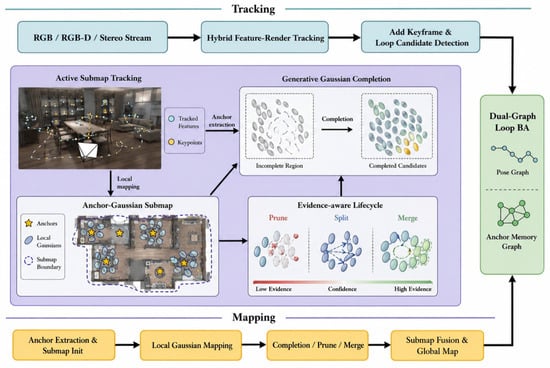
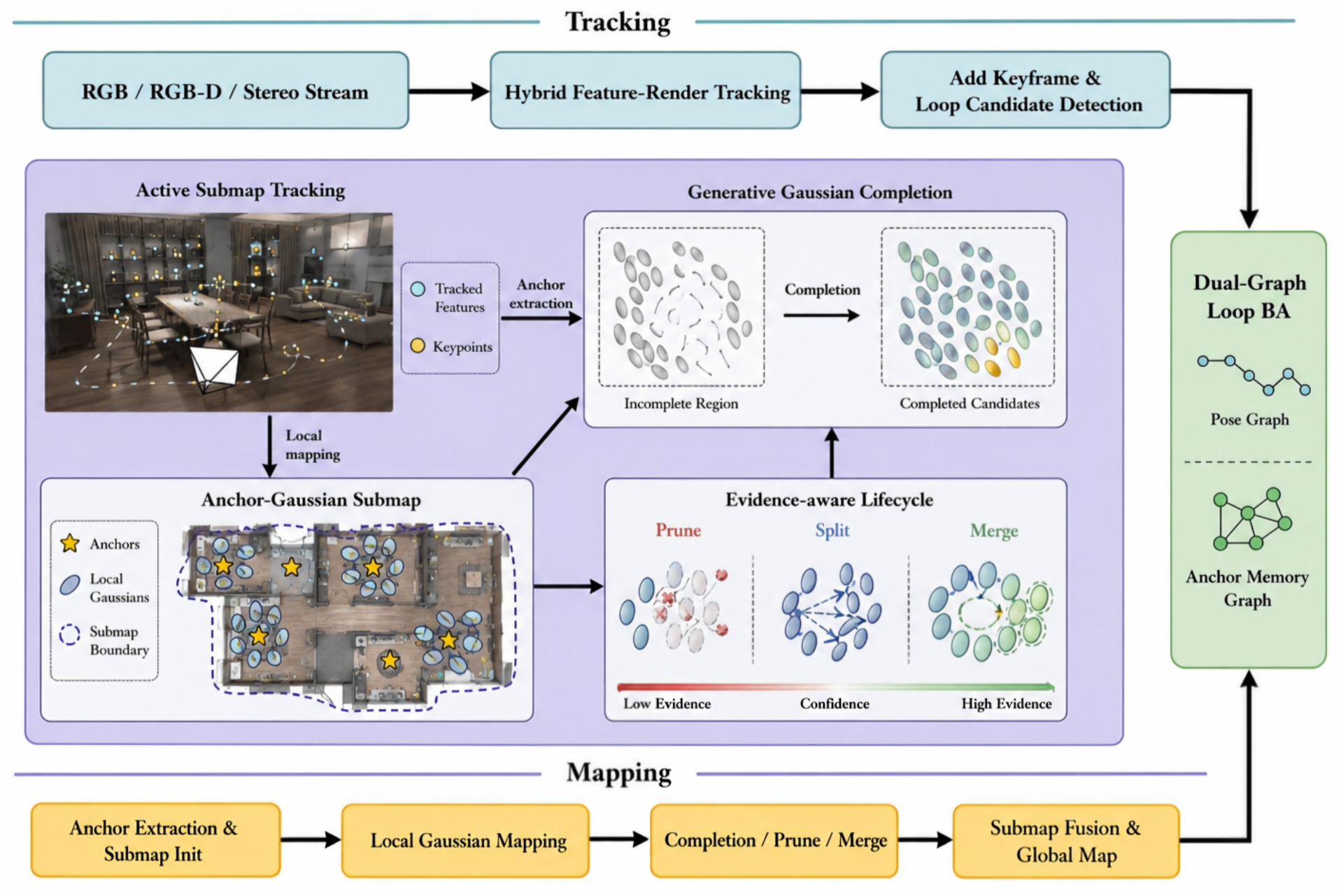
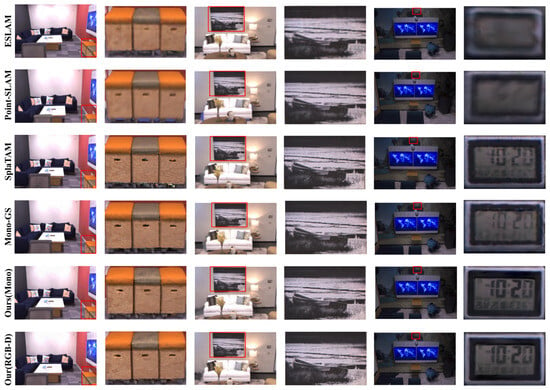
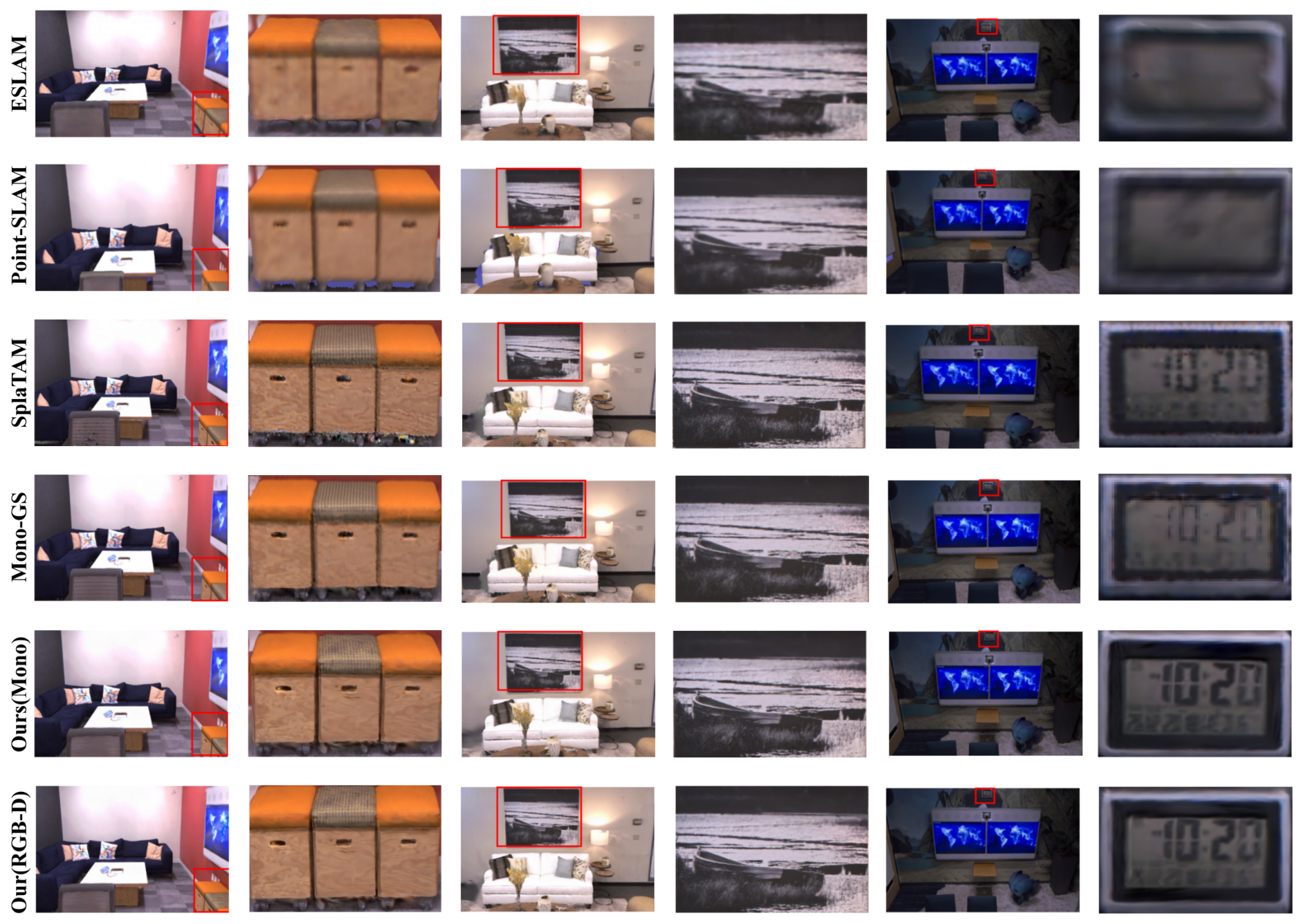
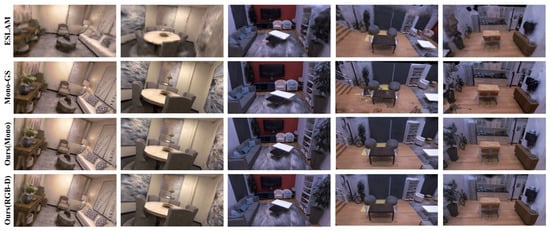
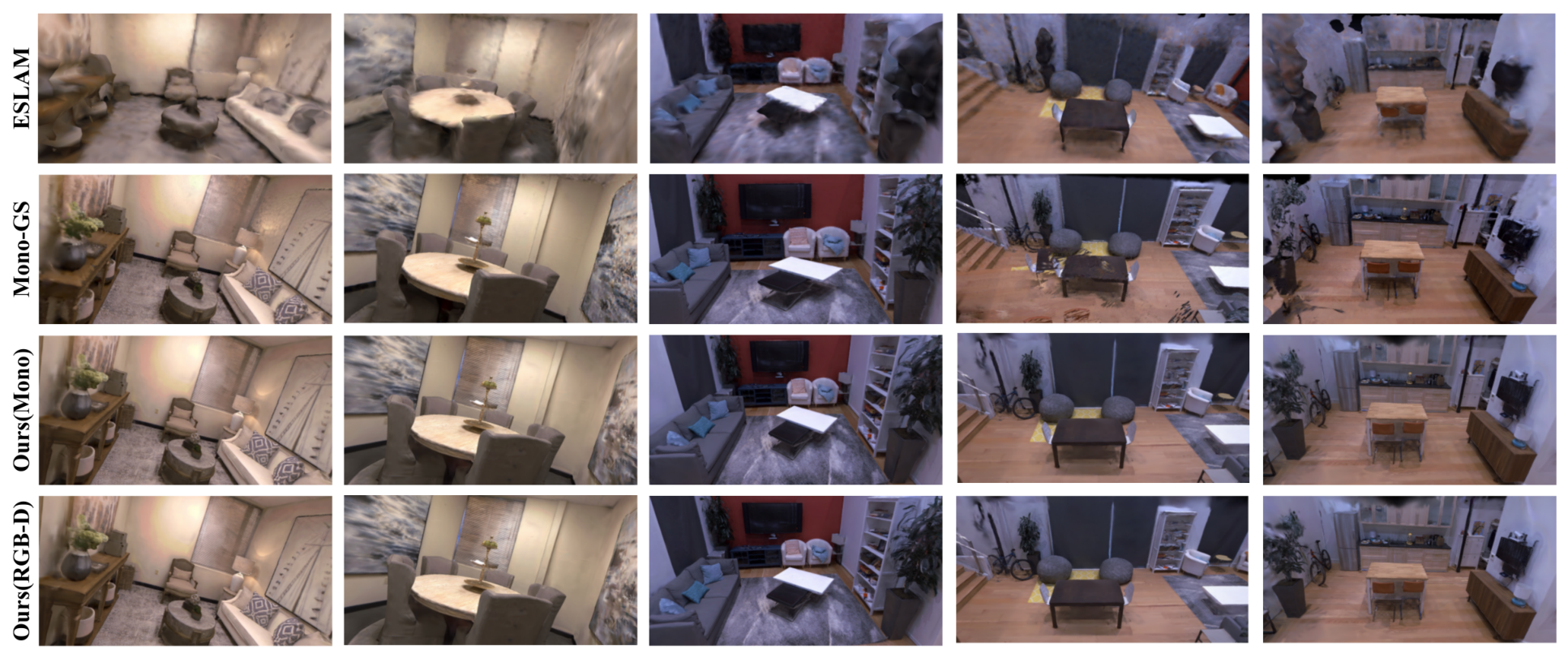
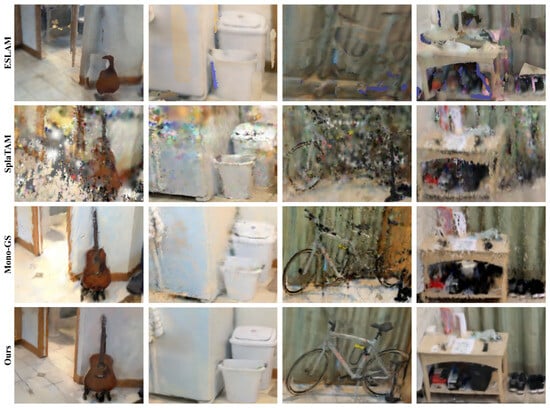
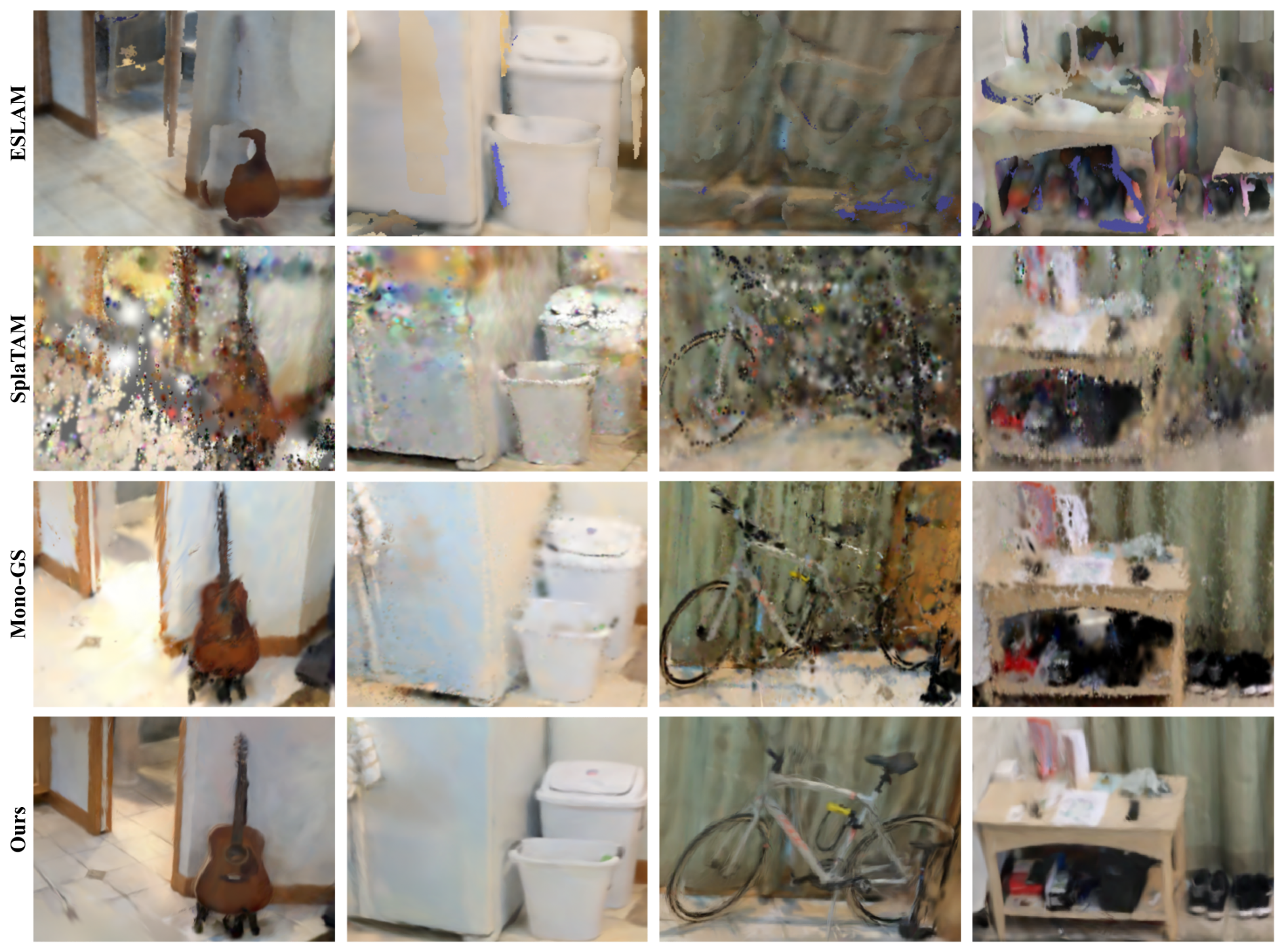

Disclaimer/Publisher’s Note: The statements, opinions and data contained in all publications are solely those of the individual author(s) and contributor(s) and not of MDPI and/or the editor(s). MDPI and/or the editor(s) disclaim responsibility for any injury to people or property resulting from any ideas, methods, instructions or products referred to in the content. |
© 2026 by the authors. Licensee MDPI, Basel, Switzerland. This article is an open access article distributed under the terms and conditions of the Creative Commons Attribution (CC BY) license.