


1. Introduction
Human Papillomavirus (HPV) is a DNA virus, belonging to papillomaviridae family. Its role in ethiopathogenesis of ano-genital cancers has been largely documented. On the contrary, HPV status in Oropharyngeal Squamous Cell Carcinoma (OPSCC) presents several controversies, supporting by a substantial heterogeneity in HPV prevalence among studies and clinical reports. These uncertainties are primarily related to two strongly interconnected reasons:
- a non-univocal topographical classification of the OPSCC;
- an extreme heterogeneity of the diagnostic procedures used to detect HPV status [1].
In respect to the last issue, there are several techniques to investigate HPV in human samples, with advantages and disadvantages related to clinical applicability and sensitivity/specificity in relation to HPV oncological activity. Polymerase Chain Reaction (PCR) is the most sensitivity and widely used method to detect and to genotype HPV. However, p16 immunohistochemistry (IHC) is considered a more versatile tool to indirectly measure the HPV transcriptional activity. For these reasons, its use was proposed by the 8th edition of TNM classification to stage the Head and Neck Squamous Cell Carcinomas (HNSCCs), in relation to a better prognosis of HPV positive (+ve) OPSCC recently supported in literature [2,3]. However, there are several studies reporting the low specificity of p16 IHC in relation to HPV status, potentially conditioning the appropriate treatments of patients with OPSCCs [4,5]. In this scenario, the aim of this abstract is to report a case of patient with p16 negative (-ve) OSCC, with HPV positivity by PCR investigation both in histological and on cytological samples.
2. Case Report
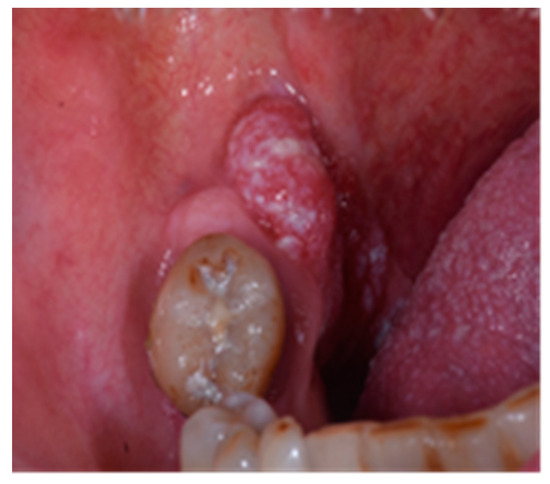
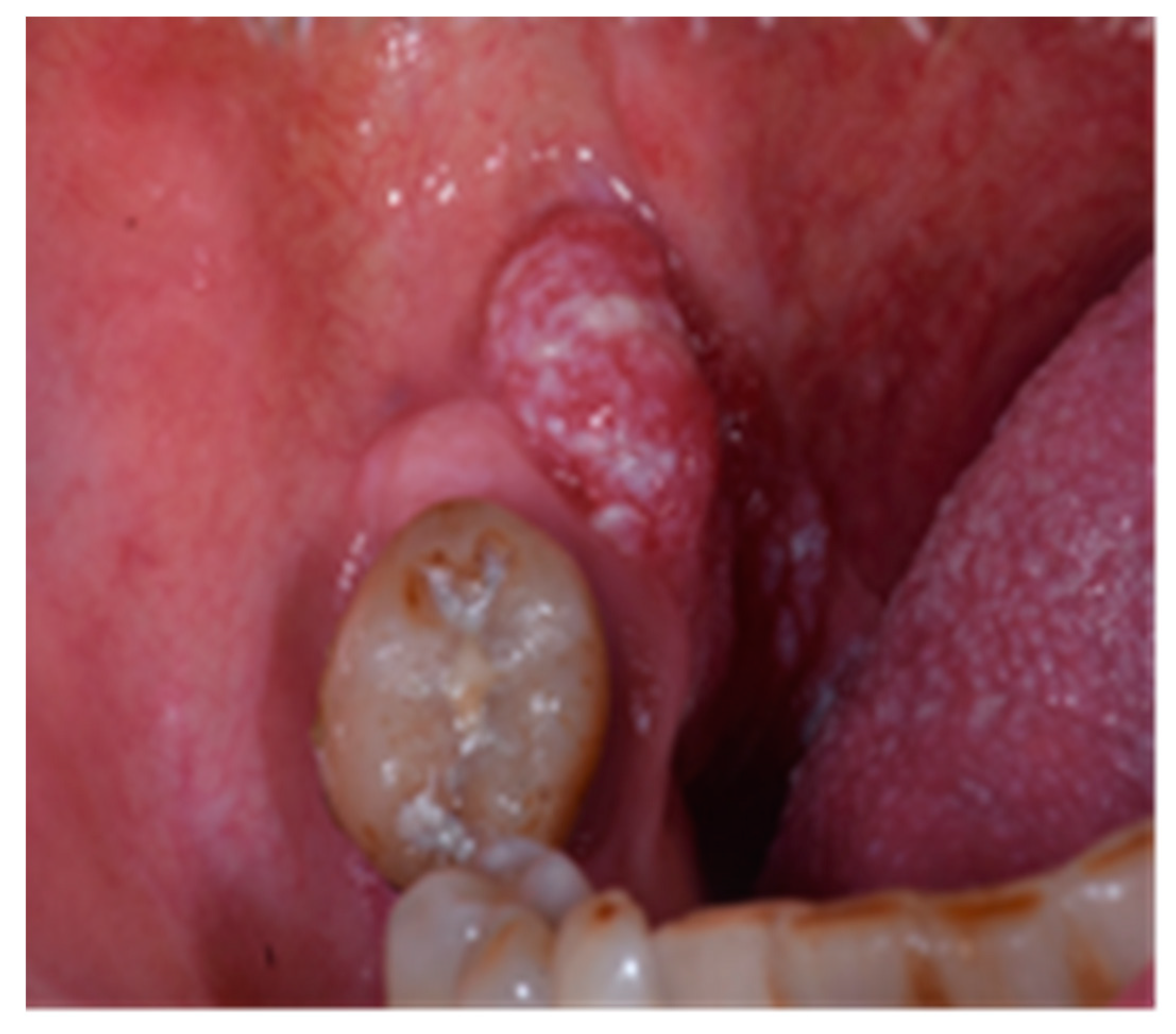
A Caucasian man of 61-years old, with any diseases or comorbidities noteworthy, referred to our Unit of Oral Medicine (Di.Chir.On.S./UNIPA) for the diagnostic assessment of a asymptomatic verrucous lesion localized at the right retromolar trigon (Figure 1).
Figure 1.
Verrucous lesion localized at the right retromolar trigon.
After informed consent, the patient underwent to: (i) oral rinse for HPV investigation (by PCR); and (ii) incisional biopsy both for HPV identification (by PCR and p16 IHC) and histological diagnosis. For PCR investigation, the HPV-DNA was extracted from oral rinse and biopsy sample with the use of the QIAamp Mini Kit (Qiagen). HPV genotypes were identified by the Ampliquality HPV-type express v3.0.
The histological reports was: squamous carcinoma/p16 IHC-ve.
On the contrary the microbiological examinations indicate a HPV positive status, supported by HR (High Risk) genotype 67 in both examined samples.
3. Conclusions
We report a case of confirmed diagnosis of HPV-DNA+ve/p16-ve OSCC at the right retromolar trigon. Exclusively according to the results of p16 IHC, the patient would have been resulted as negative HPV OSCC with a specific treatment. On the contrary, the use of more accurate technique of HPV investigation, highlighted a HPV-HR positivity.
This status, in addition to other therapeutic and monitoring oncological approaches potentially prospective, presupposes a specific management of the infectious condition (i.e., genital investigation, also for the partner/s) which, in the absence of the supplementary microbiological investigations conducted, would have been precluded.
In conclusion, it would be appropriate to consider, particularly for SCC in proximity to oropharyngeal areas, the necessity to use a combination of techniques (not only p16 IHC) for HPV status identification.
Conflicts of Interest
The authors declare no conflict of interest.
References
- Lo Muzio, L.; Pelo, S. Il Carcinoma Orale; Grilli Editore: Foggia, Italy, 2009; pp. 58–63. [Google Scholar]
- Huang, S.H.; O’Sullivan, B. Overview of the 8th Edition TNM Classification for Head and Neck Cancer. Curr. Treat. Options Oncol. 2017, 18, 40. [Google Scholar] [CrossRef] [Scilit] [PubMed]
- Doescher, J.; Veit, J.A.; Hoffmann, T.K. The 8th edition of the AJCC Cancer Staging Manual: Updates in otorhinolaryngology, head and neck surgery. HNO 2017, 65, 956–961. [Google Scholar] [CrossRef] [Scilit] [PubMed]
- Junor, E.; Kerr, G. Benefit of chemiotherapy as part of treatment for HPV-DNA-positive but p16-ve squamous cell carcinoma of the oropharynx. Br. J. Cancer 2012, 106, 358–365. [Google Scholar] [CrossRef] [Scilit] [PubMed]
- Qureishi, A.; Mawby, T.; Fraser, L.; Shah, K.A.; Møller, H.; Winter, S. Current and future techniques for human papilloma virus (HPV) testing in oropharyngeal squamous cell carcinoma. Eur. Arch. Otorhinolaryngol. 2017, 274, 2675–2683. [Google Scholar] [CrossRef] [Scilit] [PubMed]
Publisher’s Note: MDPI stays neutral with regard to jurisdictional claims in published maps and institutional affiliations. |
© 2019 by the authors. Licensee MDPI, Basel, Switzerland. This article is an open access article distributed under the terms and conditions of the Creative Commons Attribution (CC BY) license (https://creativecommons.org/licenses/by/4.0/).