


1. Introduction
Clinical studies have demonstrated the effectiveness of low-level laser therapy (LLLT) in patients with unresponsive oral lichen planus (OLP). OCT can reveal, in real time, the architecture of epithelial and sub-epithelial tissues and surrounding structures [1]. Aim of the present work was to assess the in-vivo changes of oral mucosa before and after LLLT treatment in a patient affected by erosive OLP.
2. Methods
OCT: a recent variant of a commercial frequency domain OCT dermatological instrument (SS-OCT, VivoSight®, version 2.0, Kent, UK) was deployed with a novel probe manufactured specifically for oral cavity. Length of probe = 124 mm; probe shaft diameter = 15 mm. Field of view = 6 mm2. Dynamic scans—duration = 30 s, 120 frames, depth = 6 mm − allowing hyporeflectiveness to be displayed as red area, were deployed. OCT scans were carried out before biopsy, and before/after each LLLT session.
LLLT: 980 nm diode laser (Raffaello DMT Italy) was kept perpendicularly at 2 mm from the area of irradiation, with the following parameters: application time for each point = 16 s; total energy = 4 J; output power = 250 mW; power density = 500 mW/cm2; energy density = 8 J/cm2; spot size = 0.5 cm2. A “spot” technique with slight overlapping was performed.
Patient: 74 years-old female, affected by histologically confirmed OLP, undergoing one weekly session of LLLT until complete clinical healing, for an atrophic-erosive cheek lesion of 1 cm2, unresponsive to topical steroids.
3. Results
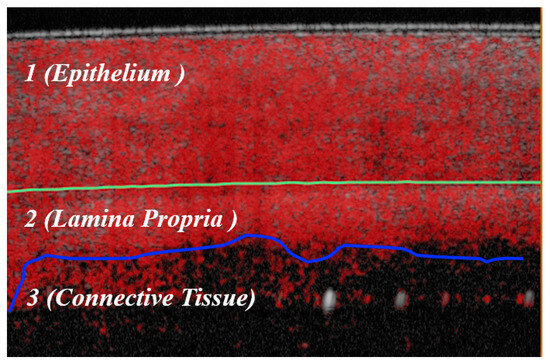
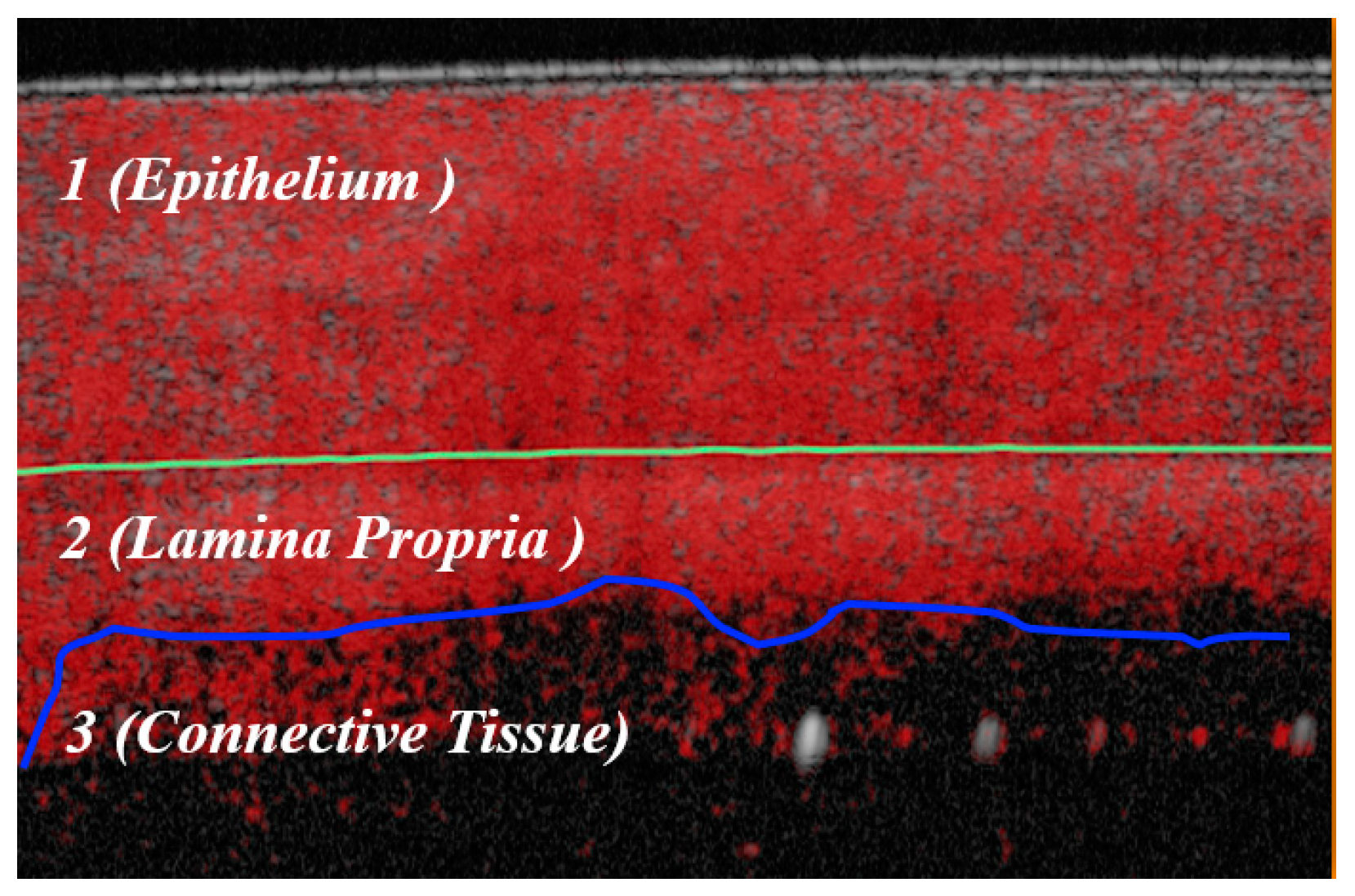
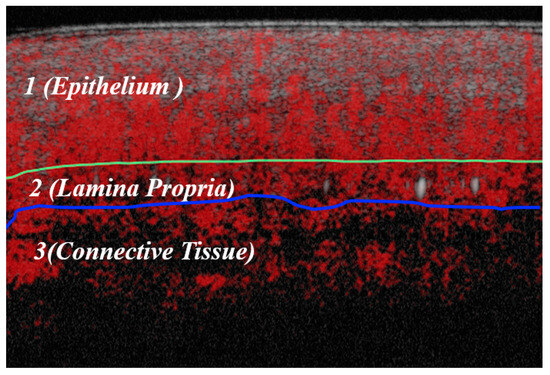
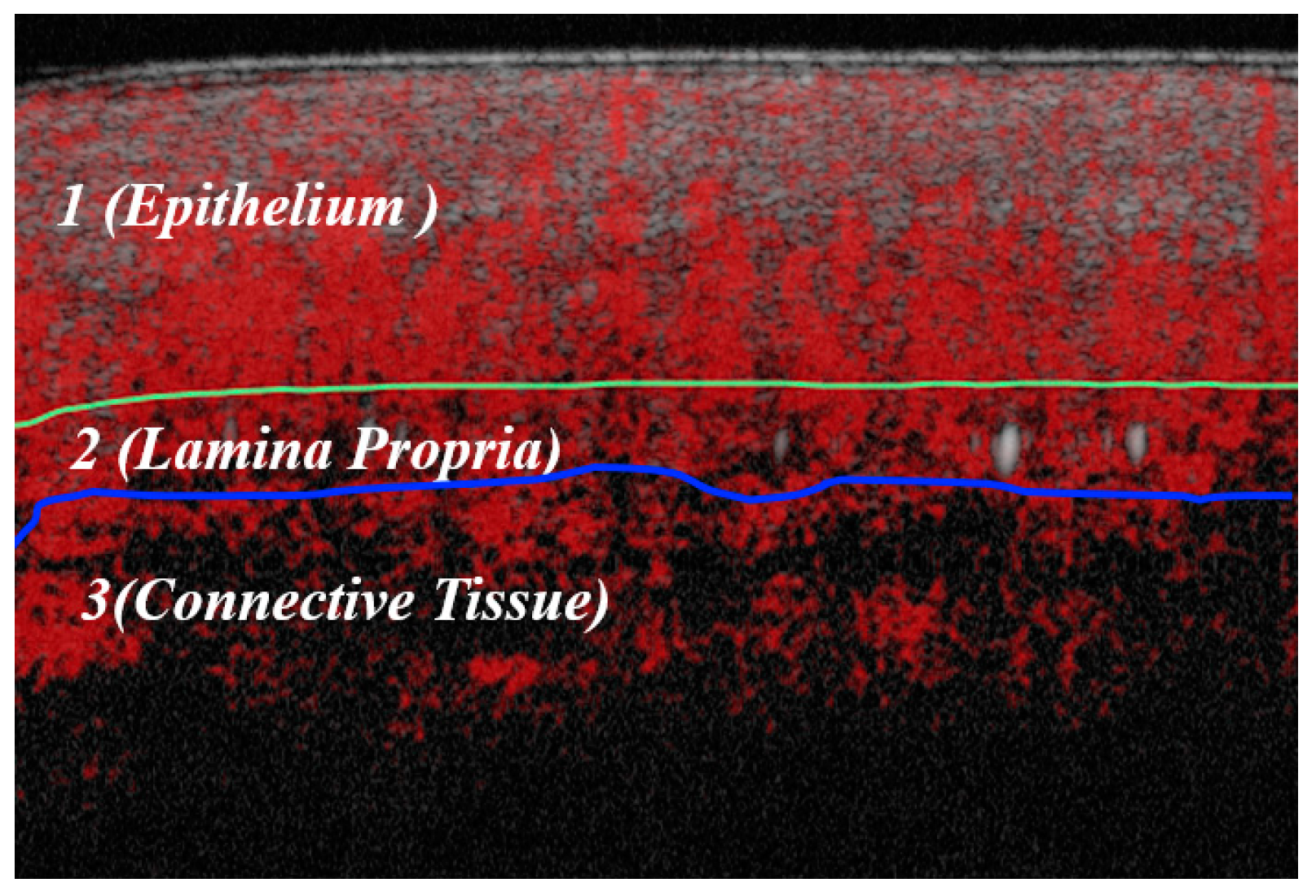
Before biopsy OCT revealed a wide red hyporeflective area beneath and above the basement membrane (BM, green line in Figure 1). Comparison between biopsy specimen and OCT scan suggested that hyporeflectiveness beneath BM might be ascribed to an uprising of the blood flow in the inflamed connective tissue, whereas above BM, hyporeflectiveness might be attributed to the edema within the epithelial layers. Immediately after the first LLLT session, despite any detectable clinical modifications, OCT revealed a decrease of the hyporeflectiveness of the upper third of the epithelium (Figure 2). After the second LLLT session, OCT showed a supplementary decrease of the red area beneath and above BM. Finally, after the third LLLT session, clinical healing was accomplished, with OCT showing a homogeneous red zone limited to the area beneath BM, whereas epithelium regained a usual hyper-reflective gray pattern intertwined with red spikes.
Figure 1.
OCT dynamic scan of the cheek lesion before biopsy, showing widespread red hyporeflective areas both in Epithelium and Lamina Propria.
Figure 2.
OCT dynamic scan of the cheek lesion immediately after the first LLLT session, showing a decrease of the hyporeflectiveness of the upper third of the epithelium.
To our knowledge, this is the first evidence of application of OCT in oral medicine as an additional tool to assess LLLT reliability for OLP. Interestingly, OCT seemed to reveal modifications of the epithelial ultrastructure before the appearance of visible clinical changes. Larger samples of OLP patients should be tested to assess the validity of these preliminary results.
Acknowledgments
Thanks to Vivosight® for leasing of the OCT.
Conflicts of Interest
The Authors declare no conflict of interest.
Reference
- Standish, B.A.; Lee, K.K.; Mariampillai, A.; Munce, N.R.; Leung, M.K.; Yang, V.X.; Vitkin, I.A. In vivo endoscopic multi-beam optical coherence tomography. Phys. Med. Biol. 2010, 55, 615. [Google Scholar] [CrossRef] [Scilit] [PubMed]
© 2019 by the authors. Licensee MDPI, Basel, Switzerland. This article is an open access article distributed under the terms and conditions of the Creative Commons Attribution (CC BY) license (http://creativecommons.org/licenses/by/4.0/).