


Cannabis sativa L. (hemp) is a unique versatile plant, which can provide high biomass quantities in a short time [1] and has been known since ancient times for its medicinal and textile uses [2]. Some biological activities of cannabinoids (the most studied class of hemp compounds) are known to be enhanced by the presence of terpenes and flavonoids in the extracts, due to a synergistic action [3]. The purpose of this research was to investigate the polyphenols and terpenes content of underused plant parts (root, hulled seeds, aerial parts, fiber, grist) of industrial hemp.
Hemp raw material was gifted by a grower from the northeastern area of Romania. The extracts from different plant parts (root, hulled seeds, aerial parts, fiber, grist) were prepared by (a) maceration with ethyl alcohol and (b) ultrasound extraction with ethyl alcohol 50%. The polyphenols and terpenes contents were evaluated by high performance thin-layer chromatography (HPTLC) using specific solvents systems [4].
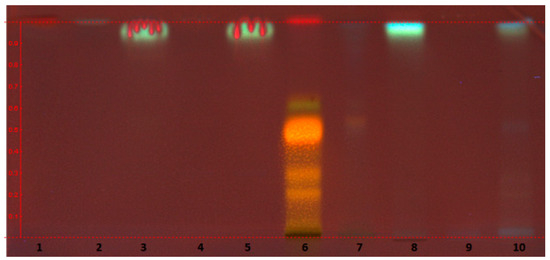
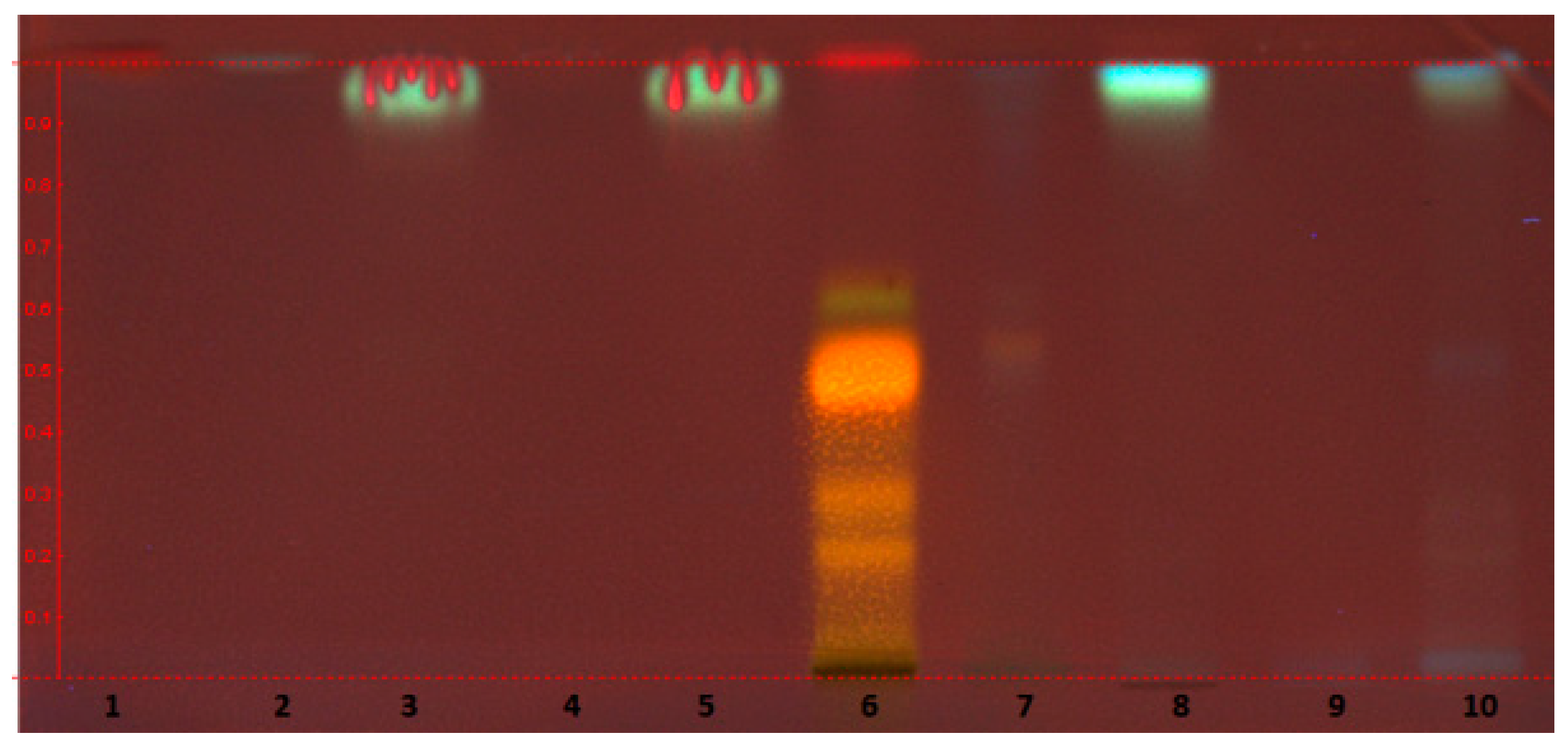
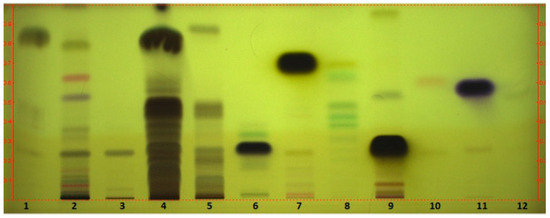
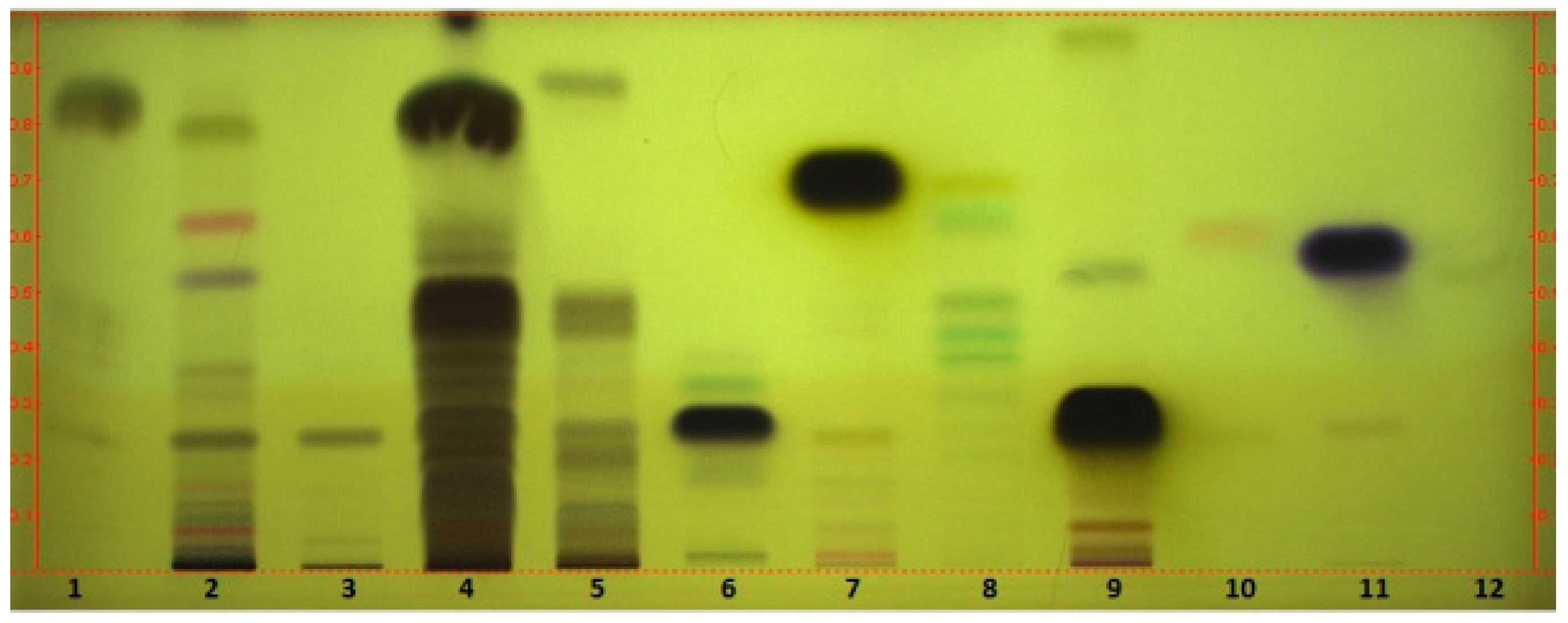
Results showed a high content of flavonoid glycosides in the hydroalcoholic extract of hemp aerial parts. In the alcoholic extracts, aglycones were present in fiber and grist (Figure 1). As regards terpenes fingerprint (Figure 2), mostly dehulled seeds contain high amounts of important compounds.
Figure 1.
HPTLC fingerprint of polyphenols in hemp ethyl alcohol extracts (tracks 1—aerial parts, 2—root, 3—fiber, 4—dehulled seeds, 5—grist) and hydroalcoholic extracts (tracks 6—aerial parts, 7—root, 8—fiber, 9—dehulled seeds, 10—grist).
Figure 2.
HPTLC fingerprint of terpenes in hemp ethyl alcohol extracts (tracks 1—fiber, 2—aerial parts, 3—root, 4—dehulled seeds, 5—grist) in comparison to reference compounds (tracks 6—terpineol, 7—geranyl acetate, 8—limonene, 9—geraniol, 10—thymol, 11—caryophyllene oxide, 12—beta-pinene).
Important bioactive compounds are present in the underused plant parts that could be converted into value-adding products for a complete valorization of industrial hemp.
Acknowledgments
This research was financially supported by the Ministry of Research and Innovation in the frame of the project PN.16.41.01.01/2018, CORE Program.
References
- Andre, C.; Hausman, J.-F.; Guerrier, G. Cannabis sativa: The Plant of the Thousand and One Molecules. Front. Plant Sci. 2016, 7, 19. [Google Scholar] [CrossRef] [Scilit] [PubMed]
- Skoglund, G.; Nockert, M.; Holst, B. Viking and early Middle Ages northern Scandinavian textiles proven to be made with hemp. Sci. Rep. 2013, 3, 2686. [Google Scholar] [CrossRef] [Scilit] [PubMed]
- Pellati, F.; Brighenti, V.; Sperlea, J.; Marchetti, L.; Bertelli, D.; Benvenuti, S. New Methods for the Comprehensive Analysis of Bioactive Compounds in Cannabis sativa L. (hemp). Molecules 2018, 23, 2639. [Google Scholar] [CrossRef] [Scilit] [PubMed]
- Wagner, H.; Bladt, S. Plant Drug Analysis, 2nd ed.; Springer Science & Business Media: Berlin, Germany, 1996; pp. 195–245. [Google Scholar]
© 2019 by the authors. Licensee MDPI, Basel, Switzerland. This article is an open access article distributed under the terms and conditions of the Creative Commons Attribution (CC BY) license (https://creativecommons.org/licenses/by/4.0/).