


Abstract
Correctional education research has largely examined recidivism and vocational outcomes, leaving degree-level higher education delivery in secure environments comparatively under-studied. This paper extends a conference abstract into a descriptive case study of the Singapore University of Social Sciences (SUSS) Prison School Project, a partnership with the Singapore Prison Service that operationalises Sustainable Development Goal (SDG) 4 (Quality Education) and SDG 10 (Reduced Inequalities) for incarcerated learners. Drawing on programme documentation, policy artefacts, and stakeholder accounts, we describe the project’s governance model, a conceptual model linking its Programme Design to multimodal, cross-sectoral delivered outcomes, and its hybrid digital–offline delivery modes (face-to-face, online synchronous, and asynchronous). Since July 2020, the project has enrolled 35 incarcerated students and engaged more than 50 volunteer faculty; of these, 12 students have since been released and are continuing their studies on campus as part-time degree students, evidencing a successful transition pathway from custodial to mainstream higher education. The case study offers a scalable, cross-sector model for prison higher education in Southeast Asia and identifies longitudinal tracking of graduate and recidivism outcomes as a priority for future research.
1. Introduction
Education is widely recognised as a powerful determinant of social mobility and reintegration, yet research on sustainability education has concentrated largely on environmental literacy, youth programmes, and workplace transformation. Correctional education research, in turn, has focused mainly on recidivism outcomes and vocational training [1,2], with comparatively few studies examining degree-level higher-education delivery models in secure environments [3]. Far less attention has been given to how higher education institutions can operationalise Sustainable Development Goal (SDG) 4 (Quality Education) and SDG 10 (Reduced Inequalities) for justice-involved populations.
The research gap addressed in this paper lies in understanding how universities can design inclusive, technology-enabled, and secure learning ecosystems that allow incarcerated individuals to access degree-level education and sustain learning continuity post-release. This aligns with calls in the literature to bridge the digital divide in custodial settings through secure, offline-capable learning infrastructure [4,5] and with the United Nations Educational, Scientific and Cultural Organization (UNESCO)’s positioning of prison higher education as an under-operationalised lever for SDG 4 and SDG 10 [6]. This paper extends a conference abstract presented at WSF-12 into a fuller descriptive case study of the Singapore University of Social Sciences (SUSS) Prison School Project. Section 2 situates the project within the literature; Section 3 outlines the case study methodology; Section 4 describes the project’s governance, curriculum, and delivery model; Section 5 and Section 6 present findings and discussion; and Section 7 concludes with implications and future work.
2. Literature Review
Sustainability education scholarship has traditionally centred on environmental stewardship, with social sustainability—particularly the inclusion of marginalised and justice-involved populations—receiving comparatively limited attention. Extending sustainability education to correctional settings requires engaging with a distinct body of literature on rehabilitation, reintegration, and secure learning infrastructure.
Correctional education research has predominantly examined the relationship between educational participation and recidivism and between vocational training and post-release employment [1,2]. Systematic reviews of rehabilitation and re-entry programmes report that multi-sector ecosystems—combining academic, financial, and social support—are associated with stronger reintegration outcomes than single-agency interventions [1], a finding consistent with Singapore’s Yellow Ribbon reintegration network. However, degree-level higher-education delivery within secure environments remains comparatively under-examined [3], with most published case studies drawn from North American college-in-prison programmes [2,3].
A second strand of literature addresses the digital divide in custodial settings. Restricted internet access in correctional facilities necessitates offline-capable or tightly controlled digital infrastructure, and policy frameworks have called for secure technology ecosystems purpose-built for correctional education [4,5]. Empirical work linking secure digital access to improved re-entry outcomes reinforces the case for investment in this infrastructure [7], even where access remains partial or supervised.
Finally, international bodies increasingly frame prison higher education as an under-operationalised lever for sustainable development. UNESCO has argued that degree-level access for incarcerated learners advances both educational equity (SDG 4) and the reduction of structural inequality (SDG 10) [6], while research on education programmes for incarcerated populations in other regional contexts underscores the role of social workers and institutional partners in sustaining access [8]. This paper responds to these calls by documenting an operational, cross-sector model from a Southeast Asian setting—a context largely absent from the existing case-study literature [2,3].
Recent comparative and applied studies reinforce this gap. A five-country policy analysis of higher education in prison across Australia, Nigeria, South Africa, the United Kingdom, and the United States finds that funding structures and educational delivery methods, rather than stated programme goals, are what most shape access for incarcerated learners [9], underscoring the practical, operational level at which this paper’s contribution is pitched. Work on multimodal learning design in institutional corrections settings similarly argues that blended instructional strategies, rather than a single delivery channel, are needed to revitalise correctional education across online and traditional formats [10], a design principle this paper operationalises directly through its three-mode delivery policy. Finally, emerging knowledge-management framings of prison higher education highlight the value of structured, cross-sector partnerships and systematic graduate tracking for sustaining reintegration outcomes beyond the custodial period [11], a direction this paper identifies as a priority for future work in Section 7. None of these studies, however, examines a Southeast Asian, university-led model in which a single coordinating point of contact and a differentiated, parity-preserving delivery policy are used jointly to sustain small and variable in-custody cohorts, which is the specific contribution of the present case study.
3. Materials and Methods
This study uses a descriptive case study approach to examine the SUSS Prison School Project as an operational model of sustainability education. The analysis draws on programme documentation and policy artefacts (including delivery-mode and remuneration policy, and internal operational guidance), internal enrolment records covering the period 2020–2025, and qualitative insights gathered from faculty and institutional partners involved in programme design and delivery. It also draws on the ecosystem partnership structures linking SUSS with the Singapore Prison Service and the Yellow Ribbon reintegration network.
The analysis examines three dimensions of the project: (i) governance and cross-sector partnership structures; (ii) curriculum design and multi-modal pedagogy, including the hybrid digital–offline learning design tailored to secure environments; and (iii) student support and reintegration pathways. Consistent with the exploratory, single-institution nature of this case study, only enrolment and staffing figures that could be verified against internal programme records are reported; historical and demographic figures that could not be independently verified at the time of writing have been excluded rather than estimated.
4. The Singapore University of Social Sciences Prison School Project: Programme Design
The SUSS Prison School Project is a partnership between the Singapore University of Social Sciences (SUSS) School of Business and the Singapore Prison Service that delivers accredited, degree-level business education to incarcerated learners. The project offers three business majors—Logistics and Supply Chain Management, a second logistics-track major, and a marketing major—and is designed around three principles: educational parity with campus-based delivery, security-compliant operation, and sustainable cost management for small cohorts.
4.1. Governance and Cross-Sector Partnerships
Programme delivery is coordinated across academic and administrative functions of the School of Business, spanning admissions, learning support, student records, examinations, and library and technology services, among others. A designated Prison School coordinator serves as the single external point of contact for all student-facing communication, providing a consistent interface between the university, the Singapore Prison Service, and the incarcerated student cohort. Beyond the coordinating institution, delivery draws on more than 50 volunteer faculty across disciplines, including accounting, applied economics, marketing, and business analytics, reflecting a cross-disciplinary staffing model that would be difficult to sustain without institutional volunteering.
4.2. Curriculum and Delivery Modes
Courses follow a standard structure of six three-hour seminars (18 contact hours) built around shared master materials common to on-campus delivery, preserving parity of content and assessment across the incarcerated and general student populations. To accommodate small and variable cohort sizes within a secure environment, the project operates under a finalised delivery-mode policy that defines three modes of delivery, summarised in Table 1.
Table 1.
Delivery modes governing course provision under the SUSS Prison School Project.
4.3. Student Support and Reintegration Pathways
Onboarding incarcerated students involves additional identity-verification, security-clearance, and software-access procedures coordinated across several university departments before a student may begin coursework, reflecting the security-compliant nature of the delivery model. A self-study pilot, launched in early 2025, extended the project’s flexibility further by allowing structured independent study to be paired with periodic tutor consultation, providing an additional access pathway for students for whom regular scheduled sessions are not feasible. Reintegration support draws on Singapore’s Yellow Ribbon ecosystem, connecting academic progress with post-release pathways into further study or employment.
5. Results
As of the most recently verified programme records, the SUSS Prison School Project has enrolled 35 incarcerated students and engaged more than 50 volunteer faculty across multiple business disciplines. The project enhances social sustainability by enabling educational continuity during incarceration and after release through flexible, part-time degree pathways unique to SUSS among providers operating in this environment.
The technology-enabled but security-compliant learning model supports academic rigour despite restricted internet access, consistent with emerging correctional-education technology frameworks [5] and with offender e-learning findings linking secure digital access to improved re-entry outcomes [7]. The three-mode delivery policy, and its underlying prudence–parity–remuneration principles, allows the project to sustain small-cohort courses (including single-student asynchronous delivery) without compromising the parity of materials, assessment, or instructor quality relative to face-to-face delivery.
Cross-agency partnerships with the Singapore Prison Service and the Yellow Ribbon ecosystem provide academic, administrative, and reintegration support, addressing structural barriers to higher-education access identified in the wider rehabilitation literature [1]. Systematic longitudinal outcome data—including course completion rates and post-release recidivism—are not yet available for this cohort and are identified as a priority for future data collection rather than estimated here.
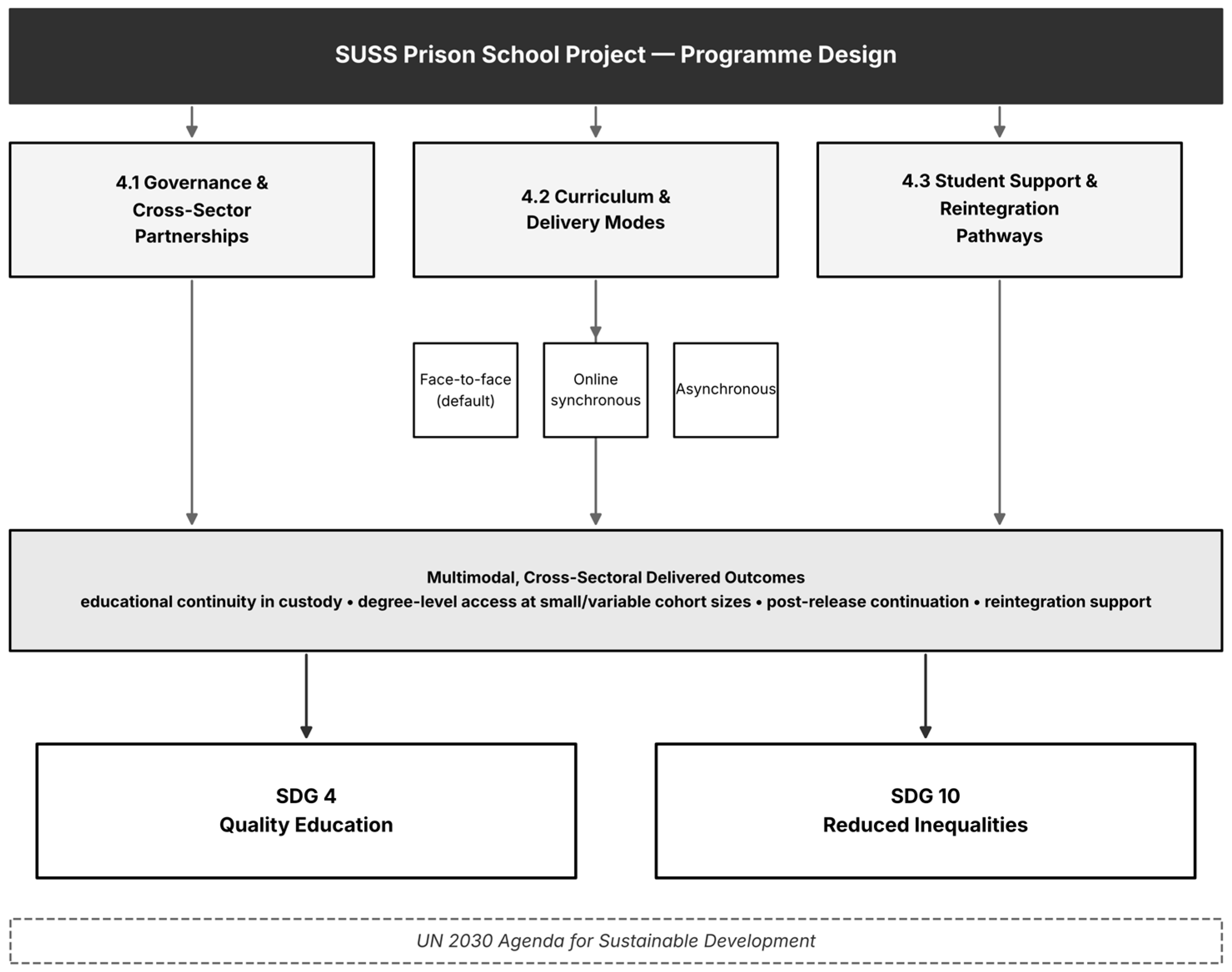
Beyond in-custody enrolment, the project also evidences a successful transition pathway: of the 35 students who have participated since July 2020, 12 have been released and are continuing their studies on campus as part-time degree students, balancing full-time employment with evening classes. This continuity from custodial to mainstream delivery is a concrete, cross-sectoral outcome of the conceptual model in Figure 1 and illustrates how the governance, delivery-mode, and student-support components of the Programme Design jointly sustain access across the custody-to-release transition, not only within it.
Figure 1.
Conceptual model linking the Singapore University of Social Sciences (SUSS) Prison School Project Programme Design (Section 4.1, Section 4.2 and Section 4.3) to its multimodal, cross-sectoral delivered outcomes and to the Sustainable Development Goals (SDGs) of the United Nations 2030 Agenda for Sustainable Development that the project operationalises.
6. Discussion
The SUSS Prison School Project extends case-based evidence from comparable college-in-prison models [2,3] to a Southeast Asian, cross-sector context, illustrating how a single coordinating point of contact, shared master materials, and a differentiated but parity-preserving delivery policy can support degree-level access at small and variable cohort sizes—a structural constraint that is common in correctional education but rarely addressed explicitly in the literature on delivery-mode design.
In SDG terms, the project operationalises SDG 4 by extending accredited, degree-level access to a population typically excluded from higher education, and SDG 10 by reducing structural barriers linked to incarceration status. The prudence–parity–remuneration framework underlying the delivery-mode policy offers a transferable governance mechanism: it demonstrates that cost containment for small-cohort secure delivery can be achieved through scheduling and session structure rather than through reduced instructional quality or pay, addressing a practical barrier—sustaining faculty participation at a viable cost—that is rarely made explicit in prior case studies [2,3].
Beyond its contribution to delivery-mode design, the case illustrates several further avenues through which prison higher education can function as a site of innovation. First, for regional policy development, the project demonstrates a scalable institutional template that ministries of education and correctional services elsewhere in Southeast Asia could adapt, particularly where small and variable in-custody cohorts make conventional classroom delivery impractical. Second, the single-coordinator governance model and the cross-agency partnership with the Singapore Prison Service and the Yellow Ribbon ecosystem offer a transferable approach to stakeholder engagement, in which academic, correctional, and reintegration-support functions are held together by one accountable interface rather than distributed informally across departments. Third, the transition of 12 released students into part-time, campus-based study points to accessibility and successful transition as measurable programme outcomes in their own right, not merely as stated aspirations—and suggests prison higher education can be evaluated on its capacity to sustain learners across, not only within, the custody boundary. Fourth, the reliance on more than 50 volunteer faculty across disciplines suggests the emergence of an informal community of practice around teaching in secure environments, with implications for pedagogy and student support services that merit dedicated study in their own right. Finally, the model’s grounding in a government-linked prison service and a university’s existing reintegration network illustrates how cross-border and cross-sectoral partnerships, even within a single national context, can be structured to support degree-level access—a template with potential relevance beyond Singapore’s own correctional and social-work settings.
This study has limitations common to single-institution descriptive case studies. Findings are drawn from one project within one national context, and generalisability to other correctional systems should be treated cautiously. Some historical enrolment and demographic figures referenced in earlier internal project documentation could not be independently verified at the time of writing and have therefore been omitted rather than reported. Longitudinal outcome data, including post-release recidivism and further-study rates, were not yet available and represent an important direction for future work.
7. Conclusions and Future Work
The SUSS Prison School Project demonstrates how sustainability education can extend beyond environmental priorities to address social inclusion and resilience. By embedding SDG 4 and SDG 10 into institutional practice through a single-point-of-contact coordination model, a parity-preserving multi-mode delivery policy, and cross-agency reintegration support, the project offers a scalable model for universities seeking to translate sustainability commitments into tangible social impact.
Future work should track graduate outcomes and recidivism longitudinally and test the transferability of the delivery-mode and governance model to other correctional and social-work settings in the region [8]. Establishing shared, privacy-preserving outcome-tracking mechanisms across university and correctional-service partners would also strengthen the evidence base for prison higher education as a lever for SDG 4 and SDG 10 across Southeast Asia.
Author Contributions
Conceptualization, H.L.T.; methodology, H.L.T. and H.S.; investigation, H.L.T., A.C.B.H. and H.S.; resources, H.L.T.; writing—original draft preparation, H.L.T.; writing—review and editing, A.C.B.H. and H.S.; project administration, H.L.T. All authors have read and agreed to the published version of the manuscript.
Funding
This research received no external funding.
Institutional Review Board Statement
Not applicable. This study is a descriptive case analysis of institutional programme documentation and did not involve identifiable data from incarcerated learners, experimental intervention, or primary human-subjects data collection beyond informal consultation with staff and institutional partners.
Informed Consent Statement
Not applicable, as the study did not involve identifiable data from incarcerated learners; all enrolment and staffing figures are reported in aggregate.
Data Availability Statement
The datasets presented in this article are not readily available because they comprise internal programme records subject to confidentiality and security requirements. Requests to access the datasets should be directed to the corresponding author.
Acknowledgments
The authors thank the Singapore Prison Service and the Yellow Ribbon reintegration network for their partnership, and the volunteer faculty of the SUSS School of Business for their contribution to the Prison School Project. During the preparation of this manuscript, the authors used Claude (Anthropic) to assist with structuring and drafting portions of the manuscript text from author-provided programme documentation and conference abstract content. The authors have reviewed and edited the output and take full responsibility for the content of this publication.
Conflicts of Interest
The authors declare no conflicts of interest.
References
- Negi, S.; Chatterjee, D.; Tripathy, S.; Udhaya, E.; Kumar, D.; Mehta, V. Rehabilitation and re-entry programmes for justice-involved individuals and their effectiveness in social reintegration: A systematic review. Int. J. Offender Ther. Comp. Criminol. 2026. advance online publication. [Google Scholar] [CrossRef] [Scilit] [PubMed]
- Romero-Carazas, R.; Del Carpio-Delgado, F.; Espinoza-Casco, R.J.; Bernedo-Moreira, D.H.; Morales-García, W.C.; Rodríguez-Asto, R.A.A.; Quiñones-Ormeño, L.K. Prison education in the resocialization of incarcerated individuals. Front. Educ. 2025, 10, 1592692. [Google Scholar] [CrossRef] [Scilit]
- Suzuki, H.; Begeny, J.C. College on the margins: A comprehensive case study of three college-in-prison programs in the Southern United States. Behav. Sci. 2025, 15, 1351. [Google Scholar] [CrossRef] [Scilit] [PubMed]
- Barreiro-Gen, M.; Novo-Corti, I. Collaborative learning in environments with restricted access to the internet: Policies to bridge the digital divide and exclusion in prisons through the development of the skills of inmates. Comput. Hum. Behav. 2015, 51, 1172–1176. [Google Scholar] [CrossRef] [Scilit]
- U.S. Department of Education, Office of Educational Technology. Building the Technology Ecosystem for Correctional Education; U.S. Department of Education: Washington, DC, USA, 2022.
- UNESCO Institute for Lifelong Learning. Higher Education in Prison: Rethinking Justice, Rehabilitation and Opportunity [Blog Post]; UIL: Hamburg, Germany, 2026. [Google Scholar]
- Mahlangu, G.; Zivanai, E. Offender eLearning: A systematic literature review on re-entry, recidivism, and life after prison. Cogent Soc. Sci. 2023, 9, 2246706. [Google Scholar] [CrossRef] [Scilit]
- Uche, I.B.; Uche, O.A.; Okoye, U.O.; Ukoha-Kalu, B.O.; Stortz, J.; Olorunlana, A. Incarcerated individuals and education programmes in Nigeria: A task for social workers. PLoS ONE 2023, 18, e0288693. [Google Scholar] [CrossRef] [Scilit] [PubMed]
- Lally, M.; Conway, P.F. Higher education in prison: A comparative policy analysis of five countries. High. Educ. 2026, 91, 1581–1600. [Google Scholar] [CrossRef] [Scilit]
- Tantoco-Peralta, S. Multimodal learning module devised to revitalize educational learning material in institutional corrections. EPRA Int. J. Multidiscip. Res. 2024, 10, 24–37. [Google Scholar] [CrossRef] [Scilit]
- Álvaro Preudhomme, J.B.; González, R.E.D. Transforming women’s reintegration through prison higher education: A knowledge management framework for sustainable socio-labour inclusion. Eduscape J. Educ. Insight 2026, 4, 173–181. [Google Scholar] [CrossRef] [Scilit]

Disclaimer/Publisher’s Note: The statements, opinions and data contained in all publications are solely those of the individual author(s) and contributor(s) and not of MDPI and/or the editor(s). MDPI and/or the editor(s) disclaim responsibility for any injury to people or property resulting from any ideas, methods, instructions or products referred to in the content. |
© 2026 by the authors. Licensee MDPI, Basel, Switzerland. This article is an open access article distributed under the terms and conditions of the Creative Commons Attribution (CC BY) license.