


Abstract
Generative artificial intelligence (GenAI) offers opportunities for dialogic scaffolding, scientific reasoning, formative feedback, and instructional design, while raising cognitive, epistemic, didactic, and ethical risks. This review synthesized 34 publications from 2023 to 2026 that were identified through searches of Scopus, Web of Science, and ERIC. Guided by didactic mediation, epistemic practices, and metacognitive regulation, the synthesis indicates that GenAI’s educational contributions depend on three dimensions: learner regulation, teacher mediation, and disciplinary grounding. Six interrelated conditions are organized within these three dimensions to position GenAI as a mediating artefact rather than an epistemic authority. Given the heterogeneous and emerging evidence base, this framework constitutes an interpretive synthesis requiring empirical validation across science education contexts.
1. Introduction
Science education aims not only to transmit established scientific concepts but also to enable learners to understand how scientific knowledge is constructed. Therefore, learning science requires participation in epistemic practices. These practices refer to the socially and context-dependent activities through which scientific knowledge is produced, communicated, justified, evaluated, and revised. They include problematization, modelling, evidence interpretation, explanation, argumentation, and validation [1]. These activities become epistemic when learners understand how evidence and methods justify knowledge claims [2,3]. From this perspective, the educational value of generative artificial intelligence (GenAI) depends on whether it supports meaningful participation in scientific reasoning and knowledge construction. Hence, using GenAI constitutes an epistemic practice only when learners critically evaluate, verify, and revise its outputs rather than reproduce them uncritically. This critical review was structured around three complementary perspectives: didactic mediation, epistemic practices in science education, and metacognitive regulation. Didactic mediation investigates how teachers organize tasks, interactions, and representations in relation to disciplinary knowledge and learning objectives [4]. Metacognitive regulation refers to learners’ planning, monitoring, evaluation, and revision of their learning processes. Epistemic agency, cognitive offloading, and the distribution of epistemic authority are treated as related but analytically distinct concepts. Several related concepts must be distinguished. Epistemic literacy refers to learners’ capacity to understand how scientific knowledge is constructed and to distinguish linguistic plausibility from disciplinary validity. Epistemic agency refers to learners’ capacity and responsibility to make and justify decisions concerning knowledge construction. Epistemic authority concerns who is recognized as entitled to formulate, evaluate, and validate scientific claims. Cognitive offloading occurs, for example, when some metacognitive regulation operations are delegated to GenAI. Finally, disciplinary grounding refers to evaluating scientific content against empirical evidence, experimentation, established scientific models, and validated disciplinary sources. The emergence of GenAI, particularly large language models, introduces new possibilities in educational contexts. Unlike conventional digital tools, GenAI can generate explanations, questions, hypotheses, arguments, examples, models, and feedback in response to natural-language prompts. Current research indicates that GenAI is increasingly used in science education for personalized support, formative assessment, analysis of learners’ work, lesson planning, and teacher professional development [5,6]. Through iterative interaction, GenAI may function as a dialogic scaffold that exposes learners to alternative explanations, questions, and perspectives. It may also support scientific inquiry and reasoning, provide immediate feedback, and help teachers identify conceptual difficulties and design differentiated activities. However, access to generative responses does not necessarily foster scientific understanding. GenAI systems can produce apparently coherent and persuasive explanations, while remaining incomplete, oversimplified, biassed, or scientifically inaccurate. Thus, learners may confuse linguistic plausibility with epistemic validity. However, science learning remains grounded in disciplinary knowledge, empirical evidence, material experience, multimodal representations, and socially situated meaning-making. These dimensions cannot be reduced to interaction with textual outputs [7]. Excessive reliance on GenAI may foster cognitive offloading and reduce engagement in the metacognitive processes needed for durable learning such as planning, monitoring, evaluation, and revision [8]. When generated responses substitute for learners’ own interpretation, reasoning, and justification, epistemic practices are bypassed rather than developed. The pedagogical and didactic effects of GenAI are therefore conditional [9].
Previous reviews have mapped the applications, potential benefits, and limitations of GenAI in science education [5,6], but have provided limited explanation of how GenAI supports epistemic practices in this field. Therefore, this review addresses this gap by integrating the epistemic, cognitive, and didactic dimensions of GenAI use and clarifying the conditions under which GenAI can function as a mediator of scientific knowledge construction rather than as an epistemic authority. The research question guiding this review is as follows: under what didactic conditions does GenAI support epistemic practices in science education, and under what conditions does it hinder these practices or generate cognitive, epistemic, and didactic risks? It pursues three objectives: (1) to identify opportunities for GenAI to support learners and teachers; (2) to examine the risks of cognitive offloading and the inappropriate attribution of epistemic authority to GenAI; and (3) to determine the conditions under which GenAI can mediate scientific learning without substituting for epistemic practices in science education.
2. Methodology
This study adopts a structured critical review following systematic search procedures [10,11]. This approach combines a comprehensive and transparent literature search with critical evaluation and interpretive synthesis. It corresponds to a systematic search and review in Grant and Booth’s typology [10]. Its purpose is not simply to summarize findings but to compare and assess the strengths and limitations of the reported evidence, identify contradictions, and develop conceptual interpretations. This approach is appropriate for an emerging field such as GenAI in science education, in which heterogeneous studies enable the identification of GenAI-related contradictions and didactic implications.
2.1. Search Strategy
The literature search was conducted on Scopus, Web of Science, and ERIC. The search covered publications from January 2023 to July 2026 because this period corresponds to the emergence of research addressing the educational uses and the epistemic consequences of GenAI. The search string combined three conceptual domains: generative artificial intelligence, science education, and epistemic practices, as reported in Table S1 in the Supplementary Materials. The final searches were conducted on 20 July 2026.
2.2. Eligibility and Study Selection
The eligibility criteria applied during study selection concerned publication status, publication period, language, technological focus, educational context, disciplinary scope, and analytical relevance. The complete inclusion and exclusion criteria are summarized in Table S2 in the Supplementary Materials. A total of 394 records were retrieved from the three databases, of which 84 duplicates were removed. The remaining 310 records were screened by title and abstract. Of these, 271 were excluded because they did not substantively examine GenAI in science education or did not address an epistemic, cognitive, or didactic dimension relevant to the review. The full texts of 39 records were assessed against the eligibility criteria. Five articles were excluded because they did not principally address the epistemic dimensions of GenAI in science education, leaving 34 articles in the critical review. Screening was conducted by a single reviewer. The selection process is presented in the PRISMA flow diagram [11] in Figure S1.
2.3. Data Extraction and Thematic Synthesis
The included articles were analyzed using a hybrid deductive–inductive thematic synthesis [12,13]. Relevant statements were extracted from the results, discussion, and conclusion sections and coded according to the role of GenAI in epistemic practices, reported outcome, epistemic risk, and implementation condition. Related codes were compared across articles and consolidated into six analytical themes under two broader discussion axes. Articles could contribute to multiple themes, and contradictory findings were retained. Because coding was conducted by one reviewer, coding decisions were verified through systematic rereading and reassessment. Given the methodological heterogeneity of the corpus, evidential strength was assessed descriptively. Each article was classified according to its evidence type, including measured outcome, observed process, technical performance, instructional proposal, or conceptual argument. These classifications are reported in Table S3.
3. Results and Discussion
As summarized in Table S3, the 34 retained articles were organized into two broad axes comprising six analytical themes. The first axis concerns the educational and epistemic opportunities offered by GenAI and includes dialogic scaffolding, support for scientific inquiry and reasoning, and formative feedback. The second axis concerns epistemic, cognitive, and didactic tensions connected to metacognitive regulation and learner epistemic agency, teacher mediation and orchestration, and the reliability, materiality, and responsible use of GenAI. These themes are interconnected because GenAI may support or hinder epistemic practices depending on how learner regulation, teacher mediation, and disciplinary grounding are enacted within the learning activity. The corpus is methodologically heterogeneous. It included one randomized controlled experiment, four quasi-experimental or comparative intervention studies, several qualitative classroom and interview studies, technical or model-performance evaluations, and eleven review, conceptual, theoretical, practice-oriented, or commentary publications without primary data. Consequently, the evidence supporting causal claims about learning outcomes remains limited. Thus, both thematic axes are interpreted through the conceptual framework adopted for this review, aiming to determine the didactic conditions required for the epistemically grounded integration of GenAI in science education.
3.1. Opportunities for GenAI in Science Education
3.1.1. Dialogic Scaffolding
The central opportunity involves using GenAI as a dialogic scaffold rather than a source of ready-made answers. When interactions are structured around questioning, comparison, justification, and revision, GenAI may help learners articulate scientific claims, consider tailored explanations, and reassess their scientific reasoning [7,14,15,16]. The educational value of GenAI resides less in answer production than in the didactic orchestration of epistemic practices. In physics, ChatGPT-supported Socratic dialogue was associated with engagement and positive learning perceptions. However, general learning perception did not differ between the comparison groups, and the case-study design did not provide evidence of improved learning [16]. For biology, GenAI can be used as a mindtool through learning activities involving modelling, concept mapping, and error analysis [17], but these propositions should not be interpreted as empirical demonstrations of effectiveness. These studies imply that conversational interaction becomes epistemically productive only when learners remain responsible for evaluating and revising the generated scientific content.
3.1.2. Support for Scientific Inquiry and Reasoning
The retained corpus also indicates that GenAI-supported inquiry is more productive when metacognitive regulation is explicitly included in the learning sequence. Structured prompts and immediate feedback may support planning, monitoring, evaluation, and reflection, thus contributing to inquiry skills and self-regulated learning [18,19]. These outcomes are not guaranteed by the availability of conversational interaction alone but depend on whether learners retain epistemic agency and remain responsible for defining scientific problems, selecting assumptions, testing outputs, and justifying conclusions. This obligation is particularly important in scientific modelling and socio-scientific reasoning, where uncritical reliance on generated answers may transform cognitive support into cognitive offloading [20,21,22].
3.1.3. Formative Feedback
Formative assessment constitutes another potential application. GenAI systems can assist in classifying learner responses, identifying aspects of epistemic understanding, and generating individualized feedback [23,24]. Still, existing evidence primarily concerns agreement with human assessment and the technical quality of feedback rather than subsequent changes in student learning. Moreover, performance varies according to disciplinary content, assessment criteria, prompt design, language, and response complexity. GenAI-supported assessment consequently requires human verification and disciplinary grounding, mainly when evaluating argumentation, reasoning, or epistemic understanding. For science teachers, GenAI can reduce the workload involved in the production of explanations, representations, assessments, differentiated materials, and lesson ideas [25,26,27]. It may also support the anticipation of likely learner responses and the design of learning activities intended to promote inquiry or agency. However, GenAI-generated materials remain temporary educational resources. Their quality and disciplinary coherence depend on teacher judgement, especially because generated lesson plans may simplify scientific inquiry or redirect it toward conventional content acquisition [28]. Teacher agency and pedagogical orchestration therefore remain necessary for aligning outputs with learning objectives and targeted epistemic practices. Overall, the corpus supports a conditional understanding of GenAI’s educational potential. GenAI is most defensible as a mediating artefact within a teacher-orchestrated didactic process. A mediating artefact refers to a material or a tool that shapes the relationship between learners and the object of activity which leads to knowledge construction [29]. Its contribution depends on structured activity design, metacognitive regulation, disciplinary grounding, and the preservation of human epistemic agency. These conditions represent a synthesis derived from the review of the corpus rather than causal mechanisms established across educational contexts.
3.2. Challenges and Risks of GenAI in Science Education
3.2.1. Metacognitive Regulation and Learner Epistemic Agency
The central challenge concerns the misplaced attribution of epistemic authority to GenAI. These systems can generate convincing and coherent responses despite scientific inaccuracies, unsupported claims, or inadequate reasoning [30,31]. Evaluations of GenAI models therefore distinguish technical accuracy from pedagogical readiness, as a model may answer correctly without providing reasoning suitable for learners or aligned with disciplinary objectives [32]. When linguistic confidence is interpreted as epistemic validity, learners may bypass evidence evaluation, modelling, argumentation, and revision. The risk extends beyond incorrect information: learners no longer inquire how a claim is established and validated. This cognitive delegation may be a source of cognitive offloading and may weaken metacognitive regulation and reduce learners’ epistemic agency [8,9,33]. The only controlled experiment found that ChatGPT support improved immediate text revision but did not improve knowledge acquisition and was associated with reduced metacognitive activity [8]. The contrast between beneficial scaffolding and cognitive offloading is therefore fundamental. Appropriate scaffolding should support learners’ reasoning temporarily and progressively return responsibility for monitoring, verification, and decision-making to them [18].
3.2.2. Reliability, Materiality, and Responsible Use of GenAI
Materiality represents a related challenge. Scientific knowledge construction involves engagement with phenomena, instruments, measurements, specimens, empirical datasets, and embodied practices, whereas GenAI generates responses from patterns in training data [34,35]. It may support preparation for investigation or interpretation of findings, but it cannot replace the epistemic function of laboratory experimentation, field observation, or authentic data analysis. GenAI’s contribution depends on whether generated representations are connected to observable phenomena and empirical evidence or become substitutes for them [34,35,36]. In a quasi-experimental study with 241 students, GenAI supported the explanation of abstract scientific content but weakened observation-based description and critical discourse [36]. Therefore, disciplinary grounding is necessary to prevent textual interaction from being confused with scientific inquiry.
3.2.3. Teacher Mediation and Orchestration
The ethical and sociocultural risks extend beyond factual inaccuracy. Generated scientific content may reproduce stereotyped representations of scientific practice and simplified explanations of the nature of science [37,38]. Uncritical adoption of GenAI may marginalize cultural plurality, embodied experience, and alternative knowledge traditions while reinforcing dominant technological and linguistic perspectives [39]. Unresolved didactic concerns include bias, privacy, academic integrity, inequitable access, transparency, and accountability [40]. Thus, these risks affect whose knowledge, language, and identity are considered authentic within science education and require explicit assessment. Teacher readiness for GenAI remains uneven. Studies report significant variation in teachers’ experience with GenAI, uncertainty about appropriate use, and a need for institutional guidance and professional development [41]. Useful GenAI integration requires disciplinary and pedagogical knowledge alongside GenAI literacy, including prompt design, bias recognition, output verification, and the capacity to align generated scientific content with curriculum objectives and epistemic practices [42]. Science teachers identify constraints related to curricular compatibility, assessment, infrastructure, and institutional policy [43]. Accordingly, GenAI’s educational function depends on teachers’ pedagogical orchestration. Overall, the corpus supports a cautious approach to the educational integration of GenAI. Existing research remains oriented toward technical performance, perceived usefulness, and efficiency, rather than durable conceptual learning and participation in scientific knowledge construction [5,6]. GenAI often extends existing practices rather than transforming their epistemic foundations. Claims of transformation are therefore premature.
3.3. A Didactic Framework for Integrating GenAI into Science Education
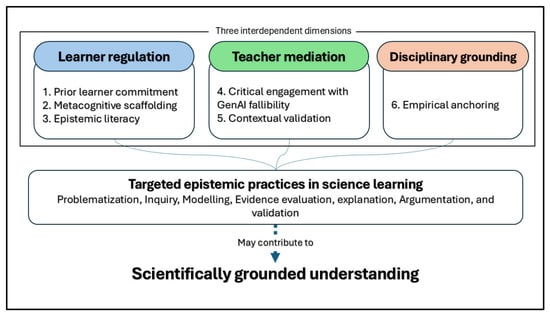
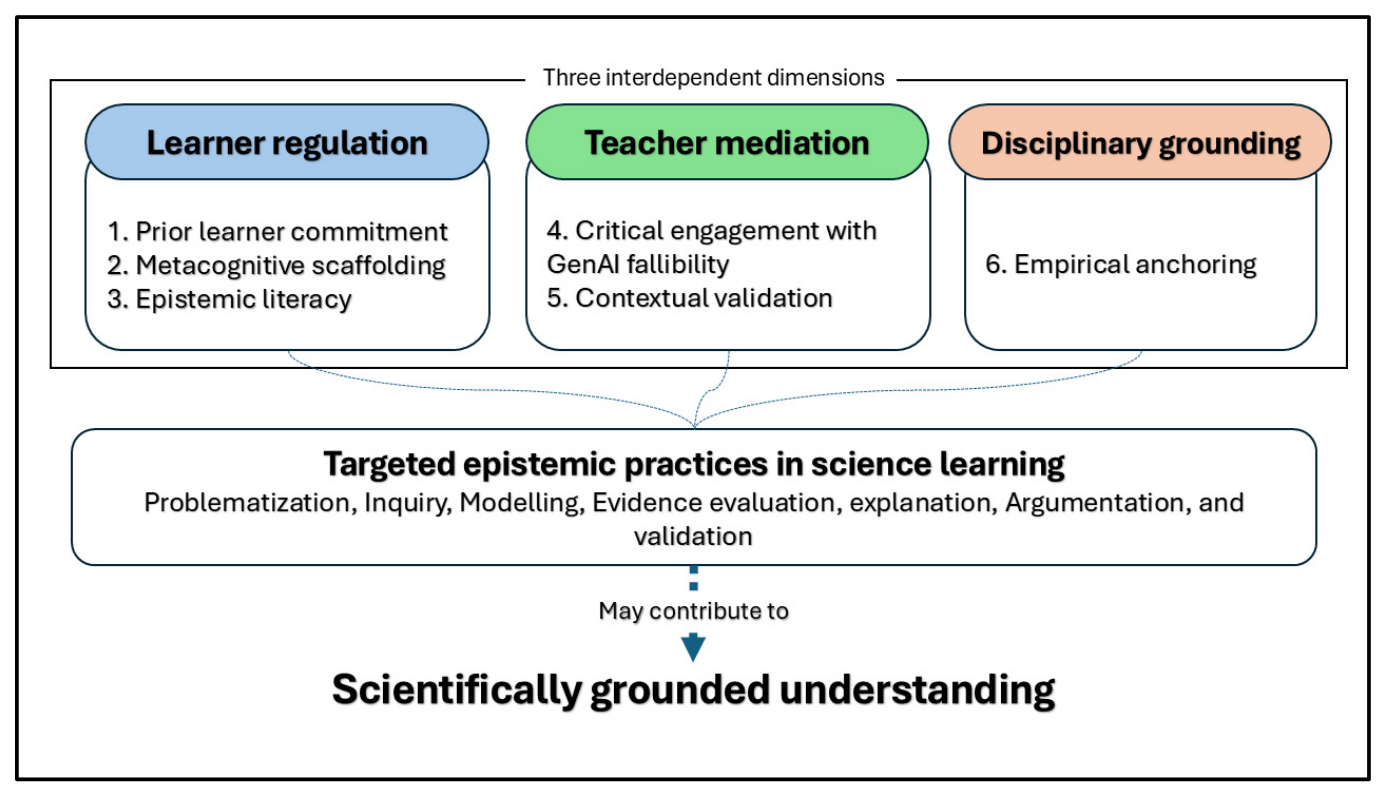
The six analytical themes reported in Section 3.1 and Section 3.2 describe recurrent opportunities and tensions identified across the corpus. Through interpretive comparison, these themes were subsequently translated into six didactic conditions organized within three dimensions: learner regulation, teacher mediation, and disciplinary grounding, as illustrated in Figure 1. These conditions represent a structured interpretation of retained evidence rather than causal mechanisms established across all educational contexts.
Figure 1.
Conceptual heuristic for the didactic integration of GenAI in science education.
The six conditions are not supported equally across the corpus. Epistemic literacy and contextual validation are associated with many articles in the corpus, whereas prior learner commitment and metacognitive scaffolding are supported by a smaller subset. Prior learner commitment is also the most prescriptive condition, but it should be treated as a theoretically informed proposition requiring direct empirical testing rather than an established instructional principle.
Learner regulation includes prior learner commitment, metacognitive scaffolding, and epistemic literacy. Learners should formulate an initial explanation, prediction, or model before consulting GenAI, while structured prompts should support monitoring, evaluation, and revision without transferring epistemic responsibility to the systems [8,9,18]. Teacher mediation involves critical engagement with GenAI fallibility and contextual validation. Critical engagement refers to treating potentially uncertain or inaccurate outputs as objects of questioning, comparison, and revision; it does not indicate deficient teacher mediation [14,15,16,30,31,32]. Contextual validation is a pedagogical and curricular process through which teachers evaluate generated content for scientific accuracy, curricular alignment, learner level, language, task objectives, and relevance to the targeted epistemic practice [42,43]. Disciplinary grounding is operationalized through empirical anchoring. This single condition functions as an integrative requirement because it requires generated scientific content to be evaluated against observations, measurements, experimental evidence, authentic datasets, established scientific models, and validated disciplinary sources. GenAI should therefore complement rather than replace laboratory work, authentic inquiry, and engagement with material phenomena [34]. Together, these dimensions position GenAI as a mediating artefact within a teacher-orchestrated didactic process. Its educational value accordingly depends on preserving learner epistemic agency, teacher responsibility, and the empirical foundations of scientific knowledge construction.
4. Conclusions
This review examined the conditions under which GenAI may support epistemic practices in science education while preserving learners’ reasoning, empirical inquiry, or disciplinary judgement. The synthesis indicates potential contributions to dialogic scaffolding, scientific inquiry and reasoning, formative feedback, and metacognitive regulation. However, these GenAI opportunities depend on how learner regulation, teacher mediation, and disciplinary grounding are enacted through the design of learning activities. Accordingly, six interrelated conditions were organized into three dimensions: learner regulation, teacher mediation, and disciplinary grounding. Together, these conditions position GenAI as a mediating artefact within a teacher-orchestrated didactic process rather than as an autonomous source of scientific knowledge. Therefore, a six-condition conceptual heuristic was proposed for guiding the epistemically grounded integration of GenAI into science education (Figure 1). These conclusions remain limited by the publication and database-indexing bias, the use of a single reviewer, the methodological heterogeneity of the included articles, and the rapid evolution of GenAI systems. In addition, the absence of truncation in parts of the search strategy may have reduced the retrieval of relevant term variants. Moreover, the proposed conceptual heuristic constitutes an interpretive synthesis rather than an empirically validated model. Future research should therefore test these conditions through robust studies across scientific disciplines, educational levels, learner populations, and sociocultural contexts.
Supplementary Materials
The following supporting information can be downloaded at: https://www.mdpi.com/article/10.3390/proceedings2026145007/s1, Table S1, The search string used in the systematic search following this syntax (A) AND (B) AND (C); Table S2, Eligibility criteria applied during studies selection; Figure S1, PRISMA flow diagram of the systematic search for this review; Table S3, characteristics and evidence contributions of the 34 included articles in the review.
Author Contributions
All authors contributed to the conceptualization of this review. M.J.I. and O.A. conducted the literature search and uploaded all articles for screening. M.J.I. reviewed all articles and determined eligibility based on the inclusion and exclusion criteria. M.J.I. organized and synthesized the results. All authors contributed to the writing of the manuscript. All authors have read and agreed to the published version of the manuscript.
Funding
This research received no external funding.
Data Availability Statement
All information relating to the results can be found in the manuscript.
Conflicts of Interest
The authors declare no conflicts of interest.
References
- Kelly, G.J. Inquiry, activity, and epistemic practice. In Teaching Scientific Inquiry: Recommendations for Research and Implementation; Duschl, R.A., Grandy, R.E., Eds.; Sense Publishers: Dordrecht, The Netherlands, 2008; pp. 99–117. [Google Scholar]
- Duschl, R.A. Science education in three-part harmony: Balancing conceptual, epistemic, and social learning goals. Rev. Res. Educ. 2008, 32, 268–291. [Google Scholar] [CrossRef] [Scilit]
- Osborne, J. Teaching scientific practices: Meeting the challenge of change. J. Sci. Teach. Educ. 2014, 25, 177–196. [Google Scholar] [CrossRef] [Scilit]
- Numa-Bocage, L. Entre didactique professionnelle et didactique disciplinaire: Le concept de la médiation didactique. Fr. Aujourd’hui 2015, 188, 53–61. [Google Scholar] [CrossRef] [Scilit]
- Cheung, K.K.C.; Long, Y.; Liu, Q.; Chan, H.-Y. Unpacking epistemic insights of artificial intelligence (AI) in science education: A systematic review. Sci. Educ. 2025, 34, 747–777. [Google Scholar] [CrossRef] [Scilit]
- Lee, G.; Yun, M.; Zhai, X.; Crippen, K. Artificial intelligence in science education research: Current states and challenges. J. Sci. Educ. Technol. 2026, 35, 110–127. [Google Scholar] [CrossRef] [Scilit]
- Tang, K.-S. Informing research on generative artificial intelligence from a language and literacy perspective: A meta-synthesis of studies in science education. Sci. Educ. 2024, 108, 1329–1355. [Google Scholar] [CrossRef] [Scilit]
- Fan, Y.; Tang, L.; Le, H.; Shen, K.; Tan, S.; Zhao, Y.; Shen, Y.; Li, X.; Gašević, D. Beware of metacognitive laziness: Effects of generative artificial intelligence on learning motivation, processes, and performance. Br. J. Educ. Technol. 2025, 56, 489–530. [Google Scholar] [CrossRef] [Scilit]
- Yan, L.; Pammer-Schindler, V.; Mills, C.; Nguyen, A.; Gašević, D. Beyond efficiency: Empirical insights on generative AI’s impact on cognition, metacognition and epistemic agency in learning. Br. J. Educ. Technol. 2025, 56, 1675–1685. [Google Scholar] [CrossRef] [Scilit]
- Grant, M.J.; Booth, A. A typology of reviews: An analysis of 14 review types and associated methodologies. Health Inf. Libr. J. 2009, 26, 91–108. [Google Scholar] [CrossRef] [Scilit] [PubMed]
- Page, M.J.; McKenzie, J.E.; Bossuyt, P.M.; Boutron, I.; Hoffmann, T.C.; Mulrow, C.D.; Shamseer, L.; Tetzlaff, J.M.; Akl, E.A.; Brennan, S.E.; et al. The PRISMA 2020 statement: An updated guideline for reporting systematic reviews. BMJ 2021, 372, n71. [Google Scholar] [CrossRef] [Scilit] [PubMed]
- Fereday, J.; Muir-Cochrane, E. Demonstrating rigor using thematic analysis: A hybrid approach of inductive and deductive coding and theme development. Int. J. Qual. Methods 2006, 5, 80–92. [Google Scholar] [CrossRef] [Scilit]
- Proudfoot, K. Inductive/deductive hybrid thematic analysis in mixed methods research. J. Mix. Methods Res. 2023, 17, 308–326. [Google Scholar] [CrossRef] [Scilit]
- Tang, K.-S.; Cooper, G.; Rappa, N.; Cooper, M.; Sims, C.; Nonis, K. A dialogic approach to transform teaching, learning and assessment with generative AI in secondary education: A proof of concept. Pedagogies 2024, 19, 493–503. [Google Scholar] [CrossRef] [Scilit]
- Tang, K.-S.; Putra, G.B.S. Generative AI as a dialogic partner: Enhancing multiple perspectives, reasoning, and argumentation in science education with customized chatbots. J. Sci. Educ. Technol. 2026, 35, 128–140. [Google Scholar] [CrossRef] [Scilit]
- Santos-Guevara, A.; Aquines-Gutiérrez, O.; Martínez-Huerta, H.; Chavarría-Garza, W.X.; Azuela, J.A. Fostering student engagement and learning perception through Socratic dialogue with ChatGPT: A case study in physics education. Educ. Sci. 2026, 16, 184. [Google Scholar] [CrossRef] [Scilit]
- Mawn, M.V.; Washington, J.M. Using artificial intelligence as a mindtool to foster critical thinking in biology education. J. Microbiol. Biol. Educ. 2026. advance online publication. [Google Scholar] [CrossRef] [Scilit] [PubMed]
- Gao, X.; Guo, X.; Jiang, Q.; Xiong, W.; Zhao, W.; Zhang, D. Chatbot-supported inquiry-based learning: Effects of metacognitive scaffolding on K–12 students’ inquiry skills, metacognitive behavior patterns, and learning experience. Educ. Inf. Technol. 2026. advance online publication. [Google Scholar] [CrossRef] [Scilit]
- Ng, D.T.K.; Tan, C.W.; Leung, J.K.L. Empowering student self-regulated learning and science education through ChatGPT: A pioneering pilot study. Br. J. Educ. Technol. 2024, 55, 1328–1353. [Google Scholar] [CrossRef] [Scilit]
- Haraldsrud, A.; Odden, T.O.B. Bridging artificial intelligence and real intelligence: Self-scaffolding computational modeling with generative AI in chemistry. J. Chem. Educ. 2025, 102, 4255–4266. [Google Scholar] [CrossRef] [Scilit]
- Küçükaydın, M.A. Artificial intelligence-supported science education: A qualitative study on pre-service teachers’ scientific reasoning experiences. Int. J. Sci. Educ. 2026. advance online publication. [Google Scholar] [CrossRef] [Scilit]
- Cheung, K.K.C.; Pun, J.K.H.; Li, W. Students’ holistic reading of socio-scientific texts on climate change in a ChatGPT scenario. Res. Sci. Educ. 2024, 54, 957–976. [Google Scholar] [CrossRef] [Scilit]
- Chang, J.; Park, J.; Sim, J.Y. Harnessing generative AI to facilitate epistemic understanding of students in scientific inquiry. J. Sci. Educ. Technol. 2026. advance online publication. [Google Scholar] [CrossRef] [Scilit]
- Gumilar, S.; Ong, Y.S.; Bhakti, D.D.; Amalia, I.F.; Nurdiana, D.; Widodo, A. Examining generative artificial intelligence in assessing students’ responses to socio-scientific issues in physics. Int. J. Sci. Educ. 2025. advance online publication. [Google Scholar] [CrossRef] [Scilit]
- Al-Karasneh, S.M.; Kanaan, E.M.; Al-Barakat, A.A.; AlAli, R.M.; Zaher, A.M.; Ibrahim, N.A. Transforming primary science education: Unlocking the power of generative AI to enhance pupils’ grasp of scientific concepts. Int. J. Learn. Teach. Educ. Res. 2025, 24, 304–322. [Google Scholar] [CrossRef] [Scilit]
- Kim, W.J. Teachers’ use of generative artificial intelligence for designing science lessons in support of environmental science agency. Res. Sci. Educ. 2026, 56, 203–222. [Google Scholar] [CrossRef] [Scilit]
- Nguyen, H.; Cao, J. Exploring the capacity of large language models to simulate students’ scientific thinking: Insights for responsive teaching. J. Sci. Educ. Technol. 2026. advance online publication. [Google Scholar] [CrossRef] [Scilit]
- Großmann, L.; Koberstein-Schwarz, M.; Krüger, D.; Krell, M. Lesson planning with ChatGPT for inquiry-based biology instruction—A(I) roll of the dice? Int. J. Sci. Educ. 2025. advance online publication. [Google Scholar] [CrossRef] [Scilit]
- Impedovo, M.A.; Andreucci, C.; Ginestié, J. Mediation of artefacts, tools and technical objects: An international and French perspective. Int. J. Technol. Des. Educ. 2017, 27, 19–30. [Google Scholar] [CrossRef] [Scilit]
- Cooper, G. Examining science education in ChatGPT: An exploratory study of generative artificial intelligence. J. Sci. Educ. Technol. 2023, 32, 444–452. [Google Scholar] [CrossRef] [Scilit]
- Uçar, S.-Ş.; Lopez-Gazpio, I.; Lopez-Gazpio, J. Evaluating and challenging the reasoning capabilities of generative artificial intelligence for technology-assisted chemistry education. Educ. Inf. Technol. 2025, 30, 11463–11482. [Google Scholar] [CrossRef] [Scilit]
- Jiang, K.; Xiao, X. Beyond accuracy: Cognitive, pedagogical, and practical readiness of multimodal LLMs for K–12 science education. Interact. Learn. Environ. 2026. advance online publication. [Google Scholar] [CrossRef] [Scilit]
- Oh, P.S.; Lee, G.-G. Confronting imminent challenges in humane epistemic agency in science education: An interview with ChatGPT. Sci. Educ. 2025, 34, 779–805. [Google Scholar] [CrossRef] [Scilit]
- Tang, K.-S.; Cooper, G. The role of materiality in an era of generative artificial intelligence. Sci. Educ. 2025, 34, 731–746. [Google Scholar] [CrossRef] [Scilit]
- Díaz, B.; Bekerman, Z.; Nussbaum, M. A biological learning theory: How we learn in the era of AI. J. Sci. Educ. Technol. 2026. advance online publication. [Google Scholar] [CrossRef] [Scilit]
- Lin, Y.-R.; Hung, C.-Y. GAI-assisted self-regulation in science learning: The impact of interaction interfaces and content abstraction on flow and mental model construction. Educ. Inf. Technol. 2026, 31, 3369–3398. [Google Scholar] [CrossRef] [Scilit]
- Cooper, G.; Tang, K.-S. Pixels and pedagogy: Examining science education imagery by generative artificial intelligence. J. Sci. Educ. Technol. 2024, 33, 556–568. [Google Scholar] [CrossRef] [Scilit]
- Cheung, K.K.C.; Zhang, W. Representations of the nature of science in generative AI (GPT-4o). Sci. Educ. 2026. advance online publication. [Google Scholar] [CrossRef] [Scilit]
- Avraamidou, L. Can we disrupt the momentum of the AI colonization of science education? J. Res. Sci. Teach. 2024, 61, 2570–2574. [Google Scholar] [CrossRef] [Scilit]
- Blonder, R.; Feldman-Maggor, Y. AI for chemistry teaching: Responsible AI and ethical considerations. Chem. Teach. Int. 2024, 6, 385–395. [Google Scholar] [CrossRef] [Scilit]
- de Putter-Smits, L.G.A.; Pols, C.F.J.; Dekkers, P.J.J.M.; Runhaar, P.R.; Timmer, M.; van der Veen, J.T. Exploring the role of generative AI in science teacher education programs: A qualitative study. Int. J. Educ. Res. Open 2025, 9, 100492. [Google Scholar] [CrossRef] [Scilit]
- Feldman-Maggor, Y.; Blonder, R.; Alexandron, G. Perspectives of generative AI in chemistry education within the TPACK framework. J. Sci. Educ. Technol. 2025, 34, 1–12. [Google Scholar] [CrossRef] [Scilit]
- Jang, H.; Choi, H. A double-edged sword: Physics educators’ perspectives on utilizing ChatGPT and its future in classrooms. J. Sci. Educ. Technol. 2025, 34, 267–283. [Google Scholar] [CrossRef] [Scilit]
Disclaimer/Publisher’s Note: The statements, opinions and data contained in all publications are solely those of the individual author(s) and contributor(s) and not of MDPI and/or the editor(s). MDPI and/or the editor(s) disclaim responsibility for any injury to people or property resulting from any ideas, methods, instructions or products referred to in the content. |
© 2026 by the authors. Licensee MDPI, Basel, Switzerland. This article is an open access article distributed under the terms and conditions of the Creative Commons Attribution (CC BY) license.