


Abstract
The rapid digitalisation of the construction and built-environment sectors has increased demand for innovative teaching methods in higher education. Among emerging digital tools, metaverse applications offer immersive and interactive learning environments with the potential to transform traditional pedagogical practices. This study evaluates the adoption of the metaverse application (EON-XR) in built-environment education by examining educator training outcomes using the Kirkpatrick model. The evaluation focuses on a structured training workshop designed to equip built-environment educators with the skills to integrate metaverse-based applications into first-year teaching modules. A post-training evaluation employed a Google Forms survey instrument explicitly aligned with Kirkpatrick’s four evaluation levels: reaction, learning, behaviour, and results, with Levels 3 (Behaviour) and 4 (Results) operationalised as behavioural-intention and perceived-results proxies collected immediately post-training, ahead of any classroom implementation. The instrument captured educators’ perceptions of usability, relevance, pedagogical value, behavioural intention to apply acquired skills, and the broader institutional and disciplinary implications of metaverse adoption. Both qualitative and quantitative data were analyzed to assess the training programme’s effectiveness across these four dimensions. Findings indicate a generally positive reaction to metaverse training, with educators recognizing the relevance and user-friendliness of the EON-XR application. Evidence of learning was demonstrated by increased confidence and perceived competence in applying metaverse tools for teaching. At the behavioural level, participants expressed strong intentions to integrate metaverse applications into their teaching practice. At the results level, the training was perceived as enhancing teaching engagement, stimulating interest in construction digitalisation, and contributing to the institutional standing of higher education providers. The study concludes that metaverse-based educator training can play a critical role in advancing digital pedagogy within built-environment education. By applying the Kirkpatrick model, this research provides a structured, replicable framework for evaluating the adoption of immersive technology in higher education contexts.
1. Introduction
The construction and built-environment sector has historically lagged behind other industries in adopting digital technologies. Yet, the sector is now under sustained pressure to modernize its processes, tools and skills base. In South Africa specifically, Construction 4.0 has been proposed as a strategic response to this pressure, encompassing digitalisation, automation and the integration of emerging technologies such as Building Information Modelling (BIM), robotics and immersive visualization tools across the construction value chain [1]. Realizing this vision depends heavily on higher education institutions producing built-environment graduates who are digitally literate and comfortable working with emerging technologies. Achieving this objective, in turn, depends on educators themselves being adequately trained and confident in using these tools for teaching.
Among the technologies reshaping teaching and learning, metaverse applications (immersive, interactive digital environments that blend virtual and augmented reality) have attracted growing interest in higher education. Systematic reviews of the metaverse in education report gains in learner engagement, experiential learning and collaborative interaction, alongside persistent challenges around infrastructure cost, content availability and staff readiness [2,3]. Within construction engineering education specifically, virtual reality (VR) and augmented reality (AR) tools have been used for visualization, safety training and simulation of construction processes, with reviews noting steady growth in adoption from desktop-based virtual reality to BIM-enabled virtual reality and augmented reality [4].
Despite this growing body of evidence on metaverse and VR use with students, considerably less attention has been paid to evaluating how well educators themselves are prepared to adopt these tools in their teaching. Educator training is a necessary precondition for meaningful metaverse integration in the curriculum, yet the effectiveness of such training programmes is rarely subjected to structured evaluation. Kirkpatrick’s four-level model, covering Reaction, Learning, Behaviour and Results, remains the most widely used framework for evaluating training programmes and has been successfully adapted to higher education contexts [5,6]. It has, for example, been used to evaluate a healthcare-staff teaching-methods workshop [7], a virtual-laboratory teacher-training programme conducted in Africa [8], and a training programme for head teachers [9], with these applications indicating consistent gains in participants’ knowledge, confidence and intended application following structured training.
This study addresses this gap by evaluating a structured training workshop that equipped built-environment educators at a historically disadvantaged university (HDU) in South Africa with the skills to use the EON-XR metaverse platform to teach first-year modules. The workshop’s evaluation strategy was designed around a SMART (Specific, Measurable, Attainable, Relevant, Time-related) evaluation statement, an approach increasingly used to sharpen training and career-development goals [10,11]. The SMART evaluation approach also remains sensitive to critiques that rigid goal-setting frameworks are not always the best fit for every training context [12]. Applying the Kirkpatrick model, this study evaluates educators’ reaction to, learning from, behavioural intention following, and perceived results of metaverse-based training, using both quantitative Likert-scale responses and qualitative open-ended reflections collected via a post-training questionnaire.
By combining a validated training-evaluation framework with empirical data from an under-researched context (an historically disadvantaged university (HDU) in South Africa), this study provides a replicable model for evaluating immersive-technology educator training. It also offers practical insights for institutions seeking to advance digital pedagogy in construction and built-environment education.
2. Research Methodology
2.1. Research Design
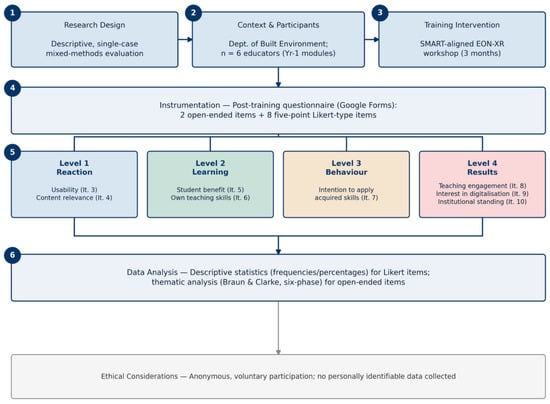
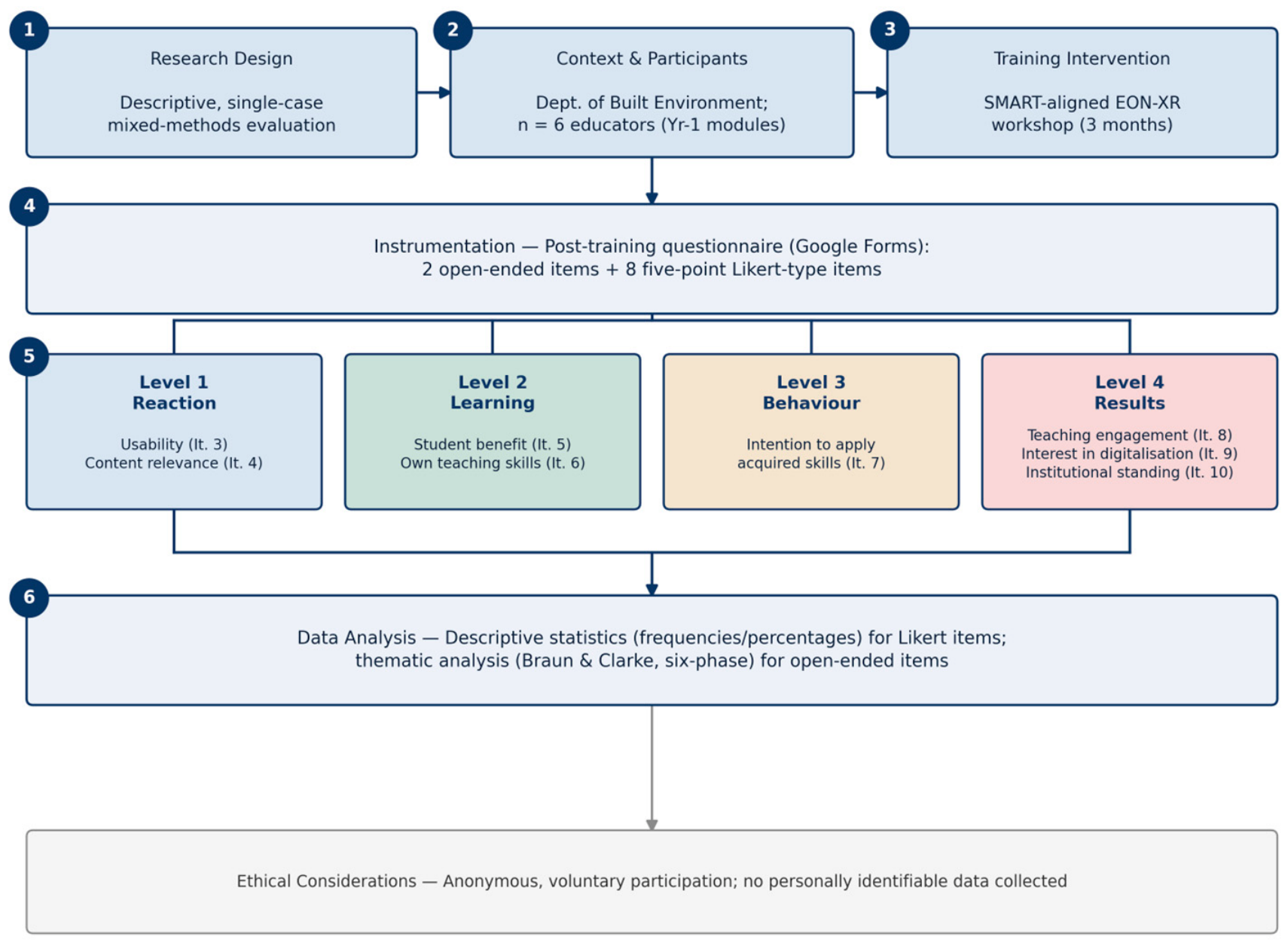
This study adopted a descriptive, single-case evaluation design, combining quantitative and qualitative post-training data collected from built-environment educators who participated in a structured EON-XR metaverse training workshop. The evaluation instrument and analysis were structured around the four levels of the Kirkpatrick training-evaluation model: Reaction, Learning, Behaviour and Results [5,6], as illustrated in Figure 1. Levels 3 and 4 are operationalised here as behavioural-intention and perceived-results proxies rather than as observed classroom behaviour or measured institutional outcomes.
Figure 1.
Research design and methodological workflow.
2.2. Context and Participants
The study was conducted within the Department of Built Environment, Faculty of Engineering, Built Environment and Information Technology, at an HDU in South Africa. Of the eight educators teaching first-year built-environment modules who were invited to participate, six attended the training workshop, and six completed the post-training questionnaire. While this reflects a small, purposive sample typical of a single-department pilot intervention, the responses nonetheless provide an in-depth, exploratory account of educators’ reactions to, and perceived outcomes of, metaverse-based training in a context where such empirical evidence remains scarce.
2.3. The Training Intervention
The training intervention consisted of a structured workshop, delivered over a period of three months, aimed at equipping participants with the knowledge and practical skills needed to design and deliver EON-XR-based learning activities for first-year built-environment modules. In line with the SMART evaluation statement guiding the intervention, the workshop was designed to be Specific (targeting the use of EON-XR for first-year teaching), Measurable (intended to be assessed via post-training satisfaction and self-reported application of skills), Attainable (accessible to educators with varying subject specializations and levels of teaching experience), Relevant (aligned with institutional and industry priorities for construction digitalisation, consistent with the Construction 4.0 agenda in South Africa [1]), and Time-related (delivered and evaluated within a three-month window) [10,11].
2.4. Instrumentation
Following completion of the workshop, a structured questionnaire was administered online via Google Forms. The instrument comprised two open-ended questions: on the perceived positive impacts of EON-XR for first-year built-environment students, and on perceived barriers to its implementation, and eight five-point Likert-type items (Strongly Disagree to Strongly Agree, or Extremely Unlikely to Extremely Likely) explicitly mapped onto the four Kirkpatrick levels, as summarized in Table 1. Table 1 presents the survey items mapped to the four levels of the Kirkpatrick model, with Levels 3 and 4 operationalised as intention and perception proxies rather than observed behaviour or measured results.
Table 1.
Survey items mapped to the four levels of the Kirkpatrick model.
2.5. Data Analysis
Responses to the eight Likert-type items were summarized using descriptive statistics (frequencies and percentages) for each item and aggregated by Kirkpatrick level. Responses to the two open-ended questions were coded and grouped thematically, following Braun and Clarke’s approach to thematic analysis: familiarization with the data, generation of initial codes, searching for themes, reviewing themes, defining and naming themes, and reporting [13]. One respondent’s open-ended answer displayed characteristics inconsistent with an authentic, spontaneously written first-person reflection, including a generic, listicle-style structure and residual interface artefacts suggestive of AI-chatbot-generated text (specifically, [e.g., a numbered-list structure atypical of the plain-text survey field, and formatting fragments such as stray markdown characters or boilerplate phrasing characteristic of chatbot output]). This respondent’s Likert-scale ratings were retained in the descriptive analysis, as there was no indication that these were compromised. Still, the accompanying open-ended text was treated with caution and excluded from illustrative quotation, consistent with recommended caution regarding data integrity in self-administered online surveys.
2.6. Ethical Considerations
Participation in the post-training evaluation was voluntary and anonymous. No personally identifiable information was collected, and participants were informed of the purpose of the evaluation before completing the questionnaire.
3. Results and Discussion
3.1. Overview of Participants
Six built-environment educators completed the post-training questionnaire following the EON-XR workshop. Given the small sample, the findings reported here should be considered as an in-depth exploratory account of one department’s training cohort rather than as generalizable estimates.
3.2. Level 1: Reaction
Reaction to the training was generally favourable. Two-thirds of respondents (4/6, 66.7%) agreed that the EON-XR application was user-friendly, with the remainder neutral and none disagreeing (Table 2). Perceptions of the relevance of the EON-XR content library to first-year built-environment modules were more mixed: half of the respondents (3/6, 50.0%) agreed or strongly agreed that the library was relevant, two (33.3%) were neutral, and one (16.7%) strongly disagreed. This pattern, stronger agreement on usability than on content relevance, echoes a recurring finding in the wider metaverse-in-education literature, where usability and interactivity are frequently rated favourably compared to the availability of discipline-specific content that lags [2,3].
Table 2.
Descriptive summary of Educators’ Likert-scale responses by Kirkpatrick level (n = 6).
3.3. Level 2: Learning
Evidence of learning was strong. Five of six respondents (83.3%) agreed or strongly agreed that the EON-XR application would be beneficial to first-year students, and the same proportion agreed or strongly agreed that the training had improved their own teaching skills. This finding is consistent with prior Kirkpatrick-based evaluations of technology-focused teacher training, including a virtual-laboratory teacher-training programme conducted in Africa, which similarly reported significant improvement in participants’ perceptions, attitudes and learning outcomes following training [8].
3.4. Level 3: Behaviour
At the behavioural level, four of six respondents (66.7%) reported that they were likely or extremely likely to apply the knowledge and skills acquired in their first-year teaching, while two (33.3%) remained neutral. Although this reflects a moderately strong behavioural intention, the proportion of neutral responses is a reminder that stated intention to adopt does not guarantee sustained classroom implementation. Bates [14] has argued that the Kirkpatrick model struggles to establish a causal chain between learning and subsequent behaviour change, and the present data, collected shortly after training, before any classroom implementation had occurred, cannot speak to whether this intention was ultimately translated into practice.
3.5. Level 4: Results
At the results level, two-thirds of respondents (4/6, 66.7%) agreed or strongly agreed that the training had improved their teaching engagement with students, improved their interest in construction digitalisation, and would improve the national and global standing of their institution. In each case, however, one respondent (16.7%) either disagreed, strongly disagreed, or remained neutral, underlining that perceived organizational and disciplinary benefits, while reported by a clear majority, were not experienced uniformly across the group. The consistency of this two-thirds majority across all three Results-level items is nonetheless consistent with the workshop’s design intent of aligning metaverse-based training with the broader institutional and industry push toward construction digitalisation in South Africa [1], though a single perception item cannot itself validate that design premise.
3.6. Qualitative Themes: Positive Impacts and Barriers
Thematic analysis of the open-ended responses identified visualization and simulation of real-world construction processes as the dominant perceived positive impact of EON-XR, mentioned in some form by nearly every respondent; for example, in terms of helping students to “visualise the learning process” and the construction process itself. This finding directly mirrors the established value of VR and AR in construction engineering education and training, where enhanced spatial and visual understanding is consistently identified as their principal pedagogical contribution [4,15].
Three barrier sub-themes emerged from the qualitative data: (i) infrastructure and cost constraints, including network limitations and the high initial cost of the technology; (ii) students’ limited prior exposure to immersive technology, producing a learning curve and, in some cases, a sense of being overwhelmed; and (iii) the still-developing maturity of discipline-specific content for first-year built-environment curricula. The learning-curve barrier in particular echoes recent construction-education VR research, which identifies students’ limited prior exposure to VR technology as the most frequently cited challenge to adoption [15].
3.7. Synthesis and Practical Implications
Read across all four levels, the training achieved its strongest outcomes at the Reaction and Learning levels, with more heterogeneous, though still majority-positive, outcomes at the Behaviour and Results levels, a pattern broadly consistent with the wider training-evaluation literature, in which reaction and learning gains are typically easier to achieve than durable behaviour change and organizational results [5,14]. These findings support continued institutional investment in metaverse-based educator development as part of a broader construction–digitalisation strategy [1], while also pointing to three practical priorities: expanding and curating the EON-XR content library toward built-environment-specific first-year material; providing infrastructure support (devices and connectivity) to reduce access barriers; and preparing students in advance of metaverse-based activities to reduce the novelty burden identified as a barrier by educators in this study.
3.8. Limitations
This study is limited by its small sample size (n = 6), drawn from a single department and cohort, and by its reliance on self-reported perceptions collected shortly after training rather than on observed classroom behaviour or measured student outcomes. As noted in the Research Methodology Section, one respondent’s open-ended answers were treated with caution owing to indications of non-authentic authorship, which may modestly reduce the qualitative dataset’s richness. Findings should therefore be interpreted as an exploratory, context-specific account rather than as generalizable evidence of EON-XR’s effectiveness across built-environment education.
4. Conclusions and Recommendations
This study applied the Kirkpatrick four-level model to evaluate a structured EON-XR metaverse training workshop for built-environment educators at an historically disadvantaged higher-education institution in South Africa, using both quantitative Likert-scale data and qualitative thematic analysis. Educators reacted positively to the training, particularly regarding the usability of the EON-XR application, and reported clear gains in learning, both in their own teaching skills and in the perceived benefit to students. Behavioural intention to apply the training was moderately strong, and a consistent majority of educators perceived results-level benefits for teaching engagement, interest in construction digitalisation, and institutional standing. However, these benefits were not experienced uniformly by all participants. Visualization of construction processes emerged as the central perceived value of the metaverse application. At the same time, infrastructure cost, students’ unfamiliarity with immersive technology, and the maturity of discipline-specific content were identified as the principal barriers to implementation.
The empirical findings reported here are exploratory, drawn from a single six-respondent pilot cohort; the study’s principal contribution is instead the Kirkpatrick-aligned evaluation instrument itself (Appendix A), offered as a replicable, low-cost tool that other institutions can adapt to assess their own metaverse-based educator training. Taken together, these findings suggest that metaverse-based educator training can meaningfully advance digital pedagogy in built-environment education, provided it is accompanied by continued investment in infrastructure, content development and student preparation, and provided further, larger-scale evaluation confirms the exploratory results reported here.
Future research should build on this exploratory account in several ways: evaluating the actual, rather than intended, classroom implementation of metaverse tools by tracking educators over a full academic term; extending data collection to larger, multi-institutional samples to improve generalisability; measuring student-level learning outcomes arising from metaverse-enabled teaching, rather than relying solely on educators’ perceptions of student benefit; and investigating the longer-term institutional and disciplinary hindrances to sustained metaverse adoption in built-environment education.
Funding
This research received no external funding.
Institutional Review Board Statement
The relevant Institutional Ethics Committee waived ethical review and approval for this study because it was considered minimal-risk educational evaluation research. The research involved secondary analysis of anonymized data collected from a routine post-workshop evaluation. This evaluation was part of the quality assurance process for a professional development workshop on using the metaverse in built-environment education. Participation was voluntary, no personally identifiable or sensitive information was collected, and all responses were anonymized before analysis. The study did not include any interventions or procedures outside of standard educational practice. As a result, it met the institutional criteria for exemption from full ethical review.
Informed Consent Statement
Informed consent was obtained from all subjects involved in the study.
Data Availability Statement
The data presented in this study are available upon reasonable request from the corresponding author, subject to institutional data-sharing policies.
Acknowledgments
The author appreciates the input of the study participants. The cidb-Walter Sisulu Centre of Excellence and the Directorate of Research and Innovation at the iYunivesithi Walter Sisulu, South Africa, are acknowledged. During the preparation of this manuscript, the author used Grammarly application for language-editing purposes. The author have reviewed and edited the output and take full responsibility for the content of this publication.
Conflicts of Interest
The author declares no conflicts of interest.
Abbreviations
The following abbreviations are used in this manuscript:
| HDU | Historically Disadvantaged University |
| SMART | Specific, Measurable, Attainable, Relevant, Time-related |
| AR | Augmented Reality |
| VR | Virtual Reality |
Appendix A
Appendix A (Table A1) presents the full set of items used in the post-training questionnaire administered via Google Forms, including the two open-ended questions and the eight Likert-type items mapped to the Kirkpatrick model, as referenced in Table 1.
Table A1.
Post-training questionnaire items.
References
- Osunsanmi, T.O.; Aigbavboa, C.; Oke, A. Construction 4.0: The future of the construction industry in South Africa. World Acad. Sci. Eng. Technol. Int. J. Civ. Environ. Eng. 2018, 12, 206–212. [Google Scholar]
- Mercan, G.; Varol Selçuk, Z. The role of metaverse technology in education: A systematic review of opportunities, challenges, and educational potential. Sak. Univ. J. Educ. 2024, 14, 360–375. [Google Scholar] [CrossRef] [Scilit]
- Li, M.; Yu, Z. A systematic review on the metaverse-based blended English learning. Front. Psychol. 2023, 13, 1087508. [Google Scholar] [CrossRef] [Scilit] [PubMed]
- Wang, P.; Wu, P.; Wang, J.; Chi, H.-L.; Wang, X. A critical review of the use of virtual reality in construction engineering education and training. Int. J. Environ. Res. Public Health 2018, 15, 1204. [Google Scholar] [CrossRef] [Scilit] [PubMed]
- Kirkpatrick, D.L. Evaluating Training Programs: The Four Levels; Berrett-Koehler: San Francisco, CA, USA, 1994. [Google Scholar]
- Praslova, L. Adaptation of Kirkpatrick’s four level model of training criteria to assessment of learning outcomes and program evaluation in Higher Education. Educ. Assess. Eval. Account. 2010, 22, 215–225. [Google Scholar] [CrossRef] [Scilit]
- Heydari, M.R.; Taghva, F.; Amini, M.; Delavari, S. Using Kirkpatrick’s model to measure the effect of a new teaching and learning methods workshop for health care staff. BMC Res. Notes 2019, 12, 388. [Google Scholar] [CrossRef] [Scilit] [PubMed]
- Achuthan, K.; Kolil, V.K.; Jyothy, S.N. Effectiveness of virtual laboratory teacher training workshops: A Kirkpatrick model analysis. Int. J. Emerg. Technol. Learn. 2023, 18, 225–239. [Google Scholar] [CrossRef] [Scilit]
- Alsalamah, A.; Callinan, C. Adaptation of Kirkpatrick’s four-level model of training criteria to evaluate training programmes for head teachers. Educ. Sci. 2021, 11, 116. [Google Scholar] [CrossRef] [Scilit]
- Danjuma, G.S. Setting smart goals for career development in the 21st century. Employab. Nexus Int. J. Career Readiness 2026, 1, 83–88. [Google Scholar]
- Shokri, S.; Aghdasi, M.T.; Behzadnia, B. Examining performance changes using multiple goal setting with a focus on the SMART principle. Sci. Rep. 2026, 16, 1476. [Google Scholar] [CrossRef] [Scilit] [PubMed]
- Tsyrulnik, A.; Nord, G.; Regan, L.; Hopson, L.; Coughlin, R.F.; Branzetti, J. When SMART isn’t always best: An investigation of emergency medicine resident goal setting practices. AEM Educ. Train. 2026, 10, e70125. [Google Scholar] [CrossRef] [Scilit] [PubMed]
- Braun, V.; Clarke, V. Using thematic analysis in psychology. Qual. Res. Psychol. 2006, 3, 77–101. [Google Scholar] [CrossRef] [Scilit]
- Bates, R. A critical analysis of evaluation practice: The Kirkpatrick model and the principle of beneficence. Eval. Program Plan. 2004, 27, 341–347. [Google Scholar] [CrossRef] [Scilit]
- Yan, D.; Wang, C.C.; Sunindijo, R.Y. Driving digital transformation in construction education: Design and development of a 360° virtual reality construction site experience. J. Build. Des. Environ. 2026, 4, 2025111. [Google Scholar] [CrossRef] [Scilit]

Disclaimer/Publisher’s Note: The statements, opinions and data contained in all publications are solely those of the individual author(s) and contributor(s) and not of MDPI and/or the editor(s). MDPI and/or the editor(s) disclaim responsibility for any injury to people or property resulting from any ideas, methods, instructions or products referred to in the content. |
© 2026 by the author. Licensee MDPI, Basel, Switzerland. This article is an open access article distributed under the terms and conditions of the Creative Commons Attribution (CC BY) license.