


Abstract
This study encourages mainstream schools to adopt inclusion processes aligned with their resources and capacity to foster own inclusive culture. Within a pilot study initially framed as a quasi-experimental design, the project dynamics demonstrated that participatory action research (PAR) enhances the experimental case study through stakeholder reflection. By implementing a Quality Deployment methodology centered on beneficiary needs, innovative solutions emerged for both students at risk of academic failure and those with high abilities, driven by the necessity to maximize their cognitive potential.
1. Introduction
The OECD evaluation of the educational system in Romania [1] identifies significant systemic challenges as: schools with poor outcomes, with low learning standards, and high dropout levels (approximately 83% of low performing schools are located in rural areas where poverty affect children, while most high-performing schools are concentrated in big cities). Furthermore, the schools are subject of multiple forms of evaluation and inspection (each using their own evaluation framework), an inconsistent understanding of what is a “good school” placing an undue burden on institutional capacity.
The same report mentions that Romania lacks a national improvement program for schools. Isolated programs appear for neuralgic subjects as coaching, special teaching and learning resources, networking, but these initiatives remain fragmented, under-resourced, and disproportionately concentrated in affluent regions.
In response, the InclusivEduHub pilot project emerged as a bottom-up strategic partnership between a mainstream middle school and a special school in Bucharest—Middle School no. 190 and Special Vocational School Sf. Nicolae. Leveraging a long-standing collaboration, the project seeks to counteract policy-driven distancing from beneficiary needs. By mobilizing the collective human resources of both institutions, InclusivEduHub aims to enhance internal capacity and foster a robust culture of inclusion.
The impact of formal schooling on cognitive development is assumed. Ritchie and Tucker-Drob [2] highlight that while numerous high-quality studies have investigated the educational effects on intelligence, a comprehensive quantitative synthesis remained necessary. Consequently, their meta-analysis of 142 studies provided consistent evidence regarding the beneficial impact of education on both general and specific cognitive abilities. This causal effect is evidenced by intelligence test scores, suggesting that each additional year of education results in an increase in several standardized IQ points—effects that persist throughout the lifespan and across all categorized cognitive abilities. Thus, education is considered ‘the most consistent, robust, and durable method yet identified for raising intelligence.’ [2] (p. 1358). However, these findings do not account for the specific types or characteristics of educational programs.
Building upon these evidences and the previously described context of the InclusivEduHub project, it became imperative to design an intervention within the partner schools that efficiently maximizes students’ potential through the lens of multiple intelligences [3]. This approach is grounded in the specific needs of the beneficiaries and the identification of the school’s internal referential [4]. Accordingly, to define the school internal quality standards, we employed a methodology previously applied [5] by the author in their current capacity as scientific coordinator of the experimental program. The school’s internal referential provides not only institutional development strategies based on specific needs but also identifies solutions by leveraging resources, thereby empowering the school to optimize its own values and assets and those of the community.
2. Methodology
The experimental study was predicated upon a comprehensive internal diagnosis of the quality of inclusion within the two partner institutions. The methodological framework integrated several diagnostic and strategic instruments, including the Beneficiary Voice, Stakeholder Matrix, Affinity Matrix, Problem Tree, and Solution Tree analysis. Specifically, the Beneficiary Voice and the Affinity Matrix were employed to systematically identify and categorize development needs and resources as perceived by key stakeholders.
To this end, seven focus groups (representing the Beneficiary Voice) were conducted, involving a total of 157 participants, including faculty, students (both with and without SEN, as well as volunteers), and parents. These consultations facilitated a participant-led categorization of primary needs, with the objective of identifying organizational aspects requiring adjustment; these empirically identified changes were subsequently integrated into the experimental intervention.
Furthermore, the Problem and Solution Trees provided the strategic framework that structured the project’s operational directions and implementation plans. Once this plan, grounded in the schools’ internal referential, was established, the study proceeded to the implementation phase. Initially, the research utilized a quasi-experimental design conducted within naturalistic classroom environments. The participant cohort included:
- -
- From the mainstream school: An experimental group of 132 students in the transition phase (final year of kindergarten, preparatory class, and first grade), paired with a control group of 115 students at the same educational level.
- -
- From the special school: An experimental group of 106 students, ranging from kindergarten to the final year of middle school (with a developmental mental age not exceeding 8 years).
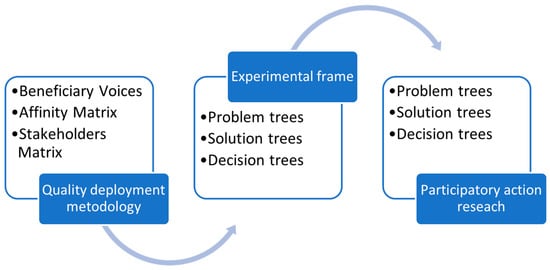
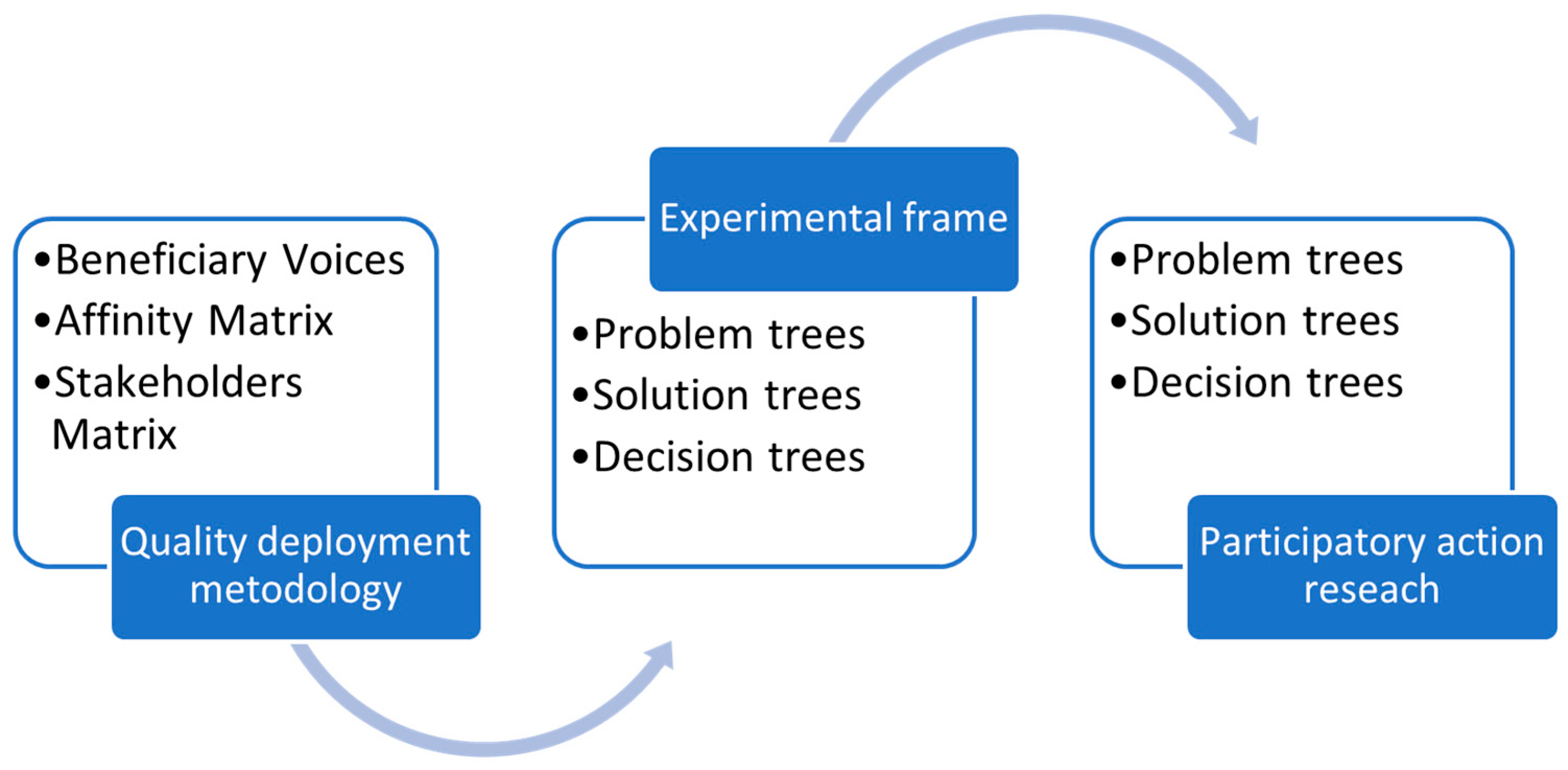
During the implementation phase, the project demonstrated that participatory action research enriches the experimental case study design [6] through the stakeholders’ reflective processes. Several stages of the intervention necessitated iterative consultation and refinement, underscoring the necessity of an action research approach (Figure 1). The project has currently reached its final implementation phase.
Figure 1.
Methodological Frame of the IncluzivEduHub Pilot Project.
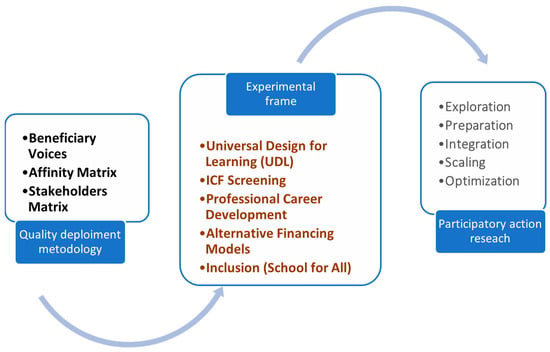
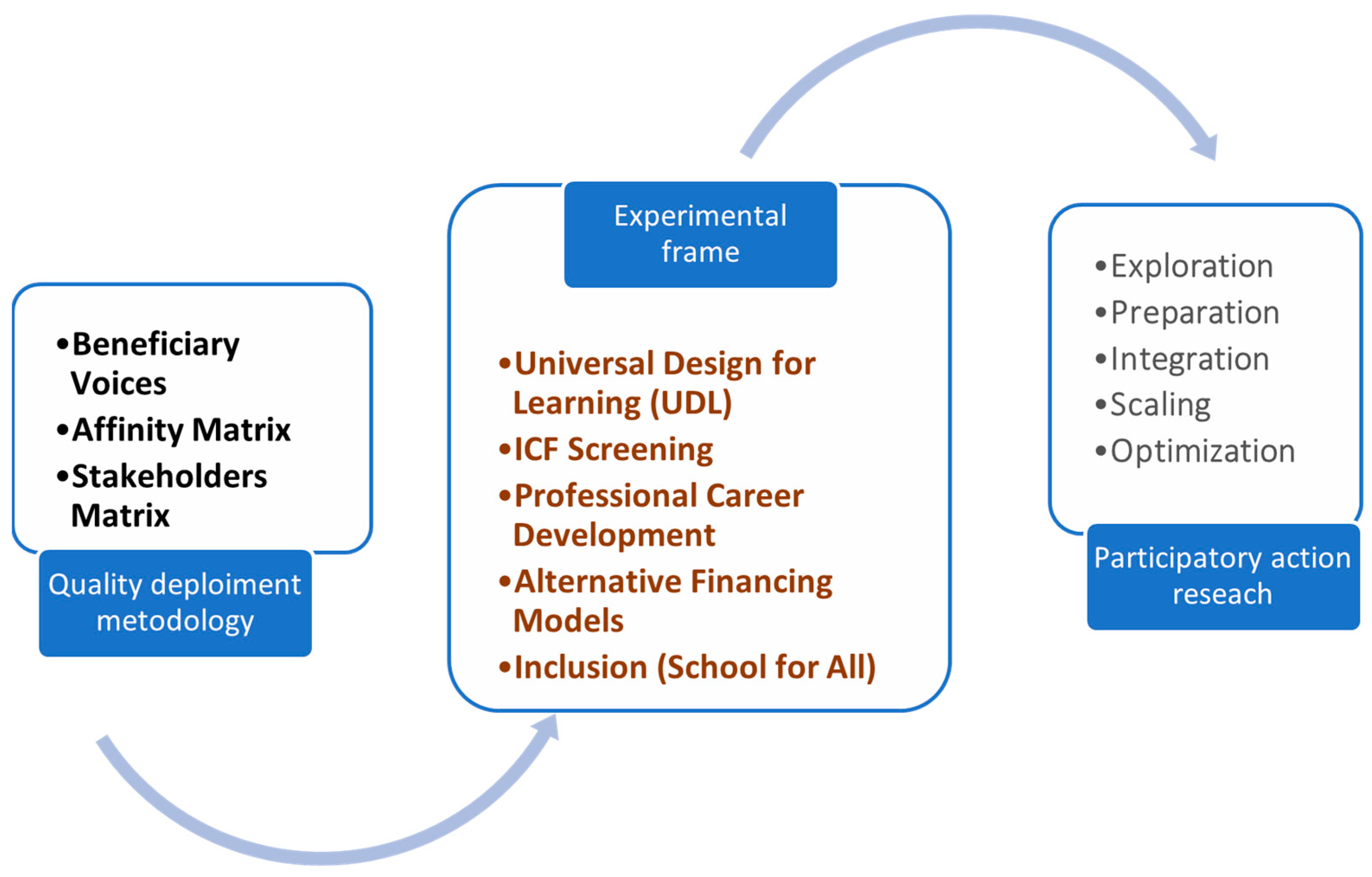
These stages aligned with the recommended steps for implementing Universal Design for Learning (UDL), as UDL is not a momentary task but a commitment to a complex, systemic approach. According to Center for Applied Special Technology (CAST), this process is executed in five distinct stages: exploration, preparation, integration, scaling, and optimization.
3. Results
Following the implementation of the internal school quality standard methodology (Quality Function Deployment), the needs identified through the seven stakeholder focus groups (Beneficiary Voice) were clustered by participant representatives (using Affinity Matrix).
Tables below illustrates the primary modification requested by stakeholders, specifically regarding curricular reform—Table 1 illustrates the stakeholder’s needs for curricular change from Middle Mainstream School no. 190 and Table 2 illustrates the needs for curricular change of stakeholders from Special Vocational School Sf. Nicolae.
Table 1.
Stakeholder Curricular Needs Clustered via Affinity Matrix for Middle Mainstream School No. 190.
Table 2.
Stakeholder Curricular Needs Clustered via Affinity Matrix for Special Vocational School St. Nicolae.
Through the content analysis of all clustered needs, we easily observe the conceptual framework of the Universal Design for Learning approach, as well as the other directions that configured the 5 pillars of the intervention model:
- Universal Design for Learning: Implementing innovative curricular frameworks;
- ICF Screening: Utilizing the International Classification of Functioning, Disability, and Health (ICF) as a standardized method for evaluating student performance and longitudinal progress;
- Professional Career Development: Strengthening teaching competencies through the establishment of professional learning communities and instructional mentoring;
- Alternative Financing Models: Exploring diversified funding streams to sustain institutional initiatives;
- Inclusion (School for All): Facilitating the inclusion of preschoolers and students with Special Educational Needs (SEN) as an intrinsic outcome.
The current regulatory framework for the formal recognition of SEN in Romania is inherently rigid; official status is typically contingent upon parental request and the submission of extensive documentation, a process predominantly accessed by families of students with diagnosed disabilities. Furthermore, the findings of the IncluzivEduHub project underscore the necessity of broadening the scope of SEN classification. There is an urgent need to extend support mechanisms to include students with emotional and attention-related difficulties, high-functioning learners, and those identified as twice-exceptional—groups for whom no specific provisions currently exist within Romanian educational legislation. Consequently, the implementation of ICF screening is essential; it provides both a viable path for supporting students who lack formal certification and a comprehensive, holistic framework for developmental planning for specialists in the experimental group.
The introduction of the Universal Design for Learning framework constitutes the core element of the experiment, we have aligned the iterative stages of the experimental implementation—necessitated by ongoing stakeholder consultations at critical junctures—with the sequential phases of the UDL model as Figure 2 highlights. Accordingly, the initial phases of UDL implementation—exploration and preparation—were synchronized with the pre-experimental preparatory stages. During this period, internal specialists underwent training to disseminate the UDL model among their peers and to provide mentorship throughout the subsequent implementation phases: integration, scaling, and optimization. This enhancement of internal human resource capacity was the direct outcome of the initial reflective cycle inherent to the action research framework, further leveraged by professional development opportunities afforded by Erasmus+ initiatives.
Figure 2.
Methodological Design of the IncluzivEduHub Pilot Project.
During the integration phase, informed by participatory stakeholder reflection, a co-teaching model was introduced—representing a significant advancement for inclusive pedagogical practices within the national context. The co-teaching staff comprises specialists with extensive experience in inclusion and pedagogical strategies for students with special educational needs. The project is currently in an implementation phase that prioritizes the mobilization of community resources through strategic partnerships, outdoor educational activities, and collaborative learning initiatives between the two partner schools. Consequently, while the scaling and optimization stages remain to be finalized, there is an emerging impetus to disseminate this intervention model to other inclusive schools in the region that have expressed interest in the project.
4. Conclusions
Integrating action research into the experimental design facilitated the self-regulation of the intervention, allowing it to adapt iteratively to stakeholder needs at each stage. This synergy is gradually shaping an organizational model designed to provide genuine developmental opportunities for children. The model maintains a consistent focus on the specific needs of each student cohort, including students with learning disabilities, those with twice-exceptionality, those facing emotional challenges, and high-functioning students.
The resulting model aligns with established intervention frameworks, such as the ‘Whole Child’ approach [7] and Trauma-Informed Schooling [8]. ICF screening facilitates a multidimensional assessment of academic, cognitive, emotional, social, and psychological needs, thereby enabling targeted improvements across the five domains mandated by local educational legislation: management, curriculum development, human resources, material and financial resources, and community relations. Consequently, these systemic enhancements facilitate the transformation of the school into a welcoming learning environment for both students and teaching staff.
In the Romanian educational landscape—characterized by a hierarchical culture of control—the limited autonomy of school principals has historically led to the lowest levels of perceived responsibility for curriculum content and student assessment among all PISA-participating countries. This pilot project demonstrates the critical need for decentralization and institutional empowerment to ensure authentic educational quality and to provide stakeholders with substantive opportunities for professional and personal growth.
Funding
This research was funded by National Recovery and Resilience Plan, contract 19106/10.12.2024.
Institutional Review Board Statement
This study complies with the ethical requirements of research involving people in accordance with the Declaration of Helsinki, through the research methodology developed and approved within the IncluzivEduHub Applied Research Center.
Informed Consent Statement
Informed consent was obtained from all subjects involved in the study.
Data Availability Statement
Research data is available on demand.
Conflicts of Interest
The author declares no conflict of interest.
References
- OECD. Reforming school education in Romania: Strengthening governance, evaluation and support systems. In OECD Education Policy Perspectives; OECD Publishing: Paris, France, 2024. [Google Scholar] [CrossRef] [Scilit]
- Ritchie, S.J.; Tucker-Drob, E.M. How much does education improve intelligence? A Meta-analysis. Psychol. Sci. 2018, 29, 1358–1369. [Google Scholar] [CrossRef] [Scilit]
- Gardner, H. Frames of Mind: The Theory of Multiple Intelligences; Basic Books: New York, NY, USA, 2011. [Google Scholar]
- Chină, R. Managementul Calităţii în Învăţământul Preuniversitar; Editura Universitară Bucureşti: Bucharest, Romania, 2015. [Google Scholar]
- Tudorache, L.A.; Folostina, R.; Michel, T. The Management and Assurance of Quality in Romanian Schools. In From Pedagogy to Quality Assurance in Education: An International Perspective; Flavian, H., Ed.; Emerald Publishing Limited: Bingley, UK, 2020; pp. 45–62. [Google Scholar] [CrossRef] [Scilit]
- Biedermann, B.; Calder, S.; Leitão, S.; Lette, H. Combining Participatory-Action-Research With Single-Case-Experimental-Designs: A New Promise for a Mixed-Methods Approach. J. Particip. Res. Methods 2025, 6, 1–21. [Google Scholar] [CrossRef] [Scilit]
- DePaoli, J.; Saunders, R. Teacher Preparation for Whole-Child Design. State Educ. Stand. 2022, 22, 28–34. [Google Scholar]
- Brown, L.M.; Biddle, C.; Tappan, M. Trauma-Responsive Schooling: Centering Student Voice and Healing; Harvard Education Press: Cambridge, MA, USA, 2022. [Google Scholar]

Disclaimer/Publisher’s Note: The statements, opinions and data contained in all publications are solely those of the individual author(s) and contributor(s) and not of MDPI and/or the editor(s). MDPI and/or the editor(s) disclaim responsibility for any injury to people or property resulting from any ideas, methods, instructions or products referred to in the content. |
© 2026 by the author. Licensee MDPI, Basel, Switzerland. This article is an open access article distributed under the terms and conditions of the Creative Commons Attribution (CC BY) license.