


Abstract
Green roofs are a key component of urban green infrastructure and can support diverse urban biota. However, the effects of global change factors, such as nitrogen (N) deposition, on arthropod communities in green roofs remain poorly understood. We conducted a controlled N addition experiment on an experimental green roof planted with four species. Ground-dwelling arthropods were collected by pitfall traps and identified to the family or genus level. We assigned individuals to functional groups based on feeding habits and analyzed how N addition and plant characteristics affect functional group structure. N addition did not change total arthropod abundance or richness, but it increased predator abundance significantly (p = 0.023) and herbivore abundance marginally (p = 0.060). The interaction between N addition and plant identity affected Shannon–Wiener and Pielou evenness of detritivore arthropods. PCoA and PERMANOVA testing showed that plant identity explained 23.7% of community variation (p = 0.006), whereas N addition was marginal (R2 = 7.7%, p = 0.056). Plant characteristics were closely related to the community structure of different functional groups. These results indicate that N addition caused functional group-specific shifts rather than overall diversity loss, and that plant identity was a major driver of ground-dwelling arthropod communities on green roofs.
1. Introduction
Green roofs, as one of the main ways to expand urban green spaces, provide multiple ecosystem services, including temperature and relative humidity regulation, stormwater retention, energy savings, and carbon storage [1,2]. Research has shown that well-designed and scientifically managed green roofs can provide habitats for various biological groups, such as plants, insects, spiders, beetles, etc., forming a semi-natural artificial ecosystem with certain structural complexity, thus playing a positive role in maintaining urban biodiversity [3,4,5]. However, current research on biodiversity in green roofs mainly focused on plants [6,7,8], with far less attention paid to animals, especially ground-dwelling arthropods [9,10,11]. Arthropods are among the most diverse terrestrial taxa and play critical roles in nutrient cycling, energy flow, and biocontrol [12]. At the same time, they are also highly sensitive to environmental changes [13,14]. Thus, studying the changes in arthropod communities on green roofs is essential for a comprehensive understanding of urban biodiversity conservation, especially under environmental change conditions.
Plant identity can have unique impacts on ground-dwelling arthropod communities [10,15,16], which are comparable to the effects of environmental changes [17,18]. Plant species identity mainly affects ground-dwelling arthropod communities through their functional traits [19,20,21]. For example, plants with higher biomass can provide more food resources for herbivorous arthropods, while also providing more dead branches and leaves to support detritivore arthropods [18,20]. Leaf area, leaf length, and other traits affect the habitat and feeding of herbivorous arthropods [22]. Specific leaf area and leaf dry matter content are related to the rate of litter decomposition, which in turn affects litter-dependent saprophytic arthropods [23]. The abundance of predators is positively correlated with plant biomass [20], and their communities are even more sensitive to habitat changes than herbivores [13]. Therefore, understanding the characteristics of plants and their relationship with ground-dwelling arthropod communities is key to predicting and managing arthropods in green roofs.
Urban areas often have a high risk of external nitrogen input due to dense population, concentrated transportation, and industrial activities [22], and urban green space ecosystems may also continue to be disturbed by nitrogen deposition [24]. A recent global synthesis indicated that N-induced arthropod diversity losses can be buffered by natural and semi-natural habitats [25]. However, green roofs, as highly artificial engineering ecosystems, have shallow substrate layers (usually < 15 cm), poor water and fertilizer retention capabilities, severe temperature and humidity fluctuations, and physical isolation from ground habitats [26,27]. These peculiarities suggest that the ecological effects of N deposition on green roofs may differ fundamentally from those in grasslands or forests [1,3]. For example, shallow substrate means that nitrogen is more easily leached out and buffering capacity is weaker [28]. Thus, the response of biological communities to resource input may be more intense than in natural soil, especially saprophytic groups.
Previous studies have shown that N addition affects arthropod communities in a specific functional group manner [29,30]. At present, most studies derive from natural or semi-natural ecosystems, such as grasslands, forests, and farmlands [12,25,31]. For example, herbivores often respond to changes in leaf N content, host biomass, and plant community composition [29,32], whereas detritivores are more influenced by litter quality, soil organic carbon, and microbial processes [9,12,29]. Elevated plant tissue N may cascade up to herbivores and their predators via bottom-up effects [20,29,33]. N inputs also alter litter decomposition, soil microbial communities, and below-ground food webs, potentially changing resource availability for detritivores [31,34]. However, it is unclear whether these processes are applicable on green roofs.
With the background mentioned above, we conducted a factorial N addition experiment on a green roof platform with multiple plant species. We measured the abundance, composition, and diversity of ground-dwelling arthropod functional groups, alongside plant characteristics (survival, above- and below-ground biomass, evapotranspiration, specific leaf area, and leaf dry matter content). We hypothesized that (1) N addition would increase herbivore and predator abundance through bottom-up effects but reduce detritivore diversity by altering litter resources and (2) that plant identity would modulate these responses, with resource-acquisitive species, such as Festuca elata, supporting more diverse detritivores than resource-conservative species, such as Allium mongolicum and Sedum aizoon. By revealing functional group dynamics, we aim to provide scientific evidence for biodiversity conservation and management in urban artificial habitats.
2. Materials and Methods
2.1. Experimental Design
The experiment was conducted on the rooftop (~17 m above ground) of the school of life science at North China University of Science and Technology, Tangshan, Hebei, China (39.806983° N, 118.170336° E), which has a warm temperate semi-humid monsoon continental climate.
We used a completely randomized block design with two N treatments, including N addition and plant identity. N addition set two levels: control (N0, no N addition) and N addition (N3.5, 3.5 g N·m−2·yr−1). A dose of 3.5 g N·m−2·yr−1 was chosen because it represents the upper range of current atmospheric N deposition in urban areas of North China and is comparable to previous green roof N addition experiments [1,35]. Plant identity had four levels: a sod-forming graminoid (Festuca elata), a creeping forb (Duchesnea indica), a tall forb (Allium mongolicum), and a succulent (Sedum aizoon). Each treatment had three replicates.
We conducted experiments using customized green roof modules (30 cm × 30 cm × 25 cm), which consist of a growth medium layer (10 cm), a filter membrane (fabric filter about 2 mm thickness), a drainage system (30 mm height), and a root barrier layer (HDPE about 1.14 mm thickness). For detailed information, refer to [1]. The growing substrate consisted of pumice (40%), sand (35%), peat (15%), and vermiculite (10% by volume). Seeds were surface-sterilized with 0.5% NaClO and sown in seedling trays. On 30 May 2025, seedlings were transplanted into the modules (seven individuals per module). During the first month, modules were watered daily for the first two weeks and every two days thereafter, and all modules were watered on the same schedule with equal volumes. Dead plants were replaced to maintain uniform density. N treatment began on 1 July 2025. NH4NO3 (99%, Macklin) solution was sprayed monthly on N addition treatments, while controls received equal volumes of water, covering the main growing season.
2.2. Arthropod Sampling and Identification
Ground-dwelling arthropod samples were collected using a trap method over 6-week periods (from 1 September to 15 October). Trap cups (diameter 1 cm, height 5 cm) were buried in each module with the rim at substrate level, filled with 75% ethanol and a small amount of detergent. During the sampling period, the storage solution was checked and replaced every 7 days. In rainy weather, the trap cup was sealed with a plastic cover and opened after the rain ended. Arthropod samples were preserved in 75% ethanol and identified to at least family level and to genus and species when possible, using the identification keys in arthropods [36,37]. Based on feeding habits, taxa were assigned to four functional groups: detritivores, herbivores, predators, and fungivores [38,39]. The abundance, richness, Shannon–Wiener, Simpson’s, and Pielou’s evenness measures for arthropod samples were calculated for each treatment [14]. In this study, abundance refers to the number of individuals, richness to the number of taxa, community composition to the identity and relative abundance of taxa, and functional group to taxa grouped by feeding habit.
2.3. Plant Characteristic Measurements
At the end of the growing season, we measured the following plant characteristics per module, including survival rate, aboveground biomass, belowground biomass, cover, evapotranspiration, leaf area, leaf length, leaf width, specific leaf area (SLA), and leaf dry matter content (LDMC). Survival rate was calculated as 100% × alive plant number/total plant number at the end of the experiment. Above- and below-ground biomass was determined by harvesting shoots and roots separately, drying at 70 °C to constant weight. Plant cover was estimated by vertical photography under fixed height and lighting conditions, and then Photoshop was used to calculate the proportion of green pixels in the total image area. Evapotranspiration was measured gravimetrically, i.e., modules were uniformly watered, left to drain, weighed, and re-weighed after 24 h, and the mass difference represented water loss from transpiration and evaporation. For leaf traits, fully expanded, healthy, undamaged leaves were collected. Fresh weight was recorded, and then leaf images were obtained with a scanner and analyzed in ImageJ (version 1.51j8; National Institutes of Health, Bethesda, MD, United States) for area, length, and width. After drying at 70 °C to constant weight, leaf dry weight was measured. SLA = leaf area/leaf dry weight (cm2 g−1), and LDMC = leaf dry weight/leaf fresh weight (g g−1).
2.4. Data Analysis
Two-way ANOVA was used to test the effects of plant identity, N addition, and their interaction on arthropod abundance, richness, Shannon–Wiener, and Pielou’s evenness. Data were Yeo–Johnson-transformed where necessary to meet normality assumptions. Community composition was visualized by principal coordinates analysis (PCoA) based on Bray–Curtis distances, and significance was tested using PERMANOVA. Pearson correlations were used to explore relationships between plant characteristics and arthropod community metrics. All analyses were performed in R 4.3.1.
3. Results
3.1. Overall Community Responses
Plant identity, N addition, and their interactions had no significant effects on total arthropod abundance, richness, Shannon–Wiener, or Pielou’s evenness (p > 0.05, Table 1).
Table 1.
Two-way ANOVA of the effects of plant identity, N addition treatment, and their interactions on total arthropod community indices.
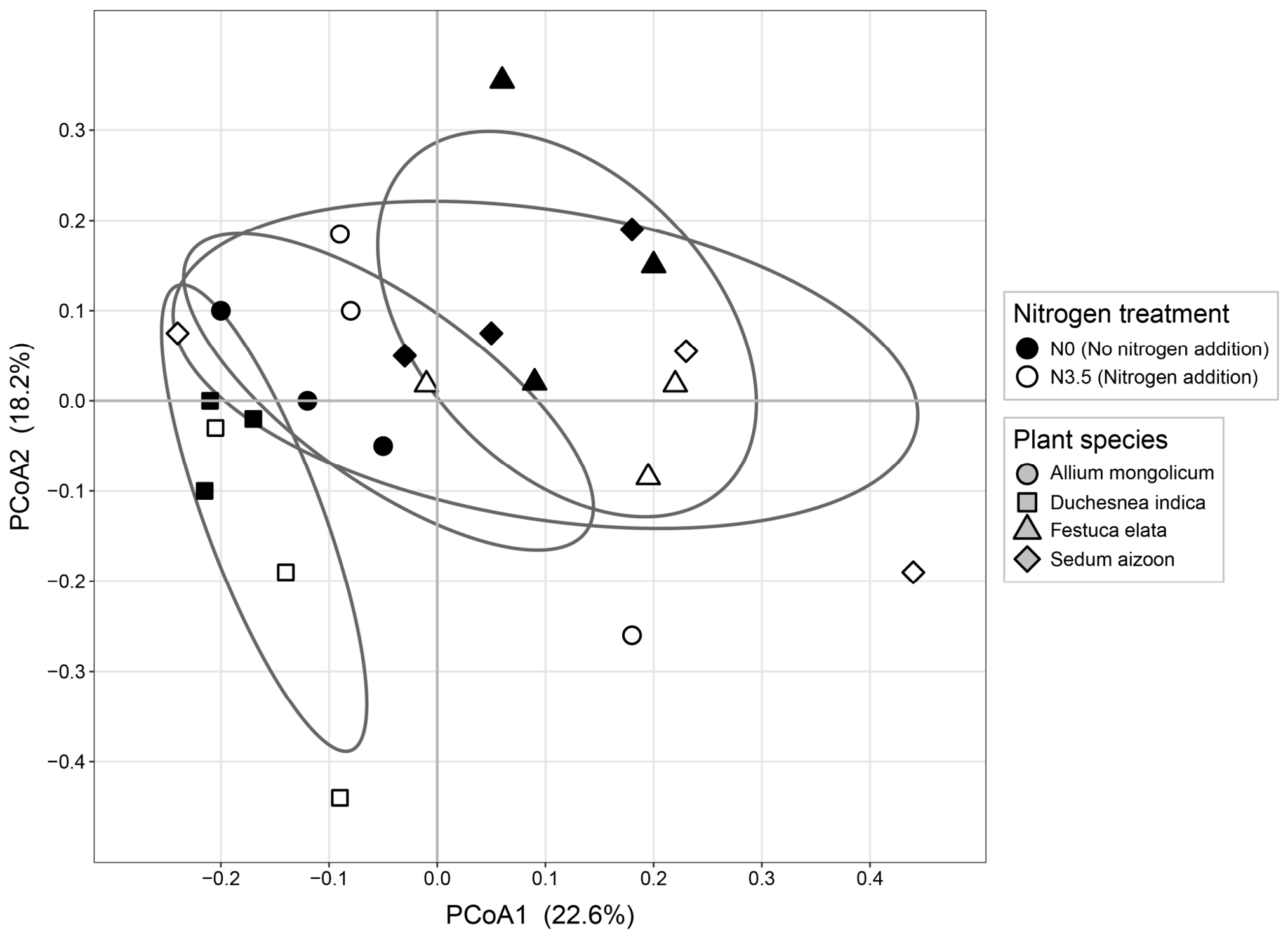
PCoA showed that the first two axes explained 22.6% and 18.2% of the total variation, respectively (Figure 1). According to PCoA, there was a clear separation between the community composition of D. indica and other plant identities (Figure 1). PERMANOVA confirmed that plant identity significantly explained community dissimilarity (R2 = 23.7, p = 0.006), while N treatment was marginally significant (R2 = 7.7, p = 0.056, Table S1).
Figure 1.
Effects of nitrogen addition on arthropod community structure in rooftop greenspaces revealed by principal coordinates analysis (PCoA).
3.2. Functional Group Composition and Abundance
We identified 16 taxa in the green roof samples, including nine detritivore arthropods, three predatory arthropods, three herbivorous arthropods, and one fungivorous arthropod (Tables S2 and S3). Detritivores showed larger relative abundance and dominated green roof arthropod communities, such as Cryptopygus, Homidia, and Willowsia. N addition significantly increased the abundance of Tetranychidae and Epicriidae, while it had no effects on other taxa (Table S2). A. mongolicum and S. aizoon had higher relative abundance of Homidia and Seira, and lower relative abundance of Coloburella and Hypogastrura (Table S3). A. mongolicum had higher relative abundance of Phlaeothripidae, and S. aizoon had higher relative abundance of Entomobrya (Table S3).
3.3. Differential Responses Among Functional Groups
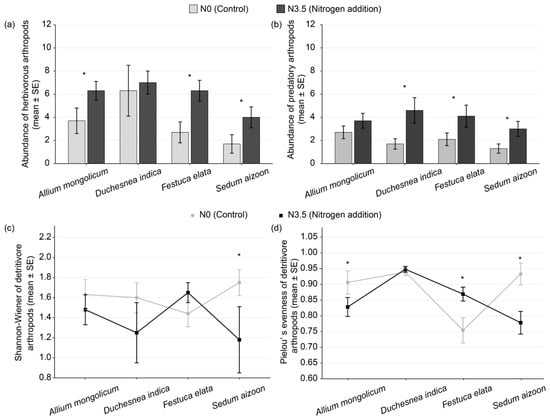
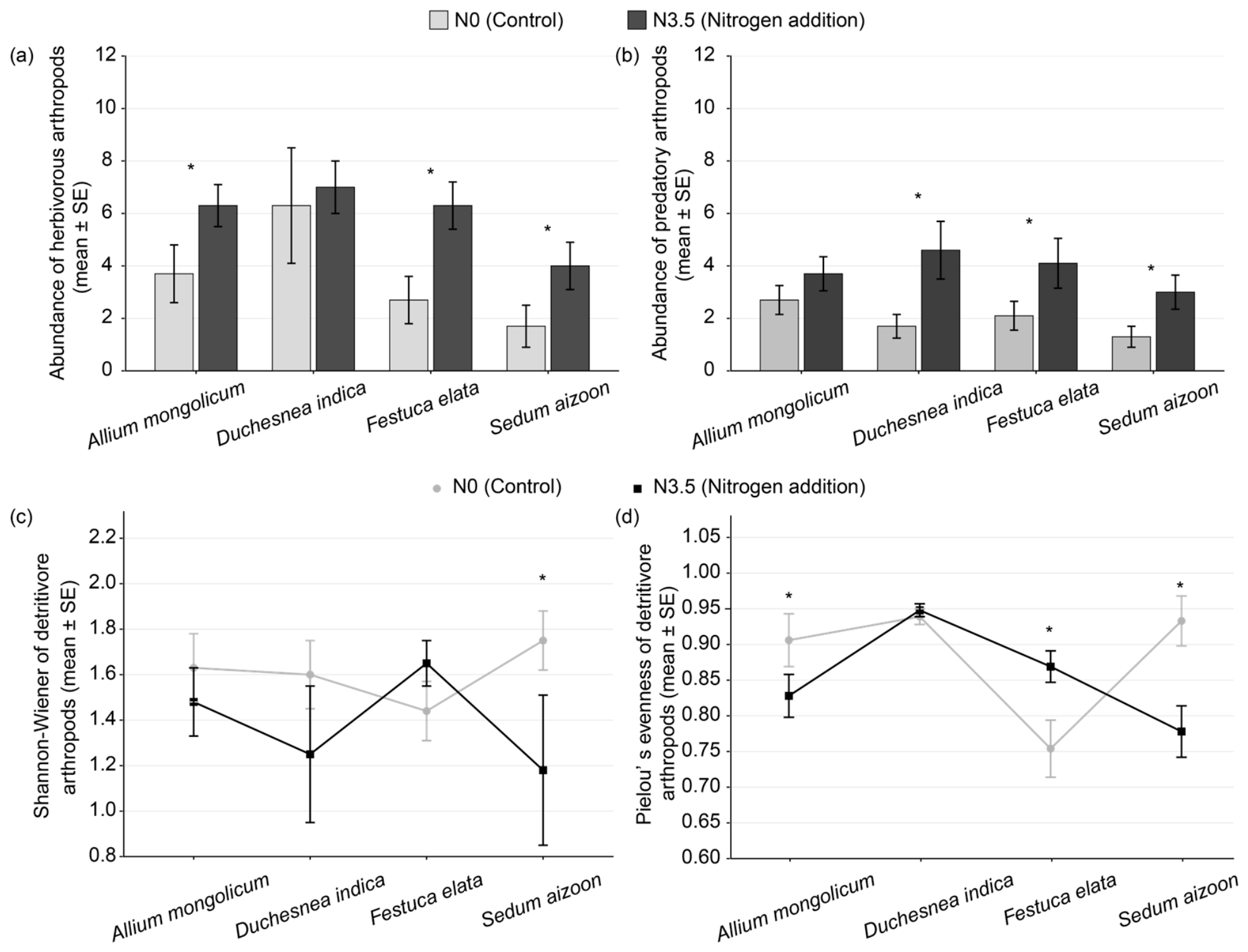
N addition marginally increased herbivore abundance (p = 0.060; Figure 2a) and significantly increased predator abundance (p = 0.023; Figure 2b). Shannon–Wiener and Pielou’s evenness of detritivore arthropods were affected by plant identity × N addition interactions (Table 2). In S. aizoon, N addition decreased Shannon–Wiener of detritivore arthropods (Figure 2c). N addition decreased Pielou’s evenness of F. elata and S. aizoon, but it increased A. mongolicum (Figure 2d).
Figure 2.
Effects of plant identity and N addition treatment on community structure of different arthropod functional groups. (a) Abundance of herbivorous arthropods, (b) abundance of predatory arthropods, (c) Shannon–Wiener of detritivore arthropods, and (d) Pielou’s evenness of detritivore arthropods. * represents significant differences (p < 0.05) between different nitrogen addition treatments.
Table 2.
Effects of plant identity, nitrogen treatment, and their interaction on community indices of different arthropod functional groups based on two-way ANOVA.
3.4. Relationships Between Ground-Dwelling Arthropods and Plant Characteristics
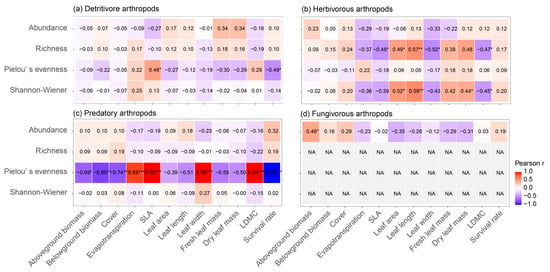
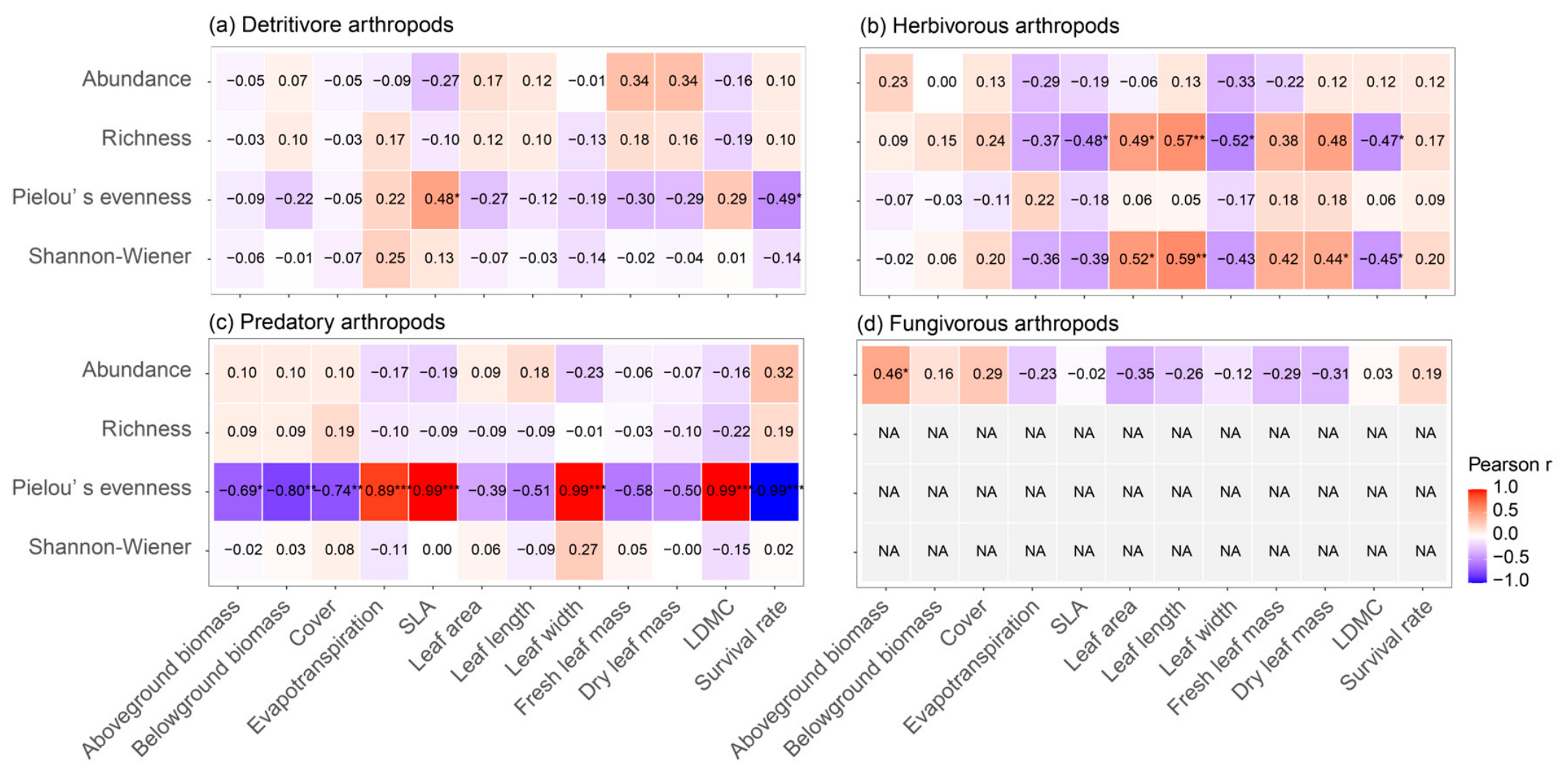
Pielou’s evenness of detritivore arthropods correlated positively with SLA and negatively with plant survival rate (Figure 3a). Richness and Shannon–Wiener of herbivores correlated positively with leaf area and leaf length but negatively with SLA, leaf width, and LDMC (Figure 3b). Pielou’s evenness of predatory arthropods correlated positively with evapotranspiration, SLA, leaf width, and LDMC, and negatively with aboveground biomass, belowground biomass, cover, leaf area, and survival rate (Figure 3c). Abundance of fungivore arthropods correlated positively with aboveground biomass (Figure 3d).
Figure 3.
Pearson correlation heatmaps between arthropod functional group community indices and plant characteristics. (a) Detritivore arthropods, (b) herbivorous arthropods, (c) predatory arthropods, and (d) fungivorous arthropods. * p < 0.05, ** p < 0.01, *** p < 0.001.
4. Discussion
Our experiment tested how N addition and plant identity affect ground-dwelling arthropod communities on an experimental green roof. We found that N addition did not alter total abundance or richness of arthropods but had divergent effects on different functional groups. Plant identity shaped the composition of different arthropod communities, and plant characteristics can predict community changes in different functional groups. These results clearly showed that considering plant identity and environmental change will provide more useful insights for understanding the changes and maintenance of biodiversity in engineered ecosystems.
4.1. Differential N Effects Among Functional Groups
Herbivore abundance showed a marginal increase under N addition (Figure 2a), which is consistent with the classic bottom-up theory expectation that N enrichment improves plant resource quality [33,40]. N addition can increase host plant N status, lower C:N ratios, and alter phytochemistry [27], thereby enhancing herbivore performance [29,40]. Specifically, the higher relative abundances of Tetranychidae under N addition support this interpretation. However, nitrogen faces strong leaching effects on green roofs and may not be fully converted into an increase in plant tissue nitrogen content [6,41]. It is worth noting that we did not measure the nitrogen content in leaves or soil. Therefore, future research needs to be validated by combining data on leaf and soil total nitrogen and carbon nitrogen ratios on green roofs. Predator abundance increased significantly under N addition (Figure 2b), which is attributed to enhanced resource quality [13,33]. Grassland experiments show that N-driven increases in plant productivity and composition can cascade to herbivores and then to predators [33]. In our study, Epicriidae are predatory mesostigmatid mites that prey on small mites, aphids, and other small arthropods. N addition likely improved the resource environment for predators by increasing the availability of active prey, thereby promoting a significant increase in predatory groups.
Shannon–Wiener of detritivore arthropods decreased under N addition, which is consistent with findings from other studies [34]. Detritivores depend on litter, organic matter, and microbial resources [12,29]. In the shallow substrate of green roofs, nitrogen addition may accelerate the decomposition rate of litter, resulting in a pulse-like decrease in the available organic debris resources for detritivore arthropods over time [31,42]. This allowed a few competitive dominants (e.g., Willowsia) to increase their proportion and reduce overall diversity. This study only investigated the response of arthropods under a single N addition level according to the N deposition background. However, the results indicate that the current background N deposition may be within the sensitive range of arthropod community response in rooftop green spaces [14,25]. At this time, the overall community structure has not changed, but the relative abundance and diversity have undergone partial changes from the perspective of functional groups.
4.2. Plant Identity Shaped Arthropod Community Structure
Plant identity significantly affected arthropod community composition (Figure 1), which is similar to natural ecosystems [9,15,17]. In natural ecosystems, such as forests, grasslands, and farmland, plant identity plays a decisive regulatory role in the composition, structure, and diversity of soil arthropod communities by altering plant traits (affecting the quality of litter and root exudates, [15,19]), soil environment (creating differentiated microhabitats for soil arthropods with different preferences, [16,43]), and resource inputs (providing quality and quantity of carbon sources and nutrients, [17]). Leaf traits strongly influence litter quality and thereby detrital food webs [44]. Leaves with high specific leaf area and low leaf dry matter content have thinner and more easily broken tissues and have a faster decomposition rate [23,45]. In our study, detritivore evenness correlated positively with SLA and negatively with plant survival, indicating that dead plants can provide more food resources for specific detritivore arthropods and that rapidly decomposing litter (e.g., high SLA) supplies these resources more quickly [44]. Herbivore richness and Shannon–Wiener correlated positively with leaf area and length, suggesting that larger leaves offer more habitat surface and feeding sites, supporting more taxa [22]. The negative correlations with SLA and LDMC may be because the dominant herbivores, e.g., Tetranychidae, are piercing–sucking or rasping feeders that prefer thicker, juicier leaves [21]. Predator evenness correlated positively with SLA and LDMC, possibly because leaf traits affect herbivore diversity, which in turn influences predators. For example, Epicriidae and Staphylinidae prey on small mites, aphids, and thrips [46]. Fungivore abundance correlated positively with above-ground biomass, likely because fungal biomass is closely related to the input of organic matter from aboveground plants [47].
4.3. Interactions Between N Addition and Plant Type
The interaction between plant identity and N addition was significant for detritivore diversity and evenness, indicating that the influence of plant identity on arthropod communities was regulated by environmental changes [48]. Under N addition, Pielou’s evenness of detritivores decreased in A. mongolicum and S. aizoon but increased in F. elata. This divergence likely reflects interspecific differences in litter quality and microenvironment changes [39,42]. A. mongolicum and S. aizoon belong to resource-conserving species (with lower SLA), and they have extremely strong drought resistance on green roofs [49]. Nitrogen addition may not effectively improve the recalcitrant litter quality of these plants, and it may even lead to soil acidification, concentrating the limited resources on a few tolerant detritivores [42]. In contrast, F. elata is a resource-acquisitive species, and its higher SLA indicates faster decomposition of litter and nutrient cycling [21,44]. This rapid resource turnover may create more variable resource patches in both time and space, promoting the coexistence of a greater diversity of detritivores [39].
It is worth noting that the ecological impact of nitrogen deposition has a cumulative effect [24], and this study only conducted observations during one growing season and at a single site. At the same time, this experiment had a small number of repetitions (n = 3). Therefore, continuous long-term monitoring, multi-site, and more replication in the future are crucial for accurately revealing the dynamics of the arthropod community in green roofs. In addition, there are multiple stress factors such as heat island effect, air pollutants, human interference, and patch fragmentation in urban environments [27,50], which can alter the response of arthropods to resource quality [51,52]. Therefore, future research should consider coupling nitrogen deposition with other environments to more accurately reflect the synergistic effects of multiple global change factors.
5. Conclusions
Our controlled N addition experiment on a green roof revealed that N addition did not alter total arthropod abundance or richness but caused moderate, functional group-specific shifts. Specifically, predator abundance increased significantly, herbivore abundance increased marginally, and detritivore diversity/evenness responses depended on plant identity. Plant identity was the strongest driver of community composition. These findings provide empirical evidence for the ecological consequences of N deposition in urban artificial habitats and offer scientific insights for plant selection and biodiversity management on green roofs. These results should be interpreted cautiously given the single-site, single-season design and low replication. Overall, our findings provide critical empirical evidence for biodiversity-friendly roof design in an era of rising urban nitrogen pollution.
Supplementary Materials
The following supporting information can be downloaded at: https://www.mdpi.com/article/10.3390/nitrogen7040119/s1, Table S1: PERMANOVA analysis of the effects of plant identity and N addition on arthropod community composition. Table S2: Abundance ranking and comparison of relative abundance among arthropod taxa. Table S3: Comparison of relative abundance of major arthropod taxa among different plant species.
Author Contributions
Conceptualization, N.Y. and G.H.; methodology, N.Y. and G.H.; software, N.Y. and Y.Z.; validation, N.Y. and G.H.; formal analysis, N.Y. and Y.Z.; investigation, N.Y., Y.Z., X.S., and G.H.; resources, N.Y. and Y.Z.; data curation, N.Y. and Y.Z.; writing—original draft preparation, N.Y.; writing—review and editing, N.Y., Y.Z., X.S., S.G., H.L. (Hechen Li), Y.W., R.W., J.M., X.L., H.L. (Hongyuan Li), R.H., and G.H.; visualization, N.Y. and Y.Z.; supervision, G.H.; project administration, G.H.; funding acquisition, G.H. All authors have read and agreed to the published version of the manuscript.
Funding
This research was funded by the National Natural Science Foundation of China (32602215), the Science Research Project of Hebei Education Department (BJ2025067), and the Youth Scholars Promotion Plan of North China University of Science and Technology (QNTJ202505).
Data Availability Statement
The data that support the findings of this study are available from the corresponding author upon reasonable request.
Conflicts of Interest
The authors declare no conflicts of interest.
References
- Hao, G.; Yang, N.; Chen, X.; Du, Z.; Li, M.; Chen, L.; Li, H. Nitrogen enrichment decrease green roof multifunctionality. Urban For. Urban Green. 2024, 93, 128233. [Google Scholar] [CrossRef] [Scilit]
- Yang, N.; Guo, Y.; Zhang, X.; Hao, G. Economy-society-ecology-humanistic values of green roofs and its contribution to sustainable development. South China Agric. 2023, 17, 18–23. [Google Scholar]
- Blank, L.; Vasl, A.; Schindler, B.Y.; Kadas, G.J.; Blaustein, L. Horizontal and vertical island biogeography of arthropods on green roofs: A review. Urban Ecosyst. 2017, 20, 911–917. [Google Scholar] [CrossRef] [Scilit]
- Braaker, S.; Obrist, M.K.; Ghazoul, J.; Moretti, M. Habitat connectivity and local conditions shape taxonomic and functional diversity of arthropods on green roofs. J. Anim. Ecol. 2017, 86, 521–531. [Google Scholar] [CrossRef] [Scilit] [PubMed]
- Schindler, B.Y.; Griffith, A.B.; Jones, K.N. Factors influencing arthropod diversity on green roofs. Cities Environ. 2011, 4, 5. [Google Scholar] [CrossRef] [Scilit]
- Hao, G.; Wang, Y.; Li, H.; Gao, S.; Wu, R.; Li, Z.; Han, J.; Li, H.; Hua, R.; Yang, N. How plant diversity and nitrogen deposition affect the net nutrient retention on temperate extensive green roofs: A case study. Ecol. Eng. 2026, 231, 108072. [Google Scholar] [CrossRef] [Scilit]
- Droz, A.G.; Coffman, R.R.; Blackwood, C.B. Plant diversity on green roofs in the wild: Testing practitioner and ecological predictions in three midwestern (USA) cities. Urban For. Urban Green. 2021, 60, 127079. [Google Scholar] [CrossRef] [Scilit]
- Williams, N.S.G.; Lundholm, J.; MacIvor, J.S. Forum: Do green roofs help urban biodiversity conservation? J. Appl. Ecol. 2014, 51, 1643–1649. [Google Scholar] [CrossRef] [Scilit]
- González, E.; Bikic, B.O.; Fabián, D.; Sanchez Dominguez, M.V.; Fenoglio, M.S. Soil- and ground-dwelling arthropod diversity on green roofs: Functional groups are strongly influenced by substrate depth and plant community. Ecol. Entomol. 2026, 51, 356–370. [Google Scholar] [CrossRef] [Scilit]
- Nevermann, S.; Hoffmann, H.; Theodorou, P.; Peters, I.; Husemann, M. Metabarcoding assessment of arthropod diversity on green roofs in the metropolitan city of Hamburg. J. Urban Ecol. 2025, 11, juaf003. [Google Scholar] [CrossRef] [Scilit]
- Tiago, P.; Leal, A.I.; Silva, C.M. Assessing ecological gains: A review of how arthropods, bats and birds benefit from green roofs and walls. Environments 2024, 11, 76. [Google Scholar] [CrossRef] [Scilit]
- Santorufo, L.; Panico, S.C.; Zarrelli, A.; De Marco, A.; Santini, G.; Memoli, V.; Maisto, G. Examining litter and soil characteristics impact on decomposer communities, detritivores and carbon accumulation in the Mediterranean area. Plant Soil 2024, 505, 381–396. [Google Scholar] [CrossRef] [Scilit]
- Genua, L.; Start, D.; Gilbert, B. Fragment size affects plant herbivory via predator loss. Oikos 2017, 126, 1357–1365. [Google Scholar] [CrossRef] [Scilit]
- Mo, L.; Xu, G.; Zhang, J.; Wu, Z.; Yu, S.; Chen, X.; Peng, B.; Squartini, A.; Zanella, A. Threshold reaction of soil arthropods to simulative nitrogen deposition in urban green spaces. Front. Ecol. Evol. 2021, 9, 711774. [Google Scholar] [CrossRef] [Scilit]
- Gorman, C.E.; Read, Q.D.; Van Nuland, M.E.; Bryant, J.A.M.; Welch, J.N.; Altobelli, J.T.; Douglas, M.J.; Genung, M.A.; Haag, E.N.; Jones, D.N.; et al. Species identity influences belowground arthropod assemblages via functional traits. AoB Plants 2013, 5, plt049. [Google Scholar] [CrossRef] [Scilit]
- Huang, J.; Wang, S.; Wu, Y.; Lu, X.; Bai, Y.; Wang, B.; Chen, D. Monoculture-experiment evidence that plant species identity regulates soil biota attributes and soil functions. Catena 2025, 258, 109309. [Google Scholar] [CrossRef] [Scilit]
- Briones, M.J.I.; Elias, D.M.O.; Grant, H.K.; McNamara, N.P. Plant identity control on soil food web structure and C transfers under perennial bioenergy plantations. Soil Biol. Biochem. 2019, 138, 107603. [Google Scholar] [CrossRef] [Scilit]
- Lin, X.; Guo, H.; Chen, Y.; Wang, Y.; Wen, H.; Fang, H.; Yue, K.; Ni, X.; Wu, F. Tree-mediated soil and litter properties drive soil fauna community composition by reshaping predators and saprophages. J. Plant Ecol. 2026, rtag036. [Google Scholar] [CrossRef] [Scilit]
- Beugnon, R.; Steinauer, K.; Barnes, A.D.; Ebeling, A.; Roscher, C.; Eisenhauer, N. Plant functional trait identity and diversity effects on soil meso- and macrofauna in an experimental grassland. Adv. Ecol. Res. 2019, 61, 163–184. [Google Scholar] [CrossRef] [Scilit]
- Lu, X.; Zhao, X.; Tachibana, T.; Welti, E.; Uchida, K.; Sasaki, T.; Bai, Y. Plant biomass and macro- and micronutrients jointly drive top-heavy arthropod trophic pyramids in grassland monocultures. Ecology 2026, 107, e70483. [Google Scholar] [CrossRef] [Scilit] [PubMed]
- Pérez-Harguindeguy, N.; Díaz, S.; Vendramini, F.; Cornelissen, J.H.C.; Gurvich, D.E.; Cabido, M. Leaf traits and herbivore selection in the field and in cafeteria experiments. Austral Ecol. 2003, 28, 642–650. [Google Scholar] [CrossRef]
- Novais, S.M.A.; Alvarenga, A.S.; Falcão, L.A.D.; Neves, F.S. Vertical stratification and effect of petiole and dry leaf size on arthropod feeding guilds in Cecropia pachystachya (Urticaceae). Braz. J. Biol. 2015, 75, 517–523. [Google Scholar] [CrossRef] [Scilit] [PubMed]
- Wang, D.; Yuan, F.; Xie, W.; Zuo, J.; Zhou, H. Effects of leaf size and defensive traits on the contribution of soil fauna to litter decomposition. Forests 2024, 15, 481. [Google Scholar] [CrossRef] [Scilit]
- Du, E.; Xia, N.; Guo, Y.; Tian, Y.; Li, B.; Liu, X.; de Vries, W. Ecological effects of nitrogen deposition on urban forests: An overview. Front. Agric. Sci. Eng. 2022, 9, 445–456. [Google Scholar] [CrossRef] [Scilit]
- Fan, S.; Newbold, T.; Axmacher, J.C.; Outhwaite, C.L.; Zou, Y.; Yu, Z.; Liu, Y. Arthropod biodiversity loss from nitrogen deposition is buffered by natural and semi-natural habitats. PLoS Biol. 2025, 23, e3003285. [Google Scholar] [CrossRef] [Scilit] [PubMed]
- Xiao, M.; Lin, Y.; Han, J.; Zhang, G. A review of green roof research and development in China. Renew. Sustain. Energy Rev. 2014, 40, 633–648. [Google Scholar] [CrossRef] [Scilit]
- Yang, N.; Li, H.; Wang, Y.; Jiang, P.; Gao, S.; Li, H.; Hua, R.; Shi, X.; Hao, G. Microbial inoculation in green roofs: Progress, challenges and ecological regulation strategies. Urban Ecosyst. 2026, 29, 211. [Google Scholar] [CrossRef] [Scilit]
- Dusza, Y.; Barot, S.; Kraepiel, Y.; Lata, J.-C.; Abbadie, L.; Raynaud, X. Multifunctionality is affected by interactions between green roof plant species, substrate depth, and substrate type. Ecol. Evol. 2017, 7, 2357–2369. [Google Scholar] [CrossRef] [Scilit] [PubMed]
- Cheng, J.; Liu, X.; Hao, B.; Zhang, X.; Zhang, Y.; Ma, W. Effects of nitrogen deposition on ground-dwelling arthropods in a temperate grassland of Inner Mongolia. Chin. J. Ecol. 2017, 36, 2237–2245. [Google Scholar]
- Nijssen, M.E.; WallisDeVries, M.F.; Siepel, H. Pathways for the effects of increased nitrogen deposition on fauna. Biol. Conserv. 2017, 212, 423–431. [Google Scholar] [CrossRef] [Scilit]
- Yin, R.; Liu, Q.; Tian, S.; Potapov, A.; Zhu, B.; Yang, K.; Li, Z.; Zhuang, L.; Tan, B.; Zhang, L.; et al. Nitrogen deposition stimulates decomposition via changes in the structure and function of litter food webs. Soil Biol. Biochem. 2022, 166, 108522. [Google Scholar] [CrossRef] [Scilit]
- Throop, H.L.; Lerdau, M.T. Effects of nitrogen deposition on insect herbivory: Implications for community and ecosystem processes. Ecosystems 2004, 7, 109–133. [Google Scholar] [CrossRef] [Scilit]
- Blubaugh, C.K. An omnivore vigour hypothesis? Nutrient availability strengthens herbivore suppression by omnivores across 48 field sites. J. Anim. Ecol. 2023, 92, 751–759. [Google Scholar] [CrossRef] [Scilit] [PubMed]
- Gallego-Zamorano, J.; de Jonge, M.M.J.; Runge, K.; Huls, S.H.; Wang, J.; Huijbregts, M.A.J.; Schipper, A.M. Context-dependent responses of terrestrial invertebrates to anthropogenic nitrogen enrichment: A meta-analysis. Glob. Change Biol. 2023, 29, 4161–4173. [Google Scholar] [CrossRef] [Scilit] [PubMed]
- Yu, G.; Jia, Y.; He, N.; Zhu, J.; Chen, Z.; Wang, Q.; Piao, S.; Liu, X.; He, H.; Guo, X.; et al. Stabilization of atmospheric nitrogen deposition in China over the past decade. Nat. Geosci. 2019, 12, 424–429. [Google Scholar] [CrossRef] [Scilit]
- Yin, W.Y. (Ed.) Pictorial Keys to Soil Animals of China; Science Press: Beijing, China, 2000. [Google Scholar]
- Zheng, L.Y.; Gui, H. (Eds.) Insect Classification; Nanjing Normal University Press: Nanjing, China, 1999. [Google Scholar]
- Kozlov, M.V.; Zverev, V.; Gusarov, V.I.; Korobushkin, D.I.; Krivosheina, N.P.; Mattila, J.; Mutanen, M.; Popova, A.; Prosvirov, A.S.; Punttila, P.; et al. Changes in biomass and diversity of soil macrofauna along a climatic gradient in European boreal forests. Insects 2022, 13, 94. [Google Scholar] [CrossRef] [Scilit] [PubMed]
- Liu, P. The Decomposition of Two Lawn Grass Litter and the Function of Soil Fauna. Master’s Thesis, Sichuan Agricultural University, Ya’an, China, 2016. [Google Scholar]
- Wu, Y.; Liu, J.; Ding, C.; Zhang, B.; Liang, X.; Ning, Y.; Yin, J.; Lv, X. Effects of nitrogen inputs and mowing on the abundance and species richness of herbivorous insects in a meadow steppe. Chin. J. Appl. Ecol. 2023, 34, 1975–1980. [Google Scholar] [CrossRef] [Scilit] [PubMed]
- Johnson, C.; Schweinhart, S.; Buffam, I. Plant species richness enhances nitrogen retention in green roof plots. Ecol. Appl. 2016, 26, 2130–2144. [Google Scholar] [CrossRef] [Scilit] [PubMed]
- Tie, L.; Wei, S.; Peñuelas, J.; Sardans, J.; Peguero, G.; Zhou, S.; Liu, X.; Hu, J.; Huang, C. Phosphorus addition reverses the negative effect of nitrogen addition on soil arthropods during litter decomposition in a subtropical forest. Sci. Total Environ. 2021, 781, 146786. [Google Scholar] [CrossRef] [Scilit]
- Liu, J.; Wu, A.; Yin, R.; Xu, Z.; You, C.; Zhang, L.; Xu, L.; Xu, H.; Wang, L.; Li, H.; et al. Tree species-mediated soil properties shape soil fauna community structure more strongly in the soil layer: Evidence from a common garden experiment. Appl. Soil Ecol. 2024, 203, 105640. [Google Scholar] [CrossRef] [Scilit]
- Cornwell, W.K.; Cornelissen, J.H.C.; Amatangelo, K.; Dorrepaal, E.; Eviner, V.T.; Godoy, O.; Hobbie, S.E.; Hoorens, B.; Kurokawa, H.; Pérez-Harguindeguy, N.; et al. Plant species traits are the predominant control on litter decomposition rates within biomes worldwide. Ecol. Lett. 2008, 11, 1065–1071. [Google Scholar] [CrossRef] [Scilit] [PubMed]
- Pérez-Harguindeguy, N.; Díaz, S.; Garnier, E.; Lavorel, S.; Poorter, H.; Jaureguiberry, P.; Bret-Harte, M.S.; Cornwell, W.K.; Craine, J.M.; Gurvich, D.E.; et al. New handbook for standardised measurement of plant functional traits worldwide. Aust. J. Bot. 2013, 61, 167–234. [Google Scholar] [CrossRef] [Scilit]
- Alberti, G. On predation in Epicriidae (Gamasida, Anactinotrichida) and fine-structural details of their forelegs. Soil Org. 2010, 82, 179–192. [Google Scholar]
- Hobbie, E.A.; Rygiewicz, P.T.; Johnson, M.G.; Moldenke, A.R. 13C and 15N in microarthropods reveal little response of Douglas-fir ecosystems to climate change. Glob. Change Biol. 2007, 13, 1386–1397. [Google Scholar] [CrossRef] [Scilit]
- Wildermuth, B.; Bröcher, M.; Ladouceur, E.; Meyer, S.T.; Schielzeth, H.; Staab, M.; Achury, R.; Blüthgen, N.; Hertzog, L.; Hines, J.; et al. Arthropod species loss underpins biomass declines. Nat. Ecol. Evol. 2026, 10, 83–94. [Google Scholar] [CrossRef] [Scilit] [PubMed]
- Zhang, Q.; Hao, G.; Li, M.; Li, L.; Kang, B.; Yang, N.; Li, H. Transformation of plant to resource acquisition under high nitrogen addition will reduce green roof ecosystem functioning. Front. Plant Sci. 2022, 13, 894782. [Google Scholar] [CrossRef] [Scilit] [PubMed]
- Fenoglio, M.S.; Calviño, A.; González, E.; Salvo, A.; Videla, M. Urbanisation drivers and underlying mechanisms of terrestrial insect diversity loss in cities. Ecol. Entomol. 2021, 46, 757–771. [Google Scholar] [CrossRef] [Scilit]
- Drukker, E.F.; Schranz, M.E.; Vet, L.E.M.; Voeten, J.; Fatouros, N.E.; Quist, C.W. The development of insect diversity and ecosystem complexity on green roofs: A review. Insect Conserv. Divers. 2026, 19, 11–25. [Google Scholar] [CrossRef] [Scilit]
- Wang, B.; Zhang, S.; Qiao, Z.; Yan, Q.; Scheu, S.; Sun, X. Small urban fragments maintain complex food webs of litter-dwelling arthropods in a subtropical city in China. Soil Biol. Biochem. 2023, 185, 109150. [Google Scholar] [CrossRef] [Scilit]

Disclaimer/Publisher’s Note: The statements, opinions and data contained in all publications are solely those of the individual author(s) and contributor(s) and not of MDPI and/or the editor(s). MDPI and/or the editor(s) disclaim responsibility for any injury to people or property resulting from any ideas, methods, instructions or products referred to in the content. |
© 2026 by the authors. Licensee MDPI, Basel, Switzerland. This article is an open access article distributed under the terms and conditions of the Creative Commons Attribution (CC BY) license.