


Abstract
Biological nitrogen fixation (BNF) is crucial for enhancing soybean productivity while reducing reliance on mineral nitrogen fertilizers. The accurate estimation of BNF via the δ15N natural abundance method depends on reliable B-values, which represent plants that derive all their nitrogen from fixation. This study aimed to assess the B-values and symbiotic efficiency of Bradyrhizobium-inoculated soybean varieties using δ15N natural abundance techniques. Eight strains and five soybean varieties were evaluated in sterilized sand culture using a factorial completely randomized design under lath-house conditions. Plants were analyzed for δ15N, shoot N concentration, shoot N content, and symbiotic efficiency (SE). The applied treatments showed highly significant effects with strong interactions, reflecting substantial genotypic variation in symbiotic performance. Strain SD-53 produced the lowest δ15N values (−0.24 to 0.14‰) and the highest SE, with several strain–variety combinations surpassing N-fertilized controls. Shoot N concentration and content ranged from 0.96–3.16% and 9.90–52.73 mg plant−1, respectively, and SE varied from 29.07 to 136.29%. δ15N showed strong negative correlations with SE and plant N traits. The study identified SD-53 as a promising inoculant candidate and generated the first regional soybean B-values (−0.24 to 0.14‰ for each tested variety and a mean of −0.08 ± 0.14‰) for Ethiopia. These values provide an important baseline for %Ndfa calculations and support future field validation and inoculant formulation.
1. Introduction
Soybean (Glycine max L.) is a globally important legume valued for its high protein and oil contents and for its capacity to enhance soil fertility through biological nitrogen fixation (BNF) [1,2,3]. Through symbiotic association with Bradyrhizobium species, soybean can obtain a substantial proportion of its nitrogen requirement from atmospheric N-fixation, thereby reducing dependence on synthetic fertilizers and contributing to more environmentally sustainable production systems [2,4]. Improving the efficiency of BNF remains a priority, especially in smallholder and low-input production systems where access to mineral fertilizers is limited, and during the period when the ever-changing climate is pressing the crop production sector [4,5].
Recent 15N tracer studies in cropping systems indicate that nitrogen use efficiency (NUE), the proportion of applied fertilizer N recovered in crop biomass, is often low, with a large share of fertilizer N retained in soil or lost through leaching and gaseous emissions rather than being harvested by the crop. Field-based 15N tracer experiments in maize systems have demonstrated that only about 34% of applied fertilizer N is recovered in aboveground biomass, while the rest remains in the soil or is lost to the environment [6]. Similarly, a global meta-analysis across rice, wheat, and maize systems reported average fertilizer N recovery efficiencies of 36–42%, highlighting the widespread inefficiency of synthetic nitrogen use in agriculture [7]. Such low recovery of applied N leads to losses of reactive nitrogen to the environment, causing serious environmental impacts, including eutrophication, biodiversity loss, human health problems, and perturbations of the climate system, and underscores the need for sustainable N management strategies [8]. Isotope-based approaches, particularly 15N tracer techniques, are therefore essential tools for quantifying fertilizer-N fate and soil–plant N flows, as they enable accurate tracking of fertilizer-derived N among plant, soil, and loss pathways [8]. In this context, biological nitrogen fixation in legumes represents a key strategy for improving system-level NUE, reducing dependence on synthetic nitrogen fertilizers, and minimizing associated environmental impacts in sustainable agricultural systems [9,10].
The effectiveness of symbiotic nitrogen fixation in soybean is strongly influenced by interactions among host genotype, Bradyrhizobium strain, and environmental conditions such as nutrient availability and growth medium [11,12]. Reliable quantification of symbiotic nitrogen fixation is therefore necessary for identifying efficient strain–variety combinations. The natural abundance 15N technique offers a robust method for estimating the proportion of nitrogen derived from atmospheric nitrogen fixation by legumes (%Ndfa) under realistic growth conditions [13,14,15]. Beyond BNF estimation, δ15N natural abundance has also been used to interpret soil and plant N dynamics as an indicator of broader ecosystem nitrogen cycle processes because δ15N reflects the openness of nitrogen cycling and transformations in soils and plants [16].
A critical parameter in this method is the B-value—the δ15N signature of a legume relying exclusively on atmospheric N2. Accurate estimation of the B-value is essential because even small deviations can lead to substantial errors in %Ndfa calculations [17,18,19]. B-values are known to vary among legume species, cultivars, and rhizobial symbionts, reflecting physiological and biochemical differences in nitrogen assimilation [11,20]. Reported B-value ranges for soybean include −2.7756 to −0.1951‰ [21], −3.67 to −1.84‰ [22], −1.172 to −0.492 [23], and −2.54 to −2.14 [24], reflecting variation in genotype, inoculant strain, and experimental conditions. Despite this documented variability, δ15N natural abundance studies commonly rely on fixed or literature-derived B-values when estimating the proportion of nitrogen derived from atmospheric fixation (%Ndfa). Such assumptions may introduce substantial uncertainty or bias into %Ndfa estimates, particularly when strain–variety specificity and growth conditions differ from those under which reference B-values were established. Consequently, empirical determination of strain- and cultivar-specific B-values is increasingly recognized as critical for improving the accuracy, comparability, and interpretation of δ15N-based assessments of symbiotic nitrogen fixation. Moreover, interactions between soybean genotype and Bradyrhizobium strain are likely to contribute to B-value variability, underscoring the need to explicitly consider symbiotic compatibility in methodological evaluations of biological nitrogen fixation.
Against this background, despite the recognized importance of BNF, limited data exist on B-values for Ethiopian soybean varieties and their compatibility with locally isolated Bradyrhizobium strains under controlled conditions. This knowledge gap hampers accurate %Ndfa estimation and the identification of high-performing variety–strain combinations. Therefore, determining crop- and strain-specific B-values is a prerequisite for obtaining meaningful %Ndfa estimates [21]. Sand culture experiments conducted under controlled environments provide suitable conditions for generating accurate B-values by minimizing external nitrogen sources and allowing uniform plant growth [25,26]. In addition to accurate B-value determination traits such as shoot nitrogen content, shoot N concentration, symbiotic efficiency, and biomass accumulation are tightly linked to N2 fixation performance and provide complementary indicators for evaluating genotype–strain compatibility [19,27].
In this study, the 15N natural abundance approach was used to estimate B-values for five Ethiopian soybean varieties inoculated with eight indigenous Bradyrhizobium strains under N-free sand culture. The eight Bradyrhizobium strains were selected based on Jaiswal et al. [28]. They belong to clusters V and VI and exhibit genetic differences in the ITS region, indicating that they are distinct even within the same cluster. All strains are effective nodulators with positive nitrogen fixation and originate from different soybean varieties. We hypothesize that δ15N natural abundance can reliably indicate strain × variety differences in N2 fixation, allowing identification of the most compatible Bradyrhizobium–soybean combinations. The specific objectives were to (i) determine δ15N discrimination patterns among soybean–Bradyrhizobium combinations, (ii) generate reliable B-values for use in subsequent %Ndfa studies, and (iii) evaluate isotopic relationships with plant biomass traits. These findings will address the current knowledge gap regarding Ethiopian soybean B-values and support the selection of efficient symbiotic partnerships, providing essential physiological parameters for improving soybean BNF in biofertilizer-based production systems.
2. Materials and Methods
2.1. Experimental Site and Design
The experiment was conducted under controlled lath house conditions at Hawassa University College of Agriculture, Ethiopia, during the year 2023. The sand culture was sterilized to eliminate native rhizobila species. The experimental design was a completely randomized design (CRD) arranged factorially with five soybean varieties, one early (Awassa-95) and four medium (Gishama, Awassa-95, Boshe, Hawassa-04, and Jalale) maturing varieties sourced from Pawe Agricultural Research Center in Ethiopia. Eight Bradyrhizobium strains (SB-36, SB-37, SD-47, SD-50, SD-51, SD-53, SB-113, and SB-120) were obtained from the microbiology laboratory at Hawassa University in Ethiopia. The Bradyrhizobium strains SB-36 and SB-37 were isolated from Boricha soil using the Wogayen variety, while SB-113 and SB-120 were isolated from the same location soil using Awassa-95 and Awassa-04 varieties, respectively. The remaining strains were isolated from Dore Bafano soil using varieties TGX-3326-44 (SD-47 and SD-50) and Gishama (SD-51 and SD-53) [29]. The genetic diversity and population composition of these Bradyrhizobium strains were studied [28]. Two uninoculated controls were included: a positive control, receiving 5 mM KNO3, and a negative control, receiving only N-free nutrient solution (representing 0% soil/mineral N source). This arrangement gave a total of 50 treatments (40 inoculated combinations + 2 controls × 5 varieties) replicated three times, resulting in 150 pots.
2.2. Inoculant Preparation and Planting
Yeast extract–mannitol agar (YEMA) was prepared according to the composition shown in Table 1. Congo red was added at a final concentration of 0.025%, and the pH was adjusted to 6.8 using 0.1 N NaOH or HCl with a microprocessor-controlled pH meter. The medium was then sterilized by autoclaving at 121 °C and 15 psi for 15 min. After cooling to approximately 55 °C, it was poured into sterile Petri dishes and allowed to solidify under laminar airflow conditions.
Table 1.
Composition of growth media and nutrient solutions used in the experiment.
A loopful of Bradyrhizobium strain suspension from preserved vials was streaked onto Petri dishes containing YEMA and incubated at 28 ± 2 °C for 5–7 days [30]. Developing colonies were repeatedly subcultured on fresh YEMA plates to obtain pure cultures. A loopful of a pure Bradyrhizobium colony was subsequently inoculated into yeast extract–mannitol (YEM) broth and incubated under the same conditions. The YEM broth had the same composition as YEMA, except that agar and Congo red were omitted (Table 1). Then, 1 mL of Bradyrhizobium strains from pure broth cultures in their logarithmic growth phases was used for inoculation.
Soybean seeds of each variety (Gishama, Awassa-95, Boshe, Hawassa-04, and Jalale) were surface-sterilized by immersing in 70% ethanol for 10 s followed by 3% sodium hypochlorite for 3 min, then rinsed thoroughly six times with sterile distilled water. Pre-germination was carried out on moist, sterile filter paper in Petri dishes at 28 °C for 48 h.
Pre-germinated seeds of uniform size were aseptically transferred to sterilized modified Leonard jars (cup volume 334.52 cm3) using sterile forceps. The jars were filled with river sand that had been washed with quarter-strength 98% H2SO4 and thoroughly rinsed with tap water to neutral pH (≈7). The sand-filled Leonard jars were then sterilized by autoclaving at 121 °C for 15 min. Each Leonard jar consisted of two plastic cups, with the upper cup containing sand and the lower cup connected by cotton wicks to supply water and nutrients by capillary action. At transplanting, one germinated seedling was placed in each pot. Following planting, each inoculated treatment received 1 mL of the respective Bradyrhizobium broth culture applied to the seedling root zone using a sterilized micropipette.
Plants were irrigated with a nitrogen-free nutrient solution (modified Jensen’s formulation; Table 1) and maintained under lath-house conditions. The positive control received 0.5 g KNO3 L−1 of sterilized distilled water as a mineral N source with each nutrient irrigation, while the negative control received only the N-free nutrient solution. Nutrient solution was applied at 100 mL per pot weekly, and sterile distilled water was supplied as needed to maintain adequate moisture.
2.3. Plant Sampling and Processing
At 45 days after planting, plants were carefully uprooted, and shoots and roots were separated. Shoots were oven-dried at 70 °C for 48 h until constant weight and finely ground using a 0.85 mm sieve. Subsamples were further ball-milled to obtain a homogenous fine powder suitable for isotope ratio mass spectrometry (IRMS) analysis.
2.4. Isotopic and Elemental Analyses
Stable nitrogen isotope analysis was carried out at the University of Hohenheim, Germany, using a Thermo Flash 2000 Elemental Analyzer connected via a Conflo IV interface to a Thermo Delta V Plus isotope ratio mass spectrometer, (Thermo, Corporation, Bremen, Germany) Approximately 3 mg of finely ground shoot sample was weighed into pre-cleaned tin capsules for simultaneous determination of nitrogen isotopic composition (δ15N, ‰) and total nitrogen concentration (%N).
Quality control was ensured by including international reference materials (Glut1 and USGS-40) four times at the start of each run and after every 12 samples to monitor instrumental drift and maintain accuracy. Analytical precision, determined from repeated measurements of laboratory standards, was better than ±0.04‰ for δ15N.
The isotopic composition of nitrogen in plant samples was expressed in delta notation [31]:
where 15N/14N sample and 15N/14N standard are the isotope ratios of the sample and air (the International Atomic Energy Agency standard), respectively.
2.5. B-Value Determination
The B-value represents the δ15N isotopic signature of a legume plant deriving all of its nitrogen from atmospheric N2 through symbiotic fixation. B-values are known to vary with legume genotype, rhizobial strain, nutrient availability, and plant physiological status [32].
In this study, inoculated soybean plants were grown in sterilized sand without mineral nitrogen, ensuring that biological nitrogen fixation was the sole nitrogen source. Under these N-free conditions, variation in plant δ15N values primarily reflects differences in the degree of reliance on symbiotic N2 fixation and isotopic fractionation during the fixation process.
For each soybean variety, the B-value was defined as the lowest δ15N value recorded among its inoculated treatments, representing plants with the greatest isotopic depletion and therefore the highest dependence on atmospheric N2. This approach is consistent with previous studies in which the minimum δ15N observed within a treatment set is taken as the best approximation of a fully fixing legume [33,34,35]. Using the lowest δ15N value for each variety accounts for varietal differences in symbiotic effectiveness among strains and provides a practical estimate of the true B-value.
The B-values obtained in this study (−0.24‰ to +0.14‰) are higher (less negative) than some commonly reported soybean B-values. This deviation may be attributed to varietal differences, the effectiveness of rhizobial strains, plant physiological responses, and isotopic fractionation associated with symbiosis. Even under N-free growth conditions, such variability has been documented, highlighting the importance of determining genotype- or site-specific B-values rather than relying on a single universal value [32].
In addition to variety-specific B-values, the lowest δ15N measured across all five soybean varieties was used to calculate a species-level B-value, allowing the results to be applied more broadly.
2.6. Shoot N Content and Percent N
Shoot nitrogen content was determined from measured shoot N concentration and shoot dry matter as
where %N is the nitrogen concentration in the shoot tissues, directly obtained from a mass spectrometer, and shoot dry weight is expressed in grams. Multiplying by 1000 converts N content from grams to milligrams.
2.7. Symbiotic Efficiency
Symbiotic efficiency (SE) was used to assess the effectiveness of each Bradyrhizobium strain–soybean variety combination by comparing shoot nitrogen content with that of the N-fertilized positive control. SE was calculated following Purcino et al. [36] but using shoot N content instead of shoot dry weight:
where shoot N content represents the total nitrogen accumulated in the shoot. SE reflects how efficiently inoculated plants meet their nitrogen requirements through symbiotic fixation relative to plants supplied with mineral nitrogen. An SE value of 100% indicates equivalent N accumulation to the positive control, while values > 100% indicate Purcino et al. [36] superior N accumulation via biological fixation. Symbiotic efficiency was classified following Purcino et al. [36] as highly effective (>80%), effective (50–80%), poorly effective (35–50%), and ineffective (<35%).
2.8. Data Analysis
Data were analyzed in R [37] using a factorial completely randomized design with Variety and Bradyrhizobium strains treated as fixed factors. Assumptions of normality and homogeneity of variance were evaluated using the Shapiro–Wilk and Levene tests, respectively [38]. For traits that violated one or both assumptions (shoot N content and δ15N), Box–Cox transformations were applied [39]. A constant was added to δ15N values prior to transformation to accommodate negative isotopic signatures. Two-way ANOVA was performed on transformed data where appropriate. When significant main effects or Variety × Bradyrhizobium strains interactions were detected, means were separated using Tukey’s HSD test at the 5% significance level.
Traits measured directly (shoot N content, percent N, and δ15N) were analyzed using all 150 experimental units. Traits derived from the δ15N natural abundance method—δ15N for determination of B-value and symbiotic efficiency—were considered only for inoculated treatments and therefore analyzed using 120 units (5 varieties × 8 strains × 3 replicates). The negative (N-free) and positive (KNO3-supplied) controls were excluded from SE calculations because they do not yield interpretable values within the natural abundance SE framework.
3. Results
3.1. δ15N (‰)
Analysis of variance revealed highly significant (p < 0.001) effects of soybean variety, Bradyrhizobium strain, and their interaction on δ15N values (Table 2). Across varieties and strains, δ15N values ranged from −0.24‰ in Boshe inoculated with SD-53, to 5.37‰ in negative control of variety Gishama (Table 3). Strains SB-37, SD-51, and SD-50 with Awassa-95 showed the highest δ15N values, which is statistically at par with their negative controls, indicating ineffectiveness of the strains with this variety. In general, uninoculated negative controls exhibited consistently high δ15N values across varieties, while inoculation with effective Bradyrhizobium strains markedly reduced δ15N, reflecting higher nitrogen fixation.
Table 2.
Analysis of variance for δ15N, N concentration, shoot nitrogen content, and SE of Bradyrhizobium-inoculated soybean varieties grown under controlled conditions at Hawassa, Ethiopia.
Table 3.
Mean values for shoot nitrogen content and nitrogen-related parameters of Bradyrhizobium-inoculated soybean varieties grown under controlled conditions at Hawassa, Ethiopia.
3.2. B-Value
Analysis of variance revealed highly significant (p < 0.001) effects of soybean variety, Bradyrhizobium strain, and their interaction on δ15N values (Table 2). Across varieties and strains, δ15N values ranged from −0.24‰ in Boshe inoculated with SD-53 to 5.23‰ in Awassa-95 inoculated with SD-51 (Table 3). The lowest δ15N values (<0.0‰) were observed in strain SD-53 in most of the varieties, indicating strong isotopic dilution relative to other strains. Strains SB-113 and SB-120 showed δ15N values of less than one with varieties Boshe and Jalale, indicating the compatibility of both varieties and strains. Strains SD-51 (5.23‰) and SB-37 (5.14‰) with Awassa-95 showed the highest δ15N values, which are statistically at par, and strain SD-50 (5.01‰) also showed the highest δ15N value, which is statistically the same as SB-37, indicating incompatibility of the strains with this variety.
3.3. Nitrogen Concentration (%)
The concentration of N in the shoot was significantly affected by varieties, Bradyrhizobium strains, and their interaction (p < 0.001; Table 2). Mean N concentration ranged from 0.96% for the variety Jalale inoculated with SD-47 to 3.16% for Hawassa-04 inoculated with SD-53 (Table 3). Among inoculated treatments, %N varied widely, with the highest values recorded for SD-53 in most varieties, while strains such as SB-36 and SB-37 produced lower N concentrations in most of the varieties. Substantial variation among variety × strain combinations reflects strong variable responses to Bradyrhizobium strains inoculation.
3.4. Shoot Nitrogen Content (mg Plant−1)
Shoot N content was significantly affected by varieties, Bradyrhizobium strains, and their interaction (p < 0.001; Table 2). Mean shoot N ranged from 9.90 mg plant−1 for the variety Gishama with negative control to 52.73 mg plant−1 for Awassa-95 inoculated with SD-53 (Table 3). Among inoculated treatments, shoot N content varied widely, with the highest values recorded for SD-53 in most varieties, recording 52.73, 42.68, and 41.30 mg plant−1 in Awassa-95, Gishama, and Boshe varieties, respectively. In contrast, strains such as SB-36 and SB-37 produced lower shoot N content in most of the varieties. Substantial variation among variety × strain combinations reflects strong variable responses to Bradyrhizobium strains inoculation.
3.5. Symbiotic Efficiency (SE, %)
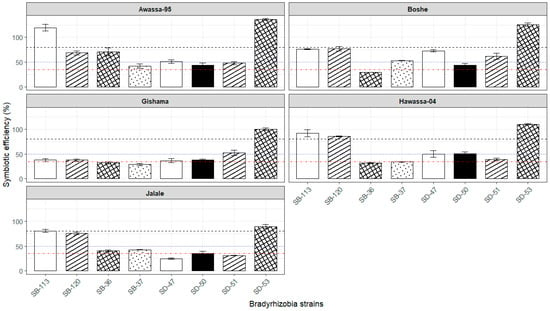
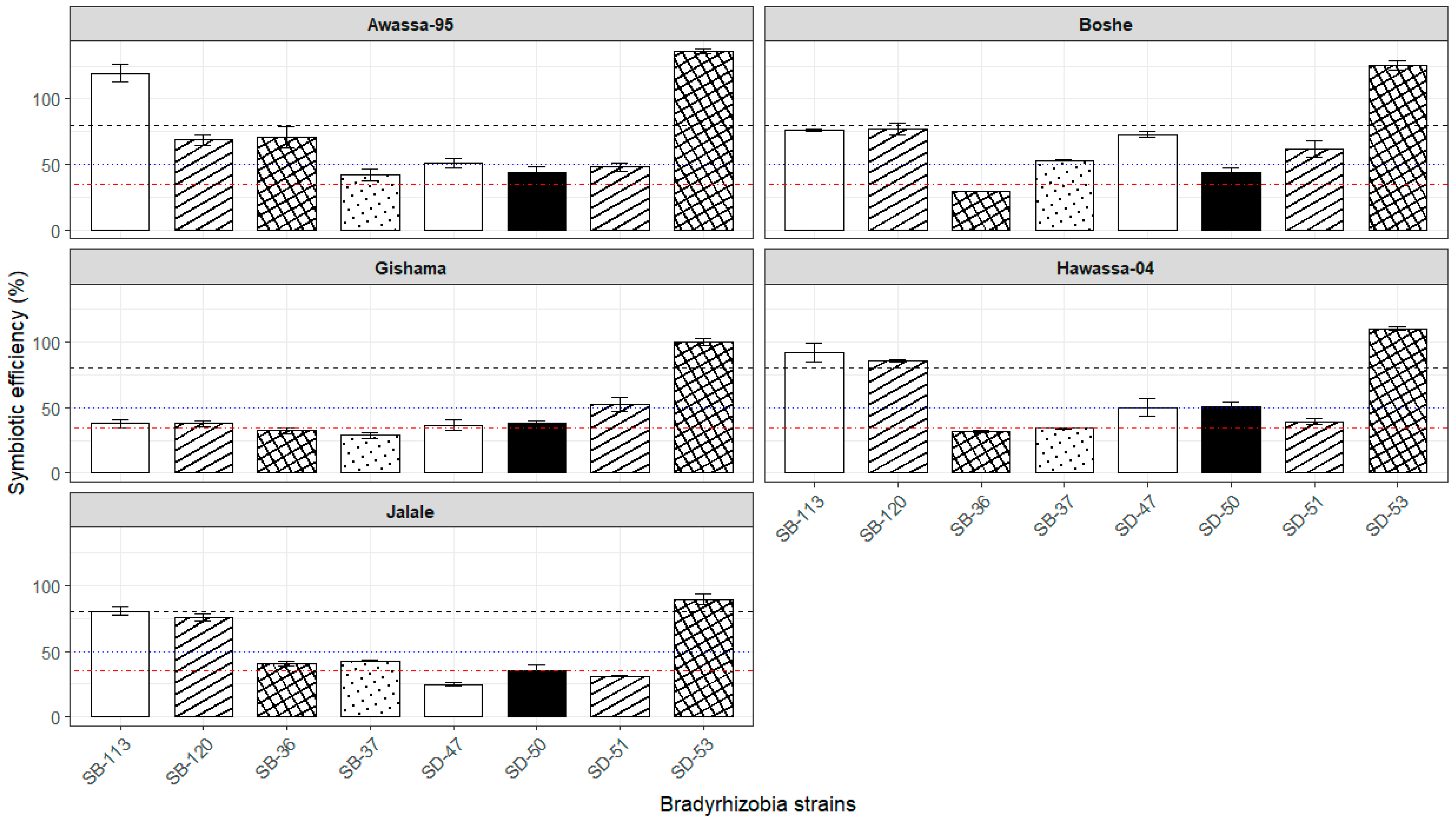
Symbiotic efficiency was significantly influenced by variety, strain, and their interactions (p < 0.001; Table 2). The SE values varied from 29.07% (Gishama × SB-37) to 136.29% (Awassa-95 × SD-53; Table 3). The highest SE values (>80%) were observed when strain SD-53 is combined with all soybean varieties. Variety Awassa-95 inoculation with strain SB-113 and variety Hawassa-04 inoculation with SB-113 and SB-120 also resulted in the highest SE. Effective symbiotic efficiency levels (50–80%) were noted for strains SB-113, SB-120, and SD-51 across different varieties, while strains SD-50, SB-36, and SB-37 were poorly effective and ineffective in some varieties (Figure 1).
Figure 1.
Symbiotic efficiency of the soybean-nodulating Bradyrhizobium strains tested on a sand culture. The horizontal dotted lines indicate the borders for highly effective (>80%), effective (50–80%), poorly effective (35–50%), and ineffective (<35%) categories.
3.6. Correlation Analysis
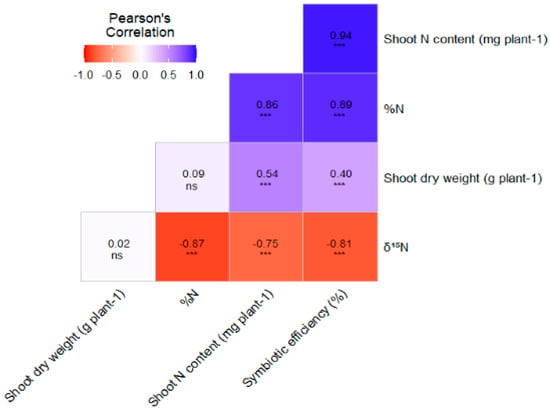
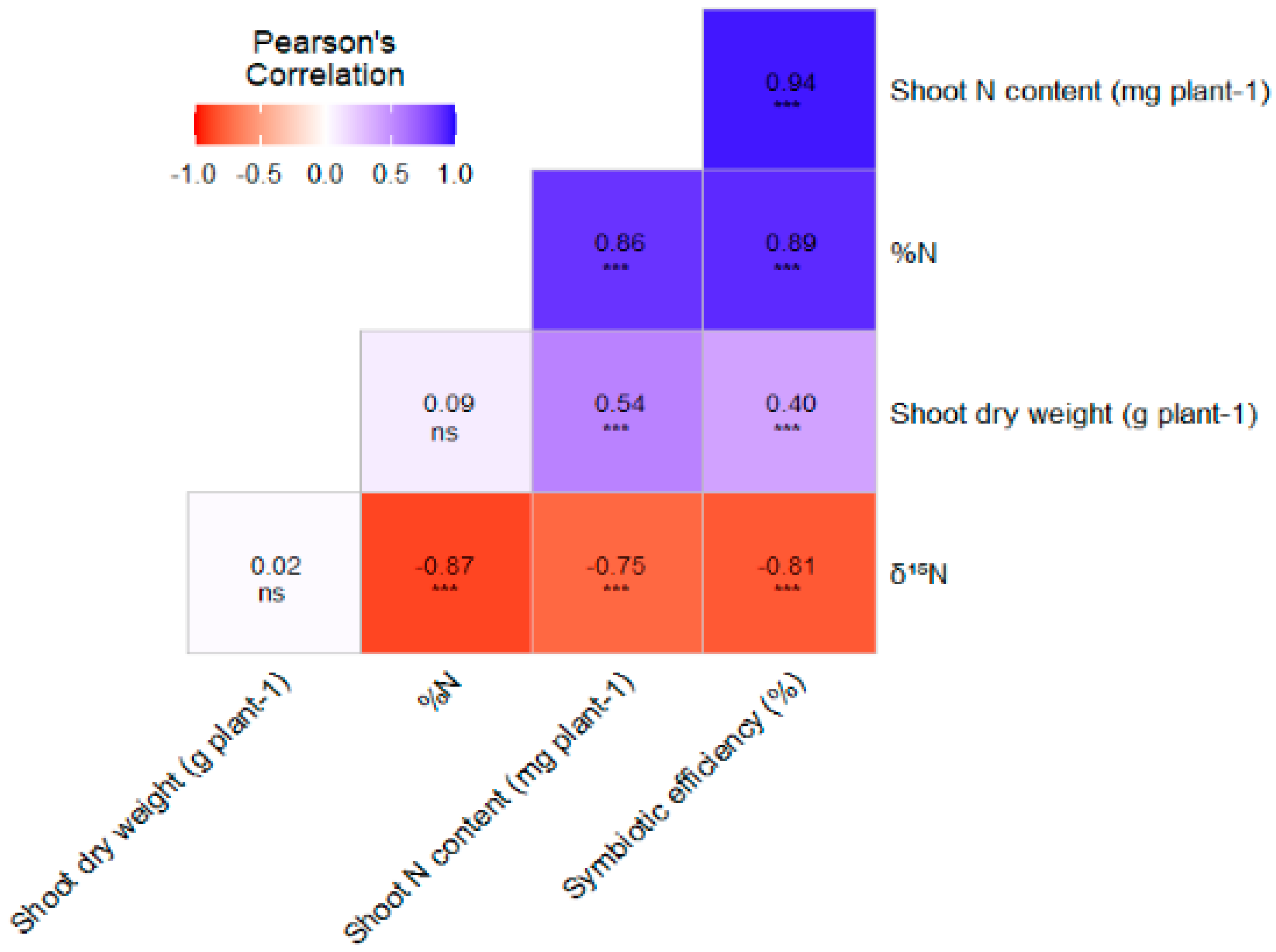
Pearson correlation analysis was conducted to examine associations among shoot nitrogen content, δ15N, shoot dry weight, nitrogen concentration, and symbiotic efficiency (SE) in Bradyrhizobium-inoculated soybean varieties (Figure 2). This analysis highlights functional traits that influence strain × variety compatibility and the efficiency of biological nitrogen fixation. Shoot N content (mg N plant−1) was calculated from shoot dry weight and %N, and SE (%) was calculated relative to the positive control (KNO3-fertilized). Shoot nitrogen content was strongly and positively correlated with SE (r = 0.94) and nitrogen concentration (r = 0.86), and moderately correlated with shoot dry weight (r = 0.54), while it showed a significant negative correlation with δ15N (r = −0.74). δ15N was negatively correlated with SE (r = −0.81), shoot nitrogen content (r = −0.75), and nitrogen concentration (r = −0.87). Shoot dry weight exhibited positive correlations with shoot nitrogen content (r = 0.54) and SE (r = 0.40). SE was also strongly and positively correlated with nitrogen concentration (r = 0.89).
Figure 2.
Pearson’s correlation matrix showing relationships among shoot nitrogen content, δ15N, shoot dry weight, %N, and symbiotic efficiency in Bradyrhizobium strains-inoculated soybean varieties evaluated on a sand culture under lath-house conditions at Hawassa, Ethiopia, during 2023. Color shading represents the magnitude and direction of correlation coefficients (−1 to +1), with darker blue indicating strong positive associations and darker red indicating strong negative associations. Significance levels are denoted as ns (p ≥ 0.05) and *** (p < 0.001).
These results indicate that plants with higher shoot nitrogen content and nitrogen concentration achieve higher symbiotic efficiency, whereas higher δ15N values indicate lower BNF. By quantifying these relationships, the correlation analysis highlights the key traits that govern symbiotic performance.
4. Discussion
4.1. δ15N Values of Soybean Varieties Inoculated with Bradyrhizobium Strains
Biological nitrogen fixation (BNF) efficiency in soybean is known to depend on both host genotype and rhizobial strain [40]; however, comparative evidence quantifying how strain × variety compatibility influences isotopic signatures across multiple soybean varieties remains limited. This study addresses this gap by applying the δ15N natural abundance approach to evaluate symbiotic performance among different soybean varieties inoculated with contrasting Bradyrhizobium strains under controlled conditions. The δ15N natural abundance technique was selected because it measures differences in isotope signatures between legumes and soil sources, making it useful for quantifying the proportion of N derived from atmospheric fixation versus soil N [11].
Analysis of variance revealed highly significant effects (p < 0.001) of soybean variety, Bradyrhizobium strain, and their interaction on δ15N, demonstrating that isotopic discrimination is strongly influenced by both host genotype and Bradyrhizobium strains. The significant variety × strain interaction reflects the well-established specificity of the legume–rhizobium symbiosis and indicates that BNF efficiency is maximized only when compatible host–microbe pairings are formed. Similar genotype-dependent responses in δ15N have been reported for soybean–Bradyrhizobium associations under controlled environmental conditions [11,22] and more recently by Skipitytė et al. [41], confirming δ15N as a sensitive integrative indicator of symbiotic performance.
Among the evaluated strains, SD-53 consistently produced the lowest δ15N values across all four soybean varieties—Boshe (−0.24‰), Awassa-95 (−0.13‰), Gishama (−0.12‰), and Hawassa-04 (−0.05‰)—indicating a greater proportional reliance on atmospheric N2 to meet plant nitrogen demand. This consistent response across genetically distinct host varieties suggests that SD-53 exhibits broad symbiotic compatibility, enabling effective colonization, stable nodule function, and sustained nitrogenase activity. Such performance implies that SD-53 may possess favorable traits related to nod gene expression, infection efficiency, or host regulation of carbon allocation to nodules, all of which can enhance N2 fixation and influence isotopic fractionation. Previous studies similarly demonstrated that inoculant strain identity often exerts a stronger control over δ15N signatures than host genotype, reinforcing the central role of strain selection in optimizing BNF [11,22,42]. Comparable reductions in δ15N following inoculation have also been documented in other legumes, including cowpea [43] and common bean [44], indicating a common physiological basis for isotopic responses to effective symbiosis.
In contrast, uninoculated controls exhibited high δ15N values (3.74–5.37‰), reflecting the absence of symbiotic N2 fixation and the limited availability of mineral N in the sterilized sand.
Nitrogen-fertilized controls showed intermediate δ15N values (0.78–2.65‰), consistent with uptake of mineral nitrogen sources. These contrasts confirm that δ15N signatures reliably reflect the balance between symbiotically fixed and externally supplied nitrogen, validating the methodological approach used in this study.
The δ15N natural abundance technique exploits isotopic fractionation during biological N2 fixation, wherein nitrogenase and associated assimilation pathways preferentially incorporate the lighter 14N isotope, resulting in more negative δ15N values in plant tissues when atmospheric N2 is the dominant nitrogen source [45,46]. Consequently, the consistently lower δ15N values observed in SD-53–inoculated plants provide mechanistic evidence of enhanced symbiotic efficiency and greater dependence on atmospheric nitrogen. In this context, δ15N serves not only as a diagnostic indicator of BNF activity but also as a conceptual link between isotopic fractionation, symbiotic compatibility, and inoculant performance. Overall, these findings highlight the importance of selecting highly compatible Bradyrhizobium strains, such as SD-53, to maximize biological nitrogen fixation across diverse soybean varieties.
4.2. B-Value of Soybean Varieties Inoculated with Bradyrhizobium Strains
Despite the widespread use of δ15N natural abundance to estimate soybean N2 fixation, limited information exists on how Bradyrhizobium strain × soybean variety interactions influence isotopic expression and B-value determination under controlled, N-free conditions. Because δ15N integrates host genotype effects, microbial symbiotic efficiency, and isotopic fractionation during biological nitrogen fixation, it provides a powerful functional indicator of symbiotic performance. In this study, δ15N values of inoculated soybean plants grown in sterile, N-free sand varied significantly among varieties, Bradyrhizobium strains, and their interactions (Table 2), demonstrating that isotopic signatures of N2 fixation are both genetically and symbiotically regulated.
Across all treatments, δ15N values ranged from −0.24‰ to +5.23‰, with the most depleted values consistently associated with strain SD-53 across four of the five varieties. These negative and near-zero δ15N values indicate strong dependence on atmospheric N2, consistent with the typical isotopic signatures reported for fully N2-fixing soybean plants, which generally exhibit δ15N values close to atmospheric N2 (0‰) or slightly negative because of isotopic fractionation [32]. In contrast, highly enriched δ15N values up to +5.23‰ (in variety Awassa-95 inoculated with strain SD-51), indicate little or no symbiotic fixation and therefore were excluded from B-value estimation. Similarly, Houngnandan et al. [21] reported that the plant b-value of the nodulating soybeans ranged from −2.7756‰ to 0.1951‰, while the non-nodulating cultivars were 2.67‰ to 9.30‰.
The use of the lowest δ15N within each variety as the B-value is justified because plants were grown in sterile, N-free medium, allowing the most depleted δ15N values to represent maximal N2 fixation. This approach aligns with methods used by Kermah et al. [33] and Vázquez et al. [35], who similarly selected the minimum δ15N from inoculated plants as the most accurate indicator of a fully N2-dependent legume. The lowest δ15N values obtained were −0.12‰ (Gishama), −0.13‰ (Awassa-95), −0.24‰ (Boshe), −0.05‰ (Hawassa-04), and 0.14‰ (Jalale), demonstrating modest but real variety-level differences in isotopic discrimination under full fixation. The low or negative δ15N values (e.g., −0.24‰) are consistent with what is expected for plants deriving nearly all their nitrogen from atmospheric N2 fixation. Indeed, in a pot experiment with soybean inoculated by different Bradyrhizobium strains, shoot δ15N values ranged from around −3.67 to −1.84 ‰ under conditions of pure fixation, indicating strong isotopic depletion relative to soil-derived nitrogen [22]. Oberson et al. [23] also reported a B-value of −1.172 to −0.492. Moreover, Araujo et al. [24] also reported that the B-value ranged from −2.54 to −2.14 at 46 days after planting. This supports that the lowest δ15N values in this study reflect real N2-fixation (i.e., near 100% N from the atmosphere).
To support a broader application of the results, a species-level B-value was calculated from the lowest δ15N for all five varieties. The resulting mean B-value was −0.08 ± 0.14‰, which falls within the globally accepted range for soybean and is appropriate for use in %Ndfa calculations when variety-specific B-values are not available. Nevertheless, the observed varietal differences underscore the advantage of using variety-specific B-values when precise estimates of biological nitrogen fixation are required.
Correlation analyses in this study further strengthened the functional linkage between δ15N and nitrogen accumulation. This is because δ15N exhibited strong significant negatively correlations with symbiotic efficiency (r = −0.81), shoot N content (r = −0.75), and nitrogen concentration (r = −0.87). These relationships are in line with the findings of Ayalew et al. [43], who reported similarly strong negative correlations between δ15N and nitrogen fixation indicators in cowpea, and are consistent with field-based observations in soybean crops [47].
Overall, these results support the use of δ15N natural abundance as a highly sensitive and biologically robust inverse indicator of nitrogen accumulation in soybean–Bradyrhizobium symbioses. The consistently low and often negative δ15N values associated with strain SD-53 across most soybean varieties suggest a greater reliance on atmospheric N2 and indicate comparatively higher symbiotic effectiveness relative to the other tested strains under controlled conditions. This consistent isotopic depletion implies that SD-53 may form highly compatible associations with diverse soybean genotypes, potentially reflecting enhanced nodulation efficiency [48], effective host–strain signaling, and sustained nitrogenase activity. The strong negative correlations between δ15N and symbiotic efficiency, shoot N content, and nitrogen concentration further support the functional advantage of SD-53 in promoting biological nitrogen fixation. Collectively, these findings highlight SD-53 as a promising candidate for further evaluation in inoculant development. Global synthesis studies emphasize that improving biological nitrogen inputs is essential for enhancing nitrogen use efficiency and reducing fertilizer losses. Taken together, accurate B-value determination and functional evaluation of strain–variety combinations provide a controlled-condition basis for identifying promising candidates, although field validation is necessary to confirm their broader agronomic applicability. Recent global syntheses and meta-analyses indicate that recovery of applied nitrogen fertilizer in major cropping systems is often well below 50%, with substantial portions of fertilizer N retained in soil or lost to the environment rather than being taken up by crops [7,49]. These findings underscore the potential contribution of biologically fixed nitrogen from legume–rhizobium partnerships for improving system-level nitrogen use efficiency and reducing reliance on synthetic nitrogen fertilizers. In this broader context, our controlled-condition results demonstrate that highly compatible strains like SD-53 can supply a large proportion of soybean nitrogen demand, providing a mechanistic and quantitative perspective that supports their further evaluation under field conditions.
4.3. Shoot Nitrogen Concentration and N Content of Inoculated Soybean Varieties
Highly significant (p < 0.001) main and interaction effects of soybean variety and Bradyrhizobium strain on shoot N concentration and content were observed, underscoring that nitrogen accumulation in vegetative tissues of legumes is controlled by both host genotype and rhizobial strains, with direct relevance for identifying effective inoculant–variety combinations in soybean production systems. Such strong genotype by strain interactions are widely documented in symbiosis studies on soybean, reflecting the fact that the host genetic background influences nodulation capacity, nodule functioning, and N assimilation pathways, while Bradyrhizobium strains differ in their intrinsic N-fixing capacity and symbiotic compatibility [11,47].
Across varieties, inoculation significantly increased shoot nitrogen concentration and content compared with uninoculated controls, confirming that the tested Bradyrhizobium isolates were capable of fixing substantial amounts of atmospheric nitrogen under sand-culture conditions. However, the magnitude of this response differed markedly among strains, indicating variation in symbiotic effectiveness. These findings are consistent with previous studies showing enhanced shoot N accumulation in soybean following inoculation with effective rhizobia [50,51].
Among the tested strains, SD-53 consistently resulted in the highest shoot N contents across multiple soybean varieties, with values reaching 52.73, 42.68, and 41.30 mg plant−1 in Awassa-95, Gishama, and Boshe, respectively. These values far exceeded those of uninoculated controls and were generally higher than those obtained with other inoculants, indicating superior nitrogen acquisition. The consistently strong performance of SD-53 suggests enhanced symbiotic compatibility, likely reflecting efficient nodulation, sustained nitrogenase activity, and effective transfer of fixed nitrogen to the host plant. Similar increases in shoot N accumulation associated with highly efficient Bradyrhizobium strains have been reported by Araujo et al. [11]. Similarly, Gyogluu et al. [47] also found that inoculated soybean genotypes in Mozambique accumulated significantly higher shoot N under field conditions, underscoring that increased N uptake is a reliable and environment-stable indicator of effective inoculation.
Comparisons with control treatments further highlight the contribution of biological nitrogen fixation to shoot N accumulation. Uninoculated plants exhibited very low shoot N content (9.90–14.16 mg plant−1), reflecting reliance on the limited nitrogen present in the growth medium. In contrast, N-supplied controls accumulated higher shoot N (29.40–45.00 mg plant−1); however, several strain–variety combinations, particularly those involving SD-53, matched or exceeded these values. This demonstrates that effective symbiosis can supply a substantial proportion of soybean nitrogen demand and, under favorable conditions, may partially or fully substitute for mineral N fertilizers [52,53]. Accordingly, the high shoot N contents observed in inoculated plants demonstrates the potential of certain Bradyrhizobium strains to function as effective biological substitutes for mineral nitrogen fertilizers.
Correlation results from the present study provide strong physiological support for the observed patterns in nitrogen acquisition. Shoot N content was strongly and positively correlated with SE (r = 0.94) and N concentration (r = 0.86), which indicates that increases in shoot nitrogen are closely linked with greater symbiotic efficiency and plants with higher internal nitrogen levels tend to exhibit improved nitrogen accumulation. Likewise, shoot N content showed a moderate positive correlation with shoot dry weight (r = 0.54), reflecting the well-established role of nitrogen in promoting vegetative growth and biomass accumulation. These findings are consistent with previous reports showing that isolates with higher nitrogen fixation produce plants with greater shoot N and biomass [14,51,54,55], highlighting the robustness of these physiological relationships across legumes and experimental conditions.
4.4. Symbiotic Efficiency of Bradyrhizobium Strains-Inoculated Soybean Varieties
Symbiotic efficiency, expressed as the percentage increase in shoot N accumulation of inoculated plants relative to the N-fertilized control, showed highly significant variation among soybean varieties, Bradyrhizobium strains, and their interaction (p < 0.001), highlighting its relevance for selecting effective variety–strain combinations in soybean production. This strong genotype × strain effect agrees with earlier findings that the efficiency of biological nitrogen fixation in soybean is strongly determined by compatibility between the host genotype and the inoculant strain. Argaw [56] similarly reported significant differences in shoot N accumulation and biomass among soybean cultivars inoculated with different Bradyrhizobium isolates, emphasizing that soybean genotypes do not respond uniformly to inoculation. More recent multi-strain evaluations—such as Omari et al. [57] in northern Germany and Temesgen and Assefa [58] in Ethiopia—also demonstrated that nodulation, growth, and yield (including N accumulation or yield proxies) vary depending on cultivar–strain (or isolate) combinations, further confirming that symbiotic performance is jointly controlled by both partners.
Across the current experiment, SE ranged from 29.07% (Gishama × SB-37) to 136.29% (Awassa-95 × SD-53), demonstrating substantial differences in symbiotic productivity among strain × variety combinations. Strain SD-53 consistently showed the highest SE across all varieties, ranging from ~90 to 136% (Figure 1)—indicating broad host compatibility and a strong N2-fixing capacity under this experimental conditions. Similarly, under Ethiopian conditions it was reported that native rhizobial isolates increased shoot total N and achieved symbiotic effectiveness values between 100% and 170% across different soybean cultivars [58]. By contrast, strain SB-37 generally produced lower SE values (e.g., 29.07% in Gishama; 42.08% in Awassa-95; 34.43% in Hawassa-04). Taken together, these findings reinforce that relative metrics like SE (based on shoot N accumulation) reliably reflect strain × variety variation in symbiotic performance under controlled environments.
The extremely high SE values (>80%) observed for combinations such as Awassa-95 × SD-53 and Boshe × SD-53 reflect both their high proportion of N derived from the atmosphere (approaching 100% Ndfa) and their strong shoot N accumulation (up to 52.73 mg plant−1). Such strong responses are consistent with findings from [47], who reported that inoculation with highly effective Bradyrhizobium strains significantly increased soybean N uptake, %Ndfa, and total N-fixed across multiple environments in Mozambique despite the presence of native rhizobial populations. This confirms that well-matched cultivar–strain combinations can achieve near-optimal symbiotic performance even under varying soil microbial backgrounds.
The internal consistency of SE as an integrative symbiotic indicator was further supported by its strong correlation structure. SE showed highly significant positive relationships with shoot N content (r = 0.94, p < 0.001) and %N (r = 0.89, p < 0.001), indicating that treatments accumulating more nitrogen also exhibited greater improvements relative to their N-fertilized controls. In contrast, SE was strongly and negatively correlated with δ15N (r = −0.80), demonstrating that more effective symbioses—those deriving a higher proportion of N from atmospheric sources—display more negative isotopic signatures. These patterns agree with studies in cowpea by Ayalew et al. [43], who reported similarly strong negative correlations between δ15N and N-fixed (r = −0.72), and very strong positive correlations between N-fixed and shoot N accumulation (r > 0.99). Such convergence across species and experimental systems supports the validity of using SE and δ15N together to diagnose biological nitrogen fixation performance.
The consistently superior performance of strain SD-53 across multiple soybean varieties—expressed as lower δ15N values, higher shoot N accumulation, and higher symbiotic efficiency—suggests broad host compatibility and efficient N2 fixation. This may reflect more effective nodulation, enhanced nitrogenase activity, or improved transfer of fixed N to the host plant, traits that are known to underlie successful rhizobium–legume symbioses.
Apparent inconsistencies between δ15N and SE among some strain–variety combinations can also be explained by the use of variety-specific N-fertilized controls in SE calculations. While δ15N reflects the proportion of nitrogen derived from atmospheric N2, SE is calculated relative to the shoot N accumulation of the N-fertilized control for each variety. Consequently, varieties with high N uptake under fertilization may exhibit lower SE values even when δ15N indicates substantial biological nitrogen fixation. Conversely, varieties with lower fertilized-N accumulation may achieve high SE despite relatively higher δ15N values. This explains cases such as Awassa-95 × SB-113, which showed high SE despite moderate δ15N, compared with Boshe × SB-113 or SB-120, where lower δ15N did not translate into higher SE. These findings highlight that δ15N and SE capture complementary but distinct physiological processes, and their combined interpretation provides a robust assessment of strain–variety compatibility and symbiotic performance.
When combined with evidence that global nitrogen use efficiency remains low across major crops and geographies [7,49], the consistently superior performance of strain SD-53 across multiple soybean varieties suggests that targeted use of highly effective Bradyrhizobium inoculants could meaningfully contribute to improved nitrogen management in soybean cropping systems beyond controlled environments.
5. Conclusions
Strong variety × strain interactions for δ15N, shoot N content, shoot N concentration, B-value, and symbiotic efficiency demonstrate that these traits are strongly influenced by cultivar–inoculant compatibility. Among the tested strains, SD-53 consistently produced the lowest δ15N signatures and the highest symbiotic efficiency values, indicating superior performance under controlled conditions. The mean B-value (−0.08 ± 0.14‰) obtained can be used for calculating the percentage of nitrogen derived from the atmosphere for soybean when variety-specific B-values are unavailable. These results provide baseline data on δ15N, shoot N concentration, N content, and symbiotic efficiency for different soybean–strain combinations in an uncontaminated system—the first such data reported for this region. Overall, this study demonstrates the feasibility of identifying high-performing Bradyrhizobium inoculants under controlled conditions and provides a foundation for future field-based evaluations.
Author Contributions
H.B. conceptualized and finalized the research methodology, conducted and managed the experiment, collected and analyzed the data, wrote the original manuscript, and revised the manuscript. T.Y. funding acquisition, reviewed and edited the manuscript, and supervision. T.A. initiated the concept, funding acquisition, project administration, and reviewed and edited the manuscript. G.C. reviewed, and edited the manuscript, and supervision. All authors have read and agreed to the published version of the manuscript.
Funding
The experiment was supported by Hawassa University through a thematic research project on ‘Soybean Popularization, Agronomic and Nutritional Evaluation, and Product Development for Agro-processing Industry Linkage in the Sidama Regional State, Ethiopia to TA’. The laboratory cost for isotopic analysis and APC is covered by “Climate Change Effects on Food Security (CLIFOOD)”, a project supported by the DAAD with funds from the Federal Ministry for Economic Cooperation and Development (BMZ) with project ID 57562534.
Data Availability Statement
All data gathered for this study are analyzed and included in this published article. For further information, please contact the corresponding author.
Conflicts of Interest
The authors declare no conflicts of interest.
References
- Maluk, M.; Giles, M.; Wardell, G.E.; Akramin, A.T.; Ferrando-Molina, F.; Murdoch, A.; Barros, M.; Beukes, C.; Vasconcelos, M.; Harrison, E. Biological nitrogen fixation by soybean (Glycine max [L.] Merr.), a novel, high protein crop in Scotland, requires inoculation with non-native bradyrhizobia. Front. Agron. 2023, 5, 1196873. [Google Scholar] [CrossRef] [Scilit]
- Telles, T.S.; Nogueira, M.A.; Hungria, M. Economic value of biological nitrogen fixation in soybean crops in Brazil. Environ. Technol. Innov. 2023, 31, 103158. [Google Scholar] [CrossRef] [Scilit]
- Moretti, L.G.; Crusciol, C.A.C.; Leite, M.F.A.; Momesso, L.; Bossolani, J.W.; Costa, O.Y.A.; Hungria, M.; Kuramae, E.E. Diverse bacterial consortia: Key drivers of rhizosoil fertility modulating microbiome functions, plant physiology, nutrition, and soybean grain yield. Environ. Microbiome 2024, 19, 50. [Google Scholar] [CrossRef] [Scilit] [PubMed]
- Amante, G.; Wedajo, M.; Temteme, S. Soybean (Glycine max (L.) Merr.) response to application of mineral nitrogen and bradyrhizobia on Nitisols of Teppi, Southwest Ethiopia. Heliyon 2024, 10, e30540. [Google Scholar] [CrossRef] [Scilit] [PubMed]
- Kyei-Boahen, S.; Savala, C.E.N.; Muananamuale, C.P.; Malita, C.; Wiredu, A.N.; Chibeba, A.M.; Elia, P.; Chikoye, D. Symbiotic effectiveness of Bradyrhizobium strains on soybean growth and productivity in Northern Mozambique. Front. Sustain. Food Syst. 2023, 6, 1084745. [Google Scholar] [CrossRef] [Scilit]
- Quan, Z.; Li, S.; Zhang, X.; Zhu, F.; Li, P.; Sheng, R.; Chen, X.; Zhang, L.-M.; He, J.-Z.; Wei, W. Fertilizer nitrogen use efficiency and fates in maize cropping systems across China: Field 15N tracer studies. Soil Tillage Res. 2020, 197, 104498. [Google Scholar] [CrossRef] [Scilit]
- Yu, X.; Keitel, C.; Zhang, Y.; Wangeci, A.N.; Dijkstra, F.A. Global meta-analysis of nitrogen fertilizer use efficiency in rice, wheat and maize. Agric. Ecosyst. Environ. 2022, 338, 108089. [Google Scholar] [CrossRef] [Scilit]
- Scheer, C.; Rütting, T. Use of 15N tracers to study nitrogen flows in agro-ecosystems: Transformation, losses and plant uptake. Nutr. Cycl. Agroecosyst. 2023, 125, 89–93. [Google Scholar] [CrossRef] [Scilit]
- Soumare, A.; Diedhiou, A.G.; Thuita, M.; Hafidi, M.; Ouhdouch, Y.; Gopalakrishnan, S.; Kouisni, L. Exploiting biological nitrogen fixation: A route towards a sustainable agriculture. Plants 2020, 9, 1011. [Google Scholar] [CrossRef] [Scilit]
- Abd-Alla, M.H.; Al-Amri, S.M.; El-Enany, A.-W.E. Enhancing Rhizobium–Legume Symbiosis and Reducing Nitrogen Fertilizer Use Are Potential Options for Mitigating Climate Change. Agriculture 2023, 13, 2092. [Google Scholar] [CrossRef] [Scilit]
- Araujo, K.E.C.; Torres, C.V.; Guimarães, A.P.; Silva, M.A.; Alves, B.J.R.; Urquiaga, S.; Boddey, R.M. Natural abundance of 15N of N derived from the atmosphere by different strains of Bradyrhizobium in symbiosis with soybean plants. Ciênc. Rural 2019, 49, e20180265. [Google Scholar] [CrossRef] [Scilit]
- Cerezini, P.; Kuwano, B.H.; Grunvald, A.K.; Hungria, M.; Nogueira, M.A. Soybean tolerance to drought depends on the associated Bradyrhizobium strain. Braz. J. Microbiol. 2020, 51, 1977–1986. [Google Scholar] [CrossRef] [Scilit]
- Shearer, G.; Kohl, D.H. N2-fixation in field settings: Estimations based on natural 15N abundance. Funct. Plant Biol. 1986, 13, 699–756. [Google Scholar]
- Mohammed, M.; Mbah, G.C.; Sowley, E.N.; Dakora, F.D. Cowpea genotypic variations in N2 fixation, Water Use Efficiency (δ13C), and grain yield in response to Bradyrhizobium inoculation in the field, measured using xylem N solutes, 15N, and 13C natural abundance. Front. Agron. 2022, 4, 764070. [Google Scholar] [CrossRef] [Scilit]
- Ngmenzuma, T.Y.; Oteng-Frimpong, R.; Dakora, F.D. N2 fixation, grain mineral accumulation, and water-use efficiency in 30 field-grown groundnut (Arachis hypogaea L.) genotypes in Mpumalanga, South Africa, measured using 15N and 13C natural abundance techniques. Front. Agron. 2025, 7, 1483741. [Google Scholar] [CrossRef] [Scilit]
- Liao, K.; Lai, X.; Zhu, Q. Soil δ 15 N is a better indicator of ecosystem nitrogen cycling than plant δ 15 N: A global meta-analysis. Soil 2021, 7, 733–742. [Google Scholar] [CrossRef] [Scilit]
- Gentili, F.G.; Huss-Danell, K. The δ15N value of N2 fixing actinorhizal plants and legumes grown with N2 as the only nitrogen source. Symbiosis 2019, 79, 213–219. [Google Scholar] [CrossRef] [Scilit]
- Nebiyu, A.; Huygens, D.; Upadhayay, H.R.; Diels, J.; Boeckx, P. Importance of correct B value determination to quantify biological N2 fixation and N balances of faba beans (Vicia faba L.) via 15N natural abundance. Biol. Fertil. Soils 2014, 50, 517–525. [Google Scholar] [CrossRef] [Scilit]
- Wanek, W.; Arndt, S.K. Difference in δ15N signatures between nodulated roots and shoots of soybean is indicative of the contribution of symbiotic N2 fixation to plant N. J. Exp. Bot. 2002, 53, 1109–1118. [Google Scholar] [CrossRef] [Scilit] [PubMed]
- Balboa, G.; Ciampitti, I. Estimating biological nitrogen fixation in field-grown soybeans: Impact of B value. Plant Soil 2020, 446, 195–210. [Google Scholar] [CrossRef] [Scilit]
- Houngnandan, P.; Yemadje, R.; Oikeh, S.; Djidohokpin, C.; Boeckx, P.; Van Cleemput, O. Improved estimation of biological nitrogen fixation of soybean cultivars (Glycine max L. Merril) using 15N natural abundance technique. Biol. Fertil. Soils 2008, 45, 175–183. [Google Scholar] [CrossRef] [Scilit]
- Guimarães, A.P.; Morais, R.F.d.; Urquiaga, S.; Boddey, R.M.; Alves, B.J.R. Bradyrhizobium strain and the 15N natural abundance quantification of biological N2 fixation in soybean. Sci. Agric. 2008, 65, 516–524. [Google Scholar] [CrossRef] [Scilit]
- Oberson, A.; Nanzer, S.; Bosshard, C.; Dubois, D.; Mäder, P.; Frossard, E. Symbiotic N2 fixation by soybean in organic and conventional cropping systems estimated by 15N dilution and 15N natural abundance. Plant Soil 2007, 290, 69–83. [Google Scholar] [CrossRef] [Scilit]
- Araujo, K.E.; Vergara, C.; Guimarães, A.P.; Rouws, J.R.; Jantalia, C.P.; Urquiaga, S.; Alves, B.J.; Boddey, R.M. Changes in 15N natural abundance of biologically fixed N2 in soybean due to shading, rhizobium strain and plant growth stage. Plant Soil 2018, 426, 413–428. [Google Scholar] [CrossRef] [Scilit]
- Jaiswal, S.K.; Dakora, F.D. Maximizing Photosynthesis and Plant Growth in African Legumes Through Rhizobial Partnerships: The Road Behind and Ahead. Microorganisms 2025, 13, 581. [Google Scholar] [CrossRef] [Scilit]
- Mataboge, M.T.; Mohammed, M.; Dakora, F.D. Symbiotic N2 Fixation, Leaf Photosynthesis, and Abiotic Stress Tolerance of Native Rhizobia Isolated from Soybean Nodules at Da, Upper West Region, Ghana. Microorganisms 2025, 13, 876. [Google Scholar] [CrossRef] [Scilit] [PubMed]
- Kaziūnienė, J.; Gegeckas, A.; Lapinskienė, L.; Razbadauskienė, K.; Mažylytė, R.; Supronienė, S. Competitiveness and Nitrogen Fixation Efficiency Analysis of Rhizobium Leguminosarum Strains in Different Field Pea (Pisum sativum L.) Genotypes. Agriculture 2025, 15, 1784. [Google Scholar] [CrossRef] [Scilit]
- Jaiswal, S.K.; Beyan, S.M.; Dakora, F.D. Distribution, diversity and population composition of soybean-nodulating bradyrhizobia from different agro-climatic regions in Ethiopia. Biol. Fertil. Soils 2016, 52, 725–738. [Google Scholar] [CrossRef] [Scilit]
- Beyan, S.M.; Wolde-Meskel, E.; Dakora, F.D. An assessment of plant growth and N2 fixation in soybean genotypes grown in uninoculated soils collected from different locations in Ethiopia. Symbiosis 2018, 75, 189–203. [Google Scholar] [CrossRef] [Scilit]
- Somasegaran, P.; Hoben, H. Handbook for Rhizobia: Methods in Legume-Rhizobium Technology; Springer: New York, NY, USA, 1994. [Google Scholar]
- Mariotti, A.; Germon, J.; Hubert, P.; Kaiser, P.; Letolle, R.; Tardieux, A.; Tardieux, P. Experimental determination of nitrogen kinetic isotope fractionation: Some principles; illustration for the denitrification and nitrification processes. Plant Soil 1981, 62, 413–430. [Google Scholar] [CrossRef] [Scilit]
- Unkovich, M.; Herridge, D.; Peoples, M.; Cadisch, G.; Boddey, B.; Giller, K.; Alves, B.; Chalk, P. Measuring Plant-Associated Nitrogen Fixation in Agricultural Systems; Australian Centre for International Agricultural Research (ACIAR): Canberra, Australia, 2008.
- Kermah, M.; Franke, A.; Adjei-Nsiah, S.; Ahiabor, B.; Abaidoo, R.C.; Giller, K. N2-fixation and N contribution by grain legumes under different soil fertility status and cropping systems in the Guinea savanna of northern Ghana. Agric. Ecosyst. Environ. 2018, 261, 201–210. [Google Scholar] [CrossRef] [Scilit]
- Berriel, V.; Monza, J.; Perdomo, C. Comparison of B values obtained by two methodologies that use soil as a substrate and their influence on the estimation of the proportion of nitrogen fixed by legumes. bioRxiv 2022. [Google Scholar] [CrossRef] [Scilit]
- Vázquez, E.; Schleuss, P.-M.; Borer, E.T.; Bugalho, M.N.; Caldeira, M.C.; Eisenhauer, N.; Eskelinen, A.; Fay, P.A.; Haider, S.; Jentsch, A. Nitrogen but not phosphorus addition affects symbiotic N2 fixation by legumes in natural and semi-natural grasslands located on four continents. Plant Soil 2022, 478, 689–707. [Google Scholar] [CrossRef] [Scilit]
- Purcino, H.; Festin, P.; Elkan, G. Identification of effective strains of Bradyrhizobium for Arachis pintoi. Trop. Agric. 2000, 77, 226–231. [Google Scholar]
- R Core Team. R: A Language and Environment for Statistical Computing, Version 4.5.0; R Foundation for Statistical Computing: Vienna, Austria, 2024.
- Fox, J.; Weisberg, S. An R Companion to Applied Regression; Sage Publications: Thousand Oaks, CA, USA, 2018. [Google Scholar]
- Box, G.E.; Cox, D.R. An analysis of transformations. J. R. Stat. Soc. Ser. B Stat. Methodol. 1964, 26, 211–243. [Google Scholar] [CrossRef] [Scilit]
- Zadegan, S.B.; Kim, W.; Abbas, H.M.K.; Kim, S.; Krishnan, H.B.; Hewezi, T. Differential symbiotic compatibilities between rhizobium strains and cultivated and wild soybeans revealed by anatomical and transcriptome analyses. Front. Plant Sci. 2024, 15, 1435632. [Google Scholar] [CrossRef] [Scilit]
- Skipitytė, R.; Barisevičiūtė, R.; Toleikienė, M. Impact of microbial strain on the nitrogen fixation of soybean varieties of different maturity under cool climate conditions of Northern Europe. Plants 2025, 14, 3097. [Google Scholar] [CrossRef] [Scilit]
- Pauferro, N.; Guimarães, A.P.; Jantalia, C.P.; Urquiaga, S.; Alves, B.J.; Boddey, R.M. 15N natural abundance of biologically fixed N2 in soybean is controlled more by the Bradyrhizobium strain than by the variety of the host plant. Soil Biol. Biochem. 2010, 42, 1694–1700. [Google Scholar] [CrossRef] [Scilit]
- Ayalew, T.; Yoseph, T.; Cadisch, G. Symbiotic N2 fixation in cowpea varieties is markedly enhanced by inoculation with elite Bradyrhizobium strains. Rhizosphere 2024, 32, 100976. [Google Scholar] [CrossRef] [Scilit]
- Samago, T.Y.; Anniye, E.W.; Dakora, F.D. Grain yield of common bean (Phaseolus vulgaris L.) varieties is markedly increased by rhizobial inoculation and phosphorus application in Ethiopia. Symbiosis 2018, 75, 245–255. [Google Scholar] [CrossRef] [Scilit] [PubMed]
- Yoneyama, T.; Fujita, K.; Yoshida, T.; Matsumoto, T.; Kambayashi, I.; Yazaki, J. Variation in natural abundance of 15N among plant parts and in 15N/14N fractionation during N2 fixation in the legume-rhizobia symbiotic system. Plant Cell Physiol. 1986, 27, 791–799. [Google Scholar] [CrossRef] [Scilit]
- Ohkouchi, N.; Ogawa, N.O.; Chikaraishi, Y.; Tanaka, H.; Wada, E. Biochemical and physiological bases for the use of carbon and nitrogen isotopes in environmental and ecological studies. Prog. Earth Planet. Sci. 2015, 2, 1. [Google Scholar] [CrossRef] [Scilit]
- Gyogluu, C.; Boahen, S.; Dakora, F.D. Response of promiscuous-nodulating soybean (Glycine max L. Merr.) genotypes to Bradyrhizobium inoculation at three field sites in Mozambique. Symbiosis 2016, 69, 81–88. [Google Scholar] [CrossRef] [Scilit]
- Beruk, H.; Yoseph, T.; Ayalew, T. Unlocking the Potential of Inoculation with Bradyrhizobium for Enhanced Growth and Symbiotic Responses in Soybean Varieties under Controlled Conditions. Agronomy 2024, 14, 1280. [Google Scholar] [CrossRef] [Scilit]
- You, L.; Ros, G.H.; Chen, Y.; Shao, Q.; Young, M.D.; Zhang, F.; De Vries, W. Global mean nitrogen recovery efficiency in croplands can be enhanced by optimal nutrient, crop and soil management practices. Nat. Commun. 2023, 14, 5747. [Google Scholar] [CrossRef] [Scilit]
- Iturralde, E.T.; Covelli, J.M.; Alvarez, F.; Pérez-Giménez, J.; Arrese-Igor, C.; Lodeiro, A.R. Soybean-nodulating strains with low intrinsic competitiveness for nodulation, good symbiotic performance, and stress-tolerance isolated from soybean-cropped soils in Argentina. Front. Microbiol. 2019, 10, 1061. [Google Scholar] [CrossRef] [Scilit]
- Nakei, M.D.; Venkataramana, P.B.; Ndakidemi, P.A. Preliminary symbiotic performance of indigenous soybean (Glycine max)-nodulating rhizobia from agricultural soils of Tanzania. Front. Sustain. Food Syst. 2023, 6, 1085843. [Google Scholar] [CrossRef] [Scilit]
- Helios, W.; Serafin-Andrzejewska, M.; Kozak, M.; Lewandowska, S. Impact of nitrogen fertilisation and inoculation on soybean nodulation, nitrogen status, and yield in a central European climate. Agriculture 2025, 15, 1654. [Google Scholar] [CrossRef] [Scilit]
- Chibeba, A.M.; Kyei-Boahen, S.; de Fátima Guimarães, M.; Nogueira, M.A.; Hungria, M. Feasibility of transference of inoculation-related technologies: A case study of evaluation of soybean rhizobial strains under the agro-climatic conditions of Brazil and Mozambique. Agric. Ecosyst. Environ. 2018, 261, 230–240. [Google Scholar] [CrossRef] [Scilit]
- Krueger, C.B.; Costa Netto, J.R.; Arifuzzaman, M.; Fritschi, F.B. Characterization of genetic diversity and identification of genetic loci associated with carbon allocation in N2 fixing soybean. BMC Genom. 2024, 25, 1233. [Google Scholar] [CrossRef] [Scilit]
- Thilakarathna, M.S.; Torkamaneh, D.; Bruce, R.W.; Rajcan, I.; Chu, G.; Grainger, C.M.; Szczyglowski, K.; Hill, B.; Raizada, M.N. Testing whether pre-pod-fill symbiotic nitrogen fixation in soybean is subject to drift or selection over 100 years of soybean breeding. Front. Agron. 2021, 3, 725813. [Google Scholar] [CrossRef] [Scilit]
- Argaw, A. Symbiotic effectiveness of inoculation with Bradyrhizobium isolates on soybean [Glycine max (L.) Merrill] genotypes with different maturities. SpringerPlus 2014, 3, 1–13. [Google Scholar] [CrossRef] [Scilit] [PubMed]
- Omari, R.A.; Yuan, K.; Anh, K.T.; Reckling, M.; Halwani, M.; Egamberdieva, D.; Ohkama-Ohtsu, N. Enhanced soybean productivity by inoculation with indigenous bradyrhizobium strains in agroecological conditions of northeast Germany. Front. Plant Sci. 2022, 12, 707080. [Google Scholar] [CrossRef] [Scilit]
- Temesgen, D.; Assefa, F. Inoculation of native symbiotic effective Sinorhizobium spp. enhanced soybean [Glycine max (L.) Merr.] grain yield in Ethiopia. Environ. Syst. Res. 2020, 9, 38. [Google Scholar] [CrossRef] [Scilit]

Disclaimer/Publisher’s Note: The statements, opinions and data contained in all publications are solely those of the individual author(s) and contributor(s) and not of MDPI and/or the editor(s). MDPI and/or the editor(s) disclaim responsibility for any injury to people or property resulting from any ideas, methods, instructions or products referred to in the content. |
© 2026 by the authors. Licensee MDPI, Basel, Switzerland. This article is an open access article distributed under the terms and conditions of the Creative Commons Attribution (CC BY) license.