


Abstract
Two decades ago, Ngai and Wang introduced a well-known finite type condition (FTC) on the self-similar iterated function system (IFS) with overlaps and used it to calculate the Hausdorff dimension of self-similar sets. In this paper, inspired by Ngai and Wang’s idea, we define a new FTC on self-affine IFS and obtain an analogous formula on the generalized dimensions of self-affine sets. The generalized dimensions raised by He and Lau are used to estimate the Hausdorff dimension of self-affine sets.
MSC:
Primary 28A80
1. Introduction
Let
be the set of all
matrices with entries in
, and let
be an expanding matrix. Let
and
be positive integers. Write
and
. Then, we can define a self-affine iterated function system (IFS)
on
by
According to [1], there exists a unique nonempty compact set
such that
We call E a self-affine set. Without loss of generality, we always assume that
and
throughout the paper.
The dimensional theory of self-affine IFS is a major topic in fractal geometry and dynamical systems. Many important results have been achieved in this area. In the case of self-similar IFS, i.e.,
in (1) are similitudes as
, where
and
are orthonormal matrices, the set E (2) is usually called a self-similar set. If the open set condition holds, the Hausdorff and box dimensions of E are clear, which satisfy
, where
is the unique solution to the equation
(see refs. [1,2,3]). The IFS (1) is said to satisfy the open set condition (OSC) [1,3] if there exists a bounded nonempty open set
such that
with disjoint union.
If the OSC does not hold, overlaps may occur; it is very challenging to obtain a simple dimensional formula. In 2001, Ngai and Wang [4] defined a finite type condition to deal with the self-similar IFSs with overlaps and described an algorithm for the dimension of self-similar sets. Subsequently, several other types of separation conditions were developed as well, e.g., weak separation condition, generalized finite type condition. With these conditions, it becomes easy to find the dimension of self-similar sets with overlapping structure (see refs. [5,6,7,8,9]). On the other hand, from the viewpoint of dynamical systems, the dimensional results of invariant measures or self-similar sets are closely related to a Ledrappier–Young type formula (see, e.g., [10] and references therein).
However, compared with self-similar sets, research on fractal dimension of self-affine sets has been progressing very slowly (see a survey paper [11]). Except for some special cases, such as the Bedford–McMullen set [12,13], it is difficult to give an exact dimensional formula (see refs. [14,15]).
Recently, by employing a pseudo-norm w rather than the Euclidean norm, He and Lau [16] introduced the generalized Hausdorff measure
, the generalized Hausdorff dimension
and the generalized box dimension
(see definitions in Section 2). The w is determined by the given matrix A. The generalized dimensions are useful to estimate the exact fractal dimension of self-affine sets. Under the OSC, He and Lau obtained a formula of the generalized dimensions on a class of self-affine IFSs with equal linear parts (i.e., all
). Later, based on He and Lau’s results, Fu, Gabardo and Qiu [17] further proved that the self-affine IFS satisfies the OSC if and only if the generalized Hausdorff measure
. The second author and Yang [18] also computed the generalized dimensions of the attractors of a class of self-affine graph-directed IFSs.
Motivated by the above studies, in this paper, we try to develop Ngai and Wang’s idea and define a new finite type condition on the self-affine IFS (1). Then, we generalize He and Lau’s dimensional result onto the overlapping situation.
Let
with
and
. If
and
; we denote by
the concatenation of them. If
, let
be the restriction of the first k symbols of I. For any
, we denote
the length of J, and write
,
Assume
and write
which stand for the contraction ratios of the maps
and
under w, respectively (see Section 2). For any
, we denote
Let
. Let U be an invariant open set of the IFS (1), i.e., U satisfies
. We say that
are neighbors with respect to U if
. The neighborhood of
is defined as the set of all its neighbors. Two neighborhoods are said to be of the same type if they are the same in the sense of scaling and translation.
We say an IFS (1) satisfies the finite type condition (FTC) when its neighborhood types are finite. Every FTC determines an incidence matrix (see the details in Section 3). Now we turn to present the key conclusion on dimensions.
Theorem 1.
From the definition, it seems that the FTC depends heavily on the invariant open set. However, the choice of open sets can be more flexible. Let V be a bounded invariant set of
and define
Theorem 2.
The IFS (1) satisfies the FTC with respect to arbitrary nonempty bounded invariant open set if and only if
is finite.
This paper is organized as follows. In Section 2, we give known results on generalized dimensions. In Section 3, we define the FTC of self-affine IFSs and prove Theorem 1. In Section 4, we provide some sufficient conditions for the FTC to hold, and prove Theorem 2. In Section 5, we include an illustrative example on the computation of generalized dimensions of self-affine sets.
2. Known Results on Generalized Dimensions
Following the notation in [16], let
be an expanding matrix with
, and
the closed ball with center x and radius r. Set the region
. Take any
and any positive smooth even function
supported on
with
. We define a function w by
where
is the characteristic function of V and
means the convolution. The
is called a pseudo-norm on
.
For
,
stands for the w-diameter of F and
a w-ball.
Proposition 1
([16]). The
defined in (4) satisfies:
- (i)
- , and if and only if ;
- (ii)
- ;
- (iii)
- ;
- (iv)
- there exists such that for any ;
- (v)
- for any .
It is worth mentioning that property (iii) implies that the matrix A is a similitude under w. This fact plays an important role in the present paper.
Proposition 2
([16]). Let
be the the minimal and maximal moduli of the eigenvalues of the expanding matrix A. Then, for any
, there exists
such that
For
, the
-dimensional generalized Hausdorff measure of F with respect to w is given by
where
Definition 1.
The generalized Hausdorff dimension of F is defined by
Accordingly, we define the generalized box dimension. Denote by
the upper and lower box dimensions of F under w. If the two values coincide, we say that the generalized box dimension of F exists, denoted by
. The following consequence is trivial.
Proposition 3.
Let
, and let
be the smallest number of the w-balls with radii δ needed to cover F. Then, we have
A simple relationship between the generalized dimensions is as follows.
Theorem 3
([16]). For any subset
, we have
and
where
and
are the minimal and maximal moduli of the eigenvalues of A.
3. FTC of Self-Affine IFS
We first introduce the FTC of the IFS (1), then consider the generalized dimension of the self-affine set (2).
Recall that
,
for
, and
(as
). Let
Define
For
, we write
and
, and define a map
by
Let
be a bounded invariant set under
, i.e.,
. Define
The set
is named as the neighborhood of
involving U.
and
are called equivalent, denoted by
, if
is of the form
such that
We use
to represent the equivalence class of
under the relation ∼. Trivially,
if and only if
Definition 2.
The IFS (1) is said to satisfy the FTC if there exists a bounded invariant open set U such that
contains only finitely many equivalence classes under the relation ∼ (i.e.,
is finite).
The major restriction of Ngai and Wang’s FTC in [4] is that the contraction ratios of similitudes must be commensurable. In the present setting, the affine maps
’s act as similitudes under the pseudo-norm w. More precisely, note that the linear part of
is
. Hence, the contraction ratio of each
is
under the pseudo-norm w. Clearly,
, are exponentially commensurable. In this sense, the FTC is well defined.
Suppose that the IFS
satisfies the FTC for open set U. Geometrically, iterates of U under
generate a neighborhood system
(where
). FTC states that there are only finitely many distinct classes of neighborhood systems. Hence, it allows us to set up a directed graph which yields an incidence matrix T to count the number of distinct iterates. The following is a standard process to construct the directed graph and the incidence matrix.
Algorithm for constructing the directed graph:
Step I: For a vertex
, if there exists a vertex
in
of the form
for some
, we call
an offspring generated by
. From
to
, we label an edge:
, where J is the label of the edge.
Step II: Due to the overlaps, it is possible to have more than one
generating a common offspring. So we need the lexicographical order for
to obtain a reduced graph. For each vertex
, let
be all the vertices in
that generate the offspring
, with
. If
in the lexicographical order, we hold the smallest edge
and eliminate all the other edges. Denote by
the edge set of the resulting graph. Therefore, we obtain a reduced graph
such that each vertex of
has a unique parent.
Definition 3.
Assume that
. For each
, take any representative
. We define
to be the number of offspring in
with type
that are generated by
. Matrix
is called the incidence matrix of the reduced graph
.
In the reduced graph
,
means that
is an offspring of
. A path in
is a sequence
such that
and
for all
, where
is the root. Let
be the set of all paths in
. For the given vertices
such that
, we define a branch as follows:
Lemma 1.
Suppose that the IFS (1) satisfies the FTC. Let
be any subsets in
with
and
. Then, one can find a positive integer
such that for all
,
Proof.
It is clear that there exists
such that if
for any
, then we have
Denote
. For
, we see that
. Let
, where
is the constant given in item (iv) of Proposition 1, then
, which implies that for any
we have
.
If the conclusion were not true, with the Dirichlet’s drawer principle, there exists a subset
of
having cardinality of any size, for any
, and one has
. It follows from (7) that
. That contradicts the definition of FTC. □
Lemma 2.
Suppose that the IFS (1) satisfies the FTC. Then, the generalized box dimension of E satisfies
where
.
Proof.
For any sufficiently small
, let
be the smallest number of w-balls with radii
needed to cover E, and denote the w-balls by
. Set
for some k with
. Observe that
, and there exists
such that each
can be covered by a w-ball of radius
.
By Lemma 1, the cardinality of
is bounded by some fixed
for all
. Thus,
. Moreover, for
, there exist two positive numbers
and
satisfying
Hence,
Therefore, by Proposition 3,
Similarly, by (8),
We complete the proof. □
Finally, we evaluate
by the incidence matrix T. Note that
and
. We may assume that
. According to the reduced graph
, we have
where
.
Proof of Theorem 1.
Since every vertex of the reduced graph
is an offspring of
, all the types of neighborhood are generated from
. Then, there exists
such that
. For
, let
be a norm on
. Then,
So for any
and large k, we have
By (9) and Lemma 2,
Letting
, we obtain
since
. On the other hand,
always holds [19]. Hence, we prove the first part of the theorem.
For the second part, we only need to show that
. Assume
, where
. Since
generates all types, one can obtain an eigenvector
of T for
such that
and other
. Let
. Thus, we have
and
.
Recall that
is the set of all paths in
. For each branch
where
such that
, let
In fact,
is a measure on
. Notice branches
and
, with
and
, intersect exactly when
for
or
is a descendant of
for
. Both have
. Then, it suffices to prove for each
,
where
is the collection of offspring of
. For any
and
, by (10),
, and noting that T’s definition,
Hence, (11) holds and the claim follows from
. We define a pullback measure supported on E by
. Observe that for all
, we have
Since
, if
is an offspring of
in
, each path
corresponds to a unique point x in E. A point
has at least one path in
by (12). For any subset
, let
be the set of all paths in
that label points in
. Define
. Then,
, and this implies that
is a measure supported on E.
Finally, let
. For any set
with
, assume that
. Lemma 1 implies that F intersects no more than M of all
. For
, let
be in
such that
. Thus,
Notice that
. Hence,
Consequently,
where
. By a generalized mass distribution principle (Proposition 2.9 in [19]), we have
. □
4. When Is FTC Fulfilled?
It seems that the definition of FTC in the previous section depends heavily on the choice of open sets. Actually, the choice can be quite flexible. In this section, we discuss this problem.
Proposition 4.
The OSC implies the FTC.
Proof.
Note that
and
, then
. By (5), the definition of
, it is clear that the set
is finite. Let U be the open set in the OSC, for any
, all
are disjoint. This implies that
, is the single vertex
. Then, for
and
,
if and only if
. Therefore, there are finitely many types of neighborhood among
, and the FTC holds with respect to U. □
Theorem 4.
If
and
, then the IFS (1) satisfies the FTC.
Proof.
For all
, we have
for some integer
. This implies that
By (13), we see that
takes no more than
possible values for all
. Notice that
for
by the assumption. Moreover,
is an open set with w-diameter
. As
is a lattice set, it yields only several sets
which are translationally inequivalent among all
and all
. Since
is also finte, it can be concluded that the FTC holds with respect to U. □
We modify the notion of FTC to a slightly different form which is more convenient to use. Let V be a bounded invariant set of
, and
as in (3). We can define the relation
as in (6) by replacing U with V. Then, the following result is straightforward.
Proposition 5.
is finite if and only if
is finite.
Proof.
By (6), the necessity is obvious. For the sufficiency, we notice that
and
are finite. □
Lemma 3.
Let
be two nonempty bounded invariant sets of the IFS (1). Suppose there is
such that
for all
(in particular
). Then,
is finite, which implies that
is finite.
Proof.
By Proposition 5, we only need to show that
is finite. Let
Clearly,
is finite and
Hence, any
can be written as
so that
, and
. By the assumptions on G and W, we have
and
, and thus,
implies
. Therefore,
which implies that
is finite as
is finite. □
Proof of Theorem 2.
The necessity follows from Lemma 3. For the sufficiency, suppose
is finite, by Proposition 5; we only need to show that
is finite for any bounded invariant open set U.
Suppose, on the contrary, that there exists a set U such that
is infinite. Let
Under the pseudo-norm w, the contraction ratios of the functions in
are bounded in
. Hence, for each k,
is finite. We can have an increasing sequence of integers
and words
such that
So
for all
. By taking subsequences, we assume that
such that
Since U is bounded, we have
for some
. Thus,
For any
, let
such that
. Then, (16) implies that
for all
. Hence, the finiteness of
implies that there exist
with
such that
5. An Example
We provide an example in this last section to illustrate our main results.
Example 1.
Let the IFS
be as in (1) where
and
,
,
.
Fix
as an invariant open set, and let
be the equivalence type of
. The iterates of U under
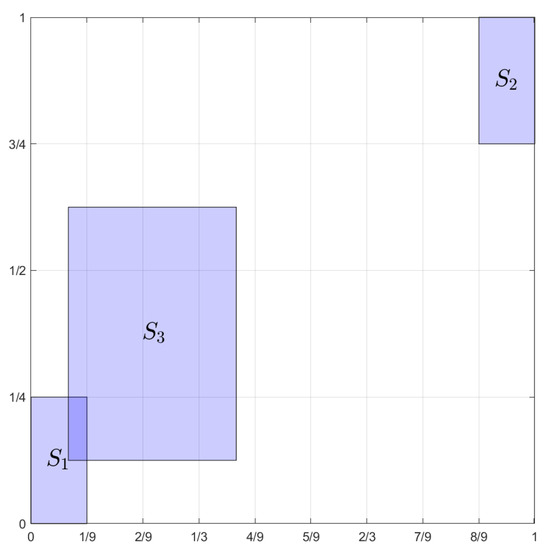
are as shown in Figure 1. It is easy to check that
and
where
Figure 1.
The iterates of U under
.
Step I: Denote
. Then, a type
vertex yields one offspring of each of the types
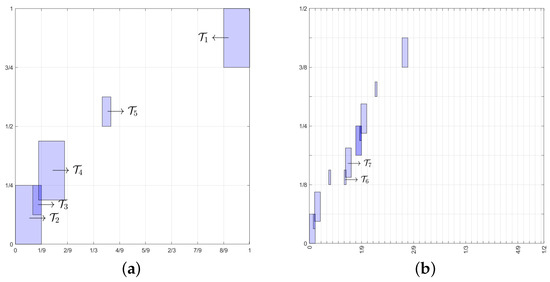
(see Figure 2a). All of these offspring are also in
, and therefore,
Figure 2.
The iterates of U under
’s.
Step II: Since
is of type
, it generates five offspring with vertices
which are of types
, respectively. Note that
, and
in the lexicographical order. The edge
connecting
to
is cancelled in the reduced graph. Notice that
is of type
; it gives rise to three offspring with vertices
It is easy to check that the types of
are different from the neighborhood types above and
. Denote
(see Figure 2b). Since
and
, the edge
connecting
to
is removed. Hence,
Using Step I and Step II again, we have
These are all the equivalences and the incidence matrix is
By Theorem 1, the generalized dimensions of the self-affine set E:
where
. Furthermore, Theorem 3 states that the Hausdorff dimension
lies in
.
6. Conclusions
This paper defines a new finite type condition on self-affine iterated function systems and obtains a dimensional formula on the generalized dimensions of self-affine sets, while the generalized dimensions are useful to estimate the classical Hausdorff dimension of self-affine sets. Specific conditions for the finite type condition to hold are also discussed.
Author Contributions
Methodology, J.L.; Writing—original draft, X.Z.; Writing—review & editing, G.M. All authors have read and agreed to the published version of the manuscript.
Funding
The research was supported by the Natural Science Foundation of Chongqing (No. CSTB2023NSCQ-MSX0553).
Data Availability Statement
Data is contained within the article.
Conflicts of Interest
The authors declare no conflicts of interest.
References
- Hutchinson, J.E. Fractals and self-similarity. Indiana Univ. Math. J. 1981, 30, 713–747. [Google Scholar] [CrossRef]
- Schief, A. Separation properties for self-similar sets. Proc. Amer. Math. Soc. 1994, 122, 111–115. [Google Scholar] [CrossRef]
- Falconer, K.J. Mathematical Foundations and Applications, Fractal geometry, 2nd ed.; John Wiley & Sons, Inc.: Hoboken, NJ, USA, 2003; xxviii+337. [Google Scholar]
- Ngai, S.M.; Wang, Y. Hausdorff dimension of self-similar sets with overlaps. J. Lond. Math. Soc. 2001, 63, 655–672. [Google Scholar] [CrossRef] [Scilit]
- Deng, Q.R.; Lau, K.S.; Ngai, S.M. Separation conditions for iterated function systems with overlaps, Fractal geometry and dynamical systems in pure and applied mathematics. I. Fractals in pure mathematics. Contemp. Math. 2013, 600, 1–20. [Google Scholar]
- Lau, K.S.; Ngai, S.M. Multifractal measures and a weak separation condition. Adv. Math. 1999, 141, 45–96. [Google Scholar] [CrossRef] [Scilit]
- Lau, K.S.; Ngai, S.M. A generalized finite type condition for iterated function systems. Adv. Math. 2007, 208, 647–671. [Google Scholar] [CrossRef] [Scilit]
- Lau, K.S.; Ngai, S.M.; Rao, H. Iterated function systems with overlaps and self-similar measures. J. Lond. Math. Soc. 2001, 63, 99–116. [Google Scholar] [CrossRef] [Scilit]
- Zerner, M.P.W. Weak separation properties for self-similar sets. Proc. Am. Math. Soc. 1996, 124, 3529–3539. [Google Scholar] [CrossRef] [Scilit]
- Feng, D.J.; Hu, H. Dimension theory of iterated function systems. Commun. Pure Appl. Math. 2009, 62, 1435–1500. [Google Scholar] [CrossRef] [Scilit]
- Falconer, K.J. Further Developments in Fractals and Related Fields; Dimensions of self-affine sets: A surveyBirkhäuser: Basel, Switzerland; Springer: New York, NY, USA, 2013; pp. 115–134, Trends, Math. [Google Scholar]
- Bedford, T. Crinkly Curves, Markov Partitions and Box Dimension in Self-Similar Sets. Ph.D. Thesis, University of Warwick, Coventry, UK, 1984. [Google Scholar]
- McMullen, C. The Hausdorff dimension of general Sierpiński carpets. Naygoya Math. J. 1984, 96, 1–9. [Google Scholar] [CrossRef] [Scilit]
- Feng, D.J. Dimension of invariant measures for affine iterated function systems. Duke Math. J. 2023, 172, 701–774. [Google Scholar] [CrossRef] [Scilit]
- Hochman, M.; Rapaport, A. Hausdorff dimension of planar self-affine sets and measures with overlaps. J. Eur. Math. Soc. 2022, 24, 2361–2441. [Google Scholar] [CrossRef] [Scilit]
- He, X.G.; Lau, K.S. On a generalized dimension of self-affine fractals. Math. Nachr. 2008, 281, 1142–1158. [Google Scholar] [CrossRef] [Scilit]
- Fu, X.Y.; Gabardo, J.P.; Qiu, H. Open set condition and pseudo Hausdorff measure of self-affine IFSs. Nonlinearity 2020, 33, 2592–2614. [Google Scholar] [CrossRef] [Scilit]
- Luo, J.J.; Yang, Y.M. On single-matrix graph-directed iterated function systems. J. Math. Anal. Appl. 2010, 372, 8–18. [Google Scholar]
- Huang, L.Y.; Luo, J. Hausdorff dimension and Minkowski content of self-affine sets under quasi-metric. preprint 2024. [Google Scholar]
Disclaimer/Publisher’s Note: The statements, opinions and data contained in all publications are solely those of the individual author(s) and contributor(s) and not of MDPI and/or the editor(s). MDPI and/or the editor(s) disclaim responsibility for any injury to people or property resulting from any ideas, methods, instructions or products referred to in the content. |
© 2024 by the authors. Licensee MDPI, Basel, Switzerland. This article is an open access article distributed under the terms and conditions of the Creative Commons Attribution (CC BY) license (https://creativecommons.org/licenses/by/4.0/).