


Abstract
Fractal scale-free structures are widely observed across a range of natural and synthetic systems, such as biological networks, internet architectures, and social networks, providing broad applications in the management of complex systems and the facilitation of dynamic processes. The global mean first-passage time (GMFPT) for random walks on the underlying networks has attracted significant attention as it serves as an important quantitative indicator that can be used in many different fields, such as reaction kinetics, network transport, random search, pathway elaboration, etc. In this study, we first introduce two degree-dependent random walk strategies where the transition probability is depended on the degree of neighbors. Then, we evaluate analytically the GMFPT of two degree-dependent random walk strategies on fractal scale-free tree structures by exploring the connection between first-passage times in degree-dependent random walk strategies and biased random walks on the weighted network. The exact results of the GMFPT for the two degree-dependent random walk strategies are presented and are compared with the GMFPT of the classical unbiased random walk strategy. Our work not only presents a way to evaluate the GMFPT for degree-dependent biased random walk strategies on general networks but also offers valuable insights to enrich the controlling of chemical reactions, network transport, random search, and pathway elaboration.
1. Introduction
Numerous natural and artificial systems, including biological networks, social networks, and internet architectures [1,2,3], display fractal and scale-free properties. The fractal scale-free trees model, which combines the theoretical models originally introduced by Barabási and Albert [4] and Benoit Mandelbrot [5], is a relatively simple fundamental dynamics network, with extensive applications in network science, epidemiology, ecology, and computer science [6,7,8,9]. The advantages of robustness and scalability, etc., in handling complex systems and dynamic processes with the fractal scale-free trees structures make the fractal scale-free trees model very popular, and many different fractal scale-free trees models have been proposed [7,9,10]. The structural and dynamic properties of these models have also been thoroughly explored; examples of these models include -trees [1], the spanning scale-free trees of some real-world networks [9], fractal and non-fractal scale-free trees [11], etc.
Among the range of dynamic properties, the expected time it takes the walker to first reach the given target, also known as the mean first-passage time (MFPT), for random walks on underlying networks stands out as especially crucial [12,13]. Numerous other properties can be measured or understood through the lens of the MFPT [14,15,16]. Let denote the MFPT to the target y from starting location x. One can define the GMFPT, , by
where is used to represent the total node population in the underlying networks.
The GMFPT represents the average duration required for a walker, initiating from a randomly chosen site, to reach a target site that is also selected at random from a uniform distribution for the first time [17]. This is a crucial indicator that can be used in many different fields, such as reaction kinetics [18,19], protein interactions and cellular search [20,21], network transport and information dissemination [22,23,24], random search [25,26], pathway elaboration [27], etc. Studies on the GMFPT are helpful for the control of chemical kinetics, network transport, random search, and pathway elaboration [18,22,28,29]. Over the past decades, considerable efforts have been dedicated to unraveling the GMFPT for classical unbiased random walks across diverse networks, including scale-free Koch networks [30], various tree-like networks [31,32,33,34], and pseudofractal scale-free web [35,36]. These studies have revealed how network topology influences the GMFPT. It is also well known that random walk strategies have a significant impact on the GMFPT. There are also many works that are dedicated to enriching random walk strategies and controlling the transport (search) efficiency. Related random walk strategies include maximal entropy random walks [37,38], true reinforced random walks [39,40], weights-dependent biased random walks [41,42,43,44,45,46,47], and degree-dependent biased random walks [48,49].
For degree-dependent biased random walks, the probability of transitioning from the current node to an adjacent node is related to the degree of that adjacent node, specifically the degrees of the nearest and second-nearest neighbors [48]. Note that the walker determines which neighboring node to move to next by making a weighted choice based on the degree of each neighboring node under this strategy; this is particularly meaningful for controlling information dissemination and search processes. The degree-dependent random strategy is an optimization approach leveraging network topology information, widely used in network science and other fields.
In this work, we study the GMFPT for two types of degree-dependent random walk strategies on a class of fractal scale-free trees [11] to enrich the strategies to control transport efficiency. First, we design two degree-dependent random walk strategies in which the transition probability depends on the degree of neighbors. Then, we evaluate analytically the GMFPT of two degree-dependent random walk strategies on a class of fractal scale-free trees by exploring the connection between the first-passage time for degree-dependent random walk strategies and biased random walks on the weighted network. Accurate results of the GMFPT of two degree-dependent random walk strategies are presented and are compared with the GMFPT for the classical unbiased random walk strategy. Our work not only provides a method to evaluate the GMFPT for degree-dependent biased random walk strategies on general networks but also offers valuable insights for enhancing the control of chemical kinetics, network transport, random search, and pathway optimization.
2. Preliminaries
In this section, we present the structure of the fractal scale-free trees we examined and describe the degree-dependent biased random walk strategies and the method we used to calculate the global mean first-passage time (GMFPT) for degree-dependent biased random walk strategies.
2.1. Fractal Scale-Free Trees
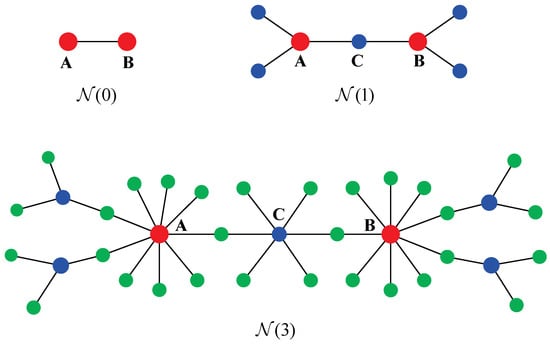
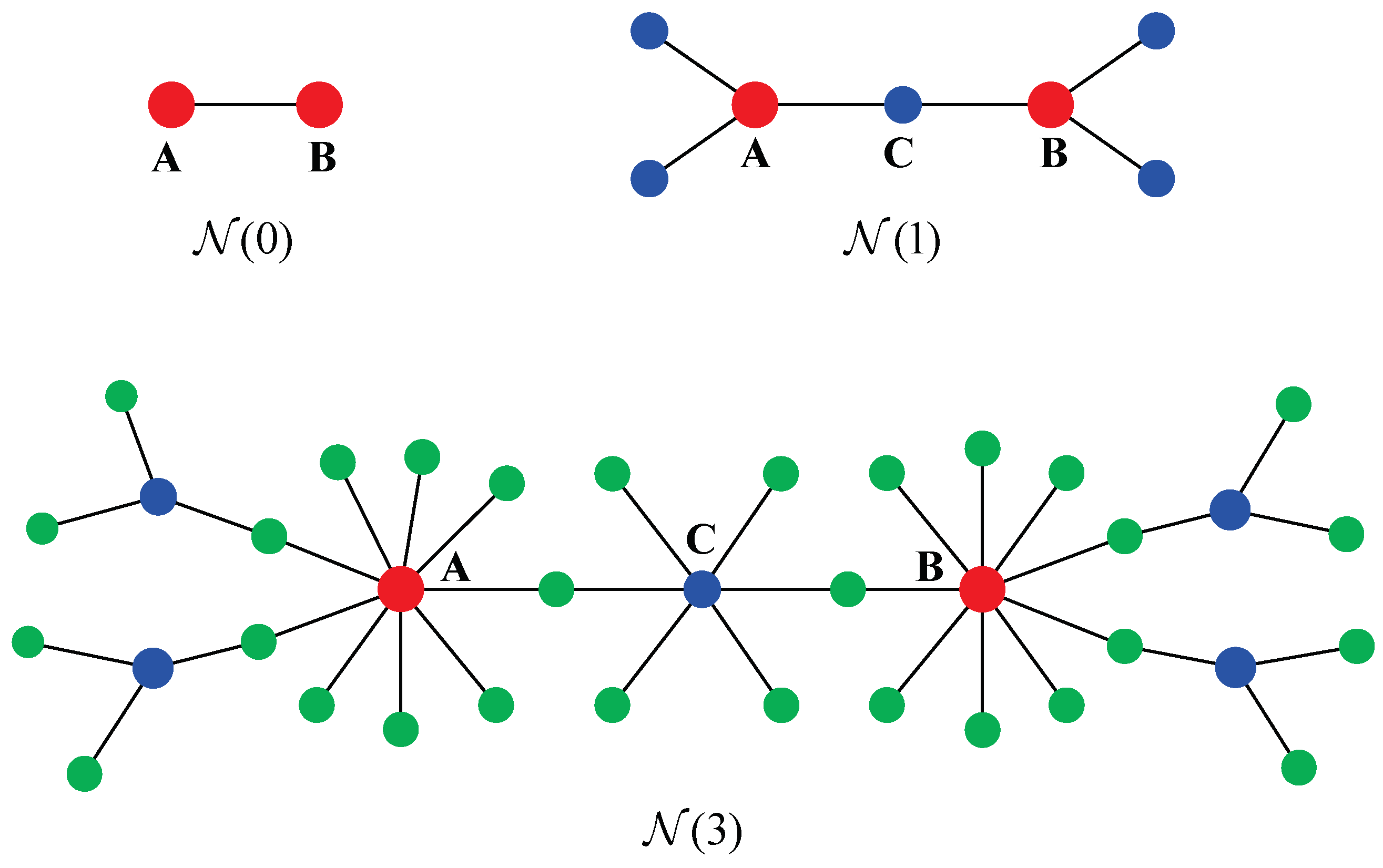
Fractal scale-free trees (FSFTs) are deterministic trees that can be constructed recursively and controlled by an integer parameter q (). Let represent the fractal scale-free trees following the g-th iteration, i.e., the FSFTs with generation g. Their construction proceeds as follows [11,50]:
- For , is an edge whose two endpoints are labeled as A and B.
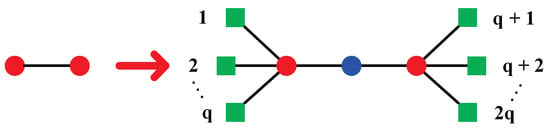
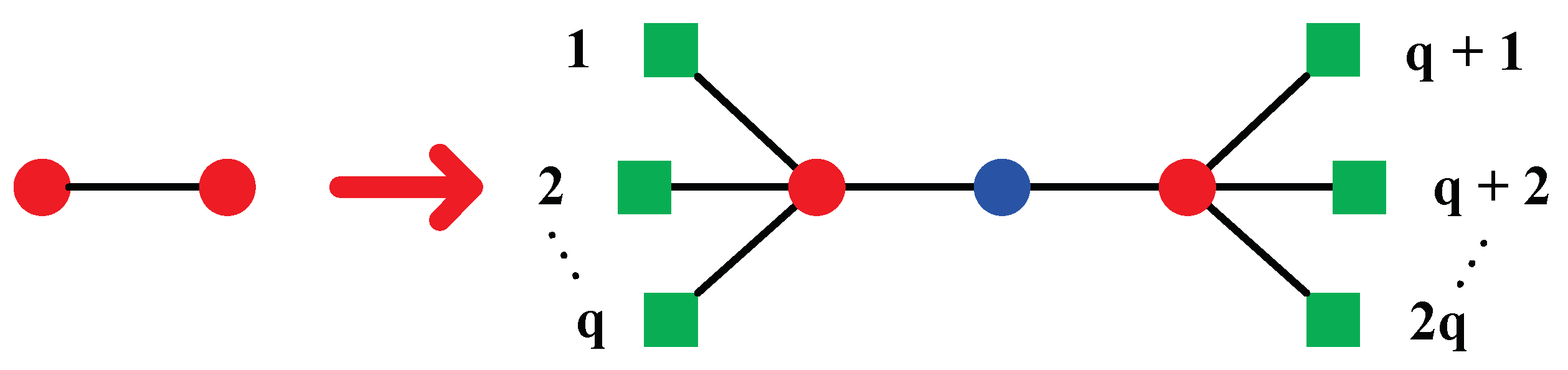
- For , can be obtained from as follows: replacing each edge of by a path of 2 links, with both endpoints of the path remaining as the endpoints of the original edge and adding new nodes to each path, one half is linked to one endpoint of the path and the other half is linked to another endpoint of the path.
In this paper, the newly added node with initial degree 2, positioned in the middle of the path, is designated as an internal node; the newly added nodes with initial degree 1 are referred to as external nodes. In other words, is obtained from by replacing each edge of with a structure, as shown on the arrow’s right side in Figure 1. The first three generations of the FSFTs with are shown in Figure 2.
Figure 1.
The construction process for the FSFTs: each edge in is substituted by the object on the right-hand side of the arrow, where the red dots represent original nodes, the blue dots represent newly added internal nodes, and the green squares represent newly added external nodes.
Figure 2.
Growth process of the first three generations for the particular FSFTs with .
As shown in Figure 3, the FSFTs can also be constructed in another way. The FSFTs of generation , denoted as , are composed of copies of , referred to as subgraphs, which are labeled by , , , …, , and the are subgraphs are connected with each other via their hub nodes (i.e., nodes with the highest degree in these subgraphs). It is known that the FSFTs exhibit a self-similar structure with fractal dimension , the degree distribution of FSFTs follows power law , with [11]. Therefore, the FSFTs are known as fractal scale-free trees.
Figure 3.
Alternative construction method of FSFTs, which shows the FSFTs have self-similarity characteristics. The FSFTs of generation , denoted as , are composed of subgraphs, which are isomorphic to , labeled by , , , …, , and are interconnected via their hub nodes.
Through its construction, it is possible to determine the total count of edges, referred to as , of as
and the total count of nodes, , satisfies
2.2. Two Degree-Dependent Random Walk Strategies
Note that the random walk strategy is determined entirely by its transition probability matrix. Here, we introduce the transition probability matrix for the two random walk strategies. For the first strategy, the probability that the walker from its current node x to any adjacent node y is proportional to the node degree of node y. For the second strategy, the probability that the walker from its current node x to any adjacent node y is inversely proportional to the node degree of node y. Let represent the transition probability from node x to node y, and , represent the set for all neighbors of node x, the degree of node x, respectively. Then, for the first random walk strategy,
and for the second random walk strategy,
For simplicity, we refer to the two random walk strategies in this paper as strategy 1 and strategy 2, respectively.
Note that the transition probabilities for both random walk strategies are dominated entirely by the degree of the neighbors of the current position x. Therefore, we call them degree-dependent random walk strategies.
2.3. Method to Evaluate the GMFPT for the Degree-Dependent Random Walk Strategies
Here, we introduce a method for calculating the GMFPT for the two degree-dependent random walk strategies on general networks. The method relies on the correlation between the MFPT on the weighted network and the effective electrical resistance within the equivalent resistance network.
First, we review the main lemma that will be used to calculate the GMFPT. For any weighted network, with being the weight for its edge , and for random walk on any weighted network with transition probability,
the GMFPT for random walks across the weighted network can be expressed as [42,51]
where is the total count of nodes of the weighted network,
is the total of the weights assigned to every edge within the weighted network, and
totals the effective resistance between any pair of nodes within the equivalent resistance network with each edge and is assigned a resistance , and is the effective resistance between node x and y within the equivalent resistance network.
Then, we build the connection between the degree-dependent random walk and the biased random walk on the weighted network as depicted in Equation (6).
For the degree-dependent biased random walk strategy 1, let ; one can recover the transition probability as shown in Equation (4) from Equation (6). Therefore, the degree-dependent biased random walk strategy 1 is equivalent to a biased random walk on the corresponding weighted network, where each edge is assigned a weight .
For strategy 2, let ; one can also recover transition probability as shown in Equation (5) from Equation (6). Therefore, the degree-dependent biased random walk strategy 2 is equivalent to a biased random walk on the corresponding weighted network, where each edge is assigned a weight .
Thus, both two degree-dependent random walks can be viewed as biased random walks on the corresponding weighted networks, and we can calculate the GMFPT for the degree-dependent random walk on FSFTs by using Equation (7).
3. GMFPT for Degree-Dependent Biased Random Walk Strategy 1 on the FSFTs
Here, we calculate the GMFPT, , for degree-dependent biased random walk strategy 1 on FSFTs. As discussed in Section 2.3, the degree-dependent biased random walk strategy 1 is equivalent to biased random walk on the corresponding weighted network, where each edge is assigned a weight , and the GMFPT can be derived from Equation (7).
For clarity, let denote the weighted FSFTs of generation g, where each edge is assigned a weight and represent the GMFPT for strategy 1 on the FSFTs with generation g, and let , represent , for the weighted FSFTs, , where each edge is assigned a weight , respectively.
In the following, we will first derive and . Then, can be obtained from Equation (7).
3.1. Derivation of for the Weighted FSFTs
Here, we consider the weighted FSFTs, where each edge and is assigned a weight, , and calculate , which totals the effective resistance between any pair of nodes within the equivalent resistance network with each edge is assigned a resistance and defined in Equation (9). Because the equivalent resistance network for is a weighted tree, the effective resistance between any two nodes is just the weighted path length between the two nodes. Thus, can be derived by exploring the self-similar structure of the network.
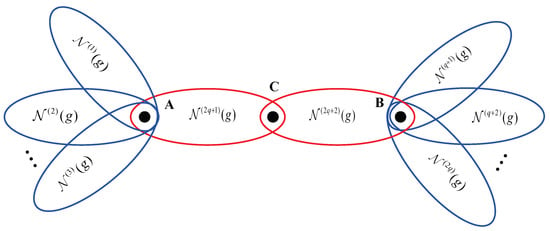
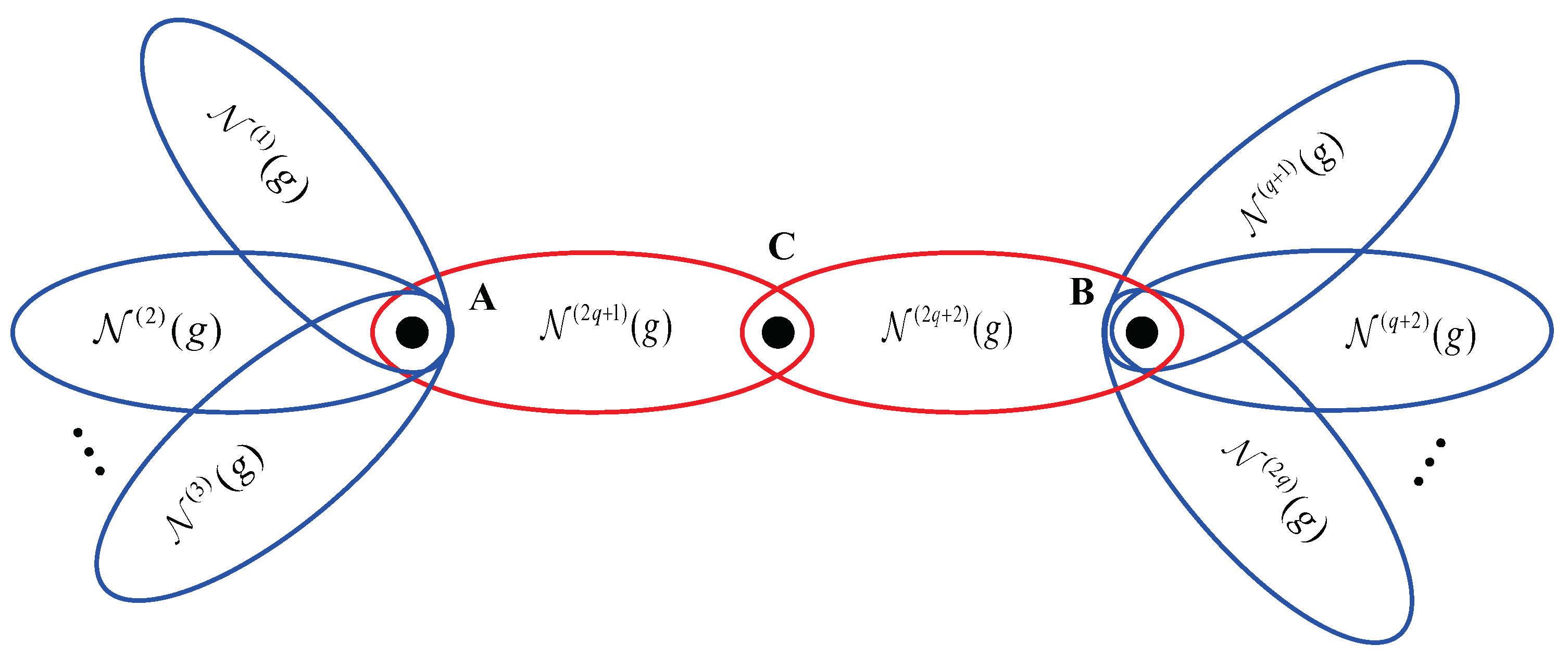
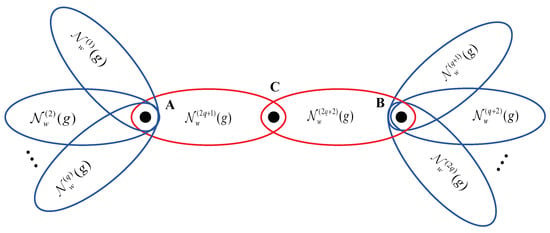
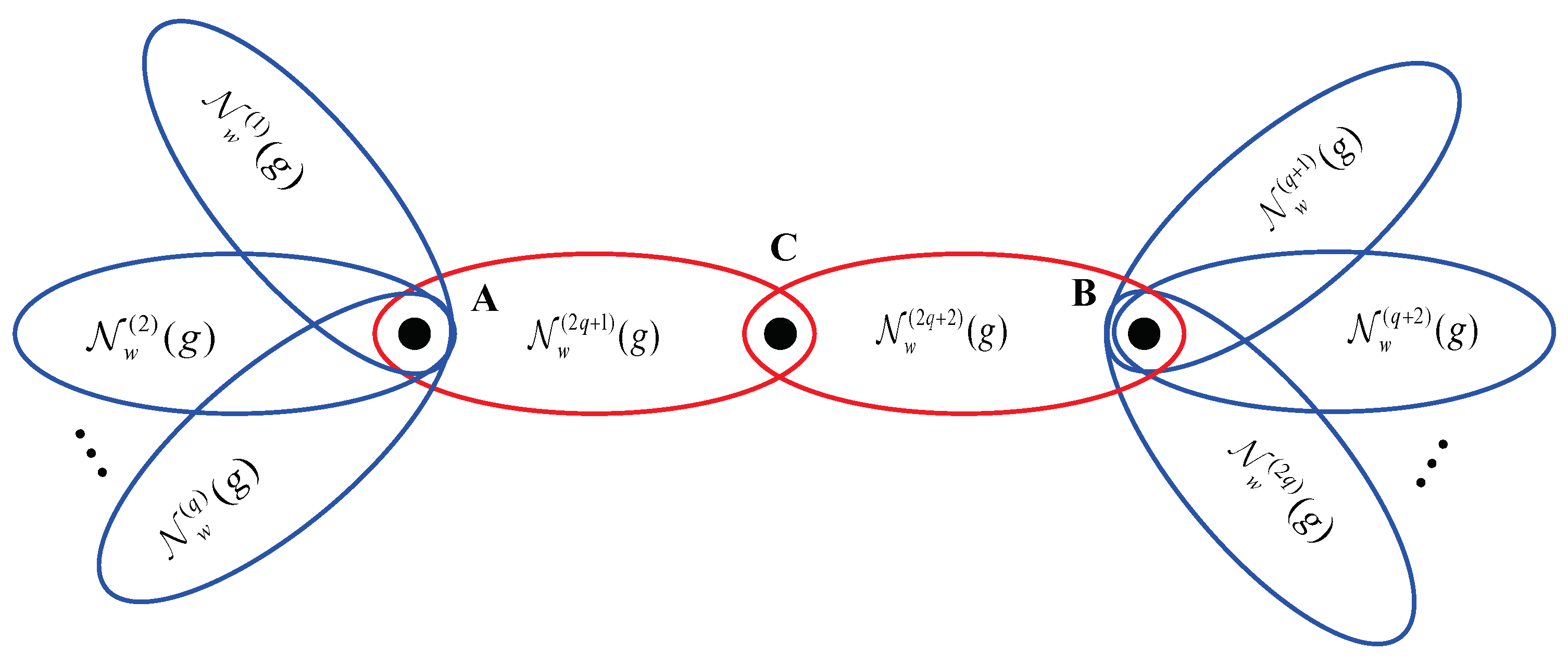
Similar to FSFTs (see Figure 3), the weighted FSFTs, , also exhibits a self-similar character. As shown in Figure 4, consists of subunits, labeled by , , …, , which have the same structure as and are connected with each other via their hubs. For any , all edges of , except edges that are incident on the hubs (i.e., A, B, C), have the same weight as the weight for the corresponding edge of . For any , let denote the sum of effective resistances for all node pairs of and represent the difference between and .
Figure 4.
Construction of the weighted FSFTs. consists of subunits, labeled by , , , …, , which have the same structure as and are interconnected via their hub nodes, A, B, and C. All edges of , except edges that are incident on the hubs (i.e., A, B, C), have the same weight as the weight for the corresponding edge of .
For , according to strategy 1, we can get that the effective resistance of each edge, , and the effective resistance of the remaining edges is ; then, we can calculate the effective resistance between two hub nodes, A and B, as
Thus, it is not hard to calculate the , and for any , is satisfied.
where
is the total resistance sum across all node pairs x and y, where x and y are not in the same subunits as and
The detailed derivation of and is presented in Appendix A.
Using Equation (10) recursively, we can obtain
For any integer , as derived in Appendix B, we find
3.2. Derivation of for the Weighted FSFTs
Here, we calculate , which totals weight for all edges of . Note that is composed of subunits, labeled by , , , …, , which have the same structure as , and for any , all edges of , except edges that are incident on the hubs (i.e., A, B, C), have the same weight as the the weight for the corresponding edge of .
Let denote the differences between and the total weight sum of all edges of subunit . Analogous to the derivation process of , for , we can get the weight of each edge, , and the weight of the remaining edges is ; therefore, it is easy to calculate , and for , satisfies
where
3.3. GMFPT for Degree-Dependent Biased Random Walk Strategy 1 on the FSFTs
Replacing and from Equations (28) and (19) in Equation (7), we obtain the exact result for the GMFPT, referred to as .
The results show, for large networks, i.e., ,
Therefore, as ,
Note that . We can rewrite Equation (21) as
with the exponent greater than 1 and related to the factor of the node degree . Thus, for strategy 1, the GMFPT grows super-linearly with the number of network nodes.
4. GMFPT for Degree-Dependent Biased Random Walk Strategy 2 on the FSFTs
Let represent the GMFPT for degree-dependent biased random walk strategy 2 on the FSFTs with generation g. As discussed in Section 2.3, the degree-dependent biased random walk strategy 2 is equivalent to a biased random walk on the corresponding weighted network, where each edge is assigned a weight . In this section, we will calculate by using Equation (7).
Let denote the weighted FSFTs of generation g, where each edge is assigned a weight , and let and represent , for the weighted FSTs, . Similar to the derivation of , we can calculate and for the weighted FSFTs . Then, can be obtained from Equation (7).
4.1. Exact Result of for the Weighted FSFTs
Here, we analyze the weighted FSFTs where each edge is assigned a weight , and we calculate , which totals the effective resistance between any pair of nodes within the equivalent resistance network, where each edge is assigned a resistance and defined in Equation (9).
Similar to weighted FSFTs , the weighted FSFTs also consists of subunits, labeled by , , …, , which have the same structure as . For any , let denote the total of effective resistances for all node pairs of and represent the difference between and .
Analogous to the derivation process of for weighted FSFTs , we find that , and for any , satisfies
where
and
Using Equation (23) recursively, we can obtain
Similarly, for any integer , we find
4.2. Derivation of for the Weighted FSFTs
Here, we calculate , which totals the weight for all edges of . Let denote the differences between and the total weight sum of all edges of subunit . Analogous to the derivation process of , we can get , and for , satisfies
where
4.3. GMFPT for Degree-Dependent Biased Random Walk Strategy 2 on the FSFTs
Replacing and from Equations (28) and (32) in Equation (7), we can get the exact result for the GMFPT, .
We also find, for large networks, i.e., ,
Therefore, as ,
with the exponent greater than 1 and related to the factor of the node degree . Thus, for strategy 2, the GMFPT grows super-linearly with the number of network nodes.
5. Comparison
In this section, we compare the GMFPT for the two degree-dependent random walk strategies on the FSFTs with the GMFPT for unbiased random walk strategy on FSFTs, as found in Ref. [11]. Recalling that, for unbiased random walk on FSFTs, the GMFPT
By comparing the exact results of GMFPTs for the three random walk strategies on the FSFTs, in the case , we find
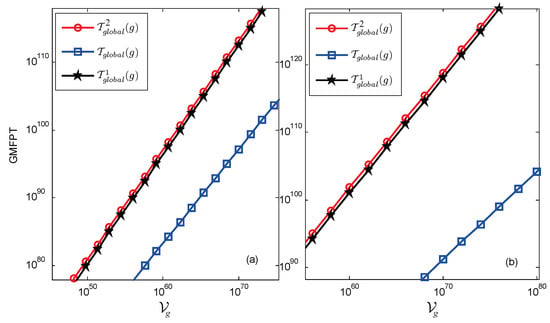
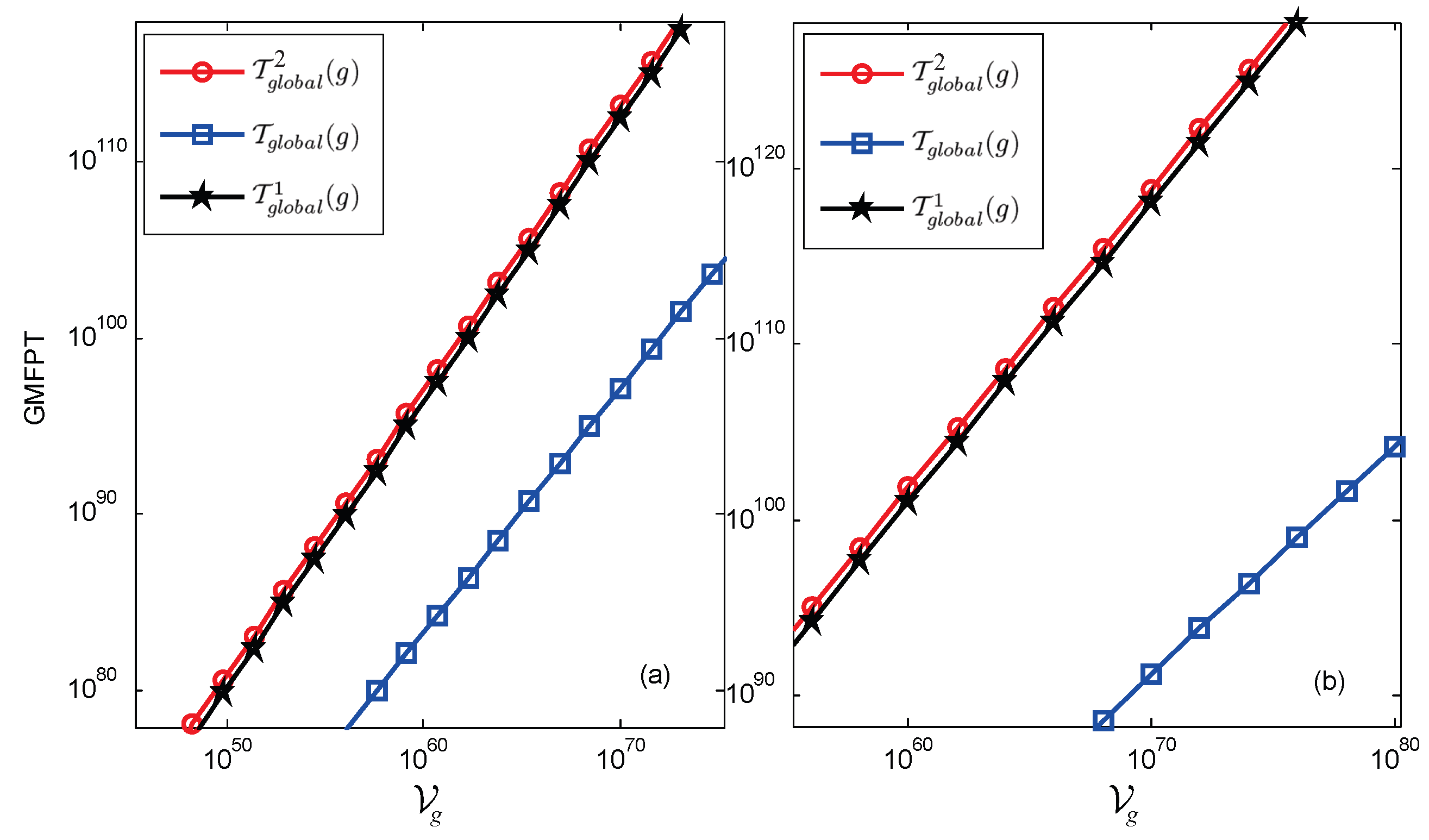
Figure 5 shows the plots of the GMFPTs for the three random walk strategies on the FSFTs versus the network size on the FSFTs with . Thus, for random walks on FSFTs, if the walker is more inclined to move to neighbors with a higher (resp. lower) degree at each step, the global transport (resp. search) efficiency will decrease, and the strategy where the walker is more inclined to move to neighbors with a higher degree is more efficient than the strategy where the walker is more inclined to move to neighbors with a lower degree.
Figure 5.
The GMFPTs for three different random walk strategies are drawn as functions of the network size on the FSFTs with (a) , (b) .
Calculating , , and , we find, for large networks, i.e., ,
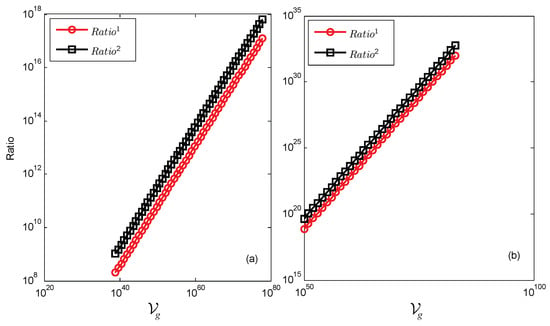
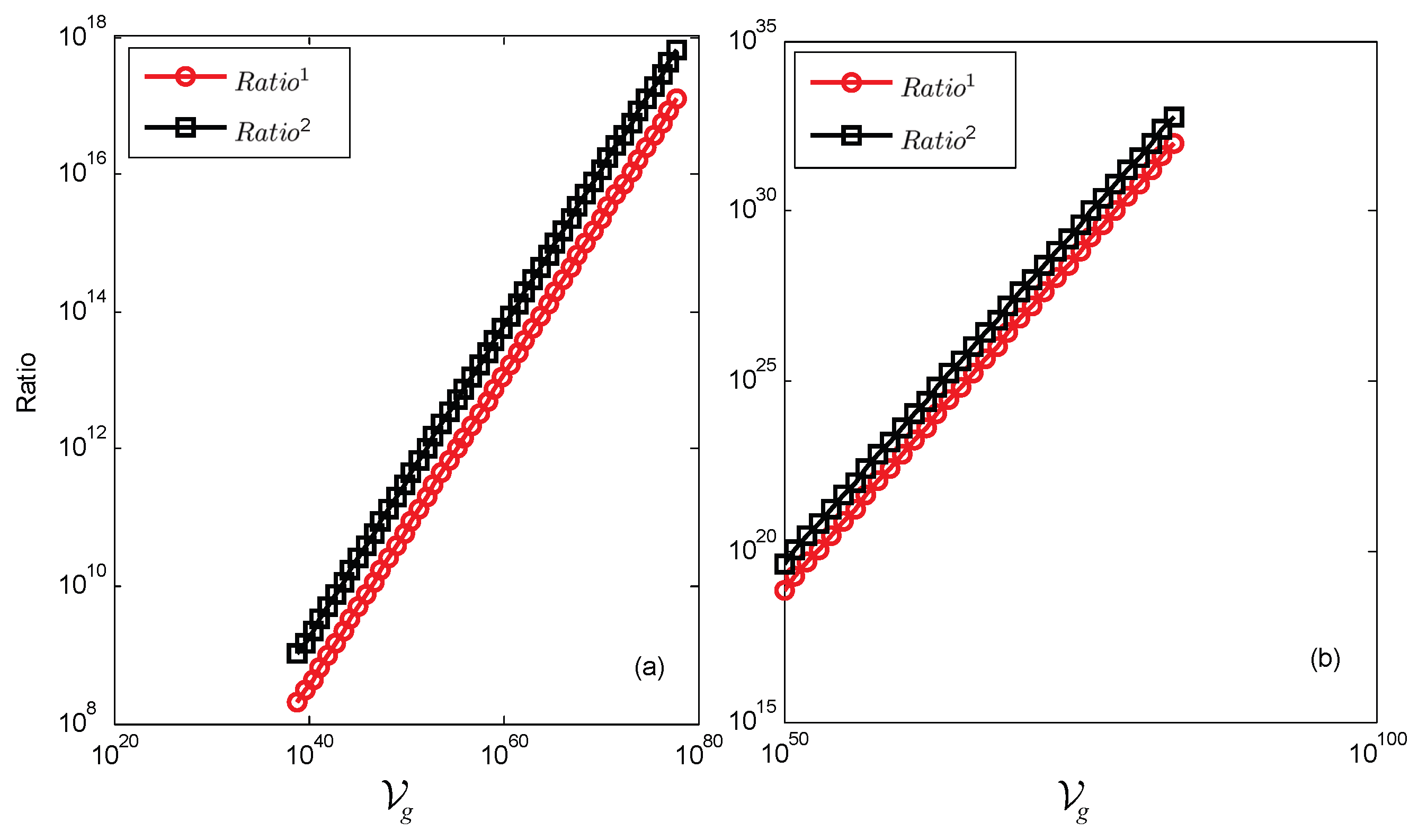
which shows that both and increase monotonically as the network size, , increases. Thus, in terms of global transport (resp. search) efficiency on FSFTs, the two degree-dependent biased strategies are much lower than the classical unbiased strategy. Figure 6 shows the semi-log plots for and v.s. on the FSFTs with different choices of q.
Figure 6.
The semilog plots for and v.s. on the FSFTs with different choices of q. (a) , (b) .
We also find that, for larger networks,
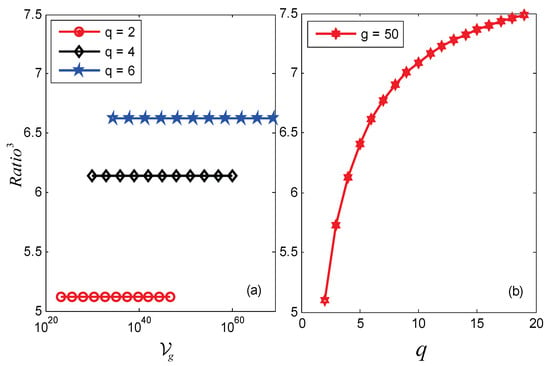
where is a constant that is independent of network size, (see Figure 7a). Note that , and for any , . Therefore, increases monotonically as the q increases, and for any (see Figure 7b), which shows is at least 5 times , and strategy 2 is less efficient than strategy 1.
Figure 7.
(a) Plot of v.s. on the FSFTs with different choices of q in . (b) is drawn as a function of on FSFTs with generation .
6. Conclusions
In this paper, we have introduced two degree-dependent biased random walk strategies on FSFTs. The GMFPT for the two degree-dependent biased random walk strategies are evaluated analytically by exploring the connection between the fist-passage time for the degree-dependent biased random walk strategy and the biased random walk strategy on the weighted network. We obtained the exact results for the GMFPT of two degree-dependent biased random walk strategies on FSFTs and compared the GMFPTs for the degree-dependent biased random walk strategies and the GMFPT for the classical unbiased random walk strategy on FSFTs. The results show that the GMFPT for the two degree-dependent biased random walk strategies grows super-linearly with the network size and is far larger than the GMFPT for the classical unbiased random walk strategy, and the GMFPT for biased strategy 2, where the walker is biased to the node with the lower degree at each step, is at least 5 times the GMFPT for biased strategy 1, where the walker is biased to the node with the higher degree at each step. Thus, strategy 2 is less efficient than strategy 1. Our work not only presents a way to evaluate the GMFPT for degree-dependent biased random walk strategies on general networks but also offers valuable insights to enrich the controlling of chemical kinetics, network transport, random search, and pathway elaboration.
Author Contributions
Conceptualization, L.G., J.P. and C.T.; methodology, L.G. and J.P.; software, L.G. and Q.X.; validation, L.G., J.P. and Q.C.; formal analysis, L.G. and Q.X.; investigation, L.G.; resources, J.P. and C.T.; data curation, L.G. and Q.C.; writing—original draft preparation, L.G. and J.P.; writing—review and editing, J.P. and C.T.; visualization, L.G.; supervision, J.P. and C.T.; project administration, J.P. and C.T.; funding acquisition, J.P., C.T. and Q.X. All authors have read and agreed to the published version of the manuscript.
Funding
The work is supported by the Guangdong Basic and Applied Basic Research Foundation (Grant No. 2024A1515011700), the National Natural Science Foundation of China (Grant Nos. 12171114 and 12201133), the Special Research Basic and Applied Research Foundation of Guangzhou (Grant No. 2023A04J0365), and the Special Fund for Scientific Research Talents of GPNU (Grant No. 2021SDKYA029).
Institutional Review Board Statement
“Not applicable” for studies are not involving humans or animals.
Informed Consent Statement
“Not applicable” for studies are not involving humans.
Data Availability Statement
The original contributions presented in the study are included in the article, further inquiries can be directed to the corresponding author.
Acknowledgments
The authors acknowledge funding from the National Natural Science Foundation of China, the Guangdong Basic and Applied Basic Research Foundation, the Special Research Basic and Applied Research Foundation of Guangzhou, and the Special Fund for Scientific Research Talents of GPNU.
Conflicts of Interest
The authors declare that they have no known competing financial interests or personal relationships that could have appeared to influence the work reported in this paper.
Abbreviations
The following abbreviations are used in this manuscript:
| MDPI | Multidisciplinary Digital Publishing Institute |
| DOAJ | Directory of open access journals |
| TLA | Three letter acronym |
| LD | Linear dichroism |
Appendix A. The Derivation of Equations (11) and (12)
As shown in Figure 4, is composed of subunits labeled by , , …, , which have the same structure as . In this appendix, we present a detailed derivation of , which is the difference between and , where and are the sum of resistance for any pairs of nodes of and , respectively. It is easy to see that and . Without loss of generality, here we just derive and .
In order to derive , we should analyze the difference in edge resistance for networks and . We find that the difference in the edge resistance only appears for the edges connected with their hubs owing to the difference in the degree of their hubs for the two networks.
In , considering the network construction, at generation there are newly added nodes directly connected to node A, of which are newly added external nodes and are newly added internal nodes. Furthermore, we observe that the edge resistance in becomes times that of the edge resistance values in for those edges directly connected to the hub node A. Thus, by analyzing the frequency of repetition of these edges, we can get the differences between and .
For each edge that connects the newly added external nodes directly to hub node A at generation , the frequency of repetition is . For each edge that connects the newly added internal nodes directly to hub node A, at generation 2, there is only one newly added edge, and for generation, the number of newly added edges directly connected to node A is ; thus, the number of 1-level subunits with node A as the hub is 1, and k-level subunits are , denoted by . Let denote the nodes directly connected to node A, and denote the corresponding edge resistance values in the subunit ; then, the hub nodes of the subunit are and , respectively, and the number of nodes in the subunits is . According to the construction method of the network, we can split into two parts, and ; the number of the nodes is and , respectively. Then, we will analyze the repetition frequency of .
- In , the repetition frequency of is which means the node and node .
- In , the repetition frequency of is which means the node and node .
- In , the repetition frequency of is which means the node and node .
Therefore, we can obtain the as
By organizing and simplifying Equation (A1), we get
Similarly, and note that the edge resistance in becomes times that of the edge resistance values in because those edges are directly connected to the hub node C, we can obtain
Appendix B. The Derivation of
In this appendix, we present a detailed derivation of Equation (14), which is the sum of resistances between nodes x and y, while x and y are not in the same subunits of for degree-dependent random walk strategy 1.
Now, let
denote the sum of resistances between nodes x and y for and . We have
where the last line of the equation is obtained from the equivalence of these subunits. The next step is to calculate these quantities, and we should calculate a variable defined by
Considering the self-similar structure of the networks and using the same method to calculate the differences in Appendix A, it is easy to see that satisfies the following recurrence relation:
where , and is
and the , is
The quantities , , , , and can be expressed as , , , and other known quantities. Thus, the is given by
Similarly,
and
and
References
- Rozenfeld, H.D.; Havlin, S.; ben Avraham, D. Fractal and transfractal recursive scale-free nets. New J. Phys. 2007, 9, 175. [Google Scholar] [CrossRef] [Scilit]
- Kousuke, Y.; Yuka, F. A genaral model of hierarchical fractal scale-free networks. PLoS ONE 2022, 17, 3. [Google Scholar]
- Erciyes, K. Graph-Theoretical Analysis of Biological Networks: A Survey. Computation 2023, 11, 188. [Google Scholar] [CrossRef] [Scilit]
- Barabási, A.L.; Albert, R. Emergence of scaling in random networks. Science 1999, 286, 509–512. [Google Scholar] [CrossRef] [Scilit] [PubMed]
- Mandelbrot, B.B. The Fractal Geometry of Nature; W. H. Freeman: San Francisco, CA, USA, 1982. [Google Scholar]
- Feng, Q.Q.; Hu, Z.S. Phase Changes in the Topological Indices of Scale-Free Trees. J. Appl. Probab. 2013, 50, 516–532. [Google Scholar] [CrossRef] [Scilit]
- Carreras, B.A.; Lybch, V.E.; Sachtjen, M.L.; Dobson, I.; Newman, D.E. Modeling blackout dynamics in power transmission networks with simple structure. In Proceedings of the 34th Annual Hawaii International Conference on System Sciences, Maui, HI, USA, 6 January 2001; pp. 719–727. [Google Scholar]
- McHugh, J.; Perl, Y. Best location of service centers in a treelike network under budget constraints. Discrete Math. 1991, 48, 199–214. [Google Scholar]
- Kim, D.H.; Noh, J.D.; Jeong, H. Scale-free trees: The skeletons of complex networks. Phys. Rev. E 2004, 70, 046126. [Google Scholar] [CrossRef] [Scilit]
- Smythe, R.T.; Mahmoud, H. A survey of recursive trees. Theory Probab. Math. Stat. 1995, 51, 1–27. [Google Scholar]
- Zhang, Z.Z.; Lin, Y.; Ma, Y.J. Effect of trap position on the efficiency of trapping in treelike scale-free networks. J. Phys. A 2011, 44, 075102. [Google Scholar]
- Redner, S. A Guide to First-Passage Processes; Cambridge University Press: Cambridge, UK, 2007. [Google Scholar]
- Barrat, A.; Barthélemy, M.; Vespignani, A. Dynamical Processes on Complex Networks; Cambridge University Press: Cambridge, UK, 2008. [Google Scholar]
- Metzler, R.; Oshanin, G.; Redner, S. First-Passage Phenomena and Their Applications; World Scientific: Singapore, 2014. [Google Scholar]
- Ben-Avraham, D.; Havlin, S. Diffusion and Reactions in Fractals and Disordered Systems; Cambridge University Press: Cambridge, UK, 2000. [Google Scholar]
- Chen, T.J.; Yuan, Z.H.; Peng, J.H. The normalized Laplacian spectrum of n-polygon graphs and applications. Linear Multilinear Algebra 2024, 72, 234–260. [Google Scholar] [CrossRef] [Scilit]
- Haynes, C.P.; Roberts, A.P. Global first-passage times of fractal lattices. Phys. Rev. E 2008, 78, 041111. [Google Scholar] [CrossRef] [Scilit] [PubMed]
- Bénichou, O.; Voituriez, R. From first-passage times of random walks in confinement to geometry-controlled kinetics. Phys. Rep. 2014, 539, 225–284. [Google Scholar] [CrossRef] [Scilit]
- Bénichou, O.; Chevalier, C.; Klafter, J.; Meyer, B.; Voituriez, R. Geometry-controlled kinetics. Nat. Chem. 2010, 2, 472–477. [Google Scholar] [CrossRef] [Scilit] [PubMed]
- Noh, J.D.; Rieger, H. Random Walks on Complex Networks. Phys. Rev. Lett. 2004, 92, 118701. [Google Scholar] [CrossRef] [Scilit] [PubMed]
- Jeon, J.; Tejedor, V.; Burov, S.; Barkai, E.; Selhuber-Unkel, C.; Berg-Sørensen, K.; Oddershede, L.; Metzler, R. In Vivo Anomalous Diffusion and weak Ergodicity Breaking of Lipid Granules. Phys. Rev. Lett. 2011, 106, 048103. [Google Scholar] [CrossRef] [Scilit] [PubMed]
- Banavar, J.R.; Maritan, A.; Rinaldo, A. Size and form in efficient transportation networks. Nature 1999, 399, 130–132. [Google Scholar] [CrossRef] [Scilit]
- Heijs, D.J.; Malyshev, V.A.; Knoester, J. Trapping time statistics and efficiency of transport of optical excitations in dendrimers. J. Chem Phys. 2004, 121, 4884–4892. [Google Scholar] [CrossRef] [Scilit]
- Guimerȧ, R.; Amaral, L. Functional Cartography of Complex Metabolic Networks. Nature 2005, 433, 895–900. [Google Scholar] [CrossRef] [Scilit]
- Viswanathan, G.M.; Buldyrev, S.V.; Havlin, S.; da Luz, M.G.E.; Raposo, E.P.; Stanley, H.E. Optimizing the success of random searches. Nature 1999, 401, 911–914. [Google Scholar] [CrossRef] [Scilit]
- Bartumeus, F.; Levin, S.A. Fractal reorientation clocks: Linking animal behavior to statistical patterns of search. Proc. Natl. Acad. Sci. USA 2008, 105, 19072–19077. [Google Scholar] [CrossRef] [Scilit]
- Zolaktaf, S.; Dannenberg, F.; Schmidt, M.; Condon, A.; Winfree, E. The pathway elaboration method for mean first passage time estimation in large continuous-time Markov chains with applications to nucleic acid kinetics. arXiv 2021, arXiv:2101.03657. [Google Scholar]
- Sims, D.W.; Southall, E.J.; Humphries, N.E.; Hays, G.C. Scaling laws of marine predator search behaviour. Nature 2008, 451, 1098–1102. [Google Scholar] [CrossRef] [Scilit] [PubMed]
- Bénichou, O.; Kafri, Y.; Sheinman, M.; Voituriez, R. Searching Fast for a Target on DNA without Falling to Traps. Phys. Rev. Lett. 2009, 103, 138102. [Google Scholar] [CrossRef] [Scilit] [PubMed]
- Zhang, Z.Z.; Gao, S.Y. Scaling of mean first-passage time as efficiency measure of nodes sending information on scale-free Koch networks. Eur. Phys. J. B 2011, 80, 209–216. [Google Scholar] [CrossRef] [Scilit]
- Zhang, Z.Z.; Li, X.T.; Lin, Y.; Chen, G.R. Random walks in small-world exponential treelike networks. J. Stat. Mech. 2011, 2011, P08013. [Google Scholar] [CrossRef] [Scilit]
- Lin, Y.; Zhang, Z.Z. Influence of trap location on the efficiency of trapping in dendrimers and regular hyperbranched polymers. J. Chem. Phys. 2013, 138, 094905. [Google Scholar] [CrossRef] [Scilit]
- Ma, F.; Wang, X.; Wang, P.; Luo, X. Random walks on the generalized Vicsek fractal. Europhys. Lett. 2021, 133, 40004. [Google Scholar] [CrossRef] [Scilit]
- Peng, J.H.; Xu, G.A. Effects of node position on diffusion and trapping efficiency for random walks on fractal scale-free trees. J. Stat. Mech. 2014, 2014, P04032. [Google Scholar] [CrossRef] [Scilit]
- Zhang, Z.Z.; Qi, Y.; Zhou, S.G.; Xie, W.L.; Guan, J.H. Exact solution for mean first-passage time on a pseudofractal scale-free web. Phys. Rev. E 2009, 79, 021127. [Google Scholar] [CrossRef] [Scilit]
- Peng, J.H.; Agliari, E.; Zhang, Z.Z. Exact calculations of first-passage properties on the pseudofractal scale-free web. Chaos 2015, 25, 073118. [Google Scholar] [CrossRef] [Scilit]
- Niu, Y.W.; Liu, H.; Wang, G.H.; Yan, G.Y. Maximal entropy random walk on heterogenous network for MIRNA-disease Association prediction. Math. Biosci. 2018, 306, 1–9. [Google Scholar] [CrossRef] [Scilit] [PubMed]
- Peng, X.; Zhang, Z.Z. Maximal entropy random walk improves efficiency of trapping in dendrimers. J. Chem. Phys. 2014, 140, 138. [Google Scholar] [CrossRef] [Scilit] [PubMed]
- Agliari, E.; Burioni, R.; Uguzzoni, G. The true reinforced random walk with bias. New J. Phys. 2012, 14, 063027. [Google Scholar] [CrossRef] [Scilit]
- Flavia, T.; Elena, A. First-passage phenomena in hierarchical networks. Phys. Rev. E 2016, 93, 022133. [Google Scholar]
- Lin, Y.; Zhang, Z.Z. Random walks in weighted networks with a perfect trap: An application of Laplacian spectra. Phys. Rev. E 2013, 87, 062140. [Google Scholar] [CrossRef] [Scilit]
- Gao, L.; Peng, J.H.; Tang, C.M.; Riascos, A.P. Trapping efficiency of random walks on weighted scale-free trees. J. Stat. Mech. 2021, 2021, 063405. [Google Scholar] [CrossRef] [Scilit]
- Wu, B.; Chen, Y.Y.; Zhang, Z.Z.; Su, W.Y. Average trapping time of weighted scale-free m-triangulation networks. J. Stat. Mech. 2019, 2019, 103207. [Google Scholar] [CrossRef] [Scilit]
- Wu, B. The average trapping time on the weighted pseudofractal scale-free web. J. Stat. Mech. 2020, 2020, 043209. [Google Scholar] [CrossRef] [Scilit]
- Gao, L.; Peng, J.H.; Tang, C.M. Optimizing the first-passage process on a class of fractal scale-free trees. Fractal Fract. 2021, 2021, 184. [Google Scholar] [CrossRef] [Scilit]
- Dai, M.F.; Ju, T.T.; Zong, Y.; Fie, J.J.; Shen, C.Y.; Su, W.Y. Trapping problem of the weighted scale-free triangulation networks for biased walks. Fractals 2019, 27, 1950028. [Google Scholar] [CrossRef] [Scilit]
- Dai, M.F.; Zong, Y.; He, J.J.; Sun, Y.; Shen, C.Y.; Su, W.Y. The trapping problem of the weighted scale-free treelike networks for two kinds of biased walks. Chaos 2018, 28, 113115. [Google Scholar] [PubMed]
- Tavani, L.A.; Lukose, R.M.; Puniyani, A.R.; Huberman, B.A. Search in power-law networks. Phys. Rev. E 2001, 64, 046135. [Google Scholar]
- Shigeo, S. Low-degree-preferential random walk for information search. In Proceedings of the 2017 IEEE International Conference on Communications Workshops, Paris, France, 21–25 May 2017; pp. 687–693. [Google Scholar]
- Jumg, S.; Kim, S.; Kahng, B. Geometric fractal growth model for scale-free networks. Phys. Rev. E 2002, 65, 065101. [Google Scholar]
- Peng, J.H.; Chen, T.J.; Xu, G.A. Optimizing the Trapping (Transport) Efficiency in Regular Branched Networks. IEEE Trans. Netw. Sci. Eng. 2022, 9, 1308–1318. [Google Scholar] [CrossRef] [Scilit]
Disclaimer/Publisher’s Note: The statements, opinions and data contained in all publications are solely those of the individual author(s) and contributor(s) and not of MDPI and/or the editor(s). MDPI and/or the editor(s) disclaim responsibility for any injury to people or property resulting from any ideas, methods, instructions or products referred to in the content. |
© 2024 by the authors. Licensee MDPI, Basel, Switzerland. This article is an open access article distributed under the terms and conditions of the Creative Commons Attribution (CC BY) license (https://creativecommons.org/licenses/by/4.0/).