


Abstract
In this paper, we study a class of random fractional functional Volterra–Fredholm integro-differential equations with infinite delay with the Caputo fractional derivative. This model under consideration is a model with hereditary memory, nonlocal Volterra and Fredholm integral interactions, and bounded random perturbations. Sufficient conditions for the existence and uniqueness of a random integral solution of the problem are derived by transforming the problem into an equivalent random fractional integral equation, by means of the Banach fixed-point theorem and Krasnosel’skii’s fixed-point theorem under appropriate assumptions of continuity, boundedness and Lipschitz. An illustrative example is given to establish the validity of the obtained theoretical results. By graphical visualization the qualitative behavior of the random fractional solution is analyzed, with smooth, bounded, and stable dynamics of the solution. Furthermore, a computational framework based on an artificial neural network is proposed to determine a family of random fractional solutions, corresponding to various realizations in a bounded random parameter. The results from both the analysis and the computation validate the proposed framework for modeling random hereditary fractional dynamical systems with infinite-delay effects.
1. Introduction
Fractional differential equations are now playing an important role in mathematical modeling of dynamical systems with hereditary memory, nonlocal interactions and anomalous diffusion phenomena. Unlike classical integer-order models, fractional-order models are able to include former states in the current dynamics, which makes them applicable to physical, biological, engineering, and economic processes with complex characteristics. Podlubny [1] has presented the basic theory and applications of fractional differential equations and Kilbas et al. [2] have given a detailed account of fractional integral and differential operators, their analytical properties, and applications.
As many systems in the real world are dependent on not only recent states but also their history, the study of functional differential equations with infinite delay has had received a lot of attention. Hale [3] laid the foundation for the phase space approach of retarded functional differential equations with infinite delay, and this is a cornerstone of the theory of hereditary dynamical systems. Infinite delay causes further mathematical complications concerning the selection of the phase spaces, boundedness of solution operators, and continuity of the delayed terms.
A class of nonlocal problems that include hereditary Volterra integrals as well as global Fredholm integral interactions is the so-called Volterra–Fredholm integro-differential equations. Hussain [4] studied the existence, uniqueness and boundedness of fractional integro-differential equations with a fixed-point approach. Syam and Hashim [5] have proposed numerical procedures for fractional Volterra–Fredholm integro-differential models, and applied their methods to nonlinear problems. In another work, Filali et al. [6] studied fractional Volterra–Fredholm equation using an iterative approximation technique and Ajileye et al. [7] investigated the computational solution of fractional-order integro-differential equations of Fredholm–Volterra type via the collocation method. Numerical methods for related variable-order integro-differential equations were also developed by El-Gindy et al. [8].
Random and stochastic fractional systems have recently been the focus of increasing research. In Hashemi et al. [9] the authors analyzed the stochastic Volterra integral equations with fractional Brownian motion, which showed the role of randomness on hereditary integral systems. Jose et al. [10] have proved the existence, uniqueness, and stability of nonlocal random impulsive integro-differential equations, and Anguraj and Vinodkumar [11] have studied the partial delay integro-differential equations of random impulses and derived global stability results. Diop et al. [12] studied the controllability problems for multi-term time-fractional random differential equations with state-dependent delay. Recent studies have undertaken optimal control problems for fractional stochastic nonlocal semilinear integro-differential systems by Khanam et al. [13] and periodic mild solutions of stochastic fractional integro-differential equations with delay and weakly singular kernels in Banach spaces by Mesri et al. [14]. The present works show the increasing role of randomness in fractional dynamical systems but do not consider the problem of the mixed Volterra–Fredholm functional interactions in the presence of random perturbations and infinite delay in a unified analytical framework.
These analytical advances have been accompanied by artificial neural networks (ANNs) which have proved to be a powerful computational tool for solving fractional differential equations. Jafarian et al. [15] developed ANN approaches to fractional ordinary differential equations and demonstrated the ability of neural networks to effectively represent fractional dynamics. Shloof et al. [16] developed an iterative method based on ANN to solve fractal-fractional differential equations with generalized Caputo operators. Antony and Mishra [17] introduced neural network approach to generalized Caputo fractional differential equations while Alsa’di and Long [18] used Bernstein neural networks to solve variable-order mixed Volterra–Fredholm fractional integro-differential equations. Moreover, Raghavendran and Parthiban [19] showed the efficacy of hybrid neural network frameworks for solving Caputo fractional neutral integro-differential equations in the context of controllability and forecasting problems.
More recent, both analytical and computational methods in the case of fractional differential and integro-differential systems have been developed. Priyadharshini and Vijayakumar [20] studied the solvability of Hilfer fractional stochastic mixed Volterra–Fredholm integro-differential inclusions. Jafarian et al. [15] and Shloof et al. [16] were the two pioneering works from a computational point of view regarding fractional differential models and using ANNs as models. Alsa’di and Long [18] discussed a Bernstein neural network solution to variable-order mixed Volterra–Fredholm fractional integro-differential equations, while Raghavendran and Parthiban [19] discussed a hybrid framework of neural networks solution to Caputo fractional neutral integro-differential systems. Viera-Martin et al. [21] summarized the applications of ANN in fractional calculus, and Khan et al. [22], Zanib et al. [23] and Shams and Carpentieri [24] also showed the use of neural network-based methods for fractional differential and engineering models. Önal et al. [25] developed an efficient higher-order trigonometric cubic B-spline collocation method for time-fractional Burgers equations, while Didgar and Ekhlasi [26] proposed a Taylor-expansion-based approximation for fractional relaxation–oscillation equations. These recent contributions further demonstrate the development of efficient analytical, numerical, and neural network-based techniques for fractional systems, while also indicating that different structural features of fractional, delayed, random, and nonlocal models have often been investigated separately or in selected combinations. These studies validate the effectiveness of analytical and neural network techniques in fractional systems, and show that the different structural properties of fractional, delayed, random, and nonlocal models are often studied individually or in certain combinations.
The driving force behind the present work is the desire to formulate an analytical and computational toolbox to model fractional functional systems with multiple nonlocal and uncertain phenomena. The proposed model features the Caputo fractional derivative which describes the hereditary memory, the infinite-delay-phase space which accounts for the effect of the full history of the past, the Volterra operator which accounts for hereditary interactions, and the Fredholm operator, which accounts for nonlocal interactions, while the bounded random parameter represents the uncertainty in the system. Fractal dynamics and time-delay systems have received a lot of attention; however, their mixture with functional infinite delay, mixed Volterra–Fredholm interactions, bounded randomness, and approximation of their parameters by ANN gives rise to a more general mathematical and computational framework. Furthermore, repeated numerical solution for various realizations of the random parameter could be very expensive. The considerations lead to the development of a framework that uses a fixed-point analysis for solvability and combines analysis with a single ANN surrogate for the efficient approximation of the parameter-dependent solution family.
The present work does not aim at filling the research gap of introducing fractional calculus or time-delay systems, as both are already developed in the literature. Instead, it is the treatment of Caputo fractional dynamics, functional infinite-delay dependence, mixed Volterra–Fredholm integral operators, bounded random perturbations, fixed-point solvability and ANN-based parameter-dependent approximation in the same frame of reference that are missing.
Therefore, the key goals of this work are: (i) to be able to formulate a random fractional functional Volterra–Fredholm integro-differential equation in an appropriate Banach-space framework; (ii) to derive sufficient conditions for the existence and uniqueness of a random integral solution by applying Banach’s fixed-point theorem; (iii) to obtain an existence result by employing Krasnosel’skii’s fixed-point theorem under appropriate compactness conditions; (iv) to analyze the importance of the Volterra and the Fredholm kernels and the functional dependence for infinite delay in the fixed-point estimates; and (v) to develop a single ANN-based surrogate using only the temporal variable and the bounded random parameter as inputs to approximate the corresponding family of parameter-dependent fractional solution trajectories.
The main strength of this study is the unification of the concepts of analytical solvable and computational approximation in a single framework. The theoretical part is devoted to the existence and uniqueness results and to the treatment of fractional memory, infinite functional delay, mixed Volterra–Fredholm interactions and bounded random perturbations. The computational part is used to complement the analytical results, and uses a single feed-forward ANN which is used to approximate the parameter-dependent solution family, while the random parameter is explicitly added as an input variable to the ANN, along with time. It is, therefore, not the novelty of the fractional calculus, but the interplay between these features that is the contribution of the present work.
The main findings of this paper are as follows:
- 1.
- A random fractional functional Volterra–Fredholm integro-differential equation with infinite delay and Caputo fractional derivative is formulated in an appropriate phase space.
- 2.
- Sufficient conditions for the existence and uniqueness of random integral solutions are established using Banach’s contraction principle, while an additional existence result is obtained through Krasnosel’skii’s fixed-point theorem.
- 3.
- An illustrative example verifies the imposed assumptions and demonstrates the applicability of the theoretical results.
- 4.
- The qualitative behavior of the random parameter-dependent fractional solution family is examined through graphical analysis.
- 5.
- A single ANN-based approximation framework is developed to predict the parameter-dependent solution family for different admissible realizations of the bounded random parameter.
The main characteristics of the various related studies and the present work are summarized in Table 1. The fractional dynamics, bounded randomness, functional infinite delay, mixed Volterra–Fredholm operators, fixed-point analysis and approximation by an ANN have been studied separately, but are combined in the present study in a unified way.
Table 1.
Comparison of representative related studies with the present work.
The rest of the paper is organized as follows. Section 2 contains auxiliary results, and some preliminaries, of fractional calculus, infinite-delay functional analysis, and fixed-point theory. In Section 3, the random fractional functional Volterra–Fredholm problem is formulated and the fundamental analytical results about the existence and uniqueness of random integral solutions are established. Section 4 gives an illustrative example, verifies the imposed hypotheses, gives the graphical interpretation, and analyzes the qualitative behavior of the random fractional solution surface. In Section 5, the approximation framework for predicting random parameter-dependent solutions is presented in the framework of ANNs and the results of the corresponding computations are discussed. Finally, the paper presents the most important results of the work and suggests future research directions related to random hereditary fractional dynamical systems with nonlocal interactions and computational approximation methods based on data.
2. Preliminaries
In this section, we recall several basic definitions and fundamental results from fractional calculus and nonlinear functional analysis that will be used throughout this paper.
Definition 1
([2]). Let be a Banach space, and let be a sufficiently smooth function with . The Riemann–Liouville fractional integral of order χ is defined by
where denotes the Gamma function given by
Definition 2
([2]). Let , where , and let . The Caputo fractional derivative of order χ is defined by
where . In particular, for ,
Definition 3
([3]). Let be a real Banach space. The phase space associated with the infinite delay is defined by
equipped with the norm
Then is a Banach space.
Furthermore, let be a complete probability space. For every continuous function , the corresponding history segment is defined by
where .
In order to accommodate the complete history of the solution over the infinite-delay interval , the phase space is introduced. The history segment for each and is given by a function , and is considered as an element of . As this is a system with infinite-delay dependence (due to the history segment ), this framework is appropriate for the present model. Therefore, the past affects the whole infinite-delay interval. The phase space is thus an appropriate functional space in which to consider the history-dependent terms and to demonstrate the necessary continuity, boundedness and fixed-point properties of the integral operator.
Theorem 1
(Banach Contraction Principle [27]). Let be a complete metric space and let be a contraction mapping; that is,
for every .
Then the mapping F possesses a unique fixed point such that
Moreover, for any initial point , the sequence
converges to the unique fixed point .
Theorem 2
(Krasnosel’skii’s Fixed-Point Theorem [27]). Let X be a Banach space and let M be a nonempty, closed, bounded and convex subset of X. Suppose that the operators satisfy the following conditions:
- 1.
- for every ;
- 2.
- is a contraction mapping;
- 3.
- is continuous and compact.
Then there exists at least one point such that
Theorem 3
(Arzelà–Ascoli Theorem [19]). Let K be a compact subset of and let , where is a Banach space. If the family is uniformly bounded and equicontinuous, then every sequence in contains a uniformly convergent subsequence. Consequently, the set is relatively compact in .
3. Existence and Uniqueness Results for Random Fractional Functional Volterra–Fredholm Integro-Differential Equations with Infinite Delay
In this section, we investigate the following random fractional functional Volterra–Fredholm integro-differential equation with infinite delay:
subject to the initial conditions
and
where and denotes the Caputo fractional derivative of order .
Let be a complete probability space, where denotes the sample space, is the associated -algebra, P is the probability measure, and denotes an elementary outcome. Let be a real Banach space.
The nonlinear mappings
represent the random nonlinear components of the system.
Furthermore,
are continuous random kernel functions associated with the Volterra and Fredholm integral operators, respectively.
The history segment belongs to the phase space defined in the Preliminaries.
For every function
and every , the history segment
belongs to the phase space .
The integral operator
describes the hereditary (Volterra) memory effect, whereas
represents the nonlocal Fredholm interaction over the finite interval J.
The prescribed initial history
is assumed to belong to the phase space , while
denotes the random initial velocity.
Throughout this section, it is assumed that all random mappings are measurable with respect to and continuous with respect to their remaining arguments.
Before establishing the existence result, we introduce the following assumptions.
H1.
The mapping
is continuous and satisfies
for all admissible arguments.
Moreover,
H2.
For ,
are continuous and satisfy
Furthermore,
H3.
The initial functions
are continuous random mappings satisfying
where denotes the expectation operator.
H4.
There exists a positive constant such that
H5.
Assume that
The conditions enforced on the Volterra and Fredholm kernels in (H2) make the corresponding integral terms well defined and satisfy the required continuity, boundedness and Lipschitz properties on bounded subsets of the phase space. In particular, for , and . These conditions help to estimate the Volterra and Fredholm contributions for the fixed-point analysis. Specifically, the Lipschitz constants and , add up to the contraction constant (see (H5)), and the inequality is exactly the condition that is needed to meet for the Banach fixed-point theorem to apply. Furthermore, both the continuity and boundedness conditions for the integral terms, as well as the bounded integration interval, give the desired features for the compactness argument in the Krasnosel’skii fixed-point framework.
Lemma 1.
Proof.
Let
Applying the Riemann–Liouville fractional integral operator to both sides of Equation (1), we obtain
Using the identity
it follows that
Using the initial conditions
and
we obtain
which is precisely the integral equation in Equation (4). Conversely, if satisfies (4), then applying the Caputo fractional derivative to both sides of the equation yields the differential equation in Equation (1) together with the initial conditions in (2) and (3). Therefore, the two formulations are equivalent.
Hence, the proof is complete. □
Theorem 4.
Proof.
Let
be the Banach space endowed with the norm
Moreover, throughout this section we assume that the phase space satisfies
Define the closed ball
where is chosen later.
Define the operator by
The proof will be completed in two steps.
- Step 1. We first show that .
Let . Then, for every , by the triangle inequality,
Using assumptions (H1)–(H3), we obtain
Choosing such that
we conclude that
for every . Hence,
- Step 2. We next prove that the operator is a contraction.
Let . Then, from the definition of the operator F, we obtain
Applying assumptions (H1)–(H3),
Hence,
Let
Then, from (16), we obtain
By assumption (H5),
Hence, the operator is a contraction mapping.
Since is a nonempty, closed and complete subset of the Banach space , all the hypotheses of the Banach fixed-point theorem are satisfied. Therefore, there exists a unique fixed point such that
Theorem 5.
Proof.
Define the operators
by
Then
Step 1. We first show that
For every , we have
Using hypotheses (H1)–(H5),
By hypothesis (H5),
Hence,
Step 2. We next prove that is continuous.
Let be such that
Since , and are continuous and bounded on bounded subsets of X, the dominated convergence theorem yields
Hence, is continuous.
- Step 3. We show that is uniformly bounded.
For every ,
Thus,
Hence, is uniformly bounded.
- Step 4. We now prove that is equicontinuous.
Let with . Then
Using hypotheses (H2)–(H4), we obtain
Both integrals tend to zero as .
Since
uniformly for every , the family is equicontinuous. Moreover, the estimate obtained above is independent of the choice of , and hence, is uniformly bounded.
Therefore, the family is relatively compact in X. Hence, by the Arzelà–Ascoli theorem, the operator is completely continuous.
Furthermore, from Step 1,
and from Step 2, the operator is a contraction on .
Hence, all the assumptions of Krasnosel’skii’s fixed-point theorem are satisfied. Consequently, there exists at least one function such that
Therefore, x is an integral solution of (1)–(3). Hence, the random fractional functional Volterra–Fredholm integro-differential problem (1)–(3) admits at least one integral solution on .
This completes the proof. □
4. Illustrative Example
Consider the random fractional functional Volterra–Fredholm integro-differential equation with infinite delay
subject to the initial conditions
and
Choose
For the chosen initial data, the solution of the problem (18) is understood as the unique random integral solution obtained from the equivalent integral formulation in Lemma 1. In particular, the solution satisfies the prescribed history for and the initial derivative condition . The existence and uniqueness of this solution on follow from Theorem 4, as verified below.
The corresponding nonlinear functions are
and
Since
for all , we obtain
Hence, the Lipschitz constants are
Take
Since
the contraction constant becomes
Therefore, assumption (H5) is satisfied.
Moreover,
and
Thus, assumption (H3) also holds.
The functions , , and are continuous and bounded on bounded subsets of the phase space . Consequently, assumptions (H1)–(H5) are satisfied.
Furthermore, the associated operator
defined by the equivalent integral equation satisfies
with
Hence, F is a contraction on .
Therefore, all the hypotheses of Theorem 4 are fulfilled, and the random fractional functional Volterra–Fredholm integro-differential Equation (18) admits a unique random integral solution on the interval .
In addition, the continuity, boundedness, and compactness properties established above ensure that the assumptions of Theorem 5 are also satisfied. Consequently, the problem possesses at least one random integral solution by Krasnosel’skii’s fixed-point theorem.
Hence, the illustrative problem (18) confirms the applicability of the existence and uniqueness results developed in this section.
Graphical Interpretation
A three-dimensional surface representation of the approximate random integral solution is created to study some qualitative dynamics of the random fractional functional Volterra–Fredholm integro-differential Equation (18). The graphical visualization is meant to illustrate the combined effect of the fractional-order memory effect, the hereditary Volterra integral term, the nonlocal Fredholm interaction, and the bounded random perturbation that accompanies the probability space .
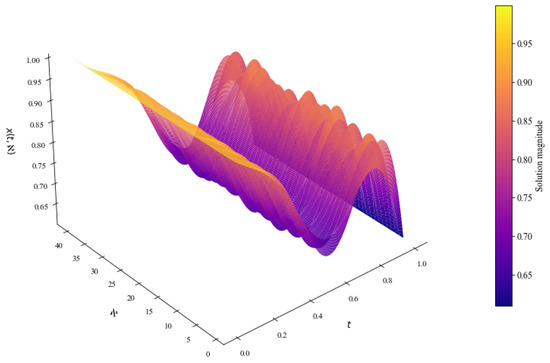
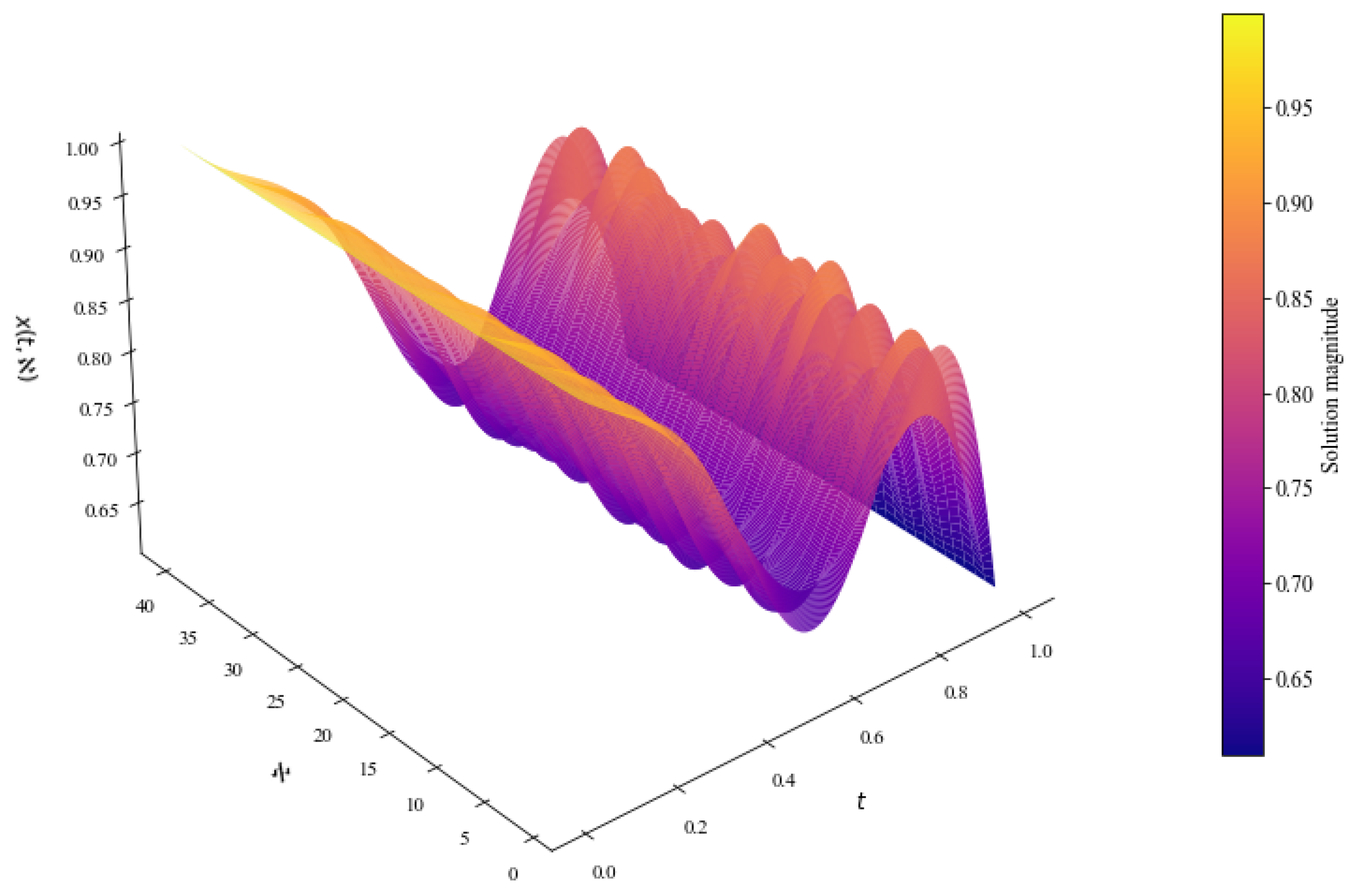
A few random realizations of the random variable ℵ are created and the approximate solution trajectories are computed at . The surface is shown below in Figure 1.
Figure 1.
Three-dimensional surface plot of the approximate random fractional integral solution corresponding to problem (18).
As shown in Figure 1, there exists a smooth and bounded oscillatory surface at all points in the computational domain. The continuity of the surface suggests that the solution is smooth in time; this is a consequence of the continuity assumptions made in the nonlinear mappings , and in hypotheses (H1)–(H5).
The fractional derivative of hereditary type is gradually time-varying, as a consequence of which the surface changes gradually along the time axis. In contrast to classical integer-order systems, the present state is determined by the cumulative effect of the previous states, and hence, the systems evolve in a memory-dependent fashion in a smooth manner.
The oscillatory structure in the solution profile comes from the delayed functional terms in both the Volterra and the Fredholm. The Volterra operator gives rise to hereditary fading-memory behavior, and the Fredholm operator gives rise to a nonlocal coupling effect over the whole interval [0, 1], which leads to the solution profile being smoother across the entire interval.
The spread along the random-realization axis shows the effects of the bounded stochastic perturbations. The structure of the surface does not change significantly, despite the slight differences in the amplitudes and local oscillatory patterns of the various realizations; it is uniformly bounded. This is a confirmation that the random perturbations do not destroy the existence and uniqueness properties set up analytically.
The other significant point to note is the lack of singularities, discontinuities and unbounded growth in the graphical output. Numerical evidence is given for the fact that the integral operator associated with the solution is contractive, due to the contraction condition found in Theorem 4 and the boundedness of the region of the integral. Thus the graphical behavior substantiates theoretically predicted uniqueness of the random integral solution of the random fractional problem.
The surface, obtained, is characteristic of fractional dynamical systems with memory and delayed feedback from an application point of view. The same bounded oscillatory responses can be observed in viscoelastic materials, hereditary control systems, population models with maturation delays as well as in stochastic processes under the action of fractional-order operators.
The three-dimensional surface plot in Figure 1 therefore gives a good qualitative confirmation of the analytical results obtained in Theorems 4 and 5. The graphical interpretation shows that the proposed random fractional Volterra–Fredholm integro-differential model provides a smooth, bounded and dynamically stable solution to the model under bounded random perturbations which proves the validity of the developed theoretical framework for random fractional systems with infinite delay.
5. Application: ANN-Based Prediction Under Random Parameter Variations
The results of analytical analysis in the previous sections demonstrate the existence and uniqueness of the random fractional integral solution for the suggested Volterra–Fredholm integro-differential model. If the value of the bounded random parameter is changed in the allowed range, on the other hand, repeated computation of the fractional integro-differential operator is costly. An ANN is used to study the impact of the random parameter on the associated solution trajectories. The ANN is used to capture the nonlinear relationship between the temporal variable and the bounded random realization, and hence allows for efficient prediction of the random fractional integral solution corresponding to different realizations of the random parameter without changing the qualitative behavior provided by the theoretical analysis.
5.1. Random Parameter-Dependent Fractional Solution
An integral solution of the random fractional functional Volterra–Fredholm integro-differential problem is a function that satisfies the equivalent integral equation obtained from the original fractional differential equation, together with the prescribed initial conditions. A fractional solution refers to a function satisfying the original problem involving the Caputo fractional derivative, thereby incorporating the memory effects associated with the fractional order. In the present problem, the fractional solution depends on the random parameter , and its numerical approximation is considered over the prescribed range of admissible values of .
For the random fractional functional Volterra–Fredholm integro-differential problem (18), the bounded random parameter influences the amplitude of the corresponding integral solution. The approximate random fractional solution is represented by
where
Different realizations of generate different solution trajectories, producing a family of bounded random fractional responses. In particular,
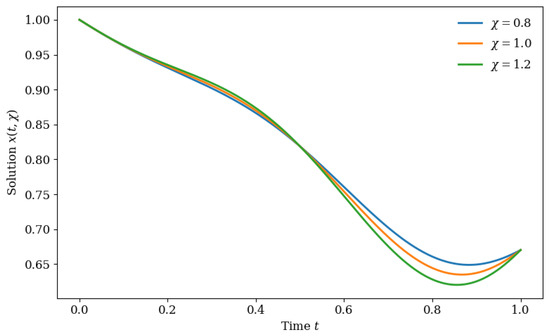
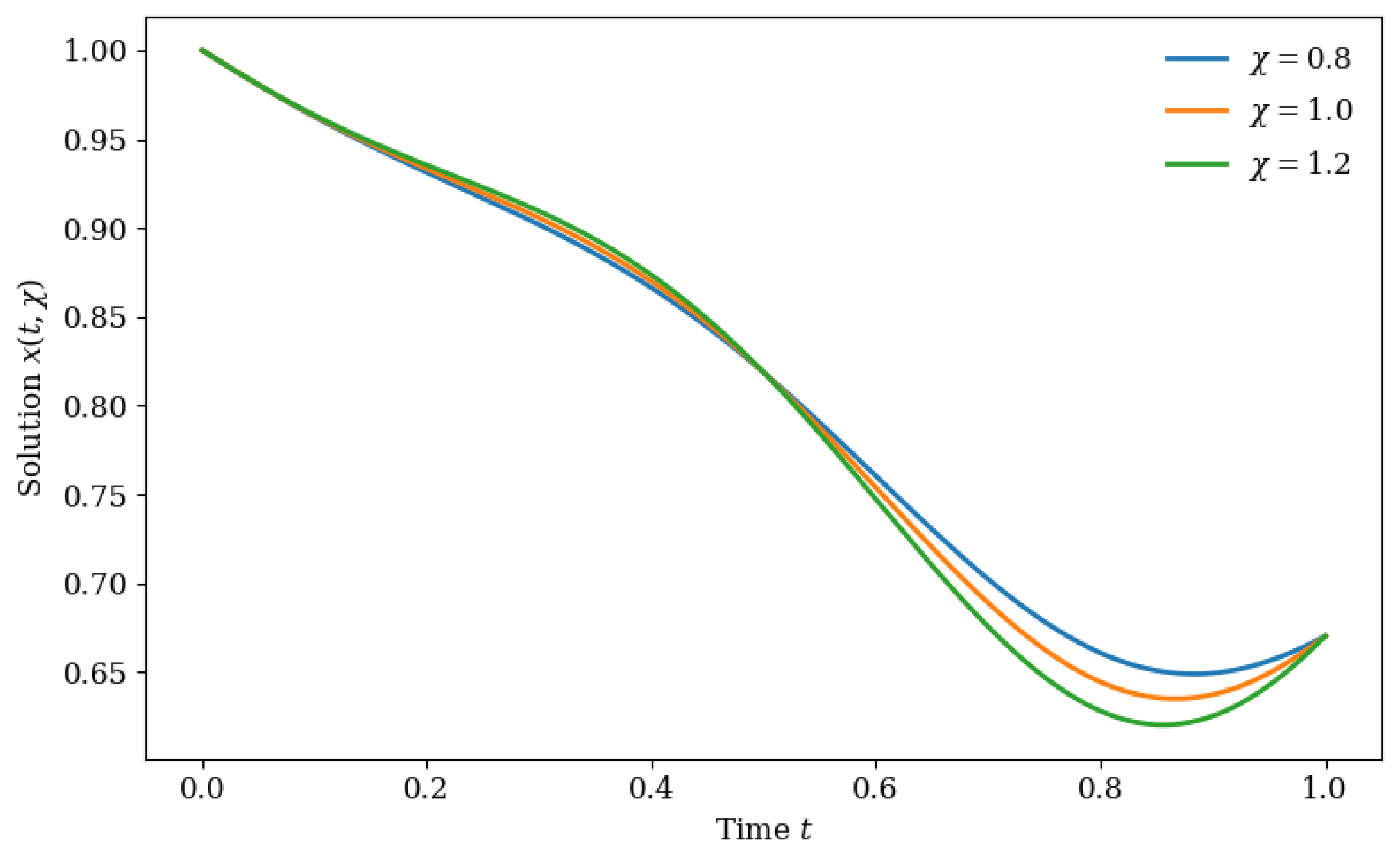
The variation of the solution family for three representative random realizations is illustrated in Figure 2.
Figure 2.
Family of random fractional solution trajectories corresponding to different values of the bounded random parameter .
We see in Figure 2 that the value of affects the amplitude of the oscillations of the solution (as long as it is bounded and stable). The qualitative structure of all the trajectories is smooth, as is expected if the nonlinear operators of the random fractional model are assumed to be continuous and bounded.
5.2. ANN-Based Prediction Framework
A feed-forward ANN is used as a surrogate approximation model to efficiently predict the random fractional solution corresponding to new values of not used during the training. The ANN approximates the nonlinear mapping
where denotes the ANN-predicted approximation of the random fractional integral solution.
The bounded random parameter is directly included in the training process of the ANN along with the time variable t. The training data are derived from the numerically calculated fractional solution with multiple allowable values of in a specified range. Thus, the parameter-dependent mapping is learned by a single feed-forward ANN. A trained network is then used to predict the solution for new admissible values of which do not form part of the training set. Therefore, there is no need to build separate neural networks for a specific value of the random parameter, but rather, a single trained ANN models the whole family of random parameter-dependent solution trajectories.
The network receives two input variables:
- The temporal variable t;
- The bounded random parameter .
The output layer produces the predicted solution value .
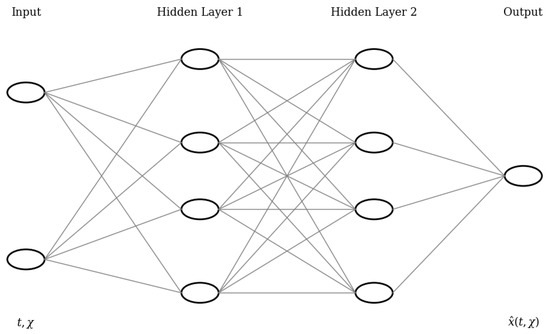
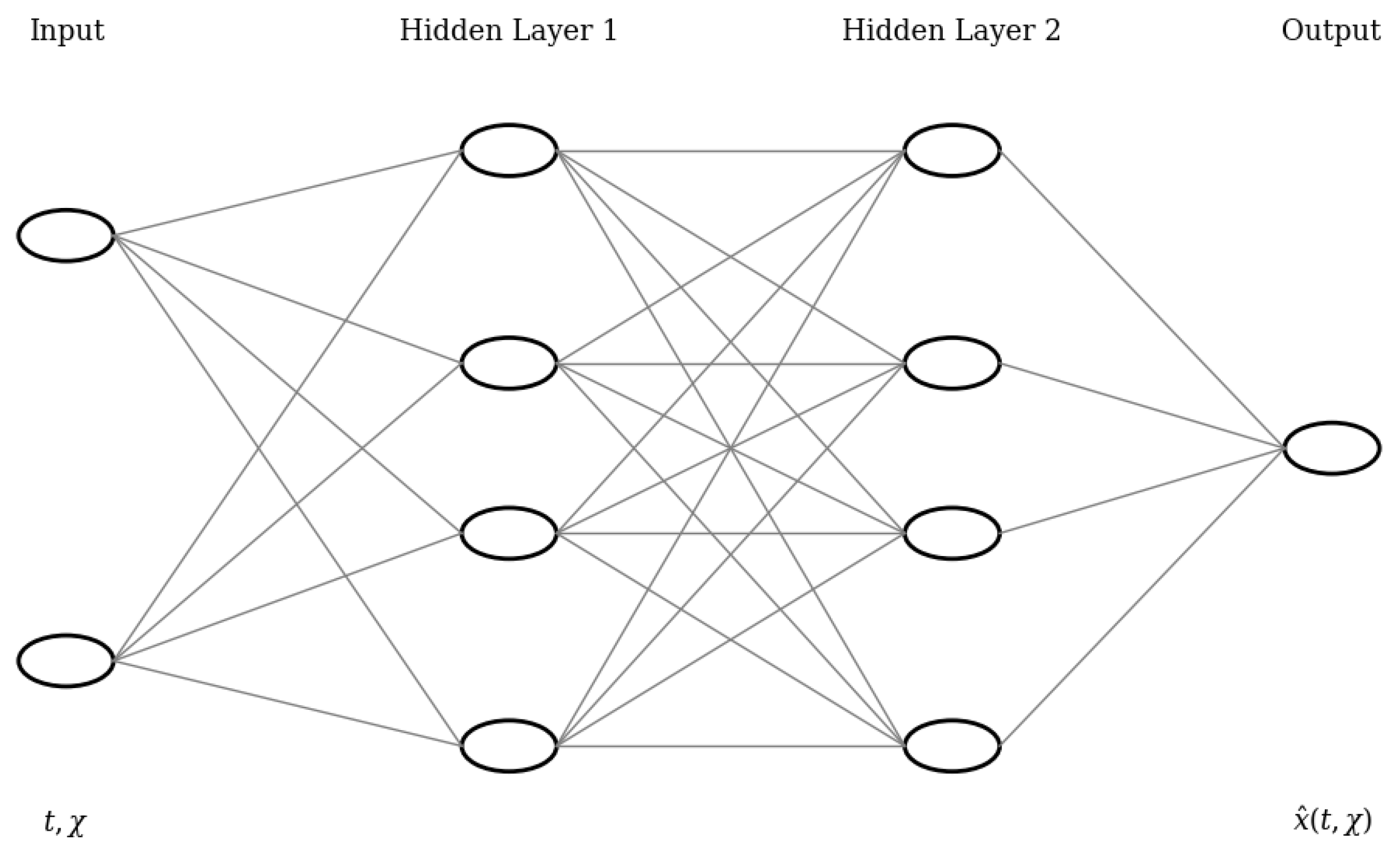
The adopted ANN architecture is illustrated in Figure 3.
Figure 3.
Feed-forward ANN architecture for predicting the random fractional integral solution from the inputs .
It has an input layer of two neurons, two hidden layers of nonlinear activation units, and an output layer of one neuron, which predicts the random fractional solution.
5.3. Prediction Performance
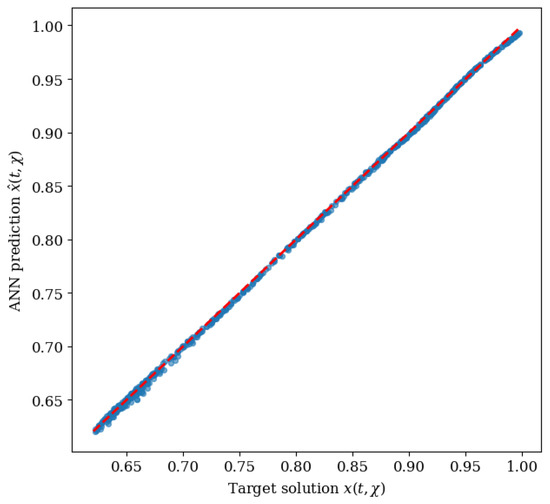
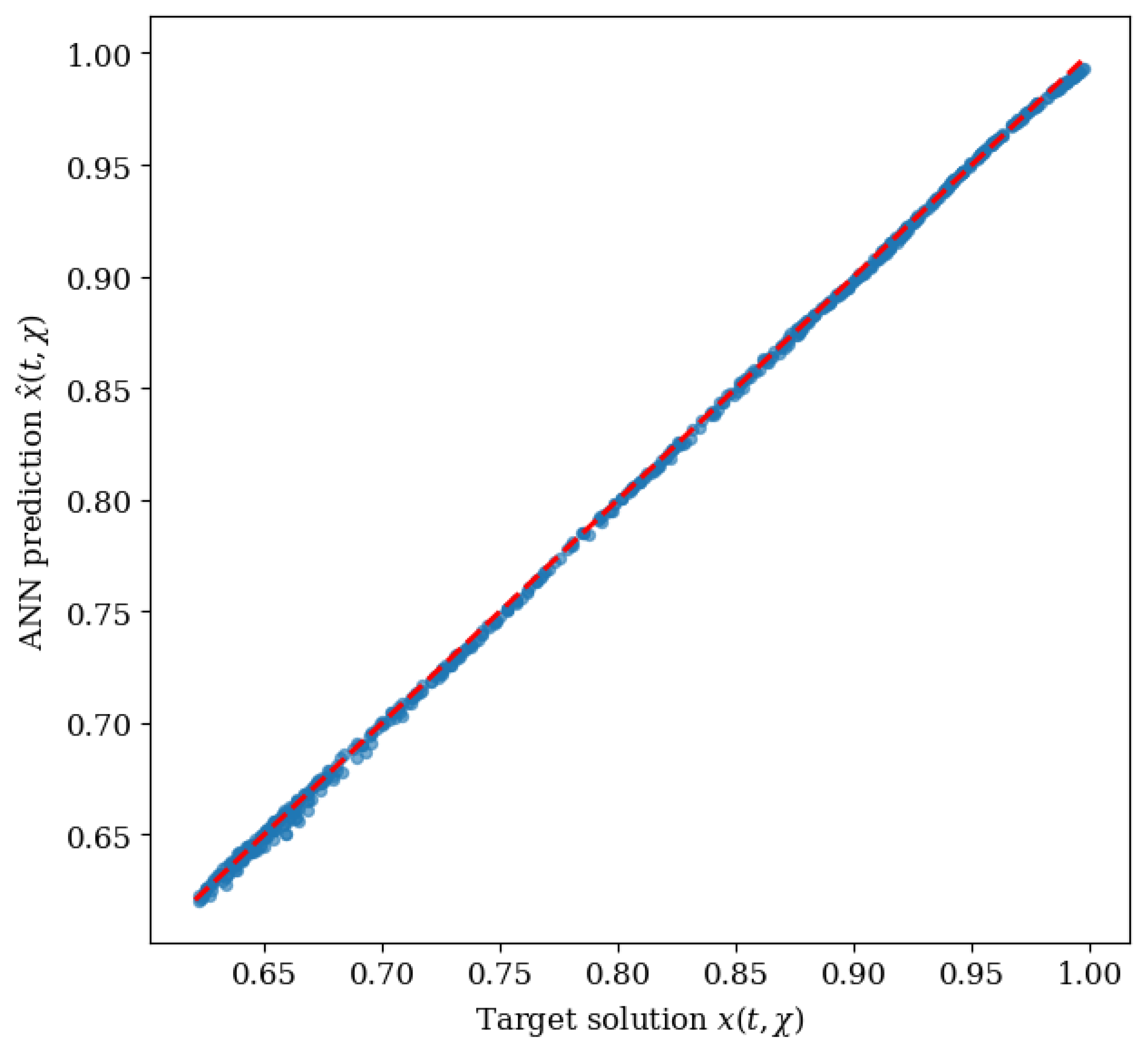
Numerical samples generated from the approximate random fractional solution are used to train and validate the ANN model. The ANN predictions are compared with the target solutions (numerically generated) after training. A comparison is given in Figure 4.
Figure 4.
Comparison between the numerically generated random fractional solution and the ANN-predicted solution.
The predicted values are concentrated close to the diagonal reference line, as shown in Figure 4, which shows good agreement between the ANN predictions and the target random fractional solutions. The small dispersion around the diagonal elements of the matrix shows that the neural network is able to model the nonlinear oscillatory behavior generated by the Caputo fractional derivative and bounded random perturbations .
5.4. Discussion
The ANN-based framework offers an efficient computational method for obtaining the random fractional integral solution for various realizations of the bounded random parameter. The trained ANN can approximate the solution trajectory of the random fractional Volterra–Fredholm integro-differential equation quickly for the different admissible values of instead of solving the equation repeatedly for all of these values.
The predicted solutions are still smooth and bounded on the interval , and completely consistent with the analysis existence and uniqueness results given by Theorems 4 and 5. The bounded oscillatory structure is well preserved, thus proving the ability of the ANN to reproduce the qualitative behavior of the underlying random fractional dynamical system.
Therefore, the proposed prediction framework based on the ANN acts as an effective surrogate approximation tool to the random fractional functional Volterra–Fredholm integro-differential model and also offers an efficient method to investigate the effects of bounded random parameter changes on the associated integral solution family.
6. Conclusions
In this work, we studied a class of random functional Volterra–Fredholm integro-differential equations of infinite delay and developed an integrated analytical and computational framework for the treatment of these equations. The proposed model includes a Caputo derivative (for fractional memory), an infinite history term (for functional dependence), a Volterra term (for hereditary interaction), a Fredholm term (for nonlocal coupling), and bounded random perturbations. Sufficient conditions for the existence and uniqueness of a random integral solution were obtained with the help of Banach’s fixed-point theorem under appropriate continuity, boundedness and Lipschitz conditions. Furthermore, Krasnosel’skii’s fixed-point theorem was used to get an existence result under appropriate compactness assumptions. The illustrative example is used to show the applicability of the theoretical assumptions and to confirm the contraction condition which is necessary for the uniqueness result.
Another goal of the work was to develop a convenient computational approximation for the parameter-dependent fractional solution. The temporal variable and the bounded random parameter were used as inputs for this purpose, with a single feed-forward ANN constructed. The network thus comes close to a family of solution trajectories without having to train an independent model for each random realization. This gives a practical approximation of the solution and is a supplement to the analytical fixed-point results. It is worth noting that the novelty of the present work is not connected with the use of fractional calculus or with the time-delay system, because both of them are well studied. On the contrary, their common treatment is the functional infinite delay, the mixed Volterra–Fredholm operator, the bounded random perturbations, the fixed-point solvability, and the parameter-dependent approximation of ANN. The proposed framework is thus a link between the theoretical study and the computational approximation of a class of random hereditary systems.
It is assumed here that the components of the system are continuous, bounded, Lipschitz, and compact, and that a bounded range (assumption) of the random parameter is considered. The model could be further generalized to include variable-order fractional derivatives, state-dependent and impulsive delays, generalized random processes, multidimensional systems and other neural network architectures to be explored in future investigations. The idea of combining approximation by ANN with the fixed-point analysis may be extended to larger-scale fractional models used, for example, in engineering, finance or other fields.
Author Contributions
Conceptualization, P.R.; methodology, P.R. and Y.P.; software, P.R.; validation, Y.P. and K.S.M.; formal analysis, P.R., Y.P. and N.M.; investigation, Y.P. and N.M.; resources, P.R. and K.S.M.; data curation, K.S.M. and N.M.; writing—original draft preparation, P.R.; writing—review and editing, P.R., Y.P. and K.S.M.; visualization, P.R., Y.P. and N.M.; supervision, P.R.; project administration, P.R. and K.S.M. All authors have read and agreed to the published version of the manuscript.
Funding
This research was funded by Qassim University, grant number QU-APC-2026. The APC was funded by Qassim University.
Data Availability Statement
The data used to support the findings of this study are available from the corresponding author upon reasonable request.
Acknowledgments
The researchers would like to thank the Deanship of Graduate Studies and Scientific Research at Qassim University (https://www.qu.edu.sa) for financial support (QU-APC-2026).
Conflicts of Interest
The authors declare no conflicts of interest.
Abbreviations
The following abbreviations are used in this manuscript:
| ANNs | Artificial Neural Networks |
References
- Podlubny, I. Fractional Differential Equations: An Introduction to Fractional Derivatives, Fractional Differential Equations, to Methods of Their Solution and Some of Their Applications; Academic Press: San Diego, CA, USA, 1998; Volume 198, ISBN 978-0-12-558840-9. [Google Scholar]
- Kilbas, A.A.; Srivastava, H.M.; Trujillo, J.J. Theory and Applications of Fractional Differential Equations; Elsevier: Amsterdam, The Netherlands, 2006; ISBN 978-0-444-51832-3. [Google Scholar]
- Hale, J.K. Retarded equations with infinite delays. In Functional Differential Equations and Approximation of Fixed Points; Peitgen, H.O., Walther, H.O., Eds.; Lecture Notes in Mathematics; Springer: Berlin/Heidelberg, Germeny, 1979; Volume 730. [Google Scholar] [CrossRef] [Scilit]
- Hussain, K.H. Existence, uniqueness and boundedness of solutions for fractional integro-differential equations. Int. J. Innov. Comput. 2021, 17, 1029–1039. [Google Scholar] [CrossRef]
- Syam, M.I.; Hashim, I. A numerical method for investigating fractional Volterra–Fredholm integro-differential model. Eur. J. Pure Appl. Math. 2024, 17, 1429–1448. [Google Scholar] [CrossRef] [Scilit]
- Filali, D.; Akram, M.; Dilshad, M. Exploring the fractional Volterra–Fredholm integro-differential equation: An iterative approach. AIMS Math. 2025, 10, 23467–23495. [Google Scholar] [CrossRef] [Scilit]
- Ajileye, G.; James, A.; Abdullahi, A.; Oyedepo, T. Collocation approach for the computational solution of Fredholm–Volterra fractional order integro-differential equations. J. Niger. Soc. Phys. Sci. 2022, 4, 834. [Google Scholar] [CrossRef] [Scilit]
- El-Gindy, T.M.; Ahmed, H.F.; Melad, M.B. Effective numerical technique for solving variable order integro-differential equations. J. Appl. Math. Comput. 2022, 68, 2823–2855. [Google Scholar] [CrossRef] [Scilit]
- Hashemi, B.; Khodabin, M.; Maleknejad, K. Numerical solution based on hat functions for solving nonlinear stochastic Itô Volterra integral equations driven by fractional Brownian motion. Mediterr. J. Math. 2017, 14, 24. [Google Scholar] [CrossRef] [Scilit]
- Jose, S.A.; Yukunthorn, W.; Valdes, J.N.; Leiva, H. Some existence, uniqueness and stability results of nonlocal random impulsive integro-differential equations. Appl. Math. E-Notes 2020, 20, 481–492. [Google Scholar]
- Anguraj, A.; Vinodkumar, A. Global existence and stability results for partial delay integro-differential equations with random impulses. Filomat 2023, 37, 317–334. [Google Scholar] [CrossRef] [Scilit]
- Diop, A.; Frederico, G.S.; Sousa, J.V.D.C. On controllability for a class of multi-term time-fractional random differential equations with state-dependent delay. Ann. Funct. Anal. 2022, 13, 20. [Google Scholar] [CrossRef] [Scilit]
- Khanam, S.; Goyal, S.; Patel, R.; Ruchi. Optimal control problem for fractional stochastic nonlocal analytic resolvent semilinear integro-differential system. Circuits Syst. Signal Process. 2025, 44, 9018–9038. [Google Scholar] [CrossRef] [Scilit]
- Mesri, F.; Salim, A.; Benchohra, M.; N’Guérékata, G.M. Periodic mild solutions of stochastic fractional integro-differential equations with delay and weakly singular kernels in Banach spaces. Nonlinear Stud. 2026, 33, 537. [Google Scholar]
- Jafarian, A.; Mokhtarpour, M.; Baleanu, D. Artificial neural network approach for a class of fractional ordinary differential equation. Neural Comput. Appl. 2017, 28, 765–773. [Google Scholar] [CrossRef] [Scilit]
- Shloof, A.M.; Senu, N.; Ahmadian, A.; Pakdaman, M.; Salahshour, S. A new iterative technique for solving fractal-fractional differential equations based on artificial neural network in the new generalized Caputo sense. Eng. Comput. 2023, 39, 505–515. [Google Scholar] [CrossRef] [Scilit]
- Antony, A.; Mishra, L.N. A novel neural network-based method for solving fractional differential equations involving the generalized Caputo operator. Adv. Stud. Euro-Tbil. Math. J. 2026, 19, 233–252. [Google Scholar] [CrossRef] [Scilit]
- Alsa’di, K.; Long, N.M.A.N. Bernstein neural networks method for solving variable order fractional mixed Volterra–Fredholm integro-differential equations. J. Qual. Meas. Anal. 2025, 21, 99–119. [Google Scholar] [CrossRef] [Scilit]
- Raghavendran, P.; Parthiban, Y. A hybrid neural network approach to controllability in Caputo fractional neutral integro-differential systems for cryptocurrency forecasting. Fractal Fract. 2026, 10, 268. [Google Scholar] [CrossRef] [Scilit]
- Priyadharshini, A.; Vijayakumar, V. Solvability results for Hilfer fractional stochastic mixed Volterra–Fredholm integro-differential inclusions with non-dense domain. Complex Anal. Oper. Theory 2025, 19, 138. [Google Scholar] [CrossRef] [Scilit]
- Viera-Martin, E.; Gómez-Aguilar, J.F.; Solís-Pérez, J.E.; Hernández-Pérez, J.A.; Escobar-Jiménez, R.F. Artificial neural networks: A practical review of applications involving fractional calculus. Eur. Phys. J. Spec. Top. 2022, 231, 2059–2095. [Google Scholar] [CrossRef] [Scilit]
- Khan, A.M.; Gaur, S.; Suthar, D.L. Predicting the solution of fractional order differential equations with artificial neural network. Partial Differ. Equ. Appl. Math. 2024, 10, 100690. [Google Scholar] [CrossRef] [Scilit]
- Zanib, S.A.; Zubair, T.; Riaz, M.B.; Asjad, M.I.; Alqarni, M.S. Finite difference and artificial neural network approach to fractional MHD Casson fluid flow oscillation. Fractals 2026, 2640022. [Google Scholar] [CrossRef] [Scilit]
- Shams, M.; Carpentieri, B. Efficient inverse fractional neural network-based simultaneous schemes for nonlinear engineering applications. Fractal Fract. 2023, 7, 849. [Google Scholar] [CrossRef] [Scilit]
- Önal, M.; Karaagac, B.; Esen, A. An efficient higher-order trigonometric cubic B-spline collocation method for time-fractional Burgers equations. Int. J. Math. Comput. Eng. 2026, 4, 211–234. [Google Scholar] [CrossRef] [Scilit]
- Didgar, M.; Ekhlasi, F. An approximate approach for fractional relaxation-oscillation equation based on Taylor expansion. Int. J. Math. Comput. Eng. 2025, 3, 435–454. [Google Scholar] [CrossRef] [Scilit]
- Smart, D.R. Fixed Point Theorems; Cambridge University Press: Cambridge, UK, 1980; Volume 66, ISBN 978-0-521-29833-9. [Google Scholar]

Disclaimer/Publisher’s Note: The statements, opinions and data contained in all publications are solely those of the individual author(s) and contributor(s) and not of MDPI and/or the editor(s). MDPI and/or the editor(s) disclaim responsibility for any injury to people or property resulting from any ideas, methods, instructions or products referred to in the content. |
© 2026 by the authors. Licensee MDPI, Basel, Switzerland. This article is an open access article distributed under the terms and conditions of the Creative Commons Attribution (CC BY) license.