


Abstract
Tectonic activity can induce deformation or failure of shale formations, thereby altering their macroscopic and microscopic structures to varying degrees. Naturally deformed shale samples from the Lower Cambrian Qiongzhusi Formation in the Dabashan Thrust-fold Belt, northeast Sichuan Basin, were investigated using scanning electron microscopy (SEM), low-temperature gas adsorption, and fractal analysis to characterize the nanoporous structure of organic matter. The results show the following: (1) SEM observations indicate that the organic nanopores are predominantly subcircular, with shape factors ranging from 0.736 to 0.859 and an average areal porosity of 7.678%. The pore diameters are mainly distributed within 10–50 nm, with micropores and mesopores being dominant, showing typical nanoscale pore characteristics. (2) Gas adsorption results show that the organic mesopores are mainly distributed within 20–30 nm. Their average pore volume and specific surface area are 0.169 cm3/g and 33.318 m2/g, respectively, indicating a relatively small number of mesopores and a low degree of mesopore development. The organic micropores exhibit a trimodal pore-size distribution, with peaks at 0.3–0.4 nm, 0.4–0.6 nm, and 0.75–0.85 nm. Their average pore volume and specific surface area are 0.012 cm3/g and 38.975 m2/g, respectively. (3) The fractal dimensions of the organic nanopores calculated using the box-counting method, the FHH model, and the V-S model are 1.280, 2.524, and 2.448, respectively, indicating relatively low pore-structure complexity and heterogeneity in the organic matter of the shale.
1. Introduction
The Upper Yangtze region of southern China is characterized by complex tectonic deformation [1,2,3,4]. Since the Indosinian period, the Lower Paleozoic marine shale successions have undergone regional uplift and intense compression, uplift, and superimposed deformation during the Yanshanian and Himalayan tectonic events [5]. Strong folding, faulting, uplift, and denudation have resulted in complex conditions for shale gas occurrence and preservation, thereby increasing the difficulty of marine shale gas exploration and development [6]. Along the margins of the Sichuan Basin, the Lower Paleozoic Qiongzhusi Formation and the Wufeng–Longmaxi Formation constitute two major source-rock successions [7,8,9]. These intervals are not only primary targets for shale gas exploration but also serve as important regional detachment layers within the tectonic framework of southern China [2,3]. Tectonic deformation, particularly compressional and shear deformation, can substantially modify the shale succession architecture, organic matter–mineral associations, and micro- to nanoscale pore–fracture systems, together with the associated reservoir properties, gas-bearing capacity, and adsorption–desorption behavior, thereby strongly constraining shale gas enrichment [8].
In recent years, increasing attention has been paid to the micro- and nanoscale pore–fracture systems, reservoir types, transport capacity, petrophysical properties, adsorption behavior, and gas-bearing characteristics of organic-rich shale [10,11,12,13]. Among these factors, pore–fracture structure is a key parameter for evaluating reservoir quality and total gas content and for understanding the occurrence, migration, and enrichment of shale gas [4]. It is therefore a major focus in the study of unconventional tight reservoirs. Previous studies have shown that organic-rich shale contains abundant nanopores and a limited number of microfractures [14,15,16]. Nanopores provide the principal storage space for shale gas, whereas microfractures serve as important pathways for gas migration [15]. Their development is controlled by tectono-sedimentary evolution, diagenesis, thermal evolution, and rock composition, with tectonic stress acting as an important external factor [2,3,4,5,8]. Previous studies, however, have mainly focused on the overall controls of deformation stages, structural styles, roof and floor conditions, fault scale, uplift, and denudation on shale gas preservation and enrichment [8], while paying less attention to the influence of tectonic stress on nanoscale structural evolution, particularly the modification of organic nanopores. Under external tectonic stress, the structures of organic matter and minerals are altered, leading to corresponding changes in pore and fracture characteristics and, consequently, in shale gas occurrence and migration [4,5,6]. For example, Zhu et al. [4,5] investigated marine shale samples from the Lower Silurian Longmaxi Formation in the southeastern Sichuan Basin and the Lower Cambrian Lujiaping Formation in northeastern the Sichuan Basin using scanning electron microscopy (SEM), low-temperature gas adsorption, and mercury intrusion porosimetry. Their results showed that tectonic stress first modifies the shale matrix components, thereby controlling pore–fracture evolution and ultimately constraining shale gas storage and migration.
This study focuses on naturally deformed marine shale from the Lower Paleozoic Qiongzhusi Formation along the margins of the Sichuan Basin. SEM, low-temperature gas adsorption, and fractal analysis were employed to investigate the nature of organic nanopore structures of naturally deformed shales. The findings provide new insights into marine shale gas accumulation systems in tectonically complex regions of China, improving the understanding of shale gas enrichment mechanisms.
2. Sampling and Methods
2.1. Sample Characterization
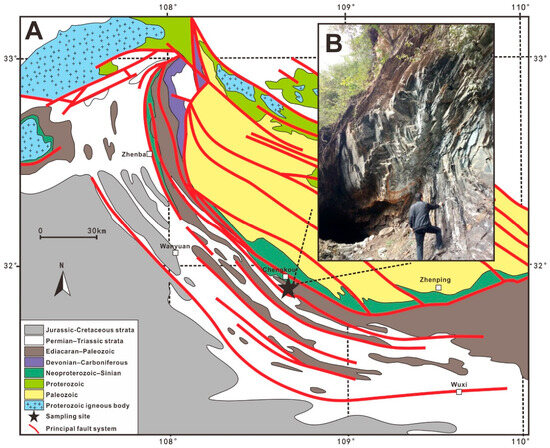
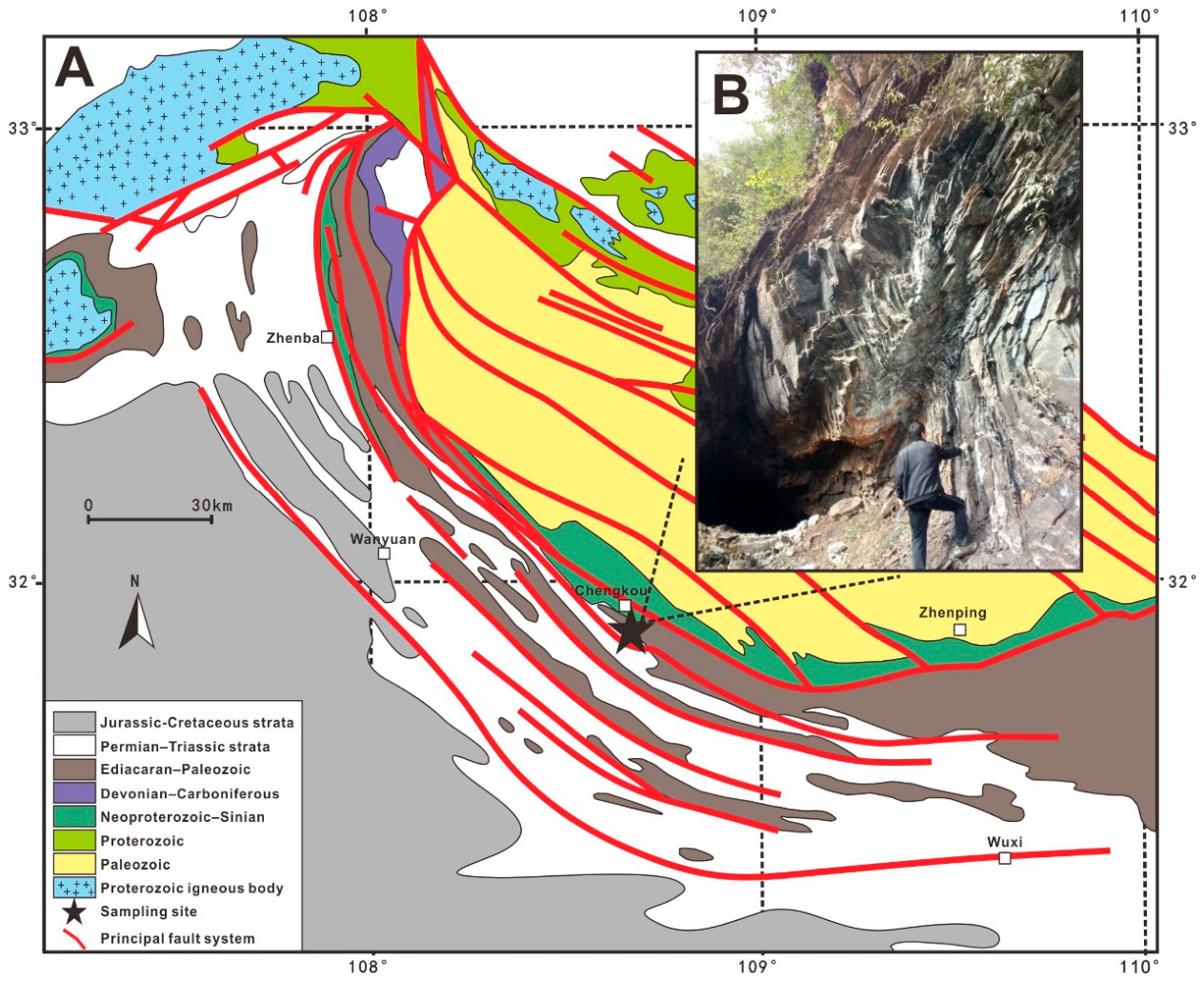
The study area is located at the Dabashan Thrust-fold Belt, northeast Sichuan Basin, as illustrated in Figure 1A. The geological map reveals a series of NE-SW trending principal fault systems (red lines), and these faults play a crucial role in controlling the migration, accumulation, and preservation of shale gas resources (Figure 1A). The sampling site (black star) is situated near Chengkou, Chongqing, where the shale succession is well-exposed and structurally strongly deformed compared to adjacent areas. A representative field outcrop is presented in Figure 1B, located in the vicinity of the sampling site. Naturally deformed shale samples were collected from a folded stratigraphic section in Xiuqi Town. The samples are from the Lower Cambrian Qiongzhusi Formation, also referred to locally as the Lujiaping Formation. The shale strata occur in tight, complex folds, and five naturally deformed samples were collected from strongly deformed zones near the fold core. It should be noted that the five samples represent a specific end-member of intense deformation near the fold core. Macroscopically, the samples exhibit intense ductile flow deformation and are relatively soft [4]. At the microscopic scale, the matrix components are strongly oriented and display well-developed foliation, lineation, and flow structures. Cleavage formation and mylonitization are pervasive, and the primary shale fabric has been completely destroyed [2,4].
Figure 1.
Regional tectonic framework and field outcrop of the study area. (A) Geological overview of the northeastern Sichuan Basin showing the distribution of major stratigraphic units and the principal fault system. The star indicates the sampling site for this study. (B) Field photograph of the exposed shale section, illustrating the complex folding nature of the strata and poorly preserved primary sedimentary structures.
2.2. Experimental and Methods
The analytical methods used in this study included SEM, organic matter isolation, and low-temperature gas adsorption using N2 and CO2. These methods were employed to characterize the nanopore morphology and pore-size distribution (PSD) of the shale through direct observation and quantitative analysis.
SEM observations were conducted using a Zeiss Gemini 450 field-emission scanning electron microscope (FESEM), (Carl Zeiss Microscopy GmbH, Oberkochen, Germany). Sample preparation and SEM analysis were performed at the Institute of Geology and Geophysics, Chinese Academy of Sciences. Shale samples were first cut into thin slabs perpendicular to the bedding and then subjected to mechanical grinding and argon-ion polishing. The polished surfaces were coated with gold to improve electrical conductivity, after which the samples were mounted on specimen stubs using conductive adhesive for SEM observation.
To enable more accurate quantitative characterization of organic nanopores, organic matter was isolated from the collected shale samples. The isolation procedure comprised sample pretreatment, acid treatment, alkali treatment, heavy-liquid flotation, freeze-drying, and chloroform extraction, as described below [3]. (1) An appropriate amount of shale sample was placed in an acid-resistant reaction vessel and soaked in distilled water for 2–4 h to allow the clay minerals to swell fully. The supernatant was then removed. (2) Hydrochloric acid at a concentration of 6 mol/L was added at a liquid-to-solid ratio of 6 mL/g, and the suspension was stirred at 65 °C for 1–2 h to dissolve the carbonate minerals. After removal of the acid solution, the residue was washed with distilled water until weakly acidic. Subsequently, 6 mol/L hydrochloric acid and 40% hydrofluoric acid were added at 2.4 and 3.6 mL/g, respectively, and the mixture was stirred at 65 °C for 2 h. After removal of the acid solution, the residue was washed three times with 1 mol/L hydrochloric acid. The acid-treatment procedure was repeated until the sample was thoroughly cleaned. (3) The sample was mixed with 200 mL of 0.5 mol/L sodium hydroxide solution and stirred continuously for 30 min. After removal of the alkaline solution, this procedure was repeated until the solution became colorless. The residue was then washed with distilled water until neutral. (4) The treated material was transferred into centrifuge tubes, mixed with a heavy liquid with a density of 2.0 g/mL, ultrasonically dispersed, and centrifuged at 2500 r/min for 20 min. After phase separation, the organic matter in the upper layer was collected. The lower residue was subjected to a second flotation step, and the upper organic matter fraction was collected. The products from the two flotation steps were combined and subjected to a third flotation. The recovered organic matter was then washed with distilled water until no halide ions were detected. (5) The isolated organic matter was frozen at −5 °C for 6 h. After thawing, it was dried in an oven at a temperature below 60 °C. (6) The dried organic matter was washed with chloroform to remove soluble organic compounds, air-dried, and then further dried in an oven below 60 °C. The final product was weighed, ground, and stored in sealed vials for subsequent analysis.
The low-temperature gas adsorption was used to characterize the nanopore structures of the isolated organic matter. The experiments were conducted using an Autosorb-iQ specific surface area and pore-size analyzer manufactured by Quantachrome Instruments (Boynton Beach, FL, USA) at Yanshan University. Before low-temperature N2 adsorption (LTNA), the samples were degassed under vacuum at 110 °C for 10 h to remove moisture and volatile components. After degassing, the samples were transferred to the analysis station and tested at 77.3 K using N2 with a purity of at least 99.99% as the adsorbate. The N2 adsorption isotherm was obtained by recording the adsorption amount as the relative pressure (P/P0) increased from 0.025 to 0.99, followed by measurement of the desorption isotherm as P/P0 decreased from 0.99. The adsorption and desorption isotherms were obtained directly from the measurements, whereas the other pore structure parameters were calculated using theoretical models. The specific surface area was determined using the Brunauer–Emmett–Teller (BET) model, and the PSD and pore volume were calculated using the Barrett–Joyner–Halenda (BJH) model. Before low-temperature CO2 adsorption (LTCA), the powdered organic matter samples were degassed for 12 h. CO2 adsorption measurements were then performed at 273.15 K in an ice-water bath over a relative pressure range of 4 × 10⁻⁴ to 3.0 × 10⁻² to obtain the adsorption isotherms. Based on the Density Functional Theory (DFT) model, pore structure parameters within the pore-size range of 0.3–1.5 nm, including specific surface area, pore volume, and PSD, were calculated.
3. Results and Discussion
3.1. SEM Imaging-Based Visualization of Organic Nanopores
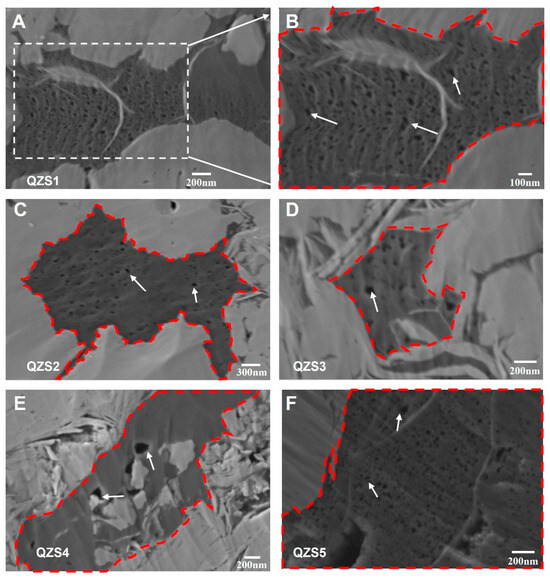
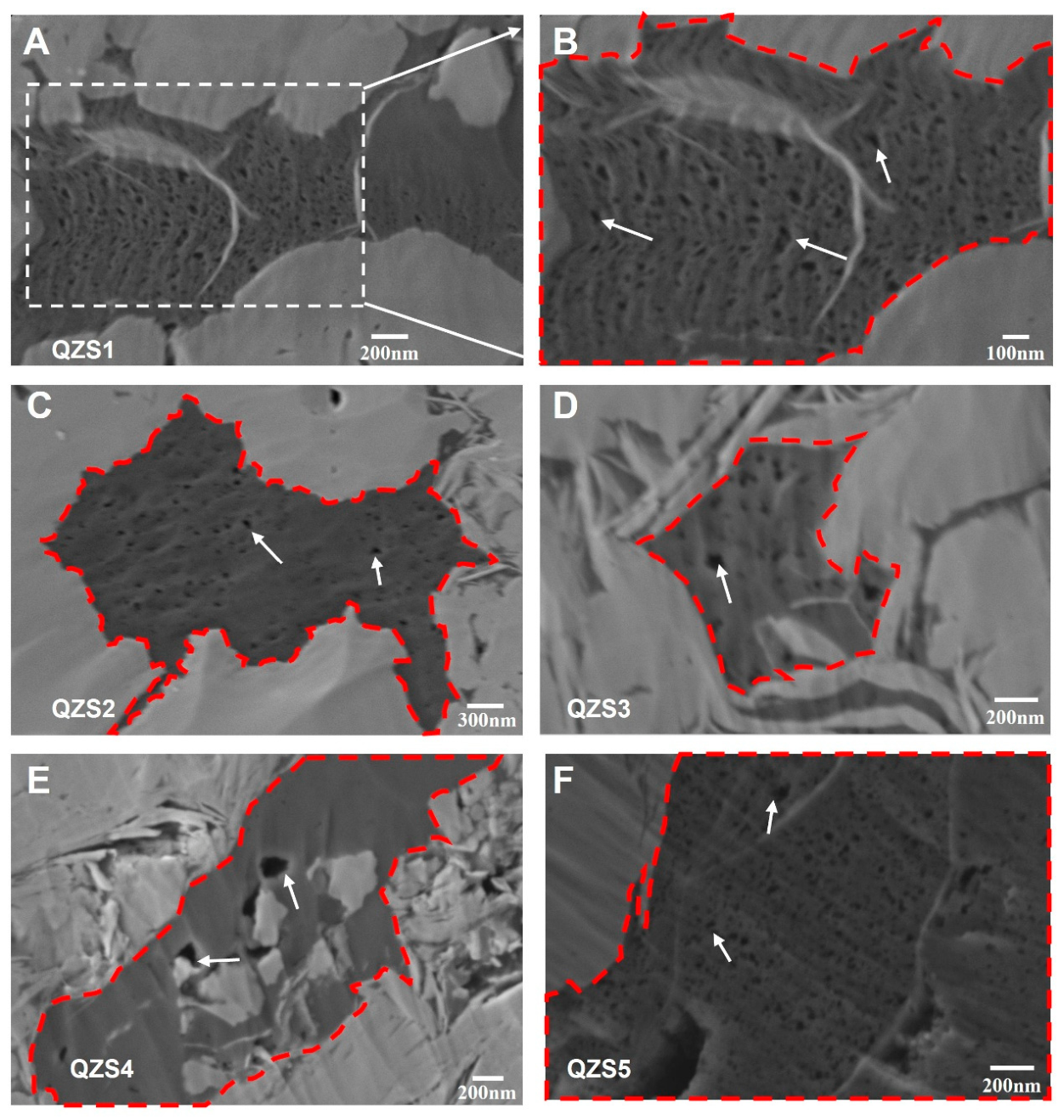
Organic nanopores are an important component of the shale microstructure and occur mainly within organic matter or along organic matter–mineral interfaces [14,15]. Their formation is a complex and prolonged process controlled by multiple geological factors [14], including the origin and abundance of organic matter, diagenetic evolution, tectonic modification, and mineral composition. High-resolution SEM characterization of the naturally deformed shale shows that the organic nanopores are generally characterized by regular geometries (Figure 2). Subcircular and elliptical pores account for more than 50% of the total, while tectonically modified, preferentially oriented slit-shaped pores are also widely developed. The organic nanopores exhibit pronounced mechanical flattening, and the slit-shaped pores account for more than 45% and show strong preferred orientation (Figure 2). Their diameters are mainly distributed between 10 and 50 nm, and the pores are generally sparse and highly dispersed. These morphological characteristics are attributed to the high thermal maturity of the Qiongzhusi Formation. Intense aromatization and graphitization caused the collapse of primary organic nanopores, whereas most residual pores were subsequently modified by tectonic stress into oriented slit-shaped pores.
Figure 2.
SEM images of organic nanopores in naturally deformed Qiongzhusi shale.
3.2. Quantitative Analysis of Organic Nanopores
3.2.1. SEM Image-Based Quantitative Characterization of Organic Nanopores
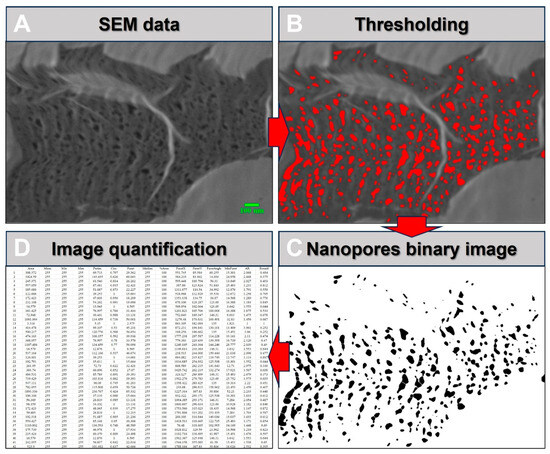
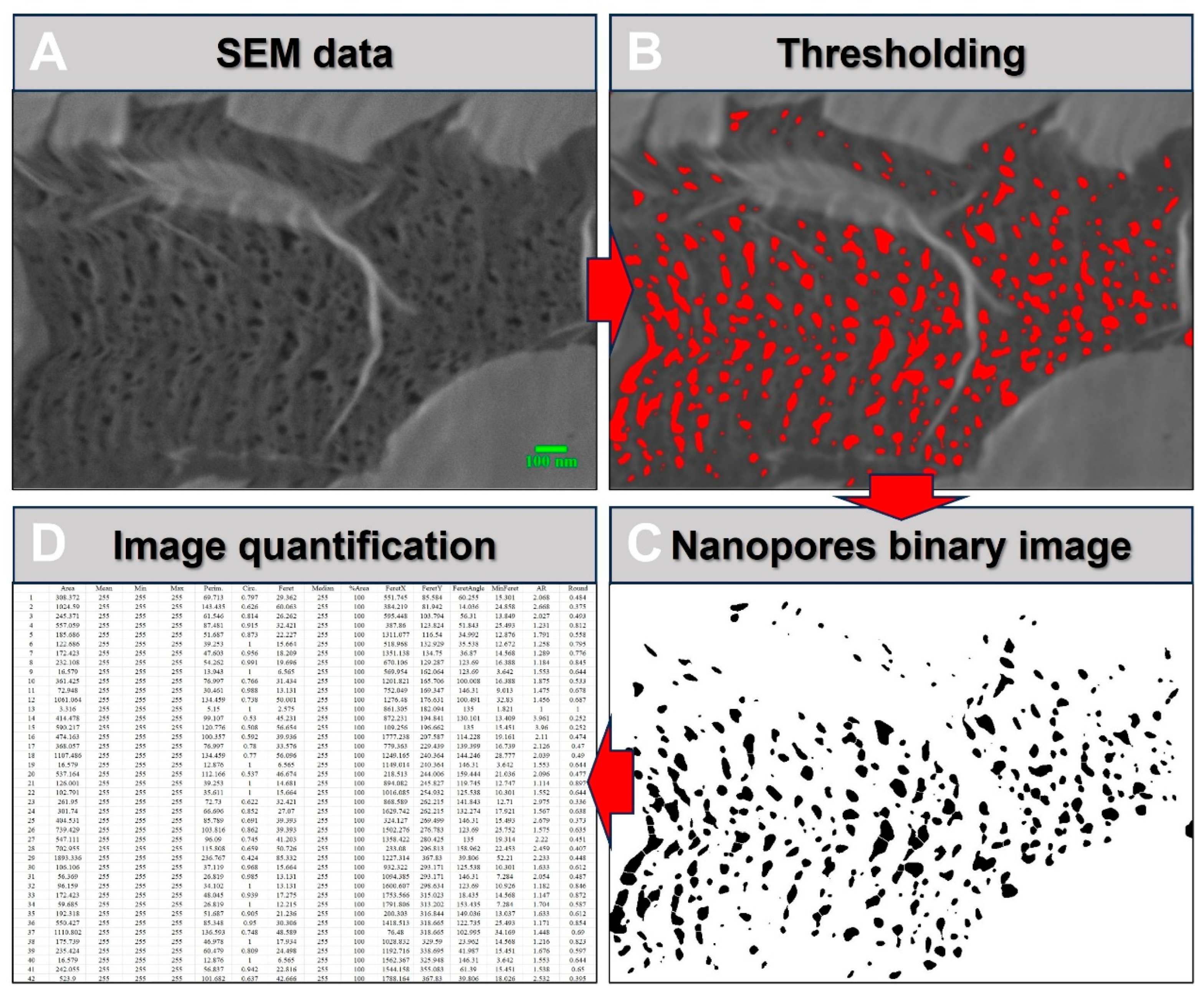
Current applications of SEM in shale nanopore research have largely focused on the qualitative characterization of pore morphology. To provide a more detailed understanding of pore structure, SEM was combined with image analysis to quantitatively characterize the shale pore system [17,18]. Specifically, SEM images of organic nanopores were processed using Image J 1.47v. Statistical analysis was then performed to extract key pore parameters, including pore number, perimeter, area, shape factor, and areal porosity. Image processing and quantitative pore-parameter extraction using Image J involved four main steps (Figure 3). (1) The image scale was calibrated in Image J according to the scale bar in each shale SEM image to ensure the accuracy of subsequent pore measurements. (2) Organic nanopores were identified by adjusting the image threshold. A consistent thresholding criterion was applied to all images to ensure that the pores were accurately and uniformly delineated. (3) The thresholded images were converted into binary images, in which the black regions represented pores and the white regions represented organic matter or the mineral matrix. (4) Individual pores in the binary images were labeled, and quantitative parameters, including pore number, perimeter, and area, were extracted to generate statistical datasets. These data were subsequently used to calculate key parameters such as areal porosity and shape factor.
Figure 3.
Workflow of organic nanopores extraction and quantitative analysis.
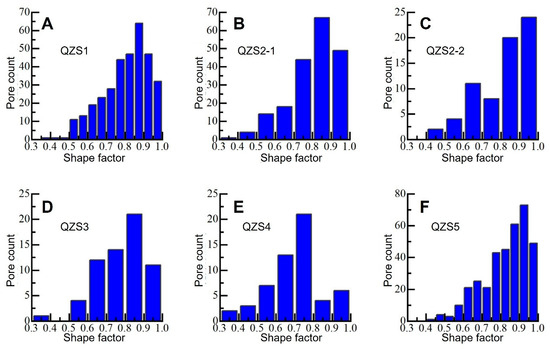
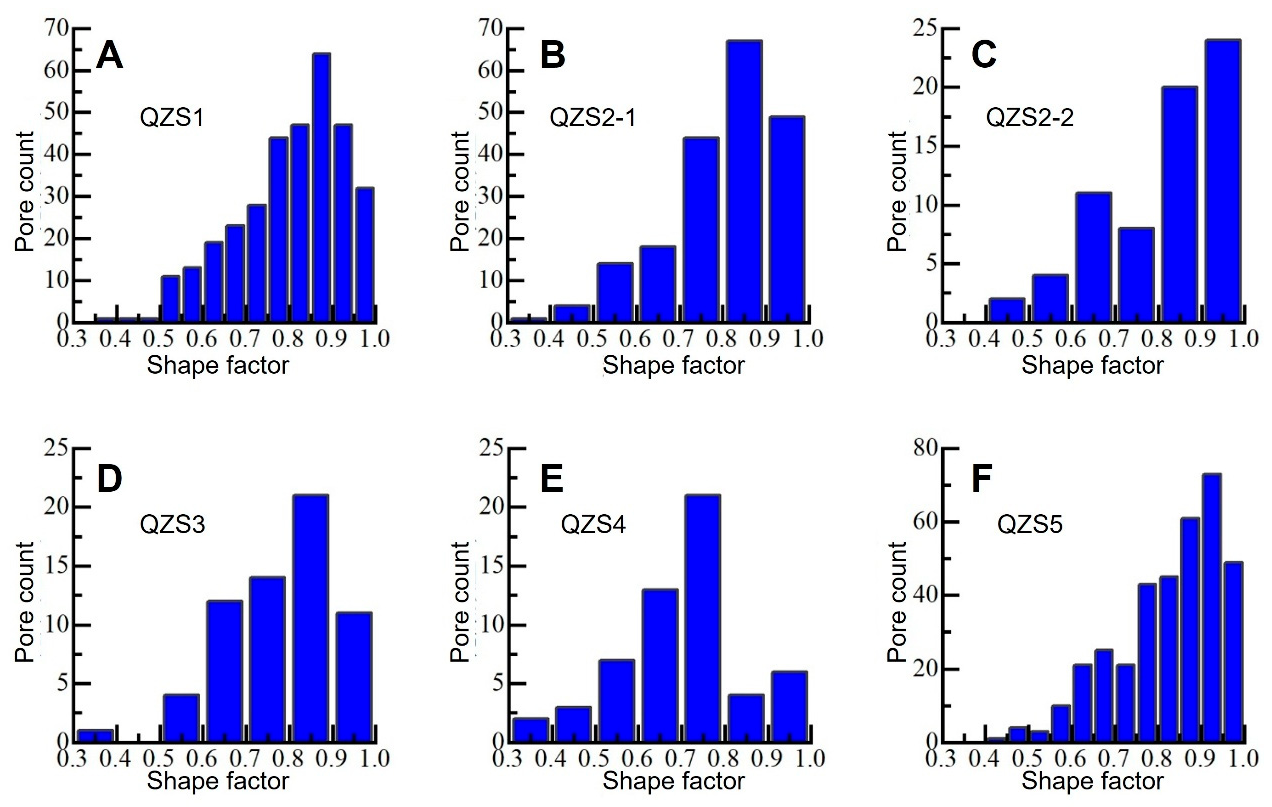
Quantitative analysis identified 68–439 organic nanopores in the examined images, indicating that these pores are generally poorly developed in the Qiongzhusi Formation shale. Areal porosity is an important parameter for evaluating the degree of pore development within organic matter and is defined as the ratio of the total cross-sectional area of organic nanopores to the cross-sectional area of the organic matter particle. The calculated areal porosity ranges from 1.618% to 12.472%, with an average of 7.678%. The shape factor is an important parameter for characterizing the geometry of two-dimensional features and reflects pore roundness and boundary roughness. A circular pore has a shape factor of 1, whereas a square pore has a shape factor of 0.785; lower values indicate more complex pore boundaries [19]. In the present study, most organic nanopores have shape factors greater than 0.8, with average values ranging from 0.736 to 0.859 (Figure 4). These results indicate that the pores exhibit an irregular or elliptical morphology, intermediate between circular and slit-like shapes. These shape factors suggest that tectonic stress promoted the geometric homogenization of the organic nanopores. This may be related to the relatively uniform stress distribution and structural reorganization of organic matter during tectonic deformation [4], which resulted in more regular pore morphologies.
Figure 4.
Distribution of shape factors of organic nanopores in the Qiongzhusi shales.
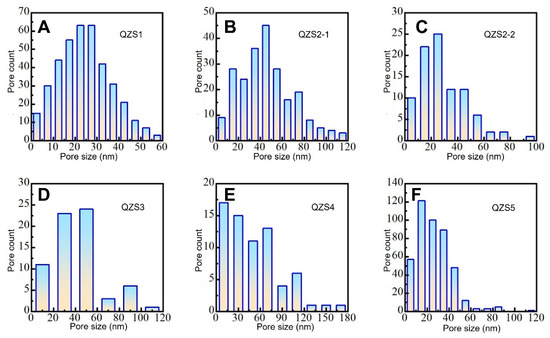
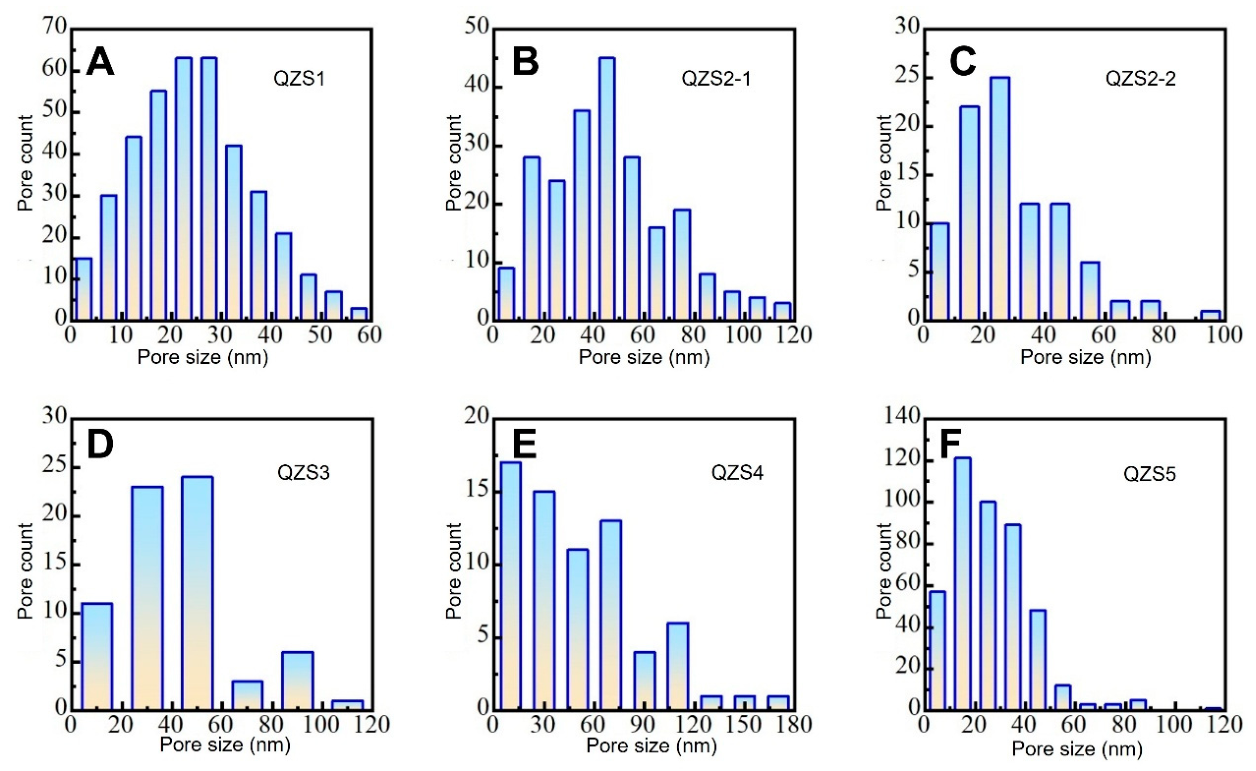
The pore diameters of the organic nanopores were calculated from SEM images using Image J. Each pore cross-sectional area was converted to that of an equivalent circle, and the corresponding equivalent pore diameter was then determined geometrically. Statistical analysis shows that the organic nanopores exhibit a distinct nanoscale size distribution, with pore diameters concentrated mainly within the 10–50 nm range and dominated by mesopores (Figure 5). This distribution may be closely related to tectonic deformation. During burial compaction, pores of different sizes respond differently to applied stress [14]. Large pores exceeding 50 nm have greater internal space and relatively weak pore walls and are therefore more susceptible to plastic deformation and structural collapse under compaction [2]. Their pore volumes decrease, shifting the PSD toward smaller diameters. In contrast, pores smaller than 50 nm exhibit greater mechanical stability because of their nanoscale dimensions and high specific surface areas, allowing them to retain their original sizes more effectively during compaction [5]. This size-dependent compression progressively shifts the organic nanopores system toward smaller pore diameters, ultimately producing a distribution dominated by pores within the 10–50 nm range. Variations in organic matter type and thermal maturity may further influence this evolution by modifying the mechanical properties of the organic matter [20,21,22].
Figure 5.
PSD of organic nanopores in the Qiongzhusi shales.
3.2.2. Quantitative Characterization of Organic Nanopores by LTNA
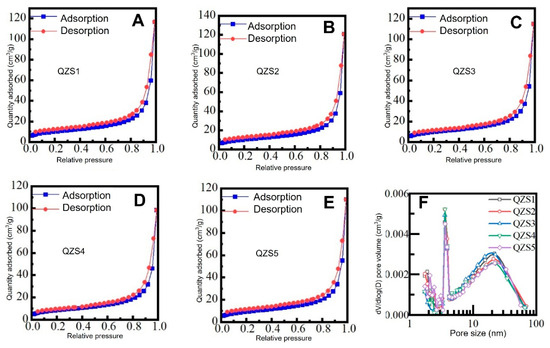
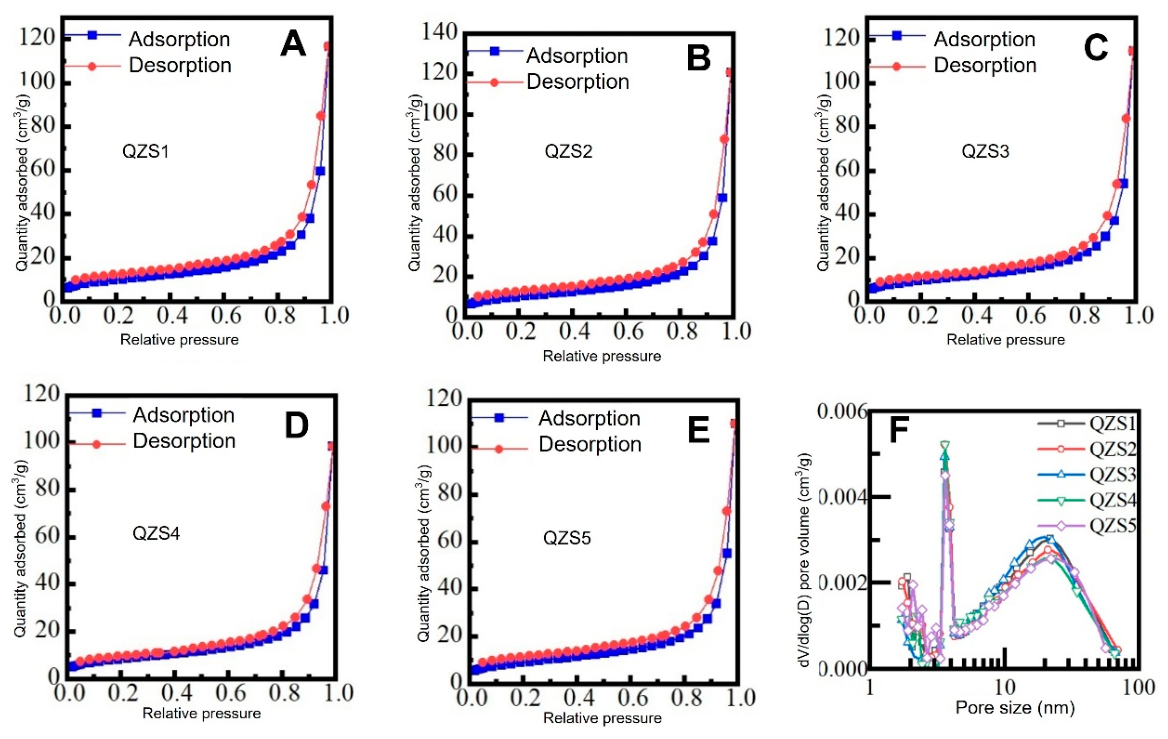
According to the IUPAC classification [23], the adsorption–desorption isotherms of the shale samples exhibit similar characteristics and approximate Type III isotherms. The adsorption amount increases slowly at low relative pressures, followed by a sharp rise and a marked increase in slope as the relative pressure approaches 0.9–1.0 [24,25,26]. The adsorption and desorption branches do not completely overlap, indicating the presence of a small number of mesopores in the samples (Figure 6A–E). The PSD curves derived from the BJH model reveal distinct pore structure characteristics of the shale organic matter (Figure 6F). The BJH pore-size distributions display a bimodal character, with a sharp peak at ~2–4 nm and a broader maximum at ~20–30 nm.
Figure 6.
Low-temperature N2 adsorption–desorption isotherms of the Qiongzhusi shales.
Pore volume was calculated using the BJH model, whereas specific surface area was determined using the BET model. The pore volume of the shale organic matter ranges from 0.149 to 0.181 cm3/g, with an average of 0.169 cm3/g. The specific surface area ranges from 29.826 to 35.166 m2/g, averaging 33.318 m2/g, while the average pore diameter ranges from 21.420 to 22.721 nm, with a mean value of 22.177 nm. These results indicate that although the organic matter in the Qiongzhusi Formation shale has a relatively large average pore diameter, large pores are scarce, the pore structure is comparatively uniform, and the overall degree of pore development is low. Consequently, despite the presence of some relatively large pores, both the pore volume and specific surface area remain low. This characteristic may be associated with the advanced thermal evolution of the shale, which enhanced the graphitization of organic matter and caused some pores to close or collapse during diagenesis [3,4]. These processes reduced the connectivity and storage capacity of the pore system and may therefore constrain reservoir productivity.
3.2.3. Quantitative Characterization of Organic Nanopores by LTCA
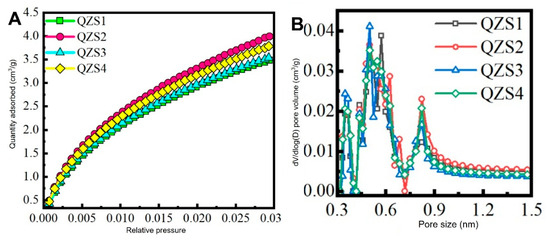
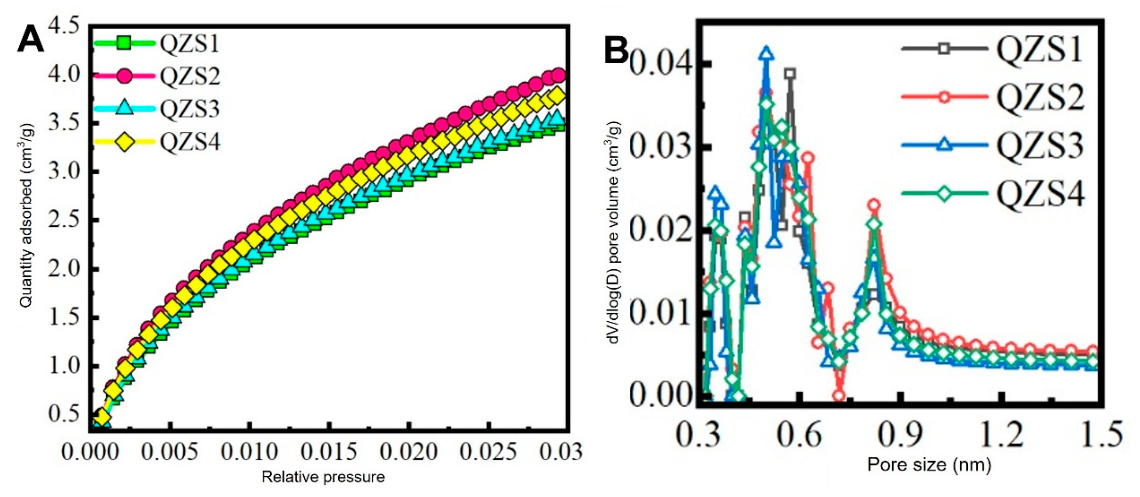
The CO2 adsorption isotherms of the organic matter in the Qiongzhusi Formation shale exhibit Type I characteristics according to the IUPAC classification (Figure 7A). The amount of CO2 adsorbed increases with increasing relative pressure (P/P0), confirming a pronounced micropore-filling effect and indicating the presence of a measurable micropore system within the organic matter. Specifically, at relative pressures below 0.006, CO2 adsorption increases rapidly with increasing P/P0, whereas above 0.006, the rate of increase declines markedly. This two-stage adsorption behavior reflects distinct adsorption processes of CO2 molecules within the micropores [24,25,26]. At low relative pressures (P/P0 < 0.006), CO2 molecules are preferentially adsorbed onto the pore-wall surfaces. The available micropore surfaces provide abundant adsorption sites, resulting in a rapid increase in adsorption capacity. At higher relative pressures (P/P0 > 0.006), surface adsorption gradually approaches saturation, and further adsorption is increasingly controlled by the filling of micropore space, leading to a slower increase in adsorption capacity.
Figure 7.
CO2 adsorption isotherms (A) and corresponding micropore size distributions (B) of the Qiongzhusi shales.
The maximum CO2 adsorption capacity of the shale samples ranges from 3.478 to 3.992 cm3/g (Figure 7A). These values indicate that micropores are only moderately developed in the organic matter of the Qiongzhusi Formation shale and are relatively limited in abundance, suggesting a comparatively low gas-storage capacity. The PSD of shale organic matter within the range of 0.3–1.5 nm was systematically analyzed using the DFT model (Figure 7B). The organic nanopores in the Qiongzhusi Formation exhibit trimodal to multimodal distributions within the 0.3–0.9 nm range (Figure 7B). The principal peaks occur at 0.3–0.4 nm, 0.4–0.6 nm, and 0.75–0.85 nm, whereas no distinct peaks are observed at pore sizes greater than 0.9 nm (Figure 7B). This distribution indicates that pores are most extensively developed within the 0.3–0.85 nm range and constitute the dominant fraction of the organic pore system. Analysis of the LTCA data using the DFT model yielded the micropore structure parameters of the shale organic matter in the study area. The pore volume is relatively low, ranging from 0.011 to 0.014 cm3/g, with an average of 0.012 cm3/g. The specific surface area ranges from 36.599 to 42.615 m2/g, averaging 38.975 m2/g, while the average pore diameter ranges from 1.548 to 1.624 nm, with a mean value of 1.586 nm.
3.3. Fractal Characteristics of Organic Nanopores
Fractal theory provides an effective approach for characterizing irregular surfaces and pore geometries [27]. It has been widely applied to complex pore systems in coal, shale, and other porous materials and has become an important tool for evaluating nanopore structure complexity and heterogeneity [27,28,29,30,31].
In recent years, fractal analysis combined with image-processing techniques and low-temperature gas adsorption has played an increasingly important role in shale reservoir characterization [17]. The fractal dimension is a key parameter for quantifying pore-structure complexity. It is important to note that the theoretical range of D is intrinsically linked to the dimensionality of the analytical method. For 3D pore-volume analyses such as low-temperature gas adsorption, D typically ranges from 2 to 3, where values approaching 2 indicate a relatively smooth pore surface and those nearing 3 reflect high surface roughness and structural heterogeneity [17,27]. Conversely, for 2D image-based analyses such as the box-counting method applied to SEM data, the fractal dimension is constrained by the Euclidean dimension of the plane (i.e., 2), thus ranging from 1 to 2. In this 2D context, a value approaching 1 suggests a simple, smooth boundary, whereas a value approaching 2 indicates a highly tortuous, space-filling pore morphology. Therefore, fractal dimensions provide an effective quantitative measure of the heterogeneity and spatial complexity of pore structures across different dimensional scales.
3.3.1. Fractal Dimension of Organic Nanopores Calculated by the Box-Counting Method
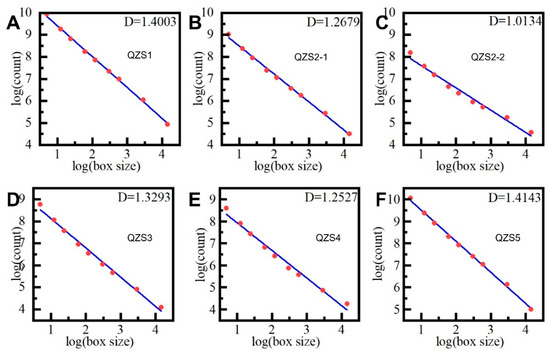
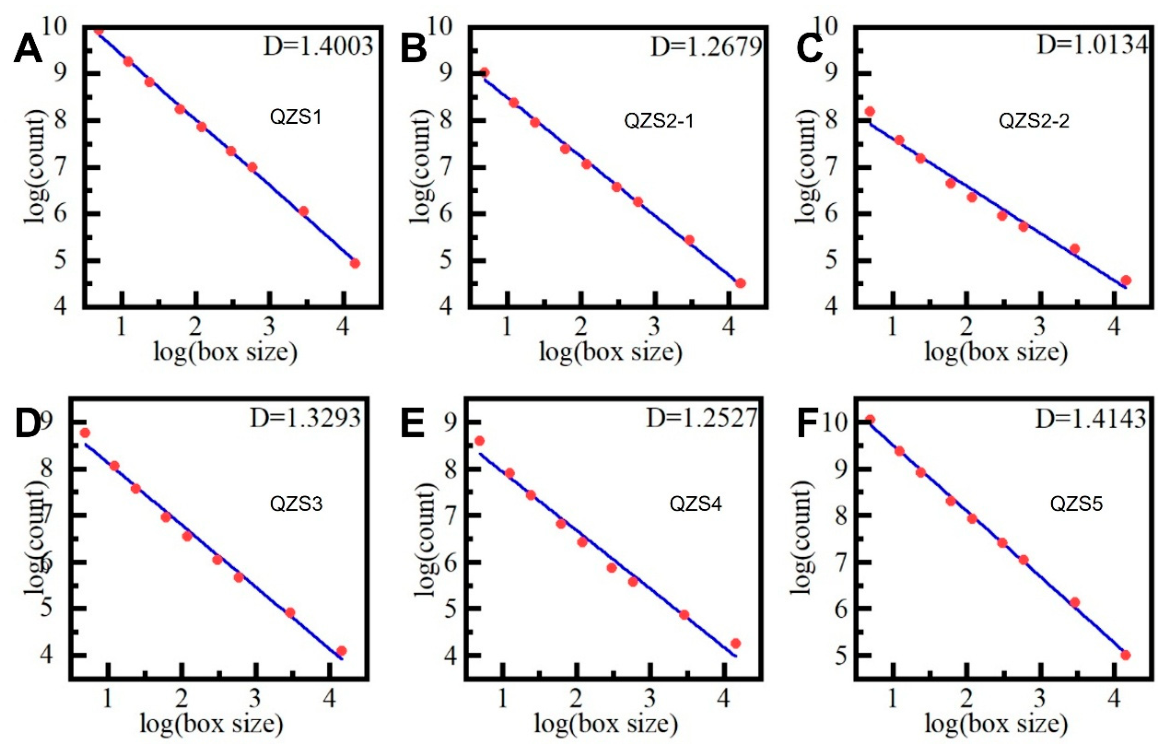
The morphological characteristics and roughness of organic nanopore surfaces were quantitatively characterized from SEM images using the box-counting method. This method is based on the scaling relationship between the number of boxes required to cover the pore structure and the corresponding box size [10,12]. By progressively reducing the box size and recording the number of boxes required to completely cover the pore structure at each scale, a linear relationship can be established in logarithmic coordinates. The absolute value of the slope of the fitted line represents the box-counting dimension [10]. During SEM image processing, the box-counting method was applied to the binarized organic nanopores to calculate their fractal dimensions. The number of boxes required to cover the pores was determined at progressively decreasing box sizes, and the relationship between box size and box number was analyzed. These variables generally exhibit a strong linear relationship in double-logarithmic coordinates, with the absolute value of the fitted slope corresponding to the box-counting dimension. Because the calculation is based on two-dimensional images, the theoretical range of the boundary fractal dimension is 1 < D < 2 [10]. A fractal dimension value approaching 1 indicates a relatively smooth pore boundary and simple geometry, whereas a value approaching 2 reflects a highly irregular and rough pore boundary with greater structural complexity. The organic nanopores in the Qiongzhusi Formation shale exhibit relatively low fractal dimensions, ranging from 1.0134 to 1.4143, with an average of 1.2797 (Figure 8). These values indicate that the pore boundaries are relatively smooth and have low geometric complexity.
Figure 8.
Fractal characterization of organic nanopores via the box-counting method.
3.3.2. Fractal Dimension of Organic Mesopores Calculated by the FHH Model
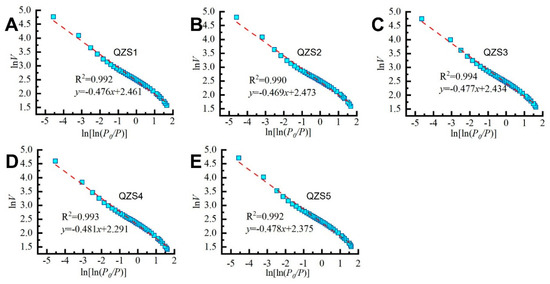
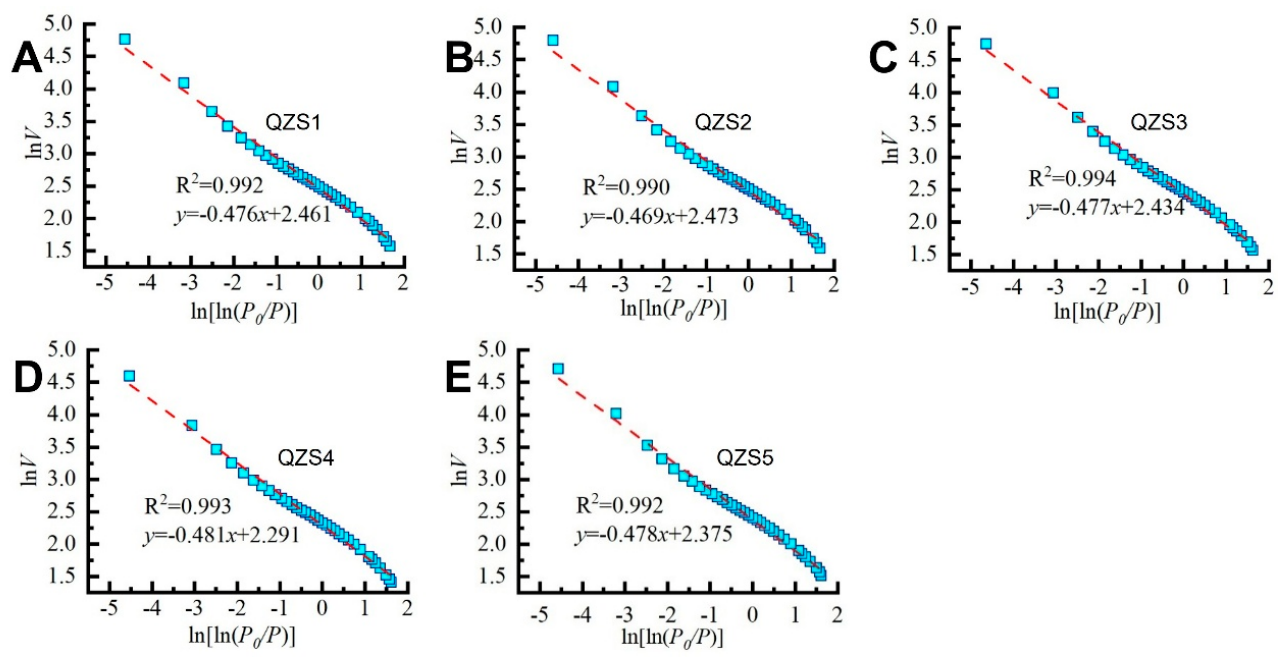
The Frenkel–Halsey–Hill (FHH) fractal model based on LTNA provides an effective method for determining the fractal dimension of shale pore structures [27]. In this study, the FHH model was used to calculate the fractal dimension of the mesopores (DN). Given that the relative pressure range of 0.50–0.95 corresponds to multilayer adsorption and capillary condensation within mesopores, the relationship DN = K + 3 was adopted, where K is the slope of the linear regression fit to the ln(V) vs. ln[ln(P0/P)] plot (Figure 9). This formulation is physically consistent with pore-filling mechanisms in the mesopore regime. The high correlation coefficients (R2 > 0.99) for all samples confirm the validity of the linear approximation within the selected pressure interval. The fractal dimensions of the organic mesopores in the Qiongzhusi Formation shale range from 2.519 to 2.531, with an average of 2.524.
Figure 9.
Fractal characterization of organic mesopores via the FHH model and LTNA data.
3.3.3. Fractal Dimension of Organic Micropores Calculated by the V-S Model
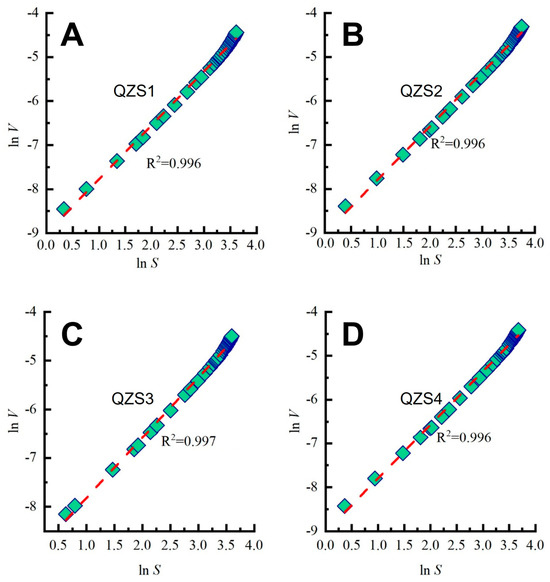
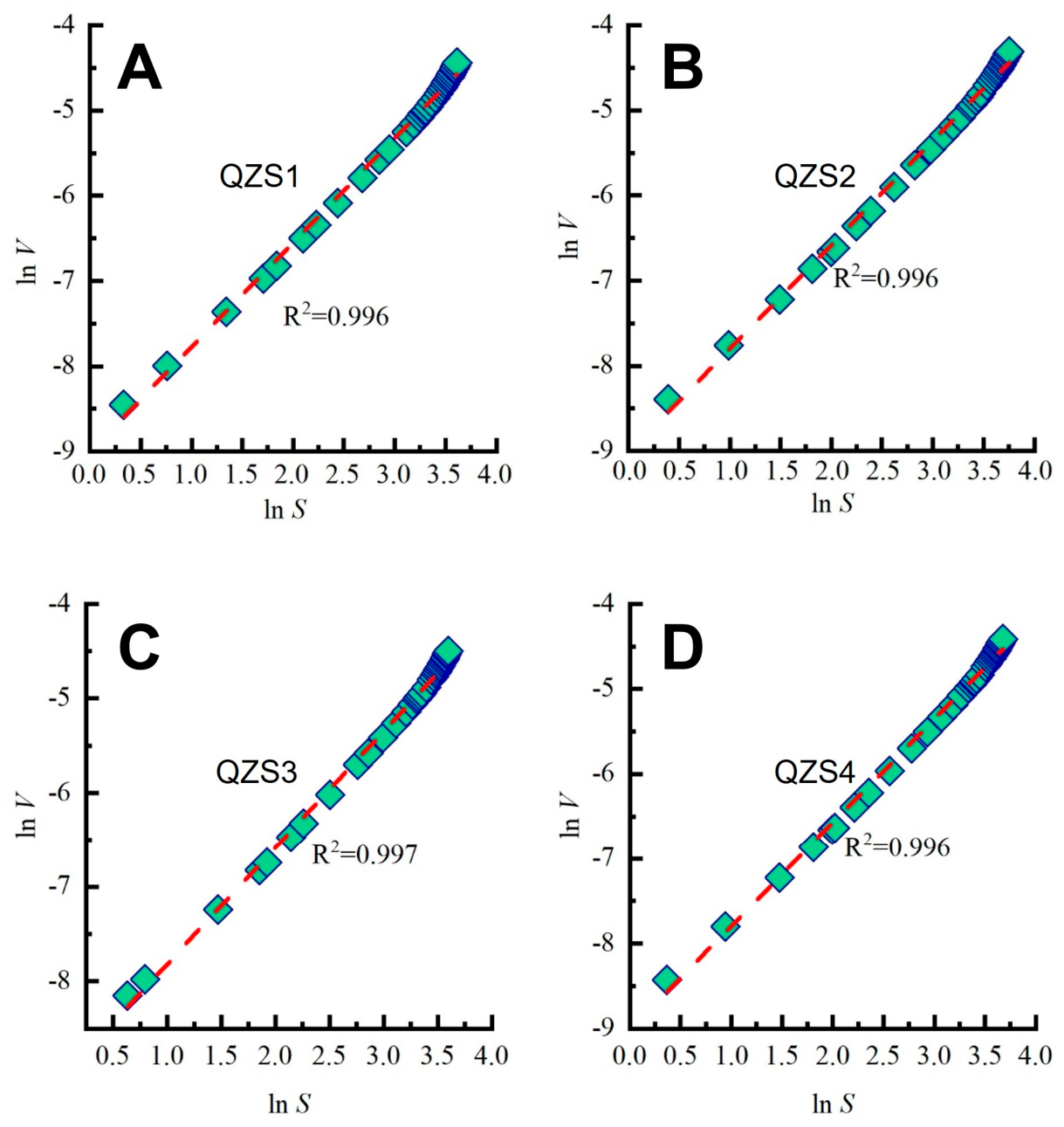
The V–S fractal model based on LTCA data was used to calculate the micropore fractal dimension (DC) [17]. A double-logarithmic plot of ln V versus ln S was constructed to obtain the linear regression equation and its slope K (Figure 10). According to fractal geometry theory, the micropore fractal dimension was calculated using DC = 3/K. The fractal dimensions of the organic micropores in the Qiongzhusi Formation shale range from 2.429 to 2.461, with an average of 2.448. These relatively low values indicate that the micropore structure is comparatively simple and that the pore surfaces are relatively smooth. A decrease in DC signifies a smoother pore surface and a more regular pore structure, which reduces the methane adsorption potential and lowers the absolute adsorbed gas capacity. In the context of naturally deformed shales, this structural simplification typically coincides with a reduction in specific surface area. Although intense tectonic deformation may simultaneously enhance free gas storage via microfracture development, the diminished adsorption capacity directly translates to a lower absolute volume of adsorbed gas within the reservoir system.
Figure 10.
Fractal characterization of organic micropores via the V-S model and LTCA data. Green squares: measured data points; red dashed line: linear fitting line (least-squares fit) in the ln V–ln S plot.
3.4. Influence of Tectonic Deformation on Organic Nanopore Structures
The conventional view holds that the evolution of the organic nanopore system within shale deformed or shear zones is governed primarily by thermal metamorphism [14]. Temperature is considered the principal factor driving organic matter graphitization and the modification of organic nanopores [3], whereas the mechanisms by which tectonic stress affects these nanopore structures remain controversial. Through a systematic investigation of the influence of tectonic deformation on coalification, Cao et al. [32] demonstrated that temperature and its thermodynamic effects are the fundamental controls on coalification. Although tectonic stress does not alter this fundamental relationship, it can substantially accelerate the evolution of sedimentary organic matter. Tectonic stress may therefore be regarded as a “catalyst” for organic matter evolution, with intense shear deformation representing a necessary geological condition for graphitization [3,32]. Compared with inorganic minerals, however, organic matter undergoes more complex deformation and evolutionary processes, and the associated microscale mechanisms remain poorly understood.
Tectonic stress exerts a significant constraint on the evolution of shale micro- and nanoscale structures, particularly the nanopore system [2,3,4,5]. Systematic SEM observations of organic nanopores in naturally deformed shale show that these pores predominantly exhibit regular morphologies, including subcircular, elliptical, and slit-shaped forms [4]. Their morphological characteristics differ markedly from those reported for undeformed shale in the Sichuan Basin. For example, Zhu et al. [5] investigated Longmaxi organic-rich shale from the Chuandong thrust-fold belt and found that organic nanopores within the fault zone were predominantly elongated, crescent-shaped, and spindle-shaped, with locally developed preferred orientations. Cheng et al. [6] reported that organic nanopores in the naturally deformed Longmaxi shales were mainly elliptical, slit-shaped, and irregularly polygonal, with pore diameters concentrated primarily within the mesopore range of 10–100 nm. Zhu et al. [4] observed that organic nanopores in naturally deformed Lujiaping shales were mostly irregular and exhibited poor two-dimensional connectivity. Comparative analysis indicates that organic nanopores in naturally deformed shale are morphologically less diverse and more regular than those in undeformed shale, with slit-shaped pores being dominant.
To evaluate the modification of organic nanopore structures by tectonic deformation, the results were compared with published data for undeformed shale. Liang et al. [33] investigated the pore structure and gas adsorption characteristics of kerogen isolated from undeformed shale. LTCA results showed that the specific surface area of the organic micropores ranged from 64.139 to 128.647 m2/g, with an average of 90.801 m2/g, while the micropore volume ranged from 0.009 to 0.020 cm3/g, averaging 0.013 cm3/g. The micropore sizes were concentrated mainly within the ranges of 0.4–0.7 nm and 0.75–0.9 nm. LTNA results indicated that the mesopore specific surface area ranged from 18.778 to 46.505 m2/g, with an average of 27.276 m2/g, whereas the mesopore volume ranged from 0.098 to 0.174 cm3/g, averaging 0.131 cm3/g. The mesopores exhibited a relatively broad PSD, with particularly well-developed pores within the range of 2–40 nm. Comparison with kerogen samples isolated from undeformed shale of the same formation and region shows that tectonic deformation markedly alters both the micropore and mesopore structure of shale organic matter. Pan et al. [34] reported that the specific surface area of naturally deformed Longmaxi shale ranged from 2.12 to 16.01 m2/g, with an average of 8.71 m2/g, indicating pronounced heterogeneity. The generally lower specific surface area of the deformed shale suggests that tectonic stress may have destroyed or reorganized part of the micropore system. Zhu et al. [4,5] proposed that tectonic deformation strongly modifies organic nanopores and that its effect is predominantly negative. In contrast, tectonic deformation generally has a positive influence on more strongly connected pore types, including mineral dissolution pores, interparticle pores, and microfractures, and may therefore improve overall reservoir quality [35,36,37,38,39]. With increasing brittle deformation, the total shale pore volume increased by a factor of 1.2, whereas the total pore specific surface area changed only slightly. With increasing ductile deformation, the pore volume decreased by 80%, while the total specific surface area increased by nearly 1.5 times. Pan et al. [34] further found that the micropore specific surface area and pore volume of organic matter in naturally deformed shale were 1.9 and 3.8 times those of undeformed shale, respectively. The mesopore specific surface area and pore volume were correspondingly 2.9 and 1.5 times higher. These results demonstrate that tectonic deformation significantly increased both the specific surface area and pore volume of the organic micropores and mesopores. The micropore-size distribution remained largely unchanged, whereas the mesopore-size distribution narrowed markedly from the broad range of 2–40 nm in the undeformed samples to a concentrated range of 3.72–3.95 nm in the deformed shale. This change suggests that tectonic stress caused some larger mesopores to contract or transform into smaller pores, thereby increasing the mesopore specific surface area. Tectonic deformation therefore not only promoted an increase in micropore abundance but also reduced the number of larger mesopores.
The organic nanopores of the naturally deformed Qiongzhusi shale exhibit distinct morphological and fractal characteristics, which are based on the integrated SEM, LTNA, and LTCA results. SEM observations reveal that the organic nanopores predominantly display subcircular, elliptical, and slit-shaped morphologies, with shape factors ranging from 0.736 to 0.859. This indicates an irregular or elliptical form intermediate between circular and slit-like shapes, reflecting the geometric complexity of the pore system under natural deformation. The average areal porosity of the organic matter is 7.678%. The PSD is mainly concentrated within 10–50 nm, demonstrating that the organic nanopore system is dominated by mesopores and exhibits typical nanoscale pore-structure characteristics. LTNA results show that the PSD of organic mesopores ranges from 20 to 30 nm, with an average pore volume of 0.169 cm3/g, an average specific surface area of 33.318 m2/g, and an average pore diameter of 22.177 nm. LTCA results indicate that the organic micropores exhibit trimodal to multimodal PSDs, with principal peaks concentrated within 0.3–0.4 nm, 0.4–0.6 nm, and 0.75–0.85 nm. The average pore volume, specific surface area, and pore diameter of the organic micropores are 0.012 cm3/g, 38.975 m2/g, and 1.586 nm, respectively. The multimodal nature of the micropore system suggests a heterogeneous pore architecture.
The fractal dimensions of the organic nanopores calculated using the box-counting method, the FHH model, and the V–S model are 1.280, 2.524, and 2.448, respectively. These relatively low values indicate that the organic nanopore system in the naturally deformed Qiongzhusi shale is characterized by relatively low structural complexity and weak heterogeneity. The reduced fractal dimensions, compared to typical undeformed shales reported in the literature, may reflect the physical alteration of the pore network due to tectonic compression, which simplifies the pore morphology and reduces the surface roughness. However, it should be noted that this interpretation is based solely on the characterization of the deformed samples, and a direct comparison with undeformed controls is not included in this study. Therefore, the observed low fractal dimensions should be considered as a descriptive result of the current dataset rather than a definitive causal conclusion.
In summary, the naturally deformed Qiongzhusi shale is characterized by a pore system with simplified morphology, limited mesopore development, and a multimodal micropore distribution. The low fractal dimensions suggest a relatively homogeneous pore structure, which may have implications for shale gas storage and transport. These findings provide a quantitative basis for understanding the nanopore architecture of naturally deformed shales in the Dabashan Thrust-fold Belt.
4. Conclusions
- (1)
- SEM observations show that the organic nanopores in naturally deformed Qiongzhusi shale predominantly exhibit regular subcircular, elliptical, and slit-shaped morphologies. The average areal porosity of the organic matter is 7.678%, and the shape factors range from 0.736 to 0.859, indicating that the nanopores have an irregular or elliptical morphology, intermediate between circular and slit-like shapes. The PSD is concentrated mainly within the range of 10–50 nm, demonstrating that the organic nanopore system is dominated by mesopores and exhibits typical nanoscale pore-structure characteristics.
- (2)
- LTNA results show that the PSD, average pore volume, average specific surface area, and average pore diameter of the organic mesopores are 20–30 nm, 0.169 cm3/g, 33.318 m2/g, and 22.177 nm, respectively. LTCA results indicate that the organic micropores exhibit trimodal to multimodal PSD, with the principal peaks concentrated within the ranges of 0.3–0.4 nm, 0.4–0.6 nm, and 0.75–0.85 nm. The average pore volume, specific surface area, and pore diameter of the organic micropores are 0.012 cm3/g, 38.975 m2/g, and 1.586 nm, respectively.
- (3)
- The fractal dimensions of the organic nanopores calculated using the box-counting method, the FHH model, and the V–S model are 1.280, 2.524, and 2.448, respectively. These relatively low values indicate that the organic pore system in the naturally deformed Qiongzhusi shale is characterized by relatively low structural complexity and weak heterogeneity.
Author Contributions
Conceptualization, X.W. and Z.H.; methodology, H.Z. and R.H.; software, Y.P.; validation, Z.C. and H.S.; formal analysis, Z.H.; investigation, H.Z. and Z.H.; resources, H.Z.; data curation, Y.P.; writing—original draft preparation, X.W., Y.P. and H.Z.; writing—review and editing, Z.C., Z.H. and H.Z.; visualization, X.W. and R.H.; supervision, X.W. and H.S.; project administration, Z.H.; funding acquisition, Z.H. All authors have read and agreed to the published version of the manuscript.
Funding
The research was funded by the National Natural Science Foundation of China (Grant No. 42272191, 42672210), the Hebei Natural Science Foundation (Grant No. D2026203002), and the China Postdoctoral Science Foundation (Grant No. 2025M770461).
Data Availability Statement
The original contributions presented in the study are included in the article, further inquiries can be directed to the corresponding authors.
Conflicts of Interest
Author Yanyan Pan was employed by the China United Coalbed Methane Co., Ltd. The remaining authors declare that the research was conducted in the absence of any commercial or financial relationships that could be construed as a potential conflict of interest.
References
- Cheng, G.; Wu, C.; Jiang, B.; Li, F.; Li, M.; Song, Y. Pore structure evolution of organic-rich shale induced by structural deformation based on shale deformation experiments. Energy 2024, 306, 132463. [Google Scholar] [CrossRef] [Scilit]
- Liang, M.; Wang, Z.; Gao, L.; Li, C.; Li, H. Evolution of pore structure in gas shale related to structural deformation. Fuel 2017, 197, 310–319. [Google Scholar] [CrossRef] [Scilit]
- Zhu, H.; Ju, Y.; Lu, Y.; Yang, M.; Feng, H.; Qiao, P.; Qi, Y. Natural evidence of organic nanostructure transformation of shale during bedding-parallel slip. GSA Bull. 2025, 137, 2719–2746. [Google Scholar] [CrossRef] [Scilit]
- Zhu, H.; Ju, Y.; Qi, Y.; Huang, C.; Zhang, L. Impact of tectonism on pore type and pore structure evolution in organic-rich shale: Implications for gas storage and migration pathways in naturally deformed rocks. Fuel 2018, 228, 272–289. [Google Scholar] [CrossRef] [Scilit]
- Zhu, H.; Ju, Y.; Huang, C.; Han, K.; Qi, Y.; Shi, M.; Qian, J. Pore structure variations across structural deformation of Silurian Longmaxi shale: An example from the Chuandong thrust-fold belt. Fuel 2019, 241, 914–932. [Google Scholar] [CrossRef] [Scilit]
- Cheng, G.; Jiang, B.; Li, F.; Li, M.; Wu, C. Evolution mechanism of pore structures of organic-rich shale under tectonic deformation: A comparative study between whole rock and kerogen samples. Nat. Resour. Res. 2024, 33, 263–297. [Google Scholar] [CrossRef] [Scilit]
- Al-Yaari, A.; Ching, D.L.C.; Sakidin, H.; Muthuvalu, M.S.; Zafar, M.; Haruna, A.; Merican, Z.M.A.; Yunus, R.B.; Al-dhawi, B.N.S.; Jagaba, A.H. The effects of nanofluid thermophysical properties on enhanced oil recovery in a heterogenous porous media. Case Stud. Chem. Environ. Eng. 2024, 9, 100556. [Google Scholar] [CrossRef] [Scilit]
- Gou, Q.; Xu, S.; Hao, F.; Yang, F.; Shu, Z.; Liu, R. The effect of tectonic deformation and preservation condition on the shale pore structure using adsorption-based textural quantification and 3D Image Observation. Energy 2021, 219, 119579. [Google Scholar] [CrossRef] [Scilit]
- Mu, Y.; Zou, C.; Hu, Z.; Duan, X.; Guo, Q.; Jing, Z. Impacts of multi-scale water-rock interaction on mineral alteration, mechanical weakening and pore-fracture evolution in marine shales. Adv. Geo-Energy Res. 2025, 17, 68–81. [Google Scholar] [CrossRef] [Scilit]
- Han, J.; Gao, M.; Wu, Y.; Raza, A.; He, P.; Li, J.; Lu, Y.; Yang, M.; Zhu, H. Experimental Study of Confining Pressure-Induced Fracture Network for Shale Gas Reservoir Under Triaxial Compression Conditions. Fractal Fract. 2025, 9, 311. [Google Scholar] [CrossRef] [Scilit]
- Wu, C.; Zhu, H.; Ju, Y.; Hu, Z.; Lu, Y.; Raza, A.; Cai, J. CO2 phase fluctuation-induced topological damage enhances shale strength. Int. J. Rock Mech. Min. Sci. 2025, 194, 106206. [Google Scholar] [CrossRef] [Scilit]
- Blunt, M.J.; Sun, S.; Boone, M.A.; Zhang, L.; Cai, J. Digital rock physics and fluid flow in the context of the energy transition. Adv. Geo-Energy Res. 2025, 18, 299–302. [Google Scholar] [CrossRef] [Scilit]
- Sun, M.; Yu, B.; Hu, Q.; Chen, S.; Xia, W.; Ye, R. Nanoscale pore characteristics of the Lower Cambrian Niutitang Formation Shale: A case study from Well Yuke #1 in the Southeast of Chongqing, China. Int. J. Coal Geol. 2016, 154–155, 16–29. [Google Scholar] [CrossRef] [Scilit]
- Loucks, R.G.; Reed, R.M.; Ruppel, S.C.; Jarvie, D.M. Morphology, genesis, and distribution of nanometer-scale pores in siliceous mudstones of the Mississippian Barnett Shale. J. Sediment. Res. 2009, 79, 848–861. [Google Scholar] [CrossRef] [Scilit]
- Slatt, R.M.; O’Brien, N.R. Pore types in the Barnett and Woodford gas shales: Contribution to understanding gas storage and migration pathways in fine-grained rocks. AAPG Bull. 2011, 95, 2017–2030. [Google Scholar] [CrossRef] [Scilit]
- Zhang, J.; Li, X.; Wei, Q.; Gao, W.; Liang, W.; Wang, Z.; Wang, F. Quantitative characterization of pore-fracture system of organic-rich marine-continental shale reservoirs: A case study of the Upper Permian Longtan Formation, Southern Sichuan Basin, China. Fuel 2017, 200, 272–281. [Google Scholar] [CrossRef] [Scilit]
- Yang, M.; Pan, Y.; Feng, H.; Yan, Q.; Lu, Y.; Wang, W.; Qi, Y.; Zhu, H. Fractal Characteristics of Pore Structure of Longmaxi Shales with Different Burial Depths in Southern Sichuan and Its Geological Significance. Fractal Fract. 2025, 9, 2. [Google Scholar] [CrossRef] [Scilit]
- Ma, B.; Hu, Q.; Yang, S.; Zhang, T.; Qiao, H.; Meng, M.; Zhu, X.; Sun, X. Pore structure typing and fractal characteristics of lacustrine shale from Kongdian Formation in East China. J. Nat. Gas Sci. Eng. 2021, 85, 103709. [Google Scholar] [CrossRef] [Scilit]
- Jiao, K.; Yao, S.; Liu, C.; Gao, Y.; Wu, H.; Li, M.; Tang, Z. The characterization and quantitative analysis of nanopores in unconventional gas reservoirs utilizing FESEM–FIB and image processing: An example from the lower Silurian Longmaxi Shale, upper Yangtze region, China. Int. J. Coal Geol. 2014, 128, 1–11. [Google Scholar] [CrossRef] [Scilit]
- Li, P.; Zheng, M.; Bi, H.; Wu, S.; Wang, X. Pore throat structure and fractal characteristics of tight oil sandstone: A case study in the Ordos Basin, China. J. Pet. Sci. Eng. 2017, 149, 665–674. [Google Scholar] [CrossRef] [Scilit]
- Li, Z.; Ren, T.; Li, X.; Qiao, M.; Yang, X.; Tan, L.; Nie, B. Multi-scale pore fractal characteristics of differently ranked coal and its impact on gas adsorption. Int. J. Min. Sci. Technol. 2023, 33, 389–401. [Google Scholar] [CrossRef] [Scilit]
- Hu, T.; Liu, Y.; Jiang, F.; Pang, X.; Wang, Q.; Zhou, K.; Wu, G.; Jiang, Z.; Huang, L.; Jiang, S.; et al. A novel method for quantifying hydrocarbon micro-migration in heterogeneous shale and the controlling mechanism. Energy 2024, 288, 129712. [Google Scholar] [CrossRef] [Scilit]
- Everett, D.H.; Koopal, L.K. International union of pure and applied chemistry. Polymer 2001, 31, 1598. [Google Scholar]
- Rouquerol, J.; Avnir, D.; Fairbridge, C.W.; Everett, D.H.; Haynes, J.M.; Pernicone, N.; Ramsay, J.D.F.; Sing, K.S.W.; Unger, K.K. Recommendations for the characterization of porous solids (Technical Report). Pure Appl. Chem. 1994, 66, 1739–1758. [Google Scholar] [CrossRef] [Scilit]
- Mandelbrot, B.B. The Fractal Geometry of Nature; W. H. Freeman and Company: New York, NY, USA, 1982. [Google Scholar]
- Avnir, D.; Jaroniec, M. An isotherm equation for adsorption on fractal surfaces of heterogeneous porous materials. Langmuir 1989, 5, 1431–1433. [Google Scholar] [CrossRef] [Scilit]
- Bu, H.; Ju, Y.; Tan, J.; Wang, G.; Li, X. Fractal characteristics of pores in non-marine shales from the Huainan coalfield, eastern China. J. Nat. Gas Sci. Eng. 2015, 24, 166–177. [Google Scholar] [CrossRef] [Scilit]
- Feng, K.; Wang, Z.; Li, G.; Zhang, P.; Wang, Z.; Wang, Y.; Liu, K. Quantifying fracture evolution characteristics of gravelly sandstones based on fractal theory. Energy Geosci. 2025, 6, 100463. [Google Scholar] [CrossRef] [Scilit]
- Zhu, H.J.; Lu, Y.J.; Pan, Y.Y.; Qiao, P.; Raza, A.; Liu, W. Nanoscale mineralogy and organic structure characterization of shales: Insights via AFM-IR spectroscopy. Adv. Geo-Energy Res. 2024, 13, 231–236. [Google Scholar] [CrossRef] [Scilit]
- Shao, X.; Pang, X.; Li, Q.; Wang, P.; Chen, D.; Shen, W.; Zhao, Z. Pore structure and fractal characteristics of organic-rich shales: A case study of the lower Silurian Longmaxi shales in the Sichuan Basin, SW China. Mar. Pet. Geol. 2017, 80, 192–202. [Google Scholar] [CrossRef] [Scilit]
- Zhang, B.; Liu, L.; Zheng, A.; Yan, D.; Wang, X.; Wang, J.; Li, K.; Yi, Y. Enhanced understanding of carbonate-rich shale heterogeneity through multifractal characterization based on N2 adsorption data: A case study of the Permian Wujiaping Formation in the Sichuan Basin. Energy Geosci. 2025, 6, 100426. [Google Scholar] [CrossRef] [Scilit]
- Cao, D.; Li, X.; Zhang, S. Influence of tectonic stress on coalification: Stress degradation mechanism and stress polycondensation mechanism. Sci. China Ser. D-Earth Sci. 2007, 50, 43–54. [Google Scholar] [CrossRef] [Scilit]
- Liang, Z.; Jiang, Z.; Li, Z.; Xue, Z.; Chen, R.; Arif, M. Influence of organic matter carbonization on pore structure and CO2/CH4 adsorption in marine kerogen: Insights from experimental observations and molecular simulation. Fuel 2025, 387, 134205. [Google Scholar] [CrossRef] [Scilit]
- Pan, Y.; Yang, M.; Lu, Y.; Lin, Y.; Wei, M.; Zhu, H. Nano-pore structure and fractal characteristics of tectonically deformed shale: A case study of Longmaxi Formation in Dabashan foreland thrust belt, northeastern Chongqing. Pet. Geol. Recovery Effic. 2025, 32, 28–41. [Google Scholar]
- Hu, T.; Pang, X.; Jiang, F.; Wang, Q.; Liu, X.; Wang, Z.; Jiang, S.; Wu, G.; Li, C.; Xu, T.; et al. Movable oil content evaluation of lacustrine organic-rich shales: Methods and a novel quantitative evaluation model. Earth-Sci. Rev. 2021, 214, 103545. [Google Scholar] [CrossRef] [Scilit]
- Yang, F.; Chen, Z.; Zhu, X. Geochemical Characteristics and Significance of Shale Gas Well Flowback Fluid in Zheng’An Block, Guizhou. J. Geo-Energy Environ. 2026, 2, 276–286. [Google Scholar] [CrossRef] [Scilit]
- Cai, Z.; Liu, Y.; Li, J.; Sun, Y. Nanostructure and evolution of thin shells in brittle-ductile shear zones. Adv. Geo-Energy Res. 2025, 17, 56–67. [Google Scholar] [CrossRef] [Scilit]
- Hu, T.; Pang, X.; Jiang, F.; Zhang, C.; Wu, G.; Hu, M.; Jiang, L.; Wang, Q.; Xu, T.; Hu, Y.; et al. Dynamic continuous hydrocarbon accumulation (DCHA): Existing theories and a new unified accumulation mode. Earth-Sci. Rev. 2022, 232, 104109. [Google Scholar] [CrossRef] [Scilit]
- Zhang, J.; Tang, Y.; He, D.; Sun, P.; Zou, X. Full-scale nanopore system and fractal characteristics of clay-rich lacustrine shale combining FE-SEM, nano-CT, gas adsorption and mercury intrusion porosimetry. Appl. Clay Sci. 2020, 196, 105758. [Google Scholar] [CrossRef] [Scilit]
Disclaimer/Publisher’s Note: The statements, opinions and data contained in all publications are solely those of the individual author(s) and contributor(s) and not of MDPI and/or the editor(s). MDPI and/or the editor(s) disclaim responsibility for any injury to people or property resulting from any ideas, methods, instructions or products referred to in the content. |
© 2026 by the authors. Licensee MDPI, Basel, Switzerland. This article is an open access article distributed under the terms and conditions of the Creative Commons Attribution (CC BY) license.