


Abstract
In this paper, a fractional-order active disturbance rejection repetitive control (FADRRC) scheme is proposed for fractional-order time-delay systems. The unified control framework integrates a bandwidth-parameterized fractional extended state observer (FESO), modified repetitive control and a filtered Smith predictor. The FESO online estimates system states and lumped disturbances, the filtered Smith predictor compensates time-delay deviation to weaken sensitivity to model mismatch, and repetitive control eliminates steady-state error for periodic reference signals. By fractional frequency-domain stability theory and the small-gain theorem, two BIBO stability criteria for nominal and mismatched cases are derived, reformulating the controller design as a pole placement problem of fractional-order transfer functions. Numerical simulations on a fractional-order time-delay PMSM servo system verify that the proposed FADRRC possesses superior periodic tracking accuracy and disturbance rejection capability compared with existing ESO-RC and DOB-RC methods, which confirms the validity of the presented control strategy.
1. Introduction
Active disturbance rejection control (ADRC) is an advanced control technique designed to enhance the performance of conventional control systems under internal and external disturbances [1]. Its core concept is to regard the total disturbance within the system as a unified, global disturbance, which is then estimated and compensated for using an extended state observer (ESO). This approach does not require an accurate mathematical model of the controlled plant, enabling ADRC to effectively manage complex systems characterized by nonlinearity, time-varying dynamics, and unknown disturbances [2,3,4].
The high-gain nature of the ESO makes it sensitive to high-frequency measurement noise. To address this limitation, a new ADRC paradigm that enhances the ESO to handle unknown disturbances and measurement noise was developed in [5]. In ref. [6], the fundamental concepts and principles of ADRC, along with several recent advancements, were summarized. An overview of the research methodologies for ADRC parameter tuning and the progress made in various directions of ADRC development was presented in [7]. A linear ADRC technique combining ESO with a nonlinear feedback control law was introduced in [8] to eliminate frequency variations. An enhanced ADRC with an improved ESO was proposed in [9], where an error-derivative compensation term was incorporated into the disturbance observation loop. A measurement delay-compensated phase-leading linear LADRC framework for systems subject to measurement delay, noise, and time-varying disturbances was proposed in [10].
In recent years, fractional-order active disturbance rejection control (FOADRC) has attracted considerable attention [11,12,13,14]. For instance, in ref. [15], a method for calculating the boundaries of the stable region to simplify the parameter tuning process for Riemann–Liouville FOADRC was introduced. A Caputo FOADRC law employing a model-based ESO for time-delay systems was proposed in [16]. In ref. [17], a composite disturbance suppression method was developed for Riemann-Liouville fractional-order uncertain systems by integrating the FOADRC approach within a disturbance observer compensation framework. A Caputo FOADRC scheme aimed at achieving high-precision positioning in the presence of disturbances and model uncertainties was presented in [18]. Additionally, in [19], a Riemann–Liouville FOADRC strategy was proposed, where the fractional-order PD controller with a Kalman filter was developed to achieve fast tracking with small overshoot, even in the presence of external disturbances. The above FOADRC methods only realize fractional-order disturbance observation, but lack dedicated time-delay compensation. When applied to time-delay fractional systems, the time delay will cause ESO observation deviation and degrade tracking precision.
Repetitive control (RC) is widely recognized as an effective strategy for precisely tracking periodic signals [20]. In ref. [21], a predictive ESO-based RC method was proposed for uncertain time-delay systems. Unlike conventional RC approaches. Ref. [22] introduced an RC system based on a fractional-delay internal model. An RC framework enabling independent regulation of control and learning processes was developed in [23]. The issue of Padé-approximation-based optimal preview RC for continuous-time uncertain systems was investigated in [24]. Furthermore, robust tracking control for fractional-order nonlinear delay systems using a modified RC approach was discussed in [25]. In ref. [14], the fractional-order active disturbance rejection RC was investigated. However, the aforementioned RC methods can achieve periodic signal tracking, yet they separate the disturbance observer and repetitive learning without coordinated design and ignore time-delay mismatch. Especially, few works integrate fractional-order state observation and Smith predictive delay compensation into a single closed-loop structure.
On the other hand, permanent magnet synchronous motor (PMSM) servo systems are widely applied in industrial motion control, which exhibit obvious fractional-order dynamic characteristics, inherent time delay and periodic speed tracking requirements [26]. In ref. [27], a novel control scheme for the PMSM position servo system using the FOADRC approach was proposed. An improved ADRC algorithm was proposed in [28], where a nonlinear function was provided to effectively improve the convergence and stability. To reduce the impact of various disturbances on the PMSM servo system without time delay, a repetitive FOADRC method was presented in [29]. However, traditional fractional-order self-disturbance rejection control or repetitive control can hardly simultaneously suppress lumped disturbances and realize zero steady-state periodic tracking for PMSM servos with time-delay mismatch.
These observations motivate the present study. We propose a repetitive control integrated with an active disturbance rejection method for a class of fractional-order time-delay systems. The main contributions of this paper are summarized as follows: (i) A unified framework integrating bandwidth-parametrized FESO, modified RC and filtered Smith predictor is established to simultaneously tackle fractional dynamics, periodic tracking, time-delay compensation and model mismatch. (ii) Different from prior single-layer stability analyses, two distinct BIBO stability criteria are derived for nominal and mismatched cases, respectively. Nominal stability is proven by fractional-order frequency-domain stability theory, while robust stability against parameter and time-delay uncertainties is established via the small-gain theorem. (iii) A unified bandwidth-oriented tuning rule is provided, in which merely two core bandwidth parameters require manual adjustment, and all other observer-controller gains are obtainable from analytical formulas. Different from traditional separate bandwidth design, this scheme inherently accounts for delay mismatch and plant uncertainties under the robust small-gain constraint.
The remainder of this paper is structured as follows. Section 2 describes the system and formulates the problem. Section 3 presents the stability analysis. A numerical example demonstrating the effectiveness of the proposed design method is provided in Section 4. Finally, Section 5 concludes the paper.
Throughout this paper, denotes the real number space. The 2-norm of function is defined by .
2. System Description and Problem Statement
Definition 1
(Zhou [30]). The Caputo fractional derivative is defined as
Consider the fractional-order time-delay system given by
where , , and l denote the positive time-delay constant.
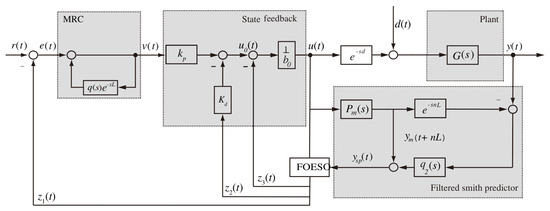
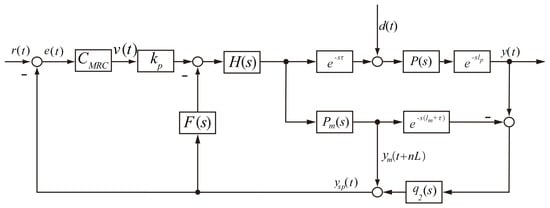
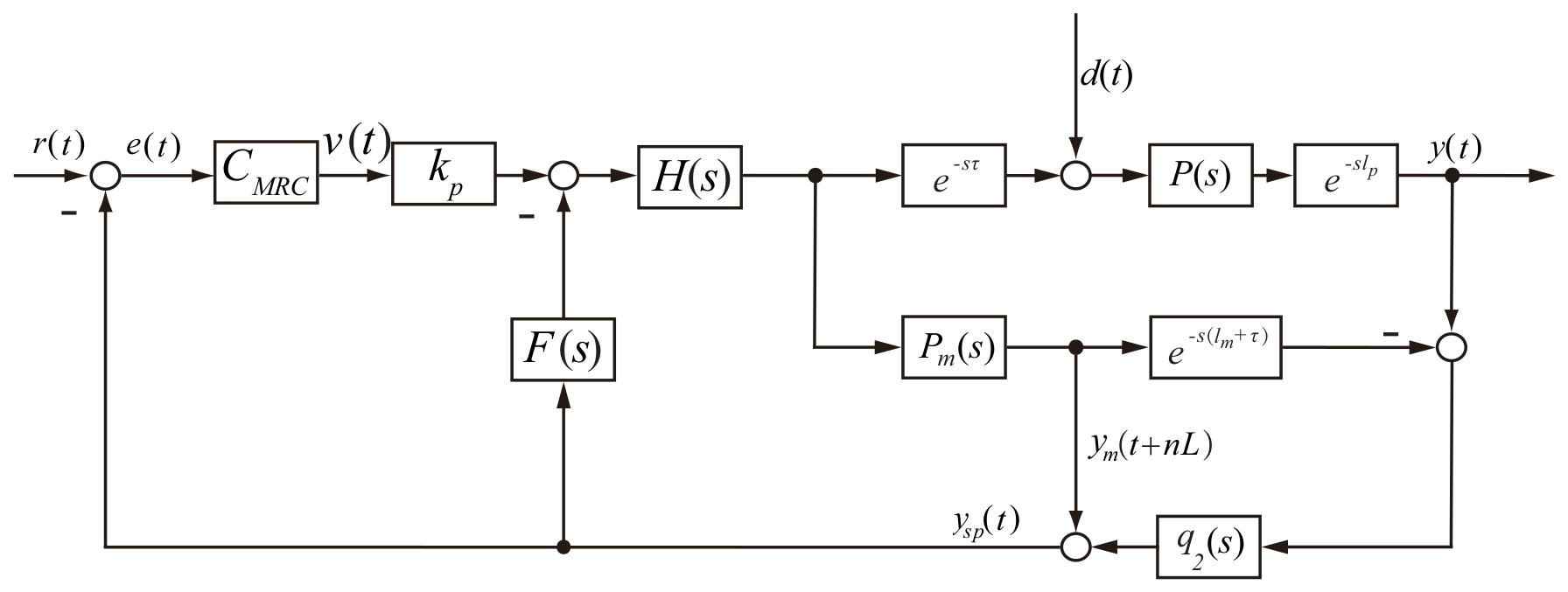
The objective of this paper is to design a fractional-order active disturbance rejection repetitive control (FADRRC) law for system (1) such that the system output can track the reference signal with period . The overall structure is illustrated in Figure 1, which consists of five modules: (i) Modified Repetitive Control (MRC): Learns and tracks periodic reference , improving periodic tracking accuracy and suppressing periodic disturbances. (ii) State Feedback: Stabilizes the fractional-order system, optimizes transient response, and enhances system stability margin. (iii) Filtered Smith Predictor: Compensates for time delay in the controlled plant, eliminating phase lag and ensuring stability under time-delay conditions. (iv) Fractional-Order Extended State Observer (FESO): Estimates system states and lumped disturbances, enhancing disturbance rejection capability. (v) Fractional-Order Time-Delay Plant: Serves as the controlled object, defining design constraints for all control and observation modules.
Figure 1.
The configuration of the FADRRC system with delay.
Remark 1.
It is worth clarifying the complementary roles of the filtered Smith predictor and FESO to resolve the apparent conflict between the model-free advantage of ADRC and the model-dependent characteristic of Smith compensation. The filtered Smith predictor only provides static delay compensation to eliminate the time offset between measured output and internal system states, which is an indispensable auxiliary module for fractional-order systems with large delay time. However, all model mismatch, delay mismatch and unmolded dynamics induced by inaccuracies of the nominal model and delay time are aggregated into the lumped total disturbance and are online estimated/canceled by FESO in real time. Different from pure Smith-based control whose performance fully relies on a precise nominal plant, the proposed FADRRC takes FOADRC as the core control framework, and the FESO retains the core merit of ADRC to tolerate mild model mismatch without relying on exact plant information. The low-pass filter further weakens the sensitivity of the predictor to parameter deviation, so the inherent model-free superiority of ADRC is not undermined.
Without considering the time delay, the state space equation of system (1) is changed into
where is the generalized disturbance, and is the estimated value of the gain b.
The following assumption is needed.
Assumption 1.
The generalized disturbance in (2) satisfies two conditions: (i) is continuously differentiable for all , i.e., its fractional derivative exists and is well-defined; (ii) Both and its fractional-order derivative are uniformly bounded.
Remark 2.
The generalized disturbance and its fractional-order derivative involve the closed-loop signals and This uniform boundedness assumption is a posteriori guaranteed by the BIBO stability results presented in Theorem 1 and Theorem 2 in the next section. Provided that the stability conditions hold, all closed-loop input/output signals remain bounded, which further validates Assumption 1. This treatment follows the standard argument widely adopted in the existing ADRC literature.
The following FESO is designed for system (3)
where . , and are the estimated values of , and , respectively. Further, as suggested in [15,16,17], the observer gain L is given by
where is the observer’s bandwidth.
When time delay is taken into account, a temporal deviation may occur between the actual system output and the estimated output of the FESO in Equation (4), which could ultimately lead to instability of the overall system. In the steady state, the relationship between the output of the time-delay system (1) and the output of the FESO is given as follows:
To eliminate the influence of the time delay, according to the Smith predictor theory, we obtain
where are the outputs of the Smith predictor model and the nominal model of the system (1), respectively.
In order to better accommodate periodic reference signals, an additional delay term is introduced, further extending the system delay. The resulting delay relationship is described as
where n is a positive integer. Therefore, the modified FESO is given by
The Laplace transform of (7) is
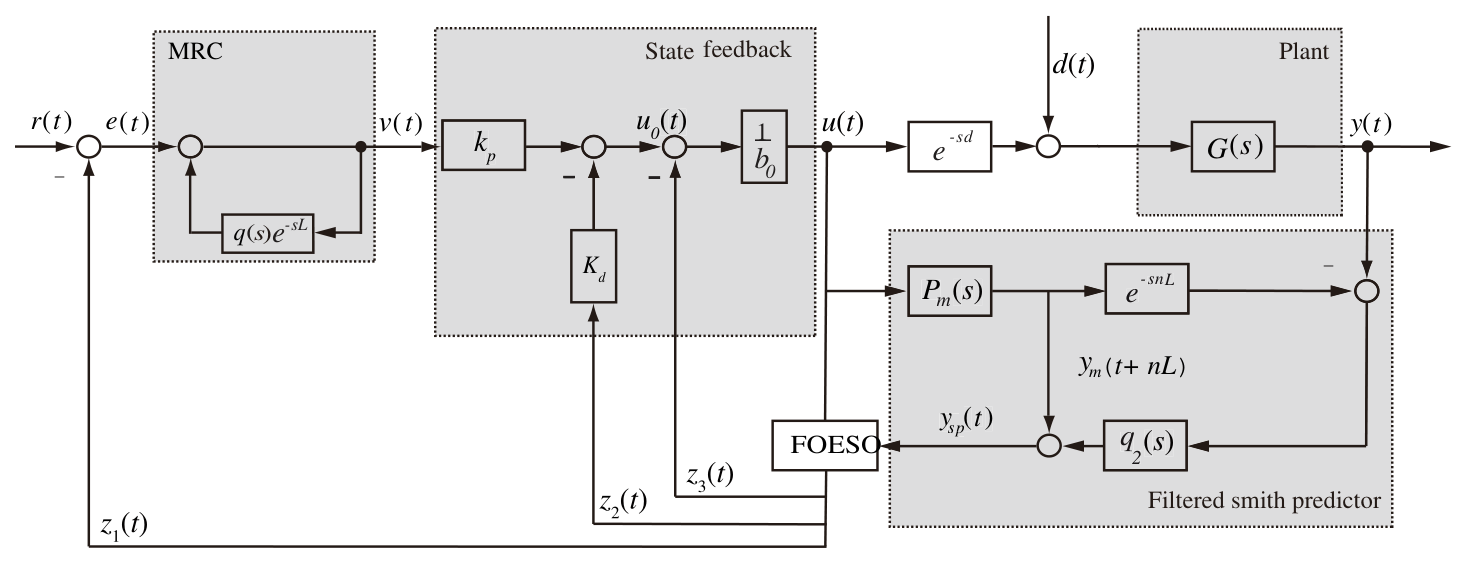
Thus, the configuration of the FADRRC system with delay illustrated in Figure 1 is equivalent to that shown in Figure 2.
Figure 2.
Equivalent configuration of Figure 1.
The transfer function of the MRC is
where is selected as
where is the cut-off angular frequency of the filter. Besides,
where is the highest frequency for tracking periodic signals and .
In addition, as stated in [20], the time-delay constant of the improved repetitive controller should be taken as
where .
From (11) and (12), we can write the state space representation of the MRC as
where is the output of the MRC law. is the tracking error, which is given by
If estimates the generalized disturbance accurately, then the final controller is
Therefore, the proposed FADRRC law for the fractional-order system (1) is designed as
where and are the gains of the MRC law and state-feedback controller, respectively. The parameters are tuned using the method in [2,3].
where is the controller bandwidth.
3. Stability Analysis
Definition 2
(Khalil and Grizzle [31]). The -induced norm of is defined as
where y and u represent the system output and input, respectively.
Definition 3
(Khalil and Grizzle [31]). If then system is said to be -stable.
Lemma 1
(Zhou [30]). Let
be the characteristic function for a fractional-order system. If and only if all poles of the polynomial
satisfy , then the fractional-order system is bounded-input bounded-output (BIBO) stable.
Lemma 2
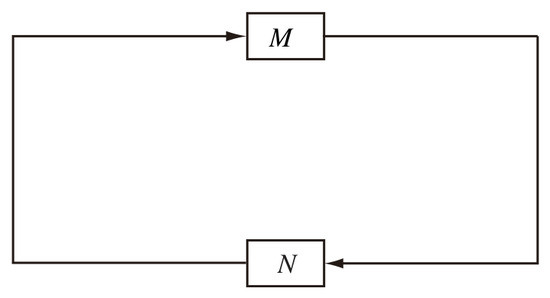
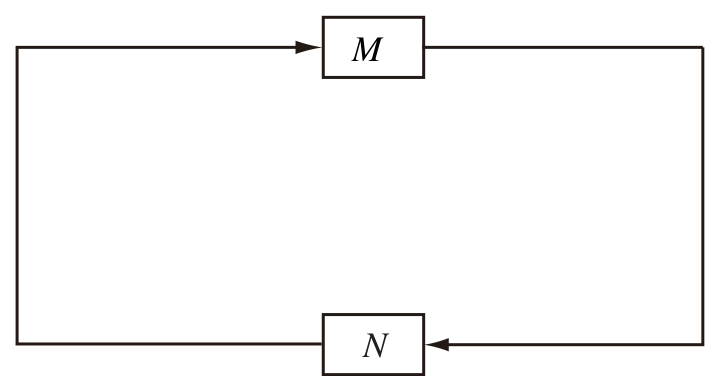
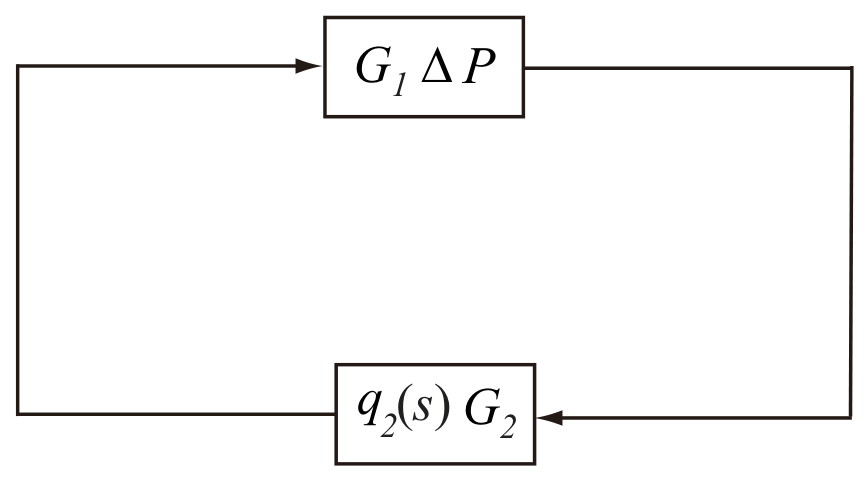
(Small gain theorem [31]). Consider a feedback system depicted in Figure 3. Supposing that N and M are both -stable, the feedback system is -stable if .
Figure 3.
Configuration of a feedback control system.
Remark 3.
The condition of the small gain theorem is also stated as , since the -induced norm is equivalent to the -norm.
Expanding (4) and performing Laplace transformation under zero initial conditions, we have
Rearranging the above equations, it yields
Solving from the third formula in (25), we get
Substituting into the second formula in (25) and multiplying both sides by , we have
Substituting into the above equation and collecting terms of , one has
By solving Equations (26)–(28), the transfer function expressions of with respect to U and Y can be derived as
where
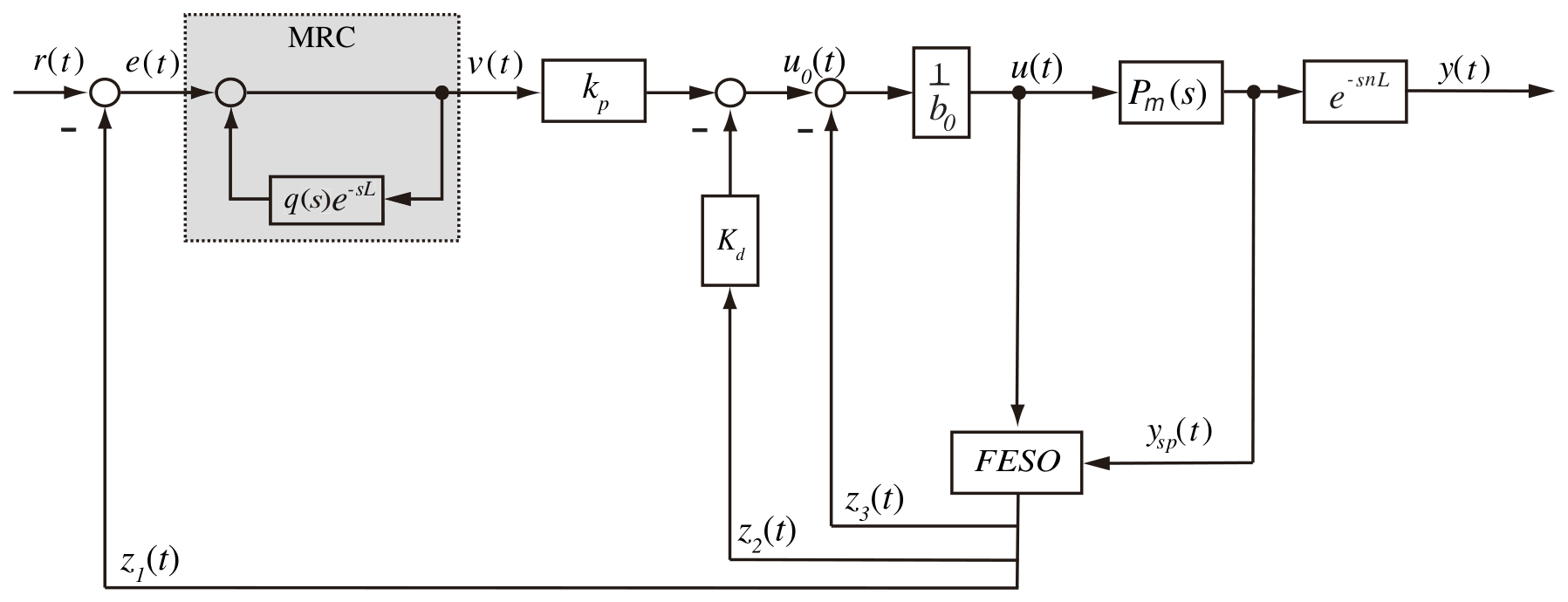
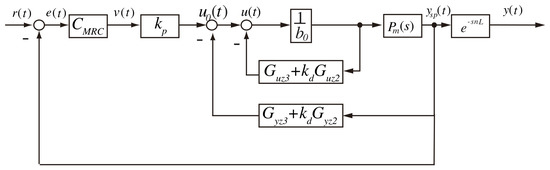
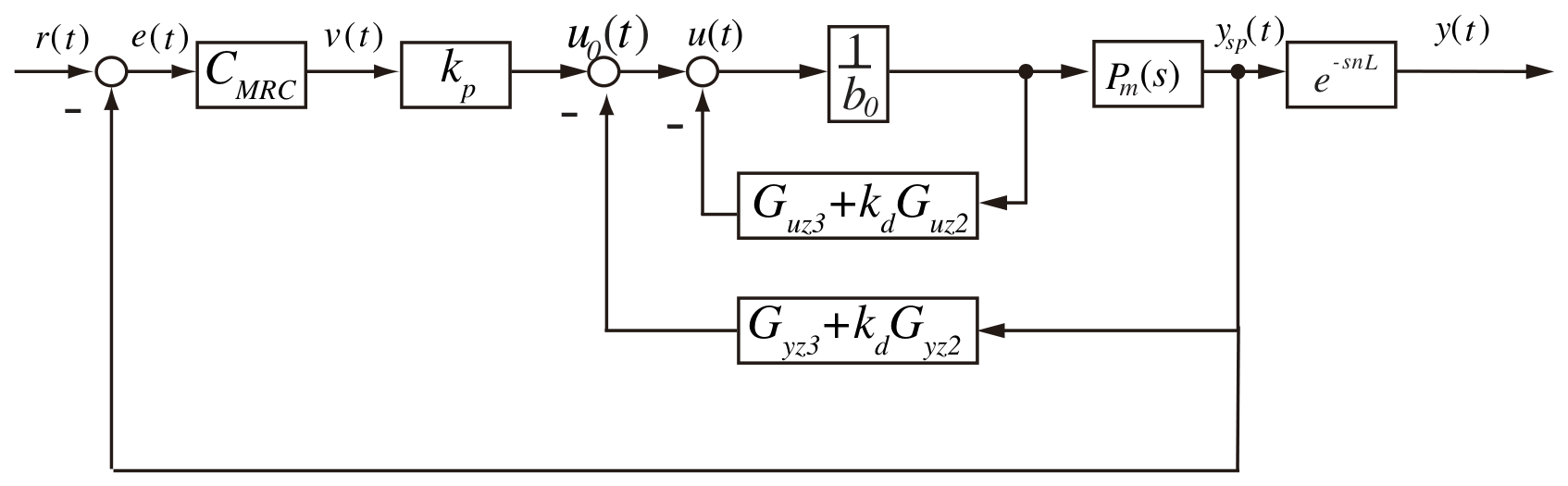
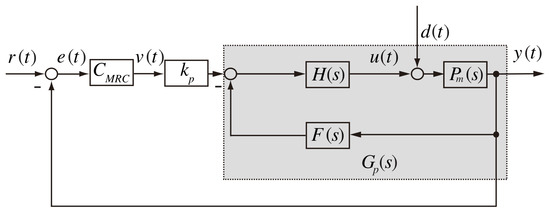
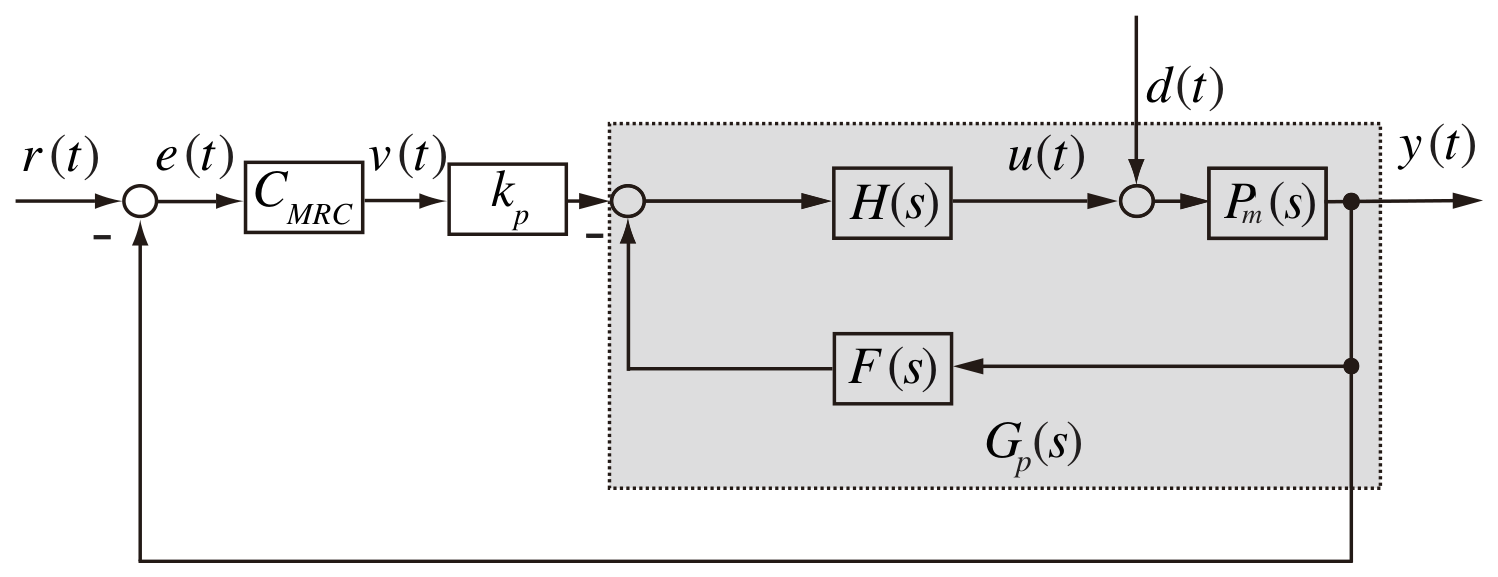
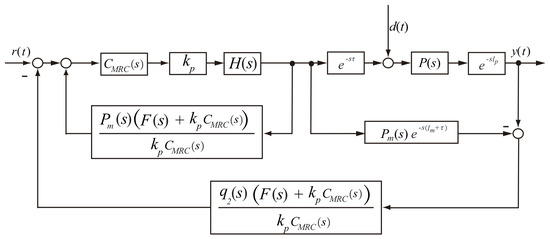
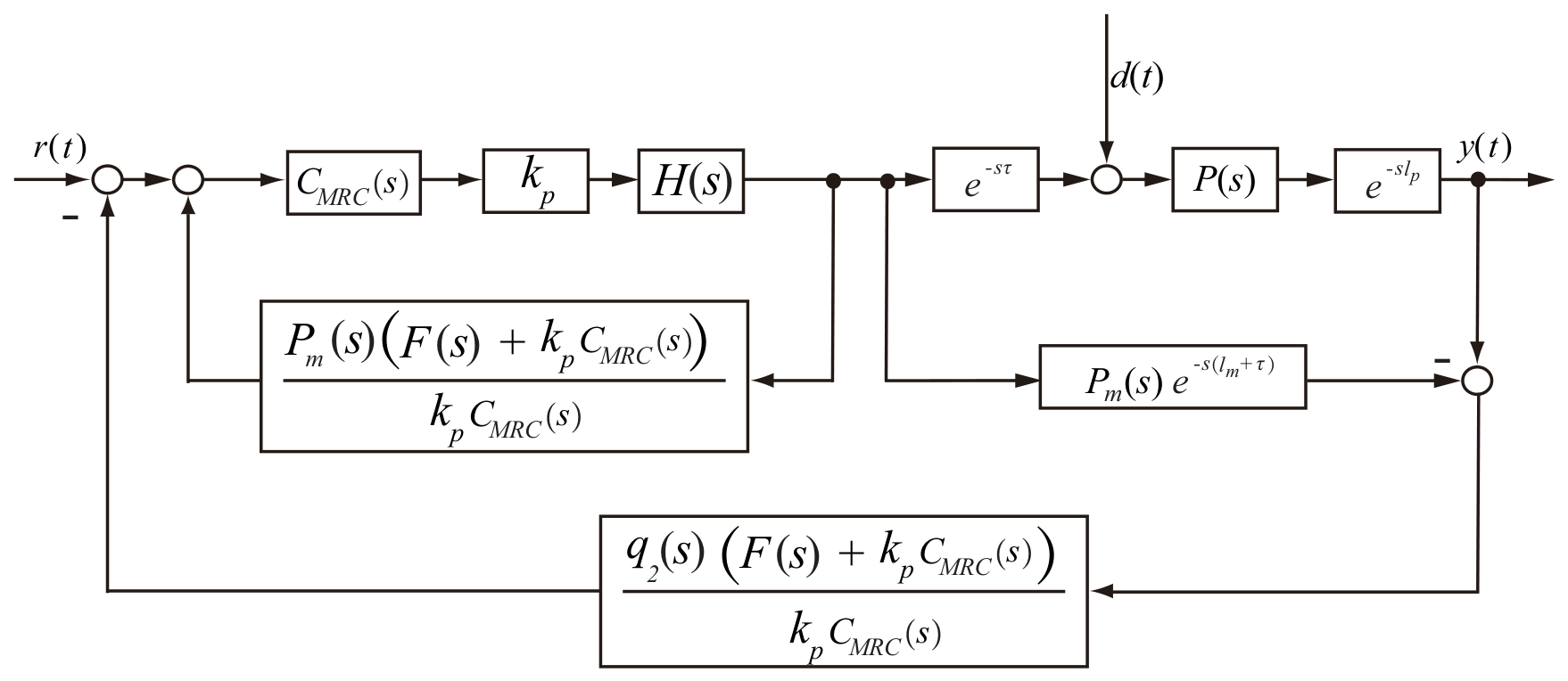
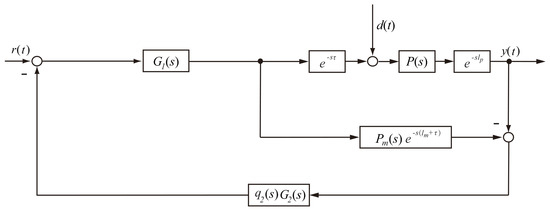
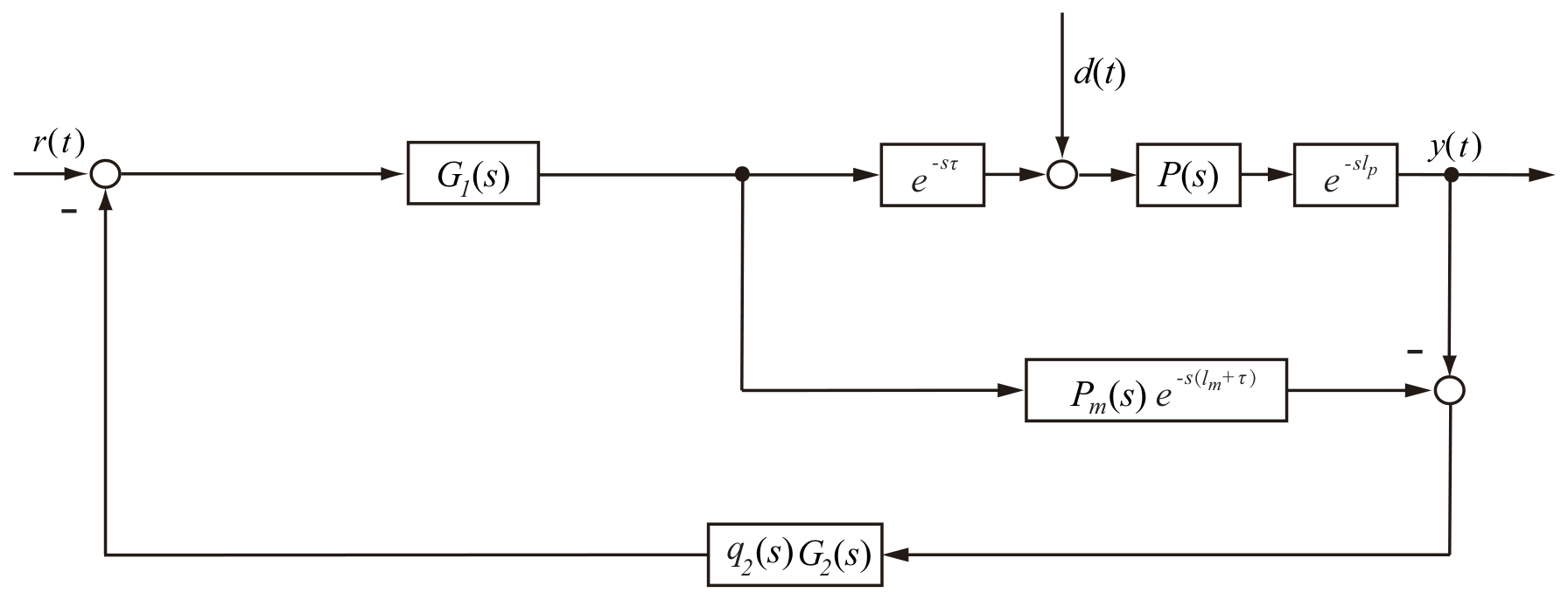
The corresponding block diagram, shown in Figure 4, can be simplified to Figure 5. From Figure 5, we observe that
where
and
Figure 4.
The block diagram corresponding to the FADRRC system.
Figure 5.
The simplified structure of the FADRRC system.
Therefore, the closed-loop transfer function of FADRRC system is given by
Theorem 1.
Proof.
From the closed-loop transfer function (35), the characteristic equation is given by the denominator set to zero
Substituting (11) and (31)–(34) into (39), we obtain
Multiplying through by the denominator and applying the first-order Padé approximation [24]
to rationalize the delay term, we expand the equation and collect like powers of s. This yields the following finite-dimensional fractional-order characteristic equation
where the coefficients of are the same as those in (38).
Letting , p and q are coprime positive integers, , , and combining with (42), it yields (37). Based on Lemma 1, the closed-loop system is BIBO stable.
The above fractional argument criterion ensures the stability of finite state modes from the plant and FESO. The RC branch introduces infinite poles caused by periodic delay , which are determined by the denominator of the repetitive controller
Define the open-loop transfer function of the repetitive feedback loop as
The repetitive internal model is stable if and only if the equation has no solution for any real The fractional low-pass filter is Thus, for any
It follows that for . At gives , which is a single marginal point on the imaginary axis. There are no real frequencies satisfying . Therefore all infinite poles induced by the periodic delay lie in the open left-half plane except the marginal DC mode. This marginal DC mode is stabilized by the outer closed-loop dynamics given in Theorem 1, guaranteeing overall BIBO stability of the repetitive control internal model loop. Based on Lemma 2, holds at all frequencies. The equation has no real-frequency solution, i.e., no poles lie on the imaginary axis. All infinite poles induced by periodic delay are located in the stable left half-plane. The proof is complete. □
Remark 4.
It should be highlighted that the characteristic polynomial is obtained by applying the first-order Padé approximation to rationalize the transcendental delay term . Consequently, the pole-place criterion in Theorem 1 only guarantees the BIBO stability for the Padé approximated finite-dimensional system, rather than the original infinite-dimensional fractional-order time-delay system. This Padé truncation may introduce potential high-frequency instability risks. The following robust small-gain condition in Theorem 2 serves as a practical supplementary check to mitigate such risks. Appropriate parameter tuning is required to guarantee all roots comply with the fractional-order stability criterion.
Now, consider the uncertainty of the model and the time-delay may be mismatched in the fractional-order time-delay system (1)
where is the mismatched time-delay.
To reduce the impact of time-delay mismatch, a low-pass filter is added to (10). That is
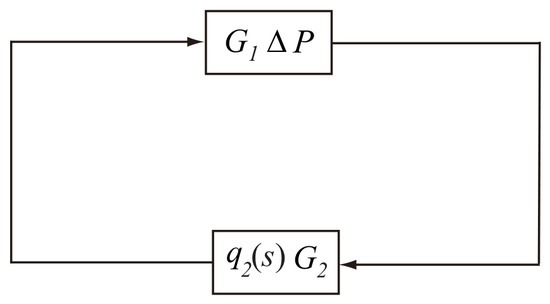
In this case, Figure 5 is modified to Figure 6. In Figure 6, is the matched time-delay. Figure 6 can be redrawn as Figure 7. Furthermore, Figure 7 can be simplified as Figure 8.
Figure 6.
The simplified structure of the FADRRC under model mismatch.
Figure 7.
The equivalent diagram of Figure 6.
Figure 8.
The simplified structure of Figure 7.
Remark 5.
The bandwidth-based parameter tuning strategy significantly facilitates the parameter regulation of the FESO. However, a high-gain FESO structure is inherently sensitive to high-frequency measurement noise. The observer bandwidth creates a prominent performance trade-off under a noisy environment, which narrows the feasible range of bandwidth selection. Therefore, the bandwidth should be carefully chosen to balance fast disturbance estimation capability and suppression of excessive noise amplification. Here, a low-pass filter is embedded within the Smith predictor channel, which can partially filter high-frequency noise contained in the system output and partially relax the bandwidth limitation of the FESO.
In Figure 8,
Theorem 2.
The fractional-order time-delay system (43) under the FADRRC law (19) with the low-pass filter is BIBO stable if the following conditions are satisfied:
- (i)
- ;
- (ii)
- ,
where and are the i-th root of Equation (37).
Proof.
It follows from Theorem 1 that the closed-loop system under the matching condition is BIBO stable if condition (i) holds. Let . Figure 8 can be equivalently transformed into Figure 9. According to Lemma 1, the closed-loop system under the mismatching condition is BIBO stable if condition (ii) holds. The proof is complete. □
Figure 9.
The equivalent diagram of Figure 8.
Remark 6.
The paper only investigates the case of fractional order . When , the proposed FADRRC algorithm cannot be directly implemented. On one hand, the fractional low-pass filter embedded in MRC brings significant amplitude attenuation and extra phase lag to periodic reference signals, which slows down the convergence of repetitive learning and increases steady-state tracking errors. On the other hand, the fractional-order BIBO stability condition leads to a sharply shrunk stable angular sector for . Once , the stable region vanishes completely, which means stabilization of the controlled plant cannot be achieved theoretically. Furthermore, transforming the fractional characteristic equation into an integer-order polynomial results in a considerably high-order equation, substantially raising the computational burden of poles calculation and stability verification.
Remark 7.
Traditional bandwidth parameterization of FOADRC ignores pure time delay and model mismatch, while RC laws are tuned separately by trial-and-error without unified bandwidth constraints. Their bandwidth design only guarantees stability under delay-free nominal models. In contrast, our scheme constructs a global bandwidth parameterization system covering FESO, state feedback controller and MRC law. The bandwidth selection of and is further restricted by the robust stability criterion derived in Theorem 2. The bandwidth parameters are jointly constrained with the low-pass filter of the Smith predictor to satisfy the small-gain condition (ii). This bandwidth tuning rule inherently takes time-delay mismatch and plant uncertainty into account, which cannot be realized by conventional separate bandwidth design.
Remark 8.
Condition (ii) is a robust stability constraint derived from the small-gain theorem, which addresses fractional-order time-delay systems subject to parameter uncertainty and time-delay mismatch. A practical guideline for verifying this condition is summarized as follows:
- (1)
- Substitute all system, observer and controller parameters to calculate transfer functions , , and low-pass filter .
- (2)
- Sweep the full concerned frequency range and plot the magnitude curve of . The inequality holds if the peak magnitude is below 0 dB, and a −3∼−6 dB gain margin is suggested for practical engineering.
- (3)
- Compute the magnitude of at each frequency point and extract the peak magnitude value, or accurately solve after rational approximation of fractional terms and time delays via standard control toolboxes.
- (4)
- If , one can tune , controller bandwidth or observer bandwidth to reduce the peak loop gain of the uncertainty channel.
- (5)
- Condition (i) for nominal stability should be validated first, followed by the norm test of Condition (ii) to guarantee robust stability under model mismatch.
Remark 9.
It is worth pointing out that the fractional order α dictates the closed-loop stability boundary. Larger α narrows the stable region and complicates FADRRC tuning, while smaller α expands the stability margin; yet extreme values degrade overall control performance. Meanwhile, excessively large α amplifies fractional inertia, slowing repetitive learning convergence and increasing FESO estimation errors. An overly small α weakens fractional disturbance compensation, inducing tracking oscillations despite fast convergence for periodic signals. Hence, α should be chosen to balance conflicting performance metrics.
In brief, the parameter tuning algorithm for the proposed FADRRC system in this article is stated as follows (Algorithm 1):
| Algorithm 1 FADRRC |
|
4. Numerical Example
In order to illustrate the validity of the proposed method, consider the speed control of a permanent magnet synchronous motor (PMSM) servo system [26]
By using the Laplace transform, the corresponding transfer function of the PMSM is
where b is the steady-state gain. Different arrangements of RLC devices may lead to non-integer behavior. Meanwhile, the electrical characteristics of the capacitor and inductor are fractional [26]. Besides, in engineering applications, system time-delay, which may be caused by low-pass filters, communication media and the computation time of the microprocessor program, is often encountered in the motor driving system. It can give rise to voltage and current distortions, and then destroy the stability of the PMSM servo system. Therefore, we consider the following fractional-order time-delay PMSM system:
Using Algorithm 1, the parameters are set as , , , , and . Set rad/s, , and rad/s. The periodic tracking reference signal is a triangular waveform with an amplitude of 1 and a frequency of . Thus, according to (14), the repetition period L of the MRC is .
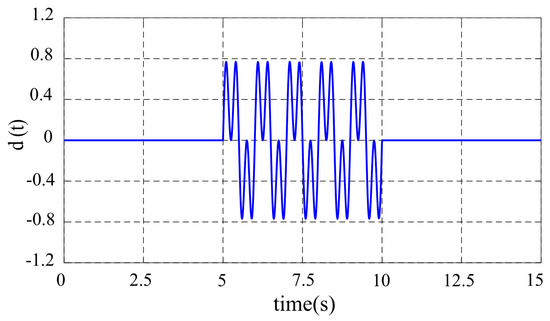
Two different types of disturbances are considered
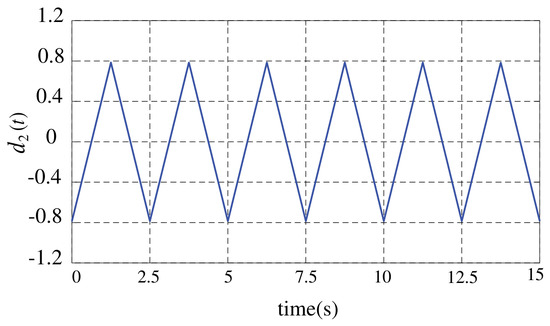
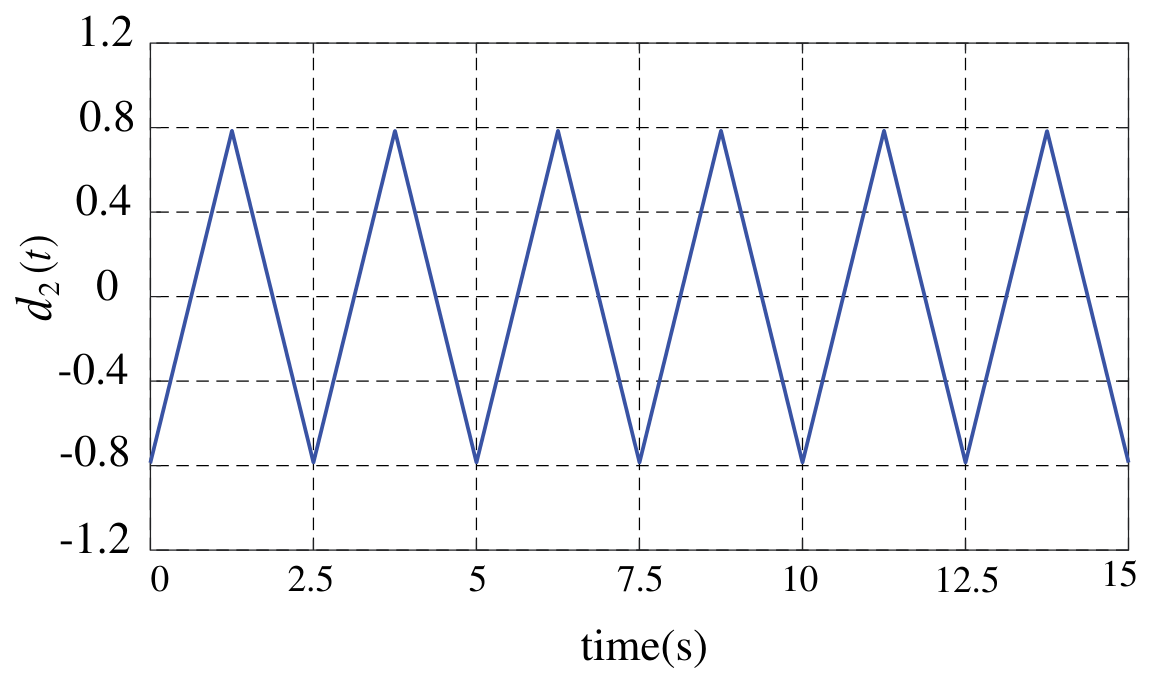
is a triangular waveform with an amplitude of and a frequency of . and are drawn in Figure 10 and Figure 11.
Figure 10.
Disturbance .
Figure 11.
Disturbance .
The Caputo fractional-order derivatives for both plant and FESO are numerically realized by using the Oustaloup recursive approximation with fitting frequency range and approximation order All simulations are carried out in MATLAB/Simulink R2023b using the fixed-step Runge-Kutta solver ODE4 with simulation step size . Zero initial conditions are adopted, i.e., . FESO estimated states . The repetitive controller internal state is and the initial control input is
Applying (37), a simple calculation shows that the characteristic equation is given by
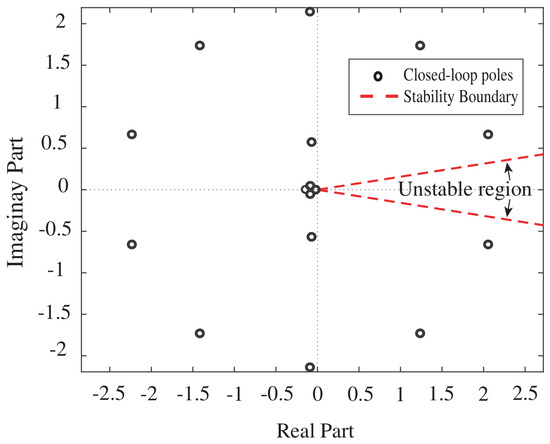
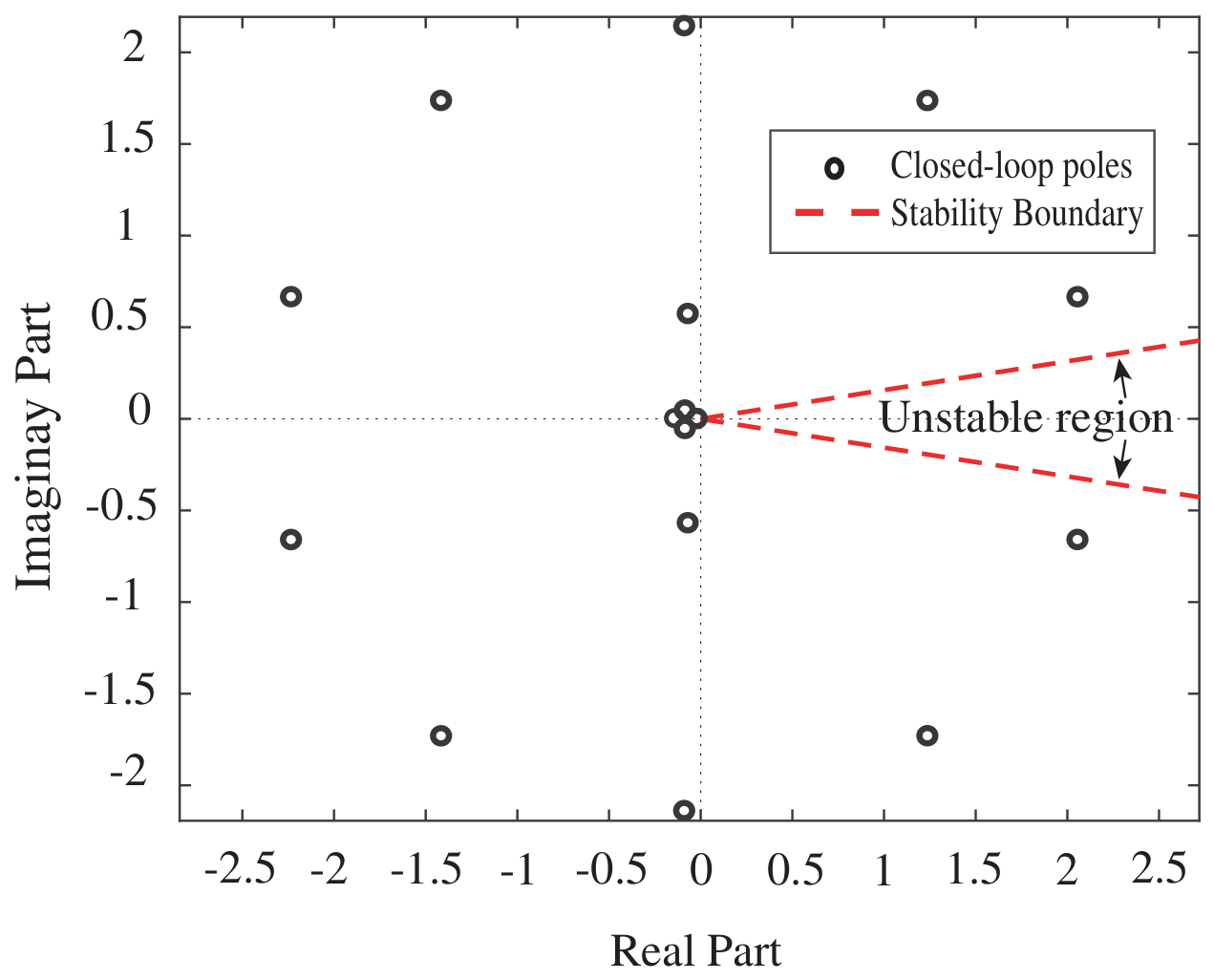
Solving Equation (49) yields all closed-loop poles , as shown in Figure 12. We compute the argument of each root and extract the minimum value as rad. For the stability boundary threshold is rad. A direct comparison verifies that the stability condition holds strictly.
Figure 12.
The poles plot of the designed FADRRC closed-loop control system.
Set rad/s. , , , , and . These individual parameter perturbations are mapped to the lumped uncertainty , which yields a multiplicative uncertainty . The controller bandwidth rad/s and observer bandwidth rad/s dominate the fast high-frequency disturbance compensation dynamics, while the periodic reference signal only contains low-frequency components within the effective range of the first-order Padé approximation. By calculation, it can be verified that , indicating that the condition in Theorem 2 also holds. So, the system is BIBO stable, which eliminates the hidden risk of high-frequency instability caused by Padé truncation. Numerical comparisons with model uncertainties of and are carried out to explore the robust stability boundary. The results indicate that the peak norm of the uncertain channel stays below 1 for uncertainties no larger than . When the model perturbation rises to , the peak magnitude exceeds 1 significantly, which violates the small-gain theorem and leads to potentially unstable responses.
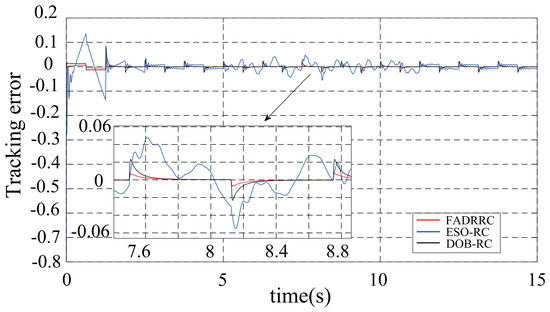
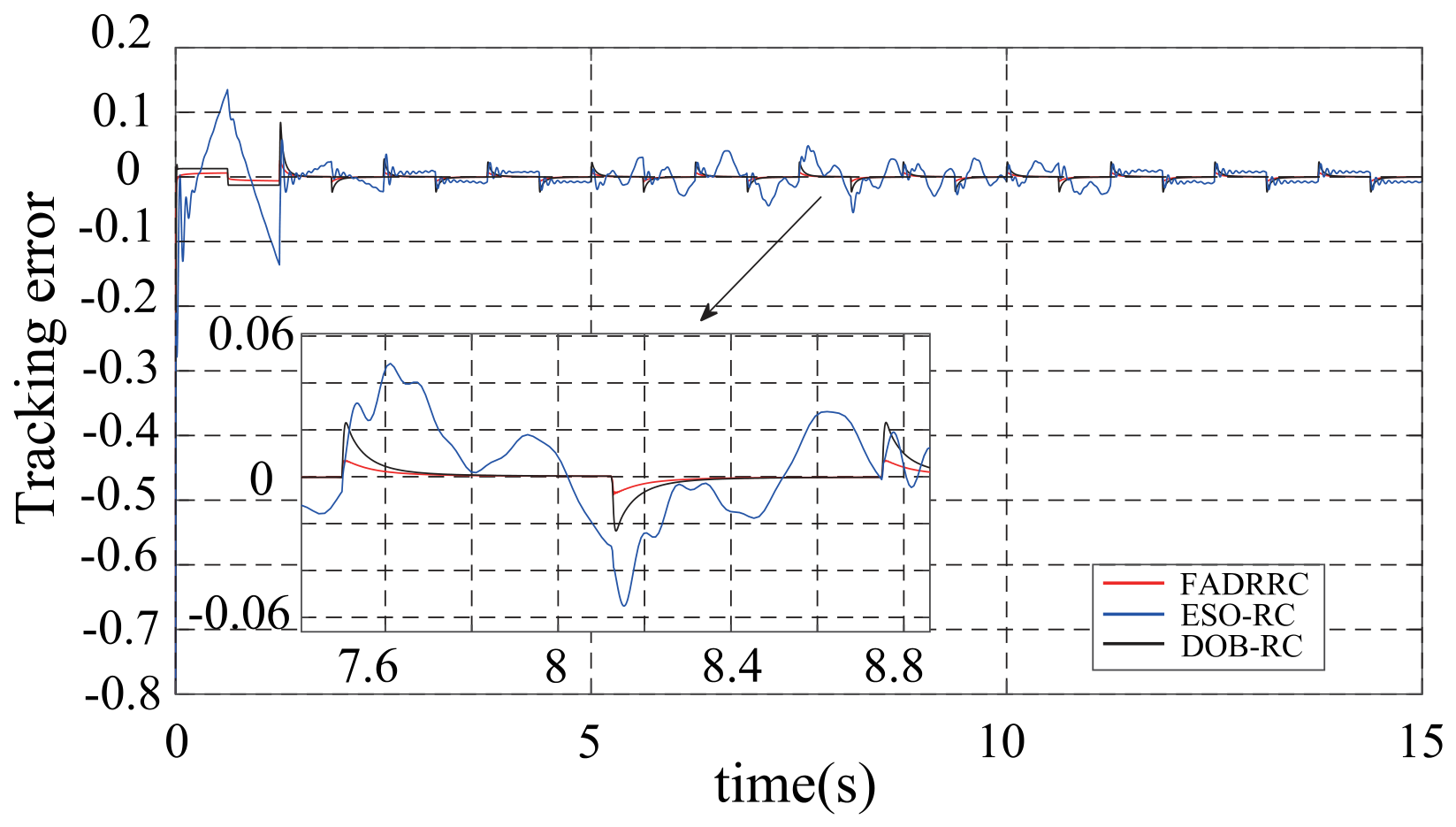
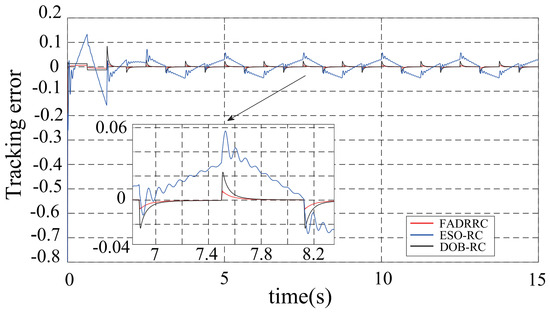
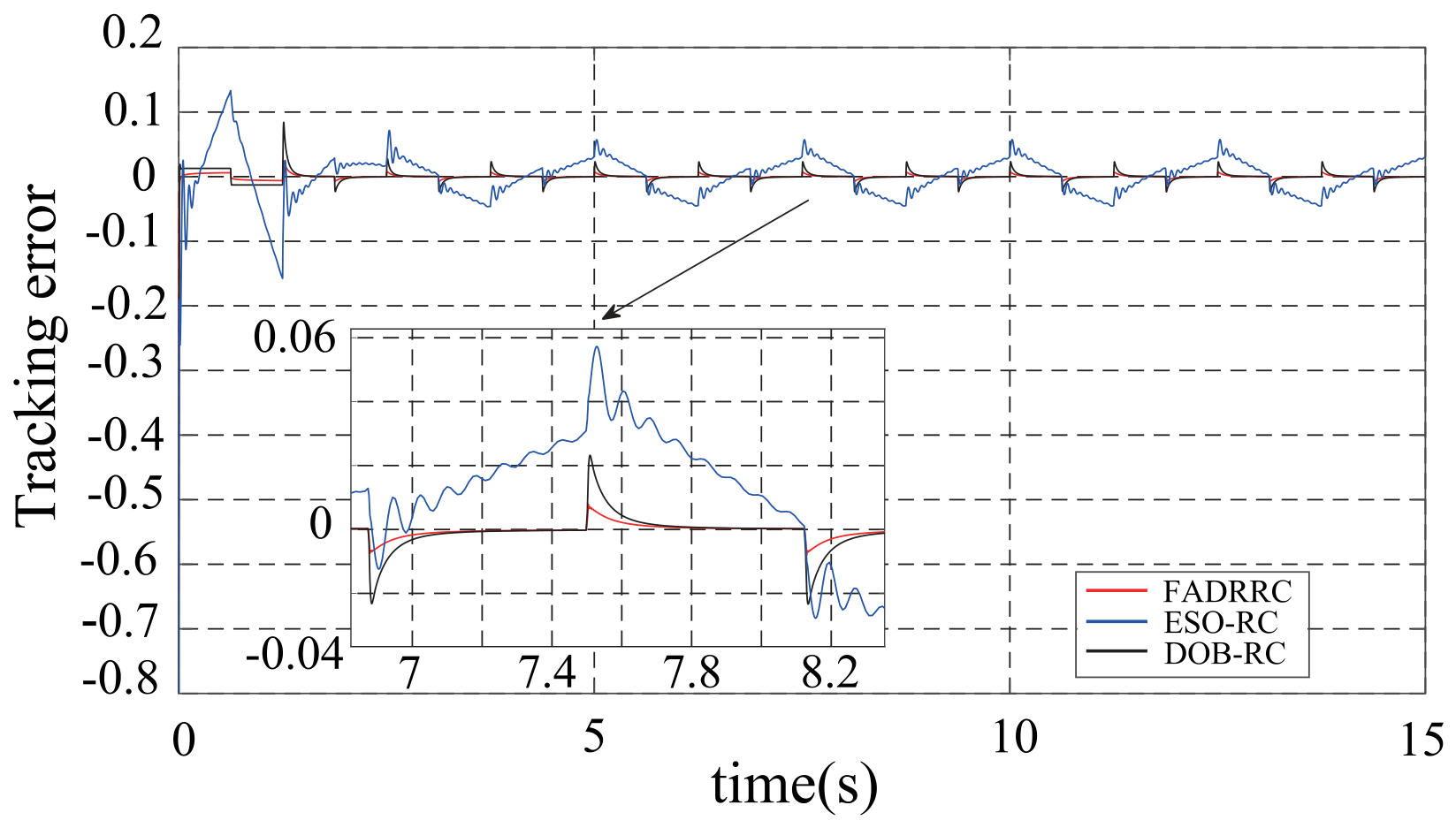
To examine the tracking and disturbance rejection performance of FADRRC, we compared the simulation results between our method and the ESO-RC method proposed in [21], as well as the DOB-RC method in [25]. The same load disturbance and fixed nominal delay, sampling period and total simulation time are adopted throughout all comparative tests. Furthermore, a uniform bandwidth-based tuning principle is applied to all three methods. The observer bandwidth and repetitive control filter cutoff frequency of ESO-RC and DOB-RC are adjusted to the same baseline range as FADRRC to avoid unfair parameter optimization for our proposed scheme. The output tracking errors are shown in Figure 13 and Figure 14. We can see that the desired asymptotic tracking performance of the considered system is achieved under different controllers. Notably, the FADRRC method achieves better tracking performance and superior disturbance rejection capability overall. The control performance has been improved significantly.
Figure 13.
The tracking errors for under different controllers [21,25].
Figure 14.
The tracking errors for under different controllers [21,25].
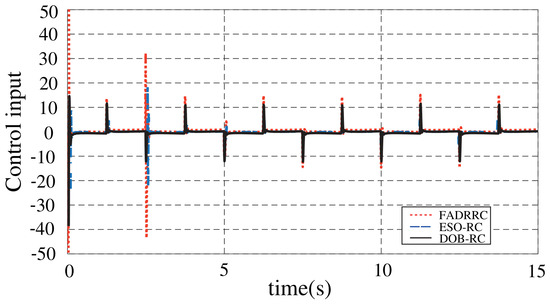
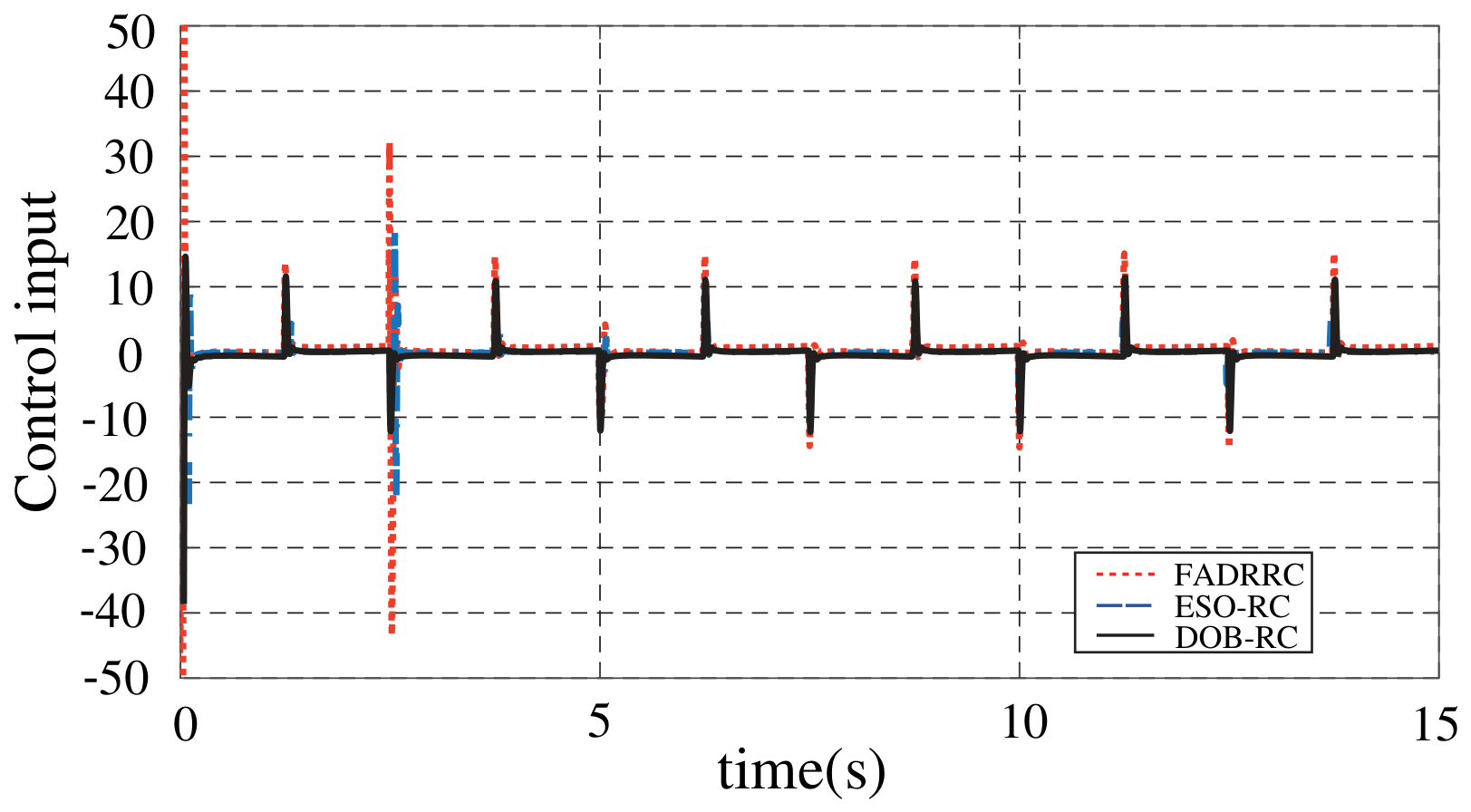
Figure 15 exhibits the control input signals of three comparative controllers under the aperiodic disturbance . ESO-RC (red dotted line) generates the largest positive-negative transient spikes when the disturbance jumps. Severe oscillation of the control signal will result in frequent large-range actuator motion and aggravate mechanical abrasion. DOB-RC (blue dash-dot line) has moderate peak amplitude, between FADRRC and ESO-RC, with relatively smooth periodic pulses. However, its tracking error is large, and the suppression of aperiodic disturbance is unsatisfactory. Our proposed FADRRC (black solid line) method achieves the best tracking accuracy and disturbance-rejection capability, while possessing the smallest control-input peak. Its steady-state control signal only produces mild periodic pulses, without large transient overshoot. Even when a disturbance occurs, the fluctuation is well constrained, and continuous high-frequency chattering does not appear in the whole simulation process.
Figure 15.
The control input for under different controllers [21,25].
To fully investigate the influence of fractional order, numerical simulations with various fractional orders are carried out for comparative analysis. For fair comparison, the key bandwidth parameters of the proposed FADRRC remain unchanged and only the fractional-order parameter is adjusted. The benchmark ESO-RC and DOB-RC are also implemented under with their respective original tuning rules. All other plant parameters remain identical. For each , the stability conditions are checked. The sampling period is and the simulation runs over the time horizon . The quantitative performance comparisons are listed in Table 1, where rise time and overshoot are obtained from the first rising edge of the triangular reference. Rise time is the time for output rising from to of reference peak amplitude . Overshoot is defined as
The discrete integral-error criteria are given by IAE , ISE , ITAE .
Table 1.
Comparisons on IAE, ISE and ITAE.
From Table 1, we can see that the fractional order has a significant and regular impact on the dynamic and steady-state performance of FADRRC. As increases from to , the rise time of FADRRC decreases monotonically, indicating a faster dynamic response. When further increases to , the response speed deteriorates. The overshoot and all three error integral metrics (IAE, ISE, ITAE) decrease monotonically with the increase of . When exceeds 0.8, all three metrics increase synchronously, reflecting a decline in tracking accuracy. The proposed FADRRC with the optimal fractional order achieves excellent comprehensive control performance. It not only has a fast dynamic response speed and excellent overshoot suppression capability, but also significantly improves the steady-state tracking accuracy, outperforming the conventional ESO-RC and DOB-RC controllers in all key performance metrics. The fractional order parameter plays a critical role in tuning the control performance, and the optimal value can effectively balance the dynamic and steady-state performance of the system.
5. Conclusions
This paper develops an integrated FADRRC with filtered Smith prediction to solve high-precision periodic tracking and anti-disturbance issues of fractional-order time-delay systems. A bandwidth-parameterized FESO is designed to reconstruct system fractional states and total lumped disturbances. A filtered Smith predictor is embedded to eliminate time-delay observation errors, retaining the model-free merit of ADRC while reducing the sensitivity to plant and delay mismatches. Combined with modified repetitive control, the unified structure realizes disturbance estimation, delay compensation, periodic error elimination and state feedback stabilization simultaneously. Stability analysis based on fractional stability theory and the small-gain theorem yields two BIBO stability conditions. The nominal stability condition restricts the root arguments of fractional characteristic polynomials; the robust stability condition imposes small-gain constraint to tolerate model and delay uncertainties. Simulations on fractional-order time-delay PMSM servo systems validate the superiority of FADRRC. Compared with ESO-RC and DOB-RC, the proposed scheme features faster response, smaller overshoot and lower IAE/ISE/ITAE tracking errors under harmonic and periodic disturbances.
All comparative simulations in this work are implemented under noise-free conditions. Future work will include quantitative performance evaluations under measurement noise, as well as hardware experiments on real-world PMSM test platforms to validate the practical effectiveness of the proposed strategy. Furthermore, adaptive-bandwidth schemes and auto-tuning algorithms will be investigated to improve the controller’s adaptability over broad operating ranges.
Author Contributions
Formal analysis and writing—original draft preparation, H.J.; data curation, H.W.; software and supervision, J.H.; methodology and writing—review and editing, Y.L. All authors have read and agreed to the published version of the manuscript.
Funding
This study is supported by Natural Science Foundation of Hunan Province (2022JJ60057) and the Science and Technology Project of Jiangxi Educational Bureau (GJJ2202208).
Data Availability Statement
The datasets used or analysed during the current study are available from the corresponding author on reasonable request.
Conflicts of Interest
The authors declare no conflicts of interest.
References
- Han, J. From PID to active disturbance rejection control. IEEE Trans. Ind. Electron. 2009, 56, 900–906. [Google Scholar] [CrossRef] [Scilit]
- Pan, Z.; Wang, X.; Zheng, Z.; Tian, L. Fractional-order linear active disturbance rejection control strategy for grid-side current of PWM rectifiers. IEEE J. Emerg. Sel. Top. Power Electron. 2023, 11, 3827–3838. [Google Scholar] [CrossRef] [Scilit]
- Zhang, J.; Wang, S. Fractional-order linear active disturbance rejection control strategy for DC-DC BUCK converters. Electronics 2025, 14, 2226. [Google Scholar] [CrossRef] [Scilit]
- Wang, S.; Gan, H.; Luo, Y.; Wang, X.; Gao, Z. Active disturbance rejection control with fractional-order model-aided extended state observer. IEEE Trans. Ind. Electron. 2026, 73, 11587–11598. [Google Scholar]
- Du, Y.; Cao, W.; She, J. Analysis and design of active disturbance rejection control with an improved extended state observer for systems with measurement noise. IEEE Trans. Ind. Electron. 2022, 70, 855–865. [Google Scholar] [CrossRef] [Scilit]
- Xu, L.; Zhuo, S.; Liu, J.; Jin, S.; Huangfu, Y.; Gao, F. Advancement of active disturbance rejection control and its applications in power electronics. IEEE Trans. Ind. Appl. 2023, 60, 1680–1694. [Google Scholar] [CrossRef] [Scilit]
- Gao, B.; Zheng, L.; Shen, W.; Zhang, W. A summary of parameter tuning of active disturbance rejection controller. Recent Adv. Electr. Electron. Eng. 2023, 16, 180–196. [Google Scholar] [CrossRef] [Scilit]
- Taghizadegan, N.; Babaei, F.; Safari, A. A linear active disturbance rejection control technique for frequency control of networked microgrids. Energy Syst. 2024, 15, 807–826. [Google Scholar] [CrossRef] [Scilit]
- Zhai, C.; Deng, Y.; Cao, H.; Kang, Y.; Li, W.; Xu, L. Enhanced ADRC with an improved extended state observer considering aperiodic and periodic disturbances for PMSM drives. IEEE Trans. Ind. Electron. 2025, 73, 3758–3769. [Google Scholar] [CrossRef] [Scilit]
- Liao, M.; Li, S. Phase-advanced ADRC: Precision missile attitude control via delay compensation. IET Control Theory Appl. 2026, 20, e70116. [Google Scholar] [CrossRef] [Scilit]
- Zhang, X.F.; Liu, R.; Ren, J.X.; Gui, Q. Adaptive fractional image enhancement algorithm based on rough set and particle swarm optimization. Fractal Fract. 2022, 6, 100. [Google Scholar] [CrossRef] [Scilit]
- Gao, Y.; Zhang, H.; Chen, X.; Lu, T.; Tan, S.; Yang, H.; Gulliver, T. Tracking performance of the coaxial counter-paddle flight system using fractional active disturbance rejection controller. Appl. Math. Model. 2023, 121, 800–827. [Google Scholar] [CrossRef] [Scilit]
- Zhang, X.F.; Lv, Y.D.; Zhang, J.X. H∞ observer-based controller synthesis for fractional order systems over 350 finite frequency range. Appl. Math. Comput. 2024, 474, 128696. [Google Scholar] [CrossRef] [Scilit]
- Lan, Y.H.; Tao, X.; Ding, L. Fractional-order active disturbance rejection repetitive control for fractional-order systems. Asian J. Control 2025, 3, 1245–1257. [Google Scholar] [CrossRef] [Scilit]
- Jiang, J.Y.; Wu, B.; Zhou, T. Fractional-order active disturbance rejection controller design for large radio telescope antenna. Int. J. Antennas Propag. 2022, 1, 1481169. [Google Scholar] [CrossRef] [Scilit]
- Chen, P.; Gan, H.; Liu, Y.; Luo, Y. Active disturbance rejection fractional-order independent control of time delay systems with application to air floating motion platform. IEEE Trans. Instrum. Meas. 2023, 73, 7500410. [Google Scholar] [CrossRef] [Scilit]
- Zheng, W.; Chen, Y.; Wang, X.; Guo, F.; Chen, Y. A composite fractional order active disturbance rejection control method for a class of uncertain systems with multiple disturbances. Int. J. Robust Nonlinear Control 2024, 34, 4595–4612. [Google Scholar] [CrossRef] [Scilit]
- Liu, W.; Guo, L.; Li, L.; Xu, J.; Yang, G. Fractional active disturbance rejection positioning and docking control of remotely operated vehicles: Analysis and experimental validation. Fractal Fract. 2024, 8, 354. [Google Scholar] [CrossRef] [Scilit]
- Zhao, J.; Zhao, T.; Mao, Y. Improved fractional-order active disturbance rejection control for photoelectric tracking system with internal uncertainty and external disturbance. Asian J. Control 2025, 1, 1–22. [Google Scholar] [CrossRef] [Scilit]
- Zhou, L.; Gao, D.; She, J.; Zhang, X.M.; Yan, H. Adaptive spatial repetitive-control for time-varying periodic signals in a rotational system. IEEE Trans. Autom. Control 2024, 69, 4134–4141. [Google Scholar] [CrossRef] [Scilit]
- Kumar, V.A.; Cao, Z.; Man, Z.; Chuei, R.; Bombuwela, D. Predictive extended state observer-based repetitive controller for uncertain systems with input delay. Automatika 2022, 63, 122–131. [Google Scholar] [CrossRef] [Scilit]
- Kurniawan, E.; Wang, H.; Prakosa, J.A.; Purwowibowo, P.; Pratiwi, E.B. An improved repetitive controller with fractional time-delay for discrete-time linear systems: Synthesis and comparison study. ISA Trans. 2024, 146, 511–527. [Google Scholar] [CrossRef] [Scilit] [PubMed]
- Zhang, M.; Lu, C.; Tian, S.; Wang, Y.; Wu, M.; Iwasaki, M. Improved disturbance rejection in repetitive-rontrol systems: Phase-compensated equivalent-input-disturbance approach. IEEE Trans. Ind. Electron. 2024, 71, 12942–12951. [Google Scholar] [CrossRef] [Scilit]
- Lan, Y.H.; Zhao, J.Y. Improving track performance by combining padé-approximation-based preview repetitive control and equivalent-input-disturbance. J. Electr. Eng. Technol. 2024, 19, 3781–3794. [Google Scholar] [CrossRef] [Scilit]
- Mahmoudabadi, P.; TavakoliKakhki, P.M. Robust tracking control for nonlinear fractional order delayed systems: Modified repetitive control approach. Asian J. Control 2024, 4, 1808–1819. [Google Scholar] [CrossRef] [Scilit]
- Wang, S.; Li, B.; Chen, P.; Yu, W.; Peng, Y.; Luo, Y. A fractional-order active disturbance rejection control for permanent magnet synchronous motor position servo system. Asian J. Control 2024, 26, 3137–3147. [Google Scholar] [CrossRef] [Scilit]
- Wang, S.; Gan, H.; Luo, Y.; Luo, X.; Chen, Y. A fractional-order ADRC architecture for a PMSM position servo system with improved disturbance rejection. Fractal Fract. 2024, 8, 54. [Google Scholar] [CrossRef] [Scilit]
- Huang, Z.; Cheng, Y.; Chen, S.; Zhang, X.; Xiang, J.; Wang, S.A. Improved active disturbance rejection control for permanent magnet synchronous motor. Electronics 2024, 13, 3023. [Google Scholar] [CrossRef] [Scilit]
- Zhao, Y.; Guo, L.; Zhang, J.; Zhou, Y.; Lu, W. Repetitive fractional-order active disturbance rejection control for permanent magnet synchronous motor. Machines 2026, 14, 70. [Google Scholar] [CrossRef] [Scilit]
- Zhou, Y.; Wang, J.R.; Zhang, L. Basic Theory of Fractional Differential Equations; World Scientific Publishing: Hackensack, NJ, USA, 2016. [Google Scholar]
- Khalil, H.K.; Grizzle, J.W. Nonlinear Systems; Prentice Hall: Upper Saddle River, NJ, USA, 1996. [Google Scholar]

Disclaimer/Publisher’s Note: The statements, opinions and data contained in all publications are solely those of the individual author(s) and contributor(s) and not of MDPI and/or the editor(s). MDPI and/or the editor(s) disclaim responsibility for any injury to people or property resulting from any ideas, methods, instructions or products referred to in the content. |
© 2026 by the authors. Licensee MDPI, Basel, Switzerland. This article is an open access article distributed under the terms and conditions of the Creative Commons Attribution (CC BY) license.