


Abstract
With the widespread application of motor drive systems in fields such as industrial automation and new energy vehicles, the impact of their nonlinear dynamical behavior on control accuracy and stability has become increasingly significant. Chaos theory provides new insights for revealing and regulating complex nonlinear phenomena in motor systems. Based on chaos theory, this paper takes the synchronous reluctance motor as the research object and proposes, for the first time, a fractional-order mathematical model of the synchronous reluctance motor based on chaotic neurons. Then, the chaotic dynamical behaviors of the fractional-order mathematical model at orders of 0.99 and 0.97 were analyzed. Through bifurcation analysis, Lyapunov exponents, Poincare sections, and attraction domains reveal the mechanism of chaotic oscillation induced by external excitation current and multiple parameter modulation factors. Subsequently, a closed-loop control system based on the Zeroing Neural Network (ZNN) algorithm was designed, which effectively suppressed the chaotic behavior in the motor system’s mechanical rotor angular velocity, phase current, and rotor electrical angular velocity, thereby significantly enhancing the system’s stability. Finally, the effectiveness of the proposed method was validated through simulation experiments, providing theoretical support for the design of motor drive systems.
1. Introduction
Chaos is an abstract science that encompasses both profound theories and complex mathematics, with its research focus on applying theories to explain scientific phenomena [1,2,3,4]. A chaotic state is a deterministic state with inherent randomness. AC motor drive is a practical discipline; it does not require brushes or commutators, thus offering greater capacity and higher speed [5,6,7]. In recent years, research in motor drive and control based on chaos theory has achieved significant breakthroughs in nonlinear dynamic modeling, improvements in control strategies, and practical applications [8,9,10,11]. Many years ago, researchers primarily employed various methods to suppress chaotic phenomena in order to stabilize the system. Now, building on the work of predecessors, we study the characteristics of chaos to effectively harness its advantages—such as near-randomness, stretchability and foldability, and broad spectrum bandwidth—to enhance the electromagnetic compatibility of motors and optimize their operational efficiency.
Neural networks (NNs) demonstrate great potential in handling nonlinear and high-dimensional data due to their powerful ability to extract features and recognize patterns [12]. Biological neurons are the basic units for the brain to process information [13,14]. Each neuron is connected to thousands of other neurons through synapses, forming a topologically and functionally extremely complex NN [15,16,17,18]. Currently, chaotic neuron models have attracted much attention due to their high computational efficiency, simple model, the need for a large time step for each iteration, and the ability to capture important dynamics and features of neuron activities [19,20,21]. In [22], a three-neuron discrete HNN with discrete multi-segment state function memristors was designed. At the beginning, this network generated multi-structure hyperchaotic attractors in a single direction. In [23], two discrete charge-controlled memristor models were proposed, and their cascading operations were discussed. Subsequently, these models were combined with the Rulkov neural mapping to construct two new types of discrete cascaded memristor neural mappings. In order to uncover the mysteries of the brain and conduct better research on artificial intelligence, researchers have constructed various artificial neurons and NN models to simulate and reproduce the rich electrical activities of biological neurons, such as the Hodgkin–Huxley (HH) neuron model [24], the FitzHugh–Nagumo (FHN) neuron model [25], the Morris–Lecar (ML) neuron model [26], the Chay neuron model [27], and the Hindmarsh–Rose (HR) neuron model [28,29]. Among them, the HR neuron model has attracted widespread attention due to its simple mathematical expression and rich electrical activity characteristics.
Since entering the industrial era, humans have experienced the ages of steam engines and internal combustion engines. Nowadays, electric motors are primarily used as the driving force. The chaotic nature driven by electric motors endows them with better adaptability, which will have significant applications in future robotics and various industrial technologies. Research on chaotic phenomena in AC motor drives began in the late 1980s. In the field of asynchronous motor drives, the earliest studies focused on induction motor drives controlled by Pulse Width Modulation (PWM). Later, chaotic phenomena were also found in induction motor drives controlled by voltage-source inverter-driven current hysteresis control and space vector PWM [30,31,32]. By analyzing the chaotic phenomena in motor drives, some nonlinear phenomena in motor systems can be well explained and predicted. Ref. [33] studied the motor’s operating states under three different conditions: constant load torque with non-zero inverter output voltage harmonics, periodic load torque with zero inverter output voltage harmonics, and constant load torque with zero inverter output voltage harmonics. Nonlinear phenomena such as period-doubling bifurcation, Neimark–Sacker bifurcation, and Hopf bifurcation were discovered. Regarding synchronous motor drives, early research on chaotic phenomena mainly focused on open-loop controlled permanent magnet synchronous motor drives [34,35,36].
As a promotion of integer-order calculus, fractional-order calculus can describe the characteristics more precisely. A real capacitor and inductor both have fractional-order characteristics. Therefore, leading fractional-order calculus into a chaotic system can help obtain a more precise chaotic circuit and mathematical model. Compared with integer-order chaotic systems, fractional-order chaotic systems usually have more complex dynamical characteristic and value in research [37,38,39,40]. A fractional-order derivate [41,42,43] has different definitions, such as the Grunwald–Letnikov, Riemann–Liouville, and Caputo. Because of the clear physical significance of the zero-state Caputo fractional-order derivate, it is widely used in engineering. In [44], a dual-wing fractional-order Hopfield neural network model based on memristors is proposed. Fractional-order memristors are utilized to simulate the response of neurons to electromagnetic radiation, thereby achieving complex chaotic dynamic behaviors. In [45], the finite-time synchronization control of fractional-order chaotic systems under the conditions of uncertain dynamics, unknown parameters, and input nonlinearity was studied. In [46], a new type of adaptive image encryption system is proposed. This system combines the fractional-order memristive chaotic engine with a nonlinear hybrid encryption core. In conclusion, fractional-order chaotic systems are complex nonlinear dynamic systems with fractional-order calculus characteristics. They exhibit chaotic phenomena such as sensitivity to initial conditions. Fractional-order calculus operations provide new features for their theoretical basis [47,48,49]. Therefore, we use the Caputo fractional-order derivate model in this paper.
The definition of Caputo is shown in Equation (1):
In Equation (1): n is positive integer, is time, is integral variation, is fraction order, is the q-order differential operator of is -order derivate of is gamma function, as shown in Equation (2):
This paper focuses on the synchronous reluctance motor, establishing for the first time a fractional-order mathematical model of the synchronous reluctance motor based on chaotic neurons. We employed the HR chaotic neuron model, using the neuron’s membrane potential as the input voltage for the synchronous reluctance motor. Through chaotic dynamics analysis methods, we investigated the chaotic phenomena induced by the modulation of multiple relevant parameters.
The remainder of this paper is organized as follows: in Section 1, the basic concepts and application fields of fractional-order derivatives, chaos theory, Zeroing Neural Networks (ZNNs), and synchronous reluctance motors are introduced. In Section 2, a fractional-order mathematical model of a synchronous reluctance motor based on chaotic neurons is proposed, and the chaotic dynamical behavior of this mathematical model is analyzed. In Section 3, a closed-loop control system based on ZNNs is designed, which stabilizes the output current of the motor by controlling the rotor angular velocity. Section 4 concludes this paper with a summary of key findings and final remarks.
2. Chaotic Dynamics Analysis of Synchronous Reluctance Motors
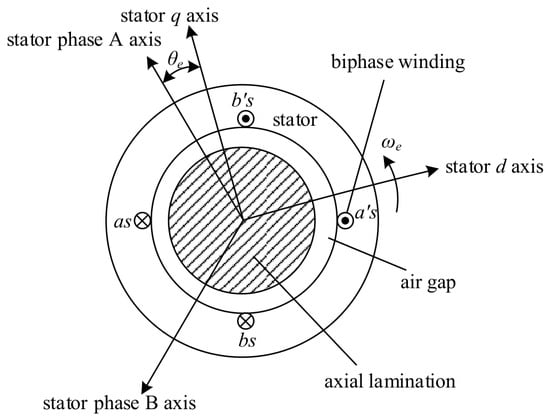
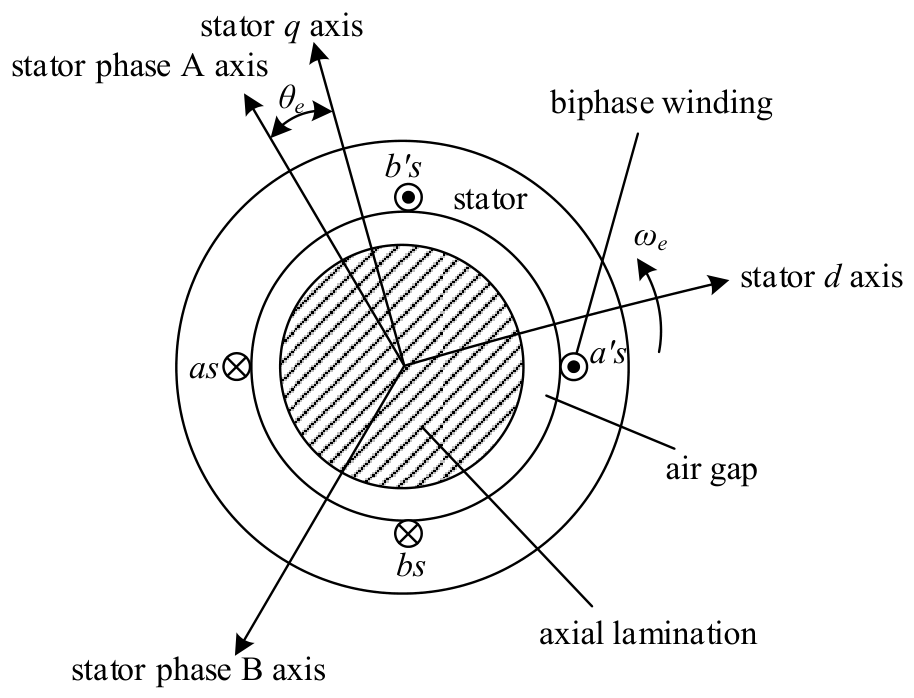
In this paper, taking the synchronous reluctance motor [50,51] as the research object, we have for the first time established a fractional-order mathematical model for the synchronous reluctance motor based on chaotic neurons, as shown in Equation (3). The subscripts ds and qs denote the corresponding direct-axis and quadrature-axis components. ids, iqs, and wr are the state components of the motor, while the membrane potential v, recovery variable y, and slowly varying adaptation current z are the state components of the chaotic neuron. The greater the difference between Lds and Lqs, the larger the electromagnetic torque generated by the drive. In Equation (3), represents the rotor mechanical speed. . Other parameters are listed in Table 1, and the motor structure diagram is shown in Figure 1.
Table 1.
Parameter settings for Equation (3).
Figure 1.
Structure diagram of a two-phase synchronous reluctance motor.
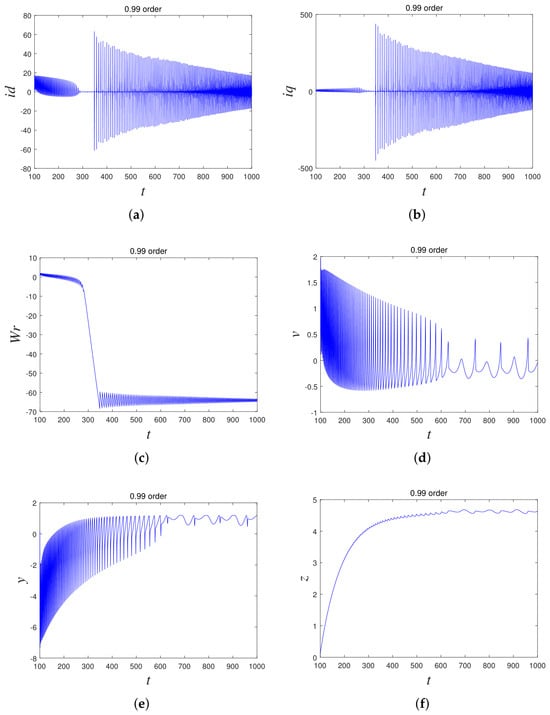
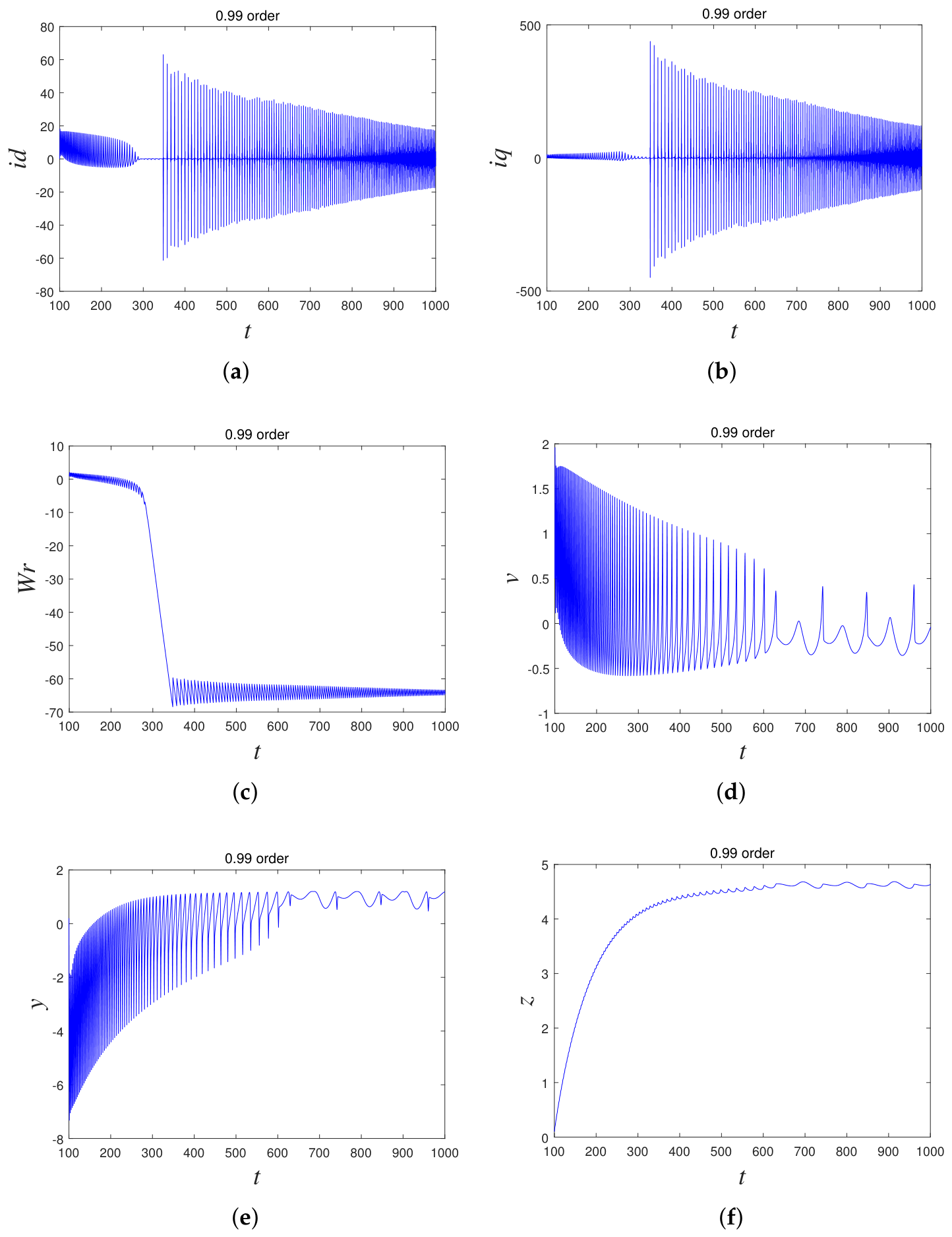
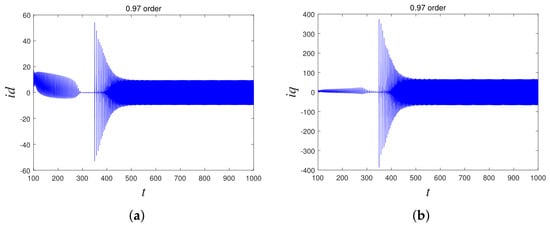
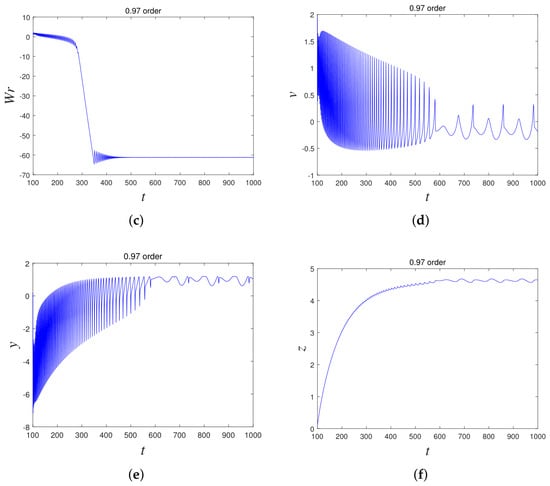
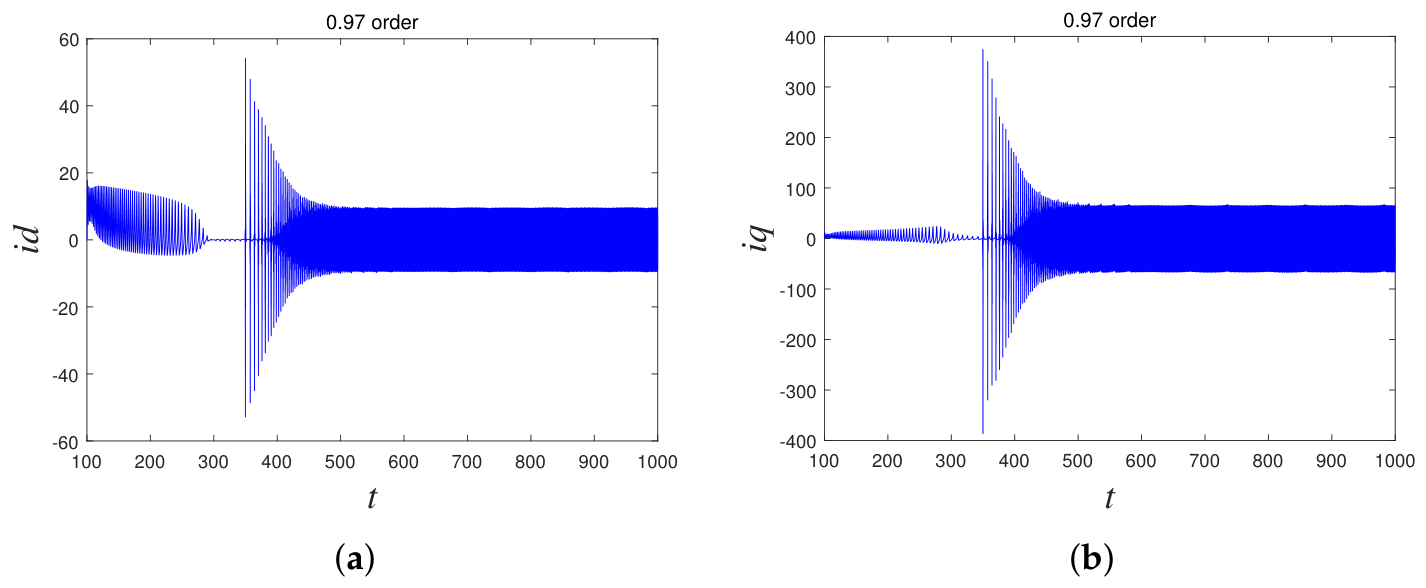
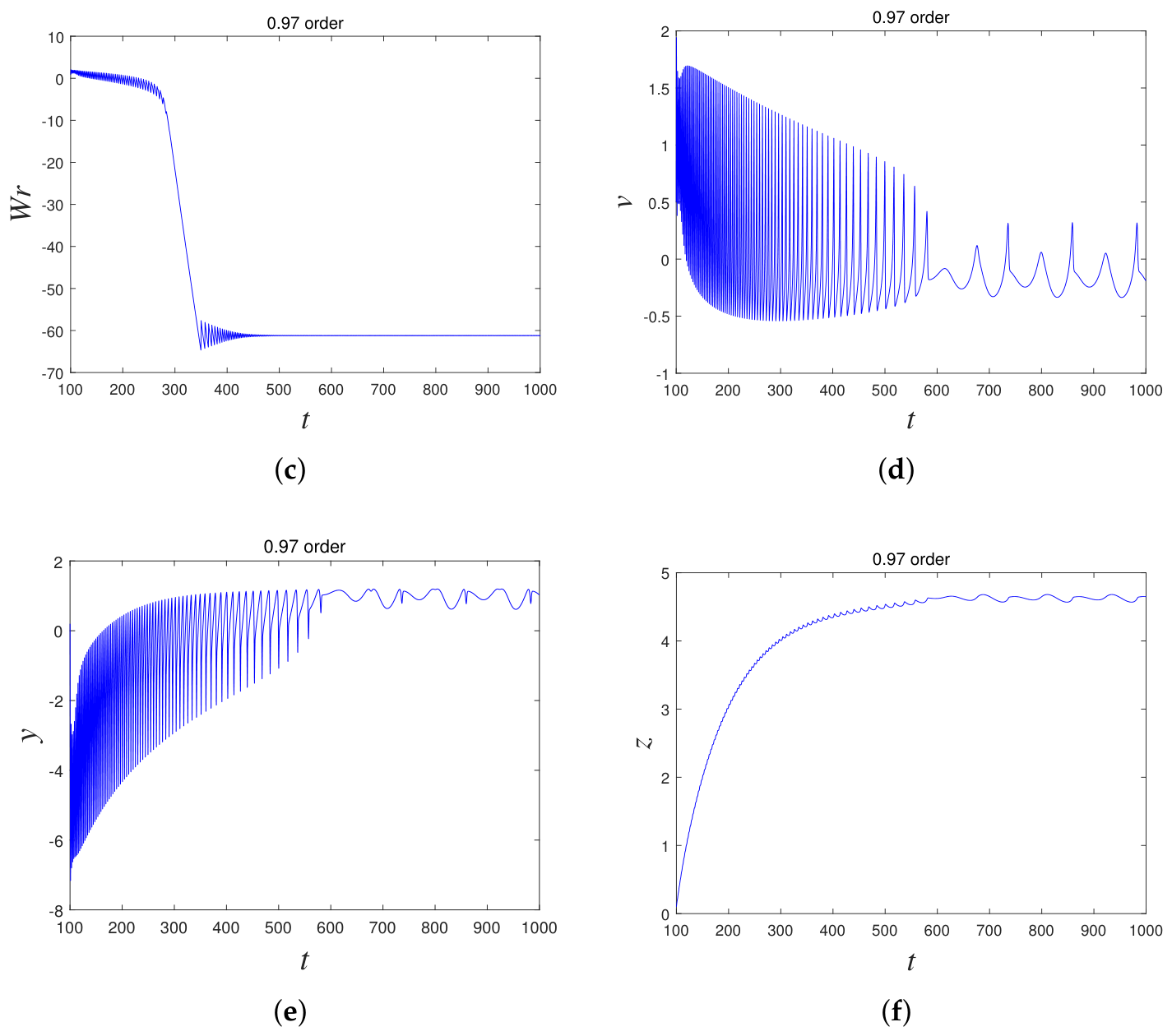
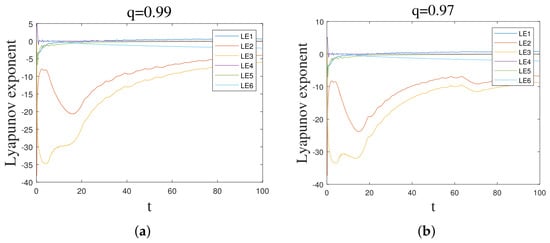
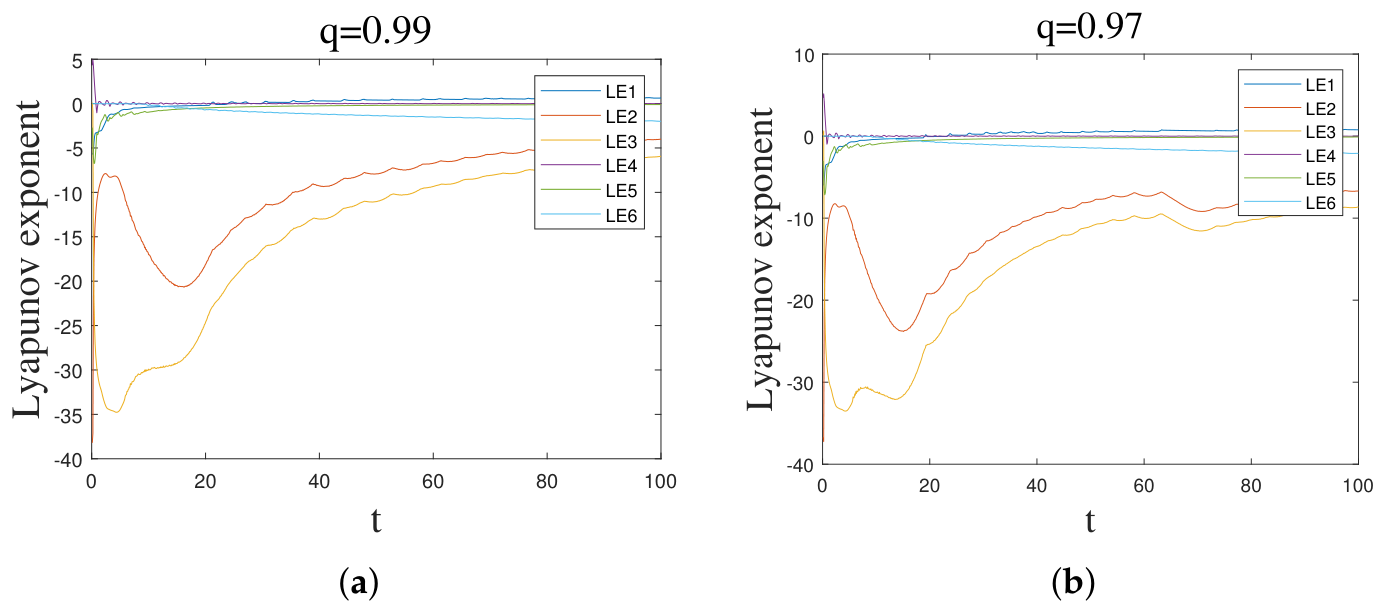
We employed the Caputo fractional-order solution algorithm to solve system (3). We analyzed the chaotic dynamics of system (3) for orders q = 0.99 and q = 0.97, respectively, for which the initial value is (0.1, 0.1, 0.2, 0.1, 0.1, 0.3). The corresponding waveforms are shown in Figure 2 and Figure 3. From Figure 2 and Figure 3, we can observe the corresponding parameters and chaotic state of Equation (3). We can preliminarily conclude that although Equation (3) exhibits chaotic behavior, it remains stable in operation. Subsequently, we obtained the Lyapunov exponents for Equation (3) with and , as shown in Figure 4. For q = 0.97: LE1 = 0.7687, LE2 = −6.6689, LE3 = −8.6377, LE4 = 0.0099, LE5 = −0.1104, LE6 = −2.1022. For q = 0.99: LE1 = 0.6364, LE2 = −3.9988, LE3 = −5.9346, LE4 = −0.0080, LE5 = −0.1054, and LE6 = −1.9934. Analysis of the exponents reveals that Equation (3) is a chaotic system when , and a hyperchaotic system when .
Figure 2.
. (a) Waveform of id, (b) Waveform of iq, (c) Waveform of wr, (d) Waveform of v, (e) Waveform of y, (f) Waveform of z.
Figure 3.
q = 0.97. (a) Waveform of id (b) Waveform of iq, (c) Waveform of wr, (d) Waveform of v, (e) Waveform of y, (f) Waveform of z.
Figure 4.
(a) q = 0.99 Lyapunov exponent convergence process; (b) q = 0.97 Lyapunov exponent convergence process.
2.1. Bifurcation Analysis
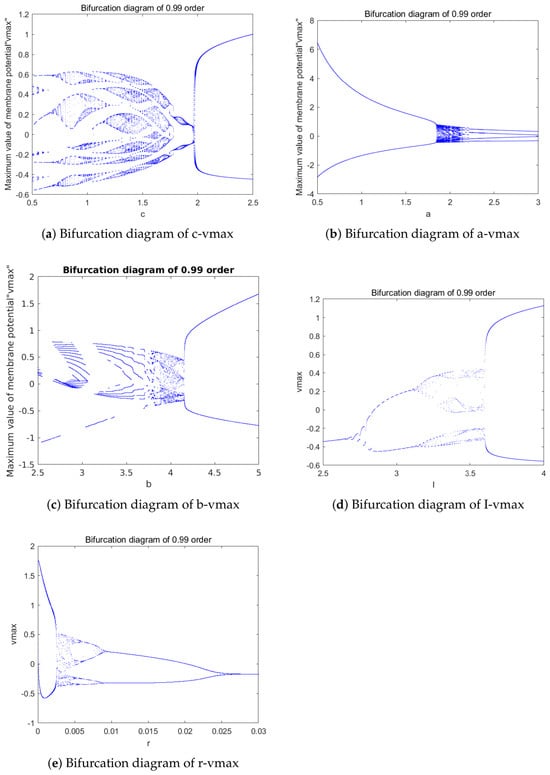
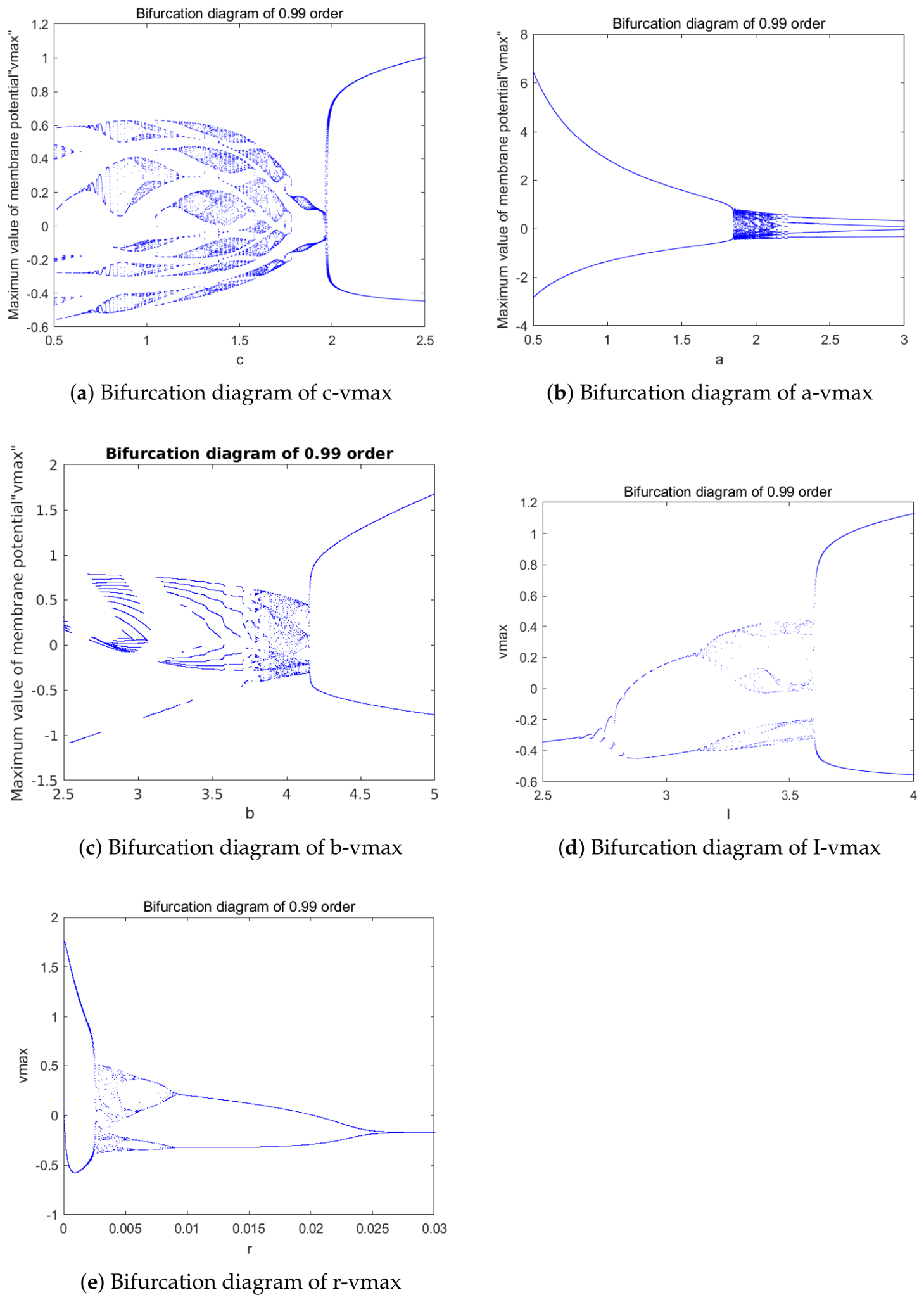
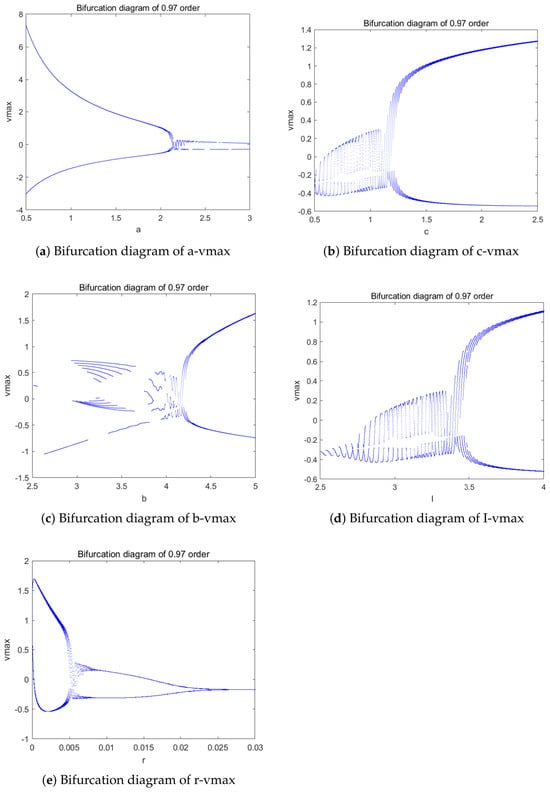
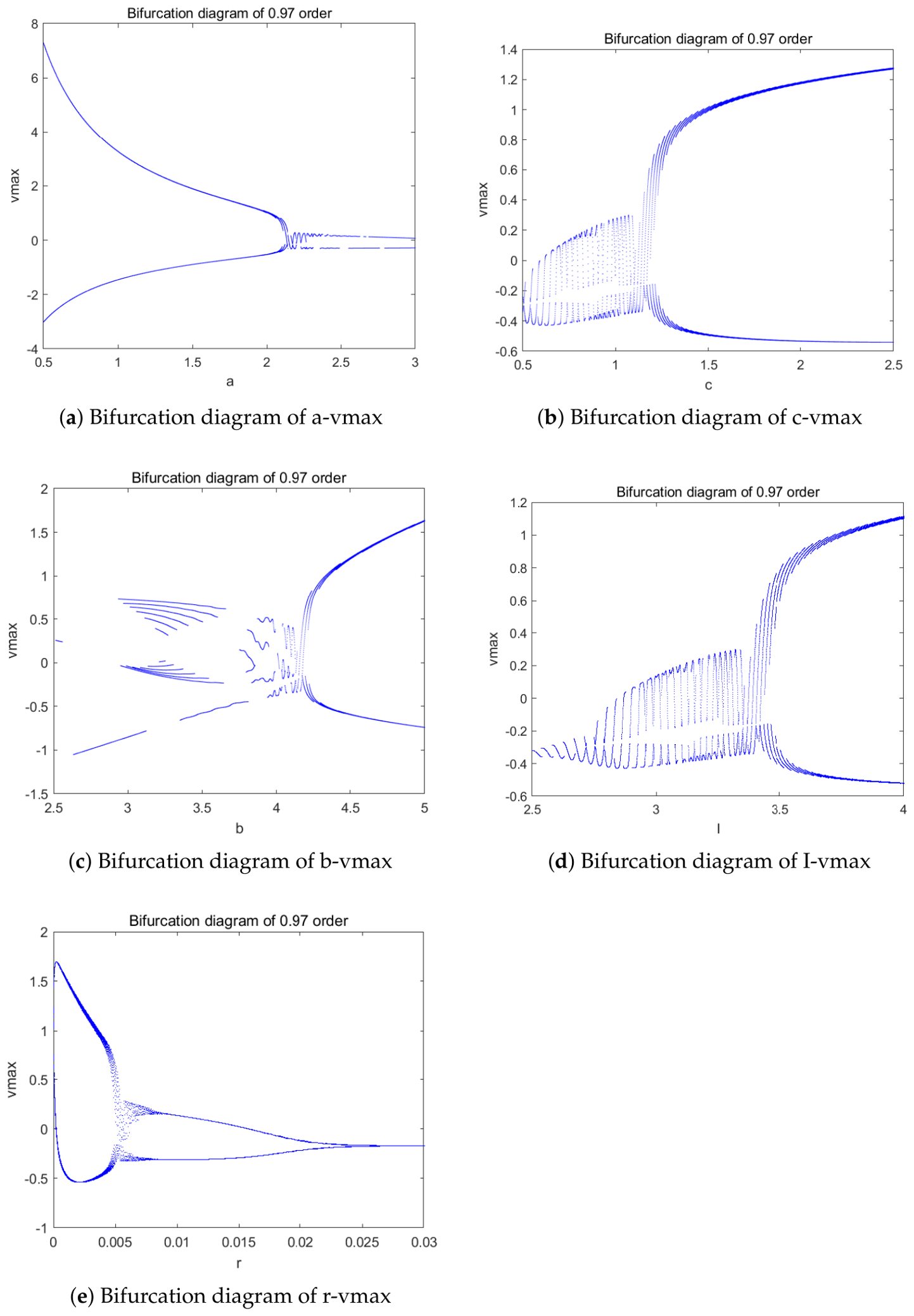
We conducted bifurcation analysis on the relevant parameters of system (3) for orders q = 0.97 and q = 0.99, respectively. In the bifurcation analysis, we found that multiple parameters of the motor can induce bifurcation phenomena during modulation. The bifurcation diagram of system (3) for q = 0.99 and q = 0.97 are shown in Figure 5 and Figure 6. In the figure, we observe that during parameter modulation, period-doubling bifurcation primarily occurs. When the system’s control parameter changes, the stability of the original periodic orbit is lost, and the system cannot return to the original orbit. It is forced to ’split’ into a new stable orbit with a doubled period. This process repeats during fine parameter adjustments, thereby exiting chaos.
Figure 5.
Bifurcation diagram of each parameter for order q = 0.99.
Figure 6.
Bifurcation diagrams of various parameters at order q = 0.97.
The equilibrium point of system (3) is (5.4353 − 5.9911i; 14.9842 + 16.4817i; 0.3484 − 8.3798i; −0.1731; 1.0435; 4.6304). At the equilibrium point, the eigenvalues of the Jacobian matrix are obtained as (−46.8782 − 0.7430i; 2.935 + 2.7395i; −1.8376 − 1.9965i; −2.6987; 0.0243; 0.0243). The real parts of the eigenvalues reach outside the unit circle, so system (3) undergoes a period-doubling bifurcation.
2.2. Poincare Section Analysis
From a topological perspective, the Poincare section leverages the property of ‘topological conjugacy between the section and the original system.’ It sacrifices the details of temporal evolution but preserves the topological structure of the system’s motion. In quasi-periodic motion, the trajectory never repeats itself, and a continuous, closed, smooth curve forms on the section plot.
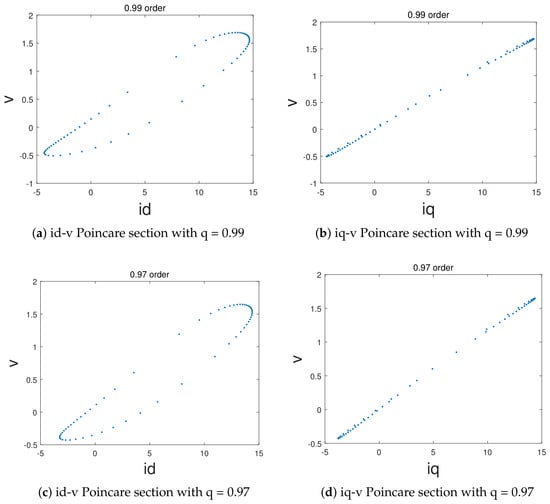
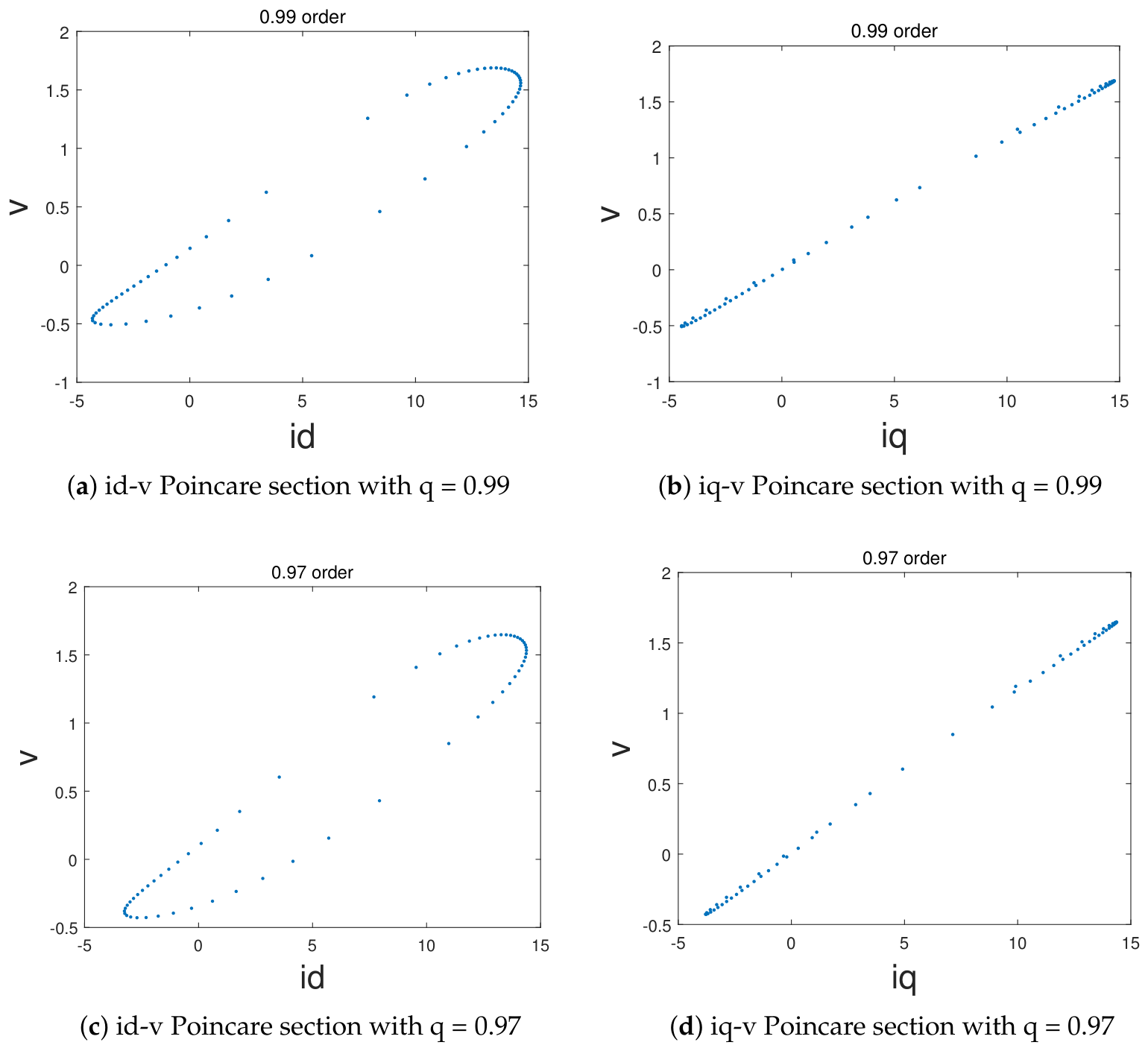
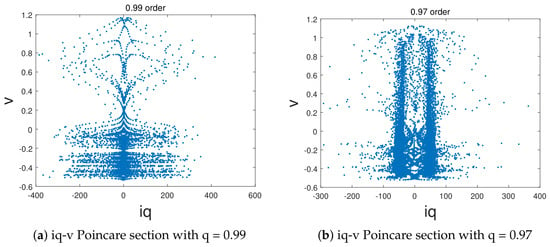
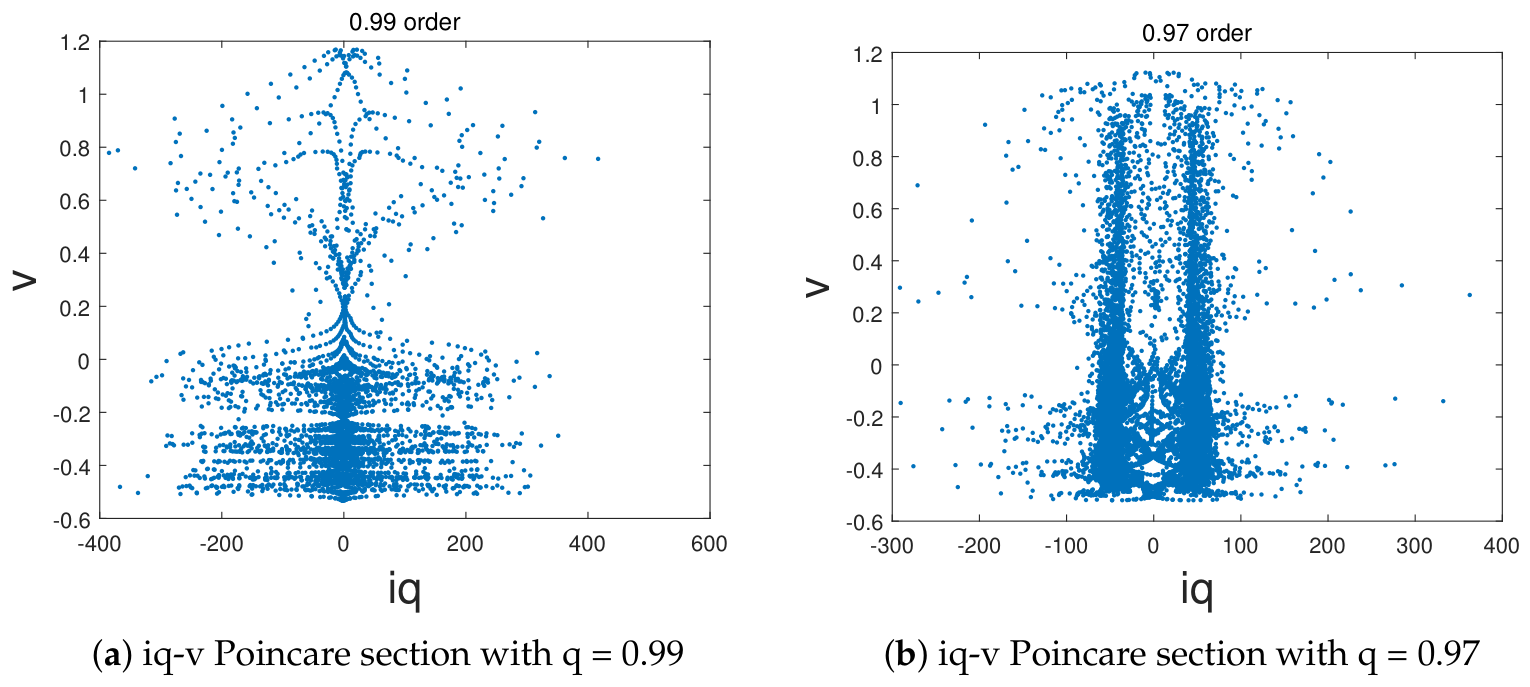
When the trajectory exhibits ergodicity and randomness, the section displays a dense set of points with a fractal structure, indicating chaotic behavior. When we take the section wr = 0.5, we obtain the Poincare section of system (3), as shown in Figure 7.
Figure 7.
Poincare section at = 0.5.
When we take the section , we obtain the Poincare section of system (3), as shown in Figure 8. From Figure 7, we can intuitively observe that the section forms a closed smooth curve, indicating that system (3) is in quasi-periodic motion. Based on the analysis of Figure 8, system (3) exhibits chaotic characteristics.
Figure 8.
Poincare section at = 5.
2.3. Basin of Attraction Analysis
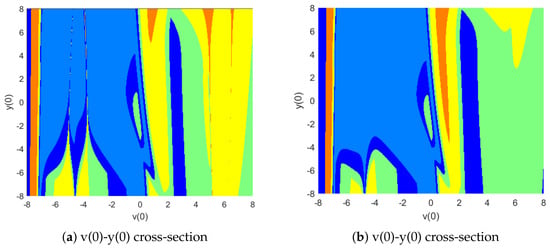
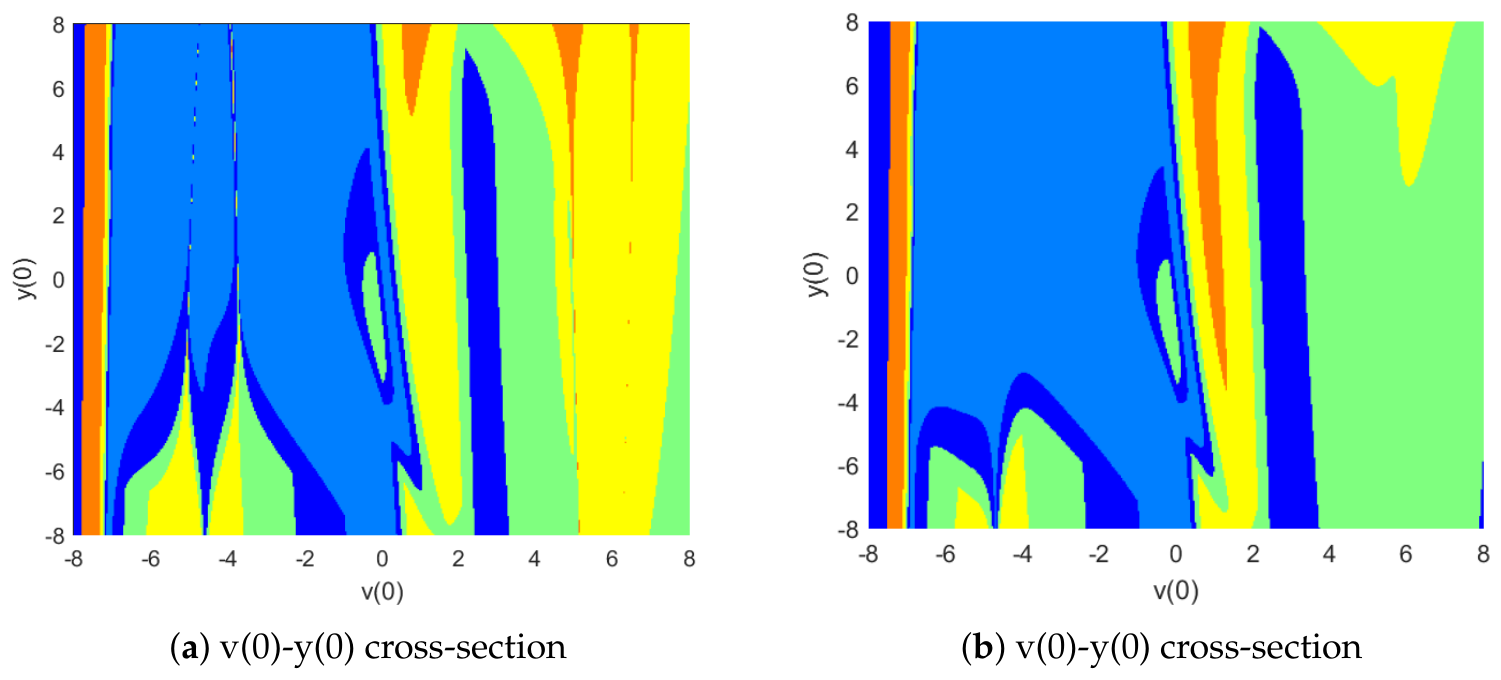
In phase space, an attractor can only ‘attract’ a subset of initial points. The basin of attraction refers to the set of all initial points that eventually evolve towards that attractor [52]. It defines the ‘sphere of influence’ of the attractor within the global state space. The boundary of a chaotic basin of attraction possesses a fractal structure. No matter how much you magnify the boundary, you will see endless, intricate, folded structures. This means the boundary is not a ‘line’ but an infinitely nested ‘chaotic band’. In extreme cases of chaos (such as Wada basins), an arbitrarily small neighborhood around any point in the space simultaneously contains initial points belonging to three or more different basins [53,54]. In simple terms, points on the boundary are ‘shared’ by all basins—each containing elements of the others, making them impossible to separate. Because the boundary is fractal, even with infinite precision near the boundary you cannot definitively determine to which basin a point belongs. This is the famous ‘final state unpredictability’. This stems from the stretching and folding of nonlinear mappings in chaotic systems. During the system’s evolution, initially connected sets of points are repeatedly stretched and folded. After countless iterations, points belonging to different basins become extremely fine, fragmented, and interwoven, ultimately forming fractal dust structures akin to the Cantor set or Julia set [55]. We obtain the basins of attraction by studying the Lyapunov exponents associated with variations in initial values [53,56]. This process is akin to ‘coloring’ the state space defined by the Lyapunov exponents, assigning each point a color based on its ultimate fate; all points of the same color constitute the basin of attraction for that attractor. The basin of attraction for System 3 is shown in Figure 9.
Figure 9.
(a) Attraction basin with q = 0.99; (b) Attraction basin with q = 0.97.
3. ZNN-Based Motor Feedback Control
This paper adopts the Zeroing Neural Network (ZNN) algorithm to design a novel closed-loop controlled motor drive system, which effectively suppresses the chaotic behavior in the input phase current and rotor mechanical angular velocity, thereby stabilizing the motor system. The ZNN is a dynamic neural network model specifically designed for solving time-varying problems. This model excels at tracking time-varying solutions by leveraging the time derivative information of time-varying parameters [57,58]. It has demonstrated unique advantages across various fields, including numerical solving of problems involving vectors, matrices, tensors, inequality problems, image processing, manipulator tracking, chaotic synchronization, and multi-agent system consensus [59,60]. The ZNN differs from traditional gradient neural network models and methods. Firstly, in contrast to the gradient method, which typically employs the concept of positive definite or lower-bounded energy functions, the ZNN can initiate the design of a neuro-dynamic system using an indefinite and unbounded error function.
Secondly, the neural network solvers generated by the ZNN are often described by implicit dynamic models, which are more prevalent in nature [61]. Furthermore, the neural network solvers produced by the ZNN can fully utilize the derivative information of various time-varying parameters at both the methodological and systemic levels. Consequently, they possess a certain predictive and guiding capability for problem-solving, enabling real-time approximation of the correct solution.
The ZNN is a dynamic neural network based on the error-decreasing principle, which automatically adjusts system states to approach the system’s zero point or equilibrium point. Its core is a recurrent neural network described by implicit dynamics (ZNN), which employs indefinite and unbounded error functions as the design foundation, distinguishing it from the energy function models of traditional gradient methods [62]. The ZNN achieves predictive real-time solution approximation by utilizing derivative information of time-varying parameters. Its applications encompass areas such as time-varying matrix inversion, solving linear/nonlinear equations, optimization problems, and robotic arm motion planning, with simulation experiments verifying its high efficiency [63]. The ZNN can effectively track time-varying solutions by utilizing the time derivative information of time-varying parameters. It does not rely on specific cost functions but drives the system to equilibrium through error functions. It possesses good convergence and stability, making it suitable for solving dynamic problems [64]. The novel ZNN method, combined with chaos theory, can effectively address time-varying problems in system optimization and has been applied in research on motor stability control [65].
By employing the ZNN as a feedback controller, we propose a closed-loop motor control model based on a ZNN. The design objective of the ZNN is directly set to eliminate the system error, as shown in Equation (4). Subsequently, a dynamic equation concerning the error is established. This dynamic equation is realized by incorporating the ZNN algorithm into the mechanical angular velocity term of system (3) to achieve closed-loop feedback control, thereby altering the chaotic characteristics of the motor. When the initial values of the ZNN feedback system remain unchanged, the motor output stabilizes. If the initial values undergo slight changes, the motor output would vary significantly without feedback control. However, once ZNN feedback control is applied, the motor output error becomes very small. Thus, it can be concluded that ZNN feedback control can make the motor output more stable.
In Equation (4), is the error of system (3), is the control gain, and is the activation function, the expression of which is given by Equation (5):
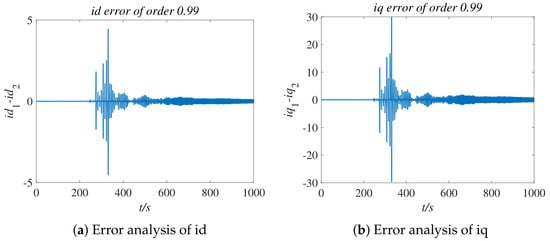
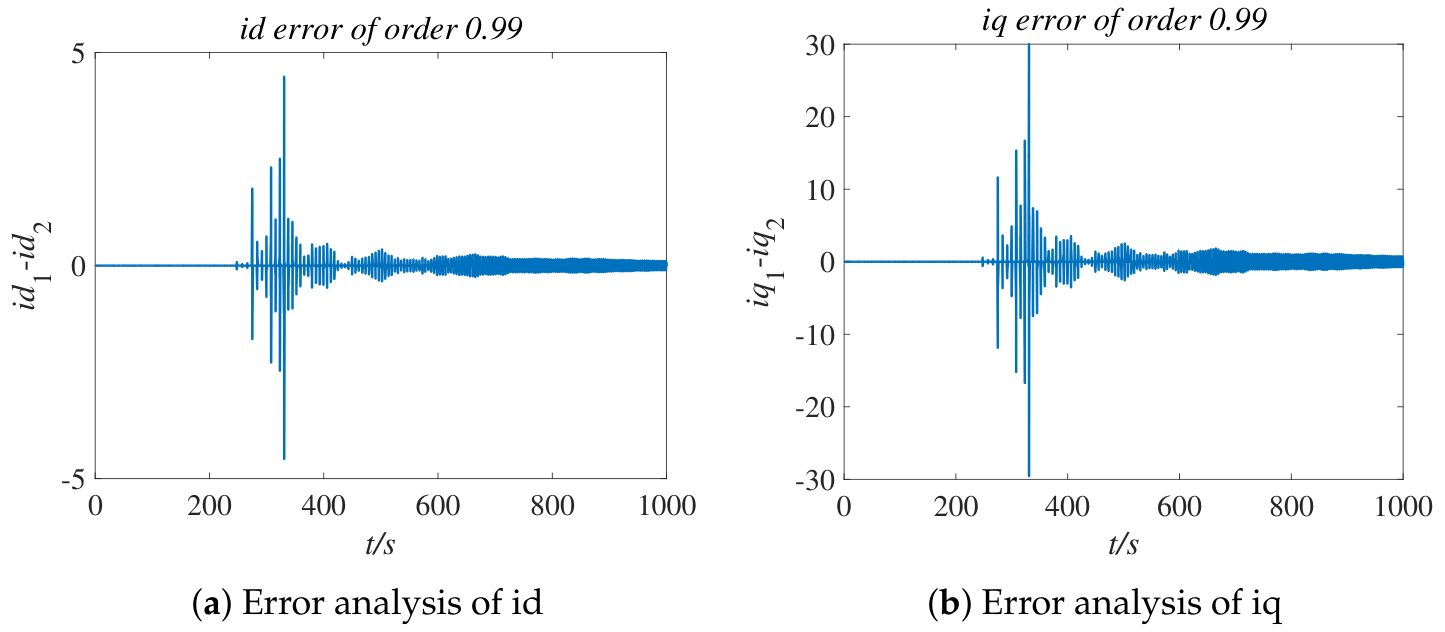
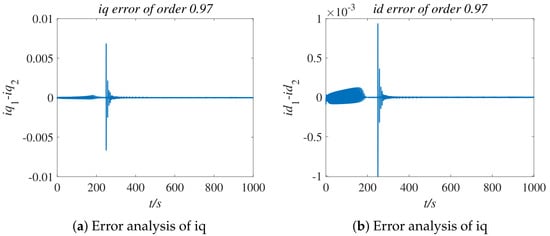
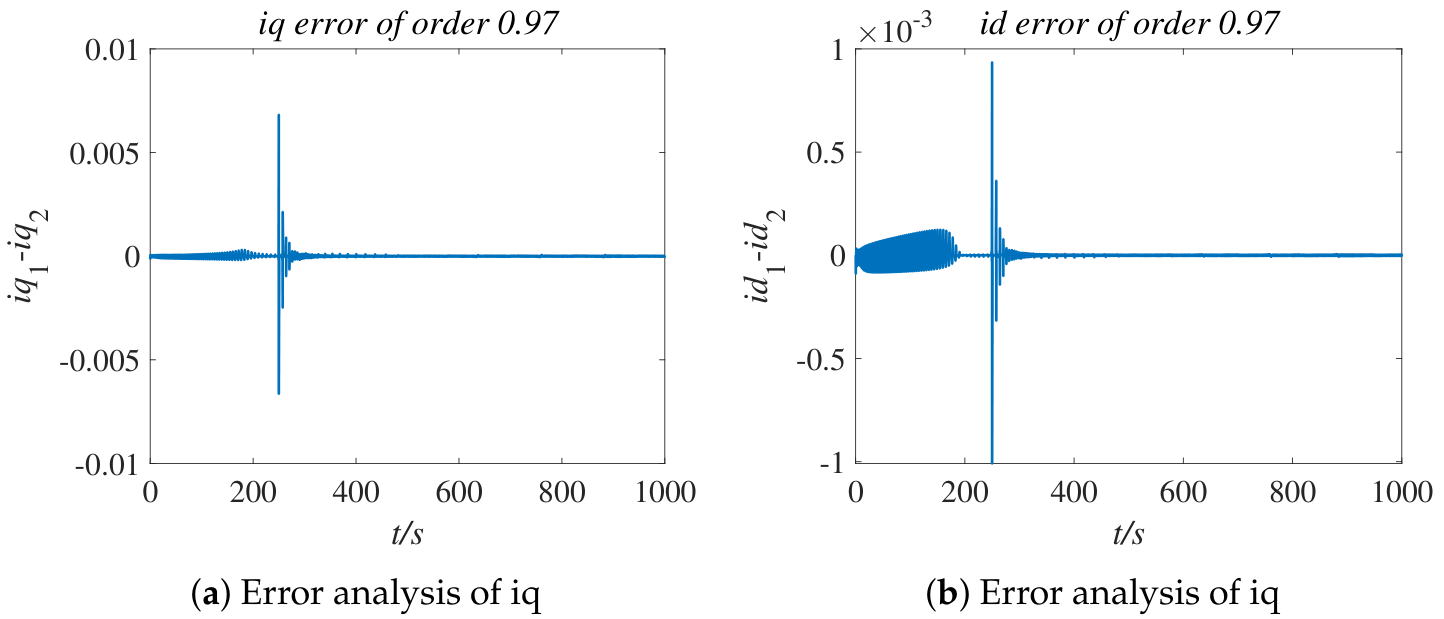
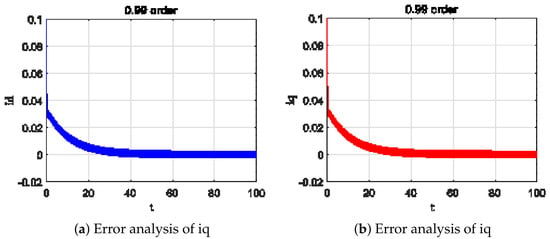
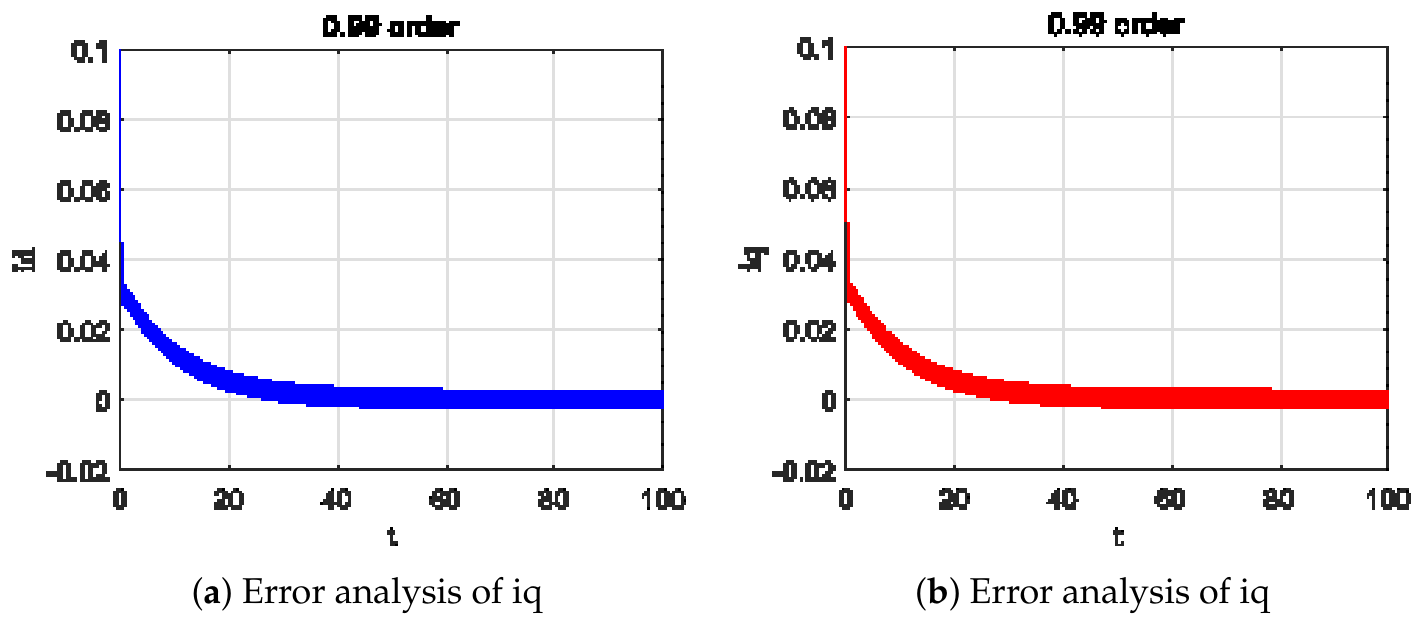
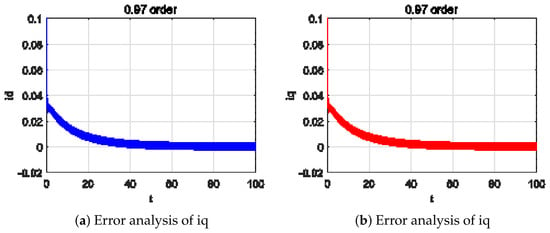
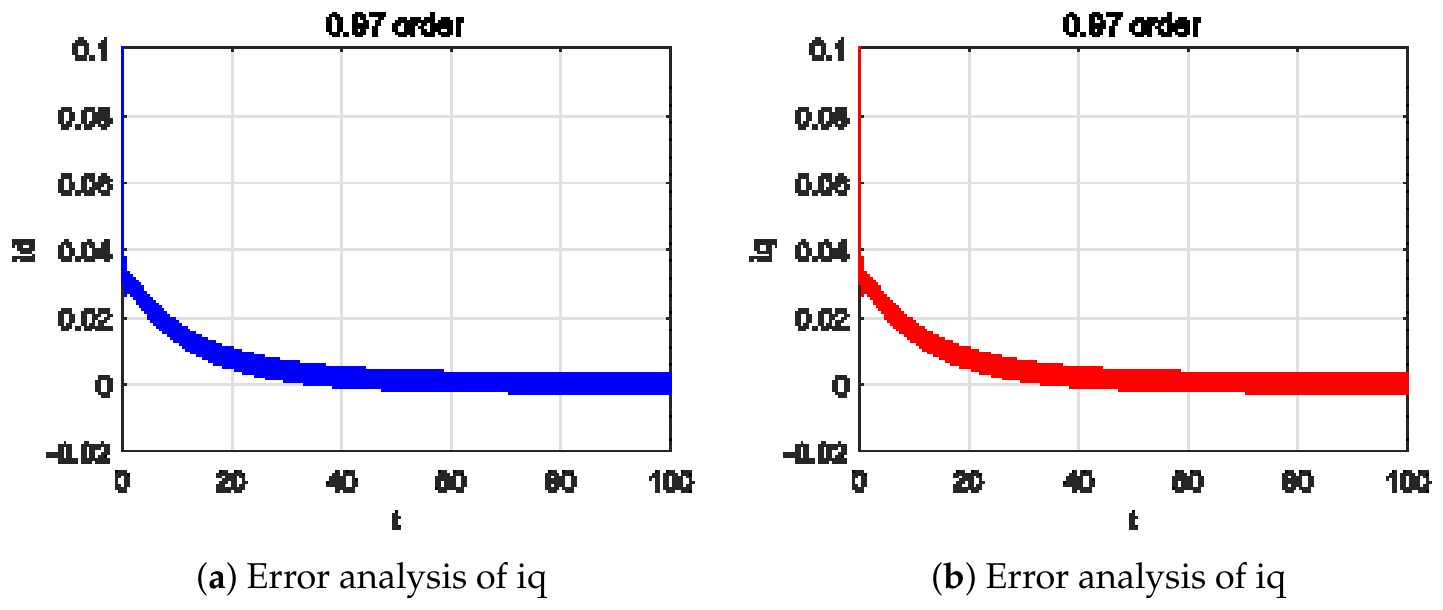
The error analysis is shown in Figure 10 and Figure 11. . From the analysis of the figure, it can be seen that by incorporating the ZNN to implement feedback control, the id and iq currents of the motor can be better controlled. The effect when q = 0.97 is superior to that when q = 0.99.
Figure 10.
Error of ZNN feedback control when q = 0.99.
Figure 11.
Error of ZNN feedback control at q = 0.97.
Meanwhile, under the same conditions, we conducted simulations of sliding mode control, as shown in Figure 12 and Figure 13. Through intuitive comparison, we found that the accuracy and stability of sliding mode control are significantly lower than those of ZNN control.
Figure 12.
Error of synovial feedback control at q = 0.99.
Figure 13.
Error of synovial feedback control at q = 0.97.
4. Conclusions
Based on chaos theory, this paper takes the synchronous reluctance motor as the research object and proposes, for the first time, a fractional-order mathematical model of the synchronous reluctance motor based on chaotic neurons. Subsequently, the chaotic dynamical behaviors of the fractional-order mathematical model at orders of 0.99 and 0.97 are analyzed. When q = 0.99, the motor model is a chaotic system, and when q = 0.97, it is a hyperchaotic system. Through bifurcation analysis, Lyapunov exponents, Poincare sections, and attraction domains, the mechanism of chaotic oscillation induced by external excitation current and multiple parameter modulation factors is revealed. Next, a closed-loop control system based on the ZNN algorithm is designed to suppress the chaos of the mechanical rotor angular velocity and phase current in the motor system. Simulation experiments show that the control effect is better when q = 0.97 than when q = 0.99. However, both can significantly improve the stability of the motor system, providing theoretical support for the widespread application of motor drive system design in industrial automation, new energy vehicles, and other fields.
Author Contributions
L.W.: conceptualization, methodology, software, validation, investigation, data curation, writing—original draft preparation, writing—review and editing, visualization; J.J.: formal analysis, writing—review and editing; L.C.: conceptualization, methodology, data curation, writing—original draft preparation, project administration, funding acquisition; F.Y.: software, validation, resources, formal analysis, writing—review and editing, funding acquisition; L.Z.: validation; M.L.: conceptualization, validation. All authors have read and agreed to the published version of the manuscript.
Funding
This work was supported by the Scientific Research Fund of Hunan Provincial Education Department (Grant Number: 23B0453), Hunan Provincial Natural Science Foundation of China (Grant Number: 2024JJ7174).
Data Availability Statement
The data that support the findings of this study are available from the corresponding authors upon reasonable request.
Conflicts of Interest
The authors declare no conflicts of interest.
References
- Yang, G.; Wang, C.; Sun, Y.; Deng, Q. A Class of Discrete Memristive Hyperchaotic Maps With Multicavity Multistructure Attractors and Its Application in Secure Communication. IEEE Trans. Ind. Inform. 2026, 22, 5298–5309. [Google Scholar] [CrossRef] [Scilit]
- Wang, Y.; Zhang, S.; Wang, Z.; Wang, J.; Wang, X.; Zeng, Z. Design of Hardware Encryption Scheme Based on Hyperchaos and Geometric Transformations With Application to IoMT Scenarios. IEEE Trans. Cybern. 2026, 1–14. [Google Scholar] [CrossRef] [Scilit] [PubMed]
- Deng, Q.; Wang, C.; Sun, Y.; Yang, G. Harnessing Complex-Valued Chaos in Discrete-Time Hopfield Neural Network for Secure Image Encryption. IEEE Trans. Circuits Syst. Video Technol. 2026. [Google Scholar] [CrossRef] [Scilit]
- Feng, W.; Tang, Z.; Zhao, X.; Qin, Z.; Chen, Y.; Cai, B.; Zhu, Z.; Qian, K.; Wen, H. Two-Dimensional Coupling-Enhanced Cubic Hyperchaotic Map with Exponential Parameters: Construction, Analysis, and Application in Hierarchical Significance-Aware Multi-Image Encryption. Axioms 2025, 14, 901. [Google Scholar] [CrossRef] [Scilit]
- Jin, J.; Liu, L.; Zhao, L.; Yu, F. Cooperative control of multi-scroll attractors in chaotic neural network with double potential wells and staircase wells and its application in image encryption. Integration 2026, 109, 102739. [Google Scholar] [CrossRef] [Scilit]
- He, T.; Yu, F.; Lin, Y.; He, S.; Yao, W.; Cai, S.; Jin, J. Multi-scroll hopfield neural network excited by memristive self-synapses and its application in image encryption. Chin. Phys. B 2025, 34, 120506. [Google Scholar] [CrossRef] [Scilit]
- Yang, G.; Wang, C.; Sun, Y.; Deng, Q. A Discrete Memristive Hopfield Neural Network With Grid Multi-structure/scroll-like Attractors. IEEE Trans. Comput.-Aided Des. Integr. Circuits Syst. 2026. [Google Scholar] [CrossRef] [Scilit]
- Lv, W.; Zhang, S.; Wang, Y.; Wu, Q.; Ding, X.; Gao, X. Memristive Multiring Rulkov Neuron Model With Hyperchaotic Firings and Application to Image Cryptosystem. IEEE Trans. Ind. Inform. 2026, 1–12. [Google Scholar] [CrossRef] [Scilit]
- Yang, G.; Wang, C.; Deng, Q. A discrete memristive cyclic Hopfield neural network with multi-cavity-like attractors and application in secure communication. Neural Netw. 2026, 201, 108953. [Google Scholar] [CrossRef] [Scilit] [PubMed]
- Chen, G. Optimal Synchronization of Higher-Order Dynamical Networks. Artif. Intell. Sci. Eng. 2025, 1, 31–36. [Google Scholar] [CrossRef] [Scilit]
- Wang, C.; Gong, Z.; Deng, Q. Discrete bidirectional memristive neural network-based hyperchaotic system and its FPGA implementation. Neural Netw. 2026, 201, 108887. [Google Scholar] [CrossRef] [Scilit] [PubMed]
- Tian, G.; Yang, Y.; Wen, S. Time-Series Stock Price Forecasting Based on Neural Networks: A Comprehensive Survey. Artif. Intell. Sci. Eng. 2025, 1, 255–277. [Google Scholar] [CrossRef] [Scilit]
- Li, Z.; Jin, J.; Zhang, D.; Chen, C. Design and realization of pulse-controlled multi-memristor Hopfield neural networks and their applications in information encryption. Multimed. Syst. 2025, 31, 1–26. [Google Scholar] [CrossRef] [Scilit]
- Wang, Y.; Yin, K.; Jin, J.; Li, H. A dual-neuron second-order memristor-based Hopfield neural network with controllable extreme multistability and its application in image encryption. Integration 2026, 109, 102731. [Google Scholar] [CrossRef] [Scilit]
- Yu, F.; Guo, R.; Zheng, M.; Yao, W.; Zhang, D.; Cai, S. Novel approach to time series forecasting based on memristive Hopfield Neural Network with hidden heterogeneous and homogeneous extreme multistability. Chaos Solitons Fractals 2026, 210, 118626. [Google Scholar] [CrossRef] [Scilit]
- Yang, G.; Wang, C.; Sun, Y.; Deng, Q. A discrete memristive heterogeneous neural network with grid multi-windmill hyperchaotic attractors and application in secure communication. Math. Comput. Simul. 2026, 249, 727–743. [Google Scholar] [CrossRef] [Scilit]
- Deng, S.; Jin, J.; Li, Z.; Chen, C.; Yu, F. A MBPAF-memristive Hopfield neural network and its application in image encryption. Cogn. Neurodynamics 2026, 20, 81. [Google Scholar] [CrossRef] [Scilit]
- Khan, A.H.; Cao, X.; Luo, C.; Zhang, S.; Guo, W.; Katsikis, V.N.; Li, S. Spiking Neural Networks: A Comprehensive Survey of Training Methodologies, Hardware Implementations and Applications. Artif. Intell. Sci. Eng. 2025, 1, 175–207. [Google Scholar] [CrossRef] [Scilit]
- Yao, W.; Gao, K.; Sun, Y.; Wen, S.; Xiong, L.; Chen, G. Extremely simple neural network and circuit design with multi-influence patterns in neurons for modeling sleep-wake cycles. Nonlinear Dyn. 2026, 114, 789. [Google Scholar] [CrossRef] [Scilit]
- Sun, J.; Sun, J.; Li, X.; Sun, Y.; Hong, Q.; Wang, C. A Review of Recent Developments in Neuromorphic Computing Based on Emerging Memory Devices. Nonlinear Dyn. 2025, 113, 33035–33061. [Google Scholar] [CrossRef] [Scilit]
- Yu, F.; Wang, X.; Guo, R.; Ying, Z.; He, Y.; Zou, Q. Discrete neuron models and memristive neural network mapping: A comprehensive review. Chin. Phys. B 2025, 34, 120501. [Google Scholar] [CrossRef] [Scilit]
- Wang, C.; Gong, Z.; Deng, Q. Grid multi-structure hyperchaotic attractors in discrete memristive Hopfield neural network with multi-level logic pulse stimulation. Nonlinear Dyn. 2026, 114, 598. [Google Scholar] [CrossRef] [Scilit]
- Yu, F.; Wang, X.; Xiao, Y.; He, Y.; Yao, W.; Cai, S.; Jin, J. Extreme multistability in discrete memristive neuron maps and implications for dual-field applications. Integration 2026, 109, 102688. [Google Scholar] [CrossRef] [Scilit]
- Fang, Y.; Feng, C.; Gu, Z.; Wu, H.; Wang, N.; Xu, Q. Ion channel blocking effects in an N-LAM-based Hodgkin-Huxley circuit. Nonlinear Dyn. 2026, 114, 389. [Google Scholar] [CrossRef] [Scilit]
- Nguessap, E.L.F.; Roque, A.C.; Ferreira, F.F. Modulation of neuronal firing modes by electric fields in a thermosensitive FitzHugh-Nagumo model. Nonlinear Dyn. 2026, 114, 27. [Google Scholar] [CrossRef] [Scilit]
- Xu, Q.; Wang, K.; Feng, C.; Fan, W.; Wang, N. Dynamical effects of low-frequency and high-frequency current stimuli in a memristive Morris–Lecar neuron model. Chaos Solitons Fractals 2024, 189, 115646. [Google Scholar] [CrossRef] [Scilit]
- Ma, J.; Qi, L.; Dong, H.; Liu, T.; Zeng, M. Parameter Control and Spatiotemporal Dynamics Analysis of the Chay Neuron Model Under Chemical Synapses. Dynamics 2025, 5, 39. [Google Scholar] [CrossRef] [Scilit]
- Hindmarsh, J.L.; Rose, R. A model of the nerve impulse using two first-order differential equations. Nature 1982, 296, 162–164. [Google Scholar] [CrossRef] [Scilit] [PubMed]
- Hindmarsh, J.L.; Rose, R. A model of neuronal bursting using three coupled first order differential equations. Proc. R. Soc. Lond. Ser. B. Biol. Sci. 1984, 221, 87–102. [Google Scholar] [CrossRef] [Scilit]
- Kolokolov, Y.V.; Monovskaya, A.V. From geometric invariants and symbolic matrixes towards new perspectives on forecasting of PWM converter dynamics. Chaos Solitons Fractals 2009, 42, 1868–1877. [Google Scholar] [CrossRef] [Scilit]
- Zhou, B.; Song, J.; Zhang, W. Influence of pulse-width modulation on mixed-mode oscillations in the Duffing system. Commun. Nonlinear Sci. Numer. Simul. 2026, 162, 110353. [Google Scholar] [CrossRef] [Scilit]
- Song, X.; Chen, H.; Xue, Y. Stabilization precision control methods of photoelectric aim-stabilized system. Opt. Commun. 2015, 351, 115–120. [Google Scholar] [CrossRef] [Scilit]
- Shi, J.; Zhao, F.; Shen, X.; Wang, X. Chaotic operation and chaos control of travelling wave ultrasonic motor. Ultrasonics 2013, 53, 1112–1123. [Google Scholar] [CrossRef] [Scilit] [PubMed]
- Yin, X.; She, J.; Liu, Z.; Wu, M.; Kaynak, O. Chaos suppression in speed control for permanent-magnet-synchronous-motor drive system. J. Frankl. Inst. 2020, 357, 13283–13303. [Google Scholar] [CrossRef] [Scilit]
- Ataei, M.; Kiyoumarsi, A.; Ghorbani, B. Control of chaos in permanent magnet synchronous motor by using optimal Lyapunov exponents placement. Phys. Lett. A 2010, 374, 4226–4230. [Google Scholar] [CrossRef] [Scilit]
- Luo, S.; Gao, R. Chaos control of the permanent magnet synchronous motor with time-varying delay by using adaptive sliding mode control based on DSC. J. Frankl. Inst. 2018, 355, 4147–4163. [Google Scholar] [CrossRef] [Scilit]
- Kavuran, G. Hybrid Lyapunov–Vision Framework for Chaos Identification in Fractional-Order Nonlinear Dynamics. Fractal Fract. 2026, 10, 386. [Google Scholar] [CrossRef] [Scilit]
- Elbadri, M.; Al-kuleab, N.; Saadeh, R.; H. Abdalla, A.; Jazmati, M.S.; A. Abdoon, M.; Hafez, M. Study of the Variable-Order Fractional Arneodo System: Bifurcation, Chaos, and Dynamic Behavior. Fractal Fract. 2026, 10, 296. [Google Scholar] [CrossRef] [Scilit]
- Varshney, P.; Naunyal, G.R.; Kumar, S.; Laroze, D. Modeling and analysis of liver dynamics via fractional differential equations and Bernstein polynomial-based neural networks. Chaos Solitons Fractals 2026, 210, 118644. [Google Scholar] [CrossRef] [Scilit]
- Ding, J.; Zhu, Y.; Yin, W.; He, D.; Wan, F.; Tu, G. A 5d fractional-order memristive neural network for satellite image encryption using dynamic DNA encoding and bidirectional diffusion. Fractal Fract. 2026, 10, 216. [Google Scholar] [CrossRef] [Scilit]
- He, S.; Wang, H.; Sun, K. Solutions and memory effect of fractional-order chaotic system: A review. Chin. Phys. B 2022, 31, 060501. [Google Scholar] [CrossRef] [Scilit]
- Elbadri, M.; Al-kuleab, N.; Saadeh, R.; Hafez, M.; Abdoon, M.A. Dynamics and Chaos Analysis of the Fractional-Order Lü System Using a Hybrid Approach. Fractal Fract. 2026, 10, 51. [Google Scholar] [CrossRef] [Scilit]
- Cui, C.; Feng, W.; Tang, J.; Gan, Y.; Gao, Z.; Wen, H. Efficient and Robust Image Cryptosystem Utilizing a Fractional-Order Discrete Cross-Coupled Map and Fractal Dragon Curve. Fractal Fract. 2026, 10, 479. [Google Scholar] [CrossRef] [Scilit]
- He, S.; Yu, F.; Guo, R.; Zheng, M.; Tang, T.; Jin, J.; Wang, C. Dynamic analysis and FPGA implementation of a fractional-order memristive Hopfield neural network with hidden chaotic dual-wing attractors. Fractal Fract. 2025, 9, 561. [Google Scholar] [CrossRef] [Scilit]
- Zhang, X.; Feng, C.; Zhou, Y.; Deng, X. Adaptive Fuzzy Finite-Time Synchronization Control of Fractional-Order Chaotic Systems with Uncertain Dynamics, Unknown Parameters and Input Nonlinearities. Fractal Fract. 2025, 9, 805. [Google Scholar] [CrossRef] [Scilit]
- Najm, H.; Mahdi, M.S.; Alkazaz, N.R.; Al-Andoli, M.N.; Alomari, M.A.; Ahmed, A.A. An Adaptive Piano-Inspired Memristive Fractional-Order Cryptosystem for Secure Image Protection. Mathematics 2026, 14, 2125. [Google Scholar] [CrossRef] [Scilit]
- Li, Y.; Zhu, J.; Wang, C. Dynamics analysis and FPGA implementation of Discrete-time Fractional-order memcapacitor-based Hopfield neural network. Chaos Solitons Fractals 2026, 208, 118364. [Google Scholar] [CrossRef] [Scilit]
- Wen, H.; Zhang, C.; Huang, L.; Ke, J.; Xiong, D. Security analysis of a color image encryption algorithm using a fractional-order chaos. Entropy 2021, 23, 258. [Google Scholar] [CrossRef] [Scilit] [PubMed]
- He, S.; Yu, F.; Guo, R.; Zhang, F.; Yao, W.; Cai, S.; Jin, J. Burst-firing and extreme multistability in a dual-neuron fractional-order memristive HNN with hardware implementation. Chaos Interdiscip. J. Nonlinear Sci. 2025, 35, 113111. [Google Scholar] [CrossRef] [Scilit]
- Jiang, F.; Ji, C.; Wang, Z.; Gao, Y.; Li, B.; Jiao, T. Finite-time Prescribed Performance Sliding Mode Speed Control Of Synchronous Reluctance Motors. Eur. J. Control 2026, 90, 101524. [Google Scholar] [CrossRef] [Scilit]
- Parveen, H.; Singh, B. Solar photovoltaic fed synchronous reluctance motor with optimized rotor flux barriers: Design and performance optimization. E-Prime Adv. Electr. Eng. Electron. Energy 2024, 9, 100761. [Google Scholar] [CrossRef] [Scilit]
- Daza, A.; Wagemakers, A.; Sanjuán, M.A. Classifying basins of attraction using the basin entropy. Chaos Solitons Fractals 2022, 159, 112112. [Google Scholar] [CrossRef] [Scilit]
- Cui, L.; Luo, W.; Ou, Q. Analysis of basins of attraction of new coupled hidden attractor system. Chaos Solitons Fractals 2021, 146, 110913. [Google Scholar] [CrossRef] [Scilit]
- Valle, D.; Wagemakers, A.; Sanjuán, M.A. Deep learning-based analysis of basins of attraction. Chaos Interdiscip. J. Nonlinear Sci. 2024, 34, 033105. [Google Scholar] [CrossRef] [Scilit]
- García-Garrido, V.J. Unveiling the fractal structure of Julia sets with Lagrangian descriptors. Commun. Nonlinear Sci. Numer. Simul. 2020, 91, 105417. [Google Scholar] [CrossRef] [Scilit]
- Cui, L.; Luo, W.H.; Ou, Q.L. Analysis and implementation of new fractional-order multi-scroll hidden attractors. Chin. Phys. B 2021, 30, 020501. [Google Scholar] [CrossRef] [Scilit]
- Chen, J.; Pan, Y.; Zhang, Y. Integration-Enhanced Zeroing Neural Network for Temporally-Variant Quadratic Programming Involving Inequality Constraints. Commun. Nonlinear Sci. Numer. Simul. 2026, 159, 109851. [Google Scholar] [CrossRef] [Scilit]
- Guo, P.; Zhang, Y.; Yao, Z.A.; Li, S. Zhang Neural Network Model and Algorithm with Inherent Properties for Tackling Temporally Dependent Generalized Sylvester’s Matrix Equation Problems with Applications. Commun. Nonlinear Sci. Numer. Simul. 2026, 157, 109703. [Google Scholar] [CrossRef] [Scilit]
- Li, H.; Ren, Y.; Liu, P.; Xiao, L. Design and analysis of a novel time-variable parameter zeroing neural network approach for synchronization control of chaotic systems. Neurocomputing 2026, 695, 134051. [Google Scholar] [CrossRef] [Scilit]
- Zhang, C.; Jiang, X.; Zheng, Y.; Jiang, Z. Structured zeroing neural network solution for the mathematical model of a fan dynamic resistor network and its applications. Phys. A Stat. Mech. Its Appl. 2026, 689, 131418. [Google Scholar] [CrossRef] [Scilit]
- Zhou, X.; Liao, B. Advances in Zeroing Neural Networks: Convergence Optimization and Robustness in Dynamic Systems. Mathematics 2025, 13, 1801. [Google Scholar] [CrossRef] [Scilit]
- Wang, Y.; Hua, C.; Khan, A.H. Advances in zeroing neural networks: Bio-inspired structures, performance enhancements, and applications. Biomimetics 2025, 10, 279. [Google Scholar] [CrossRef] [Scilit] [PubMed]
- Wang, L.; Huang, Y. A review of research progress and multi-field applications of Zeroing neural networks in optimization problems. Clust. Comput. 2026, 29, 135. [Google Scholar] [CrossRef] [Scilit]
- Li, H.; Zhang, Z.; Liao, B.; Hua, C. An improving integration-enhanced ZNN for solving time-varying polytope distance problems with inequality constraint. Neural Comput. Appl. 2024, 36, 18237–18250. [Google Scholar] [CrossRef] [Scilit]
- Hua, C.; Cao, X.; Liao, B. Real-Time Solutions for Dynamic Complex Matrix Inversion and Chaotic Control Using ODE-Based Neural Computing Methods. Comput. Intell. 2025, 41, e70042. [Google Scholar] [CrossRef] [Scilit]

Disclaimer/Publisher’s Note: The statements, opinions and data contained in all publications are solely those of the individual author(s) and contributor(s) and not of MDPI and/or the editor(s). MDPI and/or the editor(s) disclaim responsibility for any injury to people or property resulting from any ideas, methods, instructions or products referred to in the content. |
© 2026 by the authors. Licensee MDPI, Basel, Switzerland. This article is an open access article distributed under the terms and conditions of the Creative Commons Attribution (CC BY) license.