


Abstract
The propagation of Rayleigh waves on the liquid-saturated poroviscoelastic half-space, considering fractional viscoelasticity and squirt-flow (BISQ) effects, is investigated using the surface stiffness matrix method. First, the state transfer equation of a Rayleigh wave on the fractional liquid-saturated poroviscoelastic material is derived from the governing equations and constitutive relations that account for fractional viscoelasticity and squirt-flow effects. Then, the transfer matrix with fractional and squirt-flow factors and the stiffness matrix of the state vector are obtained by solving the state transfer equation of a Rayleigh wave, and, subsequently, the surface stiffness matrix of a Rayleigh wave on the fractional BISQ poroviscoelastic half-space is derived. Finally, the application of mechanically traction-free conditions, as well as permeable and impermeable conditions, yields the frequency dispersive relation of the Rayleigh wave. The dependences of the Rayleigh wave speeds on the characteristic squirt-flow length and the fractional viscoelasticity of the solid and liquid phases are numerically discussed. It is observed that the Rayleigh wave speed is influenced not only by the viscoelasticity but also by the squirt-flow length. This work provides a stable numerical implementation for fractional BISQ Rayleigh wave problems, which suffer from high-frequency instability when solved by conventional transfer matrix approaches.
1. Introduction
Rayleigh waves, whose energy is mainly concentrated near the surface of a medium, have significant applications in seismic exploration, geotechnical engineering, and non-destructive testing. Since Rayleigh theoretically demonstrated the existence of surface waves in 1885, the propagation characteristics of Rayleigh waves have been a core subject in elastic wave theory [1]. In single-phase elastic media, the theory of Rayleigh wave propagation is well-established. However, natural geomaterials such as soils and rocks are typically multiphase porous media consisting of a solid skeleton and pore fluids whose wave propagation characteristics are far more complex than those of single-phase media.
Biot pioneered the dynamic theory of elastic wave propagation in fluid-saturated porous media in 1956, predicting the existence of three types of body waves: fast compressional waves, slow compressional waves, and shear waves [2]. Since then, Jones [3], Tajuddin [4], and others have systematically investigated Rayleigh wave propagation in porous half-spaces. Yang [5] and Lo [6] showed that saturation exerts a notable influence on Rayleigh waves in unsaturated porous media. Chen et al. [7] later gave a thorough mixture-theory-based analysis of surface wave propagation in these media.
Despite its widespread use, Biot’s theory fails to adequately capture seismic wave attenuation and dispersion, particularly at lower frequencies. To address this, Dvorkin and Nur [8] developed the BISQ (Biot-squirt) model, which integrates both macroscopic Biot-flow and microscopic squirt-flow effects. This unified framework offers improved agreement with experimental observations of strong attenuation and significant dispersion. The physical motivation for introducing fractional viscoelasticity into the BISQ framework is twofold. First, experimental evidence (e.g., Kang et al. [9], Stoll [10]) demonstrates that the stress–strain relationship in fluid-saturated rocks exhibits power law creep and frequency-dependent attenuation that cannot be captured by integer-order viscoelastic models. Second, the fractional derivative operator, by its convolution structure, naturally encodes the memory effect (i.e., the dependence of current stress on the entire strain history), which is a hallmark of viscoelastic behavior in geomaterials. Subsequently, Parra [11] extended the BISQ model to three-dimensional transversely isotropic porous media; Yang and Zhang [12] further developed the anisotropic BISQ theory. Nie et al. [13] further considered the viscoelasticity of the solid skeleton and developed a generalized viscoelastic BISQ model.
Meanwhile, real geological materials, such as clay-bearing sandstones, often exhibit significant viscoelastic behavior. The fractional derivative model can accurately describe the history-dependent viscoelastic behavior of materials with fewer parameters and has been widely applied in wave propagation theory of porous media in recent years. Based on the fractional Zener model and fractional dashpot model (Abel dashpot), Kang et al. [9] established a fractional viscoelastic BISQ model that considers the viscoelasticity of both the solid skeleton and pore fluid and systematically studied the reflection and transmission of elastic waves through a liquid-saturated porous interlayer. Ma et al. [14] investigated Rayleigh wave propagation in partially saturated porous viscoelastic half-spaces based on the fractional viscoelastic model. Zheng et al. [15] introduced the fractional Zener model into the Biot theoretical framework and proposed the wave equation for saturated porous fractional viscoelastic media. Li et al. [16] further combined fractional viscoelasticity with thermoelastic coupling to study Rayleigh wave propagation in partially saturated porous thermo-viscoelastic half-spaces.
In terms of solution methods, the transfer matrix method and the stiffness matrix method are effective tools for analyzing surface wave propagation in layered media and half-spaces. The transfer matrix method is concise for multilayer media, but it is prone to numerical instability due to exponential growth in the high-frequency range. In contrast, the stiffness matrix method, which establishes the relationship between generalized stresses and generalized displacements, offers better numerical stability. However, the study of applying the surface stiffness matrix method to the Rayleigh waves in the fractional-order viscoelastic BISQ porous half-space is physically necessary, as it can capture phenomena that the integer-order BISQ model fails to capture. Classical integer-order viscoelastic BISQ models fail to reproduce the power law attenuation behavior widely observed in rock laboratory tests. Fractional-order constitutive models can capture such history-dependent viscoelastic responses with fewer parameters. Nevertheless, a numerically stable implementation combining surface stiffness matrix for Rayleigh wave in fractional viscoelastic BISQ porous half-space still needs further development.
In this paper, based on the fractional viscoelastic BISQ model, the surface stiffness matrix method is employed to study the propagation characteristics of Rayleigh waves in a liquid-saturated poroviscoelastic half-space. First, the state transfer equation of Rayleigh waves is derived from the governing equations and constitutive relations that account for fractional viscoelasticity and squirt-flow effects. Then, the transfer matrix incorporating fractional and squirt-flow factors, as well as the stiffness matrix of the state vector, are obtained by solving the state transfer equation. Subsequently, the surface stiffness matrix of the fractional BISQ poroviscoelastic half-space is derived. Finally, by applying mechanically traction-free, permeable, and impermeable boundary conditions, the frequency dispersion equation of Rayleigh waves is obtained. Through numerical examples, the effects of characteristic squirt-flow length and the fractional viscoelastic parameters of the solid skeleton and pore fluid on Rayleigh wave velocity are systematically discussed.
Natural saturated clay-bearing geomaterials exhibit broadband power law seismic attenuation, which integer-order poroviscoelastic models cannot fully reproduce. This paper investigates Rayleigh wave propagation on liquid-saturated fractional viscoelastic BISQ half-space using the surface stiffness matrix method, aiming to provide a stable theoretical tool for seismic exploration and geotechnical engineering.
Although the surface stiffness matrix method avoids the high-frequency exponential divergence of the transfer matrix for homogeneous half-space, it should be noted that the present formulation is tailored for single half-space configuration; extension to multi-layered fractional BISQ porous media requires further modification, and eigenvalue decomposition brings extra computational cost.
2. State Transfer Equation of Rayleigh Wave for Fractional Liquid-Saturated Poroviscoelastic Material
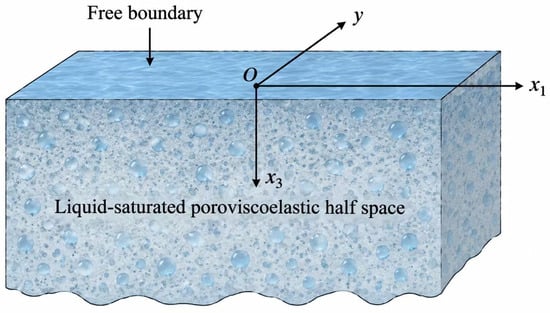
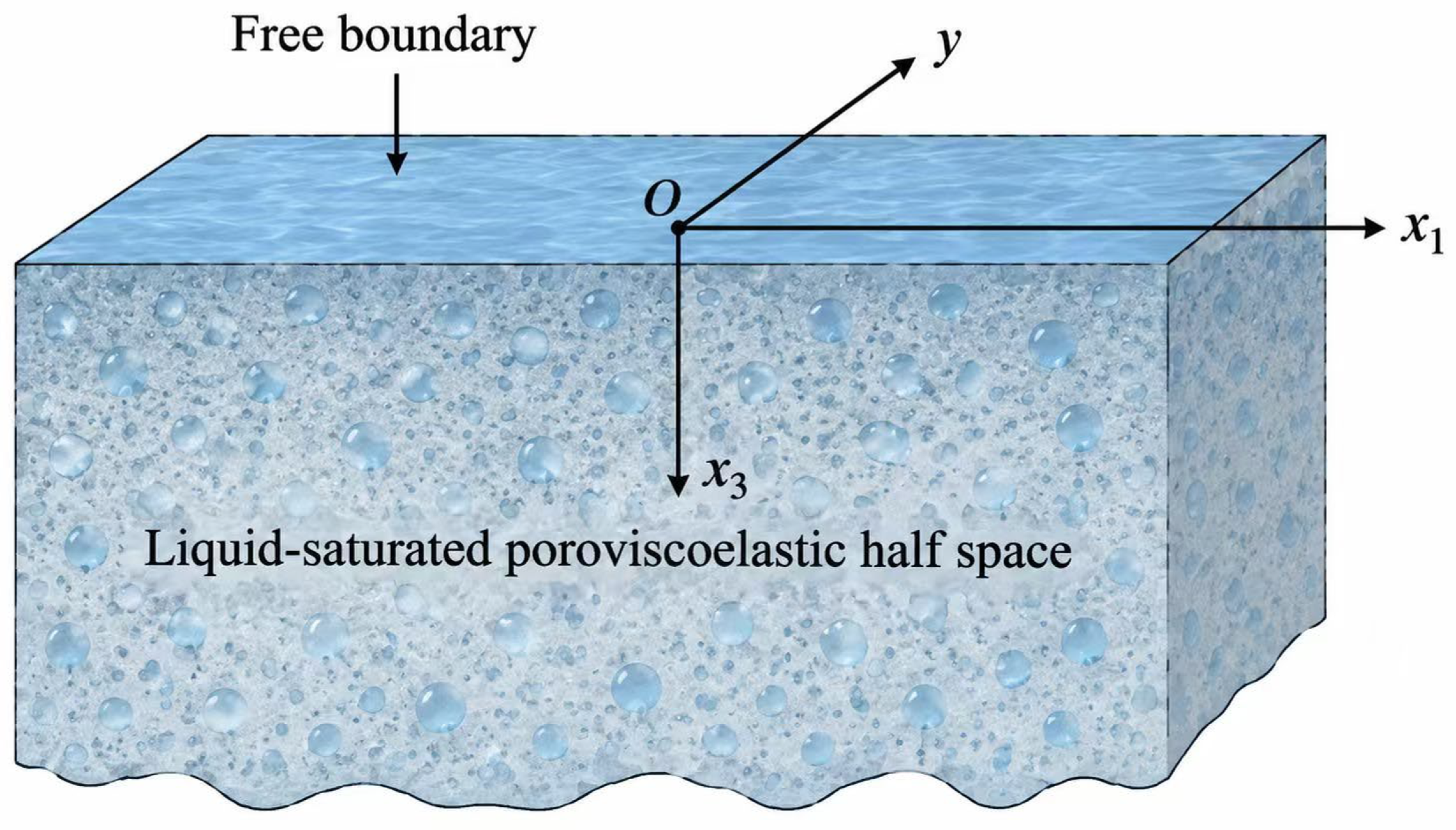
We consider a liquid-saturated poroviscoelastic half-space and a Rayleigh wave propagating along the positive direction of x1, as shown in Figure 1.
Figure 1.
3D schematic of liquid-saturated poroviscoelastic half-space.
2.1. Fractional Liquid-Saturated Poroviscoelastic BISQ Model
A fractional Zener model [9] with fractional derivative, which is a generalization of the integer-order derivative for the viscoelastic solid frame, can reflect the historic dependence of the physical phenomenon.
The fractional Zener model employs the causal Riemann–Liouville fractional derivative, whose non-local integral nature naturally describes the memory-dependent viscoelastic response of rock soil geomaterials; the stress–strain state depends on the full deformation history rather than only the instantaneous state.
The constitutive equation of the fractional Zener model is
where σ, ε, tσ, and tε, respectively, are the stress, strain, stress relaxation times, and strain relaxation times. The fractional-order derivative is defined as follows:
Dγ denotes the Riemann–Liouville fractional derivative operator of time defined as [17]
where Γ(∙) is the Gamma function and γ is the order of fractional derivative. The Fourier transform of a continuous function f(t) that is integrable on the whole real line is defined by [18]
and the Fourier transform for the causal Riemann–Liouville fractional derivative of order γ is [18]
The principal branch −π < arg(iω) ≤ π is adopted to guarantee causality, and the Fourier transform for the Riemann–Liouville fractional integral of order 1 − γ is [19]
the Fourier transform convention used throughout this manuscript is defined as .
Applying the Fourier transform to Equation (1), the complex moduli and of the fractional Zener model can be expressed as
where Kb0 and μ0 are the bulk modulus and the shear modulus of the drained solid frame. In the limit γ1 → 0 and γ2 → 0, the fractional Zener model degenerates to the classical elastic model; the fractional derivative operators D0 becomes the identity operator, and Equation (1) reduces to the linear elastic constitutive relation σ = G0ε so that and . This limiting behavior is mathematically consistent with the physical requirement that a zero fractional order implies an instantaneous (elastic) stress–strain relationship. A fractional non-Newtonian viscosity (Scott–Blair fractional viscoelastic fluid model), which can show the non-Newtonian effect of viscoelastic pore fluid, is introduced for the pore fluid. The fractional constitutive equation of fluid can be expressed as [20]
where σrz, εrz, and ηf are the shear stress, the shear strain, and the material constant of fluid. To take into account the viscoelasticity of the solid frame and pore fluid, the fractional liquid-saturated viscoelastic BISQ model has the frequency-dependent complex modulus and the frequency-dependent viscous coefficient. The constitutive equations and governing equations of the liquid-saturated poroviscoelastic solid of the fractional BISQ model can be expressed as [9]
and
where σij are total stress components of the bulk porous medium; εij are the strain of the solid frame; ∇ denotes the gradient operator; u and U are the displacement vector of the solid frame and liquid; e = ∇·u is the dilatational strain of the solid frame; w = ϕ(u − U), ϕ is the porosity; ζ = ∇·w is the variation in fluid content; Pf is the pressure of the pore fluid; ρs and ρf are the density of the solid phase and the mass density of the pore fluid; ρ = (1 − ϕ)ρs + ϕρf is the average mass density of the porous medium; c is the experimentally determined parameter and parameter m = cρf/ϕ; η is the fluid viscosity; and is the frequency correction function for dynamic permeability, which describes the deviation from Poiseuille flow under high-frequency loading and is a standard correction term for Biot-type porous media. After Fourier transform, the fractional viscoelastic pore fluid in Equation (6) yields frequency-dependent complex viscosity . For fractional-order viscoelastic pore fluid, the constant viscosity η in the original Newtonian viscous term is replaced by the complex viscosity . Consequently, the generalized frequency-dependent dissipation term becomes , which incorporates the fractional parameter γ3 into the governing Equation (10). κ is the permeability. Kr and Kf are the bulk modulus of the solid phase and the modulus of the pore fluid. The complex BISQ moduli
is the squirt-flow factor, where , , R is the characteristic squirt-flow length, and J0 and J1 are Bessel functions of zero and first order, respectively.
The variation of γ3 modifies the complex dissipation term in Equation (10), further changes the complex entries of matrix A in the state transfer equation, and finally alters the roots of the Rayleigh wave dispersion equation. Specifically, γ3 → 0 corresponds to an elastic-solid-like pore fluid with weak dissipation and higher equivalent stiffness, producing higher Rayleigh wave phase velocity; γ3 → 1 represents Newtonian dashpot-like viscous fluid with enhanced dissipation and reduced effective stiffness, yielding lower phase velocity.
In this paper, the causal Riemann–Liouville fractional derivative is adopted, which is widely used for viscoelastic constitutive modeling of geomaterials in the existing literature. Alternative fractional operators (e.g., Beta derivative, Caputo–Fabrizio derivative) are available; different definitions yield distinct frequency-dependent complex moduli, which will modify the predicted phase velocity and attenuation of seismic waves. The Beta derivative finds more applications in diffusion-type problems, while its application for saturated porous rock wave propagation remains limited. Investigating wave behaviors under other fractional derivative formulations can be considered in future work.
2.2. The State Transfer Equation Under the Fractional BISQ Model
Consider a liquid-saturated poroviscoelastic half-space and a Rayleigh wave propagating along the positive direction of x1-axis (see Figure 1).
Based on the fractional BISQ model, the constitutive equations and the governing equations of the liquid-saturated poroviscoelastic solid have been established; see formulas (7)–(10).
The displacement component of the solid frame or the pore liquid is the following form
where ω is the angular frequency and k is the complex wave number.
Define a state vector of poroviscoelastic material ξ = [U;T]T, where U = [u1,u3,w3]T is the general displacement and is the general stress. The state vector ξ satisfies the first-order matrix differential equation from Equations (7) to (11)
where
the derivation of matrix A for Equation (13) is provided in Appendix A.
Let us call Equation (13) the state transfer equation of the Rayleigh wave for the liquid-saturated poroviscoelastic material under the fractional BISQ model.
3. The Surface Stiffness Matrix of Liquid-Saturated Poroviscoelastic Half-Space
In order to derive the dispersive equation of a Rayleigh wave on halfspace, the transfer matrix of the poroviscoelastic material and the transfer matrix of half-space are firstly derived, respectively, and further obtain the surface stiffness matrix of liquid-saturated poroviscoelastic half-space.
3.1. The Transfer Matrix of the Poroviscoelastic Material
For the liquid-saturated poroviscoelastic material, define the transfer matrix , which relates the state vectors at x3 and by
Substituting Equation (14) into Equation (12), we have the following differential equation for :
where I6×6 denotes 6 × 6 the identity matrix. Because A is a constant matrix, the transfer matrix of Equation (13) can be expressed as
From Equations (14) and (16), the state vector ξ of the liquid-saturated poroviscoelastic material can be expressed as
Define the stiffness matrix of the liquid-saturated poroviscoelastic material, which relates the general stress at x3(T(x3)) and ) to the general displacements U(x3) and :
where
in which Kij i,j = 1,2 are 3 × 3 sub-blocks.
3.2. Surface Transfer and Surface Stiffness Matrix of the Poroviscoelastic Half-Space
Let λn(n = 1,…,6) and W be the eigenvectors corresponding with the eigenvalues of matrix A. The eigenvalues λn(n = 1,…,6) representing six harmonic plane waves are divided into two groups, namely, satisfying Im(λn) > 0 and satisfying Im(λn) < 0. From Equation (17), represents three attenuated harmonic plane waves along the positive direction of x3-axis, and represents three attenuated harmonic plane waves along the negative direction of x3-axis. W is also divided into two sub-matrices, and , corresponding with and , respectively, and P+, D+, P−, D− are all 3 × 3 matrices. The inverse matrix of W is written as
For an homogeneous poroviscoelastic half-space, as shown in Figure 1, the displacement components tend to zero at x3 → +∞. Only three eigenvalues satisfying Im(λn) > 0, namely, are retained. The fundamental sound tensor of poroviscoelastic half-space is thus obtained by
From Equation (16), we have
where
Equation (22) is called the transfer matrix of the poroviscoelastic half-space. From Equation (17), the state vector ξ0 of the poroviscoelastic half-space satisfies
Further, inserting Equation (22) into Equation (23), namely
For the homogeneous half-space, the state vector solution considering only decaying eigen-modes Im(λn) > 0 can be expressed as , where C+ denotes the constant amplitude vector of decaying eigen-modes. Separating the generalized displacement and generalized stress components yields
Eliminating the amplitude vector C+ from the displacement relation gives
Substituting C+ into the stress equation, we obtain
Evaluating at the free surface x3 = 0, (identity matrix). Substituting this identity matrix into the above formula directly leads to Equation (25). No matrix commutation assumption is required in this derivation.
Define the surface stiffness matrix KS, which relates the generalized traction vector TS(x3 = 0) with the generalized displacement vector US(x3 = 0) by
TS(x3 = 0) = KSUS(x3 = 0)
From Equations (18), (19), (25) and (26), we obtain the surface stiffness matrix KS of the poroviscoelastic half-space:
3.3. The Dispersive Equation of Rayleigh Waves
Now, let us consider two kinds of surface conditions of liquid-saturated poroviscoelastic half-space.
The mechanically traction-free and permeable solid conditions at x3 = 0 satisfy
namely
σ13(0) = 0,σ33(0) = 0; Pf(0) = 0
TS(0) = 0
Inserting Equation (28) into Equation (26) leads to a homogeneous algebraic equation, and the existence of nontrivial solution requires
det(KS) = 0
It gives the dispersive relation of the Rayleigh wave under the permeable condition.
- (1)
- The mechanically traction-free and impermeable solid conditions at x3 = 0 satisfy
σ13(0) = 0,σ33(0) = 0; w3(0) = 0
Inserting Equation (31) into Equation (26) leads to
where [kij] = KS.
The nontrivial solution exists when
namely,
Equation (34) is the dispersive equation of Rayleigh wave under the impermeable condition.
3.4. Numerical Algorithm for Solving the Dispersion Equation
The dispersion Equation (29) or Equation (33) is a complex-valued, transcendental equation in the complex Rayleigh wave number k. To solve this equation, the Muller method [21] is employed, which is a derivative-free iterative root-finding algorithm that generalizes the secant method by using quadratic interpolation through three initial points. The convergence tolerance is set to 10−10. To avoid missing roots, a systematic search strategy is adopted: the real and imaginary parts of the initial guess are varied over a grid covering the expected range of phase velocities (100–5000 m/s) and attenuation coefficients (0–500 m−1), respectively. The numerical integration of Bessel functions uses adaptive quadrature with a relative tolerance of 10−8.
4. Numerical Results and Discussion
In this section, numerical examples are presented to investigate the propagation characteristics of Rayleigh waves in the liquid-saturated poroviscoelastic half-space based on the fractional BISQ model. The effects of frequency, boundary permeability, solid skeleton viscoelasticity, pore fluid viscosity, and characteristic squirt-flow length on the Rayleigh wave velocity are discussed in detail. The material parameters used in the numerical calculations are listed in Table 1.
Table 1.
Poroviscoelastic material parameters [9,10].
Unless otherwise specified, the following parameter values are adopted for the fractional BISQ model: γ1 = γ2 = 0.1, γ3 = 0.3, R = 0.3 m.
4.1. Effect of Frequency on Rayleigh Wave Velocity
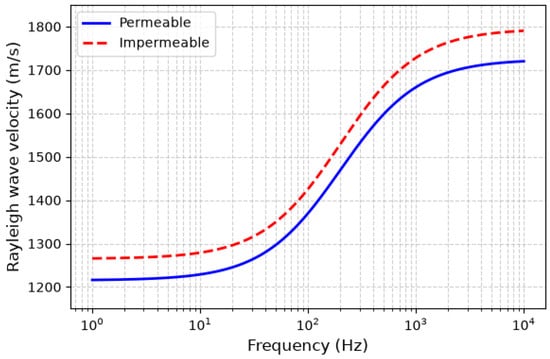
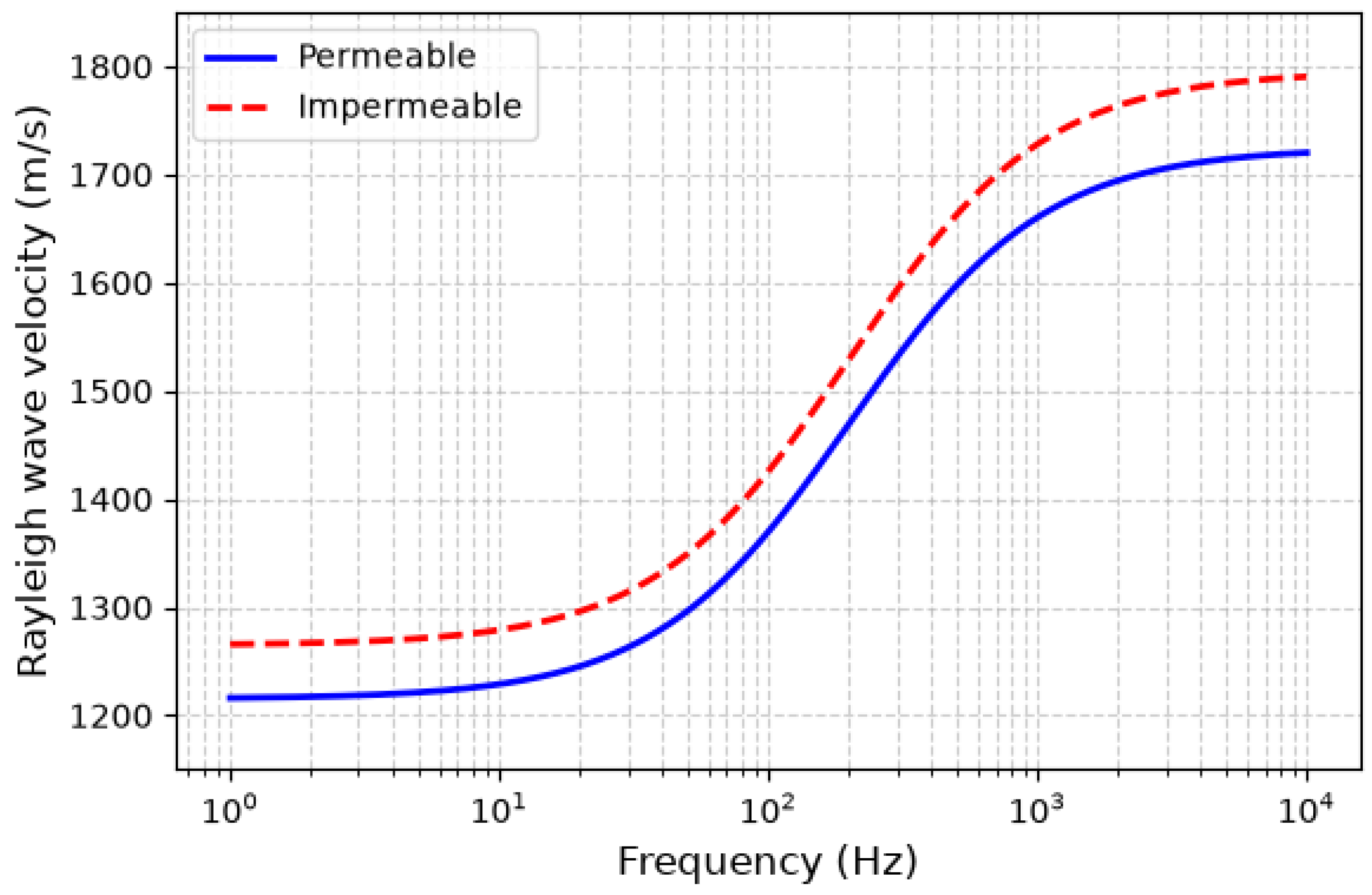
Figure 2 illustrates the variation of the Rayleigh wave phase velocity vR with frequency f under both permeable and impermeable surface conditions. The Rayleigh wave velocity is found to increase monotonically with frequency, displaying typical dispersive characteristics that evolve from a low-frequency plateau toward a high-frequency plateau. This behavior matches the predictions of the classical Biot theory and the BISQ model as reported by Dvorkin and Nur [8], Liu et al. [22], and Kang et al. [9]. The transition occurs around the characteristic frequency
where viscous dissipation effects are most significant.
ωc = ηϕ/(κρf)
Figure 2.
Variation of Rayleigh wave phase velocity with frequency under permeable and impermeable surface conditions. Fixed parameters: γ1 = γ2 = 0.1, γ3 = 0.3, R = 0.3 m; other material parameters are given in Table 1.
The Rayleigh wave velocity under the permeable boundary is slightly lower than that under the impermeable boundary across the entire frequency range. This is attributed to the fact that the permeable surface allows pore fluid to drain freely, leading to a reduction in the effective stiffness of the near-surface region. The velocity difference between the two boundary conditions is most obvious in the intermediate frequency band. The difference tends to vanish as frequency further increases toward infinity. Only partial convergence can be observed within the present computational frequency range up to 104 Hz, as fluid cannot flow across the surface boundary under extremely high-frequency excitation.
It should be noted that the apparent discrepancy of baseline Rayleigh wave velocity among Figure 2, Figure 3, Figure 4 and Figure 5 originates from different boundary condition settings. Figure 2 contains both permeable and impermeable results, while Figure 3, Figure 4 and Figure 5 are all computed under the impermeable boundary condition. The baseline curve for the impermeable case in Figure 2 is consistent with the baseline results in Figure 3, Figure 4 and Figure 5.
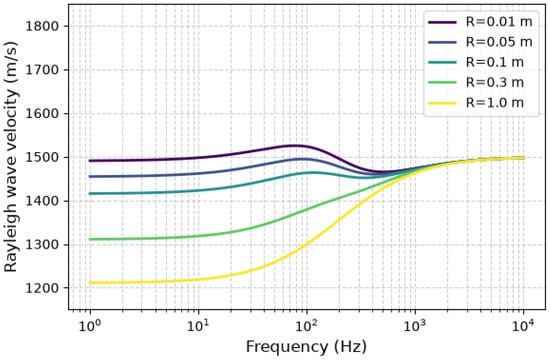
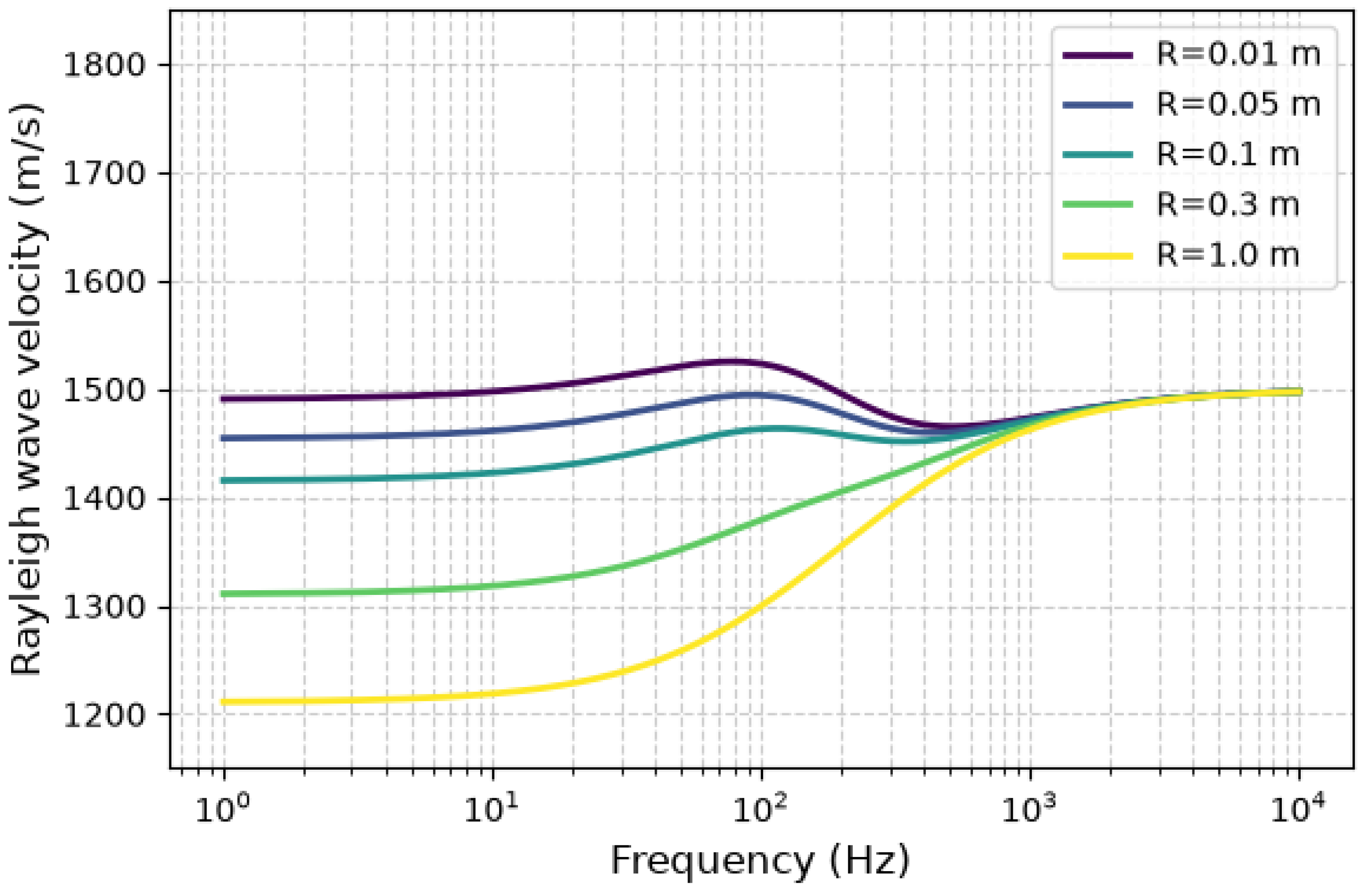
Figure 3.
Variation of Rayleigh wave phase velocity with frequency for different values of characteristic squirt-flow length R. Variation of Rayleigh wave phase velocity with frequency for different values of characteristic squirt-flow length R. Calculated under impermeable boundary condition. Fixed parameters: γ1 = γ2 = 0.1, γ3 = 0.3; other material parameters are given in Table 1.
Figure 4.
Variation of Rayleigh wave phase velocity with frequency for different values of solid skeleton fractional order parameters γ1 and γ2. Calculated under impermeable boundary condition. Fixed parameters: γ3 = 0.3, R = 0.3; other material parameters are given in Table 1.
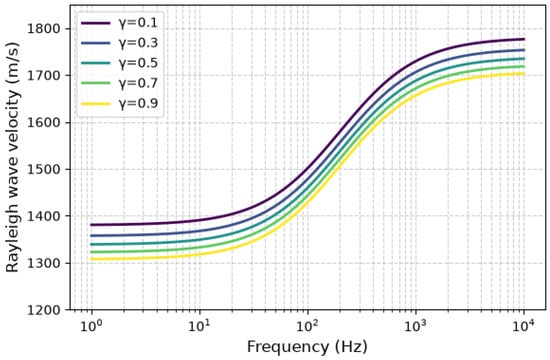
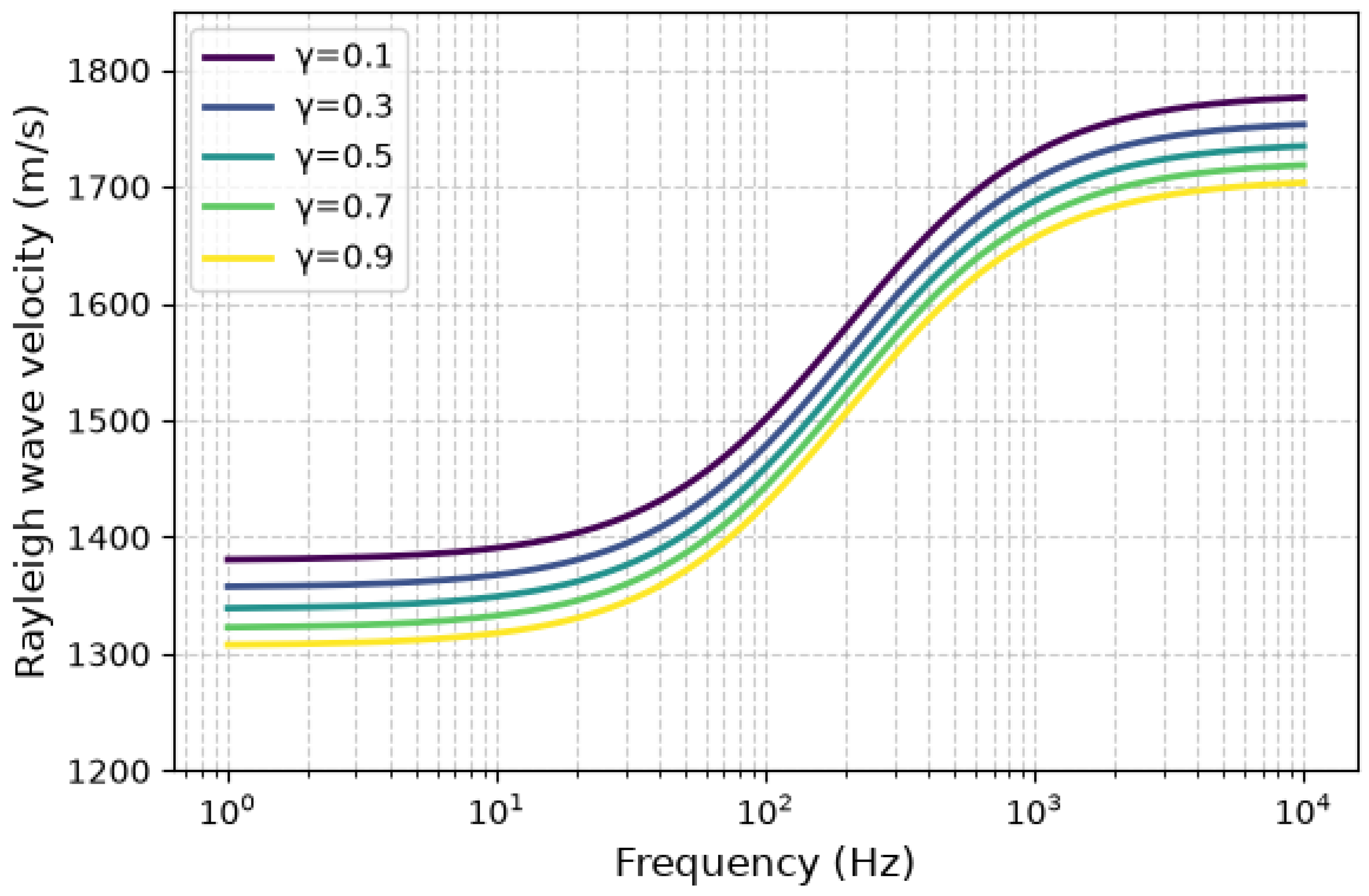
Figure 5.
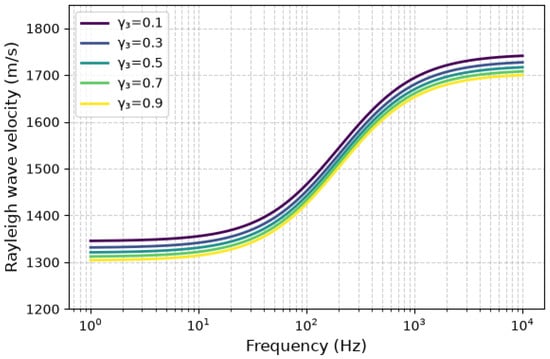
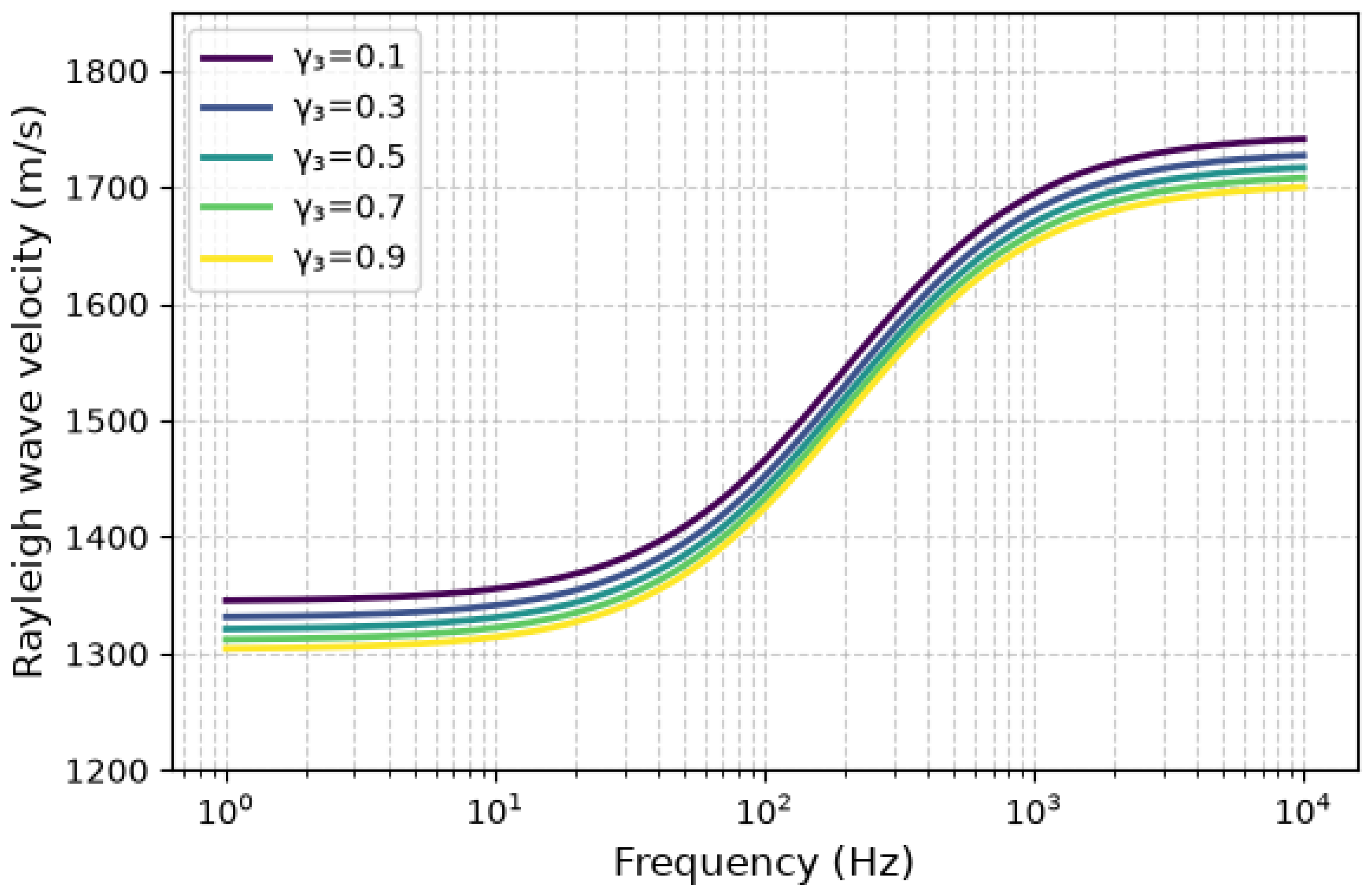
Variation of Rayleigh wave phase velocity with frequency for different values of fluid fractional order parameter γ3. Fixed parameters: γ1 = γ2 = 0.1, γ3 = 0.3, R = 0.3 m; other material parameters are given in Table 1.
4.2. Effect of Characteristic Squirt-Flow Length on Rayleigh Wave Velocity
Figure 3 shows the variation of the Rayleigh wave phase velocity vR with frequency f and compares the effects of different characteristic squirt-flow lengths R. R can be regarded as a measure of the local radial inhomogeneity of the pore fluid. A smaller characteristic squirt-flow length R produces stronger local pore fluid squirt-flow effects. As R increases, the squirt-flow effect gradually weakens, and the BISQ model tends toward the classical Biot theory. The jet flow effect becomes negligible for sufficiently large R. As R increases, the local inhomogeneity weakens, the squirt-flow phenomenon gradually disappears, and the BISQ model approaches the classical Biot model.
Globally, the Rayleigh wave phase velocity rises with increasing frequency. Nevertheless, mild local non-monotonic humps can be observed near 102 Hz for some curves, which is caused by the competition between squirt-flow relaxation and fractional viscoelastic relaxation under multi-relaxation mechanisms. At low frequencies, the Rayleigh wave velocity decreases with increasing R; at high frequencies, the curves converge to a common limit, namely the Biot high-frequency asymptotic value for fully relaxed squirt-flow.
This result is consistent with the conclusions of Kang et al. [9] and Dvorkin and Nur [8], who pointed out that the squirt-flow effect has a significant influence on wave propagation and becomes stronger as RR decreases.
In terms of the physical mechanism, as R increases, the jet effect intensifies, which reduces the real part of the complex bulk modulus (i.e., the storage modulus) and thereby lowers the P-wave velocity. The jet effect has no influence on S-waves [23,24]. Because the Rayleigh wave can be regarded as the superposition of P-waves and S-waves at the free surface of a half-infinite space, the Rayleigh wave velocity consequently decreases.
In addition, the convergence of all curves at high frequencies is an important feature of the BISQ model: squirt-flow is a low-frequency mechanism, its influence decreases as frequency increases, and the high-frequency behavior is ultimately dominated by the Biot mechanism.
In this work, the squirt-flow length is selected within 0.01 m∼1.0 m. This interval corresponds to typical pore cavity sizes of rock cores in laboratory tests reported in the literature [8,12].
4.3. Effect of Solid Skeleton Viscoelasticity on Rayleigh Wave Velocity
Figure 4 presents the variation in the Rayleigh wave phase velocity vR with frequency f for different values of the solid skeleton fractional order parameters γ1 and γ2 (where γ1 = γ2≜γ for simplicity). All curves share a common monotonic increasing trend versus frequency corresponding to the essential dispersion nature of Rayleigh waves in porous media.
The results in the figure show that the Rayleigh wave velocity decreases markedly with increasing γ1 and γ2. This is consistent with the findings of Ma et al. [13] and Li et al. [15], who likewise observed that the larger the fractional order index, the lower the Rayleigh wave phase velocity. The physical reason for this phenomenon is that when the fractional order parameter is relatively small, the mechanical response of the solid skeleton is more elastic in nature and the viscous effect is relatively weak.
In the limiting case of γ1,γ2 → 0, the complex moduli and approach their elastic values Kb0 and μ0, respectively, so that the medium exhibits higher effective stiffness and the wave velocity increases accordingly. In contrast, an increase in the fractional order parameter reflects stronger viscoelastic dissipation, which lowers the effective moduli and leads to a decrease in the wave velocity.
Another point worth noting is that under high-frequency conditions, the regulating effect of γ1 and γ2 on the Rayleigh wave velocity is more pronounced. This phenomenon arises because viscoelastic relaxation is not frequency-independent but instead exhibits a stronger effect within the frequency interval where the relaxation time is comparable to the wave period.
4.4. Effect of Pore Fluid Viscosity on Rayleigh Wave Velocity
Figure 5 displays the frequency dependence of the Rayleigh wave phase velocity vR for several values of the fluid fractional order parameter γ3. This parameter γ3 quantifies the non-Newtonian behavior of the pore fluid, with γ3 = 0 and γ3 = 0 representing the two limiting cases of an elastic solid-like fluid (Hookean spring) and a Newtonian viscous fluid (dashpot), respectively.
All curves in Figure 5 show the same monotonic rise with frequency, consistent with the basic dispersion law. The Rayleigh wave velocity declines monotonically as γ3 grows. This arises because a smaller γ3 (near 0) indicates that the pore fluid is more elastic-solid-like, with greater energy storage and higher equivalent stiffness, leading to higher wave velocities. Conversely, a larger γ3 (near 1) indicates that the pore fluid is more Newtonian-viscous-like, with energy dissipation dominating and equivalent stiffness reduced, leading to lower wave velocities.
The parameter γ3 quantifies the non-Newtonian property of pore fluid. When γ3 → 0, the pore fluid behaves in an elastic-solid-like manner with weak dissipation and high equivalent stiffness, producing higher Rayleigh wave velocity. When γ3 → 1, the pore fluid approaches a Newtonian dashpot-like viscous fluid; enhanced dissipation reduces the equivalent stiffness and yields lower phase velocity. The influence of γ3 on wave velocity is relatively weaker compared with the solid skeleton fractional parameters γ1 and γ2 because the overall medium stiffness is predominantly controlled by the solid skeleton. This observation is consistent with previous results reported by Kang et al. [12].
4.5. Summary of Parametric Effects
The following conclusions can be drawn from the above numerical results:
- (1)
- In a liquid-saturated poroviscoelastic half-space, the Rayleigh wave velocity shows significant dispersion, rising monotonically with frequency and shifting from a low-frequency plateau to a high-frequency plateau. This trend remains consistent for all parameter combinations and is in agreement with classical Biot theory and the BISQ model.
- (2)
- The viscoelasticity of the solid skeleton, as characterized by the fractional order parameters γ1 and γ2, exerts a notable effect on the Rayleigh wave velocity. Because γ1,γ2 → 0 corresponds to the elastic limit (where and ), smaller fractional order values lead to higher wave velocities. The larger the fractional order value, the more pronounced the viscoelastic dissipation, which decreases the effective stiffness and consequently reduces the wave velocity.
- (3)
- In addition to the solid skeleton factors, the pore fluid viscosity described by the fractional order parameter γ3 is also a factor affecting the Rayleigh wave velocity. Because γ3 → 0 corresponds to an elastic solid-like fluid and γ3 → 1 corresponds to a Newtonian viscous fluid, the velocity decreases with increasing γ3. The influence is relatively smaller than that of the solid skeleton viscoelasticity.
- (4)
- The squirt-flow effect characterized by the characteristic length R significantly influences the Rayleigh wave velocity in the low-frequency range. Smaller R values (stronger squirt-flow effect) result in higher wave velocities at low frequencies, while all curves converge to a common high-frequency limit.
- (5)
- The permeable surface condition yields slightly lower Rayleigh wave velocities compared with the impermeable condition, with the difference diminishing at very high frequencies.
The above findings reveal that in liquid-saturated porous media, an accurate characterization of Rayleigh wave propagation depends on a comprehensive consideration of the viscoelasticity of the solid skeleton, the viscoelasticity of the pore fluid, and the squirt-flow mechanism. The surface stiffness matrix method combined with the fractional BISQ model provides a stable and effective framework for such analyses, with the distinct advantage of maintaining numerical stability while capturing the full frequency-dependent behavior of the medium.
5. Conclusions and Future Work
This paper derives the surface stiffness matrix for fractional liquid-saturated poroviscoelastic BISQ half-space, obtains Rayleigh wave dispersion equations for permeable and impermeable boundaries, and conducts parametric numerical analysis. The main conclusions are summarized as follows:
- (1)
- With the surface stiffness matrix method, the state transfer equation for Rayleigh wave propagation in liquid-saturated poroviscoelastic half-spaces is derived considering fractional viscoelasticity and squirt-flow (BISQ) effects. The transfer matrix and surface stiffness matrix are constructed, and the frequency–dispersion relationship of Rayleigh waves is acquired subject to traction-free, permeable, and impermeable boundary conditions.
- (2)
- Numerical simulations demonstrate that the Rayleigh wave velocity strongly depends on the characteristic squirt-flow length as well as fractional viscoelastic properties of solid and liquid phases. Squirt-flow effect and viscoelasticity jointly govern the dispersion behavior of Rayleigh waves.
- (3)
- The proposed surface stiffness matrix approach overcomes the high-frequency numerical instability encountered by conventional transfer matrix methods for fractional BISQ Rayleigh wave problems. This method offers a stable numerical framework for wave analysis of saturated porous viscoelastic media and provides references for geophysical and engineering wave-propagation research.
For future work, several research directions are worthy of further exploration. First, the present theory can be extended to multi-layered fractional BISQ porous media. Second, other fractional derivative definitions including Beta derivative can be implemented to compare their influences on surface wave responses. Third, partial saturation effect can be incorporated. Fourth, experimental laboratory or field seismic datasets will be used to further calibrate the fractional viscoelastic parameters.
Author Contributions
Methodology, T.M.; writing—review and editing, T.M., L.L., and X.M.; supervision, T.M.; project administration, T.M.; funding acquisition, T.M.; software, X.M.; data curation, T.M. and X.M.; writing—original draft, T.M. and X.M.; visualization, X.M. All authors have read and agreed to the published version of the manuscript.
Funding
Tengyu Ma was supported by the National Natural Science Foundation of China (No. 42371113) and the Heilongjiang Provincial Natural Science Foundation of China (No. JJ2026PL0133), Xinzhu Ma was supported by the Shenyang Agricultural University Innovation Training Program (No. X202510157023).
Data Availability Statement
The original contributions presented in this study are included in the article. Further inquiries can be directed to the corresponding author.
Conflicts of Interest
The authors declare no conflicts of interest.
Appendix A
Derivation of matrix A in Equation (10):
Because the Rayleigh wave considered in this paper propagates in the x1x3 plane, we assume the potential functions take the following form:
where f(x3) denotes the amplitude along the x3 direction.
From Equations (7) and (10), after some algebraic manipulations, we obtain
where
Substituting Equation (A4) into Equation (A3) and simplifying yields
From Equation (8), we further obtain
Substituting Equation (A4) into Equation (A6), we obtain
From Equation (9), we further obtain
−ikσ11 + σ13,3 = (iω)2ρu1 − (iω)2ρfw1
Combining Equations (7) and (A4) and carrying out a series of algebraic manipulations and simplifications, we finally obtain
Combining Equations (7) and (9), we obtain
Finally, from Equation (10),
which yields
Combining Equations (A2), (A5), (A7), (A9), (A10), and (A11), we cast them into a matrix equation in terms of the state vector, which is Equation (10).
References
- Rayleigh, L. On waves propagating along the plane surface of an elastic bar. Proc. Lond. Math. Soc. 1885, 17, 4–11. [Google Scholar] [CrossRef] [Scilit]
- Biot, M.A. Theory of propagation of elastic waves in a fluid-saturated porous solid. I. Low-frequency range. J. Acoust. Soc. Am. 1956, 28, 168–178. [Google Scholar] [CrossRef] [Scilit]
- Jones, J.P. Rayleigh waves in a porous, elastic, saturated solid. J. Acoust. Soc. Am. 1961, 33, 959–962. [Google Scholar] [CrossRef] [Scilit]
- Tajuddin, M. Rayleigh waves in a poroelastic half-space. J. Acoust. Soc. Am. 1984, 75, 682–684. [Google Scholar] [CrossRef] [Scilit]
- Yang, J. Rayleigh surface waves in an idealized partially saturated soil. Géotechnique 2005, 55, 409–414. [Google Scholar] [CrossRef]
- Lo, W.C. Propagation and attenuation of Rayleigh waves in a semi-infinite unsaturated poroelastic medium. Adv. Water Resour. 2008, 31, 1399–1410. [Google Scholar] [CrossRef] [Scilit]
- Chen, W.; Xia, T.; Hu, W. A mixture theory analysis for the surface-wave propagation in an unsaturated porous medium. Int. J. Solids Struct. 2011, 48, 2402–2412. [Google Scholar] [CrossRef] [Scilit]
- Dvorkin, J.; Nur, A. Dynamic poroelasticity: A unified model with the squirt and the Biot mechanisms. Geophysics 1993, 58, 524–533. [Google Scholar] [CrossRef] [Scilit]
- Kang, Y.; Wei, P.; Li, Y.; Zhang, P. Elastic waves propagation through a liquid-saturated poroelastic interlayer based on the fractional viscoelastic BISQ model. Waves Random Complex Media 2021, 34, 2268–2296. [Google Scholar] [CrossRef] [Scilit]
- Stoll, R.D. Acoustic waves in ocean sediments. Geophysics 1977, 42, 715–725. [Google Scholar] [CrossRef] [Scilit]
- Parra, J.O. The transversely isotropic poroelastic wave equation including the Biot and the squirt mechanisms: Theory and application. Geophysics 1997, 62, 309–318. [Google Scholar] [CrossRef] [Scilit]
- Yang, D.; Zhang, Z. Poroelastic wave equation including the Biot/squirt mechanism and the solid/fluid coupling anisotropy. Wave Motion 2002, 35, 223–245. [Google Scholar] [CrossRef] [Scilit]
- Nie, J.; Yang, D.; Yang, H. A generalized viscoelastic Biot/squirt model for clay-bearing sandstones in a wide range of permeabilities. Appl. Geophys. 2008, 5, 249–260. [Google Scholar] [CrossRef] [Scilit]
- Ma, X.; Ma, T. Propagation behaviors of Rayleigh waves in partially saturated poroviscoelastic half-space. Mathematics 2026, 14, 2608. [Google Scholar] [CrossRef] [Scilit]
- Zheng, L.; Li, H.; Wan, Y.; Zhang, Y.; Zhu, S. Seismic response analysis of a seawater-stratified seabed- bedrock system based on a fractional derivative viscoelastic model. Appl. Math. Model. 2025, 140, 115901. [Google Scholar] [CrossRef] [Scilit]
- Li, L.; Zhuang, W. Rayleigh wave propagation on the partially saturated poro-thermo-viscoelastic half-space based on fractional order viscoelasticity. Math. Math. 2026, 14, 1751. [Google Scholar] [CrossRef] [Scilit]
- Mainardi, F. Fractional Calculus and Waves in Linear Viscoelasticity-an Introduction to Mathematical Models; Imperial College Press: London, UK, 2010. [Google Scholar]
- Podlubny, I. Fractional Differential Equations; Academic Press: New York, NY, USA, 1999. [Google Scholar]
- Bagley, R.L.; Torvik, P.J. On the fractional calculus model of viscoelastic behavior. J. Rheol. 1986, 30, 133–155. [Google Scholar] [CrossRef] [Scilit]
- Schiessel, H.; Metzler, R.; Blumen, A.; Nonnenmacher, T.F. Generalized viscoelastic models: Their fractional equations with solutions. J. Phys. A-Math. Theor. 1995, 28, 6567–6584. [Google Scholar] [CrossRef] [Scilit]
- Muller, D.E. A method for solving algebraic equations using an automatic computer. Math. Tables Other Aids Comput. 1956, 10, 208–215. [Google Scholar] [CrossRef] [Scilit]
- Liu, H.; Zhou, F.; Wang, L.; Zhang, R. Propagation of Rayleigh waves in unsaturated porothermoplastic media. Int. J. Numer. Anal. Methods Geomech. 2020, 44, 1656–1675. [Google Scholar] [CrossRef] [Scilit]
- Yang, D.; Shen, Y.; Liu, E. Wave propagation and the frequency domain Green’s functions in viscoelastic Biot/squirt (BISQ) media. Int. J. Solids Struct. 2007, 44, 4784–4794. [Google Scholar] [CrossRef] [Scilit][Green Version]
- Chen, Y.; Zong, Z.; Zhu, H. Biot-spherical squirt (BISSQ) model for wave attenuation and dispersion. Geophys. J. Int. 2022, 231, 1138–1149. [Google Scholar] [CrossRef] [Scilit]

Disclaimer/Publisher’s Note: The statements, opinions and data contained in all publications are solely those of the individual author(s) and contributor(s) and not of MDPI and/or the editor(s). MDPI and/or the editor(s) disclaim responsibility for any injury to people or property resulting from any ideas, methods, instructions or products referred to in the content. |
© 2026 by the authors. Licensee MDPI, Basel, Switzerland. This article is an open access article distributed under the terms and conditions of the Creative Commons Attribution (CC BY) license.