


Abstract
To improve cross-modal interaction modeling while controlling the complexity of multimodal fusion, this paper proposes a multimodal fake news detection framework that integrates textual and visual information through cross-modal attention and a lightweight bilinear pooling module at the fusion stage, while retaining BERT-BiLSTM and ResNet-50 as the textual and visual encoders. Cross-modal attention performs text-conditioned visual weighting, while lightweight bilinear pooling captures compact second-order cross-modal interactions. The lightweight bilinear pooling module reduces the dimensional and parameter overhead associated with conventional full bilinear interaction while preserving effective cross-modal interaction modeling. The model achieves an accuracy of nearly 93% on the Weibo dataset, outperforming the compared baseline methods. Ablation studies and projection-dimension analyses further support the effectiveness and complementary roles of the two fusion components under the evaluated Weibo setting.
1. Introduction
The research background of fake news detection stems from the rapid advancement of information technology and the widespread adoption of social media in recent years. With the continuous improvement of Internet infrastructure and the pervasive use of smartphones, the ways in which people access information have undergone a fundamental transformation. With the rapid growth of social media platforms, news content is increasingly disseminated in multimodal forms, where textual descriptions are commonly accompanied by images. This change makes fake news detection not only a problem of textual semantic understanding, but also a problem of visual evidence analysis and cross-modal consistency modeling.
From a scientific and technical perspective, fake news detection has evolved from text-centric analysis toward multimodal information processing. Text-based methods focus on linguistic patterns, semantic representations, and contextual dependencies, but they are unable to verify whether the associated visual content supports or contradicts the textual claim. Image-based methods can capture visual manipulation traces or suspicious visual patterns, yet they are generally insufficient for understanding the semantic relationship between visual evidence and news text. Therefore, recent studies have increasingly investigated multimodal fake news detection, aiming to jointly exploit textual semantics, visual representations, and their cross-modal relationships. More importantly, multimodal misinformation is not always characterized by suspicious cues within an individual modality. In many cases, the textual description and the associated image may each appear plausible when examined independently, while the misinformation arises from an inconsistent or misleading text–image pairing. For example, an authentic image may be reused to support a description of a different event, location, or time [1]. In such cases, the discriminative evidence lies not only in the individual modalities, but also in their semantic relationship. Therefore, the central challenge extends beyond simply aggregating heterogeneous features to effectively modeling how textual and visual evidence are associated.
Against this background, a variety of fake news detection models have been developed. Early approaches predominantly relied on unimodal information, with particular emphasis on textual features. However, due to the absence of complementary visual evidence, such methods are often insufficient for detecting the increasingly prevalent text–image fake news on social media platforms. Consequently, research efforts have progressively shifted toward the development of multimodal fake news detection models [2]. Nevertheless, existing multimodal fusion strategies do not address cross-modal relational information equally well. Feature concatenation, weighted aggregation, and shared representation learning can combine heterogeneous information, but complex dependencies between textual and visual features are largely left to subsequent nonlinear transformations to be learned implicitly. When authentic and misleading samples contain similar modality-specific cues but differ primarily in how those cues are associated across modalities, such fusion may produce insufficiently discriminative representations.
Numerous existing studies have employed attention mechanisms to facilitate deep interaction and fusion across modalities, such as text and images [3]. Attention mechanisms enable dynamic weighting of different modalities or semantic regions according to task-specific requirements, thereby amplifying pertinent information while suppressing redundant or noisy signals, which in turn markedly improves fusion efficacy and enhances the model’s sensitivity to critical cues [4]. Cross-modal attention further facilitates semantic correspondence by identifying visual evidence that is relevant to the textual context. However, its primary role is relevance estimation and feature reweighting, whereas multiplicative dependencies between heterogeneous feature dimensions are not explicitly parameterized. Consequently, when the distinction between real and fake news depends on specific combinations of textual and visual cues rather than on their individual salience, relevance-based fusion alone may be insufficient to distinguish misleading from authentic text–image pairs with similar unimodal evidence.
In the context of multimodal fake news detection, bilinear pooling has been widely adopted due to its capacity to effectively capture second-order interaction relationships between heterogeneous modalities [5]. Such second-order interaction is particularly relevant to multimodal fake news detection because it explicitly represents the joint activation of textual and visual features, providing a direct means of characterizing cross-modal dependency patterns that may be obscured by first-order aggregation or relevance-based weighting. Nevertheless, fake news detection models grounded in conventional bilinear pooling typically depend on high-dimensional outer-product operations to enumerate pairwise feature interactions across modalities. While this strategy enriches cross-modal representations, it inevitably produces redundant interaction patterns and leads to substantial dimensional expansion. This creates an expressiveness–efficiency trade-off: explicit second-order interaction improves the capacity to characterize complex cross-modal relationships, whereas exhaustive pairwise interaction substantially increases representation dimensionality and computational overhead. These limitations call for a multimodal fusion mechanism that can retain the discriminative strength of second-order cross-modal interaction while avoiding unnecessary feature expansion and redundant computation.
Accordingly, an unresolved challenge in multimodal fake news detection is how to jointly achieve text-conditioned visual relevance modeling, explicit second-order dependency modeling, and computationally compact feature fusion.
To address this challenge, this paper proposes SLBF, a multimodal fake news detection framework that integrates cross-modal attention with a lightweight bilinear pooling module. SLBF couples text-conditioned visual attention with second-order cross-modal interaction in a unified representation learning framework. Specifically, the cross-modal attention module uses the global text-level representation to estimate attention weights over individual visual feature units, thereby emphasizing visual evidence that is relevant to the overall textual semantics. The lightweight bilinear pooling module further captures multiplicative dependencies between heterogeneous modalities through shared-space projection and Hadamard product-based interaction, thereby avoiding the dimensional expansion caused by explicit outer-product operations while preserving the discriminative capacity of bilinear feature interaction.
The two modules therefore play complementary roles: cross-modal attention emphasizes semantically relevant visual evidence conditioned on the global textual representation, whereas lightweight bilinear pooling explicitly models interactions between projected textual and visual features. In this way, SLBF combines text-conditioned visual attention with compact second-order dependency modeling rather than relying on either mechanism alone.
Compared with conventional fusion strategies that mainly rely on feature concatenation or attention-based weighting, SLBF explicitly incorporates second-order cross-modal relationships, which improves the expressiveness of multimodal representations.
Meanwhile, the shared-space Hadamard interaction avoids constructing a full text–image outer-product representation, thereby reducing the computational burden associated with conventional bilinear pooling.
Experimental results on the Weibo dataset, together with ablation studies and visualization analyses, demonstrate the effectiveness of the proposed fusion strategy and further demonstrate the complementary contributions of cross-modal attention and lightweight bilinear pooling.
2. Related Works
Fake news detection has been studied using textual, visual, and social-context evidence. Text-based approaches mainly capture linguistic and semantic cues, whereas visual and context-based methods exploit image evidence, out-of-context image usage, or propagation information [1,6,7,8,9]. Although these evidence sources provide complementary information, they do not individually characterize the semantic consistency and dependencies between paired textual and visual content. This limitation has motivated increasing research on multimodal representation learning and cross-modal interaction modeling.
2.1. Fusion and General Representation Learning
A major line of multimodal fake news detection research focuses on integrating heterogeneous evidence through feature aggregation, shared representation learning, and adaptive fusion. These methods exploit the complementarity of textual and visual representations and provide richer evidence than unimodal models. Luvembe et al. [10] combined hierarchical interaction encoding with adaptive fusion to integrate textual, caption, and visual information. Zhang et al. [11] addressed modality imbalance through adaptive optimization and hierarchical multimodal fusion. Although these approaches improve multimodal information integration, fine-grained cross-modal dependencies are still largely encoded implicitly within aggregated or shared representations rather than modeled directly.
Related extensions have further explored uncertainty estimation, adaptive modality weighting, mixture-of-experts architectures, and knowledge-assisted multimodal reasoning [12,13,14,15,16]. These approaches mainly address modality reliability, adaptive aggregation, or external knowledge enhancement, rather than the compact explicit modeling of second-order cross-modal dependencies considered in this work.
2.2. Attention and Cross-Modal Alignment
Another major research direction focuses on fine-grained semantic alignment between textual and visual representations through attention, similarity modeling, and cross-modal correlation learning [17,18,19]. Qiao et al. [20] constructed fine-grained text–image correlation matrices from textual nouns and salient visual objects to capture local and global semantic correspondence. Huang et al. [21] employed stacked cross-attention to progressively align and fuse textual and visual representations. Compared with global feature aggregation, these approaches provide more explicit modeling of semantic relevance between cross-modal elements.
However, attention- and similarity-based mechanisms primarily estimate semantic relevance or correspondence and subsequently reweight or aggregate modality features. Multiplicative second-order dependencies between heterogeneous feature dimensions are therefore less explicitly represented. This limitation is particularly relevant when authentic and misleading samples exhibit similar modality-specific evidence but differ in how textual and visual cues jointly occur. It motivates complementing fine-grained semantic alignment with an explicit mechanism for modeling second-order cross-modal interactions.
2.3. Bilinear and Second-Order Interaction
Bilinear fusion provides a complementary approach by explicitly modeling multiplicative second-order dependencies between features from different modalities. Unlike feature aggregation or relevance-based weighting, bilinear interaction directly encodes joint cross-modal feature activation. Representative fake news detection methods have therefore introduced bilinear or factorized bilinear pooling into multimodal fusion. Kumari et al. [22] combined attention with factorized bilinear pooling to strengthen cross-modal interaction modeling, whereas Nadeem et al. [23] employed multimodal factorized bilinear pooling to integrate semantic, visual, and social information. Related bilinear-attention architectures have also demonstrated the utility of combining semantic weighting with multiplicative multimodal interaction [5].
The principal limitation of conventional bilinear pooling is the computational cost of explicitly enumerating pairwise feature combinations through a full outer-product representation, which can lead to substantial dimensional expansion and redundant interactions. Factorized variants reduce this expansion through low-rank decomposition, but still require additional projection or factorization operations. The remaining challenge is therefore to preserve the representational capacity of second-order cross-modal interaction while reducing the dimensional and computational overhead of bilinear fusion.
Overall, the multimodal fusion methods most closely related to this work can be summarized from three perspectives. Fusion and general representation learning improve the integration of heterogeneous modalities, but fine-grained cross-modal dependencies are often encoded implicitly. Attention and alignment methods strengthen semantic correspondence between textual and visual representations, but primarily operate through relevance estimation and feature reweighting. Bilinear methods explicitly model second-order cross-modal interactions, while conventional implementations introduce substantial dimensional and computational overhead. These limitations motivate a fusion architecture that combines text-conditioned visual attention with compact second-order cross-modal interaction. Accordingly, SLBF employs cross-modal attention for text-conditioned weighting of visual feature units and lightweight bilinear pooling for explicit second-order interaction after projecting textual and visual representations into a shared latent space, thereby avoiding full outer-product expansion.
3. Method
3.1. Problem Formulation
This study focuses on multimodal fake news detection. Given a social media post containing textual content and an associated image, the task is to determine whether the post is real or fake. Formally, let denote a multimodal fake news dataset, where represents the textual content of the i-th sample, represents the corresponding image, and denotes the ground-truth label. The objective is to learn a detection function that maps each text–image pair to a predicted probability , where indicates the probability that the sample belongs to the fake news category.
Different from unimodal fake news detection, the studied problem requires the model to consider not only modality-specific textual and visual cues, but also the semantic relationship between the two modalities. Therefore, the key problem addressed in this work is how to learn an effective multimodal representation from paired text and image inputs for real/fake news classification.
3.2. Approach and Model Overview
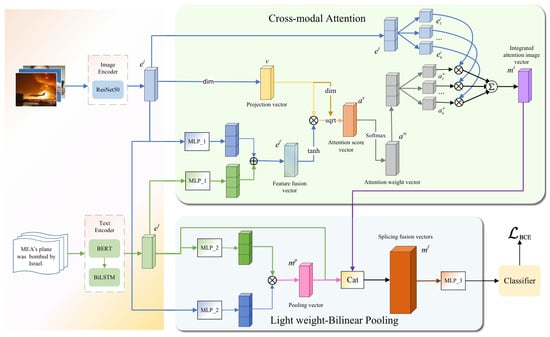
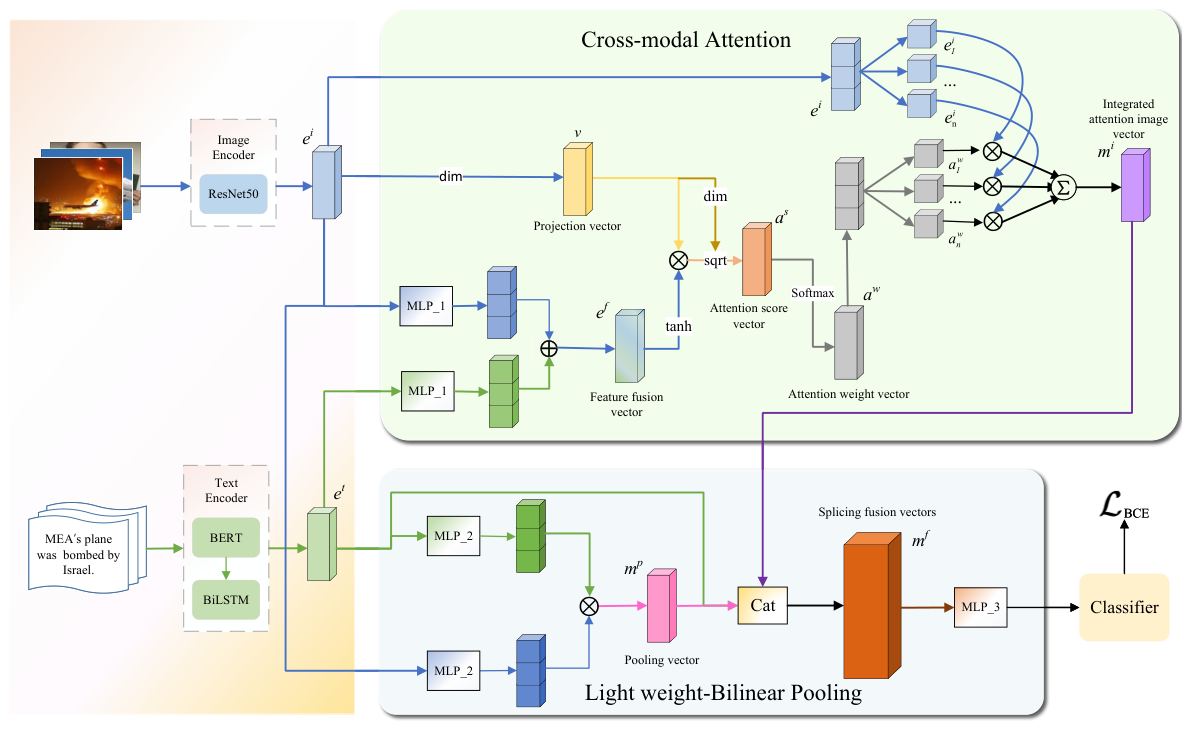
The architecture of the Synergistic Lightweight Bilinear Pooling Fusion Model (SLBF) proposed in this paper is illustrated in Figure 1. The model retains BERT-BiLSTM and ResNet-50 as its textual and visual encoders, while the lightweight design is introduced specifically at the bilinear fusion stage to reduce the dimensional expansion associated with conventional full outer-product interaction. The model employs a cross-modal attention mechanism to facilitate comprehensive feature interaction across modalities and incorporates lightweight bilinear pooling to model compact second-order cross-modal interactions, ultimately producing a synergistic dual-branch multimodal representation.
Figure 1.
The SLBF model first employs BERT to extract textual features and ResNet-50 to extract visual features. Subsequently, these features are fed into the cross-modal attention module and the lightweight bilinear pooling module, respectively. The MLPs in the two modules adopt different normalization methods to align the text and image features. Finally, the fused features from both modules are concatenated to obtain the dual-fused features.
3.3. Feature Extraction Module
3.3.1. Text Feature Extraction Module
The BERT-BiLSTM model exhibits distinctive and formidable advantages in textual feature extraction [24]. The BERT module leverages a multi-layer Transformer encoder to capture global contextual dependencies, establishing a dynamic relational network among lexical units via the self-attention mechanism. This feature extraction paradigm autonomously acquires rich linguistic knowledge, thereby generating semantic representations that are highly sensitive to contextual nuances. Subsequently, the BiLSTM module refines these features with heightened granularity: its bidirectional recurrent architecture progressively accumulates contextual information through gating mechanisms, thereby adeptly capturing localized linguistic patterns and temporal dependencies inherent in textual sequences. Such a hierarchical processing strategy enables the model to concurrently accommodate global semantic comprehension while extracting localized features, culminating in a more comprehensive and nuanced form of textual representation.
The textual representations generated by this model exhibit pronounced discriminative capacity and robustness. Through the semantic encoding afforded by BERT and the sequential modeling capabilities of BiLSTM, the model autonomously learns semantic information across varying levels of granularity—namely lexical, phrasal, and sentential—while demonstrating considerable tolerance to textual noise. This feature representation consequently preserves abundant semantic content while simultaneously encoding salient structural information. For subsequent multimodal fusion, the sequence features produced by BERT-BiLSTM are aggregated into a single text-level representation ; therefore, denotes a fixed-dimensional representation of the entire textual content rather than a token-level feature sequence.
3.3.2. Image Feature Extraction Module
ResNet-50 constitutes a canonical convolutional neural network architecture within the deep learning domain and is a member of the ResNet family, originally introduced by He et al. at Microsoft Research [25]. The principal innovation underpinning ResNet-50 resides in the introduction of the residual learning mechanism, which effectively mitigates the issues of gradient vanishing and network degradation in deep neural architectures, thereby facilitating the efficient extraction of image features.
The feature extraction process in ResNet-50 progressively derives hierarchical visual representations from raw images through a cascade of convolutional layers and residual blocks. Throughout this extraction pipeline, residual connections enable the effective integration of features across disparate hierarchical levels. As the network depth increases, the extracted features evolve from localized edge and texture patterns to constituent object parts, ultimately culminating in global representations enriched with substantial semantic information. This coarse-to-fine feature extraction paradigm empowers ResNet-50 to autonomously learn feature representations amenable to a diverse array of visual tasks. In the proposed framework, the final convolutional feature map is retained and reshaped into N spatial visual feature units for the cross-modal attention branch, while global average pooling is applied to obtain a compact visual representation for the lightweight bilinear pooling branch.
3.4. Cross-Modal Fusion
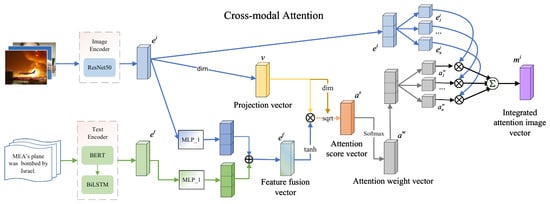
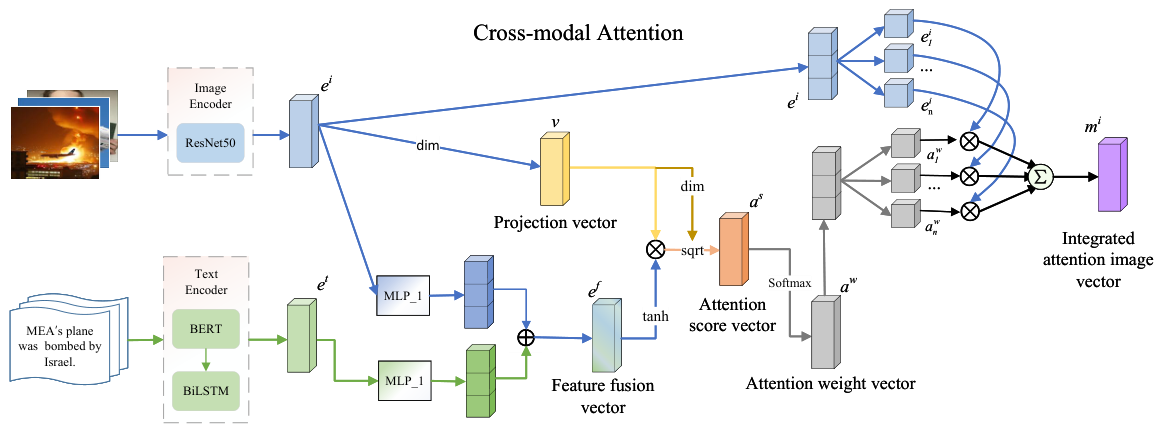
The cross-modal fusion module aims to model semantic relationships between textual information and visual feature units. Different from self-attention, which computes dependencies within a single modality, the adopted cross-modal attention mechanism uses the textual representation to estimate the relative importance of different visual feature units. Its architecture is illustrated in the Figure 2.
Figure 2.
Cross-modal attention module.
Given the text-level representation and the visual representation , where N denotes the number of visual feature units and and denote the original textual and visual feature dimensions, respectively, modality-specific nonlinear transformations are first applied to project the text-level representation and each visual feature unit into a common semantic space. The encoder-derived textual and visual representations are also used as inputs to the lightweight bilinear pooling branch.
Specifically, the textual representation is transformed as
and the r-th visual feature unit is transformed as
Here, and are learnable projection matrices in the attention branch, and are the corresponding bias terms, denotes layer normalization, and introduces nonlinear transformation. The projected representations satisfy and .
For each visual feature unit, the projected textual and visual representations are combined to construct a text-conditioned cross-modal fusion vector:
Here, denotes the joint representation formed by combining the textual representation with the r-th visual feature unit. This operation allows the relevance of each visual feature unit to be estimated under the condition of the textual semantics.
The corresponding attention score is calculated as
where is a learnable projection vector, and denotes the attention score assigned to the r-th visual feature unit. The scaling factor is used to control the magnitude of the attention scores.
The attention weights over the visual feature units are then obtained by
Equivalently, the attention weight vector can be written as
where
Each represents the relative importance of the r-th visual feature unit under the condition of the textual representation.
The integrated attention-enhanced visual representation is then obtained through weighted aggregation of the visual feature units:
Here, denotes the integrated attention-enhanced visual representation. In this module, , , , , and are learnable parameters. The attention vector reflects the fine-grained importance of individual visual feature units conditioned on the textual representation.
Consequently, the cross-modal fusion module provides the subsequent classifier with text-conditioned visual evidence rather than directly using an unweighted visual representation.
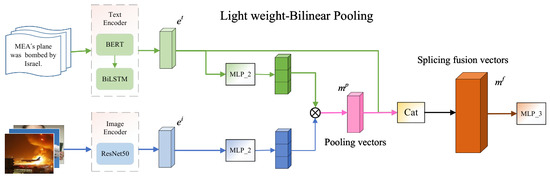
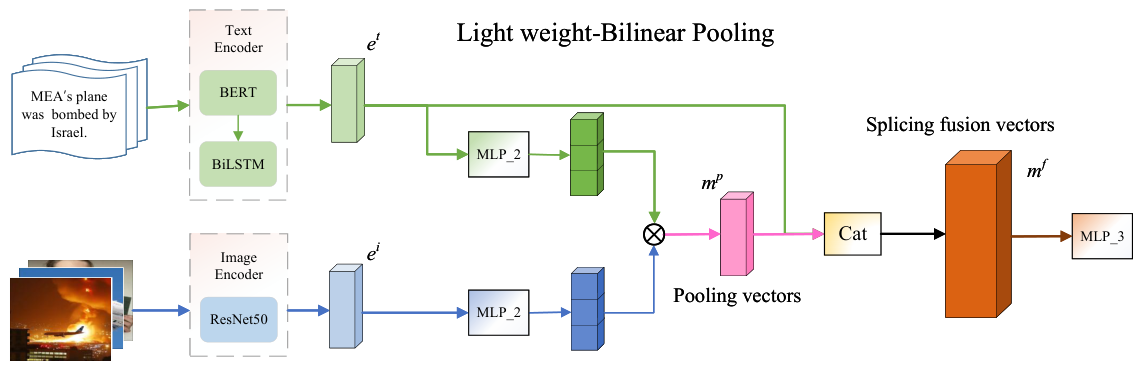
3.5. Lightweight Bilinear Pooling
The lightweight bilinear pooling module is designed to capture second-order interactions between textual and visual representations in a compact form. Unlike feature concatenation, which only stacks modality-specific features, bilinear interaction explicitly models multiplicative dependencies across modalities. However, conventional bilinear pooling usually relies on explicit outer-product operations to enumerate all pairwise feature interactions, which leads to severe dimensional expansion when textual and visual feature dimensions are large. In the proposed framework, lightweight bilinear pooling does not construct the full outer-product matrix. Instead, it first aligns heterogeneous textual and visual features into a shared latent space and then performs compact multiplicative interaction in that space.
Different from conventional full bilinear pooling, the proposed module does not aim to preserve every pairwise interaction as an independent feature. Instead, it learns a compact latent interaction space in which multiplicative cross-modal dependencies are modeled with substantially lower dimensionality.
The lightweight bilinear pooling branch receives the same text-level representation used in the cross-modal attention branch, together with the global visual representation obtained by global average pooling of the final ResNet-50 convolutional feature map.
To clarify the relationship between the proposed module and established bilinear fusion formulations, their interaction representations are compared from a unified mathematical perspective. Conventional full bilinear pooling explicitly constructs the outer-product interaction matrix
where , so that every original textual–visual feature pair is represented as an independent interaction entry. When a lower-dimensional representation is required, the full bilinear interaction can be further mapped as
where , denotes matrix vectorization, and k is the output dimensionality.
Representative projection-based low-rank bilinear pooling avoids explicitly constructing the complete outer-product matrix by factorizing the bilinear mapping into lower-dimensional modality-specific representations:
where and are modality-specific factor projection matrices, r denotes the factorization dimension, maps the factorized interaction to the output space, and is the corresponding bias term.
The three formulations differ primarily in how cross-modal interaction information is represented and utilized. Full bilinear pooling explicitly preserves all original pairwise interactions, while representative low-rank bilinear pooling represents the bilinear mapping through lower-dimensional latent factors. The proposed lightweight bilinear pooling also avoids explicit full outer-product construction, but directly retains the learned latent multiplicative channels as the cross-modal interaction representation used in the SLBF fusion framework. Therefore, its distinction lies in the organization and utilization of the learned interaction representation within the overall fusion architecture, rather than in the Hadamard operation itself.
Since the two modalities have different feature dimensions and semantic distributions, direct element-wise multiplication is not well defined when and is also unsuitable before the heterogeneous modality representations are aligned in a shared latent space.
Therefore, two independent projection branches are introduced to map the heterogeneous modality features into a shared bilinear interaction space:
where and are learnable projection matrices for the textual and visual modalities, and are bias terms, denotes batch normalization, and introduces nonlinear feature transformation.
The projected features and have the same dimensionality, where determines the number of latent multiplicative interaction channels and therefore controls the representation capacity and computational complexity of the lightweight bilinear pooling module.
After modality-specific projection, the lightweight bilinear pooling feature is computed as
where ⊙ denotes the Hadamard product and denotes the lightweight bilinear interaction representation. Each element of represents a multiplicative interaction between the textual and visual features in the same learned latent dimension. This operation differs from conventional full bilinear pooling, which explicitly enumerates all pairwise feature combinations through an outer product. The proposed module instead retains learned multiplicative interaction channels and therefore provides a compact form of bilinear interaction in the shared latent space.
Although the Hadamard product operates between corresponding dimensions in the projected space, these dimensions should not be interpreted as corresponding dimensions of the original textual and visual representations. The learnable projection matrices and transform the complete modality-specific feature vectors into the shared latent space, such that each latent dimension can integrate information from multiple original feature dimensions before the multiplicative interaction is performed. Consequently, each latent interaction channel can encode information originating from multiple cross-dimensional text–image feature combinations.
Nevertheless, the proposed representation does not explicitly preserve every pairwise interaction of the full outer product as an independent feature. Its objective is instead to compress task-relevant multiplicative dependencies into a lower-dimensional learned interaction space, thereby trading exhaustive interaction capacity for substantially reduced representation and computational cost.
Compared with explicit outer-product bilinear pooling, the proposed module avoids constructing a interaction matrix and therefore avoids the exhaustive enumeration of all original cross-modal feature pairs. Compared with direct feature concatenation or attention-based reweighting, the lightweight bilinear pooling branch explicitly introduces multiplicative second-order interactions in the learned latent space.
In the overall SLBF framework, the lightweight bilinear pooling branch complements the cross-modal attention branch: the attention branch performs text-conditioned fine-grained weighting of individual visual feature units, whereas the lightweight bilinear pooling branch captures compact second-order cross-modal interactions between the global textual and visual representations.
To further clarify the lightweight property of the proposed module, we compare the complexity of different bilinear interaction strategies. Let and denote the dimensions of textual and visual features, respectively, denote the dimension of the shared interaction space, and k denote the output dimension after projection. For a dimension-matched comparison, the factorization dimension r of the representative low-rank bilinear formulation is set to . Conventional full bilinear pooling constructs an explicit outer-product representation, and the subsequent projection may introduce a parameter complexity of .
For the representative low-rank bilinear formulation in Equation (10), the two factor projections and the subsequent output mapping result in a parameter complexity of . In contrast, the proposed lightweight bilinear pooling only requires two modality-specific projections and one Hadamard product in a -dimensional shared space, yielding a parameter complexity of .
As summarized in Table 1, the proposed module replaces exhaustive outer-product expansion with learned latent interaction channels while still modeling multiplicative second-order cross-modal dependencies in the shared interaction space. Numerical estimates based on the actual implementation dimensions are further reported in Table 2.
Table 1.
Complexity comparison of bilinear interaction strategies.
Table 2.
Numerical complexity estimates under the actual implementation dimensions.
To quantify the reduction achieved by the proposed bilinear interaction module, the actual implementation dimensions , , and are substituted into the analytical complexity expressions.
For conventional full bilinear pooling, an equivalent -dimensional output setting is considered. The reductions in intermediate interaction size and dominant projection weights are calculated as
Here, denotes the theoretical reduction in intermediate interaction size, whereas denotes the theoretical reduction in the dominant weight parameters of the bilinear interaction operation. The corresponding numerical estimates are summarized in Table 2. Table 2 shows that the proposed module reduces the intermediate interaction size by and the estimated dominant projection weights by relative to conventional full bilinear pooling.
The projection dimension determines both the capacity and complexity of the shared interaction space. The default configuration uses , while the effect of varying is systematically evaluated in Section 4.6.2.
In this formulation, and perform modality-specific projection, and denote the corresponding bias parameters, controls the capacity and complexity of the learned bilinear interaction space, and denotes the resulting lightweight bilinear representation passed to the subsequent fusion and classification layers.
This correspondence between the mathematical formulation and the module architecture is illustrated in Figure 3.
Figure 3.
Lightweight Bilinear Pooling module.
3.6. Synergistic Lightweight Bilinear Pooling Fusion Model
The cross-modal attention mechanism estimates text-conditioned relevance weights for individual visual feature units and selectively emphasizes visual evidence that is semantically related to the textual representation. The Lightweight Bilinear Pooling module performs multiplicative interaction between the learned latent textual and visual representations to capture compact second-order cross-modal dependencies.
The feature fusion module combines the previous two mechanisms and adds regularization to mitigate overfitting. Then, the attention interaction features and bilinear pooling features are concatenated to form a hybrid feature output to the classifier. The classifier adopts a multi-layer nonlinear transformation structure, and combines batch normalization and dropout technology to suppress overfitting. Finally, the sigmoid function is used to output the binary classification probability. The classifier applies a sigmoid activation function to map the output logit to a probability in , and binary cross-entropy loss is used as the training objective.
In the binary classification task of our model, the combination of binary cross-entropy loss (BCELoss) [26] and sigmoid activation function is a basic and effective probabilistic modeling method, and its mathematical essence comes from the concept of cross entropy in information theory. That is, it measures the difference between the predicted probability distribution of the model and the true label distribution. Formally speaking, the binary cross-entropy loss function is defined as the negative value of the log-likelihood of the predicted probability, which can be expressed as follows:
where is the true label and is the probabilistic output predicted by the model. This logarithmic form of the loss function has important mathematical properties: when the predicted probability deviates from the true label, the loss value increases logarithmically, thus providing a strong gradient signal for the model parameter update. However, when the prediction is close to the true value, the loss function changes gently, which is conducive to the stable convergence of the training process.
The sigmoid function
maps the classifier output logit z to the interval . The resulting output can be interpreted as the predicted probability that a sample belongs to the fake news class. Binary cross-entropy loss is then used to measure the discrepancy between the predicted probability and the ground-truth label y during model optimization.
4. Experiments
4.1. Experimental Setting
The present study adopts the Weibo dataset [27], a canonical benchmark dataset within the domain of Chinese social media fake news detection. The dataset comprises news articles collected from Sina Weibo spanning the period from 2012 to 2016. The Weibo dataset used in this study contains 13,254 samples in total. Following the experimental setting, the dataset was divided into 9252 training samples, 2029 validation samples, and 1973 test samples. Each sample consists of textual content, an associated image, and a binary label indicating whether the news item is real or fake. The training set was used for model parameter optimization, the validation set was used for model selection, and the test set was used only for final evaluation. Fake news instances were officially verified by the Weibo Community Management Center, whereas authentic news articles were sourced from the Xinhua News Agency’s Hot News Discovery System.
During the dataset construction phase, the original training and test splits were subjected to cleaning and restructuring procedures, thereby generating annotated data files corresponding to rumor and non-rumor categories, respectively. Subsequently, three data subsets were randomly partitioned from the restructured files according to a predefined ratio, ensuring consistency of data distribution across distinct subsets. Following this, both textual and visual data underwent respective preprocessing pipelines to establish a robust foundation for subsequent multimodal feature extraction and fusion modeling. Ultimately, the processed textual data, image data, and their associated ground-truth labels were employed for model training.
4.2. Experimental Evaluation
The model evaluation metrics encompass accuracy, F1 score, precision, and recall. Upon completion of training, the optimal model checkpoint is loaded for final assessment on the test set. Leveraging these diverse metrics, the model’s performance in the fake news classification task is comprehensively evaluated across multiple dimensions.
4.2.1. Evaluation Metrics
The confusion matrix constitutes a pivotal instrument for assessing model performance in classification tasks, applicable to both binary and multiclass classification problems. As presented in Table 3, the matrix comprises the following four core elements:
Table 3.
Confusion matrix.
4.2.2. Classification Metrics
In binary classification tasks such as fake news detection, accuracy—though widely employed as an evaluation metric—exhibits pronounced limitations, particularly under conditions of imbalanced data distribution, wherein its reliability diminishes substantially. To comprehensively assess model performance in such scenarios, the present study incorporates precision, recall, and F1 score as supplementary evaluation metrics within the experimental design. The computational formulation pertaining to accuracy is presented in Equation (15):
Precision quantifies the proportion of news items retrieved by the system that are actually fake. Recall reflects the proportion of all fake news instances that are successfully detected. Based on precision and recall, the F1 score—defined as the harmonic mean of these two metrics—can further be derived. The corresponding computational formulations are provided in Equations (16)–(18):
4.3. Model Training Design
All experiments were conducted on a workstation equipped with an NVIDIA GeForce RTX 3060 Laptop GPU. The model was implemented using Python 3.10 and PyTorch 2.0.1 with CUDA 11.7 acceleration. All ablation variants and the proposed SLBF model were trained and evaluated under the same hardware and software environment to ensure a fair comparison.
During model training, textual and visual features were extracted from the corresponding encoders and then fed into the proposed multimodal fusion module. The BERT-BiLSTM and ResNet-50 encoders were kept frozen during SLBF training, and only the fusion module and classifier were optimized.
In the normalization stage, StandardScaler was applied to normalize the textual and visual features. The scaler was fitted only on the training set and was subsequently applied to the validation and test sets to avoid information leakage.
The classifier input dimensionality was determined by the fused multimodal representation, and batch normalization and ReLU activation were used in the nonlinear transformation layers.
The model was optimized using AdamW with a batch size of 32 and a maximum of 100 training epochs. Different learning rates were assigned to different parameter groups: () for the fusion module and () for the classifier. For learning rate scheduling, a StepLR strategy was adopted to progressively decay the learning rate. Gradient clipping was also applied to stabilize the training process and alleviate gradient explosion.
During training, the validation set was evaluated after each epoch for model selection, and early stopping was adopted with a patience of 7 epochs. The checkpoint with the best validation performance was retained, and the independent test set was used only for final evaluation.
4.4. Analysis of Experimental Results
As presented in Table 4, the model attains an accuracy of 93.03% on the Weibo dataset, indicating favorable performance on this benchmark. The elevated F1 score achieved by the model on the Weibo dataset reflects an effective trade-off between precision and recall: high precision reflects fewer false positive predictions, whereas high recall reflects fewer false negative predictions. The combined precision and recall results further indicate balanced detection performance on the Weibo benchmark.
Table 4.
Model evaluation on the Weibo dataset.
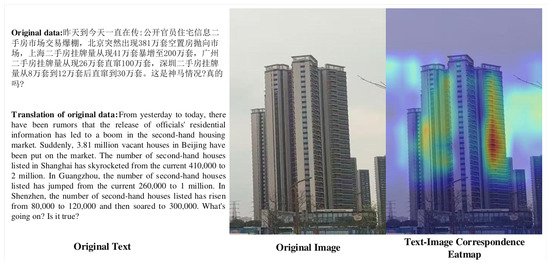
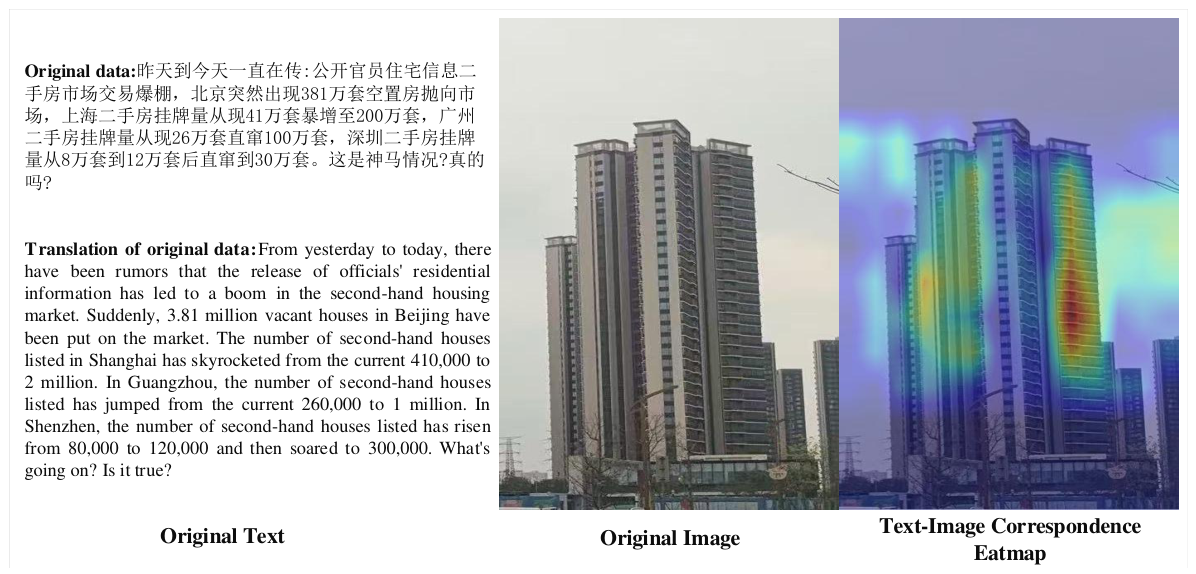
To elucidate the operational mechanism of the cross-modal attention mechanism, a visualization analysis of the attention weights was conducted. Taking the text–image pair illustrated in Figure 4 as an exemplar, wherein the textual content contains extensive descriptions pertaining to a house, the visualization results unequivocally reveal that the model’s visual attention regions are predominantly concentrated on the house portion of the image.
Figure 4.
Visualization of Attention Weight.
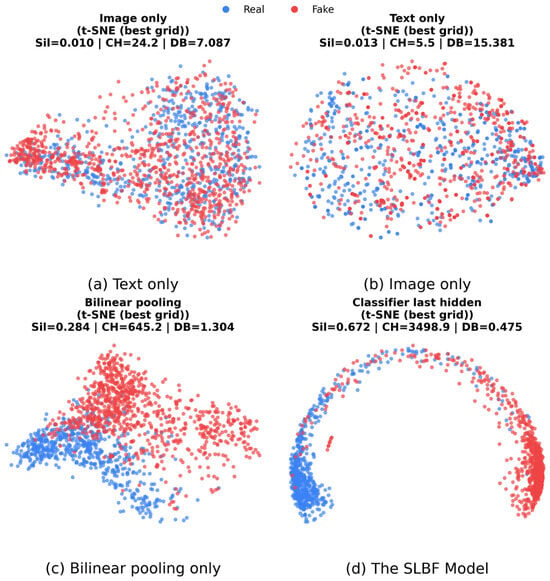
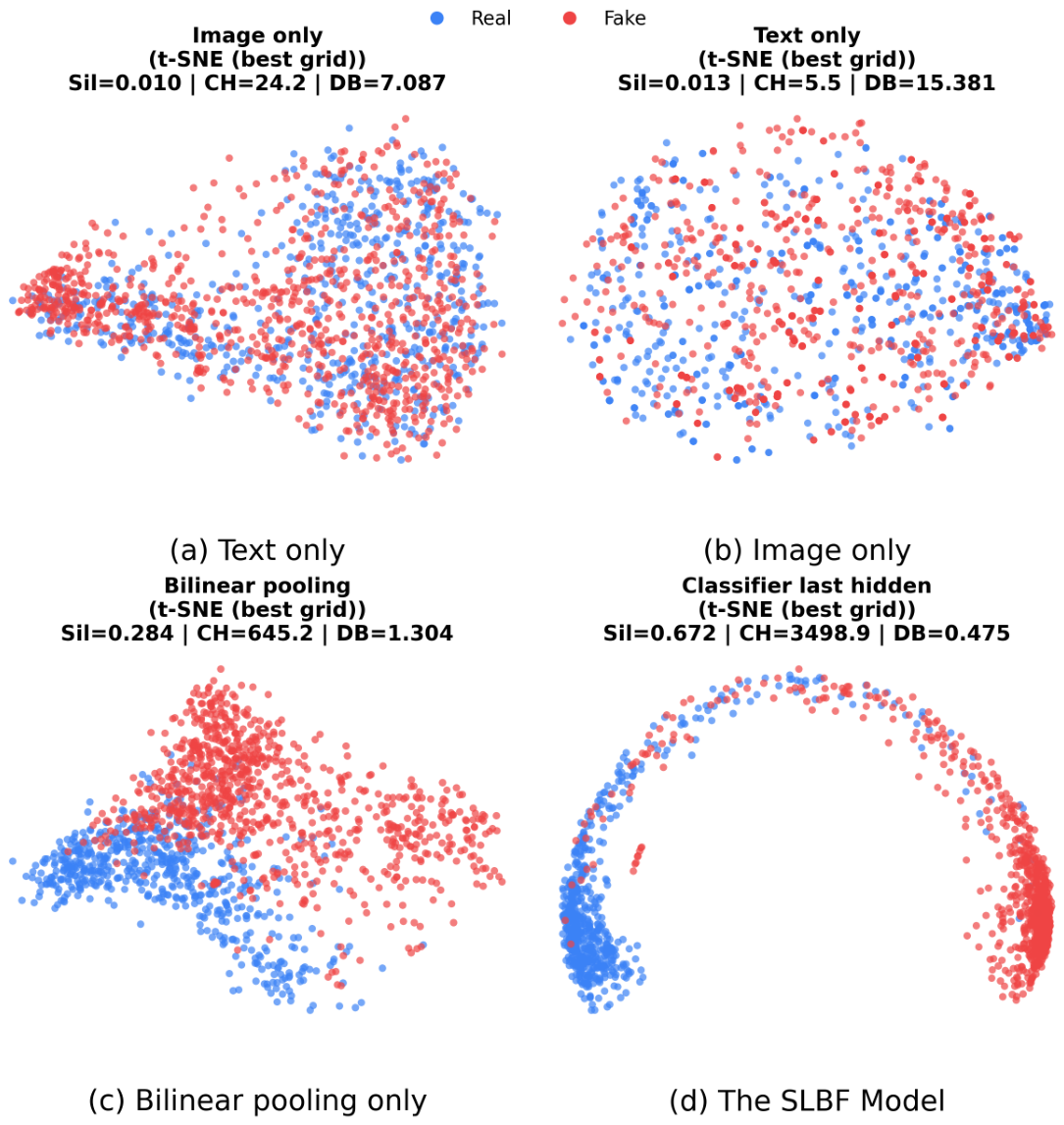
To visually delineate the separation between representations of genuine and fake news, the present study conducts a visualization analysis and evaluates the efficacy of both the model and its constituent modules through clustering metrics. The Sil index denotes the Silhouette Score, which quantifies the cohesion of true and fake sample clusters. The CH index (Calinski–Harabasz Index) measures the ratio of inter-class dispersion to intra-class dispersion, whereas the DB index (Davies–Bouldin Index) assesses the ratio of intra-class distance to inter-class distance.
As can be observed from the t-SNE dimensionality reduction visualizations presented in Figure 5a,b, under conditions where only unimodal features are available, genuine and fake news samples exhibit a scattered distribution within the feature space, lacking pronounced class separability. However, subsequent to lightweight bilinear pooling fusion (Figure 5c), the feature representations of genuine and fake news begin to manifest a comparatively aggregated distribution pattern, demonstrating a discernible degree of class discrimination. Furthermore, within the feature representations derived from the complete classification model (Figure 5d), genuine and fake news samples form highly cohesive clusters with well-delineated boundaries in the low-dimensional space, exhibiting pronounced intra-class compactness and inter-class separability.
Figure 5.
t-SNE Visualization of Pooling Representations and Classification Model Representations.
Both the quantitative metrics and the visualization analyses consistently indicate that the lightweight bilinear pooling module and the cross-modal fusion model are capable of learning highly discriminative feature representations. This enables genuine and fake news samples to form tightly cohesive and distinctly bounded cluster structures within the feature space, thereby supporting the effectiveness of both the lightweight bilinear pooling component and the cross-modal fusion model on the evaluated Weibo dataset.
In addition to detection performance, the computational complexity of the proposed bilinear fusion module is analyzed to characterize its lightweight property. It should be noted that the lightweight claim in this work is restricted to the proposed bilinear fusion module and does not refer to the end-to-end SLBF framework or its textual and visual backbones. As discussed in Section 3.5 and Table 1, conventional bilinear pooling explicitly constructs a outer-product representation, which leads to high-dimensional feature expansion and redundant pairwise interactions. In contrast, the proposed lightweight bilinear pooling first projects textual and visual features into a shared -dimensional latent space and then performs Hadamard product-based interaction. Its parameter complexity is , avoiding the multiplicative expansion caused by explicit outer-product computation. This analysis supports the lightweight characterization of the proposed bilinear fusion module in terms of interaction dimensionality and parameter overhead.
4.5. Comparative Experiments
4.5.1. Baseline Model Comparison
To evaluate the proposed multimodal feature fusion model, its performance is compared with representative multimodal methods covering different fusion paradigms on the Weibo benchmark. att-RNN and MVAE are included as classical reference baselines for attention-based fusion and shared latent representation learning, respectively, MFN represents deep multimodal interaction modeling, while C3N and SCCN provide comparisons with more recent multimodal fusion approaches.
att-RNN represents attention-based multimodal fusion, MFN represents deep cross-modal interaction modeling, and MVAE represents shared latent multimodal representation learning. C3N provides a closely matched comparison under a text–image content setting by modeling fine-grained correlations between textual and visual elements, whereas SCCN represents a complementary paradigm that further incorporates entity semantics and social-relation information. Collectively, these methods cover attention-based fusion, deep cross-modal interaction, shared latent representation learning, fine-grained text–image correlation modeling, and social-context-enhanced multimodal fusion. The results are reported in Table 5.
Table 5.
Comparative experiments of different models.
att-RNN [28]: att-RNN is a classical attention-based recurrent neural network for multimodal fake news detection. It uses LSTM and VGG19 to extract textual contextual features and visual features, respectively, and integrates textual, visual, and social context information through an attention mechanism.
MFN [29]: MFN extracts textual temporal dependency features and contextual features using BiLSTM and Text-CNN, while employing a pre-trained Faster R-CNN model to obtain image region features. Multi-head attention is further adopted to enhance the interaction between textual and visual modalities.
MVAE [30]: MVAE is a classical shared-representation baseline for multimodal fake news detection. It employs a multimodal variational autoencoder to learn the latent correlation between textual and visual information, and then applies the learned shared multimodal representation to fake news classification.
C3N [20]: C3N is a cross-modal content correlation network for multimodal fake news detection. It extracts nouns from textual content and salient object regions from images and maps these textual and visual elements into a shared vision–language representation space. A fine-grained similarity matrix is then constructed between the textual and visual elements, and convolutional operations are applied to capture local and global cross-modal correlation patterns. By relying exclusively on textual and visual content, C3N provides a directly relevant comparison for fine-grained text–image correlation modeling.
SCCN [31]: SCCN is a semantic-enhanced cross-modal co-attention network that jointly models textual content, visual information, entity-level semantics, and social-relation structures. It enhances modality-specific representations with entity information, aligns heterogeneous modalities within a shared semantic space, and employs self-supervised learning and co-attention to reduce noise during multimodal fusion. SCCN represents a complementary detection paradigm in which content-level representations are augmented with entity and social-context evidence.
The comparative results provide reference points across different multimodal fusion paradigms, including classical representative baselines and more recent fusion-based methods.
Among the classical reference baselines, MFN and MVAE obtain higher overall performance than att-RNN, providing evidence that richer cross-modal interaction and shared representation learning can improve multimodal feature integration. These results also provide a useful reference for evaluating the subsequent fine-grained fusion methods.
C3N and SCCN provide stronger reference points for fine-grained multimodal modeling. C3N focuses on local and global correlations between textual and visual elements, whereas SCCN further incorporates entity semantics and social-relation information. Their performance indicates the importance of modeling structured cross-modal relationships beyond direct feature aggregation.
Compared with C3N, SLBF improves accuracy and F1 by 1.23 and 2.23 percentage points, respectively. Relative to SCCN, the corresponding gains are 2.53 and 3.73 percentage points. The comparison with C3N shows that combining text-conditioned visual attention with compact second-order interaction achieves competitive performance relative to fine-grained text–image correlation modeling. The comparison with SCCN further indicates that, on the evaluated Weibo benchmark, textual and visual content alone can achieve competitive detection performance without additional entity or social-relation information.
These comparative results are consistent with the complementary roles of the two fusion branches in SLBF. Cross-modal attention emphasizes visual evidence that is semantically related to the textual content, while lightweight bilinear pooling introduces compact multiplicative interactions between the two modalities. Their combination enables the model to capture both text-conditioned visual relevance and second-order cross-modal dependencies within the same fusion architecture.
4.5.2. Comparison of Compact Fusion Strategies
To further evaluate the effectiveness of the proposed lightweight bilinear pooling from the perspective of fusion design, a controlled comparison is conducted with representative compact multimodal fusion strategies. Unlike the preceding model-level comparison, this experiment focuses specifically on the fusion mechanism. All compared variants use the same textual and visual representations and follow the same training configuration, while the fusion strategy is replaced accordingly. The compared fusion strategies are described as follows.
(1) PM-Concat: Parameter-matched concatenation serves as a controlled non-bilinear fusion baseline. The textual and visual representations are concatenated and subsequently projected into a compact fusion space, with the projection configuration adjusted so that its fusion parameter scale is nearly identical to that of the proposed LBP. This baseline is used to examine whether the performance improvement arises from the cross-modal interaction formulation rather than simply from an increase in fusion parameter budget.
(2) MCB: Multimodal Compact Bilinear pooling represents a compact approximation to high-dimensional bilinear interaction. Rather than explicitly retaining the complete outer-product representation, MCB compresses second-order cross-modal interactions into a lower-dimensional representation. It therefore provides a representative comparison for examining the effect of stronger interaction compression within a bilinear fusion framework.
(3) Low-rank Bilinear: Low-rank bilinear pooling represents a factorized bilinear fusion strategy. The textual and visual representations are first projected into lower-dimensional latent factors, followed by multiplicative interaction and a subsequent output transformation. This formulation avoids explicit full outer-product expansion while retaining a factorized form of bilinear interaction, and therefore provides a direct comparison with an established low-rank bilinear formulation.
(4) Proposed LBP: The proposed lightweight bilinear pooling independently transforms the textual and visual representations into a shared latent interaction space and directly retains the resulting multiplicative channels as the cross-modal interaction representation. The proposed design therefore emphasizes compact latent interaction modeling without explicitly constructing the high-dimensional outer-product representation.
The results in Table 6 indicate that compact multimodal fusion is influenced not only by fusion parameter scale, but also by how cross-modal dependencies are represented. The comparison with PM-Concat provides a particularly controlled reference because the two configurations have almost identical fusion parameter counts, 3.352 M and 3.353 M, respectively. Under this nearly matched fusion parameter budget, the proposed LBP improves accuracy from 92.35% to 93.03% and F1 from 0.9350 to 0.9403, while maintaining a comparable recall. This comparison suggests that the observed improvement is associated with the explicit modeling of multiplicative cross-modal dependencies in the learned latent interaction space rather than simply with increased fusion parameter capacity.
Table 6.
Comparison of compact multimodal fusion strategies.
The comparison with Low-rank Bilinear further highlights the importance of the interaction representation itself. Although both approaches avoid explicit full outer-product expansion and operate through compact latent representations, the proposed LBP achieves an accuracy of 93.03% and an F1 score of 0.9403 with 3.353 M fusion parameters, compared with 90.54%, 0.9192, and 3.614 M for the low-rank baseline. The proposed formulation therefore achieves stronger discriminative performance despite using a smaller fusion parameter scale. This result is consistent with the design of the proposed module, in which the learned latent multiplicative channels are directly retained as the cross-modal interaction representation rather than being used only as intermediate factors within a subsequent bilinear mapping.
MCB provides a complementary perspective on the trade-off between compression and representation capacity. It has the smallest fusion parameter count among the evaluated strategies at 2.433 M, but its F1 score decreases to 0.9219. This result indicates that stronger compression alone does not necessarily lead to a more effective compact fusion mechanism, since excessive reduction in the interaction representation may also limit the discriminative information available for multimodal classification. Conversely, the Low-rank Bilinear result shows that a larger fusion parameter scale by itself does not guarantee stronger performance.
Taken together, these controlled comparisons show that the proposed LBP provides a favorable balance between compactness and discriminative interaction modeling. PM-Concat demonstrates that the improvement cannot be explained merely by fusion parameter scale, Low-rank Bilinear shows that factorized bilinear modeling alone is insufficient to account for the observed performance, and MCB illustrates the potential loss of discriminative capacity under stronger interaction compression. The proposed LBP instead maintains a compact fusion parameter scale while achieving the highest accuracy, precision, and F1 score among the evaluated fusion strategies. These empirical results complement the formulation analysis in Section 3.5 and provide further support for directly learning and retaining compact latent multiplicative interactions for multimodal fake news detection.
4.6. Ablation and Sensitivity Analysis
4.6.1. Ablation Studies
To ascertain the respective contributions of the cross-modal attention mechanism and bilinear pooling to the experimental outcomes, ablation studies were conducted on the Weibo dataset, wherein two ablated model variants were devised for analysis.
(1) SLBF-DC: The cross-modal attention module is excised. Subsequent to feature extraction from text and images respectively, the features are directly conveyed to the bilinear pooling module and thereafter forwarded to the fake news classifier.
(2) SLBF-DB: The lightweight bilinear pooling module is excised. Following feature extraction from text and images respectively, the features are routed through the cross-modal attention mechanism and subsequently dispatched to the fake news classifier.
The performance of each model variant is reported as the mean and standard deviation across repeated runs, as presented in Table 7.
Table 7.
Evaluation results of the ablation study. Results are reported as mean ± standard deviation.
Removing the cross-modal attention module causes a modest reduction in overall performance, with accuracy decreasing from to and F1 from to . Although recall increases slightly, precision decreases, indicating a different precision–recall trade-off after removing the attention branch. This pattern is consistent with the role of cross-modal attention in emphasizing visual evidence that is semantically relevant to the textual content and improving the overall quality of multimodal discrimination.
Removing the lightweight bilinear pooling module produces a substantially larger degradation, reducing accuracy by percentage points and F1 by relative to the full model. The recall results also exhibit a noticeably larger standard deviation across repeated runs. This degradation is consistent with the role of lightweight bilinear pooling in capturing compact multiplicative dependencies between textual and visual representations, which complements the relevance-based interaction modeled by the attention branch.
Overall, the full SLBF model achieves the highest mean accuracy, precision, and F1 score, while SLBF-DC obtains a slightly higher recall. The two ablation variants exhibit different performance patterns, reflecting the complementary functions of the two fusion branches. Cross-modal attention mainly contributes text-conditioned semantic relevance modeling, whereas lightweight bilinear pooling provides compact second-order cross-modal interaction modeling. The larger degradation caused by removing the bilinear pooling branch further indicates the importance of multiplicative interaction modeling within the complete fusion architecture.
4.6.2. Effect of Projection Dimension
The projection dimension determines the number of latent multiplicative interaction channels in the lightweight bilinear pooling module and therefore controls both the representation capacity and fusion-module parameter complexity of the shared interaction space. To investigate whether restricting the number of latent interaction channels leads to a substantial loss of discriminative information, we vary over while keeping the remaining experimental settings unchanged. The corresponding detection performance and fusion parameter counts are reported in Table 8.
Table 8.
Effect of the projection dimension on detection performance and fusion parameter count.
The results show that increasing generally provides additional interaction capacity and leads to gradual improvements in overall detection performance, although the improvement is not strictly monotonic across all metrics. Even relatively compact interaction spaces maintain competitive performance. For example, the model with achieves an F1 score of , compared with at the default setting of . This result indicates that substantially reducing the number of latent interaction channels does not cause a corresponding large degradation in detection performance.
Increasing beyond 512 provides additional performance gains, but at a considerably higher fusion parameter cost. Specifically, increasing from 512 to 1024 improves accuracy from 0.9303 to 0.9324 and F1 score from 0.9403 to 0.9425, corresponding to gains of approximately 0.21 and 0.23 percentage points, respectively. In contrast, the number of fusion parameters increases from 3.353M to 4.513M, an increase of approximately 34.6%. The improvement obtained from doubling the projection dimension is therefore modest relative to the associated increase in fusion parameter count.
These results indicate that explicitly retaining a substantially larger number of latent interaction channels is not necessary to obtain strong performance on the evaluated fake news detection task. The learned projection enables useful cross-modal interaction information to be represented within a compact latent space, while increasing mainly provides additional interaction capacity at progressively higher fusion parameter cost. Accordingly, is adopted as the default configuration because it provides a favorable trade-off between detection performance and fusion-module parameter complexity.
5. Discussion
The experimental results demonstrate that SLBF achieves competitive performance on the Weibo dataset, with improvements over the representative methods evaluated in this study. More importantly, the results provide insight into the role of different multimodal modeling strategies in fake news detection. Methods that mainly rely on unimodal evidence are limited when discriminative cues arise from the relationship between textual claims and visual content. Conventional multimodal fusion methods based on concatenation, weighted aggregation, or shared representation learning can integrate heterogeneous information, but they may not sufficiently capture fine-grained semantic correspondence and multiplicative cross-modal dependencies. In comparison, SLBF combines cross-modal attention with lightweight bilinear pooling. The cross-modal attention branch performs text-conditioned relevance weighting over visual feature units, whereas the lightweight bilinear pooling branch introduces compact second-order interaction modeling. This complementary mechanism is consistent with the performance gains observed for SLBF over the compared baselines and is further supported by the ablation results, where removing either cross-modal attention or lightweight bilinear pooling leads to performance degradation.
Compared with the studies discussed in the Section 2, the proposed method focuses on content-level multimodal fusion using textual content and associated images, rather than incorporating social-context signals such as comments, user interactions, or propagation structures. This design may be applicable to early detection settings where diffusion information may be unavailable or incomplete. However, the absence of auxiliary social-context information may make it more difficult to detect fake news samples whose falsity cannot be inferred from text–image content alone, such as cases with semantically coherent text–image pairs, authentic images reused in misleading contexts, or short posts with insufficient textual evidence. Since abnormal diffusion patterns, user credibility cues, coordinated user behaviors, and corrective comments are not explicitly modeled, incorporating propagation paths and user-comment information remains an important direction for future work.
The current evaluation is conducted on Weibo, a widely used Chinese multimodal fake news detection benchmark containing paired textual and visual information. However, the current evaluation is limited to a Chinese social media dataset. Fake news expression, linguistic style, visual-textual association, and platform-specific dissemination behavior may vary across languages, platforms, and domains. Therefore, the generalizability of SLBF to English-language datasets, multilingual settings, and cross-platform scenarios remains to be evaluated. Future studies will extend the evaluation to broader multimodal fake news benchmarks to examine the robustness of the proposed fusion strategy under different linguistic and social media environments.
Several limitations remain. Although SLBF improves multimodal representation learning through text-conditioned visual attention and lightweight bilinear interaction, its performance still depends on the quality of the textual and visual features extracted by the backbone encoders. In addition, the current framework does not explicitly model temporal propagation patterns, user credibility, or comment-level evidence, which may provide complementary clues for fake news detection. The lightweight characterization in this work is restricted to the proposed bilinear fusion module; the overall SLBF framework still relies on deep textual and visual encoders and is therefore not claimed to be lightweight in an end-to-end sense.
6. Conclusions
This study investigated multimodal fake news detection through the joint modeling of text-conditioned visual attention and compact second-order cross-modal interaction. On the Weibo benchmark, SLBF achieves an accuracy of 0.9303 and an F1 score of 0.9403, outperforming both classical reference baselines and the more recent C3N and SCCN comparison methods. In particular, the F1 score exceeds that of C3N by 2.23 percentage points and that of SCCN by 3.73 percentage points. Beyond the numerical improvements, the comparative results on the Weibo benchmark suggest that explicitly combining text-conditioned visual attention with compact multiplicative interaction provides a more effective representation of complementary textual and visual evidence than relying on either fine-grained correlation modeling or additional contextual fusion alone.
The ablation results further clarify how the two fusion components contribute to the overall performance. Removing cross-modal attention leads to a relatively modest degradation, whereas removing lightweight bilinear pooling reduces the F1 score by 3.39 percentage points. This difference indicates that the two components are complementary rather than redundant: cross-modal attention estimates the relevance of visual feature units conditioned on the global textual representation, while lightweight bilinear pooling plays a more pronounced role in capturing discriminative second-order cross-modal dependencies. The projection-dimension analysis also reveals a clear performance–complexity trade-off. Doubling from 512 to 1024 yields approximately a 0.23-percentage-point improvement in F1 while increasing the fusion parameter count by approximately 34.6%. This result suggests that increasing the latent interaction capacity can provide additional performance gains, but the marginal benefit becomes limited relative to the accompanying growth in fusion parameter count, making a favorable setting for balancing detection performance and fusion-module parameter complexity.
Based on the limitations identified in the Discussion, future work will conduct a more systematic failure-case analysis to characterize difficult misinformation samples and different forms of text–image inconsistency. Further investigation will also consider the incorporation of propagation information and external contextual or factual evidence for cases that cannot be sufficiently resolved through content-level multimodal interaction alone.
Author Contributions
Conceptualization, J.L. (Jun Li 1) and J.L. (Jun Li 2); methodology, J.L. (Jun Li 1) and J.L. (Jun Li 2); software, J.L. (Jun Li 2), L.Y. and J.J.; validation, L.Y. and J.J.; formal analysis, J.L. (Jun Li 1); investigation, J.L. (Jun Li 1); resources, J.L. (Jun Li 1); data curation, J.L. (Jun Li 2); writing—original draft preparation, J.L. (Jun Li 2) and J.L. (Jun Li 1); writing—review and editing, J.L. (Jun Li 1) and J.L. (Jun Li 2); visualization, J.L. (Jun Li 2); supervision, J.L. (Jun Li 1) and J.L. (Jun Li 2); project administration, J.L. (Jun Li 1) and J.L. (Jun Li 2); funding acquisition, J.L. (Jun Li 1). All authors have read and agreed to the published version of the manuscript.
Funding
This research received no external funding.
Institutional Review Board Statement
Not applicable.
Informed Consent Statement
Not applicable.
Data Availability Statement
The original contributions presented in this study are included in the article, and further inquiries can be directed to the corresponding author.
Conflicts of Interest
The authors declare no conflicts of interest.
References
- Abdelnabi, S.; Hasan, R.; Fritz, M. Open-domain, content-based, multi-modal fact-checking of out-of-context images via online resources. In Proceedings of the IEEE/CVF Conference on Computer Vision and Pattern Recognition, New Orleans, LA, USA, 18–24 June 2022; pp. 14940–14949. Available online: https://openaccess.thecvf.com/content/CVPR2022/supplemental/Abdelnabi_Open-Domain_Content-Based_Multi-Modal_CVPR_2022_supplemental.pdf (accessed on 1 July 2026).
- Feng, S.; Yu, G.; Liu, D.; Hu, H.; Luo, Y.; Lin, H.; Ong, Y.S. MHR: A multi-modal hyperbolic representation framework for fake news detection. IEEE Trans. Knowl. Data Eng. 2025, 37, 2015–2028. [Google Scholar] [CrossRef] [Scilit]
- Xie, J.; Liu, J.; Zha, Z.j. Towards effective and transferable detection for multi-modal fake news in the social media stream. IEEE Trans. Knowl. Data Eng. 2025, 37, 6723–6737. [Google Scholar] [CrossRef] [Scilit]
- Tan, Z.; Zhang, T. Emotion-semantic interaction network for fake news detection: Perspectives on question and non-question comment semantics. Inf. Process. Manag. 2026, 63, 104391. [Google Scholar] [CrossRef] [Scilit]
- Guo, Y.; Ge, H.; Li, J. A two-branch multimodal fake news detection model based on multimodal bilinear pooling and attention mechanism. Front. Comput. Sci. 2023, 5, 1159063. [Google Scholar] [CrossRef] [Scilit]
- Kaliyar, R.K.; Goswami, A.; Narang, P. FakeBERT: Fake news detection in social media with a BERT-based deep learning approach. Multimed. Tools Appl. 2021, 80, 11765–11788. [Google Scholar] [CrossRef] [Scilit] [PubMed]
- Ma, X.; Zhang, Y.; Ding, K.; Yang, J.; Wu, J.; Fan, H. On fake news detection with LLM enhanced semantics mining. In Proceedings of the 2024 Conference on Empirical Methods in Natural Language Processing, Miami, FL, USA, 12–16 November 2024; pp. 508–521. [Google Scholar] [CrossRef] [Scilit]
- Zhu, Y.; Sheng, Q.; Cao, J.; Nan, Q.; Shu, K.; Wu, M.; Wang, J.; Zhuang, F. Memory-guided multi-view multi-domain fake news detection. IEEE Trans. Knowl. Data Eng. 2022, 35, 7178–7191. [Google Scholar] [CrossRef] [Scilit]
- Zhang, L.; Zhang, X.; Zhou, Z.; Zhang, X.; Wang, S.; Yu, P.S.; Li, C. Early detection of multimodal fake news via reinforced propagation path generation. IEEE Trans. Knowl. Data Eng. 2024, 37, 613–625. [Google Scholar] [CrossRef] [Scilit]
- Luvembe, A.M.; Li, W.; Li, S.; Liu, F.; Wu, X. CAF-ODNN: Complementary attention fusion with optimized deep neural network for multimodal fake news detection. Inf. Process. Manag. 2024, 61, 103653. [Google Scholar] [CrossRef] [Scilit]
- Zhang, F.; Liu, J.; Xie, J.; Zhang, Q.; Xu, Y.; Zha, Z.J. Escnet: Entity-enhanced and stance checking network for multi-modal fact-checking. In Proceedings of the ACM Web Conference 2024, Singapore, 13–17 May 2024; pp. 2429–2440. [Google Scholar] [CrossRef] [Scilit]
- Lv, H.; Yang, W.; Yin, Y.; Wei, F.; Peng, J.; Geng, H. MDF-FND: A dynamic fusion model for multimodal fake news detection. Knowl.-Based Syst. 2025, 317, 113417. [Google Scholar] [CrossRef] [Scilit]
- Li, Z.; Yang, J.; Wang, X.; Lei, J.; Li, S.; Zhang, J. Uncertainty-aware disentangled representation learning for multimodal fake news detection. Inf. Process. Manag. 2025, 62, 104190. [Google Scholar] [CrossRef] [Scilit]
- Meng, Y.; Wang, H.; Zhao, J.; Sun, Y.; Shao, M. Dynamic hierarchical memory improved mixture-of-experts for multimodal fake news detection. Inf. Process. Manag. 2026, 63, 104479. [Google Scholar] [CrossRef] [Scilit]
- Hu, S.; Hu, J.; Zhang, H. Synergizing LLMs with global label propagation for multimodal fake news detection. In Proceedings of the 63rd Annual Meeting of the Association for Computational Linguistics (Volume 1: Long Papers), Vienna, Austria, 27 July–1 August 2025; pp. 1426–1440. [Google Scholar] [CrossRef] [Scilit]
- Zheng, X.; Luo, M.; Wang, X. Unveiling fake news with adversarial arguments generated by multimodal large language models. In Proceedings of the 31st International Conference on Computational Linguistics, Abu Dhabi, United Arab Emirates, 19–24 January 2025; pp. 7862–7869. Available online: https://aclanthology.org/2025.coling-main.526.pdf (accessed on 13 April 2026).
- Chen, Y.; Li, D.; Zhang, P.; Sui, J.; Lv, Q.; Tun, L.; Shang, L. Cross-modal ambiguity learning for multimodal fake news detection. In Proceedings of the ACM Web Conference 2022, Lyon, France, 25–29 April 2022; pp. 2897–2905. [Google Scholar] [CrossRef] [Scilit]
- Singhal, S.; Pandey, T.; Mrig, S.; Shah, R.R.; Kumaraguru, P. Leveraging intra and inter modality relationship for multimodal fake news detection. In Proceedings of the Companion Proceedings of the Web Conference 2022, Lyon, France, 25–29 April 2022; pp. 726–734. [Google Scholar] [CrossRef] [Scilit]
- Sachan, T.; Pinnaparaju, N.; Gupta, M.; Varma, V. SCATE: Shared cross attention transformer encoders for multimodal fake news detection. In Proceedings of the 2021 IEEE/ACM International Conference on Advances in Social Networks Analysis and Mining, Virtual, 8–11 November 2021; pp. 399–406. [Google Scholar] [CrossRef] [Scilit]
- Qiao, J.; Li, X.; Gao, C.; Wu, L.; Feng, J.; Wang, Z. Improving multimodal fake news detection by leveraging cross-modal content correlation. Inf. Process. Manag. 2025, 62, 104120. [Google Scholar] [CrossRef] [Scilit]
- Huang, K.H.; McKeown, K.; Nakov, P.; Choi, Y.; Ji, H. Faking fake news for real fake news detection: Propaganda-loaded training data generation. In Proceedings of the 61st Annual Meeting of the Association for Computational Linguistics (Volume 1: Long Papers), Toronto, ON, Canada, 9–14 July 2023; pp. 14571–14589. [Google Scholar] [CrossRef] [Scilit]
- Kumari, R.; Ekbal, A. Amfb: Attention based multimodal factorized bilinear pooling for multimodal fake news detection. Expert Syst. Appl. 2021, 184, 115412. [Google Scholar] [CrossRef] [Scilit]
- Nadeem, M.I.; Ahmed, K.; Li, D.; Zheng, Z.; Alkahtani, H.K.; Mostafa, S.M.; Mamyrbayev, O.; Abdel Hameed, H. EFND: A semantic, visual, and socially augmented deep framework for extreme fake news detection. Sustainability 2022, 15, 133. [Google Scholar] [CrossRef] [Scilit]
- Aboutaleb, A.; Fayed, A.; Ismail, D.; GabAllah, N.A.; Rafea, A.; Sakr, N. BERT BiLSTM-Attention similarity model. In Proceedings of the 2021 IEEE International Conference on Artificial Intelligence and Computer Applications (ICAICA), Dalian, China, 28–30 June 2021; IEEE: New York, NY, USA, 2021; pp. 366–371. [Google Scholar] [CrossRef] [Scilit]
- He, K.; Zhang, X.; Ren, S.; Sun, J. Deep residual learning for image recognition. In Proceedings of the the IEEE Conference on Computer Vision and Pattern Recognition, Las Vegas, NV, USA, 27–30 June 2016; pp. 770–778. Available online: https://openaccess.thecvf.com/content_cvpr_2016/papers/He_Deep_Residual_Learning_CVPR_2016_paper.pdf (accessed on 13 April 2026).
- Ruby, U.; Yendapalli, V. Binary cross entropy with deep learning technique for image classification. Int. J. Adv. Trends Comput. Sci. Eng. 2020, 9, 5393–5397. [Google Scholar] [CrossRef] [Scilit]
- Wang, Y.; Ma, F.; Jin, Z.; Yuan, Y.; Xun, G.; Jha, K.; Su, L.; Gao, J. EANN: Event adversarial neural networks for multi-modal fake news detection. In Proceedings of the 24th ACM Sigkdd International Conference on Knowledge Discovery & Data Mining, London, UK, 19–23 August 2018; pp. 849–857. [Google Scholar] [CrossRef] [Scilit]
- Jin, Z.; Cao, J.; Guo, H.; Zhang, Y.; Luo, J. Multimodal fusion with recurrent neural networks for rumor detection on microblogs. In Proceedings of the 25th ACM International Conference on Multimedia, Mountain View, CA, USA, 23–27 October 2017; pp. 795–816. [Google Scholar] [CrossRef] [Scilit]
- Zadeh, A.; Liang, P.P.; Mazumder, N.; Poria, S.; Cambria, E.; Morency, L.P. Memory fusion network for multi-view sequential learning. In Proceedings of the AAAI Conference on Artificial Intelligence, New Orleans, LA, USA, 2–7 February 2018; Volume 32. [Google Scholar] [CrossRef] [Scilit]
- Khattar, D.; Goud, J.S.; Gupta, M.; Varma, V. Mvae: Multimodal variational autoencoder for fake news detection. In Proceedings of the World Wide Web Conference, San Francisco, CA, USA, 13–17 May 2019; pp. 2915–2921. [Google Scholar] [CrossRef] [Scilit]
- Chen, W.; Dang, Y.; Zhang, X. A Multimodal Semantic-Enhanced Attention Network for Fake News Detection. Entropy 2025, 27, 746. [Google Scholar] [CrossRef] [Scilit] [PubMed]

Disclaimer/Publisher’s Note: The statements, opinions and data contained in all publications are solely those of the individual author(s) and contributor(s) and not of MDPI and/or the editor(s). MDPI and/or the editor(s) disclaim responsibility for any injury to people or property resulting from any ideas, methods, instructions or products referred to in the content. |
© 2026 by the authors. Licensee MDPI, Basel, Switzerland. This article is an open access article distributed under the terms and conditions of the Creative Commons Attribution (CC BY) license.