


Abstract
This study examines whether possession-oriented tactical profiles are associated with reported absolute injury burden across Europe’s Big Five domestic football leagues. Team-level tactical statistics were integrated with publicly available injury data covering eight seasons (2017–18 to 2024–25), yielding 780 team-season observations. Three outcomes were examined: total reported injury events, total days lost, and total matches missed. League-specific feature selection used Elastic Net and Random Forest models combined through a performance-weighted Meta Score, followed by K-Medoids clustering with cosine distance to identify relatively higher- and lower-possession tactical profiles. Injury outcomes were compared using Welch’s t-tests and permutation tests with false discovery rate correction, supplemented by club-clustered bootstrap confidence intervals. After multiplicity correction, higher-possession profiles showed greater injury-event counts and matches missed in the Premier League and La Liga, all three outcomes in Ligue 1, and matches missed in the Bundesliga. The La Liga total-days-lost difference did not remain robust under club-clustered resampling. No adjusted difference was identified in Serie A. These findings indicate exploratory associations between possession-oriented tactical profiles and reported absolute injury burden rather than causal or exposure-adjusted effects. As player exposure, fixture volume, and major club- and competition-level confounders were not fully controlled, the results should not be interpreted as estimates of epidemiological injury risk.
1. Introduction
In elite football, tactical identity and player availability are tightly linked determinants of sustained performance. Clubs invest heavily in coherent playing models, targeted recruitment, and long-term squad planning, yet those efforts depend on whether players remain available often enough for the team to execute its intended style across a demanding season. Even a tactically sophisticated team can lose structural stability when injuries disrupt lineup continuity, training rhythm, and on-pitch relationships.
Modern football has also become increasingly data-driven. Public and proprietary event data now allow clubs, analysts, and researchers to describe teams not only through goals or league position, but also through patterns of possession, progression, pressing, territorial control, and chance creation [1,2,3,4]. Among these indicators, possession remains one of the most visible and most debated. It is commonly treated as a sign of control, dominance, and tactical clarity, yet its broader performance implications are less straightforward.
Possession is analytically complex because it is both a simple statistic and a broader expression of style. At a descriptive level, it reflects how much of a match a team spends on the ball. At a tactical level, it reflects build-up structure, support movement, spatial occupation, circulation patterns, and the ability to react quickly after losing the ball. Teams that dominate possession often rely on repeated short movements, positional discipline, technical precision, and immediate counter-pressing, all of which may shape physical load over time.
This raises an important question for football analytics and sports medicine: do high-possession teams face greater injury burden than low-possession teams? Existing injury research has focused mainly on workload, recovery, fixture congestion, and biomechanical stress rather than tactical style itself [5,6,7,8,9]. As a result, the literature does not offer a clear answer. Video-based incident analysis has been used to characterize the playing situations and phases of play associated with elevated injury risk in professional football [10], though this method has not directly examined whether competitive balance or possession exchange between teams influences injury risk. However, whether possession-oriented tactical style is associated with season-level injury burden has not been directly established. Possession-based football may reduce burden by allowing teams to control tempo and avoid prolonged defending, but it may also increase burden through sustained movement, pressing demands, and repeated structural adjustments.
To the best of our knowledge, no previous study has systematically examined whether possession-oriented tactical styles are associated with injury burden across multiple elite European football leagues using a unified analytical framework.
The issue becomes even more complex when leagues are compared. Tactical intensity, tempo, scheduling demands, and stylistic norms differ substantially across Europe’s major competitions. The Premier League, La Liga, Serie A, Bundesliga, and Ligue 1 differ in tactical traditions, match rhythm, officiating, scheduling, squad construction, and competitive tempo, and prior research has shown that fixture congestion and reduced recovery time are directly associated with elevated muscle injury rates [7], while broader workload-based reviews confirm that variations in match load and congestion patterns across competitions meaningfully influence injury risk [11]. If possession carries different tactical and physical implications across these contexts, then its relationship with injury burden may also differ.
This study addresses that question by examining whether high-possession teams experience different injury outcomes from low-possession teams across Europe’s Big Five leagues from the 2017–18 to 2024–25 seasons. Team-level tactical and performance data from FBref are combined with injury records to create a multi-season panel of team-seasons. Rather than applying a simple possession threshold, the study defines possession style empirically. League-specific feature selection identifies the most informative variables for possession within each competition, and clustering then groups teams into high- and low-possession profiles on that basis. Injury burden is subsequently assessed using total injuries, total matches missed, and total days lost.
This study is exploratory and hypothesis-generating rather than confirmatory. Its primary contribution is methodological: a reproducible, league-specific pipeline for deriving possession-oriented tactical profiles from multivariate tactical data, rather than an arbitrary possession-percentage threshold, combined with internally validated clustering and cross-outcome injury burden comparisons. The reported associations should be understood as candidate signals for further investigation with richer, exposure-adjusted data, rather than as established evidence that possession style causes or predicts injury burden. We see the primary value of this work in the transferable analytical framework itself, and in identifying where the relationship between possession style and reported injury burden appears strongest, providing a basis for future confirmatory research with player-level exposure data.
This study makes three main contributions. First, it provides a multi-season, cross-league examination of the association between possession-oriented tactical profiles and reported absolute injury burden. Second, it represents possession as a multidimensional and league-specific tactical profile, rather than applying a common possession-percentage threshold across competitions. Third, it introduces a reproducible analytical workflow that connects supervised feature ranking, unsupervised tactical-profile identification, and comparisons across three complementary injury-burden outcomes.
The methodological contribution lies in the design and integration of this workflow rather than in the introduction of a new machine-learning algorithm. Specifically, the framework (i) combines Elastic Net coefficients and Random Forest permutation-importance estimates through model-performance-weighted Meta Scores; (ii) applies cumulative-score and elbow-based selection to construct parsimonious league-specific tactical feature spaces; (iii) derives possession-oriented profiles through clustering, rather than fixed possession thresholds; and (iv) links those profiles to total injuries, total days lost, and total matches missed, across eight seasons and five leagues, using a common analytical sequence. This permits tactical profiles to remain context-sensitive, while preserving methodological comparability across competitions. The study remains exploratory, and the incremental value of the framework over simpler possession-percentage classifications requires further formal benchmarking.
2. Related Work
Sports analytics has evolved into an interdisciplinary field that combines statistics, data science, and domain expertise to improve decision making in sport [1,12,13,14]. In football, systematic performance analysis predates modern data infrastructure, originating with early notational recording of on-the-ball actions [15]. This evolution accelerated with the wider availability of structured event data. Providers such as Opta made it possible to record actions, such as passes, shots, tackles, and recoveries at scale, while platforms such as FBref made aggregated football data more accessible to researchers and practitioners.
As a result, football analysis moved beyond traditional outcomes and toward richer descriptions of tactical behavior. Possession has remained central in that development. It is easy to observe, widely reported, and often interpreted as a measure of superiority. Yet, possession is also context-dependent and does not automatically translate into success. High possession may reflect control, but it may also reflect sterile circulation without penetration. More importantly for this study, possession often functions as a marker of a broader tactical identity rather than a single isolated statistic.
That broader identity may matter to injury burden. Tactical systems influence how workload is produced and distributed within matches. A possession-oriented team may generate repeated support runs, accelerations to create passing lanes, and aggressive actions immediately after turnovers. A lower-possession team may instead spend longer periods in defensive shape and rely more heavily on direct transitions. These are different movement ecologies, and they may produce different injury profiles over a season.
Grounding this analysis requires attention to how football injuries are conventionally defined and reported. The widely adopted consensus statement on injury definitions and data collection in football [16], subsequently extended with football-specific recommendations [17], established standardized criteria for what constitutes a reportable injury, how exposure should be recorded, and how injury severity should be classified. These criteria are only partially satisfied by the publicly available data source used in this study, as discussed in Section 3.10 and Section 5.8. Related methodological work has also argued that sports-injury research should focus on cumulative injury burden combining incidence, severity, and time-loss, rather than incidence alone [18], a distinction that motivates our use of total injuries, total days lost, and total matches missed as complementary outcomes, rather than a single incidence measure.
Most injury research, however, has not approached the problem through style. A major strand of the literature has focused on fixture congestion and recovery time. Studies in elite football have shown that reduced recovery windows are associated with elevated injury risk, especially muscle injury risk [7,19]. These findings are particularly relevant because tactical models do not operate independently of scheduling pressure. A possession-heavy approach that requires high coordination and intense post-loss actions may become harder to sustain during congested periods.
Another strand of literature examines when and how football injuries occur during matches. Research has shown that injuries often arise in phases associated with high intensity, fatigue, or contested actions [9,20]. This matters because possession-oriented football may alter the pattern of these actions rather than simply increasing total distance covered. Repeated short movements, rapid ball recoveries, and coordinated counter-pressing may create a distinctive stress profile that is not captured by broad workload summaries alone. This is consistent with tracking-data evidence showing that physical intensity varies substantially by phase of play: teams have been shown to cover more high-speed running distance out of possession than in possession [21], while transitional phases, such as fast attacks and defensive transitions generate markedly higher physical intensity than steady-state possession phases [22], and possession and team formation have independently been shown to significantly influence match-running output in the Premier League [23]. This suggests that a simple ‘more possession, more physical load’ account is too coarse, and that the specific tactical structure of possession—not possession time alone—is more likely to shape injury-relevant physical demands.
More recent work has also suggested that active ball-possession phases may be relevant in the relationship between load and injury risk, as studies using acute-to-chronic workload ratios have shown that accumulated match and training loads over 3–4-week windows are associated with increased non-contact injury incidence [24], particularly when recovery-stress balance is poor [25]. That does not mean possession is inherently harmful. Rather, it suggests that the tactical demands surrounding possession, such as repeated high-intensity actions and limited recovery windows between matches, may interact with soft-tissue risk when they accumulate under reduced recovery conditions [11]. Broader reviews of football injury prevention and epidemiology indicate that load management, exposure, and recovery remain central explanatory factors, even when tactical context may influence how those demands are expressed.
A second gap in the literature is methodological. Tactical style is often defined too simply. Possession percentage alone may separate teams descriptively, but it does not capture how possession is expressed in different football cultures. A team averaging 58% possession in one league may play very differently from a team with the same figure in another. The tactical package around possession can vary in tempo, spacing, pressing aggression, territorial dominance, and transition management. This makes a league-specific empirical definition of possession style preferable to a single pooled threshold.
This concern is consistent with the broader playing-style literature: recent data-driven analyses of playing style have typically relied on team-level performance metrics evaluated within a single season or a small subset of top clubs [26], rather than league-specific, multi-season, multivariate tactical profiles of the kind constructed here, and a critical review of playing-style classification methods more broadly has similarly called for greater attention to context-sensitive, validated style definitions, rather than single-statistic thresholds [27]. Recent applied work reinforces this point empirically: cluster analysis applied to possession sequences in international competition has been shown to separate distinct possession types associated with team quality, rather than possession behaving as a single homogeneous construct [28], supporting the use of multivariate, data-driven approaches, such as the one adopted in this study.
Further methodological consideration concerns the public data sources increasingly used in football injury research. A large-scale validation study comparing citizen-science injury data from Transfermarkt against scientific injury-surveillance, media-based, and insurance databases across the same five leagues examined in this study found that, with few exceptions, such data are not recommended for epidemiological research, due to incomplete reporting biased toward more severe injuries [29]. This directly informs the scope and limitations of the present analysis, which relies on the same data source.
The present study addresses both gaps. It links tactical style to injury burden in a cross-league framework, and it defines possession through league-specific feature selection and clustering rather than by a single statistic. In doing so, it combines data mining (DM) and ML principles [30,31,32,33,34,35,36,37,38,39,40] with a substantive football question of practical importance for coaching, performance, and medical departments. Despite advances in football injury epidemiology and extensive study of workload-related injury risk factors, the potential relationship between possession-oriented tactical styles and injury burden remains largely unexplored.
3. Materials and Methods
To implement this approach, the study proposes a multi-stage machine-learning and statistical framework. The methodology begins with data collection and league-specific integration, followed by preprocessing to resolve structural correlations in the football event data. Team-level statistics and injury records were integrated into a multi-season dataset and preprocessed separately within each league. A hybrid ML workflow, combining Elastic Net, Random Forest, and a performance-weighted Meta Score, was used to identify key possession-related variables. K-Medoids clustering then grouped teams into tactical profiles, enabling exploratory statistical comparisons of injury burden between relatively higher- and lower-possession clusters. An overview of the analytical pipeline is presented in Figure 1.
Figure 1.
Overview of the proposed analytical pipeline.
This study was designed as a league-specific, multi-season observational analysis of the relationship between tactical style and injury burden in elite men’s football. The analysis covers the Premier League, La Liga, Serie A, Bundesliga, and Ligue 1 from the 2017–18 to 2024–25 seasons. The objective was not to predict injuries at the individual player level, but to compare team-level injury burden between empirically derived high- and low-possession styles within each competition.
The team season was used as the unit of analysis. This choice reflects the fact that tactical identity is primarily a team-level construct and that the research question concerns whether season-level possession profiles are associated with different season-level injury burdens. It also allows public tactical summaries and public injury records to be integrated into a consistent analytical framework.
3.1. Data Sources
Two main public data sources were used. Team-level football statistics were collected from FBref, which provides seasonal summaries derived from Opta/Stats Perform event data [3]. FBref was selected because it offers broad coverage and detailed team metrics across multiple competitions and seasons, including possession, passing, defensive actions, shot creation, playing time, and miscellaneous categories.
Only domestic league matches from the Premier League, La Liga, Serie A, Bundesliga, and Ligue 1 were included in the analysis; domestic cup and UEFA Champions League matches were excluded to preserve comparability across team-season observations. This domestic-only restriction applied to the tactical predictor data only. The injury outcome variables (total injuries, total days lost, total matches missed) reflect absences recorded across the full competitive season, including domestic cup and European fixtures where applicable, and were not restricted to domestic league matches. Consequently, tactical profiles were derived from a narrower competitive scope than the injury outcomes they are compared against, a scope asymmetry discussed further in Section 5.8. The unit of analysis in this study was the team-season. Accordingly, the analysis focused on team-level tactical profiles and season-level injury burden, rather than individual player characteristics. Player-level attributes such as position and age were not modeled separately, because the research question was designed to compare possession-oriented team styles across leagues using aggregated public data. This choice ensures consistency across all observations, but it also means that the results should be interpreted as team-level associations, rather than player-level causal effects.
Injury data were obtained via manual extraction from Transfermarkt.com by a single researcher, with all records [41]. No second, independent extractor was used, and inter-rater agreement was not formally assessed; this is acknowledged as a limitation below. All injuries meeting the inclusion criteria were retained, rather than a subset selected by perceived severity. To verify extraction accuracy, 5% of records were manually re-checked against the original Transfermarkt entries. This verification procedure assessed the accuracy of our transcription against the source and does not establish the completeness of the underlying injury information recorded by Transfermarkt itself; the risk of differential completeness across clubs is addressed explicitly in the Limitations. Recurrent or aggravated injuries affecting the same player were recorded as separate entries when they corresponded to distinct injury events, rather than merged as duplicates; true duplicate records (identical player, injury event, and dates) were identified and removed during cleaning. Injuries spanning two seasons had their associated days lost, and matches missed apportioned proportionally between the relevant seasons. Records with missing or uncertain injury dates or diagnoses were excluded from the dataset. No instances of players transferred while actively injured were identified in the dataset.
The final dataset contained 780 team-seasons (Premier League n = 160, La Liga n = 160, Serie A n = 160, Ligue 1 n = 156, Bundesliga n = 144). These verified records were aggregated to derive team-level totals for total injuries, total days lost, and total matches missed. Together, these three variables capture different but complementary dimensions of burden. Total injuries reflect event frequency, total days lost reflects cumulative absence duration, and total matches missed reflects the practical impact of injury on competitive availability.
The use of public football data is consistent with recent research in sports analytics. However, public data also impose limitations, particularly in relation to reporting consistency and the diagnostic granularity of injury records. These limitations are acknowledged later, but they do not prevent meaningful team-level comparative analysis. Transfermarkt has been widely used in sports analytics and injury epidemiology studies due to its extensive historical coverage and public accessibility. Nevertheless, differences in reporting practices between clubs and leagues may introduce measurement uncertainty.
Variables capturing fixture congestion, European competition participation, squad depth, individual player workload, and club financial resources were not included in the dataset, as reliable and consistently harmonised measures were not available at the required team-season or player-level granularity across all five leagues and eight seasons. Using incomplete or inconsistent proxies for these factors could have introduced additional measurement bias rather than improving the analysis.
3.2. Data Integration
The integration process linked team-level tactical data from FBref with injury outcomes derived from the internet across leagues and seasons. Each final observation represented one team in one season and included both football-performance variables and injury-burden outcomes. Before integration, the football datasets were standardized within each league to ensure consistency in columns and naming conventions across seasons. Team names and identifiers were checked and harmonized where necessary to align the two sources. The resulting league-specific datasets formed the basis for feature selection, clustering, and inferential comparison. Final Analytical Dataset: The final analytical dataset contains 780 team-season observations: Premier League (n = 160), La Liga (n = 160), Serie A (n = 160), Bundesliga (n = 144), and Ligue 1 (n = 156).
3.3. Outcome Variables
Three outcome variables were used to represent injury burden:
- Total injuries;
- Total days lost;
- Total matches missed.
These outcomes were selected because they capture complementary aspects of burden. A team may sustain many injuries that are individually short, fewer injuries that are severe and prolonged, or repeated moderate absences that produce substantial match unavailability. Using all three outcomes therefore provides a more balanced representation of season-level burden than any single measure alone.
3.4. Data Cleaning and Preprocessing
Preprocessing was performed separately within each league. This decision reflects the fact that tactical behavior and variable distributions may differ across competitions. League-specific preprocessing also supports the broader methodological choice to define possession style separately within each league rather than across a pooled dataset.
The cleaning pipeline contained several stages.
First, column consistency validation ensured that the same features were available across seasons within each league. Any inconsistencies were identified and resolved before analysis.
Second, identical and constant features were removed. Variables with no variation or duplicate information add noise but no analytical value.
Third, correlation pruning was performed once on the full pooled dataset for each league, prior to model fitting and cross-validation, rather than independently within each cross-validation fold. When two features were correlated above the threshold (), the retained feature was selected using a tie-break hierarchy that included each feature’s mean absolute Pearson correlation with the possession target across seasons, calculated on the full dataset. This constitutes target-informed preprocessing outside the cross-validation loop, and its implications are discussed in Section 5.8.
These procedures align with established data-preparation principles in DM and ML [30,31,32,33,34,37]. In football data, where many variables are structurally related, pruning is particularly important because it prevents highly overlapping metrics from dominating later modeling stages.
3.5. Feature Selection
A key methodological decision in this study was to define possession style empirically rather than through an arbitrary threshold. To do so, the analysis first identified the most informative variables for explaining team possession within each league. These variables then formed the tactical feature space used to cluster teams into style groups.
Two complementary supervised methods were used: Elastic Net and Random Forest. Elastic Net combines and regularization and is well suited to settings with many correlated predictors. This is particularly relevant in football data, where passing, progression, territorial, and creative metrics often overlap conceptually and statistically. Elastic Net therefore provides a parsimonious way to identify the variables most strongly associated with possession.
Random Forest offers a different perspective. As an ensemble tree method, it can capture nonlinear relationships and interactions that linear regularized models may not fully detect. Its importance measures therefore complement the coefficient-based output of Elastic Net and widen the analytical perspective.
For both methods, the target variable was team possession percentage. Models were fitted both per season and in combined form across seasons within each league. This allowed the analysis to assess whether possession-related feature importance was stable over time or sensitive to season-specific context.
Repeated execution under identical deterministic preprocessing and tuning settings reproduced the same outputs, confirming computational reproducibility. Formal bootstrap or repeated-resampling stability analysis was not conducted.
The outputs of the two models were combined through a performance-weighted meta-score. This fusion stage combined variables identified as informative by either the linear or nonlinear model, while variables supported by both models could receive stronger combined Meta Scores. The goal was robust identification of the variables characterizing possession structure within each competition. For each league, all features with non-zero contributions in either Elastic Net or Random Forest were merged into a common set. To allow direct comparison, their importance values were first normalized to a standard scale from 0 to 1
where denotes the absolute Elastic Net coefficient for feature , and denotes the absolute Random Forest permutation-importance score for the same feature. Each value was divided by the maximum importance within its respective model to obtain a normalised scale from 0 to 1.
Next, these normalized scores were weighted by each model’s generalization performance. This Meta Score is intended as a transparent, performance-informed heuristic for combining evidence from two complementary model families, rather than a theoretically optimal feature-fusion method. It is not claimed to be superior to alternative fusion strategies, such as equal weighting of the two normalized scores, rank aggregation, stability selection, or stacking-based ensembling of the underlying models; a formal comparison against these alternatives was not conducted in the present study. The cross-validated () was used for Elastic Net, and the out-of-bag () was used for Random Forest. All values used in the weighting procedure were positive; therefore, no special treatment of zero or negative values was required. The weights were calculated proportionally as follows:
Finally, the resulting Meta Score for each feature was computed by summing the normalized importance values, scaled by their respective performance weights:
To retain the most important variables from the meta-score ranking, an additional cumulative-score and elbow-based selection step was applied. This approach adapts the established Pareto principle and scree-plot logic commonly used in dimensionality reduction to feature selection [32,35,37]. Features were ordered from highest to lowest meta-score, and cumulative importance curves were constructed to examine how quickly the total model contribution increased as more features were added.
The selection criteria relied on identifying the “elbow point” of the curve, the mathematical point of maximum curvature where the rate of information gain begins to diminish significantly. This point was calculated by finding the feature that maximizes the perpendicular distance to the line connecting the first and last points of the cumulative curve. The elbow point was computed and plotted for each league as a diagnostic reference point, but in practice retained very few features in several leagues. The final cutoff applied was a 90% cumulative Meta Score threshold: features were retained until their cumulative Meta Score reached 90% of the total across all candidate features. This threshold was preferred over the elbow point because it consistently retained a more substantively adequate feature set across all five leagues, while still providing an objective, rank-based cutoff derived from the data rather than an arbitrary fixed top-k selection. This dual-model fusion and cumulative-threshold selection strategy provides several advantages. First, it reduces dependence on a single model family by allowing variables identified by either Elastic Net or Random Forest to contribute to the combined ranking. Second, it improves robustness to methodological bias by grounding the feature cutoff in the ranked distribution of Meta Score contributions rather than an arbitrary top-k threshold. In effect, the procedure produces parsimonious league-specific tactical feature sets, although their incremental value over simpler possession-based classifications requires further validation.
Elastic Net preprocessing was implemented through a single pipeline incorporating median imputation and feature standardization using StandardScaler. Five-fold cross-validation without shuffling was used. Cross-validation folds were constructed using standard K-Fold partitioning and were not grouped by club; as a result, observations from the same club across different seasons could appear in both training and validation folds within the same model. This is consistent with the broader non-independence of team-season observations discussed in Section 5.8. The model was fitted with a maximum of 300,000 iterations, a convergence tolerance of 1 × 10⁻³, and a fixed random seed of 42. The regularization-strength and l1_ratio grids were evaluated through cross-validation, and the best-performing configuration was retained. The regularization-strength grid spanned 180 values (120 log-spaced between 10−6 and 10−2, combined with 60 linearly spaced values between 10−3 and 5 × 10⁻²), and the l1_ratio grid comprised seven values (0.15, 0.25, 0.35, 0.5, 0.65, 0.8, 0.9). The best-performing alpha from cross-validation was subsequently shrunk by a factor of 0.75 (subject to a floor at the minimum grid value) before the final refit, as a conservative adjustment against overfitting.
The Random Forest models were fitted using 1000 trees of unbounded depth, bootstrap sampling, square-root feature sampling at each split, out-of-bag evaluation, and a fixed random seed of 42. Unlike Elastic Net, Random Forest models were not validated via explicit k-fold cross-validation; instead, out-of-bag (OOB) prediction error, generated internally through bootstrap aggregation across the 1000 trees, was used as the validation metric (), consistent with standard practice for Random Forest models. Permutation importance was repeated 20 times for each feature. Because negative permutation importance would indicate that a feature does not contribute meaningfully to predictive performance, the sign of all permutation importance estimates was verified across all five leagues (144–158 candidate features per league) prior to any transformation; no feature returned a negative mean permutation importance in any league. Consequently, the absolute-value transformation applied in the Meta Score procedure was numerically identical to the raw values in every case and did not inflate the apparent contribution of any noise feature in this dataset. We nonetheless agree that absolute-value transformation is not the most defensible general-purpose approach, since it would misrepresent a genuinely negative importance as positive were one to occur; we recommend that future applications of this pipeline clip negative permutation importance values to zero rather than take their absolute value, even though this distinction did not affect the results reported here. Random Forest predictors were median-imputed but were not standardized because tree-based models are invariant to monotonic feature scaling.
Full details of the computational environment, software versions, and random seeds used throughout the analysis are provided in Section 3.11.
The initial merged dataset contained 285 variables. Following removal of 62 duplicate variables and six constant variables, 217 candidate variables remained before league-specific correlation pruning and feature selection.
Elastic Net and Random Forest were selected because they provide complementary perspectives on feature relevance. Elastic Net combines and regularisation, making it more suitable than pure LASSO when predictors are strongly correlated, as is common among possession, passing, progression, and territorial-control variables. While LASSO may select only one variable from a group of correlated predictors, Elastic Net can retain grouped information, while still producing a sparse and interpretable solution. Random Forest complements this linear approach by capturing nonlinear relationships and interactions and by providing out-of-bag performance estimates and permutation-based feature importance. The purpose of combining these methods was therefore to integrate interpretable linear coefficients with nonlinear importance estimates, rather than to claim that they are universally superior to alternative feature-selection techniques. Figure 2 illustrates the cumulative Meta Score curve and the corresponding elbow point and 90% cumulative threshold for the Bundesliga as an example of the feature-selection procedure.
Figure 2.
Cumulative Meta Score Curve for Bundesliga.
This strategy reduces dependence on a single model family and produces league-specific tactical feature sets from complementary linear and nonlinear importance estimates. The resulting clusters were subsequently benchmarked against continuous possession percentage, a league-specific median split, and a fixed 50% possession threshold, as reported in Section 3.7. Formal benchmarking against alternative feature-fusion procedures was not conducted and remains a direction for future work.
Table 1 presents the five highest-ranked features for each league. Table 2 provides reader-friendly names and definitions for these variables, while Table A1 presents the complete league-specific feature sets retained through the Meta Score procedure. Original FBref/Opta codes are retained to preserve traceability to the source data.
Table 1.
Most Important Tactical Features by League.
Table 2.
Football Terminology|Original FBref/Opta Variable Code|Definition.
Passes Attempted (All Types) refers to the total number of attempted passes; Progressive Receptions to receptions that move the ball substantially closer to the opposition goal; Total Pass Completion % to the percentage of attempted passes completed; Touches in the Attacking Third to touches recorded in the final third; and Progressive Passing Distance to the cumulative forward distance gained through progressive passes. xG + xAG per 90 represents expected goals plus expected assisted goals per 90 min; Medium Passes Completed refers to successfully completed medium-distance passes; and Minutes Played to the aggregate minutes recorded by the team’s players. Total Touches represents all touches on the ball; Carry Total Distance is the distance advanced while carrying the ball; Progressive Passes are passes that move the ball substantially closer to the opposition goal; Passes into the Final Third are completed passes entering the attacking third; and Live-Ball Touches are touches made while the ball is in open play. Collectively, the selected variables represent passing volume and efficiency, ball retention, progression, territorial involvement, attacking contribution, and broader possession-oriented tactical behaviour.
The use of linear and nonlinear models was intended to reduce dependence on a single modelling assumption, although formal feature-selection stability analysis was not conducted. Full implementation details, including exact hyperparameter grids, cross-validated and out-of-bag R2 values for each league-season model, per-league candidate variable counts at each preprocessing stage, and the complete feature-selection code, are available from the corresponding author upon reasonable request (see Data Availability Statement).
3.6. Clustering of Team Styles
Once possession-related features were selected, teams were clustered separately within each league, using K-Means, agglomerative hierarchical clustering, and K-Medoids [32,33,34]. All selected features were z-score standardized within each league before clustering. Candidate solutions from k = 2 to k = 6 were evaluated using the Silhouette and Davies–Bouldin indices [36,42], where higher Silhouette and lower Davies–Bouldin values indicate better internal cluster quality. Across the evaluated algorithms and leagues, the two-cluster solution generally provided the strongest overall balance between these metrics, although it was not uniformly optimal for every individual comparison. K-Medoids with cosine distance and k = 2 was therefore retained as the final solution (Table 3). K-Medoids provides robustness to outliers, while cosine distance emphasizes the relative orientation of standardized multivariate tactical profiles, rather than their absolute magnitude, making it suitable for the present style-based analysis.
Table 3.
Internal validation metrics for K-Means, agglomerative (hierarchical) clustering, and K-Medoids, for k = 2–6, across all five leagues. Bold rows indicate the selected solution (K-Medoids, k = 2) in each league.
To visualize the two-cluster solution, Principal Component Analysis (PCA) [35] was used to project the multidimensional feature space onto two components. Figure 3 presents the Bundesliga projection, while the corresponding plots for the remaining leagues are provided in Appendix B. In these plots, the distinct ellipses represent the high- and low-possession clusters.
Figure 3.
PCA projection of Bundesliga team-season tactical profiles using the K-Medoids solution with cosine distance and k = 2.
The spatial separation between the ellipses is consistent with the partitioning produced by the K-Medoids algorithm; however, as this projection uses only the first two principal components of the same feature space used for clustering, it does not independently validate cluster quality, which is instead assessed formally via the Silhouette and Davies–Bouldin indices reported in Table 3. We acknowledge that Figure 3 and the corresponding league-specific PCA visualizations in Appendix B show some overlap between cluster ellipses and dense team labels, particularly in leagues with larger numbers of team-season observations. These figures are therefore intended as qualitative illustrations rather than independent validation of cluster quality. Importantly, these clusters are not simple possession-percentage bands. Because they are built from league-specific tactical features identified through ML, they represent broader style groups. A high-possession cluster should therefore be interpreted as a possession-oriented tactical profile rather than a raw statistical threshold. Because possession-related tactical profiles were defined using league-specific feature sets, cross-league pooling with a possession-profile interaction term was not performed, as the resulting construct would not be directly comparable across leagues; findings are therefore reported and interpreted separately for each league.
Descriptive statistics for possession percentage within the final high- and low-possession clusters are reported in Table 4.
Table 4.
Possession percentage descriptive statistics by cluster, all five leagues. High- and low-possession clusters were derived via K-Medoids clustering (k = 2) on league-specific tactical feature sets; possession percentage itself was not used as a clustering feature. Values are computed from raw team-season possession percentages within each cluster.
3.7. Comparison Against Simple Possession-Based Classifications
To evaluate the incremental value of the multivariate clustering pipeline relative to simpler possession-based classifications, K-Medoids cluster assignments were compared against three alternative classifications derived directly from possession percentage: (i) a continuous measure, via the point-biserial correlation between cluster assignment and possession percentage; (ii) a median-based binary split, dividing teams into higher- and lower-possession groups at each league’s median possession percentage; and (iii) a fixed 50% possession threshold. Agreement between the K-Medoids clusters and each alternative classification was quantified using the Adjusted Rand Index (ARI) and classification-disagreement counts.
Cluster assignment correlated strongly with continuous possession percentage in all five leagues (point-biserial r = 0.73–0.80, p < 0.001 in every case), confirming that the resulting clusters remain fundamentally organized around possession. However, agreement with the median-based split was only moderate (ARI = 0.487–0.579 across leagues), with between 11.9% and 15.0% of team-seasons assigned to a different group than a simple median split would produce. Agreement with the fixed 50% threshold varied more by league, ranging from moderate in La Liga (ARI = 0.505, 14.4% disagreement) to comparatively strong in the Premier League and Bundesliga (ARI = 0.742 and 0.715, respectively; 6.9% and 7.6% disagreement). Full results are reported in Table 5.
Table 5.
Agreement between K-Medoids clusters and simple possession-based classifications.
These results demonstrate that the multivariate clustering procedure is not identical to simple possession-percentage classifications. However, differences in classification alone do not establish superiority of the multivariate approach.
3.8. Statistical Analysis
After cluster assignment, injury outcomes were compared between high- and low-possession groups within each league. Welch’s t-tests and permutation tests were used [43,44]. Welch’s t-test was selected because it compares group means without assuming equal variances. This is appropriate in team-level football injury data, where dispersion may differ between stylistic groups [43].
Permutation tests were used as a complementary robustness procedure. As they rely less heavily on strict distributional assumptions, they provide an additional check on the stability of the observed group differences. This is particularly useful when sample sizes are modest, as is common in team-season analyses [44]. Permutation tests were conducted with 10,000 permutations per league–metric combination, using a fixed random seed (123) for reproducibility. For each permutation, cluster labels were randomly reshuffled across all team-season observations within a league, without preserving club-level groupings, and the mean difference between the reshuffled groups (high-possession mean minus low-possession mean) was recomputed. The two-sided p-value was calculated as the proportion of permuted mean differences at least as extreme in absolute value as the observed difference, using a standard add-one correction to avoid zero p-values. This permutation scheme assumes that cluster labels are exchangeable across team-season observations under the null hypothesis; as noted in the Limitations, this assumption does not hold strictly, since the same clubs recur across multiple seasons and are not independent observations.
To account for multiple comparisons across the fifteen league-by-outcome tests, Benjamini–Hochberg false discovery rate correction was applied separately to the Welch-test and permutation-test p-values. Both raw and adjusted p-values are reported in Table 6.
Table 6.
Comprehensive summary of league-by-outcome analyses.
Table 7.
Descriptive statistics and effect sizes by league and outcome.
Table 8.
Club-clustered (block) bootstrap results, accounting for repeated club observations.
Total injuries, total days lost, and total matches missed were treated as complementary exploratory measures of reported injury burden, and no outcome was designated as primary a priori. The matches-missed outcome is discussed separately given its practical interpretation as a measure of competitive availability, and its greater statistical sensitivity in this dataset should be interpreted cautiously: matches missed reflect the full competitive season, whereas the tactical predictors were derived from domestic league matches only. Consequently, this outcome is more directly affected by between-team differences in total fixture volume and should not be interpreted as intrinsically more informative than the other injury-burden measures (see Section 5.8).
In addition to the inferential tests, descriptive and visual tools including injury trend plots, boxplots, and violin plots were utilized during the foundational research stage. To maintain text conciseness and avoid visual redundancy, this article focuses strictly on the main statistical results and comparative metrics.
3.9. Descriptive Statistics, Effect Sizes, and Club-Clustered Robustness Check
To address the magnitude, uncertainty, and practical relevance of the reported associations, complete descriptive statistics were computed for each league-by-outcome comparison, including group means, standard deviations, medians, interquartile ranges, percentage differences, and 95% confidence intervals for the mean difference (based on the Welch-Satterthwaite approximation). Standardized effect sizes (Cohen’s d, pooled standard deviation) were also computed for each comparison.
To address the non-independence of team-season observations arising from the same clubs recurring across up to eight seasons, a club-clustered (block) bootstrap was conducted for each of the fifteen league-by-outcome comparisons. Rather than resampling individual team-season observations, entire clubs were resampled with replacement (10,000 resamples per comparison, seed = 123), with each resampled club contributing all of its original team-season observations, including their original cluster assignments and outcome values, to the bootstrap replicate. This procedure preserves the within-club correlation structure of the data, since observations from the same club always move together across resamples, unlike the team-season-level Welch and permutation tests reported above. The mean difference between high- and low-possession clusters was recomputed within each bootstrap replicate, and the resulting distribution was used to construct percentile-based 95% confidence intervals. A finding was considered robust to club-level clustering if this interval excluded zero.
3.10. Data Quality Procedures
Several data-quality procedures were carried out prior to the final analysis to ensure the integrity of the injury dataset. For this analysis, injury was operationally defined as any physical impairment sustained during football activities that resulted in a player missing at least one competitive match, as recorded by Transfermarkt. Training-only absences that did not result in a missed competitive match could not be reliably or consistently identified from this source and are therefore not captured by this definition; as a result, the reported injury counts, days lost, and matches missed reflect match-affecting injuries only, and likely understate the total number of injury events to the extent that training-only injuries occurred without causing a missed match. First, irrelevant absences were filtered out; non-football-related records such as viral illnesses (e.g., COVID-19), disciplinary suspensions, and personal leave were removed, strictly limiting the dataset to physical, football-specific injuries (e.g., muscle strains, ligament sprains, and fractures). Second, coverage checks were performed to identify and resolve duplicate entries, such as the same player being logged twice for the exact same injury event and dates. Finally, seasonal trends were visually inspected for each league to detect anomalies, such as unrealistic spikes in total days lost for a single team-season, which could indicate data entry errors or reporting inconsistencies on the source platform.
As the study relies on public injury records, some minor reporting variation is unavoidable. However, these specific cleaning steps improved internal consistency and substantially reduced noise in the burden variables. Furthermore, the focus on aggregate team-season outcomes (rather than predicting individual player injuries) reduces the influence of single-record imperfections. While these procedures improve internal consistency, they do not eliminate uncertainty arising from incomplete or differential public injury reporting. The data are therefore used for exploratory team-season comparisons rather than definitive epidemiological inference.
3.11. Computational Environment and Reproducibility
Model-specific preprocessing procedures, hyperparameters, and validation settings are reported in Section 3.5, while the software environment and reproducibility controls are summarized below. All analyses were performed in Jupyter Notebook 7.0.6, running Python 3.11.5 (Anaconda distribution; Anaconda, Inc., Austin, TX, USA) on a Windows 10 (64-bit) system. The main libraries used were pandas 2.1.4 and NumPy 1.26.3 for data handling, scikit-learn 1.2.2 for Elastic Net and Random Forest modeling, scikit-learn-extra 0.3.0 for K-Medoids clustering, SciPy 1.11.4 for Welch’s t-tests and permutation testing, and Matplotlib 3.8.0 and Seaborn 0.12.2 for data visualization. To ensure reproducibility, random seeds were fixed across all stochastic procedures: random_state = 42 was used for feature selection, K-Medoids clustering, and PCA visualization, while random_state = 123 was used for permutation testing. Parallel processing was limited (OMP_NUM_THREADS = 1, MKL_NUM_THREADS = 1) to maintain consistent results across repeated runs.
4. Results
This section presents findings from the multi-stage analytical framework applied to Europe’s Big Five leagues. First, it outlines the overarching cross-league patterns regarding the relationship between possession style and injury burden. It then details the outputs of the ML pipeline, specifically the league-specific tactical features identified through the meta-score fusion and the formation of the tactical style clusters. Finally, the section provides a detailed statistical comparison of the high- and low-possession groups across the three injury outcomes examined in this study: total matches missed, total injuries, and total days lost. Together, these results illustrate how empirically defined tactical identities correlate with season-level injury burden across different competitive contexts.
Table 7 reports complete descriptive statistics for each comparison, including medians, interquartile ranges, percentage differences, and standardized effect sizes, addressing the reviewer’s request for a fuller characterization of effect magnitude and uncertainty beyond raw mean differences and p-values. Effect sizes ranged from negligible (Serie A injuries and matches missed, Cohen’s d ≈ 0.07) to large (La Liga injuries, d = 0.85; Ligue 1 injuries, d = 0.82), with most significant comparisons in the medium-to-large range (d = 0.5–0.85).
Table 8 reports a club-clustered bootstrap analysis conducted to assess whether the significant findings in Table 6 are robust to the repeated appearance of the same clubs across up to eight seasons. Fourteen of the fifteen league-by-outcome conclusions were unchanged under club-level resampling. Among the comparisons that remained significant after false discovery rate correction at the team-season level, all but one had club-clustered bootstrap confidence intervals excluding zero. The exception was La Liga total days lost; although this comparison was significant under both Welch’s t-test (adjusted p = 0.027) and the permutation test (adjusted p = 0.024), it did not remain robust under the club-clustered bootstrap, whose 95% confidence interval [−25.13, 428.92] included zero. This indicates that this finding is substantially less robust once the non-independence of repeated club observations is accounted for, and it should not be interpreted with the same confidence as the other fourteen comparisons.
4.1. Cross-League Pattern
The magnitude and consistency of the observed associations varied descriptively across the separate league-specific analyses. However, formal between-league heterogeneity was not tested, and the findings should not be interpreted as demonstrating statistically different associations between competitions. No single pattern applies uniformly across Europe’s Big Five leagues. Instead, the association varies in both strength and consistency across competitions.
La Liga and Ligue 1 provide the clearest evidence of higher burden among high-possession teams. In both leagues, high-possession teams record significantly greater total injuries and total matches missed; total days lost were also significantly greater in both leagues under the team-season-level tests, although the La Liga days-lost finding did not survive a club-clustered robustness check reported in Table 8. These teams average approximately 9–11 more injuries per season, and 40–57 more matches missed, alongside higher totals for days lost.
The Premier League shows a more selective pattern. High-possession teams in England record more injuries and more matches missed, but not a statistically significant increase in total days lost. In the Premier League, differences in absolute reported injury-event counts and matches missed remained statistically significant after false discovery rate correction, while the difference in total days lost was not statistically significant. This pattern does not establish whether injuries differed in frequency, severity, duration, or scheduling impact.
The Bundesliga showed a statistically significant adjusted difference only for matches missed, while no adjusted difference was identified for total injuries or total days lost. Serie A showed no comparison that remained statistically significant after false discovery rate correction. The unadjusted permutation result for total days lost was in the opposite direction, with greater days lost in the lower-possession cluster, but this result did not remain significant after adjustment and should therefore be considered suggestive rather than robust.
4.2. Feature Selection and Tactical Interpretation
The feature-selection results reinforce the idea that possession is best understood as a multidimensional tactical profile. Different leagues produced different final feature sets, indicating that the football characteristics associated with possession vary across competitions.
This supports the methodological decision to model leagues separately. A pooled model would risk flattening meaningful tactical differences between competitions. Instead, the league-specific design preserved the local meaning of possession and allowed the analysis to compare style-related burden within appropriate tactical contexts.
This point is not only methodological but also substantive. If possession in one league is associated with high circulation speed, aggressive post-loss behavior, and territorial dominance, while in another it reflects slower buildup and a different defensive-rest structure, then the physical implications of possession may also differ.
4.3. Interpretation of Clustering Results
The clustering stage translated the selected tactical features into two interpretable team-style groups within each league. These corresponded to relatively high- and low-possession profiles. As K-Medoids with cosine distance emphasizes profile orientation, the grouping reflects broader stylistic similarity rather than only high or low values on a single metric.
This distinction is analytically important. The study does not compare teams above and below an arbitrary possession threshold. It compares teams whose overall tactical profiles more closely resemble possession-oriented football with those whose profiles are less possession-oriented. This permits comparisons based on broader multivariate tactical profiles, rather than a single possession threshold. The benchmarking analysis in Section 3.7 shows that these profiles remain strongly related to possession percentage but are not identical to simpler possession-based classifications.
4.4. Total Injuries
Total injuries represent the absolute number of reported injury events recorded for each team’s season. The higher-possession clusters in La Liga and Ligue 1 recorded approximately 11 and 9 additional reported injury events per team-season, respectively. The Premier League higher-possession cluster recorded approximately eight additional events. Because these totals were not adjusted for player exposure, matches played, or squad size, they should not be interpreted as evidence of higher injury incidence or risk. No statistically significant adjusted differences in total injuries were identified in the Bundesliga or Serie A. Boxplots illustrating the distribution of total injuries, total days lost, and total matches missed for high- versus low-possession teams are presented for La Liga (Figure 4) and the Premier League (Figure 5).
Figure 4.
La Liga—Boxplots of Injury Outcomes for High vs. Low Possession Teams. Blue boxes represent high-possession teams (Cluster 0); orange boxes represent low-possession teams (Cluster 1). Box edges show the interquartile range (25th–75th percentile), the horizontal line marks the median, whiskers extend to 1.5× the interquartile range, and diamond markers indicate individual outlier observations beyond this range.
Figure 5.
Premier League—Boxplots of Injury Outcomes for High vs. Low Possession Teams. Blue boxes represent high-possession teams (Cluster 0); orange boxes represent low-possession teams (Cluster 1). Box edges show the interquartile range (25th–75th percentile), the horizontal line marks the median, whiskers extend to 1.5× the interquartile range, and diamond markers indicate individual outlier observations beyond this range.
4.5. Total Days Lost
Total days lost reflects cumulative absence duration. La Liga and Ligue 1 showed greater total days lost in their higher-possession clusters, with observed differences of 211.77 days (p = 0.0128) and 185.37 days (p = 0.0176), respectively. The Premier League and Bundesliga showed no statistically significant differences (p = 0.123 and p = 0.697, respectively). Serie A displayed a reversed unadjusted difference of −154.72 days (p = 0.069), indicating more days lost in the lower-possession cluster; however, this result did not remain statistically significant after false discovery rate correction and should therefore be treated as suggestive rather than robust. The permutation of null distributions and their 2.5th–97.5th percentile bounds (Figure 6 and Figure 7) illustrate this contrast between the Premier League (no separation) and La Liga (clear separation).
Figure 6.
Premier League—Permutation distribution of mean differences (High − Low possession) for Total Days Lost, including the observed value (solid red line) and the 2.5th–97.5th percentile bounds (dashed red lines) of the permutation null distribution.
Figure 7.
La Liga—Permutation distribution of mean differences (High − Low possession) for Total Days Lost, including the observed value (solid red line) and the 2.5th–97.5th percentile bounds (dashed red lines) of the permutation null distribution.
As reported in Table 8, the La Liga days-lost finding did not survive a club-clustered bootstrap accounting for repeated observations from the same clubs and should therefore be treated as less robust than the other significant findings in this study.
4.6. Total Matches Missed
Matches missed demonstrated the most consistent statistical separation across the study. High-possession teams in the Premier League missed an average of 69 more matches per season (p < 0.05) than their low-possession counterparts, the largest matches-missed difference observed in this study. In La Liga, high-possession teams missed approximately 57 more matches (p < 0.05), and in Ligue 1, approximately 42 more matches (p < 0.05). Bundesliga also showed a statistically significant difference, with high-possession teams missing approximately 37 more matches (p = 0.0036). Serie A did not show a significant difference (p = 0.665). Because matches missed were recorded across the full competitive season while the tactical predictors reflect domestic league matches only, part of this difference may reflect variation in total fixtures played across competitions rather than a within-competition difference in injury occurrence; this is examined further in the Discussion and Limitations. The permutation distributions for Ligue 1 and Bundesliga (Figure 8 and Figure 9) illustrate this contrast: a clear statistical separation in both leagues despite their differing magnitudes, alongside the absence of separation in Serie A.
Figure 8.
Ligue 1—Permutation distribution of mean differences (High − Low possession) for Total Matches Missed, including the observed value (solid red line) and the 2.5th–97.5th percentile bounds (dashed red lines) of the permutation null distribution.
Figure 9.
Bundesliga—Permutation distribution of mean differences (High − Low possession) for Total Matches Missed, including the observed value (solid red line) and the 2.5th–97.5th percentile bounds (dashed red lines) of the permutation null distribution.
5. Discussion
The league-specific analyses identified differences in the magnitude and consistency of the observed associations between possession-related tactical profiles and reported absolute injury burden. After false discovery rate correction, La Liga and Ligue 1 showed significant differences across all three outcomes at the team-season level. However, the La Liga total-days-lost finding did not remain robust under club-clustered resampling, while the remaining multiplicity-adjusted findings were consistent with the club-clustered bootstrap. Serie A showed no difference that remained statistically significant after correction for multiple comparisons. These findings challenge simplified interpretations of possession-oriented football as either inherently protective or inherently burdensome. However, formal between-league differences were not tested, and the observed associations may reflect exposure, competitive strength, squad characteristics, reporting intensity, and other unmeasured factors.
5.1. Why La Liga and Ligue 1 Stand Out
The most consistent team-season-level differences were observed in La Liga and Ligue 1. Ligue 1 retained evidence across all three outcomes under both the multiplicity-adjusted analyses and club-clustered bootstrap. In La Liga, the injury-event and matches-missed findings remained robust, whereas the total-days-lost finding did not survive club-clustered resampling. The consistency of the Ligue 1 findings across all three outcomes is notable, whereas in La Liga only the injury-event and matches-missed findings remained robust under club-level resampling.
Ligue 1 clubs have separately been shown to experience measurable increases in injury occurrence during fixture-congested periods [45], consistent with fixture congestion as a plausible contributing factor alongside tactical style. Several interpretations are plausible. Possession in these leagues may be associated with a combination of circulation, structure, and transition behavior that generates greater cumulative stress. Another possibility is that the possession-oriented teams in these leagues spend longer periods imposing control, which may require more repeated support movement, and more intense recovery actions after losing the ball. Squad depth and rotation strategies may also interact differently with possession-heavy football in these environments.
The study cannot identify a single dominant mechanism. Within the available dataset, the higher-possession clusters in La Liga and Ligue 1 recorded greater reported absolute injury burden across all three outcomes.
5.2. The Premier League as a Partial Case
The Premier League showed adjusted differences in total injuries and matches missed, but not in total days lost. This pattern should not be interpreted as evidence of higher epidemiological injury incidence or risk, or of differences in injury severity, because exposure denominators and detailed severity distributions were unavailable. The result demonstrates the value of examining multiple complementary burden outcomes rather than relying on one measure alone.
This also highlights the value of using multiple injury outcomes. If the analysis had relied only on total days lost, the Premier League might have appeared less affected. Including injuries and matches missed provides a more complete picture of how injury burden appears in practice.
5.3. Bundesliga and Serie A
Bundesliga and Serie A show more selective patterns than La Liga and Ligue 1, but not an absence of association. In the Bundesliga, high-possession teams missed significantly more matches per season (p = 0.0036) despite showing no significant difference in total injuries or days lost, a pattern resembling a narrower version of the Premier League’s profile, concentrated in a single outcome. Serie A showed no statistically significant difference in any of the three outcomes. Total days lost were descriptively higher in the low-possession cluster (mean difference = −154.72 days; permutation p = 0.069), but this difference was not statistically significant and remained non-significant after false discovery rate correction (adjusted p = 0.103). This is the only reversed-direction result across all fifteen league–outcome combinations examined, and even treated cautiously, it argues against any claim that high possession is uniformly associated with greater burden across elite European football. This does not mean that possession is harmless in Germany or Italy; rather, it may indicate that the demands associated with possession are more balanced there, that possession-heavy teams in these leagues manage burden differently, or that possession corresponds to somewhat different tactical packages in those competitions than in La Liga or Ligue 1, though this specific reversal should be confirmed in future work before being treated as established.
5.4. Possession as a Multidimensional Tactical Construct
One of the study’s conceptual contributions is its treatment of possession as a multidimensional tactical profile. Possession percentage alone can be useful descriptively, but it does not fully capture how possession is produced and sustained. The ML pipeline used here avoids that simplification.
By identifying possession-related features separately in each league and clustering teams using those features, the study provides a context-sensitive representation of possession-oriented tactical profiles. Its superiority over simpler possession percentage classifications has not yet been demonstrated. Tactical identity emerges from coordinated patterns of play, not from one isolated variable. That identity may then influence injury burden through its movement demands, structural intensity, and transition ecology.
5.5. Distinguishing the Clustering Pipeline from Possession Percentage Alone
While several features driving cluster separation are mechanically related to possession (e.g., touches, progressive passes, and carries), others are not. Regarding goalkeeping distribution, the frequency of launched or long goal kicks was higher in the low-possession cluster in the Premier League and Bundesliga, despite reflecting a distribution strategy rather than a possession count. Several standings- and results-derived variables, including league points, rank, goal difference, wins, and losses, also contributed to cluster separation in some leagues, despite representing competitive outcomes rather than components of possession.
Quantitatively, variables reflecting competitive results including league points, rank, goal difference, wins, losses, expected-goal differentials, and their home/away splits, along with match attendance constitute a minority of each league’s final feature set, ranging from 3 of 63 selected features in La Liga (4.8%) to 11 of 58 in the Bundesliga (19.0%), with the Premier League, Serie A, and Ligue 1 falling between these (13.3–15.4%). Moreover, the twelve tactical features common to all five leagues, reflecting passing quality and progression, goalkeeper distribution, and defensive and chance-creation actions, do not include any results-derived variable, indicating that the cross-league core of the possession-oriented profile is tactical rather than results-based. Nonetheless, because Elastic Net and Random Forest were free to select any variable with non-trivial statistical association with team possession percentage, we cannot rule out that the resulting clusters partly capture competitive strength and club prominence in addition to tactical style, a possibility that appears more pronounced in the Bundesliga, Serie A, and Premier League than in La Liga. A sensitivity analysis re-running feature selection and clustering with results-derived variables excluded from the candidate pool would directly test this. We were unable to complete this additional analysis within the scope of the present revision and identify it as a specific, high-priority robustness check for future work.
The presence of variables related to goalkeeping distribution and competitive performance indicates that the clusters may reflect a broader tactical and competitive profile rather than possession volume alone. However, this does not establish incremental value over simple possession-based classifications. To assess this issue directly, Section 3.7 benchmarks the final K-Medoids assignments against continuous possession percentage, a median-based classification, and a fixed 50% threshold. The results show that the clusters remain strongly related to possession but are not identical to these simpler classifications. This demonstrates classification differences, although it does not establish that the multivariate procedure is superior.
This claim can now be assessed directly. The strong correlation between cluster assignment and continuous possession percentage (r = 0.73–0.80 across leagues) confirms that the clusters remain anchored to possession rather than capturing an unrelated construct. At the same time, the moderate agreement with a simple median-based split (ARI = 0.487–0.579) indicates that the multivariate pipeline reclassifies a non-trivial share of team-seasons between roughly one in eight and one in seven relative to what a naive possession split would produce, consistent with the clusters reflecting broader tactical profiles rather than possession percentage alone. Agreement with the fixed 50% threshold varied across leagues, indicating that the extent to which the multivariate classifications differ from a simple possession threshold is league-dependent. These comparisons address the continuous, median-based, and fixed-threshold classifications recommended for benchmarking. Two recommended comparisons remain outstanding: agreement with quantile-based classifications beyond the median (e.g., quartile groupings) and repeating the clustering after removing direct possession proxies from the candidate feature pool. Both require re-running portions of the feature-selection and clustering pipeline and were not feasible within the scope of the present revision; we identify them as priorities for future replication.
5.6. Matches Missed as an Availability Measure
From a practical perspective, the identified tactical profiles may help coaches, sports scientists, and medical staff recognize team contexts associated with greater reported injury burden. The findings could support closer monitoring of player availability, recovery, fixture congestion, and rotation in possession-oriented teams. However, the results should not be used as a standalone injury-prediction or prevention tool, since exposure and major confounders were not controlled.
Matches missed showed statistically significant adjusted differences in four of the five leagues and provided a practically interpretable measure of competitive availability. However, it should be considered alongside total days lost, because the same number of missed matches can correspond to substantially different absence durations depending on fixture density. For example, five matches missed within a congested two-week period represents a very different competitive disruption than five matches missed spread across a month. This does not reduce the importance of injury counts or days lost. Further consideration concerns exposure. The tactical predictors used to define possession-oriented profiles were derived exclusively from domestic league matches, whereas matches missed reflect absences across the entire competitive season, including domestic cup and European fixtures. Possession-oriented clusters may disproportionately include successful and competitively prominent clubs that participate in European competitions or progress further in domestic cups, thereby accumulating more total fixtures over a season. This creates more opportunities to accumulate missed matches independent of any underlying difference in injury rate. We did not have access to reliable team-season-level counts of total matches played across all competitions and were therefore unable to test or adjust for this directly. As a result, the matches-missed findings reported here should be understood as a schedule-dependent measure of absolute season-long availability loss, rather than as evidence of a higher rate of injury-related unavailability per match or per competitive fixture. This alternative, exposure-driven explanation for the matches-missed results has not been ruled out and should be treated as a live possibility alongside the tactical-style interpretation offered above.
5.7. Methodological Contributions to Sports Data Science
The methodological novelty of the study lies in the structured integration of established analytical components rather than in the development of a new machine-learning algorithm.
From a data-science perspective, this study presents a hybrid analytical framework for examining complex football-performance data. Football event data are inherently noisy and characterized by high multicollinearity because possession, passing, progression, and territorial-control measures frequently overlap. The framework combines linear Elastic Net coefficients with nonlinear Random Forest permutation-importance estimates through a performance-weighted Meta Score.
The resulting feature space was used for league-specific K-Medoids clustering with cosine distance. Based on the overall balance of the reported Silhouette and Davies–Bouldin indices, this approach was retained over the evaluated alternatives. The framework provides a reproducible mechanism for combining supervised feature ranking and unsupervised tactical-profile identification, although its added value over simpler possession-based classifications requires further validation.
5.8. Threats to Validity and Limitations
Some limitations should be considered when interpreting the findings of this study.
First, the analysis relies on publicly available injury data obtained from Transfermarkt. Although this source has been widely used in football analytics and sports injury research, reporting practices may vary across clubs, leagues, and seasons, potentially introducing measurement inconsistencies. Furthermore, the dataset does not provide detailed clinical information regarding injury severity, recurrence, rehabilitation protocols, or medical diagnoses.
Second, the study adopts a team-level perspective, using aggregated season-level observations rather than individual player data. While this approach is appropriate for examining tactical styles and collective injury burden, it does not capture player-specific factors such as age, position, playing time, physical characteristics, injury history, or individual workload.
Third, the identified associations should not be interpreted as causal relationships. High-possession teams often differ from lower-possession teams in several important respects, including squad quality, financial resources, fixture congestion, participation in European competitions, squad depth, and player rotation strategies. These factors may influence injury burden independently of tactical style and were not explicitly controlled for in the present analysis.
Fourth, possession style was derived from season-level tactical profiles. Consequently, potential tactical adaptations within a season, managerial changes, or match-specific strategic adjustments could not be captured.
Fifth, the independence of observations is not guaranteed. The 780 team-season records are not truly independent, as the same clubs recur across up to eight seasons and likely retain stable tactical, financial, medical, and reporting characteristics over time. The Welch’s t-tests and permutation tests reported in Table 6 treat each team-season as independent and do not model this club-level clustering, a form of pseudoreplication that can underestimate true uncertainty and inflate apparent significance. To address this, we conducted a club-clustered (block) bootstrap, resampling clubs rather than individual team-seasons and preserving each club’s full multi-season record within every resample (Table 8; see Methods). Fourteen of the fifteen significant and non-significant conclusions in Table 6 were unchanged under this approach; the exception was total days lost in La Liga, which was significant under team-season-level tests but not under club-clustered resampling, and should accordingly be treated with additional caution. This analysis does not fully substitute for club-level mixed-effects models or generalized estimating equations, which would additionally allow covariate adjustment and are identified as a priority for future work, but it directly addresses whether the reported findings are driven by a small number of repeatedly sampled clubs.
Sixth, the outcome variables analyzed here (total injuries, total days lost, total matches missed) are non-negative counts or accumulated durations likely to be skewed and overdispersed, which Welch’s t-test does not explicitly model. Negative binomial or other count-appropriate mixed-effects models, incorporating club-level random effects and exposure offsets, would likely provide a more statistically appropriate treatment of these outcomes; fitting and validating such models was beyond the scope of this study.
Seventh, Table 3 indicates that the two-cluster solution generally provided the strongest overall balance of Silhouette and Davies–Bouldin performance across the evaluated methods and leagues, although it was not uniformly optimal for every individual metric and algorithm. We also did not test the sensitivity of the resulting clusters to the choice of feature-selection method or distance measure (cosine versus alternatives such as Euclidean distance). These represent robustness checks that were beyond the scope of this study and are recommended as priorities for future work seeking to validate or extend this clustering approach.
Eighth, correlation pruning, used to resolve redundancy between highly correlated candidate features (|r| > 0.95), was performed once on the full pooled dataset for each league, rather than independently within each cross-validation fold. Because the tie-break criterion for which feature to retain included each feature’s correlation with the possession target, this constitutes target-informed preprocessing performed outside the cross-validation loop, which may produce mildly optimistic cross-validated R2 estimates for the Elastic Net models. We note that this pruning step only determined which of two near-duplicate, highly redundant features (|r| > 0.95) to retain, rather than selecting features based on absolute predictive strength; since paired features carried very similar information about possession by construction, the practical impact on the final feature set and downstream clustering results is likely limited. However, we cannot rule out some degree of optimistic bias in the reported cross-validated R2 values used in the meta-score weighting formula, and we identify fold-independent correlation pruning as a methodological improvement for future replications of this pipeline.
Ninth, the meta-score weighting formula combines cross-validated R2 (Elastic Net) and out-of-bag R2 (Random Forest), which arise from different validation procedures and are not guaranteed to be strictly comparable in a formal statistical sense. Both are nonetheless standard, widely used estimates of out-of-sample explanatory power for their respective model family, and both are bounded on a similar scale. We used them as practical, comparable-in-spirit performance weights rather than as formally equivalent statistical quantities and identify a shared nested cross-validation scheme for both model families as a more rigorous alternative for future work.
Tenth, another limitation concerns terminology. The three outcome variables used in this study—total injuries, total days lost, and total matches missed—are absolute season-level totals and do not incorporate denominators for player exposure, minutes played, matches played, or squad size. Studies with access to individual player-minutes have shown that exposure-adjusted incidence and burden can differ substantially from raw totals [46]. Consequently, this study evaluates the reported absolute injury burden rather than injury incidence or risk in the epidemiological sense. Teams may accumulate higher totals not only because of tactical style, but because they play more matches (e.g., through European competition or deeper domestic cup runs), field larger squads, or are subject to more comprehensive public injury reporting. We use the term “burden” rather than “risk” throughout the manuscript to reflect this distinction, and we caution against interpreting the reported associations as evidence of elevated per-match or per-minute injury risk.
Eleventh, a central limitation of this study is that major potential confounders, including competitive strength, financial resources, squad depth, player quality, European competition participation, domestic cup progression, match exposure, fixture congestion, and recovery and rotation practices, were not statistically controlled. High-possession clusters are likely to differ systematically from low-possession clusters along these dimensions, and the reported differences in injury burden may therefore partly reflect these confounding factors rather than tactical style in isolation. We did not perform exposure- or confounder-adjusted analyses because our dataset does not include the team-season-level granularity these methods require: reliable measures of match exposure split across domestic and European competition, squad-wide minutes played, rotation depth, and individual player availability were not available at a level suitable for regression adjustment or matched comparison. Given this constraint, the associations reported in this study should be interpreted as characterizing possession-oriented tactical profiles as they occur in practice often, though not always, among more competitively successful and heavily fixtured clubs, rather than as isolating the independent effect of possession style on injury burden. Future work with access to granular exposure data (e.g., player-level minutes across all competitions, confirmed squad rotation records) would be needed to disentangle these effects.
Twelfth, injury data were extracted manually by a single researcher without independent replication or formal inter-rater agreement assessment, and validation relied on Transfermarkt alone rather than triangulation with independent sources, such as official club medical reports. This single-source, single-extractor process may introduce undetected transcription errors or source-level reporting inconsistencies that a multi-rater or multi-source validation design would be more likely to catch.
Thirteenth, a related and important concern is differential ascertainment bias. Public injury reporting is likely to be more complete and more frequently updated for larger, more prominent clubs with greater media coverage, and less complete for smaller or lower-profile clubs, independent of any true difference in injury occurrence. Our data-quality procedures, including the manual re-checking of 5% of records against the original Transfermarkt entries, verified the accuracy of our extraction from the source but cannot and do not establish the completeness of the underlying injury information recorded by Transfermarkt itself: a club’s injuries can only be counted if they were reported somewhere, and reporting intensity is unlikely to be uniform across clubs. Because high-possession clusters in several leagues also tend to contain more competitively prominent, heavily followed clubs (see Limitations, confounders), this raises a substantive possibility that some of the observed differences in reported injury burden, particularly total injuries, reflect more thorough public reporting for high-possession clubs rather than a true difference in underlying injury occurrence. We are unable to quantify the magnitude of this effect with the available data. We emphasize that it should be treated as a specific, directional source of measurement bias that plausibly inflates, rather than merely adds noise to, the reported differences between clusters, rather than as a minor caveat.
Fourteenth, complete descriptive and effect-size statistics—group-level means and standard deviations, medians and interquartile ranges, percentage differences, 95% confidence intervals, and standardized effect sizes—were computed in response to reviewer feedback and are reported in Table 7, alongside the significance-testing results in Table 6. We recommend that future work extending this analysis report the full set of descriptive and effect-size statistics alongside significance tests.
Fifteenth, we partially addressed the recommended benchmarking against simpler possession-based classifications: K-Medoids cluster assignments were compared against continuous possession percentage, a median-based split, and a fixed 50% threshold, using point-biserial correlation, the Adjusted Rand Index, and cross-tabulation (see Results and Discussion). These comparisons showed strong correlation with continuous possession but only moderate agreement with binary possession-based splits, indicating meaningful but not wholesale divergence from simpler classifications. Two additional comparisons, possession-quantile groupings beyond the median and re-clustering after removing direct possession proxies from the candidate feature set, were not conducted, as both require re-running the feature-selection and clustering pipeline. The analyses demonstrate that the multivariate classification differs from simpler possession-based classifications, but they do not establish that it is superior. Further benchmarking, including possession quantiles and re-clustering after removal of direct possession proxies, remains necessary.
Sixteenth, a further limitation concerns scope asymmetry between predictor and outcome data. Tactical predictors were derived exclusively from domestic league matches, while the injury outcome variables, particularly total matches missed, reflect the full competitive season across domestic league, domestic cup, and European fixtures. Because possession-oriented clusters are likely to disproportionately contain more competitively successful clubs that play in Europe and progress further in domestic cups, these clubs have systematically more matches in which an absence could occur, independent of any underlying difference in injury rate. This is distinct from the general confounding and exposure limitations noted above in that it specifically concerns a mismatch between the competitive scope used to define the tactical exposure (possession style) and the competitive scope used to measure the outcome (missed matches). We were unable to obtain reliable team-season-level totals of matches played across all competitions for this analysis, and we could therefore not test or adjust for this directly. This possibility should be treated as an unresolved, plausible alternative explanation for part of the matches-missed findings, particularly in leagues and clusters where European and cup participation are concentrated among possession-oriented clubs.
Seventeenth, several standings- and results-derived variables (league points, rank, goal difference, wins, losses, attendance) contributed to cluster separation in some leagues. A sensitivity analysis excluding these variables from feature selection and clustering was not conducted to test whether cluster assignments and injury-burden findings remain comparable. As detailed in the Discussion, such variables represent a small share of each league’s final feature set (4.8–19.0%), and the twelve possession-related features common to all five leagues are entirely tactical. This provides some reassurance that the tactical profiles are not primarily standings-driven, but it does not substitute for the recommended sensitivity analysis, which we were unable to perform within the scope of this revision. We therefore cannot fully rule out that the reported clusters, and the injury-burden differences associated with them, partly reflect competitive strength and club prominence rather than tactical style in isolation. We flag this explicitly as an unresolved limitation and a priority for future replication of this pipeline.
Finally, the study focuses exclusively on Europe’s Big Five leagues. Although these competitions represent the highest level of professional football, the findings may not generalize to other leagues, youth football, women’s football, or international competitions. Future research could address these limitations by incorporating player-level data, additional contextual variables, longitudinal causal modelling approaches, and broader football populations.
6. Conclusions and Future Work
This section summarizes the principal findings and methodological contribution of the study, clarifies the appropriate interpretation of the results, and outlines the main directions for future research.
6.1. Conclusions
This study investigated whether possession-oriented tactical profiles were associated with reported absolute injury burden across Europe’s Big Five domestic football leagues during the 2017–18 to 2024–25 seasons. The analysis integrated team-level tactical and performance statistics with publicly available injury records, producing a dataset of 780 team-season observations. Rather than defining possession-oriented football through an arbitrary possession-percentage threshold, the study employed a league-specific analytical framework combining Elastic Net and Random Forest feature selection, performance-weighted Meta Score integration, K-Medoids clustering with cosine distance, and statistical comparisons of three complementary injury-burden outcomes: total injuries, total days lost, and total matches missed.
The results identified different patterns of reported absolute injury burden across the separate league-specific analyses. After false discovery rate correction, the higher-possession tactical cluster in La Liga recorded significantly more total injuries and matches missed than the corresponding lower-possession cluster, and significantly more total days lost under team-season-level tests, though this last finding did not survive a club-clustered robustness check. In Ligue 1, all three outcomes were significantly greater in the higher-possession cluster and remained robust under club-level resampling. In the Premier League, the higher-possession cluster recorded significantly more injuries and matches missed, while the difference in total days lost was not statistically significant. In the Bundesliga, only the difference in matches missed remained statistically significant. Serie A showed no comparison that remained statistically significant following multiplicity correction. The unadjusted Serie A result for total days lost was in the opposite direction, with more days lost in the lower-possession cluster, but this result did not remain statistically significant after correction and should therefore be interpreted as suggestive rather than robust.
These findings indicate that possession-related tactical clusters were associated with different patterns of reported absolute injury burden in several competitions within the available dataset. However, the study does not demonstrate that possession-oriented football independently increases injury incidence or injury risk. The outcomes were absolute season-level totals and were not normalized by player-minutes, match exposure, squad size, or other epidemiological denominators. The original Welch and permutation tests treated team-season observations as independent; however, an additional club-clustered bootstrap was conducted to assess the effect of repeated club observations. Most conclusions were unchanged, although the La Liga total-days-lost finding did not remain robust under club-level resampling.
The observed differences may also reflect several unmeasured or uncontrolled factors associated with possession-oriented clubs. These include competitive strength, financial resources, squad quality and depth, number of matches played, participation in European and domestic cup competitions, fixture congestion, recovery intervals, rotation practices, medical support, and public reporting intensity. High-possession clusters may contain a disproportionate number of prominent and successful clubs that play more matches and receive more comprehensive media coverage. Consequently, the present analysis cannot isolate the independent contribution of possession-oriented tactical style from the broader competitive and organizational characteristics with which it may be associated.
Variation in statistical significance and effect magnitude across the separate league analyses should also not be interpreted as formal evidence that the association differs statistically between leagues. Because each competition was modelled using its own league-specific tactical feature space, the high-possession profile does not necessarily represent an identical construct across all five leagues. A pooled possession-profile-by-league interaction was therefore not estimated. The findings describe variation within the respective league-specific analyses, rather than demonstrating formal between-league effect heterogeneity.
Despite these limitations, the study makes a methodological and exploratory contribution to football analytics. First, it represents possession as a multidimensional tactical profile that incorporates passing, progression, touches, carrying, territorial occupation, and other league-specific indicators rather than reducing tactical identity to a single possession percentage. Second, it combines complementary linear and nonlinear feature-selection methods to derive the tactical feature spaces used for clustering. Third, it demonstrates how supervised feature selection, unsupervised style discovery, and injury-burden comparison can be integrated within a reproducible cross-league analytical pipeline. The results therefore provide a basis for hypothesis generation rather than definitive clinical or tactical recommendations. They identify league-by-outcome combinations in which possession-related tactical profiles and reported injury burden appear to be associated and highlight the data and modelling improvements required to assess these relationships more rigorously. In particular, the repeated findings for missed matches suggest that competitive availability warrants further investigation as an operational injury-burden outcome. This should not be read as establishing matches missed as an inherently more reliable or informative indicator than total injuries or total days lost; as discussed in the Limitations, its comparative sensitivity may partly reflect that it was measured across a broader competitive scope than the tactical predictors used to define possession style. However, matches missed should be interpreted together with days lost, because the same number of missed matches may represent substantially different absence durations depending on fixture density and scheduling.
Overall, the present study offers an exploratory framework for examining how possession-related tactical profiles correspond with publicly reported team-level injury burden. Its findings should not be interpreted as causal evidence or exposure-adjusted estimates of injury risk, but as a structured empirical basis for future research combining tactical analysis, longitudinal workload data, and sports-injury epidemiology.
6.2. Future Work
Future research should extend the framework using player-level and exposure-adjusted data. Longitudinal panel, mixed-effects, generalized estimating equation, or club-blocked permutation approaches should be used to account for repeated club observations [47]. Count outcomes should be analyzed using distributionally appropriate models, such as negative binomial mixed-effects models, with player-minutes, team matches, or other relevant exposure measures included as offsets where possible. Future studies should also incorporate European and domestic cup participation, fixture congestion, recovery intervals, squad size and depth, player age and position, injury history, rotation practices, managerial changes, club strength, and reporting intensity.
Future research should formally benchmark the proposed feature-selection procedure against alternative approaches, including LASSO, gradient-boosted tree models such as XGBoost, SHAP-based feature-attribution methods, and wrapper techniques such as Boruta. Such comparisons should evaluate predictive performance, feature-selection stability, agreement between retained feature sets, interpretability, computational requirements, resulting cluster assignments, and the robustness of downstream injury-burden comparisons. These evaluations should preferably be conducted using repeated, nested, and club-grouped cross-validation to reduce information leakage and account for repeated club observations.
Methodological validation of the machine-learning pipeline should also be expanded. Future benchmarking should extend the comparisons conducted in this study by examining possession-quantile classifications, clustering after removal of direct possession proxies, and validation in independent seasons or competitions. Bootstrap or repeated-resampling analyses should quantify feature-selection and cluster stability, while agreement across clustering algorithms should be evaluated using measures such as the Adjusted Rand Index. Sensitivity to alternative distance measures, feature-selection procedures, and numbers of clusters should also be examined. Such extensions would help determine whether the multivariate framework provides additional explanatory and methodological value beyond simpler possession-based classifications.
Future work should benchmark the proposed Meta Score fusion strategy against alternative feature-combination approaches, including equal weighting, rank aggregation, stability selection, and stacking-based ensembling, to establish whether performance-weighted fusion offers measurable advantages in selection stability, interpretability, or downstream clustering and injury-burden results.
Author Contributions
Conceptualization, N.M. and V.S.; methodology, N.M. and V.S.; software, N.M.; validation, N.M., V.S. and C.T.; formal analysis, N.M. and V.S.; investigation, N.M.; resources, N.M. and V.S.; data curation, N.M.; writing—original draft preparation, N.M. and V.S.; writing—review and editing, V.S. and C.T.; visualization, N.M.; supervision, C.T.; project administration, C.T. and V.S.; funding acquisition, C.T. All authors have read and agreed to the published version of the manuscript.
Funding
This research received no external funding.
Institutional Review Board Statement
This study involved secondary analysis of data obtained from publicly accessible sources. It did not involve participant recruitment, intervention, direct interaction with athletes, or access to confidential medical records. Under the applicable institutional policy, formal ethics review was not required.
Informed Consent Statement
Not applicable.
Data Availability Statement
Raw data were obtained from publicly accessible Transfermarkt [41] and FBref [3] sources and are not redistributed in accordance with the providers’ terms of use. The processed dataset, supporting documentation, and analysis code are available from the corresponding author upon reasonable request.
Conflicts of Interest
The authors declare no conflict of interest.
Appendix A
Table A1.
Final Feature Set Per League.
Appendix B. League-Specific PCA Visualizations of Tactical Style Clusters
Figure A1.
PCA Plot of Premier League Teams (K-Medoids, Cosine, k = 2).
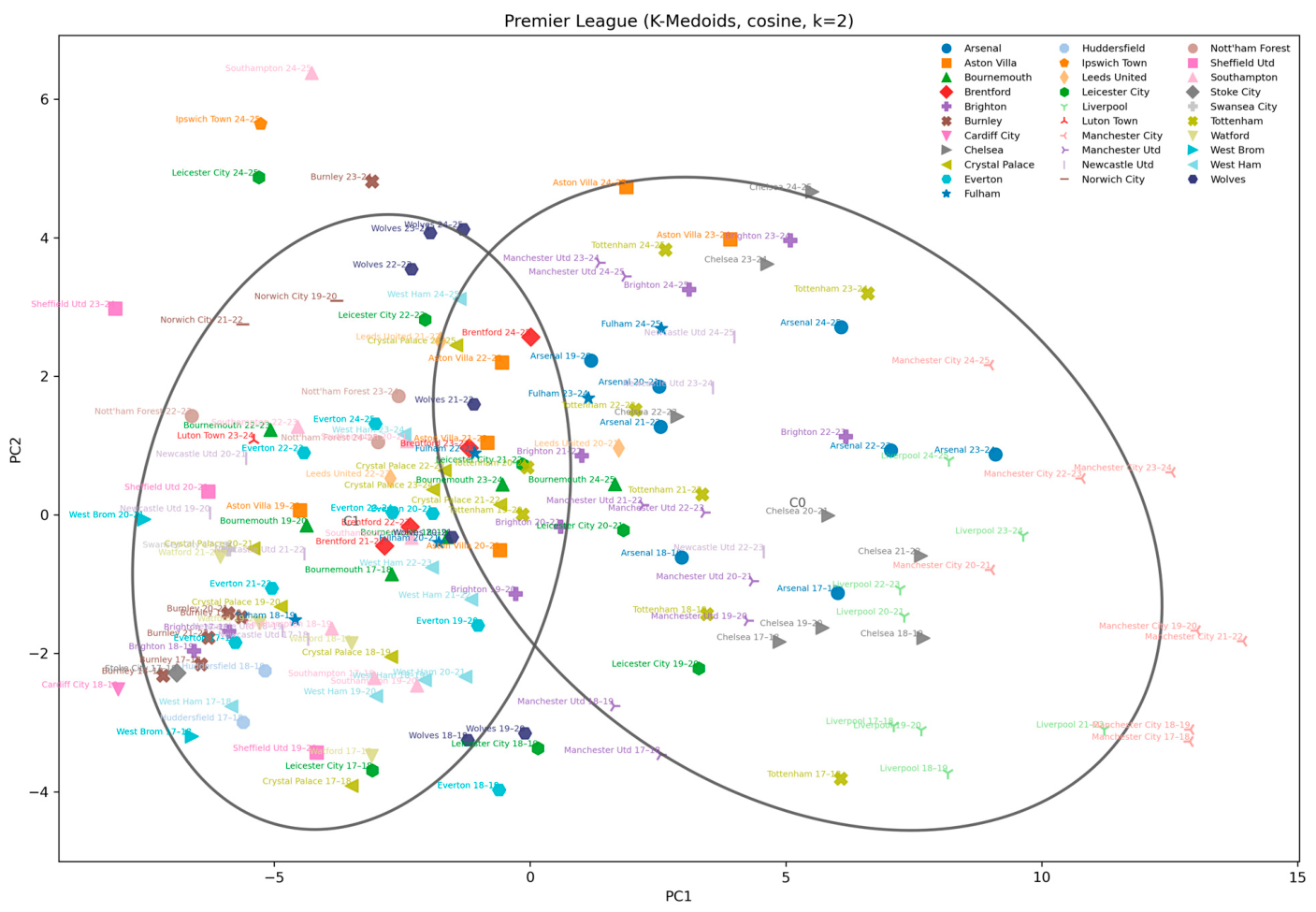
Figure A2.
PCA Plot of Ligue 1 Teams (K-Medoids, Cosine, k = 2).
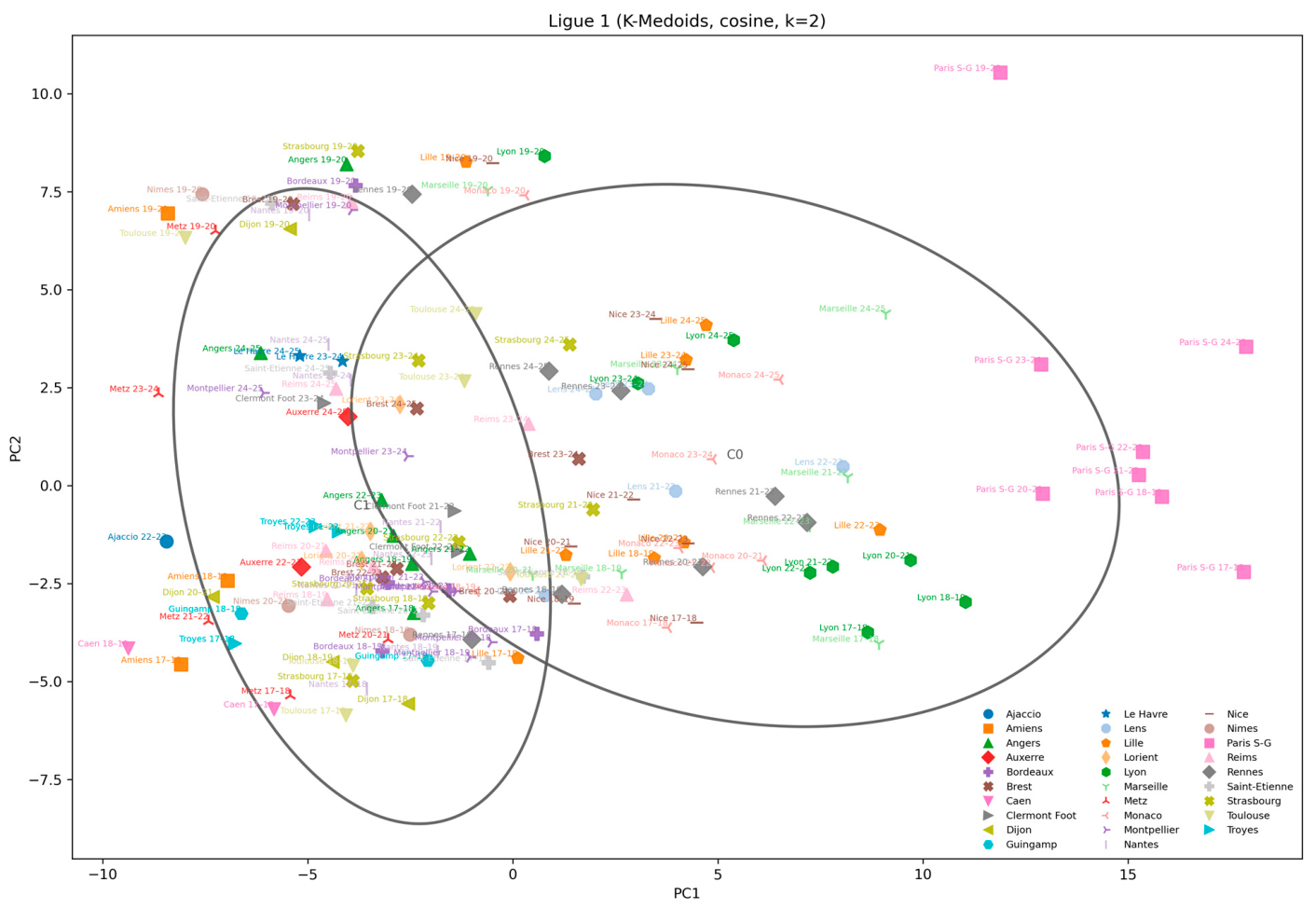
Figure A3.
PCA Plot of La Liga Teams (K-Medoids, Cosine, k = 2).
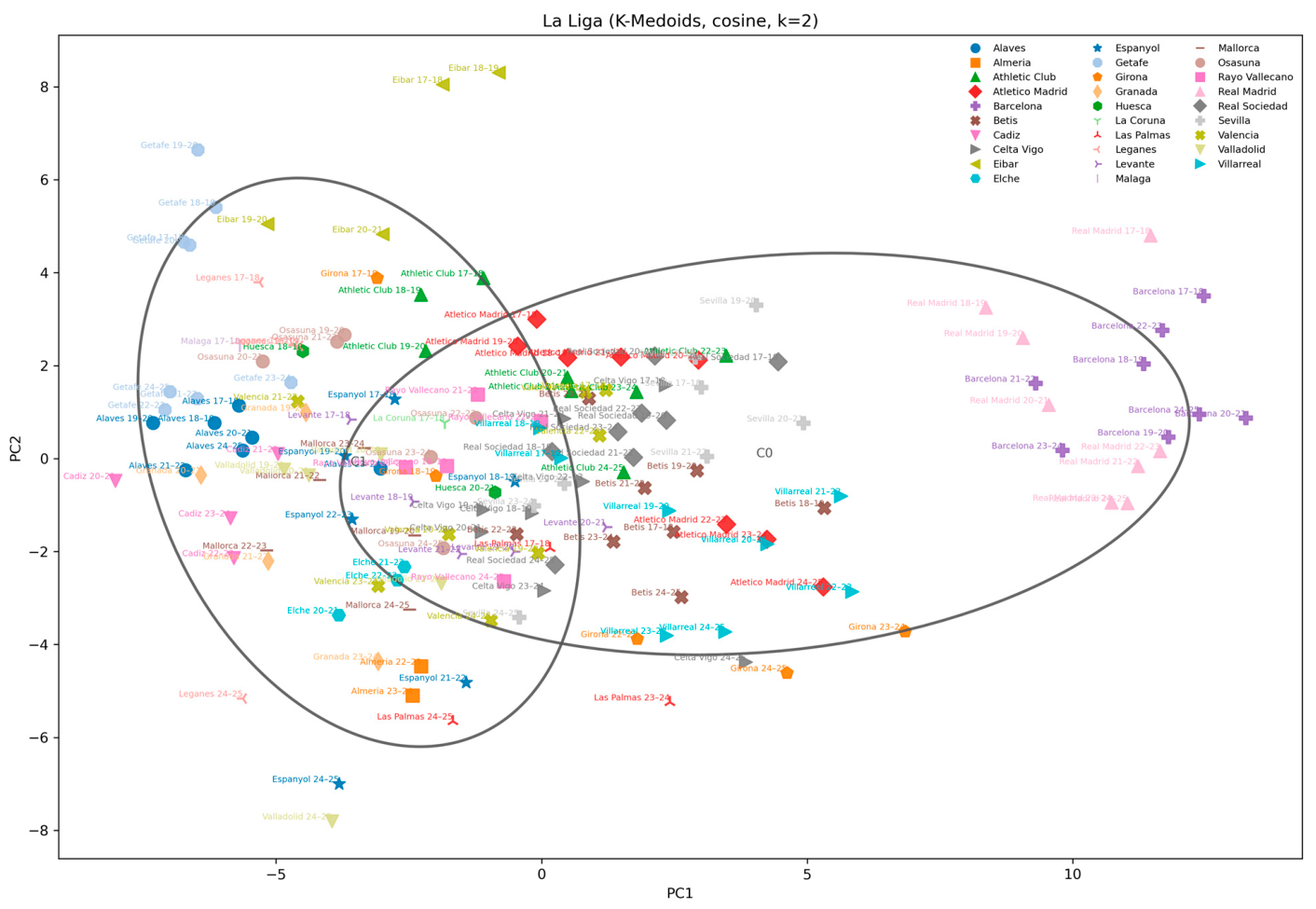
Figure A4.
PCA Plot of Serie A Teams (K-Medoids, Cosine, k = 2).
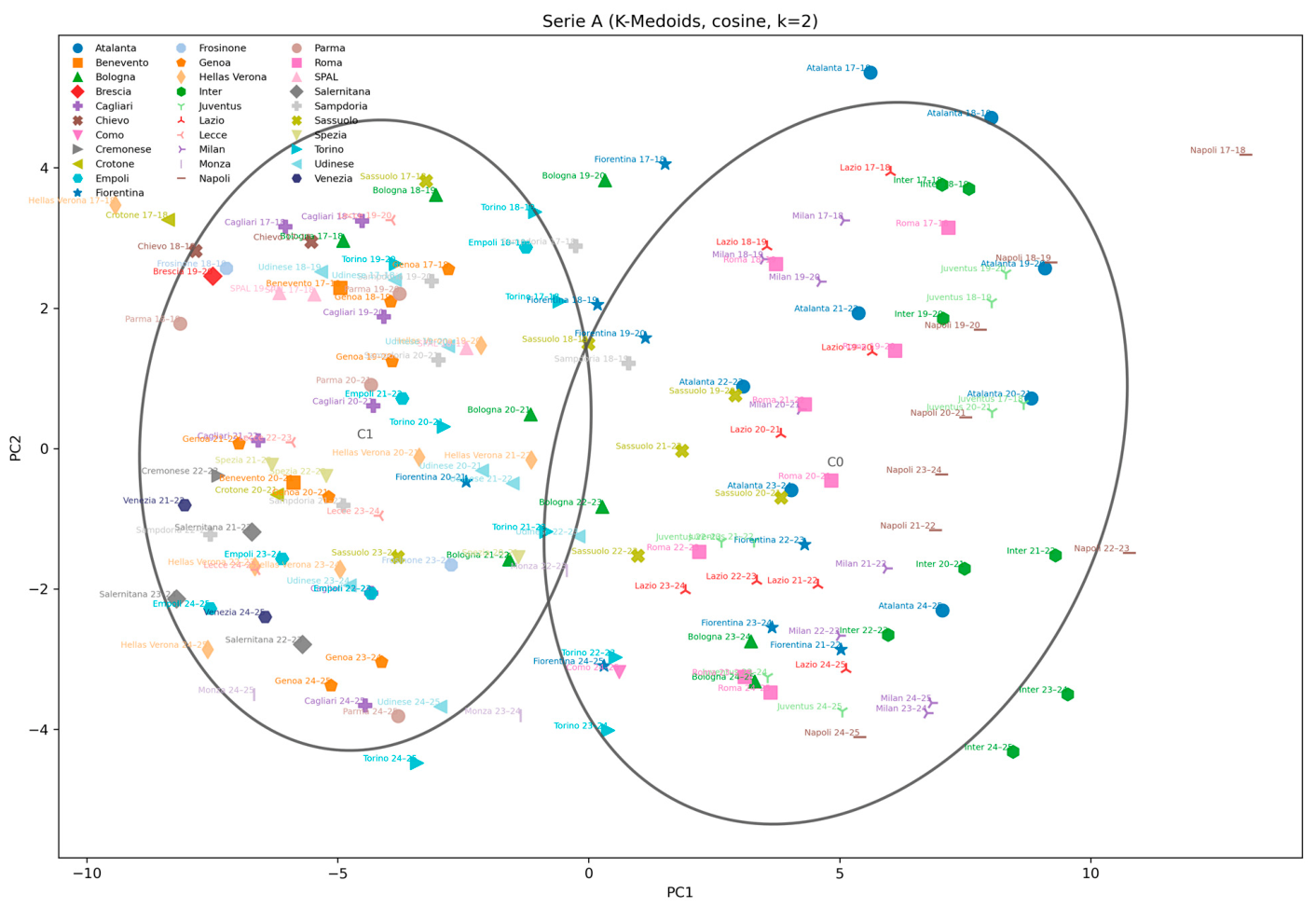
References
- Lolli, L.; Bauer, P.; Irving, C.; Bonanno, D.; Höner, O.; Gregson, W.; Di Salvo, V. Data analytics in the football industry: A survey investigating operational frameworks and practices in professional clubs and national federations from around the world. Sci. Med. Footb. 2025, 9, 189–198. [Google Scholar] [CrossRef] [Scilit]
- Pappalardo, L.; Cintia, P.; Rossi, A.; Massucco, E.; Ferragina, P.; Pedreschi, D.; Giannotti, F. A public data set of spatio-temporal match events in soccer competitions. Sci. Data 2019, 6, 236. [Google Scholar] [CrossRef] [Scilit]
- FBref. Sports Reference. Available online: https://fbref.com (accessed on 1 September 2025).
- Stats Perform. Opta Event Definitions. Available online: https://www.statsperform.com/opta-event-definitions/ (accessed on 1 September 2025).
- Bartels, F.; Xing, L.; Midoglu, C.; Boeker, M.; Kirsten, T.; Halvorsen, P. SoccerGuard: Investigating injury risk factors for professional soccer players with machine learning. arXiv 2024, arXiv:2411.08901. [Google Scholar]
- Bengtsson, H.; Ekstrand, J.; Hägglund, M. Muscle injury rates in professional football increase with fixture congestion: An 11-year follow-up of the UEFA Champions League injury study. Br. J. Sports Med. 2013, 47, 743–747. [Google Scholar] [CrossRef] [Scilit]
- Ekstrand, J.; Hägglund, M.; Waldén, M. Injury incidence and injury patterns in professional football: The UEFA injury study. Br. J. Sports Med. 2011, 45, 553–558. [Google Scholar] [CrossRef] [Scilit]
- Owoeye, O.B.A.; VanderWey, M.J.; Pike, I. Reducing injuries in soccer (football): An umbrella review of best evidence across the epidemiological framework for prevention. Sports Med. Open 2020, 6, 46. [Google Scholar] [CrossRef] [Scilit]
- Rahnama, N.; Reilly, T.; Lees, A. Injury risk associated with playing actions during competitive soccer. Br. J. Sports Med. 2002, 36, 354–359. [Google Scholar] [CrossRef] [Scilit]
- Andersen, T.E.; Tenga, A.; Engebretsen, L.; Bahr, R. Video analysis of injuries and incidents in Norwegian professional football. Br. J. Sports Med. 2004, 38, 626–631. [Google Scholar] [CrossRef] [Scilit]
- Jiang, Z.; Hao, Y.; Jin, N.; Li, Y. A systematic review of the relationship between workload and injury risk of professional male soccer players. Int. J. Environ. Res. Public Health 2022, 19, 13237. [Google Scholar] [CrossRef] [Scilit]
- Apostolou, A.; Tjortjis, C. Sports analytics algorithms for performance prediction. In Proceedings of the 2019 10th International Conference on Information, Intelligence, Systems and Applications (IISA), Patras, Greece, 15–17 July 2019; pp. 1–4. [Google Scholar] [CrossRef] [Scilit]
- Ley, C. Thomas A. Severini (2020): Analytic methods in sports—Using mathematics and statistics to understand data from baseball, football, basketball, and other sports. Stat. Pap. 2021, 62, 1091–1092. [Google Scholar] [CrossRef] [Scilit]
- Sarlis, V.; Tjortjis, C. Sports analytics—Evaluation of basketball players and team performance. Inf. Syst. 2020, 93, 101562. [Google Scholar] [CrossRef] [Scilit]
- Pollard, R. Charles Reep (1904–2002): Pioneer of notational and performance analysis in football. J. Sports Sci. 2002, 20, 853–855. [Google Scholar] [CrossRef] [Scilit]
- Fuller, C.W.; Ekstrand, J.; Junge, A.; Andersen, T.E.; Bahr, R.; Dvořák, J.; Hägglund, M.; McCrory, P.; Meeuwisse, W.H. Consensus statement on injury definitions and data collection procedures in studies of football (soccer) injuries. Br. J. Sports Med. 2006, 40, 193–201. [Google Scholar] [CrossRef] [Scilit]
- Waldén, M.; Mountjoy, M.; McCall, A.; Serner, A.; Massey, A.; Tol, J.L.; Bahr, R.; D’Hooghe, M.; Bittencourt, N.; Della Villa, F.; et al. Football-specific extension of the IOC consensus statement: Methods for recording and reporting of epidemiological data on injury and illness in sport 2020. Br. J. Sports Med. 2023, 57, 1341–1350. [Google Scholar] [CrossRef] [Scilit]
- Bahr, R.; Clarsen, B.; Ekstrand, J. Why we should focus on the burden of injuries and illnesses, not just their incidence. Br. J. Sports Med. 2018, 52, 1018–1021. [Google Scholar] [CrossRef] [Scilit]
- Page, R.M.; Field, A.; Langley, B.; Harper, L.D.; Julian, R. The effects of fixture congestion on injury in professional male soccer: A systematic review. Sports Med. 2023, 53, 667–685. [Google Scholar] [CrossRef] [Scilit]
- Jones, C.M.; Griffiths, P.C.; Mellalieu, S.D. Training load and fatigue marker associations with injury and illness: A systematic review of longitudinal studies. Sports Med. 2017, 47, 943–974. [Google Scholar] [CrossRef] [Scilit]
- Jerome, B.W.C.; Stoeckl, M.; Mackriell, B.; Seidl, T.; Dawson, C.W.; Fong, D.T.P.; Folland, J.P. The influence of ball in/out of play and possession in elite soccer: Towards a more valid measure of physical intensity during competitive matchplay. Eur. J. Sport Sci. 2023, 23, 1892–1902. [Google Scholar] [CrossRef] [Scilit]
- Jerome, B.W.C.; Stoeckl, M.; Mackriell, B.; Dawson, C.W.; Fong, D.T.P.; Folland, J.P. Contextualised physical metrics: The physical demands vary with phase of play during elite soccer match play. Eur. J. Sport Sci. 2024, 24, 1627–1638. [Google Scholar] [CrossRef] [Scilit]
- Morgans, R.; Radnor, J.; Fonseca, J.; Haslam, C.; King, M.; Rhodes, D.; Żmijewski, P.; Oliveira, R. Match running performance is influenced by possession and team formation in an English Premier League team. Biol. Sport 2024, 41, 275–286. [Google Scholar] [CrossRef] [Scilit]
- Bowen, L.; Gross, A.S.; Gimpel, M.; Li, F.-X. Accumulated workloads and the acute: Chronic workload ratio relate to injury risk in elite youth football players. Br. J. Sports Med. 2017, 51, 452–459. [Google Scholar] [CrossRef] [Scilit]
- Laux, P.; Krumm, B.; Diers, M.; Flor, H. Recovery–stress balance and injury risk in professional football players: A prospective study. J. Sports Sci. 2015, 33, 2140–2148. [Google Scholar] [CrossRef] [Scilit]
- Chacoma, A.; Billoni, O.V. Data-driven approach to defining football styles in major leagues. Chaos Solitons Fractals 2025, 200, 116926. [Google Scholar] [CrossRef] [Scilit]
- Plakias, S.; Moustakidis, S.; Kokkotis, C.; Tsatalas, T.; Papalexi, M.; Plakias, D.; Giakas, G.; Tsaopoulos, D. Identifying soccer teams’ styles of play: A scoping and critical review. J. Funct. Morphol. Kinesiol. 2023, 8, 39. [Google Scholar] [CrossRef] [Scilit]
- Iván-Baragaño, I.; Bustamante-Sánchez, Á.; Ardá, A.; Maneiro, R. Effect of team quality on offensive playing style and ball possessions development during the 2023 FIFA Women’s World Cup. Biol. Sport 2025, 42, 49–58. [Google Scholar] [CrossRef] [Scilit]
- Hoenig, T.; Edouard, P.; Krause, M.; Malhan, D.; Relógio, A.; Junge, A.; Hollander, K. Analysis of more than 20,000 injuries in European professional football by using a citizen science-based approach: An opportunity for epidemiological research? J. Sci. Med. Sport 2022, 25, 300–305. [Google Scholar] [CrossRef] [Scilit]
- Alpaydin, E. Machine Learning; MIT Press: Cambridge, MA, USA, 2015. [Google Scholar]
- Burkov, A. The Hundred-Page Machine Learning Book; Andriy Burkov: Quebec City, QC, Canada, 2019. [Google Scholar]
- Han, J.; Kamber, M.; Pei, J. Data Mining: Concepts and Techniques, 3rd ed.; Morgan Kaufmann: Waltham, MA, USA, 2011. [Google Scholar]
- James, G.; Witten, D.; Hastie, T.; Tibshirani, R. An Introduction to Statistical Learning: With Applications in R, 2nd ed.; Springer: New York, NY, USA, 2021. [Google Scholar]
- Jo, T. Machine Learning Foundations: Supervised, Unsupervised, and Advanced Learning; Springer: Cham, Switzerland, 2021. [Google Scholar]
- Jolliffe, I.T.; Cadima, J. Principal component analysis: A review and recent developments. Philos. Trans. R. Soc. A 2016, 374, 20150202. [Google Scholar] [CrossRef] [Scilit]
- Rousseeuw, P.J. Silhouettes: A graphical aid to the interpretation and validation of cluster analysis. J. Comput. Appl. Math. 1987, 20, 53–65. [Google Scholar] [CrossRef] [Scilit]
- Witten, I.H.; Frank, E.; Hall, M.A.; Pal, C.J. Data Mining: Practical Machine Learning Tools and Techniques, 4th ed.; Morgan Kaufmann: Cambridge, MA, USA, 2017. [Google Scholar]
- Wang, P.; Wang, A.; Wang, S. Integrating multimodal AI technologies for sports injury prediction and rehabilitation: Systematic review. J. Hum. Sport Exerc. 2026, 21, 22–37. [Google Scholar] [CrossRef] [Scilit]
- Lee, D.-J.; Zumeta-Olaskoaga, L. Can we really predict injuries in team sports? Bol. Soc. Esp. Estad. Investig. Oper. 2022, 38, 149. [Google Scholar]
- Leckey, C.; van Dyk, N.; Doherty, C.; Lawlor, A.; Delahunt, E. Machine learning approaches to injury risk prediction in sport: A scoping review with evidence synthesis. Br. J. Sports Med. 2025, 59, 491–500. [Google Scholar] [CrossRef] [Scilit]
- Transfermarkt. Available online: https://www.transfermarkt.com (accessed on 1 September 2025).
- Davies, D.L.; Bouldin, D.W. A cluster separation measure. IEEE Trans. Pattern Anal. Mach. Intell. 1979, 1, 224–227. [Google Scholar] [CrossRef] [Scilit]
- Ruxton, G.D. The unequal variance t-test is an underused alternative to Student’s t-test and the Mann–Whitney U test. Behav. Ecol. 2006, 17, 688–690. [Google Scholar] [CrossRef] [Scilit]
- Good, P.I. Permutation, Parametric, and Bootstrap Tests of Hypotheses, 3rd ed.; Springer: New York, NY, USA, 2005. [Google Scholar]
- Orhant, E.; Chapellier, J.F.; Carling, C. The impact of a mid-season FIFA World Cup™ on injury occurrence and patterns in French professional soccer clubs. Res. Sports Med. 2024, 32, 1005–1014. [Google Scholar] [CrossRef] [Scilit]
- Adams, S.R.; Toohey, L.A.; Drew, M.K.; Smith, C.; Borges, N.; Wollin, M.; Livingston, G.C., Jr.; Schultz, A. Epidemiology of time-loss injuries within an Australian male professional football club: A 5-year prospective observational study of 21,343 player hours. J. Sports Sci. 2023, 41, 2161–2168. [Google Scholar] [CrossRef] [Scilit]
- Casals, M.; Fernandez, D.; Zumeta-Olaskoaga, L.; Sanchez, A.; Zuccolotto, P. Reporting of generalized linear mixed models (GLMM) in sports sciences: A scoping review. J. Sports Anal. 2025, 11, 22150218251384557. [Google Scholar] [CrossRef] [Scilit]
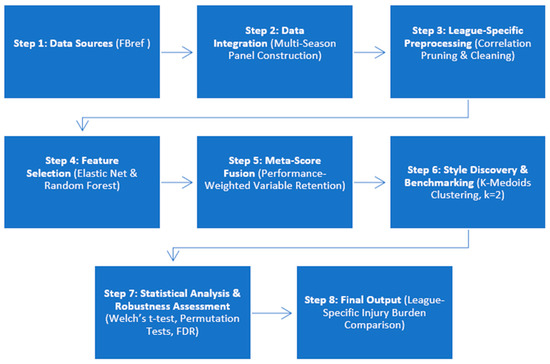
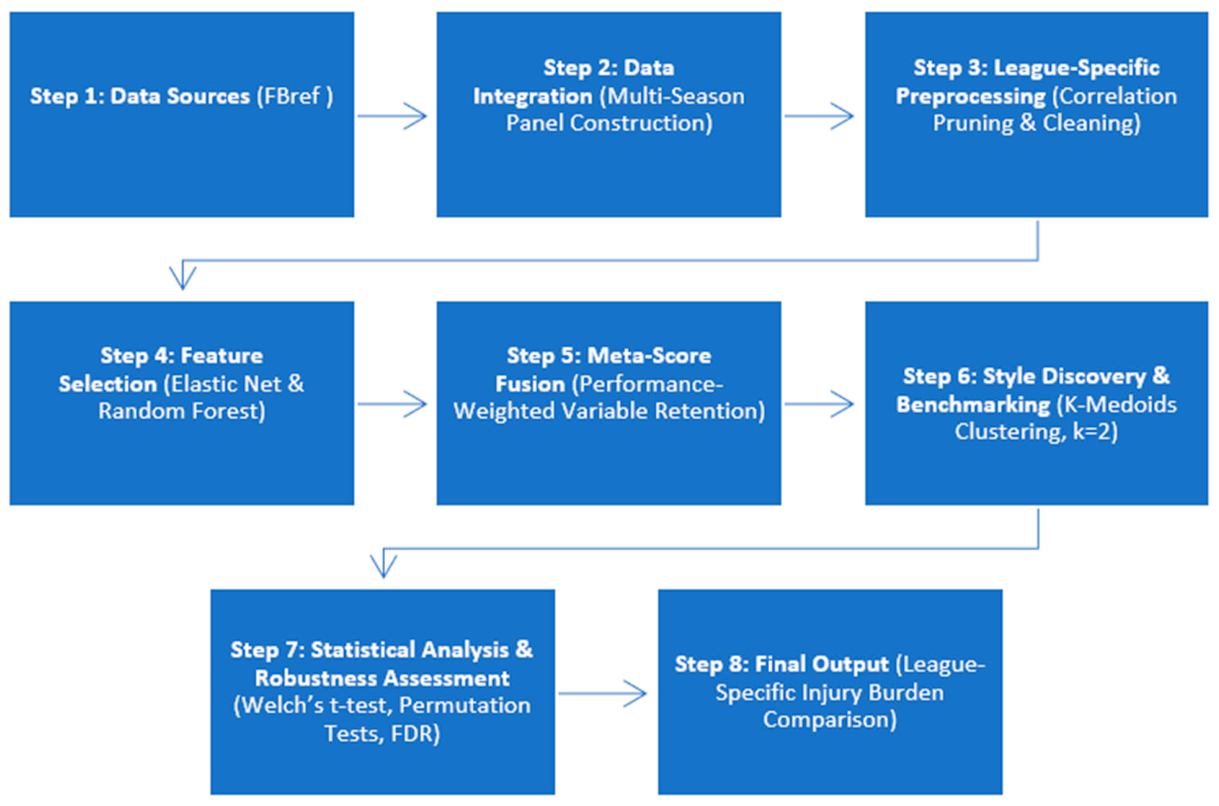
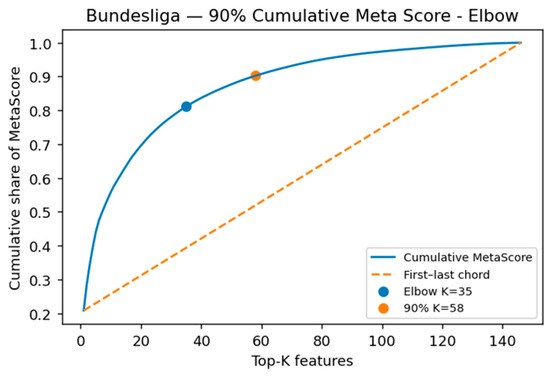
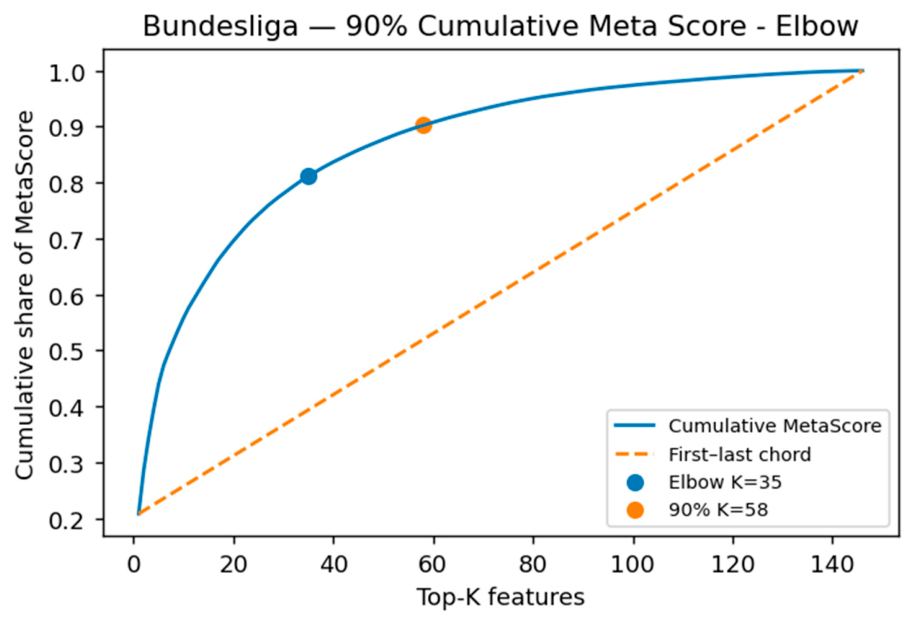
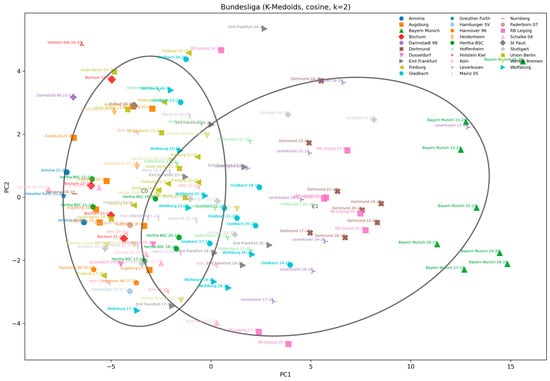
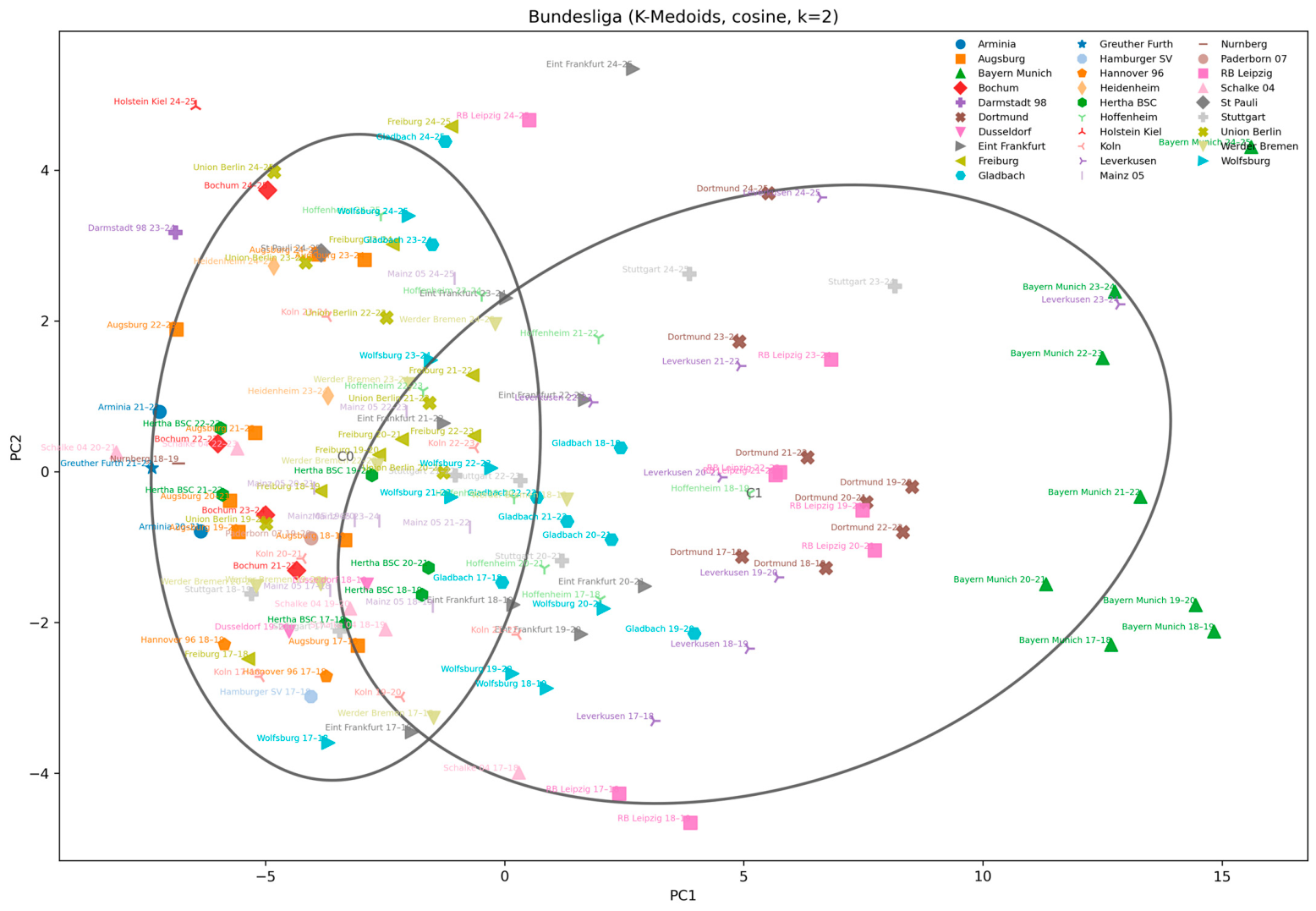
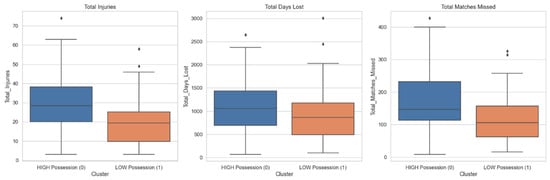
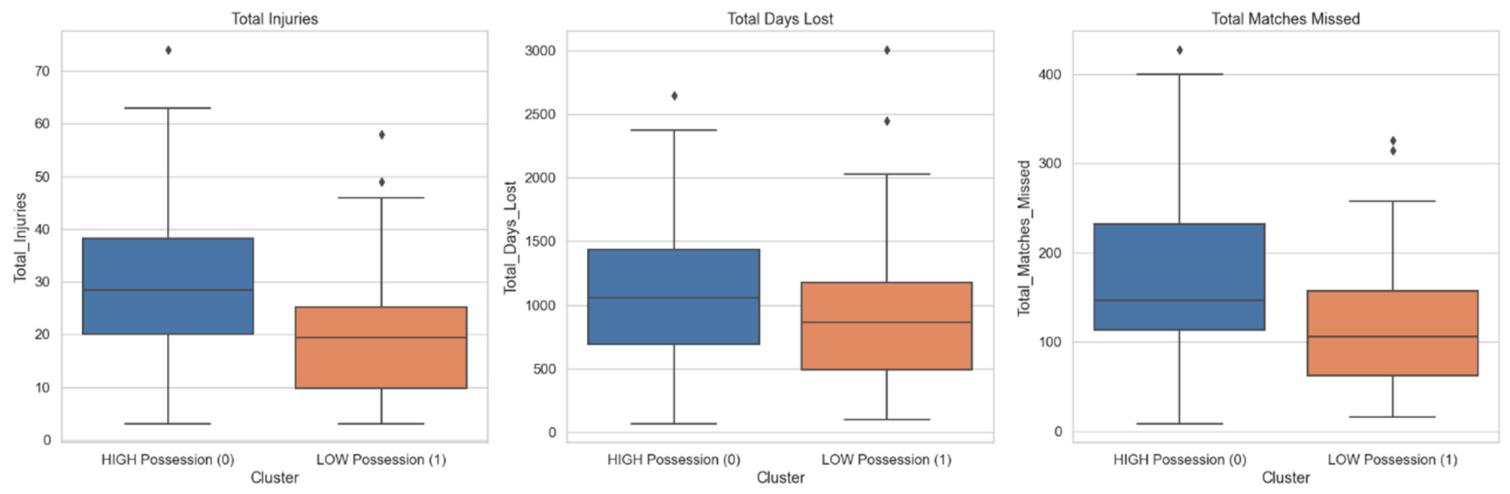
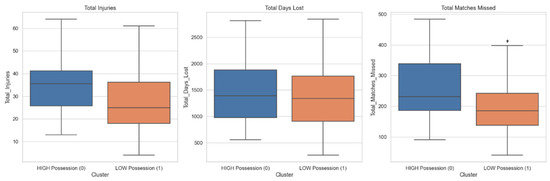
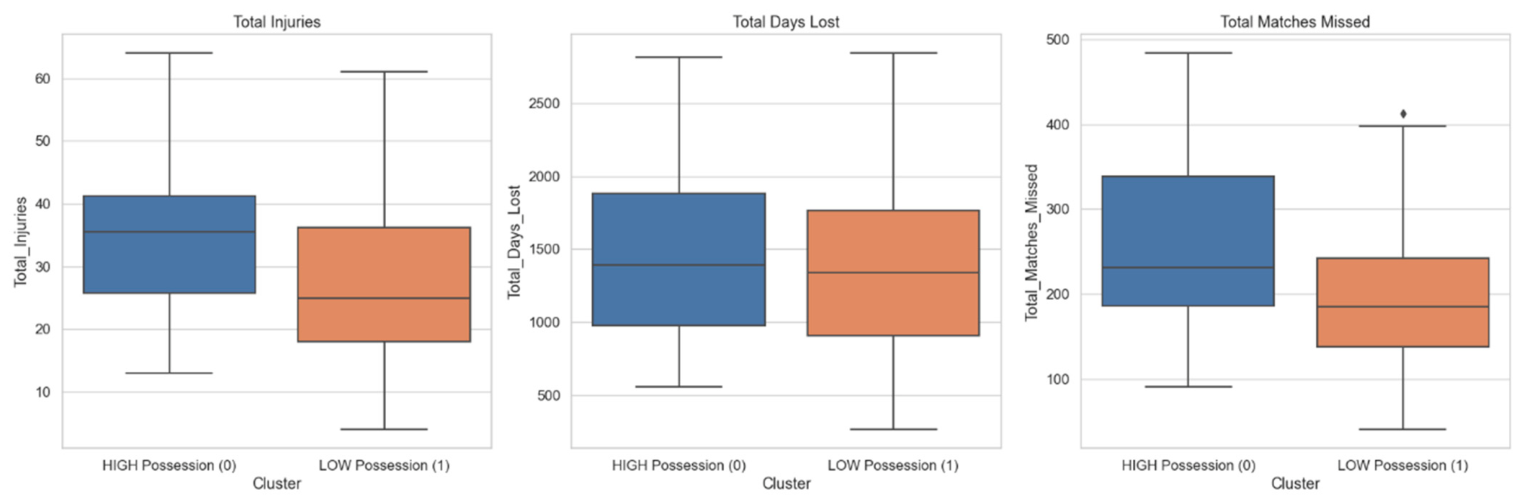
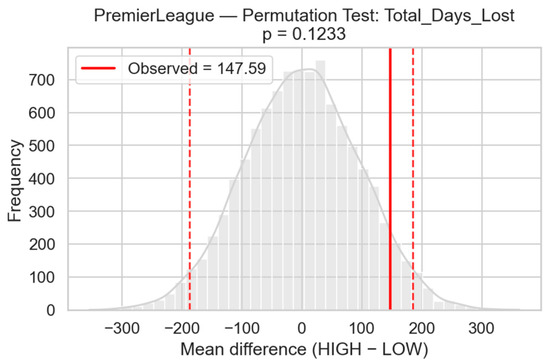
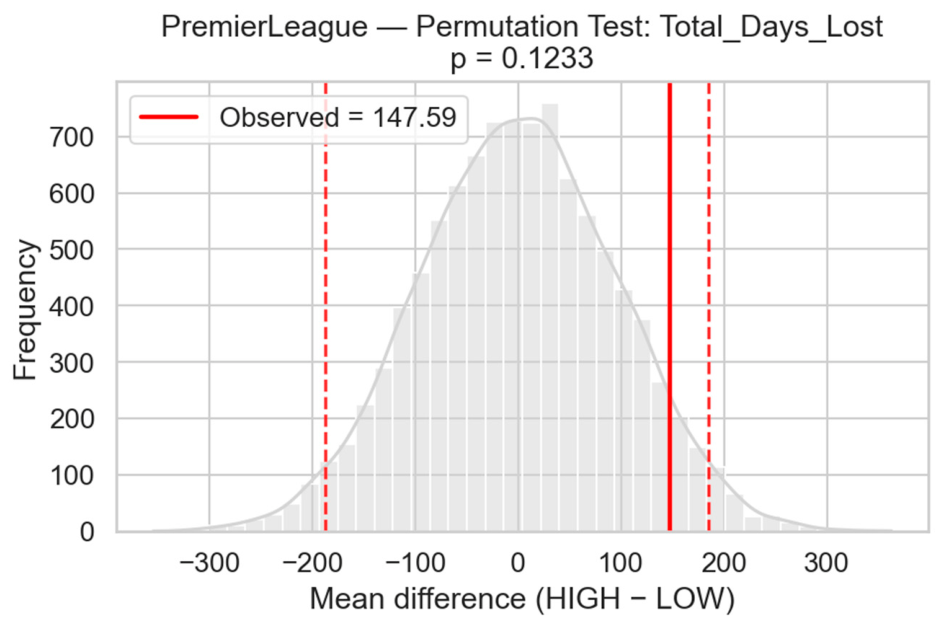
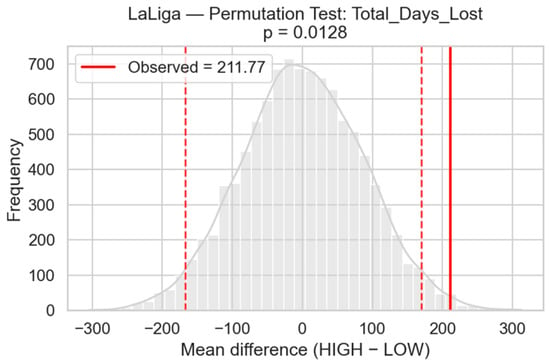
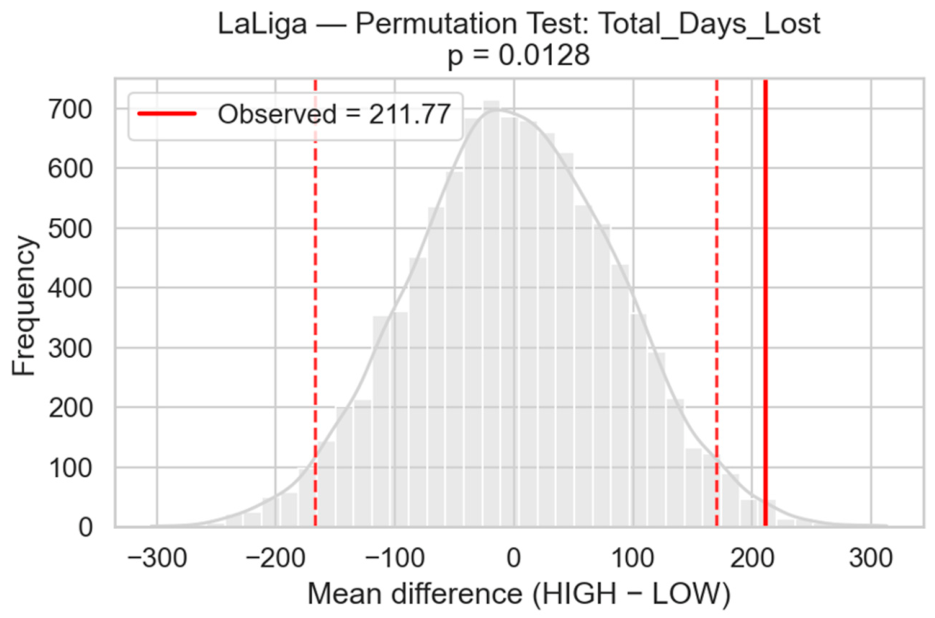
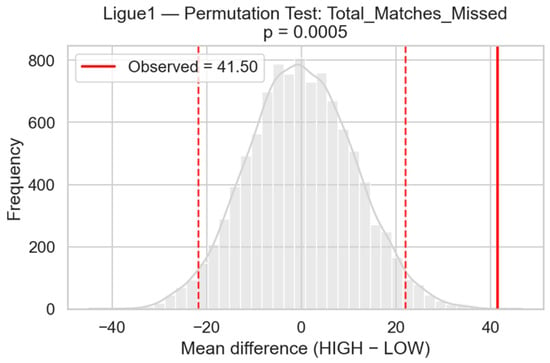
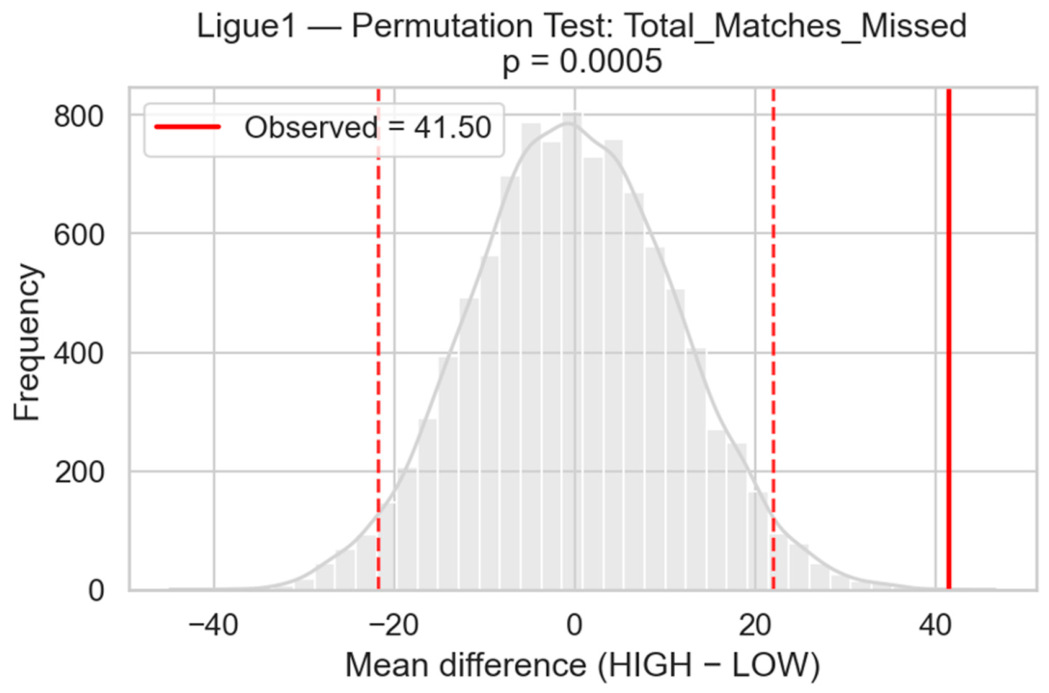
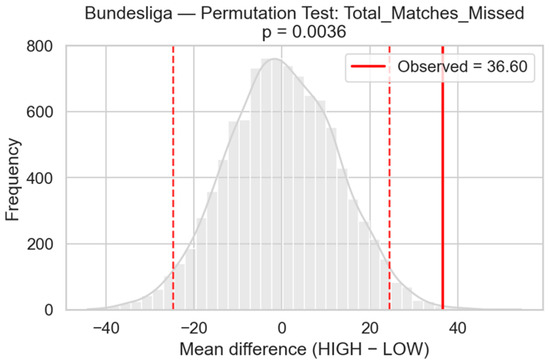
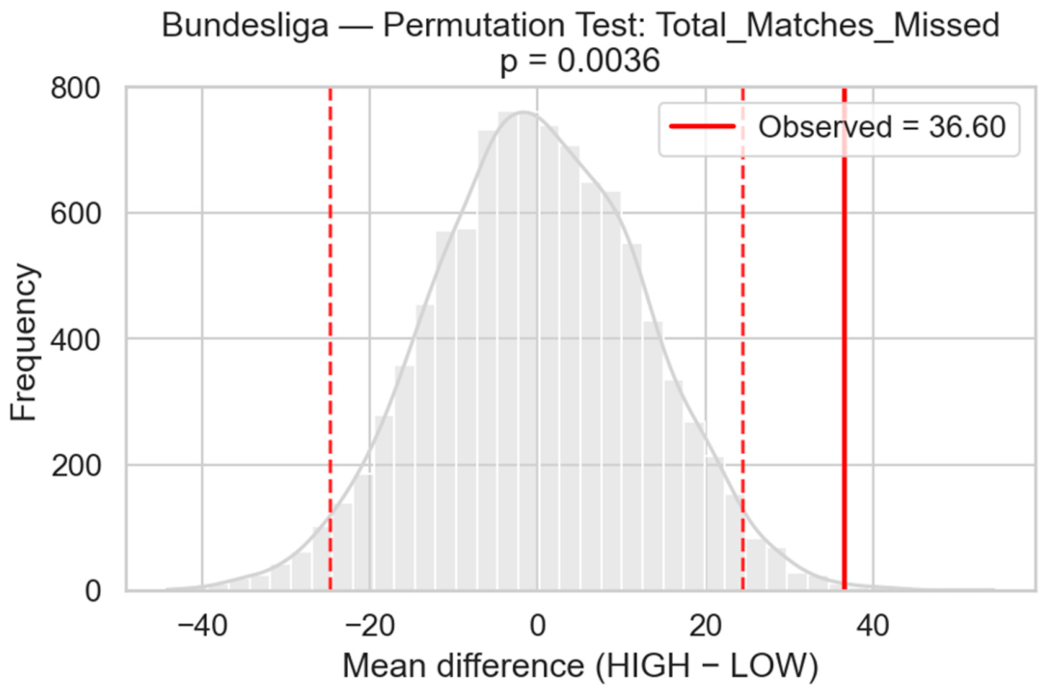

Disclaimer/Publisher’s Note: The statements, opinions and data contained in all publications are solely those of the individual author(s) and contributor(s) and not of MDPI and/or the editor(s). MDPI and/or the editor(s) disclaim responsibility for any injury to people or property resulting from any ideas, methods, instructions or products referred to in the content. |
© 2026 by the authors. Licensee MDPI, Basel, Switzerland. This article is an open access article distributed under the terms and conditions of the Creative Commons Attribution (CC BY) license.