


Abstract
Knowledge graphs are foundational to structured knowledge representation and drive the evolution of artificial intelligence from data-driven to knowledge-enhanced paradigms. Hyper-relational knowledge graphs employ hyperedge structures to overcome the expressive limitations of conventional triple-based schemes in modeling complex multi-entity facts with intricate dependency constraints. However, prevailing completion methods prioritize global structural patterns while neglecting entity role dependencies and type-level semantic priors, rendering them vulnerable to data sparsity and semantic noise. This study proposes RATA, a hyper-relational knowledge graph completion model that integrates role-aware and type-aware mechanisms to mitigate these drawbacks. The model uniformly encodes hyper-relational facts through hyperedge representations and captures global semantics using a bidirectional node–hyperedge attention module. It leverages role-aware sequence modeling to explicitly represent entity semantic roles and incorporates entity type priors to construct hierarchical semantics for aligning instance- and type-level information, thereby fusing structural, role-semantic, and type-prior knowledge. Evaluations on JF17K, WD50K, and WikiPeople show that RATA achieves competitive performance on entity and relation completion tasks. Ablation experiments validate the effectiveness of its hyperedge global encoding, role-aware modeling, and type-aware representation learning modules, indicating that RATA provides viable technical support for complex hyper-relational knowledge graph completion.
1. Introduction
Knowledge graphs, as graph-structured knowledge representation paradigms [1], have emerged as essential infrastructure across intelligent question answering, recommender systems, web search, knowledge reasoning, and knowledge-enhanced large-language models. Conventional knowledge graphs encode real-world facts as triples (h,r,t), where h,r and t correspond to the head entity, relation, and tail entity respectively [2]. Nevertheless, many real-world facts are inherently multi-relational: a single event typically involves multiple descriptive qualifiers such as time, location, participants, and quantities. For instance, the fact that “Marie Curie jointly received the 1903 Nobel Prize in Physics with Pierre Curie” involves not only the award-receiving relation but also contextual attributes such as the award year and co-laureates. Decomposing such complex facts into isolated triples disrupts their intrinsic holistic semantics and may sever the critical associations between qualifiers and core facts, thereby degrading the performance of downstream reasoning and completion tasks.
To overcome the expressive limitations of triple-centric knowledge graphs, hyper-relational knowledge graphs (HKGs) extend standard triples with qualifiers or hyperedge structures, enabling individual facts to associate multiple entities and descriptive attributes for a more faithful modeling of complex real-world knowledge. Despite this enhanced representational capacity, HKGs still suffer from widespread fact incompleteness and semantic noise, as knowledge acquisition relies heavily on manual annotation and automated extraction pipelines [3]. Knowledge graph completion (KGC), which infers missing entities and relations from observed evidence, therefore constitutes a vital research task for HKGs [4]. A series of HKG-oriented completion models, including NaLP, HINGE, StarE, HyperFormer, and HAHE, have been developed, leveraging convolutional networks, graph neural networks, and Transformers to model qualifiers and higher-order facts, and have yielded considerable progress on entity and relation prediction tasks.
Existing literature has separately investigated entity-role heterogeneity and type-ontology resources. HAHE adopts bidirectional node-hyperedge attention alongside role- and role-pair bias terms to capture both global and local semantic signals [5]. HyperCL builds paired instance-level and hierarchical ontology views, treating cross-view embeddings of identical entities as positive samples and concept-aligned entities as hard negatives for contrastive optimization [6]. However, few existing frameworks tightly unify role semantics and type-aware ontology within one integrated completion pipeline. Motivated by this gap, this work integrates global hyperedge contexts into local role sequences, explicitly differentiating intra-qualifier and cross-qualifier interactions, and applies type-driven contrastive constraints to shared entity embeddings under unified masking. This design targets the semantic disconnection among structural encoding, role interaction and type-level prior knowledge.
HAHE and HyperCL lay important theoretical foundations for hyper-relational knowledge graph completion. RATA investigates how global hyperedge representations, fine-grained role interactions, and type-level semantic supervision can be coherently integrated within a unified completion framework. Specifically, RATA adopts the bidirectional node–hyperedge attention paradigm of HAHE for instance-level structural encoding, and feeds the learned global hyperedge representations as contextual features into the subsequent role-aware sequence encoder, thereby allowing the global fact context to explicitly participate in role-conditioned interaction modeling. For type-aware learning, RATA inherits the core principle of instance–type cross-view alignment from HyperCL and further develops a type-guided negative sampling strategy, which constructs negative samples by selecting instances associated with identical or semantically similar types. Moreover, the type view employs unidirectional information propagation to preserve type-level semantic features and to mitigate interference arising from instance-level noise. Accordingly, the contributions of RATA lie in a set of task-oriented, customized designs and their joint optimization tailored to hyper-relational knowledge graph completion.
This paper makes three key contributions. First, this study proposes an integrated hyper-relational completion framework that couples HAHE-style global hyperedge encoding with role-aware sequence modeling. RATA treats the global hyperedge representation as a contextual token and incorporates role-specific and role-pair information in a subsequent sequence encoder, jointly modeling global fact context and role-conditioned interactions. Second, a type-aware learning strategy that combines instance–type cross-view alignment with type-guided negative sampling was designed. By selecting negative instances associated with identical or semantically similar types, the strategy provides more discriminative training signals than indiscriminate negative sampling, while the type view adopts unidirectional propagation to preserve the stability of type-level semantics. Third, evaluation of the integrated framework on real datasets and ablation studies provide empirical evidence for the effectiveness of the proposed design choices, while also revealing that the performance gains vary across datasets and completion tasks.
The remainder of this paper is organised as follows. Section 2 reviews related work covering hyper-relational knowledge graph completion and entity-type fusion. Section 3 details the RATA architecture, role-aware modelling and type-aware contrastive learning. Section 4 describes experimental setups, main results and ablation analysis. Section 5 concludes this study and points out promising future research directions.
2. Related Work
2.1. Hyper-Relational Knowledge Graph Completion
Traditional knowledge graphs adopt triples as the basic unit of knowledge representation, which restricts them to describing binary relations. However, a large portion of real-world knowledge inherently involves multiple entities and attributes simultaneously. To faithfully represent such complex facts, researchers have proposed hyper-relational knowledge graphs, which uniformly model multiple entities together with their attributes through qualifiers or hyperedge structures, thereby significantly enhancing representational capacity [7,8]. In recent years, HKG completion has been extensively studied from diverse technical perspectives, including approaches based on convolutional neural networks, graph neural networks, and Transformers.
Early methods predominantly represent hyper-relational facts as main triple–qualifier pairs. Guan et al. proposed NaLP, which constructs fact matrices using role–value representations and learns interactions via convolutional networks [9]. Guan et al. further introduced NeuInfer, which employs fully connected networks to model compatibility between main triples and qualifier information [10]. Rosso et al. developed HINGE, which leverages two-dimensional convolutions to enhance interactions among different qualifiers, achieving strong completion performance on multiple public datasets [11]. While these methods preserve the distinction between main facts and auxiliary information, they utilize cross-fact global structures to a limited extent. Moreover, all these approaches are centered around main triples, and their expressiveness remains constrained by the central triple structure. When the number of qualifiers increases, or relational patterns become more complex, they struggle to fully capture the holistic semantics of hyper-relational facts.
To overcome the limitations of main-triple-centric representations, researchers have gradually adopted hyperedges as a unified fact representation. Galkin et al. proposed StarE, which first introduced graph neural networks into HKG completion, aggregating neighborhood structural information via graph convolutions for entity representation learning [12]. Subsequently, Structure-Aware Transformer, GAHE, HMTE, and G-MPNN have extended higher-order fact modeling from perspectives including structural attention, geometric spaces, memory mechanisms, and message passing [13,14,15,16]. HAHE further adopts node–hyperedge bidirectional attention for global structure learning and incorporates five role types and role-pair biases to capture intra-fact semantics [5]. Compared with main-triple representations, hyperedge representations can uniformly describe higher-order relations among arbitrary numbers of entities and have thus become a prominent direction in current HKG completion research.
Recent studies have explored contextual, semantic, and structural cues for knowledge graph completion. CRL-MM models context-aware relational semantics and multidimensional matching for few-shot completion [17]. HELIOS encodes hyper-relational schema tuples with context-aware type-set representations for masked schema prediction [18]. Yu et al. jointly exploit graph structure and semantic descriptions via contrastive learning [19], while ConvD employs attention-enhanced dynamic convolution to strengthen entity–relation interactions [20]. These studies reflect a trend toward integrating complementary structural and semantic signals. However, most focus on conventional knowledge graphs or general graph representation learning. The coordinated modeling of global hyper-relational structure, entity-specific semantic roles, and type-level semantic priors remains underexplored in hyper-relational knowledge graph completion.
2.2. Entity Type-Enhanced Knowledge Representation
Entity type information describes the concepts to which entities belong and their hierarchical relations, characterized by semantic stability, low noise, and strong interpretability. It has therefore been widely adopted to enhance KG representation learning. Recent studies have explored joint modeling of instance and type representations, which can be broadly categorized into type constraints, hierarchical representations, and dual-view representation learning three paradigms.
Type-constraint methods typically use entity types as prior knowledge to guide instance representation learning. TransC models concepts as spheres and instances as points within them, capturing conceptual hierarchies through geometric constraints [21]. tNaLP incorporates type-consistency constraints into HKGs to improve semantic compatibility between roles and values [10]. CDRL further exploits concept constraints to optimize entity representations [22]. Although these methods improve interpretability, their static constraints cannot fully capture complex semantic interactions between instances and types.
Hierarchical representation learning methods further leverage conceptual hierarchies to enhance representational capacity. TKRL employs projection matrices to learn mappings between entities and types [23]. HAKE utilizes polar coordinate spaces to represent hierarchical semantics [24], and DGS combines hyperbolic and spherical spaces for concept hierarchy modeling [25]. These methods effectively capture subsumption relations among concepts, but are primarily designed for traditional KGs and cannot be directly applied to complex hyper-relational facts.
In recent years, dual-view representation learning has emerged as an important direction for entity type fusion. JOIE first proposed a joint learning framework for instance and concept views, enabling collaborative optimization of instance and concept representations [26]. DVHE and DHGE respectively introduce joint instance-view and type-view modeling for HKGs, employing shared entities to establish cross-view connections [27,28]. HyperCL further leverages concept-aware contrastive learning to alleviate training imbalance between dual views, improving the utilization of type information [6]. Although these methods improve entity type representation quality, most still prioritize instance representation learning, with type information serving primarily as an auxiliary constraint. They lack deep consistency modeling between instance and type semantic spaces, leaving the latent semantic value of entity types underexplored. More recently, structural-semantic integration with contrastive learning has also been explored for knowledge graph completion, further demonstrating the value of jointly exploiting structural and semantic signals [29]. Nevertheless, such approaches mainly target conventional knowledge graphs, whereas RATA focuses on type-level semantic priors in hyper-relational facts and integrates them with role-aware and global hyperedge representations.
2.3. Dual-View Entity Type Fusion and Limitations
From the perspective of the main triple–auxiliary pair expression paradigm, the primary fact structure and qualifier information within a hyper-relational fact exhibit both global dependencies and multi-level local semantic interactions [14]. To mitigate insufficient interaction between the main triple and auxiliary pairs, as well as noise interference in auxiliary information, a parallel modeling strategy with an instance view and a type view is adopted. The instance view encodes the topological structure and entity interactions of hyper-relational facts, whereas the type view leverages the inherent stability and low noise of entity type semantics to provide high-level semantic priors for instance representations. Shared entities across the two views serve as alignment anchors, and a contrastive loss with in-batch negative sampling pulls the cross-view representations of the same entity closer while pushing those of mismatched entities apart. This mechanism enables the relatively smaller type view to continuously receive optimization signals from the instance view, thereby alleviating view imbalance during joint training and improving the utilization efficiency of entity type information.
However, the aforementioned dual-view fusion approaches still predominantly center on the main triple during modeling, with qualifier information typically participating only as subsidiary pair-level interactions, which makes it difficult to preserve the higher-order holistic structure of hyper-relational facts. Meanwhile, negative samples generated by conventional in-batch sampling tend to be easily distinguishable, offering limited capacity to capture fine-grained semantic differences among entities of the same type. Furthermore, in the absence of explicit differentiation among semantic roles such as subject, predicate, object, attribute, and attribute value, type priors cannot effectively coordinate with the role dependencies inherent in a fact. It is therefore necessary to integrate hyperedge structure encoding, role-aware modeling, and type-aware cross-view learning within a unified framework, thereby achieving synergistic modeling of global structure, local role semantics, and entity type priors.
Based on the above analysis, this paper proposes Role-Aware and Type-Aware Hyper-relational Knowledge Graph Completion (RATA), a hyper-relational knowledge graph completion model that integrates role-aware and type-aware mechanisms. The model comprises three separable modules, including a HAHE-based instance hypergraph encoder, a HyperCL-based type view with contrastive objectives, and a pairwise-aware role sequence encoder that takes the global hyperedge representation as the [CLS] context. First, RATA adopts the bidirectional node–hyperedge attention paradigm of HAHE as the basis for instance-level structural encoding, and further uses the global hyperedge representation as the contextual token for a subsequent role-aware sequence encoder, thereby connecting global structural information with role-conditioned interactions. Second, RATA follows the instance–type cross-view alignment principle of HyperCL, and its type-aware learning design additionally specifies a type-guided negative-sampling procedure based on instances associated with identical or semantically similar types, while restricting propagation in the type view to a single direction. Third, although HAHE already models role and role-pair information, RATA organizes fact elements into a role-distinguished sequence and combines role biases with role-pair biases within the sequence attention mechanism. The key distinction this study emphasizes is therefore the integration and operationalization of these mechanisms within the RATA pipeline. These design choices are intended to address the complementary requirements of global structural encoding, role-sensitive interaction modeling, and type-informed entity discrimination.
3. Proposed Methodology
3.1. Model Framework and Problem Definition
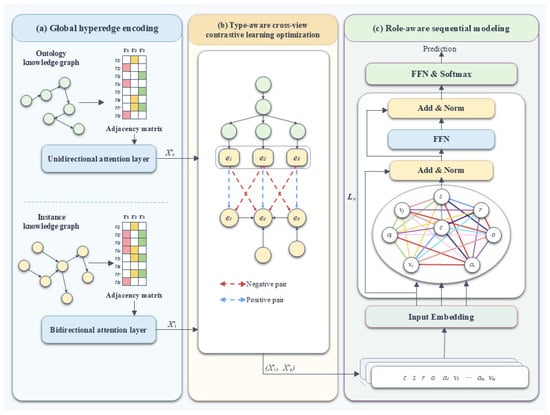
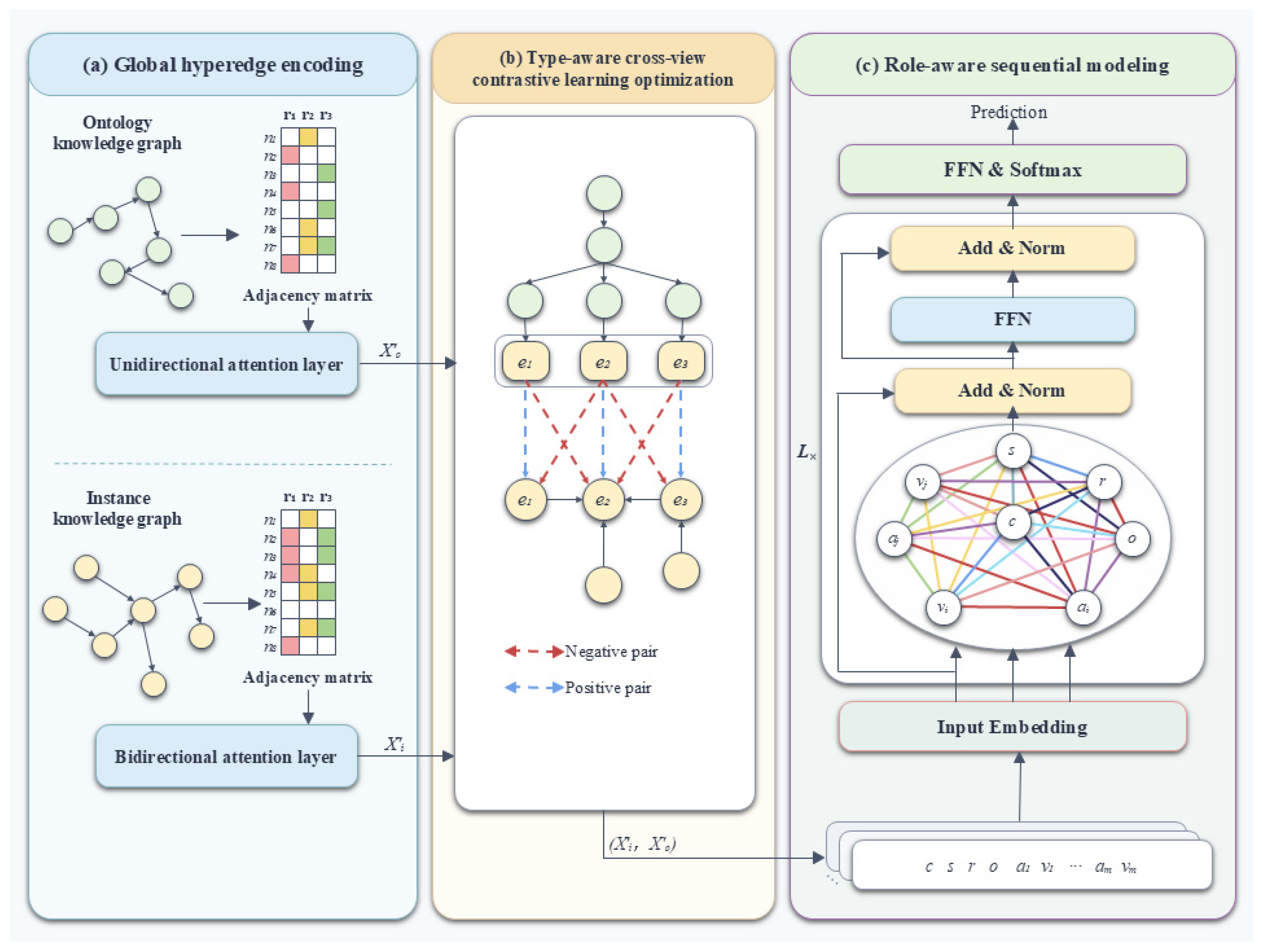
Based on the above analysis of the limitations of dual-view entity type fusion, we propose Role-Aware and Type-Aware Hyper-relational Knowledge Graph Completion (RATA), whose overall architecture is illustrated in Figure 1. The model comprises three core modules: (1) global hyperedge encoding; (2) type-aware cross-view contrastive learning; (3) role-aware sequence modeling.
Figure 1.
Overall architecture of RATA.
A hyper-relational knowledge graph is defined as:
where ℇ, and respectively denote the sets of entities, relations, and hyper-relational facts. Each fact is represented in hyperedge form:
where s, r, and o denote the subject, main relation, and object of the core triple, respectively, and denotes the set of qualifier pairs associated with the fact. Here, ai is a qualifier relation, and vi is its corresponding value. When a fact contains no qualifiers, = ∅. This notation separates the core triple from its auxiliary information while preserving the association between each qualifier and its value.
= (ℇ,,),
f = (s,r,o,),
RATA is designed as an integrated framework built upon existing hyper-relational representation learning and contrastive learning techniques, and its components differ in methodological status. The instance-view global encoder inherits the basic bidirectional node–hyperedge attention mechanism from HAHE. The type-aware component follows the cross-view alignment principle of HyperCL while specifying type-guided negative sampling and unidirectional propagation in the type view. The role-aware sequence encoder explicitly assigns semantic roles to fact elements and incorporates role and role-pair biases into sequence attention, with the global hyperedge representation serving as the contextual token. Accordingly, the intended contribution of RATA lies in the coordinated use of global structural context, role-conditioned sequence interactions, and type-informed cross-view supervision within a unified completion pipeline. We distinguish these design choices from the underlying mechanisms adopted from prior work and evaluate their individual contributions through ablation experiments. The following subsections detail the implementation of each component and the rationale for its design.
3.2. Hyper-Relational Fact Construction and View Generation
To accommodate the heterogeneous data structures of JF17K, WD50K, and WikiPeople, RATA converts dataset records into a unified hyper-relational representation while preserving the semantic associations between the main fact and its auxiliary information. Each record is parsed according to its dataset-specific format to identify the subject s, the main relation r, the object o, and the available qualifier pairs . For WD50K, the main triple is directly separated from its qualifier pairs. For JF17K and WikiPeople, the native relational arguments or attribute information are parsed according to their original field semantics and mapped into the unified representation, so that the correspondence between each auxiliary field and its value is preserved.
RATA applies a deterministic ordering rule to qualifier pairs. First, the pairs are sorted in ascending order of qualifier relation ID. If multiple pairs share the same qualifier relation ID, entity-valued qualifiers are ordered by ascending entity ID. For literal or other non-entity values, a stable sort key is constructed from the value type or datatype identifier, the language tag when applicable, and the normalized lexical form. When entity-valued and non-entity values coexist under the same qualifier relation, a fixed value-type priority is applied before their corresponding keys are compared. This ordering rule is applied consistently across the training, validation, and test splits. Each fact is then serialized into the sequence (s,r,o,a1,v1,…,am,vm), in which every qualifier relation immediately precedes its corresponding value. When no qualifiers are present, the sequence consists solely of the main triple(s,r,o).
The serialized elements are assigned five semantic roles, including subject, predicate, object, attribute, and attribute value, corresponding to s,r,o,ai and vi respectively. These roles distinguish the semantic functions of the elements within a fact rather than treating all elements as interchangeable tokens. The resulting sequence is processed by the role-aware encoder, while the global hyperedge representation is incorporated through the [CLS] token, as described in the subsequent encoding modules.
RATA constructs the type view from the available entity–type associations, denoted by 𝒜ET ⊆ × , where and are the entity and type sets, respectively. Each pair (e,τ) ∈ 𝒜ET indicates that entity e is associated with type τ. When multiple type annotations are available for an entity, all available types are retained. The instance view captures the structural information of hyper-relational facts, whereas the type view provides complementary entity-level semantic information. Entities shared by the two views serve as alignment anchors for type-aware cross-view contrastive learning. This design is related to prior work on ontology-aware hyper-relational representation learning and schema modeling [6,18]. However, RATA does not assume additional type-hierarchy relations unless such relations are available and explicitly used in the implementation.
3.3. Global Hyperedge Encoding
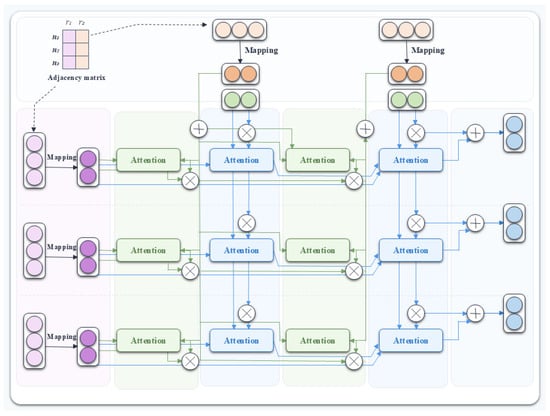
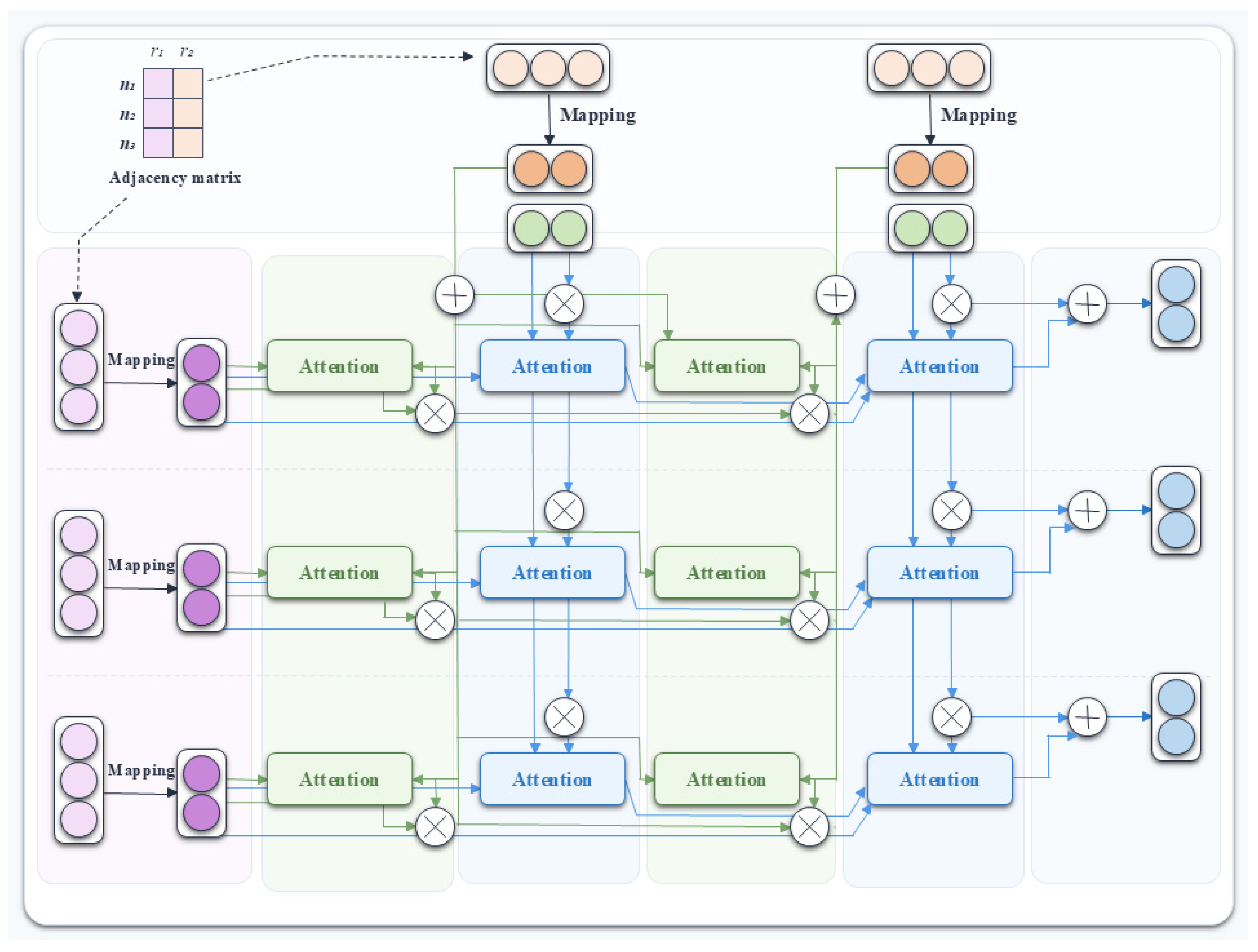
To preserve the higher-order structural information of hyper-relational facts without decomposing each hyperedge into multiple binary edges, RATA employs attention-based message passing between nodes and hyperedges, as illustrated in Figure 2. In the instance view, the encoder follows the bidirectional node–hyperedge attention mechanism of HAHE [5]. Specifically, node and hyperedge embeddings are mapped into a shared representation space using a projection matrix, and attention weights are computed to capture the interactions between nodes and their associated hyperedges.
Figure 2.
Bidirectional node–hyperedge attention.
Let the embeddings of node ej and hyperedge ri be hej and hri respectively. After mapping them into a shared space using the projection matrix W, the attention score from the node to the hyperedge is
where att(∙) denotes the attention scoring function. The updated hyperedge representation is obtained by aggregating the representations of the nodes associated with ri:
αij = att(Whri,Whej),
Similarly, the hyperedge-to-node attention score and the updated node representation are
where LR(∙) denotes LeakyReLU and σ(∙) is the activation function. denotes the hyperedge representation used for the reverse propagation step. Equations (5) and (6) follow the hyperedge-to-node attention and aggregation mechanism of HAHE [5]. Together, Equations (3)–(6) describe bidirectional information propagation between nodes and hyperedges, allowing the representation of each hyper-relational fact to incorporate information from its associated nodes and enabling node representations to receive contextual information from connected hyperedges.
βij = att(Whei,Whrj),
Although RATA retains the attention formulations of HAHE, it applies different propagation strategies to the instance and type views to accommodate their distinct representational objectives. In the instance view, nodes represent entities and hyperedges represent hyper-relational facts. Bidirectional node-to-hyperedge and hyperedge-to-node propagation is retained to capture the structural dependencies between entities and integral facts. In contrast, nodes in the type view represent entity types, and the associated hyperedges connect type nodes with their instances. Accordingly, the type view employs only node-to-hyperedge propagation and omits the reverse update defined in Equations (5) and (6). This directional restriction is intended to preserve type-level semantics and to reduce the influence of potentially noisy instance-level information on type representations. The distinction introduced by RATA in this component therefore lies not in the propagation mechanism itself but in its differentiated application across the two views.
Let gh denote the final global representation of hyperedge h produced by the global hyperedge encoder. This representation is explicitly passed to the role-aware sequence module described in Section 3.4, where it serves as the contextual [CLS] representation. Specifically, gh is placed at the beginning of the role-aware input sequence and processed together with the role-associated entity representations and role-pair information. The sequence module thus receives the global structural context learned by the hyperedge encoder and combines it with role-specific dependencies for subsequent prediction. This explicit representation interface connects global hyperedge encoding with role-aware sequence modeling within the RATA framework.
3.4. Type-Aware Cross-View Contrastive Learning
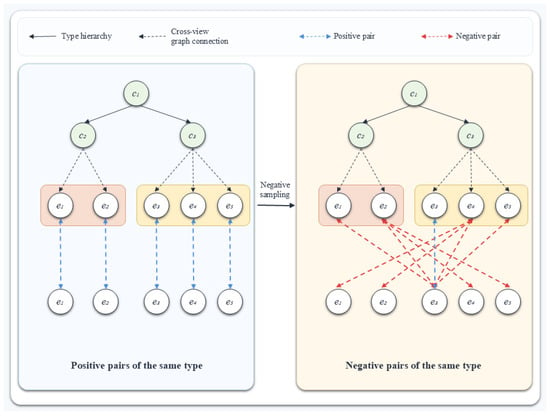
The cross-view contrastive learning objective aims to align the representations of the same entity across the instance view and the type view. The core design of RATA in this regard lies in type-guided negative sampling. A breadth-first search (BFS) starting from type nodes gathers relevant instances [6], and candidate negatives are selected from entities of identical or semantically similar types once the predefined sampling criteria are satisfied. Unlike naive in-batch negatives, these candidates yield harder and more discriminative signals owing to their type-level semantic proximity. Nevertheless, type similarity alone cannot guarantee valid negatives. Candidate generation and validity filtering are therefore decoupled. Before sampling, RATA removes the anchor entity itself, which constitutes the cross-view positive pair and all known positive entities for the corresponding query from the candidate pool, relying solely on training-set information without accessing validation or test labels. Negative samples are then drawn uniformly with replacement from the remaining candidates. In summary, type similarity produces hard candidates, whereas eligibility filtering ensures that only valid negatives enter the objective. This strategy strengthens entity discrimination and mitigates the risk of false-negative supervision.
For each entity type c, BFS is used to collect its associated training instances, forming a type-specific instance set S(c):
S(c) = {e|e ∈ c}.
Let nc = |S(c)| denote the number of instances associated with type c. Consistent with common practice [30], the instance-count threshold K = 10 is set to avoid sampling negatives from overly sparse candidate sets, and this value was determined on the validation set. When nc exceeds the predefined threshold, negative samples are selected from instance types. Following prior practice in type-aware knowledge graph modeling [31,32], RATA computes cosine similarity between type embeddings to identify semantically similar types. Let zc and zc′ denote the embeddings of types c and c′, respectively. Their cosine similarity is defined as
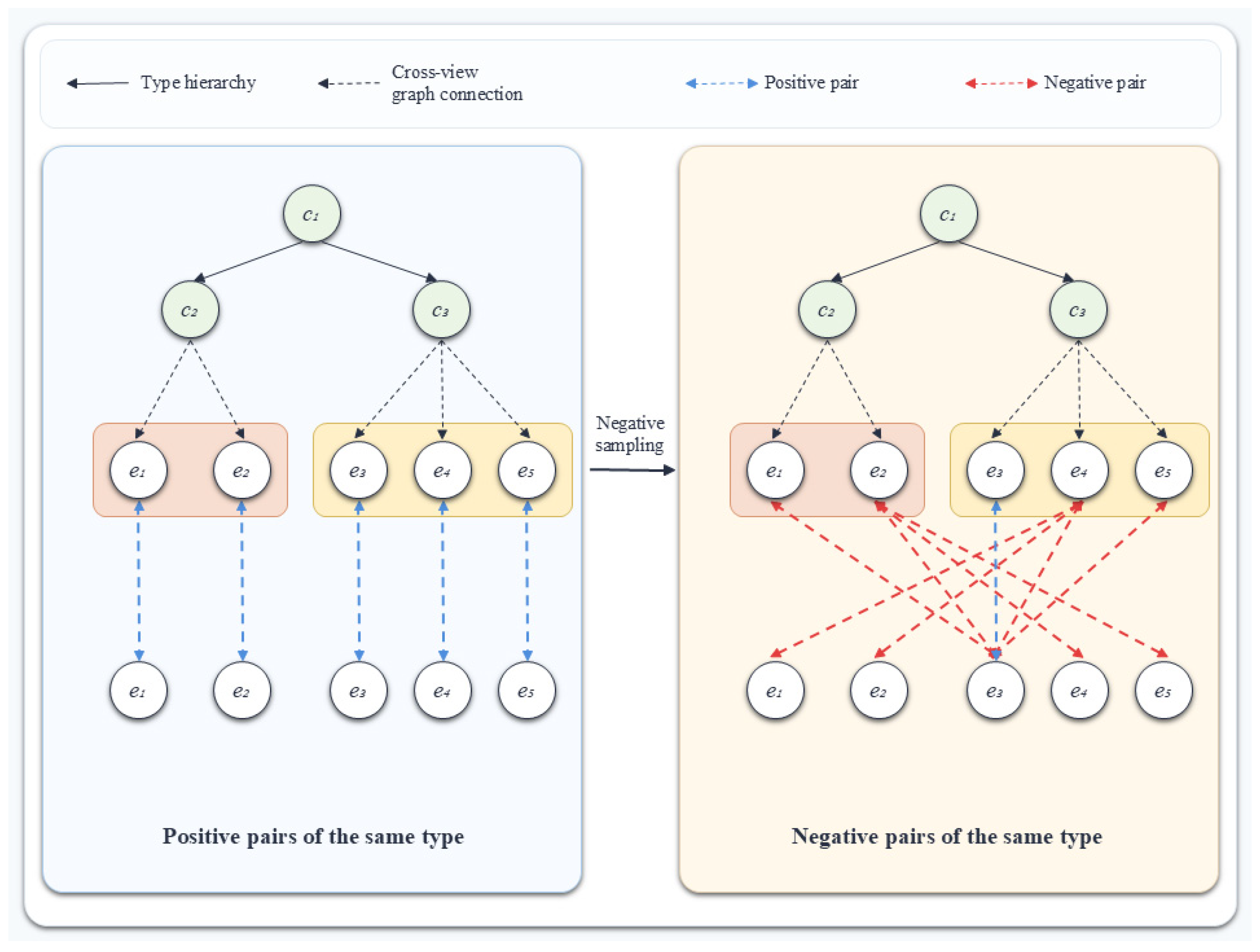
For each type c, the five other types with the highest cosine similarity scores are selected as its semantically similar types. The anchor type itself is excluded from this selection. Thus, semantic similarity is determined by relative ranking rather than by a manually specified cosine-similarity threshold. Let 5(c) denote the set of the five most similar types for type c. The negative-sampling candidate set is constructed from the instances associated with the anchor type, and the selected similar types . The resulting candidate set is used to construct type-guided negative pairs for cross-view contrastive learning. This design is consistent with the mainstream practice of leveraging semantically similar entities as hard negatives in contrastive learning [33]. For each positive cross-view pair, the target number of negative samples is set to M = 5. This setting adopts the fixed-quota sampling scheme commonly used in the literature [34], and is further supported by prior studies showing that a relatively small negative sampling ratio suffices to achieve optimal performance, whereas an excessive number of negatives may instead impair training [35]. Negative instances are sampled uniformly at random with replacement from the eligible negative candidate set, as shown in Figure 3. If the candidate set is insufficient to provide the target number of eligible negatives, fewer than five negatives are used rather than forcing the sample to reach five. This rule preserves the implemented sampling behavior when the number of eligible candidates is limited.
Figure 3.
Type-aware negative sampling.
For a shared entity ei, forms a positive pair, whereas and form bidirectional negative pairs. The objective of contrastive learning is to optimize the InfoNCE loss function, which is defined as
where sii, sij and sji denote the cosine similarities for cross-view pairs and . τ is the temperature coefficient and Ni is the set of type-aware negative samples. In Equation (9), the negative-sample set contains only the eligible negative instances remaining after the filtering procedure described above. The contrastive objective therefore uses cross-view representations of the same entity as positive pairs and the filtered type-guided candidates as negative pairs.
3.5. Role-Aware Sequence Modeling
The role bias ri ∈ Rd and role-pair bias brole(i),role(j) ∈ R are trainable parameters, where d is the embedding dimension. The role-pair bias is a 6 × 6 matrix that captures the semantic association strength between different roles. Although a hyperedge represents the overall association among entities, it does not adequately distinguish their semantic responsibilities within a fact. RATA therefore defines the following roles for fact elements:
role = {s,r,o,a,v,c}.
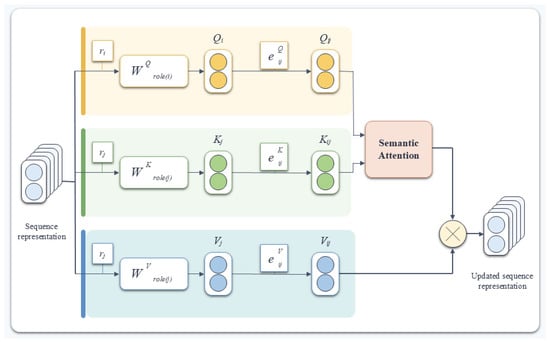
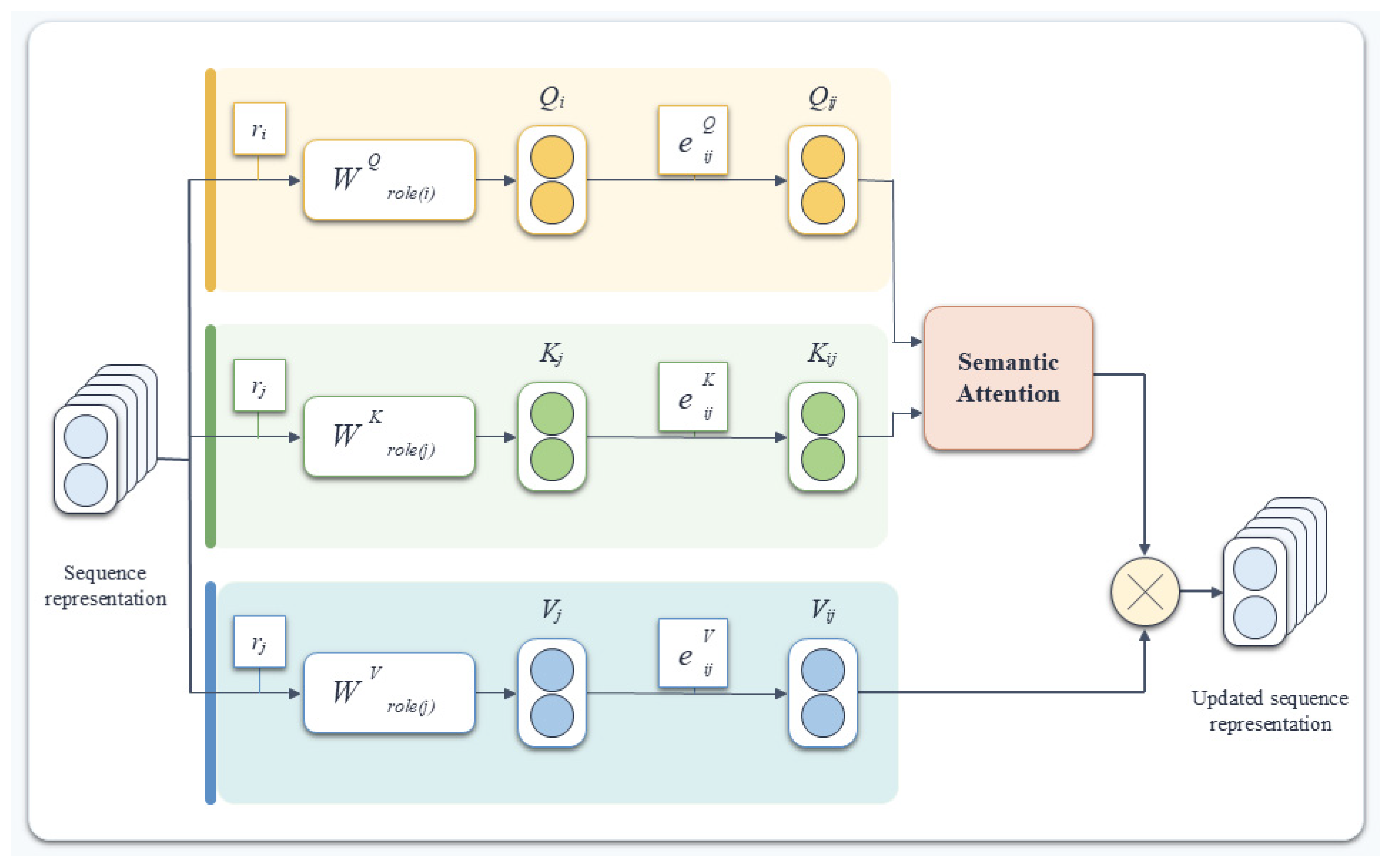
These roles denote the subject, predicate, object, attribute, and attribute value, respectively. An initial role c is also introduced for the [CLS] token associated with the global hyperedge feature. The model further defines edge types for different role pairs to characterize semantic associations between roles. The Role-aware sequence modeling process is shown in Figure 4.
Figure 4.
Role-aware sequence modeling process.
The distinction introduced by RATA lies in how role information is exploited within the overall completion pipeline. Specifically, RATA constructs a role-distinguished sequence of fact elements and introduces the global hyperedge representation as a contextual token. Within sequence attention, role biases encode the semantic identities of individual elements, whereas role-pair biases capture the learned interactions between different roles. This design enables the role-aware module to jointly exploit the holistic context of the fact and fine-grained role-conditioned interactions.
For each node representation xi, we add the role bias ri. In attention head h, the attention score between nodes i and j is
where and are role-pair edge-type biases, with dz = d/H.
The normalized attention weight is
The corresponding output is
Concatenating the outputs of all heads yields the final role-aware representation
By combining node-role biases with role-pair edge-type biases, this module jointly represents entity content, position, and role dependencies.
3.6. Decoding and Training Objective
For a target position i, a multilayer perceptron maps the role-aware representation to the candidate class space:
pi = softmax(MLP(hi)WT).
The completion task is optimized using the cross-entropy loss:
The overall training objective is
overall = 1 + λCL.
The training procedure can be summarized as follows: encoding instances and typing hypergraphs, optimizing contrastive loss with type-aware pairs, passing updated representations to the role-aware encoder, then computing candidate scores and optimizing completion loss.
4. Experiments and Analysis
4.1. Experimental Setup
All experiments were conducted on an Intel Xeon Gold 6430 CPU (Intel Corporation, Santa Clara, CA, USA) and an NVIDIA RTX 4090 GPU (NVIDIA Corporation, Santa Clara, CA, USA). We used three public datasets, JF17K, WD50K, and WikiPeople, whose statistics are reported in Table 1. Hyper-relational facts account for 45.9% of JF17K, 13.6% of WD50K, and less than 3% of WikiPeople, enabling evaluation under different densities of hyper-relational information.
Table 1.
Datasets statistics.
We used mean reciprocal rank (MRR), Hits@1, and Hits@3 as evaluation metrics. The baselines comprise NeuInfer [10], ShrinkE [36], MSeaHKG [37], HyNT [38], HyperFormer [39], HAHE [5], tNaLP [9], DVHE [27], DHGE [28], RAM [40], and sHINGE [41], covering hyperedge-structure modeling, Transformer-based encoding, and type-enhanced methods. The experimental hyperparameters are listed in Table 2.
Table 2.
Experimental settings.
4.2. Comparative Experiments
4.2.1. Entity Completion
Entity completion predicts a missing target entity in a hyper-relational fact. Table 3 reports the entity-completion results of RATA and all baselines on the three datasets. The best value for each metric is shown in bold. All results are reported to three decimal places; trailing zeros are added where necessary, and values with more than three decimal places are rounded.
Table 3.
Entity-completion results.
As shown in Table 3, RATA achieves the best results on JF17K and WD50K, demonstrating the effectiveness of the proposed framework on these two datasets. However, its performance on WikiPeople is associated with the evaluation metrics. Specifically, RATA obtains an MRR of 0.457 and a Hits@1 of 0.362, which are 0.013 and 0.031 lower than those of HAHE, respectively. Meanwhile, RATA achieves a slightly higher Hits@3 score than HAHE. These results indicate that the effectiveness of RATA varies across datasets and evaluation metrics, rather than demonstrating consistent superiority over all baselines. We therefore further examine the coverage and frequency distribution of the entity–type mappings used by the type-aware component to characterize a potential dataset-specific challenge.
To characterize the availability and frequency distribution of entity-type information, we followed the type-processing rule implemented in HyperCL. Hierarchical type paths were decomposed, and the nearest type was used for each mapping, with duplicate entity–type pairs removed before computing the statistics [6]. Entity-type coverage was defined as the proportion of dataset entities associated with at least one observed nearest type. Type-frequency imbalance was measured using the Gini coefficient and normalized entropy, and rare types were defined as those associated with no more than five distinct entities. The mapping coverage rates were 97.98% for JF17K, 97.10% for WD50K, and 98.85% for WikiPeople, indicating that entity-type annotations are available for most entities in all three datasets. However, the type-frequency distributions differ substantially across datasets. WikiPeople exhibits the highest Gini coefficient 0.935 and the lowest normalized entropy 0.508, with 62.92% of its observed nearest types associated with no more than five entities. Moreover, its most frequent 10% of types account for 91.48% of all deduplicated entity–type associations. WD50K also shows pronounced imbalance, whereas JF17K exhibits a comparatively more balanced distribution. These statistics summarize the coverage and frequency imbalance of the released type mappings. Such imbalance may pose challenges for the type-aware contrastive learning component, particularly when many types are associated with only a few entities. In addition, the effectiveness of role-aware sequence modeling may depend on the availability and informativeness of role-specific structural signals.
4.2.2. Relation Completion
Relation completion predicts a missing target relation in a hyper-relational fact. Table 4 reports the relation-completion results of RATA and all baselines on the three datasets. The best value for each metric is shown in bold. All results are reported to three decimal places; trailing zeros are added where necessary, and values with more than three decimal places are rounded.
Table 4.
Relation-completion results.
From the experimental results in the table, it can be observed that RATA attains the best or joint-best performance on all three datasets. On JF17K, its Hits@1 and MRR match those of HAHE, while Hits@3 reaches 0.999. On WD50K, RATA improves upon HAHE by 0.012, 0.014, and 0.012 on the three metrics, respectively; on WikiPeople, the corresponding gains are 0.001, 0.005, and 0.003. These results show that global hyperedge representations and role compositions provide stable signals for relation prediction.
4.3. Ablation Study
We ablate the hyperedge-attention, role-aware, and type-aware modules individually; the resulting variants are denoted by −att, −role, and −type, respectively. Table 5 reports the entity-completion results. Removing any single module leads to consistent drops in MRR, Hits@1 and Hits@3 scores, confirming that each core component contributes positively to performance. Without the attention layer in the global hyperedge encoder, the model captures global hyperedge structure less effectively, indicating that attention enriches the structural features learned by global encoding. Removing role-aware sequence modeling produces the largest degradation across the metrics. The model can no longer adequately capture positional dependencies among entities, local sequence information, or implicit interactions guided by global context, thereby weakening its overall representation of hyper-relational facts. It also suggests that the role-aware module does not introduce noise when hyper-relational facts are sparse. Finally, removing type-aware cross-view contrastive learning prevents the model from fully exploiting type information and reduces the effectiveness with which entity types guide representation learning.
Table 5.
Ablation results for entity completion.
Table 6 reports the ablation results for relation completion. Removing any core component of RATA degrades hyperedge-relation completion to varying degrees, confirming that all three modules contribute positively to overall performance. In particular, removing the attention layer from the global hyperedge encoder weakens the model’s awareness of global structure and its ability to capture complex relation-dependent correlations among entities, resulting in the largest overall decrease in the evaluation metrics. This finding underscores the central role of attention in strengthening entity-association representations. Removing role-aware sequence modeling prevents the model from effectively exploiting both the sequential information and the semantic roles of entities within a hyperedge, thereby weakening its comprehensive representation of the fact. Removing type-aware cross-view contrastive learning limits the use of entity-type information and reduces the guidance provided by type semantics during instance representation learning.
Table 6.
Ablation results for relation completion.
4.4. Convergence Analysis
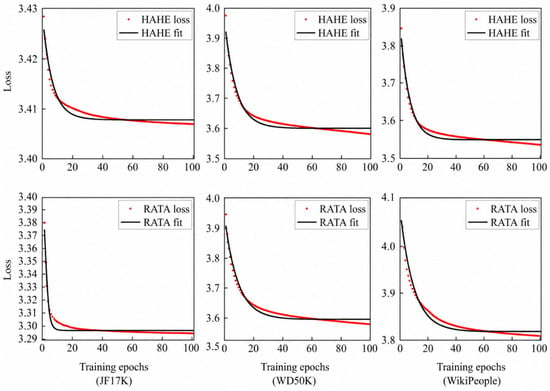
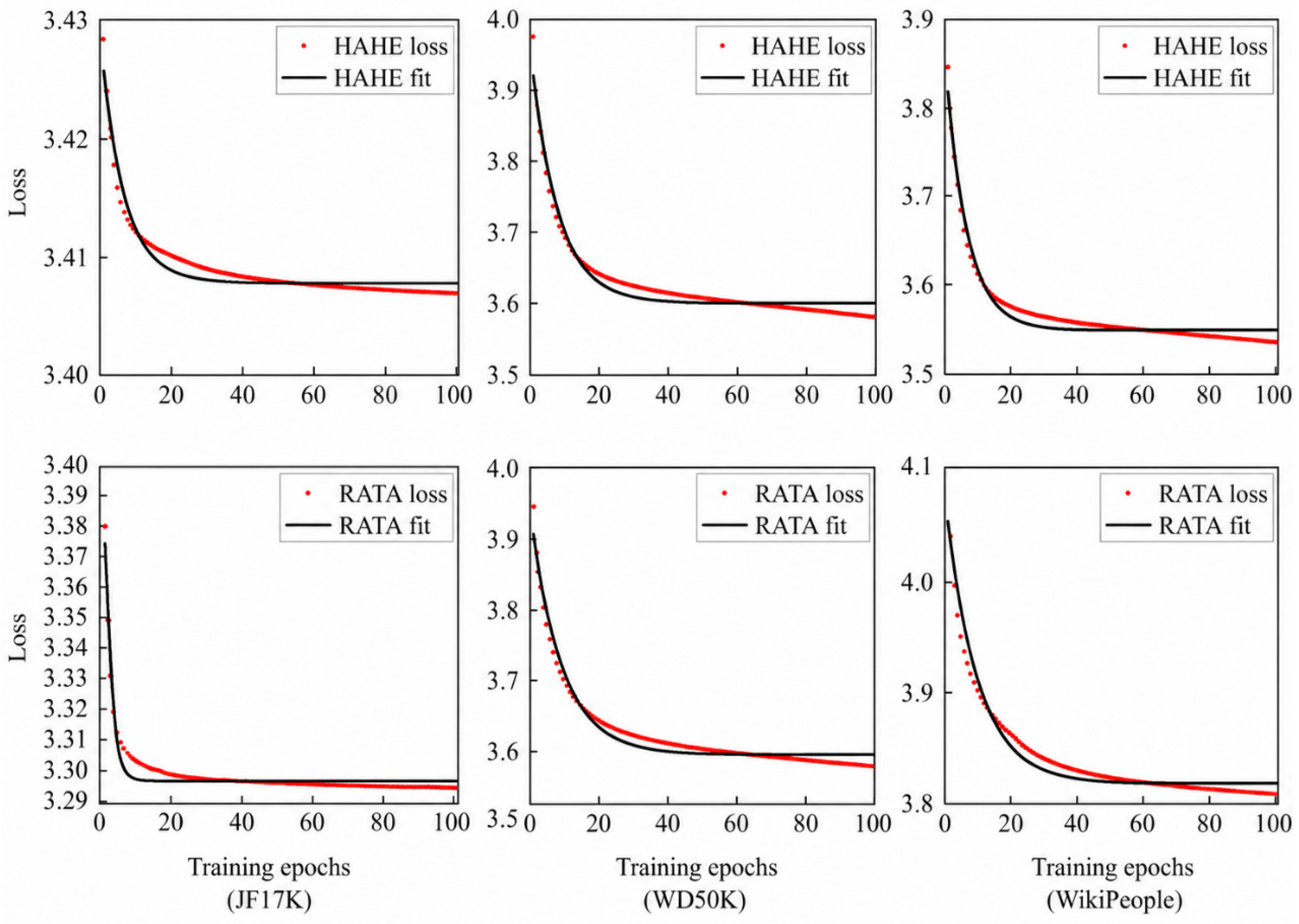
We selected HAHE, the second-best model in the comparative experiments, as the baseline for convergence analysis on JF17K, WD50K, and WikiPeople. Convergence was assessed by plotting training loss against epoch and fitting the resulting curves, as shown in Figure 5.
Figure 5.
Training loss and fitting curves of HAHE and RATA.
RATA exhibits convergence comparable to or better than HAHE on most datasets. At the beginning of training, the losses of both models decrease rapidly, indicating that they quickly capture informative features from the data. As training proceeds, the rate of decline gradually slows, and the curves flatten, showing continued but decelerating optimization as the models approach convergence. In the later stages, the loss curves remain largely stable, indicating that the models have converged and their parameters are approaching an optimum.
The two models behave differently across datasets. On JF17K, RATA maintains a lower loss and converges faster than HAHE; its fitted curve also follows the original loss curve more closely, indicating more effective optimization. On WD50K, the loss trajectories of RATA and HAHE are similar, suggesting comparable convergence. On WikiPeople, however, HAHE achieves a lower loss, converges faster, and shows closer agreement between the fitted and original loss curves. RATA exhibits a brief rise in loss at approximately epoch 20, possibly because the greater sample complexity and batch-to-batch distributional variation of WikiPeople induce a transient local fluctuation during training.
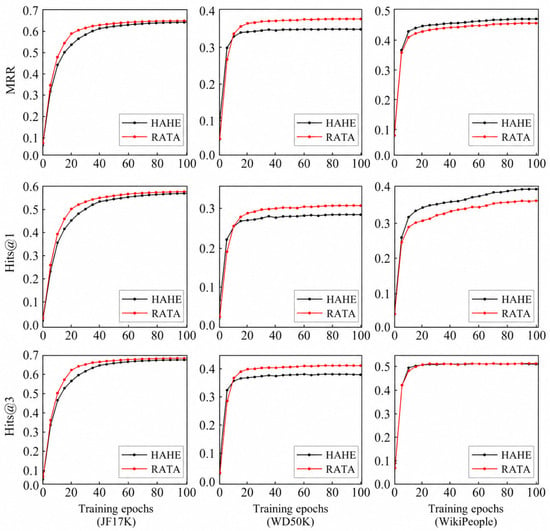
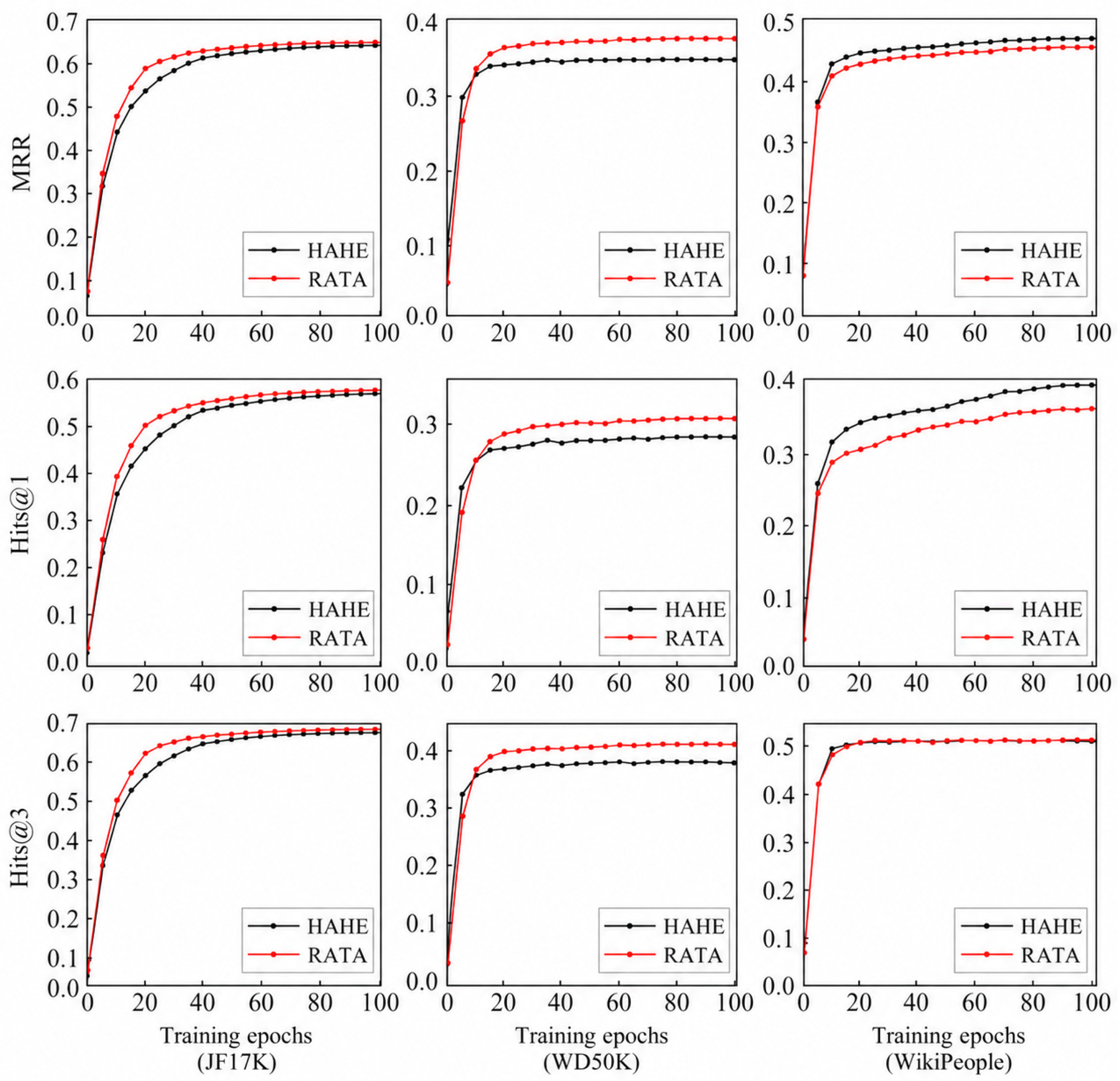
Figure 6 shows how Hits@3, Hits@1, and MRR vary with training epoch for RATA and the second-best model, HAHE, on each dataset.
Figure 6.
Convergence Curves of Evaluation Metrics for HAHE and RATA.
During the initial training stage, the metric values of both models increase rapidly. Their growth then slows, and the curves become smoother as they approach convergence. In the later stages, the metric curves remain largely stable, indicating near-convergence. Overall, RATA exhibits reliable convergence across the three datasets, although its relative advantage over HAHE varies by dataset and evaluation metric. On JF17K, RATA achieves better metric values, while on WD50K it surpasses HAHE after approximately 15 epochs. On WikiPeople, HAHE yields higher Hits@1 and MRR, whereas RATA achieves a slightly higher Hits@3. These observations are consistent with the final evaluation results and suggest that the advantages of RATA are more pronounced on datasets with denser hyper-relational information.
Both models improve rapidly early in training and then gradually stabilize. On JF17K, RATA achieves a lower loss and better metric values. On WD50K, RATA surpasses HAHE after approximately 15 epochs. On WikiPeople, HAHE yields higher Hits@1 and MRR, while RATA shows a brief loss fluctuation near epoch 20. Overall, RATA converges reliably, and its advantages are more pronounced on datasets with denser hyper-relational facts.
5. Conclusions and Future Work
This paper addresses the task of hyper-relational knowledge graph completion by proposing RATA, a modeling framework that integrates role-aware and type-aware mechanisms. The proposed model offers a unified way to capture the holistic structure of hyper-relational facts, entity role semantics, and type-level prior information. Experimental results on public benchmarks demonstrate that RATA achieves competitive overall performance and surpasses representative baselines on several datasets and metrics. This study provides a unified modeling perspective for representation learning on hyper-relational knowledge graphs and offers useful insights for complex knowledge graph completion as well as its practical deployment in knowledge-driven intelligent systems.
To comprehensively evaluate the model, we conducted experiments on three public hyper-relational knowledge graph datasets, namely JF17K, WD50K, and WikiPeople, and compared RATA with representative hyper-relational completion models. RATA achieves consistent improvements over HAHE on JF17K and WD50K for entity completion, and also achieves favorable results for relation completion across the evaluated datasets. However, the results on WikiPeople entity completion are more mixed: RATA slightly outperforms HAHE on Hits@3 but remains below HAHE on Hits@1 and MRR. This result indicates that the effectiveness of RATA varies across datasets and evaluation metrics, and that its advantages are more evident when the data contain denser hyper-relational structures. Therefore, the experimental findings support the effectiveness of the proposed integrated design. Furthermore, ablation studies confirm that the three core modules: hyperedge global encoding, role-aware modeling, and type-aware representation learning. Each contributes positively to overall performance gains, thereby verifying the effectiveness of role semantics and entity type information in enhancing the quality of hyper-relational fact representations and improving complex knowledge completion capabilities.
Although the proposed model attains favorable experimental results across multiple datasets, there remains room for further improvement. The WikiPeople results also suggest that high entity-type coverage does not necessarily imply a balanced type distribution. The potential influence of this imbalance on type-aware contrastive learning, as well as the dependence of role-aware modeling on informative structural signals, warrants further investigation. The current model primarily relies on entity types as semantic priors and has yet to fully leverage heterogeneous semantic resources embedded in knowledge graphs, such as concept hierarchies, attribute constraints, and textual descriptions. Future work may focus on incorporating multi-source knowledge fusion strategies to enrich and enhance the expressiveness of entity representations. Meanwhile, as hyper-relational knowledge graphs continue to scale in size, the computational complexity and training efficiency of the model will pose critical challenges in real-world deployment. To this end, future research could explore efficient attention mechanisms, graph-structured sampling strategies, or parameter-efficient training approaches to improve training and inference efficiency on large-scale graphs. Moreover, given the recent advances in large language models that have demonstrated powerful semantic understanding capabilities in knowledge representation learning, subsequent studies may attempt to integrate pre-trained language models with hyper-relational knowledge graph representation learning. By leveraging the complementary strengths of textual semantic knowledge and structured knowledge, this direction holds promise for further advancing complex knowledge reasoning and completion performance.
Author Contributions
Conceptualization, C.W.; methodology, C.W. and J.T.; software, C.T.; validation, C.T.; formal analysis, C.W. and J.T.; investigation, C.T.; resources, A.M.M.; data curation, A.M.M.; writing—original draft preparation, J.T.; writing—review and editing, C.W. and J.T.; visualization, J.T.; supervision, C.W.; project administration, C.W.; funding acquisition, C.W. All authors have read and agreed to the published version of the manuscript.
Funding
This research was funded by the Artificial Intelligence Special Project of the Department of Education of Liaoning Province, “Construction and Completion of Hyper-Relational Knowledge Graph for Industrial Internet of Things Integrating Multi-Source Sensing Data”, grant number LJ242610147005.
Institutional Review Board Statement
Not applicable.
Informed Consent Statement
Not applicable.
Data Availability Statement
The original data presented in the study are openly available in Zenodo at https://zenodo.org/record/4036498 (accessed on 30 October 2026), in GitHub at https://github.com/gsp2014/NaLP (accessed on 30 October 2026), and in GitHub at https://github.com/wenjf/multi-relational_learning (accessed on 30 October 2026).
Acknowledgments
During manuscript preparation, the authors used DeepSeek-V3 for language editing, structural revision, and refinement of the academic writing. The authors have reviewed and edited the output and take full responsibility for the content of this publication.
Conflicts of Interest
The authors declare no conflicts of interest.
References
- Zou, Q.; Lu, C.; Sun, Y. A Symmetry Analysis Method for Teaching Knowledge Graph Evolution Driven by Directed Attributed Graphs. Symmetry 2025, 17, 2009. [Google Scholar] [CrossRef] [Scilit]
- Liu, X.; Wang, Z.; Sun, Y.; Han, J.; Xiao, G.; Jiang, J. ISA-KGC: Integrated Semantics-Structure Analysis in Knowledge Graph Completion. IEEE Access 2024, 12, 57250–57260. [Google Scholar] [CrossRef] [Scilit]
- Chen, B.; Wu, J.; Liu, X.; Zhou, F.; Luo, G.C. Enhancing Temporal Knowledge Graph for Future Event Prediction with Long-Term Dense Graph. Tsinghua Sci. Technol. 2026, 31, 621–638. [Google Scholar] [CrossRef] [Scilit]
- Liang, K.; Meng, L.; Liu, M.; Liu, Y.; Tu, W.; Wang, S.; Zhou, S.; Liu, X.; Sun, F.; He, K.; et al. A Survey of Knowledge Graph Reasoning on Graph Types: Static, Dynamic, and Multi-Modal. IEEE Trans. Pattern Anal. Mach. Intell. 2024, 46, 9456–9478. [Google Scholar] [CrossRef] [Scilit] [PubMed]
- Luo, H.; E, H.; Yang, Y.; Guo, Y.; Sun, M.; Yao, T.; Tang, Z.; Wan, K.; Song, M.; Lin, W. HAHE: Hierarchical Attention for Hyper-Relational Knowledge Graphs in Global and Local Level. In Proceedings of the 61st Annual Meeting of the Association for Computational Linguistics, Toronto, ON, Canada, 9–14 July 2023; Volume 1, pp. 8095–8107. [Google Scholar]
- Lu, Y.; Yu, W.; Jing, X.; Yang, D. HyperCL: A Contrastive Learning Framework for Hyper-Relational Knowledge Graph Embedding with Hierarchical Ontology. In Proceedings of the Findings of the Association for Computational Linguistics: ACL 2024, Bangkok, Thailand, 11–16 August 2024; pp. 2918–2929. [Google Scholar]
- Biswas, D.; Byun, T.; Gil, J. Textual Graph Framework for Research Paper Classification Using Graph-Refined Convolutional Networks with Transformer. Hum.-Centric Comput. Inf. Sci. 2026, 16, 3. [Google Scholar] [CrossRef]
- Li, J.C.; Luo, X.D.; Lu, G.Q.; Zhang, S.C. Hyper-Relational Knowledge Graphs. Knowl.-Based Syst. 2025, 325, 113886. [Google Scholar] [CrossRef] [Scilit]
- Guan, S.; Jin, X.; Guo, J.; Wang, Y.; Cheng, X. Link Prediction on N-ary Relational Data Based on Relatedness Evaluation. IEEE Trans. Knowl. Data Eng. 2023, 35, 672–685. [Google Scholar] [CrossRef] [Scilit]
- Guan, S.; Jin, X.; Wang, Y.; Cheng, X. NeuInfer: Knowledge Inference on N-ary Facts. In Proceedings of the 58th Annual Meeting of the Association for Computational Linguistics, Online, 5–10 July 2020; pp. 6141–6151. [Google Scholar]
- Rosso, P.; Yang, D.; Cudré-Mauroux, P. Beyond Triplets: Hyper-Relational Knowledge Graph Embedding for Link Prediction. In Proceedings of the Web Conference 2020, Online, 20–24 April 2020; pp. 1885–1896. [Google Scholar]
- Galkin, M.; Trivedi, P.; Maheshwari, G.; Usbeck, R.; Lehmann, J. Message Passing for Hyper-Relational Knowledge Graphs. In Proceedings of the 2020 Conference on Empirical Methods in Natural Language Processing, Online, 16–20 November 2020; pp. 7346–7359. [Google Scholar]
- Wang, J.; Chen, H.; Zhang, W. Structure-Aware Transformer for Hyper-Relational Knowledge Graph Completion. Expert Syst. Appl. 2025, 277, 126992. [Google Scholar] [CrossRef] [Scilit]
- Cao, Z.; Xu, Q.; Yang, Z.; He, Y.; Cao, X.; Huang, Q. GAHE: Geometry-Aware Embedding for Hyper-Relational Knowledge Graph Representation. ACM Trans. Multimed. Comput. Commun. Appl. 2025, 21, 205. [Google Scholar] [CrossRef] [Scilit]
- Xue, Y.; Sun, Y.; Cai, W.; Ma, Y.; Senhadji, L.; Shu, H.; Wu, J. HMTE: Memory-Transformer Representation Learning for Knowledge Hypergraph Completion. Neurocomputing 2026, 670, 132560. [Google Scholar] [CrossRef] [Scilit]
- Yadati, N. Neural Message Passing for Multi-Relational Ordered and Recursive Hypergraphs. In Proceedings of the Advances in Neural Information Processing Systems 33 (NeurIPS 2020), Virtual Event, 6–12 December 2020. [Google Scholar]
- Jiang, W.; Wu, F.; Zhang, F.; Chen, Q.; Zhao, Z.; Guo, S. CRL-MM: Context-Aware Relational Learning and Multidimensional Matching for Few-Shot Knowledge Graph Completion. IEEE Trans. Neural Netw. Learn. Syst. 2026, 37, 1405–1419. [Google Scholar] [CrossRef] [Scilit] [PubMed]
- Lu, Y.; Deng, B.; Yu, W.; Yang, D. HELIOS: Hyper-Relational Schema Modeling from Knowledge Graphs. In Proceedings of the 31st ACM International Conference on Multimedia, Ottawa, ON, Canada, 29 October–3 November 2023. [Google Scholar] [CrossRef] [Scilit]
- Yu, C.; Wang, Z.; Luo, T.; Wang, J.; Cao, Z. Enhancing Knowledge Graph Completion with Structural-Semantic Integration and Contrastive Learning. IEEE Trans. Comput. Soc. Syst. 2026, 13, 3585–3595. [Google Scholar] [CrossRef] [Scilit]
- Guo, W.; Li, Z.; Wang, X.; Chen, Z. ConvD: Attention Enhanced Dynamic Convolutional Embeddings for Knowledge Graph Completion. IEEE Trans. Knowl. Data Eng. 2025, 37, 5049–5062. [Google Scholar] [CrossRef] [Scilit]
- Lv, X.; Hou, L.; Li, J.; Liu, Z. Differentiating Concepts and Instances for Knowledge Graph Embedding. In Proceedings of the 2018 Conference on Empirical Methods in Natural Language Processing, Brussels, Belgium, 31 October–4 November 2018; pp. 1971–1979. [Google Scholar]
- Xiang, Y.; He, H.; Yu, Z. Concept-Driven Representation Learning Model for Knowledge Graph Completion. Expert Syst. Appl. 2025, 268, 126297. [Google Scholar] [CrossRef] [Scilit]
- Xie, R.; Liu, Z.; Sun, M. Representation Learning of Knowledge Graphs with Hierarchical Types. In Proceedings of the 25th International Joint Conference on Artificial Intelligence, New York, NY, USA, 9–15 July 2016; pp. 2965–2971. [Google Scholar]
- Zhang, Z.; Cai, J.; Zhang, Y.; Wang, J. Learning Hierarchy-Aware Knowledge Graph Embeddings for Link Prediction. In Proceedings of the 34th AAAI Conference on Artificial Intelligence, New York, NY, USA, 7–12 February 2020; pp. 3065–3072. [Google Scholar]
- Iyer, R.G.; Bai, Y.; Wang, W.; Sun, Y. Dual-Geometric Space Embedding Model for Two-View Knowledge Graphs. In Proceedings of the 28th ACM SIGKDD Conference on Knowledge Discovery and Data Mining, Washington, DC, USA, 14–18 August 2022; pp. 676–686. [Google Scholar]
- Hao, J.; Chen, M.; Yu, W.; Sun, Y.; Wang, W. Universal Representation Learning of Knowledge Bases by Jointly Embedding Instances and Ontological Concepts. In Proceedings of the 25th ACM SIGKDD International Conference on Knowledge Discovery and Data Mining, Anchorage, AK, USA, 4–8 August 2019; pp. 1709–1719. [Google Scholar]
- Liu, S.; Xu, L.; Liu, Y.; Kolmanič, S. DVHE: Dual-View Hypergraph Embedding for Link Prediction in Knowledge Graphs. J. Intell. Inf. Syst. 2025, 63, 855–872. [Google Scholar] [CrossRef] [Scilit]
- Luo, H.; E, H.; Tan, L.; Zhou, G.; Yao, T.; Wan, K. DHGE: Dual-View Hyper-Relational Knowledge Graph Embedding for Link Prediction and Entity Typing. In Proceedings of the 37th AAAI Conference on Artificial Intelligence, Washington, DC, USA, 7–14 February 2023; pp. 6467–6474. [Google Scholar]
- Yang, Y.; Li, D.; Cui, Z.; Yin, H.; Sun, Q.; Zhang, M.; Chang, Y.; Hu, L. Graph Representation Learning in Complex Networks: Recent Advances and Open Challenges. J. Artif. Intell. Autom. 2026, 1, 4. [Google Scholar] [CrossRef] [Scilit]
- Ruffinelli, D.; Broscheit, S.; Gemulla, R. You CAN Teach an Old Dog New Tricks! On Training Knowledge Graph Embeddings. In Proceedings of the 8th International Conference on Learning Representations (ICLR), Addis Ababa, Ethiopia, 26–30 April 2020. [Google Scholar]
- Ge, X.; Wang, Y.C.; Wang, B.; Kuo, C.-C.J. TypeEA: Type-Associated Embedding for Knowledge Graph Entity Alignment. APSIPA Trans. Signal Inf. Process. 2023, 12, 1–23. [Google Scholar] [CrossRef] [Scilit]
- Bianchi, F.; Soto, M.; Palmonari, M.; Cutrona, V. Type Vector Representations from Text: An Empirical Analysis. In Proceedings of the First Workshop on Deep Learning for Knowledge Graphs and Semantic Technologies (DL4KGS), Co-Located with the 15th Extended Semantic Web Conference (ESWC 2018), Heraklion, Crete, Greece, 4 June 2018; pp. 72–83. [Google Scholar]
- Robinson, J.; Chuang, C.-Y.; Sra, S.; Jegelka, S. Contrastive Learning with Hard Negative Samples. In Proceedings of the 9th International Conference on Learning Representations (ICLR), Virtual Event, 3–7 May 2021. [Google Scholar]
- Sun, Z.; Deng, Z.-H.; Nie, J.-Y.; Tang, J. RotatE: Knowledge Graph Embedding by Relational Rotation in Complex Space. In Proceedings of the 7th International Conference on Learning Representations (ICLR), New Orleans, LA, USA, 6–9 May 2019. [Google Scholar]
- He, Y.; Cheng, J.; Ge, Y. Learning to Hash Knowledge Graph: Element-wise Rotation. ACM Trans. Intell. Syst. Technol. 2025, 16, 1–25. [Google Scholar] [CrossRef] [Scilit]
- Xiong, B.; Nayyeri, M.; Pan, S.; Staab, S. Shrinking Embeddings for Hyper-Relational Knowledge Graphs. In Proceedings of the 61st Annual Meeting of the Association for Computational Linguistics, Toronto, ON, Canada, 9–14 July 2023; pp. 13306–13320. [Google Scholar]
- Di, S.; Chen, L. Message Function Search for Knowledge Graph Embedding. In Proceedings of the ACM Web Conference 2023, Austin, TX, USA, 30 April–4 May 2023; pp. 2633–2644. [Google Scholar]
- Chung, C.; Lee, J.; Whang, J.J. Representation Learning on Hyper-Relational and Numeric Knowledge Graphs with Transformers. In Proceedings of the 29th ACM SIGKDD Conference on Knowledge Discovery and Data Mining, Long Beach, CA, USA, 6–10 August 2023; pp. 310–322. [Google Scholar]
- Hu, Z.; Gutiérrez-Basulto, V.; Xiang, Z.; Li, R.; Pan, J.Z. HyperFormer: Enhancing Entity and Relation Interaction for Hyper-Relational Knowledge Graph Completion. In Proceedings of the 32nd ACM International Conference on Information and Knowledge Management, Birmingham, UK, 21–25 October 2023; pp. 803–812. [Google Scholar]
- Liu, Y.; Yao, Q.; Li, Y. Role-Aware Modeling for N-ary Relational Knowledge Bases. In Proceedings of the Web Conference 2021, Virtual Event, 19–23 April 2021. [Google Scholar]
- Lu, Y.; Yang, D.; Wang, P.; Rosso, P.; Cudré-Mauroux, P. Schema-Aware Hyper-Relational Knowledge Graph Embeddings for Link Prediction. IEEE Trans. Knowl. Data Eng. 2024, 36, 2614–2628. [Google Scholar] [CrossRef] [Scilit]

Disclaimer/Publisher’s Note: The statements, opinions and data contained in all publications are solely those of the individual author(s) and contributor(s) and not of MDPI and/or the editor(s). MDPI and/or the editor(s) disclaim responsibility for any injury to people or property resulting from any ideas, methods, instructions or products referred to in the content. |
© 2026 by the authors. Licensee MDPI, Basel, Switzerland. This article is an open access article distributed under the terms and conditions of the Creative Commons Attribution (CC BY) license.