


Abstract
Objective. Older men and women have higher risk of fall due to various factors. Among Palestinian older adults fall history yet to be studied in terms of prevalence and correlates. The primary objective of this study is to determine the prevalence of fall and the differences between fallers and non-fallers among a group of Palestinian older living in rural areas in Southern West Bank region of Hebron. Methods. The study included 142 participants from two villages: Se’ar and Bani Na’em, Hebron governance. Demographic variables and fall history was collected. Anthropometric measurement were used to assess nutritional status; physical function was assessed. Geriatric scale for depression and Montreal cognitive assessment test. Results. 51.7% of study participants were females, the mean age 69.5 ± 5.7 years old. Positive fall history was present among 11.7% mostly females. Significant relationship was found between fall and larger waist and hip circumference, cognitive impairment, higher level of dependency and slower performance in time up and go (TUG) p < 0.05. Conclusions. Fall history has considerable prevalence among the study sample and it is correlated with nutritional status, cognitive and physical function.
INTRODUCTION
There is Global increase in aging people (population ≥ 65) worldwide by 3%
from 1950 to 2009 1. In 2015,
aging population was 8.5% of total population 2. According to Palestinian Bureau of statistics life
expectancy for Palestinian males is 72.1 y and for females 75.2 y 3. Due to high fertility rate and
high proportion of younger population, older Palestinian population ≥ 65 was
only 2.9% of total population in 2000 4. Aging population face higher risk of falls with consequent
severe injury disability, decreased functional capacity and increased health cost
5. It is estimated that
6% of falls in older will lead to fracture 6. Rate of fall in some population may be as high as 30%
7. History of falls in
elder Palestinians has not been studied before.
Risk factors for falls include impairment in sensory, muscle function and cognition,
specific diseases and medication use 8. Factors like gait, balance and muscle strength all have been
associated with risk of fall 9.
Moderate to severe cognitive problems are associated with double risk falling
10. In addition,
depressive symptoms increase the risk of fall in older people 11. Combined physical and cognitive
decline can lead to higher risk of fall 12.
The double burden of obesity and sarcopenia increase the risk of fall in elder
population. Sarcopenia is gradual decrease in muscle strength and function. Declined
muscle mass is replaced by fat tissue with consequent increase in obesity 13. Sarcopenic individuals have 60%
increases in the odds of falling in meta-analysis of studies on older ≥ 65
14. On the other hand,
obese people expressed more fear of falling and higher risk of falling, in addition,
to significant association between waist circumference and fall 15.
Various measures of physical functions have been used to track the wellbeing of older
population including basic and instrumental activities of daily living (ADLs and
IADLs), physical performance measures gait speed, timed up and go (TUG), chair stand
test and other measures, and muscle function tests such as hand grip that were
scarcely studied in relation to fall risk 16,17. More studies
using physical functions in relation to fall risk are needed. For example, grip
strength is used as a biomarker to reflect aging and body function as it related
directly to muscle strength for both sick and healthy older people 18. Another example, ADL which is
used to assess dependence on other caring party and independent functioning in
ones’ environment 19.
Mild cognitive impairment (MCI) which is considered a transition stage between normal
aging and dementia and is associated with two fold increase in falls risk 20. Some studies associate falls
differentially according to cognitive decline severity, but it seems that
non-Alzheimer disease dementia is linked more strongly to falls indicating that the
type of cognitive impairment defines the relationship to fall risk 21. This relationship has not been
studied before among Palestinian population.
This study aims to study the association between nutritional status, body composition
with fall risk and the relationship between fall risk with cognitive and physical
function among randomly selected older adults in southern area of West Bank.
METHODS
STUDY DESIGN
This cross-sectional study was carried out in two villages: Se’ar and Bani
Na’em, Hebron governance, in the south of the West Bank, Palestine. It
was conducted between February and April 2019. The random sampling procedure was
used to recruit 130 participants using Cochran’s (1963) equation for
prevalence studies. The prevalence of fall history was taken from similar
previous study which found fall history prevalence (35.5%) 22. The sample size was
increased to 150 participants considering the possible drop out. However, 5 were
excluded due to missing data, and finally 145 participants (72 men and 78 women)
were included in the final analysis with a 96% response rate.
The inclusion criteria were individuals aged 60 or above, living in the selected
areas and agreed to take part in the study. Whereas the exclusion criteria were
the presence of acute illness on the days of data collection, current fractures
of extremities, having medical conditions that may limit their ability to
perform the tests (such as patients with cachexia, sever edema or ascites) and
dementia. The researcher verbally informed all the participants about the
objectives of the study and gave them written informed consents. Only the
participants who signed the consent form included in the study.
COLLECTED DATA AND STUDY INSTRUMENTS
The research team used a pretested, structured questionnaire to collect the data
from the participants face to face. The collected data included
participants’ sociodemographic (i.e. gender, marital status, educational
level, monthly income, working status, living status, medical history included
the self-reported presence of 15 chronic diseases in addition to previous
surgery and fall history in the last year, nutritional status assessment,
functional status assessment, cognitive function, and mental health.
The nutritional status assessment was done using anthropometric measurements.
Anthropometric indices including (weight, height, mid-upper arm circumference
(MUAC), waist circumference (WC), hip circumference (HC) and calf circumference
(CC) were used to examine the nutritional status of the subjects according to
the standard anthropometric procedures described by Lee & Nieman (2007).
The height measure was performed using a measuring tape. Body weight was
measured using a calibrated electronic sensor scale. Body mass index was
calculated as (body in kilogram divided by height squared in meter
(kg/m2).
Waist and hip circumferences were measured using a flexible, non-extensible
measuring tape. Mid upper arm circumference (MUAC) was measured on the right
hand and used to identify subjects with muscle wasting due to malnutrition
according to the following cut-off points: < 23 cm for men, and <
22 cm for women. Calf circumference was measured using a measuring tape; and
muscle wasting was defined using the following cut-off points: < 30.1 cm
for men, and < 27.3 cm for women. Being faller was defined as having
previous history of falls and non-faller as lack of history of fall.
Physical function assessment was performed by functional status assessment using
ADL and IADL. Physical fitness was done using senior fitness tests. The senior
fitness test is one of the tools being used in standard fitness assessment for
older adults. It is a comprehensive assessment instrument that provides
continuous scale measures. In this study the following tests were chosen for
physical fitness assessment of the participants: handgrip for upper body
strength, which is a valid predictive measure for age related disorders
23; 30 seconds chair
stand test as a reliable and valid indicator for lower body strength 24; back scratch test for upper
body flexibility; set and reach for lower body flexibilit y 25; 8-ft time up and go as a
valid test for balance 25;
2-minute step test to assess cardiovascular fitness and endurance 25; and gait speed for pace
assessment 25. The activity
of daily living was assessed using the Katz index scale; and instrumental
activity of daily living was assessed using the Lawton scale.
To assess depressive symptoms, a 15-item Geriatric Scale for Depression (GDS-15)
was used. This scale was validated with 84% sensitivity and 95% specificity. The
Arabic version of Montreal Cognitive Assessment – Basic (MoCA-B)
developed to facilitate the detection of mild cognitive impairment in illiterate
and lower educated subjects was used. The MoCA-B assesses similar cognitive
domains as the original MoCA including executive functions, language,
orientation, calculations, conceptual thinking, memory, visual-perception,
attention, and concentration. It is a 30-point score scale where a score below
24 suggests mild cognitive impairment.
STATISTICAL ANALYSIS
The Statistical Package for the Social Sciences SPSS TM, version 21 was used to
analyze the collected data, 5% alpha level and 80% power were considered in all
of the statistical tests. Descriptive analysis including the means and the
standard deviations were used to analyze the continuous data. The categorical
data were described by percentages. The Independent Samples t-test was used to
determine the significant differences in the mean scores of nutritional status,
cognitive function and physical function variables between males and females.
The prevalence of fall history was presented in percentages. The association
between history of fall and independent categorical variables (i.e. gender,
marital status, educational level and medical history) was carried out using the
Chi-square test. The independent samples t-test was conducted to examine the
relationship between faller participants with non-fallers participants in the
following variables: anthropometric measurement, cognitive function, depressive
symptoms and physical function tests.
RESULTS
Subjects were selected from two village in Hebron district Sa’er and Bani
Na’em. A total of 150 participants were invited to join the study and
verbally consent to join the study. One hundred forty five participants were
included in the final analysis, 5 participants were excluded due to missing of
primary data. The mean age of the participants was 69.5 ± 5.7 years, ranged
from 60-90 years old.
Table I shows the subjects’
distribution presented in number and percentage, the women composed the majority of
the study sample 78%. The majority of the subjects were married 70.3% primary
educated 64%, doesn’t work 84% and non-smoker 66%, and 96.6% living with
family. Around half of the participants 57.7% reported their ability to read, 51.2%
to write and 51% able to calculate.
The results of the medical history revealed considerable prevalence of cardiovascular
diseases among the participants; hypertension was reported among 46.5% of the
participates, followed by diabetes mellitus was reported among 28.7% of the
participants as shown in Figure 1.
Table II, showed the nutritional status,
physical and cognitive profiles of the participants according to gender, the results
revealed women have higher BMI score as compared to men, while the women cognitive
function test MOCA score was significantly lower than men. In regard to physical
function the women showed lower level of fitness in the following tests; 2 min step
test, TUG, hand grip and back scratch test as compared to men, p < 0.05.
Generally, 32.3% of the participants had normal weight, 34.7% were overweight,
whilst 37.3% were obese. According to Mini nutrition assessment MNA; 2% of the
participant were malnourished, 17.3% are at risk of malnutrition, whilst the
majority 80% are well-nourished.
The prevalence of history of fall was 11.7% with significant higher prevalence among
women 20% as compared to men 2.9%, p < 0.05.
The results of the nutritional status profile based on history of fall are presented
in Table III. The means of the BMI and
hip circumference were significantly higher in fallers as compared to non-fallers (p
< 0.05). the MUAC and CC was lower among fallers as compared to non-faller
but these differences were not significant.
As shown in Table IV, among the physical
function tests 2 min step test, time up and go and rapid gate had significant
relationships (p < 0.05) between fallers and non-fallers. Participants with
fall history had a lower physical function performance as compared to non-fallers..
In regards to cognitive function, MOCA scores were significantly higher in normal
participants as compared to participants with fall history, but the difference
didn’t reached a significant level after the analysis done for males and
females separately.
DISCUSSION
This study is a sample of Palestinian older from rural Hebron region who were mostly
less than 70 y and had low educational level. Fall history prevalence was 11.7% in
total population and is more common in females than males. This rate is lower than
what was found in different population where fall history prevalence was higher than
35% in developed countries such as UK and US 26. In a study among Egyptian elder in Suez, 205 out of 340
reported falling at least once which is higher percent than this reported in our
study 27. The lower rate of fall
in our study could be related to the fact that 65.5% of our study participants are
less than 70 y, many of them are independent and still working, in addition to
family social support they receive as most still live with their families.
Our results were similar to other reports with regards to preference prevalence of
fall history in women relative to men 28. Our results show that women in fact have lower cognitive
performance as assessed by MoAC. In addition, physical performance tests such as 2
minute step test, TUG, hand grip, and back scratch test all were lower in females
than males. In study among Brazilian participants, fall fear was more common among
females and was associated with multiple use of medications, hearing impairment,
poor gait speed and depression29. In more than one study, being female was associated with higher
risk of falling or fear of fall which is serious health condition that prevent
normal life activities 30.
Definitely having higher risk of falling among women along with the effect of
menopause on bone mineral density could lead to higher rate of fracture and injury
related mortality. Higher rate of fall among women could be related to the fact
women live longer than men 31.
In this study, most of older participants were still living with their families, a
form of social protection which could have beneficial effect with regards to fall
risk. In a study among Japanese older adults, social support significantly improved
fall self-efficacy 32. In
another study by Trevisan et al., poor social support or social connection was twice
more frequent among the older patients with severe or multiple falls 33. Social resources that make the
person feel loved, cared for, valued and part of network of communication is reduced
in older people relative to young one and this affect their level of wellbeing and
life quality, in Palestine and as was clear from this study older people tend to
live with their extended families. However more studies are needed to understand the
dynamic of the forms of social support provided by extended Palestinian
families.
Indicators of obesity both central and hip were associated positively with fall
history. In women, both hip and waist circumference were higher in fallers than
non-fallers, whereas in men hip circumference was higher in fallers relative to
non-fallers. The association between obesity and fall could be related to lower
functional capacity as related to impaired balance and postural sway 34. Also obesity is associated with
high prevalence of depression and lower quality of life 35. Programs that lead to weight loss were shown to
improve postural balance may lead to decrease in risk of falls. One study reported
almost two fold increase in the risk of fall among obese individuals. In this study
higher risk of fall in obese people was associated with lower balance, lower quality
of life, social function, body pain, and sedentary life and central distribution of
fat 36. In addition, it is more
likely that obese people will suffer from higher rates of chronic diseases and hence
will be taking many medications which could lead to increase in fall risk.
People with cognitive impairment have high rate of fall (60-80%) which is twice the
rate of fall in regular older 37. Fall among cognitively impaired people lead to dependence on
others, need for care facilities and higher rate of mortality. In addition the cost
associated with fall among this group is very high 38. Mild cognitive impairment is transitional to
between aging and dementia. MCI increases to 29% among older more than 85 y
38. Unfortunately
intervention studies indicate that older with cognitive problems are less responsive
to intervention that aim to prevent falls that may include addressing polypharmacy
issues, improve balance and strength and hearing and visual correction 39. We used Montreal cognitive
impairment (MOCA) test which is used to detect mild cognitive impairment, the
suggested normal value for MOCA is 26-30 as taken from 90 healthy adult with mean
age 72.8 y with higher education than our study group 40. The value of MOCA in this study is lower than
normal value, and fall risk seems to have lower MOCA. However normative value for
MOCA does not exist for Palestinian population.
In this study there was high prevalence of cardiovascular disease among study
participants. Even subclinical level of cardiac damage was associated with twofold
increase in fall risk American participants 41. In another group of patients with cardiovascular disease,
increase in fall risk was linked to higher mortality and readmission to hospital
risk 42. Balanced training among
a group of patients with cardiovascular disease improved TUG (p < 0.01); TUG
and ADL in the faller participants were lower in non-fallers relative to faller in
all study sample. We did not find other functional tests to be linked to fall risk
among this group may be related to the fact that most of participants were less than
70 y and many of them still working.
Depression was not related to risk of fall in this study group. Mostly this study
participants lived with their families. In a study done among a group of Americans
over 51, that depression was linked to falls with increasing frailty and admission
to nursing home 43.
CONCLUSIONS
This study was the first study among Palestinians older living in Hebron on the risk
of falls. We included a r sample of older living in rural part of the region which
is not studied often, and was assessed many aspects related to risk of fall using
validated questionnaires. In this study, we reported very low risk of fall among
Palestinian older with high prevalence of cardiovascular diseases. Fall history was
more common among females and was related to low cognitive impairment, obesity and
reduced functional capacity as assessed by two minute step test, TUG and ADL. On the
other hand, depression was not associated with fall risk in this study. However,
this study is not without limitation including its cross sectional design which is
not able to determine the cause and effect relationship between the risk of fall and
other variables. The study sample included only two rural areas and didn’t
include the other living areas; cities and camps which are the common living areas
in Palestine.
Ethics approval and consent of participants
The study was approved by Palestine Polytechnic University ethical committee in
Hebron.
Acknowledgment
We would like to acknowledge the students who helped the researchers in the data
collection. We would like to express our gratitude to the Palestinian older adults
who agreed to participate in this study. Thanks are also to all co-researchers and
fieldworkers involved in this study.
Funding
None.
Conflict of interest
The authors disclosed no conflict of interest.
Author contributions
All the authors contributed in the development of this manuscript.
Figures and tables
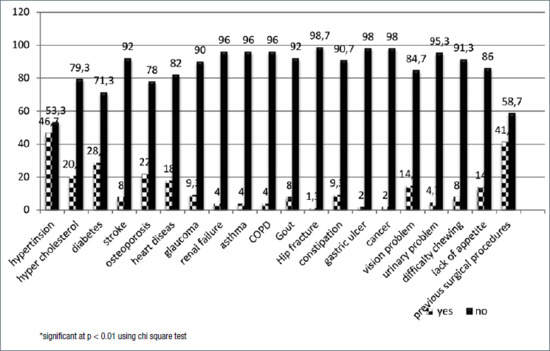
Figure 1.
Medical history of the participants.
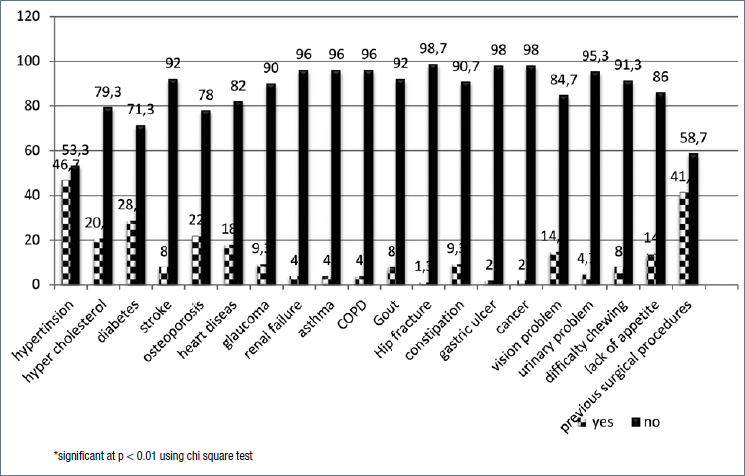

Table I.
Subjects characteristics presented in numbers and percentages.
Table II.
Participants nutritional status, cognitive and physical function profile
according to gender.
Table III.
Anthropometric measurements according to fall history and gender (mean
± SD).
Table IV.
Physical and cognitive function characteristics according to fall history and
gender.
References
- Kinsella K, He W. An aging world: 2008. Washington, DC: US Government Printing Office; 2009. US Census Bureau. International Population Reports, PS95/09. 2009;1.
- He W, Goodking D, Kowal P. An aging world: 2015. Unites States Census Bureau2016, pp. 165.
- Statistics PBo. Summary of demographic indicators in the Palestine by Region(http://www.pcbs.gov.ps/Portals/_Rainbow/Documents/DEMO-2016-EEE.htm, Accessed 20/09/2019, 2016).
- Seir RA, Kharroubi A. Implementation of palliative care in Palestine: cultural and religious perspectives. AQU Researchers Publications. 2017.
- Khanuja K, Joki J, Bachmann G, et al. Gait and balance in the aging population: fall prevention using innovation and technology. Maturitas 2018;110:51-56. https://doi.org/10.1016/j.maturitas.2018.01.02110.1016/j.maturitas.2018.01.021
- Das CP, Joseph S. Falls in elderly. J Indian Med Assoc 2005;103:136-140.
- Tinetti ME, Williams CS. The effect of falls and fall injuries on functioning in community-dwelling older persons. J Gerontol A Biol Sci Med Sci 1998;53:M112-M119. https://doi.org/10.1093/gerona/53A.2.M11210.1093/gerona/53A.2.M112
- Ek S, Rizzuto D, Fratiglioni L, et al. Risk factors for injurious falls in older adults: the role of sex and length of follow-up. J Am Geriatr Soc 2019;67:246-253. https://doi.org/10.1111/jgs.1565710.1111/jgs.15657
- Tinetti ME, Kumar C. The patient who falls: “It’s always a trade-off”. JAMA 2010;303:258-266. https://doi.org/10.1001/jama.2009.202410.1001/jama.2009.2024
- Tinetti ME, Speechley M, Ginter SF, et al. Risk factors for falls among elderly persons living in the community. N Engl J Med 1988;319:1701-1708. https://doi.org/10.1056/NEJM19881229319260410.1056/NEJM198812293192604
- Kvelde T., Lord SR, Close JCT, et al. Depressive symptoms increase fall risk in older people, independent of antidepressant use, and reduced executive and physical functioning. Arch Gerontol Geriatr 2015;60:190-195. https://doi.org/10.1016/j.archger.2014.09.00310.1016/j.archger.2014.09.003
- Welmer AK, Rizzuto D, Laukka EJ, et al. Cognitive and physical function in relation to the risk of injurious falls in older adults: a population-based study. J Gerontol A Biol Sci Med Sci 2017;72:669-675.
- Follis S, Cook A, Bea JW, et al. Association between sarcopenic obesity and falls in a multiethnic cohort of postmenopausal women. J AM Geriatr Soc 2018;66:2314-2320. https://doi.org/10.1111/jgs.1561310.1111/jgs.15613
- Yeung SSY, Reijnierse EM, Pham VK, et al. Sarcopenia and its association with falls and fractures in older adults: a systematic review and meta-analysis. J Cachexia Sarcopenia Muscle 2019;10:485-500. https://doi.org/10.1002/jcsm.1241110.1002/jcsm.12411
- Neri SGR, Gadelha AB, de David AC, et al. The association between body adiposity measures, postural balance, fear of falling, and fall risk in older community-dwelling women. J Geriatr Phys Ther 2019;42:E94-E100. https://doi.org/10.1519/JPT.000000000000016510.1519/JPT.0000000000000165
- Mangani I, Cesari M, Russo A, et al. Physical function, physical activity and recent falls. Results from the “Invecchiamento e Longevità nel Sirente (ilSIRENTE)” Study. Aging Clin Exp Res 2008;20:234-241. https://doi.org/10.1007/BF0332477810.1007/BF03324778
- Fischer B, Hoyt W, Maucieri L, et al. Performance based assessment of falls risk in older veterans with executive dysfunction. J Rehabil Res Dev 2014;51:263. https://doi.org/10.1682/JRRD.2013.03.007510.1682/JRRD.2013.03.0075
- Bohannon RW. Grip strength: an indispensable biomarker for older adults. Clinical Interv Aging 2019;14:1681. https://doi.org/10.2147/CIA.S19454310.2147/CIA.S194543
- Wiśniowska-Szurlej A, Wilmowska-Pietruszyńska A. An assessment of factors related to disability in ADL and IADL in elderly inhabitants of rural areas of south-eastern Poland. Ann Agricult Environ Med 2018;25:504-511. https://doi.org/10.26444/aaem/8131110.26444/aaem/81311
- Ritchie K. Mild cognitive impairment: an epidemiological perspective. Dialogues Clin Neurosci 2004;6:401-408. https://doi.org/10.31887/DCNS.2004.6.4/kritchie10.31887/DCNS.2004.6.4/kritchie
- Allali G, Launay CP, Blumen HM, et al. Falls, cognitive impairment, and gait performance: results from the GOOD initiative. J Am Med Dir Assoc 2017;18:335-340. https://doi.org/10.1016/j.jamda.2016.10.00810.1016/j.jamda.2016.10.008
- Orces CH. Prevalence and determinants of falls among older adults in Ecuador: an analysis of the SABE I Survey. Curr Gerontol Geriatr Res 2013;2013. https://doi.org/10.1155/2013/49546810.1155/2013/495468
- Bohannon RW. Hand-grip dynamometry predicts future outcomes in aging adults. J Geriatr Phys Ther 2008;31:3-10. https://doi.org/10.1519/00139143-200831010-0000210.1519/00139143-200831010-00002
- Jones CJ, Rikli RE, Beam WC. A 30-s chair-stand test as a measure of lower body strength in community-residing older adults. Res Quart Exerc Sport 1999;70:113-119. https://doi.org/10.1080/02701367.1999.1060802810.1080/02701367.1999.10608028
- Merellano-Navarro E, Collado-Mateo D, García-Rubio J, et al. Validity of the International Fitness Scale “IFIS” in older adults. Experim Gerontol 2017;95:77-81. https://doi.org/10.1016/j.exger.2017.05.00110.1016/j.exger.2017.05.001
- Downton JH, Andrews K. Prevalence, characteristics and factors associated with falls among the elderly living at home. AGING CLIN EXP RES 1991;3:219-228. https://doi.org/10.1007/BF0332400910.1007/BF03324009
- Kamel MH, Abdulmajeed AA, Ismail SE-S. Risk factors of falls among elderly living in Urban Suez-Egypt. Pan Afr Med 2013;14. https://doi.org/10.11604/pamj.2013.14.26.160910.11604/pamj.2013.14.26.1609
- Enriquez de Luna-Rodriguez M, Aranda-Gallardo M, Canca-Sanchez JC, et al. Profile of the patient who suffers falls in the hospital environment: multicenter study. Enferm Clin 2020;30:236-243.
- Malini FM, Lourenço RA, Lopes CS. Prevalence of fear of falling in older adults, and its associations with clinical, functional and psychosocial factors: the frailty in Brazilian older people Rio de Janeiro Study. Geriatr Gerontol Int 2016;16:336-344. https://doi.org/10.1111/ggi.1247710.1111/ggi.12477
- Murphy SL, Dubin JA, Gill TM. The development of fear of falling among community-living older women: predisposing factors and subsequent fall events. J Gerontol A Biol Sci 2003;58:M943-M947. https://doi.org/10.1093/gerona/58.10.M94310.1093/gerona/58.10.M943
- Greenberg MR, Moore EC, Nguyen MC, et al. Perceived fall risk and functional decline: gender differences in patient’s willingness to discuss fall risk, fall history, or to have a home safety evaluation. YJBM 2016;89:261-267.
- Fukukawa Y, Kozakai R, Niino N, et al. Social support as a moderator in a fall prevention program for older adults. J Gerontological Nurs 2008;34:19-25. https://doi.org/10.3928/00989134-20080501-0510.3928/00989134-20080501-05
- Trevisan C, Rizzuto D, Maggi S, et al. Impact of social network on the risk and consequences of injurious falls in older adults. J Am Geriatr Soc 2019;67:1851-1858. https://doi.org/10.1111/jgs.1601810.1111/jgs.16018
- Friedmann JM, Elasy T, Jensen GL. The relationship between body mass index and self-reported functional limitation among older adults: a gender difference. J Am Geriatr Soc 2001;49:398-403. https://doi.org/10.1046/j.1532-5415.2001.49082.x10.1046/j.1532-5415.2001.49082.x
- Katz DA, McHorney CA, Atkinson RL. Impact of obesity on health-related quality of life in patients with chronic illness. J Gen Intern Med 2000;15:789-796. https://doi.org/10.1046/j.1525-1497.2000.90906.x10.1046/j.1525-1497.2000.90906.x
- Fjeldstad C, Fjeldstad A, Acree S, et al. The influence of obesity on falls and quality of life. Dyn Med 2008;7:4. https://doi.org/10.1186/1476-5918-7-410.1186/1476-5918-7-4
- Tinetti ME, Speechley M, Ginter SF. Risk factors for falls among elderly persons living in the community. N Eng J Med 1988;319:1701-1707. https://doi.org/10.1056/NEJM19881229319260410.1056/NEJM198812293192604
- Montero-Odasso M, Verghese J, Beauchet O, et a. Gait and cognition: a complementary approach to understanding brain function and the risk of falling. J Am Geriatr Soc 2012;60:2127-2136. https://doi.org/10.1111/j.1532-5415.2012.04209.x10.1111/j.1532-5415.2012.04209.x
- Oliver D, Connelly JB, Victor CR, et al. Strategies to prevent falls and fractures in hospitals and care homes and effect of cognitive impairment: systematic review and meta-analyses. BMJ 2007;334:82. https://doi.org/10.1136/bmj.39049.706493.5510.1136/bmj.39049.706493.55
- Rossetti H, Lacritz L, Cullum M, et al. Normative data for the Montreal Cognitive Assessment (MoCA) in a population-based sample. Neurology 2011;77:1272-1275. https://doi.org/10.1212/WNL.0b013e318230208a10.1212/WNL.0b013e318230208a
- Juraschek SP, Daya N, Appel LJ, et al. Subclinical cardiovascular disease and fall risk in older adults: results from the atherosclerosis risk in communities study. J Am Geriatr Soc 2019;67:1795-1802. https://doi.org/10.1111/jgs.1604110.1111/jgs.16041
- Manemann SM, Chamberlain AM, Boyd CM, et al. Fall risk and outcomes among patients hospitalized with cardiovascular disease in the community. Circ Cardiovasc Qual Outcomes 2018;11:e004199. https://doi.org/10.1161/CIRCOUTCOMES.117.00419910.1161/CIRCOUTCOMES.117.004199
- Lohman MC, Mezuk B, Dumenci L. Depression and frailty: concurrent risks for adverse health outcomes. Aging Ment Health 2017;21:399-408. https://doi.org/10.1080/13607863.2015.110219910.1080/13607863.2015.1102199
Società Italiana di Gerontologia e Geriatria (SIGG) This is an open access article distributed in accordance with the CC-BY-NC-ND (Creative Commons Attribution-NonCommercial-NoDerivatives 4.0 International) license. The article can be used by giving appropriate credit and mentioning the license, but only for non-commercial purposes and only in the original version. For further information: https://creativecommons.org/licenses/by-nc-nd/4.0/deed.en