


You are currently viewing a new version of our website. To view the old version click .

Tropical Medicine and Infectious Disease, Volume 9, Issue 8

August 2024 - 23 articles

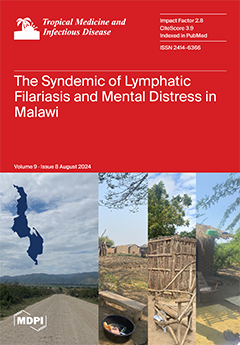
Cover Story: Lymphatic filariasis (LF) causes disfiguring and disabling lymphoedema, leading to mental distress and requiring lifelong self-care. This study uses syndemic theory to explore the biosocial relationship between LF and mental distress in Malawi. Through 21 life-history interviews and key informant interviews with staff from the LF program implemented by the Ministry of Health, we examine the experiences of those affected by LF and the impact of enhanced self-care (ESC) on disrupting this syndemic. Our findings indicate that prior to ESC training, the lack of referral pathways, healthcare inequalities, limited LF knowledge, stigma, and social exclusion—shaped by gender, poverty, and extreme climate conditions—intensified mental distress. Addressing this syndemic through person-centred interventions is crucial for effective and equitable LF care. View this paper
  • Issues are regarded as officially published after their release is announced to the table of contents alert mailing list .
  • You may sign up for email alerts to receive table of contents of newly released issues.
  • PDF is the official format for papers published in both, html and pdf forms. To view the papers in pdf format, click on the "PDF Full-text" link, and use the free Adobe Reader to open them.

Articles (23)

  • Review
  • Open Access
4 Citations
2,500 Views
18 Pages

Using a Syndemics Perspective to (Re)Conceptualize Vulnerability during the COVID-19 Pandemic: A Scoping Review

  • Yisel Hernandez Barrios,
  • Dennis Perez Chacon,
  • Yosiel Molina Gomez,
  • Charlotte Gryseels,
  • Kristien Verdonck,
  • Koen Peeters Grietens and
  • Claudia Nieto-Sanchez

Syndemics theory has been applied to study interactions between biomedical and social factors leading to the clustering of diseases. Because syndemics theory focuses on interactions that enhance risk, the concept of vulnerability is central to this a...

  • Study Protocol
  • Open Access
3 Citations
2,970 Views
16 Pages

A Generalizable Prioritization Protocol for Climate-Sensitive Zoonotic Diseases

  • Adam C. Castonguay,
  • Sukanta Chowdhury,
  • Ireen Sultana Shanta,
  • Bente Schrijver,
  • Remco Schrijver,
  • Shiyong Wang and
  • Ricardo J. Soares Magalhães

Emerging and re-emerging zoonotic diseases pose a significant threat to global health and economic security. This threat is further aggravated by amplifying drivers of change, including climate hazards and landscape alterations induced by climate cha...

  • Case Report
  • Open Access
3 Citations
2,683 Views
8 Pages

Concomitant Parenchymal, Subarachnoid, and Ventricular Neurocysticercosis in Rome, Italy: A Case Report with a 4-Year Follow-Up

  • Maria Letizia Giancola,
  • Shalom Haggiag,
  • Angela Corpolongo,
  • Alessandro Stasolla,
  • Andrea Mariano,
  • Agazio Menniti,
  • Paolo Campioni,
  • Barbara Bartolini,
  • Pierluigi Galizia and
  • Antonella Vulcano
  • + 6 authors

Neurocysticercosis (NCC) is caused by the larval stage of Taenia solium. This parasitic disease is endemic in many areas of the world and is emerging in Europe. NCC can affect different brain regions, but simultaneous involvement of the parenchymal,...

  • Case Report
  • Open Access
1 Citations
3,213 Views
7 Pages

Cat-scratch disease (CSD) is an infectious disease caused by Bartonella henselae, presenting with fever and lymphadenopathy following contact with felines. The ocular manifestations include neuroretinitis, characterised by optic nerve swelling and a...

  • Review
  • Open Access
1 Citations
6,774 Views
22 Pages

Best Practices in the Management of Clostridioides difficile Infection in Developing Nations

  • Rafael Mendo-Lopez,
  • Carolyn D. Alonso and
  • Javier A. Villafuerte-Gálvez

Clostridioides difficile infection (CDI) is a well-known cause of hospital-acquired infectious diarrhea in developed countries, though it has not been a top priority in the healthcare policies of developing countries. In the last decade, several stud...

  • Article
  • Open Access
1 Citations
2,518 Views
21 Pages

Repurposing Insecticides for Mosquito Control: Evaluating Spiromesifen, a Lipid Synthesis Inhibitor against Aedes aegypti (L.)

  • Daniela Cerda-Apresa,
  • Selene M. Gutierrez-Rodriguez,
  • Jesus A. Davila-Barboza,
  • Beatriz Lopez-Monroy,
  • Iram P. Rodriguez-Sanchez,
  • Karla L. Saavedra-Rodriguez and
  • Adriana E. Flores

The growing resistance of Aedes aegypti (L.) to conventional insecticides presents a major challenge in arbovirus control, necessitating the exploration of alternative insecticidal chemistries. Spiromesifen, derived from spirocyclic tetronic acids, i...

  • Article
  • Open Access
6 Citations
2,791 Views
24 Pages

‘The Lost Peace’: Evidencing the Syndemic Relationship between Neglected Tropical Diseases and Mental Distress in Liberia

  • Rosalind McCollum,
  • Carrie Barrett,
  • Georgina Zawolo,
  • Rachel Johnstone,
  • Tiawanlyn G. Godwin-Akpan,
  • Hannah Berrian,
  • Shahreen Chowdhury,
  • Jerry Kollie,
  • Karsor Kollie and
  • Emerson Rogers
  • + 10 authors

Neglected Tropical Diseases (NTDs) are a group of chronic infectious diseases of poverty affecting over one billion people globally. Intersections of NTDs, disability, and mental ill-health are increasingly evidenced but are rarely studied from a mix...

  • Article
  • Open Access
3 Citations
1,511 Views
9 Pages

Global Dynamics of Gastrointestinal Colonisations and Antimicrobial Resistance: Insights from International Travellers to Low- and Middle-Income Countries

  • Laura Seijas-Pereda,
  • David Carmena,
  • Carlos Rescalvo-Casas,
  • Marcos Hernando-Gozalo,
  • Laura Prieto-Pérez,
  • Juan Cuadros-González and
  • Ramón Pérez-Tanoira

Gastrointestinal microorganism resistance and dissemination are increasing, partly due to international travel. This study investigated gastrointestinal colonisations and the acquisition of antimicrobial resistance (AMR) genes among international tra...

  • Article
  • Open Access
2 Citations
2,313 Views
13 Pages

Determinants of health-seeking behavior among people living with HIV (PLHIV) are important. This study aims to develop and assess the content validity of an instrument that measures health-seeking behavior for tuberculosis among PLHIV in India. An in...

  • Article
  • Open Access
1 Citations
2,129 Views
11 Pages

Klebsiella variicola is an opportunistic pathogen often misidentified as Klebsiella pneumoniae, leading to misdiagnoses and inappropriate treatment in clinical settings. The genetic and molecular characteristics of clinically isolated K. variicola re...

of 3

Get Alerted

Add your email address to receive forthcoming issues of this journal.

XFacebookLinkedIn
Trop. Med. Infect. Dis. - ISSN 2414-6366