


Abstract
Introduction: This study investigated independent factors associated with neurological prognosis at discharge in patients with tuberculous meningitis (TBM) and evaluated the impact of intensified treatment regimens. Methods: A retrospective analysis was conducted in 518 TBM patients from two Chinese medical centers. LASSO and multivariable logistic regression were used to identify independent risk factors for poor neurological outcomes. A 1:1 PSM based on intensified treatment exposure was performed to assess its association with neurological outcomes, with an exploratory outcome-based matched comparison conducted for other prognostic factors. Results: Among 518 patients, 123 (23.75%) had poor neurological outcomes. The poor-prognosis group had higher proportions of MRC stage III (30.08% vs. 8.35%, p < 0.001), linezolid use (58.54% vs. 40.76%, |SMD| = 0.361), and fluoroquinolone use (87.8% vs. 75.19%, |SMD| = 0.386). Multivariable analysis identified decreased muscle strength, MRC stage II/III, albumin < 30 g/L, and hydrocephalus as independent risk factors for poor neurological outcomes. After treatment-exposure-based PSM, intensified treatment was not significantly associated with neurological outcomes, while an exploratory matched analysis suggested a potential association between diabetes mellitus and unfavorable neurological outcomes. Conclusion: Neurological prognosis in TBM is influenced by both disease severity and host baseline status. Intensified therapy was not significantly associated with neurological outcome at discharge after adjustment, highlighting the importance of individualized risk management.
1. Introduction
Tuberculous meningitis (TBM) remains the most lethal and debilitating manifestation of extrapulmonary tuberculosis (TB), characterized by a profound inflammatory response following the infection of the meninges by Mycobacterium tuberculosis [1,2]. Despite global efforts, the burden of TB persists; the 2025 World Health Organization Global Tuberculosis Report indicates that while case numbers showed a slight decline in 2024, approximately 10.7 million people were affected and 1.23 million died from the disease [3]. TBM is disproportionately responsible for this mortality, with global mortality rates averaging 25% and reaching as high as 70% in high-risk regions or among people living with HIV [4]. Furthermore, over 50% of survivors suffer from permanent neurological impairments, including cognitive deficits, limb paralysis, and seizures, imposing a significant socio-economic burden on healthcare systems and families [5].
Current clinical management of TBM prioritizes early diagnosis and standardized treatment to mitigate these outcomes [6]. Prognostic assessment traditionally relies on disease severity markers, most notably the modified Medical Research Council (MRC) staging system [7]. Extensive literature has identified advanced age, late-stage disease, hydrocephalus, and impaired consciousness as key predictors of poor outcomes [8,9,10]. However, a critical limitation in existing research is that many identified prognostic factors are heavily collinear with disease severity, potentially obscuring the independent contribution of individual patient characteristics. While factors such as malnutrition (assessed via the CONUT score), low hemoglobin, and immune status are known to influence TB progression, their specific impact on TBM-related neurological functional outcomes, independent of the initial clinical stage, remains insufficiently characterized [11,12,13].
Similarly, the role of intensified treatment regimens in improving neurological outcomes is a subject of ongoing debate. While the standard intensive-phase treatment involves a four-drug regimen, several studies have explored the efficacy of adjunctive second-line agents like linezolid and fluoroquinolones [14,15]. Although these agents have shown potential in reducing mortality for drug-resistant TBM, their ability to significantly reduce overall mortality or improve neurological functional recovery in the general TBM population has not been definitively established [15]. Consequently, there is a clear need to distinguish whether improved outcomes are a product of the therapeutic regimen itself or the baseline clinical status of the patient.
This study systematically evaluated the associations of disease severity, baseline patient characteristic, and treatment regimens with neurological outcomes at discharge in a retrospective cohort of 518 patients with TBM. By applying propensity score matching (PSM) based on intensified treatment exposure, this study further assessed the association between intensified treatment and neurological outcomes, while an exploratory outcome-based matched comparison was conducted to examine other potential prognostic factors. The research objective was to facilitate early identification of high-risk patients, optimize treatment strategies and patient management, and thereby improve clinical outcomes and quality of life among patients with TBM.
2. Methods
2.1. Study Design and Population
This was a multicenter retrospective cohort analysis of patients meeting the diagnostic criteria for TBM. The study population comprised patients admitted to two specialized tuberculosis centers in China: Hangzhou Red Cross Hospital and Shanghai Public Health Clinical Center, between November 2012 and November 2023.
The inclusion criteria were: (1) age ≥ 15 years; (2) a diagnosis of TBM according to the standardized diagnostic framework, which classifies cases as confirmed (microbiological evidence), highly suspected (clinical and imaging criteria), or suspected (clinical presentation without a more plausible alternative) [1]; and (3) availability of essential laboratory and imaging data required for diagnosis and analysis.
Exclusion criteria included pregnancy or lactation, a history of major central nervous system disorders (e.g., sequelae of stroke or previous cranial surgery), missing key diagnostic or analytical variables.
This research adhered to the Declaration of Helsinki and was approved by the Ethics Committee of Hangzhou Red Cross Hospital (Approval No.: 2025-S198-001), which waived the requirement for informed consent due to the retrospective nature of this study. Hangzhou Red Cross Hospital served as the leading institution, and Shanghai Public Health Clinical Center formally recognized and relied upon this ethical approval in accordance with its institutional requirements.
2.2. Data Collection and Severity Assessment
Demographic characteristics, clinical symptoms, laboratory test results (blood and cerebrospinal fluid), and neuroimaging findings were extracted from electronic medical records at the time of admission.
Disease severity was staged according to the MRC system [7]: Stage I: Glasgow Coma Scale (GCS) score of 15; fully conscious with no neurological deficits; Stage II: GCS score of 11–14; presence of lethargy or cranial nerve palsies; Stage III: GCS score ≤ 10; coma or severe neurological deficits.
2.3. Therapeutic Intervention
During the study period (2012–2023), patients were treated according to the Chinese guidelines for tuberculosis management available at the time, including the Guidelines for Tuberculosis Control and Prevention in China (2015 edition) and subsequent updates. All patients received anti-tuberculosis therapy based on national guidelines. The standard regimen consisted of an intensive phase (2 months) of isoniazid, rifampicin, pyrazinamide, and ethambutol, followed by a continuation phase (10 months) of isoniazid, rifampicin and ethambutol. Intensified treatment was defined as the addition of linezolid, fluoroquinolones, or amikacin for at least 2 weeks. The decision to initiate intensified therapy was made by treating physicians based on individual clinical conditions, including disease severity, suspected drug resistance, and response to initial anti-tuberculosis therapy. The dosages of intensified agents were prescribed according to the approved drug labels and prescribing information, with adjustments made when clinically indicated. Once the intensified regimen was determined, it was generally maintained throughout the subsequent treatment course unless clinical conditions, adverse events, or other treatment-related considerations required adjustment. Concomitant treatments included corticosteroids to mitigate neuroinflammation, mannitol for intracranial pressure management, and supportive care for nutrition and electrolyte balance.
2.4. Outcome Measures
The primary outcome was the neurological status at discharge, evaluated using the modified Rankin Scale (mRS). The mRS scores range from 0 (no symptoms) to 6 (death) [16]. Patients were stratified into two cohorts: (1) favorable outcome: mRS scores 0–2; (2) unfavorable outcome: mRS scores 3–6. Given the retrospective design and the long study period (2012–2023), follow-up completeness varied substantially among patients. Therefore, only discharge neurological status was selected as the primary endpoint to avoid potential selection bias caused by incomplete long-term follow-up.
2.5. Statistical Analysis
Missing data were assessed before statistical analysis. For continuous variables with less than 10% missing data, missing values were imputed using the median value. Variables with substantial missingness or missing essential diagnostic information were not imputed, and the corresponding patients were excluded during the screening process. Statistical analyses were conducted using IBM SPSS Statistics version 25.0 and R software version 4.5.1. Continuous variables were expressed as the mean ± standard deviation or median (interquartile range) according to their distribution, while categorical variables were expressed as frequencies and percentages. Baseline differences between groups were evaluated using standardized mean differences (SMDs) for continuous and binary categorical variables, whereas p values were used for categorical variables with three or more categories.
LASSO was first applied to the entire cohort to reduce multicollinearity and identify candidate factors associated with poor neurological prognosis. Next, the selected variables were entered into a multivariable logistic regression analysis to evaluate factors independently associated with unfavorable neurological outcomes in TBM. The strength of the associations between variables was quantified using odds ratios (ORs) and their 95% confidence intervals (CIs).
To evaluate the association between intensified treatment and neurological outcomes, patients were categorized according to intensified treatment exposure. In addition, 1:1 propensity score matching (PSM) was performed based on baseline characteristics associated with treatment allocation to reduce potential confounding by indication. The logistic regression model was used to estimate the propensity scores, followed by 1:1 nearest-neighbor matching. In the treatment-exposure-matched cohort, logistic regression was used to evaluate the association between individual intensified treatment drugs and neurological outcomes. Furthermore, an exploratory matched comparison was performed using neurological outcome as the grouping variable to explore the associations of intensified treatment drugs and other clinical factors with neurological outcomes. Additionally, a sensitivity analysis excluding patients classified as suspected TBM was performed to assess the robustness of the findings with respect to diagnostic uncertainty. A p value < 0.05 was considered statistically significant, and all tests were two-sided.
3. Results
3.1. Patient Characteristics
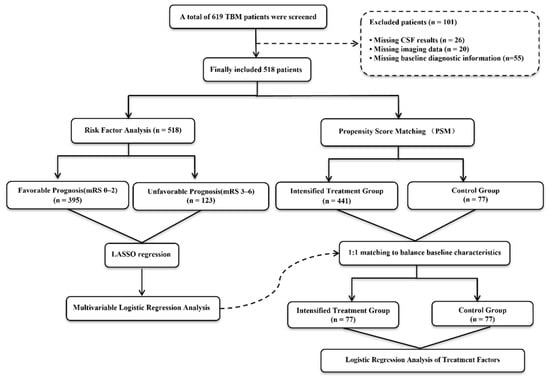
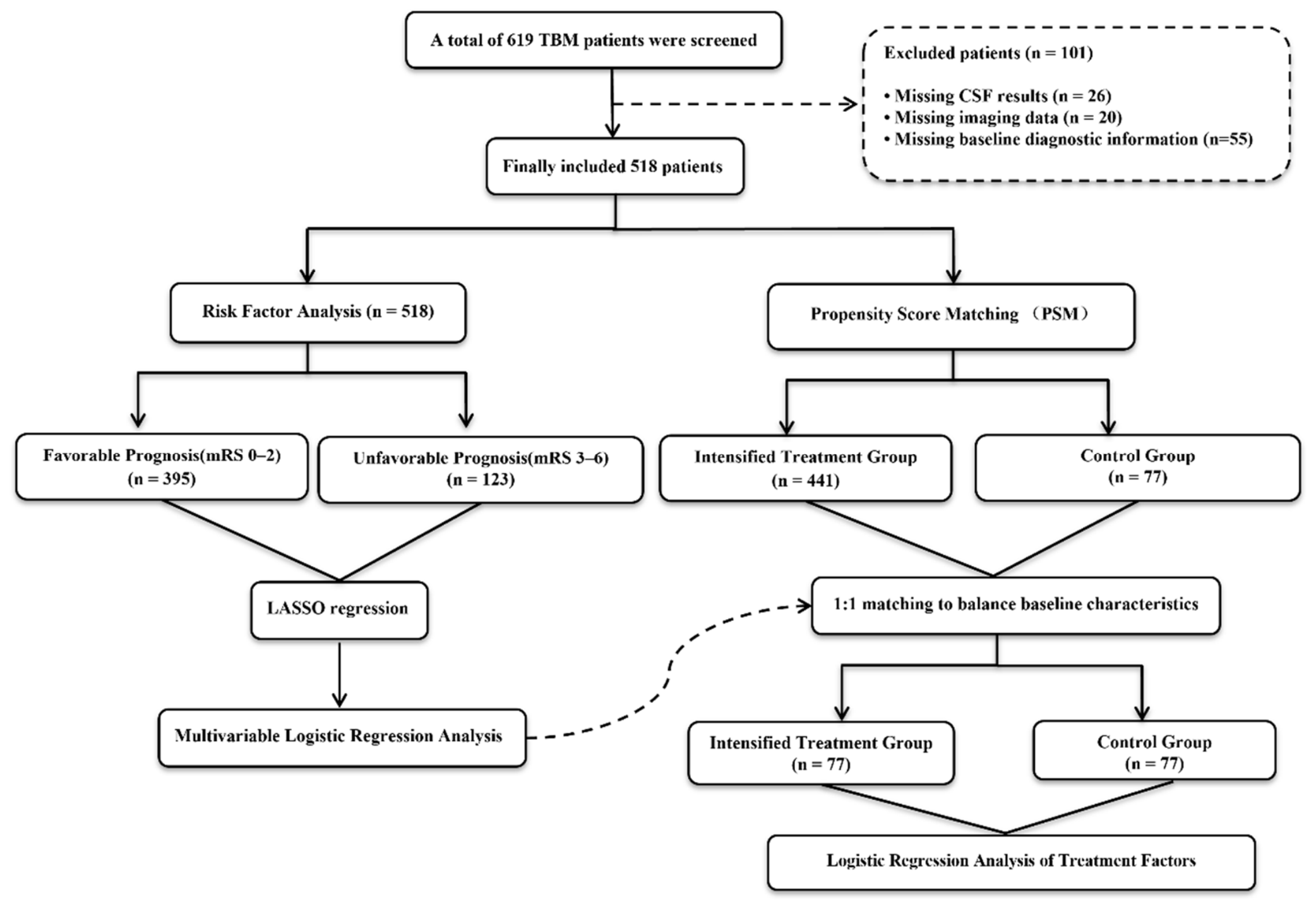
A total of 619 patients were screened during the study period. After excluding patients with incomplete cerebrospinal fluid examinations, insufficient imaging data, missing essential baseline information, and other exclusion criteria, 518 patients were included in the final analysis. The detailed patient selection process is shown in Figure 1. Based on neurological outcomes at discharge, 395 patients (76.25%) were assigned to the favorable-prognosis group (mRS 0–2) and 123 patients (23.75%) to the unfavorable-prognosis group (mRS 3–6). Microbiological confirmation (definite TBM) via cerebrospinal fluid (CSF) culture or nucleic acid amplification testing (NAAT) was achieved in 311 cases (60.04%), while the remaining 207 (39.96%) were classified as probable or suspected TBM (Table 1).
Figure 1.
Flow diagram of patient selection and inclusion in this study.
Table 1.
Comparison of ts for Variable Selection in LASSO RegresDisease Severity Between TBM Patients with Different Prognoses.
3.2. Baseline Disease Severity and Clinical Manifestations
Patients with unfavorable outcomes exhibited greater baseline disease severity (Table 1). Specifically, the distribution of MRC disease stages was imbalanced between the two groups, with a higher proportion of patients classified as MRC stage III in the unfavorable outcome group (30.08% vs. 8.35%, p < 0.001) and a lower proportion classified as stage I (9.76% vs. 40.51%, p < 0.001). This finding indicated a substantial imbalance in disease severity between the two groups. Additionally, patients with unfavorable prognosis had lower GCS scores at admission (|SMD| = 0.499), which further reflected their overall unfavorable neurological functional status.
Clinical manifestations associated with unfavorable prognosis included consciousness disorder (|SMD| = 0.521), cranial nerve palsy (|SMD| = 0.217), decreased muscle strength (|SMD| = 0.509), and abnormal muscle tone (|SMD| = 0.259). Furthermore, the proportion of patients with unfavorable prognosis who were found to have hydrocephalus on imaging examinations at admission was also higher (|SMD| = 0.343).
3.3. Individual Factors and Laboratory Tests
Neurological outcomes differed between the two treating institutions, with a higher proportion of adverse outcomes observed among patients treated at the public hospital (|SMD| = 0.399). Compared with patients with favorable outcomes, those with poor prognosis were older (|SMD| = 0.204) and exhibited a more pronounced systemic inflammatory response, as reflected by elevated peripheral white blood cell counts (|SMD| = 0.314) and higher neutrophil-to-lymphocyte ratio (NLR) levels (|SMD| = 0.261). In addition, cerebrospinal fluid lactate dehydrogenase levels were markedly increased in the poor-prognosis group (|SMD| = 0.285), suggesting more severe central nervous system inflammation and tissue injury. Furthermore, patients with adverse outcomes demonstrated poorer nutritional and metabolic status, characterized by lower serum albumin levels (|SMD| = 0.349) and electrolyte disturbances, including elevated serum potassium levels (|SMD| = 0.287) (Table 2).
Table 2.
Comparison of Individual Factors and Laboratory Tests Between TBM Patients with Different Prognoses.
3.4. Therapeutic Interventions and Intensified Regimens
Analysis of treatment regimens revealed that intensified-treatment agents were more frequently administered to patients who ultimately experienced poor outcomes. The use of linezolid (58.54% vs. 40.76%, |SMD| = 0.361) and fluoroquinolones (87.80% vs. 75.19%, |SMD| = 0.386) was higher in the unfavorable outcome group, indicating an imbalance in treatment exposure between the two groups (Table 3). Several adverse events occurred numerically more frequently in the intensified treatment group; however, only rash differed significantly between groups (Supplementary Table S1).
Table 3.
Comparison of Medication Use Between TBM Patients with Different Prognoses.
3.5. Feature Selection via LASSO Regression and Multivariable Analysis
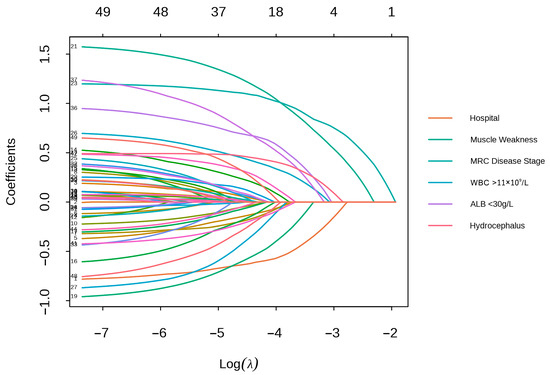
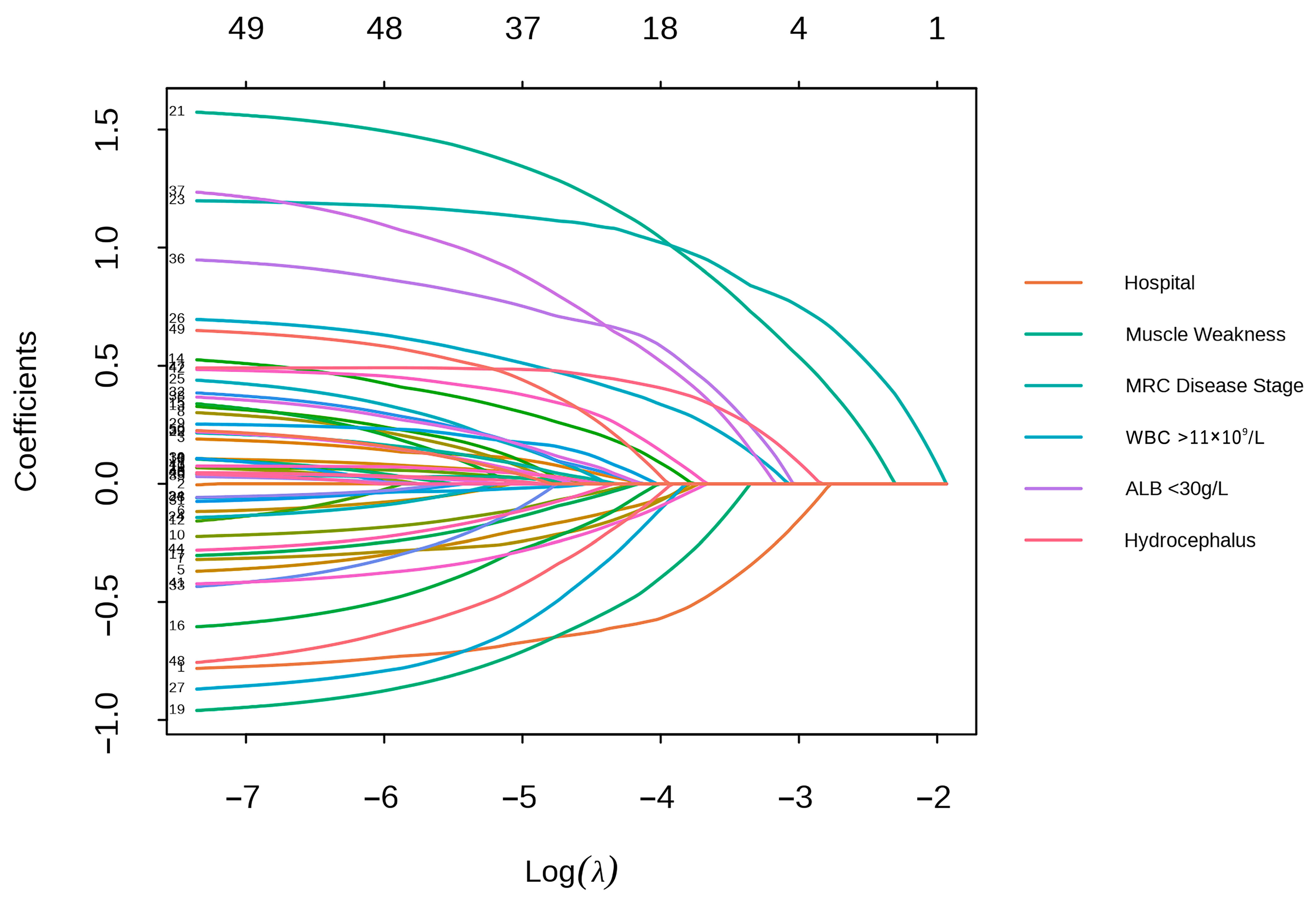
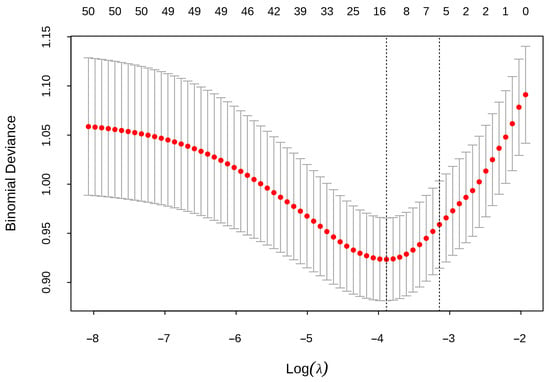
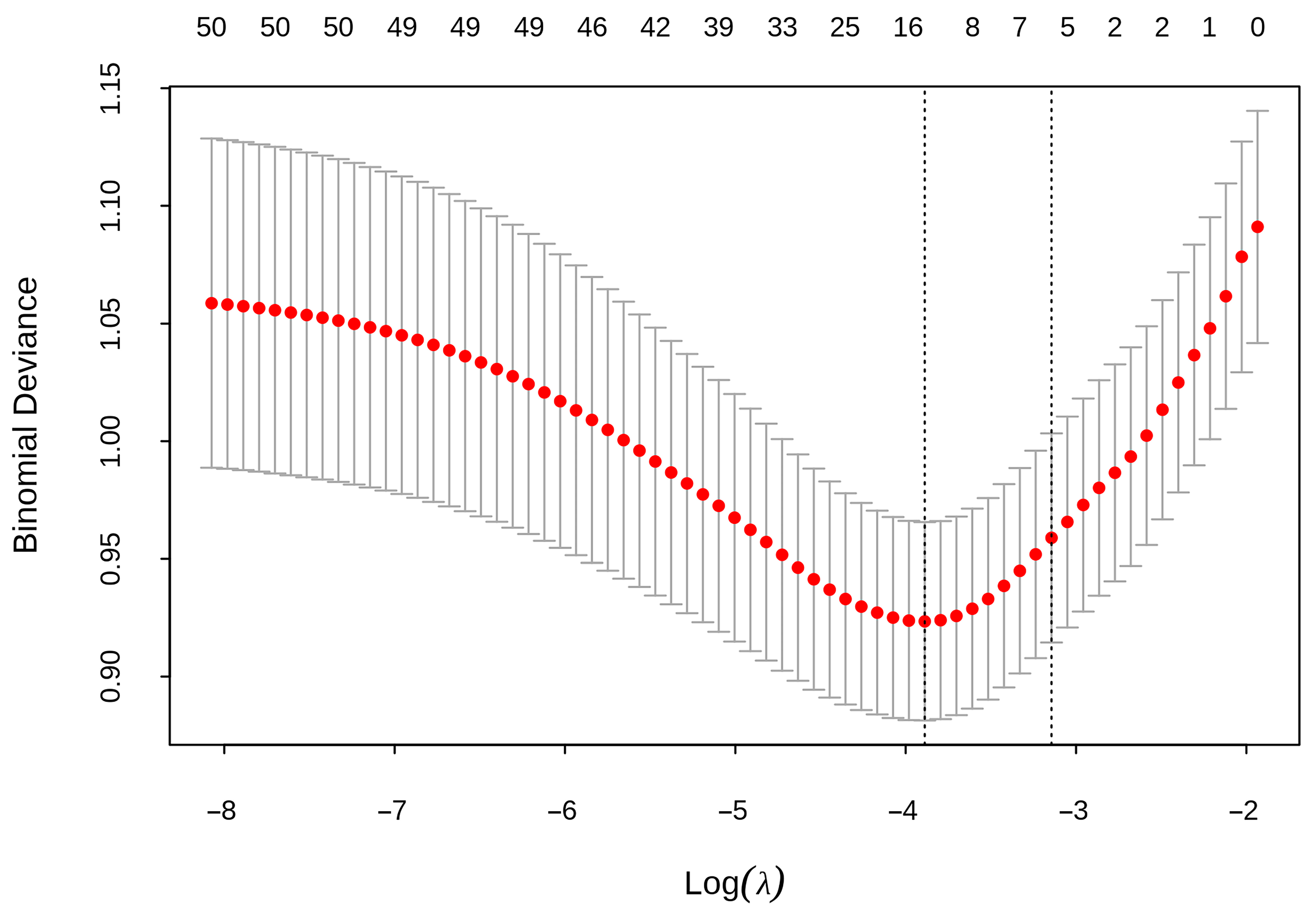
LASSO regression identified candidate variables associated with unfavorable neurological outcomes at discharge. Based on the lambda.1SE criterion, the optimal penalty parameter (λ) was 0.04. The variables selected by LASSO included hospital, muscle strength decline, MRC disease stage, white blood cell count (WBC), albumin (ALB), and hydrocephalus (Figure 2 and Figure 3).
Figure 2.
Path Diagram of Characteristic Coefficients for Variable Selection in LASSO Regression. Figure Legend: This figure shows the variation paths of regression coefficients of each candidate variable with the regularization parameter λ in LASSO (Least Absolute Shrinkage and Selection Operator) regression analysis. As λ increases, the regression coefficients of unimportant variables are gradually shrunk to 0, which is used to screen the most relevant predictors for the neurological prognosis of TBM patients.
Figure 3.
10-Fold Cross-Validation Results and Optimal λ Value Selection Diagram of LASSO Regression. Figure Legend: This figure displays the error variation in the LASSO regression model based on 10-fold cross-validation. Red dots represent the mean binomial deviance values, and error bars indicate the standard errors. λ.min represents the λ value that minimizes the cross-validation error; λ.1se represents the maximum λ value within one standard error of the minimum error.
Although hospital was identified as a potential factor during variable selection, it was considered a center-level characteristic rather than an individual biological predictor. Therefore, the primary multivariable analysis excluded hospital to focus on patient-level clinical factors. A sensitivity analysis including hospital as an adjustment variable was additionally performed and is presented in Supplementary Table S2. Given its clinical relevance, age was additionally included in the multivariable model.
In the primary multivariable analysis without hospital, decreased muscle strength (OR 3.63, 95% CI 2.12–6.21; p < 0.001), MRC stage II (OR 2.56, 95% CI 1.26–5.21; p = 0.009), MRC stage III (OR 10.18, 95% CI 4.62–22.42; p < 0.001), white blood cell count > 11 × 109/L (OR 2.13, 95% CI 1.13–4.00; p = 0.019), serum albumin < 30 g/L (OR 2.39, 95% CI 1.29–4.42; p = 0.006), and hydrocephalus (OR 1.99, 95% CI 1.22–3.25; p = 0.006) remained independently associated with poor neurological outcomes at discharge (Table 4).
Table 4.
Independent Factors Associated With Poor Neurological Outcomes in TBM.
After additional adjustment for hospital, the associations of decreased muscle strength, advanced MRC stage, low serum albumin, and hydrocephalus remained significant, whereas the association with elevated white blood cell count was attenuated and no longer reached statistical significance (Supplementary Table S2). These findings indicated that the associations of the major clinical factors were generally robust to adjustment for potential center effects, whereas the association with elevated white blood cell count was less robust and should be interpreted cautiously.
3.6. Exploratory Analysis of the Associations of Intensified Treatment and Other Clinical Factors with Neurological Outcomes
Propensity score matching (PSM) was performed on the patient data using intensified treatment exposure as the grouping variable. The propensity score model included hospital, MRC stage, hydrocephalus, muscle strength decline, and albumin level as matching variables. Nearest-neighbor 1:1 matching was performed using a caliper of 0.2 × SD of the logit of the propensity score, without replacement. After matching, 154 patients were included, with 77 patients in each treatment group. The standardized mean difference (SMD) for each covariate was lower than 0.2, indicating a good balance of baseline characteristics between groups (Table 5; Supplementary Figures S1 and S2). After PSM, the matched groups were well balanced with respect to baseline disease severity and treatment center, thereby providing a more balanced comparison for further evaluating the relationship between intensified treatment drugs and neurological outcomes.
Table 5.
Baseline Characteristics Before and After Propensity Score Matching According to Intensified Treatment Exposure.
In the matched cohort, binary logistic regression analysis was performed to evaluate the association between intensified treatment and neurological outcomes (Table 6 and Table 7). Before matching, intensified treatment was associated with neurological outcomes (OR = 2.04, 95% CI 1.04–4.01, p = 0.038), and linezolid and fluoroquinolone use was more frequent among patients with unfavorable neurological outcomes. After treatment-exposure-based PSM, however, intensified treatment was no longer significantly associated with neurological outcomes (OR = 1.11, 95% CI 0.46–2.69, p = 0.821). Similarly, no significant associations were observed between individual intensified treatment drugs and neurological outcomes in the matched cohort. Consistent findings were observed in the exploratory outcome-based matched cohort (Supplementary Tables S3 and S4).
Table 6.
Univariable Logistic Regression Analysis of Intensified Treatment Drugs and Neurological Functional Outcomes in the Matched Cohort Based on Intensified Treatment Exposure.
Table 7.
Association Between Intensified Treatment and Clinical Outcomes in Patients With Tuberculous Meningitis Before and After Propensity Score Matching.
In the exploratory outcome-based matched cohort, univariable logistic regression analysis was performed to examine the potential associations between various clinical factors and neurological outcomes (Table 8). The presence of diabetes mellitus showed a potential association with adverse neurological outcomes (OR 2.97, 95% CI 1.11–7.94, p = 0.03).
Table 8.
Univariable Logistic Regression Analysis of Other Clinical Factors and Neurological Functional Outcomes in the Exploratory Outcome-based Matched Cohort.
To further explore this association, an additional multivariable logistic regression analysis was performed in the exploratory outcome-based matched cohort, with diabetes mellitus as the variable of interest and age, MRC disease stage, muscle weakness, hydrocephalus, serum albumin, white blood cell count, and intensified treatment as covariates. After adjustment for these potential confounding factors, diabetes mellitus remained potentially associated with adverse neurological outcomes (OR 3.05, 95% CI 1.13–8.21, p = 0.027; Supplementary Table S5). However, this finding should be interpreted cautiously as an exploratory association and requires further validation.
3.7. Sensitivity Analysis Restricted to Patients with Confirmed or Highly Suspected TBM
After excluding 39 patients with suspected TBM, 479 patients with confirmed or highly suspected TBM were included in the sensitivity analysis. The results were consistent with the primary analysis. Muscle weakness, advanced MRC stage, elevated white blood cell count, serum albumin < 30 g/L, and hydrocephalus remained significantly associated with unfavorable neurological outcomes (Supplementary Table S6). After propensity score matching for intensified treatment exposure (Supplementary Table S7), neither intensified treatment nor individual intensified drugs were significantly associated with neurological outcomes (Supplementary Table S8). These findings further supported the robustness of the primary results.
4. Discussion
Tuberculous meningitis (TBM) is associated with high mortality and substantial neurological disability, imposing a considerable socioeconomic burden. Early risk stratification is therefore urgently needed [17,18]. By analyzing the severity of the disease, individual factors, and the impact of drugs on prognosis, we identified factors associated with poor neurological outcomes in TBM, providing a basis for clinical risk assessment and individualized management.
The MRC grading system has served as a cornerstone for TBM stratification for over seven decades. Our findings further support the clinical value of the MRC grading system. However, our analysis suggests that reliance on MRC grading alone may be insufficient for accurately predicting neurological outcomes. Beyond disease severity, hydrocephalus, decreased muscle strength, and serum albumin levels < 30 g/L were also identified as independent risk factors for adverse neurological prognosis.
Hydrocephalus is closely associated with poor prognoses in TBM patients, particularly those with higher MRC grades. Our study reaffirms these findings [19]. The inflammatory response in the subarachnoid space due to Mycobacterium tuberculosis infection, characterized by gelatinous exudate obstructing the cerebrospinal fluid pathway, can initiate a cascade of events leading to increased intracranial pressure and ischemic injury, ultimately resulting in unfavorable outcomes [20]. Head CT/MRI serves as a dependable modality for diagnosing and assessing the severity of hydrocephalus in TBM patients [21]. Medical personnel should vigilantly monitor imaging findings, particularly indications of hydrocephalus, in stage II/III tuberculous meningitis cases. In our investigation, standard treatments for hydrocephalus included anti-tuberculosis drugs, diuretics, and corticosteroids. Pharmacological interventions can effectively alleviate mild-to-moderate hydrocephalus. However, in cases where patients are unresponsive to drug therapy, prompt surgical intervention is necessary to mitigate damage to brain parenchyma [19].
In this study, albumin levels below 30g/L emerge as an independent risk factor for unfavorable neurological outcomes in TBM patients. This finding aligns with prior studies highlighting the link between low albumin levels and adverse tuberculosis prognosis [22,23]. Serum albumin concentration serves as a crucial marker for assessing nutritional status and potentially mirrors patients’ preclinical health and overall nutritional well-being [24]. Moreover, reduced albumin levels (<30 g/L) can modify protein binding rates and the in vivo pharmacokinetics of essential anti-tuberculosis medications like rifampicin and linezolid, impacting their therapeutic efficacy [25]. Hence, it is imperative to regularly monitor albumin levels, conduct comprehensive nutritional assessments, and promptly administer personalized nutritional support to enhance patient outcomes in clinical settings.
The multivariable analysis reveals that reduced muscle strength serves as an independent risk factor for unfavorable neurological outcomes in patients with TBM. Muscle weakness typically signifies evident neurological involvement. The inflammatory response triggered by Mycobacterium tuberculosis infection results in occlusive vasculitis, culminating in cerebral ischemia and infarction. In severe instances, it may directly affect the brain parenchyma [26]. With the escalation of the inflammatory response and the advancement of intracranial lesions, patients become more susceptible to enduring motor impairment, impacting their long-term quality of life. Prior research has demonstrated a close association between neurological impairments, the severity of TBM, and adverse clinical consequences [27]. Hence, healthcare providers must prioritize the ongoing evaluation of changes in muscle strength during clinical care, promptly identify high-risk individuals, and initiate anti-tuberculosis therapy expeditiously to enhance patient prognosis.
Regarding pharmacological intervention, our initial raw data suggested an association between the use of linezolid or fluoroquinolones and poor outcomes. However, after employing PSM to adjust for baseline severity, this association vanished. This suggests a “severity bias,” where clinicians are more likely to prescribe intensified regimens to the most critically ill patients. Our findings align with current evidence indicating that while intensified therapy is recommended for high-risk cases, it does not inherently guarantee improved neurological outcomes compared to standard regimens [28,29]. Consequently, the decision to intensify treatment should be driven by individualized risk assessment rather than a universal application of second-line drugs.
In an exploratory outcome-based matched comparison, diabetes mellitus showed a potential association with unfavorable neurological outcomes. However, this finding is insufficient to establish diabetes as an independent prognostic factor. Further prospective studies are necessary for validation. Previous research consistently shows that diabetes significantly elevates the risks of treatment failure, death, and recurrence in tuberculosis patients. Maintaining good blood glucose control (HbA1c < 7%) correlates with improved clinical outcomes, whereas poor control is linked to a worse prognosis [30,31,32]. Mechanistically, diabetes heightens susceptibility to Mycobacterium tuberculosis, compromises protective immunity via hyperglycemia-induced oxidative stress, disrupts the blood–brain barrier, and impairs macrophage function, thereby impeding tuberculosis management and treatment responses [33,34]. Therefore, diabetes mellitus may represent an important comorbidity requiring clinical attention in patients with tuberculous meningitis.
Although a center-level association was observed, the underlying mechanisms remain unclear. Differences between centers in patient characteristics, referral patterns, clinical management, treatment strategies, and supportive care may have contributed to this finding. In addition, given the 11-year study period, temporal changes in case mix, diagnostic techniques, and clinical documentation practices may also have influenced the observed association. To assess the potential impact of these temporal changes, we performed a sensitivity analysis adjusting for admission period. Adjustment for admission period did not materially alter the associations of the major clinical factors (Supplementary Tables S9 and S10). Therefore, the observed hospital-related association should be interpreted as a potential center effect rather than a patient-level biological predictor and should not be interpreted as a comparison of healthcare quality between institutions.
Several limitations warrant acknowledgment: (1) Lack of long-term outcomes: Neurological outcomes were assessed only at discharge, and longer-term functional recovery was not evaluated. Therefore, further prospective studies with long-term follow-up are needed to better evaluate the long-term neurological outcomes of TBM patients. (2) Retrospective bias: The reliance on historical medical records introduces potential record bias and limits the standardization of certain variables. Therefore, the potential impact of intensified treatment timing and duration on neurological outcomes could not be fully evaluated. This limitation restricts causal inference from our findings. (3) Universality: Despite adopting a two-center approach, variations in clinical pathways may lead to center bias. (4) Residual confounding factors: Although we adjust for known confounding factors as thoroughly as possible through multivariate analysis, unmeasured or unquantifiable clinical variables may still influence the results. (5) Impact of missing data: As this was a retrospective study, missing data were present for some clinical variables. Although appropriate strategies were implemented to reduce the potential impact of missing data, residual selection bias or information bias related to missing data cannot be completely ruled out.
5. Conclusions
MRC stage II/III, decreased muscle strength, hydrocephalus, and serum albumin levels below 30 g/L were independently associated with poor neurological outcomes in tuberculous meningitis. After adjusting for disease severity and patients’ underlying conditions, intensified therapy was not significantly associated with neurological outcome at discharge. An exploratory association between diabetes mellitus and poor neurological outcomes was also observed, necessitating further verification. It is essential to enhance the precise stratified assessment of disease severity and prioritize nutrition and individualized comprehensive management to improve neurological function outcomes.
Supplementary Materials
The following supporting information can be downloaded at: https://www.mdpi.com/article/10.3390/tropicalmed11090259/s1. Table S1: Characteristics of Treatment-Related Adverse Events. Table S2: Independent Factors Associated With Poor Neurological Outcomes in Tuberculous Meningitis. Table S3: Comparison of SMD of Patient Characteristics Before and After PSM in the Exploratory Outcome-Based Matched Cohort. Table S4: Univariable Logistic Regression Analysis of Intensified Treatment Drugs and Neurological Functional Outcomes in the Exploratory Outcome-Based Matched Cohort. Table S5: Multivariable Logistic Regression Analysis of Factors Associated With Poor Neurological Outcomes in the Exploratory Outcome-Based Matched Cohort. Table S6: Sensitivity Analysis of Factors Associated With Poor Neurological Outcomes at Discharge Among Patients With Confirmed or Highly Suspected TBM. Table S7: Baseline Characteristics Before and After Propensity Score Matching According to Intensified Treatment Exposure Among Patients With Confirmed or Highly Suspected TBM. Table S8: Univariable Logistic Regression Analysis of the Associations Between Intensified Treatment Drugs and Neurological Functional Outcomes in the Matched Cohort of Patients With Confirmed or Highly Suspected TBM. Table S9: Temporal trends in diagnostic characteristics, treatment patterns, and clinical features of tuberculous meningitis patients from 2012 to 2023. Table S10: Sensitivity Analysis of Factors Associated With Unfavorable Neurological Outcomes After Adjustment for Admission Period. Figure S1: Covariate Balance Before and After 1:1 Propensity Score Matching According to Intensified Treatment Exposure. Figure S2: Propensity score distribution before and after 1:1 nearest-neighbor matching to intensified treatment exposure.
Author Contributions
Y.Y. and H.L.: study concept and design, data analysis, and manuscript drafting. H.Y. and X.M.: manuscript editing and language refinement. D.Y., L.X., J.W. and Y.S.: statistical analysis and interpretation of data. Y.Y., H.L., Y.C. and F.L.: interpretation of data and critical review of manuscript. All authors have read and agreed to the published version of the manuscript.
Funding
This study was supported by the Major Project of Guangzhou National Laboratory (Grant No. GZNL2024A01030), Hangzhou Key Scientific Research Program Project (No. 2025SZD2B06), Disease Prevention and Control Innovation Team of Zhejiang Province (Grant No. 2026JKC-05), the Science and Technology Commission of Shanghai Municipality (Grant No. ZD2021CY001), the Clinical Research Plan Project of Traditional Chinese Medicine (Grant No. 2026ZL0580) and the Hangzhou Medical and Health Science and Technology Project (Grant No. A20262172) were added to the Funding statement.
Institutional Review Board Statement
This study was approved by the Ethics Committee of Hangzhou Red Cross Hospital (Approval No. 2025-S198-001, approved on 24 December 2025), which served as the leading institution. Shanghai Public Health Clinical Center, as the participating institution, formally recognized and relied upon the ethical approval of the leading institution in accordance with its institutional requirements. The requirement for informed consent was waived by the Ethics Committee of Hangzhou Red Cross Hospital due to the retrospective nature of this study.
Informed Consent Statement
The requirement for informed consent was waived due to the retrospective nature of this study.
Data Availability Statement
The datasets generated and/or analyzed during the current study are available from the corresponding author on reasonable request.
Acknowledgments
We thank all patients who participated in this study.
Conflicts of Interest
Yuxia Yu, Huarui Liu, Huan Yang, Dan Ye, Lu Xia, Xiaoqing Ma, Jiayi Wang, Yuchong Sun, Feng Li and Yuanyuan Chen have no relevant conflicts of interest to disclose.
References
- Marais, S.; Thwaites, G.; Schoeman, J.F.; Török, M.E.; Misra, U.K.; Prasad, K.; Donald, P.R.; Wilkinson, R.J.; Marais, B.J. Tuberculous meningitis: A uniform case definition for use in clinical research. Lancet Infect. Dis. 2010, 10, 803–812. [Google Scholar] [CrossRef] [Scilit]
- Oo, N.; Agrawal, D.K. Epidemiology, Pathogenesis, Clinical Manifestations, and Management Strategies of Tuberculous Meningitis. Arch. Intern. Med. Res. 2025, 8, 48–58. [Google Scholar] [CrossRef] [Scilit]
- World Health Organization. Global Tuberculosis Report 2025; World Health Organization: Geneva, Switzerland, 2025. [Google Scholar]
- Ieque, A.L.; Palomo, C.T.; Castro Moreira, D.; Meneguello, J.E.; Murase, L.S.; Silva, L.L.; Baldin, V.P.; Caleffi-Ferracioli, K.R.; Siqueira, V.L.D.; Cardoso, R.F.; et al. Systematic review of tuberculous meningitis in high-risk populations: Mortality and diagnostic disparities. Future Microbiol. 2025, 20, 559–571. [Google Scholar] [CrossRef] [Scilit]
- Wang, M.G.; Luo, L.; Zhang, Y.; Liu, X.; Liu, L.; He, J.Q. Treatment outcomes of tuberculous meningitis in adults: A systematic review and meta-analysis. BMC Pulm. Med. 2019, 19, 200. [Google Scholar] [CrossRef] [Scilit]
- Merkler, A.E.; Reynolds, A.S.; Gialdini, G.; Morris, N.A.; Murthy, S.B.; Thakur, K.; Kamel, H. Neurological complications after tuberculous meningitis in a multi-state cohort in the United States. J. Neurol. Sci. 2017, 375, 460–463. [Google Scholar] [CrossRef] [Scilit]
- Thwaites, G.; Fisher, M.; Hemingway, C.; Scott, G.; Solomon, T.; Innes, J. British Infection Society guidelines for the diagnosis and treatment of tuberculosis of the central nervous system in adults and children. J. Infect. 2009, 59, 167–187. [Google Scholar] [CrossRef] [Scilit]
- Wen, L.; Li, M.; Xu, T.; Yu, X.; Wang, L.; Li, K. Clinical features, outcomes and prognostic factors of tuberculous meningitis in adults worldwide: Systematic review and meta-analysis. J. Neurol. 2019, 266, 3009–3021. [Google Scholar] [CrossRef] [Scilit]
- Wang, L.; Gu, Z.; Chen, X.; Yu, X.; Meng, X. Analysis of risk factors for long-term mortality in patients with stage II and III tuberculous meningitis. BMC Infect. Dis. 2024, 24, 656. [Google Scholar] [CrossRef] [Scilit]
- Li, K.; Tang, H.; Yang, Y.; Li, Q.; Zhou, Y.; Ren, M.; Long, X.; Shen, W.; Hu, R.; Wang, X.; et al. Clinical features, long-term clinical outcomes, and prognostic factors of tuberculous meningitis in West China: A multivariate analysis of 154 adults. Expert Rev. Anti-Infect. Ther. 2017, 15, 629–635. [Google Scholar] [CrossRef] [Scilit]
- Lourens, R.; Singh, G.; Arendse, T.; Thwaites, G.; Rohlwink, U. Tuberculous Meningitis Across the Lifespan. J. Infect. Dis. 2025, 231, 1101–1111. [Google Scholar] [CrossRef] [Scilit]
- Guo, C.; Liu, K.W.; Tong, J.; Gao, M.Q. Prevalence and prognostic significance of malnutrition risk in patients with tuberculous meningitis. Front. Public Health 2024, 12, 1391821. [Google Scholar] [CrossRef] [Scilit]
- Maleki Rad, M.; Haddad, M.; Sheybani, F.; Shirazinia, M.; Dadgarmoghaddam, M. Mortality predictors and diagnostic challenges in adult tuberculous meningitis: A retrospective cohort of 100 patients. Trop. Med. Health 2025, 53, 58. [Google Scholar] [CrossRef] [Scilit]
- Fang, M.T.; Su, Y.F.; An, H.R.; Zhang, P.Z.; Deng, G.F.; Liu, H.M.; Mao, Z.; Zeng, J.-F.; Li, G.; Yang, Q.-T.; et al. Decreased mortality seen in rifampicin/multidrug-resistant tuberculous meningitis treated with linezolid in Shenzhen, China. BMC Infect. Dis. 2021, 21, 1015. [Google Scholar] [CrossRef] [Scilit]
- Llamas-Lopez, A.; Seddon, J.A.; Chow, F.C.; Upton, C.M.; Jain, S.K.; Alffenaar, J.W.; Grint, D.J.; Dooley, K.; Aarnoutse, R.; Cresswell, F.V. Intensified Treatment of Tuberculous Meningitis in Adults: A Systematic Review and Meta-analysis. Open Forum Infect. Dis. 2025, 12, ofaf503. [Google Scholar] [CrossRef] [Scilit]
- Quinn, T.J.; Dawson, J.; Walters, M.R.; Lees, K.R. Reliability of the modified Rankin Scale: A systematic review. Stroke 2009, 40, 3393–3395. [Google Scholar]
- Dodd, P.J.; Osman, M.; Cresswell, F.V.; Stadelman, A.M.; Lan, N.H.; Thuong, N.T.T.; Muzyamba, M.; Glaser, L.; Dlamini, S.S.; Seddon, J.A. The global burden of tuberculous meningitis in adults: A modelling study. PLoS Glob. Public Health 2021, 1, e0000069. [Google Scholar] [CrossRef] [Scilit]
- Evans, E.E.; Avaliani, T.; Gujabidze, M.; Bakuradze, T.; Kipiani, M.; Sabanadze, S.; Smith, A.G.C.; Avaliani, Z.; Collins, J.M.; Kempker, R.R. Long term outcomes of patients with tuberculous meningitis: The impact of drug resistance. PLoS ONE 2022, 17, e0270201. [Google Scholar] [CrossRef] [Scilit]
- Donovan, J.; Cresswell, F.V.; Tucker, E.W.; Davis, A.G.; Rohlwink, U.K.; Huynh, J.; Solomons, R.; A Seddon, J.; Bahr, N.C.; van Laarhoven, A.; et al. A clinical practice guideline for tuberculous meningitis. Lancet Infect. Dis. 2026, 26, e96–e111. [Google Scholar] [CrossRef] [Scilit]
- Kanesen, D.; Kandasamy, R.; Wong, A.S.H.; Tharakan, J.; Lim, C.J.; Abdullah, J.M. Clinical Outcome of Tuberculous Meningitis with Hydrocephalus—A Retrospective Study. Malays. J. Med. Sci. 2021, 28, 82–93. [Google Scholar] [CrossRef] [Scilit]
- Schaller, M.A.; Wicke, F.; Foerch, C.; Weidauer, S. Central Nervous System Tuberculosis: Etiology, Clinical Manifestations and Neuroradiological Features. Clin. Neuroradiol. 2019, 29, 3–18. [Google Scholar]
- Okamura, K.; Nagata, N.; Wakamatsu, K.; Yonemoto, K.; Ikegame, S.; Kajiki, A.; Takayama, K.; Nakanishi, Y. Hypoalbuminemia and Lymphocytopenia are Predictive Risk Factors for In-hospital Mortality in Patients with Tuberculosis. Intern. Med. 2013, 52, 439–444. [Google Scholar] [CrossRef] [Scilit]
- Gayaf, M.; Ayik Türk, M.; Özdemir, Ö.; Polat, G.; Karaman, O.; Güldaval, F.; Ari, G.; Tatar, D.; Erbaycu, A.E. Sociodemographic and clinical risk factors associated with in-hospital tuberculosis mortality in Türkiye, 2008–2018. Tuberk. Toraks 2024, 72, 59–70. [Google Scholar] [CrossRef] [Scilit]
- Goldwasser, P.; Feldman, J. Association of serum albumin and mortality risk. J. Clin. Epidemiol. 1997, 50, 693–703. [Google Scholar] [CrossRef] [Scilit]
- Fage, D.; Aalhoul, F.; Cotton, F. Protein binding investigation of first-line and second-line antituberculosis drugs. Int. J. Antimicrob. Agents 2023, 62, 106999. [Google Scholar] [CrossRef] [Scilit]
- Manyelo, C.M.; Solomons, R.S.; Walzl, G.; Chegou, N.N. Tuberculous Meningitis: Pathogenesis, Immune Responses, Diagnostic Challenges, and the Potential of Biomarker-Based Approaches. J. Clin. Microbiol. 2021, 59, 10. [Google Scholar] [CrossRef] [Scilit]
- Tomidy, J.; Satriadinatha, G.B.Y.; Liwang, F.K.; Maharani, K.; Imran, D.; Estiasari, R. Prognostic identifier of cerebrovascular complications in tuberculous meningitis: Meta-analysis. J. Stroke Cerebrovasc. Dis. 2023, 32, 107371. [Google Scholar] [CrossRef] [Scilit]
- Heemskerk, A.D.; Bang, N.D.; Mai, N.T.; Chau, T.T.; Phu, N.H.; Loc, P.P.; Chau, N.V.; Hien, T.T.; Dung, N.H.; Lan, N.T.; et al. Intensified Antituberculosis Therapy in Adults with Tuberculous Meningitis. N. Engl. J. Med. 2016, 374, 124–134. [Google Scholar] [CrossRef] [Scilit]
- Abdulaziz, A.T.A.; Ren, Y.M.; Li, W.; Li, J.M.; Zhou, D. Comparison of Standard and Intensified Regimens for HIV-Negative Adults With Tuberculous Meningitis in West China: A Retrospective Observational Study. Front. Neurol. 2019, 10, 626. [Google Scholar] [CrossRef] [Scilit]
- Khattak, M.; Rehman, A.U.; Muqaddas, T.; Hussain, R.; Rasool, M.F.; Saleem, Z.; Almalki, M.S.; Alturkistani, S.A.; Firash, S.Z.; Alzahrani, O.M.; et al. Tuberculosis (TB) treatment challenges in TB-diabetes comorbid patients: A systematic review and meta-analysis. Ann. Med. 2024, 56, 2313683. [Google Scholar] [CrossRef] [Scilit]
- Shewade, H.D.; Ravichandran, P.; Satish, S.; Pradeep, S.K.; Jeyashree, K.; Mahajan, P.; Shah, A.N.; Kirubakaran, R.; Kumar, A.M.V. Effect of glycemic control and type of diabetes treatment on TB treatment outcomes among people with TB-diabetes: A systematic review (updated August 2024). PLoS ONE 2025, 20, e0328619. [Google Scholar] [CrossRef] [Scilit]
- Zahid, M.; Afaq, S.; Shafique, K.; Qazi, F.K.; Ashfaq, U.; Asim, M.; Nooreen, S.; Shehzad, S. Effect of glycemic control on tuberculosis treatment outcomes among patients with tuberculosis and diabetes mellitus: A systematic review and meta-analysis. Trop. Med. Int. Health 2025, 30, 749–762. [Google Scholar] [CrossRef] [Scilit]
- Navasardyan, I.; Yeganyan, S.; Nguyen, H.; Vaghashia, P.; Subbian, S.A.-O.; Venketaraman, V.A.-O. Role of Oxidative Stress in Tuberculosis Meningitis Infection in Diabetics. Biomedicines 2023, 11, 2568. [Google Scholar] [CrossRef] [Scilit]
- Abbas, U.; Masood, K.I.; Khan, A.; Irfan, M.; Saifullah, N.; Jamil, B.; Hasan, Z. Tuberculosis and diabetes mellitus: Relating immune impact of co-morbidity with challenges in disease management in high burden countries. J. Clin. Tuberc. Other Mycobact. Dis. 2022, 29, 100343. [Google Scholar] [CrossRef] [Scilit]

Disclaimer/Publisher’s Note: The statements, opinions and data contained in all publications are solely those of the individual author(s) and contributor(s) and not of MDPI and/or the editor(s). MDPI and/or the editor(s) disclaim responsibility for any injury to people or property resulting from any ideas, methods, instructions or products referred to in the content. |
© 2026 by the authors. Licensee MDPI, Basel, Switzerland. This article is an open access article distributed under the terms and conditions of the Creative Commons Attribution (CC BY) license.