


Abstract
Background: Tuberculosis (TB) remains a major global health threat, particularly in low- and middle-income countries, with TB infection (TBI) serving as the primary source of TB disease. While HIV infection has long been recognised as a major risk factor for TB progression, the rise of Non-Communicable Diseases (NCDs), which may exert immunosuppressive effects, further compounded by their treatment, contributes to increased TB susceptibility. This scoping review synthesises evidence from systematic reviews on medical and behavioural risk factors for TBI progression to TB disease, for both asymptomatic and symptomatic disease. Methods: A preliminary literature search was conducted on 11 January 2025, in PUBMED using the keywords “tuberculosis,” “asymptomatic or subclinical tuberculosis” “risk factors,” and “systematic review” followed by targeted reviews on the identified medical and behavioural risk factors for TB infection progression to TB disease. Results: A total of 25 systematic reviews were included. Medical risk factors for progression from TB infection to TB disease included diabetes mellitus (DM), chronic kidney disease (CKD), chronic obstructive pulmonary disease (COPD), undernutrition (including iron and vitamin D deficiency), cancer—particularly haematological malignancies—and immunosuppressive therapies (TNF-α inhibitors and glucocorticoids). Iron and vitamin D deficiency, particularly severe deficiency, is linked to increased TB risk, especially among people living with HIV. Behavioural risk factors, including tobacco, drug, and alcohol use, were also highlighted. Geographic variations in TB prevalence, diagnostic practices, and healthcare systems contributed to differences in risk estimates across reviews. No systematic reviews were identified that examined risk factors for asymptomatic TB. Conclusions: The convergence of TB with NCDs, compounded by immunosuppressive therapies, poses a public health challenge in high TB burden settings. Effective TB prevention requires targeted screening, along with enhanced management of these NCDs. Nutritional support, particularly screening and treatment of anaemia and vitamin D deficiency, may benefit individuals with TBI, comorbid NCDs, and HIV. A multidisciplinary approach, integrating behavioural interventions and tailored prevention strategies, is essential to achieving WHO’s End TB targets. Addressing the evidence gap on risk factors for asymptomatic TB is also critical to improve early detection and interrupt transmission.
1. Introduction
Tuberculosis (TB) remains a global health threat, with the World Health Organization (WHO) reporting that 10.7 million people developed TB in 2024 [1] and 1.23 million people died from the disease in 2023. Over the past three decades, global TB control efforts have been guided by successive WHO strategies, although progress has been uneven across regions and income groups. In 2024, Koura and Harries analyzed TB case notification rate (CNR) trends from 1995 to 2022 across 208 countries and demonstrated persistent disparities, with low-income and lower-middle-income countries consistently reporting substantially higher CNRs compared to high-income settings [2].
An estimated quarter of the global population is infected with Mycobacterium tuberculosis [3], which serves as the principal source for the development of TB disease. While progression from TB infection to TB disease is rare in immunocompetent individuals, it is heavily influenced by immunosenescence [4], genetic susceptibility [5], and immune dysregulation, with HIV infection being the most potent risk factor due to its severe impairment of T-cell-mediated control of M. tuberculosis, even with antiretroviral therapy [6]. Although the risk of progression to TB disease declines over time after M. tuberculosis infection, it remains possible for decades [7], especially in immunocompromised individuals. Not all individuals with bacteriologically confirmed TB report symptoms suggestive of TB during screening. Asymptomatic, or subclinical TB is often identified through screening or prevalence surveys. Recent reviews estimate that about half of those detected in national TB prevalence surveys had bacteriologically confirmed disease but reported no classic symptoms of TB, such as persistent cough [8,9].
While HIV infection has historically been the leading attributable risk factor for TB disease since it first came to global attention in the 1980s, recent WHO estimates indicate a shift towards a growing contribution of non-communicable and behavioural determinants. In 2024, undernutrition accounted for approximately 1.0 million incident TB cases globally, followed by diabetes (~0.9 million), alcohol use disorders (~0.8 million), and smoking (~0.7 million), compared with approximately 0.6 million cases attributable to HIV infection [1].
The rise of non-communicable diseases (NCDs) and their immunosuppressive effects, compounded by their treatments, increases TB susceptibility, and this is increasingly recognised as a key driver of the global TB burden [10]. In 2021, there were 529 million people living with diabetes mellitus (DM) worldwide and its prevalence is increasing worldwide [11], with 80% of cases occurring in low- and middle-income countries (LMICs) [12]. Similarly, cancer incidence in LMICs is burgeoning due to increased life expectancy, expanding urbanisation and lifestyle changes [13]. With chronic kidney disease (CKD) affecting 10% of the global population [14], with 59% of cases concentrated in LMICs, CKD is also a growing concern, driven by an aging population, and limited access to healthcare [15]. Furthermore, by 2050, the number of people with chronic obstructive pulmonary disease (COPD) in LMICs is expected to be more than double that of high-income countries (HICs) [16], further compounding the dual burden of NCDs and TB.
This evolving epidemiological landscape has important implications for TB control. These conditions contribute to immune dysregulation and may increase the likelihood of progression from TB infection to TB disease. Better characterisation of medical and behavioural determinants of TB progression is therefore essential.
Preventive therapies, such as isoniazid and rifampicin, have demonstrated efficacy in reducing the risk of progression to TB disease. To attain the World Health Organization (WHO)’s “End TB Strategy”, which aims to reduce TB incidence by 90% by 2035, a deeper understanding of high-risk populations susceptible to progress from TBI to TB disease is essential. This scoping review aims to map and synthesise the current evidence on medical and behavioural risk factors for TBI progression to TB disease. This review constitutes the third paper in a structured series examining the natural history of tuberculosis.
2. Materials and Methods
2.1. Search Strategy and PEOS Questions
A general literature search was conducted on 3 January 2025, to identify medical and behavioural risk factors associated with the progression from TBI to TB disease. The initial search in the PUBMED database used the following search string: (“tuberculosis” OR “subclinical tuberculosis” OR “asymptomatic Tuberculosis”) AND (“risk factors”) AND (“systematic review” OR “meta-analysis”). Based on the identified risk factors, a targeted review was conducted on the specific factors that influence TB progression. Systematic reviews published between January 2000 and January 2025 were included to ensure updated and emerging evidence. Systematic reviews focusing exclusively on the prevalence or incidence of overlapping co-infections or TB prevalence or TB incidence were excluded. We registered our protocol with OSF https://osf.io/gn74s/overview (Accessed on 22 December 2024).
The primary research question guiding this scoping review was: What are the medical and behavioural risk factors for TBI progression to TB disease? To structure the review, the following PEOS question was formulated to systematically scope relevant literature.
- Population: Individuals of all ages and groups at risk for active TB (TB disease), including both symptomatic or asymptomatic TB.
- Exposure: Any medical/behavioural risk factors for progressing from TB infection to active TB (TB disease).
- Outcome: Active TB or TB disease; asymptomatic or subclinical TB.
- Study Design: Systematic reviews published within the specified timeframe (2000–11 January 2025).
This study was designed as a scoping review of systematic reviews. Unlike an overview (umbrella review), which aims to synthesize and compare effect estimates across reviews, our objective was to map the breadth of evidence available on medical and behavioural determinants for progression to TB disease, characterize the magnitude and consistency of reported associations, and identify evidence gaps. The scoping methodology was therefore considered appropriate to provide a structured mapping of the existing review-level evidence [17].
2.2. Inclusion and Exclusion Criteria
Systematic reviews from 2000 meeting the eligibility criteria were screened based on their titles and abstracts, followed by a full-text review to confirm relevance. Original research, commentaries, editorials, and other types of literature, and systematic reviews which only included studies before 2000 were excluded.
Although our conceptual framework focuses on determinants of progression from TB infection to TB disease, we included systematic reviews reporting risk estimates for active TB disease. In most primary studies, prior TB infection status is not microbiologically documented. Therefore, reported risk factors for active TB disease were interpreted as proxies for determinants of progression from latent infection at the population level, recognising this inherent limitation.
2.3. Data Extraction, Synthesis, and Reporting
Data from the included studies were independently extracted by two reviewers using these predefined criteria to ensure reliability and minimise bias. Any discrepancies were resolved through discussion and consensus. Key findings were synthesized into categories which emerged organically from the data based on the reviewed literature. The scoping review adhered to PRISMA-ScR (Preferred Reporting Items for Systematic Reviews and Meta-Analyses, Extension for Scoping Reviews) guidelines [18]. The PRISMA-ScR checklist is available in in the Supplementary Materials Table S1.
2.4. Use of Non-Stigmatising Language
We have adopted non-stigmatising and person-centered terminology throughout this manuscript when referring to TB and individuals affected by it. Terms such as “people with TB,” have been used instead of “TB patients” or “TB cases”. We also use “TB infection” instead of “latent TB infection” and refer to “TB disease” rather than “active TB,” except where legacy terms are needed for clarity in cited literature. This linguistic approach aims to reduce stigma, promote respect and dignity, and reflect the evolving norms in global TB research and practice [19].
3. Results
3.1. PRISMA Flow Diagram and Systematic Review Characteristics
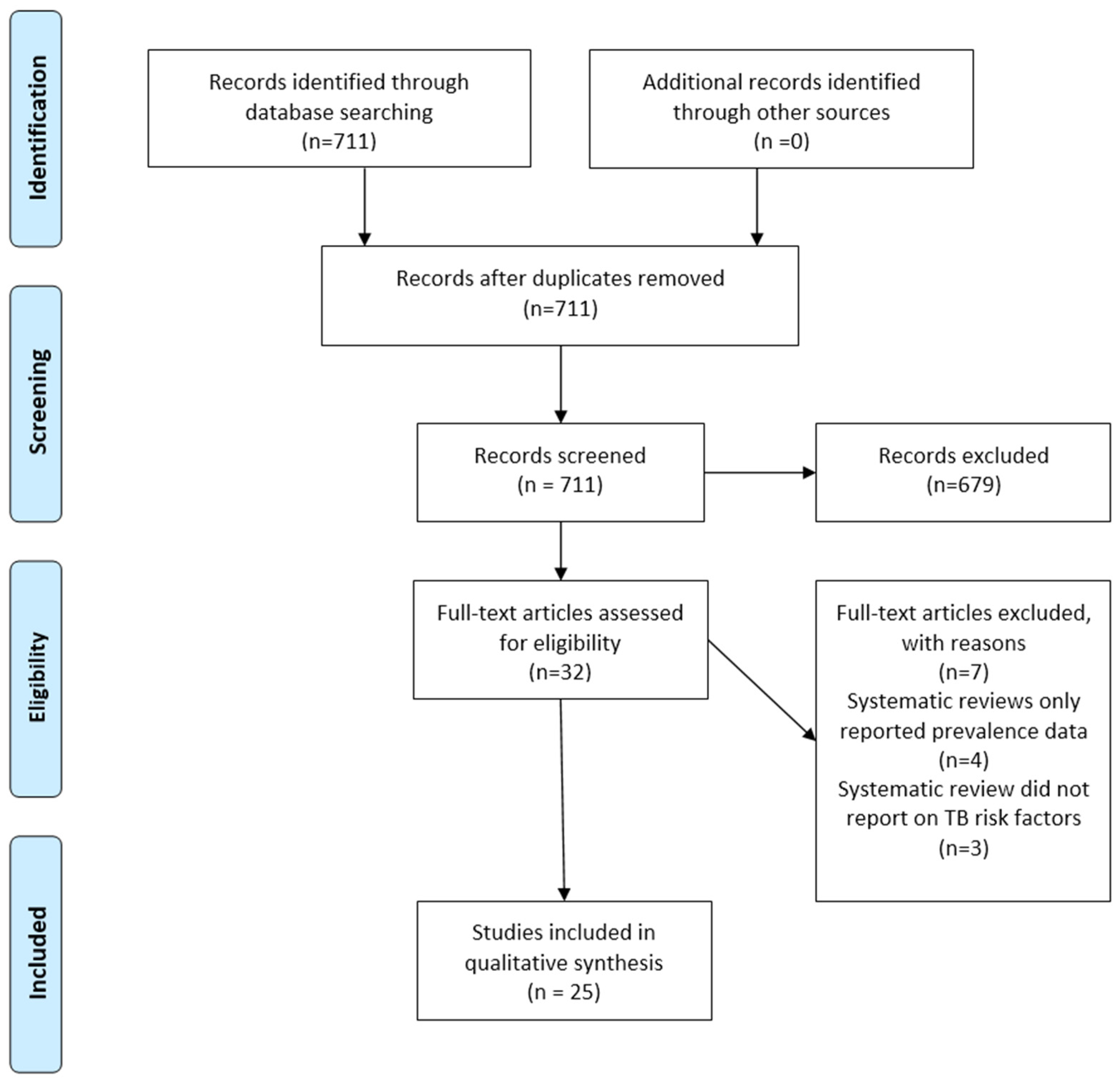
A general literature search identified DM, CKD, tumour necrosis factor-alpha (TNF-α) mediated diseases, malnutrition, and COPD, as potential risk factors for TBI progression, for which relevant systematic reviews were retrieved. Additionally, behavioural risk factors, including tobacco use, drug use, and alcohol consumption, were explored, with systematic reviews available for tobacco and alcohol use. Out of a total of 711 systematic reviews identified, 25 were retained (see Figure 1 for the PRISMA flow diagram and Table 1. for the Systematic Review Characteristics). To facilitate comparison across conditions, we provide a structured comparative synthesis of key risk factors, including approximate ranges of reported associations, consistency across reviews [Yes/No/Not Applicable (NA, if only one review)], and potential programmatic implications (Table 2).
Figure 1.
PRISMA Flow Diagram.
Table 1.
Systematic review characteristics included in the current scoping review.
Table 2.
Comparative synthesis of range of association, consistency across systematic review and potential programmatic implications of medical and behavioural determinants of Progression from TB Infection to TB Disease.
3.2. Medical Risk Factors
3.2.1. Diabetes Mellitus
The precise mechanisms linking diabetes mellitus (DM) and increased susceptibility to TB are not fully elucidated; however, chronic hyperglycaemia has been associated with impaired immune cell function and reduced host defence capacity, potentially increasing the risk of TB disease [45].
Four systematic reviews confirm this link, with risk varying by level of glycaemic control, study design, and regional TB burden.
Al-Rifai et al. (2017) [20] reported a significant association between DM and TB disease, systematically reviewing 44 studies involving 58,468,404 participants across 16 countries. The pooled adjusted risk of TB disease was highest in prospective studies (3.59-fold; 95% CI: 2.25–5.73), followed by case–control studies (2.09-fold; 95% CI: 1.71–2.55), and lowest in retrospective studies (1.55-fold; 95% CI: 1.39–1.72). The association was more pronounced in LMICs (3.16-fold vs. 1.73-fold in HICs), particularly in regions with high TB incidence (>50 cases per 100,000 person-years). Similarly, Hayashi et al. (2018) [21] reviewed 14 studies (22.6 million participants), finding that DM increases the risk of TB disease by 1.5 times (95% CI: 1.28–1.76), with greater risk in those with poor glycaemic control.
Foe-Essomba et al. (2021) [22] further analysed 47 observational studies involving 503,760 cases and 3,596,845 controls to evaluate the association between DM and TB, while accounting for a broader range of confounders, including age, gender, alcohol use, smoking, and comorbidities. The pooled analysis found that DM was associated with a significantly increased risk of TB (OR: 2.3, 95% CI: 2.0–2.7). Sensitivity analyses demonstrated that the DM-TB association remained robust even when studies with balanced confounder distributions were included. Jeon et al. (2022) [23] reinforced these findings, showing a RR of 3.11 (95% CI: 2.27–4.26) for TB in people with DM across 13 studies, emphasising regional disparities and the need for targeted TB interventions among people with DM, with subgroup analysis revealing stronger associations outside of North America.
3.2.2. Malnutrition, Vitamin D Deficiency and Anaemia
Malnutrition, particularly prevalent in LMICs with high TB rates, weakens host immune responses, including cell-mediated immunity, and may impair the body’s ability to contain TB infection, thereby increasing the likelihood of progression to TB disease.
Three systematic reviews examined the impact of malnutrition on TB risk.
Franco et al. (2024) [24] reviewed 51 cohort studies with over 27 million participants to evaluate the role of undernutrition in increasing the risk of TB. The analysis showed that undernutrition doubled the risk of TB in the short term (hazard ratio [HR]: 2.23; 95% CI: 1.83–2.72). For follow-ups under 10 years, the risk remained consistent (HR 2.02, 95% CI: 1.74–2.34), while at 10+ years, the risk surged (HR 12.43, 95% CI: 5.74–26.91) [24]. In a meta-analysis (3544 participants), Aibana et al. (2019) [25] further showed that vitamin D deficiency increased TB risk (aOR 1.48, 95% CI 1.04–2.10, p = 0.03), with severe deficiency showing a stronger trend. Among 1576 HIV-positive individuals, vitamin D deficiency doubled TB risk (aOR 2.18, 95% CI 1.22–3.90). Results suggest a dose-dependent TB risk, especially in HIV-positive individuals. Furthermore, Gelaw et al. (2021) [26] in a systematic review and meta-analysis of 17 studies (n = 215,294) found that anaemia significantly increased the risk of TB disease. Anaemic individuals had higher odds (OR 3.56, 95% CI: 2.53–5.01) and hazard ratios (HR 2.01, 95% CI: 1.70–2.37) of developing TB compared to non-anaemic individuals, with risk rising with anaemia severity.
3.2.3. Cancer
Cancer is associated with immunosuppression, caused by the malignancy itself or its treatment, increasing the risk of bacterial infections such as TB.
Two systematic reviews suggested this association.
Cheng et al. (2016) [27] explored TB incidence in 324,041 cancer patients through a meta-analysis of 23 studies. The highest TB incidence was observed in patients with hematologic cancers (219 per 100,000), head and neck cancers (143 per 100,000), and lung cancers (83 per 100,000), with corresponding incidence rate ratios (IRRs) of 26, 16, and 9, respectively. In contrast, patients with breast and other solid cancers had the lowest incidence (38 per 100,000; IRR = 4). Dobler et al. (2017) [28] analysed 13 studies with 921,464 cancer patients to assess the risk of TB in this population. Comparing incidence rates of TB rather than cumulative incidence or prevalence, the study found that the incidence rate ratio (IRR) for TB in cancer patients was 2.61 (95% CI: 2.12–3.22). The IRR was also higher in patients with haematological cancers (3.53, 95% CI: 1.63–7.64) compared to those with solid cancers (2.25, 95% CI: 1.96–2.58). Notably, children with either haematological or solid cancers had the highest IRR (16.82, 95% CI: 8.81–32.12).
3.2.4. Chronic Kidney Disease (CKD)
Due to impaired immunity, people with CKD are at increased risk of infections [46]. Two systematic reviews assess this association.
Luczynski et al. (2023) [29] evaluated the TB risk in individuals with CKD stages 3–5, excluding those with kidney failure or undergoing kidney replacement therapy. The analysis of five observational studies revealed a 57% increased risk of TB in CKD patients compared to those without CKD (adjusted HR: 1.57, 95% CI: 1.22–2.03). Advanced CKD stages (4–5) were associated with the highest TB risk, showing a 3.63-fold increased IRR (95% CI: 2.25–5.86). Furthermore, Al Efraji et al. (2015) [30] identified a significantly higher risk of TB disease in end-stage renal disease patients, with dialysis patients having a 3.62-fold increased risk (95% CI: 1.79–7.33) and renal transplant recipients within end-stage renal disease populations having an 11.35-fold increased risk compared to the general population (unadjusted risk ratio: 11.35; 95% CI: 2.97–43.41). The review reported these estimates according to renal replacement therapy modality, but did not further analyze the mechanisms underlying the higher risk observed in transplant recipients.
3.2.5. Tumor Necrosis Factor-Alpha (TNF-α) Inhibitors
TNF-α is crucial for containing M. tuberculosis infection by maintaining granuloma integrity and mediating host defences. However, TNF-α inhibitors, used to treat conditions like multiple sclerosis (MS), rheumatoid arthritis (RA), inflammatory bowel disease (IBD), and Systemic Lupus Erythematosus (SLE), impair granuloma formation [47], increasing the risk of progression from TBI to TB disease.
Six systematic reviews suggested an association between TNF-α inhibitors and an increased risk of TB across various immune-mediated diseases.
Wu et al. (2022) [31] reviewed 35 studies on 46,327 SLE patients, finding a non-significant increase in TB incidence of 1.16 per 100 person-years (95% CI: 0.69–1.93). Higher TB risk was observed in Africa (p < 0.01), high TB-burden areas (p = 0.03), and among those on ≥20 mg daily glucocorticoids, highlighting the need for targeted TB screening and prevention in at-risk populations (p = 0.04). Pego-Reigoso et al. (2021) [32] assessed 11 cohort studies to determine infection risks in SLE patients. The pooled RR for TB in SLE patients was significantly increased compared to the general population/healthy controls (RR 6.11; 95% CI 3.61–10.33), with sensitivity analyses confirming the robustness of the findings, emphasising the need for targeted TB prevention strategies in SLE populations.
For MS, Dantas et al. (2021) [33] reviewed 14 studies on MS treatments and TBI reactivation, finding that immunosuppressive therapies, especially disease-modifying therapies and biologics, significantly increase the risk. Most studies recommended pre-treatment TB screening for people with MS, particularly in high-burden areas, highlighting the need for improved screening protocols for at-risk populations. Souto et al. (2014) [34], who further reviewed 100 RCTs (75,000 patients) and 63 long term extension studies (>80,000 patient-years), assessed TB risk in immune-mediated inflammatory disease patients treated with biologics and tofacitinib. TNF-α inhibitors were linked to 31 people with TB, with a non-significant OR of 1.92 (95% CI: 0.91–4.03) in RCTs. Long term extension studies reported that TB risk was highest with TNF monoclonal antibodies in those with RA (RR: 307.71 per 100,000; 95% CI: 184.79–454.93), and this was strongly influenced by regional TB prevalence. Similarly, Ai et al. (2015) [35] reviewed 50 RCTs and 13 cohort studies and found that TNF-α antagonists significantly increased TB risk in those with RA (RR 4.03, 95% CI 2.36–6.88).
Combination therapy carried a higher risk compared with monotherapy, though anti-TNF monotherapy also showed increased TB risk. Similarly, Zhang et al. (2017) [36] assessed the risk of TB in patients receiving TNF-α antagonists among the 7912 patients treated with TNF-α antagonists, yielding an overall OR of 1.94 (95% CI: 1.10–3.44, p = 0.02). Subgroup analysis revealed that patients with RA had an even higher risk when treated with TNF-α antagonists (OR: 2.29, 95% CI: 1.09–4.78, p = 0.03) and 0.57% of patients on TNF-α antagonists developed TB, compared to 0.08% in control groups (OR = 1.94, 95% CI: 1.10–3.44, p = 0.02).
3.2.6. Chronic Obstructive Pulmonary Disease (COPD)
Chronic respiratory diseases, such as COPD, also increase TB risk due to impaired lung function and heightened susceptibility to infections. Inhaled corticosteroids (ICS), central to asthma management and severe COPD management, control inflammation but suppress immunity, thereby further increasing infection risk [48].
Two systematic reviews suggested an association between COPD and increased TB risk, particularly with ICS use.
Dong et al. (2014) [37] analysed 25 RCTs with 22,898 persons with COPD for TB risk and 23,616 for influenza, finding that ICS use doubled the risk of TB (Peto OR: 2.29; 95% CI: 1.04–5.03), with higher risk in TB-endemic regions. Similarly, Castellana et al. (2019) [38] reviewed nine studies with 36,351 ICS users and 147,171 non-users, showing a 46% increased TB risk with ICS use (OR: 1.46, 95% CI: 1.06–2.01, p = 0.02), particularly in current users. The risk was even higher in those not using oral corticosteroids (OR: 1.63, 95% CI: 1.05–2.52, p = 0.03).
3.3. Behavioural Risk Factors
Behaviours such as smoking and alcohol consumption are critical modifiable risk factors that influence TB progression. Smoking may impair mucociliary clearance and alter host immune responses, while alcohol consumption may be associated with immune dysregulation and increased susceptibility to infections [49].
Six systematic reviews have highlighted the significant role of smoking (4) and alcohol (2) in increasing TB risk.
Bates et al. (2007) [39] analysed 24 epidemiologic studies, finding that active smoking significantly increased TB risk (RR 2.33–2.66), while Slama et al. (2007) [40] reviewing 42 studies found strong evidence linking smoking to TB and moderate evidence for second-hand smoke exposure. Dogar et al. (2015) [41] examined 12 studies on second-hand smoke exposure in non-smokers, reporting a higher TB risk (RR 1.59, 95% CI: 1.11–2.27), with variability due to differing diagnostic criteria. In children, Patra et al. (2015) [42] showed that second-hand smoke exposure increased the risk of TB disease, with children having a more than three-fold higher risk (RR 3.41, 95% CI 1.81–6.45), compared to a smaller increase in adults (RR 1.32, 95% CI 1.04–1.68). Strong adjusted exposure-response relationships were seen in young children, those exposed through any parent, and those in crowded households.
Alcohol consumption has been shown to increase TB risk. Lönnroth et al. (2008) [43] reviewed 21 observational studies, finding that alcohol consumption of ≥40 g per day or an alcohol use disorder increased the risk of TB disease (RR 2.94, 95% CI: 1.89–4.59), likely due to immune suppression and higher exposure risk linked to alcohol-related behaviours. Similarly, Simou et al. (2018) [44] reviewed 49 studies, showing that alcohol consumption, even at low levels, raised TB risk (OR 1.90, 95% CI: 1.63–2.23). Further sensitivity and hazard ratio analyses confirmed a slightly lower but still elevated risk, with a 12% increase in TB risk per 10–20 g of daily alcohol intake.
4. Discussion
4.1. Summary of Results
This scoping review identified multiple medical and behavioural determinants associated with progression from TB infection to TB disease. Rather than acting in isolation, these conditions form a heterogeneous but patterned landscape of risk, with substantial variation in the magnitude of association across exposures.
Across conditions, the magnitude of association varied considerably. The highest relative risks were observed among transplant recipients, patients receiving TNF-α inhibitors, and individuals with haematological malignancies. Moderate but consistently elevated risks were seen in people with diabetes, CKD, and undernutrition. Behavioural determinants such as smoking and alcohol use showed more moderate relative risks but have substantial population-level impact due to their high prevalence. Importantly, while some conditions confer high individual-level risk, others such as diabetes and undernutrition contribute more significantly at the population level because of their widespread distribution. This distinction is critical for prioritizing TB screening and preventive strategies in different epidemiological settings.
Several cross-cutting themes emerge from this synthesis. Many of the identified conditions are characterised by some degree of immune dysregulation or immunosuppression, whether related to metabolic dysfunction, micronutrient deficiency, malignancy, organ failure, or therapeutic immune modulation. Although the included systematic reviews primarily reported epidemiological associations rather than detailed mechanistic pathways, impaired host immune responses—particularly affecting cell-mediated immunity and the maintenance of granuloma integrity—appear to represent a common underlying pathway across several conditions.
Contextual variation was also evident. Stronger associations were frequently reported in low- and middle-income countries, likely reflecting a higher background TB burden, differences in healthcare access, comorbidity patterns, and broader socioeconomic determinants. Finally, no systematic review specifically addressing risk factors for asymptomatic TB progression was identified, highlighting an important gap in the current evidence base.
4.2. Public Health Impact
4.2.1. Diabetes and Contextual Heterogeneity
The public health impact of the synergistic interactions is vast with the global DM burden in LMICs projected to increase substantially, driven by aging populations and the rising prevalence of obesity and tobacco use [50]. The stronger associations observed in LMICs compared with HICs may reflect several contextual factors. Higher background TB incidence increases the probability of exposure and progression among people with diabetes. In addition, differences in glycaemic control, delayed diagnosis, limited access to integrated diabetes and TB care, and underdiagnosis of both conditions may amplify risk estimates in resource-constrained settings. Socioeconomic determinants, nutritional status, and coexisting infections may further modify the observed associations. These contextual differences underscore the importance of adapting TB screening and prevention strategies to local epidemiological conditions. Due to resource constraints, targeting all individuals with DM for TBI screening and treatment may not be feasible. Given the evidence suggesting that poorer glycaemic control is associated with higher TB risk, prioritizing TB preventive interventions among people with diabetes with suboptimal glycaemic control may be more feasible than targeting all individuals with diabetes in resource-constrained settings. The thresholds corresponding to standard diagnostic criteria for diabetes (fasting plasma glucose ≥ 126 mg/dL or HbA1c ≥ 6.5%) are used solely to define diabetes status and should not be interpreted as TB-specific risk thresholds. Further studies are needed to determine clinically meaningful glycaemic thresholds relevant for TB risk stratification.
4.2.2. Cancer and Immunosuppression
Current evidence indicates that people with cancer, particularly those with haematological, head and neck, or lung cancers, have a significantly elevated risk of developing TB disease due to the immunosuppressive effects of both the malignancy itself and its treatments. Among these groups, children with haematological malignancies or solid tumours in high TB incidence settings are at the highest risk and may benefit from systematic TBI screening. In adults with cancer, TB risk appears to be highest during periods of active immunosuppression, particularly in patients receiving intensive chemotherapy or other immunomodulatory treatments. However, the balance between benefits and risks of routine TBI screening in adults with solid tumours remains uncertain and may depend on background TB incidence, comorbidity profile, and individual risk factors. While concerns regarding hepatotoxicity from preventive therapy have historically influenced recommendations, the availability of shorter and better-tolerated regimens may modify future risk–benefit assessments. Screening strategies should therefore be risk-based and contextualised rather than based solely on cancer type or survivorship status.
4.2.3. Chronic Kidney Disease
While current WHO guidelines prioritise TB screening for patients on dialysis or those who have undergone kidney transplantation [51], emerging evidence suggests that earlier-stage CKD patients may also face an elevated TB risk. However, its magnitude relative to other high-risk groups remains unclear, underscoring the need to assess the feasibility and cost-effectiveness of broader screening. Expanding screening must be balanced against other priorities, and the current absence of clear risk thresholds for CKD progression and TB reactivation raises concerns about overtreatment, nephrotoxicity, and missed prevention opportunities.
4.2.4. Therapeutic Immunosuppression and COPD
Furthermore, the growing use of TNF-α inhibitors in autoimmune diseases and ICS in COPD as risk factors for TB reactivation, particularly when combined with other immunosuppressive treatments, is a cause for concern. This calls for more rigorous monitoring for TB in these populations in higher TB-burden settings. These findings also underscore the need for cost-effectiveness analyses to guide TBI screening before starting TNF-α inhibitors, particularly in regions with high TB prevalence and among migrants from these endemic settings.
4.2.5. Malnutrition and Micronutrient Deficiencies
Moreover, malnutrition, especially undernutrition, accelerates progression from TBI to TB disease, a major concern in LMICs where it coexists with rising NCD burdens like DM and CKD. Therefore, integrating nutritional support into TB prevention strategies for individuals with TBI and comorbid NCDs is crucial. Emerging evidence highlights the dose-dependent role of iron deficiency and vitamin D deficiency in increasing TB risk, particularly in HIV-positive individuals, emphasising the need for nutritional screening and deficiency management, in TB prevention for those with TBI and comorbid NCDs.
4.2.6. Smoking and Multimorbidity
Smoking not only increases the risk of TB, but is also linked to the development of CKD [42,52], DM [53], COPD [54], and autoimmune diseases [55]. These conditions interact synergistically, exacerbating the risk of TB progression, particularly in an HIV-infected population. This quadripartite relationship between smoking, chronic diseases, HIV infection and TB highlights the need to design a multi-sectoral approach, combining targeted prevention efforts, particularly in regions with a high dual burden of TB and HIV, as well as among immigrant populations in HICs from high TB-prevalence countries in LMICs.
4.3. Research Gaps
Optimising TB prevention requires cost-effectiveness studies to define immunosuppression thresholds, HbA1c levels, and CKD stages warranting intervention, particularly in high TB-burden regions with limited DM and CKD care.
There is a need for well-designed, large-scale RCTs to assess the efficacy and optimal dosage of vitamin D supplementation in reducing TB risk, particularly among high-risk populations, including those with HIV and comorbid NCD populations.
No systematic reviews to date have examined risk factors specific to asymptomatic TB. This lack of evidence limits the ability to identify high-risk populations and hinders the development of targeted screening strategies beyond symptom-based approaches. As a result, many infectious but asymptomatic individuals remain detected, sustaining transmission in the community and undermining TB control efforts.
In LMICs, further research is needed to quantify TB risk in individuals with early-stage CKD and identify key stages of heightened TB susceptibility. Similarly, the immunosuppressive effects of malignancies and their treatments, especially in haematological cancers, require further investigation to determine thresholds for TB reactivation risk: this is especially important in LMICs with rising cancer rates and higher HIV burdens. This also applies to TNF-mediated inflammatory diseases.
High-quality, large-scale studies are essential to assess the role of undernutrition in TB and inform strategies for integrating nutritional support into TB control programmes for better prevention.
Advanced analytical approaches, including machine learning and mathematical modelling, may help address several of the evidence gaps identified in this review. In particular, these methods could be used to model joint risk profiles, explore interaction effects among coexisting exposures (e.g., diabetes, smoking, HIV), and improve individual-level risk stratification in settings with complex multimorbidity patterns. Predictive modelling approaches may also support the identification of individuals at risk of asymptomatic or subclinical TB, thereby informing more targeted screening strategies. However, such approaches require high-quality longitudinal data and careful validation to avoid bias and overfitting.
Most included systematic reviews evaluated single exposures in isolation, and few formally assessed combined or interaction effects between risk factors. Evidence on additive or multiplicative risks—for example, the combined impact of diabetes and HIV, smoking and chronic kidney disease, or immunosuppressive therapy in metabolically compromised individuals—remains limited. Given that patients in real-world settings frequently present with multiple overlapping conditions, understanding synergistic effects is essential. Future research should prioritise studies examining multi-morbidity and interaction modelling to better inform risk stratification and screening thresholds.
An additional gap identified in this review concerns the limited reporting of dose–response relationships for behavioural risk factors. The included systematic reviews on smoking did not consistently quantify exposure intensity (e.g., pack-years or cigarettes per day), and dose–response analyses were not systematically performed. Similar concerns apply to alcohol use. Standardised reporting of exposure intensity would strengthen risk stratification and help refine screening and prevention strategies.
Importantly, no systematic review specifically addressing risk factors for asymptomatic or subclinical TB progression was identified. This is a major evidence gap, particularly as national TB prevalence surveys and community-based screening activities have repeatedly shown that a substantial proportion of bacteriologically confirmed TB can be detected in individuals without typical symptoms at the time of screening. Reliance on symptom-based algorithms alone may therefore miss a meaningful fraction of infectious TB, delaying diagnosis and allowing ongoing community transmission. As TB programmes increasingly adopt screening approaches that go beyond symptoms (e.g., systematic screening in high-risk groups, use of radiography and rapid diagnostics), the absence of evidence on determinants of asymptomatic progression limits the ability to optimise targeting, design risk-based algorithms, and allocate resources efficiently. Future research should prioritise prospective cohorts and dedicated evidence syntheses to characterise risk profiles for asymptomatic/subclinical TB and to inform screening strategies aligned with evolving WHO recommendations.
4.4. Strengths and Limitations
The inclusion of only systematic reviews enhances the robustness of the results, and the absence of language restrictions broadens the scope and inclusivity of the evidence base. However, a limitation may be that by focusing exclusively on systematic reviews, we may have failed to capture emerging evidence on other comorbidities. At the evidence level, systematic reviews on DM lacked representation from Sub-Saharan Africa, making the findings less easy to extrapolate. Studies on malnutrition often lacked consistent long-term follow-up, while cancer-related research was limited to high-income, low-TB-prevalence settings. CKD and autoimmune disease studies lacked standardised screening protocols, with TB risk estimates varying by disease and region. Furthermore, most studies in the reviews were observational, limiting causal associations between behavioural risk factors, NCDs, and TB. In addition, variability in controlling key confounders, such as hospitalization and immigration status, may have led to residual confounding and biased estimates.
A conceptual limitation relates to the fact that most included systematic reviews reported risk or incidence of active TB without distinguishing between progression from pre-existing TB infection, reactivation, or reinfection. As this scoping review synthesised evidence as defined and reported in the included reviews, it was not possible to systematically distinguish between progression, reactivation, and reinfection mechanisms underlying incident TB cases. This may introduce conceptual imprecision, particularly in high-transmission settings where reinfection may contribute to disease occurrence.
Finally, this scoping review relied on PubMed as the primary database, which may have resulted in the omission of relevant systematic reviews indexed exclusively in other databases, particularly those covering environmental or social science literature.
5. Conclusions
The convergence of TB with CKD, DM, COPD, autoimmune diseases, and cancer presents a public health challenge, particularly in LMICs with moderate to high TB burdens and overlapping prevalence of HIV infection. This challenge is also compounded through the use of immunosuppressive treatments, such as TNF-α inhibitors and corticosteroids, which increase the risk of TB reactivation. Evidence links TB risk to NCDs, smoking, and alcohol use, but more data and cost-effectiveness studies across diverse TB burden settings are needed for refinement. Until then, clinicians should maintain a high index of suspicion for TB, particularly in vulnerable groups like those in LMICs and migrants from high-burden areas, while weighing the associated risks of hepatotoxicity and nephrotoxicity with TB preventive treatment. Malnutrition, particularly undernutrition, accelerates TBI progression to TB disease, highlighting the need for integrated nutritional support, including iron and vitamin D supplementation, in TB prevention among individuals with comorbid NCDs, and HIV infection.
Moreover, strengthening behavioural interventions, such as smoking cessation and alcohol use prevention programs, is crucial especially in high-risk populations. Importantly, the absence of robust evidence on risk factors for asymptomatic TB further limits early detection, allowing ongoing community transmission. To meet WHO’s TB End TB strategy by 2035, a multidisciplinary approach for public health interventions is vital for addressing the quadruple burden of TB, NCDs, malnutrition, and HIV and ultimately global health.
Supplementary Materials
The following supporting information can be downloaded at: https://www.mdpi.com/article/10.3390/tropicalmed11040094/s1, Table S1: Preferred Reporting Items for Systematic reviews and Meta-Analyses extension for Scoping Reviews (PRISMA-ScR) Checklist—From Infection to Disease: The Role of Medical and Behavioural Determinants of Progression from TB Infection to TB Disease.
Author Contributions
Conceptualization, S.M. and K.G.K.; data curation, S.M. and K.G.K.; formal analysis, S.M. and K.G.K.; funding acquisition, K.G.K.; investigation, S.M. and K.G.K.; methodology, S.M., A.D.H., R.A.D., G.B., M.F.D., O.B.M., P.S., Y.L., J.J., A.N.S., A.S., B.K. and K.G.K.; project administration, K.G.K.; software, S.M. and K.G.K.; supervision, K.G.K.; validation, S.M., A.D.H., R.A.D., G.B., M.F.D., O.B.M., P.S., Y.L., J.J., A.N.S., A.S., B.K. and K.G.K.; visualization, S.M., A.D.H., R.A.D., G.B., M.F.D., O.B.M., P.S., Y.L., J.J., A.N.S., A.S., B.K. and K.G.K.; writing—original draft, S.M. and K.G.K.; writing—review and editing, S.M., A.D.H., R.A.D., G.B., M.F.D., O.B.M., P.S., Y.L., J.J., A.N.S., A.S., B.K. and K.G.K. All authors have read and agreed to the published version of the manuscript.
Funding
This research was funded by The Agence Française de Développement (AFD) Group funds, grant number CZZ2579 01 L, Paris, France.
Institutional Review Board Statement
As this study is a literature review and no individual data was collected, formal ethics approval was deemed not to be necessary.
Informed Consent Statement
Not applicable. The study did not involve humans.
Data Availability Statement
The data that support the findings of the study are available from one of the first authors (K.G.K.) upon reasonable request.
Conflicts of Interest
The authors declare no conflicts of interest.
References
- World Health Organization (WHO). Global Tuberculosis Report 2025; World Health Organization: Geneva, Switzerland, 2025; Available online: https://www.who.int/teams/global-tuberculosis-programme/tb-reports (accessed on 26 February 2026).
- Koura, K.G.; Harries, A.D. The Trend of Tuberculosis Case Notification Rates from 1995 to 2022 by Country Income and World Health Organization Region. Trop. Med. Infect. Dis. 2024, 9, 294. [Google Scholar] [CrossRef] [Scilit] [PubMed]
- Cohen, A.; Mathiasen, V.D.; Schön, T.; Wejse, C. The global prevalence of latent tuberculosis: A systematic review and meta-analysis. Eur. Respir. J. 2019, 54, 1900655. [Google Scholar] [CrossRef] [Scilit] [PubMed]
- Asokan, S. Immune issues in elderly with TB. Indian J. Tuberc. 2022, 69, S241–S245. [Google Scholar] [CrossRef] [Scilit] [PubMed]
- Aravindan, P.P. Host genetics and tuberculosis: Theory of genetic polymorphism and tuberculosis. Lung India 2019, 36, 244–252. [Google Scholar]
- Sultana, Z.Z.; Hoque, F.U.; Beyene, J.; Akhlak-Ul-Islam, M.; Khan, M.H.R.; Ahmed, S.; Hawlader, D.H.; Hossain, A. HIV infection and multidrug resistant tuberculosis: A systematic review and meta-analysis. BMC Infect. Dis. 2021, 21, 51. [Google Scholar]
- Menzies, N.A.; Swartwood, N.; Testa, C.; Malyuta, Y.; Hill, A.N.; Marks, S.M.; Cohen, T.; Salomon, J.A. Time Since Infection and Risks of Future Disease for Individuals with Mycobacterium tuberculosis Infection in the United States. Epidemiology 2021, 32, 70–78. [Google Scholar] [CrossRef] [Scilit]
- Frascella, B.; Richards, A.S.; Sossen, B.; Emery, J.C.; Odone, A.; Law, I.; Onozaki, I.; Esmail, H.; Houben, R.M.G.J. Subclinical Tuberculosis Disease—A Review and Analysis of Prevalence Surveys to Inform Definitions, Burden, Associations, and Screening Methodology. Clin. Infect. Dis. 2020, 73, e830–e841. [Google Scholar] [CrossRef] [Scilit]
- Teo, A.K.J.; MacLean, E.L.-H.; Fox, G.J. Subclinical tuberculosis: A meta-analysis of prevalence and scoping review of definitions, prevalence and clinical characteristics. Eur. Respir. Rev. 2024, 33, 230208. [Google Scholar] [CrossRef] [Scilit]
- Creswell, J.; Raviglione, M.; Ottmani, S.; Migliori, G.B.; Uplekar, M.; Blanc, L.; Sotgiu, G.; Lönnroth, K. Tuberculosis and noncommunicable diseases: Neglected links and missed opportunities. Eur. Respir. J. 2011, 37, 1269–1282. [Google Scholar] [CrossRef] [Scilit]
- Ong, K.L.; Stafford, L.K.; McLaughlin, S.A.; Boyko, E.J.; Vollset, S.E.; Smith, A.E.; Dalton, B.E.; Duprey, J.; Cruz, J.A.; Hagins, H.; et al. Global, regional, and national burden of diabetes from 1990 to 2021, with projections of prevalence to 2050: A systematic analysis for the Global Burden of Disease Study 2021. Lancet 2023, 402, 203–234. [Google Scholar] [CrossRef] [Scilit]
- Chan, J.C.N.; Lim, L.L.; Wareham, N.J.; Shaw, J.E.; Orchard, T.J.; Zhang, P.; Lau, E.S.H.; Eliasson, B.; Kong, A.P.S.; Ezzati, M.; et al. The Lancet Commission on diabetes: Using data to transform diabetes care and patient lives. Lancet 2021, 396, 2019–2082. [Google Scholar] [CrossRef] [Scilit] [PubMed]
- Pramesh, C.S.; Badwe, R.A.; Bhoo-Pathy, N.; Booth, C.M.; Chinnaswamy, G.; Dare, A.J.; de Andrade, V.P.; Hunter, D.J.; Gopal, S.; Gospodarowicz, M.; et al. Priorities for cancer research in low- and middle-income countries: A global perspective. Nat. Med. 2022, 28, 649–657. [Google Scholar] [CrossRef] [Scilit] [PubMed]
- Rovin, B.H.; Ayoub, I.M.; Chan, T.M.; Liu, Z.-H.; Mejía-Vilet, J.M.; Floege, J. KDIGO 2024 Clinical Practice Guideline for the management of LUPUS NEPHRITIS. Kidney Int. 2024, 105, S1–S69. [Google Scholar] [CrossRef] [Scilit]
- López, D.S.; Hernández Vargas, J.A.; Urina-Jassir, M.; Urina-Triana, M.; Franco, O.H. Reducing the gap of chronic kidney disease in low- and middle-income countries: What is missing? Lancet Reg. Health Am. 2023, 28, 100625. [Google Scholar] [CrossRef] [Scilit] [PubMed]
- Boers, E.; Barrett, M.; Su, J.G.; Benjafield, A.V.; Sinha, S.; Kaye, L.; Zar, H.J.; Vuong, V.; Tellez, D.; Gondalia, R.; et al. Global Burden of Chronic Obstructive Pulmonary Disease Through 2050. JAMA Netw. Open 2023, 6, e2346598. [Google Scholar] [CrossRef] [Scilit]
- Pollock, D.; Evans, C.; Jia, R.M.; Alexander, L.; Pieper, D.; de Moraes, É.B.; Peters, M.D.; Tricco, A.C.; Khalil, H.; Godfrey, C.M.; et al. “How-to”: Scoping review? J. Clin. Epidemiol. 2024, 176, 111572. [Google Scholar] [CrossRef] [Scilit]
- Tricco, A.C.; Lillie, E.; Zarin, W.; O’Brien, K.K.; Colquhoun, H.; Levac, D.; Moher, D.; Peters, M.D.; Horsley, T.; Weeks, L. PRISMA extension for scoping reviews (PRISMA-ScR): Checklist and explanation. Ann. Intern. Med. 2018, 169, 467–473. [Google Scholar] [CrossRef] [Scilit]
- Stop TB Partnership. Words Matter: Suggested Language and Usage for Tuberculosis Communications. 2022. Available online: https://www.stoptb.org/words-matter-language-guide (accessed on 13 June 2025).
- Al-Rifai, R.H.; Pearson, F.; Critchley, J.A.; Abu-Raddad, L.J. Association between diabetes mellitus and active tuberculosis: A systematic review and meta-analysis. PLoS ONE 2017, 12, e0187967. [Google Scholar] [CrossRef] [Scilit]
- Hayashi, S.; Chandramohan, D. Risk of active tuberculosis among people with diabetes mellitus: Systematic review and meta-analysis. Trop. Med. Int. Health 2018, 23, 1058–1070. [Google Scholar] [CrossRef] [Scilit]
- Foe-Essomba, J.R.; Kenmoe, S.; Tchatchouang, S.; Ebogo-Belobo, J.T.; Mbaga, D.S.; Kengne-Ndé, C.; Mahamat, G.; Kame-Ngasse, G.I.; Noura, E.A.; Mbongue Mikangue, C.A.; et al. Diabetes mellitus and tuberculosis, a systematic review and meta-analysis with sensitivity analysis for studies comparable for confounders. PLoS ONE 2021, 16, e0261246. [Google Scholar] [CrossRef] [Scilit]
- Jeon, C.Y.; Murray, M.B. Diabetes mellitus increases the risk of active tuberculosis: A systematic review of 13 observational studies. PLoS Med. 2008, 5, e152. [Google Scholar]
- Franco, J.V.A.; Bongaerts, B.; Metzendorf, M.I.; Risso, A.; Guo, Y.; Peña Silva, L.; Boeckmann, M.; Schlesinger, S.; Damen, J.; Richter, B.; et al. Undernutrition as a risk factor for tuberculosis disease. Cochrane Database Syst. Rev. 2024, 6, CD015890. [Google Scholar] [CrossRef] [Scilit] [PubMed] [PubMed Central]
- Aibana, O.; Huang, C.C.; Aboud, S.; Arnedo-Pena, A.; Becerra, M.C.; Bellido-Blasco, J.B.; Bhosale, R.; Calderon, R.; Chiang, S.; Contreras, C.; et al. Vitamin D status and risk of incident tuberculosis disease: A nested case-control study, systematic review, and individual-participant data meta-analysis. PLoS Med. 2019, 16, e1002907. [Google Scholar] [CrossRef] [Scilit] [PubMed]
- Gelaw, Y.; Getaneh, Z.; Melku, M. Anemia as a risk factor for tuberculosis: A systematic review and meta-analysis. Environ. Health Prev. Med. 2021, 26, 13. [Google Scholar] [CrossRef] [Scilit] [PubMed]
- Cheng, M.P.; Chakra, C.N.A.; Yansouni, C.P.; Cnossen, S.; Shrier, I.; Menzies, D.; Greenaway, C. Risk of Active Tuberculosis in Patients with Cancer: A Systematic Review and Metaanalysis. Clin. Infect. Dis. 2016, 64, 635–644. [Google Scholar] [CrossRef] [Scilit]
- Dobler, C.C.; Cheung, K.; Nguyen, J.; Martin, A. Risk of tuberculosis in patients with solid cancers and haematological malignancies: A systematic review and meta-analysis. Eur. Respir. J. 2017, 50, 1700157. [Google Scholar] [CrossRef] [Scilit]
- Luczynski, P.; Holmes, T.; Romanowski, K.; Arbiv, O.A.; Cook, V.J.; Clark, E.G.; Johnston, J.C. Risk of Tuberculosis Disease in People with Chronic Kidney Disease Without Kidney Failure: A Systematic Review and Meta-analysis. Clin. Infect. Dis. 2023, 77, 1194–1200. [Google Scholar] [CrossRef] [Scilit]
- Al-Efraij, K.; Mota, L.; Lunny, C.; Schachter, M.; Cook, V.; Johnston, J. Risk of active tuberculosis in chronic kidney disease: A systematic review and meta-analysis. Int. J. Tuberc. Lung Dis. 2015, 19, 1493–1499. [Google Scholar] [CrossRef] [Scilit]
- Wu, Q.; Liu, Y.; Wang, W.; Zhang, Y.; Liu, K.; Chen, S.H.; Chen, B. Incidence and prevalence of tuberculosis in systemic lupus erythematosus patients: A systematic review and meta-analysis. Front. Immunol. 2022, 13, 938406. [Google Scholar] [CrossRef] [Scilit]
- Pego-Reigosa, J.M.; Nicholson, L.; Pooley, N.; Langham, S.; Embleton, N.; Marjenberg, Z.; Barut, V.; Desta, B.; Wang, X.; Langham, J.; et al. The risk of infections in adult patients with systemic lupus erythematosus: Systematic review and meta-analysis. Rheumatology 2021, 60, 60–72. [Google Scholar] [CrossRef] [Scilit]
- Dantas, L.A.; Pereira, M.S.; Gauza, A.M.; Schulz, M.E.B.; Silva, G.F.D.; Martin, M.E.M.; Medeiros Junior, W.L.G.; Gonçalves, M.V.M. Latent tuberculosis infection reactivation in patients with multiple sclerosis in use of disease-modifying therapies: A systematic review. Mult. Scler. Relat. Disord. 2021, 55, 103184. [Google Scholar] [CrossRef] [Scilit]
- Souto, A.; Maneiro, J.R.; Salgado, E.; Carmona, L.; Gomez-Reino, J.J. Risk of tuberculosis in patients with chronic immune-mediated inflammatory diseases treated with biologics and tofacitinib: A systematic review and meta-analysis of randomized controlled trials and long-term extension studies. Rheumatology 2014, 53, 1872–1885. [Google Scholar] [CrossRef] [Scilit] [PubMed]
- Ai, J.W.; Zhang, S.; Ruan, Q.L.; Yu, Y.Q.; Zhang, B.Y.; Liu, Q.H.; Zhang, W.H. The Risk of Tuberculosis in Patients with Rheumatoid Arthritis Treated with Tumor Necrosis Factor-α Antagonist. A Metaanalysis of Both Randomized Controlled Trials and Registry/Cohort Studies. J. Rheumatol. 2015, 42, 2229–2237. [Google Scholar] [CrossRef] [Scilit] [PubMed]
- Zhang, Z.; Fan, W.; Yang, G.; Xu, Z.; Wang, J.; Cheng, Q.; Yu, M. Risk of tuberculosis in patients treated with TNF-α antagonists: A systematic review and meta-analysis of randomised controlled trials. BMJ Open 2017, 7, e012567. [Google Scholar] [CrossRef] [Scilit] [PubMed]
- Dong, Y.H.; Chang, C.H.; Wu, F.L.; Shen, L.J.; Calverley, P.M.A.; Löfdahl, C.G.; Lai, M.S.; Mahler, D.A. Use of inhaled corticosteroids in patients with COPD and the risk of TB and influenza: A systematic review and meta-analysis of randomized controlled trials. a systematic review and meta-analysis of randomized controlled trials. Chest 2014, 145, 1286–1297. [Google Scholar] [CrossRef] [Scilit]
- Castellana, G.; Castellana, M.; Castellana, C.; Castellana, G.; Resta, E.; Carone, M.; Resta, O. Inhaled Corticosteroids and Risk of Tuberculosis in Patients with Obstructive Lung Diseases: A Systematic Review and Meta-Analysis of Non-randomized Studies. Int. J. Chronic Obstr. Pulm. Dis. 2019, 14, 2219–2227. [Google Scholar] [CrossRef] [Scilit]
- Bates, M.N.; Khalakdina, A.; Pai, M.; Chang, L.; Lessa, F.; Smith, K.R. Risk of Tuberculosis From Exposure to Tobacco Smoke: A Systematic Review and Meta-analysis. Arch. Intern. Med. 2007, 167, 335–342. [Google Scholar] [CrossRef] [Scilit]
- Slama, K.; Chiang, C.Y.; Enarson, D.A.; Hassmiller, K.; Fanning, A.; Gupta, P.; Ray, C. Tobacco and tuberculosis: A qualitative systematic review and meta-analysis. Int. J. Tuberc. Lung Dis. 2007, 11, 1049–1061. [Google Scholar]
- Dogar, O.F.; Pillai, N.; Safdar, N.; Shah, S.K.; Zahid, R.; Siddiqi, K. Second-hand smoke and the risk of tuberculosis: A systematic review and a meta-analysis. Epidemiol. Infect. 2015, 143, 3158–3172. [Google Scholar] [CrossRef] [Scilit]
- Patra, J.; Bhatia, M.; Suraweera, W.; Morris, S.K.; Patra, C.; Gupta, P.C.; Jha, P. Exposure to second-hand smoke and the risk of tuberculosis in children and adults: A systematic review and meta-analysis of 18 observational studies. PLoS Med. 2015, 12, e1001835. [Google Scholar] [CrossRef] [Scilit]
- Lönnroth, K.; Williams, B.G.; Stadlin, S.; Jaramillo, E.; Dye, C. Alcohol use as a risk factor for tuberculosis—A systematic review. BMC Public Health 2008, 8, 289. [Google Scholar] [CrossRef] [Scilit]
- Simou, E.; Britton, J.; Leonardi-Bee, J. Alcohol consumption and risk of tuberculosis: A systematic review and meta-analysis. Int. J. Tuberc. Lung Dis. 2018, 22, 1277–1285. [Google Scholar] [CrossRef] [Scilit] [PubMed]
- Ssekamatte, P.; Sande, O.J.; van Crevel, R.; Biraro, I.A. Immunologic, metabolic and genetic impact of diabetes on tuberculosis susceptibility. Front. Immunol. 2023, 14, 1122255. [Google Scholar] [CrossRef] [Scilit] [PubMed]
- James, M.T.; Laupland, K.B.; Tonelli, M.; Manns, B.J.; Culleton, B.F.; Hemmelgarn, B.R. Risk of bloodstream infection in patients with chronic kidney disease not treated with dialysis. Arch. Intern. Med. 2008, 168, 2333–2339. [Google Scholar] [CrossRef] [Scilit] [PubMed]
- Silva, D.; Silva, M.V.D.; Barros, C.C.O.; Alexandre, P.B.D.; Timóteo, R.P.; Catarino, J.S.; Sales-Campos, H.; Machado, J.R.; Rodrigues, D.B.R.; Oliveira, C.J.; et al. TNF-α blockade impairs in vitro tuberculous granuloma formation and down modulate Th1, Th17 and Treg cytokines. PLoS ONE 2018, 13, e0194430. [Google Scholar] [CrossRef] [Scilit]
- Singh, D.; Agusti, A.; Anzueto, A.; Barnes, P.J.; Bourbeau, J.; Celli, B.R.; Criner, G.J.; Frith, P.; Halpin, D.M.G.; Han, M.; et al. Global Strategy for the Diagnosis, Management, and Prevention of Chronic Obstructive Lung Disease: The GOLD science committee report 2019. Eur. Respir. J. 2019, 53, 1900164. [Google Scholar] [CrossRef] [Scilit]
- Arcavi, L.; Benowitz, N.L. Cigarette Smoking and Infection. Arch. Intern. Med. 2004, 164, 2206–2216. [Google Scholar] [CrossRef] [Scilit]
- Gaziano, T.A.; Bitton, A.; Anand, S.; Abrahams-Gessel, S.; Murphy, A. Growing epidemic of coronary heart disease in low- and middle-income countries. Curr. Probl. Cardiol. 2010, 35, 72–115. [Google Scholar] [CrossRef] [Scilit]
- Getahun, H.; Matteelli, A.; Abubakar, I.; Aziz, M.A.; Baddeley, A.; Barreira, D.; Den Boon, S.; Borroto Gutierrez, S.M.; Bruchfeld, J.; Burhan, E.; et al. Management of latent Mycobacterium tuberculosis infection: WHO guidelines for low tuberculosis burden countries. Eur. Respir. J. 2015, 46, 1563–1576. [Google Scholar] [CrossRef] [Scilit]
- Xia, J.; Wang, L.; Ma, Z.; Zhong, L.; Wang, Y.; Gao, Y.; He, L.; Su, X. Cigarette smoking and chronic kidney disease in the general population: A systematic review and meta-analysis of prospective cohort studies. Nephrol. Dial. Transpl. 2017, 32, 475–487. [Google Scholar] [CrossRef] [Scilit]
- Willi, C.; Bodenmann, P.; Ghali, W.A.; Faris, P.D.; Cornuz, J. Active smoking and the risk of type 2 diabetes: A systematic review and meta-analysis. JAMA 2007, 298, 2654–2664. [Google Scholar] [CrossRef] [Scilit]
- Forey, B.A.; Thornton, A.J.; Lee, P.N. Systematic review with meta-analysis of the epidemiological evidence relating smoking to COPD, chronic bronchitis and emphysema. BMC Pulm. Med. 2011, 11, 36. [Google Scholar] [CrossRef] [Scilit]
- Perricone, C.; Versini, M.; Ben-Ami, D.; Gertel, S.; Watad, A.; Segel, M.J.; Ceccarelli, F.; Conti, F.; Cantarini, L.; Bogdanos, D.P.; et al. Smoke and autoimmunity: The fire behind the disease. Autoimmun. Rev. 2016, 15, 354–374. [Google Scholar] [CrossRef] [Scilit]

Disclaimer/Publisher’s Note: The statements, opinions and data contained in all publications are solely those of the individual author(s) and contributor(s) and not of MDPI and/or the editor(s). MDPI and/or the editor(s) disclaim responsibility for any injury to people or property resulting from any ideas, methods, instructions or products referred to in the content. |
© 2026 by the authors. Licensee MDPI, Basel, Switzerland. This article is an open access article distributed under the terms and conditions of the Creative Commons Attribution (CC BY) license.