


Abstract
Motion capture (MoCap) is increasingly recognized as a powerful multimodal immersive learning technology, providing embodied interaction and real-time motion visualization that enrich educational experiences. Although MoCap is gaining prominence within educational research, its pedagogical value and integration into computer animation training environments have received relatively limited systematic investigation. This review synthesizes findings from 17 studies to analyze how MoCap supports instructional design, creative development, and workflow efficiency in animation education. Results show that MoCap enables a multimodal learning process by combining visual, kinesthetic, and performative modalities, strengthening learners’ sense of presence, agency, and perceptual–motor understanding. Furthermore, we identified five key technical affordances of MoCap, including precision and fidelity, multi-actor and creative control, interactivity and immersion, perceptual–motor learning, and emotional expressiveness, which together shape both cognitive and creative learning outcomes. Emerging trends highlight MoCap’s growing convergence with VR/AR, XR, real-time rendering engines, and AI-augmented motion analysis, expanding its role in the design of immersive and interactive educational systems. This review offers insights into the use of MoCap in animation education research and provides a springboard for future work on more immersive and industry-relevant training.
1. Introduction
There has been growing evidence that motion capture technology has evolved from a specialized tool for clinical rehabilitation, performance analysis, and biomechanics into a versatile platform for immersive interaction across a wide range of domains [1,2]. As Kitagawa and Windsor once stated, “Nowadays, most people, even small children, have seen or used animation, TV, and games that employ MoCap technology; in that sense, motion capture is our everyday life [3].” However, with the widespread availability of modern technologies such as virtual and augmented reality and the rapid growth of free development engines, it has become increasingly feasible for anyone to create engaging and immersive virtual experiences. This shift is particularly significant in education, a field often criticized for failing to adapt to the opportunities and challenges of twenty-first-century learning [4]. In parallel with these technological developments, substantial advances in optical, inertial, and markerless tracking systems have transformed MoCap from a specialized recording tool into a multimodal interface that integrates visual, kinesthetic, spatial, and performative modalities—a point emphasized by Lamberti et al. [5] in their analysis of embodied, movement-based interaction. These capabilities position MoCap alongside VR, AR, and XR technologies, which similarly rely on real-time feedback, spatial tracking, and embodied engagement to enhance digital experiences; this is almost consistent with the mixed-reality framework described by Makransky and Petersen [6]. As such, MoCap offers unique affordances for immersive educational contexts, particularly in disciplines that require understanding of movement, performance, and expressive motion.
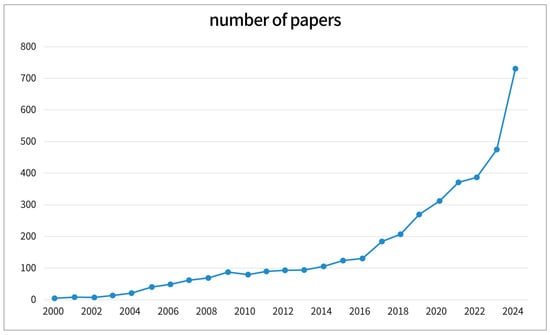
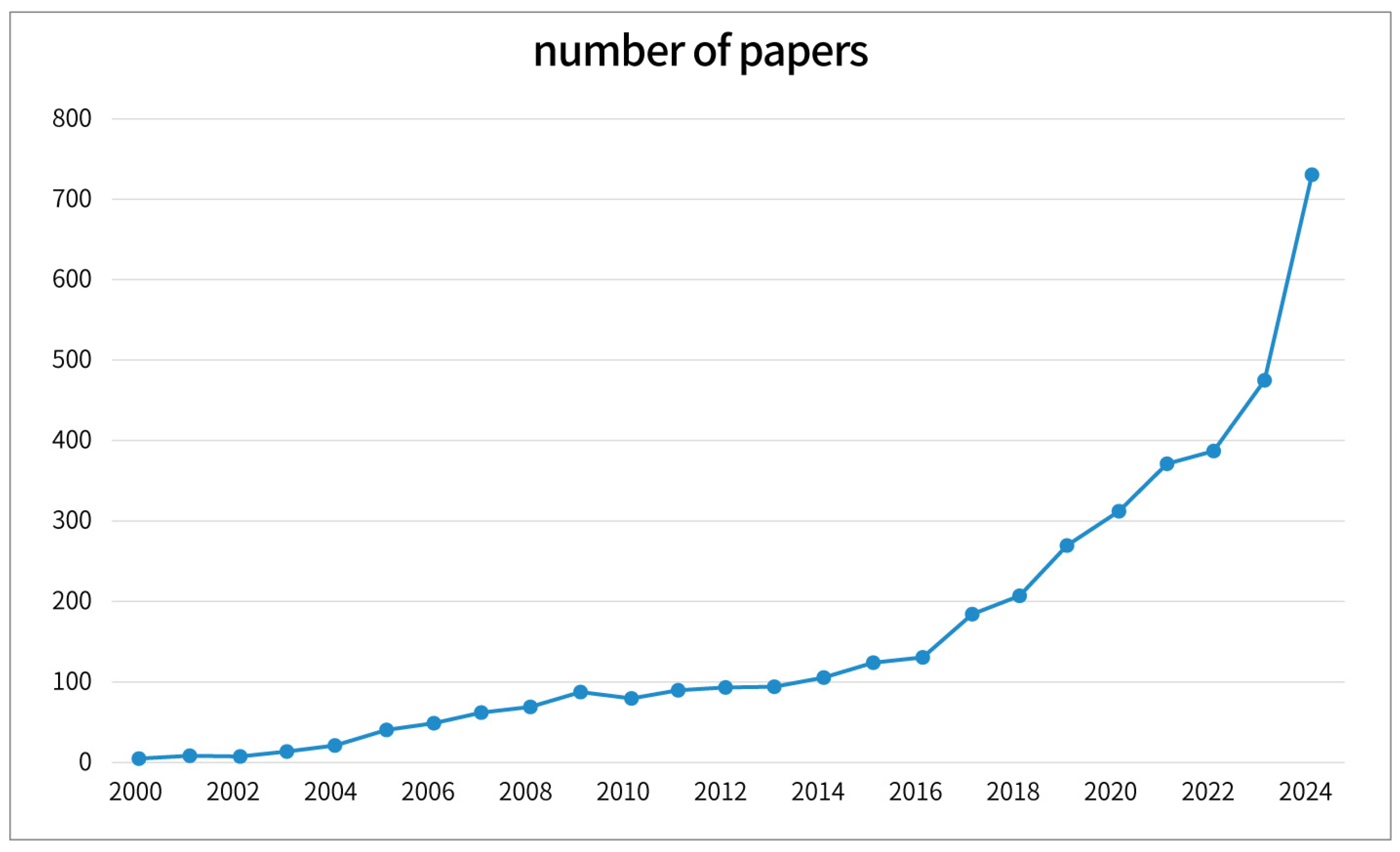
Systematic reviews of MoCap applications already exist in various fields, including medicine, education, and industry. Recent work has examined MoCap systems for clinical rehabilitation and ergonomic analysis, educational applications, and sports scenarios [7,8,9]. A literature search shows that the number of publications on Scopus referring to MoCap in combination with learning, education, or training is rapidly increasing (see Figure 1). However, while MoCap’s role in these domains is well documented, its potential as an educational and pedagogical tool in computer animation training has received far less systematic attention. This means that educators and researchers in animation currently lack a consolidated, evidence-based overview of how MoCap is implemented in curricula, which systems are used in practice, and what kinds of learning and creative outcomes have been reported. Such a synthesis is particularly timely given the rapid expansion of virtual production workflows, real-time engines, and increasingly affordable MoCap systems in higher education animation programs over the last decade. Hence, a detailed analysis of how MoCap is employed in animation training, along with an exploration of the different types of MoCap systems and their applications, provides an overview of the research landscape that can be used to identify trends and can provide a springboard for further research in this area. Therefore, the aim of this article is to provide an overview of MoCap and its uses in animation educational research.
Figure 1.
Number of articles on the Scopus database that refer to the trend of MoCap in education. Note: The following search string was applied: TITLE-ABS-KEY (“motion capture”) OR TITLE-ABS-KEY (MoCap) AND TITLE-ABS-KEY (education) OR TITLE-ABS-KEY (train*) OR TITLE-ABS-KEY (learn*) OR TITLE-ABS-KEY (teach*) from January 2000 to January 2025.
1.1. Defining Motion Capture in Computer Animation Training
In films, animations, and video games, MoCap refers to the process of recording the movements of human actors and using that data to animate digital character models in 2D or 3D computer animation [10,11,12]. When MoCap extends to include facial expressions, finger movements, and other subtle gestures, it is often termed performance capture [13]. MoCap systems include various types of hardware setups, such as optical tracking systems, inertial sensor suits, depth cameras, and markerless AI-based tracking devices. These systems are widely used in professional fields like film, game design, and virtual production, but are now increasingly accessible for educational and creative learning purposes. A defining characteristic that differentiates MoCap-based learning from traditional computer animation education is real-time performance immersion. Unlike conventional animation techniques that rely on manual keyframing or timeline editing, MoCap enables learners to use their physical bodies directly as the input device for generating animation [14]. In this sense, like virtual reality (VR), which serves as a system capable of enhancing learning through multimedia interaction, MoCap fosters an embodied learning environment in which the learner’s body functions simultaneously as the creative tool and the subject of performance exploration. This distinctive feature shifts the animation learning process from purely technical manipulation to an experiential, body-driven creative practice, supporting new modes of performance-based learning, skill acquisition, and expressive animation development.
While other media technologies (e.g., VR) also provide immersive experiences, MoCap is unique in that it integrates the learner’s physical action as the primary creative mechanism for generating animation content, whereas VR (head-mounted display) completely shuts out the real world, psychologically isolating the learner within the virtual environment to create a fully immersive experience [15]. Another defining feature of MoCap-based learning is performance-driven interaction. In contrast to software-based animation methods, through real-time MoCap, mapped onto the virtual body, when the person moves their real body, they would see the virtual body move correspondingly. Participants can see their virtual body moving and directly looking toward themselves in virtual mirror reflections. This interaction is closely tied to feedback fidelity, the degree to which the captured motion accurately reflects the learner’s real-time actions in the digital environment [16].
In this review, we use the term “immersive learning” to refer to learning situations in which MoCap is embedded in environments that provide a strong sense of presence and agency together with real-time, multimodal feedback, broadly consistent with the cognitive affective model of immersive learning proposed by Makransky and Petersen [6]. “Experiential learning” is used in a pragmatic sense to describe cycles of doing, observing, and reflecting, in which learners perform movements, see their actions mapped onto digital characters in real time, and adjust their performance on the basis of this feedback. “Creative flexibility” refers to the extent to which MoCap systems allow learners to rapidly explore alternative performances, styles, and motion variations, for example, through retakes, layering, and the recombination of captured motion when designing animated sequences.
Taken together, the growing body of research demonstrates that MoCap holds substantial potential not only as a production technology but also as a pedagogical tool capable of shaping new forms of embodied, performance-driven learning in computer animation. Yet, existing studies remain fragmented across different domains, employ diverse MoCap systems, and vary widely in their instructional purposes, making it difficult to form a coherent understanding of how MoCap is currently integrated into animation training. These gaps highlight the need for a systematic examination that synthesizes prior findings, clarifies the educational value of MoCap, and maps out the ways in which different MoCap technologies support learning, creativity, and skill development. To address this need and advance the understanding of MoCap-based animation education, the present review identifies the scope of existing research, evaluates emerging patterns and applications, and formulates key questions that guide further investigation.
1.2. Aim of This Paper and Research Questions
Although several systematic reviews exist in fields such as medicine, sports, industry, and cultural research, to the best of our knowledge, no comprehensive review has been conducted on the use of motion capture (MoCap) technology in computer animation training. The primary aim of this article is to provide a prospective overview of MoCap and its applications in animation training research. To achieve this, we propose the following research questions.
First, in the medical field, MoCap is often used as an analysis tools in rehabilitative training, and in the industrial sector, it is widely used in the process of robotics and human–computer interaction. As these examples of previous research show, there are various purposes for using MoCap. Therefore, we investigated the following questions:
- (1)
- What is the purpose of using MoCap in computer animation training?
- (2)
- What are the aims and research questions of the studies?
Secondly, we conducted a detailed examination of MoCap systems, focusing specifically on the types of MoCap systems commonly utilized in research and the third-party applications integrated into the training process. This led us to explore the following question:
- (3)
- What types of MoCap systems are most used in these studies, and which third-party applications are integrated into the training process?
Furthermore, we explored the technical aspects of MoCap systems and their direct impact on computer animation research. Understanding the technical features of MoCap is essential, as they offer varying levels of precision, latency, and real-time feedback; this analysis led us to the question:
- (4)
- What are the technical features of MoCap, and how do they influence computer animation training?
Additionally, given the rapid advancements in MoCap technology, it is crucial to examine the latest innovations and trends shaping its application in computer animation training. Emerging developments, such as AI-driven motion analysis, markerless tracking, real-time rendering, and VR/AR integration, are redefining how animators and trainers utilize the MoCap technique. To gain insight into these technological shifts, we posed the question:
- (5)
- What are the emerging trends of MoCap technology in computer animation training?
2. Materials and Methods
To answer the research questions above, we conducted a systematic literature review, which followed the main steps of PRISMA-informed reporting for systematic reviews [17]. This involved establishing the research scope and selection criteria, executing the database search, screening studies based on inclusion and exclusion criteria, extracting and synthesizing relevant findings, and structuring the results into a coherent discussion. This methodology draws from practical experience and is influenced by established guidelines for literature reviews, as proposed by [18,19,20]. Given the small and methodologically heterogeneous set of 17 included studies, we did not apply a formal, score-based quality appraisal tool; instead, we provide descriptive information on study design, participants, and key findings (Table 1) and discuss common methodological limitations in Section 4.
Table 1.
Characteristics of studies.
2.1. Identification Step
To include highly relevant research articles, we conducted the search procedure using three scientific databases: Web of Science, Scopus, and Google Scholar. The search covered the period from 2015 to 2025 and was restricted to full-text articles written in English. Titles, abstracts, and authors’ keywords were screened using a three-component search string with Boolean operators. The first component targeted motion capture and used the terms “MoCap” OR “motion cap*” OR “motion track*”. The second component addressed animation and used the terms “animation” OR “character animation*” OR “computer animation*” OR “keyframe animation*”. The third component focused on training and education and used the terms “educ*” OR “school*” OR “teach*” OR “train*” OR “learn*”. These three components were combined with AND operators so that all retrieved records referred to motion capture, animation, and education or training simultaneously.
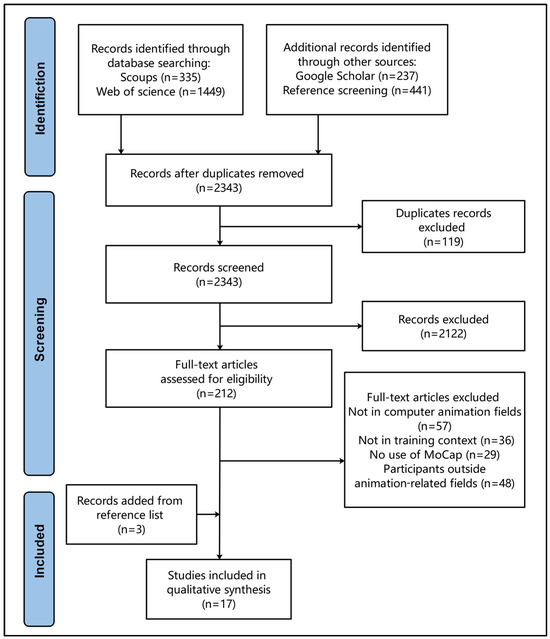
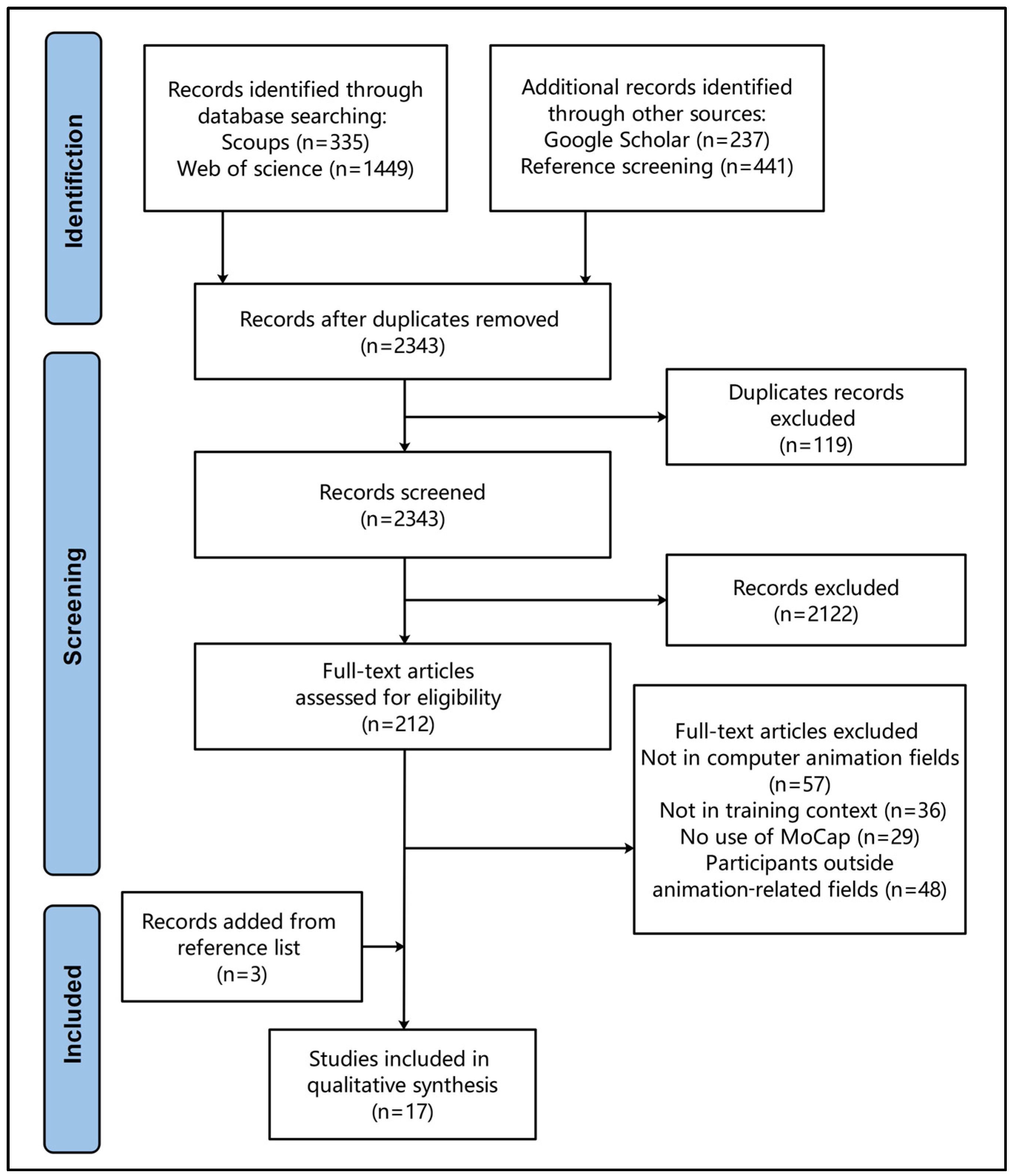
To ensure reproducibility, the search string was applied to the title, abstract, and author-provided keywords of each record. Only empirical full-text articles written in English were considered. This restriction reflects both the dominance of English in contemporary scientific publishing and the fact that the authors could not systematically include additional languages without introducing selection bias. The ten-year window 2015–2025 was chosen to capture the most recent decade of the research field. The review was conducted in January 2025, so studies published between January 2015 and early 2025 were eligible for inclusion. Across the three databases, the search returned 2462 records in total (Scopus: 335; Web of Science: 1449; Google Scholar: 237) before the removal of duplicates; these figures, together with the subsequent screening steps, are summarized in Figure 2.
Figure 2.
Flow diagram.
2.2. Screening Step: Inclusion and Exclusion Criteria
To find the articles that were relevant to our research aim and questions, inclusion and exclusion criteria were specified. Studies were eligible for inclusion if they (1) reported original empirical research in which MoCap technology was used in the context of computer animation training or closely related teaching and learning activities, (2) involved participants such as animation students, design students, artists, or professionals engaged in animation-related training, and (3) provided sufficient information about the educational or training context and the MoCap setup. We included full-length, peer-reviewed journal articles and conference papers that reported original research studies, and excluded theses, book chapters, short abstracts, non-peer-reviewed reports, and workshop posters. Articles that used MoCap exclusively in other domains (for example, clinical gait analysis, sports performance, psychological assessment, geological simulation) or that focused solely on production pipelines without explicitly using a MoCap system were also excluded.
2.3. Screening Step: Screening Process
Following the inclusion and exclusion criteria, all duplicates were removed, leaving 2343 articles for screening. The selection process involved two phases. In the first phase, titles and abstracts were reviewed, and articles were excluded if they clearly did not meet the inclusion criteria (for example, lack of MoCap usage or irrelevance to animators and animation students). In the second phase, the remaining articles underwent full-text review, where their complete content was assessed for eligibility. As the review progressed, a significant number of articles were excluded due to the broad search terms, as many did not involve MoCap technology in an educational or animation-related context. For instance, studies such as learning a controllable high-resolution model of the eye and peri-ocular region were not considered. Numerous studies from the fields of sports, medicine, psychology, and geology were also excluded, including work using markerless MoCap for analyzing knee disorders, statistical analysis-based MoCap for dance-training pose evaluation, and simulations of individual and crowd dynamics in earthquake evacuation. Furthermore, based on the search criteria, we identified studies that utilized MoCap in the exploration of music, arts, and intangible cultural heritage. Although these studies provide valuable insights into creative and cultural applications, they were excluded if they did not explicitly address computer animation training or related educational settings. We therefore extended our approach by screening the reference lists of the included articles to identify the additional relevant literature and collect further evidence. At the full-text screening stage, 212 articles were assessed for eligibility, of which 198 were excluded; the main reasons and their counts (e.g., not computer animation training, no MoCap, wrong participant type) are summarized in Figure 2. Even though MoCap is not a new technology, the evidence meeting all these criteria in the field of animation training was sparse. We therefore extended our approach by screening the reference lists of the included articles to identify the additional relevant literature and collect further evidence.
2.4. Analysis Step
The analysis of the 17 selected articles was conducted using a qualitative approach. To streamline content extraction, the articles were initially summarized, with key aspects relevant to this review carefully identified. In the next phase, the articles were scanned and coded based on five primary categories, which were derived deductively from the research questions. The following five key categories were established: 1. The purposes of use, 2. The aims and research questions, 3. The types of systems and application used, 4. The technical features and the potential benefits, 5. The emerging trends of motion capture technology in computer animation. Following the initial coding process, article summaries were further analyzed to inductively identify subcategories in line with the inductive category formation method. Using these subcategories, the articles underwent a second round of coding. The first author conducted all coding procedures. During the second phase of analysis, descriptive coding was applied to create an index of subtopics under each broad structural category, marking key information relevant to the research questions. Subsequently, pattern coding was used to consolidate similar codes and group related themes into clusters.
3. Results
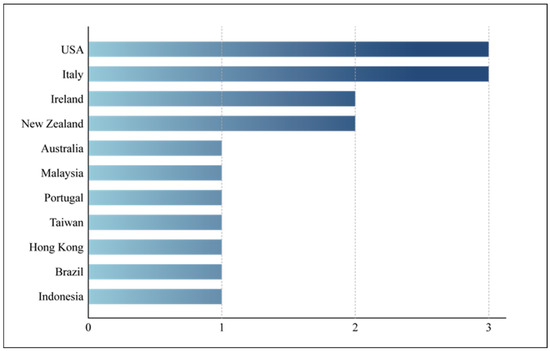
This section presents the analytical findings of the study, based on a systematic re-view of 17 selected articles. A review of all studies identified diverse locations and proportions where MoCap were investigated (see Figure 3). The analysis was conducted according to six principal categories outlined in Section 2, which form the structural basis for the subsections that follow. Each subsection begins with a clear conceptual definition of its respective category, followed by a synthesized summary of key empirical insights relevant to the application of motion capture technology in animation training. For a more detailed overview of the classification and results, a comprehensive tabular breakdown is provided in Appendix A, and a comparative summary of all 17 studies, including study purpose, study design, participants, and key findings, is presented in Table 1.
Figure 3.
Distribution of selected papers by regions.
3.1. The Purposes of Use
To systematically examine the academic applications of MoCap technology, this section developed a classification framework to identify its key purposes. Thematic analysis of seventeen publications revealed three main domains: (1) instructional design, (2) artistic innovation and creative expression, and (3) technical efficiency and workflow optimization. The distribution of these research purposes is shown in the Table 2.
Table 2.
The purpose of using MoCap.
The first subcategory highlights diverse applications of MoCap in instructional design for animation. Typical examples in this subcategory include studies [21,22], which emphasize aligning educational practices with evolving industry workflows. Similarly, Maraffi [23] integrates MoCap with performing arts principles to teach real-time animation, fostering both technical proficiency and creative expression. Some studies also highlight MoCap’s collaborative and interdisciplinary benefits, examining how team-based MoCap activities in simulated animation settings enhance student communication and efficiency [24]. Najafi et al. [25] present a curriculum structure that incorporates a MoCap minor alongside animation, VFX, and game design pathways, fostering interdisciplinary collaboration and equipping students with future-focused skills. One more study reveals that MoCap supports intuitive motion design, whereas traditional keyframe animation encourages creativity, particularly in crafting exaggerated poses [14].
Four studies grouped under the subcategory of artistic innovation and creative ex-pression illustrate how MoCap bridges artistic practices and technological advancement. One notable example, Bowman et al. [26], develops a knowledge-based system indexing dance movements based on pandemic, kinesthetic, cinematographic, and aesthetic elements. The system’s utility extends beyond animation to inform medical applications. Salomão et al. [27] combine MoCap with VR within human–computer interaction (HCI) research to enhance creative expression and adapt animations specifically for VR experi-ences. Moreover, Sasongko [28] explores the cultural significance of MoCap by docu-menting and analyzing the movements of Penchak Silat, an Indonesian martial art, by recording the performer’s body movements in different styles, such as “hero” or “villain” characters, and playing back the recorded videos, with the aims to predict and convey the character’s intentions through their animations [29].
Studies on technical efficiency and workflow optimization emphasize how MoCap can streamline animation pipelines through system integration and multimodal interaction [5,30,31,32,33,34,35]. While Gupta et al. [30] and Lamberti et al. [5,31] propose systems that lower technical barriers through real-time annotation, NLP, and VR-based keyframing, these solutions often prioritize usability over creative depth. Megre and Kunz [33] highlight artistic flexibility by merging MoCap with digital sculpting, yet their framework remains tool-centric rather than pedagogically grounded. Studies integrating tangible or mixed-reality interfaces enhance accessibility and collaboration but rarely address how such innovations transform the animator’s cognitive or creative process [32,34,35]. Building on these differentiated purposes, the next subsection turns from how MoCap is used to what the studies aim to investigate and which research questions they pose.
3.2. The Aims of the Studies and Research Questions
This section analyses the research objectives guiding the use of MoCap in animation studies. A systematic review of 17 publications reveals three dominant investigative aims: (1) learning and skill acquisition, focusing on cognitive development through animation training; (2) system and tool design with an emphasis on usability evaluation and iterative prototyping; and (3) motion data capture and analysis. The frequency distribution of these categorized research aims is presented in Table 3.
Table 3.
Aims of the studies and research questions.
Six studies indicate that integrating MoCap into education enhances learners’ creativity, storytelling, technical skills, and collaboration. Bennett and Kruse [21] focus on aligning curricula and virtual production tools with industry practice to develop students’ visual and problem-solving abilities. Maraffi [23] links photogrammetry and MoCap to improved creativity and improvisation, while Manaf et al. [24] emphasize teamwork and communication as essential for effective MoCap use. Mou [14] finds that MoCap training fosters greater creativity than traditional keyframing, and Najafi et al. [25] highlight its role in improving project quality and interdisciplinary collaboration.
The System or Tool Design and Evaluation subcategory investigates the development and assessment of tools integrating MoCap and immersive technologies to enhance animation production and training. These studies also primarily focus on accessibility, user interaction, and workflow efficiency [5,26,30]. While Paravati et al. [32] employ tangible user interfaces to optimize user experience and creative efficiency. The last three studies in this subcategory [27,28,29] employ MoCap to capture and analyze human movement across diverse contexts. They demonstrate how MoCap can reveal social cues in performance, support medical and creative applications through VR, and preserve traditional martial arts through realistic animation, highlighting its capacity to bridge real-world motion and digital expression.
3.3. The Types of Systems and the Third-Party Applications Used
To take a closer look at how MoCap systems and applications are used in the included studies, and to clarify the technological landscape underpinning them, we distinguish the main system configurations so that their potential to support or constrain different forms of learning and creative practice in computer animation can be compared more easily. We included this category. These systems are classified into four major categories: marker-based systems, markerless systems, inertial sensor-based systems, and hybrid or specialized configurations.
In this review, “marker-based” systems are defined as optical motion capture setups that track reflective or active markers attached to the body using multiple cameras. “Markerless” systems estimate body pose directly from RGB or depth images without requiring physical markers. “Inertial” systems use body-worn inertial measurement units, such as accelerometers and gyroscopes, to measure segment orientation and movement. In addition, several commonly third-party animation applications were identified, reflecting their roles in data acquisition, processing, animation, and visualization. Table 4 and Table 5 present a taxonomic overview of these classifications, listing both the system types and specific commercial brand, along with their corresponding technical specifications.
Table 4.
The types of systems.
Table 5.
Third-party applications.
Markerless systems leverage algorithms and depth-sensing cameras to track body movements without the need for markers. These systems, though less precise than their marker-based counterparts, offer significant advantages in terms of ease of setup and cost. The Kinect system was conducted in several studies, e.g., [5,30,32], highlighting its capacity for accessible motion capture in smaller studios or individual projects.
Optical systems that use markers have long been considered the gold standard for high-precision motion capture due to their sub-millimeter accuracy. These systems rely on cameras that track reflective or active markers affixed to the subject. For example, Vicon, one of the most widely recognized marker-based systems, was employed in several studies [21,22,27]. Raptor-4 digital cameras, as seen in the work of Bennett et al. [22], and Omnitrack Bowman et al., [26] are representative of high-end optical systems that provide robust and reliable data for complex movements. We note that one study [24] did not mention the specific system used; it can be seen from the figures in the article that the study used typical optical cameras and reflective markers.
The reviewed studies utilized inertial motion capture systems such as Noitom Perception [23,35] and the Animazoo IGS-180 System [14], both effective in capturing full-body movements for applications including virtual production and robotics. Although inertial systems typically offer lower precision compared to optical systems, their affordability and versatility make them appealing alternatives for various research scenarios.
Some studies employed systems that do not fit neatly into the categories above, often using them in conjunction with other technologies. For instance, the HTC Vive [5,34] was utilized as a VR platform integrated with motion capture workflows. Although primarily a VR system, its spatial tracking capabilities enable applications in motion capture when paired with other tools, particularly in immersive VR environments.
The most frequently mentioned applications include Autodesk Maya and Blender. Autodesk Maya is a pivotal tool in MoCap workflows, providing essential functions such as data cleanup, character rigging, animation refinement, and scene visualization. Several studies highlight Maya’s role in retargeting MoCap data, refining animations [14,21,23,24,25,26,28]. For example, studies [21,30] demonstrate how Maya facilitates the cleanup and retargeting of MoCap data, while study [14] explores how Maya is used to combine MoCap and keyframe animation techniques. Studies also [24,26] emphasize the software’s ability to process and manipulate character animations, crucial for creating high-quality motion sequences in 3D environments. Maya’s flexibility in camera manipulation and scene composition allows users to fine-tune the visual storytelling aspects of MoCap-driven animations, as seen in the work of [22,28].
One study describes Blender’s ability to easily switch between traditional and immersive interfaces to improve user interaction during animation tasks, while another highlights its role in a cost-effective MoCap system that integrates Lego Mindstorms EV3 and Microsoft Kinect to create a tangible user interface for virtual character animation [31,32]. These approaches demonstrate Blender’s ability to support real-time skeleton tracking. Future developments in Blender’s VR integration and MoCap automation will likely further streamline real-time animation workflows, making high-quality animation tools available to a wider audience.
The Autodesk MotionBuilder was used three times, particularly in data streaming, real-time visualization, and animation cleanup. Several studies highlight its use as a specialized tool for processing MoCap data before integration into animation and game engines [22]. Where other studies utilize MotionBuilder for real-time visualization, configuring it for Data Arena environments to prototype and manipulate motion-based assets [26] further showcases [24] its role in MoCap data cleanup, noting that it is more efficient than Autodesk Maya for processing and refining raw motion files, ensuring smoother animations for digital characters.
Notably, game engines were mentioned twice, alongside mainstream animation software and MoCap systems. Unreal Engine emerges as a new-type platform for real-time rendering, virtual production, and interactive content creation in MoCap workflows. One study demonstrates its integration with green screen filming, VIVE Pro trackers, and Metahuman Creator, enhancing real-time character animation and VFX workflows [22]. Another study explores its applications in XR and interactive animation, emphasizing VR-based MoCap workshops, where students actively engage in real-time animation exercises [35]. One study uses the Stanford CoreNLP toolkit, which is relevant to system development rather than animation production itself [5]. Similarly, Lego Mindstorms EV3, although primarily a hardware platform, is referenced as part of a tangible interface for motion capture, enabling custom interaction devices that can be integrated with animation software [32]. Likewise, other software tools such as Unity 3D [34], Adobe After Effects [25], and Nuke [22] appear only sporadically in the reviewed studies.
3.4. The Technical Features of MoCap and Their Influence on the Study
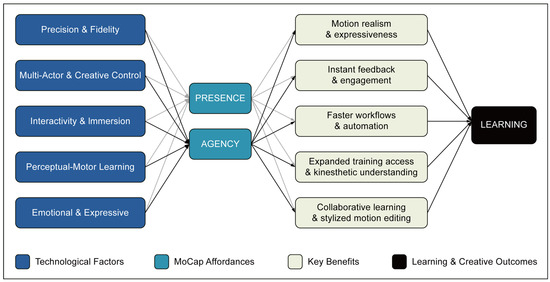
After mapping the purposes, aims, and system types across the 17 studies, this section synthesizes how the technical features of MoCap shape learning and creative processes in animation training. Based on our thematic coding and prior work on embodied and immersive learning, we identified five recurring technical features that support learning and creative expression: precision and fidelity, multi-actor and creative control, interactivity and immersion, perceptual–motor learning, and emotional expressiveness. These features collectively shape how MoCap-based pedagogical environments operate. As summarized in Figure 4, they feed into two experiential affordances, Presence and Agency, which, in turn, are associated in the reviewed literature with a range of learning and creative outcomes.
Figure 4.
Conceptual model of MoCap technological features.
In this conceptual model, the five technical features form the technological layer of MoCap: they describe how systems capture, map, and render human movement in the reviewed studies. The intermediate layer consists of two experiential affordances—Presence and Agency—derived by grouping together student- and teacher-reported experiences such as feeling “inside” the virtual space, seeing one’s own body mapped onto a character, and experiencing direct control over animated motion. The outer layer summarizes the types of outcomes most frequently associated with these affordances in the 17 studies, including enhanced motion realism, learner engagement, workflow efficiency, kinesthetic understanding, and collaboration. The distinction between technological features, experiential affordances, and learning outcomes is informed by our coding scheme and by existing models of immersive learning and presence [5,6,15,16].
First, precision and fidelity ensure biomechanical accuracy, allowing systems to capture fine motor details essential for realistic and socially expressive animation. Studies [28,29] demonstrate that accurate motion tracking improves the conveyance of social traits and helps animators understand complex martial arts movements.
Multi-actor and creative control enhance collaborative and directorial flexibility. Gupta et al. [30] showed that systems such as MotionMontage enable multi-take recording for nuanced decision-making, while Lamberti et al. [5,31,32] integrated natural language interfaces to facilitate the intuitive manipulation of motion data, increasing creative control.
Real-time interactivity and immersion provide immediate feedback and allow for on-the-spot adjustments that transform animation training environments. Salomão et al. [27] supposed that integrating MoCap with VR deepens engagement and realism, while study [34] observed that interactive setups promote the collaboration and active refinement of performance.
Perceptual–motor learning promotes embodied understanding. Mou [14] noted that real-time tracking improves learners’ ability to reproduce natural movement, and the study [25] emphasized that engaging directly with captured motion data strengthens kinesthetic learning and digital performance skills.
Finally, emotional and expressive performance extends MoCap’s impact on affective storytelling. Previous studies found that expressive digital doubles and virtual production techniques enhance emotional communication and narrative authenticity [21,23].
To sum up, the reviewed studies portray MoCap as a promising tool in both animation production and research, providing new pathways for studying movement, learning, and creativity. Its ability to record the subtleties of human motion enables not only technical fidelity in character performance but also pedagogical advances in animation training in the contexts examined. Functioning as an interconnected techno-pedagogical framework, these features can be understood as fostering two key affordances: Presence, the immersive sense of “being there” in a digital performance space, and Agency, the learner’s perception of control, responsiveness, and creative authorship. In the included studies, these affordances are associated with several reported benefits, including improved motion realism, greater engagement, faster workflows, deeper kinesthetic understanding, and enhanced collaboration.
3.5. The Emerging Trends of MoCap in Computer Animation Training
Following the insights identified in the previous category, where MoCap was shown to exhibit learning characteristics comparable to those of other immersive tools, this section explores the broader trends in how MoCap is being integrated and advanced within computer animation research. These trends are derived primarily from patterns observed in the 17 included studies—for example, the use of real-time engines, VR-based workshops, and low-cost systems in animation-related contexts [22,31,32,35]—and are further contextualized, where indicated, by selected recent work on MoCap, VR/XR, and AI-based motion analysis.
It was found that, in the NVivo word-frequency analysis, in addition to high-frequency terms related to animation and performance, virtuality also emerged as an important concept included in this scoping review. The results of a word frequency query run in NVivo 14 revealed that some synonyms of the word “virtual” appeared in the collective sample of all articles a total of 456 times. It is worth noting that MoCap is not studied in isolation but, in both the reviewed studies and the wider MoCap literature, is increasingly discussed in relation to real-time rendering, virtual production, XR, and AI.
One significant trend is the integration of MoCap with real-time rendering engines such as Unreal Engine [22]. This allows for seamless character animation in virtual production workflows, enabling real-time visualization and enhancing interactive content creation. Another growing trend is the use of MoCap for interdisciplinary applications, where researchers combine performance arts, biomechanics, and human–computer interaction (HCI) to study expressive movements, e.g., Bowman et al. [26,27]. Furthermore, XR applications, such as VR-based MoCap workshops [35], demonstrate how immersive technologies are shaping animation education and content creation. Additionally, advancements in affordable and accessible MoCap systems are driving research into more cost-effective solutions [31,32], making MoCap tools available to independent animators, students, and small studios. The automation of motion processing using AI-driven motion synthesis is another rising trend, allowing researchers to enhance animation workflows by predicting and refining human motion data more efficiently.
Overall, these emerging trends suggest that MoCap research is gradually shifting from exclusively supporting traditional animation pipelines to enabling more real-time, interactive, and AI-augmented forms of digital performance. Recent advances in real-time human motion capture and AI-based motion synthesis provide examples of this development [36,37,38]. Rather than functioning solely as a recording tool, MoCap is increasingly described in the literature as a flexible platform for creativity, experimentation, and multimodal exploration. Systematic reviews and individual case studies further indicate that MoCap is expanding its role within animation workflows and educational applications [39], inviting researchers to reconsider how movement, expressiveness, and embodied interaction can be reimagined through technology. Looking ahead, MoCap is likely to deepen its presence across interdisciplinary studies, immersive media environments, and automation-driven production pipelines, especially as the boundaries between physical and virtual performance continue to blur.
4. Discussion
The aim of this review was to provide an overview of MoCap technology and its use in animation training research. In particular, we focused on recent studies conducted in universities and research institutions, examining how different MoCap systems and workflows support instructional design, artistic innovation, and technical optimization in computer animation training. By synthesizing findings from 17 empirical studies, the review mapped the main purposes of using MoCap in education, the types of systems and third-party applications employed, and the technical features that shape learning and creative outcomes. The findings show that MoCap is being integrated into animation curricula in diverse ways, ranging from course-based case studies and practice-led artistic projects to workflow-oriented system evaluations. At the same time, the evidence base is still relatively small and unevenly distributed, and the reviewed studies vary considerably in design, context, and conceptual framing. The following subsections therefore consider the methodological and conceptual limitations, discuss the main results in more detail, and outline the implications for future research on MoCap-based animation training.
4.1. Methodological Considerations and Potential Biases
Although this review followed PRISMA-informed procedures, several methodological issues should be borne in mind when interpreting the findings. First, the evidence base is small: only 17 studies met the inclusion criteria, and most adopted small-scale case study or exploratory user study designs with limited numbers of participants. Only one study included a controlled comparison between MoCap-based and more traditional animation training [14], which restricts the strength of any causal claims. Second, all included publications were peer-reviewed articles written in English and drawn from three major databases. This language restriction and database focus may have led to sampling bias, particularly underrepresenting research from regions where MoCap is emerging but less frequently reported in English. The geographic distribution of the included work is also uneven, with a concentration of cases in Europe, Oceania, North America, and parts of Asia, and little coverage from other regions.
A further limitation is that the review does not incorporate industry reports, internal documentation, or other forms of gray literature. Many animation studios and training programs use MoCap, but such practices are rarely described in academic outlets, which means that our synthesis may not fully capture how MoCap is deployed in professional training contexts. Finally, the tendency of published studies to emphasize successful or promising implementations suggests a possible publication bias towards positive results. These factors indicate that the patterns identified in this review should be interpreted as indicative rather than exhaustive, and they underscore the need for more diverse, systematically reported studies on MoCap in animation education.
4.2. Discussion of the Results
By analyzing the 17 selected studies, this review identifies three primary purposes of using MoCap in animation education: instructional design, artistic innovation and creative expression, and technical efficiency and workflow optimization. As summarized in Table 1, instructional design studies are typically implemented as course-based case studies that integrate MoCap into existing curricula, while artistic innovation studies often adopt practice-led research methods involving artists and performers, and workflow-oriented studies mainly focus on system or tool design and user evaluations. We found that discussing the use of MoCap in animation training differs from simply examining its role in animation production. In our review, about one third of the studies focused on leveraging MoCap’s unique characteristics to reform or innovate professional pedagogy, while another third explored its application in artistic innovation. This highlights that MoCap not only enhances the efficiency of animation production but also contributes to creativity and artistic performance. In contrast, studies that focus on optimizing the MoCap animation production pipeline tend to prioritize technological advancements rather than their educational or creative implications [40,41,42,43].
We further analyzed and categorized the research aims and questions presented in the reviewed studies. The research aims and questions are generally aligned with the three purpose categories, but research questions tend to explore the subject from a more specific and narrowly focused perspective. Questions related to learning and skills acquisition most frequently appear in studies with educational objectives. This trend is not limited to MoCap’s role in animation education but extends to other fields as well. For instance, MoCap has been used in a study on augmented reality games designed to teach vowels and consonants [44]. Similarly, in the field of physical education, MoCap is often used for developing training programs that help students enhance body stability and refine their movements [45,46]. Additional research questions fall under the categories of system and tool design and data analysis. The first focuses on the development and evaluation of integrated tools, while the second examines the technical aspects of human movement. The latter is comparable to the use of MoCap in medical research, where it is commonly employed to analyze patients’ gait patterns for clinical assessments and rehabilitation purposes [47,48,49].
The review also highlights how MoCap technology influences learning engagement, real-time interactivity, and creative flexibility, which are critical factors in modern animation training. The categorisation of MoCap system types, including marker-based, markerless, and inertial systems, shows that marker-based optical systems are the most frequently used, likely because of their stability and high-quality capture performance. Improvements in equipment manufacturing have made these systems increasingly affordable in recent years, further contributing to their widespread adoption. Conversely, inertial sensors are the least frequently used. While the article does not provide a definitive explanation for this, it is evident that inertial systems were more prominent in earlier studies [42,50,51]. At that time, optical systems were not as user-friendly or easy to operate as they are today, which may have influenced researchers’ choices when selecting motion capture technologies.
In addition, the integration of third-party applications such as Autodesk Maya, Blender, MotionBuilder, and Unreal Engine underscores the growing convergence of MoCap with digital animation tools. We do not list all the software mentioned in the literature, as some tools and plugins are developed for specific tasks rather than general applications. For example, one study [5] uses the Stanford CoreNLP toolkit, a comprehensive library for natural language processing that is relevant to the development of the proposed animation system rather than animation production itself. In the same way, while Lego Mindstorms EV3 is primarily a hardware platform, it is referenced as part of a tangible interface used for motion capture, enabling the creation of custom interfaces that can be integrated with animation software [32]. Some software tools, such as Unity 3D [34], Adobe After Effects [25], and Nuke [22], appear only sporadically in the reviewed studies. These tools are either mentioned only once or play a minor role in the research, as they are not directly involved in the core development of animation production. Overall, the findings suggest that MoCap-based animation training is increasingly embedded in tool ecosystems that mirror professional pipelines, while still leaving room for experimental and interdisciplinary configurations.
4.3. Implications for Future Research
The synthesis presented in this review points to several priorities for future research on MoCap-based animation learning. It is essential to demonstrate that the benefits of MoCap in animation training extend beyond entertainment value. Although prior analyses and the studies reviewed here suggest that specific MoCap features may positively influence animation learning, the underlying mechanisms remain insufficiently understood. The conceptual model in Figure 4 should therefore be read as a preliminary synthesis of our findings rather than a fully elaborated theory. Future empirical work is needed to examine how the technical features of MoCap, the experiential affordances of presence and agency, and the design of learning activities interact to shape educational outcomes.
Forthcoming studies should examine learner acceptance of MoCap-supported training, identify the direct and indirect factors that influence its effectiveness and evaluate how immersive, performance-based interaction shapes learning engagement, technical skill development, and creative growth. Comparative studies that contrast MoCap-based approaches with keyframe-only or other forms of animation instruction would be particularly valuable for clarifying when and for whom MoCap adds the most pedagogical value. There is also a need for research that investigates how different system types and configurations, including low-cost and markerless solutions, affect accessibility and equity in animation education. Building on this empirical work, future research should develop and rigorously test a more detailed framework for MoCap-based animation learning that clarifies the specific relationships between its variables and pays particular attention to the properties most relevant to educational outcomes. Such a framework would ideally be grounded in both immersive learning theory and practice-based insights from animation educators and students. Over time, this could support the formulation of evidence-informed design principles for integrating MoCap into curricula, assessment, and professional training.
5. Conclusions
This systematic review provides a comprehensive examination of MoCap technology in 3D computer animation training, highlighting its educational applications, technical characteristics, and emerging research trends. Across the 17 included studies, three primary research orientations were identified: instructional design, artistic innovation, and workflow optimization. The findings indicate that, in the contexts studied, MoCap is used not only as a production tool but also as an educational resource that can enhance learner engagement, technical proficiency, and creative expression. A key insight is that MoCap’s role in animation training differs markedly from its use in professional animation pipelines. Whereas production-oriented research focuses on technical efficiency and motion fidelity, studies in educational contexts emphasize MoCap’s pedagogical value, showing how it supports students in understanding motion, expressing artistic intent, and refining animation techniques. For educators and curriculum designers, this suggests that MoCap is most effective when it is integrated as a complement to keyframe animation and used in tasks that foreground movement analysis, performance, and collaboration, such as MoCap workshops, virtual production projects, and group-based assignments that mirror industry workflows. Furthermore, MoCap’s integration with tools such as Autodesk Maya, Blender, MotionBuilder, and Unreal Engine underscores its capacity to support a seamless transition from learning environments to professional practice.
A significant trend identified in this review is the increasing recognition of MoCap as an immersive learning technology. Studies show that MoCap offers embodied interaction, real-time feedback, and high-fidelity motion visualization, which are core qualities that parallel those of VR- and AR-based immersive systems. These features foster deeper learner engagement, stronger perceptual–motor understanding, and more authentic creative performance, reinforcing MoCap’s potential as a central tool in future animation education. For program leaders and institutions, this means that decisions about MoCap infrastructure and software should be aligned with specific pedagogical aims, available technical support, and opportunities for interdisciplinary collaboration, for example, in virtual production, human–computer interaction, performance, and media arts. This review contributes to the academic discourse by consolidating current research findings, identifying emerging trends, and outlining critical directions for further investigation. As MoCap becomes increasingly accessible and technologically advanced, its convergence with AI, VR, and real-time rendering tools is likely to reshape animation education and further bridge the gap between traditional pedagogy and industry practice.
Author Contributions
Conceptualization, X.J. and Z.I.; methodology, X.J.; software, G.L., J.J. and X.J.; investigation, X.J.; writing—original draft preparation, X.J.; writing—review and editing, X.J. and Z.I.; visualization, X.J. and J.J.; supervision, Z.I.; project administration, G.L. All authors have read and agreed to the published version of the manuscript.
Funding
This research was funded by the Anhui Xinhua University 2024 University-Level Research-Teaching Integration Project (Grant No. 2024zx015), Research on Practice and Innovation of Animation Courses Reinforced by Virtual Motion Capture Training Technology: A Case Study of the Provincial Virtual Simulation Teaching Center; and the First-Class Animation Major Construction Project (Grant No. 2020ylzy03).
Data Availability Statement
The data presented in this study are available upon request from the corresponding author.
Acknowledgments
The authors would like to express their sincere gratitude to Zainuddin Ibrahim, the corresponding author, for his invaluable guidance in the research methodology and for his extensive support in the academic writing throughout the development of this study. His expertise and constructive insights greatly strengthened the quality and rigor of this work. The authors also extend their appreciation to Jing Jiang and Gang Liu for their participation in the motion capture projects that provided essential practical experience and technical support. Their contributions, together with the sponsorship and resources made available through these projects, played a significant role in enabling the successful completion of this research.
Conflicts of Interest
The authors declare no conflicts of interest.
Appendix A
Table A1.
The purpose of using MoCap.
Table A2.
Aims of the studies and research questions.
Table A3.
The types of systems and system used.
Table A4.
The third-party applications.
References
- Brigante, C.M.; Abbate, N.; Basile, A.; Faulisi, A.C.; Sessa, S. Towards miniaturization of a MEMS-based wearable motion capture system. IEEE Trans. Ind. Electron. 2011, 58, 3234–3241. [Google Scholar] [CrossRef] [Scilit]
- Menolotto, M.; Komaris, D.-S.; Tedesco, S.; O’flynn, B.; Walsh, M. Motion capture technology in industrial applications: A systematic review. Sensors 2020, 20, 5687. [Google Scholar] [CrossRef] [Scilit]
- Kitagawa, M.; Windsor, B. MoCap for Artists: Workflow and Techniques for Motion Capture; Routledge: London, UK, 2020. [Google Scholar]
- Scott, C.L. The Futures of Learning 3: What kind of pedagogies for the 21st century? Int. J. Bus. Educ. 2023, 164, 1. [Google Scholar] [CrossRef] [Scilit]
- Lamberti, F.; Gatteschi, V.; Sanna, A.; Cannavò, A. A multimodal interface for virtual character animation based on live performance and natural language processing. Int. J. Hum.–Comput. Interact. 2019, 35, 1655–1671. [Google Scholar] [CrossRef] [Scilit]
- Makransky, G.; Petersen, G.B. The cognitive affective model of immersive learning (CAMIL): A theoretical research-based model of learning in immersive virtual reality. Educ. Psychol. Rev. 2021, 33, 937–958. [Google Scholar] [CrossRef] [Scilit]
- Rybnikár, F.; Kačerová, I.; Hořejší, P.; Šimon, M. Ergonomics Evaluation Using Motion Capture Technology—Literature Review. Appl. Sci. 2023, 13, 162. [Google Scholar] [CrossRef] [Scilit]
- Reuter, A.S.; Schindler, M. Motion Capture Systems and Their Use in Educational Research: Insights from a Systematic Literature Review. Educ. Sci. 2023, 13, 167. [Google Scholar] [CrossRef] [Scilit]
- Suo, X.; Tang, W.; Li, Z. Motion Capture Technology in Sports Scenarios: A Survey. Sensors 2024, 24, 2947. [Google Scholar] [CrossRef] [Scilit]
- Child, B. Andy Serkis: Why Won’t Oscars Go Ape over Motioncapture Acting; The Guardian: London, UK, 2011. [Google Scholar]
- Rapp, I. Motion Capture Actors: Body Movement Tells the Story. Obtenido de DirectSubmit from NYCastings. 2017. Available online: https://www.nycastings.com/motion-capture-actors-body-movement-tells-the-story/ (accessed on 30 November 2025).
- Salomon, A. Growth in Performance Capture Helping Gaming Actors Weather Slump. Backstage.com. 2013. Available online: https://www.backstage.com/magazine/article/growth-performance-capturehelping-gaming-actors-weatherslump-47881/ (accessed on 19 January 2023).
- Auslander, P. Film Acting and Performance Capture. PAJ J. Perform. Art 2017, 39, 7–23. [Google Scholar] [CrossRef] [Scilit]
- Mou, T.-Y. Keyframe or motion capture? Reflections on education of character animation. EURASIA J. Math. Sci. Technol. Educ. 2018, 14, em1649. [Google Scholar] [CrossRef] [Scilit]
- Loomis, J.M.; Blascovich, J.J.; Beall, A.C. Immersive virtual environment technology as a basic research tool in psychology. Behav. Res. Methods Instrum. Comput. 1999, 31, 557–564. [Google Scholar] [CrossRef] [Scilit]
- Slater, M.; Sanchez-Vives, M.V. Enhancing our lives with immersive virtual reality. Front. Robot. AI 2016, 3, 74. [Google Scholar] [CrossRef] [Scilit]
- Page, M.J.; McKenzie, J.E.; Bossuyt, P.M.; Boutron, I.; Hoffmann, T.C.; Mulrow, C.D.; Shamseer, L.; Tetzlaff, J.M.; Akl, E.A.; Brennan, S.E.; et al. The PRISMA 2020 statement: An updated guideline for reporting systematic reviews. BMJ 2021, 372, n71. [Google Scholar] [CrossRef] [Scilit]
- David Tranfield, D.D. 1 Palminder Smart 1, The PRISMA Statement for Reporting Systematic Reviews and Meta-Analyses of Studies That Evaluate Health Care Interventions: Explanation and Elaboration. Ann. Intern. Med. 2009, 151, W-65–W-94. [Google Scholar] [CrossRef]
- Tranfield, D.; Denyer, D.; Smart, P. Towards a methodology for developing evidence-informed management knowledge by means of systematic review. Br. J. Manag. 2003, 14, 207–222. [Google Scholar] [CrossRef] [Scilit]
- Wong, G.; Greenhalgh, T.; Westhorp, G.; Buckingham, J.; Pawson, R. RAMESES publication standards: Meta-narrative reviews. J. Adv. Nurs. 2013, 69, 987–1004. [Google Scholar] [CrossRef] [Scilit]
- Bennett, G.; Kruse, J. Teaching visual storytelling for virtual production pipelines incorporating motion capture and visual effects. In Proceedings of the SIGGRAPH Asia 2015 Symposium on Education, Kobe, Japan, 2–6 November 2015. [Google Scholar] [CrossRef] [Scilit]
- Bennett, G.; Najafi, H.; Jackson, L. Pedagogical strategies for teaching Virtual Production pipelines. In Proceedings of the SIGGRAPH Asia 2023 Educator’s Forum, Sydney, NSW, Australia, 12–15 December 2023. [Google Scholar] [CrossRef] [Scilit]
- Maraffi, T. Metahuman Theatre: Teaching Photogrammetry and MoCap as a Performing Arts Process. In Proceedings of the ACM SIGGRAPH 2024 Educator’s Forum, Denver, CO, USA, 27 July–1 August 2024. [Google Scholar] [CrossRef] [Scilit]
- Manaf, A.A.; Arshad, M.R.; Bahrin, K. Team Learning In Motion Capture Operations And Independent Rigging Processes. Int. J. Sci. Technol. Res. 2020, 9, 2545–2549. [Google Scholar]
- Najafi, H.; Kennedy, J.; Ramsay, E.; Todoroki, M.; Bennett, G. A Pedagogical Workflow for Interconnected Learning: Integrating Motion Capture in Animation, Visual Effects, and Game Design: Major/Minor curriculum structure that supports the integration of Motion Capture with Animation, Visual Effects and Game Design teaching pathways. In Proceedings of the SIGGRAPH Asia 2024 Educator’s Forum, Tokyo, Japan, 3–6 December 2024. [Google Scholar] [CrossRef] [Scilit]
- Bowman, C.; Fujita, H.; Perin, G. Towards a knowledge based environment for the cognitive understanding and creation of immersive visualization of expressive human movement data. In Trends in Applied Knowledge-Based Systems and Data Science: 29th International Conference on Industrial Engineering and Other Applications of Applied Intelligent Systems, IEA/AIE 2016, Morioka, Japan, 2–4 August 2016; Proceedings 29; Springer: Berlin/Heidelberg, Germany, 2016. [Google Scholar]
- Salomão, A.; Andaló, F.; Prim, G.; Vieira, M.L.H.; Romeiro, N.C. Case studies of motion capture as a tool for human-computer interaction research in the areas of design and animation. In International Conference on Human-Computer Interaction; Springer: Berlin/Heidelberg, Germany, 2022. [Google Scholar] [CrossRef] [Scilit]
- Sasongko, H. Performance capturing Penchak Silat movement as a reference study for content creators. Bus. Econ. Commun. Soc. Sci. J. (BECOSS) 2019, 1, 125–135. [Google Scholar] [CrossRef] [Scilit]
- Kiiski, H.; Hoyet, L.; Woods, A.T.; O’sUllivan, C.; Newell, F.N. Strutting hero, sneaking villain: Utilizing body motion cues to predict the intentions of others. ACM Trans. Appl. Percept. (TAP) 2015, 13, 1–21. [Google Scholar] [CrossRef] [Scilit]
- Gupta, A.; Agrawala, M.; Curless, B.; Cohen, M. Motionmontage: A system to annotate and combine motion takes for 3d animations. In Proceedings of the SIGCHI Conference on Human Factors in Computing Systems, Toronto, ON, Canada, 26 April–1 May 2014. [Google Scholar] [CrossRef] [Scilit]
- Lamberti, F.; Cannavo, A.; Montuschi, P. Is immersive virtual reality the ultimate interface for 3D animators? Computer 2020, 53, 36–45. [Google Scholar] [CrossRef] [Scilit]
- Lamberti, F.; Paravati, G.; Gatteschi, V.; Cannavo, A.; Montuschi, P. Virtual character animation based on affordable motion capture and reconfigurable tangible interfaces. IEEE Trans. Vis. Comput. Graph. 2017, 24, 1742–1755. [Google Scholar] [CrossRef] [Scilit]
- Megre, R.; Kunz, S. Motion capture visualization for mixed animated techniques. In Proceedings of the Electronic Visualisation and the Arts London 2020 Conference, London, UK, 6–9 July 2020. [Google Scholar] [CrossRef] [Scilit]
- Pan, Y.; Mitchell, K. Group-based expert walkthroughs: How immersive technologies can facilitate the collaborative authoring of character animation. In Proceedings of the 2020 IEEE Conference on Virtual Reality and 3D User Interfaces Abstracts and Workshops (VRW), Atlanta GA, USA, 22–26 March 2020; IEEE: Piscataway, NJ, USA, 2020. [Google Scholar] [CrossRef] [Scilit]
- Young, G.W.; Dinan, G.; Smolic, A. Realtime-3D Interactive Content Creation for Multi-platform Distribution: A 3D Interactive Content Creation User Study. In Proceedings of the International Conference on Human-Computer Interaction, Copenhagen, Denmark, 23–28 July 2023; Springer: Berlin/Heidelberg, Germany, 2023. [Google Scholar] [CrossRef] [Scilit]
- Pan, S.; Ma, Q.; Yi, X.; Hu, W.; Wang, X.; Zhou, X.; Li, J.; Xu, F. Fusing monocular images and sparse imu signals for real-time human motion capture. In SIGGRAPH Asia 2023 Conference Papers; ACM: New York, NY, USA, 2023. [Google Scholar] [CrossRef] [Scilit]
- Hu, Z.; Tang, J.; Li, L.; Hou, J.; Xin, H.; Yu, X.; Bu, J. MarkerNet: A Divide-and-Conquer Solution to Motion Capture Solving from Raw Markers. Comput. Animat. Virtual Worlds 2024, 35, e2228. [Google Scholar] [CrossRef] [Scilit]
- Zhang, M.; Cai, Z.; Pan, L.; Hong, F.; Guo, X.; Yang, L.; Liu, Z. MotionDiffuse: Text-Driven Human Motion Generation with Diffusion Model. IEEE Trans. Pattern Anal. Mach. Intell. 2024, 46, 4115–4128. [Google Scholar] [CrossRef] [Scilit]
- Wibowo, M.C.; Nugroho, S.; Wibowo, A. The use of motion capture technology in 3D animation. Int. J. Comput. Digit. Syst. 2024, 15, 975–987. [Google Scholar] [CrossRef] [Scilit] [PubMed]
- Guo, Y.; Zhong, C. Motion capture technology and its applications in film and television animation. Adv. Multimed. 2022, 2022, 6392168. [Google Scholar] [CrossRef] [Scilit]
- Liu, X.-m.; Hao, A.-m.; Zhao, D. Optimization-based key frame extraction for motion capture animation. Vis. Comput. 2013, 29, 85–95. [Google Scholar] [CrossRef] [Scilit]
- Multon, F.; Kulpa, R.; Hoyet, L.; Komura, T. Interactive animation of virtual humans based on motion capture data. Comput. Animat. Virtual Worlds 2009, 20, 491–500. [Google Scholar] [CrossRef] [Scilit]
- Zordan, V.B.; Majkowska, A.; Chiu, B.; Fast, M. Dynamic response for motion capture animation. ACM Trans. Graph. (TOG) 2005, 24, 697–701. [Google Scholar] [CrossRef] [Scilit]
- Guarnieri, R.; Crocetta, T.B.; Massetti, T.; Barbosa, R.T.d.A.; Antão, J.Y.F.d.L.; Antunes, T.P.C.; Hounsell, M.d.S.; Monteiro, C.B.d.M.; Oliveira, A.S.B.; de Abreu, L.C. Test–Retest Reliability and Clinical Feasibility of a Motion-Controlled Game to Enhance the Literacy and Numeracy Skills of Young Individuals with Intellectual Disability. Cyberpsychol. Behav. Soc. Netw. 2019, 22, 111–121. [Google Scholar] [CrossRef] [Scilit]
- Chen, H.-Y.; Cheng, Y.-H.; Lo, A. Improve dancing skills with motion capture systems: Case study of a taiwanese high school dance class. Res. Danc. Educ. 2023, 24, 342–360. [Google Scholar] [CrossRef] [Scilit]
- Jaime-Gil, J.L.; Callejas-Cuervo, M.; Monroy-Guerrero, L.A. Basic gymnastics program to support the improvement of body stability in adolescents. J. Hum. Sport Exerc. 2021, 16, S1063–S1074. [Google Scholar] [CrossRef] [Scilit]
- Johnston, D.; Egermann, H.; Kearney, G. Innovative computer technology in music-based interventions for individuals with autism moving beyond traditional interactive music therapy techniques. Cogent Psychol. 2018, 5, 1554773. [Google Scholar] [CrossRef] [Scilit]
- Pintado-Izquierdo, S.; Cano-de-la-Cuerda, R.; Ortiz-Gutiérrez, R.M. Video game-based therapy on balance and gait of patients with stroke: A systematic review. Appl. Sci. 2020, 10, 6426. [Google Scholar] [CrossRef] [Scilit]
- Sempere-Tortosa, M.; Fernández-Carrasco, F.; Navarro-Soria, I.; Rizo-Maestre, C. Movement patterns in students diagnosed with adhd, objective measurement in a natural learning environment. Int. J. Environ. Res. Public Health 2021, 18, 3870. [Google Scholar] [CrossRef] [Scilit]
- Vlasic, D.; Adelsberger, R.; Vannucci, G.; Barnwell, J.; Gross, M.; Matusik, W.; Popović, J. Practical motion capture in everyday surroundings. ACM Trans. Graph. (TOG) 2007, 26, 35-es. [Google Scholar] [CrossRef]
- Young, A.D. From posture to motion: The challenge for real time wireless inertial motion capture. In Proceedings of the Fifth International Conference on Body Area Networks, Corfu, Greece, 10–12 September 2010. [Google Scholar] [CrossRef] [Scilit]

Disclaimer/Publisher’s Note: The statements, opinions and data contained in all publications are solely those of the individual author(s) and contributor(s) and not of MDPI and/or the editor(s). MDPI and/or the editor(s) disclaim responsibility for any injury to people or property resulting from any ideas, methods, instructions or products referred to in the content. |
© 2025 by the authors. Licensee MDPI, Basel, Switzerland. This article is an open access article distributed under the terms and conditions of the Creative Commons Attribution (CC BY) license.