


Abstract
Healthcare demand for liquid oxygen during the COVID-19 pandemic limited the availability of oxygen needed for ozone disinfection of drinking water in several urban areas of Florida. While the situation reduced the state’s capacity to provide normal drinking water treatment for millions of people, calls for water conservation during the emergency period resulted in virtually no change in water consumption. Here, we point out that 38–40% of the potable water produced by one of the major utilities in Florida is not used for drinking water but instead is used for outdoor landscape irrigation. This suggests that emergency-level calls for reduced water use could have been made if outdoor irrigation was limited, but we present data showing that there was little change in public behavior, and the state was unable to meet necessary water use reductions during the emergency. This inability to meet short-term emergency water conservation needs foretells a long-term lack of resilience against other global change scenarios and suggests that much work is still needed to build resilience into Florida’s water future. We conclude this Viewpoint paper by calling for more urgent sociohydrological research to understand the coupled human-natural drivers of how water supplies respond to global change.
1. Introduction
Florida, a peninsular state with a subtropical climate, is surrounded by water and receives almost 140 cm of rainfall each year. However, surprisingly, Florida faces a looming water supply shortage. In 2020, the population totaled more than 21.5 million individuals and is projected to increase by 26% to more than 27 million people by 2045 [1]. Regional water supply planners estimate that the state will need an additional 849 million gallons per day (MGD) of potable water to keep up with population growth through 2040 [2]. Not all of that 849 MGD can be met with existing developed drinking water sources [2], leaving the question of where the water needed for the next decades will come from.
In the midst of this already-stressed water supply situation, the COVID-19 pandemic further exposed the fragility of Florida’s drinking water supply. In short, the liquid oxygen used to make ozone for disinfection at various drinking water treatment plants was scarce because priority was given to COVID-19 patients needing the same oxygen supply. Ozone is a strong oxidizer and is used in water treatment as an alternative to chlorine disinfection to remove pathogens, hydrogen sulfide, and bad tastes and odors. However, as high demand from healthcare systems for liquid oxygen peaked in August and September 2021, Florida utilities that rely on ozone disinfection experienced a 30–50% reduction in oxygen supply shipments [3]. This led to reduced capacity to meet normal drinking water treatment and disinfection standards for millions of Floridians. In August 2021, the mayor of Orlando, Florida (the state’s fourth most populous city) joined with a representative from the Orlando Utilities Commission to announce that they would need to reduce water demand by 25–50% in the coming weeks. They explained that liquid oxygen used in the drinking water treatment process was being diverted to area hospitals for critically ill COVID-19 patients [4] and made a call for citizens to cut down on all non-essential water consumption. A few days later, Tampa Bay Water, which provides drinking water to more than 2.5 million people in the Tampa Bay region, made a similar plea to its water customers [5].
While disturbances to water treatment processes such as this one associated with a global pandemic cannot always be predicted, this scenario does highlight how a single event can tip us toward drinking water vulnerability and foretell a lack of resilience. The pandemic-driven water treatment crisis in Florida also underscores how we cannot expect to achieve that resilience until we fully address the social dimensions of water supply. “How we got here” rests on one crucial statistic: Under normal operating conditions, 38–40% of the treated water produced by the Orlando Utilities Commission is not actually used for drinking water but instead goes toward landscape irrigation [3]. Reductions in non-essential water use (e.g., landscape irrigation) could have made large contributions in ameliorating the sudden threat to sufficient supplies of properly disinfected water for drinking during the COVID-19 pandemic. However, data collected over the ensuing weeks on how residents responded to the crisis showed that the necessary reductions in water use were not achieved. Below, we provide a brief background on Florida’s public water supply and present data on how public use of drinking water during the COVID-19 emergency described above remained largely unchanged. The purpose of presenting this narrative is to highlight how the current pandemic exposed the fragility of our public water supply and the need to more effectively build resilience for an uncertain future in the face of population growth and climate change.
2. Public Water Supply Trends in Florida
Approximately 90% of all drinking water in Florida is sourced from the Floridan aquifer [6]. Although a renewable resource, groundwater in Florida experiences seasonal fluctuations due to distinct wet and dry seasons associated with a subtropical climate, and periodic droughts are not uncommon in the state. Florida is currently the third most populous state in the U.S. and continues to experience substantial population growth and urbanization. In the past two decades, the public water supply has surpassed agriculture as the state’s largest user of freshwater. Total freshwater withdrawals for public supply increased by 170% between 1970 and 2015 and now account for more than half of all groundwater withdrawals in the state. Domestic water use, both indoor and outdoor, comprises approximately 64% of that demand [7].
Water management in the state is administered through five hydrologically defined water management districts. Florida Statutes require these districts to engage in regional water supply planning where it has been determined that the existing water supply is not adequate for all current and future “reasonable-beneficial uses” (§373.709, Fla. Stat.). These plans indicate that over a twenty-year planning horizon (2020–2040), due to population growth, there will be a net demand increase of 849 MGD, of which 337 MGD (40%) is not available from currently developed sources [2]. Many of these water supply plans rely on water conservation and alternative water supply sources to meet future demands. Alternative water supply sources include seawater and brackish groundwater desalination, wastewater effluent reuse (including reuse for aquifer recharge), surface water withdrawals, or drawing groundwater from lower-quality aquifers. A recent analysis of more than 600 statewide water supply projects estimated the median cost of implementation at $3.54 million per project. The authors project that nearly $2 billion will need to be invested in the development of alternative water supply projects to meet future water demand in Florida by 2035 [8]. Additionally, expanded reuse of wastewater effluent will require overcoming several social and technical barriers, including any public resistance against using former wastewater and any potential human or ecological risks that may be associated with its use.
The cost of alternative water supplies in Florida is 6–30 times higher than traditional water supplies and, depending on the source, can cost customers between $1.74 and $7.21 per 1000 gallons, as compared to $0.25 for traditional water supply sources [9]. It has been estimated that water conservation can also reduce the need for alternative water supplies by nearly 40% [8]. Therefore, water conservation is recognized by the state as a more economical and efficient means for meeting water supply needs than alternative supply projects (§373.227, Fla. Stat.) and is a key strategy being relied upon in long-term water supply planning for the state.
Successful water conservation strategies are contingent on identifying how consumers are currently using water and acting upon the opportunities and benefits associated with these efforts. In Florida, more than half of the residential water supply (equal to over 900 MGD) is used for landscape irrigation [10]. For high water users or those homes that fall within the top 25% of all water users in terms of daily water consumption, the proportion of water that is used for outdoor irrigation can be as much as 70% [11]. Given this, targeting landscape irrigation is identified in long-term planning reports as one of the best opportunities for water conservation in the public water supply sector and for building resilience against future threats to drinking water supply and infrastructure.
3. Consumer Response to Emergency Calls for Water Conservation
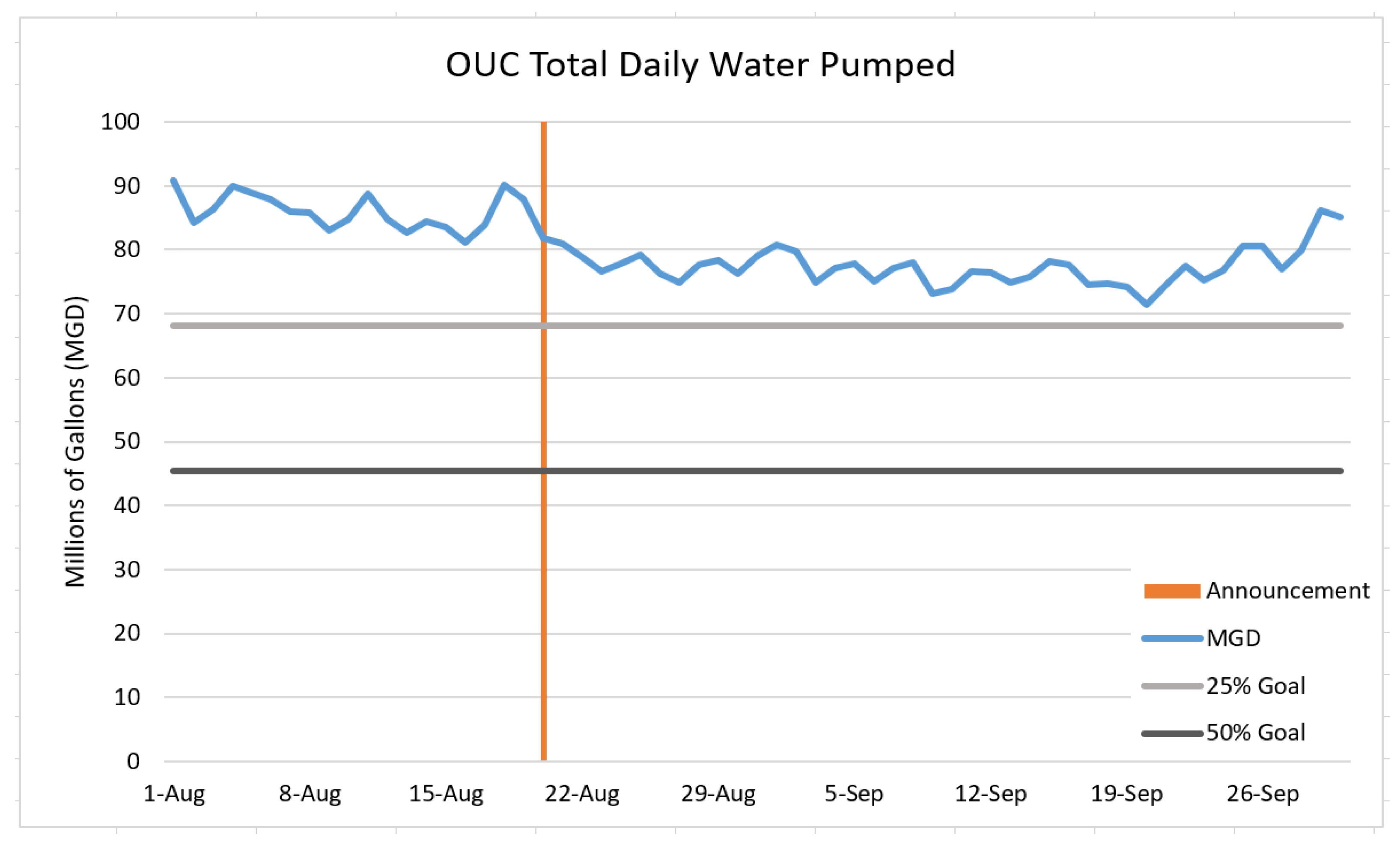
Just as calls for water conservation are part of the state’s long-term planning against water scarcity in the face of future population growth, so were there calls for water conservation during the near-term COVID-19 water treatment emergency. The Orlando Utilities Commission (OUC) made direct requests for their customers to limit lawn irrigation and other non-essential uses of drinking water during the crisis. Public requests were made to consumers August-September, during Florida’s rainy season. Over those two months, the OUC region received 10.95 inches of rain, which was 60–120% of the average for those months [12]. Although consumer demand for treated drinking water in Orlando fell slightly from the pre-emergency demand of approximately 90 MGD, the demand did not fall enough to meet necessary treatment capacity thresholds (Figure 1). The utility needed a 25–50% reduction in daily water demand, but as of 5 October 2021, the lowest daily usage since the beginning of the emergency was 71.5 MGD, only a 20% reduction. It is noteworthy that the lowest daily usage occurred on a Monday, the only weekday when irrigation is not permitted for any portion of the population under existing county watering restrictions.
Figure 1.
The blue line shows the total daily water pumped (consumer demand) by Orlando Utility Commission (OUC) in August and September 2020. The orange bar marks the initial call for water use reductions during the COVID-19 shortage of liquid oxygen supplies. Horizontal gray lines represent the 25–50% reduction thresholds needed (but not met) by the utility to continue normal disinfection processes.
Other experiences nationally and internationally have demonstrated similar results. For example, calls for voluntary limits on landscape irrigation during a drought in Los Angeles, California, from 2008 to 2010 were ineffective [13]. A review of water conservation programs across the US found that voluntary irrigation restrictions achieved only 4–12% of actual water savings [14].
4. Rethinking Strategies to Ensure Long-Term Water Supply
The futility of relying on calls for water conservation during the rainy season in the face of a short-term emergency in Florida demonstrates that there is much work to be done if we are to successfully rely on water conservation as a strategy to build long-term resilience in our water supply. Positioning water conservation as a tool in the toolbox against future water shortages is meaningless unless there is the societal will and action to use the tool, that is, to actually use less water. We have pointed out here that in Florida, more than half of all residential water use goes toward landscape irrigation, highlighting one key area for action. Achieving the necessary improvement in water conservation will require efforts in multiple sectors of society and will come from a combination of public education and engagement, advanced technologies (such as high-efficiency plumbing fixtures and appliances, and smart irrigation controllers), alternative landscaping practices, and best management practices. Other potential areas for change include regulatory actions such as irrigation codes and the enforcement of those codes, landscape efficiency ordinance adoption, and increasing-block rate structures from utilities.
The fragility of Florida’s drinking water supply system exposed by the COVID-19 pandemic also makes one thing very clear: We cannot fix an already-stressed water supply system at the last minute. Long-term regional water supply planning processes are an acknowledgment of this, but again, relying on plans for water conservation cannot be an effective strategy if plans are not fully executed through public action. Such calls were certainly not effective during Florida’s COVID-19 emergency. Looking forward, we need transdisciplinary and socio-hydrological research to better understand the feedbacks between water resources and society and any uncertainty associated with future global change, and how society will respond to that. Importantly, fixing our fragile water supply system and building resilience into it will need to view water supply as a coupled human-natural system, and we call for urgent future research on the underlying mechanisms driving social responses to drinking water vulnerability.
Author Contributions
Conceptualization, M.G.L., L.S.K. and N.T.; methodology, M.G.L., L.S.K. and N.T.; formal analysis, N.T.; writing—original draft preparation, M.G.L., L.S.K. and N.T.; writing—review and editing, M.G.L., L.S.K. and N.T.; visualization, N.T. All authors have read and agreed to the published version of the manuscript.
Funding
This research received no external funding.
Institutional Review Board Statement
Not applicable.
Informed Consent Statement
Not applicable.
Data Availability Statement
3rd Party Data. Data were obtained from and used with permission of the Orlando Utilities Commission and are available from the corresponding author with the permission of Orlando Utilities Commission.
Conflicts of Interest
The authors declare no conflict of interest.
References
- Economic and Demographic Research. Populations and Demographics. Available online: http://edr.state.fl.us/content/population-demographics/index.cfm (accessed on 10 October 2021).
- Florida Department of Environmental Protection. 2020 RWSP Annual Report Summary Table For AGO. Available online: https://www.arcgis.com/home/item.html?id=b3e8603649224aabbca5f1113bbed0f4 (accessed on 10 October 2021).
- Orlando Utilities Commission. Updates. Available online: https://ouc.com/water-info#faqs (accessed on 10 October 2021).
- Green, A. Orlando Officials: Conserve Water to Save Oxygen for Coronavirus Patients. Available online: https://www.wmfe.org/orlando-officials-conserve-water-to-save-oxygen-for-coronavirus-patients/188467 (accessed on 10 October 2021).
- Miller, D. Tampa Bay Water on Liquid Oxygen, Shortages, and the Pandemic. Available online: https://wusfnews.wusf.usf.edu/health-news-florida/2021-08-31/tampa-bay-water-on-liquid-oxygen-shortages-and-the-pandemic (accessed on 10 October 2021).
- Florida Department of Environmental Protection. Springs. Available online: https://floridadep.gov/springs (accessed on 10 October 2021).
- Marella, R.L. Water Withdrawals, Uses, and Trends in Florida. 2015. Available online: https://pubs.usgs.gov/sir/2019/5147/sir20195147.pdf (accessed on 10 October 2021).
- Borisova, T.; Cutillo, M.; Beggs, K.; Hoenstine, K. Addressing the Scarcity of Traditional Water Sources through Investments in Alternative Water Supplies: Case Study from Florida. Water 2020, 12, 2089. [Google Scholar] [CrossRef] [Scilit]
- Revoir, G.J.; MacNevin, D. Where Wastewater Treatment Ends and Drinking Water Begins: Evaluating the Viability of Potable Reuse in Florida. Proc. Water Environ. Fed. 2016, 6, 3281–3305. [Google Scholar] [CrossRef] [Scilit]
- Haley, M.B.; Dukes, M.D.; Miller, G.L. Residential irrigation water use in Central Florida. J. Irrig. Drain. Eng. 2007, 133, 427–434. [Google Scholar] [CrossRef] [Scilit]
- Taylor, N.; Price, K.O.R.; Spatz, B.; Johnson, P.; Jones, P. Florida H2OSAV insights: Home water use in orange county. EDIS 2021, 2021. [Google Scholar] [CrossRef] [Scilit]
- SFWMD. Historical Monthly Rainfall. 2021. Available online: https://www.sfwmd.gov/weather-radar/rainfall-historical/monthly (accessed on 10 October 2021).
- Mini, C.; Hogue, T.; Pincetl, S. The effectiveness of water conservation measures on summer residential water use in Los Angeles, California. Resour. Conserv. Recycl. 2015, 94, 136–145. [Google Scholar] [CrossRef] [Scilit]
- Mayer, P.; Lander, P.; Glenn, D.T. Outdoor water efficiency offers large potential savings, but research on effectiveness remains scarce. J. Am. Water Work. Assoc. 2015, 2, 61–66. [Google Scholar] [CrossRef] [Scilit]
Publisher’s Note: MDPI stays neutral with regard to jurisdictional claims in published maps and institutional affiliations. |
© 2021 by the authors. Licensee MDPI, Basel, Switzerland. This article is an open access article distributed under the terms and conditions of the Creative Commons Attribution (CC BY) license (https://creativecommons.org/licenses/by/4.0/).