


Abstract
Housing is a crucial determinant of population migration. However, the mechanisms through which urban housing influences floating-population re-migration, as well as its role in guiding the efficient spatial allocation of populations, remain underexplored. This study investigated the impact of urban housing status on population re-migration based on the spatial equilibrium theory, and empirically tested this relationship using nearly 370,477 individual migration intentions records from the China Migrants Dynamic Survey (CMDS). The key findings are as follows. First, urban housing status is related to shaping population re-migration intentions. In particular, owner-occupied housing and government-provided low-rent housing are associated with lower re-migration intentions. Second, institutional constraints on migrant populations can vary somewhat depending on household registration status. Rural-registered floating populations may sometimes face somewhat more restrictions in accessing urban housing and public services. By contrast, high-wage areas has less re-migration intentions primarily through labor income gains, leading to heterogeneous housing status effects on migration intentions. Further analysis reveals spatial and individual heterogeneity in how urban housing status shapes population re-mobility. Floating populations residing in first-tier, second-tier, and provincial capital cities prioritize employment opportunities. In comparison, first-generation floating populations, those with local spouses, and individuals engaged in low-risk occupations exhibit stronger demand for stable residence.
1. Introduction
Floating populations have emerged as a primary engine of urban development, and population mobility serves as a critical determinant of urban well-being, social cohesion, and sustainable development [1], bringing both opportunities and challenges to cities [2]. According to the definition of floating populations stipulated by the National Bureau of Statistics of China floating populations are defined as individuals who have resided outside their registered county, city, or district for no less than six months but have not transferred their household registration to their current residence. Amid the global process of urbanization, unstable housing among floating populations has become a key bottleneck constraining inclusive urban growth. The housing status of floating populations in urban areas is dominated by rental accommodation, with some members of this group still residing in informal housing. This population exhibits a pronounced tendency toward re-migration, with a corresponding share as high as 20.56%. Re-Migration Intentions refer to the floating population leaving the current city to relocate in other regions, including returning to hometowns and migrating to alternative cities. Poor urban housing conditions may reduce residents’ well-being and quality of life, while large-scale population movements could hinder the further development of cities.
In contrast to the declining domestic migration scale observed in the United States since 2008 [3,4], interprovincial population mobility in China has experienced gradual expansion, and rural areas have emerged as new destinations for floating populations (Figure 1 and Figure 2). The population migrating interprovincially to rural areas exceeded 7 million in 2000 and rose to more than 19 million by 2020, with Sichuan Province alone recording an increase of over 1.58 million, while the population migrating intraprovincially to rural areas stood at more than 10.8 million in 2000 and grew to over 16.84 million in 2020, including an increase of more than 1.58 million in Sichuan and an especially large rise of over 1.78 million in Zhejiang. Moreover, two-way population flows between urban and rural areas and across regions have become increasingly evident [5].
Figure 1.
Intraprovincial floating population moving to rural areas (data are sourced from China’s national population censuses conducted in 2000, 2010 and 2020; Map Examination and Approval Number: GS(2024)0650).
Figure 2.
Interprovincial floating population moving to rural areas (data are sourced from China’s national population censuses conducted in 2000, 2010 and 2020; Map Examination and Approval Number: GS(2024)0650).
Population re-mobility has become increasingly prevalent and has emerged as a pivotal driver reshaping global population distributions, with pronounced trends observed across all regions [6]. North America has witnessed notable re-migration patterns. In the United States, population shifts occur from large metropolitan areas to suburbs, from the Frost Belt to the Sun Belt, and out of high-cost regions. Traditional core states, including California and New York, register net population outflows, while central cities maintain growing appeal for interstate and international floating populations [3]. Latin America has seen population flows diverge from unipolar agglomeration to decentralized redistribution across cities. Europe also displays prominent re-mobility tendencies. German residents are relocating from aging industrial hubs in the east, such as the Ruhr region, to southern innovation centers, such as Munich and Stuttgart. France is experiencing substantial suburbanization alongside frequent cross-regional population exchanges [7], and distinct internal migration characteristics have likewise been identified in European nations such as Denmark [8]. In Asia, the population in India continues to concentrate in national hub cities such as Delhi, Mumbai, and Bengaluru [9], and the cross-state migration volume is expanding steadily [10]. In China, high population mobility has evolved into a normal spatial distribution pattern [11]. The country has entered an era dominated by migrant cities, and large-scale population flows continuously restructure urban development layouts and regional economic geographies [12].
In reality, only a small share of floating populations initially secure suitable employment in cities, with most individuals frequently changing jobs [13], leading to circular and repetitive mobility between urban and rural areas and across cities [14]. With deepening reforms in China and the implementation of national strategies such as regional revitalization, economic growth and social development across regions have gradually become more balanced [15,16]. Policies encouraging return entrepreneurship have induced repeat migration among a segment of the population [17], as small- and medium-sized cities and rural areas have increasingly become in-migration destinations [18]. These cities are no longer merely regarded as spillover zones of high-cost metropolitan areas [19], and their lower living and housing costs compared with those of metropolitan regions have enhanced their attractiveness [20]. In practice, return floating populations exhibit low stability both while working outside their hometowns and after returning to their registered residences [21]; meanwhile, the pattern of “leaving rural land and villages without returning” strengthens their desire to settle permanently in urban areas.
Under the influence of the traditional notion that homeownership signifies belonging, migrant populations generally regard the purchase of a house at their migration destination as a fundamental prerequisite for settled living and genuine local identity [22,23]. Housing is not only a key social determinant of health [24] but is also a factor shaping population mobility. Population re-mobility exhibits evident residential inertia, and home possession is negatively correlated with migrants’ secondary migration intentions. Relevant evidence suggests that the re-mobility rate among residents with urban housing assets is 42.94% higher than that of those without housing property [25]. Housing exerts more pronounced impacts on mobility intentions among low-income groups [26], and fluctuations in urban wages, housing rents, and endogenous welfare amenities further exacerbate socioeconomic inequality [27]. China has established a housing security system centered on public rental, indemnificatory rental, and shared ownership housing amid the ongoing urbanization drive [28]. Nevertheless, policy implementation falls short of expectations in practice, as most floating populations rely on private market rentals or makeshift construction site dormitories for accommodation, and failure to secure stable residential settlement in cities can substantially affect their re-mobility intentions.
Urban housing conditions constitute a core determinant of population re-mobility. As both a livelihood and developmental issue, housing bears on the vital interests of households and the stable well-being of residents [29], and housing availability and affordability directly shape labor migration patterns [30,31]. Young floating populations tend to relocate over short distances [32], a choice closely tied to housing affordability and employment prospects [33,34]. The Oswald hypothesis holds that high homeownership rates and local settlement-restricting policies are negatively correlated with labor mobility and impair labor market adjustment efficiency [35]. A high degree of housing privatization similarly hinders cross-regional labor mobility [36], and household heterogeneity also leads to divergent housing affordability levels [37]. Stringent housing regulation triggers an insufficient housing supply and rising housing prices in certain regions, eroding migration gains for low-skilled workers and their inflow [38].
The existing literature predominantly focuses on initial population migration, while research on secondary re-mobility remains limited. Moreover, scholarly discussions regarding population mobility, housing, and labor markets have not yet yielded a coherent and unified analytical framework, and divergent migration patterns between China, the United States, and most other nations offer opportunities to further test the Oswald hypothesis. This study aims to explore the relationship between housing status of the floating population and their secondary migration intentions, fill this research gap and establishes a migrant intentions model for migrant re-mobility, as individuals compare housing and employment conditions between their current destinations and prospective relocation destinations to seek places with superior living stability, and residents tend to stay and continue working locally if their current living conditions are preferable; otherwise, they opt for re-migration. Based on micro-level migrant data, this study empirically examines the influence of urban housing status on re-migration intentions and compares heterogeneous mobility preferences across regions. The findings clarify regularities governing migrant re-mobility and provide policy implications for housing and population governance in China and other economies worldwide.
2. Theoretical Analysis
2.1. China’s Hukou System
In China’s migration context, housing conditions, population mobility, and hukou status are strongly correlated. From the perspective of market transition, the hukou system exacerbates homeownership inequality between urban natives and migrant residents [39]. Additionally, acquiring local hukou status serves as a core determinant of the access of floating populations to urban housing assets [40].
Hukou refers to legal documents issued by state household administrative authorities that record and preserve fundamental personal demographic information [41], with China’s hukou system undertaking the function of public resource allocation. During the First Five-Year Plan starting in 1953, China adopted a heavy industry-oriented development strategy. Mass factory construction in urban areas attracted surplus rural laborers, driving the rapid growth of urban populations. This sharp population surge triggered shortages of grain, housing, education, medical care, and other public amenities in cities. In 1955, the State Council promulgated the Interim Measures for Unified State Purchase and Marketing of Rural Grain, imposing a nationwide unified grain procurement and distribution system. All grain produced by farmers was purchased exclusively by the state, and the grain supply for urban residents was centrally allocated by government authorities. Meanwhile, residents were classified into rural and urban hukou categories. Rural areas implemented a grain management system featuring fixed output, procurement, and sales quotas, while urban areas adopted tiered, rationed grain supplies verified by household registration, making hukou the core benchmark for grain production and distribution quotas [42]. Cities tightened their population inflow control in line with their grain supply capacities and expelled non-local residents without valid urban hukou status, tying their planned grain supply quotas directly to urban household registration. Under this institutional arrangement, grain was distributed strictly based on hukou eligibility. Floating populations without local hukou could not access basic grain provisions at their destinations, faced severe survival pressure, and were thus compelled to return to their registered hometowns.
Following the reform and opening up, China gradually relaxed restrictions on free population mobility and made economic policy adjustments. The Circular on Deepening the Reform of the Grain Purchase and Sales System issued by the State Council in 1994 officially liberalized the grain retail market. The grain supply was no longer subject to state planning and hukou constraints, decoupling grain access from household registration status. Since the relaxation of the urban–rural hukou system in 1978, massive rural laborer populations have migrated to cities; however, without urban hukou, floating populations live under distinctly different conditions compared with native urban residents. Relevant studies regard rural-registered floating populations as a unique intermediate group between peasants and urban citizens, and the segregation between floating populations and urban locals reflects the persistence of urban–rural division within urban society [43,44]. As socioeconomic development advanced, the hukou system gradually failed to adapt to changing realities. After the completion of state-owned enterprise restructuring around 2000, urban residents became far less reliant on affiliated work units and emerged as market-oriented individuals with independent migration intentions, and an increasing number left their registered hometowns to seek employment across cities.
China has deepened its hukou system reforms continuously since 2014, effectively mitigating institutional restrictions tied to household registration. The opinions on further advancing the reform of the household registration system released by the State Council in 2014 put forward three targeted measures to ease hukou constraints: (1) revision of migration policies and relaxation of settlement restrictions based on the urban population scale; (2) innovative population governance by establishing a unified urban–rural household registration framework and implementing the residence permit system; and (3) safeguarding of the legitimate rights and interests of rural floating populations and permanent residents, including improving rural property rights systems, expanding coverage of basic public services, and strengthening fiscal support for public service provision.
Concurrent with the hukou reform and the rapid growth of migrant populations, China’s real estate industry expanded alongside soaring housing prices [45]. During the housing system reform, urban natives enjoyed greater access to property ownership, which helped to elevate their living standards relative to floating populations. First, indigenous urban residents were eligible to purchase public housing from work units at discounted prices amid the reform [46]. Second, although housing transactions became fully monetized afterwards, benefits that accrued from the reform have exerted long-lasting effects, as close intergenerational bonds in China enable offspring to occupy and inherit parental housing assets. Third, accumulated housing wealth generates continuous capital appreciation. By contrast, intercity floating populations seldom gain such advantages. Driven by profit motives, floating populations generally move from towns and small cities to large- and medium-sized metropolitan areas in pursuit of higher incomes and superior social welfare. Moreover, their hometowns feature fewer public-sector institutions, resulting in limited chances for themselves or their parents to acquire subsidized housing. Even if property is owned, its appreciation rate lags far behind that in major cities. Moreover, even after selling local assets, substantial additional funds are still required to afford housing in destination cities, placing such purchases beyond the affordability of most floating populations. Consequently, urban natives possess notably higher homeownership rates than non-local floating populations due to uneven market access.
From an international comparative perspective, China’s model of regulating population mobility and allocating public resources via hukou management differs fundamentally from the population governance systems adopted by most economies. The vast majority of countries adopt residence-based population administration, where residents enjoy legal freedom of movement without rigid institutional barriers tied to registration status and housing entitlement is primarily determined by actual residency and employment conditions. In essence, the hukou system exerts a substantial influence on the housing acquisition costs of floating populations.
2.2. Re-Migration Intentions
Assume that a floating-population individual consumes a composite good and housing , and that individual utility depends on consumption and amenities; that is, utility is a function of the amenities, composite good, and housing, with the budget constraint given by the wage income. The utility maximization problem can then be expressed as follows:
where denotes the housing price. includes institutional factors, and we further derive the indirect utility function as follows: institutional restrictions hinder population mobility, . Particularly in China, the hukou system considerably increases floating-population housing acquisition costs in urban areas. The indirect utility function is thereby derived as follows:
Under spatial equilibrium, individuals freely migrate across regions and obtain a reservation utility () in any region, with the following result:
where is a constant, and , . This constant applies throughout the remainder of this paper. The objective function of real estate developers is given as follows:
where denotes the average residential building height in the city, represents the total land area allocated to residential use in the region, and . The condition implies that the construction cost per unit land area increases monotonically with the building height, and at an accelerating rate. Combining the maximization problem of real estate developers, we obtain the housing market equilibrium condition for a given total urban population () as follows:
The urban density can be approximated by the total urban population divided by the total land area ; thus, Equation (5) can be rewritten as follows:
When both the housing market and the household budget constraint are in equilibrium, we can solve Equations (3) and (5) simultaneously to obtain the following:
where , , and . In the general equilibrium framework, the real wage is positively correlated with the urban density (i.e., ) and is negatively correlated with urban amenities (i.e., ). This implies that individuals may choose to stay in a city with low amenities but high wages to balance housing and employment concerns, whereas those residing in cities with both low amenities and low wages have a stronger incentive to migrate in search of higher utility, thereby increasing their propensity for re-migration. Furthermore, under spatial general equilibrium, the following condition holds:
For a given residential density, housing prices are negatively correlated with amenities; that is, . Higher housing prices reduce the number of residential amenities affordable to the floating population given their wage income. Therefore, for a fixed level of wage income, rising housing prices may induce individuals to migrate across regions in pursuit of locations with higher utility. Accordingly, the reservation utility of an individual in the current region can be derived from Equation (3) as follows:
A migrant’s reservation utility in the current region depends on both the residential security derived from amenities () and the employment stability derived from wage income (). Under the influence of the traditional belief that “a stable home makes a family,” stable housing is widely regarded as a fundamental condition for secure living and employment. Therefore, for floating populations, achieving stability in their destination region also requires access to stable housing. We define the housing status of the floating population in the host region as . If housing conditions in the host region are poor and residential amenities are low, then , and vice versa. The housing conditions of floating populations who live in rented housing, shared accommodation, employer-provided temporary housing, or informal residences are typically poor. In such cases, pronounced residential segregation between floating populations and local residents often emerges [47], leading to barriers to social integration and psychological identification. Such residential segregation may weaken agglomeration externalities between firms, create intra-urban fragmentation, and thereby exert negative effects on the urban productive efficiency. We therefore infer the following: poorer housing conditions among floating populations are associated with lower productive efficiency and worse human capital outcomes, reflected by and .
We consider regional selection in the context of labor re-migration:
where and denote the expected utilities of the local region () and other regions (), respectively. For a representative migrant individual , indicates that the migrant chooses to leave the local region and relocate to another city (i.e., repeat migration), while indicates that the individual chooses to stay in the current city .
Based on the theoretical discussion above, we propose the following hypotheses.
Hypothesis 1:
Local housing prices are negatively correlated with migrants’ willingness to remain locally, whereas wage income is positively correlated with such willingness. In other words, high urban housing prices tend to raise the secondary migration intentions of the floating population, while higher wages help reduce such intentions.
Hypothesis 2:
The negative effect of housing prices on migration willingness is more pronounced among rural-registered residents.
Hypothesis 3:
Unstable housing status tends to raise the propensity for population re-mobility intentions.
Hypothesis 4:
Stable housing status tends to reduce the propensity for population re-mobility intentions.
3. Research Design
3.1. Empirical Strategy
China is a typical emerging market economy that has undergone an unprecedented urbanization process over the past few decades, characterized by rapid economic growth and large-scale rural–urban labor migration [48]. Motivated by the theoretical analysis of the relationship between urban housing conditions and the re-migration intentions of the floating population, we specified the predicted value of the re-migration intentions () to lie within the unit interval [0, 1], reflecting the binary probability of re-migration. For individual , where denotes the city, we employed the probit estimator for our baseline regression for ease of exposition and conducted comparative analyses using IVprobit models for robustness checks. The specific specification is as follows:
where denotes urban housing status; is the wage income of the floating population; represents local housing prices; stands for regional characteristics, including internet development, smoke emissions, industrial structure, educational resources, and medical resources; and refers to individual-level attributes, such as gender, age, marital status, and educational attainment. Furthermore, captures migration-related factors, including migration duration; , , , and γ are the coefficients to be estimated; and is the error term. The China Migrants Dynamic Survey is conducted by the National Health Commission of China, and its sampling distribution closely matches the regional pattern of domestic population mobility. Given its large sample size and high consistency between the variable distribution and population characteristics, survey weights were not adopted in this study; however, omitting weights poses no substantial threat to the robustness of the empirical results.
3.2. Data Source
The data used in this paper were obtained from the China Migrants Dynamic Survey (CMDS) for the period 2010–2018. The CMDS is a large-scale, annual, nationally representative survey of the floating population initiated in 2009 by the National Health Commission of China that covers migrant-concentrated destinations across 31 provincial-level administrative regions and the Xinjiang Production and Construction Corps in mainland China, excluding Hong Kong, Macao, and Taiwan. The survey collects nearly 200,000 household samples annually and records comprehensive information on the floating population and their family members. Initial CMDS pooled sample (2010–2018): 1,505,957 observations; Excluded due to age restrictions(only individuals aged 16–64 are retained) 11,157, Excluded due to unavailable housing variables 676,241; excluded due to missing re-migration intention 286,754; and 161,328 observations are removed because of missing values in other explanatory variables. final regression sample is 370,477. which was further merged with urban-level data. City statistics were sourced from the China Urban Statistical Yearbook and China Urban Construction Statistical Yearbook spanning 2010 to 2018, supplemented by official data from national and local statistical bureaus. The survey methodology for the floating population takes the 31 provincial-level administrative regions (provinces, autonomous regions and municipalities directly under the Central Government) in Chinese mainland and the Xinjiang Production and Construction Corps as subpopulations. Stratification is implemented within each subpopulation by provincial capitals, cities with separate state planning status, and key prefectures or regions. Table 1 presents the provincial distribution of sampled observations.
Table 1.
Sample Distribution.
3.3. Variable Definition
3.3.1. Dependent Variable
The dependent variable in this study is the re-migration intention of the floating population.
3.3.2. Independent Variables
The housing status of the floating population at their destination destinations is categorized into unstable housing and stable housing. Housing types including free accommodation from relatives, informal dwellings, employer-provided free housing, and private rental housing are classified as unstable housing. Occupants of such housing are vulnerable to involuntary relocation triggered by unexpected incidents such as landlords repossessing properties, termination of employment contracts, and urban environmental remediation, lacking long-term residential security. In contrast, low-rent public housing supplied by the government and owner-occupied housing are defined as stable housing, as residents’ residential rights are protected by laws and policies with a low risk of forced relocation.
Free borrowed housing is accommodation provided by relatives, friends or colleagues with no rental payment required. Informal dwellings are illegally self-built shelters including shanties and culverts. Employer-provided free housing is housing owned by employers (institutions or individuals) and offered free of charge based on employment contracts. Private rental housing is dwellings privately owned; respondents sign lease agreements with private landlords and pay rent directly to individual property owners. Government-sponsored low-rent housing is state-owned housing managed by local housing authorities; tenancy contracts are signed and rent is paid to corresponding government housing administrative departments. Owner-occupied housing is properties of which respondents hold full or partial property rights, covering commercial housing and policy-supported affordable housing such as economically affordable housing, talent housing, and price-limited commercial housing.
Individual wage incomes and housing prices are also incorporated. Housing price is measured by the annual average transaction price per square meter (RMB/m2) of commercial residential housing at the county level across China. The housing price data are obtained from national and local real estate transaction information platforms in China.
3.3.3. Control Variables
Population re-migration is essentially a rational intention made by individuals under the combined effects of personal endowments, family constraints, and regional environments. Accordingly, this study specifies control variables across three dimensions: regional characteristics, individual and household characteristics, and migration experience. At the regional level, to account for the influence of regional development disparities on re-migration intentions, we include indicators such as housing prices, internet development, intensity of smoke and dust emissions, industrial structure, supply of educational resources, and supply of medical resources. At the individual and household level [21], we include gender, age, marital status, and educational attainment as core control variables to capture the role of heterogeneity across microeconomic agents. In addition, previous migration experience has been shown to significantly shape subsequent migration intentions [14]. We therefore further control for migration-related characteristics, such as migration duration.
3.4. Urban Housing Conditions and Migration Patterns of China’s Floating Population
In China, population movements are predominantly directed toward urban areas. Consistent with the overall evolutionary pattern of internal migration in China, the total size of the floating population continues to expand, with the dominant flow directed toward urban agglomerations. At the same time, intraprovincial nearby migration and inter-county migration have emerged as increasingly prominent new trends in China’s migration landscape (see Figure 3 and Figure 4), with the scale of intraprovincial migration expanding substantially and continuously. Data indicate that China’s intraprovincial floating population reached 130.89 million in 2020, equivalent to 2.05 times its 2010 level and 3.35 times its 2000 level, making intraprovincial movement a major component of the overall population mobility. Among provinces, Guangdong Province, as a major migration destination, recorded an intraprovincial floating population of 17.8498 million in 2020, ranking prominently among all provinces, municipalities, and autonomous regions nationwide. The scale of interprovincial (cross-provincial) migration has also maintained steady growth. Specifically, China’s interprovincial floating population stood at approximately 23.12 million in 2000, rose to 58.02 million in 2010, and further climbed to 88.32 million in 2020. By 2020, its scale had expanded nearly 3.8 times relative to that in 2000, and high growth persisted over the 2010–2020 period. In terms of regional distribution, interprovincial floating populations exhibit a clear pattern of agglomeration in economically developed regions. Among them, Guangdong Province received an interprovincial in-floating population of 24.86 million in 2020, while Zhejiang Province, Shanghai, and Jiangsu Province each hosted cross-provincial in-floating populations of more than 6 million, establishing the Yangtze River Delta as China’s most magnetizing region for population inflows.
Figure 3.
Intraprovincial urban migrant population (data are sourced from China’s national population censuses conducted in 2000, 2010 and 2020; Map Examination and Approval Number: GS(2024)0650).
Figure 4.
Interprovincial urban migrant population (data are sourced from China’s national population censuses conducted in 2000, 2010 and 2020; Map Examination and Approval Number: GS(2024)0650).
The housing status of floating populations in urban areas is dominated by rental housing. As indicated by the descriptive statistics in Table 2, 64.7% of China’s floating population lives in rented housing; 1.6% resides in borrowed housing; 11.8% occupies free housing provided by employers; 0.7% lives in government-provided low-rent housing; 20.6% owns self-purchased housing; and a small share of 0.4% still lives in informal residences. These findings are consistent with other research [49], who document that floating populations often reside in informal communities such as urban villages, construction camps, and substandard basements near their workplaces, while access to public low-rent housing remains quite limited. Constrained by low income and household wealth, the share of the floating population that owns housing is relatively small, especially amid high and rising housing prices.
Table 2.
Descriptive statistics of variables.
Floating populations are predominantly male, accounting for 52.1% of the sample. Married or remarried individuals have gradually become the main group among migrants. The average educational attainment of migrants falls between junior high and senior high school, which is largely attributable to the universalization of China’s nine-year compulsory education, as an increasing number of floating populations complete junior high school before entering the labor market. The average duration of residence in the host city is approximately five years, and cross-provincial movement remains the dominant migration pattern.
Urban housing status is directly linked to the re-migration intentions of the floating population. As illustrated in Figure 5, floating populations living in informal residences display the highest propensity for re-migration at 20.56%. This pattern arises primarily because of reduced residential comfort due to the absence of formal or stable accommodation and, ceteris paribus, the desire for a stable living environment. The re-migration rate is also relatively high (18.43%) among floating populations residing in employer-provided free housing. Although such housing reduces living expenses, employer-provided dormitories are often associated with poor living conditions. Furthermore, rational employers effectively treat housing benefits as part of the total monetary compensation package, meaning that such benefits are indirectly deducted from employees’ wages. The re-migration rates for floating populations living in borrowed housing and private rental housing are 17.27% and 15.47%, respectively. In comparison, the re-migration rates are substantially lower for those in government-provided low-rent housing and owner-occupied housing, standing at only 10.16% and 8.96%, respectively. Household groups with owner-occupied housing exhibit the lowest propensity for secondary migration; however, this specification suffers from endogeneity, as home purchase itself represents a settlement decision, implying a bidirectional causal relationship with repeat migration intentions.
Figure 5.
Urban housing status and re-migration of floating population.
4. Empirical Results
Based on the theoretical analysis of the relationship between urban housing conditions and labor re-migration, we control for time fixed effects, location fixed effects, as well as regional characteristics, individual attributes, and migration-related factors. The empirical results are consistent with our theoretical predictions: in making re-migration intentions, floating populations value not only employment opportunities that support their livelihoods but also stable urban housing conditions that enable them to settle comfortably.
4.1. Baseline Regression
Urban housing status is a key determinant of population re-migration. As shown in the empirical results (Table 3), borrowed housing, informal residences, employer-provided free housing, and rented housing all exert significantly positive effects on population re-migration. That is, floating populations living in borrowed or rented accommodation, as well as those in employer-provided dormitories or informal settlements, are more likely to seek re-migration to improve their current utility. Government-provided low-rent housing has a significantly negative effect on re-migration, mainly because public low-rent housing reduces the housing and mobility costs of floating populations [9] while providing decent living conditions that increase individual utility in the destination city, thereby lowering the propensity to re-migrate. Owner-occupied housing also has a significantly negative coefficient, implying that members of floating populations who own housing in their host cities prefer to settle there permanently rather than relocate again, thereby reducing re-mobility intentions.
Table 3.
Housing status and population mobility intentions.
As shown in the empirical results (Table 3), wage income has a significantly negative effect on re-migration, indicating that higher wage income is associated with a lower re-migration propensity, mainly because higher income improves individual living conditions and positively affects the utility of floating populations. When wages are relatively high in the destination city, floating populations tend to stay locally rather than relocate again after comparing income levels across alternative regions. The empirical results (Table 3) also show that housing prices have a significantly positive effect on individual re-migration intentions, meaning that higher housing prices are associated with a stronger inclination to relocate. In the face of elevated housing prices, floating populations may perceive that they cannot improve their residential conditions through their own efforts or family support, and because most floating populations aspire to decent housing for themselves, their children, and their families, they are more likely to seek relocation to enhance their utility, increasing the probability of re-migration.
Floating populations tend to avoid re-migrating to areas with better living environments. As reported in Table 3, internet development has a significantly negative effect on re-migration. In particular, widespread internet access facilitates job hunting and boosts population mobility. Smoke and dust emissions show a significantly positive coefficient, indicating that floating populations respond sensitively to environmental conditions. In cities with severe air pollution and high smoke emissions, many floating populations choose to leave for health reasons or to seek better residential quality, thereby increasing re-migration. Floating populations are less likely to relocate repeatedly in regions with more advanced industrial structures and better public services. As shown in Table 3, industrial structure has a significant negative effect on re-migration. A higher-value industrial structure reflects a more developed non-agricultural sector, which implies stronger labor demand and greater attractiveness to floating populations, lowering the incentive to re-migrate. Educational resources also exert a significantly negative effect. Floating populations are more inclined to settle in places with abundant educational provisions, especially as their migration careers progress to marriage and child-rearing and the availability of quality education for children and grandchildren becomes a key consideration. Richer local educational resources raise the likelihood of stable schooling for younger generations and reduce the propensity to migrate again. Similarly, medical resources have a significantly negative impact on re-migration. As an essential component of public services, medical care becomes increasingly important throughout the life cycles of individuals, particularly in the later stages of life. Adequate healthcare provision therefore acts as an important anchor that discourages re-migration.
Individual endowments are crucial determinants of re-migration intentions. As shown in Table 3, being male has a significantly negative effect on re-migration, indicating that male floating populations exhibit a lower propensity to relocate again. Age exerts an inverted U-shaped effect on secondary migration: individuals’ propensity to relocate rises with age at first and then declines as age further increases, older floating populations tend to have accumulated more local social networks and have adapted to the local environment, making them less willing to migrate repeatedly. This finding is consistent with the negative effect of migration duration on re-migration. Moreover, older individuals generally possess weaker adaptability to new environments than younger cohorts, further reducing their likelihood of re-migration. Marital status has a significantly negative effect on re-migration: married or remarried floating populations typically prefer to maintain stable employment locally to support household expenditures. Educational attainment also exerts a significantly negative impact on re-migration. In general, floating populations with higher educational attainment can access more employment opportunities in the host city [50] and are thus less inclined to engage in repeated migration.
Contemporary migration characteristics represent important determinants of re-migration intentions. As shown in Table 3, migration duration has a significantly negative effect on re-migration, meaning that the longer floating populations have resided in their destinations, the lower their propensity to relocate again. Influenced by the traditional Chinese cultural value of “reluctance to leave one’s native place,” longer periods of local employment and living lead to greater adaptation to local life, and the destination often becomes a second hometown, thereby discouraging further migration. The migration scope has a significantly positive effect on re-migration, indicating that a broader migration range is associated with a higher likelihood of repeated migration. Floating populations who have moved over longer distances tend to be more adaptable and less attached to their places of origin. This pattern is particularly evident among cross-provincial floating populations, who often display a higher propensity to relocate again, commonly moving to the provincial capital of their birth region or to nearby counties or urban districts in the later migration stages.
4.2. Hukou System and Population Re-Mobility Intention
Population mobility in China is strongly shaped by institutional factors. The relationship between housing status and re-mobility across different hukou categories is analyzed in this section to better identify the hukou system’s effects on re-mobility.
For rural-registered floating populations, residing in borrowed or informal dwellings corresponds to stronger re-mobility intentions. The empirical results (Table 4 and Table 5) show that such housing conditions exert a significantly positive effect on the re-mobility propensity of rural-registered floating populations, while no significant effect is observed for their urban-registered counterparts. Most rural floating populations relocate merely to secure a basic livelihood with limited financial capacity. The long-term occupancy of borrowed and informal housing comes with poor living conditions and insecure residency, hindering urban social integration and diminishing local attachment. Meanwhile, floating populations face low sunk costs of migration, making unstable housing a notable driver of repeated mobility. By contrast, urban-registered floating populations pursue career advancement with superior resource endowments and economic status, treating informal accommodation as a temporary transition. Favored by local registration benefits, urban-registered floating populations access urban public services conveniently and build stable careers, social networks, and daily ties. Higher migration costs make temporary housing drawbacks insufficient to alter settlement intentions, resulting in an insignificant correlation between informal residence and re-mobility intention.
Table 4.
Effects of housing status on re-mobility intentions of rural hukou population.
Table 5.
Effects of housing status on re-mobility intentions of urban hukou population.
Urban-registered floating populations exhibit higher re-mobility intentions when living in employer-provided free housing or rental residences. The empirical results in Table 4 and Table 5 suggest that the coefficient impacts of such housing types on re-mobility intentions are larger for urban-registered floating populations than for their rural counterparts. Urban-registered floating populations generally enjoy better employment quality and brighter career prospects. Employer-sponsored accommodation and private rental housing cut living expenses substantially and strengthen employment attachment. Rural-registered floating populations are mostly engaged in casual and temporary jobs with unstable employment and inherent mobility preference, and even with such housing support, their short-term working orientation and readiness to relocate remain largely unchanged.
The empirical results presented in Table 4 and Table 5 indicate that urban floating populations residing in government-subsidized low-rent housing show lower re-mobility intentions. Holding urban household registration, such floating populations face fewer barriers to accessing basic public services and primarily migrate to pursue better career prospects. Featuring low rent, stable tenure, and solid policy guarantees, low-rent housing effectively eases residential pressure, stabilizes livelihood expectations, consolidates local settlement patterns, weakens mobility incentives driven by the housing strain, and thereby significantly reduces the re-mobility propensity of this group.
The empirical results in Table 4 and Table 5 reveal that rural-registered floating populations who own residential property exhibit lower re-mobility intentions. A home purchase serves as a pivotal symbol of urban settlement for this group. Property accumulation solidifies local livelihood roots and raises migration sunk costs substantially, which greatly discourages the willingness of these populations to relocate. By contrast, urban-registered floating populations already possess urban living foundations and household registration privileges; thus, homeownership is not an essential condition for settlement. Government-subsidized low-rent housing, with low living costs, reliable security, and stable policy support, adequately satisfies basic housing needs and stabilizes long-term life expectations. Accordingly, rural-registered floating populations are subject to stricter restrictions on housing acquisition and public service access, while institutional constraints differ markedly between the two hukou groups.
4.3. Housing Prices, Wages, and Population Re-Mobility Intention
Population mobility is directly related to local housing prices and wage levels. When deciding whether to re-migrate, individuals compare housing prices and wage levels between their current location and alternative destinations (Table 6). Accordingly, based on region-level data on migrant wages and housing prices, we compared relative housing prices and relative wage levels across potential inflow areas and categorized regions into four types: high-housing-price/high-wage regions; high-housing-price/low-wage regions; low-housing-price/high-wage regions; and low-housing-price/low-wage regions. We then analyzed re-migration intentions across these regional categories.
Table 6.
Relative to local housing prices and wage income.
As shown in Figure 6, the re-migration rate is the highest in high-housing-price/low-wage regions, reaching 19.86%, followed by low-housing-price/high-wage regions at 16.86%, high-housing-price/high-wage regions at 14.72%, and low-housing-price/low-wage regions at only 14.09%. The main reason is that floating populations face relatively low employment and living pressure in low-housing-price/low-wage regions, and many floating populations who move to such areas tend to settle locally, which also constitutes a key focus of county-level economic development.
Figure 6.
Regional classification and re-migration.
Low housing prices weaken the negative impact of unstable housing conditions on re-mobility intentions and amplify the positive effect of relatively stable housing status. To further explore regional housing price effects, the regression in Table 7 incorporates interaction terms between the low-housing-price regional dummy variable and housing status indicators. The empirical results in Table 7 show that the effects of borrowed housing and informal dwellings on re-mobility intentions become insignificant after introducing their respective interaction terms. The coefficient of employer-provided free housing declines following the inclusion of its interaction term. The coefficient of rental housing reverses to negative, while the negative magnitude of the coefficient for government-subsidized low-rent housing becomes larger.
Table 7.
Low housing prices, housing status, and population re-mobility.
High wages strengthen the positive effect of stable housing status on re-mobility intentions and exert heterogeneous influences on the negative impact of unstable housing conditions. Interaction terms between the high-wage regional dummy and housing status are incorporated into the regression model in Table 8 to examine the regional wage effects on the re-mobility propensity.
Table 8.
High wages, housing status, and population re-mobility.
As shown in Table 8, the coefficient of borrowed housing increases, and its interaction term presents a negative value. The statistical significance of informal housing declines after introducing the corresponding interaction term. The coefficient of employer-provided free housing decreases, with its interaction term positively associated with re-mobility intention. Rental housing yields a smaller baseline coefficient, and its interaction term is significantly positive. Meanwhile, low-rent housing generates an enlarged negative coefficient after adding the high-wage-region interaction term.
4.4. Individual and Spatial Heterogeneity of Population Re-Mobility
Re-migration intentions reflect the employment or residential location choices that floating populations make by comparing regional conditions based on individual characteristics and thus exhibit substantial spatial and individual heterogeneity. Accordingly, this section examines spatial heterogeneity in re-migration intentions by classifying regions according to their characteristics into first-tier, second-tier, third-tier, and lower-tier cities, as well as provincial capitals versus non-capital cities. Individual heterogeneity is further analyzed across three dimensions: personal characteristics (first-generation versus second-generation floating populations), household migration characteristics (spouses residing locally versus spouses residing elsewhere), and occupational characteristics (lower-risk occupations versus higher-risk occupations).
Floating populations in first- and second-tier cities tend to prioritize employment prospects signaled by wage income, whereas those in third- and lower-tier cities place greater weight on housing conditions that reflect residential security. As reported in Table 9, the size of the effect of wage income on re-migration is substantially larger for floating populations in first- and second-tier cities. In third- and lower-tier cities, by contrast, homeownership displays a significantly positive effect on re-migration, and housing prices also exert a significantly positive effect. However, housing prices have no statistically significant impact on re-migration in first- and second-tier cities. The primary mechanism is that housing prices in first- and second-tier cities are relatively high, making homeownership and permanent settlement challenging for the average migrant. Most floating populations that migrate to these areas are motivated primarily by higher earnings; thus, wage income plays a dominant role in their mobility intentions. In third- and lower-tier cities, however, floating populations tend to prefer more comfortable living environments and often aim to settle permanently through homeownership, and as a result, housing tenure status and housing prices exert stronger influences on their re-migration intentions.
Table 9.
Heterogeneity analysis (spatial).
Floating populations in provincial capitals tend to prioritize employment prospects reflected in wage income, whereas those in non-capital cities place greater emphasis on housing conditions that represent residential stability. The empirical results in Table 9 indicate that homeownership exerts a larger coefficient effect on re-mobility among floating populations in non-provincial capital cities. By contrast, wage income shows more significant impacts and housing prices carry greater coefficient magnitudes for floating populations residing in provincial capital cities. Provincial capitals are generally key regional development hubs with relatively developed economies and more abundant employment opportunities. However, their housing prices tend to be higher, making homeownership and permanent settlement less attainable for most floating populations. By contrast, non-capital cities usually feature slower economic growth and lower housing prices, enabling a higher likelihood of settlement through home purchases. Consequently, housing prices and conditions exert more pronounced effects on the re-migration intentions of floating populations in these areas.
Housing tenure conditions exert a stronger influence on second-generation floating populations, and wage has negative correlation in population re-migration. As shown in Table 10, the coefficient effect of local homeownership on re-migration is larger for second-generation floating populations than for first-generation floating populations. The main explanation is that second-generation floating populations tend to place greater emphasis on residential comfort, rendering housing conditions more influential to their mobility intentions. In contrast, the coefficient effect of wage income on re-migration is considerably larger among first-generation floating populations. This finding aligns with the preference of second-generation floating populations for residing in owner-occupied housing, such that wage income plays a relatively weaker role in shaping their re-migration intentions compared with first-generation floating populations.
Table 10.
Heterogeneity analysis (individual).
The effect of housing prices is more pronounced for floating populations whose spouses reside locally. As shown in Table 10, among floating populations with local spouses, the coefficient effect of homeownership on re-migration is smaller than that for floating populations whose spouses live elsewhere, while the coefficient effect of housing prices on re-migration is more statistically significant. The main reason is, ceteris paribus, floating populations with local spouses tend to have more extensive local social networks and core household members present, which reduces their propensity to re-migrate. The impact of wage income on population re-mobility presents a more significant coefficient for floating populations whose spouses reside locally. As migration evolves into a new phase, individual migration is gradually shifting toward family migration, and local co-residence with spouses raises the willingness of residents to settle permanently.
Wage income exerts a more pronounced effect on workers in high-risk occupations, while housing status carries a larger coefficient for those in low-risk jobs. As shown in Table 10, housing status and housing prices impose stronger impacts on re-mobility among low-risk workers, whereas wage income plays a more dominant role for high-risk occupational groups. Low-risk floating populations, such as skilled workers, tend to prioritize residential conditions, while high-risk workers focus more on income returns.
4.5. Robustness Checks
A series of robustness checks were conducted in this study to further ensure the reliability of the findings (Table 11). First, we adjusted the model specification. Given that the floating population survey adopts a sampling design, omitting sampling weights may yield biased coefficient estimates and standard errors and compromise sample representativeness. Accordingly, Column (1) of Table 11 employs a weighted Probit regression. Second, we altered the sample scope. Because floating populations may not exit the labor market precisely at age 65, in Column (2) of Table 11, we relaxed the age restriction from 15–64 to a broader sample. Third, rooted in traditional Chinese culture, individuals bear responsibilities for elder support and child-rearing [51], and the presence of children inevitably affects the intentions of floating populations. To isolate the direct intentions of floating populations, in Column (3), we restricted the sample to childless floating populations for the regression analysis. Third, we removed outliers and addressed administrative heterogeneity. Fourth, given that municipalities directly under the central government may not be comparable to ordinary prefecture-level cities due to their special administrative status, Column (4) excludes observations from Beijing, Shanghai, Guangzhou, and Shenzhen. Fifth, we accounted for migration motives. The reason for the current migration may influence re-migration intentions, especially for those who migrate for training or education, who tend to have a higher propensity to re-migrate. Column (5) thus excludes this subgroup for robustness.
Table 11.
Robustness checks.
Finally, as discussed in the theoretical framework, wage income, housing prices, and housing tenure may be mutually endogenous. Valid instrumental variables need to satisfy correlation and exogeneity conditions. A two-period lagged housing price was adopted in this study as the instrumental variable for current housing prices, and the average wage of urban employees was adopted as the instrumental variable for the wage incomes of migrants. Affected by the temporal price transmission effect, the lagged housing price is strongly correlated with the current housing prices. Regional average employee wages determine local income benchmarks and closely correlate with individual wage incomes, which satisfies the correlation requirement of instrumental variables. Meanwhile, historical housing prices cannot be reversely affected by current migration intentions, and macro-wage levels are independent of individual intentions. Both instrumental variables only exert impacts on the re-migration willingness of floating populations indirectly through corresponding endogenous variables without direct influence channels. The selection of instrumental variables is scientifically valid, and the first-stage joint F-statistic was applied to test weak instrumental variables. As shown in Column (6), all F-values are significantly higher than the critical values, indicating no weak instrumental variable bias. The number of instrumental variables equals that of endogenous variables, forming an exactly identified model with no need for overidentification testing. The robustness test results are consistent with the baseline regression outcomes, verifying the reliability of the empirical findings.
5. Discussion
5.1. Policy Implications
Population mobility is a core driving force reshaping regional economic layouts, and its patterns and evolutionary trajectories are shaped by a country’s stage of economic development, industrial restructuring, and regional disparities, resulting in distinct cross-country variations [24,52]. From a global perspective, developing countries remain in a phase of rapid urbanization, where large-scale rural–urban migration dominates population movement, with populations concentrating in core cities and metropolitan areas. By contrast, developed countries have entered a stage of stock optimization in population mobility, shifting from traditional rural–urban migration to intercity resource reallocation, suburbanization of metropolitan areas, and counter-urbanization, weakening the trend of population mobility.
The drivers of population mobility have become increasingly diversified, and its determinants are numerous and heterogeneous across individuals [53]. Young and middle-aged floating populations in European countries [54] relocate mainly for education, career, or family reasons. Among these factors, economic conditions have long been central to migration intentions, including employment opportunities and institutional barriers [55,56]. As population mobility enters a new phase, however, floating populations tend to marry, have children, and watch their children grow up, complete schooling, enter the labor force, and potentially join the migration stream themselves [57,58]. Social networks, identity formation [30], and other non-economic factors have gradually gained prominence, making the determinants of rural–urban and urban–urban migration more complex and diverse, while the role of economic factors has diminished. Urban public services [59], information technology [60], identity rents associated with birth cities [61], housing prices [62], and residential environments have all become key determinants of re-migration. Significant spatial interdependencies exist across migration destinations, highlighted by interactions between housing price levels and origins categorized by age cohort, distance, or housing price ranges [63]. In essence, individual migration intentions represent utility-maximizing intentions under given constraints, where utility derives not only from wage income from employment but also from residential stability.
Based on the theoretical and empirical results, urban housing status plays a substantial role in shaping population re-migration. Targeted policy guidance is needed to prevent declines in individual well-being and regional mismatches of human resources that could undermine local economic development. Accordingly, this study proposes the following policy implications:
(1) Residential supply systems need to be improved and informal housing settlements rectified. Against the backdrop of an expanding migrant population and frequent cross-regional re-mobility, renting remains the dominant housing intention for floating populations. The government should scale up the construction of indemnificatory and affordable rental housing and standardize the rental market. Moreover, it is also necessary to renovate informal residential clusters, upgrade living conditions for temporary residents, and enhance the overall housing quality for floating populations.
(2) The multi-level housing security system must be improved. Eligible floating populations with sound financial capacity can be reasonably supported to purchase housing and settle down. The supply scope and scale of low-rent and public rental housing need to be expanded to stabilize residential settlement. Meanwhile, regional housing price regulation is required, as well as a steady increase in the labor income of floating populations. These measures will shift migration intentions from income-oriented choices to rational trade-offs among residential environments, employment quality, and living costs.
(3) Barriers stemming from the household registration system must be broken, the rights and interests of rural–urban floating populations must be equalized, and institutional restrictions arising from household registration disparities must be gradually eliminated. Access thresholds for urban housing purchases, subsidized housing applications, education, medical care, and other public services should be relaxed for rural-registered floating populations, and policy gaps between urban and rural residents in urban settlement and development should be narrowed to ease urban integration pressure and reduce involuntary re-mobility driven by institutional constraints.
(4) The moderating effects of housing prices and income must be leveraged to refine regional settlement support policies. Housing price and wage adjustments should be given full play, and basic public amenities in low-price areas should be upgraded to boost the stable-housing settling capacity. In high-wage industrial clusters, enterprises should be encouraged to provide staff dormitories and housing subsidies to retain floating populations via high income and stable residence. Policy designs should be differentiated based on the varied impacts of income and housing prices, and targeted housing assistance measures need to be adopted to balance settlement and mobility intentions among floating populations with disparate economic conditions.
(5) Differentiated regional governance strategies need to be adopted to reconcile regional disparities and individual demands. Given the spatial and individual heterogeneity in housing-related mobility patterns, first-tier, second-tier, and provincial capital cities should prioritize optimizing salary structures and career advancement paths to retain floating populations via high-quality employment opportunities, and small and medium-sized cities should improve residential supporting facilities and cut living costs. Moreover, targeted policies should cater to diverse groups: preferential settlement policies should be offered to first-generation floating populations, migrant families, and employees with stable, low-risk occupations in response to their strong settlement intentions, and flexible housing regulations should be applied to young-generation floating populations and highly mobile workers to balance their career mobility needs and basic living security.
(6) We recommend coordinating the macro-population distribution and guiding the rational and orderly re-mobility of floating populations. Drawing on international experience and domestic mobility trends, housing and industrial layouts should be utilized to guide reasonable population diversion and ease overconcentration in large cities. Moreover, floating populations should be encouraged to relocate to cities matching their housing affordability, income levels, and living demands, forming a new pattern with a rational scale, orderly migration directions, and stable residential status.
5.2. Limitations and Future Studies
One limitation of this study lies in its relatively short time span. Although the large-scale Chinese sample provides a general picture of how urban housing affects population re-migration, it may not fully capture the evolving trends of migration over time. The research primarily utilizes the migration willingness of the floating population, and there may be some differences between migration intentions and migration behavior, and the data capture stated intention only, distinct from decision and realized move. In terms of the variable selection, using monthly wages as a proxy for economic status only reflects the current income of the floating population and fails to capture long-term financial stability and household endowments, which leads to measurement limitations. Future research can adopt multi-period income data and household assets to better characterize the economic standing of floating populations. In addition, cross-border population mobility between China and other countries is substantial, yet this dimension is not included in the dataset, preventing comparative analyses with international re-migration patterns. Future research incorporating long time-series data and cross-country comparisons would help to deepen the understanding of the dynamic nature of the relationships among these variables.
6. Conclusions
Floating populations inject new vitality into urban development, while urban housing conditions and wage levels represent key determinants of population re-migration. This study theoretically and empirically examined the impact of urban housing status on the re-migration intentions of floating populations. The main conclusions are as follows:
Unlike the declining scale of internal migration in the United States, China is still witnessing a growing migrant population alongside an upward trend in cross-regional re-mobility. Most floating populations reside in rented housing in urban areas, while some still live in informal dwellings. This group exhibits a pronounced propensity toward re-migration, with a corresponding share as high as 20.56%. Urban housing status serves as a core determinant of population re-mobility. Homeownership is negatively correlated with re-mobility propensity. Similarly, government-subsidized low-rent housing also exerts a negative effect on re-mobility. Migration intentions no longer merely stem from the individual pursuit of maximum employment income but represent comprehensive trade-offs between residence and employment constrained by housing institutions, housing prices, and income levels. Institutional constraints vary across household registration statuses. Floating populations with rural hukou encounter stricter restrictions in accessing urban housing and public services. Low housing prices mitigate the negative effect of unstable housing status on re-mobility intention and amplify the positive impact of relatively stable housing conditions. High wages strengthen the positive association between stable housing status and re-mobility willingness and generate heterogeneous effects on the negative influence of unstable housing status. The effect of urban housing status on re-migration displays spatial and individual heterogeneity. Floating populations in first-tier, second-tier, and provincial capital cities tend to prioritize wage income. In contrast, first-generation floating populations, those with local spouses, and those in lower-risk occupations express stronger demand for residential stability.
Author Contributions
Conceptualization, Z.D. and J.K.; methodology, Z.D.; software, Z.D.; validation, Z.D. and J.K.; formal analysis, Z.D. and J.K.; investigation, J.K.; resources, J.K.; data curation, Z.D.; writing—original draft preparation, Z.D. and J.K.; writing—review and editing, J.K.; visualization, Z.D.; supervision, Z.D.; project administration, J.K.; funding acquisition, Z.D. and J.K. All authors have read and agreed to the published version of the manuscript.
Funding
This research was funded by The Youth Project of the National Social Science Fund of China entitled “A Study on the Evolution Mechanism and Adaptive Adjustment of the Hierarchical Elderly Care Service Network in Rural Areas Under the Background of Intergenerational Residential Separation” (25CGL100), and by The Phase Achievement of the Shanghai Cultural Talent Fund Project (2025-A01).
Institutional Review Board Statement
Not applicable.
Informed Consent Statement
Not applicable.
Data Availability Statement
The data supporting the conclusions of this article will be made available by the authors upon request.
Conflicts of Interest
The authors declare no conflicts of interest.
References
- Mkrtchyan, T.; Khachatryan, A.; Ratner, S. Urban Demographic Risks and Sustainability: A Composite Index Approach to Population Change, Health, and Migration in Armenia. Urban Sci. 2026, 10, 200. [Google Scholar] [CrossRef] [Scilit]
- World Economic Forum. Migration and Its Impact on Cities; World Economic Forum: Geneva, Switzerland, 2017. [Google Scholar]
- Molloy, R.; Smith, C.L.; Wozniak, A. Internal migration in the United States. J. Econ. Perspect. 2011, 25, 173–196. [Google Scholar] [CrossRef] [Scilit]
- Olney, W.W.; Thompson, O. The determinants of declining internal migration. J. Urban Econ. 2026, 153, 103856. [Google Scholar] [CrossRef] [Scilit]
- Tang, D.; Liu, X.; Ni, H.; Yang, Y. The Changing Global Economic Landscape and China’s Potential Growth Rate and High-quality Development in the Post-epidemic Era. Econ. Res. J. 2020, 55, 4–23. [Google Scholar]
- Niva, V.; Horton, A.; Virkki, V.; Heino, M.; Kosonen, M.; Kallio, M.; Kinnunen, P.; Abel, G.J.; Muttarak, R.; Taka, M.; et al. World’s human migration patterns in 2000–2019 unveiled by high-resolution data. Nat. Hum. Behav. 2023, 7, 2023–2037. [Google Scholar] [CrossRef] [Scilit] [PubMed]
- Kveladze, I.; Jokinen, J.C.; Tapia, C.; Hansen, H.S. What can location-based social media reveal on human migration patterns in Europe? J. Maps 2024, 20, 2329168. [Google Scholar] [CrossRef] [Scilit]
- Kveladze, I.; Hansen, H.S. Exploratory Analysis of the Migrant Population Distribution in Medium-Sized Cities: A Case Study of Aalborg and Odense. Urban Sci. 2026, 10, 189. [Google Scholar] [CrossRef] [Scilit]
- Bhatiya, A.Y.; Chakravorty, B.; Imbert, C.; Rathelot, R. How do beliefs and preferences over jobs affect enrollment in vocational training: Experimental evidence from India. Eur. Econ. Rev. 2026, 184, 105238. [Google Scholar] [CrossRef] [Scilit]
- Dutta, A.; Randolph, G. Telecom Expansion and Internal Migrants in Indian Cities. J. Reg. Sci. 2022. [Google Scholar] [CrossRef] [Scilit]
- Duan, C.; Qiu, Y.; Huang, F.; Xie, D. From 6.57 Million to 376 Million: Remarks on Migration Transition in China. Popul. Res. 2022, 46, 41–58. [Google Scholar]
- Wang, G. Promoting Equalization of Basic Public Services through Population Migration and Mobility. Chin. J. Popul. Sci. 2023, 37, 9–12. [Google Scholar]
- Wang, H.; Luo, Y.; Hu, S. The Impact of Digital Economy on Labor Migration: Viewing from the Occupational Allocation. Chin. J. Popul. Sci. 2023, 37, 84–99. [Google Scholar] [CrossRef] [Scilit]
- Zhang, Y.; Chen, Y. Retain or return: The impact of housing on return migration. Popul. Res. 2022, 46, 75–88. Available online: https://rkyj.ruc.edu.cn/EN/Y2022/V46/I2/75 (accessed on 10 June 2026). [CrossRef] [Scilit]
- Wu, F.; Kang, J. Research on Return and Re-outmigration of Rural Migrant Workers in China. Chin. J. Popul. Sci. 2020, 3, 47–60+127. [Google Scholar]
- Zhang, Y.; Tao, X.; Han, Y. Population Mobility and Optimal Regional Coordination Model of Social Security. Econ. Res. J. 2023, 58, 124–140. [Google Scholar]
- Huang, Z.; Song, W.; Ye, C.; Hu, W. The county economic growth effect of government support for migrant workers to return home for entrepreneurship. Chin. Rural. Econ. 2022, 1, 24–43. [Google Scholar]
- Michele, B.; Luisa, C.M.; Martina, L.C.; Simone, B. Migrants in the economy of European rural and mountain areas. A cross-national investigation of their economic integration. J. Rural. Stud. 2023, 99, 62–70. [Google Scholar] [CrossRef] [Scilit]
- OECD. The Contribution of Migration to Regional Development; OECD Regional Development Studies; OECD Publishing: Paris, France, 2022. [Google Scholar]
- Hartt, M.; Bagchi-Sen, S.; Hollander, J.B. Reflections on the post-pandemic future of shrinking cities. Town Plan. Rev. 2024, 95, 391–400. [Google Scholar] [CrossRef] [Scilit]
- Zhang, J.; Huang, J.; Wang, J.; Huang, M. Return Migration and the Hukou Registration Reform in Chinese Cities. Econ. Res. J. 2020, 55, 175–190. [Google Scholar]
- Blunt, A.; Sheringham, O. Home-city geographies: Urban dwelling and mobility. Prog. Hum. Geogr. 2019, 43, 815–834. [Google Scholar]
- Sun, Q. Changing Housing Conditions in China. Popul. Res. 2022, 46, 117–128. [Google Scholar]
- Hu, Y.; Wang, Y.; Zhang, P. Anti-urbanization and rural development: Evidence from return migrants in China. J. Rural. Stud. 2023, 103, 103102. [Google Scholar] [CrossRef] [Scilit]
- Niu, L.; Yuan, L.; Ding, Z.; Zhao, Y. How Do Support Pressure and Urban Housing Purchase Affect the Homecoming Decisions of Rural Migrant Workers? Evid. Rural. China. Agric. 2023, 13, 1473. [Google Scholar] [CrossRef] [Scilit]
- Yu, L.; Xu, W.; MacLachlan, I. The lived housing experience of the urban poor in Chengdu: Four distinct periods in the urban housing career. Popul. Space Place 2025, 31, e2828. [Google Scholar]
- Diamond, R. The Determinants and Welfare Implications of US Workers’ Diverging Location Choices by Skill: 1980–2000. Am. Econ. Rev. 2016, 106, 479–524. [Google Scholar] [CrossRef] [Scilit]
- Sun, W.; Wang, S.; Wang, H. Housing Security System, Household Consumption and Social Integration of Migrants—Analysis using Fuzzy Regression Discontinuity Based on Public Rental Housing Access Conditions. J. Financ. Res. 2024, 4, 169–187. [Google Scholar]
- Xi, J. Selected Works on Economy (Volume I); Central Party Literature Press: Beijing, China, 2025. [Google Scholar]
- Constant, A.F.; Schüller, S.; Zimmermann, K.F. Ethnic spatial dispersion and immigrant identity. J. Chin. Econ. Bus. Stud. 2024, 22, 205–230. [Google Scholar] [CrossRef] [Scilit]
- Portes, A.; Rumbaut, R.G. Immigrant America: A Portrait; Univ of California Press: Berkeley, CA, USA, 2024. [Google Scholar]
- Šantić, D.; Langović, M.; Đorđević, D.Ž. Urban sustainability through the lens of migration-Case study: City of Leskovac, Serbia. Econ. Themes 2023, 61, 105–119. [Google Scholar] [CrossRef] [Scilit]
- Peng, C.-W.; Tsai, I.-C. The long- and short-run influences of housing prices on migration. Cities 2019, 93, 253–262. [Google Scholar] [CrossRef] [Scilit]
- Lomax, N.; Norman, P.; Darlington-Pollock, F. Defining distance thresholds for migration research. Popul. Space Place 2021, 27, e2440. [Google Scholar] [CrossRef] [Scilit]
- Oswald, A.J. A Conjecture on the Explanation for High Unemployment in the Industrialized Nations: Part I; University of Warwick Economic Research Papers; University of Warwick: Coventry, UK, 1996. [Google Scholar]
- Zabel, J.E. Migration, housing market, and labor market responses to employment shocks. J. Urban Econ. 2012, 72, 267–284. [Google Scholar] [CrossRef] [Scilit]
- Kaplan, G.; Schulhofer-Wohl, S. Inflation at the household level. J. Monet. Econ. 2017, 91, 19–38. [Google Scholar] [CrossRef] [Scilit]
- Ganong, P.; Shoag, D. Why has regional income convergence in the US declined? J. Urban Econ. 2017, 102, 76–90. [Google Scholar] [CrossRef] [Scilit]
- Logan, J.R.; Bian, Y.; Bian, F. Housing inequality in urban China in the 1990s. Int. J. Urban Reg. Res. 1999, 23, 7–25. [Google Scholar] [CrossRef] [Scilit]
- He, X.; Fei, H. HuKou and the Household’s Choice of Housing Modes. China Econ. Q. 2018, 17, 527–548. Available online: https://ccj.pku.edu.cn/article/info?aid=217345866 (accessed on 10 June 2026).
- Xiang, J.; Wang, P.; Liu, F. Institutional Changes in the Household Registration System and Social Mobility: An Analysis from the Perspective of Structural Functionalism. Soc. Sci. Front. 2023, 225–237. [Google Scholar]
- Wang, H.; Jia, M. Chinese Household Register System’s Damage to Individual Rights and Reflection. Hebei Law Sci. 2017, 35, 113–125. [Google Scholar]
- Chen, Y. “Peasant-labor”: System and identity. Sociol. Stud. 2005, 119–132+244. [Google Scholar]
- Wang, C. A Study of Floating Rural People’s “Semi-urbanization”. Sociol. Stud. 2006, 107–122+244. [Google Scholar]
- Ma, N.; Sun, W. Hukou Reform, Equalization of Public Services and Household Consumption of Migrant Population: Evidence from Residence Permit System. World Econ. Pap. 2025, 20–47. [Google Scholar] [CrossRef] [Scilit]
- Walder, A.G.; He, X. Public housing into private assets: Wealth creation in urban China. Soc. Sci. Res. 2014, 46, 85–99. [Google Scholar] [CrossRef] [Scilit] [PubMed]
- H., V.H.M.; Stier, J.; R., P.N.; Valle, M.A. A novel methodological approach for analyzing the multifaceted phenomenon of residential segregation: The case of Berlin. Cities 2023, 141, 104465. [Google Scholar] [CrossRef] [Scilit]
- Yang, J.; Li, J.; Xu, F.; Li, S.; Zheng, M.; Gong, J. Urban development wave: Understanding physical spatial processes of urban expansion from density gradient of new urban land. Comput. Environ. Urban Syst. 2022, 97, 101867. [Google Scholar] [CrossRef] [Scilit]
- Zheng, S.; Liao, J.; Ren, R.; Cao, Y. Housing Policy for Migrant Workers and Economic Growth. Econ. Res. J. 2011, 2, 73–86. [Google Scholar]
- Amior, M. Education and Geographical Mobility: The Role of the Job Surplus. Am. Econ. J. Econ. Policy 2024, 16, 341–381. [Google Scholar] [CrossRef] [Scilit]
- Fei, X. The Elderly Support Issue in the Change of Family Structure—A Further Study on the Change of Chinese Family Structure. J. Peking Univ. (Philos. Soc. Sci.) 1983, 7–16. [Google Scholar]
- Liu, Y.; Wang, H.; Yang, J.; Xu, D. The Impact of Long-Term Security on the Return of Rural Labor Force: Evidence from Rural China. Agriculture 2024, 14, 1727. [Google Scholar] [CrossRef] [Scilit]
- Yao, X.; Feng, L.; Zhou, M. A Review of Research on the Determinants of Labor Migration in China. Chin. J. Popul. Sci. 2021, 117–125+128. [Google Scholar]
- Levy, H.; Mussida, C. The Impact of Age and Life Cycle on Migration: Evidence from European Countries. Eur. J. Popul. 2020, 36, 25–49. [Google Scholar]
- Van Hear, N.; Bakewell, O.; Long, K. Push-pull plus: Reconsidering the drivers of migration. In Aspiration, Desire and the Drivers of Migration; Routledge: Oxfordshire, UK, 2020; pp. 19–36. [Google Scholar]
- Jiang, W.; Ni, S.; Ji, P. Labor Mobility Barriers Across Regions in China: Measurement Methods, Evolution Trends and Determinants. Econ. Res. J. 2024, 59, 60–77. [Google Scholar]
- Wang, C.; Zhang, C.; Ni, J.; Zhang, H.; Zhang, J. Family migration in China: Do migrant children affect parental settlement intention? J. Comp. Econ. 2019, 47, 416–428. [Google Scholar] [CrossRef] [Scilit]
- Huang, X.; Chen, M. Understanding the role of housing in rural migrants’ intention to settle in cities: Evidence from China. Habitat Int. 2022, 128, 102650. [Google Scholar] [CrossRef] [Scilit]
- Liu, T.; Wang, J. Bringing city size in understanding the permanent settlement intention of rural–urban migrants in China. Popul. Space Place 2020, 26, e2295. [Google Scholar]
- Ning, G.; Cui, H.; Fu, W. How does Information Technology Development Affect Labor Mobility across Industries? An Empirical Study Based on Job Tasks and Skill Types. J. Manag. World 2023, 39, 1–21. [Google Scholar] [CrossRef] [Scilit]
- Zhang, L.; Deng, Z.; Zhang, C. Why We Stay in Our Homeland: Birthplace City Identity Rent and the Labor Migration Decision. Financ. Trade Econ. 2024, 45, 106–123. Available online: https://cmjj.ajcass.com/Magazine/Show?ID=97368 (accessed on 10 June 2026).
- Zhao, F.; Fan, Z. The Inhibitory Effect of High Housing Prices on Population Inflows in the Megacities: Based on the Empirical Evidence from the Four Ciitiesof Beijing, Shanghai, Guangzhou and Shenzhen. Urban Dev. Stud. 2019, 26, 41–48. [Google Scholar] [CrossRef] [Scilit]
- Le, T.Q.; Doan, L.-V.; Le, H.N. An Approach to Analyzing Migration Flow and House Price Data: Exploring Spatial Linkages between Flow, Price, Distance, Age at the Local Level. Sustainability 2024, 16, 7087. [Google Scholar] [CrossRef] [Scilit]
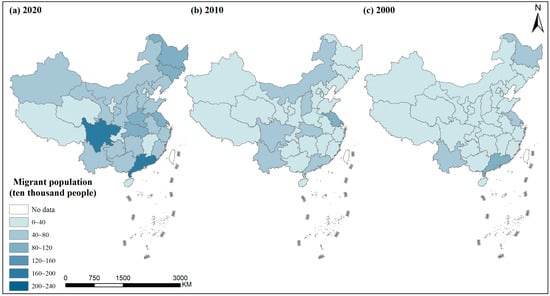
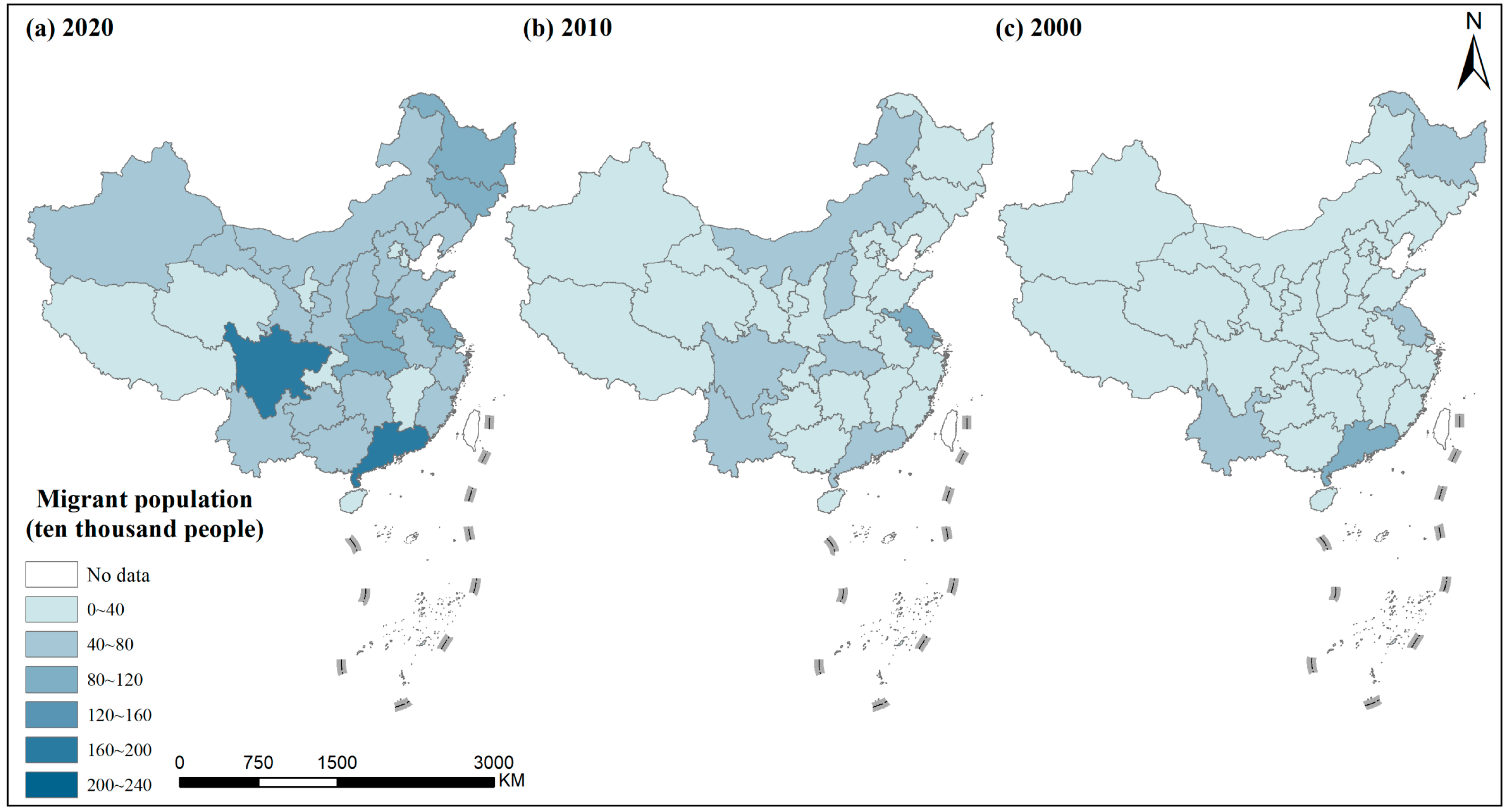
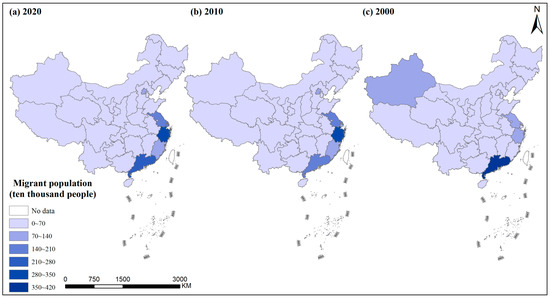
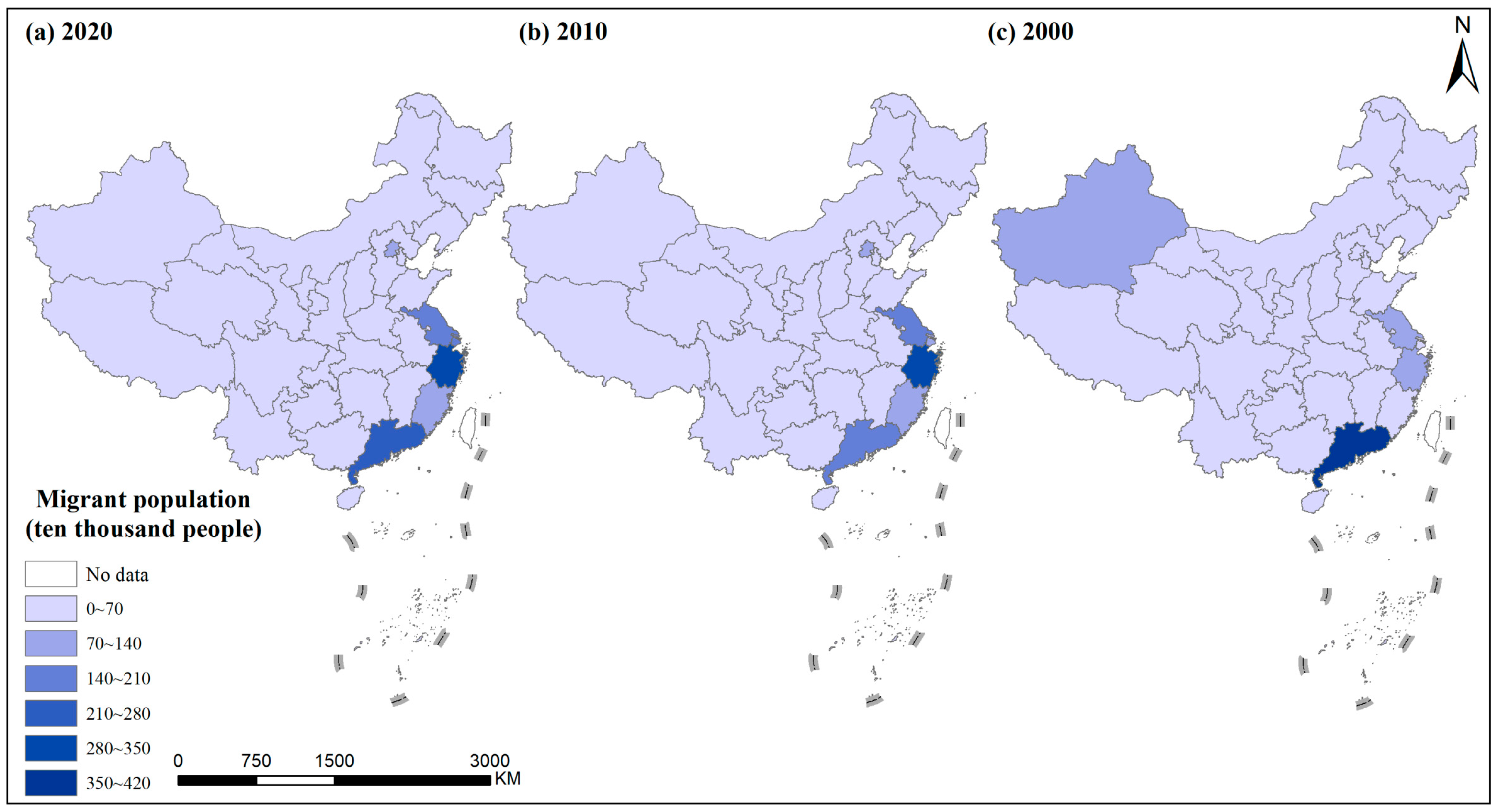
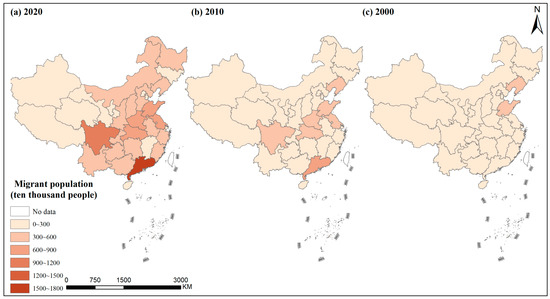
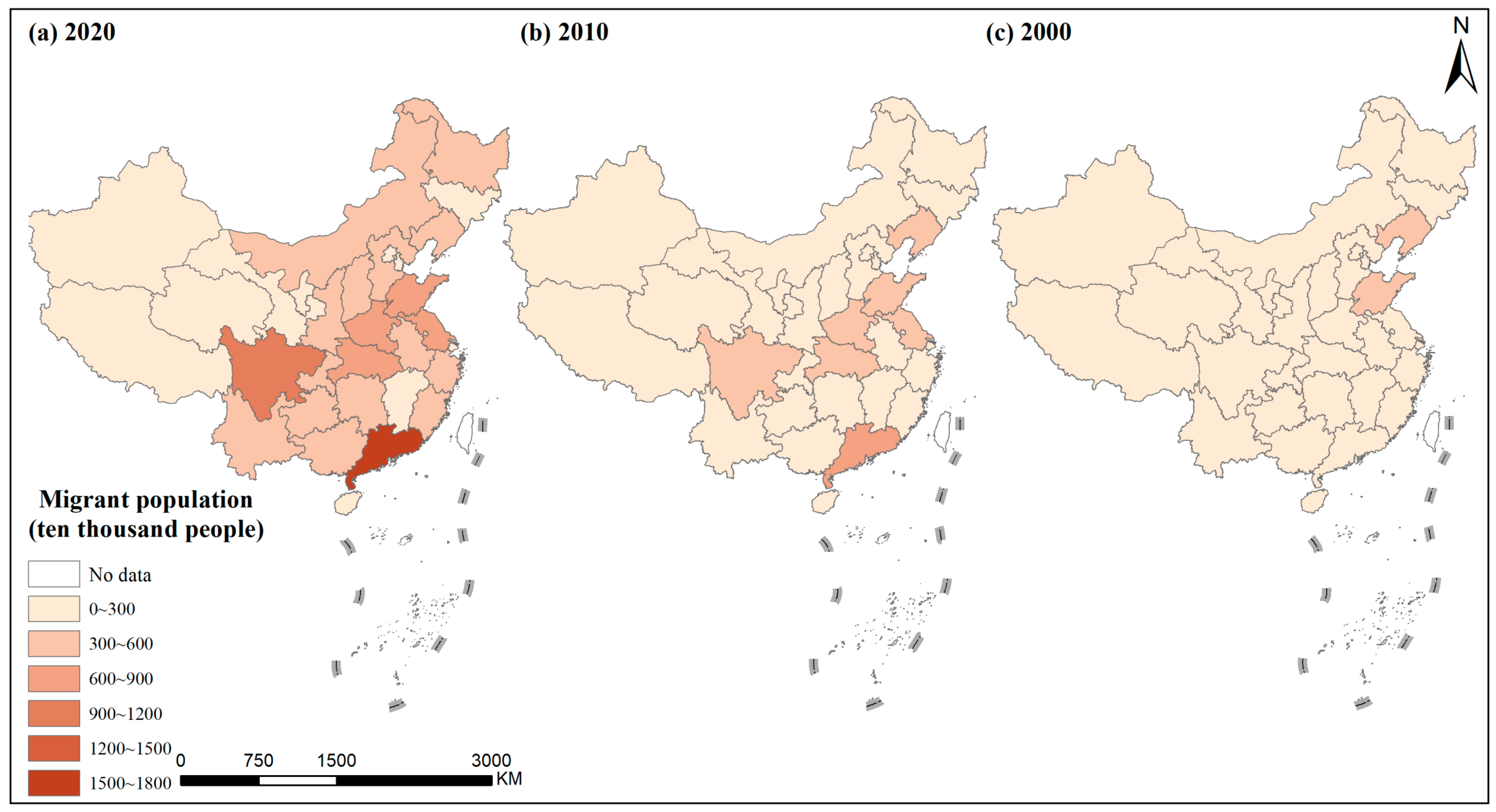
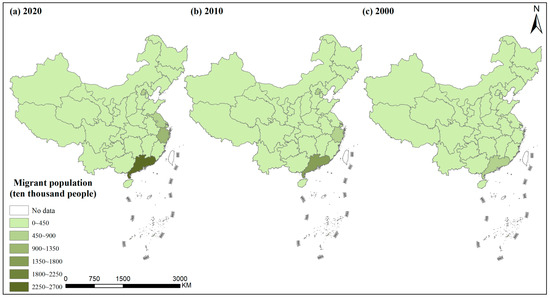
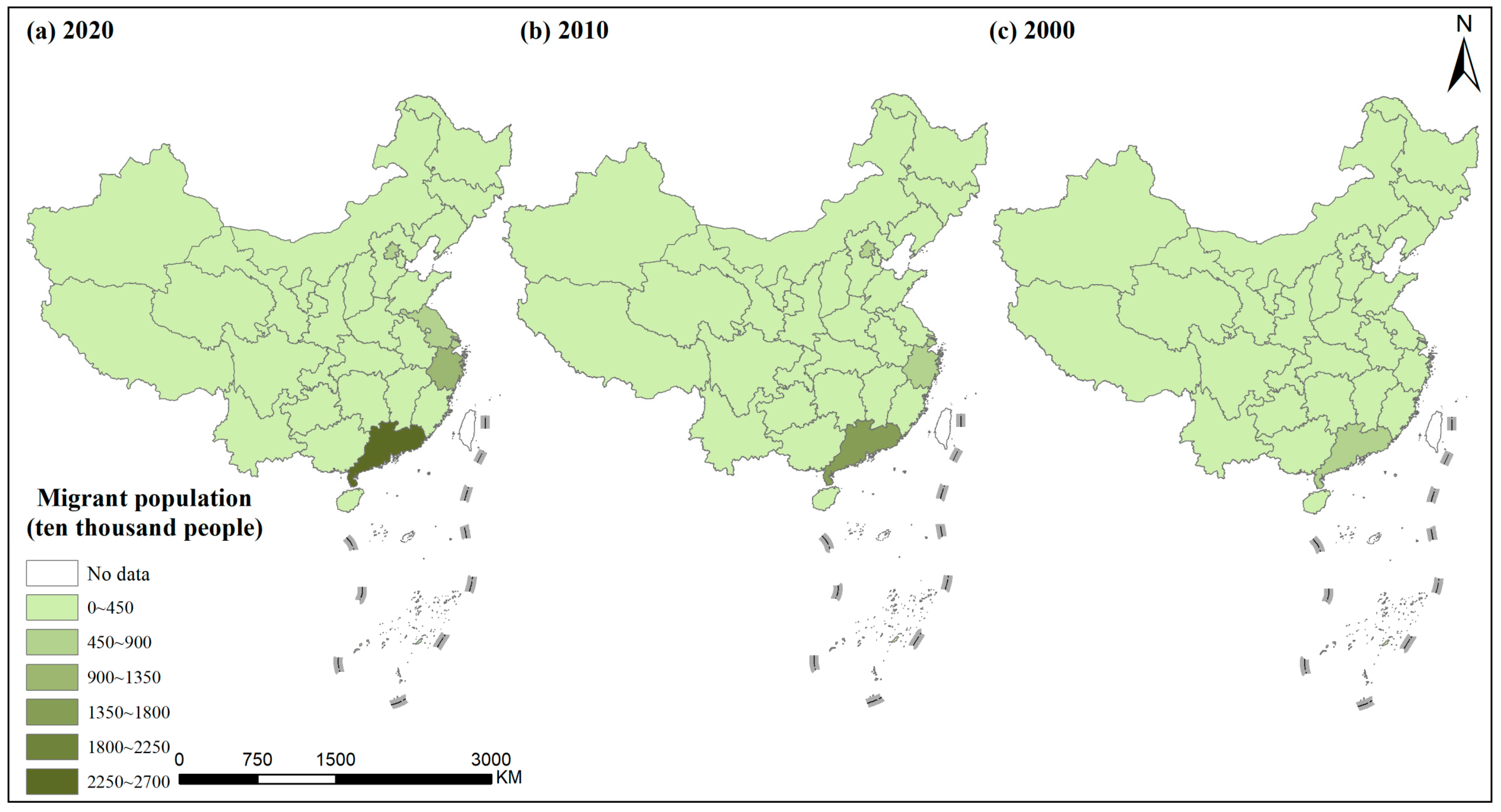
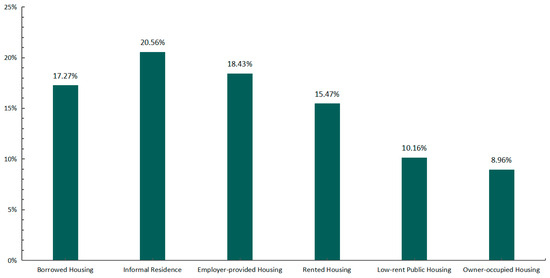
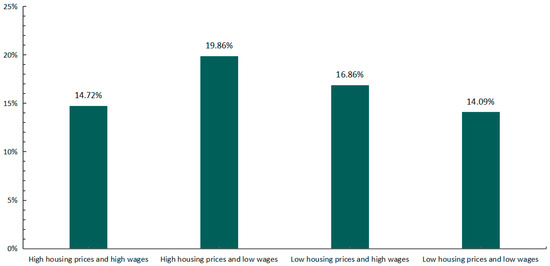

Disclaimer/Publisher’s Note: The statements, opinions and data contained in all publications are solely those of the individual author(s) and contributor(s) and not of MDPI and/or the editor(s). MDPI and/or the editor(s) disclaim responsibility for any injury to people or property resulting from any ideas, methods, instructions or products referred to in the content. |
© 2026 by the authors. Licensee MDPI, Basel, Switzerland. This article is an open access article distributed under the terms and conditions of the Creative Commons Attribution (CC BY) license.