


Abstract
Large language models (LLMs) are increasingly explored for biomedical research and clinical medicine, yet their use remains limited by hallucinations, missing provenance, domain drift, privacy constraints, and uncertain regulatory pathways. Retrieval-augmented generation (RAG) offers a pragmatic alternative to full model training or fine-tuning by grounding LLM outputs in curated, versioned, and auditable external sources. This narrative review examines RAG as a biomedical grounding infrastructure rather than a chatbot add-on. We clarify key terminology around databases, knowledge bases, vector stores, knowledge graphs, RAG systems, and grounding, and distinguish factual, contextual, analytical, provenance, normative, and operational grounding. Two anchor scenarios are used to structure the review: single-cell annotation and omics interpretation as an exploratory biomedical research setting, and EHR, PDF, and clinical free-text integration as a regulated clinical information setting. We compare how these scenarios differ in sources, retrieval units, risk profiles, evaluation targets, infrastructure needs, and governance requirements. We further discuss design choices across the biomedical RAG lifecycle, evaluation and benchmarking, semi-automated and agentic RAG construction, infrastructure integration, normative grounding, and deployer-side governance. We argue that biomedical LLM deployment will not be determined by model scale alone, but by the quality of grounding infrastructures that make outputs traceable, contextual, updateable, and accountable.
1. Biomedical LLMs Need Grounding, Not Only Scale
1.1. Introduction and Scope
Large language models (LLMs) are increasingly utilized for biomedical research and clinical medicine, including literature synthesis, molecular interpretation, documentation support, clinical question answering, and patient-facing information access [1]. However, their direct use in biomedical and clinical settings remains limited by hallucinations, missing provenance, domain drift, privacy constraints, and uncertain regulatory pathways [2]. In these contexts, fluent language generation is insufficient. Biomedical LLM outputs must be traceable to trustworthy sources, clinically or biologically contextualized, and embedded in workflows that allow validation, auditability, and human oversight [3,4].
Three broad strategies can be distinguished for adapting LLMs to biomedical tasks. First, foundation models may be trained from scratch on large biomedical corpora, but this requires extensive data, computational resources, and model-development expertise [5]. Second, existing models may be fine-tuned for specific domains or tasks, but this still requires suitable training data, careful validation, and continuous updating when knowledge or local requirements change [6]. Third, existing models may be grounded at inference time through retrieval-augmented generation (RAG), where external biomedical knowledge sources are retrieved and provided as context for response generation [7]. This review focuses on the third strategy.
We argue that biomedical LLM deployment will not be solved by larger models alone, but by better grounding infrastructures [8]. In this view, RAG is not merely a chatbot add-on or prompt-engineering technique [9]. Rather, it can function as a semi-automated and governable middleware layer connecting LLMs with biomedical knowledge, patient-specific data, institutional rules, and auditable workflows. This perspective is particularly relevant for research and healthcare environments where full model training or fine-tuning is impractical, where local or open models may be preferred, and where data protection, provenance, and human oversight are central requirements [10].
This article is written as a narrative review and conceptual synthesis. It does not aim to provide another exhaustive inventory of all RAG systems in biomedicine. Instead, it addresses a gap that remains despite the growing number of RAG reviews: how the breadth of RAG architectures can be translated into concrete grounding strategies for different biomedical data environments. Literature was identified through targeted searches in PubMed, Scopus, and Google Scholar, complemented by forward and backward citation tracking and the authors’ domain expertise in biomedical data integration, single-cell analysis, and clinical information systems. Given the narrative-review design, no formal inclusion and exclusion criteria were applied. Searches focused on literature available up to August 2026 and combined terms related to retrieval-augmented generation, large language models, biomedical artificial intelligence, medical informatics, single-cell analysis, omics interpretation, electronic health records, clinical free text, PDF-based retrieval, knowledge graphs, and healthcare governance. Because this article is a narrative review and conceptual synthesis rather than a systematic or scoping review, we did not perform PRISMA-style screening or formal risk-of-bias assessment. Instead, we selected representative studies and systems that illustrate recurring design choices, grounding strategies, evaluation challenges, and infrastructure requirements across the two anchor scenarios. Preprints were considered when they addressed emerging RAG architectures or biomedical use cases not yet covered by peer-reviewed literature; where included, they were treated as preliminary evidence and interpreted cautiously.
We use two contrasting and complementary anchor scenarios throughout the review: RAG-supported single-cell annotation and omics interpretation, and RAG-supported EHR, PDF, and clinical free-text integration. These scenarios were selected because they represent two highly relevant but structurally different biomedical settings. Single-cell RAG illustrates exploratory research support for high-dimensional, rapidly evolving biological knowledge, where grounding is needed for annotation, interpretation, ontology mapping, and biological plausibility. Clinical EHR/PDF RAG illustrates regulated patient-specific information use, where grounding is needed for temporal context, provenance, access control, safety, and governance. Together, both scenarios allow us to compare biomedical RAG requirements across research and clinical contexts and to derive transferable design principles for grounding LLMs in heterogeneous, dynamic, and institutionally governed data sources.
This review makes three contributions. First, it clarifies terminology around databases, knowledge bases, vector stores, knowledge graphs, RAG systems, and grounding in biomedical LLM applications. Second, it distinguishes different grounding types and analyzes how they become operational in two representative biomedical scenarios with different data structures, risk profiles, and validation needs. Third, it translates these insights into an actionable framework for biomedical RAG development, including lifecycle design, evaluation, semi-automated and agentic construction, infrastructure integration, and deployer-side governance. In doing so, the review positions RAG not only as a retrieval technique, but as a practical grounding layer for making biomedical LLM applications more traceable, updateable, contextualized, and accountable.
1.2. Terminology: Databases, Knowledge Bases, Vector Stores, Knowledge Graphs, and RAG Systems
The terminology around RAG is often used inconsistently. This is problematic in biomedical contexts, where the same system may combine structured databases, curated knowledge bases, vector stores, knowledge graphs, clinical documents, and model-generated outputs. For clarity, this review uses the following distinctions (Table 1).
Table 1.
Terminology used in this review. Definitions and examples of key components relevant to biomedical retrieval-augmented generation, including databases, knowledge bases, vector stores, knowledge graphs, RAG systems, and grounding. Abbreviations: EHR, electronic health record; FAISS, Facebook AI Similarity Search; FHIR, Fast Healthcare Interoperability Resources; LLM, large language model; MTB, molecular tumor board; NCBI, National Center for Biotechnology Information; OMOP CDM, Observational Medical Outcomes Partnership Common Data Model; PDF, Portable Document Format; QA, question answering; RAG, retrieval-augmented generation; SOP, standard operating procedure.
A database, vector store, or knowledge graph can therefore be part of a RAG system, but none of them alone is equivalent to RAG. A knowledge graph may provide structured biological or clinical relationships, a vector store may provide semantic search, and a knowledge base may provide curated factual or normative content. The RAG system is the broader architecture that retrieves from these sources and uses the retrieved context to guide LLM generation [11].
This distinction matters because biomedical RAG often retrieves more than plain text. In single-cell applications, the retrievable unit may be a marker-gene set, ontology term, tissue-specific cell-type entry, pathway result, or computed analysis output. In clinical applications, the retrievable unit may be a note passage, PDF page, laboratory event, medication record, guideline section, consent rule, or longitudinal patient event. Biomedical RAG therefore requires source-aware and context-aware design rather than generic document upload alone [8].
Take-home message: A RAG system is not equivalent to a database, vector store, or knowledge graph. It is an architecture that can combine these components to ground an LLM in external evidence, context, and constraints.
1.3. Grounding Types in Biomedical RAG
In biomedical applications, grounding should not be reduced to factual retrieval alone. A system that retrieves a relevant paper or guideline may still fail if it ignores tissue context, patient history, source provenance, consent, access rights, or workflow constraints [12]. We therefore distinguish six complementary grounding types that are relevant for biomedical RAG (Table 2).
Table 2.
Grounding types in biomedical RAG. Overview of factual, contextual, analytical, provenance, normative, and operational grounding, with examples from single-cell/omics workflows and clinical EHR/PDF-based workflows. Abbreviations: AI, artificial intelligence; DIZ, Data Integration Center; EHR, electronic health record; FHIR, Fast Healthcare Interoperability Resources; GDPR, General Data Protection Regulation; MTB, molecular tumor board; OMOP, Observational Medical Outcomes Partnership; PDF, Portable Document Format; SOP, standard operating procedure.
We interpret these grounding types as complementary and compositional rather than as a strict hierarchy or a sequence of pipeline stages. They are defined by different guiding questions and may co-occur within the same RAG workflow or output. For example, a clinical answer may be factually grounded in a guideline, contextually grounded in the patient’s encounter and date, provenance-grounded through citations to notes or PDF pages, and normatively grounded through consent rules or institutional SOPs. Similarly, a single-cell annotation may combine factual grounding in marker databases, contextual grounding in tissue or disease state, analytical grounding in differential expression results, and provenance grounding in atlas or publication references. The six grounding types should therefore be understood as overlapping dimensions of biomedical grounding rather than mutually exclusive categories.
These grounding types also help to connect the two anchor scenarios of this review. Single-cell RAG primarily stresses factual, contextual, analytical, and provenance grounding. It must retrieve biologically meaningful evidence and link interpretations to marker genes, ontologies, atlases, pathways, and analysis results. Clinical RAG primarily stresses contextual, provenance, normative, and operational grounding, with a stronger emphasis on safety-oriented evaluation. It must retrieve the right evidence for the right patient, from the right document, at the right time, under the right access and governance conditions.
This distinction provides the conceptual basis for the remainder of the review. The two use cases are not included as isolated examples, instead they are used as stress tests for different forms of biomedical grounding.
Take-home message: Biomedical grounding is not only factual. It also includes biological or patient context, analytical results, provenance, normative constraints, and operational workflow integration.
1.4. Why RAG Instead of Training or Fine-Tuning
Biomedical LLMs can be adapted to domain-specific tasks through several strategies, including training from scratch, fine-tuning existing foundation models, prompt engineering, and retrieval-augmented generation. Training a biomedical foundation model from scratch requires large-scale domain-specific corpora, substantial computational resources, and extensive model-development expertise. Fine-tuning is often more feasible, but it still requires suitable training data, access to model weights or training interfaces, careful hyperparameter choices, and systematic validation. Moreover, both approaches tend to encode knowledge into the model parameters at a specific point in time. This is problematic in biomedical settings, where guidelines, the literature, ontologies, databases, institutional SOPs, and local documentation practices change continuously.
RAG offers a complementary and often more pragmatic strategy. Instead of modifying the model parameters, RAG grounds the model at inference time by retrieving relevant external information and providing it as context for generation [13]. This allows biomedical knowledge sources to be updated without retraining the underlying LLM. New guidelines, revised SOPs, updated marker databases, additional publications, or newly available patient documents can be added to the retrieval layer, while the model backend remains exchangeable [9]. This is particularly relevant for institutions that want to compare different local or open models, such as GPT-OSS, DeepSeek, Teuken, Llama-derived models, or other deployable systems, without rebuilding the full application logic for each model.
A second advantage is configurability. A RAG system can be adapted through the selection of knowledge sources, the embedding model, the chunking strategy, the vector store or knowledge graph, metadata filters, retrieval parameters, reranking, system prompts, association rules, and answer-generation settings [14]. Domain-specific embedding models may improve retrieval for medical, biological, legal, or institutional documents, while system prompts can define response style, terminology, uncertainty handling, and citation requirements [13]. Embedding-model selection is a central design decision because it determines how user queries and biomedical source units are represented and compared during retrieval [15]. In biomedical RAG, marker-gene entries, ontology terms, guideline passages, EHR notes, PDF sections, or institutional policies must be converted into vector representations that preserve relevant biological, clinical, or normative meaning. If the embedding model does not capture domain-specific terminology, abbreviations, gene symbols, clinical concepts, or local language variants, the system may retrieve sources that are textually similar but biologically or clinically irrelevant [16]. Embedding models should therefore be selected and validated according to the intended use, source type, language, and retrieval task. Domain-specific, multilingual, or locally evaluated embedding models may be preferable when biomedical semantics, German clinical text, or institution-specific terminology are central to the use case. In this sense, RAG allows adaptation not only to a biomedical domain, but also to a concrete use case, institution, workflow, and user group.
A third advantage is transparency and provenance. Because RAG systems retrieve documents or data elements before generating an answer, they can expose the sources on which the answer is based [7]. This does not guarantee correctness, but it creates the possibility of source inspection, citation checking, version control, and auditability. In clinical and biomedical research settings, this is a central difference from standalone LLM output, where the origin of a generated claim is usually opaque.
A fourth advantage is local and privacy-preserving deployment. RAG systems can be operated on-premise or inside secure institutional environments, keeping indexed documents, patient data, and user queries within a healthcare or research organization [1]. This is especially relevant for sensitive clinical records, unpublished research data, controlled-access omics data, and institutional SOPs. However, local deployment does not remove the need for validation, governance, logging, access control, or clear responsibility boundaries.
Taken together, RAG should not be seen only as a method for increasing answer accuracy. In biomedical contexts, it can function as an updateable, auditable, and workflow-specific grounding layer between LLMs and trusted sources. The key question is therefore not only whether RAG improves the final answer, but whether the full RAG lifecycle, including source selection, ingestion, retrieval, generation, citation, evaluation, monitoring, and updating, can be designed in a reliable and governable way.
2. Two Anchor Scenarios: From Omics Interpretation to Clinical Documentation
Figure 1 serves as an early conceptual anchor for the review. It illustrates our central argument and represents it by two anchor scenarios throughout the manuscript. The first scenario is RAG for single-cell annotation and omics interpretation. Single-cell workflows generate clusters, marker genes, cell states, trajectories, perturbation signatures, and pathway-level results, but their interpretation depends on scattered knowledge across papers, atlases, marker databases, ontologies, and expert experience [17]. RAG can support this process by retrieving relevant cell-type markers, ontology terms, tissue-specific references, pathway information, and supporting literature. In this setting, the main risk is misleading biological interpretation, for example through hallucinated marker-cell associations, overconfident annotation of ambiguous clusters, species mismatch, or outdated marker knowledge.
Figure 1.
Biomedical RAG as a grounding infrastructure for two anchor scenarios. The figure summarizes a shared retrieval-augmented generation (RAG) architecture across two biomedical settings: single-cell and omics interpretation (green) and clinical EHR/PDF-based information integration (blue). In both cases, scenario-specific sources are preprocessed and indexed, followed by tailored retrieval logic that feeds a common RAG grounding layer (gray), comprising source curation, embedding and indexing, retrieval and reranking, grounded context construction, LLM generation, and source-linked response. The six grounding dimensions introduced in Table 2 are highlighted in yellow within the figure and illustrate how shared RAG principles are adapted to different biomedical contexts.
The second scenario is RAG for clinical documentation, EHRs, PDFs, and free text [18]. Clinical information is fragmented across structured EHR fields, longitudinal event histories, notes, discharge summaries, pathology reports, molecular diagnostics, radiology findings, scanned documents, tumor board notes, medication records, patient-reported outcomes, clinical guidelines, SOPs, and institutional policies. RAG can support patient-history summarization, guideline-grounded question answering, retrieval of prior therapies, molecular tumor board preparation, trial eligibility screening, adverse-event context retrieval, de-identification review, and discharge-letter analysis [19]. In this setting, the main risk is unsafe or incomplete patient-context reconstruction, including outdated guidelines, missing documents, wrong temporal interpretation, privacy leakage, or unsupported clinical conclusions.
Together, these two scenarios illustrate why biomedical RAG cannot be designed as a one-size-fits-all architecture. Both require trusted external grounding, but they differ in data types, retrieval units, validation standards, risk profiles, infrastructure requirements, and governance constraints. Single-cell RAG is primarily a research interpretation layer. Clinical RAG is a regulated information-support layer. The comparison between both scenarios is used throughout this review to derive design, evaluation, automation, infrastructure, and governance requirements for biomedical RAG systems.
2.1. Anchor Scenario I: RAG for Single-Cell Annotation and Omics Interpretation
Single-cell RNA sequencing has transformed biomedical research by enabling high-resolution analysis of cellular heterogeneity, tissue composition, disease-associated cell states, developmental trajectories, and perturbation responses. However, the interpretation of single-cell data remains a major bottleneck [20]. Computational workflows can identify clusters, marker genes, differentially expressed genes, pathways, and trajectories, but assigning biologically meaningful labels and explanations often requires expert knowledge distributed across marker databases, cell ontologies, tissue atlases, pathway resources, publications, and internal laboratory experience.
This makes single-cell analysis a natural setting for RAG-supported LLMs. General-purpose LLMs may produce fluent biological explanations, but their internal knowledge of genes, markers, cell types, pathways, and disease contexts can be incomplete, outdated, or insufficiently specific [21,22]. RAG can address this limitation by retrieving external biological knowledge at inference time, thereby converting a general LLM into a more context-aware biological assistant without requiring full retraining or fine-tuning.
Typical knowledge sources for single-cell RAG include Cell Ontology, Human Cell Atlas resources, PanglaoDB, CellMarker, Azimuth references, tissue-specific atlases, pathway databases such as Reactome, KEGG, and WikiPathways, PubMed abstracts, curated local publication sets, and internal annotation guidelines. Depending on the system architecture, these sources may be represented as vector databases, structured marker tables, knowledge graphs, or hybrid retrieval systems.
Recent single-cell RAG frameworks illustrate different design choices. GeneRAG uses gene-related external knowledge, embedding-based retrieval, and diversity-aware retrieval to support gene-related question answering, cell type annotation, and gene interaction tasks [3]. scRAG combines structured retrieval from knowledge graphs with unstructured retrieval from reference databases, aiming to improve cross-tissue cell type annotation [23]. CellTypeAI emphasizes local deployment with open-source models and a user-editable curated knowledge base, reflecting the importance of data security and practical deployment [24]. scChat extends the paradigm further by combining RAG with multi-agent orchestration, external analysis tools, pathway resources, and memory of previous function calls, thereby moving from static fact retrieval toward an interactive single-cell analysis assistant [22].
Across these systems, a shared pattern emerges: RAG improves the biological specificity of LLM outputs by connecting them to external marker, ontology, pathway, and literature knowledge. Several studies report improved annotation or question-answering performance compared with unaugmented LLMs, while also showing that larger general-purpose models do not automatically solve domain grounding problems [22]. However, direct comparison remains difficult because evaluation settings differ substantially, including annotation accuracy, hierarchical F1, gene-related question answering, trap questions, rubric-based scoring, and expert review.
For single-cell RAG, retrieval strategies should reflect the structure of the biological knowledge source. Vector retrieval can identify semantically relevant literature passages, gene descriptions, or atlas entries, while structured retrieval through marker tables, ontologies, or knowledge graphs can preserve explicit relationships between genes, cell types, tissues, diseases, and pathways [25]. Hybrid approaches are particularly relevant when marker evidence, ontology structure, and publication context need to be combined for candidate cell-type annotation or pathway interpretation. scRAG also illustrates important limitations. Performance depends strongly on the quality, completeness, and coverage of external databases [23]. Missing cell types, incomplete marker information, species mismatch, tissue-specific marker variation, disease-state effects, and inconsistent naming conventions can all lead to misleading annotations. Public benchmark data may also overlap with model pretraining data, which complicates interpretation of reported performance. In addition, the distinction between cell type, cell state, disease-associated phenotype, and transient activation state remains biologically complex and cannot be solved by retrieval alone.
The single-cell scenario therefore shows that biomedical RAG is not merely document retrieval. It requires biological context, structured domain knowledge, appropriate evaluation metrics, expert validation, and transparent uncertainty communication. In this setting, the main risk is misleading biological interpretation rather than immediate patient harm. Nevertheless, unreliable annotation can propagate into downstream biological conclusions, pathway interpretation, biomarker discovery, and translational hypotheses.
2.2. Anchor Scenario II: RAG for EHRs, PDFs, and Clinical Free Text
Clinical documentation represents a second major use case for biomedical RAG. A single patient’s longitudinal record is typically fragmented across structured EHR fields, laboratory values, medication histories, clinical notes, discharge summaries, pathology reports, molecular diagnostics, radiology findings, scanned PDFs, tumor board notes, patient-reported outcomes, clinical guidelines, SOPs, and institutional policies. This fragmentation creates a grounding problem for clinical LLMs. A general-purpose model can summarize an isolated note fluently, but it does not know which patient-specific documents are relevant, which guideline version applies, which report is current, or which local institutional rule constrains the output [26].
RAG can address this problem by retrieving patient-specific or task-specific evidence at inference time. In this setting, RAG is not only a performance-enhancing technique, but a potential safety mechanism: it can link generated summaries or answers to traceable documents, relevant time points, structured events, guideline passages, and source metadata [7]. Unlike model fine-tuning, RAG can reason over records the model has never seen during training without memorizing them, while still allowing provenance and source inspection.
Clinical RAG systems differ depending on whether they target structured longitudinal records, free-text notes, PDFs, multimodal EHR data, or external clinical knowledge. For structured EHR data, retrieval must preserve event types, temporal order, encounter context, and dependencies between earlier and later observations. For free-text notes and discharge summaries, systems require passage-level retrieval, reranking, attribution, and summarization. For PDFs and scanned documents, OCR quality control, page-level citation, document segmentation, and metadata extraction become critical. For scanned PDFs and poorly digitized documents, OCR uncertainty should be propagated into retrieval and generation rather than hidden from the user [27]. Practical strategies include storing OCR confidence scores, preserving page images and page numbers, flagging low-confidence passages, separating tables from narrative text, retaining document layout when clinically relevant, and requiring source inspection when the answer depends on uncertain OCR output. If a retrieved passage has low OCR confidence or ambiguous layout, the RAG system should indicate this uncertainty and avoid generating definitive clinical statements from that source alone. For guideline-grounded tasks, version control, source validity, and detection of outdated or conflicting recommendations are central requirements.
Typical clinical RAG tasks include patient-history summarization, discharge-letter review, retrieval of prior therapies and response history, medication-context retrieval, adverse-event context retrieval, patient-reported outcome summarization, explanation of longitudinal trajectories, guideline-grounded question answering, molecular tumor board preparation, clinical trial eligibility screening, cohort identification, plausibility checking of de-identification outputs, and review of clinical documentation [28]. In several of these settings, the expected output is not a new medical decision, but a traceable information synthesis that supports clinicians or researchers.
Recent clinical RAG work also shows that retrieval can extend beyond static document search. Longitudinal EHR-RAG approaches introduce time-aware or event-aware retrieval for patient histories that exceed LLM context windows [29]. Multimodal systems connect clinical notes and time-series EHR data with biomedical knowledge graphs [30]. Case-based retrieval systems retrieve similar patient cases as experiential context for discharge-related question answering [26,31]. Attribute-aware question-answering tasks emphasize that clinical answers should not only be correct, but also explicitly linked to supporting evidence sentences.
The clinical scenario highlights a different risk profile from single-cell RAG. Incomplete retrieval may create false reassurance. Outdated guidelines may lead to inappropriate recommendations. Documents from different encounters may be mixed. OCR errors may distort clinical facts. Patient identity, date, or context may be misinterpreted. Privacy leakage, missing consent, unclear access rights, and automation bias may undermine safe deployment. Therefore, clinical RAG cannot be evaluated only as a language technology [28]. It must be assessed as part of a sociotechnical clinical information system with clear intended use, role-based access, audit trails, clinician oversight, and institutional governance.
2.3. Comparative Design Matrix: Why Biomedical RAG Is Not One-Size-Fits-All
The two anchor scenarios show that biomedical RAG design is context-dependent. Single-cell annotation and clinical EHR/PDF integration both require external grounding, but they differ in sources, retrieval units, validation standards, risks, and governance requirements (Table 3).
Table 3.
Comparative design requirements for biomedical RAG across the two anchor scenarios. Comparison of single-cell annotation and clinical EHR/PDF/free-text integration with respect to purpose, data sources, retrieval units, grounding types, evaluation focus, infrastructure, governance, and human oversight. Abbreviations: DIZ, Data Integration Center; EHR, electronic health record; FHIR, Fast Healthcare Interoperability Resources; MTB, molecular tumor board; OMOP, Observational Medical Outcomes Partnership; PDF, portable document format; PRO, patient-reported outcome; SOP, standard operating procedure.
This comparison illustrates why biomedical RAG systems should not be evaluated as generic chatbot applications. A RAG pipeline that works for marker-gene interpretation may fail in patient-specific retrieval if it does not preserve temporal context, document provenance, or access control. Conversely, a clinically governed document-retrieval system may not support the biological specificity required for single-cell annotation. The design of biomedical RAG should therefore start from the intended use, source landscape, risk profile, and validation target rather than from a one-size-fits-all architecture. To make the technical comparison between representative systems more transparent, Supplementary Table S1 summarizes selected biomedical RAG systems and approaches according to their retrieval strategy, evaluation focus, primary reported performance metric(s) and score(s), and comparability limitations. Because the included systems differ substantially in tasks, datasets, metrics, and intended uses, the table is intended as a structured design comparison rather than a quantitative benchmark.
3. Developing and Evaluating Biomedical RAG Systems
3.1. Design Choices Across the RAG Lifecycle
Biomedical RAG systems require design decisions across the full lifecycle, from source selection to deployment and monitoring (Table 4). These decisions are not merely technical optimizations, because they determine whether the system can provide reliable grounding for a specific biomedical or clinical task, which we specified in more detail in Table 4. A RAG system for single-cell annotation, for example, requires different retrieval units, metadata, and validation logic than a RAG system for clinical documentation or EHR-based summarization. Biomedical RAG development should therefore begin with the intended use, the relevant source landscape, and the expected risk profile rather than with the model backend alone.
Table 4.
Design choices across the biomedical RAG lifecycle. Key lifecycle steps for developing biomedical RAG systems, from intended-use definition and source curation to retrieval, generation, provenance display, and monitoring. Abbreviations: EHR, electronic health record; FHIR, Fast Healthcare Interoperability Resources; LLM, large language model; MTB, molecular tumor board; OMOP, Observational Medical Outcomes Partnership; PDF, portable document format; QA, question answering; SOP, standard operating procedure.
The first design step is to define the intended use. For clinical RAG systems, intended use should be defined more broadly than the technical task alone. It should specify the target users, the clinical setting, the expected output, the degree to which the output may influence clinical decision-making, and who remains responsible for final interpretation. A system that retrieves and summarizes existing patient information has a different risk profile from a system that prioritizes findings, suggests diagnoses, recommends therapies, or screens patients for trials [32]. These distinctions influence validation requirements, governance needs, human oversight, and potentially the regulatory classification of the system (Box 1).
Box 1. Intended-use template for clinical RAG systems.
A clinical RAG system should define its intended use before source selection, retrieval design, evaluation, and deployment. A minimal intended-use description may include:
- Clinical task: What problem is the system intended to support, such as patient-history summarization, guideline-grounded question answering, trial eligibility screening, or tumor board preparation?
- Target users: Who is expected to use the system, such as physicians, molecular tumor board coordinators, data managers, researchers, or patients?
- Clinical setting: In which setting will the system be used, such as outpatient care, inpatient documentation review, molecular tumor board preparation, retrospective research, or patient communication?
- Source scope: Which source types are allowed, such as EHR notes, structured events, PDFs, laboratory values, guidelines, SOPs, consent documents, or institutional policies?
- Expected output: What should the system produce, such as a cited summary, candidate evidence list, eligibility explanation, uncertainty statement, or structured report?
- Decision influence: Is the output informational only, prioritizing findings, suggesting possible interpretations, or contributing to diagnostic or therapeutic decisions?
- Responsibility model: Who reviews the output, who may act on it, and who remains responsible for final interpretation?
- Escalation and abstention: Under which conditions should the system refuse to answer, request additional information, or escalate to expert review?
- Governance requirements: Which access-control, logging, validation, monitoring, and update procedures are required for the intended use?
A RAG system may support exploratory literature synthesis, marker-gene-based annotation, clinical document summarization, guideline-grounded question answering, tumor board preparation, or trial eligibility screening. Each task implies different requirements for source selection, retrieval precision, output format, human oversight, and acceptable uncertainty. In exploratory research, a system may provide hypotheses or candidate interpretations; in clinical settings, it may need to restrict itself to traceable information synthesis and explicitly avoid unsupported recommendations.
The second design step is source curation and representation. Biomedical RAG can retrieve from heterogeneous sources, including publications, guidelines, ontologies, marker databases, pathway resources, structured EHR data, clinical notes, PDFs, laboratory values, SOPs, consent documents, and institutional policies. Source curation should define which sources are trusted, how they are updated, how versions are controlled, and which metadata are attached. Preprocessing may include OCR, table extraction, section segmentation, ontology mapping, entity recognition, temporal normalization, and conversion of structured or multimodal content into retrievable units [33]. This conversion into retrievable units should use source-specific segmentation rather than uniform fixed-size chunks alone. In single-cell and omics RAG, meaningful retrieval units may include marker sets, ontology terms, pathway entries, atlas records, differential expression results, or publication passages. In clinical EHR and free-text RAG, segmentation should preserve note sections, discharge-summary structure, medication lists, laboratory events, temporal order, and encounter context. For PDFs and scanned documents, page numbers, section headings, tables, OCR confidence, layout information, and provenance metadata should be retained whenever possible [34]. Guidelines, SOPs, consent documents, and trial criteria may require section- or rule-level segmentation rather than arbitrary token windows. Overall, chunking should balance semantic completeness with retrieval specificity: overly small chunks may lose relevant context, whereas overly large chunks may reduce retrieval precision and citation accuracy [35].
The third design step is retrieval architecture. Biomedical RAG systems may use vector search, keyword search, metadata filtering, structured database queries, knowledge graph traversal, or hybrid combinations of these methods. Vector search can support semantic retrieval from free text, while knowledge graphs can support relation-aware retrieval across genes, cell types, diseases, drugs, phenotypes, or clinical concepts. Structured query mechanisms may be needed for OMOP- or FHIR-based clinical data, while metadata filtering may be essential to restrict retrieval to the correct patient, encounter, tissue, species, or guideline version [36]. Retrieval-strategy selection should be guided by the structure of the source material, the intended use, and the required form of grounding. Vector search is useful for semantic retrieval from free text, such as notes, guideline passages, the literature abstracts, or PDF sections [37]. Keyword search remains valuable when exact terms, gene symbols, drug names, abbreviations, or identifiers must be preserved. Structured database queries are appropriate when the answer depends on coded events, laboratory values, medication records, or cohort criteria. Knowledge graphs are useful when relationships between entities, such as genes, cell types, diseases, drugs, phenotypes, or pathways, are central to the task [38]. Hybrid retrieval can combine these approaches, for example by using structured filters to restrict the search space, vector retrieval to identify semantically relevant passages, and reranking to prioritize the most specific and trustworthy evidence [12]. Such combinations are often preferable in biomedical RAG because neither vector similarity nor structured retrieval alone captures all relevant biomedical context.
The fourth design step is context construction, generation, and provenance display. Retrieved evidence must be assembled into a prompt in a way that preserves source provenance, temporal context, and task-specific constraints. System prompts can define the expected response style, citation requirements, uncertainty handling, and conditions under which no answer should be given. For biomedical and clinical applications, source-faithful and citation-aware outputs are usually preferable to creative generation [26]. The user interface should make it possible for experts to inspect retrieved evidence rather than only read the final generated answer. Prompt construction should also be scenario-specific. In single-cell and omics RAG, prompts may combine cluster markers, differential expression results, tissue or species metadata, candidate ontology terms, and retrieved marker or pathway evidence. The output prompt should encourage uncertainty-aware candidate annotations rather than definitive labels when evidence is ambiguous. In clinical EHR/PDF RAG, prompts should assemble patient-specific context, encounter dates, document types, guideline passages, source citations, and relevant normative constraints such as SOPs or consent limitations [39]. Clinical prompts should explicitly restrict the model to the retrieved evidence, require citation of supporting sources, indicate missing or conflicting evidence, and avoid unsupported diagnostic or therapeutic recommendations outside the intended use [40].
Finally, biomedical RAG systems require monitoring and updating. Guidelines change, the literature expands, ontologies are updated, clinical documents accumulate, and institutional policies evolve. RAG systems therefore require update procedures, source-quality checks, retrieval monitoring, model-version tracking, user-feedback loops, and audit logs. In clinical settings, this also includes access-control monitoring, patient-context filtering, and documentation of human review. Maintenance and updating should be treated as part of the RAG lifecycle rather than as an optional post-deployment step [41]. Updates may be manual, scheduled, or semi-automated, but they require governance. A robust update workflow should include source registration, versioning, change logs, source-quality review, reindexing, retrieval regression tests, access-control review, and the possibility to roll back problematic updates. In single-cell RAG, this may involve updated marker databases, new atlas versions, revised ontology terms, or newly published tissue-specific evidence. In clinical RAG, it may involve updated guidelines, newly available reports, revised SOPs, changed consent status, or modified access rights. Agentic RAG systems may assist by identifying candidate updates, checking source freshness, or triggering reindexing, but high-risk sources should still require human approval and auditability before they are used for grounding.
Taken together, these design decisions define the biomedical RAG lifecycle: intended use definition, source curation, preprocessing, indexing, retrieval, reranking, context construction, generation, provenance display, evaluation, deployment, monitoring, and updating. This lifecycle perspective is essential for moving from manually assembled RAG prototypes toward semi-automated, agent-supported, and governed RAG infrastructures.
3.2. Evaluation and Benchmarking: From Biological Plausibility to Clinical Safety
Evaluation is a central challenge for biomedical RAG systems because performance cannot be reduced to the fluency or plausibility of the generated answer. A RAG system may fail at several stages: (i) the source collection may be incomplete or outdated, (ii) preprocessing and chunking may remove relevant context, (iii) embeddings may not capture biomedical semantics, (iv) retrieval may miss relevant evidence, (v) reranking may prioritize irrelevant passages or the final answer may be unsupported, incomplete, or misleading. Therefore, biomedical RAG evaluation must assess the full pipeline rather than only the final output [33].
General RAG evaluation frameworks distinguish between retrieval-level and generation-level metrics [42]. Retrieval-level evaluation asks whether the system retrieved the relevant evidence, using measures such as recall, hit rate, precision, ranking quality, and coverage. Generation-level evaluation asks whether the produced answer is faithful to the retrieved evidence, factually correct, complete, coherent, and appropriately calibrated. Frameworks such as RAGAS and ARES provide useful starting points for systematic assessment, but biomedical and clinical applications require additional task-specific and expert-driven evaluation [43,44]. Healthcare-focused metrics such as FactScore, RadGraph-F1, and MED-F1 can complement general RAG metrics by assessing factual alignment, radiology-oriented entity–relation correctness, and medical concept-level alignment [9]. However, these metrics should be selected according to the task, data type, and intended use rather than treated as universally applicable (Table 5). For clinical RAG systems, a third evaluation level may be required at workflow- or system-level. A system may retrieve the correct evidence and generate a faithful answer, yet still fail in practice if relevant information is displayed too late, source checking takes too much time, important details are difficult to notice, or users rely too strongly on generated summaries [45]. Clinical evaluation should therefore also assess usability, task completion time, workload, integration into clinical workflows, user trust, automation bias, and effects on the decision process [46]. In this sense, clinical RAG evaluation should move from retrieval quality and answer quality toward workflow readiness and safe clinical use.
Table 5.
Example evaluation targets for the six grounding types in biomedical RAG. The table links the grounding dimensions introduced in Table 2 to possible evaluation targets. The listed metrics and checks are examples and should be adapted to the intended use, risk profile, data type, and clinical or research setting. Abbreviations: PDF, Portable Document Format.
For single-cell RAG, evaluation should focus on biological plausibility and annotation quality. Relevant endpoints include agreement with expert annotations, hierarchical F1 scores, marker-gene consistency, ontology mapping accuracy, tissue and species specificity, recognition of ambiguous cell states, and robustness across datasets. Particular attention is needed for rare cell types, disease-associated cell states, cross-tissue generalization, and possible overlap between public benchmark datasets and LLM pretraining data. Here, a specific challenge for single-cell and biomedical RAG benchmarking is possible overlap between public benchmark datasets and the pretraining data of the underlying LLM. If a model has already seen parts of a benchmark dataset, publication, or annotation resource during pretraining, observed performance gains may partly reflect parametric memory rather than retrieval-based grounding [47]. Because the exact pretraining corpora of many LLMs are not fully transparent, leakage cannot always be excluded. Mitigation strategies include using post-training datasets where possible, comparing benchmark publication dates with model release dates, testing private or locally curated datasets, reporting source overlap risks, and comparing performance with and without retrieval. The goal is to distinguish whether performance improvements arise from the RAG mechanism itself or from prior knowledge encoded in the model parameters. A system that performs well on common cell types may still fail in precisely the cases where expert support is most needed.
For clinical RAG, evaluation must be more safety-oriented. Relevant endpoints include patient-document matching accuracy, temporal correctness, retrieval completeness, citation accuracy, factuality, omission rate, non-harmfulness, clinician agreement, and robustness to missing or conflicting documents. Clinical RAG systems must be tested for failure modes such as retrieving the wrong patient context, mixing different encounters, missing prior therapies, relying on outdated guidelines, silently falling back to parametric model knowledge, or generating confident answers from incomplete evidence [48].
This difference can be summarized as follows: in single-cell RAG, the central failure mode is misleading biological interpretation; in clinical RAG, the central failure mode is unsafe patient-context reconstruction. Both require expert validation, but the consequences, acceptable risk levels, and governance requirements differ substantially.
Benchmarking should therefore move from generic question answering toward use-case-specific system readiness. For single-cell RAG, future benchmarks should include rare cell types, disease contexts, cross-tissue datasets, ontology-aware scoring, and explicit leakage controls. For clinical RAG, benchmarks should include longitudinal patient histories, heterogeneous source types, conflicting documents, outdated guidelines, PDFs with OCR noise, and structured as well as unstructured data. In this context, benchmarking should not only assess the quality of responses but also whether the system detects and mitigates the clinical failure modes described above. This includes testing source coverage and retrieval recall for missing evidence, version metadata, and updates for outdated guidelines; PDF-related uncertainty should be assessed using OCR-confidence thresholds and section-aware segmentation, especially when clinical benchmarks include heterogeneous documents and PDFs with OCR noise. Multilingual evaluation is also needed, especially for non-English clinical environments such as German healthcare, where local documentation style, terminology, abbreviations, and regulatory constraints may differ from English-language benchmark settings [49]. In such settings, RAG may partly reduce dependence on English-language benchmarks and model assumptions by grounding outputs in local-language clinical sources. However, this does not replace the need for local validation, because retrieval quality, terminology mapping, and other potential task-specific outputs must still be evaluated in the target language and care settings [50].
A further requirement is evaluation of uncertainty and abstention behavior. Biomedical RAG systems should not only answer correctly when evidence is available; they should also recognize when retrieval is insufficient, sources conflict, sources are outdated, or the query exceeds the system’s intended use [48]. In such cases, the system should avoid generating a definitive answer from parametric model knowledge alone. Instead, it should communicate an explicit evidence status, for example: “sufficient retrieved evidence”, “incomplete evidence”, “conflicting sources”, “outdated source version”, or “outside intended use”. Depending on the risk profile, the system should either abstain from answering, provide a limited answer with uncertainty clearly stated, request additional information, or escalate to expert review. For clinical RAG, such evidence-status reporting is particularly important because a well-formulated and cited answer may still be unsafe if the retrieved evidence is incomplete, outdated, or not applicable to the patient context [51]. Mitigation strategies should therefore target the full RAG pipeline [52]. Source-level mitigation includes curated source registries, version control, update logs, and exclusion of outdated or unapproved sources. Retrieval-level mitigation includes metadata filtering, patient- or tissue-aware retrieval, retrieval recall checks, reranking, and testing with trap questions or adversarial queries. Generation-level mitigation includes citation verification, source-faithfulness checks, uncertainty statements, and prevention of unsupported fallback to parametric model knowledge. Workflow-level mitigation includes human review, audit logs, monitoring of post-deployment errors, and feedback loops for updating the source collection and retrieval configuration [53].
Taken together, these considerations suggest that biomedical RAG evaluation should not be understood as a set of isolated benchmark tests, but as an iterative process toward use-case-specific system readiness (Figure 2). Source and context quality determine the evidence available to the system and therefore influence retrieval and generation performance. Generated outputs must subsequently be evaluated against the relevant grounding dimensions, workflow and safety requirements, and the system’s ability to recognize insufficient, conflicting, outdated, or otherwise unsuitable evidence. Identified shortcomings should feed back into source curation, retrieval configuration, context construction, and subsequent evaluation.
Figure 2.
From component evaluation to use-case-specific biomedical RAG system readiness. Biomedical retrieval-augmented generation (RAG) evaluation is represented as an iterative cycle connecting source and context quality, retrieval evaluation, generation evaluation, grounding validation, workflow- and safety-level evaluation, and uncertainty, abstention, and feedback. System readiness is defined relative to the intended use and therefore depends on the application context, illustrated here by the single-cell/omics and clinical EHR/PDF anchor scenarios. Human oversight, access control, provenance tracking, audit logging, versioning, and monitoring act as cross-cutting controls throughout the cycle.
The resulting readiness criteria remain dependent on the intended use. Single-cell and omics applications primarily emphasize biological plausibility, annotation quality, robustness across datasets, and appropriate handling of ambiguous or rare cell states, whereas clinical EHR/PDF applications additionally require patient-context integrity, temporal correctness, retrieval completeness, non-harmfulness, and safe workflow integration. Cross-cutting controls such as human oversight, access control, provenance tracking, audit logging, versioning, and monitoring accompany this evaluation cycle throughout deployment. Biomedical RAG evaluation should therefore be understood as a continuous assessment of system readiness rather than a one-time measure of answer quality.
3.3. Semi-Automated and Agentic RAG Construction
Most current biomedical RAG systems are still manually assembled prototypes. Developers select documents, define preprocessing rules, choose chunking strategies, configure embeddings, build vector stores or knowledge graphs, write prompts, and evaluate outputs for a specific task. This manual process is useful for controlled experimentation, but it does not scale well across dynamic biomedical environments where sources, guidelines, ontologies, patient records, and institutional policies change continuously.
Semi-automated and agentic RAG systems may address this limitation by supporting the construction, maintenance, and monitoring of RAG pipelines. In this context, “agentic” does not necessarily mean autonomous biomedical decision-making. Rather, agentic RAG can be understood as the use of LLM-based or tool-using agents to orchestrate retrieval, select sources, route queries, update indexes, check outputs, and support evaluation [54]. Conventional RAG usually follows a comparatively fixed retrieve-then-generate pattern: a user query is used to retrieve relevant sources, the retrieved context is inserted into the prompt, and the LLM generates an answer. Agentic RAG extends this pattern by introducing LLM-based or tool-using agents that can decompose a task, select sources, route queries, call external tools, iteratively refine context, validate intermediate outputs, and maintain state across multi-step workflows. The difference is therefore less about the final application domain than about workflow control and adaptability. Conventional RAG is often sufficient for focused question answering, document summarization, or source-supported explanation. Agentic RAG becomes more relevant when the task requires multi-step retrieval, tool orchestration, repeated checking, source updating, or adaptive routing, for example in interactive single-cell analysis, patient-timeline reconstruction, trial-eligibility screening, or guideline-version monitoring [54]. Mitigation of error propagation in agentic RAG requires controls at each intermediate step rather than only evaluation of the final answer [55]. Practical safeguards include predefined tool permissions, retrieval scope limits, intermediate evidence checks, validation agents or rule-based validators, citation checks after each retrieval step, stopping rules for conflicting or insufficient evidence, and mandatory escalation to human review in high-risk settings. Agentic workflows should also record tool calls, retrieved sources, discarded sources, intermediate summaries, error messages, and final evidence links [56]. Such audit trails make it possible to identify whether an error originated from source selection, retrieval, reranking, tool execution, context construction, or generation.
In single-cell analysis, agentic RAG may help identify relevant marker databases, update cell-type knowledge bases, map cluster labels to ontologies, retrieve recent tissue-specific literature, compare marker signatures with reference atlases, and generate annotation reports. More advanced systems such as scChat illustrate how RAG can extend beyond static biological fact retrieval toward multi-step analysis workflows, where agents coordinate external tools, pathway resources, and memory of previous computations [22].
In clinical settings, agentic RAG could support document classification, metadata extraction, OCR quality checks, guideline version monitoring, patient-timeline construction, retrieval routing, conflict detection, and citation validation. For example, a clinical RAG agent could decide whether a query should retrieve from patient notes, structured EHR fields, guidelines, SOPs, trial criteria, or institutional policies. It could also flag when retrieved evidence is insufficient, outdated, or inconsistent.
However, agentic RAG also introduces additional risks [57]. Multi-step systems may propagate early retrieval errors, hide intermediate reasoning failures, overuse tools, and thus increasing computational costs, as well as retrieve unnecessary sensitive data, or generate unsupported conclusions after several apparently reasonable steps. In clinical contexts, autonomous tool use also raises questions about access control, auditability, intended use, and responsibility. Therefore, agentic RAG should be framed primarily as a mechanism for building, updating, routing, checking, and maintaining RAG systems, not as a replacement for biomedical or clinical judgment.
Future work should define validation strategies for agentic RAG systems. Evaluation must cover not only final answer quality, but also intermediate retrieval decisions, tool calls, source selection, self-checking behavior, escalation to human review, and reproducibility of multi-step workflows. For regulated environments, every relevant intermediate step should be logged and auditable.
4. From Prototypes to Governed and Future-Ready Biomedical Infrastructures
4.1. Embedding RAG into Biomedical Research and Clinical Data Infrastructures
For RAG to become useful beyond isolated prototypes, it must be embedded into biomedical research and clinical data infrastructures. This requires a shift from “upload documents and query them” toward RAG-ready environments in which sources are curated, versioned, access-controlled, interoperable, and auditable. Access control should be enforced before and during retrieval, not only after generation. In structured clinical data layers, such as FHIR or OMOP-based environments, this may involve role-based permissions, patient- or cohort-level restrictions, purpose-of-use constraints, consent-state checks, and filtering of coded events before they enter the retrieval context. For document-based RAG, chunk-level access-control metadata can be attached during ingestion, including patient identifier, encounter, document type, department, sensitivity class, consent status, and permitted user roles [58]. Retrieval should then filter inaccessible chunks before embedding results are passed to the LLM. The generated answer should inherit the strictest applicable access and provenance constraints from the retrieved sources, and all retrieval events should be logged for auditability.
In research settings, relevant infrastructures include single-cell analysis workflows, laboratory knowledge bases, institutional repositories, ontology services, publication collections, workflow systems, and data management platforms. RAG systems for single-cell annotation may need to connect to marker databases, tissue atlases, analysis outputs, pathway resources, and internal annotation guidelines. Integration with tools such as Scanpy, Jupyter, workflow managers, and institutional repositories can help turn RAG from a conversational add-on into a reproducible research-support layer [22,24].
In clinical settings, relevant infrastructures include EHR systems, secure hospital IT environments, Data Integration Centers [59], FHIR servers, OMOP CDM databases [60], document management systems, clinical data warehouses, molecular tumor board platforms, clinical trial units, consent-management systems, and audit logging infrastructures [61]. Here, it is important to distinguish clinical data infrastructures from RAG-ready grounding sources. A Data Integration Center, FHIR server, OMOP CDM database, EHR system, or document archive can provide relevant data, but these resources are not automatically suitable for safe grounding [62]. Additional layers are required to make them usable for RAG, including semantic normalization, metadata enrichment, provenance tracking, temporal alignment, access control, consent-aware filtering, and source-quality management. Clinical RAG must be able to retrieve from structured and unstructured sources while preserving patient context, encounter context, source provenance, access rights, and temporal information [26,63].
Interoperability standards are central to this transition. FHIR-based approaches can connect RAG systems to patient-specific resources and clinical applications, while OMOP-based infrastructures can support observational research, cohort identification, and structured retrieval over harmonized clinical data. Retrieval-augmented text-to-SQL approaches may help translate eligibility criteria or cohort definitions into structured database queries, while document-based RAG can complement structured retrieval by accessing notes, PDFs, reports, and guidelines [36,64,65].
Precision oncology illustrates the need for such infrastructure-level grounding [14,66]. Molecular tumor board workflows combine genomic findings, pathology reports, prior therapies, clinical history, guidelines, trial information, and expert interpretation. RAG systems may support this process by retrieving biomarker evidence, guideline passages, trial criteria, previous reports, and institutional decision rules. However, reported hallucinated references and source-control issues in MTB-related RAG applications show that curated knowledge bases, clinician supervision, version control, and auditability remain essential [19].
A RAG-ready biomedical infrastructure should therefore include several components: approved source repositories, metadata standards, document-version control, source-quality curation, role-based access control, consent-aware retrieval, patient-context filtering, vector and graph indexes, logging of retrieved evidence, model-version tracking, user-feedback mechanisms, and continuous evaluation. These components should be treated as part of the system, not as optional technical details.
This infrastructure perspective is one of the main reasons why RAG is particularly relevant for medical informatics. The practical challenge is not only to improve LLM answers, but to connect LLMs responsibly to the data environments, governance structures, and workflows in which biomedical knowledge is created and used.
4.2. Normative Grounding, Regulation, and Deployer-Side Governance
Biomedical grounding is not limited to factual correctness. In clinical and translational settings, LLM outputs must also be aligned with ethical, legal, institutional, and professional constraints [67]. This creates a need for normative grounding: the retrieval of sources that define not only what is known, but also what is allowed, appropriate, consented, auditable, and institutionally governed.
Normative sources may include institutional SOPs, ethics approvals, consent documents, data-use agreements, access policies, data protection guidance, professional codes, clinical workflow rules, patient advisory board recommendations, and regulatory requirements. A RAG system can retrieve these sources alongside factual or clinical evidence, thereby making the normative basis of an answer explicit. For example, a clinical RAG system could retrieve not only a guideline passage and a patient report, but also the local SOP that defines whether and how this information may be used in a specific workflow. Transforming normative sources into RAG-ready resources requires additional safeguards because legal, ethical, and institutional texts are often long, context-dependent, and difficult to interpret. These documents should therefore not be ingested as undifferentiated text. Instead, they should be segmented into identifiable units such as policy clauses, SOP sections, consent modules, access rules, review-board conditions, or workflow-specific constraints. Each unit should retain metadata on source type, jurisdiction, institution, version, validity period, responsible authority, applicable workflow, and intended user group. Retrieval should prioritize the most specific applicable rule and should expose provenance to the user. In high-risk settings, retrieved normative text should be used to inform or constrain generation, but binding constraints such as access rights, consent status, or role permissions should be enforced by technical controls rather than by free-text generation alone.
This creates a form of deployer-side or external alignment. Traditional LLM alignment is often model-internal or developer-controlled, relying on training data, fine-tuning, reinforcement learning from human feedback, system prompts, or platform-level safety policies. RAG adds another layer: institutions, hospitals, research consortia, ethics boards, or professional societies can provide external knowledge sources that contextualize the model’s behavior for a specific setting. In this sense, RAG can support local and transparent alignment without requiring direct modification of the model parameters [24].
However, RAG should not be mistaken for complete ethical or regulatory enforcement. A system may retrieve the wrong policy, fail to retrieve a relevant consent rule, misinterpret a regulatory text, or generate an answer that cites a policy while still violating its intent. Therefore, normative RAG must be combined with rule-based enforcement, access control, policy-as-code, knowledge graphs, output validation, audit logging, and human oversight. Some constraints should not merely be retrieved, instead they should be enforced technically.
Regulatory requirements differ across jurisdictions and intended uses. In research-support settings, the main issues may be reproducibility, transparency, data governance, and responsible secondary use. In clinical decision-support settings, additional questions arise around medical-device boundaries, intended use, clinician responsibility, validation, post-deployment monitoring, and patient safety. The same technical RAG architecture may therefore fall into different governance categories depending on whether it is used for exploratory literature synthesis, single-cell annotation, clinical documentation support, trial eligibility screening, or therapeutic recommendation.
The European context is particularly relevant because data protection, transparency, human oversight, and accountability are central requirements for healthcare AI. In such environments, RAG-based architectures may be attractive because they allow local deployment, source inspection, version-controlled knowledge bases, and auditable retrieval logs. At the same time, these properties do not automatically make a system compliant. The full system, including sources, retrievers, model backend, user interface, logging, update procedures, and human oversight, must be evaluated and governed according to its intended use.
Normative grounding therefore extends the role of RAG beyond factual evidence retrieval [68]. It positions RAG as a possible bridge between LLM capabilities, institutional governance, ethical requirements, and regulatory accountability. This is especially important for deployers who cannot rely solely on model developers to encode all local, professional, and jurisdiction-specific constraints into the model itself.
4.3. Open Challenges and Research Agenda
Despite rapid progress, biomedical RAG remains an emerging field with unresolved technical, methodological, and governance challenges. These challenges differ across use cases, but they share a common theme: the value of RAG depends on the quality of the full grounding lifecycle, not only on the capability of the underlying LLM. Table 6 summarizes key challenges and priority directions.
Table 6.
Open challenges and priority directions for biomedical RAG. Summary of unresolved technical, methodological, infrastructural, and governance challenges, together with priority directions for future research and implementation. Abbreviations: DIZ, Data Integration Center; EHR, electronic health record; FHIR, Fast Healthcare Interoperability Resources; OMOP, Observational Medical Outcomes Partnership; PDF, portable document format; QA, question answering; RAG, retrieval-augmented generation; SOP, standard operating procedure.
This agenda shows that the next phase of biomedical RAG should focus less on isolated demonstrations and more on lifecycle maturity. Source collections need to be curated and versioned; retrieval needs to be context-aware; evaluation needs to include domain-specific risks; uncertainty needs to be communicated; agentic workflows need to be auditable; and deployment needs to be aligned with local infrastructures and governance structures.
The most important unresolved question is not whether RAG can improve individual answers, but how biomedical institutions can build RAG systems that remain reliable as data, models, guidelines, regulations, and workflows change. This requires closer collaboration between biomedical researchers, clinicians, medical informaticians, data protection experts, infrastructure teams, and AI developers.
4.4. Future Outlook: RAG-Ready Knowledge Resources and Agent-Readable Reviews
If biomedical RAG systems and scientific agents increasingly rely on external knowledge, then biomedical knowledge resources may also need to change. Most review articles are still written primarily as human-readable narratives. They synthesize evidence and provide interpretation, but often do not expose claim-evidence relationships, provenance, uncertainty, negative results, or implementation decisions in a machine-actionable form.
Future reviews may therefore serve a dual function: readable synthesis for human experts and structured, provenance-rich knowledge resources for RAG systems and scientific agents [69]. This does not mean that reviews for humans will disappear. Rather, high-quality reviews may increasingly include elements that make them useful for both humans and machines, such as terminology tables, claim-evidence mappings, benchmark summaries, source registries, design matrices, metadata-rich references, and structured open questions.
For the present review, this perspective reinforces the central argument. If LLMs and agents are to reason over biomedical literature, then the quality, structure, and provenance of external knowledge sources become part of the AI system. Biomedical RAG may therefore change both sides of the interaction: LLMs need improved and, where appropriate, local grounding infrastructures, and biomedical knowledge resources may need to become more structured, auditable, and reusable as grounding material.
5. Conclusions
Biomedical LLMs are becoming increasingly capable, but their reliable use in research and clinical settings requires more than model scale. The central challenge is grounding: connecting model outputs to trusted, current, context-specific, and auditable sources. Retrieval-augmented generation offers a pragmatic approach to this challenge by coupling LLMs with external biomedical knowledge, patient-specific records, institutional rules, and workflow-specific evidence at inference time.
Using single-cell annotation and clinical EHR/PDF/free-text integration as two anchor scenarios, this review has shown that biomedical RAG is not a single technical pattern. Single-cell RAG emphasizes biological interpretation, marker knowledge, ontology alignment, analytical grounding, and expert validation. Clinical RAG emphasizes patient-context reconstruction, temporal correctness, source attribution, access control, safety evaluation, and governance. Both scenarios require external grounding, but their design choices, evaluation metrics, risks, and infrastructure needs differ substantially.
The next step for the field is the transition from manually assembled RAG prototypes toward semi-automated, agent-supported, evaluated, and governed RAG lifecycles. This includes systematic source curation, configurable retrieval architectures, benchmarked evaluation, human oversight, audit logging, local and interoperable deployment, and mechanisms for normative grounding. RAG should therefore be understood less as a chatbot enhancement and more as biomedical middleware: a governable layer between LLMs, knowledge sources, data infrastructures, and responsible use.
In this sense, the future of biomedical LLM deployment will not be determined by larger models alone. It will depend on whether biomedical research and healthcare institutions can build trustworthy grounding infrastructures that make model outputs traceable, contextual, updateable, and accountable.
Supplementary Materials
The following supporting information can be downloaded at: https://www.mdpi.com/article/10.3390/sci8090266/s1, Table S1: Representative biomedical RAG systems and reported evaluation characteristics.
Author Contributions
Conceptualization, M.E., V.P., K.S. and M.W.; methodology, M.E., V.P., K.S. and M.W.; writing—original draft preparation, M.E., V.P. and K.S.; writing—review and editing, E.P. and M.W.; visualization, M.W.; supervision, M.W.; project administration, M.W.; funding acquisition, M.W. All authors have read and agreed to the published version of the manuscript.
Funding
This research was financially supported by the BMFTR within GeMTeX (01ZZ2314F) and MutRad (02NUK096D).
Institutional Review Board Statement
Not applicable.
Informed Consent Statement
Not applicable.
Data Availability Statement
No new data were created or analyzed in this study. Data sharing is not applicable to this article.
Acknowledgments
During the preparation of this review, the authors used OpenAI GPT5.5 and Claude Sonnet4.6 for the purposes of language editing only. The authors have reviewed and edited the output and take full responsibility for the content of this publication.
Conflicts of Interest
The authors declare no conflicts of interest. The funders had no role in the design of the study; or in the collection, analyses, or interpretation of data; in the writing of the manuscript; or in the decision to publish the result.
References
- Gargari, O.K.; Habibi, G. Enhancing medical AI with retrieval-augmented generation: A mini narrative review. Digit. Health 2025, 11, 20552076251337177. [Google Scholar] [CrossRef] [Scilit] [PubMed]
- Kumar, D.; Choudhary, N.; Gupta, V.; Tanwar, R.; Behmani, K.; Antal, S.; Jarora, S.; Gupta, S.; Shaikh, M.S.; Webster, T.J.; et al. Natural Language Processing in Healthcare: From Unstructured Data to Clinical Intelligence. Intell. Syst. Appl. 2026, 31, 200698. [Google Scholar] [CrossRef] [Scilit]
- Lin, X.; Deng, G.; Li, Y.; Ge, J.; Ho, J.W.K.; Liu, Y. GeneRAG: Enhancing Large Language Models with Gene-Related Task by Retrieval-Augmented Generation. bioRxiv 2024. [Google Scholar] [CrossRef] [Scilit]
- Artsi, Y.; Sorin, V.; Glicksberg, B.S.; Korfiatis, P.; Nadkarni, G.N.; Klang, E. Large language models in real-world clinical workflows: A systematic review of applications and implementation. Front. Digit. Health 2025, 7, 1659134. [Google Scholar] [CrossRef] [Scilit] [PubMed] [PubMed Central]
- Li, X.; Peng, L.; Wang, Y.-P.; Zhang, W. Open challenges and opportunities in federated foundation models towards biomedical healthcare. BioData Min. 2025, 18, 2. [Google Scholar] [CrossRef] [Scilit] [PubMed] [PubMed Central]
- Anisuzzaman, D.M.; Malins, J.G.; Friedman, P.A.; Attia, Z.I. Fine-Tuning Large Language Models for Specialized Use Cases. Mayo Clin. Proc. Digit. Health 2025, 3, 100184. [Google Scholar] [CrossRef] [Scilit] [PubMed]
- Oche, A.J.; Folashade, A.G.; Ghosal, T.; Biswas, A. A Systematic Review of Key Retrieval-Augmented Generation (RAG) Systems: Progress, Gaps, and Future Directions. arXiv 2025. [Google Scholar] [CrossRef] [Scilit]
- Amugongo, L.M.; Mascheroni, P.; Brooks, S.; Doering, S.; Seidel, J. Retrieval augmented generation for large language models in healthcare: A systematic review. PLoS Digit. Health 2025, 4, e0000877. [Google Scholar] [CrossRef] [Scilit] [PubMed] [PubMed Central]
- Neha, F.; Bhati, D.; Shukla, D.K. Retrieval-Augmented Generation (RAG) in Healthcare: A Comprehensive Review. AI 2025, 6, 226. [Google Scholar] [CrossRef] [Scilit]
- Zandigohar, M.; Dai, Y. RAGulate: Retrieval-Augmented Generation for Post-hoc Literature-Grounded Regulatory Assessment. bioRxiv 2026. [Google Scholar] [CrossRef] [Scilit]
- Gupta, S.; Ranjan, R.; Singh, S.N. A Comprehensive Survey of Retrieval-Augmented Generation (RAG): Evolution, Current Landscape and Future Directions. arXiv 2024. [Google Scholar] [CrossRef] [Scilit]
- Irany, F.A.; Akwafuo, S. A Hybrid Retrieval and Reranking Framework for Evidence-Grounded Retrieval-Augmented Generation. arXiv 2026. [Google Scholar] [CrossRef] [Scilit]
- Gao, Y.; Xiong, Y.; Gao, X.; Jia, K.; Pan, J.; Bi, Y.; Dai, Y.; Sun, J.; Wang, M.; Wang, H. Retrieval-Augmented Generation for Large Language Models: A Survey. arXiv 2024. [Google Scholar] [CrossRef] [Scilit]
- Thaker, N.G.; Liu, W.; Waddle, M.; Showalter, T.; Mastroleo, F.; Luh, J.; Levitt, C.; Ning, M.; Loaiza-Bonilla, A.; Hong, J. Retrieval-Augmented Generation in Oncology: Promises, Pitfalls, and Early Applications. AI Precis. Oncol. 2026, 3, 34–45. [Google Scholar] [CrossRef] [Scilit] [PubMed] [PubMed Central]
- Mikkelsen, Y. Clinical Context Variables Collectively Rival Model Choice in Embedding-Based Retrieval: Multi-Corpus Benchmark Study. JMIR Med. Inform. 2026, 14, e94241. [Google Scholar] [CrossRef] [Scilit] [PubMed] [PubMed Central]
- Niyonkuru, E.; Gomez, M.S.; Casarighi, E.; Antogiovanni, S.; Blau, H.; Reese, J.T.; Valentini, G.; Robinson, P.N. Replacing non-biomedical concepts improves embedding of biomedical concepts. PLoS ONE 2025, 20, e0322498. [Google Scholar] [CrossRef] [Scilit] [PubMed] [PubMed Central]
- Yang, C.; Zhang, X.; Chen, J. Large language model consensus substantially improves the cell type annotation accuracy for scRNA-seq data. Commun. Biol. 2026. Online ahead of print. [Google Scholar] [CrossRef] [Scilit] [PubMed]
- Lopez, I.; Swaminathan, A.; Vedula, K.; Narayanan, S.; Nateghi Haredasht, F.; Ma, S.P.; Liang, A.S.; Tate, S.; Maddali, M.; Gallo, R.J.; et al. Clinical entity augmented retrieval for clinical information extraction. npj Digit. Med. 2025, 8, 45. [Google Scholar] [CrossRef] [Scilit] [PubMed]
- Berman, E.; Sundberg Malek, H.; Bitzer, M.; Malek, N.; Eickhoff, C. Retrieval Augmented Therapy Suggestion for Molecular Tumor Boards: Algorithmic Development and Validation Study. J. Med. Internet Res. 2025, 27, e64364. [Google Scholar] [CrossRef] [Scilit] [PubMed] [PubMed Central]
- Nouri, N.; Artzi, R.; Savova, V. An agentic AI framework for ingestion and standardization of single-cell RNA-seq data analysis. npj Artif. Intell. 2026, 2, 8. [Google Scholar] [CrossRef] [Scilit]
- Baek, S.; Song, K.; Lee, I. Single-cell foundation models: Bringing artificial intelligence into cell biology. Exp. Mol. Med. 2025, 57, 2169–2181. [Google Scholar] [CrossRef] [Scilit] [PubMed]
- Chiu, H.-H.; Varghese, A.; Shao, K.; Lu, Y.-C.; Nahar, R.; Chen, H.; Deng, Q.; Bao, X.; Li, C. scChat: A large language model-powered co-pilot for contextualized single-cell RNA sequencing analysis. AIChE J. 2026, 72, e70285. [Google Scholar] [CrossRef] [Scilit] [PubMed]
- Yu, Z.; Zheng, C.; Chen, C.; Hua, X.-S.; Luo, X. scRAG: Hybrid Retrieval-Augmented Generation for LLM-based Cross-Tissue Single-Cell Annotation. In Proceedings of the Findings of the Association for Computational Linguistics: ACL 2025; Che, W., Nabende, J., Shutova, E., Pilehvar, M.T., Eds.; Association for Computational Linguistics: Vienna, Austria, 2025; pp. 954–970. [Google Scholar]
- Daw, R.H.; Deijnen, H.R.; Rattray, M.; Grainger, J.R. CellTypeAI: Cell annotation for scRNA-seq using local generative-AI. Bioinformatics 2026, 42, btag425. [Google Scholar] [CrossRef] [Scilit] [PubMed]
- Xie, E.; Cheng, L.; Shireman, J.; Cai, Y.; Liu, J.; Mohanty, C.; Dey, M.; Kendziorski, C. CASSIA: A multi-agent large language model for automated and interpretable cell annotation. Nat. Commun. 2025, 17, 389. [Google Scholar] [CrossRef] [Scilit] [PubMed]
- Ou, J.; Huang, T.; Zhao, Y.; Yu, Z.; Lu, P.; Shen, Y.; Ying, R. Experience Retrieval-Augmentation with Electronic Health Records Enables Accurate Discharge QA. In Proceedings of the 64th Annual Meeting of the Association for Computational Linguistics (Volume 1: Long Papers); Liakata, M., Moreira, V.P., Zhang, J., Jurgens, D., Eds.; Association for Computational Linguistics: San Diego, CA, USA, 2026; pp. 23406–23430. [Google Scholar]
- Bazzo, G.T.; Lorentz, G.A.; Suarez Vargas, D.; Moreira, V.P. Assessing the Impact of OCR Errors in Information Retrieval. Adv. Inf. Retr. 2020, 12036, 102–109. [Google Scholar] [CrossRef] [Scilit]
- Abo El-Enen, M.; Saad, S.; Nazmy, T. A survey on retrieval-augmentation generation (RAG) models for healthcare applications. Neural Comput. Appl. 2025, 37, 28191–28267. [Google Scholar] [CrossRef] [Scilit]
- Cao, L.; Chen, Q.; Guo, Y. EHR-RAG: Bridging Long-Horizon Structured Electronic Health Records and Large Language Models via Enhanced Retrieval-Augmented Generation. arXiv 2026. [Google Scholar] [CrossRef] [Scilit]
- Zhu, Y.; Ren, C.; Wang, Z.; Zheng, X.; Xie, S.; Feng, J.; Zhu, X.; Li, Z.; Ma, L.; Pan, C. EMERGE: Enhancing Multimodal Electronic Health Records Predictive Modeling with Retrieval-Augmented Generation. In Proceedings of the 33rd ACM International Conference on Information and Knowledge Management, Boise, ID, USA, 21–25 October 2024; pp. 3549–3559. [Google Scholar]
- Chouhan, A.; Gertz, M. heiDS at ArchEHR-QA 2025: From Fixed-k to Query-dependent-k for Retrieval Augmented Generation. In Proceedings of the 24th Workshop on Biomedical Language Processing (Shared Tasks); Soni, S., Demner-Fushman, D., Eds.; Association for Computational Linguistics: Vienna, Austria, 2025; pp. 50–61. [Google Scholar]
- Fahim, Y.A.; Hasani, I.W.; Kabba, S.; Ragab, W.M. Artificial intelligence in healthcare and medicine: Clinical applications, therapeutic advances, and future perspectives. Eur. J. Med. Res. 2025, 30, 848. [Google Scholar] [CrossRef] [Scilit] [PubMed] [PubMed Central]
- Liu, S.; McCoy, A.B.; Wright, A. Improving large language model applications in biomedicine with retrieval-augmented generation: A systematic review, meta-analysis, and clinical development guidelines. J. Am. Med. Inform. Assoc. JAMIA 2025, 32, 605–615. [Google Scholar] [CrossRef] [Scilit] [PubMed] [PubMed Central]
- Ayalew, A.M.; Hasan, M.R.; Seppänen, T.; Oussalah, M. Large Language Models for Explainable Medical Text Summarization: A Systematic Literature Review. WIREs Data Min. Knowl. Discov. 2026, 16, e70089. [Google Scholar] [CrossRef] [Scilit]
- Gomez-Cabello, C.A.; Prabha, S.; Haider, S.A.; Genovese, A.; Collaco, B.G.; Wood, N.G.; Bagaria, S.; Forte, A.J. Comparative Evaluation of Advanced Chunking for Retrieval-Augmented Generation in Large Language Models for Clinical Decision Support. Bioengineering 2025, 12, 1194. [Google Scholar] [CrossRef] [Scilit] [PubMed] [PubMed Central]
- Kabak, Y.; Erturkmen, G.B.L.; Gencturk, M.; Namli, T.; Sinaci, A.A.; Corcoles, R.A.; Ballesteros, C.G.; Abizanda, P.; Dogac, A. FHIR-RAG-MEDS: Integrating HL7 FHIR with Retrieval-Augmented Large Language Models for Enhanced Medical Decision Support. AI 2026, 7, 246. [Google Scholar] [CrossRef] [Scilit]
- Wijesekara, Y.; Brahma, R.; Lotfi, M.; Vollmer, M.; Kaderali, L. VectorSage: Enhancing article retrieval with advanced semantic search. Bioinform. Adv. 2026, 6, vbag116. [Google Scholar] [CrossRef] [Scilit] [PubMed]
- Wei, S.; Sasi, C.; Piepenbrock, J.; Huynen, M.A.; ’t Hoen, P.A.C. The use of knowledge graphs for drug repurposing: From classical machine learning algorithms to graph neural networks. Comput. Biol. Med. 2025, 196, 110873. [Google Scholar] [CrossRef] [Scilit] [PubMed]
- Nanua, S.; Steward, R.; Neely, B.; Datto, M.; Youens, K. Retrieval-augmented generation for interpreting clinical laboratory regulations using large language models. J. Pathol. Inform. 2025, 19, 100520. [Google Scholar] [CrossRef] [Scilit] [PubMed] [PubMed Central]
- Li, D.; Jiang, N.; Huang, K.; Tu, R.; Ouyang, S.; Yu, H.; Qiao, L.; Yu, C.; Zhou, T.; Tong, D.; et al. Streamlining evidence based clinical recommendations with large language models. npj Digit. Med. 2025, 8, 793. [Google Scholar] [CrossRef] [Scilit] [PubMed] [PubMed Central]
- Xu, X.; Weytjens, H.; Zhang, D.; Lu, Q.; Weber, I.; Zhu, L. RAGOps: Operating and Managing Retrieval-Augmented Generation Pipelines. arXiv 2025. [Google Scholar] [CrossRef] [Scilit]
- Yu, H.; Gan, A.; Zhang, K.; Tong, S.; Liu, Q.; Liu, Z. Evaluation of Retrieval-Augmented Generation: A Survey. arXiv 2024. [Google Scholar] [CrossRef] [Scilit]
- Es, S.; James, J.; Espinosa Anke, L.; Schockaert, S. RAGAs: Automated Evaluation of Retrieval Augmented Generation. In Proceedings of the 18th Conference of the European Chapter of the Association for Computational Linguistics: System Demonstrations; Aletras, N., De Clercq, O., Eds.; Association for Computational Linguistics: St. Julians, Malta, 2024; pp. 150–158. [Google Scholar]
- Saad-Falcon, J.; Khattab, O.; Potts, C.; Zaharia, M. ARES: An Automated Evaluation Framework for Retrieval-Augmented Generation Systems. In Proceedings of the 2024 Conference of the North American Chapter of the Association for Computational Linguistics: Human Language Technologies (Volume 1: Long Papers); Duh, K., Gomez, H., Bethard, S., Eds.; Association for Computational Linguistics: Mexico City, Mexico, 2024; pp. 338–354. [Google Scholar]
- Donabauer, P.; Elsweiler, D. Exploring the Impact of Warnings on User Perception towards AI-Generated Content in Search Results. In Proceedings of the 34th ACM International Conference on Information and Knowledge Management; Association for Computing Machinery: New York, NY, USA, 2025; pp. 605–614. [Google Scholar]
- Fletcher, E.; Burns, A.; Wiering, B.; Lavu, D.; Shephard, E.; Hamilton, W.; Campbell, J.L.; Abel, G. Workload and workflow implications associated with the use of electronic clinical decision support tools used by health professionals in general practice: A scoping review. BMC Prim. Care 2023, 24, 23. [Google Scholar] [CrossRef] [Scilit] [PubMed] [PubMed Central]
- Veiner, M.; Supek, F. The DNA dialect: A comprehensive guide to pretrained genomic language models. Mol. Syst. Biol. 2026, 22, 309–332. [Google Scholar] [CrossRef] [Scilit] [PubMed] [PubMed Central]
- Kim, H.; Sohn, J.; Gilson, A.; Cochran-Caggiano, N.; Applebaum, S.; Jin, H.; Park, S.; Park, Y.; Park, J.; Choi, S.; et al. Rethinking Retrieval-Augmented Generation for Medicine: A Large-Scale, Systematic Expert Evaluation and Practical Insights. arXiv 2025. [Google Scholar] [CrossRef] [Scilit]
- Bressem, K.K.; Papaioannou, J.-M.; Grundmann, P.; Borchert, F.; Adams, L.C.; Liu, L.; Busch, F.; Xu, L.; Loyen, J.P.; Niehues, S.M.; et al. medBERT.de: A comprehensive German BERT model for the medical domain. Expert Syst. Appl. 2024, 237, 121598. [Google Scholar] [CrossRef] [Scilit]
- Arzideh, K.; Schäfer, H.; Idrissi-Yaghir, A.; Schmidt, C.S.; Eryilmaz, B.; Bahn, M.; Turki, A.T.; Pollok, O.B.; Hartmann, E.M.; Winnekens, P.; et al. Improving Retrieval Augmented Generation for Health Care by Fine-Tuning Clinical Embedding Models: Development and Evaluation Study. J. Med. Internet Res. 2026, 28, e82997. [Google Scholar] [CrossRef] [Scilit] [PubMed]
- Tu, X.; Shi, C.; Qian, P.; Wang, L. Ethical Imperatives for Retrieval-Augmented Generation in Clinical Nursing: Viewpoint on Responsible AI Use. JMIR Med. Inform. 2026, 14, e79922. [Google Scholar] [CrossRef] [Scilit] [PubMed] [PubMed Central]
- Ammann, L.; Ott, S.; Landolt, C.R.; Lehmann, M.P. Securing RAG: A Risk Assessment and Mitigation Framework. In Proceedings of the 2025 IEEE Swiss Conference on Data Science (SDS), Zürich, Switzerland, 26–27 June 2025; pp. 127–134. [Google Scholar]
- Wang, Y.; Cheng, C.; Chang, J.-W. From Documents to Decisions: Enterprise-Grade LLM Systems for Zero-Hallucination, Attributed Generation, and Regulatory Alignment. Comput. Model. Eng. Sci. 2026, 147, 8. [Google Scholar] [CrossRef] [Scilit]
- Singh, A.; Ehtesham, A.; Kumar, S.; Khoei, T.T.; Vasilakos, A.V. Agentic Retrieval-Augmented Generation: A Survey on Agentic RAG. arXiv 2026. [Google Scholar] [CrossRef] [Scilit]
- Farooq, A.; Raza, S.; Karim, N.; Iqbal, H.; Vasilakos, A.V.; Emmanouilidis, C. Evaluating and regulating agentic AI: A study of benchmarks, metrics, and regulation. Inf. Fusion 2026, 136, 104444. [Google Scholar] [CrossRef] [Scilit]
- Tang, Y.; Zhou, Y.; Chen, H. Characterizing Large Language Model Agentic Workflows: A Study on N8n Ecosystem. arXiv 2026. [Google Scholar] [CrossRef] [Scilit]
- Athni, T.S. Emerging Risks of AI-to-AI Interactions in Health Care: Lessons From Moltbook. J. Med. Internet Res. 2026, 28, e96199. [Google Scholar] [CrossRef] [Scilit] [PubMed] [PubMed Central]
- Prabha, S.; Gomez-Cabello, C.A.; Haider, S.A.; Genovese, A.; Trabilsy, M.; Wood, N.G.; Bagaria, S.; Tao, C.; Forte, A.J. Enhancing Clinical Decision Support with Adaptive Iterative Self-Query Retrieval for Retrieval-Augmented Large Language Models. Bioengineering 2025, 12, 895. [Google Scholar] [CrossRef] [Scilit] [PubMed] [PubMed Central]
- Semler, S.C.; Wissing, F.; Heyder, R. German Medical Informatics Initiative. Methods Inf. Med. 2018, 57, e50–e56. [Google Scholar] [CrossRef] [Scilit] [PubMed] [PubMed Central]
- Ahmadi, N.; Peng, Y.; Wolfien, M.; Zoch, M.; Sedlmayr, M. OMOP CDM Can Facilitate Data-Driven Studies for Cancer Prediction: A Systematic Review. Int. J. Mol. Sci. 2022, 23, 11834. [Google Scholar] [CrossRef] [Scilit] [PubMed]
- Ferber, D.; Hilgers, L.; Höper, C.; Kinny-Köster, B.; Eckardt, J.-N.; Egger-Heidrich, K.; Bill, M.; Schneider, M.M.K.; Clusmann, J.; Kadric, L.; et al. Towards autonomous medical artificial intelligence agents. Nature 2026, 655, 1282–1291. [Google Scholar] [CrossRef] [Scilit] [PubMed]
- Ardel, H.K.; Randmaa, R.; Bossenko, I.; Piho, G.; Ross, P. Toward bidirectional FHIR–OMOP CDM transformations using TermX to support the secondary use of real-world health data within a patient-centered digital health paradigm. Front. Med. 2026, 13, 1736785. [Google Scholar] [CrossRef] [Scilit] [PubMed] [PubMed Central]
- Saba, W.; Wendelken, S.; Shanahan, J. Question-Answering Based Summarization of Electronic Health Records using Retrieval Augmented Generation. arXiv 2024. [Google Scholar] [CrossRef] [Scilit]
- Ziletti, A.; D’Ambrosi, L. Generating Patient Cohorts from Electronic Health Records Using Two-Step Retrieval-Augmented Text-to-SQL Generation. In Proceedings of the Artificial Intelligence for Healthcare, and Hybrid Models for Coupling Deductive and Inductive Reasoning; Bruno, P., Calimeri, F., Cauteruccio, F., Dragoni, M., Stella, F., Terracina, G., Eds.; Springer Nature: Cham, Switzerland, 2026; pp. 231–242. [Google Scholar]
- Schmiedmayer, P.; Rao, A.; Zagar, P.; Aalami, L.; Ravi, V.; Zahedivash, A.; Yao, D.; Fereydooni, A.; Aalami, O. LLMonFHIR: A Physician-Validated, Large Language Model–Based Mobile Application for Querying Patient Electronic Health Data. JACC Adv. 2025, 4, 101780. [Google Scholar] [CrossRef] [Scilit] [PubMed]
- Lammert, J.; Dreyer, T.; Mathes, S.; Kuligin, L.; Borm, K.J.; Schatz, U.A.; Kiechle, M.; Lörsch, A.M.; Jung, J.; Lange, S.; et al. Expert-Guided Large Language Models for Clinical Decision Support in Precision Oncology. JCO Precis. Oncol. 2024, 8, e2400478. [Google Scholar] [CrossRef] [Scilit] [PubMed]
- Timilsina, M.; Buosi, S.; Razzaq, M.A.; Haque, R.; Judge, C.; Curry, E. Harmonizing foundation models in healthcare: A comprehensive survey of their roles, relationships, and impact in artificial intelligence’s advancing terrain. Comput. Biol. Med. 2025, 189, 109925. [Google Scholar] [CrossRef] [Scilit] [PubMed]
- Rashid, M.T. From Recommender to Actor: The Normative Boundary When RAG Tools Become Tool-Calling Agents. Minds Mach. 2026, 36, 30. [Google Scholar] [CrossRef] [Scilit]
- Liu, J.; Pei, J.; Huang, J.; Si, C.; Qu, A.; Tang, X.; Lu, R.; Chen, L.; Bai, X.; Zheng, H.; et al. The Last Human-Written Paper: Agent-Native Research Artifacts. arXiv 2026. [Google Scholar] [CrossRef] [Scilit]
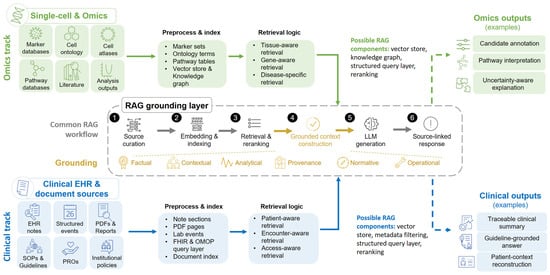
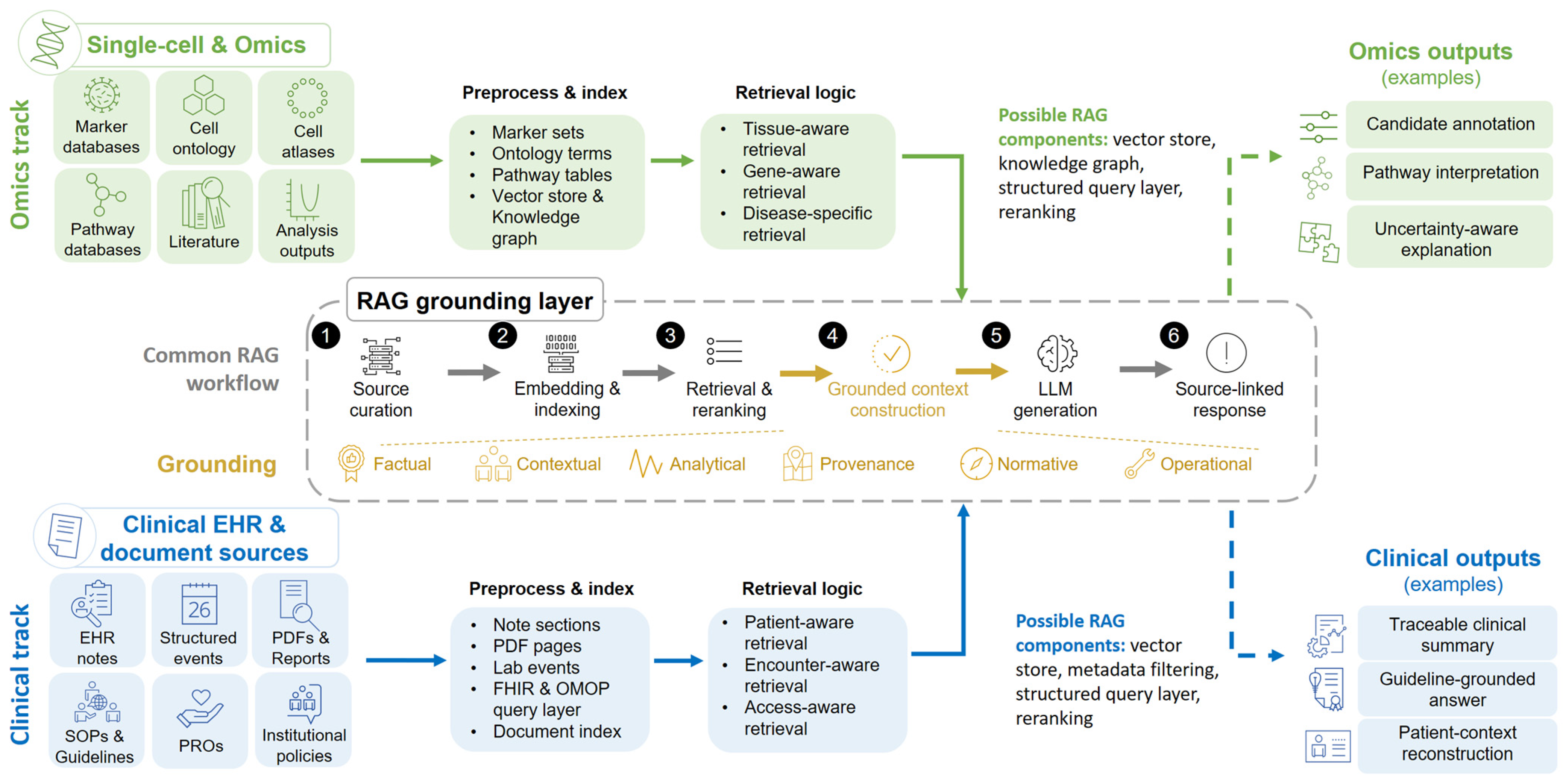
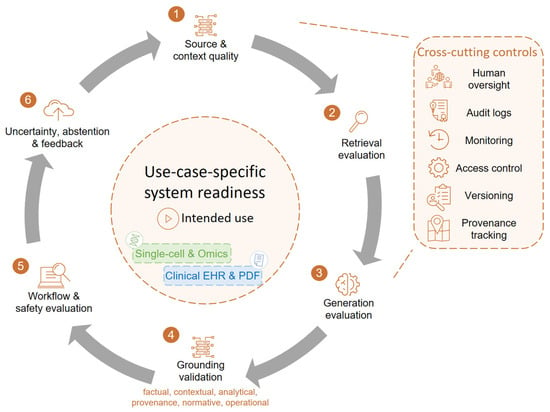
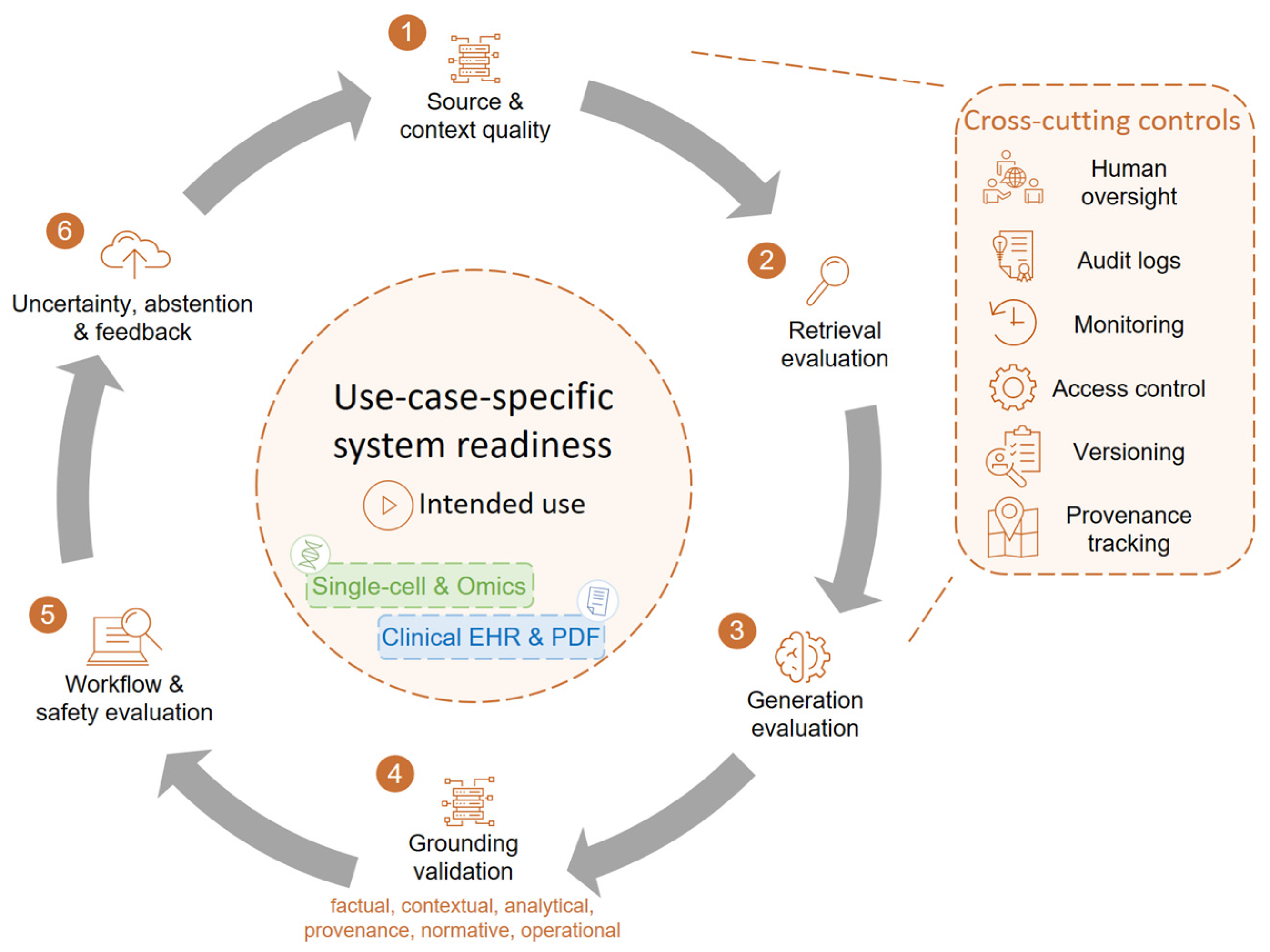

Disclaimer/Publisher’s Note: The statements, opinions and data contained in all publications are solely those of the individual author(s) and contributor(s) and not of MDPI and/or the editor(s). MDPI and/or the editor(s) disclaim responsibility for any injury to people or property resulting from any ideas, methods, instructions or products referred to in the content. |
© 2026 by the authors. Licensee MDPI, Basel, Switzerland. This article is an open access article distributed under the terms and conditions of the Creative Commons Attribution (CC BY) license.