


Abstract
Frosty pod rot (FPR), caused by the basidiomycete Moniliophthora roreri, remains a major constraint to cacao production in the Neotropics and a biosecurity concern where the pathogen is absent. This critical narrative review appraises 69 sources spanning reproductive biology, infection-stage transitions, population genomics, molecular pathogenicity, diagnostics, epidemiology, resistance and management, calibrating recurrent claims against the directness and reproducibility of their evidence. The evidence supports predominantly clonal reproduction, marked geographical structure, continued genome evolution and prolonged hidden colonisation. It does not support a uniquely resolved geographical origin, a correspondence between genetic structure and pathogenic phenotype, or the inference of epidemic risk from pathogen DNA alone, and extensive candidate secreted-protein and carbohydrate-active enzyme (CAZyme) repertoires remain largely without causal validation. We integrate these domains into an evidence-calibrated causal framework linking pathogen diversity, molecular processes, infection and transmission traits, epidemic behaviour and adaptive management and identify epidemiological resistance and dynamic sentinel-isolate panels as priorities for advancing predictive and durable FPR management.
1. Introduction
Frosty pod rot (FPR), caused by Moniliophthora roreri, is one of the most consequential disease threats to cacao (Theobroma cacao L.) in tropical America and a continuing biosecurity concern where the pathogen is absent. A specialised basidiomycete pathogen of developing Theobroma and Herrania fruits [1,2], it differs from its close relative M. perniciosa in tissue tropism and reproductive biology: predominant association with developing fruits, no conclusively demonstrated mushroom-forming sexual stage under natural conditions and abundant asexual rhexolytic thallic conidia on diseased pods [1,3,4], with population-level evidence supporting predominantly clonal reproduction [5]. Together with its prolonged hemibiotrophic development, these traits make the pathogen both a major phytosanitary challenge and an informative model for disease emergence in perennial tropical crops.
A central management difficulty is the temporal separation between infection and externally recognisable disease. After infecting susceptible pods, M. roreri maintains a prolonged internal association with living tissue before necrotic lesions and sporulation appear, while physiological and transcriptional changes are already under way in both partners [6,7]; the duration of this phase varies with pod stage, cacao genotype, inoculation conditions and environment, so a fixed universal latency period is biologically misleading [1,6]. The resulting epidemiological lag has consequences for every symptom-based intervention.
A second source of complexity is that M. roreri is not genetically uniform. Population-genetic and genomic studies consistently reveal pronounced geographical structure, founder effects and lineage-specific variation [8,9,10,11], and broader sampling has challenged earlier attempts to infer a unique geographical origin from contemporary diversity centres [10]. For breeding and management, the consequential question is not where diversity is greatest but whether divergent populations differ in epidemiologically relevant traits.
Genomics and transcriptomics have in parallel revealed extensive repertoires of secreted proteins, carbohydrate-active enzymes (CAZymes) and candidate effectors, together with stage- and genotype-dependent transcription [7,11,12,13]. Candidate discovery nevertheless outpaces causal validation, as the functional characterisation of the effector MrB1 illustrates: it provides direct evidence of host-modifying activity without yet demonstrating an in-pathogen requirement for virulence [14].
A further dimension complicates a purely two-part model, since cacao genotype can shape pod-associated fungal communities and thereby modify disease outcomes and biocontrol efficacy [15].
Taken together, these advances expose a broader limitation: population biology, infection physiology, molecular pathogenicity, diagnostics, epidemiology, resistance and management have progressed as parallel research areas rather than as components of one causal system. Population structure is rarely connected to quantitative infection and transmission phenotypes, molecular candidates are seldom followed through to epidemiological consequences, resistance is often screened without representative pathogen diversity, and management outcomes are interpreted without integrating hidden colonisation, host background or pathogen population structure.
This review therefore treats M. roreri as an integrated pathosystem rather than a collection of independent topics, synthesising evidence across taxonomy and reproductive biology, infection-stage transitions, population structure and genome variation, molecular pathogenicity, diagnostics, epidemiology, resistance, biological control, and integrated management and calibrating claims according to whether they rest on direct experimental evidence, association, prediction or plausible inference. These domains are then connected through an explicit causal architecture (Section 10). By identifying where these connections are supported, where they remain uncertain and which experiments could resolve them, the review offers an evidence-calibrated roadmap towards predictive and durable disease management. Selected molecular, genomic and diagnostic milestones underpinning this transition are summarised chronologically in Figure 1.
Figure 1.
Selected molecular, genomic and diagnostic milestones in the Theobroma cacao–Moniliophthora roreri pathosystem. Date ranges are approximate and may overlap; illustrations are schematic and do not reproduce original experimental outputs. The figure was prepared using Corel PHOTO-PAINT 2022 and selected BioRender elements, with ChatGPT (OpenAI) assistance for scientific review and verification. All content was verified by the authors. Note: AFLP, amplified fragment length polymorphism; ISSR, inter-simple sequence repeat; SSR, simple sequence repeat; SNP, single-nucleotide polymorphism; RNA-seq, RNA sequencing.
2. Review Strategy and Evidence Appraisal
This study is a critical narrative review integrating biological, molecular, epidemiological and applied evidence across the M. roreri–cacao pathosystem. A narrative approach was chosen because the literature spans heterogeneous domains—taxonomy, population genetics, molecular pathogenicity, diagnostics, epidemiology, resistance and management—with substantial differences in study design and analytical resolution; the objective was mechanistic integration and critical appraisal rather than quantitative pooling.
The literature base was assembled through structured manual searches of Scopus, Web of Science Core Collection and PubMed/MEDLINE, supplemented by Google Scholar, citation tracking and relevant technical/phytosanitary sources, combining the core terms “Moniliophthora roreri” and “frosty pod rot” with thematic terms for population genetics/genomics, molecular pathogenicity, diagnostics, epidemiology, resistance, biological control and integrated management (search term groups summarised in Appendix A). Publications in English, Spanish and Portuguese were considered with no strict lower date limit, though recent work received particular attention; primary peer-reviewed studies were prioritised alongside authoritative reviews and official phytosanitary documents, and reference lists/forward citations of key studies were examined for additional evidence. The search closed on 20 August 2026.
Records were screened in two stages (title and abstract, then full text) by two authors (Y.Y.P.-R. and L.A.R.-P.) working independently; disagreements on inclusion, or on the calibration assigned to a claim, were resolved by discussion and, where consensus was not reached, by the third author (A.J.-O.). Sources were included when they (i) reported original data, a systematic or authoritative synthesis, or an official phytosanitary or methodological standard bearing directly on M. roreri or FPR in any of the eight thematic domains or (ii) provided a comparative or methodological model needed to interpret an FPR-specific question for which direct evidence was lacking. Sources were excluded when they duplicated data already reported in an included publication, lacked sufficient methodological description to judge the inference drawn, consisted of conference abstracts or non-peer-reviewed reports without retrievable data (official documents and protocols excepted), or addressed other cacao pathogens without a comparative purpose; the criteria applied per domain are detailed in Supplementary File S1. Appraisal emphasised thematic relevance and methodological adequacy—sample size and geographical representation in population-genetic studies, design and replication in pathogenicity/resistance studies, validation in diagnostic studies, and duration, scale and environmental context in management studies. Data were synthesised narratively, first within domains and then across domains to identify convergent findings, conflicting interpretations and unresolved causal relationships, informing the integrative framework of Section 10.
The resulting evidence base comprises 69 included sources: 65 peer-reviewed journal articles, one edited reference volume, one national phytosanitary document and two technical documents (an inoculation protocol and a clone catalogue). Fifty-seven sources report observations or interpretations obtained directly in M. roreri or the FPR pathosystem; the remaining twelve are comparative or methodological sources from other pathosystems, population–genetic methodology or the wider cacao production literature, cited explicitly as analogy or context rather than as direct FPR evidence. Thirty-four included sources (49%) were published in 2020 or later and twenty-five (36%) in 2023 or later, reflecting the recent expansion of genomic, diagnostic and functional work. Because searching was iterative and conducted manually across databases with substantial overlap, the numbers of records retrieved, de-duplicated and excluded at each stage were not registered prospectively and cannot now be recovered; no record-flow diagram is therefore presented and no claim of PRISMA-equivalent retrieval transparency is made. Auditability is instead provided at the source and claim levels: the search strategy per database and domain, whose detailed search strings are retrospective reconstructions of the iterative searches performed (Supplementary File S1); a per-reference evidence map giving the domain, design, main finding used, citing section and principal inferential limitation of every included source (Table S1)l and a claim–evidence audit linking each major evidence-sensitive statement to its support, calibration and decisive future test (Table S2).
To align language with evidence strength, four calibration terms are applied to the principal evidence-sensitive claims, including the molecular–pathogenicity claims appraised in Section 6, the Conclusions and Supplementary Table S2. Demonstrated denotes direct experimental or field evidence addressing the stated mechanism in M. roreri; supported, convergence among independent or complementary lines of evidence; suggested, associations, comparative inference, restricted replication or surrogate-system results that increase plausibility without establishing causation; and hypothesised, mechanistically plausible propositions not yet directly tested in M. roreri. Table 1 gives the full definitions and the evidentiary basis required for each. These terms calibrate individual claims by the directness and reproducibility of the underlying evidence and do not constitute a formal study design hierarchy.
Table 1.
Evidence calibration rules applied throughout this review (Section 2). These terms qualify the strength of individual claims according to the directness, consistency and reproducibility of the supporting evidence, not as a formal ranking of study designs.
As a critical narrative review, this synthesis does not estimate pooled effect sizes, and study selection and interpretation remain subject to the inherent limitations of narrative synthesis even where searching was structured and claims were explicitly calibrated. Its principal contribution therefore lies in cross-domain conceptual integration, critical appraisal of inferential boundaries and prioritisation of experimentally testable hypotheses.
3. Taxonomic Placement, Reproductive Biology and Evolutionary Context
3.1. From Monilia to Moniliophthora
The taxonomic history of M. roreri illustrates how morphological interpretation changes as phylogenetic resolution improves. Originally described within an anamorphic framework, early ultrastructural work established basidiomycetous affinities despite the absence of a conspicuous mushroom-forming stage. Evans et al. [16] combined morphological, cytological and molecular evidence to place the pathogen close to Crinipellis perniciosa, then interpreting its dispersive spores as meiospores from a highly modified basidial system. Multilocus phylogenetics later provided firmer resolution: using five nuclear loci, Aime and Phillips-Mora [3] showed that the frosty pod rot and witches’ broom agents are sister taxa within Marasmiaceae, and transferred the witches’ broom pathogen to Moniliophthora as M. perniciosa. The genus itself was erected in 1978, when the frosty pod rot pathogen, originally described as Monilia roreri Cif., was transferred to it as M. roreri (Cif.) H.C. Evans, Stalpers, Samson & Benny [3].
The accepted species, M. roreri (Cif.) H.C. Evans, Stalpers, Samson & Benny, thus sits within Basidiomycota, Agaricomycetes, Agaricales and Marasmiaceae. Its close relationship to M. perniciosa is informative, but the two are not functionally equivalent: M. perniciosa forms basidiomata and colonises meristematic tissue, whereas M. roreri is predominantly fruit-associated, with no conclusively demonstrated sexual stage in nature [1,3], implying substantial divergence in tissue tropism and developmental regulation despite shared ancestry.
3.2. What Are the Spores of M. roreri?
The nature of the abundant powdery spores on diseased pods was historically controversial. Evans et al. [16] interpreted them cytologically as meiospores or a modified basidial stage; this was later reassessed through detailed analysis of sporogenesis, nuclear condition and germination. Díaz-Valderrama and Aime [4] demonstrated that M. roreri produces conidia asexually by a thallic, rhexolytic mode, with one or two nuclei per conidium influencing conidial size.
The implications extend beyond terminology: an asexual dispersive stage removes the most conspicuous route by which meiotic recombination could generate diversity, but it does not by itself exclude a contribution of rare or cryptic recombination. Whether contemporary genetic and geographical structure reflects clonal reproduction, mutation, genome restructuring, founder effects and historical movement alone must therefore be judged from the population-genetic evidence examined in Section 3.3.
3.3. Mating Potential Does Not Demonstrate Realised Sexual Reproduction
Asexual sporulation does not imply loss of the molecular machinery for sexual compatibility. Díaz-Valderrama and Aime [5] identified A and B mating-type loci and documented mating-type diversity among geographically distributed isolates, but retained loci indicate reproductive potential rather than an active sexual cycle in nature. Population-level evidence remains most consistent with predominant clonality: strong linkage disequilibrium and broader population-genetic patterns across sampled regions indicate that regular meiotic recombination is not required to explain contemporary structure [5,9,10,11,17]. It should be emphasised that this inference derives from that population–genetic evidence—above all repeatedly recovered linkage disequilibrium, together with repeated multilocus genotypes in SNP datasets (37 genotypes among 172 isolates [9]) and geographical differentiation—and not from the absence of observed basidiomata, which would be far weaker evidence because a rarely formed or cryptic sexual stage could escape field observation; rare or cryptic recombination therefore remains unresolved rather than excluded. Genotype redundancy is, however, marker-dependent: a highly polymorphic SSR panel resolved 117 genotypes among 120 Colombian isolates while still recovering strong linkage disequilibrium [17], so linkage disequilibrium rather than genotype redundancy carries most of the inferential weight.
The tests applied so far nevertheless remain limited relative to the toolkit available for detecting rare recombination in fungal populations [18]. Multilocus association indices (IA and its standardised form ) should be computed on clone-corrected data because repeated sampling of a single clone inflates linkage disequilibrium [18,19]; phylogenetic–compatibility tests, the decay of linkage disequilibrium with physical distance in genome-wide data and tests of mating-type frequencies provide complementary signals. Reported analyses differ in whether such indices were clone-corrected, and genome-wide linkage-disequilibrium decay across the species range was not identified in the literature examined. Mating-type loci offer a particularly direct test: only the A1B1 and A2B2 combinations have been detected in populations outside Colombia [11], so a systematic search for recombinant A1B2 and A2B1 combinations within the principal diversity centres—informative to the extent that the A and B loci are unlinked, as expected in a tetrapolar system—together with clone-corrected and genome-wide linkage-disequilibrium decay, would discriminate among strict clonality, rare contemporary recombination and historical recombination now masked by clonal expansion. Until such analyses are reported, predominant clonality is best described as supported and the absence of contemporary recombination as unresolved.
3.4. Clonality Without Evolutionary Stasis
Predominant clonality should not be equated with genomic stasis. Whole-genome comparisons reveal substantial structural variation among lineages—inversions, translocations, duplications and lineage-specific architecture arising during range expansion—in regions containing transposable elements, secondary metabolism, CAZymes, secreted proteins and candidate effectors [11], showing that asexual lineages can accumulate biologically relevant differences. Particularly informative are the lineage-specific configurations of populations beyond the principal diversity centres, consistent with strong founder effects followed by clonal expansion, with segmental duplications adding further variation in gene content and dosage [11].
Clonality should therefore be understood as a dominant reproductive mode rather than a constraint on continued evolution. For management, the apparent stability of a clonal lineage cannot be assumed to guarantee long-term uniformity in aggressiveness, host compatibility or response to control measures, so surveillance should consider lineage identity together with genome-level variation, particularly in expanding or newly introduced populations.
4. Infection Biology and Disease Progression: From Hidden Colonisation to Sporulation
4.1. Infection Establishment and Host Developmental Stage
M. roreri is unusual among major cacao pathogens in its strong association with developing fruits. Conidia deposited on susceptible pods germinate under favourable conditions and initiate infection in actively growing tissue [1,20], although the route and cellular mechanisms of penetration remain less resolved than later disease stages; descriptions of specialised penetration structures should be treated cautiously absent direct microscopic or functional evidence in this species.
Host developmental stage strongly determines susceptibility: young, actively developing pods are generally more vulnerable, and susceptibility declines as fruits mature [1,20,21]. This should not be reduced to a universal age threshold, since pod age interacts with genotype, environment and inoculation conditions; susceptibility is better treated as a developmental gradient than a binary transition, which matters whenever studies that do not standardise or report pod stage are compared.
4.2. Hidden Colonisation and the Early Biotrophic Phase
The early interaction is conventionally biotrophic: fungal development proceeds for an extended period while much of the infected tissue remains alive, and the phase is not quiescent, since changes in host metabolism, tissue development and fungal physiology can precede visible necrosis [1,6]. Reported durations differ among studies and conditions: externally asymptomatic intervals of approximately 14–21 days after infection have been described, with the biotrophic phase estimated at about three to six weeks and extending to roughly 60 days before necrosis and abundant sporulation in experimentally inoculated pods [6,13]. In epidemiological terms, these values bracket the incubation period (infection to first visible symptoms) and the latent period (infection to first sporulation). Field data from natural infection are consistent with this order of magnitude: in a cohort study of 2268 pods of the highly susceptible clone Pound-7, tagged at 1–2 months of age in 55 weekly cohorts in Costa Rica, the transition from healthy to symptomatic peaked 40–50 days after tagging and that from symptomatic to sporulating 60–70 days after tagging, each modulated by microclimate [22]. Because pods were tagged at 1–2 months of age with unknown infection dates, these intervals are counted from tagging and are proxies for, not direct measurements of, the incubation and latent periods. These ranges should be read as study-specific observations rather than universal incubation or latent periods, since duration depends on pod stage, cacao genotype, isolate, inoculum dose and environment, and the more precise estimates derive from controlled inoculations rather than natural infections of known timing. “Asymptomatic” should therefore be read operationally: absence of visible symptoms does not imply absence of fungal growth or molecular interaction. The more informative concept is a hidden, externally inconspicuous colonisation phase in which infection is already established while escaping routine inspection, which makes symptom-based surveillance and sanitation necessarily reactive and makes the same interval a potentially important window for early molecular detection and resistance that restricts infection before extensive damage or sporulation.
4.3. The Biotrophic–Necrotrophic Transition: A Central Unresolved Mechanism
The transition from prolonged colonisation of living tissue to destructive necrotrophy is one of the most important unresolved questions in M. roreri biology. Physiological studies document coordinated changes in cacao metabolites and fungal development around symptom appearance, while transcriptomics reveal extensive reprogramming of genes for nutrient acquisition, oxidative stress, redox regulation, secretion and cell wall degradation [6,7,12,23], together strongly supporting a stage-dependent infection programme. What remains unresolved is whether the transition is governed by a discrete molecular switch or emerges from interacting regulatory and environmental processes: nutrient availability, host developmental state, defence intensity, redox conditions, fungal developmental regulators and host-derived signals are all plausible contributors, none demonstrated as a singular trigger.
A machine learning re-analysis of infection-associated expression data nominated candidate regulatory hubs for this transition [24]; such analyses are useful for prioritising hypotheses, but computational importance within a network does not demonstrate biological control, and nominated regulators remain candidates until experimentally perturbed. The experimental requirements are set out in Section 6.4 and Section 11.3.
4.4. Necrotrophy, Sporulation and Epidemiological Competence
As disease progresses, expanding necrosis is followed by a white pseudostromatal layer and abundant production of powdery conidia. Infected pods then shift from sites of colonisation to epidemiologically important inoculum sources, and diseased or mummified fruit retained in the canopy can sustain inoculum between infection cycles [1,25,26,27]. Wind, rain splash, mechanical disturbance and human activity have been proposed as short-distance redistribution pathways [1,27], but their quantitative contribution remains insufficiently characterised (Section 8.3).
Sporulation is therefore more than a late symptom; it is the stage most directly linked to onward transmission, with direct consequences for resistance phenotyping. A genotype that develops smaller lesions but ultimately supports substantial fungal biomass and sporulation may provide less epidemiological resistance than lesion scores suggest, whereas genotypes restricting infection establishment, colonisation or conidial production could reduce transmission even with some visible symptoms.
We therefore propose that host response to FPR be operationally decomposed into four epidemiologically relevant components—infection resistance, colonisation resistance, damage tolerance and transmission/sporulation resistance—quantified separately rather than summarised by external lesion severity. Infection, colonisation and transmission/sporulation resistance constrain different stages of pathogen establishment, development or reproductive output, whereas damage tolerance reflects the host’s capacity to limit biological or productive damage at a given pathogen burden and should therefore not be interpreted as resistance per se. This decomposition is used throughout the review (Section 6, Section 9 and Section 11).
5. Population Structure and Genetic Diversity Across Cacao-Growing Regions
5.1. Marker Systems Changed the Resolution of Population Inference
Understanding M. roreri population biology has depended on the molecular resolution available at each stage of research. Early AFLP and ISSR analyses established that the pathogen was not a single homogeneous clone and revealed broad geographical structuring: Phillips-Mora et al. [8] analysed 94 isolates across much of the known range and identified five broad genetic groups. These dominant-marker systems were valuable for exploratory biogeography, but their anonymous loci and lack of nucleotide-level information limit comparison with later datasets. SSR markers subsequently increased resolution within regional populations: 120 Colombian isolates typed at 23 SSR loci yielded 117 multilocus genotypes while simultaneously showing strong linkage disequilibrium [17], illustrating that high multilocus diversity does not imply frequent sexual recombination.
RNA-seq-derived SNP markers increased resolution further: Ali et al. [9] genotyped 172 isolates at 88 polymorphic SNPs and recovered 37 genotypes, with particularly high diversity in the upper Magdalena Valley; chromosome-scale assemblies and population resequencing have since enabled direct investigation of founder effects, mating-type diversity and lineage-specific architecture [11]. Marker heterogeneity nevertheless complicates retrospective synthesis: an AFLP or ISSR group cannot be equated with an SSR cluster, an SNP genotype or a genome-defined lineage, so historical group names should be treated as marker- and dataset-dependent hypotheses unless correspondence has been demonstrated with shared isolates or comparable genomic data.
5.2. Geographic Structure and Centres of Genetic Diversity
Despite differing marker systems, M. roreri populations are consistently geographically structured. Phillips-Mora et al. [8] identified high genetic diversity in Colombia and proposed central and north-eastern Colombia as a possible centre of origin; Ali et al. [9] found 36 of 37 SNP genotypes in Colombia, particularly in the upper Magdalena Valley; and Jaimes et al. [17] demonstrated substantial differentiation among Colombian production regions despite the predominantly clonal signal. Broader sampling subsequently complicated a simple Colombian-origin model: Díaz-Valderrama et al. [10], integrating new SSR data with public SNP information, identified two major diversity hotspots—coastal Ecuador and the inter-Andean Magdalena Valley—both historically important cacao cultivation centres, and argued that agriculture and human-mediated movement have substantially shaped contemporary diversity. At a finer scale, Rodríguez-Velázquez et al. [28] detected two ISSR groups among 145 isolates from 17 Soconusco (Chiapas) sites, associated with landscape-restricted gene flow, a local-scale finding that should not be extrapolated to genome-defined lineages across the species.
5.3. Genetic Diversity Is Not Equivalent to Geographical Origin
A centre of observed genetic diversity is not necessarily a centre of evolutionary origin, since high contemporary diversity may equally reflect repeated introductions, expansion, admixture, intensive cultivation or accumulated mutation. Earlier marker-based studies read high Colombian diversity as support for Colombian origin [8,9], but Díaz-Valderrama et al. [10] showed that substantial diversity also occurs in coastal Ecuador and concluded that origin cannot be established definitively from available data, results compatible with a broader upper-Amazonian scenario followed by movement into major growing areas, but a biogeographical hypothesis rather than a demonstrated origin. The sampling and modelling required are set out in Section 11.1.
5.4. Founder Effects and Genome Evolution During Range Expansion
Population structure outside the principal diversity centres is consistent with strong founder effects during expansion, historical movement having disseminated only a subset of older-population diversity. Minio et al. [11] showed that lineages outside Colombia contain a restricted subset of mating-type diversity (only A1B1 and A2B2 combinations detected) and carry lineage-specific genomic configurations, including a chromosome-segment duplication in Costa Rican isolates that increased the copy number of genes encoding secreted proteins and candidate effectors; a chromosome-scale resource for the invasive A1B1 lineage strengthens this comparative basis [29]. Range expansion is therefore not the movement of invariant clones: founder events sharply reduce diversity, while subsequent mutation, duplication and structural evolution generate lineage-specific configurations fixed by clonal propagation.
5.5. Does Genetic Structure Predict Pathogenic Phenotype?
Not necessarily, and this is one of the most important unresolved links in M. roreri biology. Genetic clustering identifies shared ancestry or marker similarity; it does not demonstrate differences in aggressiveness, host specificity, latency or sporulation. Phillips-Mora et al. [30] inoculated pods of five host genotypes with seven Colombian isolates from four genetic groups: differences occurred among isolates and genotypes, but the reported genetic diversity was not mirrored by equivalent aggressiveness differentiation, most isolates being highly aggressive across hosts, with no significant clone × isolate interaction for the principal disease variables. Available evidence therefore does not support treating marker-defined groups as physiological races: genetic distance is not a surrogate for virulence distance. Demonstrating genotype–phenotype relationships will require the standardised design outlined in Section 11.4.
The same principle applies to resistance breeding: screening against one convenient isolate cannot establish broad-spectrum resistance, whereas testing many isolates without genomic characterisation may replicate closely related diversity. We therefore propose sentinel isolate panels, a manageable number of genomically characterised isolates representing major lineages, geographical origins, collection dates and, where reproducibly demonstrated, contrasting pathogenic phenotypes. Such panels should prioritise non-redundant genomic diversity and remain dynamic rather than taxonomically or geographically fixed, incorporating newly detected populations whenever genomic or phenotypic evidence indicates additional diversity. Table 2 summarises these milestones and the principal inferential limits of successive molecular approaches.
Table 2.
Key milestones in the population biology of M. roreri and the principal inferential limits of successive molecular approaches.
6. Molecular Determinants of Pathogenicity and Host Interaction
6.1. Genome Architecture and Enzymatic Capacity: Potential Is Not Function
Genomic resources have expanded the mechanistic hypotheses available for FPR, complementing broader comparative treatments of the main eukaryotic cacao pathogens [31]. The first genome and transcriptome analyses revealed a repertoire consistent with a hemibiotrophic lifestyle, including numerous predicted secreted proteins and CAZymes [13]; comparative pathogenomics extended the catalogue of candidate secreted proteins and effectors across Moniliophthora populations [32]; and chromosome-scale assemblies revealed lineage-specific structural variants affecting regions containing secreted proteins and candidate effectors [11].
Genome content should nevertheless not be conflated with pathogenic function. Gene presence, absence or copy number identifies molecular capacity and prioritises hypotheses, but does not establish when a product is expressed, whether it reaches host tissue, which target it encounters or whether altering the gene changes disease outcome; the same caution applies to lineage-specific duplications, whose altered dosage cannot be assumed consequential without expression and perturbation data. CAZymes illustrate the point: pectinases, cellulases, hemicellulases and related enzymes are plausible contributors to cell wall modification during necrotrophy, but their individual contributions depend on developmental timing, substrate accessibility, functional redundancy and host countermeasures, so the genome is better described as encoding substantial capacity for cell wall modification than as containing validated virulence determinants.
6.2. Secretome and Effectors: From Candidate Repertoires to Functional Evidence
Secreted proteins are among the strongest molecular candidates for mediating the interaction, and genome and comparative secretome studies have identified substantial repertoires of predicted secreted proteins and candidate effectors, including stage-associated and Moniliophthora-specific candidates [11,13,32], but prediction from secretion signals, size, composition or comparative genomics is evidence of candidacy, not of virulence function. Transcriptomic profiling has refined this space: de Nascimento et al. [12] identified 1075 transcripts encoding predicted secreted proteins in spores and mycelium exposed to cacao fruit extract, 61 differentially expressed, and prioritised 23 putative effectors, selecting candidates producing measurable responses in heterologous assays without demonstrating a requirement for pod infection.
The functional characterisation of MrB1 is an important advance: recombinant MrB1 altered host cellular homeostasis, affected membrane integrity and oxidative responses and induced genotype-dependent necrosis, with stronger responses in susceptible backgrounds [14], and it shows homology to BASIDIN, an effector characterised in M. perniciosa [33]. A distinction nevertheless remains between recombinant-protein activity and an in-pathogen virulence requirement, which only pathogen-side disruption and complementation can establish (Section 11.2). MrB1 is therefore best regarded as a functionally supported, host-active effector rather than a genetically proven virulence determinant—a distinction that should guide terminology throughout the field: candidate effector (prediction) → expressed candidate effector (transcriptional or proteomic evidence) → host-active effector (demonstrated activity) → virulence determinant (pathogen-side genetic evidence).
6.3. Transcriptional Reprogramming and Cacao Defence
The interaction is dynamic and depends on infection stage and host genetic background. Bailey et al. [7] identified marked fungal transcriptional changes while M. roreri colonised genotypes differing in tolerance, and Ali et al. [23] demonstrated clone-dependent host responses in defence, hormone signalling and stress pathways, arguing against a fixed virulence programme operating identically across genotypes. Host responses repeatedly implicate oxidative signalling, pathogenesis-related proteins, phenylpropanoid metabolism and hormone-associated defence [7,23], but transcriptional induction is not automatically effective resistance: a large increase in defence transcripts may reflect rapid containment or a late consequence of extensive damage, which makes timing and localisation essential. The same caution applies to fungal transcription, where stage-associated expression cannot distinguish initiation from response, and biomass change can confound transcript abundance.
Future studies should therefore integrate host and pathogen measurements in the same material (Section 11.3) and determine which component of the host-response framework of Section 4.4 is primarily affected.
6.4. The Unresolved Regulatory Layer of the Biotrophic–Necrotrophic Transition
As discussed in Section 4.3, no master switch for the transition to necrotrophy has been demonstrated, and computationally nominated regulatory hubs [24] prioritise hypotheses without demonstrating control. Resolving it requires dense temporal sampling followed by controlled perturbation across genotypes and isolates (Section 11.2 and Section 11.3); until it exists, the literature supports stage- and genotype-dependent reprogramming rather than a defined causal regulatory circuit. Table 3 summarises the evidence status of the major molecular–pathogenicity claims discussed in this section.
Table 3.
Evidence appraisal for major molecular–pathogenicity claims in M. roreri. Evidence strength refers to the specific claim shown, not to the overall quality of cited studies, and uses the calibration terms defined in Table 1.
7. Diagnostic Approaches: From Disease Recognition to Molecular Surveillance
7.1. Symptom-Based Diagnosis Is Useful but Inherently Late
FPR is often recognisable in endemic areas once signs are fully developed—pod deformation, brown lesions, white pseudostromatal growth and powdery conidia—but, because of the hidden colonisation phase (Section 4.2), symptom-based diagnosis identifies infection late and potentially after an inoculum source has already formed. Microscopy and isolation confirm the pathogen and supply isolates, but are slow and subject to contamination and culturability bias.
7.2. qPCR Has Moved FPR Diagnosis Towards Quantitative Molecular Surveillance
Jiménez-Zapata et al. [34] combined quantitative polymerase chain reaction (qPCR) with environmental spore trapping to detect and estimate inoculum in cacao fields, detecting very small DNA quantities over a broad analytical range, an important shift from diseased pod diagnosis to environmental surveillance. The study nevertheless reported substantial variability in relating molecular measurements to spore counts (see Section 7.3). Genome-informed diagnostics have since improved specificity: Reis et al. [35] used comparative genomics to identify M. roreri-specific regions and developed the Mr77F/R and Mr78F/R primer pairs for conventional polymerase chain reaction (PCR) and SYBR Green qPCR, validated against a broad non-target panel (M. perniciosa, Ceratocystis cacaofunesta, Clonostachys rosea, Fusarium, Lasiodiplodia, Phytophthora, Trichoderma) and detecting geographically diverse material and naturally diseased pods without cross-amplifying M. perniciosa. Validation should now move from assay development to deployment conditions—additional lineages, laboratories, extraction procedures, pod stages, low pathogen loads, inhibitors and mixed infections—distinguishing analytical from diagnostic performance.
7.3. A Diagnostic Result Is Only Meaningful in Relation to the Decision It Supports
The appropriate method depends on the question: quarantine detection of new introductions, research estimation of fungal biomass, environmental surveillance of inoculum and field sanitation triggers do not require identical performance. Regulatory diagnostics prioritise specificity, traceability and independent validation; epidemiological surveillance additionally requires calibration against biologically meaningful inoculum levels; field tests must balance performance against speed, cost and simplicity. Future studies should therefore report intended use, sample matrix, sampling strategy, extraction method, controls, limit of detection, cross-reactivity panel and positive-classification criteria, and should distinguish explicitly among detection of DNA, RNA, viable propagules and successful infection. The implication for qPCR is direct: because DNA detection establishes nucleic-acid presence rather than viability or infection competence, DNA-based surveillance should not be translated into risk thresholds unless the DNA–viability–infection relationship has been experimentally calibrated. Viability- or infection-linked assays, such as RNA-based approaches or viability dyes coupled with amplification, are consequently a priority, and would themselves require validation against culture, germination and infection assays.
7.4. Emerging Technologies: Promising Tools, Not Yet Validated Capabilities
Isothermal approaches such as loop-mediated isothermal amplification (LAMP) and recombinase polymerase amplification (RPA) are attractive because they amplify target nucleic acids rapidly with relatively simple equipment, and LAMP has already been deployed in other pathosystems, including a colourimetric assay for a cacao badnavirus (cacao yellow vein-banding virus) [36] and detection of Phytophthora species in strawberry fields [37]; however, no peer-reviewed LAMP or RPA assay specific to M. roreri was identified in the literature examined. Reis et al. [35] identified isothermal adaptation of their species-specific targets as a logical next step, but no field-validated LAMP or RPA workflow for this pathogen was identified in the literature examined here. A DNA-based electrochemical nanobiosensor for Phytophthora palmivora in cacao pod material [38] demonstrates biosensor feasibility in this crop, and genosensor, immunosensor, aptasensor and volatile-based platforms are expanding rapidly [39], but no equivalent validated M. roreri platform was identified. Hyperspectral imaging and near-infrared spectroscopy detect host physiological change rather than pathogen nucleic acids, with demonstrated pre-symptomatic potential in other pathosystems [40], although FPR specificity has not been established and would require comparison against molecularly confirmed, temporally staged infections while controlling for genotype, developmental stage, water and nutrient status, and other diseases. Table 4 ranks every approach on an ordinal four-level readiness scale for FPR use. Only symptom recognition, microscopy and isolation, and species-specific PCR and qPCR currently occupy the first two categories. The critical next step is therefore not more sophisticated platforms but establishing what biological state each one measures.
Table 4.
Diagnostic approaches for M. roreri and the biological inference each can legitimately support. Readiness for FPR is ranked on an ordinal scale from (1), highest, to (4), lowest.
8. Epidemiology from a Fungal Biology Perspective
8.1. Epidemics Emerge from Inoculum, Susceptible Host Cohorts, Environment and Time
FPR epidemics emerge from repeated interaction among available inoculum, the abundance and developmental stage of susceptible pods, environmental conditions, and management, which are dynamically coupled rather than independent. Field observations in Colombia showed FPR dynamics varying with plot, clone, observation period and pod production, so epidemic intensity cannot be reduced to a single climatic threshold [21]. Temperature, wetness and humidity influence different disease-cycle stages, but their effects depend on host developmental stage, inoculum availability and exposure timing [20]. Because susceptibility varies through pod development, periods with many simultaneous young pods amplify the consequences of favourable infection conditions, whereas otherwise-favourable climates generate limited disease when susceptible tissue or inoculum is scarce. Weather variables measured without host cohort, inoculum and management information therefore explain only part of observed dynamics.
8.2. Hidden Infection Creates Epidemiological Memory and Time Lags
The prolonged infection-to-symptom interval creates epidemiological memory: disease observed at inspection partly represents infections established considerably earlier, so current weather need not match the conditions under which they occurred. Contemporaneous rainfall, temperature or humidity correlations with visible incidence may therefore assign effects to the wrong biological stage; infection-associated conditions should be evaluated over biologically plausible lag periods, while conditions acting on necrosis and sporulation operate later. Field cohort data support this lag structure: pod wetness during the two weeks before tagging and maximum temperature 4–21 days after tagging were associated with symptom onset, whereas temperatures 35–58 days after tagging were associated with sporulation [22]. The biological states of Section 4 provide the corresponding modelling structure—susceptible, infected but inconspicuous, symptomatic, sporulating and removed—which also clarifies why the apparent short-term effect of sanitation cannot be interpreted without allowing for an unobserved pool of already-infected pods that continues to progress after intervention.
8.3. Dispersal Operates at Different Spatial Scales
Historical reconstruction and population genetics strongly implicate human-mediated movement in geographical expansion [8,10,27], and founder effects and restricted diversity in introduced populations are consistent with dissemination of only subsets of pathogen diversity; genetic evidence cannot, however, uniquely reconstruct every introduction, since unsampled sources and repeated transport generate similar signatures. Brazil illustrates why spatial precision matters: M. roreri has been documented in Acre and subsequently detected in Amazonas, with official quarantine, surveillance and containment measures maintained in affected areas [41,42,43]—occurrence remained geographically restricted and under official containment at the 20 August 2026 literature cut-off. At within- and between-farm scales, the uncertainty is greater: wind, rain splash and mechanical disturbance are plausible redistribution mechanisms, but quantitative dispersal kernels have not been established for M. roreri, and evidence that wind dispersal can be strongly anisotropic and splash dispersal highly localised in other fungal pathosystems [44,45] provides comparative models rather than direct FPR evidence; proposed insect or animal dissemination remains hypothetical. Experiments quantifying deposition as a function of distance, direction, wind, rainfall and canopy conditions would supply the kernels needed for spatially explicit models and rational design of sanitation buffers and surveillance zones. These contrasting spatial states are summarised schematically in Figure 2.
Figure 2.
Conceptual biogeographic schematic of Moniliophthora roreri in the Americas, distinguishing major centres of observed genetic diversity (coastal Ecuador and the Magdalena Valley, Colombia), selected locations of the established range (southern Mexico, Central America, Jamaica, Venezuela, Peru and Bolivia) and geographically restricted documented foci under phytosanitary containment in Brazil (Acre and Amazonas). Dashed connectors indicate inferred historical or human-mediated connectivity; they do not identify a unique centre of origin, a specific source population or quantitatively resolved dispersal routes. Locations and connections are schematic and are not intended for spatial measurement.
8.4. Climatic Suitability Is Not Equivalent to Realised Epidemic Risk
Moura et al. [46] modelled current and projected climatic suitability for M. roreri in Pará, Brazil, which is valuable for phytosanitary prioritisation but models bioclimatic suitability rather than realised incidence, while Fremout et al. [47] modelled climatic suitability for cultivated and wild cacao in Colombia, addressing the host’s climatic niche rather than the pathogen’s distribution. These complementary but distinct approaches illustrate that host suitability, pathogen suitability and realised FPR risk are not interchangeable: realised disease requires geographical and temporal coincidence of susceptible host, epidemiologically competent inoculum and permissive conditions, further modified by management, cropping system, host genotype and pathogen phenotype. Climate-envelope models are therefore best read as scenario-dependent exposure or establishment estimates rather than epidemic forecasts (see Section 11.5).
8.5. From Descriptive Epidemiology to Predictive Surveillance
A more predictive FPR epidemiology should combine observations at different biological and spatial scales: weather and microclimate describe environmental opportunity; host phenology describes susceptible-tissue availability; sanitation and management history determine inoculum-source persistence; molecular surveillance provides pathogen-associated information; population genomics supplies evolutionary context. None of these alone equals epidemic risk. Process-based tools for FPR remain scarce and site-specific: an early simulation model developed for Costa Rica [48] and the cohort-based transition analysis described in Section 8.2 [22] are the closest current templates, the latter showing that each disease-cycle transition responds to a different microclimatic window, so that a single weather-based index is unlikely to forecast all stages. Pathogen genotype should enter such models only once genotype–phenotype relationships have been demonstrated (Section 5.5), so that measured traits rather than genetic clusters parameterise them. Operational systems should be tested prospectively against newly observed infection, symptom and sporulation events rather than only against historical fit. The long-term objective is not forecasting where M. roreri could occur, but predicting when susceptible tissue, competent inoculum and favourable conditions coincide sufficiently to generate transmission.
9. Implications for Resistance, Biological Control and Integrated Disease Management
9.1. Sanitation and Cultural Control Remain the Epidemiological Foundation
Regular removal of diseased and sporulating pods reduces secondary inoculum [26,49,50,51]. In Huila, Colombia, an intensive integrated programme including removal every 7 days reduced disease progress by approximately 70% at one site, with a smaller effect at a second; 21-day intervals were among the least effective [50]. These results concern combined programmes and do not isolate the effect of removal frequency.
Independent field studies broaden the evidence: more frequent phytosanitary removal increased yield economically in eastern Peru [52]; subsequent Peruvian trials tested removal with fertilisation and biocontrol frequency [53]; and integrated programmes were evaluated in Costa Rica [54], Tabasco, Mexico [51] and CCN-51 cacao [49]. Together, they support sanitation while leaving the optimal interval dependent on site, host material, disease pressure and labour costs.
A 7-day interval is therefore a study-specific benchmark rather than a universal optimum. Removal reduces subsequent inoculum production but cannot prevent established infections (Section 4.2). Local schedules should be evaluated against disease, yield, labour and cost across seasons.
9.2. Resistance Breeding Should Target Epidemiological Resistance and Durability
Host resistance offers the greatest potential for reducing dependence on repeated intervention, but should not be reduced to external lesion severity. Historical clone × isolate experiments demonstrated substantial genotype and isolate variation, while quantitative trait locus (QTL), genome-wide association study (GWAS) and genomic-prediction studies confirmed that resistance is quantitative and genetically complex [30,55,56,57]. It is useful to distinguish four successive stages—discovery of resistance sources and associated loci; validation in independent material; demonstration of transferability across populations, pathogen lineages and environments; and deployment in cultivars that retain performance under commercial conditions—because most available evidence sits at discovery and early validation, whereas claims of durable resistance implicitly require the latter two. Marker effects illustrate the distinction: cross-population prediction accuracy can decline when training and target populations differ [56], so resistance-associated markers remain population-dependent predictors until independently validated, which is a transferability rather than a discovery limitation. Deployment-stage evidence exists but is geographically concentrated: in the long-term L6 trial at La Lola, Costa Rica, the CATIE-selected clones CATIE-R6 and CATIE-R4 (both UF-273 × PA-169) averaged about 5% and 9% FPR incidence over 11 years, reacted as resistant to artificial inoculation and were the most productive of the selected clones, whereas widely used materials such as ICS-95 and CC-137 were moderately susceptible [58]. The recent rise in incidence noted for CATIE-R4 in the same evaluation [58] illustrates why durability must be monitored rather than assumed, and the transferability of this resistance to other pathogen lineages and environments remains to be demonstrated. Field phenotyping must also separate resistance from exposure: under natural infection, even a highly susceptible clone such as Pound-7 shows marked cohort-to-cohort variation in the timing of symptom onset and sporulation driven by microclimate [22], so single-season incidence data can confound genetic resistance with disease escape. Breeding objectives should align with transmission biology through the four-component host-response framework of Section 4.4. Future pipelines should therefore combine multi-environment field evaluation with controlled inoculation using genomically characterised isolates (Section 5.5), phenotyping infection success, internal lesion development, biomass, latent period, external severity and final sporulation; durability belongs to the deployment stage and should be demonstrated across multiple lineages, environments and production cycles rather than assumed from single-isolate, single-site data.
9.3. Biological Control: Ecological Fit Is as Important as Antagonistic Capacity
Biological control has expanded from classical antagonism studies to diverse fungal, bacterial and yeast candidates. Trichoderma spp. remain the most extensively investigated, with native isolates reducing FPR in field or controlled assays, although efficacy varies among strains, sites and systems [54,59,60,61], and native-strain volatile and non-volatile metabolites inhibit M. roreri in vitro [62]. Bacterial antagonists add a further reservoir: Paenibacillus sp. NMA1017 showed promising effects in selected assays [63], and a survey of 90 culturable bacteria from Peruvian Amazon cacao rhizospheres found frequent antagonism, particularly among Bacillus-associated isolates [64]. Yeasts broaden it again, with Wickerhamomyces anomalus KLG-014 and Candida sorboxylosa KLG-104 showing strong in vitro antagonism and Pichia kluyveri volatiles inhibiting growth in the laboratory [65,66]. This discovery base remains predominantly pre-deployment: in vitro inhibition indicates potential, not field control.
A particularly informative development is that biocontrol can depend on host genetic background: Castillo et al. [15] showed that cacao genotype influenced pod mycobiome composition and that Clonostachys rosea inoculation significantly reduced sporulating lesions in field experiments, with a stronger effect in the more susceptible genotype—introducing a third biological layer (host genotype × resident microbiome or biocontrol agent × pathogen) into disease management. An earlier field trial in Panama illustrates why endpoints matter: application of an endophytic C. rosea isolate reduced the incidence of pods with sporulating FPR lesions by about 10% without reducing overall pod loss to the disease [67], consistent with suppression of transmission rather than protection of yield, two outcomes that should be evaluated separately. The practical challenge is ecological compatibility: an antagonist that suppresses M. roreri on nutrient-rich agar may fail to persist on a pod surface exposed to ultraviolet radiation, rainfall, temperature fluctuation and microbial competition, and an agent acting on external sporulation may have little access to infection already established internally. Studies should therefore move beyond antagonism percentages to the field criteria set out in Section 11.6.
The microbiome therefore deserves explicit but bounded treatment. Evidence specific to FPR can be ordered in three tiers of increasing causal strength: descriptive, showing that cacao genotype structures the pod mycobiome [15]; host–microbe interaction, showing that the suppressive effect of an introduced C. rosea isolate varies with host genotype [15]; and experimental manipulation, so far limited to single introduced agents that reduced sporulating lesions without reducing pod loss [67], with no manipulation of the resident community itself. Evidence from other pathosystems can frame hypotheses but is not treated here as FPR evidence, and no study has yet demonstrated that resident community composition determines FPR incidence, severity or sporulation independently of host genotype and environment. The defensible position is to treat the pod and phyllosphere microbiome as a contextual modifier of the host–pathogen interaction and biocontrol performance rather than as an independent determinant of disease outcome. Converting this into usable knowledge requires multi-genotype, multi-site validation with consistent sampling of pod tissue and surface communities, absolute rather than purely relative quantification, and designs that separate host genotype from microbiome effects, ideally by testing whether defined community manipulations change disease outcomes in more than one host background and more than one environment. Until such evidence exists, microbiome data should inform the interpretation of variable biocontrol results rather than serve as a basis for management recommendations.
9.4. Chemical Control Is a Protective Component, Not a Standalone Solution
Fungicides can contribute to FPR suppression as protective components of an integrated programme, but published efficacy varies with active ingredient, timing, disease pressure, phenology, site and economic context [49,50,51,54], which argues against a universal spray calendar; registration differs by country and changes over time, and repeated applications impose economic, environmental and resistance-management constraints, so recommendations remain subordinate to national registration and stewardship guidance. Because colonisation is hidden, applications made after symptom development cannot reverse established infections, so their defensible role is protective: reducing infection of susceptible cohorts during elevated-risk periods. Rotations or combinations with biological products may broaden a programme, but adding products does not itself demonstrate superior management: contribution must be established against appropriate sanitation controls and evaluated in terms of disease progress, yield, cost, labour and environmental outcomes.
9.5. Integrated Management Should Be Adaptive, Locally Calibrated and Economically Interpretable
The strongest evidence supports combining complementary measures acting at different points of the disease cycle rather than a single universally optimal intervention: sanitation reduces sporulating inoculum, resistant cultivars reduce infection and transmission components, biological or chemical protection acts on susceptible tissue or externally accessible pathogen stages, and surveillance informs the intensity and timing of intervention (Section 8.5). The Huila study illustrates why biological and economic outcomes must be interpreted together [50]: the most intensive programme substantially reduced disease progress at one location but produced smaller gains at another, and at Rivera, the higher-input treatment yielded statistically comparable results to traditional management despite stronger disease suppression. A strategy should therefore not be judged superior solely on a lower disease index; its practical value depends on yield saved, labour, cost, operational complexity, seasonal consistency and adoption, which makes multi-year trials particularly important in perennial systems where short experiments may miss cumulative inoculum effects or interannual variability. We propose that future integrated-management experiments report, as a minimum, disease incidence and severity, sporulation or infectious pod burden, yield, intervention frequency, labour requirements, and direct costs, complemented where feasible by pathogen surveillance and pod phenology. The principle emerging from the evidence is not maximal intervention but the minimum effective combination required to suppress transmission under a defined local risk context. Table 5 summarises these strategies by the biological process each most plausibly modifies.
Table 5.
Major FPR management strategies interpreted by the biological process they most plausibly modify, principal evidence limitation, and priority improvement for durable field implementation.
10. Integrating Population Biology, Pathogenicity and Disease Control
10.1. A Testable Causal Architecture from Pathogen Genotype to Epidemic Phenotype
We propose the following testable architecture: pathogen genotype and genome architecture → regulatory and secreted repertoires → infection traits → epidemic phenotype → management response and evolutionary feedback.
Genomic variation [11], candidate repertoires [12] and host-active proteins [14] identify hypotheses for connecting these domains. Each link requires independent validation: pathogen-side perturbation, quantitative infection and transmission phenotypes, prospective epidemic prediction, and longitudinal assessment of management effects. The framework integrates the evidence boundaries established in Section 4, Section 5, Section 6, Section 7, Section 8 and Section 9 rather than assuming that these links are already demonstrated.
10.2. The Causal Chain Is Conditional: Host Genotype, Microbiome and Environment Modify Its Expression
Host genotype, pod stage and environment condition the pathway, while the resident microbiome remains a contextual modifier whose independent effect is unresolved (Section 9.3). Host-dependent responses [14,23,30] and genotype-dependent biocontrol performance [15] support factorial testing of these interactions rather than treating pathogen phenotype as an invariant isolate attribute.
10.3. Intervention Points Along the Causal Chain
Biosecurity targets establishment, protective measures target infection, host responses modify colonisation and disease outcomes, and sanitation reduces sporulating sources. Surveillance informs these interventions when its measurements are calibrated against epidemiological outcomes. Their timing and combination should follow the accessible disease-cycle stage and local conditions (Section 7, Section 8 and Section 9).
10.4. Adaptive Management as a Closed-Loop Learning System
Figure 3 represents the proposed feedback between surveillance, intervention and measured outcomes. Regional pathogen status and farm-level phenology, microclimate, and disease progression inform decisions; subsequent disease, sporulation, yield and economic measurements test their value. Newly detected diversity prompts reassessment of representative isolate panels, without automatically defining a new virulence race. The framework is conceptual and requires prospective validation; operational thresholds must be derived locally.
Figure 3.
Conceptual closed-loop framework for adaptive management of frosty pod rot. Regional pathogen status and local surveillance inform estimates of inoculum pressure, host phenology and environmental opportunity; these guide interventions targeted to biologically accessible disease-cycle stages. Disease, sporulation, yield and economic outcomes feed back into the next management decision. This figure presents an illustrative conceptual framework rather than a validated operational protocol; no universal numerical decision thresholds are implied. Arrows indicate decision flow and feedback, while colours distinguish illustrative risk levels and intervention categories. Figure prepared using Corel PHOTO-PAINT and selected BioRender elements, with ChatGPT (OpenAI) assistance for scientific review and schematic refinement. All content was verified by the authors.
11. Research Priorities and Experimental Roadmap
Table 6 specifies the designs, endpoints and translational value of eight priorities addressing unresolved links in Section 10. Their central requirements are summarised below.
11.1. Species-Wide Population Genomics and Surveillance
Combine SNPs, structural variation and standardised metadata across diversity centres, invasion fronts and the upper Amazon to resolve ancestry, migration and founder events [11].
11.2. From Candidate Effectors and Regulators to Causal Functional Genetics
Develop transformation and genome-editing tools and then test candidate virulence functions through disruption and complementation, including MrB1 [14] and nominated transition regulators [24].
11.3. Temporally and Spatially Explicit Multi-Omics of the Infection Interface
Sample before symptoms, distinguish infection fronts from established necrosis and normalise molecular measurements for biomass to identify changes preceding the transition to necrotrophy.
11.4. Standardised Pathogenicity Phenotyping and Dynamic Sentinel-Isolate Panels
Apply the CATIE protocol [68] to genomically characterised sentinel isolates, resolving host responses as defined in Section 4.4 and Section 5.5 (Figure 4), and test reproducibility between laboratories.
Figure 4.
Conceptual framework for standardised phenotyping of cacao host response to Moniliophthora roreri. Genomically characterised sentinel isolates are evaluated under standardised challenge conditions using time-resolved phenotyping from infection establishment and hidden colonisation to visible damage and sporulation. Host response is resolved into infection resistance, colonisation resistance, damage tolerance and transmission/sporulation resistance, generating comparable phenotypes for resistance breeding and epidemiological modelling. Protocol-specific inoculation parameters should follow validated primary protocols. Arrows indicate workflow progression and disease-stage transitions, while colours distinguish the proposed host-response components and schematic disease stages. The figure was prepared using Corel PHOTO-PAINT and selected BioRender elements, with ChatGPT (OpenAI) assistance for scientific review and schematic refinement. All content was verified by the authors.
11.5. Mechanistic Epidemiology and Prospectively Validated Decision Support
Represent hidden infection states and lagged transitions alongside host and pathogen suitability [46,47] and then validate forecasts prospectively on independent farms and seasons.
11.6. Biological Control as Ecological Engineering, Not Antagonist Screening
Test antagonist persistence and host genotype × microbiome × agent interactions [15], with field sporulation, pod loss and yield assessed separately [60,61].
11.7. Operationally Ready Diagnostics and Genomics for Biosecurity
Validate assays across laboratories, lineages and field matrices [34,35] and establish whether viability-linked measurements predict infectivity under surveillance and quarantine conditions.
11.8. Socio-Economic Validation as Part of Disease-Control Science
Record labour, costs, intervention frequency and yield alongside disease over multiple production cycles [50,69] to identify effective combinations that growers can sustain.
Table 6.
Experimental roadmap for converting current knowledge of M. roreri into predictive and durable disease management. Each strategic axis (Section 11) links a major unresolved question to the minimum design required for stronger causal inference, a decisive endpoint and its translational value.
12. Conclusions
The evidence supports predominantly clonal reproduction, geographical population structure and continued genome evolution in Moniliophthora roreri. Controlled inoculations demonstrate prolonged hidden colonisation, consistent with natural-infection field observations, while stage-dependent molecular responses indicate a dynamic host–pathogen interaction. Sporulation is a key endpoint for linking disease biology to transmission and management.
The strongest remaining limitations concern causal and predictive inference, where the evidence is at most suggested or hypothesised. Contemporary diversity does not resolve geographical origin, rare recombination remains unresolved, and molecular candidates or genetic clusters do not establish virulence mechanisms or pathotypes. Detection of pathogen DNA does not establish viable inoculum, and diagnostic deployment, resistance durability and biological control require validation at the scale and under the conditions of their intended use; the resident microbiome’s independent contribution remains unproven.
Two priorities are decisive: pathogen-side functional genetics (Section 11.2) and population genomics linked to reproducible infection and transmission phenotypes (Section 11.4). The conceptual architecture in Section 10 connects these priorities to epidemiology and intervention through explicit, testable links. Sustainable FPR management should combine locally calibrated measures and evaluate transmission, yield, labour and cost together. Progress therefore depends on validating the connections between biological domains and testing their practical value across environments and production cycles.
Supplementary Materials
The following supporting information can be downloaded at: https://www.mdpi.com/article/10.3390/sci8110336/s1. Supplementary File S1: Search strategy for the Critical Narrative Review, detailing the databases searched, the retrospectively reconstructed Boolean search strategy for each thematic domain and database, the search cutoff date, and the inclusion/exclusion criteria used to assemble the literature base for this critical narrative review (Supplementary_File_S1_Search_Strategy.docx); Table S1: Evidence mapping Across the 69 References Cited in the Review, providing a structured, per-reference summary of the study domain, design, host and pathogen material, main finding used in this review, manuscript section(s) citing the source, evidence category, and principal inferential limitation for all 69 references (Supplementary_Table_S1_Evidence_Mapping.xlsx); Table S2: Audit of 24 Evidence-Sensitive Claims, cross-referencing the major evidence-sensitive claims made in this review against their supporting reference(s), evidence calibration, availability of direct versus comparative evidence in M. roreri, principal inferential limitation and a proposed decisive future test (Supplementary_Table_S2_Claim_Evidence_Audit.xlsx); and Table S3: Proposed reporting template for Standardised Phenotyping of Cacao Host Response to Moniliophthora roreri—Not a Validated Universal Protocol, a proposed, non-validated and non-mandatory minimum reporting template for standardised phenotyping of cacao host response to M. roreri, covering pathogen, host, outcome and experimental context variables (Supplementary_Table_S3_Phenotyping_Reporting_Template.xlsx). All references cited in the supplementary materials correspond to references [1,2,3,4,5,6,7,8,9,10,11,12,13,14,15,16,17,18,19,20,21,22,23,24,25,26,27,28,29,30,31,32,33,34,35,36,37,38,39,40,41,42,43,44,45,46,47,48,49,50,51,52,53,54,55,56,57,58,59,60,61,62,63,64,65,66,67,68,69] in the main manuscript.
Author Contributions
Conceptualization, Y.Y.P.-R. and L.A.R.-P.; methodology, Y.Y.P.-R. and L.A.R.-P.; investigation, Y.Y.P.-R. and L.A.R.-P.; data curation, Y.Y.P.-R. and L.A.R.-P.; writing—original draft preparation, Y.Y.P.-R. and A.J.-O.; writing—review and editing, Y.Y.P.-R., L.A.R.-P. and A.J.-O.; supervision, L.A.R.-P.; project administration, A.J.-O.; funding acquisition, A.J.-O. All authors have read and agreed to the published version of the manuscript.
Funding
This review was supported through a doctoral scholarship under agreement no. FX23TA-10960C008 between Universidad de Córdoba, Colombia, and the UnitedStates Department of Agriculture (USDA). The article processing charge (APC) was funded by the authors.
Institutional Review Board Statement
Not applicable. This study is a structured critical review and evidence synthesis based exclusively on previously published literature and did not involve human participants or animals.
Informed Consent Statement
Not applicable. This study did not involve human participants.
Data Availability Statement
No new experimental data were generated in this study. The evidence mapping and claim–evidence audit compiled for this critical narrative review are provided in Supplementary Tables S1 and S2, respectively. The underlying published sources are identified in the References section.
Acknowledgments
The authors thank Isidro Elías Suárez Padrón, the Faculty of Agricultural Sciences at the Universidad de Córdoba, for his leadership and support of the cacao research programme, and the U.S. Department of Agriculture (USDA) for its collaboration. The authors also acknowledge the administrative staff of the Faculty of Agricultural Sciences for their assistance. During the preparation of this manuscript, the authors used ChatGPT (OpenAI; GPT-6, 2026) to assist with scientific review, verification of molecular and taxonomic information, and refinement of the conceptual content of Figure 1, Figure 3 and Figure 4. These figures were primarily designed and edited using Corel PHOTO-PAINT 2022 (version 24.2.1.446; Corel Corporation), incorporating selected BioRender elements. The authors have reviewed and edited the output and take full responsibility for the content of this publication.
Conflicts of Interest
The authors declare no conflicts of interest.
Abbreviations
The following abbreviations are used in this manuscript:
| Abbreviation | Definition |
| AFLP | Amplified fragment length polymorphism |
| CAZyme | Carbohydrate-active enzyme |
| FPR | Frosty pod rot |
| GWAS | Genome-wide association study |
| ISSR | Inter-simple sequence repeat |
| LAMP | Loop-mediated isothermal amplification |
| PCR | Polymerase chain reaction |
| QTL | Quantitative trait locus |
| qPCR | Quantitative (real-time) polymerase chain reaction |
| RNA-seq | RNA sequencing |
| RPA | Recombinase polymerase amplification |
| SNP | Single-nucleotide polymorphism |
| SSR | Simple sequence repeat (microsatellite) |
Appendix A
Table A1.
Principal search-term groups used in the structured literature search (Section 2), combined with the core terms “Moniliophthora roreri” and “frosty pod rot” across Scopus, Web of Science Core Collection and PubMed/MEDLINE, and supplemented by Google Scholar, citation tracking and relevant technical/phytosanitary sources. Search closed 20 August 2026.
References
- Bailey, B.A.; Evans, H.C.; Phillips-Mora, W.; Ali, S.S.; Meinhardt, L.W. Moniliophthora roreri, Causal Agent of Cacao Frosty Pod Rot. Mol. Plant Pathol. 2018, 19, 1580–1594. [Google Scholar] [CrossRef] [Scilit] [PubMed]
- Phillips-Mora, W.; Wilkinson, M.J. Frosty Pod of Cacao: A Disease with a Limited Geographic Range but Unlimited Potential for Damage. Phytopathology 2007, 97, 1644–1647. [Google Scholar] [CrossRef] [Scilit] [PubMed]
- Aime, M.C.; Phillips-Mora, W. The Causal Agents of Witches’ Broom and Frosty Pod Rot of Cacao (Chocolate, Theobroma cacao) Form a New Lineage of Marasmiaceae. Mycologia 2005, 97, 1012–1022. [Google Scholar] [CrossRef] [Scilit] [PubMed]
- Díaz-Valderrama, J.R.; Aime, M.C. The Cacao Pathogen Moniliophthora roreri (Marasmiaceae) Produces Rhexolytic Thallic Conidia and Their Size Is Influenced by Nuclear Condition. Mycoscience 2016, 57, 208–216. [Google Scholar] [CrossRef] [Scilit]
- Díaz-Valderrama, J.R.; Aime, M.C. The Cacao Pathogen Moniliophthora roreri (Marasmiaceae) Possesses Biallelic A and B Mating Loci but Reproduces Clonally. Heredity 2016, 116, 491–501. [Google Scholar] [CrossRef] [Scilit] [PubMed]
- Bailey, B.A.; Crozier, J.; Sicher, R.C.; Strem, M.D.; Melnick, R.; Carazzolle, M.F.; Costa, G.G.L.; Pereira, G.A.G.; Zhang, D.; Maximova, S.; et al. Dynamic Changes in Pod and Fungal Physiology Associated with the Shift from Biotrophy to Necrotrophy during Infection of Theobroma cacao by Moniliophthora roreri. Physiol. Mol. Plant Pathol. 2013, 81, 84–96. [Google Scholar] [CrossRef] [Scilit]
- Bailey, B.A.; Melnick, R.L.; Strem, M.D.; Crozier, J.; Shao, J.; Sicher, R.; Phillips-Mora, W.; Ali, S.S.; Zhang, D.; Meinhardt, L.W. Differential Gene Expression by Moniliophthora roreri While Overcoming Cacao Tolerance in the Field. Mol. Plant Pathol. 2014, 15, 711–729. [Google Scholar] [CrossRef] [Scilit] [PubMed]
- Phillips-Mora, W.; Aime, M.C.; Wilkinson, M.J. Biodiversity and Biogeography of the Cacao (Theobroma cacao) Pathogen Moniliophthora roreri in Tropical America. Plant Pathol. 2007, 56, 911–922. [Google Scholar] [CrossRef] [Scilit]
- Ali, S.S.; Shao, J.; Strem, M.D.; Phillips-Mora, W.; Zhang, D.; Meinhardt, L.W.; Bailey, B.A. Combination of RNAseq and SNP Nanofluidic Array Reveals the Center of Genetic Diversity of Cacao Pathogen Moniliophthora roreri in the Upper Magdalena Valley of Colombia and Its Clonality. Front. Microbiol. 2015, 6, 850. [Google Scholar] [CrossRef] [Scilit] [PubMed]
- Díaz-Valderrama, J.R.; Zambrano, R.; Cedeño-Amador, S.; Córdova-Bermejo, U.; Casas, G.G.; García-Zurita, N.; Sánchez-Arévalo, J.A.J.; Arévalo-Gardini, E.; Dávila, D.; Ruiz, J.; et al. Diversity in the Invasive Cacao Pathogen Moniliophthora roreri Is Shaped by Agriculture. Plant Pathol. 2022, 71, 1721–1734. [Google Scholar] [CrossRef] [Scilit]
- Minio, A.; Figueroa-Balderas, R.; Cohen, S.P.; Ali, S.S.; Carriel, D.; Santos Britto, D.; Stack, C.; Baruah, I.; Marelli, J.-P.; Cantu, D.; et al. Clonal Reproduction of Moniliophthora roreri and the Emergence of Unique Lineages with Distinct Genomes during Range Expansion. G3 2023, 13, jkad125. [Google Scholar] [CrossRef] [Scilit] [PubMed]
- de Nascimento, K.T.S.; Lopes, Í.S.; Santos, A.S.; Mora-Ocampo, I.Y.; Santos, T.A.; de Oliveira, H.V.V.; Oliveira, L.K.S.; Costa, E.A.; Mares, J.H.; Zugaib, M.; et al. Candidate Effector Proteins Revealed by Transcriptional Profiling during Development of Moniliophthora roreri, a Fungal Pathogen of Theobroma cacao. Genomics 2025, 117, 111083. [Google Scholar] [CrossRef] [Scilit] [PubMed]
- Meinhardt, L.W.; Costa, G.G.L.; Thomazella, D.P.T.; Teixeira, P.J.P.L.; Carazzolle, M.F.; Schuster, S.C.; Carlson, J.E.; Guiltinan, M.J.; Mieczkowski, P.; Farmer, A.; et al. Genome and Secretome Analysis of the Hemibiotrophic Fungal Pathogen, Moniliophthora roreri, Which Causes Frosty Pod Rot Disease of Cacao: Mechanisms of the Biotrophic and Necrotrophic Phases. BMC Genom. 2014, 15, 164. [Google Scholar] [CrossRef] [Scilit] [PubMed]
- Santos, T.A.; Santos, M.L.C.; Ferreira, M.M.; Farias, K.S.; Carvalho Neto, C.H.; Corrêa, R.X.; Lopes, U.V.; Pirovani, C.P. The Moniliophthora roreri Effector MrB1 Affects Cellular Homeostasis and Induces Genotype-Dependent Necrosis in Theobroma cacao. Mol. Plant Pathol. 2026, 27, e70316. [Google Scholar] [CrossRef] [Scilit] [PubMed]
- Castillo, H.E.; Valdés, Y.D.; Rodriguez, C.; Rojas, E.I.; Gutiérrez, M.; Mejía, L.C. The Interplay of Theobroma cacao Genetics and Its Pod-Mycobiome on Controlling Pathogenic Fungus Moniliophthora roreri. Phytobiomes J. 2025, 9, 528–540. [Google Scholar] [CrossRef] [Scilit]
- Evans, H.C.; Holmes, K.A.; Reid, A.P. Phylogeny of the Frosty Pod Rot Pathogen of Cocoa. Plant Pathol. 2003, 52, 476–485. [Google Scholar] [CrossRef] [Scilit]
- Jaimes, Y.Y.; Gonzalez, C.; Rojas, J.; Cornejo, O.E.; Mideros, M.F.; Restrepo, S.; Cilas, C.; Furtado, E.L. Geographic Differentiation and Population Genetic Structure of Moniliophthora roreri in the Principal Cocoa Production Areas in Colombia. Plant Dis. 2016, 100, 1548–1558. [Google Scholar] [CrossRef] [Scilit] [PubMed]
- Milgroom, M.G. Recombination and the Multilocus Structure of Fungal Populations. Annu. Rev. Phytopathol. 1996, 34, 457–477. [Google Scholar] [CrossRef] [Scilit] [PubMed]
- Agapow, P.-M.; Burt, A. Indices of Multilocus Linkage Disequilibrium. Mol. Ecol. Notes 2001, 1, 101–102. [Google Scholar] [CrossRef]
- Jiménez, D.L.; Alvarez, J.C.; Mosquera, S. Frosty Pod Rot: A Major Threat to Cacao Plantations on the Move. Trop. Plant Pathol. 2022, 47, 187–200. [Google Scholar] [CrossRef] [Scilit]
- Jaimes, Y.Y.; Ribeyre, F.; Gonzalez, C.; Rojas, J.; Furtado, E.L.; Cilas, C. Factors Affecting the Dynamics of Frosty Pod Rot in the Main Cocoa Areas of Santander State, Colombia. Plant Dis. 2019, 103, 1665–1673. [Google Scholar] [CrossRef] [Scilit] [PubMed]
- Leandro-Muñoz, M.E.; Tixier, P.; Germon, A.; Rakotobe, V.; Phillips-Mora, W.; Maximova, S.; Avelino, J. Effects of Microclimatic Variables on the Symptoms and Signs Onset of Moniliophthora roreri, Causal Agent of Moniliophthora Pod Rot in Cacao. PLoS ONE 2017, 12, e0184638. [Google Scholar] [CrossRef] [Scilit] [PubMed]
- Ali, S.S.; Melnick, R.L.; Crozier, J.; Phillips-Mora, W.; Strem, M.D.; Shao, J.; Zhang, D.; Sicher, R.; Meinhardt, L.W.; Bailey, B.A. Successful Pod Infections by Moniliophthora roreri Result in Differential Theobroma cacao Gene Expression Depending on the Clone’s Level of Tolerance. Mol. Plant Pathol. 2014, 15, 698–710. [Google Scholar] [CrossRef] [Scilit] [PubMed]
- Lim, S.; Park, S.; Bhatt, J.; Jang, J.H.; Zhang, D.; Meinhardt, L.W.; Ahn, E. Beyond Differential Expression: A Machine Learning Approach to Identify Regulatory Hubs in Moniliophthora roreri Infection of Cacao. Eur. J. Plant Pathol. 2026, 174, 645–665. [Google Scholar] [CrossRef] [Scilit]
- Bailey, B.A.; Meinhardt, L.W. Cacao Diseases: A History of Old Enemies and New Encounters; Springer: Cham, Switzerland, 2016. [Google Scholar] [CrossRef] [Scilit]
- Cubillos, G. Frosty Pod Rot, Disease That Affects the Cocoa (Theobroma cacao) Crops in Colombia. Crop Prot. 2017, 96, 77–82. [Google Scholar] [CrossRef] [Scilit]
- Díaz-Valderrama, J.R.; Leiva-Espinoza, S.T.; Aime, M.C. The History of Cacao and Its Diseases in the Americas: Movement, Domestication and Phytopathological Consequences. Phytopathology 2020, 110, 1604–1619. [Google Scholar] [CrossRef] [Scilit] [PubMed]
- Rodríguez-Velázquez, N.D.; Fernández-Pavía, S.P.; Pineda-Vaca, D.; Tlacuilo-Cano, J.-D.; López-Guillén, G.; Chávez-Ramírez, B.; Estrada-de Los Santos, P. Genetic Diversity of Moniliophthora roreri from Cacao Trees Growing in the Soconusco Area, Chiapas, Mexico. Plant Dis. 2025, 109, 1303–1313. [Google Scholar] [CrossRef] [Scilit] [PubMed]
- Díaz-Valderrama, J.R.; Rubio-Rojas, K.B.; Fernández, N.B.; Kijpornyongpan, T.; Phillips-Mora, W.; Weil, C.F.; Gribskov, M.; Aime, M.C. Genome Sequence of the Cacao Pathogen Moniliophthora roreri Belonging to the Invasive A1B1 Mating Type: A Resource for Genomic Efforts in Cacao Pathology. PhytoFrontiers 2023, 3, 719–722. [Google Scholar] [CrossRef] [Scilit]
- Phillips-Mora, W.; Castillo, J.; Krauss, U.; Rodriguez, E.; Wilkinson, M.J. Evaluation of Cacao (Theobroma cacao) Clones against Seven Colombian Isolates of Moniliophthora roreri from Four Pathogen Genetic Groups. Plant Pathol. 2005, 54, 483–490. [Google Scholar] [CrossRef] [Scilit]
- de Novais, D.P.S.; Batista, T.M.; Costa, E.A.; Pirovani, C.P. Genomic and Pathogenicity Mechanisms of the Main Theobroma cacao L. Eukaryotic Pathogens: A Systematic Review. Microorganisms 2023, 11, 1567. [Google Scholar] [CrossRef] [Scilit] [PubMed]
- Barbosa, C.S.; da Fonseca, R.R.; Batista, T.M.; Barreto, M.A.; Argolo, C.S.; de Carvalho, M.R.; do Amaral, D.O.J.; de Andrade Silva, E.M.; Arévalo-Gardini, E.; Solis Hidalgo, K.; et al. Genome Sequence and Effectorome of Moniliophthora perniciosa and Moniliophthora roreri Subpopulations. BMC Genom. 2018, 19, 509. [Google Scholar] [CrossRef] [Scilit] [PubMed]
- Farias, K.S.; Ferreira, M.M.; Amaral, G.V.; Zugaib, M.; Santos, A.S.; Gomes, F.P.; Rezende, R.P.; Gramacho, K.P.; Aguiar, E.R.G.R.; Pirovani, C.P. BASIDIN as a New Protein Effector of the Phytopathogen Causing Witches’ Broom Disease in Cocoa. Int. J. Mol. Sci. 2023, 24, 11714. [Google Scholar] [CrossRef] [Scilit] [PubMed]
- Jiménez-Zapata, D.L.; Quiroga-Pérez, M.; Quiroz-Yepes, M.; Marulanda-Tobón, A.; Álvarez, J.C.; Mosquera-López, S. Development of a Method for Detecting and Estimating Moniliophthora roreri Spore Loads Based on Spore Traps and qPCR. J. Fungi 2023, 9, 47. [Google Scholar] [CrossRef] [Scilit] [PubMed]
- Reis, S.P.M.; Diorato, V.S.; dos Santos Júnior, A.N.; Barbosa, C.S.; Ciampi-Guillardi, M.; de Andrade, E.M.; Solis, K.Z.; Manco, M.J.S.; França, F.S.; Vera, D.; et al. Genome-Wide Analysis of Moniliophthora roreri Facilitates the Development of Species-Specific Primers for Biomonitoring Frosty Pod Rot of Cacao. PhytoFrontiers 2025, 5, 311–321. [Google Scholar] [CrossRef] [Scilit]
- Ullah, I.; Daymond, A.J.; Hadley, P.; End, M.J.; Umaharan, P.; Dunwell, J.M. Identification of Cacao Mild Mosaic Virus (CaMMV) and Cacao Yellow Vein-Banding Virus (CYVBV) in Cocoa (Theobroma cacao) Germplasm. Viruses 2021, 13, 2152. [Google Scholar] [CrossRef] [Scilit] [PubMed]
- Siegieda, D.G.; Panek, J.; Frąc, M. “Shining a LAMP” (Loop-Mediated Isothermal Amplification) on the Molecular Detection of Phytopathogens Phytophthora spp. and Phytophthora cactorum in Strawberry Fields. Pathogens 2021, 10, 1453. [Google Scholar] [CrossRef] [Scilit] [PubMed]
- Franco, A.D.; Merca, F.E.; Rodriguez, M.S.; Balidion, J.F.; Migo, V.P.; Amalin, D.M.; Alocilja, E.C.; Fernando, L.M. DNA-Based Electrochemical Nanobiosensor for the Detection of Phytophthora palmivora (Butler) Butler, Causing Black Pod Rot in Cacao (Theobroma cacao L.) Pods. Physiol. Mol. Plant Pathol. 2019, 107, 14–20. [Google Scholar] [CrossRef] [Scilit]
- Zheng, Y.; Fu, L.; Yang, J.; Gao, S.; Sun, H.; Zhang, F. Electrochemical Biosensing Platforms for Rapid and Early Diagnosis of Crop Fungal and Viral Diseases. Sensors 2026, 26, 2004. [Google Scholar] [CrossRef] [Scilit] [PubMed]
- Terentev, A.; Dolzhenko, V.; Fedotov, A.; Eremenko, D. Current State of Hyperspectral Remote Sensing for Early Plant Disease Detection: A Review. Sensors 2022, 22, 757. [Google Scholar] [CrossRef] [Scilit] [PubMed]
- Ministério da Agricultura e Pecuária (Brazil). Monilíase do Cacaueiro. Available online: https://www.gov.br/agricultura/pt-br/assuntos/sanidade-animal-e-vegetal/sanidade-vegetal/planos-de-contingencia-pragas-ausentes/plano-de-contingencia-de-moniliase-do-cacaueiro (accessed on 20 August 2026).
- Santos Júnior, A.N.; Pereira, R.F.; Gramacho, K.P. Patossistema: Theobroma cacao L. (Cacaueiro) x Moniliophthora roreri (Monilíase do Cacaueiro). Agrotrópica 2023, 35, 188–190. [Google Scholar] [CrossRef]
- Siviero, A.; Macedo, P.E.F.; Moreira, G.T.S. Doenças em Cacaueiro e Cupuaçuzeiro no Acre. Agrotrópica 2022, 34, 159–164. [Google Scholar] [CrossRef] [Scilit]
- Penet, L.; Guyader, S.; Pétro, D.; Salles, M.; Bussière, F. Direct Splash Dispersal Prevails over Indirect and Subsequent Spread during Rains in Colletotrichum gloeosporioides Infecting Yams. PLoS ONE 2014, 9, e115757. [Google Scholar] [CrossRef] [Scilit] [PubMed]
- Rieux, A.; Soubeyrand, S.; Bonnot, F.; Klein, E.K.; Ngando, J.E.; Mehl, A.; Ravigne, V.; Carlier, J.; de Lapeyre de Bellaire, L. Long-Distance Wind-Dispersal of Spores in a Fungal Plant Pathogen: Estimation of Anisotropic Dispersal Kernels from an Extensive Field Experiment. PLoS ONE 2014, 9, e103225. [Google Scholar] [CrossRef] [Scilit] [PubMed]
- Moura, V.B.; Pantoja, L.P.; Filho, E.H.C.; Haber, R.A.; Leandro-Silva, V.; Costa, D.L.P.; Júnior, M.A.; Franco, T.M.; Nery, M.K.M.; Rua, M.L.; et al. Current Bioclimatic Suitability and Climate Change Impacts on the Risk of Cacao Moniliasis Invasion in Pará. Ecol. Model. 2025, 505, 111106. [Google Scholar] [CrossRef] [Scilit]
- Fremout, T.; González-Orozco, C.E.; Ceccarelli, V.; Ramirez-Siniva, E.K.; Thomas, E. Securing the Future of Colombian Cacao: Projected Suitability Changes and Adaptation Strategies under Climate Change. Reg. Environ. Change 2026, 26, 60. [Google Scholar] [CrossRef] [Scilit]
- Leach, A.W.; Mumford, J.D.; Krauss, U. Modelling Moniliophthora roreri in Costa Rica. Crop Prot. 2002, 21, 317–326. [Google Scholar] [CrossRef] [Scilit]
- Anzules Toala, V.; Borjas Ventura, R.; Alvarado Huamán, L.; Castro-Cepero, V.; Julca-Otiniano, A. Control Cultural, Biológico y Químico de Moniliophthora roreri y Phytophthora spp. en Theobroma cacao “CCN-51”. Sci. Agropecu. 2019, 10, 511–520. [Google Scholar] [CrossRef] [Scilit]
- Rodriguez Polanco, E.; Parra Alferes, E.B.; López Hernández, F.; Bermeo-Fúquene, P.; Navarro, D.A.; Rico, E.M.; Zuluaga, J.J. Integrated Management Reduces Frosty Pod Rot in Cacao (Theobroma cacao L.) Pods in Huila, Colombia. Rev. Fac. Nac. Agron. Medellín 2026, 79, e120359. [Google Scholar] [CrossRef] [Scilit]
- Torres-de-la-Cruz, M.; Ortiz-García, C.F.; Téliz-Ortiz, D.; Mora-Aguilera, A.; Nava-Díaz, C. Temporal Progress and Integrated Management of Frosty Pod Rot (Moniliophthora roreri) of Cocoa in Tabasco, Mexico. J. Plant Pathol. 2011, 93, 31–36. [Google Scholar] [CrossRef]
- Soberanis, W.; Ríos, R.; Arévalo, E.; Zúñiga, L.C.; Cabezas, O.; Krauss, U. Increased Frequency of Phytosanitary Pod Removal in Cacao (Theobroma cacao) Increases Yield Economically in Eastern Peru. Crop Prot. 1999, 18, 677–685. [Google Scholar] [CrossRef] [Scilit]
- Krauss, U.; Soberanis, W. Effect of Fertilization and Biocontrol Application Frequency on Cocoa Pod Diseases. Biol. Control 2002, 24, 82–89. [Google Scholar] [CrossRef] [Scilit]
- Bateman, R.P.; Hidalgo, E.; García, J.; Arroyo, C.; Ten Hoopen, G.M.; Adonijah, V.; Krauss, U. Application of Chemical and Biological Agents for the Management of Frosty Pod Rot (Moniliophthora roreri) in Costa Rican Cocoa (Theobroma cacao). Ann. Appl. Biol. 2005, 147, 129–138. [Google Scholar] [CrossRef] [Scilit]
- Brown, J.S.; Phillips-Mora, W.; Power, E.J.; Krol, C.; Cervantes-Martinez, C.; Motamayor, J.C.; Schnell, R.J. Mapping QTLs for Resistance to Frosty Pod and Black Pod Diseases and Horticultural Traits in Theobroma cacao L. Crop Sci. 2007, 47, 1851–1858. [Google Scholar] [CrossRef] [Scilit]
- McElroy, M.S.; Navarro, A.J.R.; Mustiga, G.; Stack, C.; Gezan, S.; Peña, G.; Sarabia, W.; Saquicela, D.; Sotomayor, I.; Douglas, G.M.; et al. Prediction of Cacao (Theobroma cacao) Resistance to Moniliophthora spp. Diseases via Genome-Wide Association Analysis and Genomic Selection. Front. Plant Sci. 2018, 9, 343. [Google Scholar] [CrossRef] [Scilit] [PubMed]
- Osorio-Guarín, J.A.; Berdugo-Cely, J.A.; Coronado-Silva, R.A.; Baez, E.; Jaimes, Y.; Yockteng, R. Genome-Wide Association Study Reveals Novel Candidate Genes Associated with Productivity and Disease Resistance to Moniliophthora spp. in Cacao (Theobroma cacao L.). G3 2020, 10, 1713–1725. [Google Scholar] [CrossRef] [Scilit] [PubMed]
- Phillips-Mora, W.; Arciniegas-Leal, A.; Mata-Quirós, A.; Motamayor-Arias, J.C. Catalogue of Cacao Clones Selected by CATIE for Commercial Plantings; Technical Series, Technical Manual No. 105; CATIE: Turrialba, Costa Rica, 2013. [Google Scholar]
- Leiva, S.; Oliva, M.; Hernández, E.; Chuquibala, B.; Rubio, K.; García, F.; Torres-de-la-Cruz, M. Assessment of the Potential of Trichoderma spp. Strains Native to Bagua (Amazonas, Peru) in the Biocontrol of Frosty Pod Rot (Moniliophthora roreri). Agronomy 2020, 10, 1376. [Google Scholar] [CrossRef] [Scilit]
- Meza-Maicelo, W.; Cortez-Lázaro, A.; Reyna-Rivera, E.R.; Loja-Torres, M.I.; Oliva-Cruz, M.; Leiva-Espinoza, S.T. Efficacy of a Biofungicide Based on Trichoderma afroharzianum CP 24-6 against Cacao Frosty Pod Rot under Different Doses and Application Timings. Front. Plant Sci. 2026, 17, 1694820. [Google Scholar] [CrossRef] [Scilit] [PubMed]
- Santillan-Culquimboz, H.W.; Aguilar-Rafael, V.; Díaz-Valderrama, J.R.; Lozano-Isla, F.; Reyna-Rivera, E.R.; Leiva-Espinoza, S.T. Endophytic Trichoderma Species Associated with Theobroma cacao L.: Identification and Biocontrol Potential against Moniliophthora roreri and Fusarium sp. Front. Microbiol. 2026, 17, 1811538. [Google Scholar] [CrossRef] [Scilit] [PubMed]
- Casanca-Uquiche, J.S.; Caetano, A.C.; Oliva-Cruz, M.; Vera-Obando, N.; Rascón, J.; Leiva-Espinoza, S.T. Antagonistic Activity of Native Trichoderma spp. against Moniliophthora roreri and Volatile Metabolite Profiling of the Most Active Strain in Amazonas, Peru. Physiol. Mol. Plant Pathol. 2025, 140, 102959. [Google Scholar] [CrossRef] [Scilit]
- Gómez-de la Cruz, I.; Chávez-Ramírez, B.; Avendaño-Arrazate, C.H.; Morales-García, Y.E.; Muñoz-Rojas, J.; Estrada-de los Santos, P. Optimization of Paenibacillus sp. NMA1017 Application as a Biocontrol Agent for Phytophthora tropicalis and Moniliophthora roreri in Cacao-Growing Fields in Chiapas, Mexico. Plants 2023, 12, 2336. [Google Scholar] [CrossRef] [Scilit] [PubMed]
- Crisostomo-Panuera, J.S.; Nieva, A.S.V.; Ix-Balam, M.A.; Díaz-Valderrama, J.R.; Alviarez-Gutierrez, E.; Oliva-Cruz, S.M.; Cumpa-Velásquez, L.M. Diversity and Functional Assessment of Indigenous Culturable Bacteria Inhabiting Fine-Flavor Cacao Rhizosphere: Uncovering Antagonistic Potential against Moniliophthora roreri. Heliyon 2024, 10, e28453. [Google Scholar] [CrossRef] [Scilit] [PubMed]
- García Riaño, L.; Uribe-Gutiérrez, L.; Mejía, C.; Sinuco, D.; Ávila-Murillo, M.; Amaya-Gómez, C. Volatile Organic Compounds from Pichia kluyveri Inhibit the Cacao Pathogen Moniliophthora roreri. Int. Microbiol. 2026, 29, 75–84. [Google Scholar] [CrossRef] [Scilit] [PubMed]
- Llanos-Gómez, K.J.; Aime, M.C.; Rascón, J.; Ananco-Ahuananchi, O.; Huaman-Pilco, J.; Oliva-Cruz, S.M.; Leiva-Espinoza, S.T.; Díaz-Valderrama, J.R. Yeasts from the Peruvian Native Cacao (Theobroma cacao L.) Phyllosphere and Their Biocontrol Potential against Moniliophthora roreri. Mycol. Prog. 2026, 25, 14. [Google Scholar] [CrossRef] [Scilit]
- Mejía, L.C.; Rojas, E.I.; Maynard, Z.; Van Bael, S.; Arnold, A.E.; Hebbar, P.; Samuels, G.J.; Robbins, N.; Herre, E.A. Endophytic Fungi as Biocontrol Agents of Theobroma cacao Pathogens. Biol. Control 2008, 46, 4–14. [Google Scholar] [CrossRef] [Scilit]
- Leandro Muñoz, M.E.; Phillips Mora, W.; Arciniegas Leal, A.; Romero Guerrero, G.; Cerda Bustillos, R. Protocolo de Inoculación Artificial del Hongo Moniliophthora roreri (Moniliasis) para Determinar la Reacción de Genotipos de Cacao; CATIE (Centro Agronómico Tropical de Investigación y Enseñanza): Turrialba, Costa Rica, 2025. [Google Scholar]
- Kongor, J.E.; Owusu, M.; Oduro-Yeboah, C. Cocoa Production in the 2020s: Challenges and Solutions. CABI Agric. Biosci. 2024, 5, 102. [Google Scholar] [CrossRef] [Scilit]
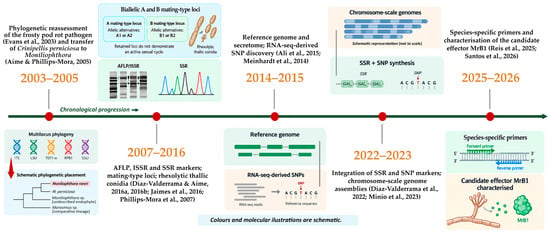
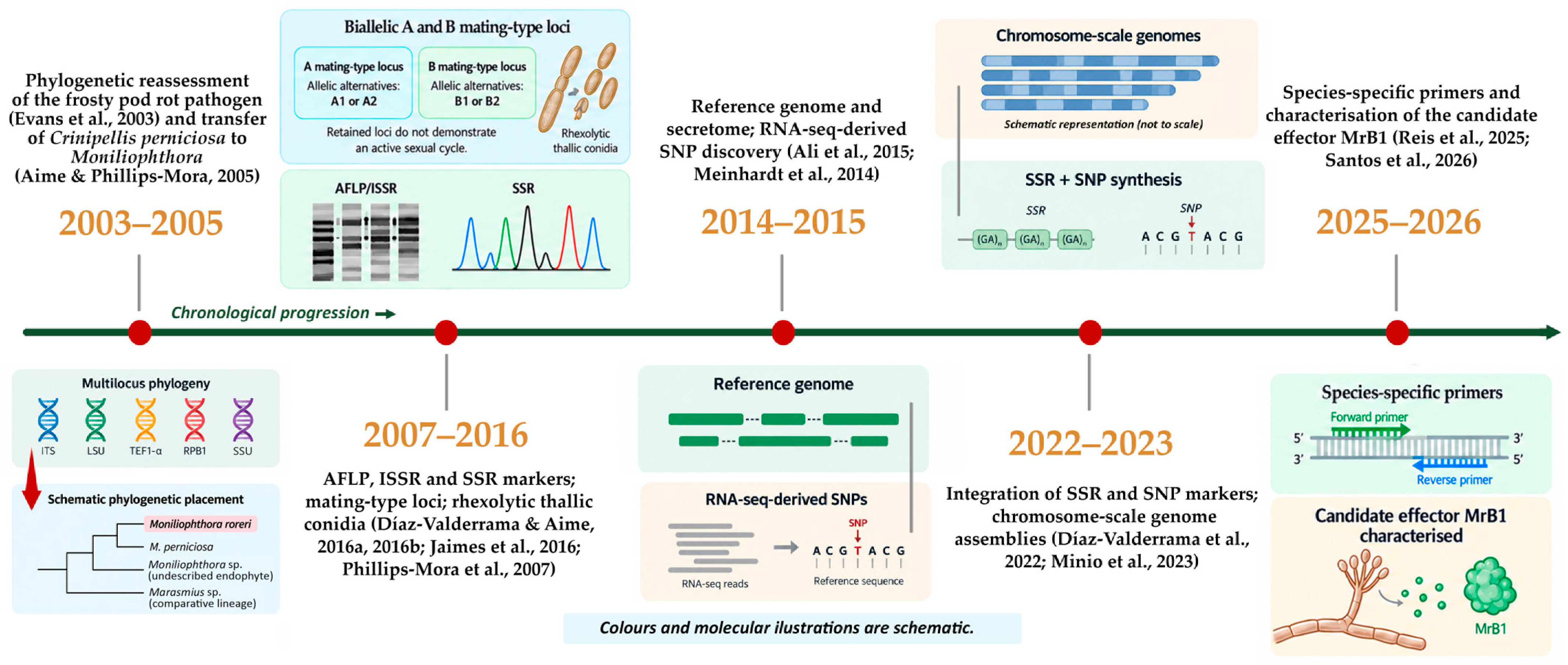
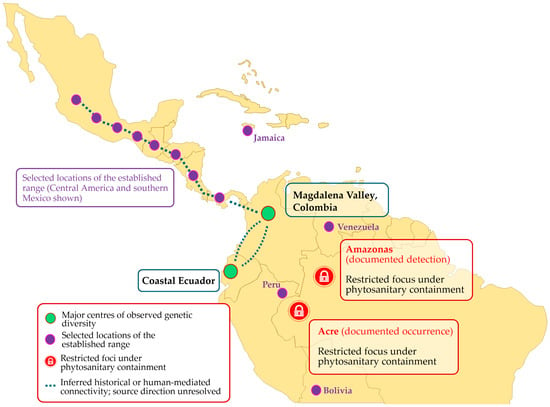
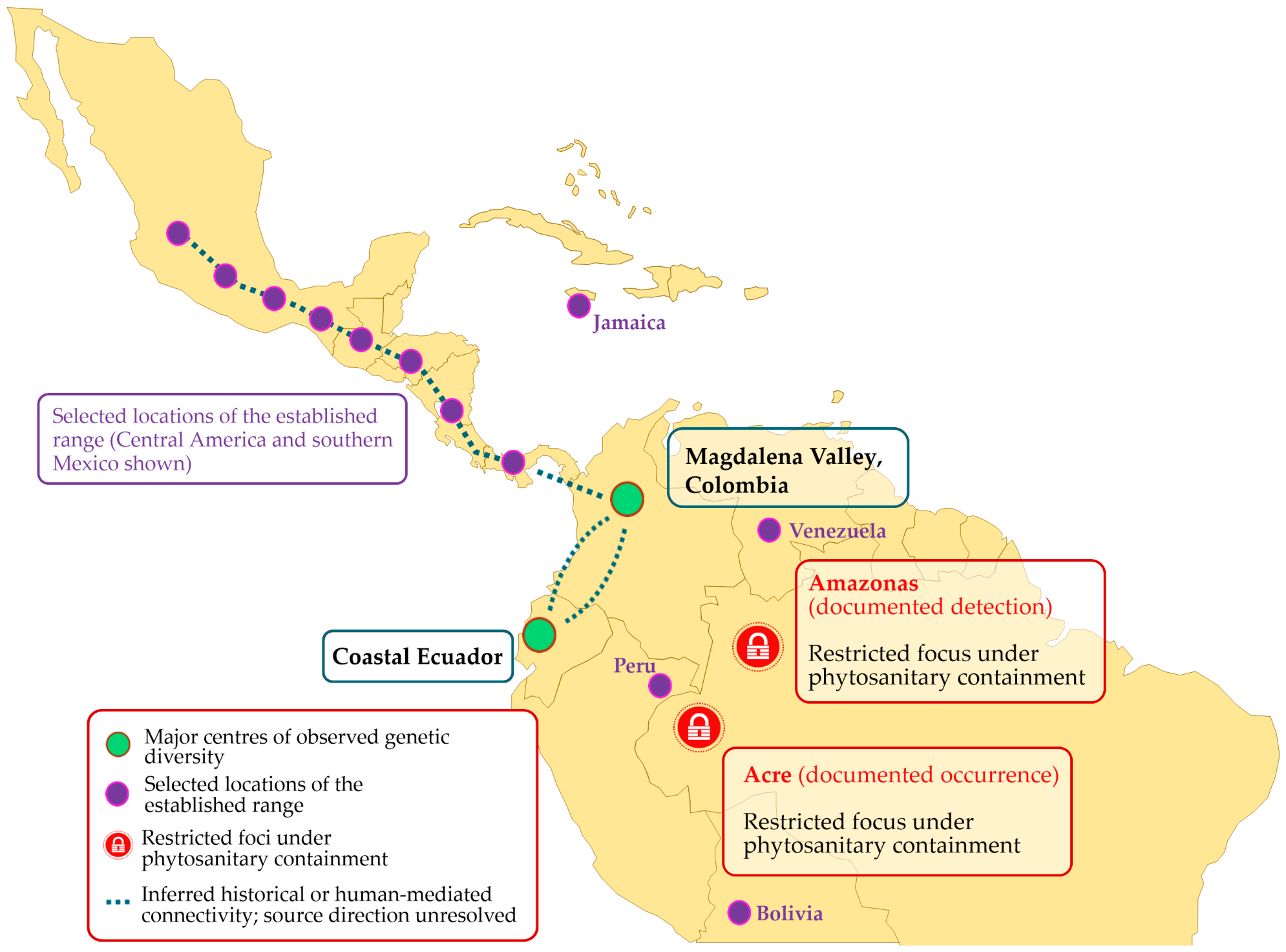
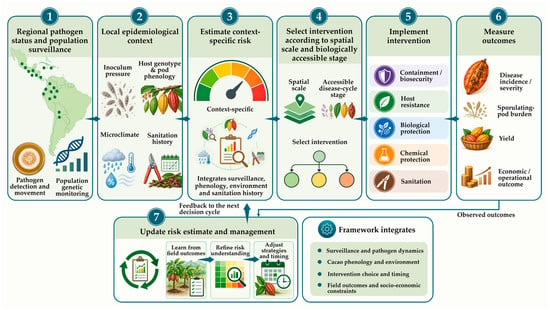
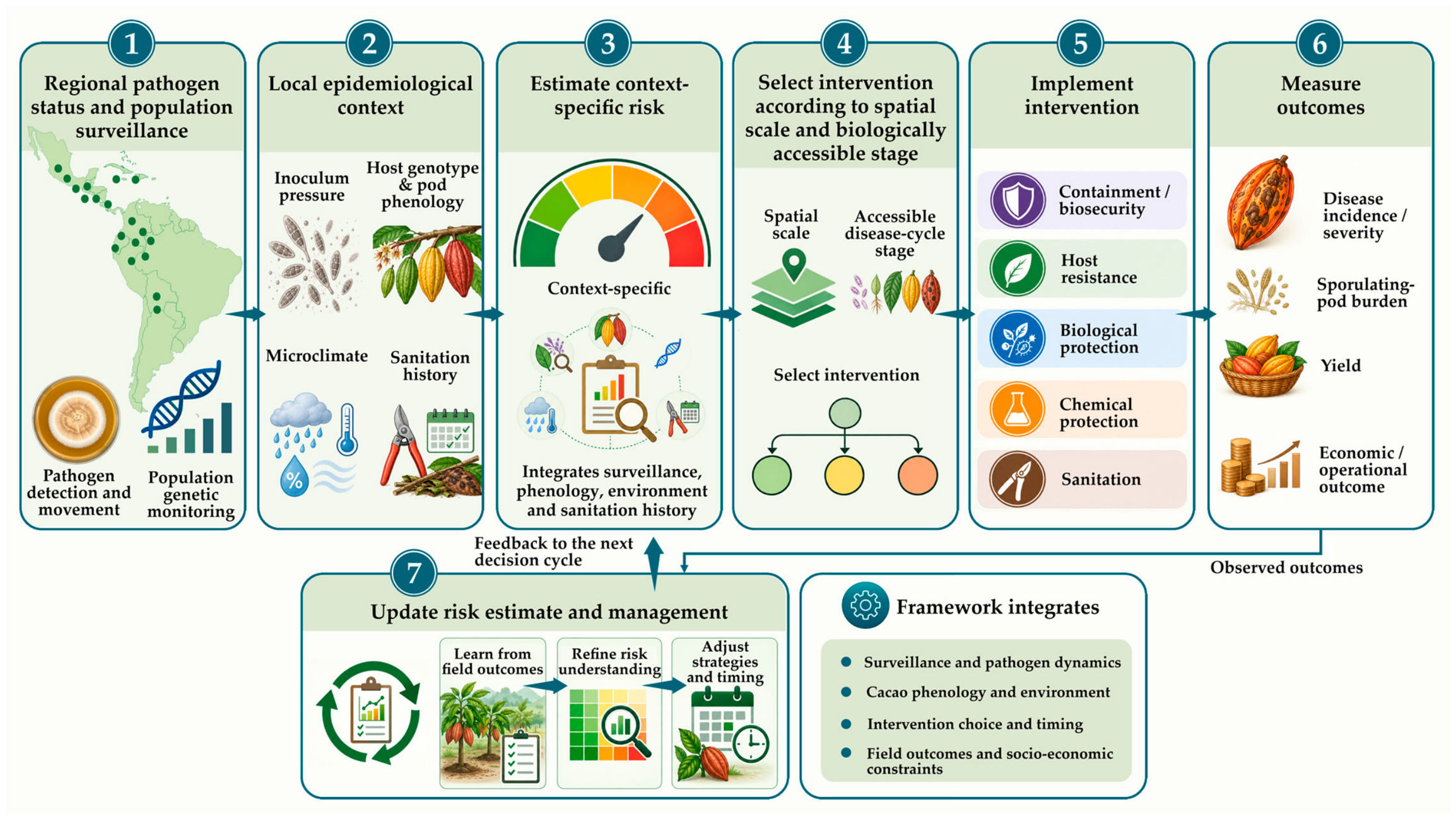
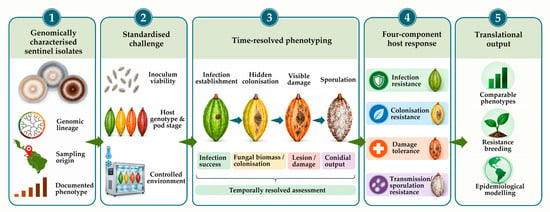
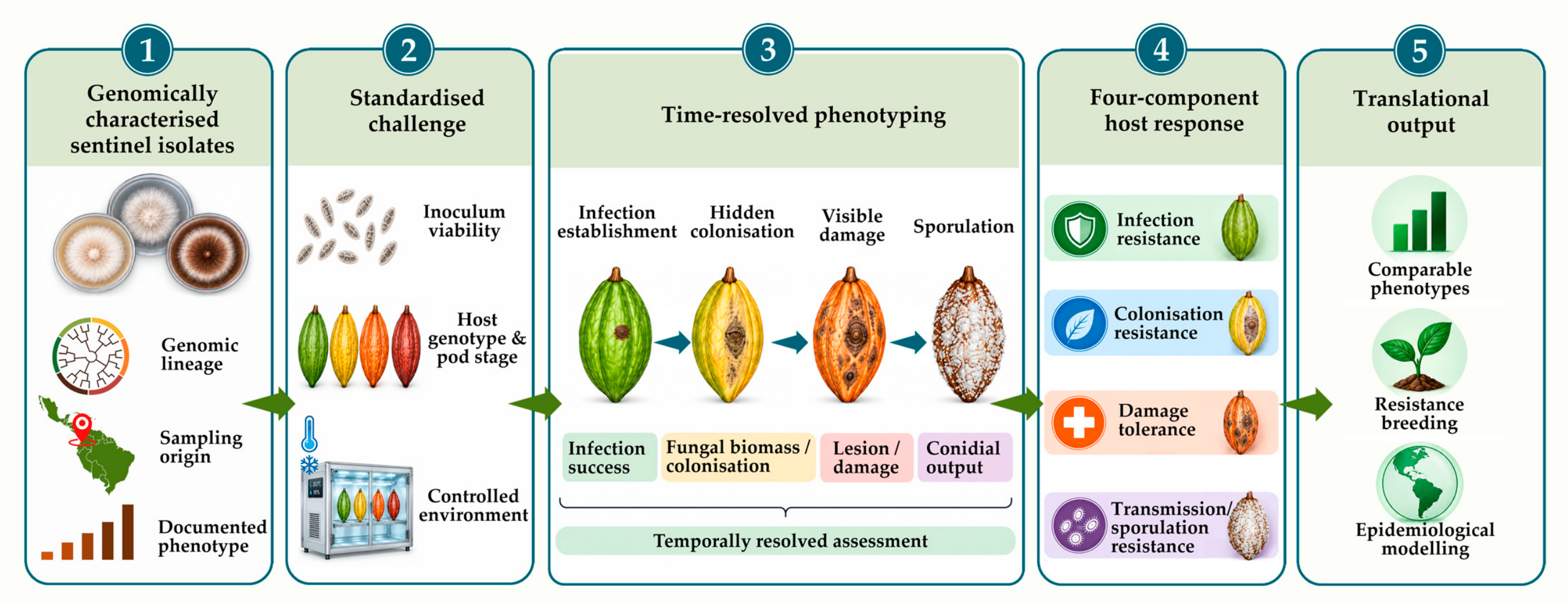

Disclaimer/Publisher’s Note: The statements, opinions and data contained in all publications are solely those of the individual author(s) and contributor(s) and not of MDPI and/or the editor(s). MDPI and/or the editor(s) disclaim responsibility for any injury to people or property resulting from any ideas, methods, instructions or products referred to in the content. |
© 2026 by the authors. Licensee MDPI, Basel, Switzerland. This article is an open access article distributed under the terms and conditions of the Creative Commons Attribution (CC BY) license.