


Abstract
Geographical indications (GIs) differentiate agri-food products through regulated links between origin, production practices and product attributes. This study examines differences in processing architecture within an identified portfolio of 35 EU-27 native pig Protected Designation of Origin (PDO) and Protected Geographical Indication (PGI) meat products. Exact tests, multiple correspondence analysis and exploratory bias-reduced models distinguish fresh products from cured/matured and cured/matured-plus-smoked pathways. The simple processed-versus-fresh margin did not differ by scheme, whereas the three-level pathway did (p < 0.001). PDOs were concentrated in non-smoked curing/maturation, whereas all 11 cured/matured-plus-smoked products were Portuguese PGIs. This geographical concentration limits interpretation of the pooled association as a scheme pattern extending across national portfolios. Geographical sensitivity analyses confirmed the pattern but showed concentration within particular national portfolios. The results indicate that GI specifications encode different bundles of processing attributes, with implications for product differentiation, market communication, specification governance and place-based agri-food policy.
1. Introduction
Geographical indications (GIs) are institutional quality signals that differentiate agri-food products by linking product identity to origin, production rules, and reputation. In markets characterised by imperfect information, certification and specification rules can reduce information asymmetry by making otherwise difficult-to-observe attributes more credible to buyers [1]. The economic value of origin information is nevertheless context dependent: region-of-origin cues are more effective when supported by recognised geographical indication labels, and consumer awareness of European quality certifications varies across products and population groups [2,3]. These European quality schemes (QSs) should therefore be understood not only as legal instruments protecting names, but also as market institutions that organise product differentiation and the communication of quality attributes.
The territorial dimension is equally important. GI products can mobilise local knowledge, reputation and production traditions as intangible assets, thereby creating potential links between product differentiation and rural or regional development. Evidence from GI territories shows that economic performance depends on the interaction between the protected product and its wider socio-economic and socio-cultural context rather than on the designation alone [4]. EU-wide mapping similarly shows that PDO products are associated with specific social-ecological landscape characteristics [5]. These findings support a place-sensitive interpretation of GIs in which production specifications, territorial institutions and market positioning jointly shape the economic role of protected foods.
Product specifications are central to this process because they define which attributes and production stages become part of the protected product. This creates a policy and management trade-off. On the one hand, codified rules can protect reputation, limit opportunistic imitation and make product attributes more credible. On the other hand, tightly defined specifications can constrain technological adaptation or require formal amendment when producers seek to innovate. Research on PDO marketing strategies has shown that innovation outside the traditional production chain can affect both producers and consumers and may require additional regulatory coordination [6]. For traditional meat products, the relevant attributes include not only origin but also preservation and processing operations that may be economically important components of product identity.
Native pig protected meats offer a useful setting to examine this issue because the same broad livestock resource follows very different processing trajectories. Products may be sold as fresh pork or transformed through salting, drying, curing, maturation, smoking and, in some cases, fermentation or complex charcuterie production. These operations affect shelf life, sensory properties, and production time and therefore can influence costs, market segmentation, and how quality is communicated. Food science research shows that dry curing and maturation drive substantial biochemical changes in native pig products [7,8,9,10,11], while smoking technologies alter volatile profiles, sensory characteristics, and food safety risks [12,13]. The economic relevance of these technologies lies in their incorporation into differentiated product specifications rather than in the technologies themselves.
A further distinction concerns product form. Whole-muscle hams and shoulders, dry-cured loins and sausage or charcuterie products represent different combinations of raw material, processing time, formulation and preservation. Traditional fermented sausages, for example, depend on interactions among production practices and microbial communities [14,15,16]. From an applied-economics perspective, these differences can be treated as observable components of a regulated attribute bundle. If PDO and PGI portfolios systematically encode different processing combinations, quality schemes may be associated with different forms of product differentiation even when the overall probability that pork is processed does not differ.
Most existing work on GIs has focused on consumer valuation, territorial development, marketing, governance or the characteristics of individual products. Much less attention has been paid to the cross-product structure of processing rules as an institutional dimension of differentiation. This distinction matters because a binary fresh-versus-processed classification can hide economically relevant heterogeneity within processed products. A scheme may not be associated with processing as such, yet it may be strongly associated with the specific technology bundle through which the product is preserved, positioned and communicated to the market.
Accordingly, this study examines processing architecture in EU-27 PDO and PGI native pig meat products. The objectives are as follows: (i) quantify the distribution of fresh, cured/matured-only and cured/matured-plus-smoked pathways; (ii) test whether processing pathway, smoking and product form differ between quality schemes; (iii) describe the joint configuration of scheme, product form and smoking using multiple correspondence analysis (MCA); (iv) estimate scheme associations with processing outcomes using bias-reduced binomial and multinomial models; and (v) assess the robustness of the main scheme pathway association with geographical concentration. We hypothesised that PDO and PGI products would differ more clearly in processing pathway composition than in the extensive margin of processing itself, that smoking would be closely associated with sausage/charcuterie forms, and that the scheme difference in the smoked pathway would remain after accounting for product form.
2. Materials and Methods
2.1. Data Source and Analytical Portfolio
A cross-sectional product-level dataset was assembled from the European Commission eAmbrosia geographical indications register and the associated registration- or specification-linked documentation [17], consulted on 15 July 2026. The source compilation contained 133 retained product records across livestock species, of which 125 were classified as belonging to EU-27 Member States. Selecting records classified as pig products yielded 35 observations: 17 coded as protected designations of origin (PDOs) and 18 as protected geographical indications (PGIs). All 35 records were analysed without further subsampling.
The compilation targeted registered PDO and PGI products in Class 1.1, “Fresh meat (and offal)”, and Class 1.2, “Meat products (cooked, salted, smoked, etc.)”. These were compilation eligibility criteria, not documented settings from a separate eAmbrosia search performed for this analysis. Erasmus et al. [18] initially identified fresh-meat records through an eAmbrosia- and Qualigeo-based review, while they added processed-meat records using product specifications and registration documentation. No complete register export or screening log was retained to establish the total number of records returned, screened, or excluded at each stage of the original compilation.
Breed identity and native, autochthonous, or local classification were inherited from the source compilation’s breed and supporting evidence fields. The compilation’s intended inclusion rule required a named native-breed component, including a compulsory native parent where crosses were permitted. Optional breed use, geographical references and historical descriptions alone were intended to be insufficient.
Each protected product constituted one observation, regardless of the number of listed breeds, permitted crosses or processing variants. The product list is provided in Table A1. The sequence of 133 compiled records, 125 EU-27 records and 35 pig product records describes extraction from the existing compilation.
2.2. Product Attributes and Product-Form Harmonisation
Processing attributes were derived from eAmbrosia class, product group, product subtype and specification-linked coding for smoking, curing/drying/maturation, fermentation, ham/shoulder form, sausage/charcuterie form, mixed-species recipe status and harmonised product family [18]. These variables were interpreted as codified product attributes in legal or registration-linked descriptions, not as observed plant-level production practices. Smoking, curing/drying/maturation and explicit fermentation were represented as binary indicators. Their sum was retained as a descriptive preservation process count with a theoretical range from zero to three.
Product form was harmonised as fresh pork, ham/shoulder, sausage/charcuterie or other processed meat. The classification separates products that reach the market without a coded preservation process from preserved whole-muscle products and from charcuterie-type preparations. One dry-cured loin product formed the other processed-meat category. The harmonised product family defined the sausage/charcuterie category and therefore includes protected charcuterie preparations that are not necessarily comminuted or stuffed sausages. A mixed-species indicator identified a protected processed recipe specifying another animal species in addition to the compulsory native pig component.
For MCA, product form was collapsed to three categories to avoid a singleton level: fresh pork; whole-muscle processed products, combining ham/shoulder with the single dry-cured loin product; and sausage/charcuterie. For the adjusted smoking model, product form was represented as sausage/charcuterie versus other processed forms. These harmonisations were defined before modelling and were intended to preserve economically interpretable product segments while avoiding categories with insufficient observations.
2.3. Definition of Processing Pathways
A mutually exclusive processing-pathway variable was derived from product group and preservation indicators. Fresh products were fresh-meat records with no coded smoking, curing/drying/maturation or fermentation. Processed products were classified as cured/matured only when curing, drying or maturation was specified without smoking, and as cured/matured plus smoked when both curing/drying/maturation and smoking were specified. No product required a fourth pathway category. The three-level variable was preferred to treating the process count as a continuous intensity measure because the operations represent qualitatively different production technologies and cannot be assumed to have equal economic or technological increments.
2.4. Data Validation
Before analysis, the pig subset was checked for internal consistency between the original processing indicators and the derived variables. The preservation-process count was independently recalculated from smoking, curing/drying/maturation, and fermentation; fresh/processed status was cross-checked against eAmbrosia class and product group; and the derived three-level pathway was checked against the preservation indicators. Product-form categories were cross-validated against product subtype and the ham/shoulder and sausage/charcuterie indicators. Product names were used only for identification, and no analytical classification was based solely on free-text names.
Initial product-level assignments were obtained from the project compilation, two authors subsequently verified all product-form and processing-pathway assignments against the official product specifications, applying the definitions described above. The two authors discussed uncertain or ambiguous cases until they reached agreement. Verification was collaborative rather than an independent double-coding exercise; therefore, percentage agreement and Cohen’s κ were not calculated. Product-level assignments are provided in Table A1, and their distribution by country, quality scheme and processing pathway is presented in Table A2.
2.5. Empirical Strategy
2.5.1. Descriptive and Exact Association Analysis
Categorical variables were summarised as counts and within-group percentages. The primary unadjusted comparison tested quality scheme against the three-level processing pathway using the Fisher–Freeman–Halton exact test for the 2 × 3 table. Cramér’s V quantified association magnitude. Adjusted standardised Pearson residuals identified the cells contributing to the global association, and the corresponding two-sided probabilities were adjusted across the six cells using the Benjamini–Hochberg false discovery rate (FDR).
Three secondary scheme comparisons were prespecified: fresh versus processed status in the complete pig portfolio; smoking versus no smoking among processed products; and harmonised product family among processed products. Fisher’s exact test was used for 2 × 2 tables and the Fisher–Freeman–Halton exact test for the 2 × k product family table. Cramér’s V was calculated for each comparison and FDR adjustment was applied across the three secondary scheme tests. These exact procedures were selected because the analytical population is small and several scheme-by-attribute cells are sparse or empty.
Counts, proportions and effect sizes were prioritised in describing the identified portfolio. Exact tests provided supplementary assessments of compatibility with a null model of independence between quality scheme and product attributes, conditional on the contingency table margins. They were not interpreted as measuring sampling uncertainty in the observed portfolio or as establishing representativeness beyond the documented selection procedure. Regression confidence intervals describe uncertainty conditional on the fitted models; they do not quantify uncertainty arising from incomplete register coverage or documentary coding. The primary analysis compared the quality scheme with the three-level processing pathway. Fresh-versus-processed status, smoking and product form were secondary exact comparisons. MCA, exploratory bias-reduced regression, and country-omission diagnostics supported the comparison with the primary findings.
2.5.2. Multiple Correspondence Analysis
MCA was used as a complementary exploratory representation of the joint categorical structure of quality scheme, product form and smoking. Three active variables were entered: scheme (PDO or PGI), harmonised product form (fresh pork, whole-muscle processed or sausage/charcuterie) and smoking (smoked or not smoked). Derived variables that reproduced the same processing information, including fresh/processed status, preservation process count and the three-level pathway, were not entered simultaneously because this would duplicate the underlying attribute signal and mechanically overweight processing in the ordination. Country, breed identity and breed-requirement architecture were also excluded.
MCA was fitted to the complete disjunctive indicator matrix. Eigenvalues and percentages of raw inertia were retained for all non-zero dimensions. Because raw MCA inertia is diluted by complete-disjunctive coding, Benzécri-adjusted eigenvalues were additionally calculated for dimensions with eigenvalues greater than 1/Q, where Q = 3 active variables, as [Q/(Q − 1)]2(λj − 1/Q)2 and expressed as percentages of total positive adjusted inertia. Category principal coordinates, percentage contributions and squared cosines (cos2) were examined for the first two raw dimensions. Individual products were displayed as background points; we applied slight display-only jitter where products shared identical profiles, which did not affect the solution. Given the close empirical relationship between product form and smoking, MCA was interpreted as a descriptive mapping of product differentiation rather than as independent confirmation of the exact association tests.
2.5.3. Bias-Reduced Generalised Linear Models
Regression analysis distinguished the extensive margin of processing (fresh versus processed) from the composition of the subsequent preservation pathway. Conventional maximum-likelihood logistic regression was unsuitable for the principal sparse comparisons because zero cells produced or risked complete separation. A Firth bias-reduced binomial logistic model was first fitted to all 35 products with processed status as the outcome (1 = processed; 0 = fresh) and quality scheme as the explanatory variable. PGI was the reference scheme.
The three-level pathway was then analysed using a mean bias-reduced multinomial logit model. This adjusted-score estimator produced finite, bias-reduced coefficients even with sparse or separated outcome combinations. Fresh pork was the reference outcome; cured/matured only and cured/matured plus smoked were the two non-reference logits. The quality scheme was the explanatory variable, with PGI as the reference. The joint contribution of scheme was evaluated with a two-degree-of-freedom global test based on constrained refitting in the same mean bias-reduced parameterisation. Category-specific odds ratios (ORs) were obtained by exponentiating the scheme coefficients; 95% CI and one-degree-of-freedom component tests were also derived from constrained refits. Because type = “AS_mean” solves mean bias-reducing adjusted score equations rather than maximising a penalised likelihood, multinomial results are described as bias-reduced inference rather than penalised-likelihood inference.
Adjustment for the sausage/charcuterie indicator was intended to examine the scheme association conditional on this product form distinction. We did not interpret it as fully separating quality scheme, geography, and product form, because these characteristics were strongly aligned and their combinations overlapped little in the analytical dataset. Two additional Firth binomial models were fitted among the 25 processed products with smoking as the outcome. The first included quality scheme alone. The second included the quality scheme and a binary indicator for sausage/charcuterie. The adjusted specification was used to assess whether the scheme–smoking association remained after accounting for the strong correspondence between smoking and charcuterie product form. Interactions were not fitted because the limited number of products and sparse scheme-by-form combinations would not support stable interaction estimates.
Regression models were treated as exploratory analyses of associations within the identified portfolio. Interpretation considered the estimated direction, confidence interval width and compatibility with the null value, rather than the precise magnitude of individual odds ratios. Bias reduction provided finite estimates in sparse or separated configurations but did not eliminate uncertainty arising from limited information.
2.5.4. Geographical Sensitivity Analysis and Software
A leave-one-Member-State-out influence analysis was used as a robustness diagnostic for the primary scheme-by-pathway association. Each represented Member State was omitted in turn and the exact 2 × k comparison was recomputed using pathway categories remaining in the reduced dataset. The exercise evaluates whether the pooled portfolio pattern depends entirely on a single national GI portfolio; it does not estimate country effects or rank Member States. Country was not entered as a predictor in the regression models or MCA because only six Member States were represented and one national portfolio was substantially larger than the others.
Analyses were specified for R version 4.5.2. Exact contingency table tests and multiplicity adjustment used base R stats functions; Cramér’s V used DescTools; MCA used FactoMineR::MCA(), with plotting supported by factoextra and ggplot2; Firth binomial models used logistf::logistf(); and the mean bias-reduced multinomial model used brglm2::brmultinom(type = “AS_mean”). A fixed random seed of 20260715 was used for graphical jitter and stochastic procedures. Tests were two-sided. Interpretation prioritised counts, proportions, and effect sizes, supplemented by model-based confidence intervals, exact comparisons, multivariate structure, and geographic sensitivity diagnostics. p values were considered alongside these findings, without extending conclusions beyond the identified portfolio.
During the preparation of this work, the authors used OpenAI ChatGPT-5.6 sol. to assist with manuscript structuring and language editing. After using this tool, the authors reviewed and edited the content as needed and take full responsibility for the published article.
3. Results
3.1. Protected-Product Portfolio and Processing Structure
Portugal contributed 18 of the 35 analysed products (51.4%), comprising four PDOs and 14 PGIs. All 11 products assigned to the cured/matured-plus-smoked pathway were Portuguese PGIs. Furthermore, all 14 processed PGIs belonged to the Portuguese portfolio; the four PGIs outside Portugal were fresh products. The pooled scheme–pathway association therefore coincides strongly with the geographical composition of the identified portfolio (Appendix A Table A2).
The identified analytical portfolio comprised 35 EU-27 native pig protected meat products: 17 PDOs and 18 PGIs. Ten products were fresh pork (28.6%) and 25 were processed (71.4%). The three-level pathway divided the portfolio into 10 fresh products, 14 cured/matured-only products (40.0%) and 11 cured/matured-plus-smoked products (31.4%) (Table 1). The protected-product portfolio therefore contains substantial heterogeneity within the processed segment rather than a single common transformation pathway.
Table 1.
Distribution of processing pathways in EU-27 native pig protected meat products.
All processed products specified curing, drying or maturation, and no record contained an explicit fermentation indicator. The latter result refers to the documentary coding used in the analysis and should not be interpreted as evidence that microbial fermentation is absent from practical manufacture.
3.2. Quality Scheme and Processing Pathway
The processing margin did not differ detectably between quality schemes. Processed products represented 11 of 17 PDOs (64.7%) and 14 of 18 PGIs (77.8%; Fisher exact p = 0.471). In contrast, the three-level processing pathway composition differed markedly between PDO and PGI products (Fisher–Freeman–Halton exact p < 0.001; Cramér’s V = 0.675) (Table 2). PDOs were concentrated in the cured/matured-only category (11/17; 64.7%), and none combined curing or maturation with smoking. PGIs displayed a different attribute bundle: 11 of 18 (61.1%) combined curing or maturation with smoking, three (16.7%) were cured/matured only, and four (22.2%) were fresh.
Table 2.
Exact tests of processing structure by quality scheme.
Cellwise diagnostics showed that the scheme difference was concentrated in the two processed pathways rather than in the fresh category. Cured/matured-only products were overrepresented among PDOs (adjusted standardised residual = 2.90; FDR q = 0.006), whereas cured/matured-plus-smoked products were strongly underrepresented (residual = −3.89; q < 0.001); PGIs showed reciprocal deviations. The fresh category contributed little to the global association (|residual| = 0.86; q = 0.392). Full observed and expected counts, residuals and multiplicity-adjusted cell probabilities are reported in Table A3; the complete secondary exact-test structures are provided in Table A4.
3.3. Product Form and Preservation Attributes Among Processed Products
All 25 processed products were coded as cured, dried or matured. Eleven (44.0%) additionally specified smoking, yielding 14 products with one coded preservation process and 11 with two (Table 3). Thirteen processed products (52.0%) were ham or shoulder products, 11 (44.0%) were sausage/charcuterie products, and one (4.0%) was another whole-muscle product (dry-cured loin). One product specified a mixed-species recipe.
Table 3.
Processing and preservation attributes of the 25 processed native-pig protected meat products.
Product form and preservation attributes were strongly aligned. Twelve of the 14 cured/matured-only products were ham/shoulder preparations; the remaining two were one sausage/charcuterie product and one dry-cured loin. Conversely, 10 of the 11 cured/matured-plus-smoked products were sausage/charcuterie products, with one smoked ham. Smoking was absent from all 11 processed PDOs but present in 11 of 14 processed PGIs (78.6%; Fisher exact p < 0.001; FDR q < 0.001; Cramér’s V = 0.786). Product family also differed by scheme (Fisher–Freeman–Halton p = 0.004; FDR q = 0.006; Cramér’s V = 0.635): nine of 11 processed PDOs were ham/shoulder products, whereas 10 of 14 processed PGIs were sausage/charcuterie products. Complete secondary exact-test structures are reported in Table A4.
3.4. Multivariate Configuration of Product Attributes and Quality Scheme
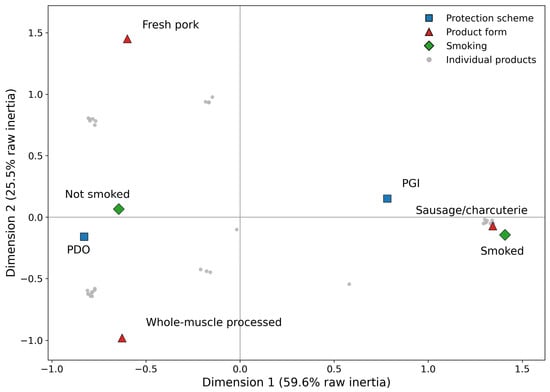
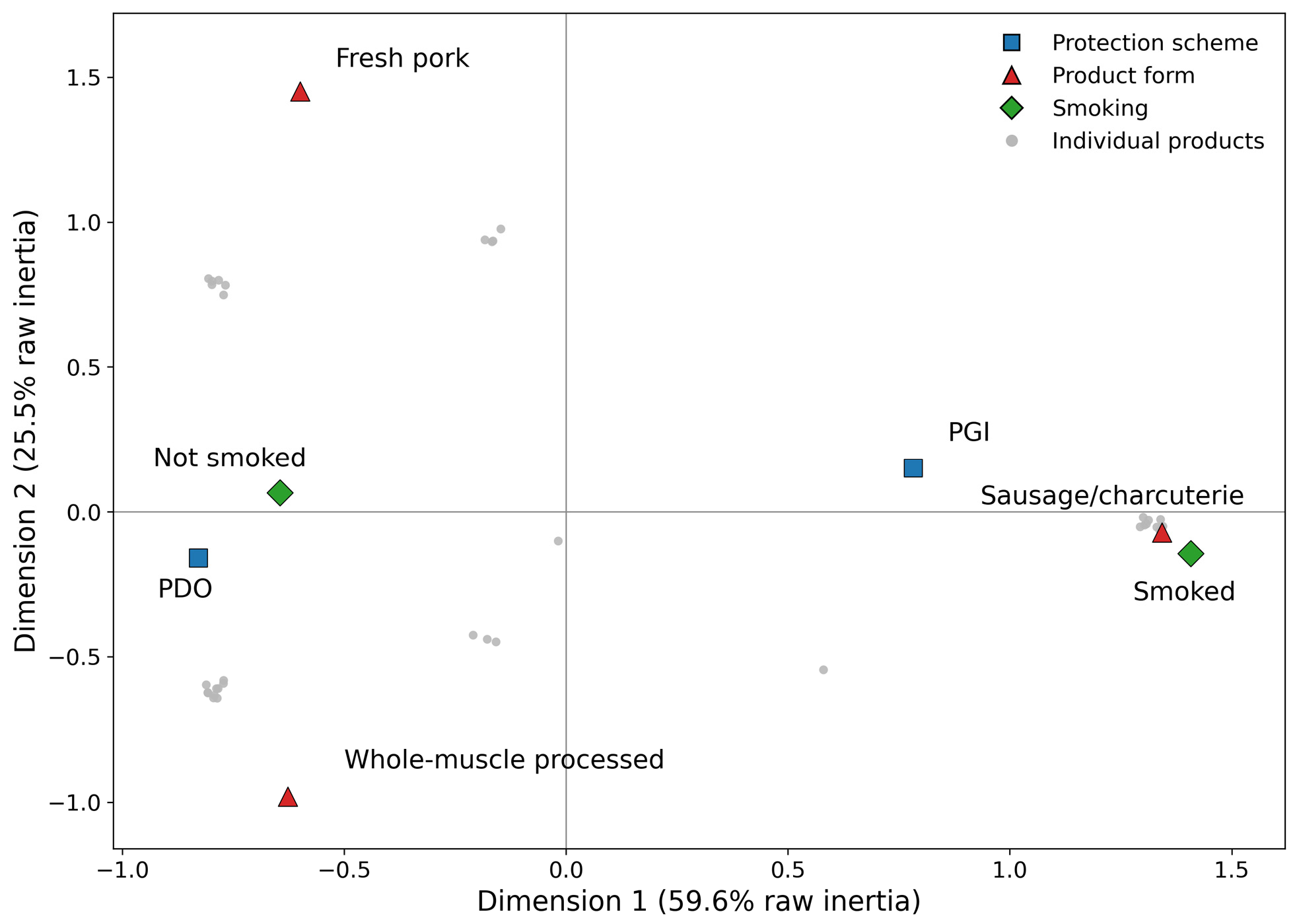
MCA provided a complementary map of the joint categorical structure of scheme, product form and smoking. Dimension 1 had an eigenvalue of 0.794 and explained 59.6% of raw inertia; Dimension 2 had an eigenvalue of 0.340 and explained 25.5%. Together, the first two dimensions represented 85.1% of raw inertia (Figure 1), while Dimensions 3 and 4 accounted for 12.1% and 2.8%, respectively. After Benzécri correction, Dimension 1 accounted for 99.98% of positive adjusted inertia and Dimension 2 for 0.02%, indicating that the corrected configuration was effectively one-dimensional. Complete inertia diagnostics are provided in Table A5.
Figure 1.
Multiple correspondence analysis biplot of quality scheme, harmonised product form and smoking in 35 EU-27 native pig protected meat products. Grey points represent individual products and are shown with slight graphical jitter where categorical profiles coincide; coordinates and inertia are calculated from the unjittered data. Axis percentages refer to raw MCA inertia; Benzécri-adjusted inertia is reported in Table A3. PDO—Protected Designation of Origin; PGI—Protected Geographical Indication.
Dimension 1 captured the dominant differentiated-product configuration in the portfolio. Smoked products contributed 26.1% to this axis, sausage/charcuterie 23.8%, PDO and PGI 14.0% and 13.2%, respectively, and the non-smoked category 12.0%. Smoked products, sausage/charcuterie, and PGI fell on the same side of the dimension, while PDO and non-smoked products fell on the opposite side. Representation quality was high for smoking status (cos2 = 0.908 for both levels) and sausage/charcuterie (cos2 = 0.826). In the raw ordination, Dimension 2 separated fresh pork from processed whole-muscle products, but its negligible Benzécri-adjusted inertia means that this contrast should be treated as secondary. The MCA therefore summarises a dominant scheme–smoking–charcuterie attribute bundle rather than providing an independent inferential test. Table 4 summarises these first two dimensions. Full category coordinates, contributions and cos2 values are reported in Table A6.
Table 4.
Summary of the first two MCA dimensions.
3.5. Bias-Reduced Generalised Linear Models
The exploratory bias-reduced models described associations between quality scheme and processing outcomes. For processed rather than fresh status, the confidence interval included an odds ratio of one, indicating uncertainty about both the magnitude and direction of the association.
In the multinomial model, the confidence interval for cured/matured-only rather than fresh status also included one. For the cured/matured-plus-smoked pathway, PDO status was associated with lower estimated odds relative to PGI, although the wide interval limited interpretation of the association’s magnitude.
Among processed products, both the scheme-only and product-form-adjusted models estimated lower odds of smoking for PDO products. The adjusted model estimated higher odds of smoking for sausage/charcuterie products than for other processed forms. These directional patterns should be interpreted cautiously because of sparse combinations, wide confidence intervals and geographical concentration. Numerical estimates and model-based confidence intervals are reported in Table 5. In the mean bias-reduced multinomial model, quality scheme contributed jointly to the three-level pathway (global χ2 = 17.31, 2 df; p < 0.001). PDO status was not clearly associated with cured/matured-only rather than fresh status (OR = 2.275, 95% CI 0.420–13.418; p = 0.339). In contrast, PDO products had markedly lower odds of occupying the cured/matured-plus-smoked pathway rather than the fresh pathway (OR = 0.030, 95% CI 0.0002–0.342; p = 0.002). The scheme difference was therefore concentrated in the smoked processing segment rather than in processing per se.
Table 5.
Exploratory bias-reduced regression models for processing pathway and smoking outcomes.
Within the 25 processed products, the scheme-only Firth model similarly showed substantially lower odds of smoking for PDO than PGI products (OR = 0.013, profile 95% CI 0.00009–0.146; PLR p < 0.001). In a secondary model controlling for sausage/charcuterie form, the PDO association remained (OR = 0.021, 95% CI 0.00006–0.465; p = 0.012), while sausage/charcuterie form was associated with higher odds of smoking than other processed forms (OR = 38.70, 95% CI 2.65–6184; p = 0.006) (Table 5).
The wide intervals indicate limited precision, particularly in the adjusted smoking model. Quality scheme, product form and geography were strongly intertwined: all smoked products and all processed PGIs belonged to the Portuguese portfolio, while smoking was concentrated in sausage/charcuterie products. Adjusting for product form therefore describes a conditional association within the observed configuration but does not establish an independent effect of the scheme. Bias reduction provides finite estimates without resolving the limited overlap between these characteristics. The models provide exploratory descriptions of the observed portfolio. Complete coefficient-level outputs are reported in Table A7.
3.6. Geographical Sensitivity Analysis
The primary exact scheme-by-pathway association was repeated after sequential omission of each represented Member State. The association remained detectable in every reduced dataset that included all three pathway categories, with exact p values ranging from 0.000113 to 0.001323. Omission of the largest national portfolio removed the cured/matured-plus-smoked category entirely; the remaining two-category comparison yielded p = 0.029. Table A8 reports complete omission-specific sample sizes, pathway tables, and exact p values. After omitting Portugal, the remaining test compared fresh products with cured/matured-only products because no smoked products remained. Its p value therefore does not demonstrate geographical robustness of the scheme–smoking association. The sensitivity analysis highlights the smoked pathway’s dependence on the Portuguese portfolio and limits interpretation beyond this geographical setting.
4. Discussion
The results show that quality scheme differentiation in the native pig GI portfolio operates primarily through the composition of processing attributes rather than through the simple decision to process pork. More than two-thirds of products were processed, but the fresh-versus-processed margin did not differ between PDO and PGI. The economically more informative distinction emerged within processed products: PDOs were concentrated in non-smoked curing/maturation, whereas the cured/matured-plus-smoked pathway was entirely associated with PGIs. This pattern supports the first hypothesis and suggests that protected specifications encode different bundles of production attributes even when the broad degree of transformation is similar.
From a product differentiation perspective, this distinction is relevant because processing practices are part of the information embedded in the protected product. GI labels can reduce information asymmetry and strengthen origin-based differentiation when consumers recognise and trust the certification system [1,2,3]. Recent EU-wide evidence also shows that awareness of the PDO logo varies socially and geographically [19], while sensory experiments on dry-cured ham indicate that PDO labelling can increase product acceptance and purchase intention [20]. However, a PDO or PGI logo does not directly communicate every technological attribute. The present results indicate that scheme portfolios are associated with systematically different processing architectures, so marketing and communication strategies may benefit from making those attributes more visible where they form a meaningful part of product identity. This is particularly relevant for smoked charcuterie, where the processing bundle is much more common among PGIs than PDOs.
The smoked charcuterie configuration also shows why GI specifications can serve as governance devices within agri-food value chains. Comparative work on EU GIs shows that specification amendment is itself a governance process in which producer autonomy, institutional coordination and product identity condition adaptability [21]. Curing, maturation and smoking are not interchangeable operations: for dry-cured ham, salting and drying conditions materially affect texture [22], while smoking conditions can alter flavour and food safety, including exposure to polycyclic aromatic hydrocarbons [10,11,23]. When these practices are codified in a specification, they become part of the product’s institutional definition and can constrain how firms can alter production while retaining the protected name. This creates a familiar tension between preserving reputation and permitting innovation. Such tensions between codified tradition and technological permissiveness also appear in GI systems [24]. Other PDO products further show that innovation strategies can create value but also require regulatory coordination to protect both producers and consumers [6].
The difference between PDO and PGI portfolios should not be interpreted as evidence that one scheme intrinsically causes a particular technology. The geographical sensitivity analysis is important here. All products combining curing/maturation with smoking occurred within the Portuguese PGI portfolio. Removing Portugal therefore eliminated the smoked pathway, preventing assessment of whether the scheme–smoking association persisted outside that national portfolio. This is consistent with evidence that GI performance and meaning depend on local socio-economic and socio-cultural conditions [4]. At the European regional level, GI adoption has also been associated with marginality, producers’ propensity to cooperate and pre-existing registration traditions [25]. Processing architecture is therefore better understood as an outcome jointly shaped by scheme design, territorial tradition, collective organisation and the historical composition of national GI portfolios.
The MCA reinforces this interpretation by showing that the principal categorical contrast is not between fresh and processed meat but between a joint PGI-smoked-charcuterie configuration. Because product form and smoking are closely related, the ordination is not an independent test; it summarises the structure of the regulated attribute bundle. The exploratory regression models complement this description of these associations. Lower estimated odds of smoking among PDO products remained after adjustment for sausage/charcuterie form, but this conditional association should not be interpreted as an independent contribution of quality scheme. The adjusted model did not include geography, and the concentration of processed PGIs and smoked products in Portugal, together with limited overlap across product forms, prevents the available data from fully distinguishing scheme and geographical and product-form associations. Wide confidence intervals further limit interpretation of their magnitudes.
These findings have implications for the economic governance of GI specifications. Protected products are often expected to preserve traditional practices while remaining competitive in evolving food markets. That objective can create trade-offs when firms face pressure to reformulate products, alter processing conditions or adopt new safety and nutritional technologies. Salt reduction in PDO and PGI meats is a clear example: technological changes may improve nutritional profiles but can interact with safety, sensory attributes and specification requirements [17]. Other technological adaptations can create similar trade-offs: high-pressure processing can improve microbial safety and shelf life in dry-cured ham while modifying volatile compounds and aroma [26]. A portfolio in which some products derive identity mainly from prolonged curing and others from combined curing, smoking and charcuterie processing is unlikely to support a uniform innovation strategy. Policy and producer organisations may therefore need pathway-specific approaches to amending specifications and adapting technology.
The results also inform place-based agri-food policy. GIs are frequently justified by their potential to retain value within territories, protect intangible assets and support differentiated local production. Yet a GI’s economic contribution depends on more than legal registration; it depends on how the product is positioned, how supply chains are organised, and whether markets recognise protected attributes. EU evidence indicates that geographical indications can affect both trade margins and export unit values, although these outcomes depend on the direction and context of trade [27]. Evidence from GI territories also points to the importance of place-sensitive policy rather than uniform interventions [4]. A recent systematic review similarly concluded that GIs’ sustainability performance depends on features such as product specifications, institutions, producer practices, and the strength of territorial linkages rather than on GI status alone [28]. The present analysis adds a product-level dimension to this argument: national and territorial portfolios differ not only in which products are protected but also in the processing architectures that are institutionalised through protection.
The absence of an explicit fermentation requirement in the coded data should be interpreted cautiously. It indicates that fermentation was not directly codified in terms that mapped to the binary variable, not that microbial processes are absent from production. Research on traditional sausages and dry-cured hams shows that microbial succession can be technologically important even when it is not expressed as a formal fermentation requirement [13,14,18]. For this economic analysis, the relevant point is documentary observability: only attributes explicitly encoded in the specification or registration-linked data can serve as measured institutional product characteristics.
Several limitations qualify the conclusions. First, the analysis covers 35 protected products rather than firms, production volumes or transactions, so it describes portfolio structure rather than market shares, costs or profitability. Second, the cross-sectional data cannot identify whether schemes or specifications changed processing practices over time. Third, scheme quality, geography, and product form were strongly intertwined, with limited overlap across combinations. The available data therefore do not allow us to fully separate their associations with smoking, and adjusting for product form does not resolve geographical confounding. Fourth, sparse cells require bias-reduced estimation and produce wide confidence intervals, especially in the adjusted smoking model. Finally, the analysis does not observe prices, sales, export performance, consumer willingness to pay, producer margins, or compliance costs. These outcomes would be required to establish the economic value of the identified processing architectures.
Future research should connect specification-based attributes to market and supply-chain outcomes. Product-level price and production data could test whether processing pathways are associated with price premiums or market scale; consumer experiments could assess whether curing, maturation and smoking information adds value beyond the PDO or PGI logo; and producer-level data could identify compliance costs and the distribution of value along the chain. Longitudinal analysis of specification amendments would also help determine whether processing rules act primarily as constraints on adaptation or as institutional assets that preserve differentiation. Such evidence would move from the present structural description towards a fuller assessment of how GI processing rules contribute to competitiveness, rural value creation and agri-food policy objectives.
5. Conclusions
Within the identified portfolio of 35 native pig products, PDO and PGI registrations differed in their observed processing configurations. PDO products were concentrated in non-smoked curing/maturation, whereas all 11 products combining curing/maturation with smoking were Portuguese PGIs. The distinction reflected processing-pathway composition more clearly than the broad separation between fresh and processed products. These findings describe the analysed portfolio and do not establish that quality scheme status causes particular processing choices or that the observed associations apply universally across European registrations.
MCA, exploratory regression and country-omission analyses provided complementary descriptions of this pattern. However, geographical concentration, limited overlap between scheme and product form, and wide regression confidence intervals prevent fully separating their associations. Potential implications for market differentiation, value creation and the economic viability of native pig production should therefore be treated as hypotheses requiring further investigation. Establishing these consequences would require evidence on production costs, prices, sales, and producer returns, which this study did not measure.
Author Contributions
Conceptualisation, F.M.; methodology, F.M.; investigation, F.M., M.J. and J.S.; writing—original draft preparation, F.M., M.J. and J.S.; writing—review and editing, F.M., M.J. and J.S.; supervision, F.M. All authors have read and agreed to the published version of the manuscript.
Funding
This research received no external funding.
Institutional Review Board Statement
Not applicable.
Informed Consent Statement
Not applicable.
Data Availability Statement
The data used in this study are publicly available through the European Union eAmbrosia geographical indications database at https://ec.europa.eu/agriculture/eambrosia/geographical-indications-register/ (accessed on 15 July 2026) [15].
Acknowledgments
To the Foundation for Science and Technology (FCT, Portugal) for financial support to CISAS UID/05937/2025.
Conflicts of Interest
The authors declare no conflicts of interest.
Appendix A
Table A1.
The 35 products included in the analysis.
Table A2.
Distribution of the analysed products by country, quality scheme and processing pathway.
Table A3.
Full cell-level diagnostics for quality scheme by three-level processing pathway.
Table A4.
Complete exact-test summaries for processing structure by quality scheme.
Table A5.
MCA eigenvalue, raw inertia and Benzécri-adjusted inertia diagnostics.
Table A6.
Full MCA category coordinates, contributions and representation quality for Dimensions 1 and 2.
Table A7.
Complete coefficient-level bias-reduced regression summary.
Table A8.
Leave-one-Member-State-out influence analysis for the primary scheme-by-processing-pathway association.
References
- Marette, S. Quality, market mechanisms and regulation in the food chain. Bio-Based Appl. Econ. 2017, 5, 217–235. [Google Scholar] [CrossRef] [Scilit]
- Santeramo, F.G.; Lamonaca, E.; Carlucci, D.; De Devitiis, B.; Seccia, A.; Viscecchia, R.; Nardone, G. On the relevance of the Region-Of-Origin in consumers studies. Bio-Based Appl. Econ. 2020, 9, 137–154. [Google Scholar] [CrossRef] [Scilit]
- Sampalean, N.I.; Rama, D.; Visentin, G. An investigation into Italian consumers’ awareness, perception, knowledge of European Union quality certifications, and consumption of agri-food products carrying those certifications. Bio-Based Appl. Econ. 2021, 10, 35–49. [Google Scholar] [CrossRef] [Scilit]
- Vaquero-Piñeiro, C. The long-term fortunes of territories as a route for agri-food policies: Evidence from Geographical Indications. Bio-Based Appl. Econ. 2021, 10, 89–108. [Google Scholar] [CrossRef] [Scilit]
- Flinzberger, L.; Zinngrebe, Y.; Bugalho, M.N.; Plieninger, T. EU-wide mapping of ‘Protected Designations of Origin’ food products (PDOs) reveals correlations with social-ecological landscape values. Agron. Sustain. Dev. 2022, 42, 43. [Google Scholar] [CrossRef] [Scilit]
- Mancini, M.C.; Consiglieri, C. Innovation and marketing strategies for PDO products: The case of “Parmigiano Reggiano” as an ingredient. Bio-Based Appl. Econ. 2017, 5, 153–174. [Google Scholar] [CrossRef] [Scilit]
- Salazar, E.; Cayuela, J.M.; Abellán, A.; Bueno-Gavilá, E.; Tejada, L. Fatty acids and free amino acids changes during processing of a Mediterranean native pig breed dry-cured ham. Foods 2020, 9, 1170. [Google Scholar] [CrossRef] [Scilit] [PubMed]
- Marušić Radovčić, N.; Poljanec, I.; Petričević, S.; Mora, L.; Medić, H. Influence of muscle type on physicochemical parameters, lipolysis, proteolysis, and volatile compounds throughout the processing of smoked dry-cured ham. Foods 2021, 10, 1228. [Google Scholar] [CrossRef] [Scilit] [PubMed]
- Karolyi, D.; Škrlep, M.; Marušić Radovčić, N.; Luković, Z.; Škorput, D.; Salajpal, K.; Kljak, K.; Čandek-Potokar, M. Effects of animal diet and processing methods on the quality traits of dry-cured ham produced from Turopolje pigs. Animals 2024, 14, 286. [Google Scholar] [CrossRef] [Scilit] [PubMed]
- Lebret, B.; Čandek-Potokar, M. Review: Pork quality attributes from farm to fork. Part II. Processed pork products. Animal 2022, 16, 100383. [Google Scholar] [CrossRef] [Scilit] [PubMed]
- Li, P.; Bao, Z.; Wang, Y.; Su, X.; Zhou, H.; Xu, B. Role of microbiota and its ecological succession on flavor formation in traditional dry-cured ham: A review. Crit. Rev. Food Sci. Nutr. 2025, 65, 992–1008. [Google Scholar] [CrossRef] [Scilit] [PubMed]
- Yin, X.; Chen, Q.; Liu, Q.; Wang, Y.; Kong, B. Influences of smoking in traditional and industrial conditions on flavour profile of Harbin red sausages by comprehensive two-dimensional gas chromatography mass spectrometry. Foods 2021, 10, 1180. [Google Scholar] [CrossRef] [Scilit] [PubMed]
- Nizio, E.; Czwartkowski, K.; Niedbała, G. Impact of smoking technology on the quality of food products: Absorption of polycyclic aromatic hydrocarbons (PAHs) by food products during smoking. Sustainability 2023, 15, 16890. [Google Scholar] [CrossRef] [Scilit]
- Barbieri, F.; Tabanelli, G.; Montanari, C.; Dall’Osso, N.; Šimat, V.; Smole Možina, S.; Baños, A.; Özogul, F.; Bassi, D.; Fontana, C.; et al. Mediterranean spontaneously fermented sausages: Spotlight on microbiological and quality features to exploit their bacterial biodiversity. Foods 2021, 10, 2691. [Google Scholar] [CrossRef] [Scilit] [PubMed]
- Franciosa, I.; Ferrocino, I.; Giordano, M.; Mounier, J.; Rantsiou, K.; Cocolin, L. Specific metagenomic asset drives the spontaneous fermentation of Italian sausages. Food Res. Int. 2021, 144, 110379. [Google Scholar] [CrossRef] [Scilit]
- Leroy, F.; Charmpi, C.; De Vuyst, L. Meat fermentation at a crossroads: Where the age-old interplay of human, animal, and microbial diversity and contemporary markets meet. FEMS Microbiol. Rev. 2023, 47, fuad016. [Google Scholar] [CrossRef] [Scilit] [PubMed]
- European Union. eAmbrosia—EU Geographical Indications Register Database [Dataset]. European Data. Available online: https://data.europa.eu/data/datasets/eambrosia-eu-geographical-indications-register?locale=en (accessed on 15 July 2026).
- Erasmus, S.W.; Sohaib, M.; Revilla, I.; Vivar-Quintana, A.M.; Giancoli, S.J. Markers for meat provenance and authenticity with an account of its defining factors and quality characteristics–a review. J. Sci. Food Agric. 2024, 104, 7027–7084. [Google Scholar] [CrossRef] [Scilit] [PubMed]
- Goudis, A.; Skuras, D. Consumers’ awareness of the EU’s protected designations of origin logo. Br. Food J. 2021, 123, 1–18. [Google Scholar] [CrossRef] [Scilit]
- Savelli, E.; Bravi, L.; Francioni, B.; Murmura, F.; Pencarelli, T. PDO labels and food preferences: Results from a sensory analysis. Br. Food J. 2021, 123, 1170–1189. [Google Scholar] [CrossRef] [Scilit]
- Penker, M.; Scaramuzzi, S.; Edelmann, H.; Belletti, G.; Marescotti, A.; Casabianca, F.; Quiñones-Ruiz, X.F. Polycentric structures nurturing adaptive food quality governance—Lessons learned from geographical indications in the European Union. J. Rural Stud. 2022, 89, 208–221. [Google Scholar] [CrossRef] [Scilit]
- Coll-Brasas, E.; Gou, P.; Arnau, J.; Olmos, A.; Fulladosa, E. Processing parameters involved in the development of texture and tyrosine precipitates in dry-cured ham: Modelisation of texture development. Meat Sci. 2021, 172, 108362. [Google Scholar] [CrossRef] [Scilit] [PubMed]
- Onopiuk, A.; Kołodziejczak, K.; Marcinkowska-Lesiak, M.; Poltorak, A. Determination of polycyclic aromatic hydrocarbons using different extraction methods and HPLC-FLD detection in smoked and grilled meat products. Food Chem. 2022, 373, 131506. [Google Scholar] [CrossRef] [Scilit] [PubMed]
- Oledinma, A.; Roper, S. Tradition (re-)defined: Farm v factory trade-offs in the definition of geographical indications, the case of Three Counties Cider. J. Rural Stud. 2021, 84, 12–21. [Google Scholar] [CrossRef] [Scilit]
- Cei, L.; Stefani, G.; Defrancesco, E. How do local factors shape the regional adoption of geographical indications in Europe? Evidences from France, Italy and Spain. Food Policy 2021, 105, 102170. [Google Scholar] [CrossRef] [Scilit]
- Picon, A.; Nuñez, M. Volatile compounds in high-pressure-treated dry-cured ham: A review. Meat Sci. 2022, 184, 108673. [Google Scholar] [CrossRef] [Scilit] [PubMed]
- Raimondi, V.; Falco, C.; Curzi, D.; Olper, A. Trade effects of geographical indication policy: The EU case. J. Agric. Econ. 2020, 71, 330–356. [Google Scholar] [CrossRef] [Scilit]
- Falasco, S.; Caputo, P.; Garrone, P. Can geographical indications promote environmental sustainability in food supply chains? Insights from a systematic literature review. J. Clean. Prod. 2024, 444, 141100. [Google Scholar] [CrossRef] [Scilit]

Disclaimer/Publisher’s Note: The statements, opinions and data contained in all publications are solely those of the individual author(s) and contributor(s) and not of MDPI and/or the editor(s). MDPI and/or the editor(s) disclaim responsibility for any injury to people or property resulting from any ideas, methods, instructions or products referred to in the content. |
© 2026 by the authors. Licensee MDPI, Basel, Switzerland. This article is an open access article distributed under the terms and conditions of the Creative Commons Attribution (CC BY) license.