


Abstract
Background: Headers and aerial duels account for most head-impact exposure in football, but identifying them relies on labour-intensive video review. Existing computer vision (CV) systems detect only intentional headers and were developed on male footage. Methods: Headers, aerial duels and possible concussive events (PCEs; a behavioural proxy) were annotated in 19 broadcast matches (nine male, 10 female; 35.5 h; 1441 head actions; inter-rater classification κ = 0.713). Pretrained video encoders (R(2+1)D-18, VideoMAE) scored every moment of each match. Models were evaluated by leave-one-match-out cross-validation on 17 matches and on two held-out matches. Five training conditions separated sex composition from dataset size. Results: The best model (VideoMAE) reached head-action average precision of 0.40 in development (used for model selection) and 0.49 on the independent held-out matches. Reviewing its top-ranked clips for 6 min per hour of football found 58% of held-out head actions (random footage: 10%). At equal size, mixed-sex training did not differ detectably from male-only training and outperformed female-only training for head actions (+0.042); no same-sex advantage was detected. PCEs (34 events) could not be detected. Conclusions: Whole-match CV can prioritise footage for analyst review of headers and aerial duels in both sexes but cannot yet identify possible concussive events.
1. Introduction
Sport-related concussion (SRC) is a common injury in football, typically resulting from a sudden linear or angular acceleration of the head. Reported acute effects include visual disturbance, balance impairment, memory deficits, photophobia, vomiting, sleep disruption, appetite loss, and gastrointestinal symptoms [1]. Female players consistently show higher SRC incidence than male players. A meta-analysis found that females sustain heading-related concussions at 1.65 times the male rate (95% CI: 1.35–2.03), with a similarly elevated rate during goalkeeping [2]. This pattern was corroborated by a 2024 umbrella review and recent English professional football data comparing male and female concussion burden [3]. Beyond incidence, females also report greater symptom severity: a 2025 analysis of 1021 NCAA athletes found 21.6% higher average symptom severity in females, driven largely by emotional distress, drowsiness, photophobia, and fatigue, a pattern confirmed by a 2026 systematic review of sex differences in mTBI recovery [4]. Proposed biomechanical contributors include lower neck strength, smaller neck girth, and reduced head-to-neck mass ratios in females, which may increase head–neck angular acceleration during impact, although this systematic review and meta-analysis found only low-certainty evidence for neck strength as a protective factor [5]. With female football participation growing from 4.8 million players in 2014 to 16.6 million in 2023, these findings collectively support sex-stratified approaches to concussion monitoring; hypothetically, a unified model could risk masking clinically meaningful differences in exposure and mechanism [6].
Injury mechanisms vary by contact type. Intentional headers are generally lower-risk, as anticipatory cervical bracing helps distribute impact force [7,8] whereas unintentional ball-to-head contact removes this preparatory response and produces substantially greater head acceleration, recorded at approximately 77G versus 19G for intentional headers [9]. Head-to-head collisions during aerial duels are a particularly high-risk mechanism, accounting for 61% of SRC occurrences in a study of French professional football (2015–2019) [10]. Aerial duels were also the most frequent context of potential head injury situations at the FIFA World Cup Qatar 2022 [11], defined as incidents in which a player remained on the ground for more than five seconds, sought medical attention, or both, with the head as a contact site, and accounted for 45% of potential head injuries in women’s international tournaments from 2021 to 2024 [12]. Repetitive sub-concussive head impacts are common in football; systematic reviews report no established injury threshold [13] though structural white matter alterations have been observed after impacts exceeding 10 g accumulated over a season, in a dose-dependent relationship. Cumulative heading has also been linked to neuropsychological decline and white matter abnormalities on MRI [14,15,16].
No consensus definition of “sub-concussive” currently exists in the literature; in this study, headers are therefore treated as head impacts and aerial duels as potential head-impact exposure, without assuming an injury threshold. Current surveillance of head injury situations relies on medically trained personnel positioned pitch-side or reviewing tactical camera feeds, a resource typically limited to the highest levels of play (Premier League, WSL, La Liga, etc.) [17]. Retrospective video review by performance analysts is similarly common but highly resource-intensive: Kuo et al. [17] required fourteen raters and over 163 h of video review to verify 217 sensor-recorded head impacts in American football, while Huber et al. [18] coded over 4050 match minutes. Existing SRC assessment tools are similarly constrained, having been validated primarily on male cohorts and often requiring specialist training that limits accessibility at lower levels of play. Rezaei et al. (2022) [19] subsequently proposed DeepImpact, a CV approach automating detection of headers from broadcast video. However, this and comparable approaches remain limited to a single event type and have not been evaluated for sex-specific performance differences, despite known risks of representation bias in vision models trained on demographically skewed datasets.
This study attempted to address these gaps by developing and evaluating a CV model for automated detection of head-related events, headers, aerial duels, and possible concussive events (PCEs), using broadcast footage from both male and female football matches. By training and comparing sex-stratified and unified models, this work extends automated detection beyond intentional headers alone and directly tests whether model performance generalises across sexes, providing a cost-effective foundation for scalable, sex-inclusive head-impact monitoring.
2. Materials and Methods
2.1. Footage and Annotation
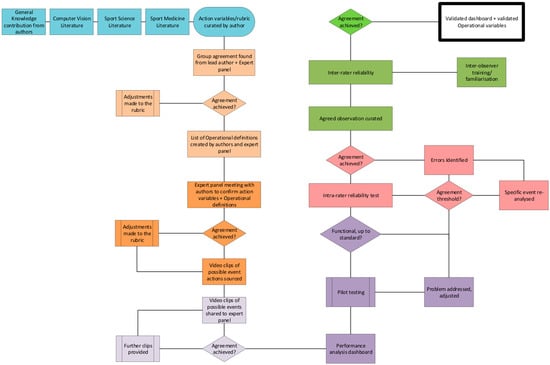
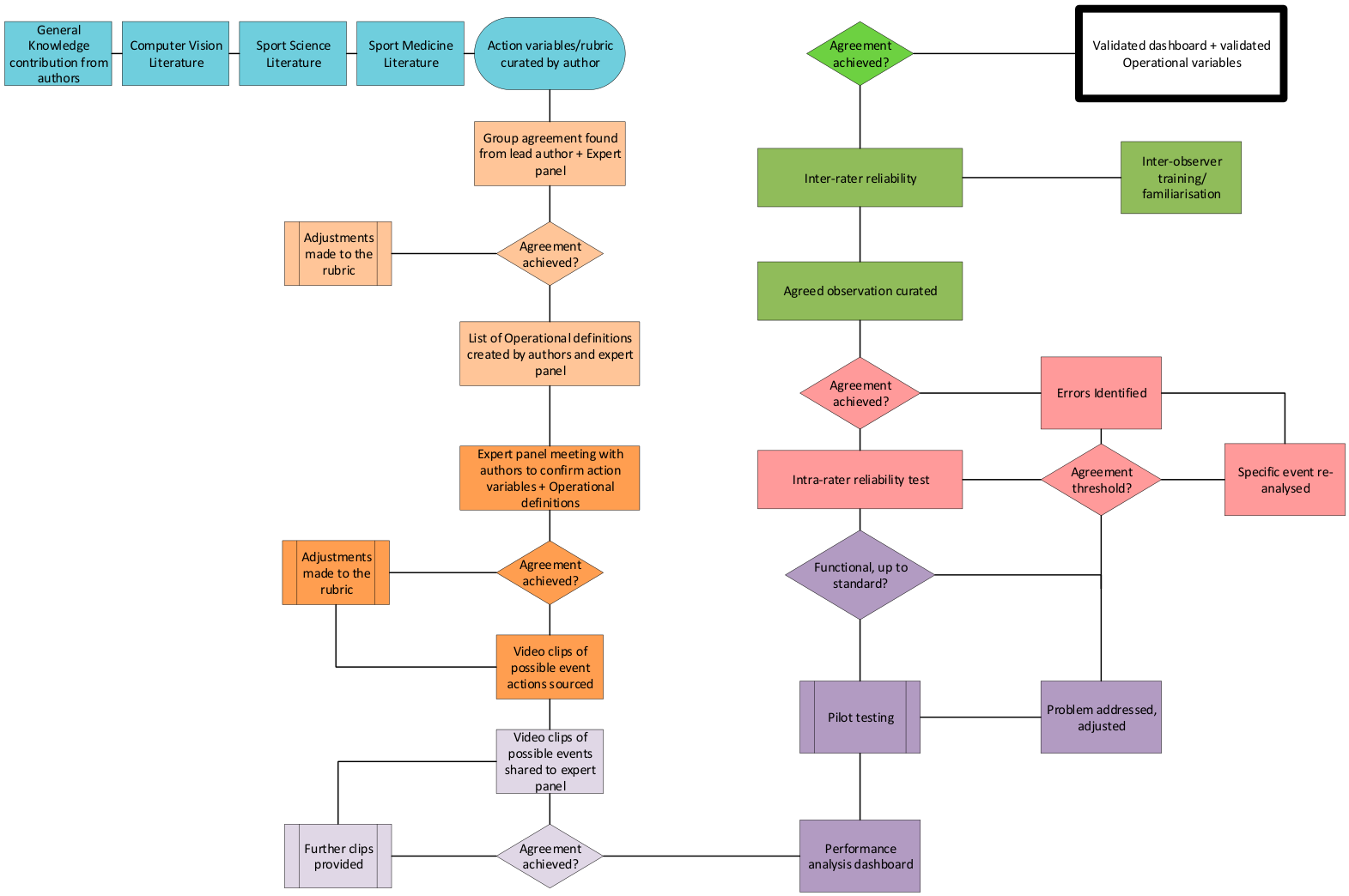
Twenty full-length matches (10 male, 10 female) were retrieved from YouTube on 22 September 2025. Male matches came from the NCAA, Premier League, La Liga, Bundesliga and Serie A; female matches came from the Women’s Super League. Videos were converted from WebM to MP4 (1280 × 720 pixels, 30 frames per second). Match identity, date, venue and source URL are listed in the Supplementary Material. Head-related events were coded using the rubric in Table 1. Each event was assigned one class: header, aerial duel or possible concussive event (PCE). An aerial duel won with a header was coded as a header. Headers therefore involve confirmed head–ball contact, whereas aerial duels are contests in which head–ball or head–head contact may occur but was not confirmed on video; together they are referred to as head actions and represent head-impact exposure rather than confirmed impacts. PCEs are a video-based behavioural proxy for potential head injury (Table 1): they were not linked to medical assessment and do not indicate that a concussion occurred. The annotation workflow (Figure 1) followed published guidance on operational definitions, system validation and reliability testing in performance analysis [20,21,22].
Table 1.
Event annotation rubric. Classes are mutually exclusive; if an aerial duel results in a successful header, only the header is credited to the winning player.
Figure 1.
Annotation workflow, adapted from [20,21,22].
Two analysts (LCD, CD) each annotated 10 matches in NACSport Scout (v.2024), after piloting the dashboard on a 15-min demonstration match and one full match. One match (M08) was coded independently by both analysts to assess inter-rater reliability. To assess intra-rater reliability, CD re-coded the same match after a revision of the coding dashboard, and LCD reviewed his coding of it six days after the original session. A header was recorded only where the ball visibly changed direction after head contact. NACSport exports were collated into one workbook, and each event’s time was mapped from the annotation clock to the video clock per half. Where the two clocks were not identical, matched anchor points (kick-off, half-time and full-time whistles) were used, and the mapping was accepted only if the clocks ran at the same speed (within 0.2%). Every alignment was checked visually on frame strips before training. Exclusion criteria One male match (M06) was excluded before any model was trained, because its annotation clock could not be reconciled with the available video. The analysed dataset is therefore 19 matches (nine male, 10 female). Reliability analysis: Events from two codings were paired when they were tagged at the same timestamp (±1 s). Event detection agreement was assessed with the Jaccard index; classification agreement on paired events with raw agreement, Cohen’s κ, prevalence- and bias-adjusted κ (PABAK) and Krippendorff’s α [22]; click timing with two-way mixed intra-class correlation (ICC(A,1)); and per-class F1 scores including unpaired events. For M08, CD’s coding (128 events served as the reference for evaluation, and LCD’s coding was used to assess inter-rater reliability. The difference in counts arose mainly because CD coded both the aerial duel and the header at duels won with the head, where LCD more often coded the duel alone; this affects the header class of the three-class task but has little effect on the head-action task, in which a header and aerial duel at the same moment count as one event.
2.2. Study Design
The aim was to locate head-related events within complete broadcast matches, as an analyst reviewing footage would need to. Models therefore scored every moment of every match rather than clips pre-selected around annotated events, were trained with ordinary play as negative examples, and were evaluated on detections ranked across whole matches, so that every false alarm counted against them. Evaluating only pre-selected clips measures how well a model ranks events it has already been shown, and can greatly overstate performance on continuous footage, where ordinary play far outnumbers events. Detection used video encoders pretrained on human action recognition, combined with a small, trained classifier that considers the seconds around each moment (Section 2.4). Performance was assessed by cross-validation across development matches and on two independent held-out matches (Section 2.3).
2.3. Detection Tasks, Data Splits and Training Conditions
Tasks. Two tasks were run on the same annotations:
- Three-class task: Header, aerial duel and PCE as separate classes.
- Head-action task: Headers and aerial duels merged into one class (head action), with PCE kept separate. An aerial duel within 1 s of a header (or of another aerial duel) counted once, so a header inside a duel was not counted twice.
The model scores each class independently, so one moment can score high for more than one class.
One male and one female match were drawn at random (seed 20261021) and excluded from all training, model selection and threshold choice. M08 was a men’s, Serie A, 2009 match (111 min of video; 90 headers, 36 aerial duels, two PCEs) and W03 a Women’s Super League (WSL), 2025, match (110 min; 55 headers, 33 aerial duels, one PCE). Both were standard broadcast footage at 1280 × 720 pixels and 30 frames per second, processed identically to the development matches. Both matches had been in the training data of the original clip-level model (TSM-ResNet50) described in the first version of this manuscript, which shares no weights, features or design choices with the present models. In the present pipeline they were excluded from all training, validation, early stopping, model selection and smoothing choices, and were scored once, after the final configuration had been fixed. The other 17 matches (eight male, nine female) were evaluated by leave-one-match-out cross-validation (17 folds). In each fold, one match was held out for testing, one male and one female match (seed 1729) formed the validation set used only for early stopping, and the remaining 14 matches were the training pool. To separate the effect of training-data diversity (both sexes) from training-data size, five training sets were drawn from each fold’s training pool (Table 2). For each class, the quota q was the smaller of the male and female event counts in the pool, rounded down to an even number.
Table 2.
Training conditions per fold (events per class; ordinary-play negatives drawn from the same matches).
2.4. Models and Training
The final model’s configuration can be seen in Table 3 below. Each match was processed as a sequence of short, overlapping 3 s windows, and each window was given a score for each class; events were then identified as peaks in these scores (Section 2.6). Frames were sampled at 5 per second and resized to 256 × 144 pixels. Each window comprised 16 frames (3.0 s) and was timed at its centre. A new window started every 0.4 s for R(2+1)D and every 0.8 s for VideoMAE, reflecting the latter’s higher computational cost. Two video networks pretrained on Kinetics-400, a human action recognition dataset [23], converted each window into a feature vector (descriptor), with their weights frozen:
- R(2+1)D-18 [24]: 512-dimensional descriptor.
- VideoMAE-B (ViT-B/16) [25]: 768-dimensional descriptor, from frames resized to 224 × 224 pixels.
Table 3.
Final model configuration.
Classifier head and temporal context: A small, trained network (the head) mapped these descriptors to a probability for each class. To score a moment, the head received the descriptor of that window together with those of the windows approximately 1 and 2.4 s before and after it (five windows in total), allowing it to use the movement leading into and out of a possible event, such as a jump and landing. For each class, a window was positive if its centre lay within 0.6 s of an annotated event, ignored between 0.6 and 2.0 s, and negative otherwise. The loss was binary cross-entropy per class, with ignored windows excluded and rare classes up-weighted by the square root of their negative-to-positive ratio (capped at 30).
Analyses were run in Python 3.13 with PyTorch 2.11 (CUDA 13.0), torchvision 0.26, Hugging Face Transformers, NumPy 2.1, pandas 2.2 and FFmpeg 6.1, on Google Colab with an NVIDIA Tesla T4 GPU. R(2+1)D-18 used the Kinetics-400 weights distributed with torchvision; VideoMAE-B used the Kinetics-400 checkpoint MCG-NJU/videomae-base-finetuned-kinetics from Hugging Face. All random choices were seeded, deterministic GPU kernels were enforced, and package versions and hardware were logged for every experiment.
2.5. Model Selection
The head design and the amount of score smoothing were chosen on the development matches only, before the held-out pair was scored. Five head variants were compared: no temporal context, three-window context, five-window context, a linear head, and 30 instead of 10 negatives per positive. Each was combined with Gaussian smoothing of σ = 0, 0.4, 0.8, 1.2 or 1.6 s. Screening used the Mixed ×2 condition, three subsample seeds and one model seed. The criterion was development AP for head actions (head-action task), or the mean of header and aerial-duel AP (three-class task); PCE was not part of the criterion. The best combination was the five-window context head with σ = 0.4 s, for both encoders and both tasks, and it was used for all further results. Because these choices were made on the development results, development performance (Section 3.4, Section 3.5 and Section 3.6) is optimistically biased and is used to compare models and training conditions; the held-out pair provides the only independent estimate of performance.
2.6. Evaluation and Statistics
For each match and class, the smoothed score stream was reduced to its local peaks, keeping only the highest score within any 2 s span. No score threshold was applied, so the full ranking was evaluated. A detection counted as correct if it fell within ±2 s of an annotated event of its class; each annotation could be claimed only once, by the highest-scoring detection near it. The ±2 s tolerance reflects the temporal resolution of the system and its intended use: each window spans 3 s, windows are spaced up to 0.8 s apart, and a detection is reviewed as a 6 s clip centred on it, so any event within ±2 s of a detection appears in the clip the analyst sees. Detections from all evaluated matches were ranked together by score. AP is the mean precision at each correct detection, divided by the total number of annotated events, so missed events lower AP. Mean AP (mAP) is the average over classes. Recall was reported when false detections were limited to 10, 30 or 60 per hour of football. To translate performance into analyst workload, we assumed that an analyst watches the model’s top-ranked moments as 6-s clips: 5, 10, 20, 30 or 60 clips per hour of football (0.5–6 min of video per hour). For each budget we report the share of real events found (recall), the share of clips containing an event (precision), and the recall the analyst would get by watching the same amount of footage chosen at random. To confirm that AP was not an artefact of how common events are, each match’s score stream was shifted in time by a random amount, which breaks its alignment with the annotations, and AP was recomputed (100 repetitions).
The p-value was computed as (b + 1)/(m + 1), where b is the number of shifted APs at least as high as the observed AP and m = 100 is the number of shifts [26], so the smallest attainable value is 1/101 ≈ 0.0099. The 95% confidence intervals for development results came from a bootstrap that resampled whole matches (1000 repetitions). Differences between training conditions and between models were tested as paired differences on the same bootstrap resamples; a difference was considered detectable if its 95% interval excluded zero. An interval that included zero was interpreted as no detected difference, not as evidence of equivalence. For cross-sex comparisons, male and female test matches were resampled separately. The held-out pair (two matches) is reported without intervals. For the VideoMAE heads, one fit per development fold (Mixed ×2, seeds 101 and 42) was repeated with the training and validation loss and validation AP logged at every epoch. The fits were run to 30 epochs, and the epoch that early stopping would have selected was recomputed from the log and checked against the training record. The fine-tuning run logged training loss and validation AP per epoch. Each annotated event was represented by the encoder’s description of the window nearest to it. Silhouette scores (cosine distance) were computed for (a) the three event classes and (b) head actions against an equal number of ordinary-play windows at least 2 s from any annotation. Scores were computed for both frozen encoders and, on the held-out pair, for the trained VideoMAE head’s 256-unit hidden layer, which these events never trained. Silhouette ranges from −1 to 1; values near 0 mean the classes overlap. Four held-out examples were selected by fixed rules from the three-class VideoMAE model: the highest-scoring correct header detection, the highest-scoring false header detection, the annotated header that received the lowest score (a miss), and the highest-scoring correct aerial-duel detection. For each, every region of the picture (an 8 × 6 grid) was greyed out in turn across all 16 frames and the change in the model’s score recorded (occlusion analysis). Each of the five context windows was also replaced in turn by the match-average descriptor, to show which moments in time the score depended on. Frames shown in figures are blurred so that no player is identifiable.
2.7. Sub-Study: Partial Fine-Tuning
A separate sub-study tested whether adapting the encoder to football footage improves detection. The last residual block of R(2+1)D-18 was trained together with the head, with earlier layers frozen. One network predicted header, aerial duel, PCE and head action. It used AdamW (learning rate 10−4 for the residual block, 10−3 for the head), batches of 24 and up to six epochs (early-stopping patience two) on every positive window, plus 800 randomly sampled ordinary-play windows per match. Because each fold requires decoding the video again, the sub-study used five sex-balanced folds of whole development matches rather than leave-one-match-out, with one model seed. It was compared with a frozen R(2+1)D head trained on the same folds and events, without temporal context or smoothing, and was also evaluated on the held-out matches.
3. Results
3.1. Annotation Reliability
Inter-rater reliability (LCD vs. CD, M08). LCD tagged 83 events and CD 128; 82 were tagged by both analysts, one by LCD only and 46 by CD only (Jaccard = 0.636), with most of the latter being headers (42 of 46). Classification of paired events showed substantial agreement (86.6%; Cohen’s κ = 0.713; PABAK = 0.799; Krippendorff’s α = 0.711), and click timing was identical (ICC(A,1) = 1.00). Most classification disagreements were events coded as headers by LCD and as aerial duels by CD (10 of 11). Including unpaired events, F1 was 0.639 for headers and 0.787 for aerial duels; PCE agreement could not be estimated (one and two events). Intra-rater reliability (CD, M08): The two codings contained 130 and 128 events, of which 128 were paired (Jaccard = 0.985); classification agreement was 98.4% (κ = 0.964; PABAK = 0.977; α = 0.964), click timing was identical (ICC(A,1) = 1.00), and F1 was 0.978 for headers, 0.973 for aerial duels and 1.000 for PCEs. LCD reviewed his M08 coding six days after the original session; all 83 events were retained with unchanged timestamps and classifications. Earlier coding rounds, before the dashboard and the operational definitions were revised, showed lower agreement, mainly because aerial duels were coded as headers.
3.2. Dataset Characteristics
The 19 analysed matches contained 35.5 h of football and 1568 annotated events: 1062 headers, 472 aerial duels and 34 PCEs (Table 4). PCEs made up 2.2% of events. Merging headers and aerial duels gave 1441 head actions.
Table 4.
Annotated events by split. Development: 17 matches (eight male, nine female); held-out pair: M08 and W03.
Male development matches had more head actions per hour than female ones (45.7 vs. 34.7), mainly because of more headers (32.8 vs. 25.4 per hour). Because event density raises AP, this difference is relevant when comparing results on male and female test matches (Section 3.6). Per-match counts and competition level are given in Supplementary Table S2.
3.3. Model Training
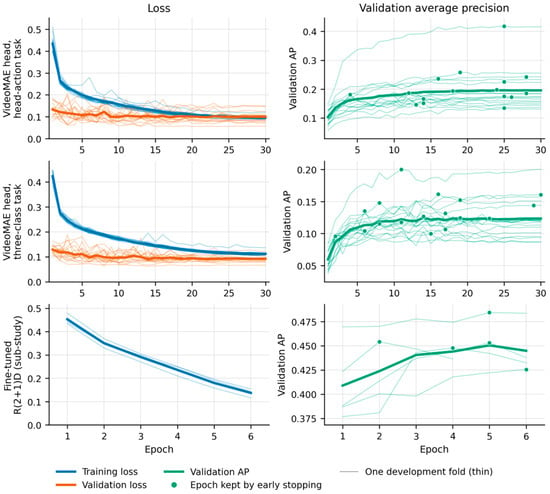
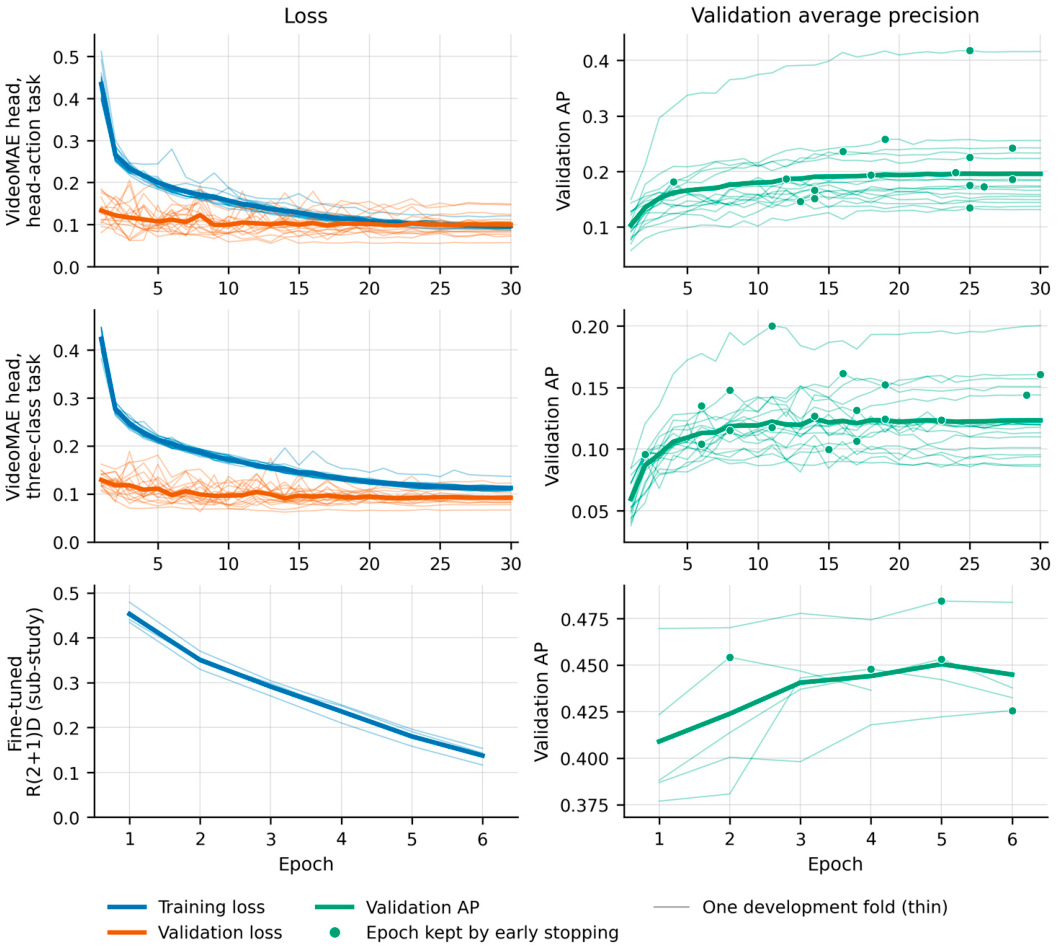
In the fine-tuning sub-study, training loss fell steadily in every fold, from 0.43–0.48 after the first epoch to 0.12–0.24 at the last (Figure 2). Validation AP rose from 0.38–0.47 to a peak of 0.43–0.48, reached at epochs 2–6, and then flattened or fell while training loss kept falling, the point at which early stopping ended training.
Figure 2.
Training and validation curves per development fold. Top two rows: VideoMAE heads (head-action and three-class tasks), with training loss, validation loss, validation AP and learning rate. Bottom row: Partial fine-tuning of R(2+1)D (training loss and validation AP). Dots mark the epoch kept by early stopping.
For the VideoMAE heads, training loss fell from about 0.44 to 0.10 over 30 epochs in both tasks, while validation loss dropped in the first 2–3 epochs and then stayed flat (about 0.10 for head actions, 0.09 for the three-class task) without rising. Validation AP plateaued after about 10–15 epochs. The models therefore did not overfit markedly, and later epochs changed validation performance little. Early stopping selected epochs 4–28 (median 19) for the head-action task and 2–30 (median 15) for the three-class task. Replaying the early-stopping rule on the logged curves reproduced the epoch recorded during training in all 34 folds.
3.4. Detection Performance
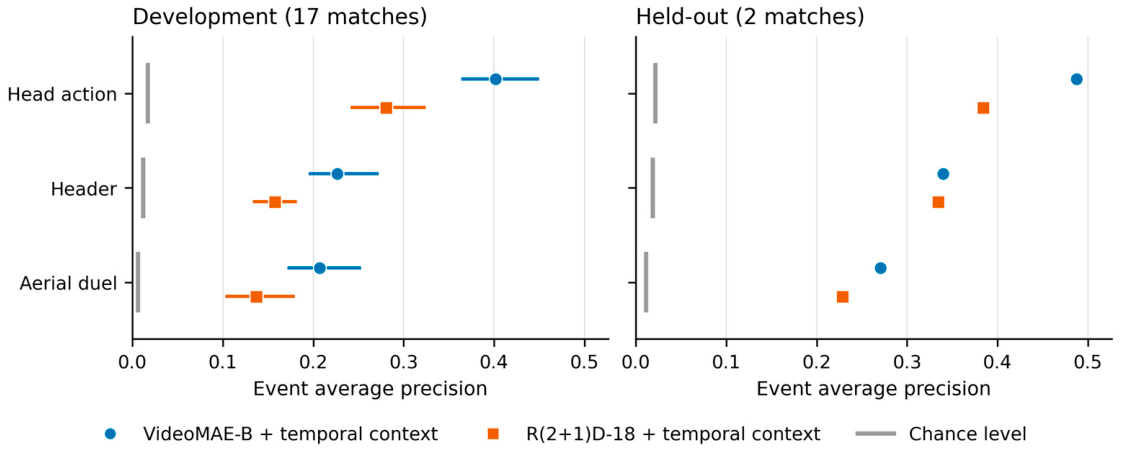
The frozen VideoMAE encoder with temporal context was the best model overall. Its three-class mAP was 0.147 on the development matches and 0.206 on the held-out pair, against 0.098 and 0.187 for R(2+1)D (Table 5, Figure 3). Every model ranked events far above chance: development AP was 10–32 times the shifted-score baseline.
Table 5.
Event-level detection (Mixed ×2 training, ±2 s tolerance). Development (used for model selection, therefore optimistic): 17 matches, leave-one-match-out, with 95% bootstrap intervals; held-out: M08 + W03. Recall at 60 false alarms per hour.
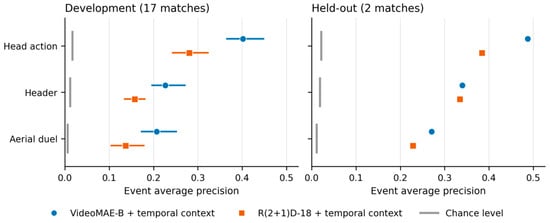
Figure 3.
Event AP by class and model with development 95% intervals and the chance level.
VideoMAE led on every class in development and on the held-out matches, and its development intervals for headers and head actions did not overlap with those of R(2+1)D. Allowing 60 false alarms per hour, VideoMAE found 62% of development head actions and 67% of held-out ones.
Recall has a ceiling set by peak picking. Even if every candidate were reviewed (about 415 per hour of football), VideoMAE would reach 74% of development head actions (931 of 1266) and 76% of held-out ones (133 of 175). The ceiling was 72% for headers (development and held out) and 81% and 84% for aerial duels. The remaining events had no score peak within ±2 s, so no threshold could recover them; they set the upper limit for any review budget.
3.5. Ablations and Fine-Tuning Sub-Study
Temporal context improved detection for both encoders, while the other head settings had small effects (Supplementary Figure S1). Letting the head see the 2.4 s before and after each moment raised head-action AP over the moment alone by 0.052 for both R(2+1)D (0.280 vs. 0.229) and VideoMAE (0.399 vs. 0.347). On the three-class task the gains were 0.025 and 0.036. Context over ±1.2 s recovered about half to three-quarters of these gains. A linear head was the worst variant in every comparison, 0.03–0.04 AP below the standard head on head actions. Raising negatives from 10 to 30 per positive changed AP by at most 0.017. Smoothing the scores up to σ = 0.8 s changed AP by less than 0.01; heavier smoothing (1.6 s) lowered it in every case. Training the last block of R(2+1)D together with the head improved development AP over the frozen encoder on the same five folds for every class: from 0.130 to 0.163 for headers (Δ = +0.033, 95% CI 0.010 to 0.061), from 0.103 to 0.148 for aerial duels (+0.045, 0.016 to 0.077) and from 0.202 to 0.320 for head actions (+0.118, 0.087 to 0.160; Supplementary Figure S2). The gain was also seen on the held-out matches (headers 0.362 vs. 0.191, aerial duels 0.187 vs. 0.131, head actions 0.434 vs. 0.236). The frozen comparison model had no temporal context; combining fine-tuning with temporal context was not tested.
The largest gain was for head actions, where fine-tuning added about 60% to development AP and nearly doubled held-out AP.
Head-variant screening (development AP for each head variant and smoothing level) is shown in Supplementary Figure S1, and the paired fine-tuning differences in Supplementary Figure S2.
3.6. Training-Data Composition: Sex, Diversity and Size
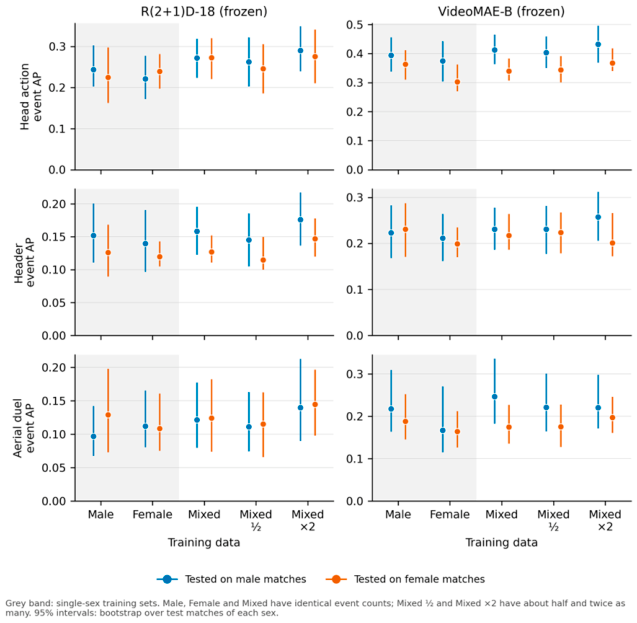
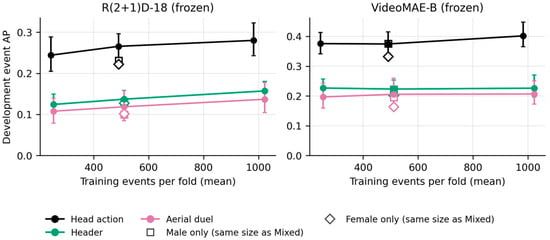
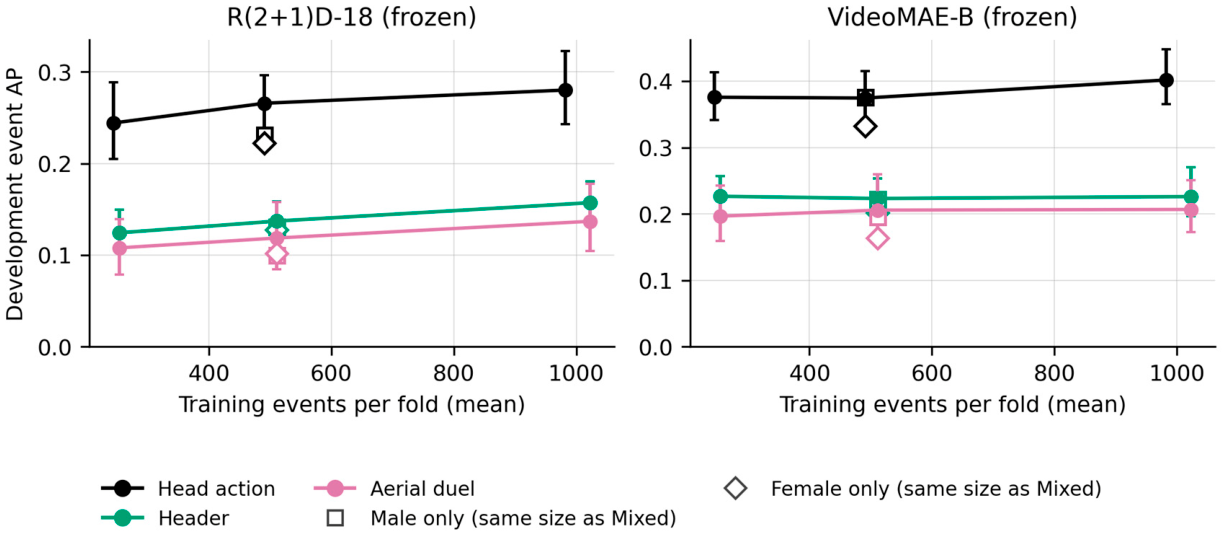
At equal size, mixed-sex training was never better than male-only training, but it was better than female-only training for head actions with both encoders. More data improved R(2+1)D in most comparisons but VideoMAE only for head actions at the largest size. No class showed a same-sex training advantage (Table 6, Figure 4 and Figure 5).
Table 6.
Paired differences in development AP between training conditions (95% bootstrap intervals; bold = interval excludes zero). Same-sex advantage = AP of the model trained on the test matches’ sex minus AP of the model trained on the other sex, averaged over male and female test matches.
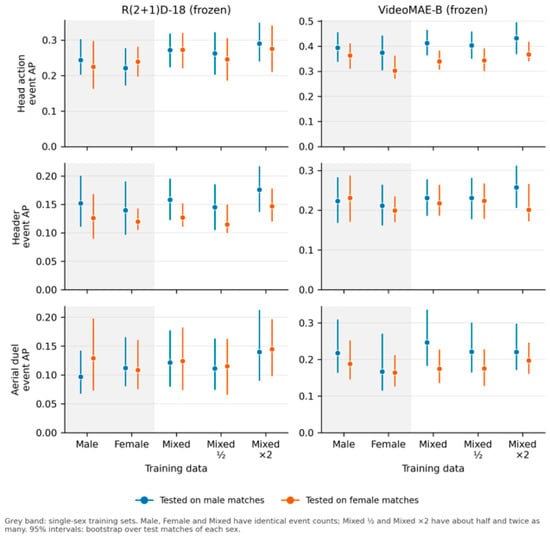
Figure 4.
Cross-sex transfer: Development AP by training condition, tested on male (blue) and female (orange) matches, for headers, aerial duels and head actions, with both encoders.
Figure 5.
Size and diversity: Development AP against training events per fold for the mixed conditions, with single-sex sets of equal size.
Male only, Female only and Mixed contain identical numbers of events. No difference between mixed and male-only training was detected for any class (all intervals include zero; head actions with VideoMAE, Δ = +0.000, 95% CI −0.028 to 0.026), so differences of up to about 0.03 AP in either direction cannot be excluded. It outperformed female-only training for head actions (+0.042 with both encoders) and, with VideoMAE, for aerial duels (+0.043); for headers the VideoMAE interval reached zero. No same-sex training advantage was detected for any class or encoder: models trained on one sex were not measurably better on matches of that sex than models trained on the other (Figure 4). With VideoMAE, head-action AP was lower on female than on male test matches in all five training conditions, including female-only training (male 0.37–0.43, female 0.30–0.37; 0.432 vs. 0.367 with Mixed ×2). Header AP differed little between sexes (0.20–0.26 throughout), and with R(2+1)D head-action AP was similar for both sexes (male 0.22–0.29, female 0.23–0.28). Female development matches had fewer head actions per hour than male matches (34.7 vs. 45.7; Section 3.2). For R(2+1)D, more data improved AP in four of six comparisons: from Mixed ½ to Mixed for head actions and headers, and from Mixed to Mixed ×2 for headers and aerial duels. For VideoMAE, only doubling the data improved head actions (+0.027); the other five size comparisons were not detectable. With VideoMAE, Mixed ×2 gave the highest held-out head-action AP (0.487), with the other conditions between 0.427 (Male only) and 0.461 (Female only). With two matches, no intervals were computed for these differences.
3.7. Feature-Space Separability
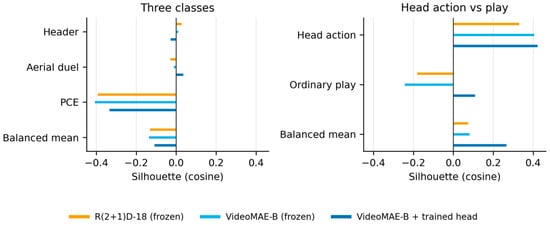
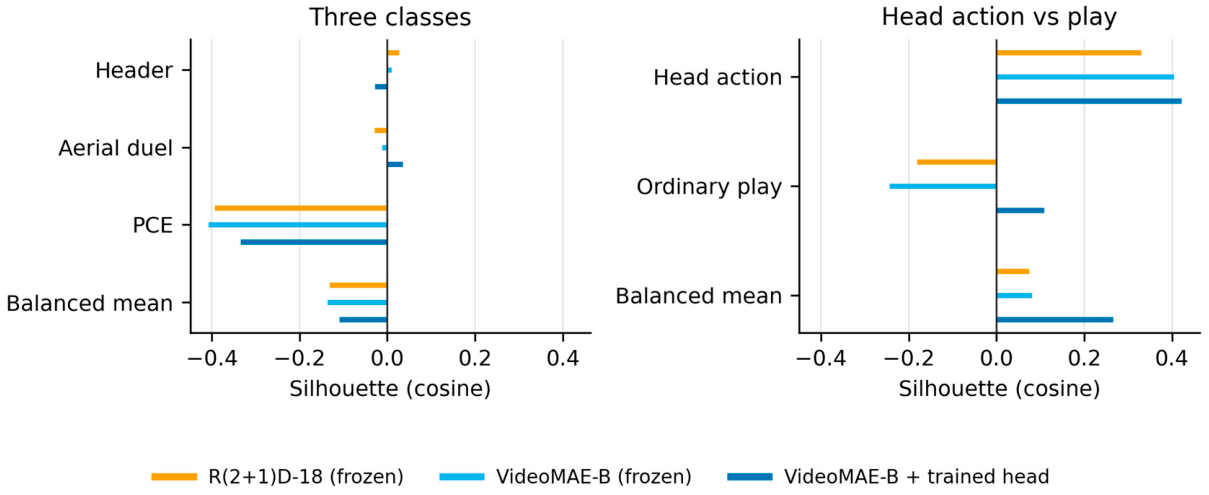
Before training, neither frozen encoder separated headers, aerial duels and PCEs; both separated head actions from ordinary play to a moderate degree. After training, the classification head separated head actions from play more strongly, while separation of the three classes changed little (Table 7, Figure 6).
Table 7.
Mean silhouette score (cosine distance). Frozen encoder descriptors on all 19 matches and on the held-out pair; after training = hidden layer of the trained VideoMAE head on the held-out pair. Range −1 to 1; values near 0 indicate overlapping classes.
Figure 6.
Silhouette per class for the frozen R(2+1)D and VideoMAE descriptors and for the trained VideoMAE head, held-out matches.
With both frozen encoders the three classes overlapped almost completely (weighted means 0.007 and 0.012 across all matches). Headers were the most separable class and PCEs the least; PCE silhouette was strongly negative on the held-out matches, where only three PCEs were present. Head-action windows formed a moderately coherent group in both frozen encoders (0.28–0.40), more so with VideoMAE, while ordinary-play windows had negative silhouette. On the held-out matches, the trained VideoMAE head raised the balanced head-action-vs-play silhouette from 0.080 to 0.265, mainly through ordinary-play windows (−0.244 to 0.108). The three-class balanced mean changed from −0.137 to −0.109.
Silhouette describes how the representation groups events; it is not a measure of detection performance.
3.8. Independent Held-Out Matches
On the two held-out matches (M08, W03; 3.7 h), an analyst reviewing VideoMAE’s top-ranked clips would have found 58% of all head actions while watching 6 min of video per hour of football. Held-out AP was 0.340 for headers, 0.271 for aerial duels and 0.487 for head actions with VideoMAE (Table 5). Held-out AP was higher than development AP for every model and class. Head actions were also more frequent in the held-out matches than in the development matches (48 vs. 40 per hour). With two matches, no intervals were computed for held-out results. VideoMAE’s top five clips per hour on the held-out matches contained a head action in 16 of 18 cases (89%). At 60 clips per hour (6 min of video per hour of football, about 110 clips per match), 58% of head actions were found and 46% of clips contained one; watching the same amount of footage at random would find 10%, a 5.8-fold difference. For headers alone, the same budget found 54% (36% of clips containing a header), and for aerial duels 58%. The frozen R(2+1)D network found 46% of head actions at this budget, and the fine-tuned network in the sub-study 54%.
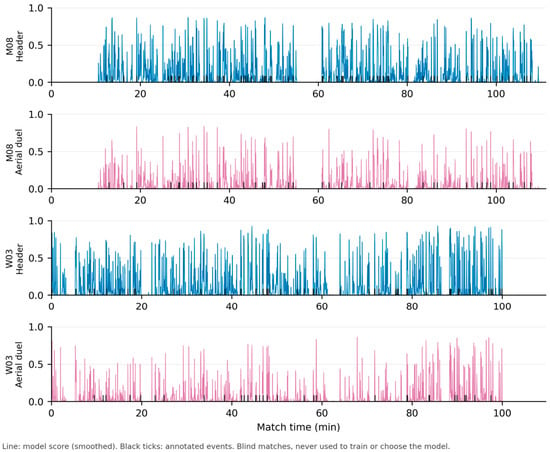
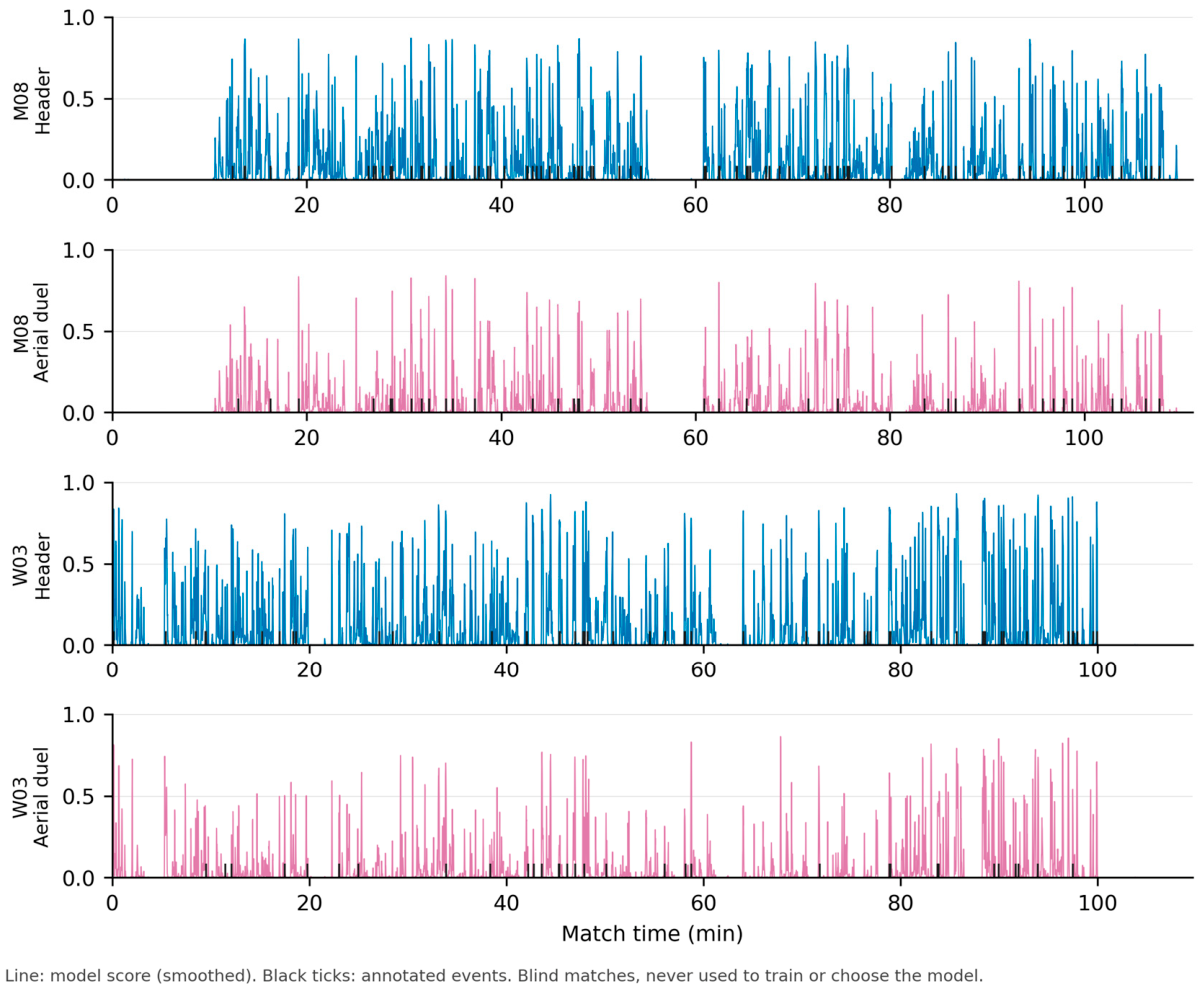
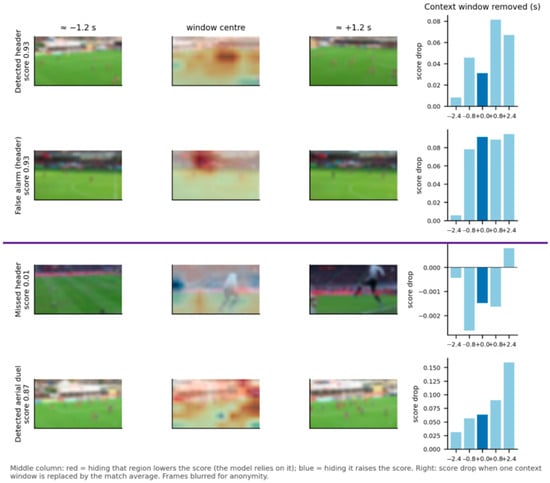
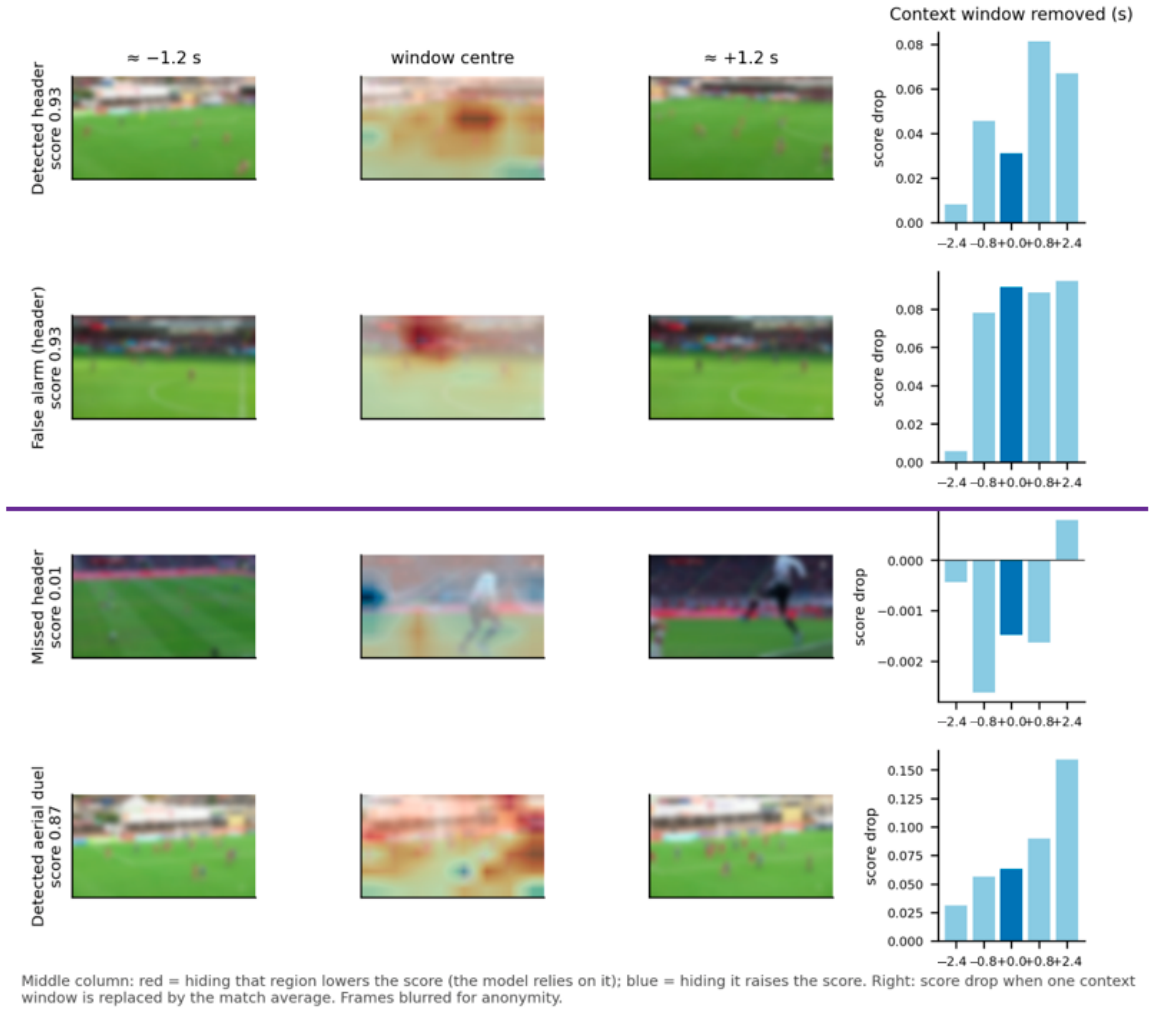
Figure 7 shows the header and aerial-duel scores across both held-out matches against the annotated events. High-scoring moments occurred throughout both matches rather than in particular phases of play. Annotated events generally coincided with score peaks, but many peaks of similar height had no annotated event nearby. Figure 8 shows the occlusion and temporal relevance for the four held-out examples (Section 2.6); the frames analysed reproduced the model’s stored descriptors exactly (cosine similarity 1.0). Hiding any single image region changed the score by at most 0.018, whereas removing one context window changed it by up to 0.16. For the detected header (score 0.93) and the false alarm (score 0.92), the regions with the largest effect lay in the upper part of the frame, around the far touchline and advertising boards where play was concentrated, and the two examples showed similar temporal profiles (largest drops 0.081 and 0.095, after the window centre). For the detected aerial duel (score 0.85), the window 2.4 s after the centre had the largest effect (drop 0.16). The missed header (score 0.007) occurred as the broadcast cut from the wide view to a close-up; no region or context window changed its score by more than 0.003.
Figure 7.
Model scores across the two held-out matches; ticks mark annotated events.
Figure 8.
Occlusion relevance. Middle column: Red regions lower the score when hidden. Right: Score change when each context window is replaced by the match average. From the plotted bar charts; the highlighted (dark blue) bars indicate the most significant frame in performance. Frames blurred for anonymity.
3.9. Limitations in Detecting Possible Concussive Events
PCE could not be detected reliably with 31 development and three held-out events. Development AP ranged from 0.002 to 0.014 across models, against a chance level of about 0.001; the best value (VideoMAE, head-action task, 0.014) had an interval of 0.001–0.071. On the held-out pair the frozen R(2+1)D network was indistinguishable from chance (p = 0.60). PCE results are reported for completeness and are not interpreted further.
4. Discussion
This study tested whether head-related events can be found automatically across entire broadcast matches of male and female football, and whether the sex composition and size of the training data affect that ability. Four main findings emerged:
- Head actions can be located across whole matches well above chance. Reviewing the best model’s top-ranked clips for 6 min per hour of football found 58% of head actions in unseen matches.
- Training on female footage alone produced weaker models than mixed or male-only training of the same size, while no difference was detected between mixed and male-only training. No same-sex training advantage was detected.
- Temporal context and adapting the encoder to football footage improved detection more than any other design choice. The model relied on what happened over several seconds rather than on any single region of the image.
- PCEs could not be detected with the 34 events available.
4.1. From Clip Classification to Whole-Match Review
Event detection models in sports video are often evaluated on short clips cut around annotated events. Such evaluations measure how well a model distinguishes events it has already been shown, and can greatly overstate performance on continuous footage, where ordinary play far outnumbers events. Here every moment of every match was scored, so the average precision values reported are lower than clip-level figures but describe the task an analyst would actually face. On this stricter test, detection was well above chance for every model and held-out performance did not fall below development performance. This contrasts with DeepImpact, whose header precision fell from 96.0% under cross-validation to 21.1% on five unseen games [19]. Part of the stability seen here reflects event density, since the held-out matches contained more head actions per hour, and two matches cannot provide confidence intervals. The score traces showed many high-scoring moments with no annotated event nearby, so the model is not suited to raising alerts at a fixed threshold. It is better used to rank footage for review. Framed this way, the results are practically meaningful: an analyst watching 6 min of the model’s selected clips per hour would find more than half of all head actions, about six times as many as from the same amount of randomly chosen footage. About a quarter of head actions had no score peak at all, however, so a review guided by this model would still miss some events whatever time is spent.
4.2. Sex, Diversity and Dataset Size
Comparisons between sex-specific and combined models are easily confounded by dataset size, because a combined model is usually trained on more data. The present design therefore held size constant when comparing male-only, female-only and mixed training, and varied size while holding the mix constant. At equal size, mixed training was never better than male-only training and was better than female-only training for head actions with both encoders and for aerial duels with VideoMAE. Models trained on one sex were not better on matches of that sex. These results do not support the hypothesis, stated in the Introduction, that sex-specific models are needed to capture differences between male and female football; for event detection from broadcast video, a single model trained on both sexes was not detectably worse than male-only training and was better than female-only training for head actions, although differences of up to about 0.03 AP relative to male-only training cannot be excluded.
Female test matches scored lower than male ones with VideoMAE in every training condition, including female-only training. The gap therefore lies in the test footage rather than in the training data. Female development matches contained fewer head actions per hour (34.7 vs. 45.7), which lowers average precision regardless of the model; differences in broadcast production, such as camera coverage, may also contribute but were not measured. Why female-only training produced weaker models at equal event counts cannot be determined from these data; it is consistent with female footage being harder to learn from, rather than with a shortage of female examples. Female sport remains underrepresented in vision datasets [27,28], and these results support including female footage in training, together with reporting performance separately for each sex so that aggregate results do not hide differences. Additional data helped the weaker R(2+1)D encoder in most comparisons but improved VideoMAE only for head actions when the data were doubled. Stronger pretrained representations may therefore reduce how much annotated football footage is needed, although the dataset was too small to establish where performance levels off.
4.3. What the Model Relies on
Temporal context gave the largest single improvement, and the relevance analysis agreed: removing one moment of context changed the score up to ten times more than hiding any region of the image. Head actions unfold over a few seconds, with the approach, the contest and the aftermath, and the model drew on that sequence. The feature-space analysis showed that the encoders separated head actions from ordinary play, and the trained head improved this separation substantially, but neither separated headers from aerial duels. The same distinction was the main source of disagreement between annotators in early coding rounds and remained the main source of classification disagreement between analysts (10 of 11 disagreements). Distinguishing a header from an aerial duel depends on whether an opponent contests the ball, which is often small and partly hidden in a wide broadcast view. The examples suggest two specific weaknesses. For both a detected header and a false alarm, the score depended on where play was concentrated rather than on one player’s head, so the model appears to recognise situations in which head actions are likely as much as the actions themselves. A header missed during a close-up shot suggests that the model does not recognise head actions outside the wide view on which most footage is filmed. These observations come from four examples and should be confirmed on more events. Partial fine-tuning of R(2+1)D improved every class, with the largest gain for head actions, showing that adapting the encoder to football broadcasts is worthwhile. It was tested without temporal context and only on the weaker encoder, so combining fine-tuning with context and with VideoMAE is the most direct route to better performance.
4.4. Possible Concussive Events
PCE detection did not exceed chance in any meaningful way. With 31 development and three held-out events, this is unsurprising, and PCEs were also the least separable class in feature space. The PCE label is a behavioural proxy (a player going down or holding their head after contact) rather than a confirmed injury, so visually similar events may carry different labels. This work should therefore be read as a system for detecting headers and aerial duels, the events that make up most head-impact exposure, with PCE detection remaining unresolved. Progress will require many more events and labels linked to medically confirmed concussions.
4.5. Limitations
The dataset comprised 19 matches, and the held-out evaluation rests on two matches, one per sex, so held-out results cannot separate closely performing models. Events were matched within ±2 s, which suits review but not precise timing of contact. Fine-tuning was applied to one encoder, with five folds. Broadcast footage shows only what the director chose to show, so head actions off camera or during replays cannot be detected. Finally, video identifies head-related events, not the forces involved, so it cannot by itself establish the severity of an impact. Inter-rater reliability was assessed on one match, where agreement on which events occurred was moderate (Jaccard = 0.64), mostly because one analyst tagged additional headers, so some head actions may be missing from the annotations; any such omissions would count correct detections as false alarms and lower measured AP. Intra-rater reliability for LCD was based on a review of his existing coding rather than an independent re-code. The head design and smoothing were selected on the development matches, so development results are optimistic, and the held-out matches, although excluded from all development of the present models, had been used to train the original clip-level model.
4.6. Practical Implications and Future Work
In its current form, the model could reduce the time needed to review a match for head actions by directing analysts to the footage most likely to contain them, in both male and female football. It is not suitable for real-time alerts or for identifying concussions. Future work should combine temporal context with fine-tuning of the stronger encoder, enlarge the dataset with more female matches from different competitions and broadcast styles, report results separately for each sex, and link video detections to wearable impact sensors and to medically confirmed concussions, so that detected events can be related to impact magnitude and clinical outcome.
5. Conclusions
This proof-of-concept study shows that head-related events, specifically headers and aerial duels, can be located across complete broadcast matches of male and female football well above chance. Used to rank footage for review, the best model allowed an analyst to find more than half of the head actions in unseen matches while watching 6 min of video per hour of play. Training on both sexes was not detectably worse than male-only training and was better than female-only training, and no benefit of sex-specific training was detected, although female matches remained harder to analyse. The model identifies headers and aerial duels, not concussions: possible concussive events could not be detected, and doing so will require larger datasets with medically confirmed labels. Automated detection is therefore best viewed as a tool to support, not replace, analyst and medical review of head-impact exposure.
Supplementary Materials
The following supporting information can be downloaded at: https://www.mdpi.com/article/10.3390/jfmk11040498/s1, Table S1. Training events per fold; Table S2. Annotated events per match; Figure S1. Classifier-head screening; Figure S2. Fine-tuning sub-study.
Author Contributions
Conceptualization, L.C.D., L.R. and E.D.; methodology, L.C.D.; formal analysis, L.C.D. and C.D.; investigation, L.C.D.; data curation, L.C.D. and C.D.; writing—original draft preparation, L.C.D.; writing—review and editing, L.R., E.D. and M.M.; visualisation, L.C.D., L.R., E.D. and M.M.; supervision, M.M., L.R. and E.D. All authors have read and agreed to the published version of the manuscript.
Funding
This research was funded under the RISE@ATU initiative and co-funded by the Government of Ireland and the European Union through the ERDF Northern & Western Regional Programme 2021–2027.
Institutional Review Board Statement
Ethical review and approval were waived for this study due to the retrospective analysis of publicly available broadcast video footage, which did not involve direct interaction with, recruitment of, or intervention on human participants.
Informed Consent Statement
No identifiable individual player images are reproduced in this manuscript; all figures use blurred, cropped, or schematic representations that do not permit identification of individual athletes.
Data Availability Statement
The model pipeline, video download notebooks, previous versions, weights and other supporting materials are available in the Zenodo repository here: https://doi.org/10.5281/zenodo.23644851 access date: 20 November 2026.
Conflicts of Interest
The authors declare no conflict of interest.
Abbreviations
The following abbreviations are used in this manuscript:
| SRC | Sport-Related Concussion |
| CV | Computer Vision |
| PCE | Possible Concussive Event |
| AP | Average Precision |
| mAP | Mean Average Precision |
| MTBI | Mild Traumatic Brain Injury |
| CI | Confidence Interval |
| NCAA | National Collegiate Athletic Association |
| FIFA | Fédération Internationale de Football Association |
| MRI | Magnetic resonance imaging |
| WSL | Women’s super league |
| H2H | Head-to-head |
| H2G | Head to ground |
| H2B | Head to body |
| AE | Aerial duel |
| ICC | Intra-class correlation |
| PABAK | Prevalence adjusted bias adjusted kappa |
| KW | Weighted Cohens Kappa |
| LOMO-CV | Leave one match out cross validation |
| LCD | Luke Canavan Dignam |
| ED | Ed Daly |
| LR | Lisa Ryan |
| CD | Conn Durkan |
| MM | Michael McCann |
References
- Finnegan, E.; Daly, E.; Hunzinger, K.J.; Ryan, L. Gastrointestinal Symptoms After Sport-Related Concussion: Prevalence and Patterns in a Multi-Cohort Analysis. Nutrients 2026, 18, 1740. [Google Scholar] [CrossRef] [Scilit] [PubMed]
- Dave, U.; Kinderknecht, J.; Cheng, J.; Santiago, K.; Jivanelli, B.; Ling, D.I. Systematic review and meta-analysis of sex-based differences for concussion incidence in soccer. Phys. Sportsmed. 2022, 50, 11–19. [Google Scholar] [CrossRef] [Scilit] [PubMed]
- Sprouse, B.; Morris, J.; Cooper, S.; Cowie, C.; Kemp, S.; Bennett, P.; Varley, I. The incidence and burden of concussion in men’s and women’s English professional football. BMJ Open Sport Exerc. Med. 2025, 11, e002297. [Google Scholar] [CrossRef] [Scilit] [PubMed]
- Arachchi, S.; Daly, E.; Dwivedi, A.; Ryan, L. Sex Differences in Severity and Recovery Following Mild Traumatic Brain Injury: A Systematic Review. Brain Sci. 2026, 16, 77, Erratum in Brain Sci. 2026, 16, 373. [Google Scholar] [CrossRef] [Scilit] [PubMed]
- Postula, B.; Hicks, A.; Toldi, J.P. Evaluation of Neck Strength and Concussion Risk: A Systematic Review. Curr. Sports Med. Rep. 2026, 25, 19–28. [Google Scholar] [CrossRef] [Scilit] [PubMed]
- FIFA. Setting the Pace: FIFA Benchmarking Report—Women’s Football; FIFA: Zurich, Switzerland, 2023. [Google Scholar]
- Eckner, J.T.; Oh, Y.K.; Joshi, M.S.; Richardson, J.K.; Ashton-Miller, J.A. Effect of neck muscle strength and anticipatory cervical muscle activation on the kinematic response of the head to impulsive loads. Am. J. Sports Med. 2014, 42, 566–576. [Google Scholar] [CrossRef] [Scilit] [PubMed]
- Pereira, E.; Peek, K.; McLean, C.; Lavender, A.P.; Ma’ay, F.; Davey, P.; Morris, S.; Georgieva, J. The effect of ball pressure and maximal isometric neck strength on head acceleration during purposeful heading in adult football players during heading drills. JSAMS Plus 2024, 3, 100051. [Google Scholar] [CrossRef] [Scilit] [PubMed]
- den Hollander, S.; Gouttebarge, V. Headers and concussions in elite female and male football: A pilot study. S. Afr. J. Sports Med. 2023, 35, v35i1a15236. [Google Scholar] [CrossRef] [Scilit] [PubMed]
- Cassoudesalle, H.; Laborde, B.; Orhant, E.; Dehail, P. Video analysis of concussion mechanisms and immediate management in French men’s professional football (soccer) from 2015 to 2019. Scand. J. Med. Sci. Sports 2021, 31, 465–472. [Google Scholar] [CrossRef] [Scilit] [PubMed]
- Peek, K.; Aiello, F.; Avery, L.; Gardner, T.; Rutherford, H.; Massey, A.; Georgieva, J.; Andersen, T.E.; Dahlén, S.; Serner, A. Characteristics of potential head injury situations at the FIFA World Cup Qatar 2022™. Sci. Med. Footb. 2026, 10, 12–20. [Google Scholar] [CrossRef] [Scilit] [PubMed]
- Lima, Y.; Köyağasıoğlu, O.; Karaçoban, L.; Serner, A.; Peek, K. Potential head injuries in professional women’s football: A video analysis of frequency, characteristics, and assessment. J. Sci. Med. Sport 2026, 29, 665–673. [Google Scholar] [CrossRef] [Scilit] [PubMed]
- Mainwaring, L.; Ferdinand Pennock, K.M.; Mylabathula, S.; Alavie, B.Z. Subconcussive head impacts in sport: A systematic review of the evidence. Int. J. Psychophysiol. 2018, 132, 39–54. [Google Scholar] [CrossRef] [Scilit] [PubMed]
- Hack, L.; Singh, B.; Binkofski, F.; Helmich, I. Repetitive Subconcussive Head Impacts in Sports and Their Impact on Brain Anatomy and Function: A Systematic Review. Int. J. Sports Med. 2024, 45, 871–883. [Google Scholar] [CrossRef] [Scilit] [PubMed]
- Kuzminski, S.; Clark, M.; Fraser, M.; Haswell, C.; Morey, R.; Liu, C.; Choudhury, K.; Guskiewicz, K.; Petrella, J. White matter changes related to subconcussive impact frequency during a single season of high school football. AJNR Am. J. Neuroradiol. 2018, 39, 245–251, Erratum in AJNR Am. J. Neuroradiol. 2019, 40, E5. [Google Scholar] [CrossRef] [Scilit] [PubMed]
- Lipton, M.L.; Kim, N.; Zimmerman, M.E.; Kim, M.; Stewart, W.F.; Branch, C.A.; Lipton, R.B. Soccer heading is associated with white matter microstructural and cognitive abnormalities. Radiology 2013, 268, 850–857. [Google Scholar] [CrossRef] [Scilit] [PubMed]
- Kuo, C.; Wu, L.; Loza, J.; Senif, D.; Anderson, S.C.; Camarillo, D.B. Comparison of video-based and sensor-based head impact exposure. PLoS ONE 2018, 13, e0199238. [Google Scholar] [CrossRef] [Scilit] [PubMed]
- Huber, L.; Szymski, D.; Krutsch, W.; Alt, V.; Weber, J. Video analysis of heading and risk of head injury situations in elite international men’s football: Does the frequency of headers increase with the level of play? Eur. J. Sport Sci. 2024, 24, 518–524. [Google Scholar] [CrossRef] [Scilit]
- Rezaei, A.; Wu, L.C. Automated soccer head impact exposure tracking using video and deep learning. Sci. Rep. 2022, 12, 9282. [Google Scholar] [CrossRef] [Scilit] [PubMed]
- Williams, J.J. Operational definitions in performance analysis and the need for consensus. Int. J. Perform. Anal. Sport 2012, 12, 52–63. [Google Scholar] [CrossRef] [Scilit]
- Francis, J.W.; Kyte, J.L.; Bateman, M.; Nicholls, S.B. The landscape of validity and reliability practices from applied performance analysts: Establishing a best practice framework. Int. J. Sports Sci. Coach. 2025, 20, 1014–1036. [Google Scholar] [CrossRef] [Scilit]
- Robinson, G.; O’Donoghue, P. A weighted kappa statistic for reliability testing in performance analysis of sport. Int. J. Perform. Anal. Sport 2007, 7, 12–19. [Google Scholar] [CrossRef] [Scilit]
- Kay, W.; Carreira, J.; Simonyan, K.; Zhang, B.; Hillier, C.; Vijayanarasimhan, S.; Viola, F.; Green, T.; Back, T.; Natsev, P.; et al. The Kinetics Human Action Video Dataset. arXiv 2017, arXiv:1705.06950. [Google Scholar]
- Tran, D.; Wang, H.; Torresani, L.; Ray, J.; LeCun, Y.; Paluri, M. A Closer Look at Spatiotemporal Convolutions for Action Recognition. In Proceedings of the IEEE/CVF Conference on Computer Vision and Pattern Recognition (CVPR), Salt Lake City, UT, USA, 18–23 June 2018; pp. 6450–6459. [Google Scholar]
- Tong, Z.; Song, Y.; Wang, J.; Wang, L. VideoMAE: Masked Autoencoders Are Data-Efficient Learners for Self-Supervised Video Pre-Training. Adv. Neural Inf. Process. Syst. 2022, 35, 10078–10093. [Google Scholar] [CrossRef] [Scilit]
- Phipson, B.; Smyth, G.K. Permutation P-values should never be zero: Calculating exact P-values when permutations are randomly drawn. Stat. Appl. Genet. Mol. Biol. 2010, 9, 39. [Google Scholar] [CrossRef] [Scilit] [PubMed]
- Harrison, S.; Gualdoni, E.; Boleda, G. Run Like a Girl! Sport-Related Gender Bias in Language and Vision. In Findings of the Association for Computational Linguistics: ACL 2023; Association for Computational Linguistics: Toronto, Canada, 2023. [Google Scholar]
- Ray, P.; Sasmal, M.; Bera, A. Women Sport Actions Dataset for Visual Classification Using Small-Scale Training Data. arXiv 2025, arXiv:2507.10969. [Google Scholar]

Disclaimer/Publisher’s Note: The statements, opinions and data contained in all publications are solely those of the individual author(s) and contributor(s) and not of MDPI and/or the editor(s). MDPI and/or the editor(s) disclaim responsibility for any injury to people or property resulting from any ideas, methods, instructions or products referred to in the content. |
© 2026 by the authors. Licensee MDPI, Basel, Switzerland. This article is an open access article distributed under the terms and conditions of the Creative Commons Attribution (CC BY) license.