


Abstract
Heat loss adaptations involve key mechanisms including increased skin blood flow and sweat production, although sex-specific responses are not fully understood. We hypothesized that circulating angiogenic and lymphangiogenic factors linked to post-exercise heat responses would be elevated following a simulated occupational work trial. Background and Objectives: We quantified circulating markers associated with angiogenic and lymphangiogenic responses to a simulated occupational exercise in the heat in females and males. Methods: Females and males (n = 30 each) were randomized to 7 consecutive days of exercise comprising 60 min of walking (3 × 20 min) in a hot environment (38 °C, 60% relative humidity, 3.5 mph, 5% grade). Participants were assigned to either a Sustained (90 min heat exposure, n = 30) or Periodic (3 × 30 min, 3 h separation, n = 30) heat exposure. Blood samples were collected “Pre” and “Post” the first 30 min of exposure on days 1 and 7. Results: Analyses revealed a significant time × day interaction only for sFlt-1 (p < 0.001). Following the 30 min bout of heat + exercise, females exhibited Pre–Post elevations for VEGF-A (p = 0.020) and VEGF-C (p = 0.004), while corresponding changes were not observed in males. However, sex-based differences were attenuated in VEGF-A and VEGF-C after adjusting for body composition and aerobic capacity. Independent of sex, Pre–Post changes were lower for VEGF-D (p < 0.008) but elevated for bFGF (p < 0.001) and sFlt-1 (p < 0.001). Conclusions: Contrasting males, females exposed to a hot environment had post-exercise elevations in the circulating markers VEGF-A and VEGF-C. Moreover, sFlt-1 concentrations may reflect a heat adaptation response after 7 days of exposure.
1. Introduction
The world is experiencing a changing climate, often with rising temperatures. For those living and working in affected regions, the higher temperatures pose an increasing challenge to human physiology [1]. Accordingly, individuals engaged in occupations with significant heat exposure times are at an elevated risk of heat illness [2]. In the United States, an estimated 33,890 work-related heat injuries and illnesses occurred annually between 2011 to 2020 [3]. Fortunately, humans can adapt to prolonged and serial heat exposures, including exposures linked to physically demanding occupations performed in a hot environment [1,4]. Sustained and periodic heat stress elevates core and skin temperature. In response, the body increases the demands of blood flow to the skin and the active tissues, leading to a series of adaptive responses to regulate the rate of dry and evaporative heat loss [5], including increased sweating rate, earlier onset of sweat, expansion of blood volume, and increased sensitivity of the skin vasculature [6,7].
Physiologic adaptations facilitate the dissipation of increased core and skin temperatures during physical activity in hot environments [8]. While the processes that underpin these physiologic responses remain incompletely understood, repeated heat exposures likely include an acute elevation in circulating angiogenic and lymphangiogenic factors than may promote angiogenesis. Subsequent to these circulating stimuli, new vessels may be formed to bolster vascular networks and establish microcirculatory systems, promoting improved blood supply and fluid homeostasis, among other functions [9,10]. Previous research is inconsistent, however, regarding the circulating factors observed during, and immediately following, exercise in a hot environment. For example, the acute changes in circulating angiogenesis factors (e.g., vascular endothelial growth factor, VEGF) in response to simulated occupational heat exposures are not well defined [5,11,12].
In addition, limited evidence suggests that sex differences may exist in response to heat acclimation [6]. Interestingly, while females and males demonstrate similar acclimation effectiveness, as reflected by comparable adaptations in core temperature [13], sex-dependent heat dissipation mechanisms may exist. For example, vascular adaptations may contribute differently to heat acclimation in females and males. However, the existing body of literature on vascular adaptations to heat has primarily been conducted in males [5]. In support, a recent meta-analysis highlighted the paucity of data on the topic, concluding that female thermoregulatory responses are not fully resolved [14]. Nonetheless, foundational studies confirm that females and males show similar adaptations in core temperature, one of the most impactful adaptations of heat adaptation protocols [13]. Consequently, sex-dependent vascular and thermoregulatory responses to occupational heat exposure are not fully understood [6], representing a critical gap in the literature that warrants further investigation.
Given the need to continue to explore the impact of thermal physiology on human vascular function [2], we took an exploratory approach to examine potential responses to a simulated occupational physical activity investigation. Given the possible influence of this collective stimulus on tissue-level adaptations, our first step in this process was to examine a panel of circulating markers related to vascular changes in females and males. Both groups were exposed to sustained and periodic heat regimens designed to simulate the physiological demands of an occupational workplace setting. Based on this rationale, we hypothesized that circulating markers associated with angiogenesis and lymphangiogenesis would be elevated more in females than males exposed to 7 days of a simulated occupational heat challenge.
2. Materials and Methods
2.1. Participants
The study approval was obtained from the University of Montana Review Board and the Air Force Human Research Protection Office before participant recruitment and testing. The current study addresses a secondary hypothesis from a larger data set [8]. Study participants (female: n = 30, male: n = 30) were recruited from the Missoula Montana community, and written informed consent was obtained from all subjects involved in the study prior to data collection. Study participants between the ages of 18 and 45 years of age were cleared for participation based on ACSM’s Pre-Participation Questionnaire.
2.2. Study Design
The study encompassed baseline testing and random assignment to one of two 7-day heat acclimation interventions performed at a set workload. The first laboratory visit preceded the intervention and included the collection of anthropometric measures and body composition determination (using a 7-site skinfold). Aerobic capacity was assessed with a treadmill VO2 max test. More details are available elsewhere [8].
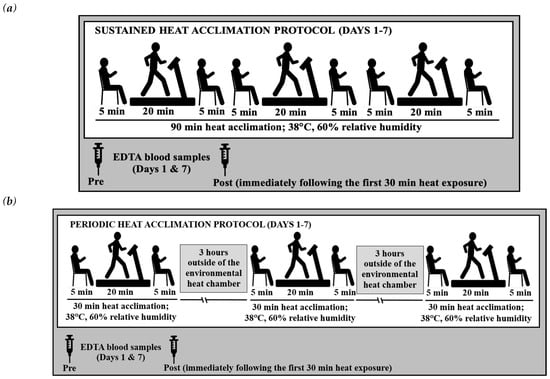
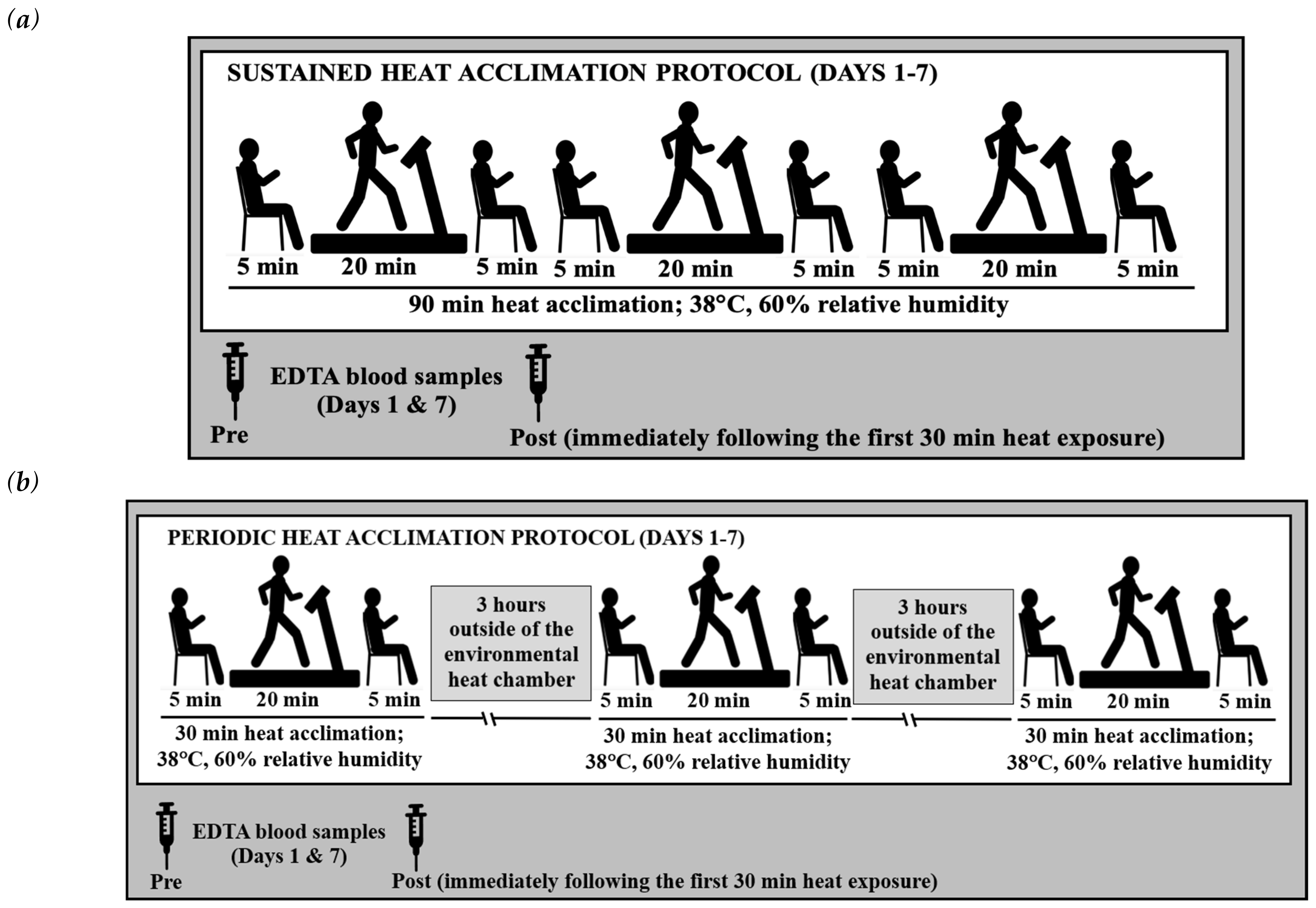
The 60 participants were assigned to either a “Periodic” or a “Sustained” heat exposure groups. As presented in Figure 1a,b, the physical activity–heat protocol involved 3 × 20 min of treadmill walking at 3.5 mph and 5% grade. The three treadmill walking intervals were preceded and followed by 5 min of seated rest, resulting in 90 total minutes of heat exposure. The Periodic treatment entailed 3 × 20 min of the physical activity–heat protocol separated by 3 h breaks in a normothermic environment (n = 15 females, n = 15 males). In contrast, the Sustained physical activity–heat group received 3 × 20 min of physical activity–heat protocols with no breaks in a normothermic environment (n = 15 females, n = 15 males). The physical activity–heat protocols were performed on 7 consecutive days. For both intervention groups, participants were exposed to a cumulative 90 min of absolute workload and heat exposure in a climate-controlled environmental chamber set at 38 °C (100.4 °F) and 60% humidity. Blood samples were collected on days 1 and 7 before (“Pre”) and after (“Post”) the physical activity–heat protocol as described in the subsequent section.
Figure 1.
Diagrams outlining the sustained and periodic heat acclimation protocols. (a) A diagram of the sustained heat acclimation exposure protocol. (b) A diagram of the periodic heat acclimation exposure protocol.
2.3. Blood Sample Handling and Analysis
Blood samples (8–10 mL) were drawn from an antecubital vein. Blood samples were collected into vacutainer tubes containing EDTA (BD, Franklin Lakes, NJ, USA) before and after the first 30 min of the physical activity–heat protocol on days 1 and 7 of the intervention. After collection, blood samples were spun for 10 min at 10,000 RPM in a centrifuge (MR22i, Jouan Incorporated, Winchester, VA, USA) cooled to 4 °C. After the initial collection, plasma was aliquoted into 1.5 mL microcentrifuge tubes. Samples were held briefly at −30 °C (weeks), and subsequently stored for several months at −80 °C until biochemical analyses were performed. Changes in Pre–Post plasma volume were calculated from whole blood hemoglobin measurements (microcuvettes read in the Hemocue Hb 201, Brea, CA, USA) and corresponding hematocrit values (12,000 rpm in a hematocrit centrifuge, GF Health Products, Inc., Atlanta, GA, USA). Hemoglobin and hematocrit values were then used to correct for Pre–Post plasma volume shifts using the method of Dill & Costill [15].
Assays for eight proangiogenic proteins were quantified using the Multi-Spot 96-well plates from Meso Scale Discovery (MSD, Rockville, MD, USA), and procedures were carried out according to manufacturer’s instructions. The following seven angiogenesis-related biomarkers were included: vascular endothelial growth factor isoforms including (VEGF)-A, VEGF-C, VEGF-D. In addition, tyrosine kinase (Tie)-2, Fms-like tyrosine kinase 1 (sFlt)-1, placental growth factor (PIGF), and basic fibroblast growth factor (bFGF) were quantified. Each plate was read using a MESO QuickPlex SQ 120MM instrument (MSD, Rockville, MD, USA).
Individual analysis of progesterone and estradiol in the female groups was performed to confirm similar ovarian hormone fluctuations. Eumenorrhea was not verified in female participants. A detailed methodology for this work can be found in a prior investigation [8].
2.4. Data Analysis and Statistical Testing
Data were summarized for potential Pre–Post changes (averaged Pre and Post 30 min values per individual across days), day (1 versus 7), sex (females versus males), and group (Periodic versus Sustained). Furthermore, data are reported as mean ± standard error. Pre–Post findings were summarized across days and groups after observing non-significant effects that existed between day 1 and 7 and between Sustained and Periodic treatment groups. Given that the current investigation was exploratory in nature, we embarked on a planned comparisons approach intended to balance statistical rigor against the potential for type I errors. To achieve this balance, a 4-way factorial repeated-measures ANOVA (time × day × sex × group) was conducted to assess mean differences. Post hoc analyses with Tukey correction were performed when statistically significant results were found. All the analyses were completed using Jamovi Software (version 2.6.44.00) [16], with an alpha level determined at p < 0.05 for statistical significance a priori. Effect size was measured with partial eta square (η2p), the scales of magnitude were interpreted based on Cohen, J. (1988), as small = 0.01, medium = 0.06, and large = 0.14 [17], while acknowledging that partial n2 is not balanced for repeated-measures designs.
3. Results
A total of 30 females and 30 males completed the study, resulting in 15 females and 15 males assigned to the Periodic or Sustained groups. The sample baseline characteristics are presented in Table 1. When comparing between sexes, body composition and aerobic fitness were significantly different between females and males. Additionally, while the phase of the individual’s menstrual cycles were not controlled for currently, females showed equivalent circulating levels of estradiol and progesterone (p > 0.05), as published previously [8]. Further characteristic analyses of this participant cohort can be found as published elsewhere [8].
Table 1.
Participant characteristic data from females and males assigned to sustained and periodic protocols.
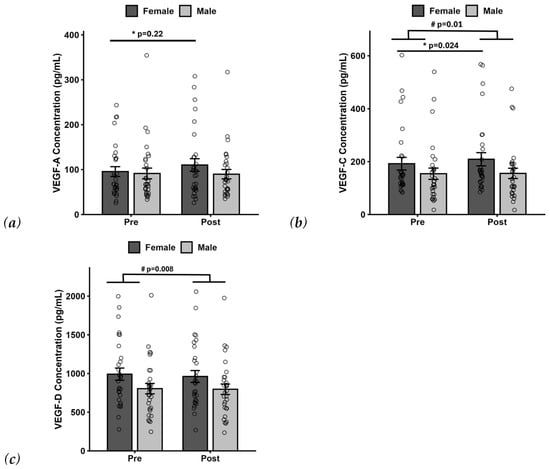
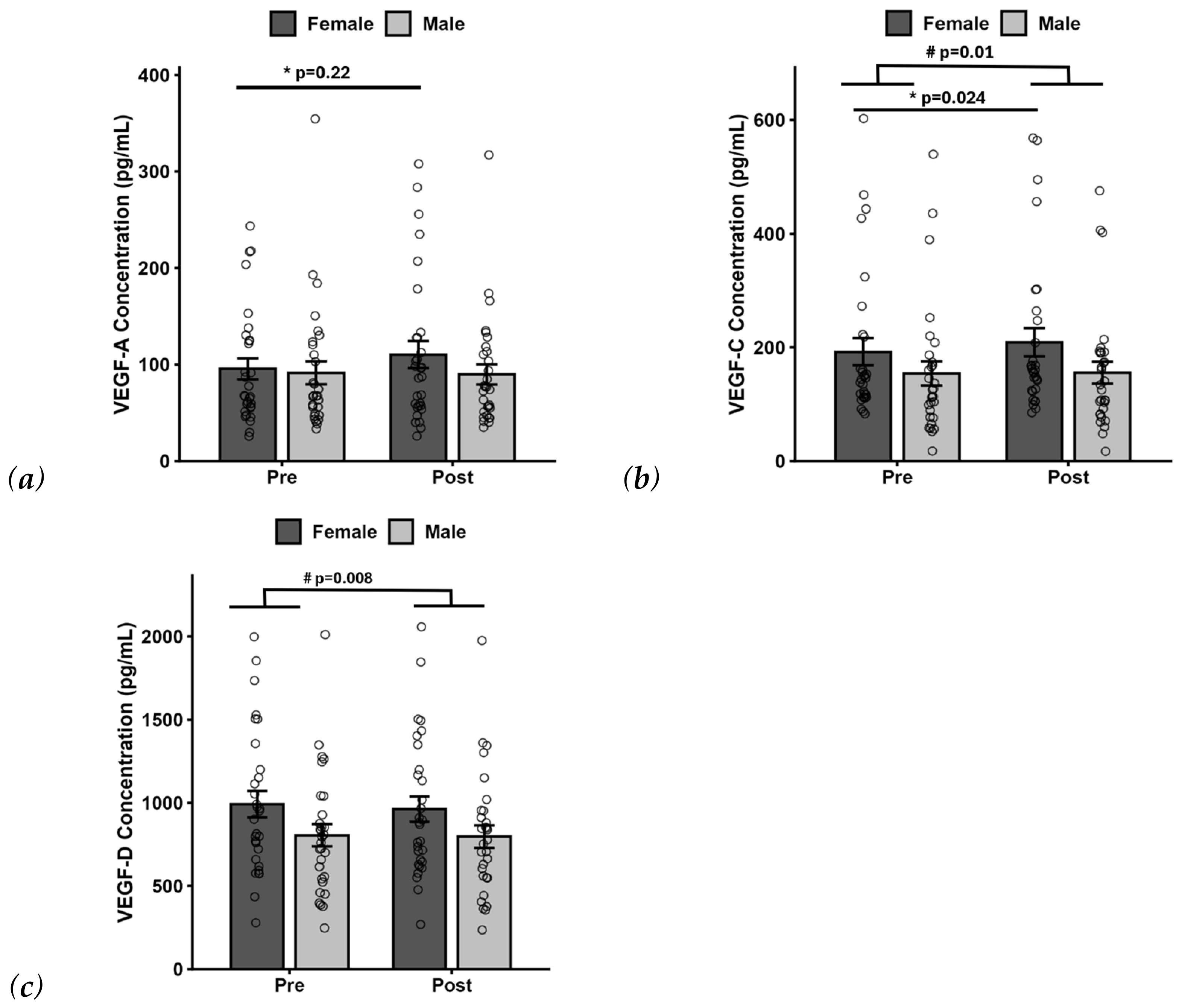
Figure 2a–c presents findings for VEGF-A, VEGF-C, and VEGF-D,. The analysis revealed a statistically significant Pre–Post × sex interaction for VEGF-A (p = 0.022, η2p = 0.09, Figure 2a) and VEGF-C (p = 0.024, η2p = 0.087, Figure 2b). The main effects for VEGF-A were non-significant (Pre–Post, p = 0.065; sex, p = 0.46). VEGF-C main effects showed significant Pre–Post (p = 0.010), and non-significant sex (p = 0.15). Post hoc analyses demonstrated a statistically significant pre-to-post-exercise increase in females (VEGF-A, p = 0.020; VEGF-C, p = 0.004), which was not evident for males. Additionally, VEGF-D showed a significant decrease from pre-to-post-exercise (p = 0.008, η2p = 0.118, Figure 2c). No significant main effects or interactions were found for groups or day analyses.
Figure 2.
A comparison of VEGF-A, VEGF-C, and VEGF-D pre- and post-exercise by sex. (a) VEGF-A circulating Pre–Post changes by sex, n = 30 females; 30 males, (b) VEGF-C circulating Pre–Post changes by sex, n = 30 females; 30 males, (c) VEGF-D circulating Pre–Post changes by sex, n = 30 females; 30 males. * Indicates a significant pre–post-exercise increase in females, p ≤ 0.05. # Indicates a significant Pre–Post effect, p ≤ 0.05. Data are presented as mean ± SE.
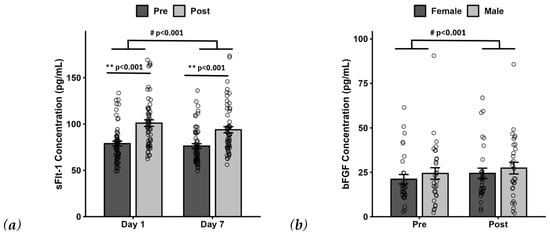
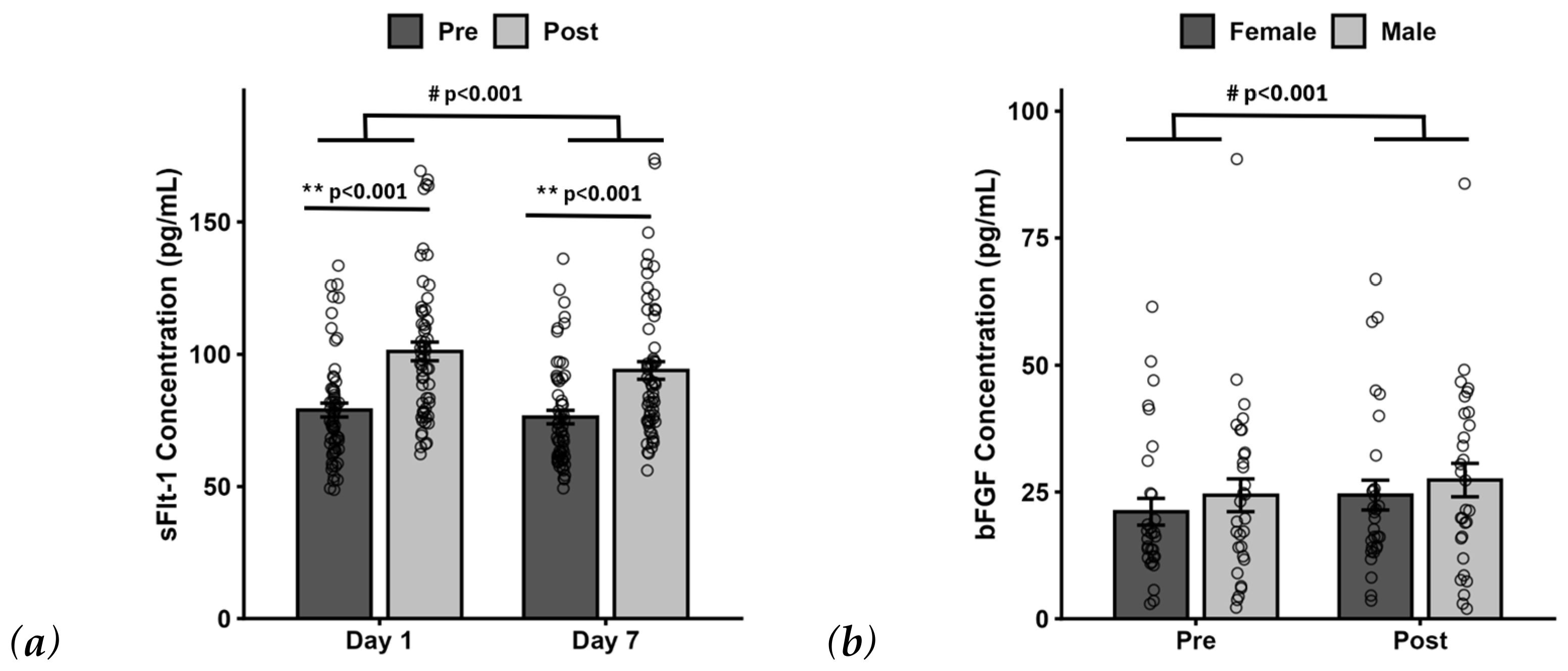
Additionally, Figure 3a,b presents the findings for sFlt-1 and bFGF. sFlt-1 showed significant main effects for Pre–Post (p < 0.001) and day (p = 0.003), with a statistically significant time × day interaction (p = 0.001, η2p = 0.167, Figure 3a). Post hoc analysis revealed significant Pre–Post changes for day 1 (p < 0.001) and day 7 (p < 0.001). Additionally, the main effect for pre–post-exercise was found to be statistically significant for bFGF (p < 0.001, η2p = 0.184, Figure 3b). Lastly, PIGF and Tie-2 did not reveal statistically significant results. No significant main effects or interactions were observed for groups across any of the measured variables.
Figure 3.
The quantification of sFLT-1 and bFGF Pre–Post. (a) sFlt-1 circulating Pre–Post day changes, n = 30 females; 30 males, (b) bFGF circulating Pre–Post changes by sex, n = 30 females; 30 males. # Indicates a significant Pre–Post effect, p ≤ 0.05. ** Indicates a significant Pre–Post × day interaction, p ≤ 0.05. Data are presented as mean ± SE.
Additional comparisons and data analyses focused on descriptive presentations of the biomarkers based on day, sex, and group are provided in the Supplementary Material. Moreover, covariate analyses are provided for each biomarker relative to VO2 peak and surface area (BSA).
Given the potential influence of body composition and aerobic capacity on sex differences in the measured blood biomarkers, additional analyses were performed. These supplementary analyses controlled for body surface area, aerobic capacity, and percentage of body fat (refer to Supplementary Material). Findings revealed that when controlling for body surface area, Pre–Post × sex interaction was still evident for VEGF-A (p = 0.042, η2p = 0.073), but not for VEGF-C (p = 0.055, η2p = 0.065). Additionally, when controlling for aerobic capacity, both VEGF-A (p = 0.095, η2p = 0.050) and VEGF-C (p = 0.151, η2p = 0.037) no longer exhibited a significance Pre–Post × sex interaction. Lastly, supplementary analyses of participant’s body fat percentage as a covariate revealed a non-significant result for VEGF-A (p = 0.091, η2p = 0.051) and VEGF-C (p = 0.151, η2p = 0.037).
4. Discussion
Research into the interactions between occupational physiology and environmental stress is a growing line of scientific inquiry. This emergent topic reflects an expanding interest in the physiological demands placed on females and males engaged in physically demanding jobs conducted within warm or hot climates. Based on this scientific need, the current study exposed 30 females and 30 males to a week-long laboratory-based exercise challenge (treadmill walking at 3.5 mph, 5% grade) conducted in a heat chamber (38 °C, 60% relative humidity) [8]. To evaluate the demands of this simulated occupational task on participants of both sexes, we quantified a panel of circulating blood markers including VEGF-A, VEGF-C, VEGF-D, sFlt1, bFGF, PIGF, and Tie-2. Our key findings indicate that seven consecutive days of matched heat stress and exercise duration were sufficient to elicit vascular biomarker changes in sFlt-1. The 7-day Sustained and Periodic heat protocol appeared to yield similar outcomes on this biomarker panel. Independent of the heat exposure schedule, however, a single acute 30 min session (encompassing 20 min of simulated occupational physical activity flanked by 2 × 5 min rest periods) was associated with a significant change in five out of seven measured blood biomarkers. Moreover, we observed sex-based differences in two (VEGF-A and VEGF-C) out of seven biomarkers. Notably, this study is one of the first to quantify sex-based changes in circulating angiogenic biomarkers following a combined heat and exercise stress.
Environmental conditions play a crucial role in shaping the physiological stress responses of occupational workers, particularly when ambient heat is combined with internally produced metabolic heat. The physiologic management of heat stress varies substantially between individuals and is influenced by factors such as elevated body fat level. For example, higher levels of subcutaneous fat stores are associated with elevated core temperatures during exercise in a hot environment [18]. Perhaps not surprisingly, these elevated core temperatures are linked to comparable elevations in circulating angiogenic factors [11].
Elevated core temperatures are also linked to the relative intensity of the activity being performed. In this investigation, a fixed workload (i.e., treadmill walking at 3.5 mph and 5% grade) was utilized to simulate the absolute nature of many occupational tasks. Based on these methodological constraints, participants with a lower aerobic capacity relative to the sample average performed the occupational task at a higher relative intensity. As discussed subsequently, there is a rationale to believe that both body composition and the relative intensity of the exercise–heat challenge may have influenced pre-to-post changes in some of the circulating blood markers.
Similar to the population at large [19], females in this cohort had a higher body fat percentage and lower aerobic capacity as compared to males. Accordingly, it may follow that the stimulus to the occupational heat stress in these females may be different than males. A panel of biomarkers linked to angiogenesis and lymphangiogenesis [20] were examined in blood samples collected pre- and post-exercise on days 1 and 7 of the respective heat acclimation protocols. We observed that several angiogenic (and lymphangiogenic) biomarkers exhibited a time-dependent elevated expression after 30 min of heat exposure, which included 20 min of physical activity. Specifically, we observed an acute increase in pro-angiogenic factors (VEGF-A, VEGF-C, bFGF). In contrast, we separately observed an acute decrease in one pro-angiogenic factor (VEGF-D) and an increase in an anti-angiogenic decoy receptor (sFlt-1).
While this occupational simulation study does not allow for the determination of causal relationships (i.e., immediate or future vascular adaptations), it is plausible that the altered panel of circulating factors may contribute to longer-term (e.g., weeks to months) heat acclimation. In support, previous investigations have observed heterogeneous findings regarding VEGF responses to heat and exercise stimuli. Contrary to our findings, a group of physically active individuals performed an acute session of high-intensity exercise (75–80% VO2 max) in a hot environment, and no significant increases in plasma VEGF were observed [5]. The conflicting outcome between the prior investigation and this study may be explained by differences in the respective exercise stimuli, and the aerobic capacity of the individuals sampled. In support, we observed significant changes immediately post-exercise in 5/7 biomarkers. However, when the stimulus is limited to structured exercise in a normothermic environment, responses vary based on the exercise modality. For example, contrary to our response immediately post-exercise, circulating VEGF responses to resistance training in a thermoneutral condition were only evident at 2 and 4 h post-exercise [21]. In contrast, cycle ergometry performed at 50% of maximal power output in thermoneutral conditions significantly increased the levels of serum VEGF [22], as did 10 min of wrist flexion exercise [23]. Lastly, one hour of resting hot water immersion was insufficient to produce significant acute effects in plasma VEGF concentrations [12]. Collectively, our findings combined with prior observations suggest that the stimulus for VEGF is sensitive to the total thermal load (ambient and metabolic heat production) and may be critical to consider when evaluating circulating biomarkers to a given heat stress.
Importantly, and as speculated at the start of the study, sex-specific thermoregulatory responses in circulating angiogenic biomarkers were observed in this investigation. The current analyses indicated that females exhibited higher pre-to-post-exercise increases in VEGF-A and VEGF-C. While we cannot confirm the current outcomes in females, there is a strong rationale to suspect that possessing a higher average body fat percentages contributed. In addition, the female cohort also completed the fixed workload at a higher relative intensity [8]. In support of this tentative conclusion, supplemental statistical analyses indicated that sex-based differences for VEFG-C disappeared when we controlled individually for the percentage of body fat, BSA, or VO2 peak covariates. Similarly, we observed that sex-based differences for VEGF-A were no longer presented when covaried for body fat or VO2 peak. In contrast, sex-based differences in VEGF-A remained statistically significant after controlling statistically for BSA. Collectively these findings may indicate that circulating factors are similar between sexes, provided the outcomes are normalized for foundational physiological factors, including body composition, VO2 peak, and BSA. Future investigations should utilize matched case-control study designs to better resolve these points as they may apply to sex-specific responses to occupational heat stressors.
In support, in our sample (data published elsewhere), females showed a lower body surface and a higher core temperature compared to males; however, when accounting for the rise after baseline, differences were diminished [8], supporting that females did not present an augmented response indicative of greater occupational risk. Several physiological factors may account for the observed sex differences in biomarker elevations. Further research is needed to better understand the potential downstream effects of circulating vascular growth factors on heat dissipation.
5. Limitations
For all the strengths of the current approach (balanced female and male numbers, repetitive stress trials, etc.), a number of study considerations should be acknowledged. First, in the current study we focus on the application across the menstrual cycle, and future investigations may consider the differences across the individual phases of the menstrual cycle and the use of oral contraceptives. VEGF responses to both physical activity and an environmental heat stress could be influenced by sex-specific hormones in females of a reproductive age [20,24,25,26]. To mitigate this limitation, however, we measured circulating progesterone and estradiol and did not find statistical differences between groups [8]. Separately, we limited our measures to selected circulating factors linked to angiogenesis and lymphogenic responses. Future studies may benefit from the inclusion of additional blood draw time points (e.g., 2–4 h post-exercise) after the occupational heat stress to identify peak time points for different circulating markers.
Separately, the power calculation was performed for key dependent variables featured in the parent study. Given the exploratory nature of this investigation of corresponding circulating vascular growth factors, no specific a priori analysis was performed for these biomarkers. Accordingly, future studies of these circulating markers should be founded directly on power calculations of these specific blood markers. To mitigate this limitation, post hoc analyses were performed with a Tukey correction. We further performed a sensitivity analysis to control for type I error inflation across multiple comparisons with the relatively conservative Holm–Bonferroni correction. From these assessments we found that the statistical significance of our results remained unchanged from the preliminary statistical approach.
In addition, several other limitations should be acknowledged, including the absence of a thermoneutral condition. Similarly, while the current study utilized an absolute workload to provide participants with an identical occupational simulation, future studies could also include a cross-over study design where participants are provided with a second challenge that is matched for a common relative intensity. Moreover, our sample was composed of healthy young adults, a fact that limits the generalizability to overall population. Finally, the absence of physiologic and tissue-level measurements confirming angiogenesis and lymphangiogenesis (e.g., changes of skin blood flow and muscle oxygenation) are acknowledged. Future investigations should consider expanding to include other biomarkers such as heat shock proteins and other factors linked to heat adaptation responses.
6. Conclusions
The purpose of this study was to examine circulating markers linked to angiogenic and lymphangiogenic responses to a simulated occupational heat stress. Our findings indicate that seven consecutive days of matched heat stress and exercise duration elicit a significant response for sFlt-1 across days. In contrast, acute 30 min heat exposure sessions resulted in increases for circulating levels of VEGF-A, VEGF-C, sFlt-1, and bFGF and a decrease in VEGF-D levels. Females exhibited a greater response in VEGF-A, and VEGF-C compared to males. Supplemental analyses indicated that sex-based differences for VEGF-A and VEGF-C were no longer present when we controlled statistically for aerobic capacity or body composition. Collectively, these results suggest that VEGF factors may play a role in tissue-level adaptations in response to a simulated occupational heat stress, although follow-up study is needed to confirm or refute this outcome. While the mechanisms responsible for the observed sex differences are not fully resolved, findings indirectly suggest that the relative work intensity and physiological factors such as body composition may contribute to post-exercise responses performed in warm or hot environments.
In terms of practical applications, these findings may indicate that in warm–hot occupational settings, healthy young adult females experience the environment at a marginally higher relative intensity. Because of this response females may also experience an elevation in circulating markers related to vascular growth. The findings, however, should be contextualized to the workload (e.g., absolute versus relative intensity), in addition to physiologic constraints (e.g., changing menstrual status, sex, body composition, or physical capacity). How these post-activity responses may translate to short- or long-term physiologic adaptations is a matter for future study. Further research is necessary to better understand the potential mechanistic roles of circulating vascular growth factors as potential mediator of heat dissipation adaptations.
Supplementary Materials
The following supporting information can be downloaded at: https://www.mdpi.com/article/10.3390/jfmk11040486/s1.
Author Contributions
J.C.Q., D.R.S. and B.C.R. designed the research. A.M.R. acquired the data. A.A.C., M.R.-L., R.E.M., K.W. and J.C.Q. analyzed the data. A.A.C., R.E.M. and J.C.Q. interpreted the data. A.A.C., R.E.M., M.R.-L. and J.C.Q. prepared figures and drafted the manuscript. All authors have read and agreed to the published version of the manuscript.
Funding
This study was supported by the United States Department of Defense, Department of the Air Force (FA8650-19-C6124).
Institutional Review Board Statement
The study was conducted in accordance with the Declaration of Helsinki and approved by the Institutional Review Board of the University of Montana (IRB 137-22 approved on 19 August 2022).
Informed Consent Statement
Informed consent was obtained from all subjects involved in the study.
Data Availability Statement
Data have not been placed into any public repository but may be available from the corresponding author upon request.
Conflicts of Interest
The authors declare no conflicts of interest.
Abbreviations
The following abbreviations are used in this manuscript:
| VEGF | Vascular Endothelial Growth Factor |
| PIGF | Placental Growth Factor |
| Tie-1 | Tyrosine Kinase |
| sFlt-1 | Fms-like tyrosine kinase 1 |
| bFGF | Basic fibroblast growth factor |
References
- Sherwood, S.C.; Huber, M. An adaptability limit to climate change due to heat stress. Proc. Natl. Acad. Sci. USA 2010, 107, 9552–9555. [Google Scholar] [CrossRef] [Scilit] [PubMed]
- Kenney, W.L.; Havenith, G.; Jay, O. Thermal physiology, more relevant than ever before. J. Appl. Physiol. 2022, 133, 676–678. [Google Scholar] [CrossRef] [Scilit] [PubMed]
- OSHA. Report of the Small Business Advocacy Review Panel on OSHA’s Potential Standard for Heat Injury and Illness Prevention in Outdoor and Indoor Work Settings; OSHA: Washington, DC, USA, 2023.
- Kenney, W.L.; Craighead, D.H.; Alexander, L.M. Heat Waves, Aging, and Human Cardiovascular Health. Med. Sci. Sports Exerc. 2014, 46, 1891–1899. [Google Scholar] [CrossRef] [Scilit] [PubMed]
- Sureda, A.; Mestre-Alfaro, A.; Banquells, M.; Riera, J.; Drobnic, F.; Camps, J.; Joven, J.; Tur, J.A.; Pons, A. Exercise in a hot environment influences plasma anti-inflammatory and antioxidant status in well-trained athletes. J. Therm. Biol. 2015, 47, 91–98. [Google Scholar] [CrossRef] [Scilit] [PubMed]
- Alele, F.; Malau-Aduli, B.; Malau-Aduli, A.; Crowe, M. Systematic review of gender differences in the epidemiology and risk factors of exertional heat illness and heat tolerance in the armed forces. BMJ Open 2020, 10, e031825. [Google Scholar] [CrossRef] [Scilit] [PubMed]
- Nadel, E.R.; Pandolf, K.B.; Roberts, M.F.; Stolwijk, J.A. Mechanisms of thermal acclimation to exercise and heat. J. Appl. Physiol. 1974, 37, 515–520. [Google Scholar] [CrossRef] [Scilit] [PubMed]
- Rosales, A.M.; Moler, J.L.; Engellant, A.C.; Held, A.L.; Ruby, B.C.; Slivka, D.R. COMPARISON of HEAT ACCLIMATION AFTER ONCE DAILY and THRICE DAILY HEAT EXPOSURES in HEALTHY ADULTS. Physiol. Rep. 2026, 145, e70796. [Google Scholar] [CrossRef] [Scilit] [PubMed]
- Jiang, J.; Zheng, Y.; Wang, R.; Yang, H.; Zang, S.; Chatterjee, E.; Li, G.; Cretoiu, D.; Zhao, C.; Xiao, J. Exercise-induced angiogenesis and lymphangiogenesis: A potential therapeutic tool to fight aging and disease. Chin. Med. J. 2025, 138, 2552–2587. [Google Scholar] [CrossRef] [Scilit] [PubMed]
- Liu, X.; Cui, K.; Wu, H.; Li, K.S.; Peng, Q.; Wang, D.; Cowan, D.B.; Dixon, J.B.; Sathish Srinivasan, R.; Bielenberg, D.R.; et al. Promoting Lymphangiogenesis and Lymphatic Growth and Remodeling to Treat Cardiovascular and Metabolic Diseases. Arterioscler. Thromb. Vasc. Biol. 2023, 43, e1–e10. [Google Scholar] [CrossRef] [Scilit] [PubMed]
- Kuhlenhoelter, A.M.; Kim, K.; Neff, D.; Nie, Y.; Blaize, A.N.; Wong, B.J.; Kuang, S.; Stout, J.; Song, Q.; Gavin, T.P.; et al. Heat therapy promotes the expression of angiogenic regulators in human skeletal muscle. Am. J. Physiol.-Regul. Integr. Comp. Physiol. 2016, 311, R377–R391. [Google Scholar] [CrossRef] [Scilit] [PubMed]
- Brunt, V.E.; Weidenfeld-Needham, K.M.; Comrada, L.N.; Francisco, M.A.; Eymann, T.M.; Minson, C.T. Serum from young, sedentary adults who underwent passive heat therapy improves endothelial cell angiogenesis via improved nitric oxide bioavailability. Temperature 2019, 6, 169–178. [Google Scholar] [CrossRef] [Scilit] [PubMed]
- Giersch, G.E.W.; Greenfield, A.M.; Brazelton, S.C.; Alba, B.K.; Bodurtha, P.O.; Caldwell, A.R.; Mayer, T.A.; Murray, T.A.; Ryan, B.J.; Salgado, R.M.; et al. Distinct physiological responses to heat acclimation in males and females lead to similar thermal adaptations in both sexes. J. Appl. Physiol. 2025, 139, 863–872. [Google Scholar] [CrossRef] [Scilit] [PubMed]
- Kelly, M.K.; Bowe, S.J.; Jardine, W.T.; Condo, D.; Guy, J.H.; Snow, R.J.; Carr, A.J. Heat Adaptation for Females: A Systematic Review and Meta-Analysis of Physiological Adaptations and Exercise Performance in the Heat. Sports Med. 2023, 53, 1395–1421. [Google Scholar] [CrossRef] [Scilit] [PubMed]
- Dill, D.B.; Costill, D.L. Calculation of percentage changes in volumes of blood, plasma, and red cells in dehydration. J. Appl. Physiol. 1974, 37, 247–248. [Google Scholar] [CrossRef] [Scilit] [PubMed]
- Jamovi. The Jamovi Project; The jamovi Project Pty Ltd.: Sydney, Australia, 2024. [Google Scholar]
- Cohen, J. Statistical Power Analysis for the Behavioral Sciences, 2nd ed.; L. Erlbaum Associates: Hillsdale, NJ, USA, 1988; 567p. [Google Scholar]
- Dervis, S.; Coombs, G.B.; Chaseling, G.K.; Filingeri, D.; Smoljanic, J.; Jay, O. A comparison of thermoregulatory responses to exercise between mass-matched groups with large differences in body fat. J. Appl. Physiol. 2016, 120, 615–623. [Google Scholar] [CrossRef] [Scilit] [PubMed]
- Kaminsky, L.A.; Arena, R.; Myers, J. Reference Standards for Cardiorespiratory Fitness Measured With Cardiopulmonary Exercise Testing. Mayo Clin. Proc. 2015, 90, 1515–1523. [Google Scholar] [CrossRef] [Scilit] [PubMed]
- Byrne, A.M.; Bouchier-Hayes, D.J.; Harmey, J.H. Angiogenic and cell survival functions of Vascular Endothelial Growth Factor (VEGF). J. Cell. Mol. Med. 2005, 9, 777–794. [Google Scholar] [CrossRef] [Scilit] [PubMed]
- Gavin, T.P.; Drew, J.L.; Kubik, C.J.; Pofahl, W.E.; Hickner, R.C. Acute resistance exercise increases skeletal muscle angiogenic growth factor expression. Acta Physiol. 2007, 191, 139–146. [Google Scholar] [CrossRef] [Scilit] [PubMed]
- Kraus, R.M.; Stallings, H.W., 3rd; Yeager, R.C.; Gavin, T.P. Circulating plasma VEGF response to exercise in sedentary and endurance-trained men. J. Appl. Physiol. 2004, 96, 1445–1450. [Google Scholar] [CrossRef] [Scilit] [PubMed]
- Nemet, D.; Hong, S.; Mills, P.J.; Ziegler, M.G.; Hill, M.; Cooper, D.M. Systemic vs. local cytokine and leukocyte responses to unilateral wrist flexion exercise. J. Appl. Physiol. 2002, 93, 546–554. [Google Scholar] [CrossRef] [Scilit] [PubMed]
- Otani, N.; Minami, S.; Yamoto, M.; Shikone, T.; Otani, H.; Nishiyama, R.; Otani, T.; Nakano, R. The Vascular Endothelial Growth Factor/fms-Like Tyrosine Kinase System in Human Ovary during the Menstrual Cycle and Early Pregnancy. J. Clin. Endocrinol. Metab. 1999, 84, 3845–3851. [Google Scholar] [CrossRef] [PubMed]
- Reynolds, L.P.; Redmer, D.A. Expression of the angiogenic factors, basic fibroblast growth factor and vascular endothelial growth factor, in the ovary. J. Anim. Sci. 1998, 76, 1671–1681. [Google Scholar] [CrossRef] [Scilit] [PubMed]
- Christison, K.S.; Gurney, S.C.; Williamson-Reisdorph, C.M.; Covington, A.C.; Dumke, C.L. Menstrual cycle effects on thermoregulation while exercising in the heat. J. Therm. Biol. 2025, 127, 104036. [Google Scholar] [CrossRef] [Scilit] [PubMed]

Disclaimer/Publisher’s Note: The statements, opinions and data contained in all publications are solely those of the individual author(s) and contributor(s) and not of MDPI and/or the editor(s). MDPI and/or the editor(s) disclaim responsibility for any injury to people or property resulting from any ideas, methods, instructions or products referred to in the content. |
© 2026 by the authors. Licensee MDPI, Basel, Switzerland. This article is an open access article distributed under the terms and conditions of the Creative Commons Attribution (CC BY) license.