


Abstract
Background: Age-related changes in postural control and altered somatosensory input may both affect balance regulation, but their combined influence on postural adjustments during external perturbations remains unclear. This study investigated the effects of age and support-surface condition on postural adjustments induced by pendulum perturbations. Methods: Forty-four healthy male Chinese participants, including 22 young adults and 22 older adults, were exposed to external perturbations while standing on firm and foam support surfaces. Surface electromyography and force-platform data were used to assess muscle activation and center-of-pressure behavior during anticipatory postural adjustments (APAs) and compensatory postural adjustments (CPAs). Results: Young adults showed earlier EMG onset and greater modulation of selected postural muscles than older adults. During APAs, tibialis anterior and rectus femoris baseline-normalized EMG responses were greater on the foam surface, whereas during CPAs, soleus baseline-normalized EMG activity was greater on foam. Older adults showed greater normalized lower-limb co-contraction on the foam surface, whereas young adults showed no significant surface-related change in co-contraction. Conclusions: These findings indicate age-related differences in neuromuscular responses to compliant support conditions and suggest that older adults may rely more on lower-limb co-contraction when somatosensory information and mechanical support are altered.
1. Introduction
Postural control is the ability of the central nervous system (CNS) to maintain the body’s center of gravity, sustain balance, and manage limb spatial orientation [1]. When the body encounters an external postural perturbation, such as a pendulum [2] or a falling ball [3], the CNS primarily relies on anticipatory postural adjustments (APAs) and compensatory postural adjustments (CPAs) to maintain balance [4,5].
Aging is associated with declines in functional capacity and physical activity that may adversely affect balance and postural control [6,7]. Previous research has indicated that aging detrimentally affects neuromuscular control, including reductions in muscle mass and strength, slower axonal conduction velocity, and impaired balance function [8]. These changes further weaken feed-forward control mechanisms in older adults, leading to diminished APAs [9,10]. In a sudden loading experiment, APAs of the erector spinae muscle were much weaker in older adults, and reflex latency was significantly prolonged with age, with this delay becoming more pronounced in older participants [3]. Additionally, age influences the activation strategies of postural muscles. Generally, older adults exhibit greater muscle co-contraction during perturbation compared to young adults [11,12]. This co-contraction is even more significant among older individuals with poorer postural control ability [13].
Somatosensory input is also critical for postural control [11,14]. Plantar cutaneous afferents may provide effective feedback for standing balance, involving ankle torque generation, weight transfer between legs, limb loading rate, or the properties of the support surface [14,15]. Proprioception can be interfered with by altering the support surface to reduce the stimulation of ankle joint proprioceptors [14]. Standing on a 5 cm thick foam support surface has been shown to increase anterior–posterior body sway and sway velocity in both older and young adults [16]. Other studies have interfered with somatosensation by altering plantar sensitivity, for instance, by cooling the mechanoreceptors in the plantar skin [17], anesthetizing the receptors [18], inducing ischemia in the feet [19], or applying high-frequency [20] or low-frequency [21] vibrations. These techniques reduce tactile sensitivity, which in turn leads to a reduction in human postural stability. In addition to altering somatosensory input, foam surfaces also introduce mechanical challenges by increasing surface compliance and modifying foot–surface interactions and force transmission. Such conditions may better reflect some compliant or unstable surfaces encountered by older adults in daily life, such as soft grass or sand.
Previous studies using foam surfaces have largely focused on static standing tasks and therefore provide limited insight into responses to external perturbations under compliant support conditions. Consequently, how older adults adapt their postural strategies under these conditions remains unclear. Therefore, this study aimed to examine the differences in postural adjustment parameters (EMG and COP) between different age groups under firm and foam surface conditions, in order to characterize how postural responses are modified when both sensory information and mechanical support are altered.
We proposed the following hypotheses: (1) To compensate for the instability caused by the foam surface, the onset of postural muscle activity would occur earlier, accompanied by increased activation of anterior muscles and inhibition of posterior muscles. (2) The foam surface would induce increased muscle co-contraction. Given that older adults inherently rely more on co-contraction strategies, this effect may be more evident in the older group. (3) On the foam surface, due to the enhanced activation of anterior muscles, the COP displacement would occur in the same direction as on the hard surface, but with a larger amplitude.
2. Materials and Methods
2.1. Participants
An a priori sample size calculation was conducted using G*Power (version 3.1.9.7; Heinrich Heine University Düsseldorf, Düsseldorf, Germany) for a repeated-measures ANOVA with a within-between interaction. Assuming a medium effect size (Cohen’s f = 0.25), α = 0.05, power = 0.80, two groups, two repeated measurements, a correlation of 0.50 between repeated measures, and a nonsphericity correction of 1.0, a minimum total sample size of 34 participants was required. To account for potential data loss, 44 participants (22 per group) were recruited. No single outcome was designated as the primary endpoint for this calculation.
Given reported sex-related differences in skeletal muscle characteristics and postural stability with aging [22,23,24] and considering that males generally have greater skeletal muscle mass [25], this study exclusively recruited male participants to minimize inter-subject variability. A total of 44 healthy male Chinese participants were recruited, comprising 22 older adults (age ≥ 60 years, mean age 67.76 ± 4.57 years, height 166.16 ± 6.34 cm, weight 64.33 ± 11.79 kg) and 22 young adults (mean age 23.40 ± 3.25 years, height 175.13 ± 4.89 cm, weight 66.45 ± 7.88 kg). No participants had a history of joint injury, neurological disorders, serious chronic diseases, or falls. Both uncorrected and corrected visual acuity were better than 4.8 (approximately 20/30 in the Snellen chart). None of them had undergone surgery or engaged in vigorous physical activity within 24 h. The study was conducted in accordance with the Declaration of Helsinki and was approved by the Medical Ethics Committee of the Department of Psychology and Behavioral Sciences at Zhejiang University on 8 July 2025 (Approval No. [2025]051). All participants provided written informed consent before participation.
2.2. Procedure
Prior to data collection, all participants completed two to three familiarization trials. During formal testing, each participant completed one perturbation trial under each of the two surface conditions (firm and foam). The order of the two surface conditions was randomized, with a 2 min rest interval between conditions to minimize fatigue in the postural muscles. During the foam-surface condition, a compliant foam pad (50 × 41 × 6 cm; approximately 0.7 kg; density, 55 kg/m3) was placed directly on the force platform.
2.3. Postural Test
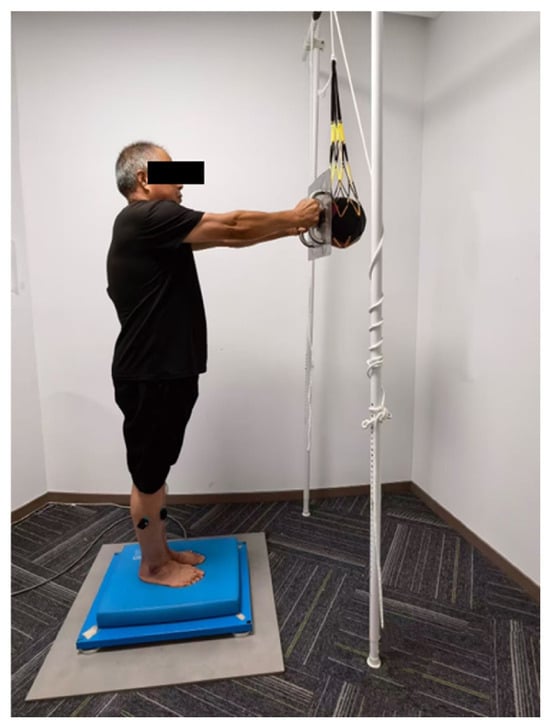
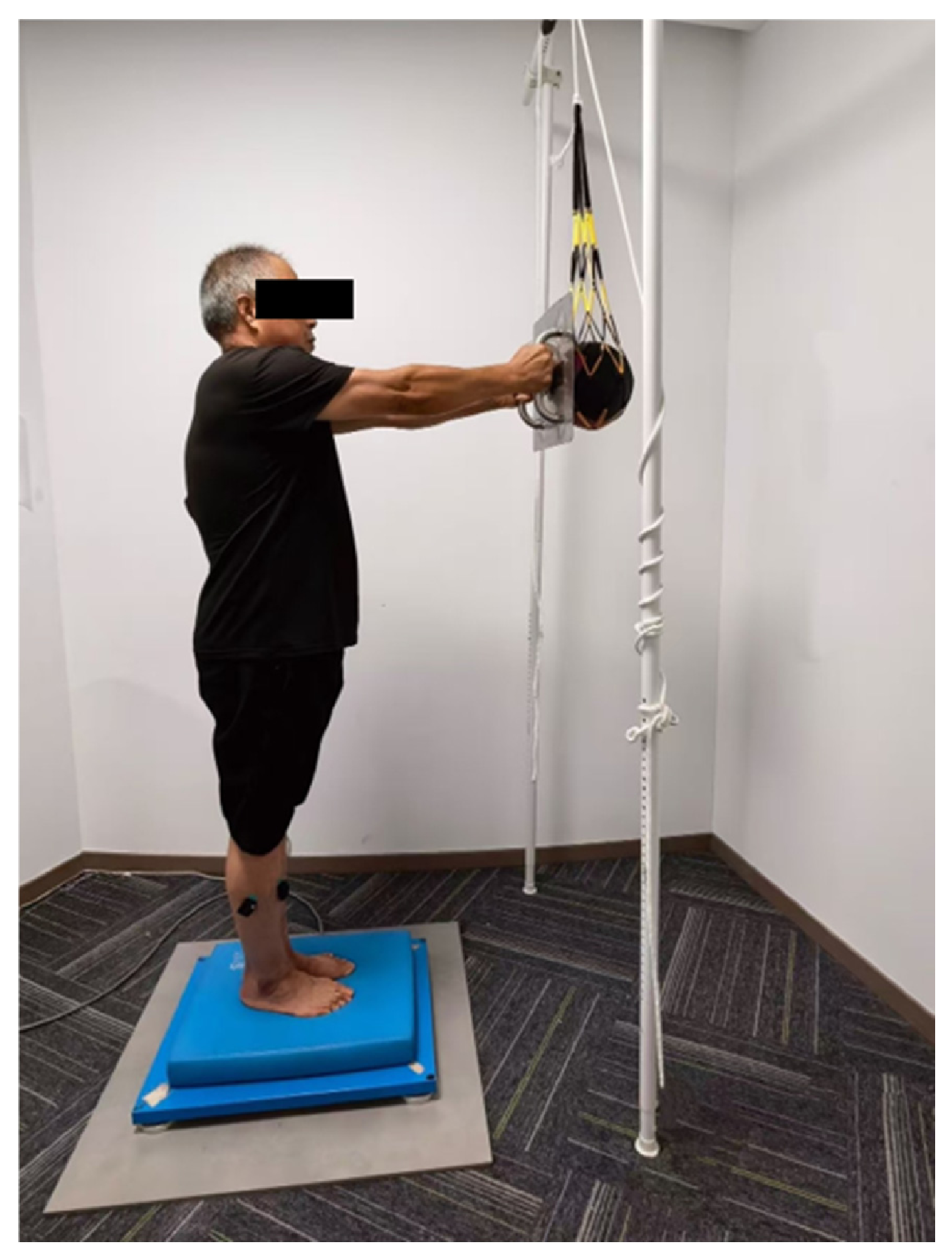
As shown in Figure 1, a pendulum paradigm was employed in the study. Participants stood on a force platform with feet together, holding a board with both hands at shoulder height while facing a pendulum suspended from the ceiling. The board was maintained approximately vertical to the ground and perpendicular to the forearms. The pendulum consisted of a rope and a 2 kg solid ball, with the rope length adjusted so that the ball reached shoulder level [26]. The ball was positioned at a fixed distance of 0.8 m from the board [4]. As the task was performed with eyes open, participants could observe the pendulum and its release. The ball was released at a variable time within 30 s after the participant assumed the testing position. The ball then struck the center of the board held by the participant. No fixed standing duration was prescribed before release or after impact. After each data acquisition, the EMG and force-platform signals were immediately inspected for signal completeness and obvious technical artifacts. Participants were instructed to maintain their balance throughout the perturbation. No formal trial required repetition or exclusion because of technical signal loss.
Figure 1.
Pendulum Test. Surface electromyographic electrodes were placed on the postural muscles of participants for signal acquisition. One of the electrodes was fixed to the board to detect the perturbation onset using its accelerometer.
2.4. Data Analysis
Wireless surface electromyography equipment (Trigno Wireless System, Delsys Inc., Natick, MA, USA) was used to record sEMG signals from the right-side Tibialis Anterior (TA), Soleus (SOL), Medial Gastrocnemius (MG), Rectus Femoris (RF), Biceps Femoris (BF), External Oblique (EO), Multifidus (MF), Rectus Abdominis (RA), and Erector Spinae (ES). After cleaning the skin over these muscles with alcohol swabs, disposable EMG electrodes were placed on the skin surface over the muscle bellies. The sampling frequency was 2000 Hz. Electrode placement was based on palpable anatomical landmarks and the expected muscle-fiber direction, with reference to the Atlas of Muscle Innervation Zones where applicable [27]. Sensors were positioned over the target muscle belly and oriented approximately parallel to the predominant fiber direction, while avoiding muscle borders as far as possible to reduce potential crosstalk from adjacent muscles. For the abdominal and lumbar muscles, electrodes were placed over the corresponding palpable muscle bellies with orientation following the local fiber direction. Additionally, the accelerometer embedded in this EMG electrode was used to detect the moment of pendulum impact and to synchronize the sEMG and force platform data.
We used a customized MATLAB program (R2018a, The MathWorks, Inc., Natick, MA, USA) to process the EMG signals. Raw signals were filtered with a 10–500 Hz bandpass Butterworth filter (fourth-order, zero-lag) and rectified [28]. The time point of the first peak in the signal from the EMG electrode fixed to the board was defined as the onset of the external perturbation (T0). The EMG signal from −800 ms to −650 ms was taken as the baseline, from which the mean (M) and standard deviation (SD) were calculated. The EMG signal from −350 ms to 350 ms was then scanned. The onset criterion was applied sample by sample to the rectified EMG signal. Activation and inhibition onsets were defined as the first points at which EMG exceeded M + 2 SD or fell below M − 2 SD, respectively, for at least 50 ms [4]. When M − 2 SD was nonpositive, inhibition onset was not assigned. All detected onsets were visually verified to exclude isolated spikes or obvious artifacts. EMG onset time was expressed as T − T0, with negative values indicating anticipatory activity and values ≥0 ms indicating post-impact responses; invalid or absent detections were treated as missing.
The integrated EMG (iEMG) of postural muscles was calculated for APAs (Anticipatory, −100 ms to +50 ms) and CPAs (Compensatory, +50 ms to +200 ms) [29]. For each phase, iEMG was normalized to baseline activity using the following formula [30], yielding the normalized integrated EMG (iEMGNORM).
where a represents the iEMG value within the selected phase, and b represents the baseline iEMG value calculated from −800 ms to −650 ms before T0.
Surface EMG co-contraction index (CCI) was calculated for five agonist–antagonist muscle pairs: TA-MG, TA-SOL, RF-BF, RA-ES, and EO-MF. Prior to CCI calculation, the rectified EMG signal of each muscle was normalized to the mean rectified EMG amplitude during the baseline period (−800 to −650 ms). The CCI was subsequently calculated from the normalized EMG signals. The average CCI was calculated separately for the APAs and CPAs according to the following formula [31].
where M is the number of samples within the selected time window, and EMG_low,i and EMG_high,i denote the smaller and larger baseline-normalized rectified EMG amplitudes, respectively, at each time point i. Thus, the complete pointwise expression was calculated first and then averaged across the selected time window. When both signals were zero, the corresponding pointwise contribution was set to zero, while near-zero positive values were retained.
Normalized iEMG and CCI were interpreted as responses relative to pre-perturbation baseline activity. No zero baseline values were observed. To assess the influence of very small denominators, the analyses were repeated after excluding observations below the muscle-specific 5th percentile of baseline EMG, with the 10th percentile examined as a more conservative sensitivity criterion.
COP signals were acquired using a force platform (Kistler 9286BA, Winterthur, Switzerland) at a sampling frequency of 1000 Hz. Since the pendulum primarily influenced COP along the anterior–posterior axis (designated as Y-axis of force platform in our experimental setup), data analysis was confined to this direction. According to the Kistler force-plate coordinate system, the exported moment signals were referenced to the top surface of the force platform. For the firm-surface condition, COPy was calculated as:
For the foam-surface condition, the additional 6 cm height of the foam was considered:
where Mx is the sagittal-plane moment; Fy and Fz are the force signals along the Y- and Z-axes, respectively; and d (0.06 m) is the distance from the force-platform origin to the surface [32].
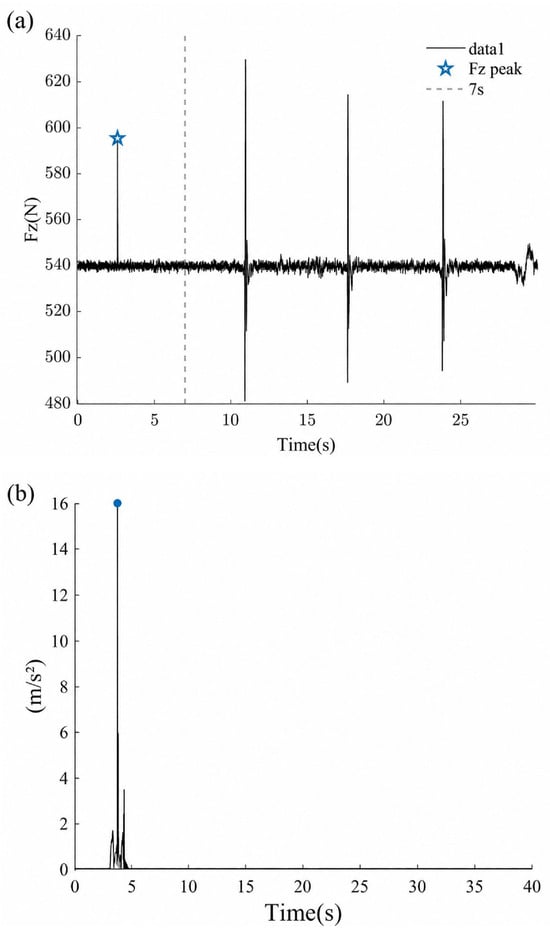
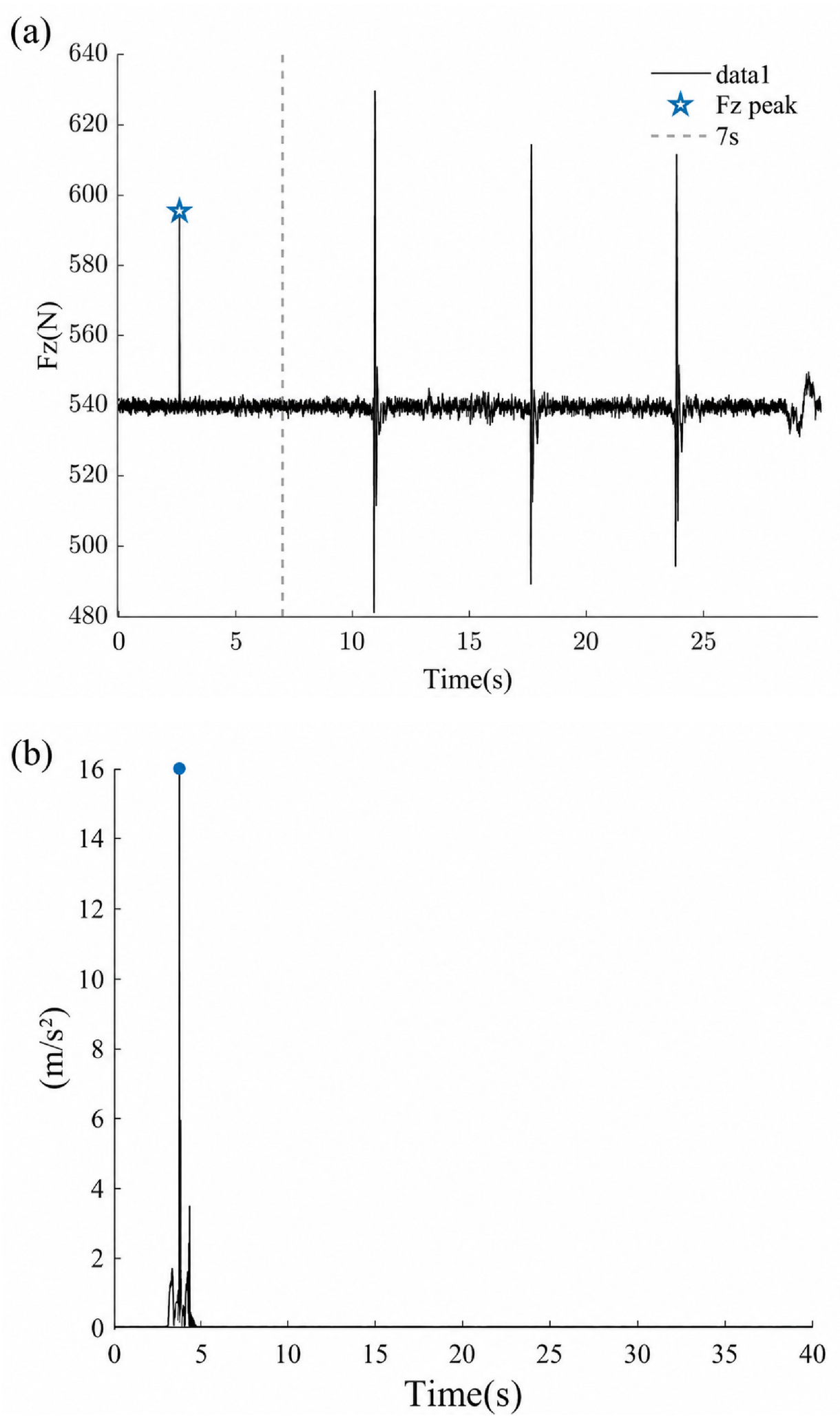
The COP signal was subsequently low-pass filtered using a fourth-order, zero-lag Butterworth filter with a 20 Hz cutoff frequency [26]. The mean value from −800 ms to −650 ms before T0 served as the baseline value. COP displacement was baseline-referenced by subtracting the mean baseline COPy value and was expressed in millimetres. A-COPy was interpreted as COP displacement at T0. C-COPy was defined as the signed maximum absolute displacement within 0–400 ms after T0, with TP representing the latency to this peak [29]. Positive COPy indicated forward displacement. Synchronization between the EMG system and the force platform was achieved using a custom-built synchronizer. A bottle with a fixed electrode was tapped quickly on the force platform. As illustrated in Figure 2a, the peak Fz force within the first 7 s on the force platform was taken as the platform start signal (tkistler). As shown in Figure 2b, the peak time of the signal from the electrode was taken as the EMG system start signal (tfy). The time difference from tapping the platform to pendulum impact was (T0 − tfy). Therefore, the impact moment on the force platform was calculated as tkistler + T0 − tfy. The sEMG, force-platform, and accelerometer signals were sampled at 2000 Hz, 1000 Hz, and approximately 148.15 Hz, corresponding to sampling intervals of 0.5, 1.0, and 6.75 ms, respectively. Assuming event times were assigned to the nearest sampled point without temporal interpolation, the theoretical maximum sampling-related temporal uncertainty of the synchronization procedure was approximately ± 4.13 ms. The synchronized T0 was mapped to the 1000 Hz force-platform time base and assigned to the nearest COP sample, and TP was calculated from the sample interval between T0 and the selected C-COPy peak.
Figure 2.
(a). The force (N) from the force platform’s Fz axis. The star indicates the maximum force value within the first 7 s on the Fz axis, whose corresponding time is recorded as tkistler. (b). Signal from the electrode. The circle indicates the maximum acceleration, whose corresponding time is recorded as tfy. The different time ranges reflect the sequential start of the two recording systems. Both peaks represent the same tapping event and were used to align the recordings. The three subsequent peaks represent pendulum impacts included in a separate demonstration recording to distinguish the synchronization signal from the impact signals, rather than data from formal experimental trials.
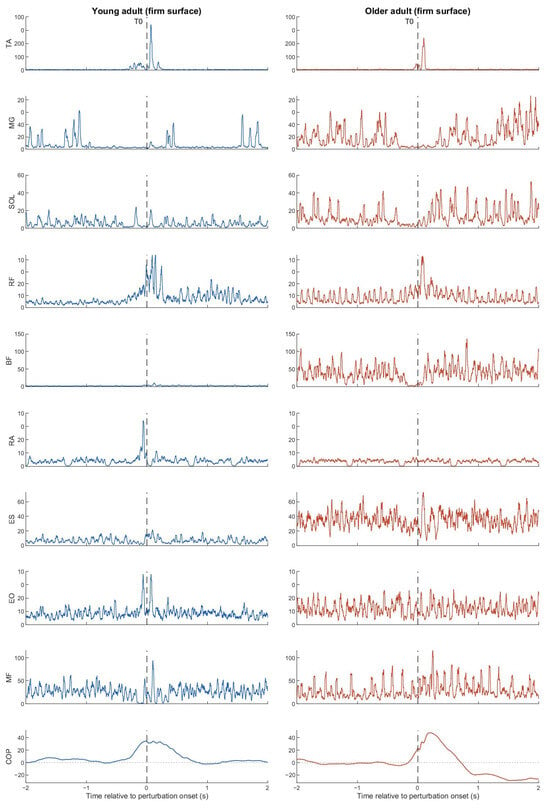
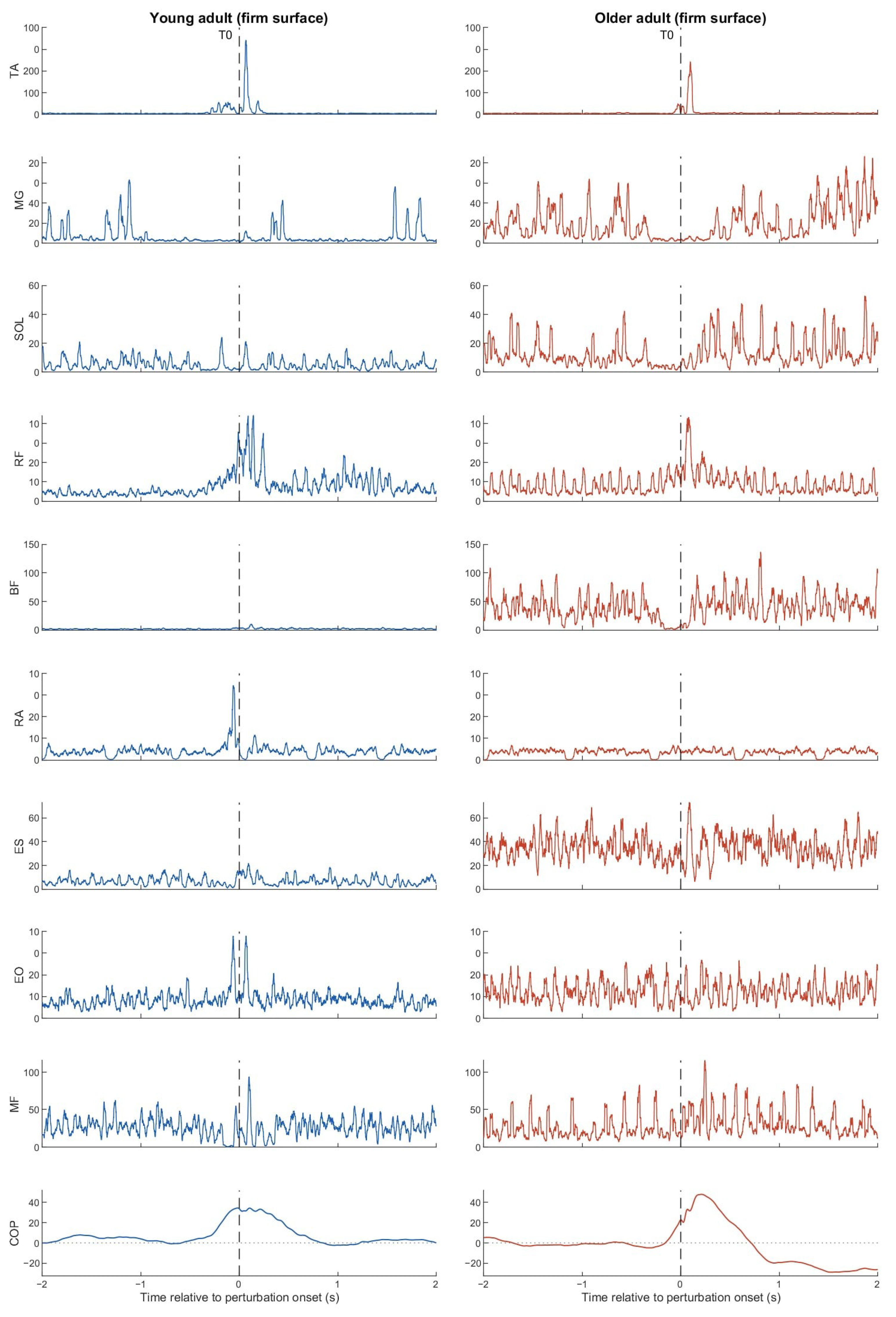
Representative synchronized EMG and COP time series from a young adult and an older adult are shown in Figure 3. All signals were aligned to perturbation onset (T0 = 0 s) and displayed from −2 to +2 s to illustrate the temporal characteristics of neuromuscular and postural responses before and after perturbation.
Figure 3.
Representative synchronized EMG and COP responses in a young and an older adult. Signals are shown from −2 to +2 s relative to perturbation onset (T0 = 0 s). The vertical dashed line indicates perturbation onset. COPy traces are shown relative to the pre-perturbation baseline, with positive values indicating anterior (forward) displacement.
2.5. Statistical Analysis
Statistical analyses were performed using SPSS 25.0 (SPSS Inc., IBM, USA). All outcomes were analyzed using 2 × 2 mixed-design ANOVAs, with age group (young vs. older adults) as the between-subject factor and surface condition (firm vs. foam) as the within-subject factor. Between-group differences in baseline anthropometric characteristics, including height and body mass, were assessed using Welch’s independent-samples t-tests.
For EMG onset, analyses were performed for each muscle. For iEMGNORM and CCI, analyses were performed for each muscle or muscle pair within APAs and CPAs. COP variables (A-COPy, C-COPy, and TP) were analyzed individually. Model assumptions were assessed by examining residual normality using Shapiro–Wilk tests and Q–Q plots and homogeneity of variance using Levene’s tests. Potential outliers were evaluated using studentized residuals. Residual and outlier checks were used primarily to assess model adequacy while retaining genuine inter-individual variability; statistically extreme observations were not excluded unless there was evidence of a technical artifact or invalid recording. Because the within-subject factor had only two levels, sphericity was not applicable. When a significant age group × surface condition interaction was identified, simple-effects analyses were performed with Bonferroni adjustment. Effect sizes were reported as partial eta squared (ηp2). The statistical significance was set at p ≤ 0.05.
To guide the interpretation of results, particular emphasis was placed on TA and RF activation onset and normalized iEMG, lower-limb antagonist co-contraction (TA-MG, TA-SOL, and RF-BF), and anterior–posterior COP displacement (A-COPy and C-COPy). This emphasis was based on the study hypotheses, the sagittal-plane pendulum perturbation paradigm, and previous findings [13,26,28]. The remaining outcomes were considered complementary analyses.
3. Results
3.1. Baseline EMG Activity
Young adults were significantly taller than older adults (175.13 ± 4.89 vs. 166.16 ± 6.34 cm; mean difference = 8.97 cm, t(39.45) = 5.26, p < 0.001, 95% CI [5.52, 12.42]). In contrast, body mass did not differ significantly between groups (mean difference = 2.12 kg, t(36.64) = 0.70, p = 0.488).
Significant main effects of age were observed for the TA (F(1,42) = 12.57, p < 0.001, ηp2 = 0.230), SOL (F(1,42) = 14.17, p < 0.001, ηp2 = 0.252), RF (F(1,42) = 9.34, p = 0.004, ηp2 = 0.182), ES (F(1,42) = 6.00, p = 0.019, ηp2 = 0.125), BF (F(1,42) = 22.70, p < 0.001, ηp2 = 0.351), and MF (F(1,42) = 4.92, p = 0.032, ηp2 = 0.105), with higher baseline EMG activity in older than younger adults. Significant main effects of support surface were found for the TA (F(1,42) = 10.82, p = 0.002, ηp2 = 0.205), MG (F(1,42) = 22.59, p < 0.001, ηp2 = 0.350), ES (F(1,42) = 5.06, p = 0.030, ηp2 = 0.107), and MF (F(1,42) = 4.88, p = 0.033, ηp2 = 0.104). No significant age group × surface interactions were observed for any muscle (all p ≥ 0.160). No significant main or interaction effects were observed for the RA or EO (Table 1).
Table 1.
Baseline EMG activity across age groups and surface conditions and results of the 2 × 2 mixed-design ANOVAs.
3.2. EMG Onset Time of Postural Muscles
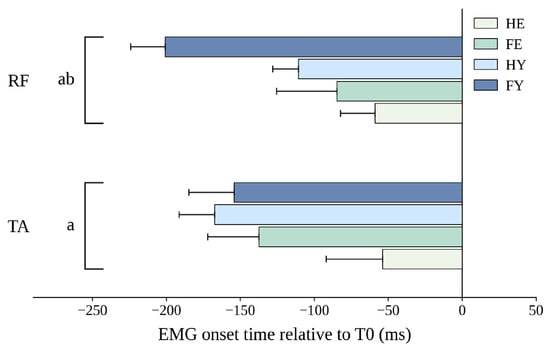
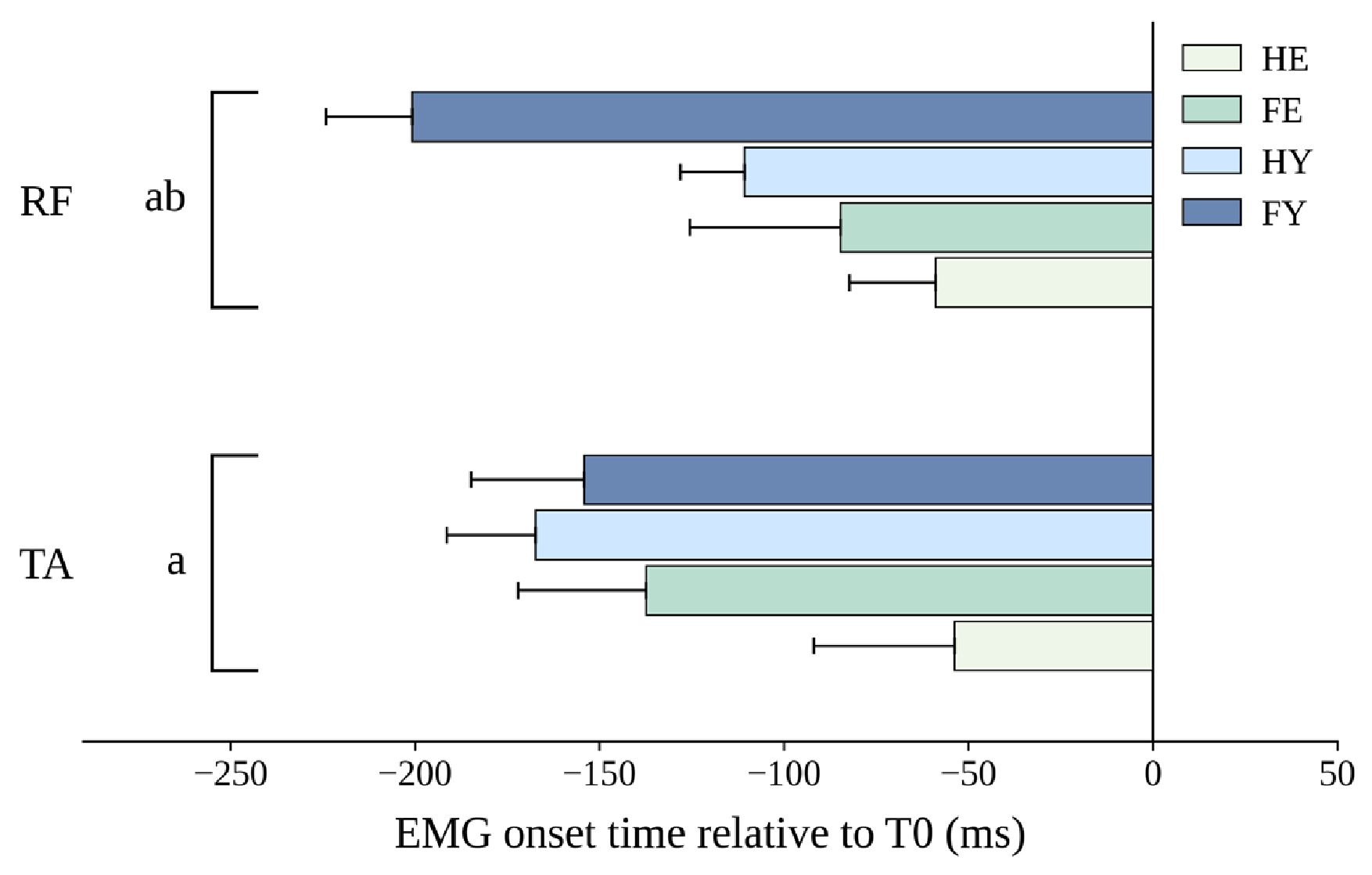
Figure 4 shows EMG onset times relative to perturbation onset (T0). Negative values indicate anticipatory activity, whereas values at or after 0 ms indicate post-impact responses. For TA, a significant main effect of age was observed (F(1,36) = 5.203, p = 0.029, ηp2 = 0.126), with young adults showing earlier EMG onset than older adults. For RF, significant main effects of surface condition (F(1,34) = 6.079, p = 0.019, ηp2 = 0.152) and age (F(1,34) = 7.212, p = 0.011, ηp2 = 0.175) were observed, with EMG onset occurring earlier on the foam than on the firm surface and earlier in young than in older adults. For the remaining muscles (MG, SOL, BF, EO, MF, RA, and ES), the number of participants with valid onset measurements under both surface conditions was insufficient for reliable mixed-design ANOVA; their detection status is therefore reported descriptively in Supplementary Table S2.
Figure 4.
EMG onset times relative to perturbation onset (T0) for TA and RF under four experimental conditions: Hard Elderly (HE), Foam Elderly (FE), Hard Young (HY), and Foam Young (FY). Bars represent means, and error bars represent +1 standard error in the outward direction. Negative values indicate anticipatory activity occurring before perturbation onset, whereas values at or after 0 ms indicate post-impact responses. Significant differences (p ≤ 0.05) are indicated as follows: a, between Older (HE + FE) and Young (HY + FY) groups; b, between Hard (HE + HY) and Foam (FE + FY) conditions.
3.3. Normalized Integrated EMG
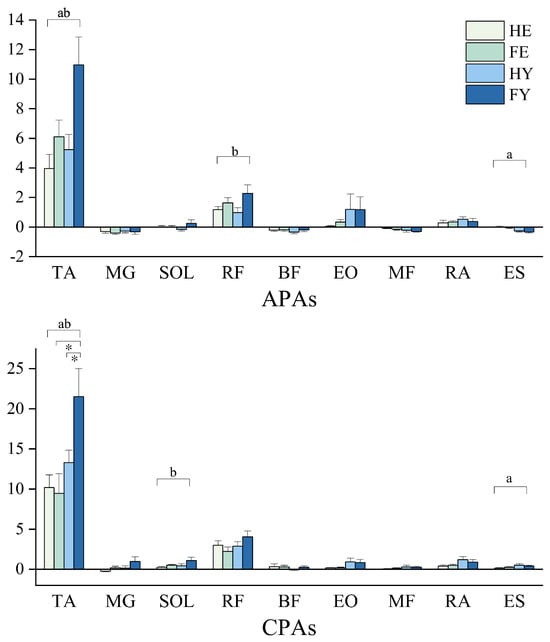
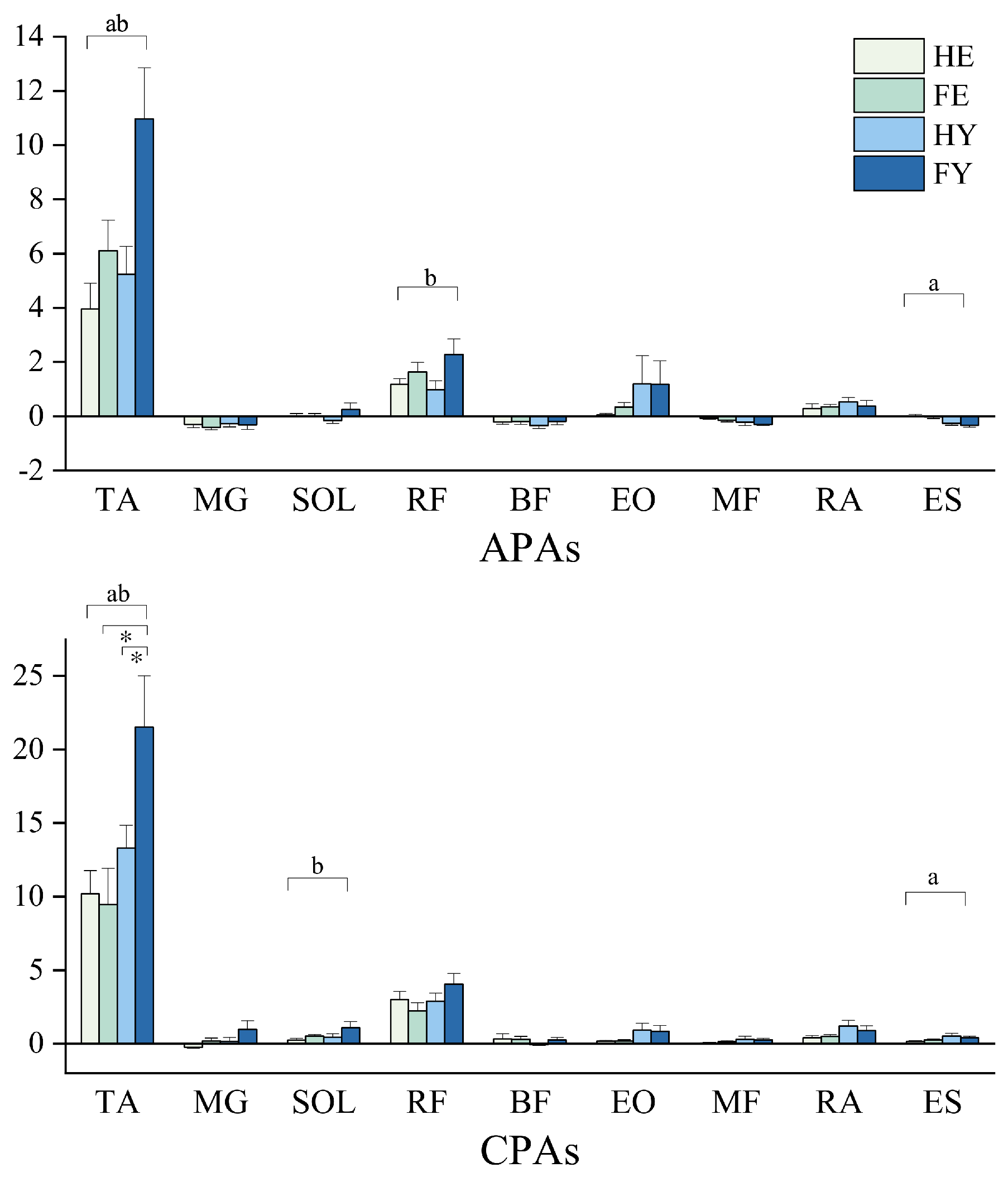
Figure 5 shows the iEMGNORM for each muscle. The results of mixed-design ANOVAs are presented in Table 2. Anterior muscles showed varying degrees of activation. For TA, significant main effects of age were observed during both APAs and CPAs, with young adults demonstrating significantly greater iEMGNORM than older adults. TA also showed a significant main effect of surface condition during APAs, with greater iEMGNORM on the foam surface. Additionally, a significant age × surface condition interaction was found during CPAs. Simple effects analysis showed greater iEMGNORM in young adults than in older adults on the foam surface (F(1,42) = 8.008, p = 0.007, ηp2 = 0.160), and iEMGNORM increased significantly on the foam surface compared to the hard surface within the young adult group (F(1,42) = 7.828, p = 0.008, ηp2 = 0.157). For RF, a significant main effect of surface condition was observed during APAs, demonstrating significantly greater iEMGNORM on the foam surface. A significant age group × surface condition interaction was also observed during CPAs (F(1,42) = 4.253, p = 0.045, ηp2 = 0.092); however, none of the subsequent Bonferroni-adjusted simple-effects comparisons reached statistical significance. No significant main effects or interactions were observed for RA or EO.
Figure 5.
The mean iEMGNORM and standard error for TA, MG, SOL, RF, BF, EO, MF, RA and ES during APAs and CPAs under the four experimental conditions: Foam Young (FY), Hard Young (HY), Foam Elderly (FE), and Hard Elderly (HE). Error bars represent ±1 standard error. iEMGNORM is dimensionless (a. u.). Significant differences (p ≤ 0.05) are indicated as follows. a: between Older (HE + FE) and Young (HY + FY) groups. b: between Hard (HE + HY) and Foam (FE + FY) conditions. *: for simple effects between groups.
Table 2.
Effects of surface condition, age, and their interaction on iEMGNORM during APAs and CPAs.
The posterior muscles primarily exhibited inhibition during APAs and activation during CPAs. SOL showed a significant main effect of surface condition during CPAs, with greater activation on the foam surface. ES showed significant main effects of age during APAs and CPAs: young adults exhibited greater inhibition than older adults during APAs, and greater activation during CPAs. No significant main effects or interactions were observed for MF or MG.
3.4. Muscle Co-Contraction Index
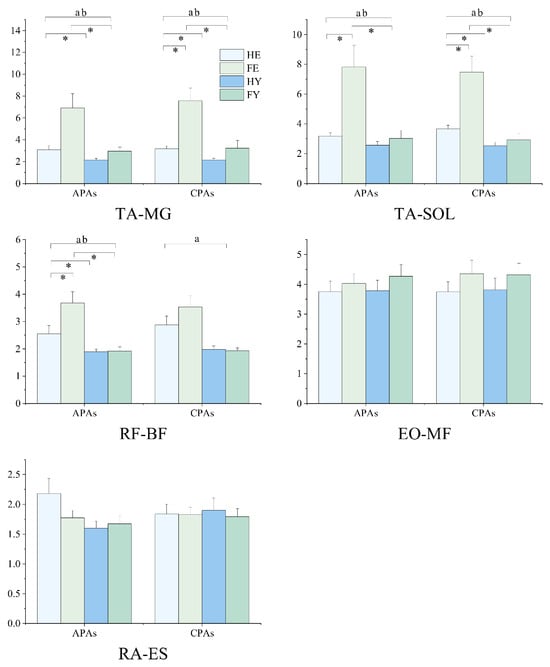
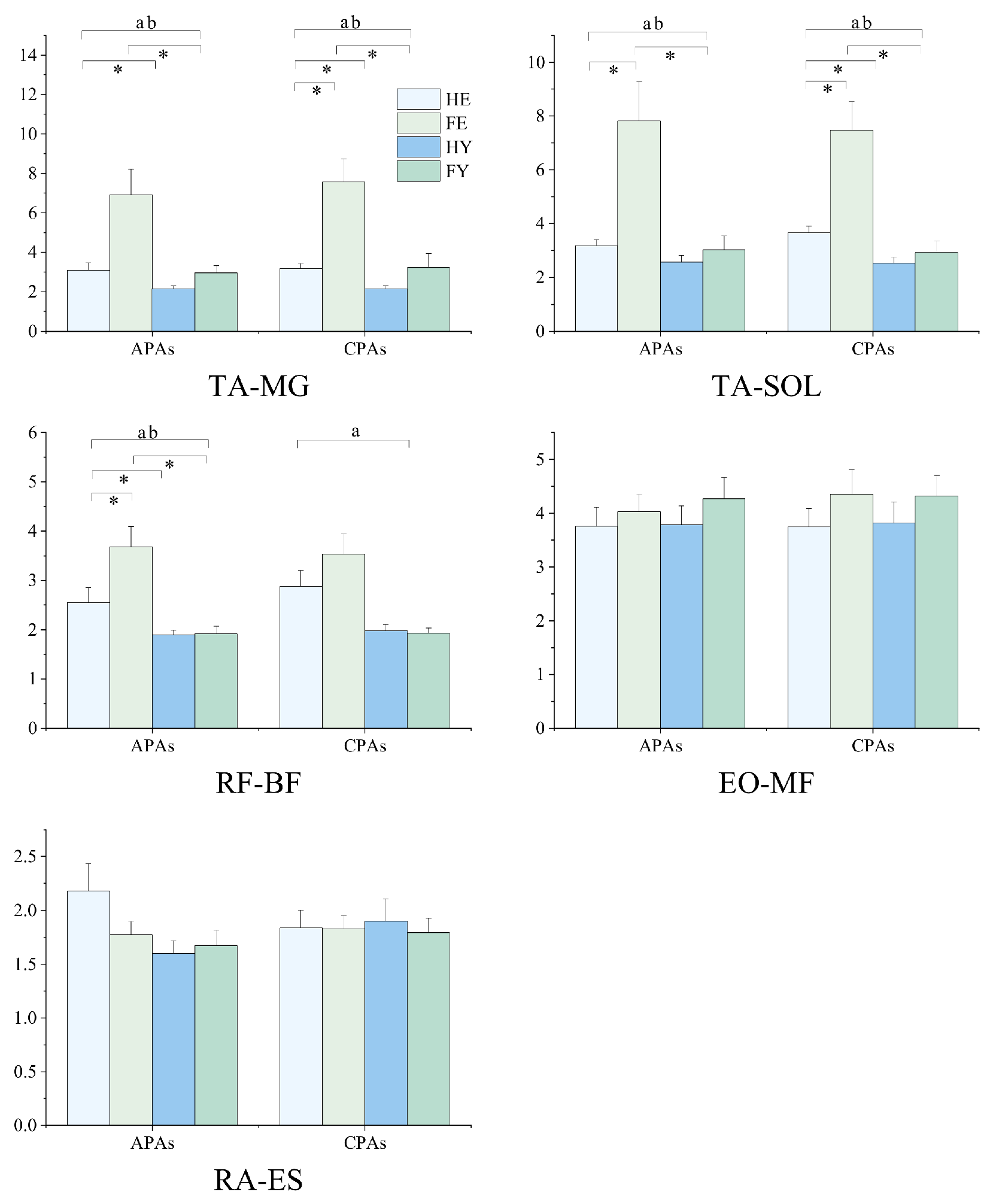
Figure 6 displays the CCI for five muscle pairs during APAs and CPAs, and the results of mixed-design ANOVA are presented in Table 3. The analysis revealed that the TA-MG pair showed significant main effects of surface condition and age during both APAs and CPAs, indicating higher CCI on the foam surface and stronger co-contraction in older adults. Significant interaction effects were found in the APAs and CPAs. Simple effect analysis showed that on the hard surface, older adults had significantly higher CCI than young adults during APAs (F(1,42) = 5.600, p = 0.023, ηp2 = 0.118) and CPAs (F(1,42) = 13.222, p = 0.001, ηp2 = 0.239). On the foam surface, older adults showed significantly higher CCI than young adults across APAs (F(1,42) = 8.766, p = 0.005, ηp2 = 0.173) and CPAs (F(1,42) = 9.877, p = 0.003, ηp2 = 0.190). Within the older adult group, CCI was significantly higher on the foam surface than on the hard surface during APAs (F(1,42) = 19.467, p < 0.001, ηp2 = 0.317) and CPAs (F(1,42) = 19.365, p < 0.001, ηp2 = 0.316). In contrast, no significant differences were observed between surfaces within the young adult group.
Figure 6.
The mean co-contraction index and standard errors for five muscle pairs: TA-MG, TA-SOL, RF-BF, EO-MF and RA-ES, under four experimental conditions: Foam Young (FY), Hard Young (HY), Foam Elderly (FE), and Hard Elderly (HE). Error bars represent ±1 standard error. CCI values are dimensionless. Significant differences (p ≤ 0.05) are indicated as follows. a: between Older (HE + FE) and Young (HY + FY) groups. b: between Hard (HE + HY) and Foam (FE + FY) conditions. *: for simple effects between groups.
Table 3.
Effects of surface condition, age, and their interaction on muscle co-contraction indices during APAs and CPAs.
The TA-SOL muscle pair showed significant main effects of surface condition and age during both APAs and CPAs, demonstrating higher CCI on the foam surface and stronger co-contraction in older adults. Significant interaction effects were observed during both APAs and CPAs. Simple effects analysis showed that on the hard surface, older adults had significantly higher CCI than young adults during CPAs (F(1,42) = 11.829, p = 0.001, ηp2 = 0.220). On the foam surface, older adults had significantly higher CCI than young adults during both APAs (F(1,42) = 9.833, p = 0.003, ηp2 = 0.190) and CPAs (F(1,42) = 15.830, p < 0.001, ηp2 = 0.274). Within the older adult group, CCI values were significantly higher on the foam surface compared to the hard surface in APAs (F(1,42) = 17.770, p < 0.001, ηp2 = 0.297) and CPAs (F(1,42) = 19.519, p < 0.001, ηp2 = 0.317). In contrast, no significant differences were observed between surfaces within the young adult group.
The RF-BF muscle pair showed significant main effects of age during both APAs and CPAs, demonstrating that older adults exhibited significantly higher CCI than young adults. Significant main effects of surface condition were found in the APAs, with higher CCI on the foam surface. Significant interaction effects were also observed during APAs. Simple effect analysis showed that on the hard surface, older adults had significantly higher CCI than young adults (F(1,42) = 4.322, p = 0.044, ηp2 = 0.093). On the foam surface, older adults also showed significantly higher CCI during APAs (F(1,42) = 15.973, p < 0.001, ηp2 = 0.276). Within the older adult group, CCI was significantly higher on the foam surface than on the hard surface during APAs (F(1,42) = 18.747, p < 0.001, ηp2 = 0.309). In contrast, no significant differences between surfaces were found within the young adult group.
For the RA-ES and EO-MF muscle pairs, no significant main effects or interactions were observed.
Sensitivity analyses showed that all significant CCI findings remained significant after both P5 and P10 exclusions. Most iEMG findings were also stable; however, the Age × Surface interactions for TA and RF during CPAs and the age effect for ES during CPAs were attenuated after exclusion of low-baseline observations (Supplementary Table S1).
3.5. COP Displacement
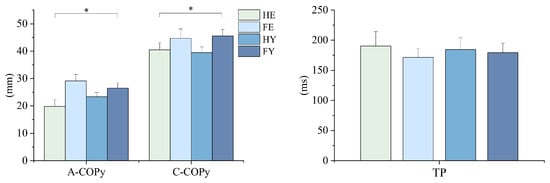
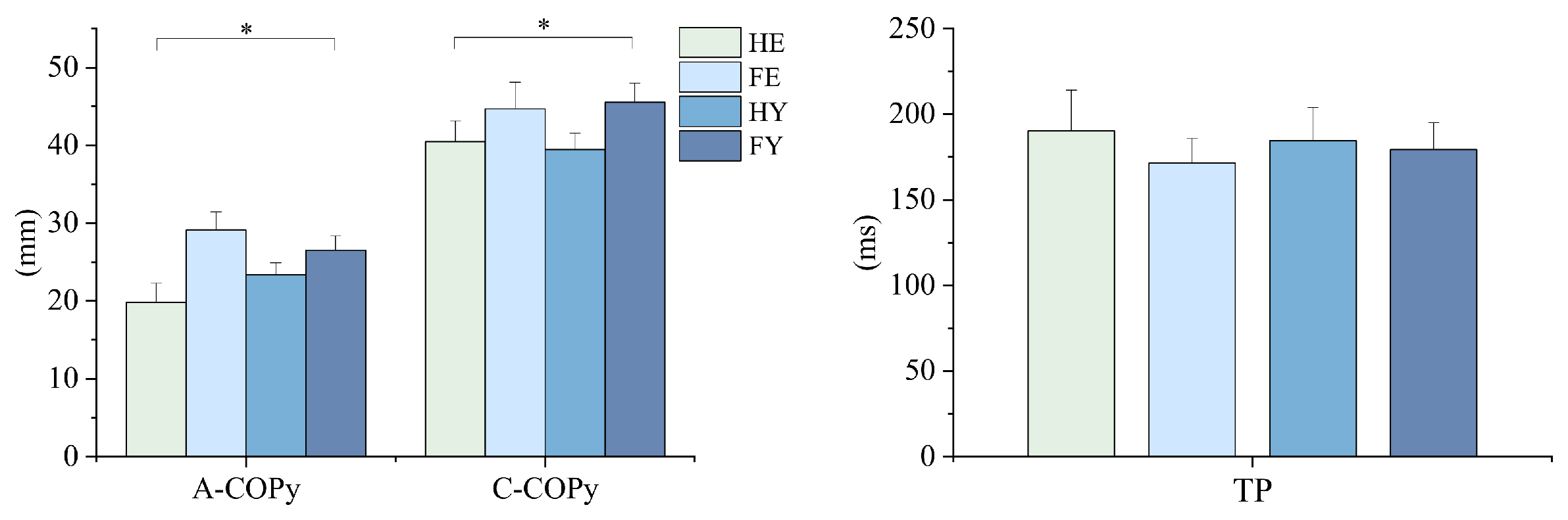
The mean COPy calculated under the four experimental conditions is shown in Figure 7. Significant main effects of surface condition were found for both A-COPy (F(1,42) = 10.111, p = 0.003, ηp2 = 0.194) and C-COPy (F(1,42) = 7.693, p = 0.008, ηp2 = 0.155), indicating a greater forward COP shift on the foam surface. However, neither the main effect of age nor the interaction effect reached statistical significance. Furthermore, no significant effects were found for the time-to-peak COP displacement (TP).
Figure 7.
The mean values and standard errors for the COP under the four experimental conditions: Foam Young (FY), Hard Young (HY), Foam Elderly (FE), and Hard Elderly (HE). Parameters include COP displacement at time T0 (A-COPy), the peak COP displacement (C-COPy), and the time from T0 to peak COP displacement (TP), with error bars representing one standard error. Positive values represent forward displacement. * p ≤ 0.05 indicates significant difference between Hard (HE & HY) and Foam (FE & FY) conditions. Paired surface-condition differences (Foam − Firm) with 95% confidence intervals for all analyzed outcomes are provided in Supplementary Table S3.
4. Discussion
This study investigated age-related differences in muscle activity and COP displacement during APAs and CPAs across hard and foam support-surface conditions using a pendulum test. The main findings were as follows: (1) The first hypothesis was partially supported. The foam surface was associated with earlier RF onset and greater normalized TA and RF activity during APAs; however, no significant foam-related increase in posterior-muscle inhibition was observed. (2) On the foam surface, normalized co-contraction remained unchanged in young adults but increased significantly in the lower limbs of older adults, supporting the second hypothesis. (3) On the foam surface, A-COPy and C-COPy showed greater forward displacement than on the firm surface, reflecting an overall surface effect, aligning with the third hypothesis.
A significant difference in stature was also observed between the age groups, with young adults being taller than older adults, although body mass did not differ significantly. Adjusting the pendulum to each participant’s shoulder level helped standardize the perturbation across participants; however, differences in stature may still have influenced perturbation geometry and COP responses. Therefore, the possibility that anthropometric differences contributed partly to the observed age-group differences cannot be excluded. The baseline analyses showed higher pre-perturbation EMG activity in several muscles in older adults and on the foam surface, while no significant age group × surface condition interactions were observed. Because iEMG was normalized to each participant’s condition-specific pre-perturbation activity, the normalized values reflect perturbation-related changes relative to baseline rather than absolute differences in muscle activation between groups or surfaces. The same consideration applies to the co-contraction indices derived from these normalized EMG signals.
With advancing age, declines in neuromuscular function may impair feed-forward postural control [3,33]. In the present study, older adults showed later EMG onset, smaller baseline-normalized TA activation, and less pronounced ES inhibition than young adults, indicating age-related differences in anticipatory neuromuscular response patterns. Notably, greater baseline-normalized TA and RF responses were observed during APAs on the foam surface, which differs from the notion that the CNS may suppress anticipatory adjustments under high stability demands to avoid further instability [34]. This discrepancy may be related to differences in task constraints: the wooden board used in Aruin’s experiment mainly challenged mechanical stability, whereas the compliant foam surface in the present study altered surface compliance, mechanical support, force transmission, and the sensory conditions at the foot–surface interface [35]. These greater responses may reflect increased neuromuscular demands associated with the compliant foam condition [36]. In contrast, older adults did not show a comparable increase in normalized TA response, possibly because aging-related neuromuscular decline limited their ability to scale muscle responses with increasing task difficulty [37], but age-related neuromuscular decline was not directly assessed in the present study; therefore, this explanation remains speculative. Also, the interaction effect (p = 0.037) warrants cautious interpretation given the number of statistical tests performed.
In addition to changes in muscle activation, the results indicate that older adults relied more heavily on lower-limb co-contraction under the foam-surface condition. This finding is consistent with the age-related joint stiffening strategy hypothesis [11,12,13]. However, trunk muscle co-contraction, including RA-ES and EO-MF, did not show significant changes. This pattern suggests that the foam surface primarily affected distal control, with the ankle and knee joints playing a more prominent role in responding to perturbations. Although co-contraction is commonly used to increase joint stability under challenging postural conditions [11,38], the present results further show that this strategy was age-dependent: young adults maintained similar lower-limb co-contraction across surfaces, whereas older adults showed significantly greater baseline-normalized co-contraction responses on the foam surface for TA-MG and TA-SOL during both APAs and CPAs, and for RF-BF during APAs. However, increased co-contraction does not necessarily indicate better postural control, and whether this response helped older adults recover balance remains unclear.
In addition, because participants could observe the approaching pendulum, visual information about the impending perturbation may have facilitated anticipatory postural adjustments, including preparatory muscle co-contraction. Future studies should consider the potential influence of variability in the pre-release standing interval on preparatory muscle activity and co-contraction. Regarding COP displacement, both A-COPy and C-COPy shifted more forward on the hard and foam surfaces, which differs from previous pendulum studies reporting backward COP displacement [2,39]. Importantly, neither the age main effect nor the age group × surface interaction was significant for the COP outcomes. Thus, the COP response reflects an overall surface effect rather than an age-dependent response. The greater forward COP displacement indicates a more anterior shift in the pressure response, particularly under foam-surface conditions. Following perturbation onset, a greater peak COP displacement (C-COPy) was observed on the foam surface than on the firm surface. We therefore infer that the forward COP shift may be associated with increased activation of anterior muscles, particularly the TA and RF. However, because no participant-level mechanical or association analysis was performed to directly link these muscle responses to COP direction, this interpretation remains speculative.
This study has several limitations. To reduce inter-individual variability, only healthy male participants were recruited; therefore, these findings may not be generalizable to older adults with balance impairments or increased fall risk, who may adopt different postural control strategies. Multiple statistical tests were conducted across muscles, phases, co-contraction indices, and COP variables. Although Bonferroni adjustment was applied to simple-effects comparisons, no correction was applied across outcome-specific ANOVAs, potentially increasing the risk of type I errors. In addition, although single-trial protocols have been used in previous studies [40,41], analyzing only one formal trial per surface condition may increase the influence of trial-to-trial variability in EMG and COP responses, thereby affecting measurement precision. Furthermore, within-condition repeatability cannot be assessed, and intraclass correlation coefficients (ICCs) cannot be derived from the present single-trial dataset. Moreover, exact pendulum geometry and delivered impact impulse were not quantified; because rope length was adjusted to participant shoulder height, equivalent perturbation magnitude across participants and conditions cannot be confirmed. Future studies should include repeated trials with more precise control or measurement of perturbation magnitude, as well as larger and more diverse samples, particularly women, very old adults, and individuals with medical conditions or balance impairments.
5. Conclusions
These findings demonstrate that age and support-surface condition influence postural adjustment strategies during external perturbations. Across surface conditions, young adults showed earlier TA and RF EMG onset than older adults, while RF onset occurred earlier on foam than on firm support, whereas older adults exhibited greater baseline-normalized lower-limb co-contraction, indicating age-related differences in neuromuscular responses to compliant support conditions. These findings may provide preliminary information for the design of future interventions targeting postural control in older adults. Future studies should determine whether training aimed at improving postural adaptation to foam support conditions can enhance balance and postural control.
Supplementary Materials
The following supporting information can be downloaded at: https://www.mdpi.com/article/10.3390/jfmk11040473/s1, Table S1: Sensitivity analyses assessing the influence of low baseline EMG values on normalized iEMG and CCI results. Table S2. EMG onset detection status and effective sample sizes by muscle and experimental condition. Table S3. Paired firm-to-foam differences with 95% confidence intervals for all analyzed outcomes, overall and by age group.
Author Contributions
Y.Z.: Conceptualization, Data curation, Formal analysis, Investigation, Methodology, Software, Visualization, Writing—original draft, Writing—review and editing. H.L.: Investigation, Project administration, Validation, Writing—review and editing. J.W.: Conceptualization, Project administration, Resources, Supervision, Writing—review and editing. All authors have read and agreed to the published version of the manuscript.
Funding
This research received no external funding.
Institutional Review Board Statement
The study was conducted in accordance with the Declaration of Helsinki and approved by the Medical Ethics Committee of the Department of Psychology and Behavioral Sciences at Zhejiang University (Approval No. [2025]051; 8 July 2025).
Informed Consent Statement
Written informed consent was obtained from all participants involved in the study. Written informed consent was obtained from the participant shown in Figure 1 for publication of the identifiable image.
Data Availability Statement
The data that support the findings of this study are available from the corresponding author upon reasonable request.
Acknowledgments
We would like to thank all the subjects who participated in the experiments. We are grateful to Jian Wang for his support and Ying Gao for her help. In particular, we extend our special thanks to Yong Fan for his critical guidance and assistance.
Conflicts of Interest
The authors declare that they have no known competing financial interests or personal relationships that could have appeared to influence the work reported in this paper.
References
- Shumway-Cook, A.; Woollacott, M.H. Motor Control: Translating Research into Clinical Practice, 4th ed.; Lippincott Williams & Wilkins: Philadelphia, PA, USA, 2012. [Google Scholar]
- Krishnan, V.; Aruin, A.S. Postural control in response to a perturbation: Role of vision and additional support. Exp. Brain Res. 2011, 212, 385–397, Erratum in Exp. Brain Res. 2011, 213, 515. [Google Scholar] [CrossRef] [Scilit] [PubMed]
- Hwang, J.H.; Lee, Y.T.; Park, D.S.; Kwon, T.K. Age affects the latency of the erector spinae response to sudden loading. Clin. Biomech. 2008, 23, 23–29. [Google Scholar] [CrossRef] [Scilit] [PubMed]
- Lyu, H.; Fan, Y.; Hua, A.; Cao, X.; Gao, Y.; Wang, J. Effects of unilateral and bilateral lower extremity fatiguing exercises on postural control during quiet stance and self-initiated perturbation. Hum. Mov. Sci. 2022, 81, 102911. [Google Scholar] [CrossRef] [Scilit] [PubMed]
- Santos, M.J.; Kanekar, N.; Aruin, A.S. The role of anticipatory postural adjustments in compensatory control of posture: 1. Electromyographic analysis. J. Electromyogr. Kinesiol. 2010, 20, 388–397. [Google Scholar] [CrossRef] [Scilit] [PubMed]
- Fernández-Argüelles, E.L.; Rodríguez-Mansilla, J.; Antunez, L.E.; Garrido-Ardila, E.M.; Muñoz, R.P. Effects of dancing on the risk of falling related factors of healthy older adults: A systematic review. Arch. Gerontol. Geriatr. 2015, 60, 1–8. [Google Scholar] [CrossRef] [Scilit] [PubMed]
- Woollacott, M.; Shumway-Cook, A. Attention and the control of posture and gait: A review of an emerging area of research. Gait Posture 2002, 16, 1–14. [Google Scholar] [CrossRef] [Scilit] [PubMed]
- Fiatarone, M.A.; Evans, W.J. The etiology and reversibility of muscle dysfunction in the aged. J. Gerontol. 1993, 48, 77–83. [Google Scholar] [CrossRef] [Scilit] [PubMed]
- Inglin, B.; Woollacott, M. Age-related changes in anticipatory postural adjustments associated with arm movements. J. Gerontol. 1988, 43, M105–M113. [Google Scholar] [CrossRef] [Scilit] [PubMed]
- Olafsdottir, H.; Yoshida, N.; Zatsiorsky, V.M.; Latash, M.L. Elderly show decreased adjustments of motor synergies in preparation to action. Clin. Biomech. 2007, 22, 44–51. [Google Scholar] [CrossRef] [Scilit] [PubMed]
- Cenciarini, M.; Loughlin, P.J.; Sparto, P.J.; Redfern, M.S. Stiffness and damping in postural control increase with age. IEEE Trans. Biomed. Eng. 2010, 57, 267–275. [Google Scholar] [CrossRef] [Scilit] [PubMed]
- Ho, C.Y.; Bendrups, A.P. Ankle reflex stiffness during unperceived perturbation of standing in elderly subjects. J. Gerontol. A Biol. Sci. Med. Sci. 2002, 57, B344–B350. [Google Scholar] [CrossRef] [Scilit] [PubMed]
- Nagai, K.; Yamada, M.; Uemura, K.; Yamada, Y.; Ichihashi, N.; Tsuboyama, T. Differences in muscle coactivation during postural control between healthy older and young adults. Arch. Gerontol. Geriatr. 2011, 53, 338–343. [Google Scholar] [CrossRef] [Scilit] [PubMed]
- Meyer, P.F.; Oddsson, L.I.; De Luca, C.J. The role of plantar cutaneous sensation in unperturbed stance. Exp. Brain Res. 2004, 156, 505–512. [Google Scholar] [CrossRef] [Scilit] [PubMed]
- Trotman, M.; Ha, P.L.; Tucker, K.; Cattagni, T.; Hatton, A.L. The effects of plantar surface stimulation on neuromuscular responses during standing balance and gait in healthy and clinical populations: A systematic review. J. Electromyogr. Kinesiol. 2025, 82, 103007. [Google Scholar] [CrossRef] [Scilit] [PubMed]
- Teasdale, N.; Stelmach, G.E.; Breunig, A. Postural sway characteristics of the elderly under normal and altered visual and support surface conditions. J. Gerontol. 1991, 46, B238–B244. [Google Scholar] [CrossRef] [Scilit] [PubMed]
- Magnusson, M.; Enbom, H.; Johansson, R.; Wiklund, J. Significance of pressor input from the human feet in lateral postural control. The effect of hypothermia on galvanically induced body-sway. Acta Otolaryngol. 1990, 110, 321–327. [Google Scholar] [CrossRef] [Scilit]
- Horak, F.B.; Nashner, L.M.; Diener, H.C. Postural strategies associated with somatosensory and vestibular loss. Exp. Brain Res. 1990, 82, 167–177. [Google Scholar] [CrossRef] [Scilit] [PubMed]
- Mauritz, K.H.; Dietz, V. Characteristics of postural instability induced by ischemic blocking of leg afferents. Exp. Brain Res. 1980, 38, 117–119. [Google Scholar] [CrossRef] [Scilit] [PubMed]
- Kavounoudias, A.; Gilhodes, J.C.; Roll, R.; Roll, J.P. From balance regulation to body orientation: Two goals for muscle proprioceptive information processing? Exp. Brain Res. 1999, 124, 80–88. [Google Scholar] [CrossRef] [Scilit] [PubMed]
- Maurer, C.; Mergner, T.; Bolha, B.; Hlavacka, F. Human balance control during cutaneous stimulation of the plantar soles. Neurosci. Lett. 2001, 302, 45–48. [Google Scholar] [CrossRef] [Scilit] [PubMed]
- de Jong, J.C.B.C.; Attema, B.J.; van der Hoek, M.D.; Verschuren, L.; Caspers, M.P.M.; Kleemann, R.; van der Leij, F.R.; van den Hoek, A.M.; Nieuwenhuizen, A.G.; Keijer, J. Sex differences in skeletal muscle-aging trajectory: Same processes, but with a different ranking. GeroScience 2023, 45, 2367–2386. [Google Scholar] [CrossRef] [Scilit] [PubMed]
- Puszczalowska-Lizis, E.; Bujas, P.; Jandzis, S.; Omorczyk, J.; Zak, M. Inter-gender differences of balance indicators in persons 60–90 years of age. Clin. Interv. Aging 2018, 13, 903–912. [Google Scholar] [CrossRef] [Scilit] [PubMed]
- Wiśniowska-Szurlej, A.; Ćwirlej-Sozańska, A.B.; Wilmowska-Pietruszyńska, A.; Wołoszyn, N.; Sozański, B. Gender differences in postural stability in elderly people under institutional care. Acta Bioeng. Biomech. 2019, 21, 45–53. [Google Scholar] [CrossRef] [Scilit]
- Ichinose, H.; Tanaka, F.; Yamagishi, T.; Sado, N.; Shiotani, H.; Evangelidis, P.E.; Naito, M.; Shibata, S.; Kawakami, Y. Age- and sex-dependence of muscle quality: Influence of intramuscular non-contractile tissues. Exp. Gerontol. 2024, 196, 112574. [Google Scholar] [CrossRef] [Scilit] [PubMed]
- Fan, Y.; Lyu, H.; Chen, L.; Wang, J.; Gao, Y. Effects of unilateral and bilateral lower extremity fatigue on static stance and postural adjustments response to the externally initiated perturbation. J. Electromyogr. Kinesiol. 2024, 78, 102918. [Google Scholar] [CrossRef] [Scilit] [PubMed]
- Barbero, M.; Merletti, R.; Rainoldi, A. Atlas of Muscle Innervation Zones: Understanding Surface Electromyography and Its Applications; Springer: Milan, Italy, 2012. [Google Scholar]
- Mohapatra, S.; Krishnan, V.; Aruin, A.S. The effect of decreased visual acuity on control of posture. Clin. Neurophysiol. 2012, 123, 173–182. [Google Scholar] [CrossRef] [Scilit] [PubMed]
- Krishnan, V.; Latash, M.L.; Aruin, A.S. Early and late components of feed-forward postural adjustments to predictable perturbations. Clin. Neurophysiol. 2012, 123, 1016–1026. [Google Scholar] [CrossRef] [Scilit] [PubMed]
- Santamaria, V.; Luna, T.D.; Agrawal, S.K. Feasibility and tolerance of a robotic postural training to improve standing in a person with ambulatory spinal cord injury. Spinal Cord. Ser. Cases 2021, 7, 94, Correction in Spinal Cord Ser. Cases 2021, 7, 104. https://doi.org/10.1038/s41394-021-00467-6. [Google Scholar] [CrossRef] [Scilit] [PubMed]
- Craig, C.E.; Doumas, M. Slowed sensory reweighting and postural illusions in older adults: The moving platform illusion. J. Neurophysiol. 2019, 121, 690–700. [Google Scholar] [CrossRef] [Scilit] [PubMed]
- Winter, D.A.; Prince, F.; Frank, J.S.; Powell, C.; Zabjek, K.F. Unified theory regarding A/P and M/L balance in quiet stance. J. Neurophysiol. 1996, 75, 2334–2343. [Google Scholar] [CrossRef] [Scilit] [PubMed]
- Grima-Terrén, M.; Campanario, S.; Ramírez-Pardo, I.; Cisneros, A.; Hong, X.; Perdiguero, E.; Serrano, A.L.; Isern, J.; Muñoz-Cánoves, P. Muscle aging and sarcopenia: The pathology, etiology, and most promising therapeutic targets. Mol. Asp. Med. 2024, 100, 101319. [Google Scholar] [CrossRef] [Scilit] [PubMed]
- Aruin, A.S.; Forrest, W.R.; Latash, M.L. Anticipatory postural adjustments in conditions of postural instability. Electroencephalogr. Clin. Neurophysiol. 1998, 109, 350–359. [Google Scholar] [CrossRef] [Scilit] [PubMed]
- Chiang, J.-H.; Wu, G. The influence of foam surfaces on biomechanical variables contributing to postural control. Gait Posture 1997, 5, 239–245. [Google Scholar] [CrossRef] [Scilit]
- Fransson, P.A.; Gomez, S.; Patel, M.; Johansson, L. Changes in multi-segmented body movements and EMG activity while standing on firm and foam support surfaces. Eur. J. Appl. Physiol. 2007, 101, 81–89. [Google Scholar] [CrossRef] [Scilit] [PubMed]
- Vandervoort, A.A. Aging of the human neuromuscular system. Muscle Nerve 2002, 25, 17–25. [Google Scholar] [CrossRef] [Scilit]
- Chambers, A.J.; Cham, R. Slip-related muscle activation patterns in the stance leg during walking. Gait Posture 2007, 25, 565–572. [Google Scholar] [CrossRef] [Scilit] [PubMed]
- Kanekar, N.; Aruin, A.S. Aging and balance control in response to external perturbations: Role of anticipatory and compensatory postural mechanisms. Age 2014, 36, 9621. [Google Scholar] [CrossRef] [Scilit] [PubMed]
- Ma, A.W.W.; Wang, H.K.; Chen, D.R.; Chen, Y.M.; Chak, Y.T.C.; Chan, J.W.Y.; Yam, T.T.T.; Cheng, Y.T.Y.; Ganesan, B.; Fong, S.S.M. Chinese martial art training failed to improve balance or inhibit falls in older adults. Percept. Mot. Skills 2019, 126, 389–409. [Google Scholar] [CrossRef] [Scilit] [PubMed]
- Weber, A.; Werth, J.; Epro, G.; Friemert, D.; Hartmann, U.; Lambrianides, Y.; Seeley, J.; Nickel, P.; Karamanidis, K. Head-mounted and hand-held displays diminish the effectiveness of fall-resisting skills. Sensors 2022, 22, 344. [Google Scholar] [CrossRef] [Scilit] [PubMed]

Disclaimer/Publisher’s Note: The statements, opinions and data contained in all publications are solely those of the individual author(s) and contributor(s) and not of MDPI and/or the editor(s). MDPI and/or the editor(s) disclaim responsibility for any injury to people or property resulting from any ideas, methods, instructions or products referred to in the content. |
© 2026 by the authors. Licensee MDPI, Basel, Switzerland. This article is an open access article distributed under the terms and conditions of the Creative Commons Attribution (CC BY) license.