


Abstract
Background: Explosive power, sprint speed, and change-of-direction (COD) speed are key determinants of basketball performance, yet evidence on how plyometric training affects all three concurrently in adolescent basketball players, particularly COD speed, is limited. This exploratory study compared changes in these qualities over 10 weeks between two teams, one of which added a plyometric program. Methods: Thirty-three male players from two clubs, one club per group (experimental, E, n = 16; control, C, n = 17), participated. The E group performed plyometric training twice weekly in addition to regular technical-tactical training; the C group performed technical-tactical training only, so the E group had a larger total training volume. Jump (squat, countermovement, drop, and arm-swing countermovement jumps), sprint (5, 10, and 20 m), and COD tests (Reactive Shuttle Test, Lane Arrow Closeout, Lane Agility Drill, Modified 505 Test) were performed before and after the program. Groups were compared at follow-up using one-way ANCOVA with initial scores as covariate and Holm adjustment within three outcome domains. Results: The E group showed greater baseline-adjusted follow-up performance on eight of eleven outcomes (partial η2 = 0.141–0.622); all remained significant after adjustment except the 5 m sprint. No significant differences were found for the arm-swing countermovement jump, 10 m sprint, or Modified 505 Test. Conclusions: These preliminary findings suggest that adding a plyometric program may be associated with greater improvements in explosive power, short sprint speed, and COD speed in adolescent basketball players. Club-based allocation and the E group’s larger training volume preclude causal inference; randomized, volume-matched, multi-club trials are needed.
1. Introduction
Basketball is among the most popular team sports worldwide, governed by 213 national federations under the International Basketball Federation (FIBA). The game is characterized by an intermittent activity profile in which brief, high-intensity efforts—jumps, sprints, and rapid changes of direction—are interspersed with longer periods of low-to-moderate intensity movement such as walking and jogging [1]. This alternation of anaerobic and aerobic demands makes basketball a mixed-energy sport in which players repeatedly change movement type or intensity roughly every two seconds [2]. Because technical execution deteriorates once players fatigue, a high level of physical preparedness underpins successful basketball performance regardless of playing position [3].
Among the physical qualities that determine basketball performance, explosive power of the lower extremities, short sprint speed, and change-of-direction (COD) speed are considered particularly important, since jumping, accelerating, and changing direction are embedded in nearly every offensive and defensive action of the game [4,5]. A single game may involve up to 46 ± 12 jumps per player, and short sprints (1–2 s) occur roughly 100 times per game, underscoring the relevance of these qualities to competitive success [6].
Plyometric training is one of the most widely used methods for developing explosive power. It relies on the stretch-shortening cycle (SSC), in which a rapid eccentric (lengthening) muscle action is immediately followed by a concentric (shortening) action, allowing greater force to be produced in a shorter time than through concentric action alone [6,7,8]. This pattern of muscle action—an eccentric stretch that elicits a reflexive, more forceful concentric contraction—occurs naturally during basketball-specific movements such as jumping, landing, and rapid changes of direction. Plyometric exercises are therefore considered high-intensity, specialized training techniques designed to maximize force output in minimal time [9,10].
Explosive power—the ability to generate maximal muscular force in the shortest possible time—is closely tied to short-duration maximal-effort actions such as jumping, sprinting, and accelerating, all of which depend on muscular strength and speed [8,11]. Vertical jump ability in particular is a key performance indicator in basketball, since an athlete’s jump reach can directly influence rebounding, shot-blocking, and scoring outcomes [12]. Similarly, short sprints of 5–20 m and rapid changes of direction are performed repeatedly throughout a game and are closely linked to defensive and offensive success [2]. Professional basketball players perform an average of 105 ± 52 short sprints (1–2 s) per game [13], with the longest sprint lasting 5.5 s and the majority (51%) lasting between 1.5 and 2 s [1,6]. During a game, elite players cover approximately 991 m through high-intensity movement, performing 40–60 maximal jumps and 50–60 changes of speed or direction [1,14], altering direction roughly every 1–3 s [15,16].
Previous research has demonstrated that plyometric training is an effective means of improving explosive power [17], sprint performance [18], and change-of-direction ability [19] in basketball players. However, Bouteraa et al. [20] suggest that the benefits of jump-based plyometric training may not always transfer to sprinting and change-of-direction performance to the same extent as to vertical jump height. Moreover, the evidence base specifically addressing change-of-direction speed in adolescent basketball players remains comparatively limited, in part due to the restricted availability of validated, sport-specific tests for this population [21].
Consequently, while the individual effects of plyometric training on explosive power are well documented, its concurrent effects on sprint and change-of-direction speed within a single experimental design remain less thoroughly investigated, particularly in adolescent basketball populations. Therefore, the aim of this exploratory study was to compare changes in explosive power, sprint speed, and change-of-direction speed over 10 weeks between two teams of young basketball players, one of which added a plyometric training program to its regular training. We hypothesized that the experimental group would show significantly greater improvements in explosive power, sprint speed, and change-of-direction speed than the control group, which performed technical-tactical training only.
2. Materials and Methods
2.1. Participants
Thirty-three male basketball players from two basketball clubs in Novi Pazar, Serbia, completed the study. Participants were assigned by club to an experimental group (E; n = 16) and a control group (C; n = 17): one club formed the E group and the other club the C group. Group allocation was therefore determined by club affiliation and was not randomized, and the sample was a convenience sample comprising all eligible players from the two participating clubs. All 33 participants completed the study and were included in the analysis. Participant characteristics are presented in Table 1.
Table 1.
Participant characteristics (mean ± SD).
No a priori sample size calculation was performed. The sample size was determined by the number of eligible players available in the two participating clubs (convenience sample), and post hoc power computed from observed effects was not used to justify it. A convenience sample is a non-random sample comprising participants who were available for recruitment, which limits the generalizability of the findings. A sensitivity analysis (G*Power 3.1.9.7, Heinrich Heine University, Düsseldorf, Germany; F tests, ANCOVA: fixed effects, main effects and interactions; α = 0.05, power = 0.80, n = 33, 2 groups, 1 covariate) indicated that the study could detect effects of approximately η2p = 0.20 (f = 0.50) or larger.
Inclusion criteria were as follows: male basketball players registered with one of the two participating clubs; aged 14–16 years; a minimum of 2 years of continuous organized basketball training experience; regularly attending technical-tactical training (≥90% of scheduled sessions) throughout the study period; free of any injury or health condition at baseline that would prevent full participation in training and testing; and written informed consent provided by the participant and a parent/legal guardian.
Exclusion criteria were any musculoskeletal injury or illness in the 6 months preceding the study that could affect testing performance; failure to complete a sufficient number of the prescribed plyometric training sessions during the intervention (E group); and incomplete baseline or follow-up testing data.
All participants, their parents or legal guardians, coaching staff, and club management were informed in detail about the testing procedures, the experimental protocol, and the aims of the study, and written informed consent was obtained prior to enrollment. Participants took part voluntarily and were free to withdraw at any time. The study was conducted in accordance with the Declaration of Helsinki and received approval from the Institutional Review Board of the Faculty of Sport and Physical Education, University of Niš, Serbia (approval no. 8/18-01-001/19-026).
2.2. Study Design and Procedures
A quasi-experimental, two-group pre-test–post-test design was used, with intact teams assigned to the experimental and control conditions. The intervention was conducted from early October to early December 2019: it began in the preparatory period and continued into the competitive season. The E group performed technical-tactical basketball training identical to that of the C group, supplemented by a structured plyometric training program twice weekly for 10 weeks; the C group performed technical-tactical training only (five 90 min sessions per week) and did not undertake any additional, separate conditioning or plyometric training. However, physical preparation was part of the regular technical-tactical sessions of both groups. The plyometric sessions were an addition to, and did not replace, any part of the usual technical-tactical training; consequently, the E group had a larger total weekly training volume than the C group (two additional sessions of 45–70 min per week) and total exposure time was not matched between groups. The study was designed as an exploratory comparison between two intact teams. Testing was performed immediately before (baseline) and after (follow-up) the 10-week intervention, using identical procedures, equipment, and time of day for both measurements to minimize diurnal variation.
To ensure consistency of testing conditions, all assessments were conducted by the same trained examiners in indoor basketball halls under the comparable conditions, and each group was tested in its own hall at both baseline and follow-up. The examiners were doctoral students in sport science trained for these procedures; testing took place during the players’ regular training time, at the same time of day at baseline and follow-up, following standardized protocols and the equipment manufacturers’ recommendations. Before testing, participants were familiarized with each test, first through verbal explanation and then through a description and demonstration. Each test was performed in three trials, and the best result was retained for analysis. Testing was preceded by a standardized warm-up (5–10 min of moderate-intensity jogging, 5 min of static and dynamic stretching, and brief bouts of high-intensity running including changes of direction and jumps). A minimum of 3 min of passive rest was allowed between trials and 5 min between tests [21]. The tests were performed in the order in which they are presented in Section 2.4, Section 2.5 and Section 2.6 (jump, sprint, and change-of-direction tests).
2.3. Anthropometric Measurements
Body height was measured to the nearest 0.1 cm using a GPM anthropometer (GPM, Susten, Switzerland), with participants standing upright, heels together, in accordance with standard international procedures [22]. Body mass was measured to the nearest 0.1 kg using a Tefal Bodymaster BM6010 electronic scale (Tefal, Rumilly, France). Anthropometric data are presented in Table 1 and were used for sample description only; they were not subjected to inferential statistical analysis.
2.4. Assessment of Explosive Power
Lower-limb explosive power was assessed using an Optojump photoelectric cell system (Microgate, Bolzano, Italy), which measures flight and contact time during jumping with an accuracy of 1/1000 s and derives jump height accordingly. This system has demonstrated excellent reliability and validity for assessing jump performance (ICC = 0.98–0.99) when compared against force-platform measurements [23].
Four jump tests were performed: the squat jump (SJ), performed from a static 90° knee-flexion position with hands on the hips; the countermovement jump (CMJ), performed from a standing position with a rapid downward movement to 90° knee flexion followed immediately by a maximal vertical jump, hands remaining on the hips; the drop jump (DJ), performed by stepping off a 40 cm platform and, upon landing, immediately executing a maximal vertical jump with an arm swing; and the countermovement jump with arm swing (CMJ/AS), performed identically to the CMJ but with a coordinated arm swing to maximize jump height. Jump-height performance showed the following reliability in basketball players [24,25]: SJ, ICC = 0.94–0.97 and CV = 0.9–1.8%; DJ (40 cm), ICC = 0.98 and CV = 2.8%; CMJ, ICC = 0.90–0.95 and CV = 1.7–3.2%; and CMJ/AS, ICC = 0.97–0.98 and CV = 1.3–1.6%. For each test, jump height (cm) was recorded as the dependent variable. Jump height was used as an indicator of lower-limb explosive performance and is not a direct measure of mechanical muscle power.
2.5. Assessment of Sprint Speed
Sprint speed was assessed over 5, 10, and 20 m using an electronic photocell timing-gate system (Microgate, Bolzano, Italy), with photocells positioned at each distance.
Participants began from a two-point standing start and initiated the sprint at their own discretion. Split times at 5 m (S5m), 10 m (S10m), and 20 m (S20m) were recorded to the nearest 0.01 s. Sprint performance showed the following reliability in basketball players [26]: ICC = 0.93–0.99 and CV = 1.2–1.9% across the sprint distances assessed. Photocell timing systems have demonstrated acceptable reliability for short-duration sprint assessment, although they show greater trial-to-trial variability (SD = 0.08–0.10 s) than criterion video-based timing systems (SD = 0.05–0.09 s). Measured times are influenced primarily by the starting position and the body segment triggering the photocell beam, rather than by systematic instrument error [27].
2.6. Assessment of Change-of-Direction Speed
Change-of-direction speed was assessed with four sport-specific tests adapted from a previously validated test battery for adolescent basketball players [21]: the Reactive Shuttle Test (RST), Lane Arrow Closeout (LAC), Lane Agility Drill (LAD), and Modified 505 Test (M505). All four tests were timed using the same electronic photocell system described above and showed the following reliability in adolescent basketball players [21]: Cronbach’s α = 0.843–0.973, and CV = 5.1–7.9% across the four tests.
Briefly, in the RST, participants straddled the center line of the free-throw lane (and the timing gate), ran 2.45 m to the left to place a foot on or beyond the side line, ran 4.9 m to the right to the opposite side line, and ran back 2.45 m through the gate; although named “reactive” in the original source [21], no external or unpredictable stimulus was used in the present study, so the test assessed pre-planned lateral change-of-direction speed; in the LAC, participants started below the center of the basket, sprinted 6.75 m forward to the central square, shuffled 4.45 m to the left to touch a cone, returned to the central square, shuffled 4.45 m to the right to touch a cone, sprinted back to the central square to make foot contact with a designated line, and then sprinted back through the start gates.
In the LAD, participants started at the top left corner of the lane at the free-throw line, ran 5.8 m to the baseline, side-shuffled 4.9 m to the right along the baseline, ran backward to the top right corner of the free-throw line, side-shuffled 4.9 m to the left to touch a designated point with the foot, and immediately repeated the circuit in the opposite direction, with timing stopping on return to the start position. In the M505, participants sprinted 15 m forward, placed the preferred foot on or behind a designated line, made a 180° turn, and ran 5 m back toward the start; timing gates were positioned at the start and at the end point of this path, and the total time to complete it was recorded.
For all tests, total time (s) was recorded to the nearest 1/100 s. Timing gates were set at a height of 1.2 m for the LAC, LAD, and M505 and 0.4 m for the RST. Except for the RST, the tests started from a stationary position with the lead foot 20 cm behind the start line, so that any forward movement triggered the timing [21].
2.7. Plyometric Training Program
The E group performed plyometric training twice weekly for 10 weeks, with a minimum of 48 h between sessions to allow adequate recovery; sessions were scheduled around regular technical-tactical training and friendly/competitive fixtures. Total session duration progressed from 45 min at the start of the program to 70 min by its conclusion. Each session comprised three parts: a warm-up (7–10 min) consisting of light running, lateral movement, backward running, short sprints, and dynamic mobility drills; a main part (30–50 min) consisting of the plyometric exercises described below, with volume and intensity progressed according to established recommendations [28]; and a cool-down (8–10 min) emphasizing static stretching of the muscle groups loaded during the session. The first weekly session included the squat jump, single-leg jump, countermovement jump, ankle jump, tuck jump, and lunge jump. The second weekly session included the rim jump, countermovement jump with arm swing, single-leg tuck jump, zigzag tuck jump, lateral box jump, and drop jump; the lateral box jump and drop jump were both performed from a 40 cm platform [8,11,25]. The full progression of sets, repetitions, and rest intervals across the 10-week program is presented in Table 2.
Table 2.
Exercise-by-exercise progression across the 10-week plyometric program.
Repetitions in Table 2 refer to the number of jumps per set; for unilateral exercises (single-leg jump, single-leg tuck jump), the stated number of repetitions is the total across both legs, not per leg, and for the lateral box jump, one floor–platform–floor sequence was counted as one jump. Accordingly, the training volume was 96, 120, 144, and 180 jumps per session in weeks 1–3, 4–5, 6–7, and 8–10, respectively (two sessions per week), amounting to 2712 jumps over the 10-week program. All participants attended the training sessions regularly, no participant dropped out, and no injuries or other adverse events were recorded during the intervention.
2.8. Statistical Analysis
Data were analyzed using SPSS version 25.0 (SPSS Inc., Chicago, IL, USA). Descriptive statistics are presented as mean ± standard deviation (SD) for all variables. The normality of the distribution of each variable was assessed with the Shapiro–Wilk test [29,30]. Between-group differences at follow-up were examined using a one-way analysis of covariance (ANCOVA) for each dependent variable, with the corresponding baseline score entered as the covariate to statistically control for pre-existing between-group differences; this approach adjusts for baseline differences between pre-existing, non-randomized groups [31] but cannot remove confounding by club-level factors.
Prior to conducting the ANCOVA, the assumptions of homogeneity of error variances (Levene’s test, df = 1,31) and homogeneity of regression slopes (group × baseline covariate interaction, df = 1,29) were tested for each outcome. The significance level was set at p < 0.05. Effect sizes were expressed as partial eta squared (η2p), interpreted according to conventional benchmarks of 0.01 (small), 0.06 (medium), and ≥0.14 (large) [32]. For each ANCOVA model, 95% confidence intervals (CI) for the adjusted (estimated marginal) means were computed and are presented in the corresponding figures. Because 11 outcomes were analyzed, p-values were additionally adjusted with Holm’s procedure within three outcome domains defined by the study aim (explosive power: 4 tests; sprint speed: 3 tests; change-of-direction speed: 4 tests); both unadjusted and Holm-adjusted decisions are reported, and the study is considered exploratory. Effect-size categories are descriptive statistical benchmarks and do not by themselves indicate a practically relevant improvement in competitive performance. To judge the practical size of the differences, the smallest worthwhile change (SWC) was calculated for each outcome as 0.2 × the between-subject SD of baseline scores pooled across groups [33], together with the minimum between-group difference detectable with 80% power (MDD = 2.9 × SE of the adjusted difference).
3. Results
Descriptive statistics for all variables were calculated for both groups at baseline and follow-up. The Shapiro–Wilk test indicated that variables were normally distributed at both time points in both groups, satisfying the assumption of normality required for ANCOVA [31]. Levene’s test indicated homogeneous error variances for all 11 models (F(1,31) = 0.12–3.69, all p > 0.05; lowest p = 0.064 for CMJ). The group × baseline interaction was not significant for any outcome (F(1,29) = 0.02–1.18, all p ≥ 0.286), supporting homogeneity of regression slopes and the appropriateness of the ANCOVA models.
3.1. Explosive Power Results
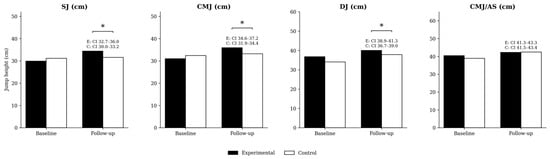
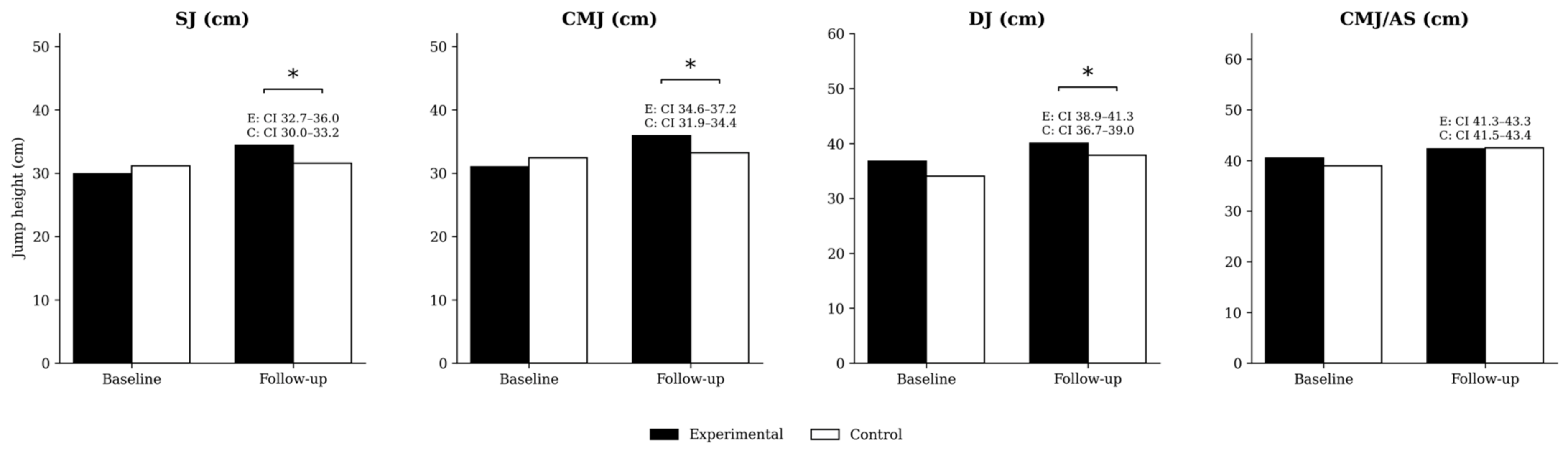
After statistically controlling for baseline scores, the E group demonstrated significantly greater improvement than the C group at follow-up on the SJ, CMJ, and DJ tests (Table 3 and Figure 1), all with large effect sizes. No significant between-group difference was found for the CMJ/AS test. Both groups improved from baseline to follow-up, with a slightly greater increase in the C group (+2.92 cm) than in the E group (+2.49 cm). The adjusted follow-up means were similar (42.27 cm vs. 42.45 cm), confirming no significant between-group difference.
Table 3.
Univariate Analysis of Covariance (ANCOVA) Results for Explosive Power Tests.
Figure 1.
Mean Jump Height at Baseline and Adjusted Follow-Up by Group. Legend: SJ—squat jump; CMJ—countermovement jump; DJ—drop jump; CMJ/AS—countermovement jump with arm swing. Black bars—Experimental group; white bars—Control group. Baseline bars show observed (unadjusted) means. Follow-up bars represent ANCOVA-adjusted means; CI labels denote the 95% confidence interval of the adjusted mean. Asterisks (*) denote a statistically significant between-group difference at follow-up after controlling for baseline scores (p < 0.05).
3.2. Sprint Test Results
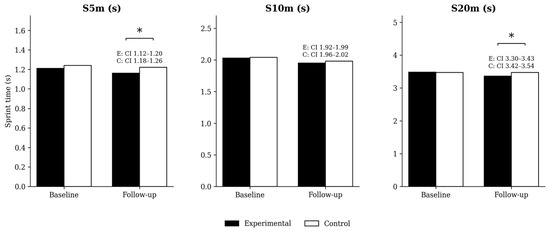
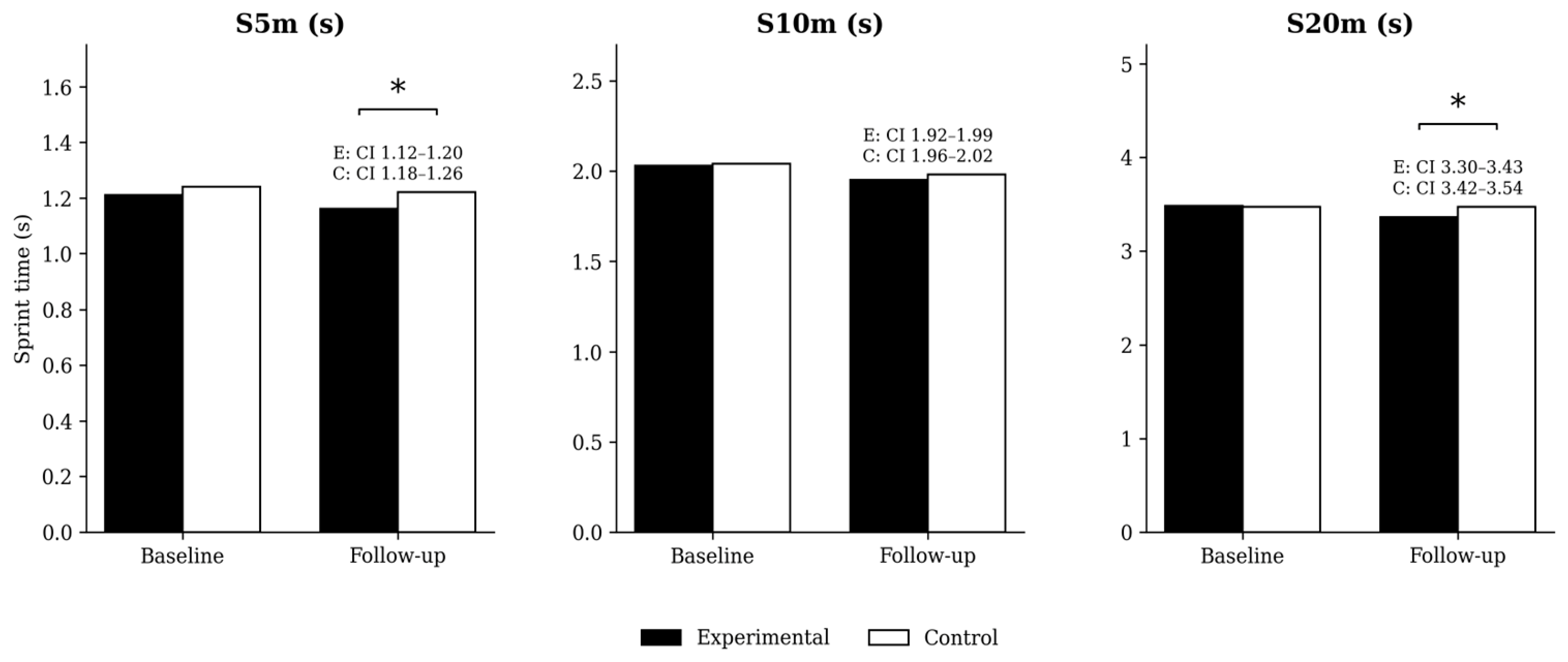
The E group showed significantly greater improvement than the C group at follow-up on the S5m and S20m sprint tests (Table 4 and Figure 2), with large effect sizes. No significant between-group difference was found for the S10m test. Both groups reduced their sprint times from baseline to follow-up, with a slightly greater reduction in the E group (−0.08 s) than in the C group (−0.05 s). However, this numerical difference was not statistically significant.
Table 4.
Univariate Analysis of Covariance (ANCOVA) Results for Sprint Speed Tests.
Figure 2.
Mean Sprint Time at Baseline and Adjusted Follow-Up by Group. Legend: S5m, S10m, S20m—5 m, 10 m, and 20 m sprint time. Black bars—Experimental group; white bars—Control group. Lower values indicate faster sprint times. Baseline bars show observed (unadjusted) means. Follow-up bars represent ANCOVA-adjusted means; CI labels denote the 95% confidence interval of the adjusted mean. Asterisks (*) denote a statistically significant between-group difference at follow-up after controlling for baseline scores (p < 0.05).
3.3. Change-of-Direction Test Results
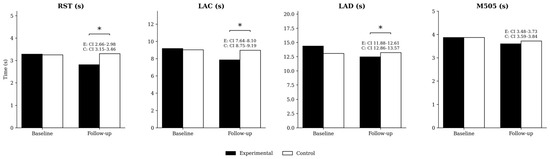
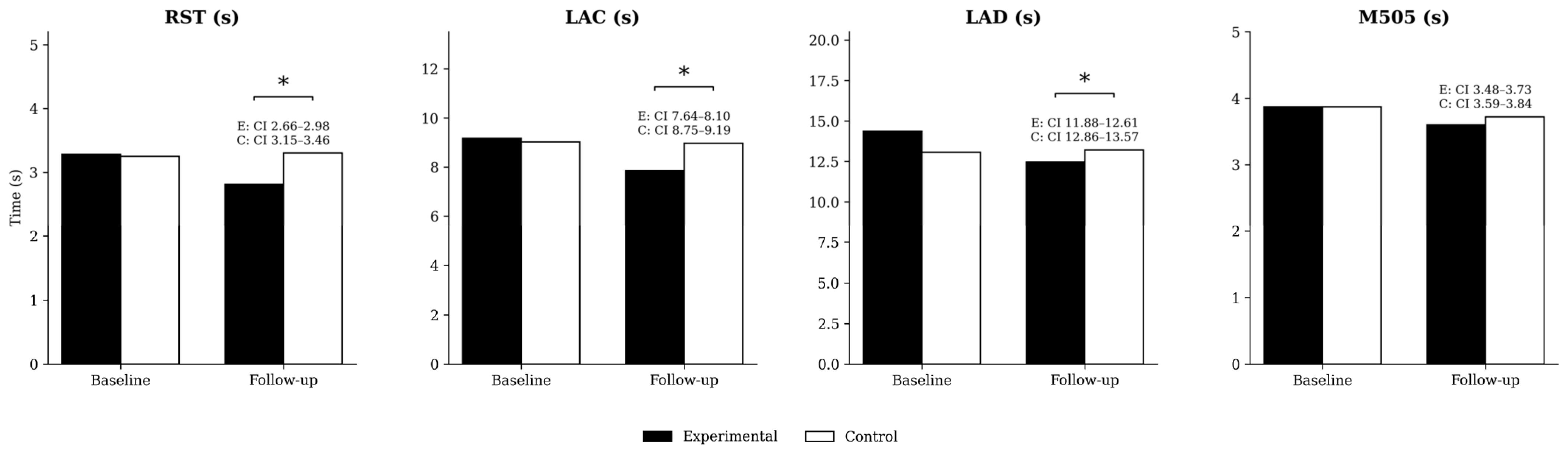
The E group demonstrated significantly greater improvement than the C group at follow-up on the RST, LAC, and LAD tests (Table 5 and Figure 3), with effect sizes ranging from large (η2p = 0.298 for LAD) to very large (η2p = 0.622 for LAC). No significant between-group difference was found for the M505 test. Both groups reduced their completion times from baseline to follow-up, with a greater reduction in the E group (−0.27 s) than in the C group (−0.16 s). The adjusted follow-up means were also slightly more favorable for the E group (3.60 s vs. 3.72 s), although the difference was not statistically significant.
Table 5.
Univariate Analysis of Covariance (ANCOVA) Results for Change-of-Direction Speed Tests.
Figure 3.
Mean Change-of-Direction Time at Baseline and Adjusted Follow-Up by Group. Legend: RST—Reactive Shuttle Test; LAC—Lane Arrow Closeout; LAD—Lane Agility Drill; M505—Modified 505 Test. Black bars—Experimental group; white bars—Control group. Lower values indicate faster (better) times. Baseline bars show observed (unadjusted) means. Follow-up bars represent ANCOVA-adjusted means; CI labels denote the 95% confidence interval of the adjusted mean. Asterisks (*) denote a statistically significant between-group difference at follow-up after controlling for baseline scores (p < 0.05).
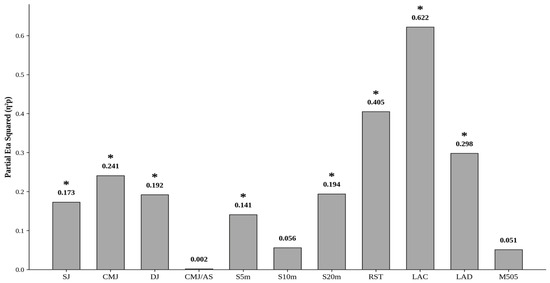
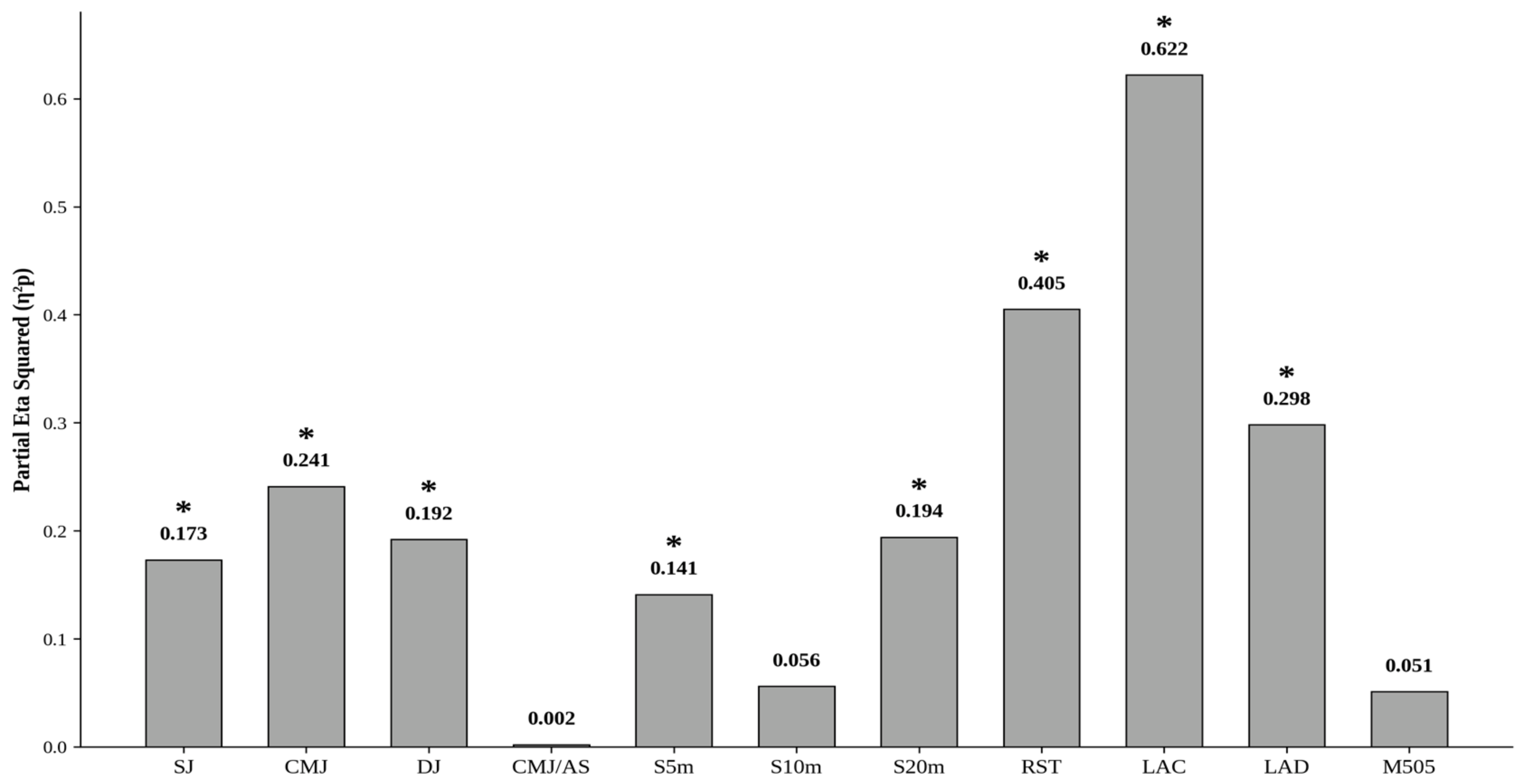
Finally, it is instructive to compare the partial eta squared (η2p) values across all tests on which plyometric training produced significant improvements (Figure 4), with effect sizes ranging from large (η2p = 0.141 for S5m) to very large (η2p = 0.622 for LAC). Overall, the E group showed statistically significant between-group differences with large η2p values on eight of the eleven motor performance tests administered (SJ, CMJ, DJ, S5m, S20m, RST, LAC, and LAD); seven of these remained significant after Holm adjustment within domains (all except S5m), while no significant between-group differences emerged on CMJ/AS, S10m, and M505. Adjusted between-group differences with 95% CIs are presented in Table 6. The adjusted between-group differences exceeded the SWC for all outcomes except CMJ/AS, but exceeded the MDD only for CMJ, RST, LAC, and LAD (Table 7). For the COD tests, the differences in RST, LAC, and LAD (0.49, 1.11, and 0.97 s, respectively) exceeded the reported typical errors [21], whereas the M505 difference (0.12 s) did not. These findings suggest that most differences were potentially meaningful, although the limited sample size reduced the ability to detect smaller effects.
Figure 4.
Comparative Effect Sizes (η2p) for Explosive Power, Sprint Speed, and Change-of-Direction Tests. Legend: SJ—squat jump; CMJ—countermovement jump; DJ—drop jump; CMJ/AS—countermovement jump with arm swing; S5m, S10m, S20m—5 m, 10 m, and 20 m sprint time; RST—Reactive Shuttle Test; LAC—Lane Arrow Closeout; LAD—Lane Agility Drill; M505—Modified 505 Test. Bars represent partial eta squared (η2p) values from the ANCOVA models for each test. Asterisks (*) denote a statistically significant between-group difference at follow-up after controlling for baseline scores (p < 0.05).
Table 6.
Adjusted between-group differences (E − C) at follow-up with 95% confidence intervals.
Table 7.
Adjusted between-group differences relative to the smallest worthwhile change (SWC) and the minimum detectable difference (MDD).
4. Discussion
To our knowledge, this is among the first studies to examine explosive power, sprint speed, and change-of-direction speed together in young male basketball players following a single plyometric intervention. The main finding of this study was that a 10-week, twice-weekly plyometric training program, performed alongside regular technical-tactical basketball training, was associated with significantly greater improvements than technical-tactical training alone in eight of eleven measures of explosive power, sprint speed, and change-of-direction speed in young basketball players (seven of eleven after Holm adjustment within domains). These results are consistent with the study hypothesis; however, because groups were formed by club (one club per condition) and the E group completed additional training, the differences cannot be attributed solely to the plyometric content. The results are also consistent with a substantial body of literature indicating that plyometric training is an effective, low-cost method for developing lower-limb power and speed qualities in young basketball players.
4.1. Effects on Explosive Power
The experimental group achieved significantly greater gains than the control group on the SJ, CMJ, and DJ tests, with partial eta-squared values indicating large between-group effects (0.173–0.241). These findings align with previous studies reporting significant improvements in vertical jump performance following 8–10-week plyometric programs in adolescent male basketball players [8,34]. Santos and Janeira [8] similarly found that plyometric training over a comparable duration improved SJ performance in young basketball players, and comparable SJ improvements have been reported following combined plyometric interventions [34]. A systematic review and meta-analysis of plyometric training in young female athletes further indicates that training programs lasting 10 weeks or longer tend to produce larger improvements in jump height than shorter interventions, with the largest training-induced effects generally reported for the DJ and CMJ variants [16]. In the present study, the effect size was likewise larger for CMJ than for SJ (η2p = 0.241 vs. 0.173), although DJ (η2p = 0.192) did not exceed CMJ as the meta-analytic pattern would suggest. The CMJ/AS finding, discussed below, diverges most clearly from that meta-analysis, which reported a large effect for this variant. The magnitude of improvement on CMJ observed in the present study is also consistent with earlier work in junior basketball players [35] and in youth basketball players following even shorter plyometric interventions [36].
In contrast to SJ, CMJ, and DJ, the CMJ/AS test did not show a statistically significant between-group difference, despite numerically similar improvements in both groups. In fact, the control group’s absolute gain on this test (2.92 cm) slightly exceeded that of the experimental group (2.49 cm). The arm-swing component of this test recruits a substantial contribution from upper-body coordination in addition to lower-limb power. It is therefore possible that a training program focused specifically on lower-limb jumping actions produced a smaller relative advantage on this more technically complex, whole-body task. A plausible contributing factor is that regular technical-tactical basketball training itself involves frequent arm-swing jumping, most notably during rebounding actions. This may have allowed the control group to develop this specific jump pattern through sport practice alone, independent of the plyometric intervention. This pattern echoes reports of differential, test-specific responses to plyometric training across vertical jump variants—for example, significant gains on CMJ but not SJ following a comparable plyometric protocol [37].
4.2. Effects on Sprint Speed
The experimental group demonstrated significantly greater improvement than the control group on the S5m and S20m tests, with large effect sizes (η2p = 0.141 and 0.194, respectively), whereas no significant between-group difference emerged for S10m. The improvement observed over the shortest distance (5 m) is consistent with the notion that plyometric training may improve the neuromuscular mechanisms underlying acceleration. However, the S5m difference did not remain significant after Holm adjustment, and these mechanisms (e.g., neural drive, rate of force development, RFD) were not measured in the present study, so this interpretation is speculative.
RFD and reactive strength, in particular, are most heavily weighted during the initial phase of a sprint. The lack of a significant effect on S10m, despite significant effects at both 5 m and 20 m, echoes prior work noting that different phases of a short sprint—initial acceleration versus the approach to maximal speed—are underpinned by partly distinct neuromuscular qualities. Training-induced transfer may therefore not be uniform across all split distances [38]. Comparable null findings for 10 m sprint performance following plyometric interventions in team-sport athletes have previously been reported, with training volume, intensity, and sample size proposed as possible explanatory factors [20,39]. Arede et al. [40] found that an 8-week in-season strength and conditioning program—which combined stabilization, plyometric, and VertiMax-based resisted power training—produced significant S10m improvements in young basketball players. This suggests that training-induced transfer to this split may depend on program composition and intensity. The significant improvement in S20m performance is nonetheless consistent with reports that plyometric training can enhance basketball players’ sprinting ability over longer distances when combined with regular sport-specific training [41].
4.3. Effects on Change-of-Direction Speed
The experimental group showed significantly greater improvement than the control group on the RST, LAC, and LAD tests, with effect sizes ranging from large to very large (η2p = 0.298–0.622), while the M505 test did not reach statistical significance. These findings extend the existing literature, since change-of-direction speed—particularly as assessed with basketball-specific tests such as the RST and LAC—has been investigated far less frequently than vertical jump performance in youth basketball populations. The improvement observed on the RST, which is composed of two short lateral sprints across the free-throw lane rather than a distinct directional cut, may reflect, at least in part, the concurrent gains in short-sprint acceleration observed on the S5m and S20m tests. The pronounced improvement observed on the LAC test, which combines a linear sprint with lateral defensive-slide actions, may partly reflect the emphasis of the training program on single- and double-leg lateral and multidirectional jumping exercises. These exercises may have strengthened the hip abductor and adductor musculature engaged during defensive lateral movement, although muscle strength was not assessed. The improvements on RST and LAD are broadly consistent with a meta-analysis indicating that plyometric training produces a small-to-moderate but consistent improvement in change-of-direction ability across sports and age groups [19]. Similar gains in agility performance have also been reported following plyometric and combined balance-plyometric interventions in youth basketball players [20] and other youth team-sport athletes [42]. The absence of a significant effect on the M505 test, which is heavily weighted toward a single 180° change of direction during linear sprinting, may indicate that the adaptations possibly induced by the program transferred more readily to multidirectional, sport-specific movement patterns than to a single-plane turning task.
4.4. Mechanistic Considerations
Taken together, the pattern of significant differences observed across most jump, sprint, and change-of-direction measures may be hypothesized to reflect a common set of neuromuscular adaptations to plyometric training. These mechanisms are presented as hypotheses only, since neural adaptations, musculotendinous stiffness, RFD, and strength were not measured in this study. Repeated exposure to rapid SSC actions is known to enhance musculotendinous stiffness and improve the storage and utilization of elastic energy during the transition from the eccentric to the concentric phase of movement [43]. In parallel, plyometric training promotes greater motor unit recruitment and firing frequency, along with improved intermuscular coordination, both of which contribute to a faster RFD [44,45]. Because RFD and SSC efficiency are heavily weighted during the early, ballistic phase of jumping, sprinting, and directional change, these adaptations could potentially contribute to the improvements observed on tests that emphasize brief, high-intensity ground contacts, such as SJ, CMJ, DJ, S5m, RST, and LAC [46,47]. Conversely, the absence of significant between-group differences on CMJ/AS, S10m, and M505 may indicate that these adaptations do not transfer uniformly to all tasks, although a non-significant result does not demonstrate the absence of an effect, nor any benefit. Tasks involving a greater upper-body coordinative demand, a longer acceleration phase, or a single-plane directional change may instead depend more heavily on other technical, biomechanical or anthropometric factors [48,49,50,51,52].
4.5. Practical Applications and Limitations
From an applied perspective, coaches working with adolescent basketball players may consider adding two plyometric sessions per week to the regular training microcycle, as this was associated with greater improvements in several jump, sprint, and change-of-direction measures in the present exploratory comparison. Statistical significance and large η2p values do not by themselves demonstrate a relevant improvement in competitive performance, and the present data are insufficient to issue firm training recommendations. The training itself requires only a low platform, making it feasible for most youth basketball programs, although objective monitoring of progress—as used in this study—requires access to photocell timing equipment.
Several limitations should be acknowledged. First, and most importantly, participants were assigned to groups by club rather than individually randomized, with only one club per condition. The effect of the intervention is therefore confounded with the effect of club (coaches, training loads, competitive exposure, and testing conditions), and ANCOVA adjustment for baseline values does not resolve this limitation; the study should be regarded as an exploratory comparison between two teams, and causal inference is not warranted. Second, the E group completed additional training, so total training volume and exposure time were not matched, and the differences cannot be attributed solely to the plyometric content. Third, the sample was a convenience sample without an a priori sample size calculation, and 11 outcomes were analyzed, which increases the risk of false-positive findings; the S5m result did not survive Holm adjustment. Moreover, although statistically significant differences were observed for SJ, DJ, S5m, and S20m, these differences did not exceed the corresponding MDD, indicating that their magnitude should be interpreted cautiously.
Fourth, jump height is not a direct measure of muscle power, and the proposed mechanisms were not measured. Fifth, the sample was restricted to male players from a single age cohort, which may limit the generalizability of the findings to female players, other age groups, or different competitive levels. Finally, the control group performed regular technical-tactical training only; a comparison with another type of additional training (e.g., resistance training) was not included and should be addressed in future studies. Future research should consider randomized designs, larger and more diverse samples, and longer-term follow-up to examine the persistence of training-induced adaptations.
5. Conclusions
A 10-week plyometric training program, performed twice weekly in addition to regular technical-tactical basketball training, was associated with greater improvements than technical-tactical training alone in explosive power (SJ, CMJ, DJ), short sprint speed (S5m, S20m), and change-of-direction speed (RST, LAC, LAD) in this exploratory comparison of two teams. Seven of these eight differences remained significant after Holm adjustment; the S5m difference did not. No significant between-group differences were found for CMJ/AS, S10m, or M505, and these results should not be interpreted as evidence of benefit. Overall, the findings suggest that a simple, progressively loaded plyometric program, delivered in real club conditions alongside regular training, may be a useful complement for developing these qualities in young basketball players. However, given the one-club-per-condition design and the unmatched training volume, they cannot establish effectiveness, and statistical significance or large effect sizes should not be equated with improved competitive performance. They do provide a documented basis for randomized, volume-matched, multi-club trials.
Author Contributions
Conceptualization, N.A., L.T. and B.B.; methodology, L.T., B.B. and R.A.; software, R.A. and S.B.; validation, V.S., M.M., F.W. and S.S.; formal analysis, N.A. and S.B.; investigation, L.T., R.A., V.S., S.S. and S.B.; resources, V.S., F.W. and S.S.; data curation, L.T. and N.A.; writing—original draft preparation, N.A., L.T. and B.B.; writing—review and editing, N.A., L.T., B.B., R.A., V.S., F.W., M.M., S.S. and S.B.; visualization, L.T. and S.B.; supervision, B.B., V.S. and S.S.; project administration, N.A., M.M., L.T. and V.S.; funding acquisition, V.S., F.W. and S.S. All authors have read and agreed to the published version of the manuscript.
Funding
This research received no external funding.
Institutional Review Board Statement
The study was conducted in accordance with the Declaration of Helsinki and approved by the Institutional Review Board of the Faculty of Sport and Physical Education, University of Niš, Serbia (approval no. 8/18-01-001/19-026 issued on 25 January 2019).
Informed Consent Statement
Informed consent was obtained from all subjects involved in the study.
Data Availability Statement
The data supporting the findings of this study are openly available in the first author’s doctoral dissertation (Aksović, N., Faculty of Sport and Physical Education, University of Niš), deposited in the National Repository of Doctoral Dissertations of Serbia (NaRDuS): https://nardus.mpn.gov.rs/handle/123456789/17500 (accessed on 5 November 2026).
Acknowledgments
The authors would like to express their sincere gratitude to the participating basketball players, their parents or legal guardians, coaches, and the management of the participating basketball clubs for their cooperation, commitment, and valuable contribution to the successful completion of the study. The authors also thank the trained examiners and all individuals who supported the implementation of the testing procedures and the 10-week plyometric training program. This study is based on data from the doctoral dissertation of the first author: Aksović, N. Effects of Plyometric Training on Explosive Power, Sprint, and Change-of-Direction Speed in Young Basketball Players. Doctoral dissertation, Faculty of Sport and Physical Education, University of Niš, Niš, Serbia, defended 13 November 2019.
Conflicts of Interest
The authors declare no conflicts of interest.
Abbreviations
The following abbreviations are used in this manuscript:
| SJ | Squat Jump |
| CMJ | Countermovement Jump |
| DJ | Drop Jump |
| CMJ/AS | Countermovement Jump with Arm Swing |
| S5m, S10m, S20m | 5 m, 10 m, and 20 m Sprint Time |
| RST | Reactive Shuttle Test |
| LAC | Lane Arrow Closeout |
| LAD | Lane Agility Drill |
| M505 | Modified 505 Test |
References
- McInnes, S.E.; Carlson, J.S.; Jones, C.J.; McKenna, M.J. The physiological load imposed on basketball players during competition. J. Sports Sci. 1995, 13, 387–397. [Google Scholar] [CrossRef] [Scilit] [PubMed]
- Delextrat, A.; Cohen, D. Strength, power, speed, and agility of women basketball players according to playing position. J. Strength Cond. Res. 2009, 23, 1974–1981. [Google Scholar] [CrossRef] [Scilit] [PubMed]
- Bourdas, D.I.; Travlos, A.K.; Souglis, A.; Gofas, D.C.; Stavropoulos, D.; Bakirtzoglou, P. Basketball Fatigue Impact on Kinematic Parameters and 3-Point Shooting Accuracy: Insights across Players’ Positions and Cardiorespiratory Fitness Associations of High-Level Players. Sports 2024, 12, 63. [Google Scholar] [CrossRef] [Scilit] [PubMed]
- de Pedro-Múñez, Á.; Álvarez-Yates, T.; Serrano-Gómez, V.; García-García, O. Changes in Sprinting and Jumping Performance During Preseason in Professional Basketball Players. J. Funct. Morphol. Kinesiol. 2025, 10, 339. [Google Scholar] [CrossRef] [Scilit] [PubMed]
- Keiner, M.; Kadlubowski, B.; Wirth, K.; Klusemann, M. The influence of linear sprint and jump performance on change-of-direction performance in male and female state-representative youth basketball players. Int. J. Sports Exerc. Med. 2021, 7, 186. [Google Scholar] [CrossRef] [Scilit]
- Aksović, N.; Bjelica, B.; Milanović, F.; Jovanović, N.; Zelenović, M. Plyometric training effects on explosive power, sprint and direction change speed in basketball. A review. Turk. J. Kinesiol. 2021, 7, 73–79. [Google Scholar] [CrossRef] [Scilit]
- Zatsiorsky, V.M.; Kraemer, W.J.; Fry, A.C. Science and Practice of Strength Training, 3rd ed.; Human Kinetics: Champaign, IL, USA, 2020. [Google Scholar]
- Santos, E.J.; Janeira, M.A. The effects of plyometric training followed by detraining and reduced training periods on explosive strength in adolescent male basketball players. J. Strength Cond. Res. 2011, 25, 441–452. [Google Scholar] [CrossRef] [Scilit] [PubMed]
- Lehnert, M.; Hůlka, K.; Malý, T.; Fohler, J.; Zahálka, F. The effects of a 6-week plyometric training programme on explosive strength and agility in professional basketball players. Acta Gymnica 2013, 43, 7–15. [Google Scholar] [CrossRef] [Scilit]
- Huang, H.; Huang, W.-Y.; Wu, C.-E. The Effect of Plyometric Training on the Speed, Agility, and Explosive Strength Performance in Elite Athletes. Appl. Sci. 2023, 13, 3605. [Google Scholar] [CrossRef] [Scilit]
- Santos, E.J.; Janeira, M.A. Effects of complex training on explosive strength in adolescent male basketball players. J. Strength Cond. Res. 2008, 22, 903–909. [Google Scholar] [CrossRef] [Scilit] [PubMed]
- Ham, D.J.; Knez, W.L.; Young, W.B. A deterministic model of the vertical jump: Implications for training. J. Strength Cond. Res. 2007, 21, 967–972. [Google Scholar] [CrossRef] [Scilit] [PubMed]
- Castagna, C.; Chaouachi, A.; Rampinini, E.; Chamari, K.; Impellizzeri, F. Aerobic and explosive power performance of elite Italian regional-level basketball players. J. Strength Cond. Res. 2009, 23, 1982–1987. [Google Scholar] [CrossRef] [Scilit] [PubMed]
- Balčiūnas, M.; Stonkus, S.; Abrantes, C.; Sampaio, J. Long term effects of different training modalities on power, speed, skill and anaerobic capacity in young male basketball players. J. Sports Sci. Med. 2006, 5, 163–170. [Google Scholar] [PubMed]
- Scanlan, A.; Dascombe, B.; Reaburn, P. A comparison of the activity demands of elite and sub-elite Australian men’s basketball competition. J. Sports Sci. 2011, 29, 1153–1160. [Google Scholar] [CrossRef] [Scilit] [PubMed]
- Stojanović, E.; Ristić, V.; McMaster, D.T.; Milanović, Z. Effect of plyometric training on vertical jump performance in female athletes: A systematic review and meta-analysis. Sports Med. 2017, 47, 975–986. [Google Scholar] [CrossRef] [Scilit] [PubMed]
- Huang, W.-Y.; Wu, C.-E. The Effects of Plyometric Training on Lower Limb Joint Mobility, Explosive Strength, Advanced Layup Success Rate, and Sports Injury Rate Among College Male Basketball Players. Appl. Sci. 2025, 15, 5356. [Google Scholar] [CrossRef] [Scilit]
- Kotzamanidis, C. Effect of plyometric training on running performance and vertical jumping in prepubertal boys. J. Strength Cond. Res. 2006, 20, 441–445. [Google Scholar] [CrossRef] [Scilit] [PubMed]
- Asadi, A.; Arazi, H.; Young, W.B.; de Villarreal, E.S. The effects of plyometric training on change-of-direction ability: A meta-analysis. Int. J. Sports Physiol. Perform. 2016, 11, 563–573. [Google Scholar] [CrossRef] [Scilit] [PubMed]
- Bouteraa, I.; Negra, Y.; Shephard, R.J.; Chelly, M.S. Effects of combined balance and plyometric training on athletic performance in female basketball players. J. Strength Cond. Res. 2020, 34, 1967–1973. [Google Scholar] [CrossRef] [Scilit] [PubMed]
- Stojanović, E.; Aksović, N.; Stojiljković, N.; Stanković, R.; Scanlan, A.T.; Milanović, Z. Reliability, usefulness, and factorial validity of change-of-direction speed tests in adolescent basketball players. J. Strength Cond. Res. 2019, 33, 3162–3173. [Google Scholar] [CrossRef] [Scilit] [PubMed]
- Reilly, T.; Eston, R.G. (Eds.) Kinanthropometry and Exercise Physiology Laboratory Manual: Tests, Procedures and Data; Psychology Press: London, UK, 2001. [Google Scholar]
- Glatthorn, J.F.; Gouge, S.; Nussbaumer, S.; Stauffacher, S.; Impellizzeri, F.M.; Maffiuletti, N.A. Validity and reliability of Optojump photoelectric cells for estimating vertical jump height. J. Strength Cond. Res. 2011, 25, 556–560. [Google Scholar] [CrossRef] [Scilit] [PubMed]
- de Pedro-Múñez, Á.; Álvarez-Yates, T.; Serrano-Gómez, V.; García-García, Ó. Validity and Reliability of Jumping and Linear Sprinting Tests to Assess Neuromuscular Performance in Professional Basketball Players. Appl. Sci. 2025, 15, 3997. [Google Scholar] [CrossRef] [Scilit]
- Markwick, W.J.; Bird, S.P.; Tufano, J.J.; Seitz, L.B.; Haff, G.G. The Intraday Reliability of the Reactive Strength Index Calculated from a Drop Jump in Professional Men’s Basketball. Int. J. Sports Physiol. Perform. 2015, 10, 482–488. [Google Scholar] [CrossRef] [Scilit] [PubMed]
- Rodríguez-Rosell, D.; Mora-Custodio, R.; Franco-Márquez, F.; Yáñez-García, J.M.; González-Badillo, J.J. Traditional vs. sport-specific vertical jump tests: Reliability, validity, and relationship with the legs strength and sprint performance in adult and teen soccer and basketball players. J. Strength Cond. Res. 2017, 31, 196–206. [Google Scholar] [CrossRef] [Scilit] [PubMed]
- Bond, C.W.; Willaert, E.M.; Noonan, B.C. Comparison of three timing systems: Reliability and best practice recommendations in timing short-duration sprints. J. Strength Cond. Res. 2017, 31, 1062–1071. [Google Scholar] [CrossRef] [Scilit] [PubMed]
- De Villarreal, E.S.S.; Kellis, E.; Kraemer, W.J.; Izquierdo, M. Determining variables of plyometric training for improving vertical jump height performance: A meta-analysis. J. Strength Cond. Res. 2009, 23, 495–506. [Google Scholar] [CrossRef] [Scilit] [PubMed]
- Shapiro, S.S.; Wilk, M.B. An analysis of variance test for normality (complete samples). Biometrika 1965, 52, 591–611. [Google Scholar] [CrossRef] [Scilit]
- Tabachnick, B.G.; Fidell, L.S.; Ullman, J.B. Using Multivariate Statistics, 5th ed.; Pearson Education: Boston, MA, USA, 2007. [Google Scholar]
- Pallant, J. SPSS Survival Manual: A Step by Step Guide to Data Analysis Using SPSS, 4th ed.; Allen & Unwin: Crows Nest, Australia, 2011. [Google Scholar]
- Cohen, J. Statistical Power Analysis for the Behavioral Sciences, 2nd ed.; Routledge: New York, NY, USA, 2013. [Google Scholar]
- Hopkins, W.G. Measures of reliability in sports medicine and science. Sports Med. 2000, 30, 1–15. [Google Scholar] [CrossRef] [Scilit] [PubMed]
- Khlifa, R.; Aouadi, R.; Hermassi, S.; Chelly, M.S.; Jlid, M.C.; Hbacha, H.; Castagna, C. Effects of a plyometric training program with and without added load on jumping ability in basketball players. J. Strength Cond. Res. 2010, 24, 2955–2961. [Google Scholar] [CrossRef] [Scilit] [PubMed]
- Matavulj, D.; Kukolj, M.; Ugarkovic, D.; Tihanyi, J.; Jaric, S. Effects of plyometric training on jumping performance in junior basketball players. J. Sports Med. Phys. Fit. 2001, 41, 159–164. [Google Scholar]
- Hernández, S.; Ramirez-Campillo, R.; Álvarez, C.; Sanchez-Sanchez, J.; Moran, J.; Pereira, L.A.; Loturco, I. Effects of plyometric training on neuromuscular performance in youth basketball players: A pilot study on the influence of drill randomization. J. Sports Sci. Med. 2018, 17, 372–378. [Google Scholar] [PubMed]
- Ma, S.; Wang, D.; Soh, K.G.; Wang, X.; Xu, Y.; Tu, Q. The effects of plyometric training on athletic’ jump performance: A systematic review and meta-analysis. Front. Physiol. 2025, 16, 1683281. [Google Scholar] [CrossRef] [Scilit] [PubMed]
- Shalfawi, S.A.; Sabbah, A.; Kailani, G.; Tønnessen, E.; Enoksen, E. The relationship between running speed and measures of vertical jump in professional basketball players: A field-test approach. J. Strength Cond. Res. 2011, 25, 3088–3092. [Google Scholar] [CrossRef] [Scilit] [PubMed]
- Thomas, K.; French, D.; Hayes, P.R. The effect of two plyometric training techniques on muscular power and agility in youth soccer players. J. Strength Cond. Res. 2009, 23, 332–335. [Google Scholar] [CrossRef] [Scilit] [PubMed]
- Arede, J.; Vaz, R.; Franceschi, A.; Gonzalo-Skok, O.; Leite, N. Effects of a combined strength and conditioning training program on physical abilities in adolescent male basketball players. J. Sports Med. Phys. Fit. 2018, 59, 1298–1305. [Google Scholar] [CrossRef] [Scilit] [PubMed]
- Poomsalood, S.; Pakulanon, S. Effects of 4-week plyometric training on speed, agility, and leg muscle power in male university basketball players: A pilot study. Kasetsart J. Soc. Sci. 2015, 36, 598–606. [Google Scholar]
- Gjinovci, B.; Idrizovic, K.; Uljevic, O.; Sekulic, D. Plyometric training improves sprinting, jumping and throwing capacities of high level female volleyball players better than skill-based conditioning. J. Sports Sci. Med. 2017, 16, 527–535. [Google Scholar] [PubMed]
- Komi, P.V. Stretch-shortening cycle: A powerful model to study normal and fatigued muscle. J. Biomech. 2000, 33, 1197–1206. [Google Scholar] [CrossRef] [Scilit] [PubMed]
- Aagaard, P.; Simonsen, E.B.; Andersen, J.L.; Magnusson, P.; Dyhre-Poulsen, P. Increased rate of force development and neural drive of human skeletal muscle following resistance training. J. Appl. Physiol. 2002, 93, 1318–1326. [Google Scholar] [CrossRef] [Scilit] [PubMed]
- Markovic, G.; Mikulic, P. Neuro-musculoskeletal and performance adaptations to lower-extremity plyometric training. Sports Med. 2010, 40, 859–895. [Google Scholar] [CrossRef] [Scilit] [PubMed]
- McCarthy, J.P.; Wood, D.S.; Bolding, M.S.; Roy, J.L.; Hunter, G.R. Potentiation of concentric force and acceleration only occurs early during the stretch-shortening cycle. J. Strength Cond. Res. 2012, 26, 2345–2355. [Google Scholar] [CrossRef] [Scilit] [PubMed]
- Southey, B.; Willshire, M.; Connick, M.J.; Austin, D.; Spits, D.; Beckman, E. Reactive strength index as a key performance indicator in different athlete populations—A systematic review. Sci. Sports 2024, 39, 129–143. [Google Scholar] [CrossRef] [Scilit]
- McCormick, B.T.; Hannon, J.C.; Hicks-Little, C.A.; Newton, M.; Shultz, B.; Detling, N.; Young, W.B. The relationship between change of direction speed in the frontal plane, power, reactive strength, and strength. Int. J. Exerc. Sci. 2014, 7, 260–270. [Google Scholar] [CrossRef] [Scilit]
- McCormick, B.T.; Hannon, J.C.; Newton, M.; Shultz, B.; Detling, N.; Young, W.B. The effects of frontal- and sagittal-plane plyometrics on change-of-direction speed and power in adolescent female basketball players. Int. J. Sports Physiol. Perform. 2016, 11, 102–107. [Google Scholar] [CrossRef] [Scilit] [PubMed]
- Spiteri, T.; Newton, R.U.; Nimphius, S. Neuromuscular strategies contributing to faster multidirectional agility performance. J. Electromyogr. Kinesiol. 2015, 25, 629–636. [Google Scholar] [CrossRef] [Scilit] [PubMed]
- Nejić, K.; Ilić, I. Impact of morphological characteristics and jumping ability on block jump height. Phys. Educ. Sport Centuries 2025, 12, 5–15. [Google Scholar] [CrossRef] [Scilit]
- Šarabon, N.; Kozinc, Ž.; Bishop, C. Comparison of vertical and horizontal reactive strength index variants and association with change of direction performance. J. Strength Cond. Res. 2023, 37, 84–90. [Google Scholar] [CrossRef] [Scilit] [PubMed]

Disclaimer/Publisher’s Note: The statements, opinions and data contained in all publications are solely those of the individual author(s) and contributor(s) and not of MDPI and/or the editor(s). MDPI and/or the editor(s) disclaim responsibility for any injury to people or property resulting from any ideas, methods, instructions or products referred to in the content. |
© 2026 by the authors. Licensee MDPI, Basel, Switzerland. This article is an open access article distributed under the terms and conditions of the Creative Commons Attribution (CC BY) license.