


Abstract
In agentic security operations centers, an agent’s action may execute after its justification has lapsed because evidence went stale, confidence was overstated or policy changed. We present evidence-bound action warrants issued by a deterministic gateway outside the agent. A warrant admits one action on one asset only if five predicates hold: evidence freshness, calibrated confidence above a risk-tiered threshold, quorum-confirmed ledger evidence, a current policy version and a sufficient response-time budget. Warrants are signed, single-use, expiring and revalidated immediately before execution. We derive an admissibility condition, show that revalidation shrinks the check-to-act window to the commit latency and prove a fail-closed property conditional on protected signing keys, complete mediation at enforcement points and at most f faulty validators. All results come from an Avalanche-parameterized discrete-event simulation, so the mechanism remains at technology readiness level 3, unvalidated on real SOC infrastructure. Its zero adversarial executions and contract violations verify the implementation rather than providing security evidence. Relative to confidence-only admission, unsafe executions fell from 53.2 to 14.6 per 1000 proposals at 2.0 points more deadline misses and 1.8 points more escalations. Adaptive proposals citing authentic evidence succeeded whenever it passed the confidence threshold. A cyber-range validation protocol is specified.
1. Introduction
Security operations centers (SOCs) collect telemetry from endpoints, networks, identities and cloud services, correlate it into alerts, and coordinate containment and recovery [1,2]. Their bottleneck is human attention: analysts face alert streams dominated by false positives [3,4], and security orchestration, automation and response (SOAR) platforms relieve only the steps that can be scripted in advance [5]. Agents built on large language models (LLMs), which plan, call tools and react to observations [6,7], are therefore entering SOC workflows. They were first used for enrichment and triage and are increasingly used for response itself [8,9,10], which continues a long line of research on autonomous intelligent cyber-defense agents [11].
Moving an agent from recommending to acting changes the nature of its errors. A containment action, such as blocking an address, terminating a process, disabling an account or isolating a host, is justified only by the evidence, confidence and policy that hold when it takes effect, not when it was planned. Three failure modes break this coupling. First, evidence ages: telemetry pipelines lag, processes exit and addresses are reassigned, so the observation that justified an action may be obsolete when an orchestrator finally dispatches it. The time-of-check-to-time-of-use (TOCTOU) race known from operating systems [12] thus reappears at the level of security operations, and the freshness of information becomes a first-class quantity, as in the age-of-information literature [13]. Second, confidence is overstated: modern neural classifiers and LLMs are frequently miscalibrated [14,15], and agents may hallucinate entities and relations that do not exist [16]. Third, the agent’s input channel is an attack surface: indirect prompt injection lets an adversary who controls a log line, a ticket or an e-mail steer the agent toward attacker-chosen actions [17,18,19,20], and excessive agency is now listed among the principal risks of LLM applications [21,22]. A more accurate model removes none of these failures, because they are architectural. They arise in the gap between the moment a justification is established and the moment an irreversible action takes effect.
This paper closes that gap with an evidence-bound action warrant (EBAW): a signed, single-use, expiring authorization for one action on one asset, issued by a deterministic admission gateway that sits outside the agent, between the response orchestrator and the enforcement points. The agent only proposes. The gateway admits a proposal only if an admission contract of five predicates holds. The primary observation must be fresh, the calibrated confidence of the authenticated analytical estimate must exceed a risk-tiered threshold, the evidence record must be confirmed by a quorum of independent ledger nodes, the policy version must be current, and the remaining response-time budget must cover execution. The gateway checks the same contract again immediately before execution. The design generalizes two elements of our previous work on uncertainty-aware sensing for critical-infrastructure SOCs [23], namely the AUTO/VERIFY/OBSERVE confidence regimes and the anchoring of integrity metadata on a permissioned ledger, from the evidence layer to the authorization of actions. The verification mechanism, in which deterministic code checks a configurable set of rules before a transaction or an action takes effect, is not new. Reusable smart contract design patterns, such as AdapT and CongruenT, already standardize verification functions for any domain and any number of rules (Section 1.6). Our contribution is a specific contract of five rules tailored to one business application, the authorization of autonomous containment actions in a SOC, together with its execution-time revalidation, the warrant that carries its outcome and a formal and simulation-based analysis of this rule set.
The contributions of this work are as follows:
- C1. The EBAW mechanism: a domain-specific admission contract of five predicates for autonomous SOC response; warrants bound to the action, the evidence snapshot and the policy version that expire at the earlier of the freshness and deadline limits; execution-time revalidation; a budget-aware confirmation wait; and expiry-ordered dispatch (Section 2.1).
- C2. Formal properties: an explicit admissibility condition with a distribution-free design rule, the reduction of the residual check-to-act window to the commit latency, a fail-closed property that prevents self-authorization under explicit trust assumptions, and pointwise monotonicity over the lattice of contracts (Section 2.1.6).
- C3. A reproducible discrete-event evaluation that compares the gateway with agent-direct, confidence-only and receipt-only admission and with an ablation without revalidation over eight scenarios, together with an exhaustive analysis of all 32 contracts, an adaptive-adversary scenario and a sensitivity analysis (Section 2.2, Section 2.3, Section 2.4, Section 2.5, Section 2.6 and Section 3).
- C4. A design for a labeled dataset of agentic response episodes that records the full decision trace required to evaluate admission control (Section 3.9.1).
- C5. Design guidelines for implementing the contract with established smart contract design patterns, a software project and a protocol for the experimental verification of the invention on the SOC cyber range of the University of Customs and Finance (Section 3.9.2, Section 3.9.3 and Section 4.1).
Four research questions guide the study. RQ1: Can a deterministic gateway prevent actions with lapsed justification and adversarial proposals from executing, and at what cost in timeliness and analyst workload? RQ2: How much does each predicate contribute, and how should the contract be configured for different risk tiers? RQ3: How accurately does the analytical admissibility condition predict autonomous admission under realistic latencies? RQ4: Which data, software and experiments are required to validate the invention on a real SOC cyber range? Section 1.1, Section 1.2, Section 1.3, Section 1.4, Section 1.5 and Section 1.6 review related work, Section 2 specifies the invention and its properties (Section 2.1) and the simulation method (Section 2.2, Section 2.3, Section 2.4, Section 2.5 and Section 2.6), Section 3 reports the results and presents the dataset, software and experimental proposals (Section 3.9), Section 4 discusses implications, design guidelines and limitations, and Section 5 concludes.
1.1. Agentic Artificial Intelligence in Security Operations
SOC research has documented persistent overload and the limits of rule-based automation [1,4]. SOAR platforms codify playbooks and integrate tools, but the response logic must be fixed in advance [5]. Surveys of LLM applications in cybersecurity and in SOCs report rapid adoption for triage, investigation and reporting and a growing interest in autonomous response [8,9], and benchmarks such as ExCyTIn-Bench evaluate agents on multi-step threat investigations over realistic security logs [10]. Research on autonomous intelligent cyber-defense agents anticipated software agents that act with limited human supervision [11], while NIST SP 800-61r3 frames incident response as part of continuous cybersecurity risk management, which turns the timeliness and accountability of automated actions into governance requirements [2]. These works motivate autonomous response but do not specify a mechanism that binds an action to the state that justifies it.
1.2. Securing LLM Agents
Prompt injection has been formalized and benchmarked [18,19,20], and indirect injection through retrieved content has been demonstrated against deployed systems [17]. Surveys catalogue these and related threats to agents, including unsafe tool use [22]. Defenses increasingly move enforcement outside the model. GuardAgent employs a guard agent that generates and executes checking code [24], and AgentSpec provides a domain-specific language of runtime rules triggered by agent events [25]. IsolateGPT isolates the execution of third-party applications and mediates their interactions through a trusted hub [26], and StruQ separates trusted instructions from untrusted data by means of structured queries [27]. A journal survey of LLM security reviews these and related attacks together with the defenses proposed against them [28]. These mechanisms decide whether a tool call is permitted by a policy at call time. They do not reason about the age of the evidence, the calibration of the confidence, the confirmation state of shared evidence or the response deadline, and they do not revalidate an authorization that waits in a queue before taking effect, which is the normal situation in SOC orchestration.
1.3. Runtime Assurance, Reference Monitors and Zero Trust
Guarding an untrusted complex controller with a simple, verifiable one is a classical safety pattern: the Simplex architecture [29], runtime-assurance frameworks such as SOTER [30] and shields for reinforcement learning [31] switch to a safe controller or veto unsafe actions. In security, the reference monitor and the principles of complete mediation and fail-safe defaults [32], together with the theory of policies enforceable by execution monitors [33], provide the foundation for a gateway that mediates every action. Zero-trust architecture separates policy decision points from policy enforcement points and evaluates access per request [34]. Policy languages such as Cedar make authorization decisions analyzable [35], and capability tokens with caveats [36], rich authorization requests [37] and JSON Web Tokens [38] bind authority to specific actions and validity periods. Selective classification with a reject option [39,40] and the model of levels of automation [41] provide the decision-theoretic and human-factors basis for routing uncertain cases to analysts, while calibration by binning [42] and the Wilson score interval [43] yield conservative confidence estimates. EBAW combines these elements and adds three evidential predicates (freshness, calibrated confidence and confirmed shared state) together with the deadline predicate that an autonomous security action requires.
1.4. Ledger-Anchored Evidence
Tamper-evident logging predates blockchains [44]. Permissioned ledgers such as Hyperledger Fabric [45] and blockchain-based log services [46,47] provide integrity and non-repudiation for security records, and blockchains are increasingly used for decentralized trust and access control in connected systems [48]. Byzantine quorum systems bound what f faulty replicas can make a reader accept: in a masking quorum system with n ≥ 4f + 1 replicas and quorums of ⌈(n + 2f + 1)/2⌉ replicas, every two quorums share at least 2f + 1 replicas, so the latest written value is vouched for by at least f + 1 correct replicas of any read quorum, whereas a value fabricated by the faulty replicas never is [49]. Avalanche consensus reaches probabilistic finality through repeated subsampled voting [50,51]. Its documentation states sub-second finality and approximately one-second acceptance [52], whereas the Diablo benchmark measured latencies of tens of seconds under demanding workloads on an earlier client version [53]. This spread matters because a gateway must decide how long waiting for confirmation remains worthwhile when the confirmation latency can exceed the time budget of an action. Ledger-anchored logging records evidence after the fact and does not address this question.
1.5. Cyber Ranges and Datasets
Cyber ranges provide isolated, instrumented environments for training and experimentation [54,55]. Public intrusion-detection datasets have documented construction and labeling pitfalls [56,57], which motivated maintainable, scenario-driven log datasets [58]. None of the datasets known to us records the complete decision trace of an agentic response that is needed to evaluate admission control, namely the proposal, evidence age, confirmation state, policy version, verdict and execution outcome. Section 3.9.1 proposes such a dataset. Table 1 summarizes the comparison of EBAW with related approaches, including the smart contract design patterns discussed in Section 1.6.
Table 1.
Comparison of evidence-bound action warrants (EBAW) with related approaches.
1.6. Smart Contract Design Patterns for Verification Functions
The admission contract of EBAW belongs to a broader family of mechanisms in which deterministic code checks a set of rules before a transaction takes effect. In blockchain systems, this role is played by the verification functions of smart contracts. The AdapT design pattern and its reusable package handle transactions of congruous types with a separate configuration for each transaction type, while the configurations share a single object for each verification rule, so that duplicated verification logic is eliminated [59]. The CongruenT package standardizes the verification functions themselves and ensures the reuse of both condition objects and condition classes across smart contracts [60]. Together, these patterns establish a standard, domain-independent mechanism for smart contract verification, and they allow specific smart contracts to be constructed for any domain and for any number of verification rules.
We therefore do not claim the verification mechanism itself as a contribution. EBAW is a specific contract that comprises five rules tailored to one business application, namely the authorization of autonomous containment actions in a SOC. Its novelty lies in the content of these rules and in the context in which they are evaluated. The rules are temporal and evidential because they depend on the age of an observation, the calibration of an analytical score, the confirmation state of a ledger record and a response deadline. A rule that held at issuance can therefore cease to hold before the action takes effect, which is why the contract is evaluated twice, at issuance and immediately before execution, and why its outcome is a signed, single-use and expiring warrant rather than the acceptance of a single transaction. The formal properties in Section 2.1.6 and the lattice analysis in Section 3.3 concern this particular rule set. Section 4.1 describes how the five predicates map onto the configurations, condition objects and condition classes of the AdapT and CongruenT patterns, so that the rule set can be implemented and extended with these packages.
2. Materials and Methods
2.1. The Invention: Evidence-Bound Action Warrants
2.1.1. System and Threat Model
Figure 1 and Figure 2 show the components and the protocol. The LLM agent receives alerts and context, reasons with tools and emits action proposals. The agent is treated as untrusted. Detection analytics assign a score s to each observation, sensors sign their observations, raw telemetry stays off chain, and an evidence record e = ⟨H(raw), x, tobs, s, src⟩ is anchored on a permissioned ledger of n ≥ 4f + 1 validators. A policy store keeps versioned policies partitioned by action class and asset group. The gateway G is a deterministic service that holds a signing key skG. The orchestrator runs playbooks, and enforcement points (PEPs)— namely firewall, endpoint and identity controllers—execute an action only when presented with a valid warrant and a committed EXECUTE verdict. Analysts handle escalations, and a human decision re-enters the gateway as a human-attested warrant, whose evidence and policy version are revalidated for retraction and supersession before execution. The attestation replaces the confidence, freshness and deadline predicates. Because the autonomous path and the analyst path involve different participants and messages, they are shown as two separate UML sequence diagrams. Figure 1 depicts the interactions initiated by the LLM agent, and Figure 2 depicts the escalation to the SOC analyst and the human-attested warrant that results from an approval.
Figure 1.
UML sequence diagram of the autonomous path initiated by the LLM agent. The agent only proposes (1). The gateway reads the evidence record from a ledger read quorum (2–3) and the current policy partition (4–5), evaluates the five-predicate contract (6) and issues a signed, single-use, expiring warrant (7). After the check-to-act window W in the orchestrator, the warrant is revalidated (8–9), and the action is executed only if all predicates still hold (10–12). Otherwise, the gateway refreshes the evidence once, re-issues the warrant under the current policy version, rejects the proposal or escalates it to an analyst (13), as shown in Figure 2. Solid arrows denote messages, dashed arrows denote returned results, grey arrows denote ledger anchoring, and self-arrows denote internal checks.
Figure 2.
UML sequence diagram of the analyst path. An escalated proposal reaches the SOC analyst together with its failure set and priority (1), and the analyst investigates and decides (2–3). An approval re-enters the gateway as a human-attested warrant (4–6), which replaces the confidence, freshness and deadline predicates but is revalidated for evidence retraction and policy supersession before execution (7–8). The enforcement point then verifies the warrant and acts (9–11). A rejection closes the case and anchors the decision without any action (12). Solid arrows denote messages, dashed arrows denote returned results, grey arrows denote ledger anchoring, and self-arrows denote internal checks.
The adversary may (i) control content that the agent reads, enabling indirect prompt injection; (ii) induce hallucinated proposals that cite wrong assets or non-existent evidence; (iii) tamper with off-chain stores such as SIEM indices; (iv) delay network messages and ledger confirmations; and (v) control up to f validators. The adversary cannot obtain skG or forge gateway signatures, cannot corrupt more than f validators, and cannot alter the gateway code or the write path of the policy store, which is protected by change management. The clocks of sensors, the gateway and validators are synchronized within a known bound.
2.1.2. Proposals and Evidence
An action proposal is a tuple π = (α, x, ε, ĉ, tp), where α is an action class, x the target asset, ε a set of evidence references, ĉ, the confidence claimed by the agent and tp the proposal time. The primary evidence record e ∈ ε carries the observation time tobs, the asset identifier, the analytical score s, a digest of the raw telemetry and the sensor signature. Its anchoring is submitted when the observation has age a0 and becomes final after the confirmed-state visibility latency Lc, defined as the time from submission until the record is final and readable from a read quorum. Each pair (α, x) belongs to a policy partition with version v*(α, x;t), a freshness bound Φα, a response deadline Dα measured from tobs and a risk tier ρ ∈ {low, medium, high, critical} determined by the reversibility of the action and the criticality of the asset; the tier selects a pair of thresholds (θρauto, θρobs).
2.1.3. The Five-Predicate Admission Contract
A proposal is admissible at time t when
The freshness predicate bounds the age of the primary observation:
The calibrated-confidence predicate never uses the confidence ĉ claimed by the agent. The gateway recomputes confidence from the authenticated score s that the detection analytics bound to the evidence record of the proposed asset x, using a calibration map g fitted on held-out labeled data. If no authenticated analytical record exists for x, then g = 0, and the proposal falls into the OBSERVE regime. Scores are grouped into equal-mass bins; for bin b with nb samples and empirical precision , the conservative estimate is the one-sided Wilson lower bound [43]
which is made non-decreasing in the score by its conservative lower envelope, so that a bin never receives more confidence than any bin of higher scores:
The same estimate routes each proposal into one of three regimes, which generalize the AUTO/VERIFY/OBSERVE modes of [23] from a sensing pipeline to action admission:
The ledger-quorum predicate requires that the evidence record be final, bound to the proposed asset and not superseded by a retraction. The gateway reads from a masking Byzantine quorum system [49] of n ≥ 4f + 1 validators, with read quorums |Q| ≥ ⌈(n + 2f + 1)/2⌉, and takes as the ledger state the most recent state that at least f + 1 members of Q report identically:
The policy-version predicate binds the warrant to the version vw of the policy partition under which it was evaluated and requires the action to be permitted by that version:
Scoping versions to partitions avoids needless re-issuance when unrelated parts of the policy change. Finally, the deadline-budget predicate requires that the remaining time cover the gateway, the dispatch and the execution:
where δg is the gateway evaluation latency, δc the commit latency, an estimate of the orchestration delay (the 90th percentile of the recent dispatch waits plus that of the playbook preparation time) and the 90th percentile of the execution time of class α; at revalidation = 0. Table 2 summarizes the contract, the authenticated inputs of every predicate and the deterministic response to its failure.
Table 2.
The EBAW admission contract: predicates, authenticated inputs and failure responses.
2.1.4. Warrant Structure
When the contract holds, the gateway issues a warrant w = SigskG(id, α, x, H(ε), v, g(s), ρ, tiss, texp, ν) whose lifetime ends at the earlier of the freshness and deadline limits:
The single-use nonce ν is consumed by the enforcement point at execution and the consumption is anchored, so a warrant cannot be replayed. Table 3 lists the claims. The warrant can be encoded as a compact signed token, for example a JSON Web Token [38] or a CBOR-based equivalent, whose authorization details follow the structure of rich authorization requests [37]. Signing keys are kept in a hardware security module.
Table 3.
Claims of an evidence-bound action warrant.
2.1.5. Gateway Algorithm
Algorithm 1 specifies admission and revalidation. Two features keep the gateway useful under latency. First, the gateway waits for ledger confirmation only while the action can still be admitted (budget-aware confirmation wait):
| Algorithm 1. EBAW admission (ADMIT) and execution-time revalidation (REVALIDATE) |
| Input: proposal π = (α, x, ε, ĉ, tp); contract S ⊆ {P1, …, P5}; versioned policy store ADMIT(π): 1: e ← QUORUM-READ(ε) 2: while P3 ∈ S and e is valid but pending and t < twaitmax (Equation (10)) do wait for finality 3: evaluate every Pi ∈ S at time t from authenticated inputs only (assumption A3) 4: if the action is not permitted by v*(α, x;t) then REJECT(π) 5: if all predicates in S hold then w ← SIGN(π, e, v*, texp, ν); DISPATCH(w, priority = texp); return 6: if P3 failed because e is invalid or bound to another asset then REJECT(π) and raise an alert 7: if P3 failed because e has been retracted then REJECT(π) 8: if P2 failed then VERIFY → ESCALATE; OBSERVE → MONITOR (no action) 9: if P5 failed then ESCALATE(urgent) 10: if P1 failed then REFRESH(e) once and go to 2 (REJECT if the target state has changed); after a refresh, ESCALATE 11: otherwise (e still pending when twaitmax is reached) ESCALATE REVALIDATE(w) when the orchestrator is ready (t = tready): 12: if the signature of w is invalid or ν is consumed then REFUSE 13: re-evaluate every Pi ∈ S at tready (P5 without the orchestration term) 14: if e has been retracted (P2 or P3 false) then REJECT 15: if P4 failed then REJECT if the action is no longer permitted, otherwise re-issue w under v*(α, x;t) 16: if P5 failed then ESCALATE(urgent) 17: if P1 failed or e is pending then REFRESH(e) once while holding the worker, re-issue w and go to 13 (REJECT if the target state has changed); after a refresh, ESCALATE 18: COMMIT(EXECUTE, w) within δc; the enforcement point verifies w, consumes ν and executes α on x Any error, timeout or missing input evaluates the affected predicate to false (assumption A4). |
Second, warrants are dispatched in order of their expiry texp (earliest deadline first), so that the orchestrator serves first the actions whose justification lapses first. Section 3.4 compares this order with first-in-first-out dispatch. A refresh replaces a stale primary observation with a fresh, target-bound sensor query, which is anchored before it is used; because the query concerns the proposed asset, it also exposes proposals that cite evidence about another asset.
2.1.6. Formal Properties
Proposition 1 (admissibility condition).
Consider a proposal of class α that is processed without refresh or escalation. Let a0 be the age of the observation when its anchoring is submitted, Δa the agent latency measured from the availability of the evidence, δs the submission latency, Lc the confirmed-state visibility latency, δq the quorum-read latency, δg and δr the evaluation latencies at issuance and revalidation, Δo the orchestration delay and τα the execution time. Define the end-to-end check latency Λ by
The action is executed autonomously with P1 and P5 satisfied at the revalidation instant if and only if Λ ≤ Φα and Λ + δc + τα ≤ Dα, that is, up to the commit latency δc, if and only if Equation (11) holds.
Proof.
The gateway needs both the proposal and the confirmed record, so its first check happens at max(tp, tconf) + δq; since anchoring proceeds in parallel with agent reasoning, the corresponding delay after evidence availability is max(Δa, δs + Lc). Issuance adds δg, dispatch Δo and revalidation δr, so the revalidation decision occurs at tobs + Λ. P1 requires an age not exceeding Φα at this instant, and P5 requires completion by tobs + Dα, i.e., Λ + δc + τα ≤ Dα. □
Three consequences follow. The maximum term shows that anchoring in parallel with reasoning hides the ledger latency whenever δs + Lc ≤ Δa, so a ledger with sub-second finality incurs no end-to-end latency. With τα replaced by its 90th percentile , the budget Bα equals the lifetime that Equation (9) grants to the warrant, so the expiry check at the enforcement point implements Proposition 1 locally. And the wait bound of Equation (10) stops waiting for confirmation once the remaining slack can no longer cover the downstream latencies.
Corollary 1 (distribution-free design rule).
If the latency components have finite variance, then for any η ∈ (0, 1)
Proof.
Cantelli’s one-sided inequality gives Pr[Λ − 𝔼[Λ] ≥ k] ≤ σΛ2/(σΛ2 + k2); setting k = Bα − 𝔼[Λ] and requiring the bound to be at most η yields Equation (12). □
The rule lets an operator choose Φα and Dα, or engineer the latencies, so that a class is autonomously admissible with probability at least 1 − η from the first two moments of the latencies alone.
Proposition 2 (residual check-to-act window).
Let the state changes that are relevant to (α, x)—policy updates, evidence retractions and target drift—form a Poisson process with rate λ that is independent of the decision process. Without revalidation, the probability that an admitted action executes on a changed state is
whereas with revalidation and an atomic commit, the exposure is limited to the commit latency:
Proof.
Conditioning on the window length, the probability of no event in a window of length w is e−λw; the inequality follows from 1 − e−u ≤ u. □
For λW ≪ 1, revalidation reduces the exposure by the factor 𝔼[δc]/𝔼[W].
Proposition 3 (conditional fail-closed property; no self-authorization).
Assume that (A1) the signing key is held only by the gateway and the signature scheme is existentially unforgeable; (A2) every enforcement point executes only actions accompanied by a warrant whose signature verifies, whose nonce is unused and whose expiry has not passed, and for which a revalidation verdict EXECUTE has been committed; (A3) the gateway computes every predicate exclusively from authenticated inputs—signed observations, quorum-read ledger state, the versioned policy store and its own synchronized clock—and never from fields asserted by the proposer; and (A4) every timeout, parse error, missing input or inconsistency evaluates the affected predicate to false. Then, for every proposal π, irrespective of how it was produced,
where tr is the revalidation instant, εsig is the forgery advantage against the signature scheme and εq is the probability that more than f validators are faulty. In particular, a hallucinated or injected proposal can execute only if the action it names is admissible on authentic evidence.
Proof sketch.
By A2, execution requires a verifying warrant and a committed verdict; by A1, only the gateway produces them, except with probability εsig. The gateway commits EXECUTE only when Adm(π, tr) evaluates to true (Algorithm 1, line 18). By A3, the proposer controls none of the inputs of the evaluation; because any two quorums of the masking quorum system share at least 2f + 1 validators, the latest committed state is reported by at least f + 1 correct members of every read quorum, whereas a state fabricated or withheld by at most f faulty validators cannot reach or suppress that threshold, so P3 reflects the committed ledger state unless more than f validators are faulty (probability εq); and by A4, no error can turn a predicate true. □
Proposition 3 is therefore a conditional guarantee and not a demonstrated operational property. Its assumptions, namely the protection of the signing key, for example in a hardware security module (A1), complete mediation by every enforcement point (A2), the exclusive use of authenticated inputs (A3), fail-closed error handling (A4) and at most f faulty validators, are not verified in this paper. They hold by construction in the simulation of Section 2.2, Section 2.3, Section 2.4, Section 2.5 and Section 2.6, and they must be established for deployed sensors, ledger nodes, policy stores and enforcement adapters, which experiments E6 and E8 of Section 3.9.3 are designed to test. Proposition 4 concerns only the logic of the contract and does not depend on these assumptions, but it holds for fixed decision instants and not for system-level metrics, as stated below.
Proposition 4 (pointwise monotonicity over contracts).
For contracts S ⊆ S′ ⊆ {P1, …, P5} and a fixed state at time t, AdmS′(π, t) ⇒ AdmS(π, t). The 32 contracts therefore form a Boolean lattice ordered by inclusion, and, for fixed decision instants, strengthening the contract can only remove autonomous executions and cannot introduce violations of the predicates it contains. System-level metrics need not be monotone, because the decision instants themselves depend on queueing and escalation, which the contract changes; Section 3.3 quantifies this effect.
2.2. Discrete-Event Model
The invention was evaluated with a discrete-event model of an agentic SOC implemented in Python 3.13 (Python Software Foundation, Wilmington, DE, USA) with SimPy 4.1.2, NumPy 2.5.3, SciPy 1.18.1 and pandas 3.0.5 (Supplementary Materials). The code is available as ebaw-soc 2.0.0 in Zenodo [61] (https://doi.org/10.5281/zenodo.23246047). The corresponding source code on GitHub is pinned to commit ebd362b7. Each replication simulates an 8 h shift. Genuine proposals arrive as a Poisson process with a rate of 45 h−1; 70% of them concern malicious activity, which reflects the precision of the agent after triage. Table 4 lists the seven action classes with their risk tiers, thresholds, freshness bounds, deadlines and median execution times. Detection scores follow Beta(6, 1.5) for malicious and Beta(1.5, 4) for benign observations. The calibration map g uses 25 equal-mass bins fitted on 40,000 held-out samples, one-sided Wilson bounds with z = 1.645 and the conservative monotone envelope of Equation (4).
Table 4.
Action classes and contract parameters, with the validation of the admissibility condition of Proposition 1 (discussed in Section 3.6).
Latencies are log-normal unless stated otherwise: telemetry ingestion has a median of 8 s (log-standard deviation 0.6), agent reasoning 12 s (0.5), quorum read 80 ms, gateway evaluation 35 ms, commit 20 ms (0.4 for these three) and a fresh, target-bound re-verification query 10 s (0.5); anchoring submission takes a constant 0.2 s, and execution times are log-normal around the class medians of Table 4 (0.4). The confirmed-state visibility latency Lc has a median of 1.0 s (0.35), consistent with the approximately one-second acceptance stated for Avalanche [52]; the delayed-confirmation regime draws Lc uniformly from 15–60 s and a stall regime from 120–600 s, bracketing the tens of seconds observed under heavy load [53]. Three orchestrator workers run playbooks whose preparation (enrichment, ticketing and notification) takes a median of 25 s (0.8) before the enforcement call. Two analysts handle escalations with a median of 4 min (0.6) per case and a decision accuracy of 0.95; urgent escalations are served first. The budget-aware confirmation wait of the gateways is additionally capped at 600 s, and after a refresh at revalidation the gateway waits at most 30 s for the confirmation of the new record while holding the worker.
Ground truth is generated as follows. The target state of a malicious incident drifts after an exponentially distributed time with a mean of 20Φα, so that the probability of drift before Φα is about 4.9%; an action executed after drift misses its target and counts as unsafe. Relevant policy changes occur per partition (α, x) as a Poisson process with rate λ (0.1 h−1 nominally), and each change forbids the action with probability 0.5. Benign incidents may be exonerated by retracting evidence (30% within a mean of 300 s nominally). Three kinds of adversarial proposals are injected: hallucinated proposals cite a real, confirmed record of another asset; injected proposals target an attacker-chosen asset, claim a confidence of 0.99 and cite an unrelated record or none; and tampered proposals rely on a forged off-chain analytical record for a benign target without a matching ledger anchor. Because the gateway looks up the analytical estimate of the asset named in the proposal (Section 2.1.3), it finds none for hallucinated and injected proposals and computes g = 0, so in the model, these proposals fail P2 as well as P3; tampered proposals carry a forged estimate of 0.99 that passes P2 and can be stopped only by P3.
The comparison uses synchronized common random numbers: each proposal draws its attributes from its own generator seeded by the triple (seed, stream, index), with seed 42 + r for replication r, so that all policies and all scenarios are evaluated on identical base streams and every comparison is paired.
2.3. Scenarios
Eight scenarios stress the mechanisms that the contract is meant to control (Table 5). S0 is nominal operation. S1 delays ledger confirmation for 30% of the records and stalls it for 3%. S2 adds a telemetry backlog of 60–400 s to 25% of the observations. S3 raises the rate of relevant policy changes to 3 h−1 per partition. S4 retracts the evidence of 85% of the benign incidents within a mean of 30 s. S5 injects hallucinated, injected and tampered proposals at 10%, 6% and 4% of the genuine rate. S6 contains two 20 min alert storms with an eightfold arrival rate. S7 combines moderate levels of all perturbations. Table 5 also reports the expected cost of each policy, which Section 3 discusses.
Table 5.
Simulation scenarios and expected cost J per proposal of each admission policy (mean over 30 replications; the lowest value in each row is in bold).
2.4. Admission Policies
Six policies were compared on identical proposal streams. Agent-direct (AD) executes every proposal and serves as a reference without admission control. Confidence-only (CO) admits a proposal when the confidence attached to it exceeds the AUTO threshold of its tier, escalates the VERIFY band and checks once, at proposal time; this is the common “act when confident” pattern. For genuine proposals, the attached confidence equals the gateway’s calibrated estimate, so CO and the gateways differ only in the remaining predicates and in what they trust. Receipt-only (RO) executes once the referenced evidence transaction has a receipt, without checking the binding of the record to the asset or its retraction; it rejects proposals that reference no transaction and escalates when the receipt does not arrive within 30 s. Like the gateways, CO and RO reject an action that the policy in force forbids at decision time. Gateway without revalidation (GN) applies the full contract at issuance only and isolates the effect of revalidation. EBAW (EB) applies the full contract with revalidation, budget-aware waiting and expiry-ordered dispatch; variants of EB and ET with first-in-first-out dispatch serve as an ablation of the dispatch order. Tier-scoped EBAW (ET) applies the full contract to high- and critical-tier actions and the contract {P2, P3, P4} to low- and medium-tier actions, which are reversible. In addition, all 32 contracts S ⊆ {P1, …, P5} were evaluated with revalidation under S7.
Call-time policy engines in the style of the guardrail systems of Section 1.2 evaluate symbolic rules on a tool call at the moment it is made. Within the present model, such an engine is bracketed by two of the evaluated policies. An engine that sees only the action, its arguments and the current policy corresponds to the contract {P4} checked once at call time, which is not expected to perform better than the same contract checked again at execution, whose unsafe-execution rate under S7 was 361.9 per 1000 proposals (Section 3.3). An engine that is also given the authenticated evidence, confidence and timing inputs and applies the full contract at call time is the gateway without revalidation (GN). Section 3.7 additionally evaluates an explicit call-time policy engine (PE), which admits a proposal when the current policy permits the action and the cited evidence record exists and names the proposed asset.
2.5. Metrics
An execution is unsafe if, at the moment of execution, the target is benign or is not the asset of the incident, the proposal is adversarial, the evidence has been retracted, the action is forbidden by the policy in force or the target state has drifted. The unsafe-execution rate per 1000 proposals is
where N is the number of proposals. The contract-violation rate is the fraction of autonomous executions Xauto at which at least one of the five predicates is false when evaluated by an oracle with the true state at the execution instant tx:
The deadline-miss rate is the fraction of malicious incidents M that are not contained safely within their deadline, where Tkcont is the completion time of a safe containing action (autonomous or manual):
The escalation rate (ESC) is the fraction of proposals routed to analysts, and the time to containment (TTC) is reported by its median and 95th percentile. The three costs are combined into the expected cost per proposal:
with cU = 10, cM = 5 and cE = 1, i.e., an unsafe execution costs as much as ten escalations and a missed deadline as much as five. Because these weights are a policy choice, the break-even unsafe-execution cost at which policy A is preferable to policy B is also reported:
where ΔU is the reduction in unsafe executions per proposal achieved by A, and ΔM and ΔE are the corresponding increases in misses and escalations.
2.6. Statistical Analysis
Each scenario–policy pair was replicated 30 times. Means are reported with 95% Student t confidence intervals across replications (29 degrees of freedom), rare events as pooled ratios, and zero counts with rule-of-three upper bounds. Rates of events (CVR, DMR and ESC, as well as the pooled unsafe-execution rates quoted in the text) are reported as pooled ratios, that is, as the sum of the events over the 30 replications divided by the sum of the corresponding denominators. This ratio-of-sums estimator is the consistent estimator of the long-run rate, whereas per-replication ratios are unstable for rare events and undefined when a replication contains no autonomous execution or no malicious incident of a class. The uncertainty of every pooled ratio is quantified by a nonparametric bootstrap over replications, with 10,000 resamples of the 30 replications and percentile intervals, so that the events of one replication stay together and between-replication variability is reflected in the interval. When all scenarios are pooled, the replication index is resampled jointly because the scenarios of one replication share their base streams. The resulting 95% intervals for all metrics in Table 6 are reported in the ebaw-soc 2.0.0 archive [61]. Because the eight scenarios of a replication share their base streams, they do not form independent blocks; policies were therefore ranked over N = 30 blocks, one per replication, in which each metric was averaged over the eight scenarios. The ranking used the Friedman test [62] with the Iman–Davenport correction, followed by the Nemenyi post hoc test [63] visualized as critical difference diagrams [64], with
where k is the number of policies and q0.05 the critical value of the Studentized range divided by √(2) (q0.05 = 2.850 for k = 6, hence CD = 1.377 for N = 30). Because the Nemenyi test is conservative, the pairs of primary interest were also compared with two-sided Wilcoxon signed-rank tests on the same blocks, with Holm’s step-down correction for multiple comparisons [64]. Intersections of failed predicates are visualized with UpSet plots [65].
Table 6.
Outcomes of the six admission policies in the nominal (S0) and combined-stress (S7) scenarios (30 replications each).
2.7. Use of Generative Artificial Intelligence
Generative artificial intelligence was used as an assistant and not as a source of data or results. In the original preparation, Claude (Anthropic; model claude-opus-5-5, accessed in October 2026) assisted with implementing the simulation code, generating the figures and drafting the text, and ChatGPT (GPT-5; OpenAI, San Francisco, CA, USA) assisted with editorial revision and with the expanded limitations section. During the revisions, Claude (accessed in November 2026) assisted with language editing, with drawing Figure 1 and Figure 2 and the figure in Section 3.7 and Section 3.8, with writing the standalone analysis script (Supplementary Materials) and the bootstrap script for Supplementary Materials, and with drafting the new text of Section 1.6, Section 3.7, Section 3.8 and Section 4.1. Generative AI was not used to produce or select simulation outputs or to supply references. Every number reported in the paper was obtained by executing the published code (Supplementary Materials), the standalone script was checked against the analytical values of Table 4, and every reference was checked against the original source. The authors reviewed and edited all AI-assisted content and take full responsibility for it.
3. Results
3.1. Admission Outcomes (RQ1)
Across the 240 runs, each policy faced 100,270 proposals, of which 4276 were adversarial. Agent-direct execution executed all adversarial proposals, confidence-only admission executed 3309 (77.4%) and receipt-only admission 3221 (75.3%), whereas no gateway variant executed any of them (rule-of-three 95% upper bound: 0.07%). Proposition 3 predicts this outcome for a gateway that evaluates authenticated inputs only. In the model, it also holds by construction because hallucinated and injected proposals find no analytical estimate for the asset they name and tampered proposals find no matching anchor. The result therefore verifies the implementation rather than providing empirical security evidence, and experiment E6 (Section 3.9.3) is designed to test the underlying assumptions. Pooled over all scenarios, the full EBAW contract produced 14.6 unsafe executions per 1000 proposals, compared with 53.2 for confidence-only admission (−72.6%), 17.8 for the gateway without revalidation (−18.0%) and 332.8 and 351.2 for receipt-only and agent-direct execution, whose unsafe executions are dominated by actions on benign targets. No contract violation occurred in the 53,668 autonomous executions admitted by EBAW (95% upper bound: 0.006%), against 2.35% for the gateway without revalidation and 12.9% for confidence-only admission. Because revalidation immediately precedes the commit, Proposition 2 limits the remaining exposure to the commit latency, so this result also primarily verifies the implementation of the revalidation step.
These gains have a price in timeliness and analyst load. The deadline-miss rate of EBAW was 15.2%, compared with 13.2% for confidence-only admission and 5.8% for agent-direct execution, and 11.3% of the proposals were escalated, compared with 9.5%. Relative to agent-direct execution, most misses of the gated policies concern malicious incidents whose confidence fell into the VERIFY or OBSERVE regimes and which these policies do not act on autonomously. A paired comparison attributes the additional 2.0 points of EBAW relative to confidence-only admission: of the 1431 malicious incidents that confidence-only admission contained in time but EBAW did not (against 85 in the opposite direction), 53.1% were escalated by the deadline predicate, 29.8% were escalated because confirmation did not arrive within the admissible wait, 13.5% were VERIFY-band escalations that completed later because the analyst queue was longer, and the remaining 3.6% were executed after target drift, blocked by an intervening policy change or delayed by a refresh. For autonomously executed containments, the median time to containment increased by only 0.4 s (58.1 s versus 57.7 s; means of the per-replication medians), because anchoring runs in parallel with agent reasoning; including manual containments after escalation, the medians were 64.2 s and 62.1 s. Table 6 details the nominal and the combined-stress scenarios: under S7, EBAW reduced unsafe executions to 12.7 per 1000 proposals, compared with 80.7 for confidence-only admission (−84.3%) and 19.1 for the gateway without revalidation (−33.8%), while the tier-scoped configuration achieved the lowest expected cost of the six policies (0.826 versus 0.963 for the full contract) with a lower deadline-miss rate and fewer escalations.
3.2. Revalidation Closes the Check-to-Act Window
Figure 3 traces one simulated proposal from scenario S3 in the style of a logic analyzer. A process-termination proposal was checked 31.5 s after the primary observation, its warrant was issued 45 ms later, and the playbook occupied the orchestrator for 67.3 s. At 65.4 s, a policy change placed the asset under an exception that forbade the action, which invalidated the warrant. Without revalidation, the action executed at 98.9 s under the superseded policy; with revalidation, the version mismatch was detected at the same instant, the proposal was re-evaluated under the current version, and blocked. The upper band of the figure decomposes the end-to-end check latency Λ of Proposition 1: ingestion and agent reasoning consumed 31.5 s, the ledger confirmation (1.5 s) was fully overlapped with reasoning, and the orchestration delay left a slack of 21.1 s to the freshness bound of 120 s.
Figure 3.
Logic-analyzer timing diagram of one simulated process-termination proposal (scenario S3, replication 2). Rows show the truth values of the five predicates and of the warrant over time; the hatched region marks the undefined confidence before the analytical score exists. The upper band decomposes the end-to-end check latency Λ (Proposition 1) and the remaining slack to the budget Bα. A policy change at 65.4 s invalidates the warrant; the gateway, without revalidation (GN), executes under the superseded policy, whereas EBAW detects the version mismatch at revalidation and blocks the action.
Across all scenarios, the check-to-act window of the gateway without revalidation had a median of 26.2 s and a 95th percentile of 107.7 s, and some relevant state changes—a policy change, an evidence retraction or target drift—occurred inside it for 1.55% of the autonomous executions. The 1279 contract violations of this policy were dominated by stale evidence (P1 false in 70.1% of them) and superseded policies (P4, 27.0%), followed by deadline overruns (P5, 17.2%) and retracted evidence (4.5%). Under EBAW, the residual window equaled the commit latency (median 20.0 ms, 95th percentile 38.6 ms), and none of the 53,668 autonomous executions saw a state change within it. The simulation confirms the closed form of Proposition 2: in S3 (λ = 3 h−1), the observed probability of a policy-version change inside the window was 2.75%, against 2.85% predicted by Equation (13) from the realized window lengths; in S7 it was 1.64% against 1.70%, and in S0 0.11% against 0.10%. The ratio of the median windows (26.2 s to 20 ms) implies a reduction of exposure by more than three orders of magnitude.
3.3. Contribution of Individual Predicates (RQ2)
Figure 4 arranges the 32 contracts as a Hasse diagram and colors each node by its unsafe-execution rate under S7. Without any predicate, the rate was 380.4 per 1000 proposals. The calibrated-confidence predicate alone reduced it to 33.3. This was the largest single contribution, because the predicate filters benign targets and, in the model, also the hallucinated and injected proposals, for whose named asset the gateway finds no analytical estimate (g = 0). The ledger predicate alone reduced the rate to 190.4 by rejecting invalid, foreign and retracted evidence, whereas freshness (310.3), deadline (296.3) and policy version (361.9) were weak on their own. The greedy safety path adds P2, P3, P4, P1 and finally P5 (33.3, 21.4, 16.3, 12.1 and 12.7). Two system-level effects anticipated by Proposition 4 are visible. First, adding the deadline predicate to {P1, P2, P3, P4} slightly increased the unsafe-execution rate, because the diverted actions reach analysts whose decisions are themselves imperfect. Second, the contract with the lowest expected cost in S7 was {P2, P3, P4} (J = 0.781), not the full contract (J = 0.963), which is the only contract without contract violations and lies only about 0.6 unsafe executions per 1000 proposals above the safest one. This trade-off motivated the tier-scoped configuration evaluated in Section 3.1.
Figure 4.
Hasse diagram of the 32 admission contracts (subsets of P1–P5 = F, C, L, V, D, all with revalidation) under the combined-stress scenario S7. Node fill and the number below each node indicate the unsafe executions per 1000 proposals (log color scale, mean of 30 replications); edges connect contracts that differ by one predicate. The thick path represents the greedy safety path; ringed nodes mark the full contract, the contract with the minimum unsafe-execution rate and the contract with the minimum expected cost J.
Figure 5 shows which predicates fail together for the full contract under S7. Of 14,995 proposals, 7956 failed at least one predicate. Confidence alone ({P2}, 4236 proposals) was the most frequent failure set and consisted mostly of benign incidents (66.8%); the joint failure of confidence and ledger ({P2, P3}, 1449) collected benign incidents (71.8%), 86% of which had their evidence retracted by the time of the check, and adversarial proposals (24.2%); and the four-predicate set {P1, P2, P3, P5} (594) was 81.3% adversarial, because hallucinated proposals cite old records that fail freshness and deadline as well. The ledger predicate alone ({P3}, 402) contained 176 of the 184 tampered proposals, whose forged confidence passes P2 (the other 8 also failed the deadline predicate; all 184 failed P3), together with malicious incidents whose confirmation exceeded the admissible wait (55.2%), while pure freshness and deadline failures ({P1}, {P5}, {P1, P5}) concerned malicious incidents delayed by telemetry backlogs or queuing. Policy-version failures ({P4}, 109) occurred only at revalidation, which is the only place they can be detected.
Figure 5.
UpSet plot of the sets of failed predicates for the full EBAW contract under S7 (30 replications pooled). (Top): number of proposals with exactly the indicated failure set (the tallest bar is truncated); (middle): class composition of each set; (bottom): set membership; (left): number of proposals failing each predicate.
3.4. Behavior Under Alert Surges
Figure 6 shows the cumulative flow of proposals through the gateway during an 8 h shift with two alert storms (S6). The vertical distance between the arrival curve and the closed band represents the work in progress, and the colored bands show where it accumulates. During the first storm, the work in progress peaked at 25 proposals at 2:12. At most, 9 warrants waited for an orchestrator worker; the binding constraint was the analyst pool, whose backlog peaked at 20 cases and needed about 48 min after the end of the storm to return to its pre-storm level. Waiting for admission, including the budget-aware wait for confirmation, never accumulated. Pooled over 30 replications, the storms raised the deadline-miss rate of EBAW to 17.1% (13.5% for confidence-only admission) and its escalation rate to 12.7% (9.7%); the tier-scoped configuration reduced them to 14.0% and 10.5% and had the lowest expected cost of the six policies in S6 (0.752 versus 0.826 for confidence-only admission). Replacing expiry-ordered with first-in-first-out dispatch did not change the outcome beyond replication noise: the paired difference in J (FIFO minus EDF) was 0.022 ± 0.050 for the full contract and 0.014 ± 0.019 for the tier-scoped configuration in S6, and −0.039 ± 0.054 and 0.006 ± 0.009 in S7, while the mean peak of the dispatch queue in S6 was 10.2 versus 10.4 warrants. At the simulated loads, the dispatch order is therefore not a significant factor; its effect under heavier and more heterogeneous loads is left to experiment E7.
Figure 6.
Cumulative flow diagram of proposals through the full EBAW gateway in scenario S6 (replication 0, 583 proposals): (a) the 8 h shift with two alert storms (shaded); (b) zoom on the first storm. Bands show the number of proposals warranted and awaiting dispatch, in playbook execution and escalated to analysts; the black line is the cumulative number of arrivals. Closed proposals are shown in grey. Proposals awaiting admission (median 0.12 s) form a band that is too narrow to be visible at this scale; this band is therefore not included in the legend.
3.5. Statistical Ranking and Cost Sensitivity
The Friedman test rejected the equality of the six policies for both the expected cost (χF2 = 148.5; Iman–Davenport FF = 2790.4 with 5 and 145 degrees of freedom; p < 10−100) and the unsafe-execution rate (χF2 = 146.1; FF = 1093.5; p < 10−100). Figure 7 shows the mean ranks over the 30 replication blocks with the Nemenyi critical difference CD = 1.377. The ordering hardly varied between replications: for the expected cost, the tier-scoped configuration ranked first in every replication (mean rank 1.00), followed by the full contract (2.10), the gateway without revalidation (2.90) and confidence-only, receipt-only and agent-direct admission (4.00, 5.00 and 6.00); for the unsafe-execution rate, the full contract ranked first (1.12), followed by the tier-scoped configuration (2.02) and the gateway without revalidation (2.87). With 30 blocks, the conservative Nemenyi test separates only policies that are at least two places apart in the ranking. The Wilcoxon signed-rank tests separated all six tested pairs among the gateway variants and confidence-only admission (all Holm-adjusted p ≤ 3.5 × 10⁻⁵): the full contract had a lower expected cost than the gateway without revalidation in 27 of 30 replications and a lower unsafe-execution rate in all 30; the tier-scoped configuration had a lower expected cost than the full contract in all 30 replications but a higher unsafe-execution rate in 26 (one tie); and every gateway variant improved on confidence-only admission in both metrics in all 30 replications.
Figure 7.
Critical difference diagrams (Friedman test with Nemenyi post hoc test, α = 0.05) of the mean ranks of the six admission policies over N = 30 blocks (replications, each metric averaged over the eight scenarios): (a) expected cost J; (b) unsafe executions per 1000 proposals. Lower ranks are better; policies joined by a thick bar do not differ significantly.
Equation (20) quantifies how strongly these conclusions depend on the cost weights. Pooled over all scenarios, revalidation (EB versus GN) pays off whenever an unsafe execution costs more than 3.96 escalations; the break-even value ranged from 0.83 under policy churn (S3) to 13.6 under alert surges (S6), which explains why the gateway without revalidation is marginally cheaper in S1 and S6 at cU = 10 (0.779 versus 0.780 and 0.873 versus 0.877), where the break-even values are 11.3 and 13.6. The full contract outperforms confidence-only admission whenever an unsafe execution costs more than 2.21 escalations. Conversely, the full contract outperforms its tier-scoped variant only if an unsafe execution costs more than 71.1 escalations, i.e., more than 14.2 missed deadlines—a regime that may apply to critical assets but rarely to reversible low-tier actions, which is precisely what tier scoping exploits.
3.6. Validation of the Admissibility Condition (RQ3)
The two right-hand columns of Table 4 compare the probability of autonomous admission predicted by Proposition 1 with the simulated share of proposals that passed the timing predicates without refresh or escalation. Over the 14 class–scenario combinations, the largest absolute difference was 2.5 percentage points. In 12 combinations, the difference was within 1.8 binomial standard errors evaluated at the predicted probability; the two exceptions concern the session-revocation class, whose predicted failure probability is below 10−3 and which recorded 2 and 3 timing failures where 0.1 and 0.5 were expected—rare queuing effects that the closed form ignores. The closed form therefore remains accurate at the loads considered. The distribution-free rule of Corollary 1 (with η = 0.05) certified four of the seven classes in S0, although the exact probabilities exceeded 0.95 for all classes, and certified none in S2, where the high-variance telemetry backlog (σΛ = 116.2 s) makes the second-moment bound vacuous while the exact admission probabilities still ranged from 0.72 to 1.00. Corollary 1 is therefore a safe design rule for latencies of moderate variance, whereas pipelines with large or bursty delays call for the empirical distribution of Λ used in Proposition 1.
3.7. Adaptive Adversary Citing Authentic Evidence
The adversarial proposals of scenario S5 fail by design, because hallucinated and injected proposals name an asset for which no analytical estimate exists. To find where the contract stops protecting, we evaluated an adaptive adversary who names the correct asset, cites an authentic and confirmed evidence record of that asset, attaches a confidence of 0.99 and submits the proposal immediately after the record has been anchored. Two variants were considered. In the first, the cited evidence is the authentic record of a benign asset, whose score follows the benign distribution Beta(1.5, 4). In the second, the adversary induces misleading but authentic evidence, for example by triggering harmless activity on the target that resembles an attack, so that the score follows the malicious distribution Beta(6, 1.5). Retractions follow S0 (30% of the benign incidents within a mean of 300 s) or S4 (85% within a mean of 30 s), and action classes are drawn with the probabilities of Table 4. The scenario was evaluated with a standalone Monte Carlo model of the admission predicates, the calibration map and the latency model of Section 2.2, with 400,000 proposals per configuration and without queuing, in the same way as the analytical columns of Table 4. This model reproduces those columns to within 0.001 for all seven classes in S0 and S2 (Supplementary Materials). Besides the six policies of Section 2.4, the analysis includes the call-time policy engine (PE) described there.
Figure 8a shows the result. Agent-direct, confidence-only and receipt-only admission and the call-time policy engine executed every adaptive proposal, because each of them trusts either the attached confidence or the mere existence of a matching record. With authentic benign evidence, the full contract executed 2.7% of the adaptive proposals under the retractions of S0 and 0.9% under those of S4, and the tier-scoped configuration executed the same shares. These rates equal the share of benign observations whose calibrated confidence exceeds the AUTO threshold, between 0.8% for critical-tier and 4.6% for low-tier actions, reduced by the retractions that are caught at revalidation. The gateway without revalidation executed 2.8% and 1.7%, because it misses retractions that occur while the warrant waits in the orchestrator. With induced evidence, the full contract executed 78.2% of the adaptive proposals under S0 and 27.0% under S4.
Figure 8.
(a) Share of adaptive proposals executed when the adversary names the correct asset and cites authentic evidence of a benign asset (authentic evidence) or misleading evidence induced to resemble an attack (induced evidence) under the retraction settings of S0 and S4. PE is the call-time policy engine of Section 2.4. Standalone Monte Carlo model of the admission predicates with 400,000 proposals per configuration and no queueing. (b) Cheapest of the six policies in S7 under other cost weights, recomputed from Table 6 with Equation (19) and cE = 1; the star marks the nominal weights.
The contract therefore stops protecting where the evidence itself is misleading. An adversary who can make authentic evidence resemble an attack is limited only by the detector, by the confirmation and retraction of evidence and by the policy envelope, and a score-aware adversary who targets only observations above the threshold would succeed whenever such an observation exists. This boundary is consistent with Proposition 3, which guarantees only that an executed action is admissible on authentic evidence. It also shows that the protection of EBAW against adaptive attackers rests on the quality and monitoring of the detection analytics, as discussed in Section 4.2.
3.8. Sensitivity to Model Parameters
Most simulation parameters are assumptions, so we examined how strongly the conclusions depend on them. The cost weights affect only the ranking by expected cost. Because Table 6 reports the unsafe-execution rate, the escalation rate and J for each policy, the share of missed deadlines per proposal can be recovered from Equation (19), and J can be recomputed for any weights. Figure 8b shows the cheapest policy in S7 for cU between 1 and 300 and cM between 1 and 20 escalations. The tier-scoped configuration is cheapest over most of this range, including the nominal weights. The full contract becomes cheapest when an unsafe execution costs more than about 31, 79 and 259 escalations for cM = 1, 5 and 20, respectively, and the corresponding values in S0 are 36, 60 and 150. Confidence-only or agent-direct admission becomes cheapest in S7 only when an unsafe execution costs less than about four escalations while a missed deadline costs considerably more. The preference for a gateway variant over the ungated and confidence-only policies therefore holds whenever an unsafe execution is considered more costly than a few escalations.
The score distributions act through the calibrated-confidence predicate, which the gateways share with confidence-only admission for genuine proposals. With the nominal distributions, whose scores separate malicious from benign observations with an area under the ROC curve of 0.98, 83% of the malicious and 2.8% of the benign proposals fall into the AUTO regime. With Beta(4, 2) and Beta(2, 3) (area 0.83), the conservative calibration map moves most malicious proposals into the VERIFY band, leaving 34–38% of them in AUTO, while the benign share in AUTO rises to 5.5–6.5%. With Beta(3, 2) and Beta(2, 2.5) (area 0.70), only 8–9% of the malicious proposals remain in AUTO, and no high- or critical-tier action reaches its threshold. Weaker detectors therefore shift work from autonomous execution to analysts and raise the deadline-miss rate of every confidence-based policy. They do not favor confidence-only admission over the gateways, because both use the same calibrated estimate for genuine proposals and differ only in the remaining predicates.
The latency distributions act through Proposition 1. Scaling the ingestion and orchestration latencies by 0.5, 2 and 4 changes the class-weighted probability of autonomous admissibility in S0 from 0.987 to 0.999, 0.922 and 0.741, and that of the most demanding classes (Φα = 120 s) from 0.953 to 0.995, 0.744 and 0.318. Slower pipelines therefore shift the trade-off toward escalation, as in S2, rather than toward unsafe executions, because the timing predicates fail closed. The drift rate acts through Proposition 2. For a mean time to drift of 80, 20, 5 and 2 times Φα, the probability that a target drifts inside the check-to-act window of the gateway without revalidation is 0.18%, 0.72%, 2.8% and 6.7%, whereas revalidation keeps it below 0.005% in every case. The advantage of revalidation thus grows with the drift rate.
These analyses vary one group of parameters at a time and, except for the cost weights, do not re-run the discrete-event simulation with queueing and analysts. A joint, simulation-based sensitivity analysis and the calibration of the confidence map on public labeled log data are planned together with the measurements of the cyber-range campaign (Section 3.9).
3.9. Proposed Dataset, Software Project and Cyber-Range Verification (RQ4)
3.9.1. Dataset Formation
The simulation shows what the mechanism can achieve under stated assumptions. Its parameters, namely latency distributions, calibration curves, drift, policy dynamics and analyst behavior, must now be measured. We therefore propose an open, labeled dataset of agentic response episodes (EBAW-SOC) that records, for every proposal, the evidence and its timing, the confirmation state, the policy state, the gateway verdict and the execution outcome. Such a record allows calibration maps to be fitted, thresholds and budgets to be configured and admission policies to be evaluated reproducibly, which is not possible with alert-level intrusion datasets. Telemetry is normalized to the Open Cybersecurity Schema Framework [66], techniques are labeled with MITRE ATT&CK [67] and LLM-specific attacks with MITRE ATLAS [68]. Table 7 gives the record schema and Table 8 the scenario catalog with target volumes. A synthetic implementation of this schema, EBAW-SOC-Synth 1.0.0, has been generated with the simulation model and is available in Zenodo [69] (https://doi.org/10.5281/zenodo.23246133). The dataset files on GitHub are pinned to the same commit as the simulation code (ebd362b7). This synthetic dataset fixes the format and tooling before the cyber-range campaign, but it is not a substitute for measured data. Before the campaign, the calibration map will also be refitted on a public labeled log dataset, such as the maintainable log datasets of [58], to check the conservative envelope on real detection scores.
Table 7.
Proposed record schema of the EBAW-SOC dataset.
Table 8.
Scenario catalog for generating the dataset on the cyber range.
Ground truth follows from the scenario design—scripted malicious and benign activity and injected faults—and ambiguous cases are labeled independently by two annotators, with Cohen’s κ ≥ 0.8 as the acceptance threshold. To avoid the leakage and labeling pitfalls documented for security datasets [56,57], episodes are split at the episode level and in time (60/20/20% for fitting the calibration map, selecting thresholds and testing). The dataset is documented with a datasheet [70], deposited according to the FAIR principles [71] and versioned so that it can be regenerated and extended, as recommended for maintainable log datasets [58]. Only synthetic identities are used, raw payloads are stored as digests where possible, and each episode manifest is anchored on the ledger. The target volume (Table 8) follows from the power analysis in Section 3.9.3: 6300 proposals and at least 600 adversarial proposals exceed the requirements of the planned comparisons.
3.9.2. Software Project
The next step is an integrated cyber-range implementation that raises the invention from technology readiness level (TRL) 3, a proof of concept in simulation, to TRL 5, validation in a relevant environment, namely the cyber range. Table 9 structures a twelve-month project into seven work packages. The gateway is kept deterministic and small, and the nonce store is its only state. The contract is written as policy as code in an analyzable language [35], and the warrant format follows existing token standards [37,38]. The registry contract of WP3 and any on-chain part of the admission contract follow the smart contract design guidelines of Section 4.1. The simulation package ebaw-soc 2.0.0 [61] seeds the evaluation harness, so that every experiment in Section 3.9.3 can be replayed in simulation with the parameters measured on the range.
Table 9.
Work packages of the proposed software project.
A reference implementation of the gateway core (contract evaluation, warrant signing and verification, quorum reads and nonce consumption), together with property-based tests of Propositions 3 and 4, is included in ebaw-soc 2.0.0 [61]. This core provides a starting point for the integration and cyber-range validation work packages in Table 9.
3.9.3. Experimental Verification on the SOC Cyber Range of the University of Customs and Finance
The SOC cyber range of the Department of Cybersecurity and Information Technologies at the University of Customs and Finance (Dnipro, Ukraine) is proposed as the validation environment. It builds on the department’s laboratory base—Cisco, MikroTik and Ubiquiti network equipment and environments for SIEM analytics and digital forensics—and is extended as listed in Table 10, so that it emulates an organization operating customs-declaration and payment services. Cyber ranges of this kind combine isolation, instrumentation and repeatable scenarios [54,55], which are exactly the properties that the paired experimental design requires.
Table 10.
Proposed configuration of the SOC cyber range for the verification of EBAW.
Table 11 lists nine experiments, each with a falsifiable hypothesis, the manipulated factor, the primary metrics and an acceptance criterion. Every experiment replays identical episode streams under each policy (paired design with randomized order and three repetitions per configuration), mirroring the synchronized common random numbers of the simulation. Every experiment also includes a call-time policy-engine baseline, implemented with runtime rules in the style of AgentSpec [25] on the same agent harness. The comparisons of unsafe-execution proportions determine the sample size: for a two-sided test at the 5% level with 80% power,
which, for the pooled simulated proportions of confidence-only admission and EBAW (p1 = 0.053, p2 = 0.015), requires 354 proposals per policy; with paired replay, the requirement is lower. Demonstrating that no adversarial proposal executes, with a 95% upper bound of at most 1%, requires at least 300 adversarial proposals (rule of three). The dataset volumes in Table 8 satisfy both requirements.
Table 11.
Experiment matrix for the verification of EBAW on the cyber range.
The campaign has three outputs: evidence for TRL 5; the EBAW-SOC dataset; and measured distributions of all latencies, calibration curves and analyst parameters, with which Propositions 1 and 2 and the lattice analysis of Section 3.3 are recomputed and the tier-scoped configuration is re-derived. The range is isolated from production networks and the Internet during adversary emulation, no production data are used, and the human-in-the-loop experiment (E9) will be conducted only with informed consent and after approval by the university’s ethics committee.
4. Discussion
The results answer RQ1 affirmatively within the simulated setting. In the model, a gateway that derives every predicate from authenticated inputs executed none of the adversarial proposals, whereas policies that trust the confidence or the evidence reference attached to a proposal executed about three quarters of them. Because the model implements assumptions A1–A4, this outcome follows from Proposition 3 rather than testing it. The contrast with the baselines quantifies what is at stake when those assumptions are not enforced, and experiment E6 is designed to test them on real components. The adaptive-adversary analysis of Section 3.7 marks the boundary of this protection, since a proposal that cites authentic but misleading evidence passes whenever that evidence passes the calibrated-confidence threshold. Revalidation removed the remaining contract violations, which arose from stale evidence, superseded policies, deadline overruns and retracted evidence in the check-to-act window, and the probability of a state change inside this window matched the prediction of Proposition 2. The price is a moderately higher deadline-miss rate and escalation rate, which originate in the conservative decision to act autonomously only on confirmed, fresh and well-calibrated evidence.
For RQ2, the lattice analysis separates the predicates into two groups. The calibrated-confidence, ledger-quorum and policy-version predicates carry most of the harm reduction and are cheap; the freshness and deadline predicates protect the integrity of the timing of an action, and their net value depends on how quickly target states drift and on how costly late or stale actions are relative to misses and escalations. This is why the full contract is the only one without contract violations and lies only about 0.6 unsafe executions per 1000 proposals above the safest contract, while a tier-scoped contract—full for irreversible high- and critical-tier actions, {P2, P3, P4} for reversible ones—had the lowest expected cost of the six compared policies in every scenario (under S7, applying {P2, P3, P4} to all tiers was cheaper still, at the price of freshness and deadline violations on high- and critical-tier actions as well). The configurability of the contract is therefore a design feature: Proposition 1, Corollary 1 and the break-even ratio of Equation (20) give an operator explicit, auditable reasons for each choice. For RQ3, the closed form of Proposition 1 predicted autonomous admission to within 2.5 percentage points, and within sampling error in 12 of the 14 class–scenario combinations, and Corollary 1 provides a distribution-free certificate for latencies of moderate variance.
Relative to agent guardrails [24,25,26,27], EBAW does not try to determine whether an agent’s plan is benign. Instead, it assesses whether a specific action is justified by authentic evidence at the moment it takes effect, and it is agnostic to the agent architecture. The two approaches are complementary, since guardrails reduce the number of bad proposals and the gateway bounds what any remaining proposal can do. Architecturally, the gateway follows the Simplex and runtime-assurance pattern [29,30] and the reference-monitor principles of complete mediation and fail-safe defaults [32]. The warrant resembles a capability token with caveats [36], where the caveats are evidential and are re-evaluated before use. Relative to our previous work [23], the AUTO/VERIFY/OBSERVE regimes become one predicate of a contract and the anchoring of integrity metadata becomes an admission condition with a quantified latency budget.
The results also lead to three practical observations. First, the ledger adds no end-to-end latency when anchoring runs in parallel with agent reasoning, and finality is faster than reasoning, which favors permissioned ledgers with sub-second finality. When confirmation is slow, the budget-aware wait of Equation (10) prevents futile waiting. Second, the dominant contributor to the check-to-act window was playbook preparation rather than the gateway, so revalidation should be placed immediately before the enforcement call and not at the start of a playbook. Third, during alert storms, the analyst pool, not the gateway, is the bottleneck. Tier scoping mitigates this, whereas expiry-ordered dispatch performed on par with first-in-first-out dispatch at the simulated loads, and degraded but faster fallback actions are a natural extension.
4.1. Guidelines for Smart Contract and Gateway Design
The software project in Section 3.9.2 describes what must be built. This subsection states how the admission contract should be designed so that it remains verifiable and extensible, and it relates these guidelines to the smart contract design patterns reviewed in Section 1.6. The guidelines apply both to the off-chain gateway of Figure 1 and Figure 2 and to an on-chain variant in which part of the contract runs as a verification function of a smart contract on the permissioned ledger.
First, each predicate should be implemented as a separate verification rule with an explicit, side-effect-free evaluation method rather than as a precondition repeated across contract functions. In terms of the AdapT pattern [59], the predicates P1 to P5 become verification rule objects, and each action class or risk tier becomes a configuration that lists the rules it requires. One rule object is then shared by all configurations, so that the freshness or quorum check is written and tested once. The tier-scoped contract of Section 2.4 is an example of this structure: the configurations for high- and critical-tier actions contain all five rules, whereas those for low- and medium-tier actions contain only P2, P3 and P4. Adding an action class, or a new rule such as a check of the reversibility of an action, changes a configuration but not the verification code.
Second, rules that differ only in their parameters should be instances of one condition class. The freshness bounds Φα, the deadlines Dα and the thresholds of the risk tiers are parameters rather than code, which corresponds to the reuse of condition objects and condition classes provided by the CongruenT package [60]. The parameter values should be kept in the versioned policy store, so that predicate P4 detects any changes to them and the warrant remains bound to the version under which it was evaluated.
Third, the verification function must remain deterministic and fail-closed. Every rule should read only authenticated inputs (assumption A3) and return false on any error or timeout (assumption A4), and the only state the function may change is the consumption of the nonce. Cheap and decisive checks, such as the signature, the nonce and the policy version, should run before the quorum read, and the outcome of every rule should be recorded in the pred claim of the warrant (Table 3) so that every decision remains explainable. Because the same configuration is evaluated at issuance and at revalidation, the function should receive the evaluation instant as an explicit argument instead of reading a clock internally. Both evaluations and their replay in the evaluation harness are then reproducible.
Fourth, the division between on-chain and off-chain logic should follow the latency budget of Proposition 1. Rules that depend only on ledger state, such as P3 and the nonce check, can run as an on-chain verification function in the registry contract of work package WP3. Rules that require the synchronized gateway clock and sub-second decisions, such as P1 and P5, should stay in the off-chain gateway, which records their outcomes on the ledger. Finally, because every configuration is an explicit list of rules, the 32 contracts analyzed in Section 3.3 correspond to 32 configurations of the same rule objects. The property-based tests of work package WP1 can therefore be run against every configuration before it is deployed.
4.2. Limitations and Threats to Validity
All quantitative findings are based on a discrete-event simulation with synthetic workloads. The eight scenarios and seven action classes cover the conditions defined in Section 2.2, Section 2.3, Section 2.4, Section 2.5 and Section 2.6, but they do not establish performance across production SOCs, different organizations or deployed LLM agents. Latency distributions, target drift, policy dynamics and analyst behavior are model assumptions, partly informed by published Avalanche measurements, and Section 3.8 examines their influence one group at a time. The synthetic dataset and reference gateway implementation support reproducibility, but they do not replace the measured cyber-range data and integrated validation proposed in Section 3.9. The current evidence therefore supports a proof of concept rather than operational readiness.
The security results are conditional on the trust assumptions of Section 2.1.6. In particular, gateway signing keys must remain protected, enforcement points must mediate every action, authenticated inputs must be available, and the number of faulty validators must remain within the assumed bound. The absence of adversarial executions and contract violations in the simulated runs primarily verifies the implementation of these assumptions. It is not independent evidence that deployed sensors, policy stores, ledger nodes or enforcement adapters satisfy them. The modeled hallucinated, injected and tampered proposals represent selected failure cases rather than a comprehensive evaluation against adaptive attackers. Section 3.7 adds one adaptive strategy in which proposals cite authentic but misleading evidence, while other strategies, such as timing proposals around retractions or poisoning the calibration data, remain to be studied.
The timing analysis has a restricted scope. Proposition 2 assumes Poisson state changes independent of the decision process; correlated or bursty changes can alter the estimated residual exposure. Revalidation reduces the check-to-act window to the commit interval under the atomic-commit assumption, but does not eliminate that interval. Freshness checks also depend on synchronized clocks and trustworthy signed timestamps. Clock faults, network partitions, delayed revocations and non-atomic execution across heterogeneous enforcement points require separate measurements and fault-injection tests. The percentile-based execution-time estimates used by the deadline predicate do not provide hard worst-case completion guarantees.
The gateway was modeled as a single, always-available service. Gateway replication, failover, concurrent nonce consumption, nonce-store recovery and the hardening of this high-value component were not evaluated. Denial of service or unavailable confirmation can preserve fail-closed behavior while reducing the availability of timely containment. Likewise, the analyst bottleneck observed during alert storms is specific to the modeled arrival rates and staffing. The results do not establish maximum gateway throughput, production availability or the behavior of large multi-agent workflows.
EBAW is an authorization mechanism, not a detector. Authenticated or ledger-anchored evidence can still describe a mistaken observation, and a calibrated score remains dependent on the quality and relevance of its labeled data. The held-out synthetic calibration samples do not establish calibration under production distribution shifts, rare attack classes, sensor compromise or adversarial evasion. An injected proposal that coincides with an action justified by authentic evidence can remain admissible within the policy envelope; the gateway does not infer the proposer’s intent. Deployment therefore requires monitoring of calibration and evidence quality in addition to warrant verification.
Human intervention is represented by a simplified service-time distribution and a fixed decision accuracy. Fatigue, differences in expertise, coordination overhead and automation bias are not modeled, and the human-attestation path deliberately substitutes for the autonomous confidence, freshness and deadline predicates. The present results therefore cannot establish the safety or workload of real analyst overrides. The proposed human-in-the-loop experiment in Section 3.9.3 remains future work and requires informed consent and prior ethics approval.
The comparison isolates the value of admission predicates and revalidation using common proposal streams. It does not compare complete implementations of commercial SOAR platforms or all contemporary agent-security systems. The cost weights, risk tiers, freshness limits and deadlines are policy choices. The break-even analysis and the cost-weight map of Section 3.8 make their consequences explicit without establishing a universally optimal configuration. The advantage of tier-scoped admission and the absence of a clear dispatch-order benefit apply to the tested workloads and must be reassessed for local operational costs and heavier or more heterogeneous loads.
Paired comparisons with synchronized random numbers, 30 replications per configuration, non-parametric tests and comparisons between analytical predictions and simulation results mitigate stochastic and implementation-related threats to validity. They do not remove structural model bias or establish external validity. The reported upper bounds associated with zero observed events concern the finite simulated samples and should not be interpreted as guarantees of zero operational risk. The cyber-range campaign is needed to measure the assumed distributions, test the trust and timing conditions, and reassess the safety, timeliness and workload trade-offs before production deployment.
5. Conclusions
This paper introduced evidence-bound action warrants, a deterministic admission mechanism that places a formal, five-predicate contract between the proposals of an agentic SOC and the irreversible actions they request. A warrant authorizes one action on one asset, is bound to the evidence snapshot and the policy version, expires at the earlier of the freshness and deadline limits and is revalidated immediately before execution. The analysis established an explicit admissibility condition with a distribution-free design rule, showed that revalidation reduces the residual check-to-act window to the commit latency, and showed that the gateway is fail-closed against hallucinated, injected and tampered proposals, conditioned on the protection of its signing keys, complete mediation at the enforcement points and at most f faulty validators. These are formal guarantees under stated assumptions, not demonstrated operational properties. In a reproducible, Avalanche-parameterized simulation over eight scenarios, the implementation executed none of 4276 adversarial proposals and recorded no contract violations in 53,668 autonomous executions. These two results follow from Propositions 2 and 3 and from the construction of the model, so they verify the implementation rather than providing empirical security evidence. The informative results are the trade-offs. Relative to confidence-only admission, the gateway reduced unsafe executions from 53.2 to 14.6 per 1000 proposals at the cost of 2.0 points in deadline misses and 1.8 points in escalations. Among the six compared policies, a tier-scoped contract achieved the lowest expected cost in all scenarios. This ranking held over a wide range of cost weights. An additional adaptive-adversary analysis showed where the contract stops protecting, because proposals that cite authentic but misleading evidence succeed at the rate at which that evidence passes the calibrated-confidence threshold. All quantitative results come from a synthetic discrete-event model with assumed latency, drift and analyst parameters. The mechanism therefore remains at technology readiness level 3, a proof of concept in simulation, and it has not yet been validated on real SOC infrastructure. The paper also specified a labeled dataset, a twelve-month software project and a nine-experiment verification protocol for the SOC cyber range of the University of Customs and Finance. The five predicates form a domain-specific rule set rather than a new verification mechanism, and the paper derived guidelines for implementing this rule set with established smart contract design patterns for verification functions. Future work will carry out this campaign, add deadline-aware fallback actions and replicated gateways, verify the gateway logic formally and extend the contract to multi-agent workflows in which one agent’s action becomes another agent’s evidence.
Supplementary Materials
The following supporting information is available in Zenodo: ebaw-soc 2.0.0 [61] at https://doi.org/10.5281/zenodo.23246047 (MIT License; accessed on 10 November 2026) and EBAW-SOC-Synth 1.0.0 [69] at https://doi.org/10.5281/zenodo.23246133 (CC BY 4.0; accessed on 10 November 2026). The source code and dataset are also available in the ebaw-soc directory of omega2417/bnt at commit ebd362b7.
Author Contributions
Conceptualization, D.P.-T. and O.T.; methodology, D.P.-T. and O.K.; software, D.P.-T.; validation, O.K., K.T. and M.B.; formal analysis, D.P.-T. and M.B.; investigation, D.P.-T., K.T. and M.B.; resources, O.T. and O.K.; data curation, D.P.-T.; writing—original draft preparation, D.P.-T.; writing—review and editing, O.T., O.K., K.T. and M.B.; visualization, D.P.-T.; supervision, O.T.; project administration, D.P.-T. All authors have read and agreed to the published version of the manuscript.
Funding
This research received no external funding.
Institutional Review Board Statement
Not applicable. This study used simulated data only. The human-in-the-loop experiment proposed in Section 3.9.3 will be submitted to the ethics committee of the University of Customs and Finance for approval before it is conducted.
Informed Consent Statement
Not applicable.
Data Availability Statement
The original data presented in the study are openly available in Zenodo as ebaw-soc 2.0.0 [61] at https://doi.org/10.5281/zenodo.23246047 (MIT License; accessed on 10 November 2026) and EBAW-SOC-Synth 1.0.0 [69] at https://doi.org/10.5281/zenodo.23246133 (CC BY 4.0; accessed on 10 November 2026). GitHub copies at commit ebd362b7 in omega2417/bnt Software [61] https://github.com/omega2417/bnt/tree/ebd362b77fda8064376bda05daef62349d2ec97a/ebaw-soc (accessed on 10 November 2026) Dataset [69] https://github.com/omega2417/bnt/tree/ebd362b77fda8064376bda05daef62349d2ec97a/ebaw-soc/data/ebaw-soc-synth-1.0.0 (accessed on 10 November 2026).
Acknowledgments
The authors thank Halmstad University, Sweden, for supporting the dissemination of this research through institutional coverage of the article processing charge (APC). During the preparation and revision of this manuscript, the authors used Claude (Anthropic; model claude-opus-5-5, accessed in October and November 2026) and ChatGPT (OpenAI) for the purposes described in Section 2.7. The authors have reviewed and edited the output and take full responsibility for the content of this publication.
Conflicts of Interest
The authors declare no conflicts of interest.
Abbreviations
The following abbreviations are used in this manuscript:
| AD | agent-direct execution (no admission control) |
| CD | critical difference |
| CO | confidence-only admission |
| CVR | contract-violation rate |
| DMR | deadline-miss rate |
| EB, EBAW | evidence-bound action warrant (full contract) |
| EDF | earliest deadline first |
| ESC | escalation rate |
| ET | tier-scoped EBAW |
| GN | gateway without revalidation |
| HSM | hardware security module |
| LLM | large language model |
| OCSF | Open Cybersecurity Schema Framework |
| PE | call-time policy engine (baseline) |
| PEP | policy enforcement point |
| RO | receipt-only admission |
| SIEM | security information and event management |
| SOAR | security orchestration, automation and response |
| SOC | security operations center |
| TOCTOU | time of check to time of use |
| TRL | technology readiness level |
| TTC | time to containment |
| UER | unsafe-execution rate |
| WIP | work in progress |
References
- Vielberth, M.; Böhm, F.; Fichtinger, I.; Pernul, G. Security Operations Center: A Systematic Study and Open Challenges. IEEE Access 2020, 8, 227756–227779. [Google Scholar] [CrossRef] [Scilit]
- Nelson, A.; Rekhi, S.; Souppaya, M.; Scarfone, K. Incident Response Recommendations and Considerations for Cybersecurity Risk Management: A CSF 2.0 Community Profile; NIST Special Publication 800-61 Rev. 3; National Institute of Standards and Technology: Gaithersburg, MD, USA, 2025. [Google Scholar] [CrossRef] [Scilit]
- Alahmadi, B.A.; Axon, L.; Martinovic, I. 99% False Positives: A Qualitative Study of SOC Analysts’ Perspectives on Security Alarms. In Proceedings of the 31st USENIX Security Symposium (USENIX Security 22), Boston, MA, USA, 10–12 August 2022; pp. 2783–2800. Available online: https://www.usenix.org/conference/usenixsecurity22/presentation/alahmadi (accessed on 8 October 2026).
- Tariq, S.; Baruwal Chhetri, M.; Nepal, S.; Paris, C. Alert Fatigue in Security Operations Centres: Research Challenges and Opportunities. ACM Comput. Surv. 2025, 57, 224. [Google Scholar] [CrossRef] [Scilit]
- Islam, C.; Babar, M.A.; Nepal, S. A Multi-Vocal Review of Security Orchestration. ACM Comput. Surv. 2019, 52, 37. [Google Scholar] [CrossRef] [Scilit]
- Yao, S.; Zhao, J.; Yu, D.; Du, N.; Shafran, I.; Narasimhan, K.; Cao, Y. ReAct: Synergizing Reasoning and Acting in Language Models. In Proceedings of the 11th International Conference on Learning Representations (ICLR 2023), Kigali, Rwanda, 1–5 May 2023; Available online: https://par.nsf.gov/biblio/10451467 (accessed on 9 November 2026).
- Wang, L.; Ma, C.; Feng, X.; Zhang, Z.; Yang, H.; Zhang, J.; Chen, Z.; Tang, J.; Chen, X.; Lin, Y.; et al. A Survey on Large Language Model Based Autonomous Agents. Front. Comput. Sci. 2024, 18, 186345. [Google Scholar] [CrossRef] [Scilit]
- Srinivas, S.; Kirk, B.; Zendejas, J.; Espino, M.; Boskovich, M.; Bari, A.; Dajani, K.; Alzahrani, N. AI-Augmented SOC: A Survey of LLMs and Agents for Security Automation. J. Cybersecur. Priv. 2025, 5, 95. [Google Scholar] [CrossRef] [Scilit]
- Ferrag, M.A.; Alwahedi, F.; Battah, A.; Cherif, B.; Mechri, A.; Tihanyi, N.; Bisztray, T.; Debbah, M. Generative AI in Cybersecurity: A Comprehensive Review of LLM Applications and Vulnerabilities. Internet Things Cyber Phys. Syst. 2025, 5, 1–46. [Google Scholar] [CrossRef] [Scilit]
- Wu, Y.; Velazco, M.; Zhao, A.; Meléndez Luján, M.R.; Movva, S.; Roy, Y.K.; Nguyen, Q.; Rodriguez, R.; Wu, Q.; Albada, M.; et al. ExCyTIn-Bench: Evaluating LLM Agents on Cyber Threat Investigation. In Proceedings of the 43rd International Conference on Machine Learning (ICML 2026); Proceedings of Machine Learning Research; PMLR: Cambridge, MA, USA, 2026; Volume 306, pp. 136937–136980. Available online: https://proceedings.mlr.press/v306/wu26bd.html (accessed on 9 November 2026).
- Kott, A. (Ed.) Autonomous Intelligent Cyber Defense Agent (AICA): A Comprehensive Guide; Springer: Cham, Switzerland, 2023. [Google Scholar] [CrossRef] [Scilit]
- Wei, J.; Pu, C. TOCTTOU Vulnerabilities in UNIX-Style File Systems: An Anatomical Study. In Proceedings of the 4th USENIX Conference on File and Storage Technologies (FAST ‘05), San Francisco, CA, USA, 13–16 December 2005; pp. 155–167. Available online: https://www.usenix.org/conference/fast-05/tocttou-vulnerabilities-unix-style-file-systems-anatomical-study (accessed on 8 October 2026).
- Yates, R.D.; Sun, Y.; Brown, D.R.; Kaul, S.K.; Modiano, E.; Ulukus, S. Age of Information: An Introduction and Survey. IEEE J. Sel. Areas Commun. 2021, 39, 1183–1210. [Google Scholar] [CrossRef] [Scilit]
- Guo, C.; Pleiss, G.; Sun, Y.; Weinberger, K.Q. On Calibration of Modern Neural Networks. In Proceedings of the 34th International Conference on Machine Learning (PMLR 70), Sydney, Australia, 6–11 August 2017; pp. 1321–1330. Available online: https://proceedings.mlr.press/v70/guo17a.html (accessed on 8 October 2026).
- Xiong, M.; Hu, Z.; Lu, X.; Li, Y.; Fu, J.; He, J.; Hooi, B. Can LLMs Express Their Uncertainty? An Empirical Evaluation of Confidence Elicitation in LLMs. In Proceedings of the 12th International Conference on Learning Representations (ICLR 2024), Vienna, Austria, 7–11 May 2024; Available online: https://openreview.net/forum?id=gjeQKFxFpZ (accessed on 9 November 2026).
- Huang, L.; Yu, W.; Ma, W.; Zhong, W.; Feng, Z.; Wang, H.; Chen, Q.; Peng, W.; Feng, X.; Qin, B.; et al. A Survey on Hallucination in Large Language Models: Principles, Taxonomy, Challenges, and Open Questions. ACM Trans. Inf. Syst. 2025, 43, 42. [Google Scholar] [CrossRef] [Scilit]
- Greshake, K.; Abdelnabi, S.; Mishra, S.; Endres, C.; Holz, T.; Fritz, M. Not What You’ve Signed Up For: Compromising Real-World LLM-Integrated Applications with Indirect Prompt Injection. In Proceedings of the 16th ACM Workshop on Artificial Intelligence and Security (AISec ‘23), Copenhagen, Denmark, 30 November 2023; pp. 79–90. [Google Scholar] [CrossRef] [Scilit]
- Liu, Y.; Jia, Y.; Geng, R.; Jia, J.; Gong, N.Z. Formalizing and Benchmarking Prompt Injection Attacks and Defenses. In Proceedings of the 33rd USENIX Security Symposium (USENIX Security 24), Philadelphia, PA, USA, 14–16 August 2024; pp. 1831–1847. Available online: https://www.usenix.org/conference/usenixsecurity24/presentation/liu-yupei (accessed on 8 October 2026).
- Zhan, Q.; Liang, Z.; Ying, Z.; Kang, D. InjecAgent: Benchmarking Indirect Prompt Injections in Tool-Integrated Large Language Model Agents. In Proceedings of the Findings of the Association for Computational Linguistics: ACL 2024, Bangkok, Thailand, 11–16 August 2024; pp. 10471–10506. [Google Scholar] [CrossRef] [Scilit]
- Debenedetti, E.; Zhang, J.; Balunović, M.; Beurer-Kellner, L.; Fischer, M.; Tramèr, F. AgentDojo: A Dynamic Environment to Evaluate Prompt Injection Attacks and Defenses for LLM Agents. In Proceedings of the Advances in Neural Information Processing Systems 37 (NeurIPS 2024), Datasets and Benchmarks Track, Vancouver, BC, Canada, 10–15 December 2024; pp. 82895–82920. [Google Scholar] [CrossRef] [Scilit]
- OWASP Gen AI Security Project. OWASP Top 10 for LLM Applications 2025 (LLM06:2025 Excessive Agency). Available online: https://genai.owasp.org/resource/owasp-top-10-for-llm-applications-2025/ (accessed on 8 October 2026).
- Deng, Z.; Guo, Y.; Han, C.; Ma, W.; Xiong, J.; Wen, S.; Xiang, Y. AI Agents Under Threat: A Survey of Key Security Challenges and Future Pathways. ACM Comput. Surv. 2025, 57, 182. [Google Scholar] [CrossRef] [Scilit]
- Prokopovych-Tkachenko, D.; Galushchenko, O.; Torstensson, O.; Zvieriev, V.; Adilzhanova, S.; Pignaton de Freitas, E. Blockchain-Enabled Uncertainty-Aware Passive Wi-Fi Localization for Secure Critical Infrastructure Sensor Networks. Sensors 2026, 26, 2797. [Google Scholar] [CrossRef] [Scilit] [PubMed]
- Xiang, Z.; Zheng, L.; Li, Y.; Hong, J.; Li, Q.; Xie, H.; Zhang, J.; Xiong, Z.; Xie, C.; Yang, C.; et al. GuardAgent: Safeguard LLM Agents via Knowledge-Enabled Reasoning. In Proceedings of the 42nd International Conference on Machine Learning (PMLR 267), Vancouver, BC, Canada, 13–19 July 2025; pp. 68316–68342. Available online: https://proceedings.mlr.press/v267/xiang25a.html (accessed on 9 November 2026).
- Wang, H.; Poskitt, C.M.; Sun, J. AgentSpec: Customizable Runtime Enforcement for Safe and Reliable LLM Agents. In Proceedings of the IEEE/ACM 48th International Conference on Software Engineering (ICSE ‘26), Rio de Janeiro, Brazil, 12–18 April 2026; ACM: New York, NY, USA, 2026; Available online: https://ink.library.smu.edu.sg/sis_research/10278 (accessed on 9 November 2026).
- Wu, Y.; Roesner, F.; Kohno, T.; Zhang, N.; Iqbal, U. IsolateGPT: An Execution Isolation Architecture for LLM-Based Agentic Systems. In Proceedings of the 2025 Network and Distributed System Security Symposium (NDSS 2025), San Diego, CA, USA, 24–28 February 2025. [Google Scholar] [CrossRef] [Scilit]
- Chen, S.; Piet, J.; Sitawarin, C.; Wagner, D. StruQ: Defending Against Prompt Injection with Structured Queries. In Proceedings of the 34th USENIX Security Symposium (USENIX Security 25), Seattle, WA, USA, 13–15 August 2025; pp. 2383–2400. Available online: https://www.usenix.org/conference/usenixsecurity25/presentation/chen-sizhe (accessed on 9 November 2026).
- Yao, Y.; Duan, J.; Xu, K.; Cai, Y.; Sun, Z.; Zhang, Y. A Survey on Large Language Model (LLM) Security and Privacy: The Good, the Bad, and the Ugly. High Confid. Comput. 2024, 4, 100211. [Google Scholar] [CrossRef] [Scilit]
- Sha, L. Using Simplicity to Control Complexity. IEEE Softw. 2001, 18, 20–28. [Google Scholar] [CrossRef] [Scilit]
- Desai, A.; Ghosh, S.; Seshia, S.A.; Shankar, N.; Tiwari, A. SOTER: A Runtime Assurance Framework for Programming Safe Robotics Systems. In Proceedings of the 49th Annual IEEE/IFIP International Conference on Dependable Systems and Networks (DSN), Portland, OR, USA, 24–27 June 2019; pp. 138–150. [Google Scholar] [CrossRef] [Scilit]
- Alshiekh, M.; Bloem, R.; Ehlers, R.; Könighofer, B.; Niekum, S.; Topcu, U. Safe Reinforcement Learning via Shielding. In Proceedings of the Thirty-Second AAAI Conference on Artificial Intelligence (AAAI-18), New Orleans, LA, USA, 2–7 February 2018; pp. 2669–2678. [Google Scholar] [CrossRef] [Scilit]
- Saltzer, J.H.; Schroeder, M.D. The Protection of Information in Computer Systems. Proc. IEEE 1975, 63, 1278–1308. [Google Scholar] [CrossRef] [Scilit]
- Schneider, F.B. Enforceable Security Policies. ACM Trans. Inf. Syst. Secur. 2000, 3, 30–50. [Google Scholar] [CrossRef] [Scilit]
- Rose, S.; Borchert, O.; Mitchell, S.; Connelly, S. Zero Trust Architecture; NIST Special Publication 800-207; National Institute of Standards and Technology: Gaithersburg, MD, USA, 2020. [Google Scholar] [CrossRef] [Scilit]
- Cutler, J.W.; Disselkoen, C.; Eline, A.; He, S.; Headley, K.; Hicks, M.; Hietala, K.; Ioannidis, E.; Kastner, J.; Mamat, A.; et al. Cedar: A New Language for Expressive, Fast, Safe, and Analyzable Authorization. Proc. ACM Program. Lang. 2024, 8, 670–697. [Google Scholar] [CrossRef] [Scilit]
- Birgisson, A.; Politz, J.G.; Erlingsson, Ú.; Taly, A.; Vrable, M.; Lentczner, M. Macaroons: Cookies with Contextual Caveats for Decentralized Authorization in the Cloud. In Proceedings of the 2014 Network and Distributed System Security Symposium (NDSS 2014), San Diego, CA, USA, 23–26 February 2014. [Google Scholar] [CrossRef] [Scilit]
- Lodderstedt, T.; Richer, J.; Campbell, B. OAuth 2.0 Rich Authorization Requests; RFC 9396; RFC Editor: Wilmington, DE, USA, 2023. [Google Scholar] [CrossRef] [Scilit]
- Jones, M.; Bradley, J.; Sakimura, N. JSON Web Token (JWT); RFC 7519; RFC Editor: Wilmington, DE, USA, 2015. [Google Scholar] [CrossRef] [Scilit]
- Chow, C.K. On Optimum Recognition Error and Reject Tradeoff. IEEE Trans. Inf. Theory 1970, 16, 41–46. [Google Scholar] [CrossRef] [Scilit]
- Geifman, Y.; El-Yaniv, R. Selective Classification for Deep Neural Networks. In Proceedings of the Advances in Neural Information Processing Systems 30 (NIPS 2017), Long Beach, CA, USA, 4–9 December 2017; pp. 4878–4887. Available online: https://proceedings.neurips.cc/paper_files/paper/2017/hash/4a8423d5e91fda00bb7e46540e2b0cf1-Abstract.html (accessed on 8 October 2026).
- Parasuraman, R.; Sheridan, T.B.; Wickens, C.D. A Model for Types and Levels of Human Interaction with Automation. IEEE Trans. Syst. Man Cybern. Part A Syst. Hum. 2000, 30, 286–297. [Google Scholar] [CrossRef] [Scilit] [PubMed]
- Pakdaman Naeini, M.; Cooper, G.F.; Hauskrecht, M. Obtaining Well Calibrated Probabilities Using Bayesian Binning. In Proceedings of the Twenty-Ninth AAAI Conference on Artificial Intelligence, Austin, TX, USA, 25–30 January 2015; pp. 2901–2907. [Google Scholar] [CrossRef] [Scilit]
- Wilson, E.B. Probable Inference, the Law of Succession, and Statistical Inference. J. Am. Stat. Assoc. 1927, 22, 209–212. [Google Scholar] [CrossRef]
- Schneier, B.; Kelsey, J. Secure Audit Logs to Support Computer Forensics. ACM Trans. Inf. Syst. Secur. 1999, 2, 159–176. [Google Scholar] [CrossRef] [Scilit]
- Androulaki, E.; Barger, A.; Bortnikov, V.; Cachin, C.; Christidis, K.; De Caro, A.; Enyeart, D.; Ferris, C.; Laventman, G.; Manevich, Y.; et al. Hyperledger Fabric: A Distributed Operating System for Permissioned Blockchains. In Proceedings of the Thirteenth EuroSys Conference (EuroSys ‘18), Porto, Portugal, 23–26 April 2018. Article 30. [Google Scholar] [CrossRef] [Scilit]
- Pourmajidi, W.; Zhang, L.; Steinbacher, J.; Erwin, T.; Miranskyy, A. Immutable Log Storage as a Service on Private and Public Blockchains. IEEE Trans. Serv. Comput. 2023, 16, 356–369. [Google Scholar] [CrossRef] [Scilit]
- Morillo Reina, J.D.; Mateo Sanguino, T.J. Decentralized and Secure Blockchain Solution for Tamper-Proof Logging Events. Future Internet 2025, 17, 108. [Google Scholar] [CrossRef] [Scilit]
- Honar Pajooh, H.; Demidenko, S.; Aslam, S.; Harris, M. Blockchain and 6G-Enabled IoT. Inventions 2022, 7, 109. [Google Scholar] [CrossRef] [Scilit]
- Malkhi, D.; Reiter, M. Byzantine Quorum Systems. Distrib. Comput. 1998, 11, 203–213. [Google Scholar] [CrossRef] [Scilit]
- Amores-Sesar, I.; Cachin, C.; Tedeschi, E. When Is Spring Coming? A Security Analysis of Avalanche Consensus. In Proceedings of the 26th International Conference on Principles of Distributed Systems (OPODIS 2022), Brussels, Belgium, 13–15 December 2022; Hillel, E., Palmieri, R., Rivière, E., Eds.; Leibniz International Proceedings in Informatics (LIPIcs); Schloss Dagstuhl–Leibniz-Zentrum für Informatik: Dagstuhl, Germany, 2023; Volume 253, pp. 10:1–10:22. [Google Scholar] [CrossRef]
- Amores-Sesar, I.; Cachin, C.; Schneider, P. An Analysis of Avalanche Consensus. In Structural Information and Communication Complexity (SIROCCO 2024); Emek, Y., Ed.; Lecture Notes in Computer Science; Springer: Cham, Switzerland, 2024; Volume 14662, pp. 27–44. [Google Scholar] [CrossRef] [Scilit]
- Ava Labs. Snowman Consensus. Avalanche Builder Hub Documentation. Available online: https://build.avax.network/docs/primary-network/avalanche-consensus (accessed on 8 October 2026).
- Gramoli, V.; Guerraoui, R.; Lebedev, A.; Natoli, C.; Voron, G. Diablo: A Benchmark Suite for Blockchains. In Proceedings of the Eighteenth European Conference on Computer Systems (EuroSys ‘23), Rome, Italy, 8–12 May 2023; pp. 540–556. [Google Scholar] [CrossRef] [Scilit]
- Yamin, M.M.; Katt, B.; Gkioulos, V. Cyber Ranges and Security Testbeds: Scenarios, Functions, Tools and Architecture. Comput. Secur. 2020, 88, 101636. [Google Scholar] [CrossRef] [Scilit]
- Ukwandu, E.; Ben Farah, M.A.; Hindy, H.; Brosset, D.; Kavallieros, D.; Atkinson, R.; Tachtatzis, C.; Bures, M.; Andonovic, I.; Bellekens, X. A Review of Cyber-Ranges and Test-Beds: Current and Future Trends. Sensors 2020, 20, 7148. [Google Scholar] [CrossRef] [Scilit] [PubMed]
- Engelen, G.; Rimmer, V.; Joosen, W. Troubleshooting an Intrusion Detection Dataset: The CICIDS2017 Case Study. In Proceedings of the 2021 IEEE Security and Privacy Workshops (SPW), San Francisco, CA, USA, 27 May 2021; pp. 7–12. [Google Scholar] [CrossRef] [Scilit]
- Arp, D.; Quiring, E.; Pendlebury, F.; Warnecke, A.; Pierazzi, F.; Wressnegger, C.; Cavallaro, L.; Rieck, K. Pitfalls in Machine Learning for Computer Security. Commun. ACM 2024, 67, 104–112. [Google Scholar] [CrossRef] [Scilit]
- Landauer, M.; Skopik, F.; Frank, M.; Hotwagner, W.; Wurzenberger, M.; Rauber, A. Maintainable Log Datasets for Evaluation of Intrusion Detection Systems. IEEE Trans. Dependable Secur. Comput. 2023, 20, 3466–3482. [Google Scholar] [CrossRef] [Scilit]
- Górski, T. AdapT: A Reusable Package for Implementing Smart Contracts That Process Transactions of Congruous Types. Softw. Impacts 2024, 21, 100694. [Google Scholar] [CrossRef] [Scilit]
- Górski, T. CongruenT: A Package for Smart Contract Verification Functions That Ensures the Reuse of Condition Objects and Classes. SoftwareX 2026, 35, 102796. [Google Scholar] [CrossRef] [Scilit]
- Prokopovych-Tkachenko, D. ebaw-soc 2.0.0: Evidence-Bound Action Warrants for Agentic Security Operations—Simulation, Reference Gateway Core and the EBAW-SOC-Synth Dataset [Software], version 2.0.0; Zenodo; European Organization for Nuclear Research (CERN): Geneva, Switzerland, 2026. [Google Scholar] [CrossRef]
- Friedman, M. The Use of Ranks to Avoid the Assumption of Normality Implicit in the Analysis of Variance. J. Am. Stat. Assoc. 1937, 32, 675–701. [Google Scholar] [CrossRef]
- Nemenyi, P.B. Distribution-Free Multiple Comparisons. Ph.D. Thesis, Princeton University, Princeton, NJ, USA, 1963. [Google Scholar]
- Demšar, J. Statistical Comparisons of Classifiers over Multiple Data Sets. J. Mach. Learn. Res. 2006, 7, 1–30. [Google Scholar]
- Lex, A.; Gehlenborg, N.; Strobelt, H.; Vuillemot, R.; Pfister, H. UpSet: Visualization of Intersecting Sets. IEEE Trans. Vis. Comput. Graph. 2014, 20, 1983–1992. [Google Scholar] [CrossRef] [Scilit] [PubMed]
- OCSF Project. Open Cybersecurity Schema Framework (OCSF), Schema Version 1.9.0; The Linux Foundation: San Francisco, CA, USA; Available online: https://schema.ocsf.io/ (accessed on 8 October 2026).
- Strom, B.E.; Applebaum, A.; Miller, D.P.; Nickels, K.C.; Pennington, A.G.; Thomas, C.B. MITRE ATT&CK: Design and Philosophy; The MITRE Corporation: McLean, VA, USA, 2020; Available online: https://www.mitre.org/sites/default/files/2021-11/prs-19-01075-28-mitre-attack-design-and-philosophy.pdf (accessed on 8 October 2026).
- The MITRE Corporation. MITRE ATLAS: Adversarial Threat Landscape for Artificial-Intelligence Systems (Technique AML.T0051, LLM Prompt Injection). Available online: https://atlas.mitre.org/ (accessed on 8 October 2026).
- Prokopovych-Tkachenko, D. EBAW-SOC-Synth 1.0.0: Synthetic Agentic Response Episodes with Evidence-Bound Action Warrants [Data Set], version 1.0.0; Zenodo; European Organization for Nuclear Research (CERN): Geneva, Switzerland, 2026. [Google Scholar] [CrossRef]
- Gebru, T.; Morgenstern, J.; Vecchione, B.; Vaughan, J.W.; Wallach, H.; Daumé, H., III; Crawford, K. Datasheets for Datasets. Commun. ACM 2021, 64, 86–92. [Google Scholar] [CrossRef] [Scilit]
- Wilkinson, M.D.; Dumontier, M.; Aalbersberg, I.J.; Appleton, G.; Axton, M.; Baak, A.; Blomberg, N.; Boiten, J.-W.; da Silva Santos, L.B.; Bourne, P.E.; et al. The FAIR Guiding Principles for Scientific Data Management and Stewardship. Sci. Data 2016, 3, 160018. [Google Scholar] [CrossRef] [Scilit] [PubMed]
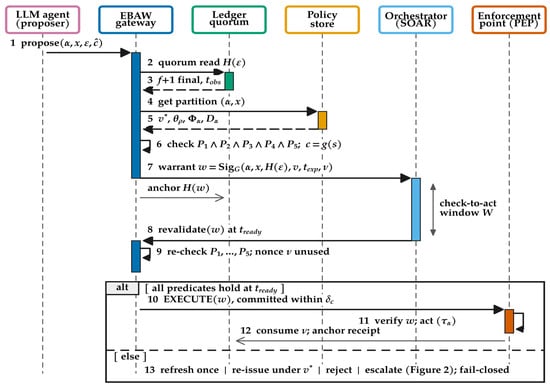
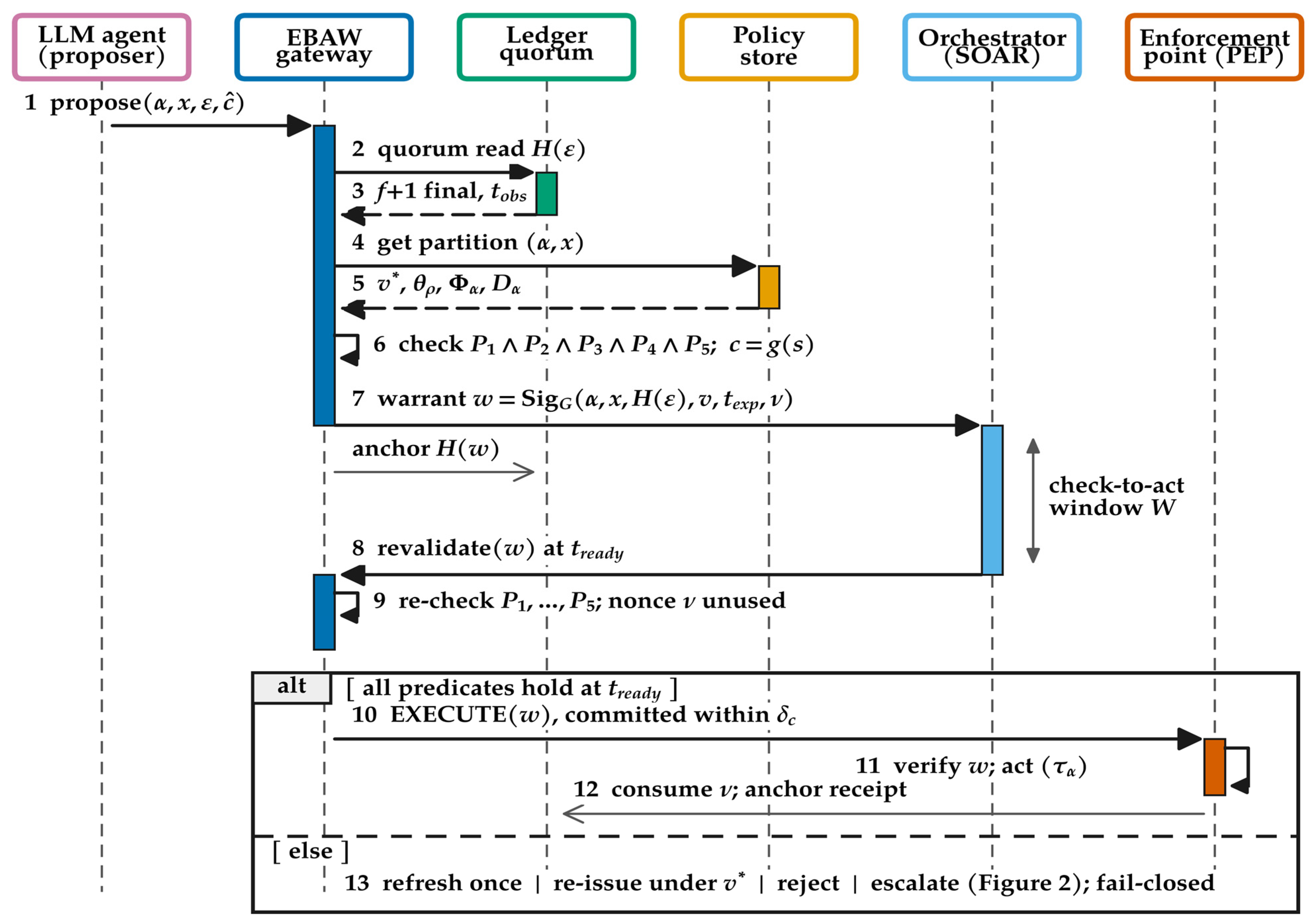
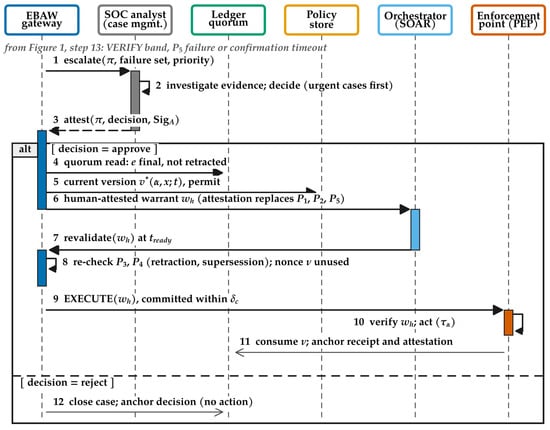
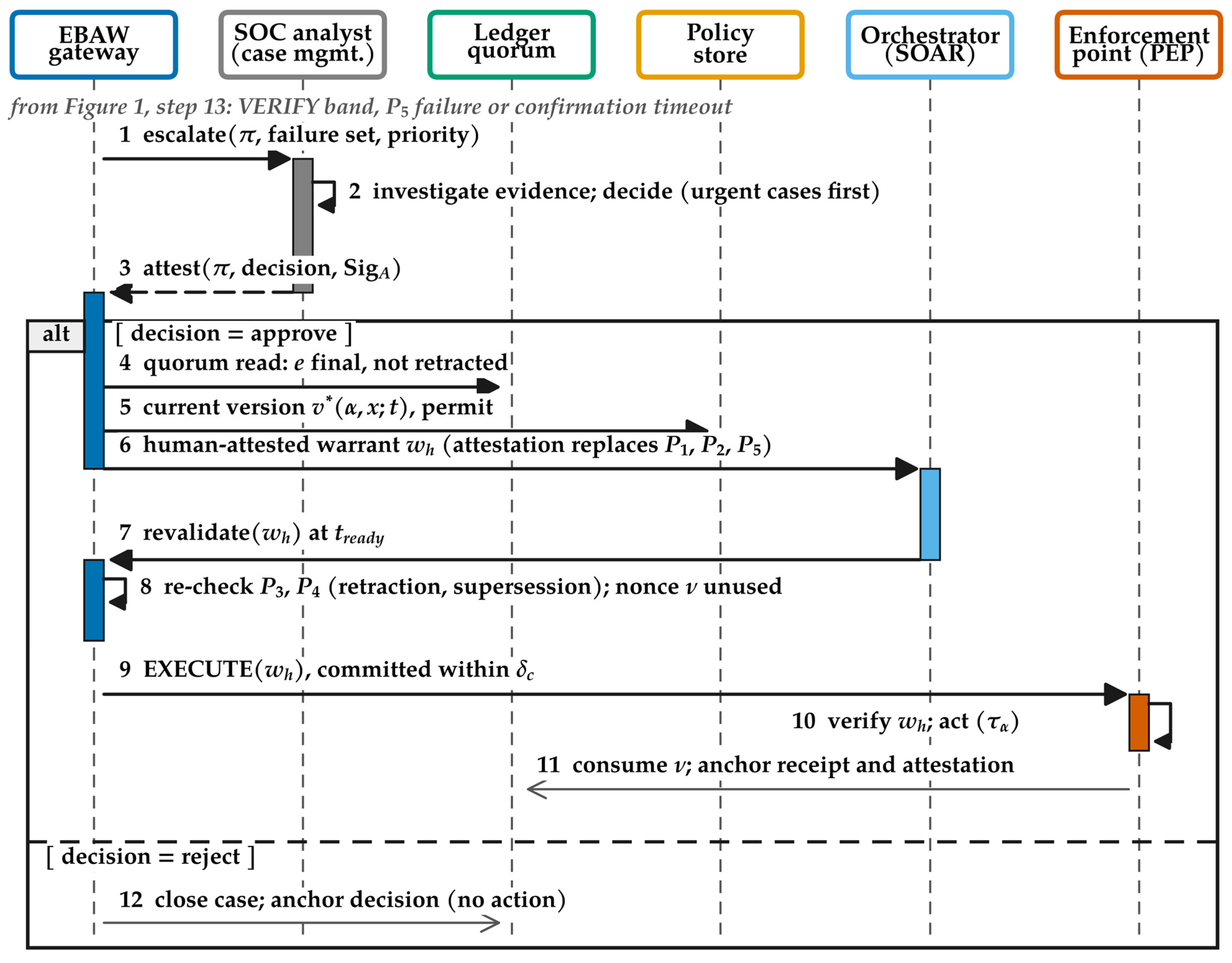
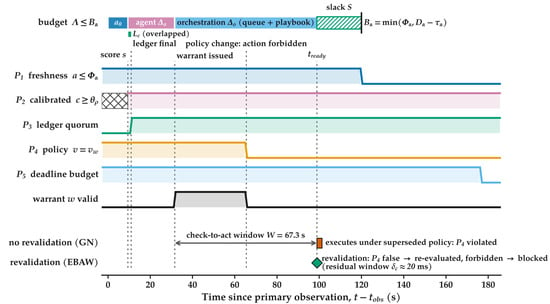
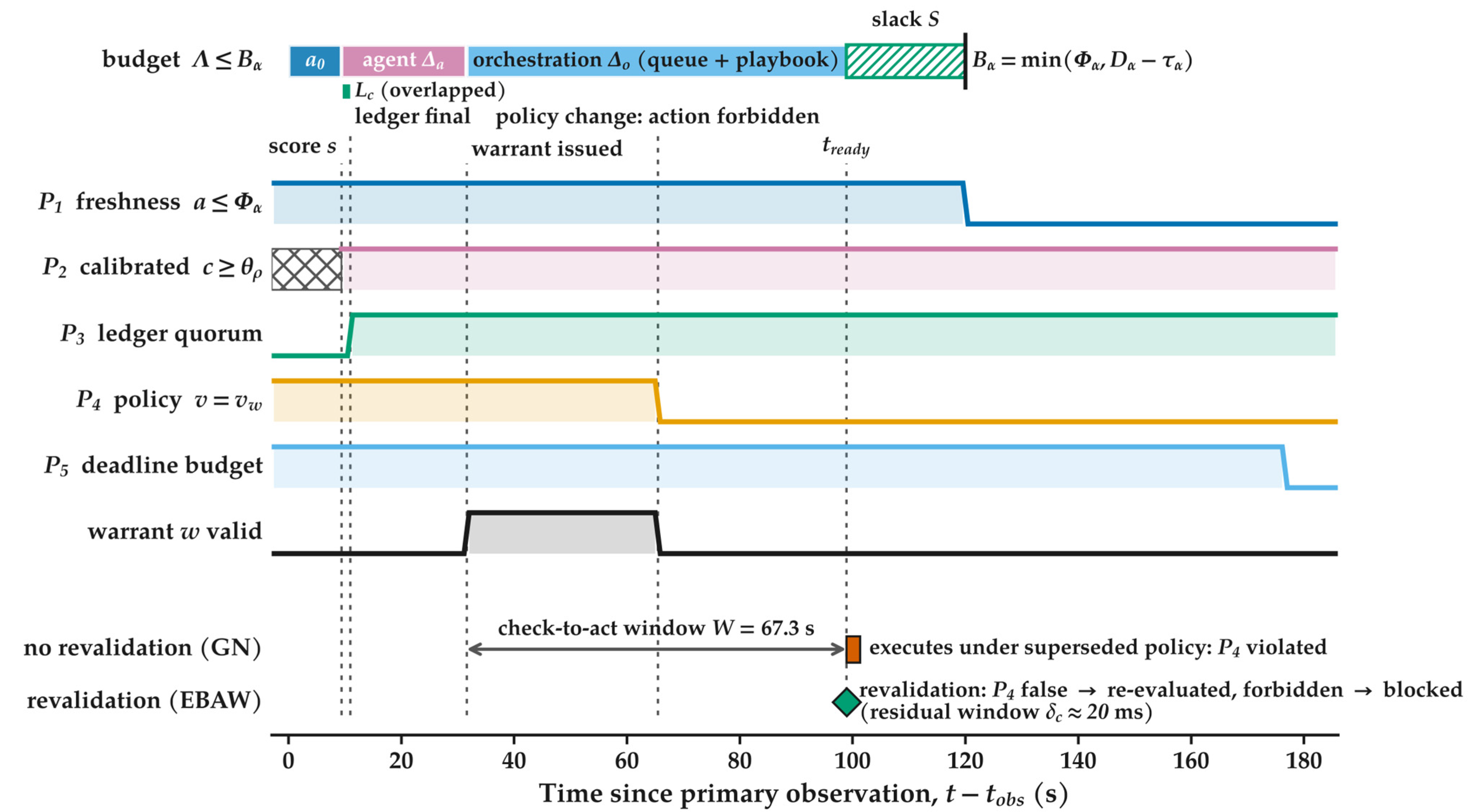
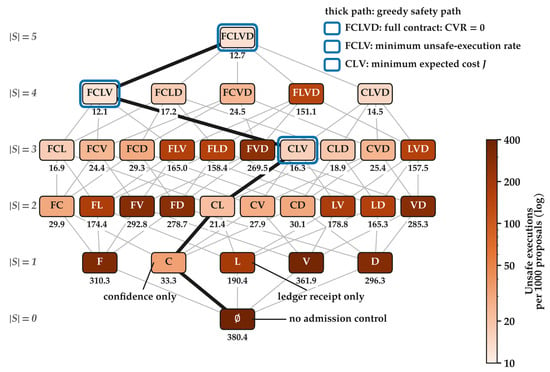
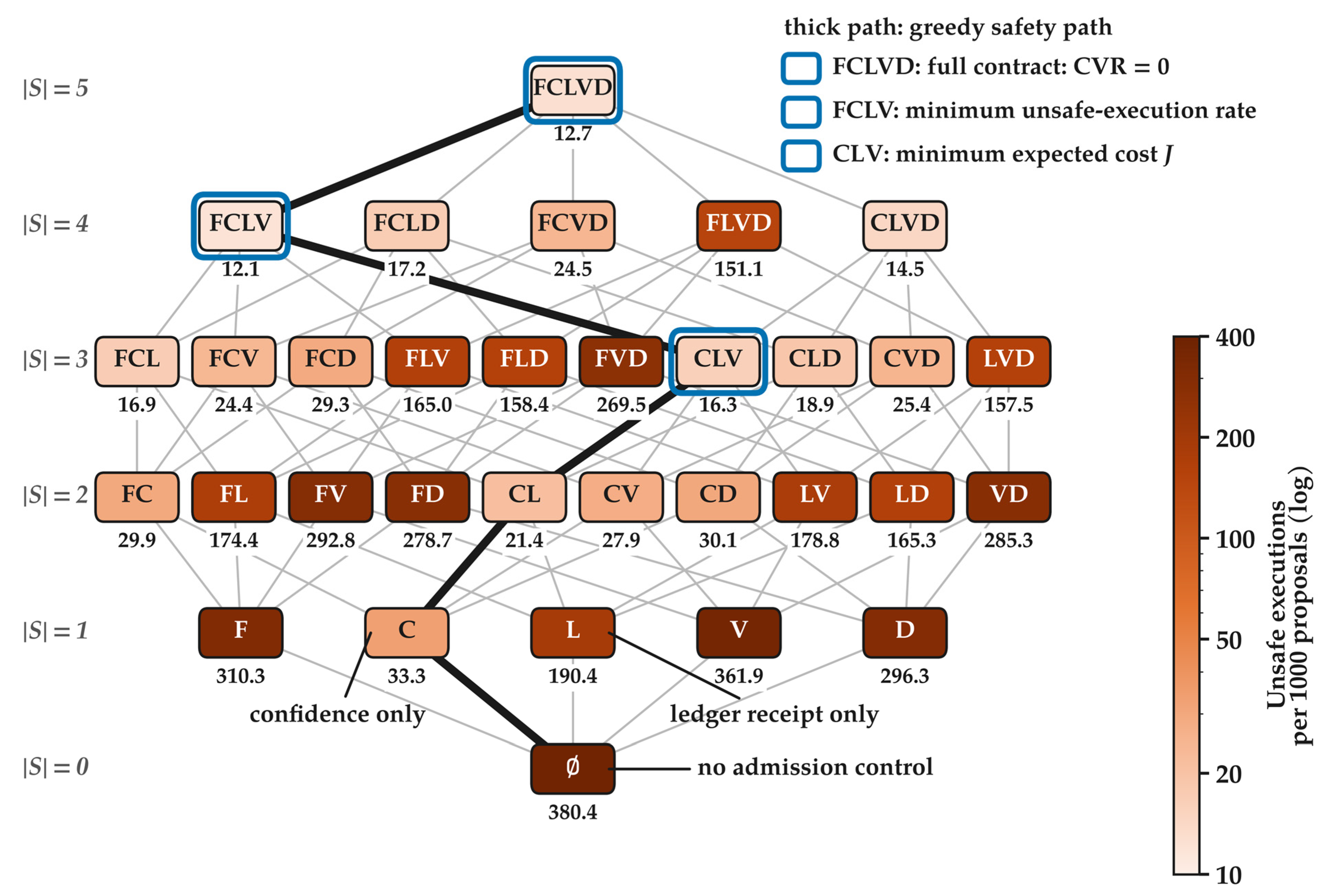
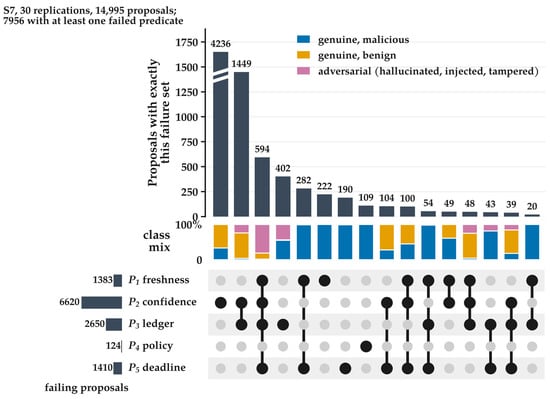
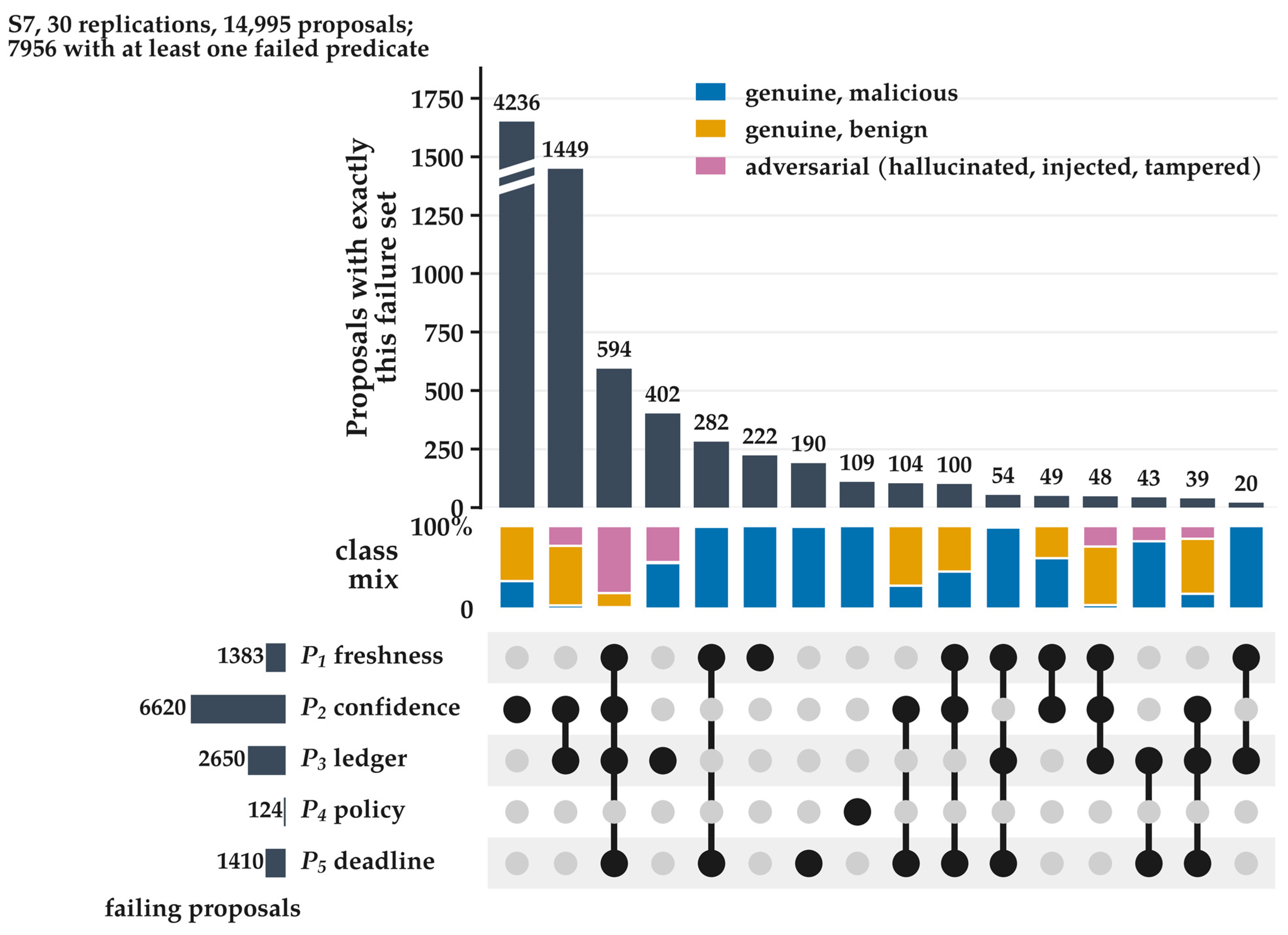
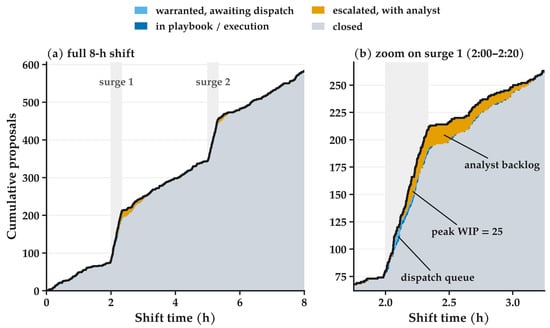
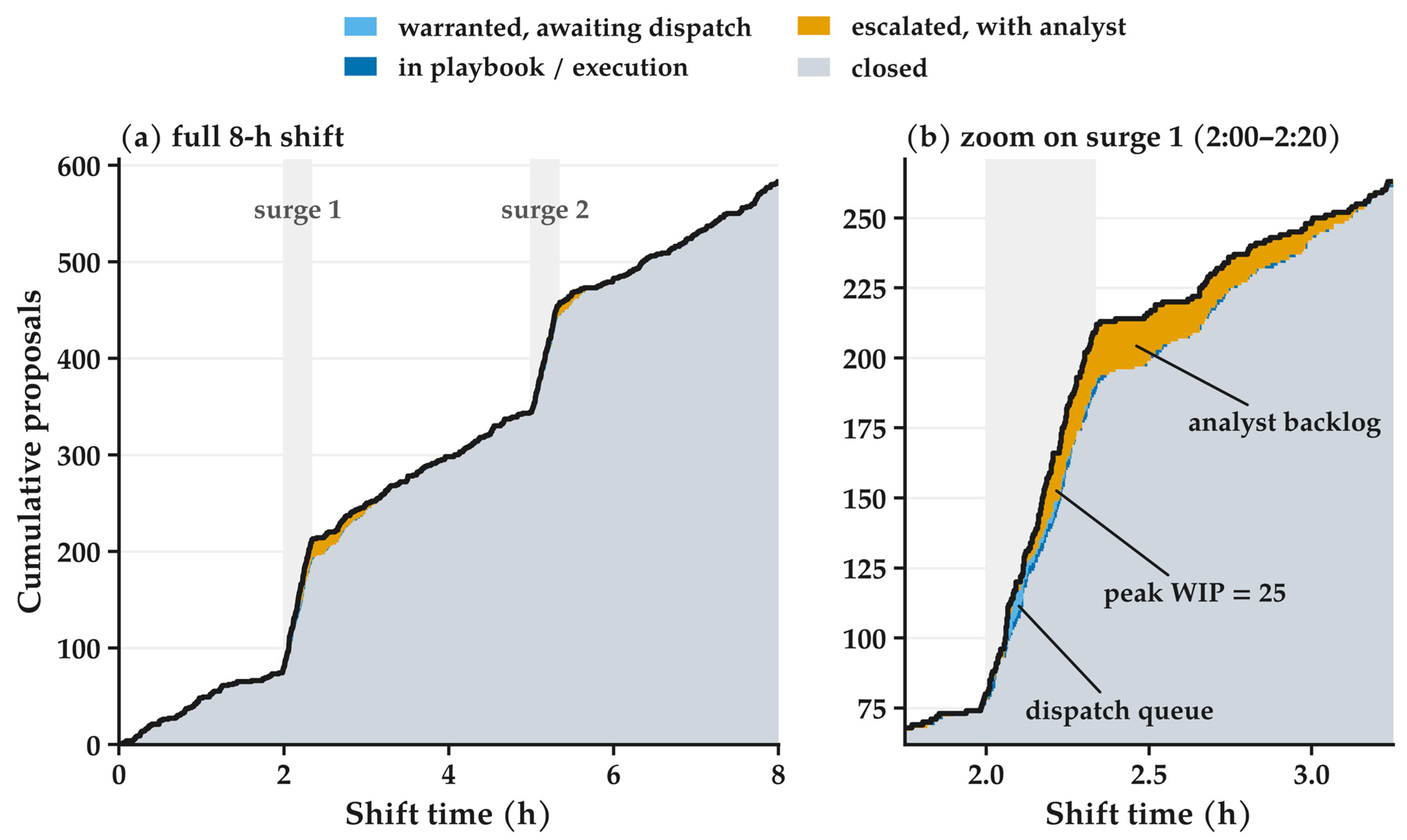
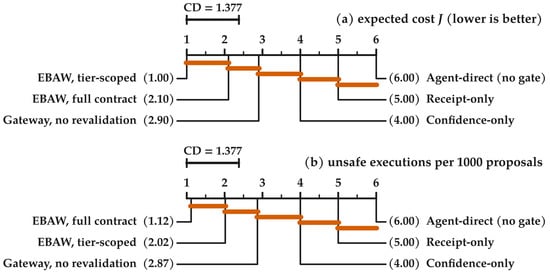
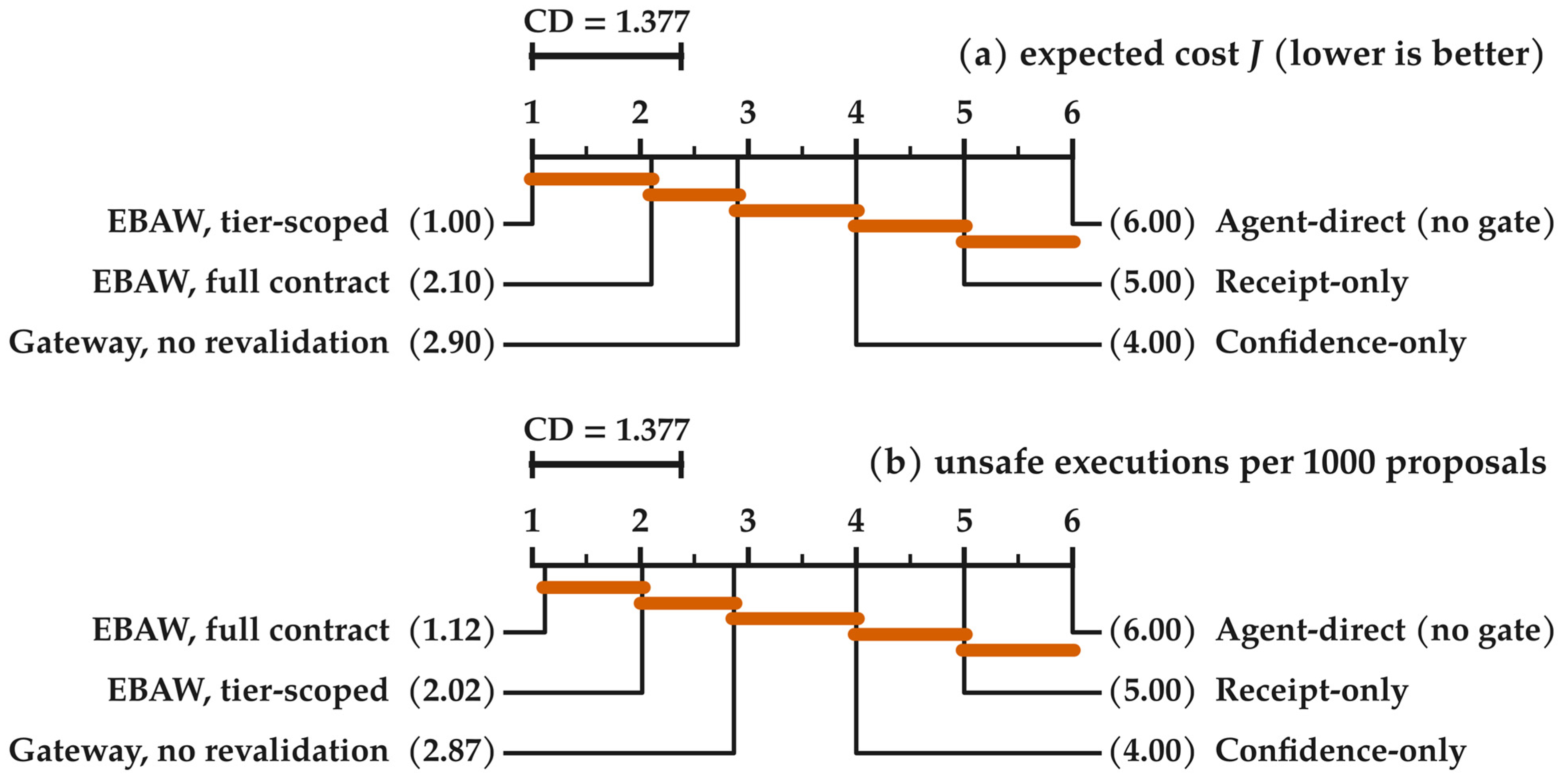
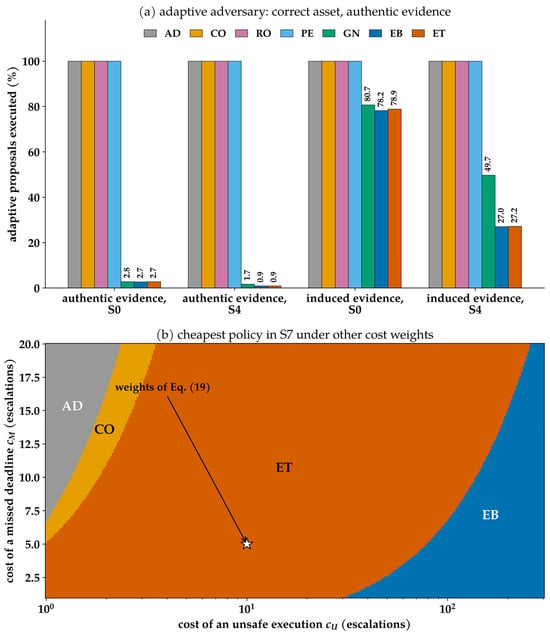
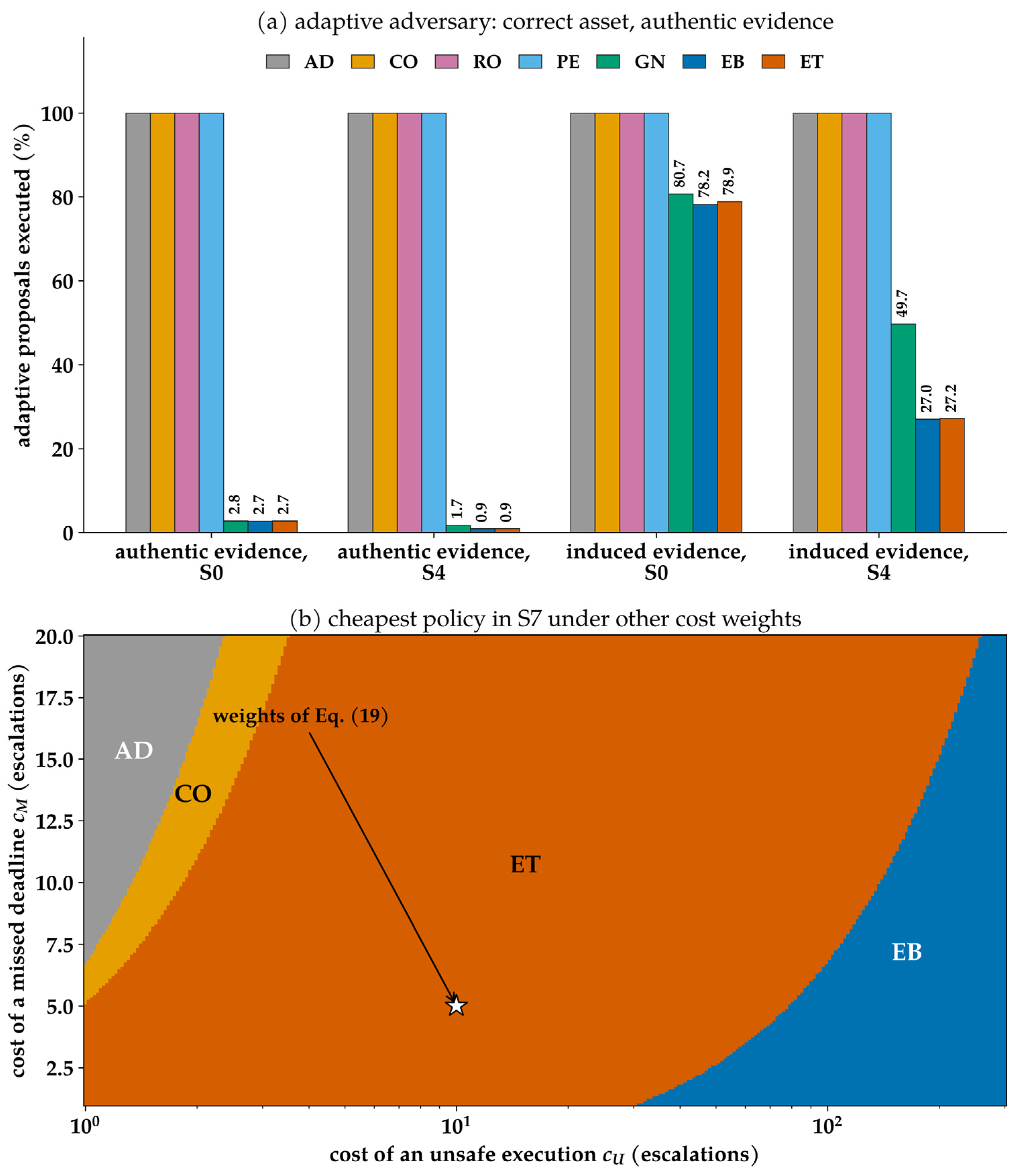

Disclaimer/Publisher’s Note: The statements, opinions and data contained in all publications are solely those of the individual author(s) and contributor(s) and not of MDPI and/or the editor(s). MDPI and/or the editor(s) disclaim responsibility for any injury to people or property resulting from any ideas, methods, instructions or products referred to in the content. |
© 2026 by the authors. Licensee MDPI, Basel, Switzerland. This article is an open access article distributed under the terms and conditions of the Creative Commons Attribution (CC BY) license.