


Abstract
Civil unmanned aerial vehicles (UAVs) serve increasingly diverse applications, yet their technological structure, evolutionary pathways, and future trends remain difficult to characterize. This study analyzes global civil UAV invention patents from the PatSnap database (2005–2024) by integrating BERTopic-based topic identification, semantic–intensity-coupled evolution analysis, and self-attention-enhanced long short-term memory (SA-LSTM) forecasting. Of 61,715 screened patent records, 59,217 texts remained for topic modeling after deduplication by application number and removal of records with missing or invalid text. We identify 30 technology topics grouped into nine categories and distinguish three stages of development: foundational platform development, intelligent capability enhancement, and networked system development. Four major pathways are revealed: from single-UAV stability control to swarm intelligence; from lithium-ion batteries to alternative energy systems and automated replenishment; from point-to-point communication to networked low-altitude systems; and from single-mission applications to integrated multi-scenario operations. Forecasts for 2025–2029 indicate heterogeneous topic trajectories, suggesting development potential in low-altitude communication networks, swarm control, and emerging power systems. Together, these findings provide patent-based evidence to support technology monitoring, screening of candidate R&D directions, and planning of subsequent engineering assessments.
1. Introduction
1.1. Research Background
The low-altitude economy is emerging as a new frontier in technological development and industrial transformation. Civil unmanned aerial vehicles (UAVs) are an important component of this development, serving applications ranging from precision agriculture and environmental monitoring to urban logistics and emergency rescue [1,2,3,4,5]. The expansion of these applications has been accompanied by increasing patent activity. Patent documents record technical solutions and provide an important source for examining technological innovation [6]. According to statistics from Mathys & Squire based on World Intellectual Property Organization data, global patent applications for drone-related technologies reached approximately 19,700 in 2023, representing a year-on-year increase of about 16% [7]. This growing body of patent information provides a basis for examining the technological structure and development of civil UAVs.
Interpreting this information requires attention to the relationships among the technologies involved. Civil UAV innovation spans multiple domains and increasingly depends on system integration [8,9,10]. A UAV system combines airframe structures, propulsion and energy systems, flight control, communication and navigation, environmental sensing, mission payloads, and ground support [11,12,13,14]. As these systems become more autonomous and networked, their technical functions increasingly intersect. Solutions addressing similar functions may appear in different patent classifications, while patents within the same classification may concern different technical objectives. Classification statistics alone therefore provide an incomplete account of the technical content and relationships within this field. Analysis of patent texts can complement these statistics by identifying technology topics, tracing their connections across development stages, and examining their future trajectories.
1.2. Literature Review
The systematic identification, evolutionary analysis, and forecasting of technology topics based on patent data are essential for understanding technological development trajectories and advancing scientific and technological innovation [15,16,17]. Patent data have long been used to examine R&D scale, technology distributions, knowledge diffusion, and technological opportunities [18,19]. Accordingly, this study reviews the literature from three perspectives: patent-based technology topic identification, patent-based technology topic evolution, and patent-based technology forecasting.
1.2.1. Patent-Based Technology Topic Identification
Patent-based technology topic identification applies feature-analysis methods to organize patent documents and extract information systematically. It identifies and synthesizes representative key technologies within a specific technology domain, thereby supporting the tracking of technology evolution trends [20]. Existing studies mainly use three approaches: patent bibliometric analysis [21], patent citation network analysis [22], and patent text analysis [20].
Patent bibliometric analysis primarily relies on structured data, such as patent counts and classification systems, including International Patent Classification (IPC) codes, Cooperative Patent Classification (CPC) codes, and Derwent codes. It conducts quantitative analyses of relevant indicators to reveal development patterns and relationships across technology domains [21]. For example, Zhou et al. [23] used IPC co-classification analysis to construct a knowledge-structure map of hydrogen fuel cell technologies. Liu et al. [24] combined high-frequency IPC codes with their temporal distributions to analyze the structural configuration of electric vehicle charging technologies. Patent bibliometric analysis can reveal macro-level technology distributions. However, classification systems are often updated with a lag, manual indexing practices vary, and this approach provides limited insight into patent text semantics. These constraints limit fine-grained technology identification and may reduce the precision of the identification results.
Patent citation network analysis focuses on the relational structure among technologies. It constructs citation networks among patents and examines their structural characteristics and evolution to characterize technological trajectories and knowledge-diffusion paths [22]. Mariani et al. [25] incorporated temporal information into conventional citation network analysis to identify important patents during the early stages of technology development. Tsay and Liu [14] combined IPC codes with CiteSpace to analyze innovation networks in artificial intelligence systematically and identify potentially important technology directions. Although this approach can represent relationships among technologies, its results depend heavily on observed citation behavior and are susceptible to citation lags and bias toward highly cited patents, which may constrain the identification of emerging technologies.
Patent text analysis mines unstructured information from patent titles, abstracts, and claims and applies natural language processing to identify latent technology topics [20]. Earlier studies often used probabilistic topic models. For example, Garechana et al. [26] applied latent Dirichlet allocation (LDA) to patent analysis and identified multiple technological fronts in 3D printing. Researchers subsequently refined these models in various ways to improve semantic representation. Pölzlbauer and Auer [27] developed a patent-mining toolchain that combined LDA topic modeling, IPC metadata, and visual analysis. Using patents on electric mobility and battery technologies, they identified technology topics and characterized their distributions. In recent years, pretrained language models such as BERT have demonstrated clear advantages in contextual semantic modeling, addressing the limitations of traditional topic models in representing semantic relationships and providing richer semantic representations for technology topic identification [28]. Building on this development, Jeon et al. [29] applied BERTopic to patents related to psychiatric disorders and used topic-similarity calculations to detect technology fronts. Compared with patent bibliometric analysis and patent citation network analysis, patent text analysis relies less on manually defined classification systems and can characterize technology topics at a finer semantic granularity.
1.2.2. Patent-Based Technology Topic Evolution
Technology evolution theory posits that technological development is not a series of isolated random events but rather a dynamic process governed by mechanisms of variation, selection, and retention [30]. Existing studies have systematically analyzed multidimensional data from specific technological domains to reveal how technological forms, functional characteristics, and core knowledge evolve over time, thereby identifying evolutionary pathways and underlying patterns [20]. Two main methodological approaches have emerged: patent citation network analysis and text-mining approaches.
Patent citation network analysis uses structured citation data to characterize relational patterns among technologies. This approach constructs patent citation networks and identifies key nodes and their connections to reveal how knowledge diffuses and recombines across technological domains. For example, building on conventional citation analysis, Li [31] introduced Subject–Action–Object (SAO) analysis to construct a relational network and trained a graph convolutional network (GCN) to predict high-value patents. Zhou et al. [32] used eight-digit IPC codes to analyze the overall evolution of dye-sensitized solar cell technology and the evolutionary pathways of its subsystems. By measuring network structures and their topological properties, these studies reconstructed how technological knowledge evolved over time and provided an important perspective on the macro-level structure of technology evolution.
Text-mining approaches use topic models to extract technological features from large volumes of unstructured patent text. They measure changes in technology topic features across different time windows and calculate similarity matrices to analyze technology topic evolution dynamically. Early studies predominantly relied on LDA. Huang et al. [33] used LDA to identify technology hotspots and trace the evolution of their content in the field of carbon dioxide storage. They also used a logistic curve model to quantitatively forecast technology maturity and development trends. Focusing on China’s hydrogen industry, Liu et al. [34] used an LDA–Word2Vec model to analyze patent data and identified evolutionary pathways, key breakthroughs, and trends across hydrogen production, storage, transportation, and utilization. More recently, BERT has been introduced into technology evolution analysis. Using scholarly publication data, Liu and Wan [35] applied dynamic BERTopic to analyze evolutionary trends in precision agriculture. Yao et al. [36] used a BERT–LDA model to identify fine-grained technology topics in carbon capture, utilization, and storage (CCUS) patents, constructed an evolution network based on temporal correlations among the topics, and drew on knowledge evolution theory to reveal the evolutionary characteristics of technology topics and potential opportunities. These deep semantic mining methods provide more precise quantitative tools for revealing the micro-level evolutionary patterns of complex technological systems.
1.2.3. Patent-Based Technology Forecasting
Technology forecasting draws on historical evolution data and existing technology characteristics and applies systematic analytical methods to assess future development directions, the timing of key breakthroughs, and potential impacts [37]. In the early stages of technology forecasting, limitations in data availability and analytical tools led researchers to rely heavily on expert judgment and qualitative methods. Typical methods included the Delphi method [37], scenario analysis [38], and cross-impact analysis [39].
As technology data expanded rapidly and industrial environments became increasingly complex, approaches relying solely on expert judgment gradually showed limitations in timeliness and forecasting accuracy. Consequently, the integration of data-driven methods has become an important direction in technology forecasting. Current mainstream approaches include social network analysis [40], link prediction [41], and time-series analysis [42]. Social network analysis examines relational structures among technologies. It uses information such as patent classification codes to construct technology co-occurrence networks and characterizes technology development trends by tracking changes in network topology. For example, Cho et al. [43] used IPC co-occurrence information to construct a patent map and combined generative topographic mapping (GTM) with association-rule mining to forecast innovation opportunities in electric motor technology. Chang [44] combined IPC codes with complex network analysis to forecast emerging technology fronts in artificial intelligence.
Link prediction focuses on identifying potential links between technology nodes that have not yet become observable. This approach typically uses network structure or semantic features to construct quantitative measures of node similarity and identify links that may form in the future, thereby revealing potential directions of cross-domain technology convergence. For example, Feng et al. [45] combined an IPC co-occurrence network with a Subject–Action–Object (SAO) semantic network and used a link-prediction algorithm to identify potential innovation directions in electric vehicle technologies.
Time-series analysis captures dynamic patterns in data over time and uses historical time-series features to fit and forecast future trajectories. Although this approach has been widely applied in fields such as econometrics and meteorology, researchers have also introduced it into technology forecasting. Xiang et al. [46] used patent text data and an improved LDA2Vec model to extract disruptive technology topics and then applied an autoregressive integrated moving average (ARIMA) model to quantitatively forecast their development trends. The introduction of deep learning has further improved the capacity to capture high-dimensional temporal features. Hou et al. [47] proposed a multi-indicator model for technology life-cycle identification based on an LSTM–CRF architecture. Using multidimensional patent indicators from the incoPat database, the model predicted the probability of technologies transitioning across life-cycle stages and was validated through a case study of 3D printing technology. Chang et al. [48] developed SAFE-LSTM, which integrates self-attention and frequency enhancement, and constructed a future technology interaction map by forecasting the strength of connections between patent classification codes.
1.3. Research Gaps and Contributions
The literature provides methods for identifying technology topics, tracing their evolution, and forecasting their development. Applying these methods to civil UAV technologies requires three issues to be addressed. First, frequency-based topic representations can obscure contextual relationships among specialized terms in condensed patent abstracts, particularly when related technical functions appear across different classifications. Topic identification therefore requires representations that retain technical meaning while producing interpretable topic groupings. Second, semantic similarity and technology intensity describe different aspects of evolution. Similarity indicates connections in technical content, whereas intensity characterizes the development of the associated topics. Examining either dimension alone provides an incomplete basis for comparing cross-stage evolutionary associations. Third, although LSTM-based models capture temporal dependencies, their recurrent structure does not provide explicit attention weights for individual historical time steps. Forecasting topic-level technology intensity therefore warrants examining whether temporal attention can improve the use of historical observations.
To address these issues, this study analyzes civil UAV invention patents from the PatSnap global patent database covering 2005–2024. It connects BERTopic-based topic identification, semantic–intensity-coupled evolution analysis, and self-attention-enhanced forecasting within a common analytical framework. The analysis proceeds from identifying the technological structure of civil UAVs to tracing cross-stage pathways and forecasting changes in comprehensive technology intensity. The contributions are as follows.
First, we apply BERTopic to identify fine-grained technology topics from civil UAV patent texts using contextual document embeddings. A large language model (LLM) assists in generating candidate topic labels from topic keywords and representative patent abstracts. These labels support the interpretation of the identified technological structure.
Second, we develop a semantic–intensity-coupled evolution model that combines comprehensive technology intensity with semantic similarity across adjacent time windows. The resulting technology evolution flux measure characterizes the strength of cross-stage associations and supports the identification of continuation, differentiation, fusion, and transition among civil UAV technologies.
Third, we employ a self-attention-enhanced long short-term memory (SA-LSTM) model to forecast comprehensive technology intensity. The attention mechanism assigns weights to historical time steps according to their relevance to the forecast. Its forecasting performance is compared with statistical and machine-learning baselines to assess its suitability for the observed technology intensity series.
2. Materials and Methods
2.1. Data Collection and Preprocessing
2.1.1. Data Collection
This study used the PatSnap global patent database as its data source. The search was conducted on 30 May 2026. Because civil UAV technologies span multiple technological domains, keywords were combined with CPC codes using the following search query:
(TA_ALL:(“UAV” OR “Drone” OR “无人机” OR “Unmanned Aerial Vehicle”)) AND (CPC:(B64)).
In this query, TA_ALL specifies a combined search of patent titles, abstracts, claims, descriptions, and other searchable text fields to cover the diverse expressions used for civil UAVs in different contexts. CPC:(B64) restricts the results to patent records assigned to CPC class B64, thereby improving their technical relevance to civil UAVs.
Considering the approximately 18-month lag between patent filing and publication [6], this study included invention patent records with application dates between 1 January 2005 and 31 December 2024. This cutoff was intended to reduce the effect of publication delays on recent-year patent counts.
To identify patent records relevant to civil UAV technologies, four researchers independently screened the retrieved records, primarily by examining patent abstracts. The following exclusion criteria were applied:
(1) Patents explicitly directed to military applications were excluded from the dataset.
(2) Patents concerning toy or recreational model aircraft without substantive technical relevance to civil UAV systems were excluded.
(3) Patents mentioning UAVs solely as carriers or application platforms, without disclosing technical solutions concerning UAV systems or UAV-specific technologies, were excluded.
(4) Patents mentioning UAVs but focusing on other equipment or general-purpose technologies unrelated to civil UAV systems were excluded.
(5) Records containing insufficient information to assess their relevance to civil UAV technologies were excluded.
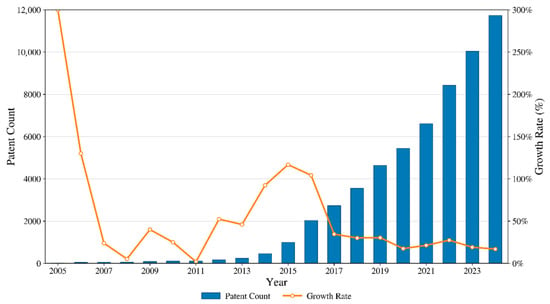
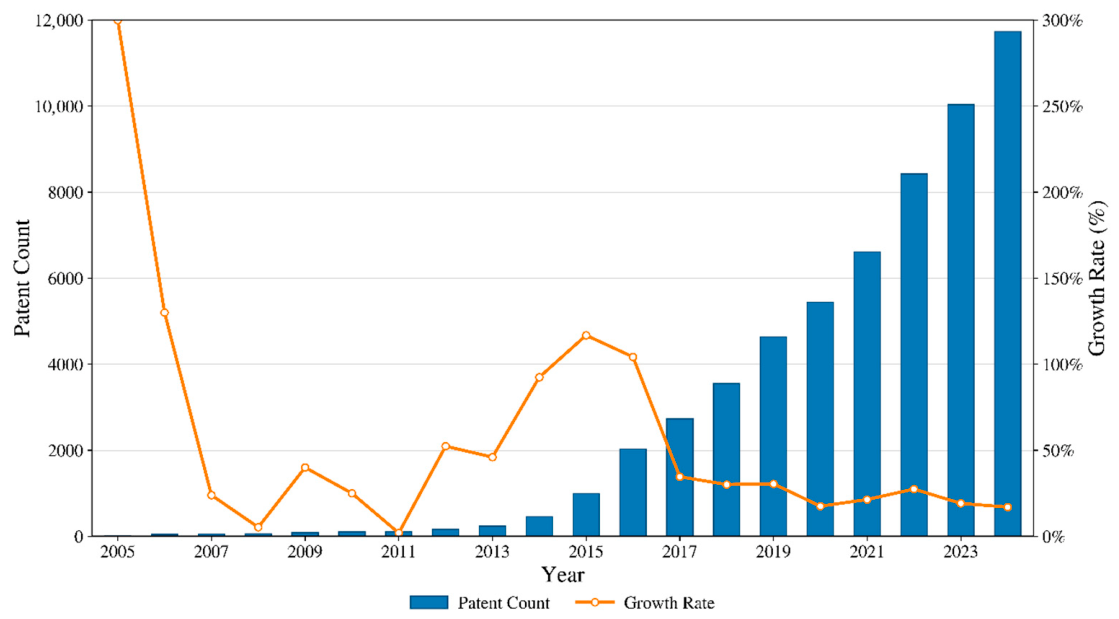
Disagreements over eligibility were resolved through three rounds of discussion, resulting in consensus among all four researchers. A total of 61,715 patent records were retained after relevance screening. Figure 1 presents their annual distribution.
Figure 1.
Annual civil UAV patent applications and growth rates.
2.1.2. Data Preprocessing
To improve the accuracy of technology topic modeling and the effectiveness of text feature extraction, patent titles and abstracts were used to construct the modeling corpus. The following preprocessing steps were performed.
(1) Data cleaning. The modeling texts were constructed by combining the Chinese-language title and abstract fields exported from PatSnap. Duplicate records were removed using patent application numbers, and records with missing or invalid text were excluded, leaving 59,217 patent texts for topic modeling. Punctuation marks, numbers, and other special characters were removed from the retained texts to reduce textual noise.
(2) Word segmentation and domain lexicon construction. Chinese patent texts were segmented using Jieba, an open-source Python package developed by Junyi Sun. A domain-specific lexicon was constructed by adding civil UAV terms such as flight control systems, compound-wing configurations, and vertical takeoff and landing to improve the segmentation of technical terms.
(3) Stop-word filtering. After the initial segmentation, the Baidu stop-word list was used to remove common but uninformative particles, conjunctions, and pronouns. Additional high-frequency terms lacking specific technical meaning were also removed. This step reduced interference from redundant information and retained terms that more accurately represented specific technological content and characteristics.
2.2. Research Design
This study constructed an integrated analytical framework combining LLM-enhanced topic modeling, semantic–intensity-coupled evolution analysis, and self-attention-enhanced deep learning forecasting. The framework examines civil UAV technological innovation through three connected components: technology topic identification, technology topic evolution, and technology trend forecasting.
2.2.1. Technology Topic Identification Model for Civil UAVs
This study constructed a modular BERTopic framework for technology topic identification. BERTopic moves beyond methods based solely on conventional frequency statistics by integrating the semantic representation capabilities of Transformer architectures with density-based clustering, thereby producing semantically coherent and clearly differentiated topic clusters [49]. The workflow comprised three modules: patent text embedding and manifold dimensionality reduction, hierarchical density-based topic clustering, and topic semantic representation and label generation.
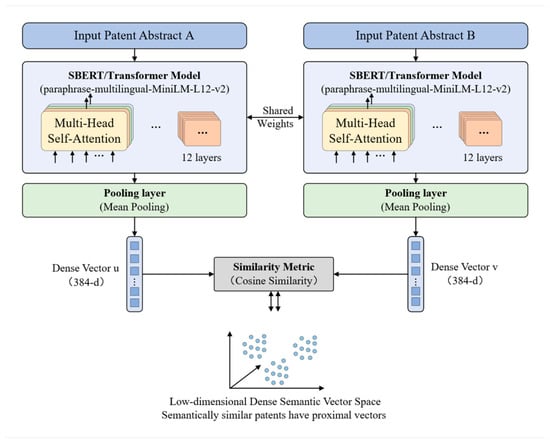
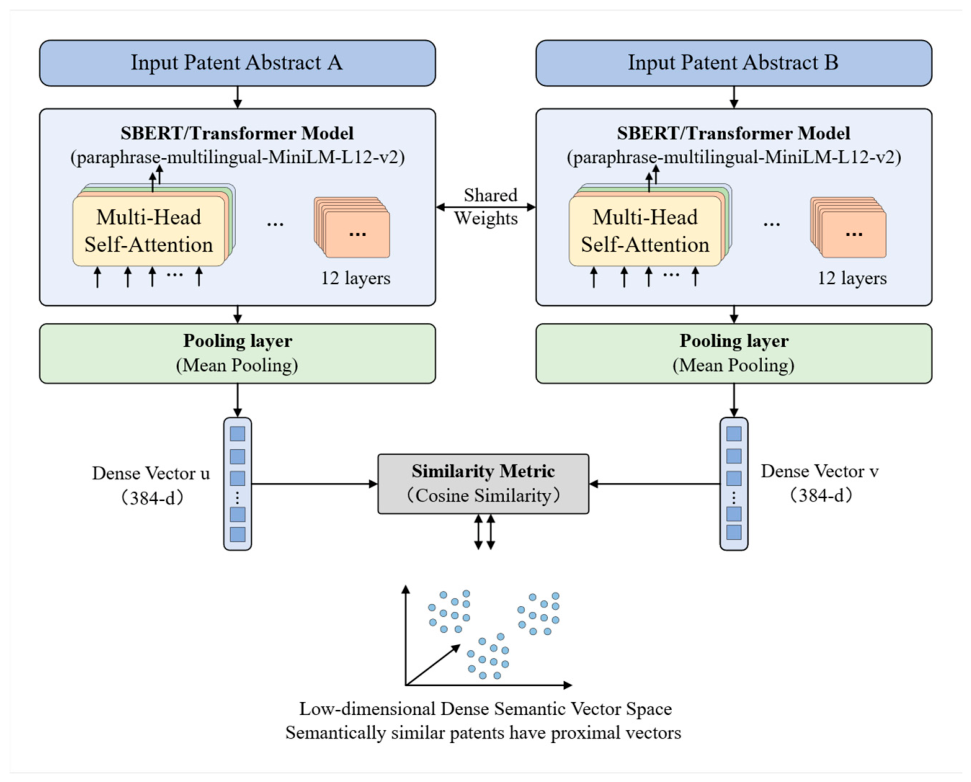
First, patent text embedding and manifold dimensionality reduction were performed using a two-stage strategy. The patent texts were initially encoded as high-dimensional semantic embeddings and then projected into a low-dimensional dense semantic space, as shown in Figure 2.
Figure 2.
Patent text embedding and UMAP dimensionality reduction.
Multidimensional semantic encoding with Sentence-BERT (SBERT). The pretrained paraphrase-multilingual-MiniLM-L12-v2 model was used to encode the preprocessed patent titles and abstracts. Mean pooling was applied to extract global features [50], converting each text sequence into a fixed-length 384-dimensional dense vector.
Manifold dimensionality reduction with Uniform Manifold Approximation and Projection (UMAP). UMAP projected the 384-dimensional vectors into a lower-dimensional space, with key parameters such as neighborhood size (n_neighbors) and minimum distance (min_dist) adjusted during model configuration [51]. This process reduced dimensional redundancy and limited the influence of noise while preserving the manifold structure required for subsequent density-based clustering.
Second, hierarchical density-based topic clustering was performed. Hierarchical Density-Based Spatial Clustering of Applications with Noise (HDBSCAN) was used to cluster the reduced document embeddings into candidate technology topics [52]. By adjusting key parameters such as minimum cluster size (min_cluster_size) and minimum samples (min_samples), HDBSCAN constructed a weighted graph based on mutual-reachability distance and generated a corresponding hierarchical cluster tree. The tree was subsequently pruned and condensed to extract topic clusters that remained highly stable across different density levels.
Third, topic semantic representation and label generation were conducted by combining class-based term frequency–inverse document frequency (c-TF-IDF), maximum marginal relevance (MMR), and an LLM.
c-TF-IDF treated all documents assigned to the same topic as a single class-level document. It identified discriminative core terms by calculating term frequency within each class-level document and inverse document frequency across classes.
MMR improved topic-term diversity by reranking candidate terms according to their relevance to the topic and their novelty relative to terms already selected [53]. This procedure enabled the selected keywords to cover a broader range of technological subdomains and improved the representation of each technology topic.
The MMR objective is given in Equation (1).
In this equation, Di denotes a candidate keyword, and Q is the topic centroid vector containing the core semantic features of the topic. R is the complete set of initial candidate keywords, whereas S is the set of selected keywords. R∖S denotes the candidate keywords that have not yet been selected, and Dj denotes a keyword already included in S. Sim1(Di,Q) is the cosine similarity between a candidate keyword and the topic centroid vector, whereas Sim2(Di,Dj) measures semantic redundancy between a candidate keyword and a selected keyword. The diversity parameter λ balances topic relevance against coverage of different technological subdomains and ranges from 0 to 1. During the first iteration, the candidate keyword with the highest similarity to Q is added to S; the remaining keywords are then selected sequentially using Equation (1).
LLM-enhanced semantic refinement and topic label generation. The top 10 core keywords selected using c-TF-IDF and MMR, together with representative patent abstracts having the highest cosine similarity to the topic, were provided to the LLM in a structured prompt. The LLM synthesized the dispersed technological terms and generated concise, academically appropriate, and readily interpretable technology topic labels [54].
After topic modeling, the key parameter combinations for the UMAP and HDBSCAN modules were compared. Clustering performance was evaluated using the noise ratio, silhouette coefficient, and Davies–Bouldin index. A lower noise ratio indicates that a larger proportion of the text samples are assigned to valid clusters; a higher silhouette coefficient indicates stronger separation among technology topics; and a lower Davies–Bouldin index indicates better clustering performance. Table 1 presents the results obtained after multiple experiments and parameter adjustments. Based on the three metrics, configuration D was selected.
Table 1.
BERTopic hyperparameters and clustering performance.
2.2.2. Technology Evolution Model for Civil UAVs
The civil UAV technology evolution model uses two indicators: comprehensive technology intensity and semantic similarity between technology topics. Comprehensive technology intensity summarizes each topic’s activity, influence, novelty, and multidimensional value within a given time window. Let Tt,i denote technology topic i in stage t, and let Tt+1,j denote target topic j in stage t + 1. Their comprehensive technology intensities are denoted by It,i and It+1,j, respectively.
For each stage, comprehensive technology intensity was calculated as the entropy-weighted sum of eight normalized indicators: topic popularity (0.1466), attention (0.1220), impact (0.1614), novelty (0.1159), market value (0.1188), technological value (0.1193), economic value (0.1173), and strategic value (0.0985). A higher comprehensive technology intensity indicates greater node attractiveness within the evolution network and a greater likelihood that the corresponding topic will serve as a central hub in an evolutionary pathway.
Semantic similarity between technology topics serves as a proxy for potential knowledge continuity or flow between topics in adjacent stages and thereby helps explain evolutionary pathways. Cosine similarity was used to calculate the semantic similarity between topics in adjacent stages. Let the semantic vectors of source topic Tt,i and target topic Tt+1,j be Vt,i and Vt+1,j, respectively. Their similarity is denoted by Sim(Vt,i,Vt+1,j). Within the model, semantic similarity is treated as a transmission coefficient. A higher value is interpreted as lower resistance to potential knowledge flow and a greater likelihood of technological inheritance or transition.
Furthermore, to quantify the strength of the evolutionary association between source topic Tt,i and target topic Tt+1,j, this study drew on Lin et al. [55] and integrated comprehensive technology intensity with semantic similarity between technology topics to define a technology evolution flux measure, as shown in Equation (2).
The technology evolution flux measure indicates the strength of the cross-stage association from source topic i in stage t to target topic j in stage t + 1. By jointly considering comprehensive technology intensity and semantic similarity between technology topics, this measure was used to identify principal evolutionary pathways with strong cross-stage associations.
2.2.3. Technology Forecasting Model for Civil UAVs
Technology evolution analysis identifies cross-stage relationships among technology topics, whereas technology trend forecasting further examines how the comprehensive technology intensity of each topic may change along its observed trajectory. This study introduced an SA-LSTM model to forecast comprehensive technology intensity. The forecasting procedure comprised three steps.
First, a stacked LSTM architecture [56] was used to extract high-dimensional latent features from the time series and model long-sequence dependencies. An LSTM unit regulates information flow through the cell state using a forget gate, an input gate, and an output gate. At time t, given input vector xt, the unit updates its internal state through these three gates. The forget gate determines which information from the previous cell state is retained or discarded. The input gate determines how the current candidate information is incorporated into the cell state, and the output gate generates the current hidden state from the updated cell state. Two stacked LSTM layers were used to strengthen the model’s capacity to represent complex nonlinear patterns. The input sequence is defined in Equation (3).
X = [x1,x2,⋯,xT]
After processing the input sequence, the LSTM layers produce the hidden-state sequence defined in Equation (4).
In this equation, H is the hidden-state sequence produced by the LSTM, ht is the hidden state at time step t, and dh is the dimension of the LSTM hidden state. This sequence is passed to the subsequent attention layer and provides a temporal feature representation for each time step.
Second, self-attention calculates the relative contribution of each historical time step to the forecast and adaptively weights the temporal features. The hidden-state sequence H is mapped to a query matrix Q, key matrix K, and value matrix V. Dot-product attention scores between Q and K are calculated to obtain the attention weights, which are then used to compute a weighted combination of V, as defined in Equation (5).
Q = HWQ,K = HWK,V = HWV
WQ, WK, and WV are the linear projection matrices used to generate the query, key, and value matrices, respectively.
Scaled dot-product attention is defined as follows:
The attention-weighted output is then calculated as follows:
where dk is the projection dimension of the query and key matrices, and A is the normalized attention-weight matrix representing the relative attention assigned across time steps. H′ is the attention-weighted feature sequence. This mechanism allows the model to assign greater weight to historical time steps that contribute more strongly to the forecast, thereby enhancing informative temporal features.
H′ = AV
Third, a fully connected network performs nonlinear mapping and generates the forecast. The attention-weighted sequence H′ contains the global temporal representation. To obtain the final forecast, the feature vector at the final time step was entered into a fully connected regression network.
The output network comprised two linear layers with a rectified linear unit (ReLU) activation function between them to increase the nonlinear fitting capacity. A dropout mechanism with a rate of 0.2 randomly deactivated a subset of activations during training, helping to prevent overfitting and improve generalization to unseen data. The final output is calculated as follows:
where is the final-time-step feature produced by the attention layer; W1 and W2 are the weight matrices of the fully connected layers; b1 and b2 are the bias vectors; and is the final forecast.
The core SA-LSTM hyperparameters are reported in Table 2.
Table 2.
SA-LSTM hyperparameter settings.
To evaluate the proposed SA-LSTM model, its forecasts were compared with those generated by autoregressive integrated moving average (ARIMA), k-nearest neighbors (KNN), a support vector machine (SVM), and a standard LSTM. These models were selected as baselines for technology topic forecasting. All models used the same chronologically ordered 80% training and 20% testing split and were evaluated on the held-out test set using MAE, RMSE, and R2. For KNN, SVM, LSTM, and SA-LSTM, the min–max-normalized series were converted into supervised samples using a three-year sliding window, with the preceding three years used to predict the following year. ARIMA orders were selected using the Akaike information criterion (AIC), whereas KNN and SVM hyperparameters were optimized within predefined search ranges; LSTM and SA-LSTM were tuned under comparable core settings. The comparative forecasting performance of the five models is presented in Table 3.
Table 3.
Performance comparison of forecasting models.
Forecasting performance differed markedly across the models. Both LSTM and SA-LSTM produced substantially lower MAE and RMSE values than ARIMA, SVM, and KNN, and their R2 values exceeded 0.86. The relatively weaker performance of ARIMA suggests that a conventional linear time-series specification was less well suited to the nonlinear and time-varying patterns in this dataset.
Compared with the standard LSTM, SA-LSTM improved all three evaluation metrics. MAE decreased from 15.6355 to 10.7105, RMSE decreased from 18.2136 to 13.1307, and R2 increased from 0.8634 to 0.8815.
3. Results and Discussion
3.1. Distribution of Civil UAV Technology Topics
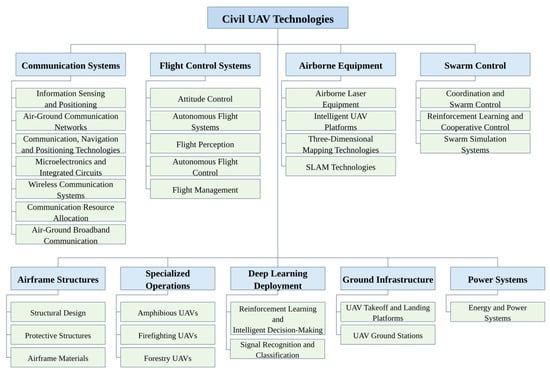
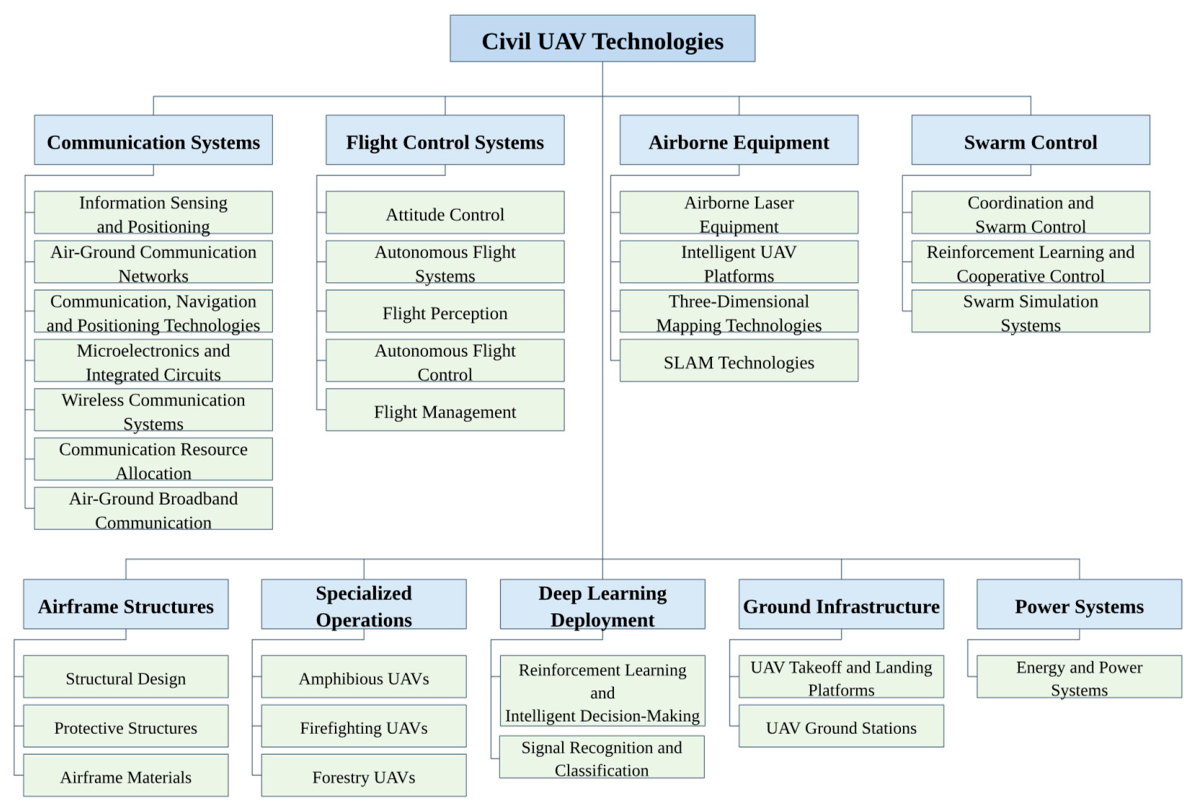
Figure 3 presents the 30 technology topics identified for civil UAVs. Based on expert assessment, these topics were grouped into nine technology categories.
Figure 3.
Taxonomy of civil UAV technologies.
Communication systems (T0, T10, T11, T12, T19, T26, and T29) cover the information links and electronic hardware used in UAV operation. Their topics include sensing, navigation and positioning, air–ground and wireless communication, microelectronics and integrated circuits, and communication resource allocation. Flight control systems (T8, T16, T27, T28, and T31) focus on aircraft control and flight management, including attitude control, flight perception, and autonomous flight.
Swarm control (T5, T21, and T34) focuses on cooperative operation and simulation of multi-UAV systems. Reinforcement learning in this category concerns cooperative control, whereas deep learning deployment (T6 and T15) includes reinforcement learning for intelligent decision-making and techniques for signal recognition and classification.
Airframe structures (T1, T13, and T25) and power systems (T32) concern aircraft structure and energy supply, respectively. Structural topics cover design, protective structures, and airframe materials; the power topic covers energy storage and management. Ground infrastructure (T24 and T33) covers takeoff and landing platforms and ground stations supporting charging and routine operations.
Airborne equipment (T2, T4, T14, and T36) covers onboard platform, sensing, and mapping technologies, including airborne laser equipment, intelligent UAV platforms, three-dimensional mapping, and simultaneous localization and mapping (SLAM). Specialized operations (T3, T7, and T17) concern application-specific UAV technologies for amphibious operations, firefighting, and forestry.
3.2. Analysis of Civil UAV Technology Evolution
3.2.1. Identification of Evolutionary Stages
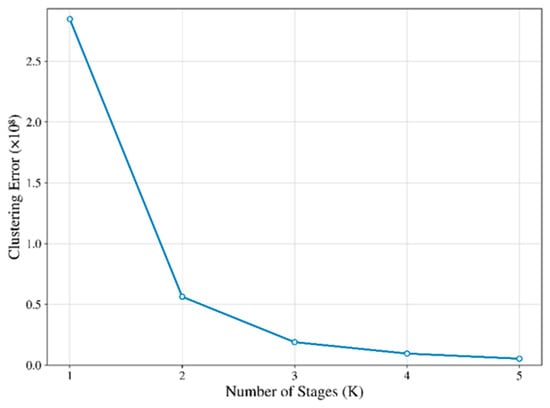
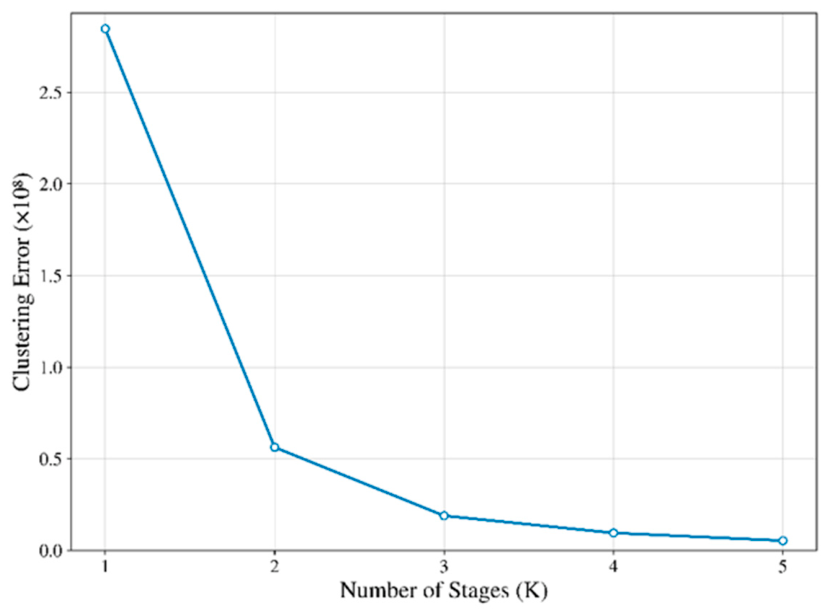
This study used Fisher ordered clustering to divide the patent samples into developmental stages. As shown in Figure 4, the clustering error decreased as the number of segments, k, increased. At k = 3, the marginal reduction in clustering error diminished markedly, producing a clear elbow in the curve. Accordingly, civil UAV development was divided into three stages.
Figure 4.
Fisher ordered clustering errors.
The first stage (2005–2014) was characterized by a low level of patent activity and slow growth. Core technologies remained under development, and UAV application scenarios had not yet expanded widely. The industry was therefore primarily engaged in technological accumulation and exploratory applications, corresponding to an early exploratory phase of the technology life cycle.
The second stage (2015–2020) was characterized by rapid growth in patent applications. This growth was associated with advances in key technologies, the broad expansion of consumer- and industrial-grade civil UAV applications, increasing market demand, and the entry of additional innovation actors. Civil UAV technology was therefore in a rapid growth phase during this period.
During the third stage (2021–2024), patent applications remained at a high level, but their growth rate slowed relative to the preceding stage. The industry entered a high-level plateau as the core software and hardware architectures of civil UAVs became increasingly stable. During the same period, the low-altitude economy was elevated to a national strategic priority in China, and the industry increasingly shifted from rapid expansion toward standardized, scenario-oriented, and system-level development.
3.2.2. Analysis of Civil UAV Technology Evolutionary Pathways
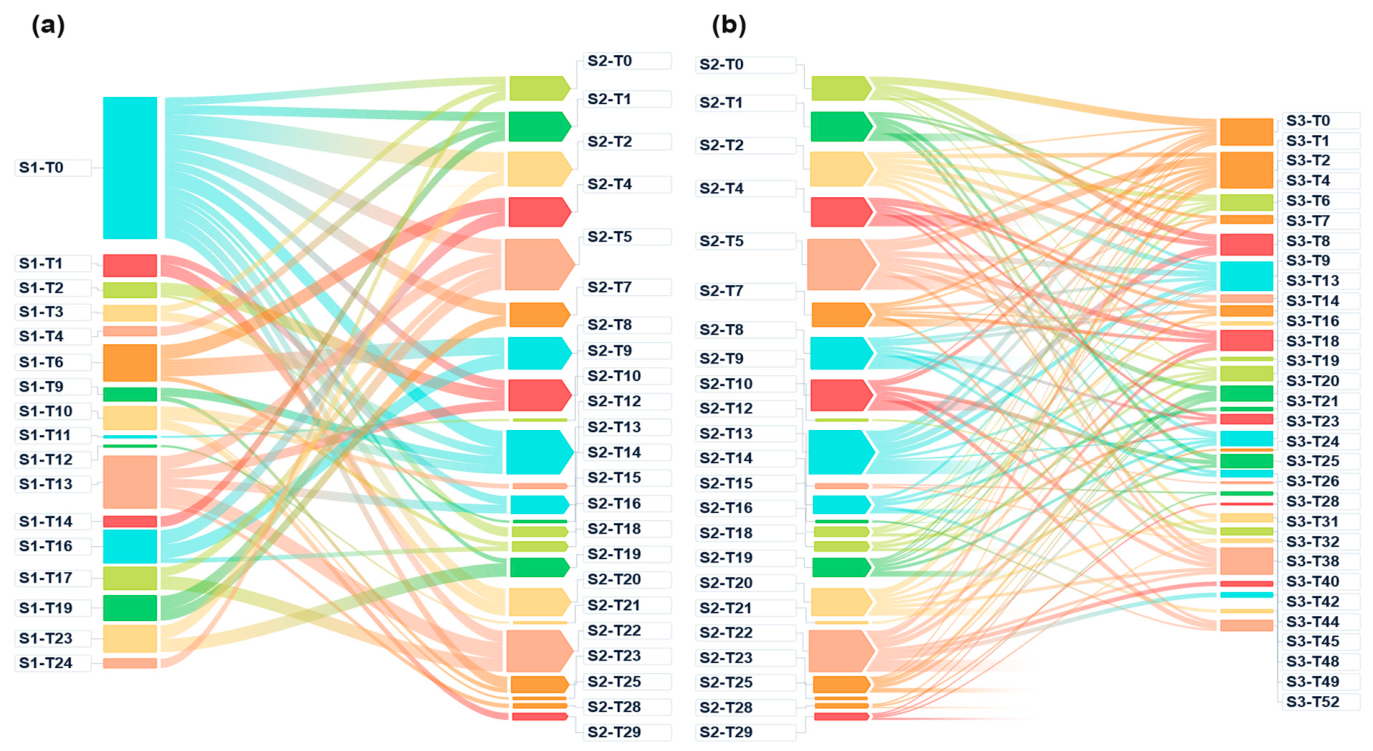
The three-stage evolution network of civil UAV technologies is shown in Figure 5. The nodes represent technology topics, the links represent evolutionary associations between topics, and the link width represents the magnitude of the technology evolution flux measure. The labels S1-T, S2-T, and S3-T denote stage-specific topic states used to characterize cross-stage technology evolution. By tracing pathways longitudinally from S1 through S2 to S3, this study identified four major directions associated with civil UAV technological development.
Figure 5.
Cross-stage evolution network of civil UAV technologies: (a) Stage 1 (2005–2014) to Stage 2 (2015–2020); (b) Stage 2 (2015–2020) to Stage 3 (2021–2024). Nodes represent technology topics in each stage, and link widths indicate the magnitude of cross-stage evolution flux.
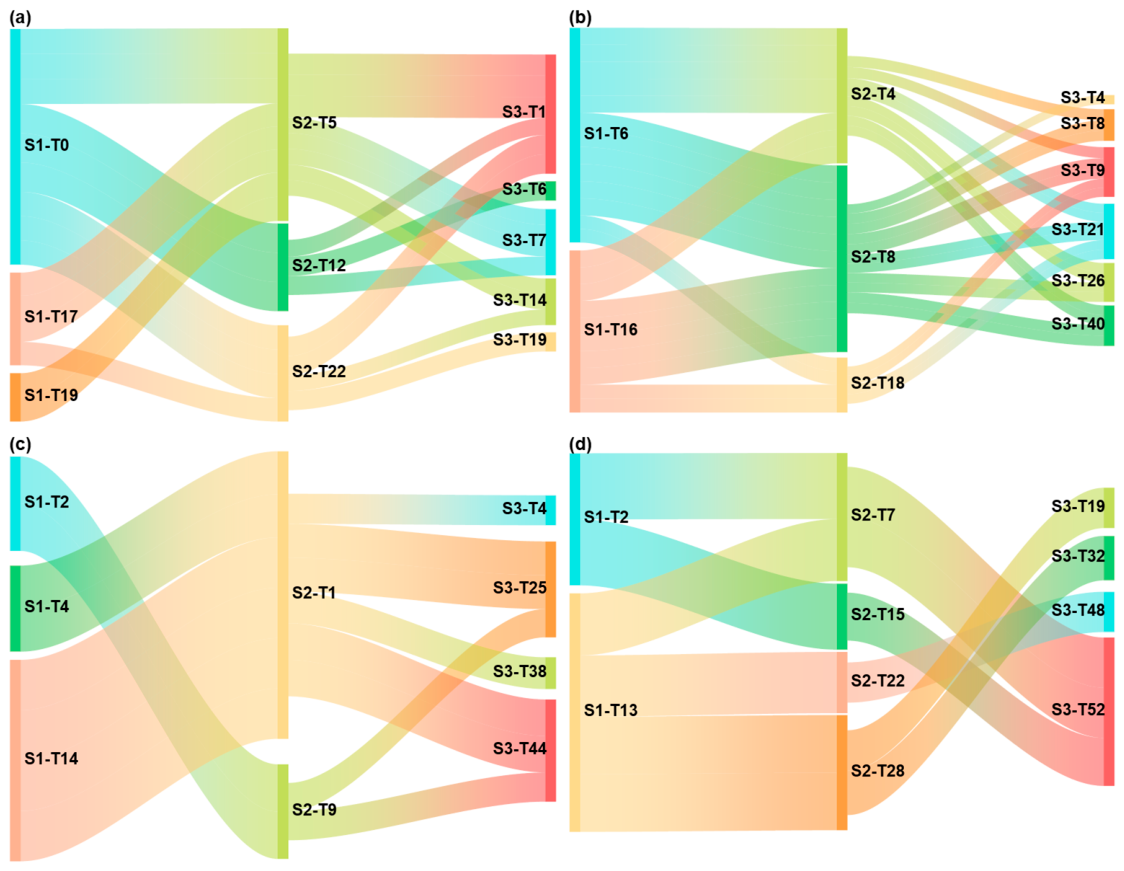
From single-UAV stability control to swarm intelligence. This pathway extends across the full period of civil UAV technology evolution and forms the strongest and most continuous axis in the evolution network. During the first stage, research focused on fundamental flight-control problems. The core nodes included UAV control systems (S1-T0), navigation control (S1-T17), and preliminary applications of UAV swarms (S1-T19). The associated research focused on establishing stable UAV control systems and initial forms of intelligent swarm operation. As operating environments became more complex, the pathway split and deepened. Control technologies evolved toward nonlinear attitude control (S2-T12) to improve disturbance rejection, while path-planning technologies developed further (S2-T5 and S2-T22) to support autonomous obstacle avoidance by individual UAVs in static environments. In the third stage, conventional control algorithms evolved toward autonomous decision-making (S3-T6 and S3-T7), and the pathway ultimately converged on UAV swarm and formation coordination (S3-T1). This transition marked a shift in technological emphasis from individual intelligence toward swarm intelligence, as shown in Figure 6a.
Figure 6.
Major evolutionary pathways of civil UAV technologies: (a) single-UAV control to swarm intelligence; (b) lithium batteries to hydrogen-based energy and automated energy replenishment; (c) point-to-point links to a networked low-altitude ecosystem; and (d) simple operations to applications across diverse scenarios. Nodes represent technology topics in stages S1–S3, and link widths are proportional to the technology evolution flux between adjacent stages.
From lithium batteries to hydrogen-based energy and automated energy replenishment. This pathway reveals potential directions for overcoming power-system constraints on UAV development. Early technologies focused on battery charging and discharging (S1-T6) and battery components (S1-T16). To mitigate endurance limitations associated with the low energy density of lithium batteries, the pathway extended toward automated charging platforms (S2-T4) and photovoltaic charging (S2-T18), using automated ground infrastructure and clean energy to compensate for limited onboard energy capacity. New branches, including hydrogen fuel cells (S3-T26) and solar-energy storage (S3-T21), subsequently emerged, while lithium batteries (S3-T9) and power-supply systems (S3-T40) continued to develop. This pathway is shown in Figure 6b.
From point-to-point links to a networked low-altitude ecosystem. This pathway captures the transition of UAV communication technologies from individual communication links toward networked operations. Early wireless communication technologies focused on point-to-point radio links or radar-signal processing within visual line of sight (S1-T4 and S1-T14), emphasizing physical link connectivity. With the introduction of 4G and 5G technologies, the pathway shifted toward data transmission (S2-T1) and real-time image monitoring (S2-T9). UAVs increasingly functioned as airborne data-acquisition terminals, making real-time transmission performance, bandwidth, and coverage major technical concerns (S3-T25 and S3-T38). In response to security challenges associated with large-scale terminal access, technology topics such as blockchain and consensus mechanisms (S3-T44) emerged during the third stage. As shown in Figure 6c, communication technologies evolved from transmission channels toward a networked low-altitude ecosystem incorporating identity authentication, data encryption, and distributed oversight.
From simple operations to applications across diverse scenarios. This pathway captures the expansion of UAVs from individual tasks toward applications across a broader range of scenarios. Early applications were concentrated in aerial photography and remote control (S1-T2), with relatively loose coupling between technologies and application scenarios and an emphasis on sensor-equipment validation (S1-T13). During the second stage, technologies became more closely integrated with specific industries, producing applications such as precision agricultural plant protection (S2-T7), water-surface navigation and path planning (S2-T22), and geodetic coordinate measurement (S2-T28). During the third stage, some technologies exhibited deeper integration with specific operational processes, including digital engineering management (S3-T32) and bridge structural inspection (S3-T48). As shown in Figure 6d, these developments suggest that UAVs are no longer used solely as data-acquisition tools but are increasingly embedded in inspection, engineering digitalization, and other specialized operational scenarios.
3.3. Civil UAV Technology Forecasting Results
3.3.1. Technology Trend Analysis
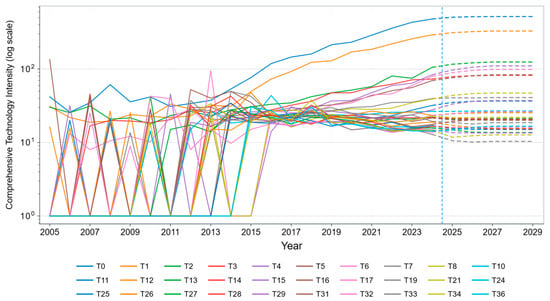
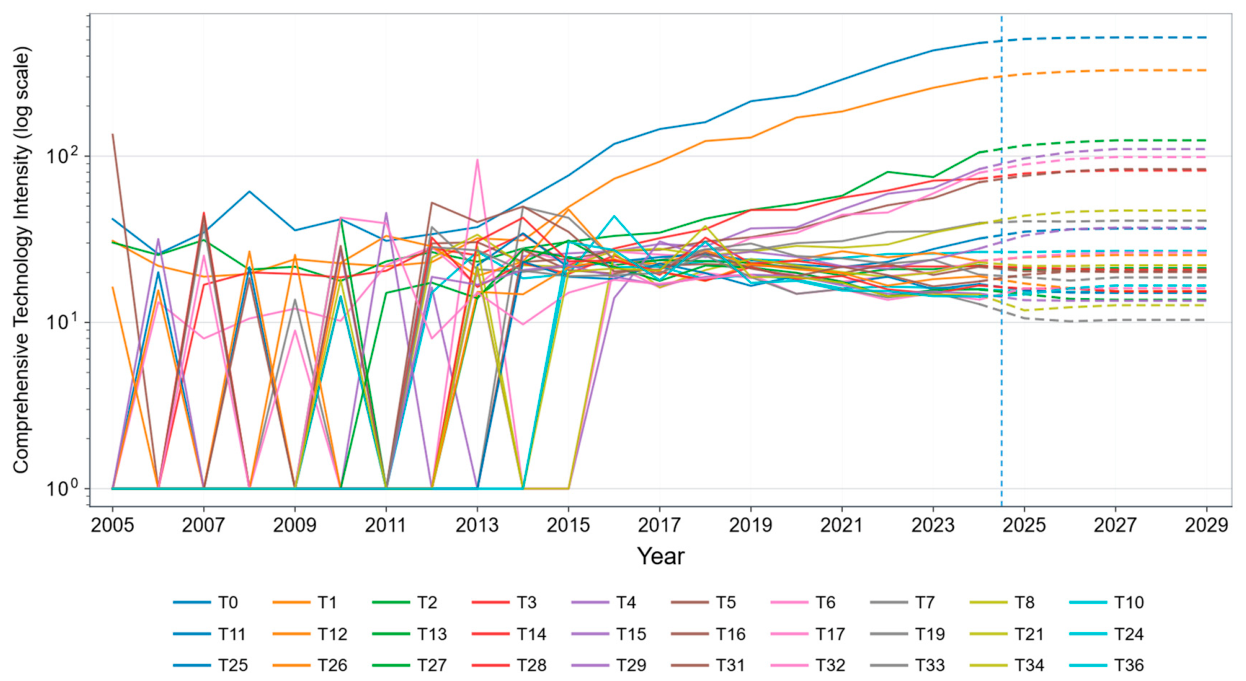
Figure 7 shows that forecast trajectories differ markedly across technology topics, reflecting uneven development and structural change. Some topics rise rapidly, whereas others continue to grow at a steadier rate. Rapidly growing topics indicate likely areas of technological change, whereas steadier growth characterizes technologies that support practical deployment. We therefore selected topics for further analysis based on projected increases in comprehensive technology intensity and regrouped them by technology category. The results are summarized below.
Figure 7.
Observed and forecast comprehensive technology intensity of civil UAV technology topics, 2005–2029. Solid lines represent observations for 2005–2024, dashed lines represent forecasts for 2025–2029, and the vertical dashed line marks the boundary between the two periods. Each line corresponds to a topic code in the legend, and the vertical axis uses a logarithmic scale.
Communication systems form the technical basis for networked low-altitude operations and large-scale UAV deployment. T11 is associated with satellite-based communication, navigation, and positioning, whereas T10 represents air–ground communication networks. Their projected growth suggests that an integrated space–air–ground communication structure will remain a central direction for low-altitude networks. Together with T0, these topics support real-time information exchange and position awareness in low-altitude airspace, which are needed to reduce communication blind spots in beyond-visual-line-of-sight operations. T12 provides the supporting hardware through specialized communication antennas and high-performance computing chips.
Deep learning deployment and swarm control show relatively high projected growth. T15 rises rapidly and is associated with signal recognition and classification, indicating continued development of deep-learning-based perception in complex environments. T6 concerns reinforcement learning and intelligent decision-making, while T5 focuses on cooperative and swarm control. Taken together, T5 and T6 point to a shift from single-UAV operation toward multi-UAV task allocation and coordinated execution.
Flight control systems are in the third projected-growth tier. T8 remains on a steady development path despite the emergence of newer intelligent algorithms, indicating that attitude control is still required for stable and safe operation under complex conditions. T31 extends the control problem to UAV traffic management through automated flight-plan generation, dynamic adjustment, and conflict detection and avoidance.
Airborne equipment is in the fourth projected-growth tier. T4 reflects increasingly integrated and intelligent onboard platforms. The close association between T2 and T36 indicates further integration of airborne laser equipment with SLAM, suggesting greater use of LiDAR and multisource data for mapping, navigation, and positioning in GPS-denied environments. These capabilities extend the range of environments in which UAVs can operate autonomously.
Within specialized operations, application scenarios become more differentiated as basic UAV technologies mature. T3 represents cross-domain platforms that combine underwater and surface-navigation mechanisms and can operate across multiple media. T17 is associated with forestry applications, including forest-fire monitoring, early warning, and emergency response. These topics show how civil UAVs are being adapted to more specialized operating environments.
Airframe structures show a steadier development path centered on materials and structural design. The projected growth of T1 indicates continued work on structural strength, weight reduction, and environmental adaptability as new materials are introduced.
3.3.2. Analysis of Technological Directions
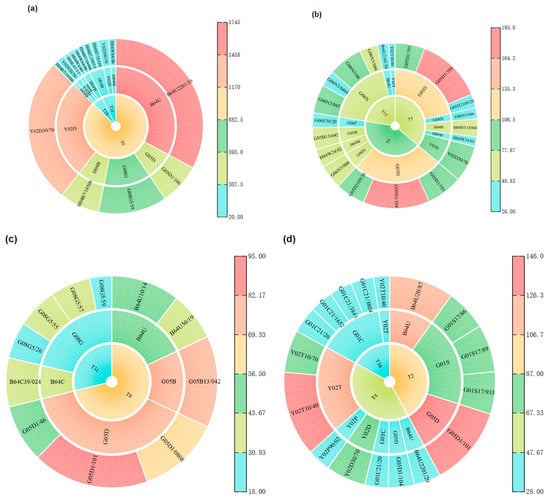
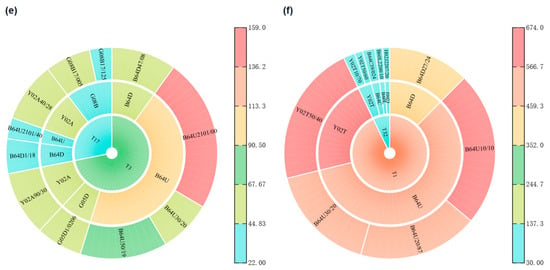
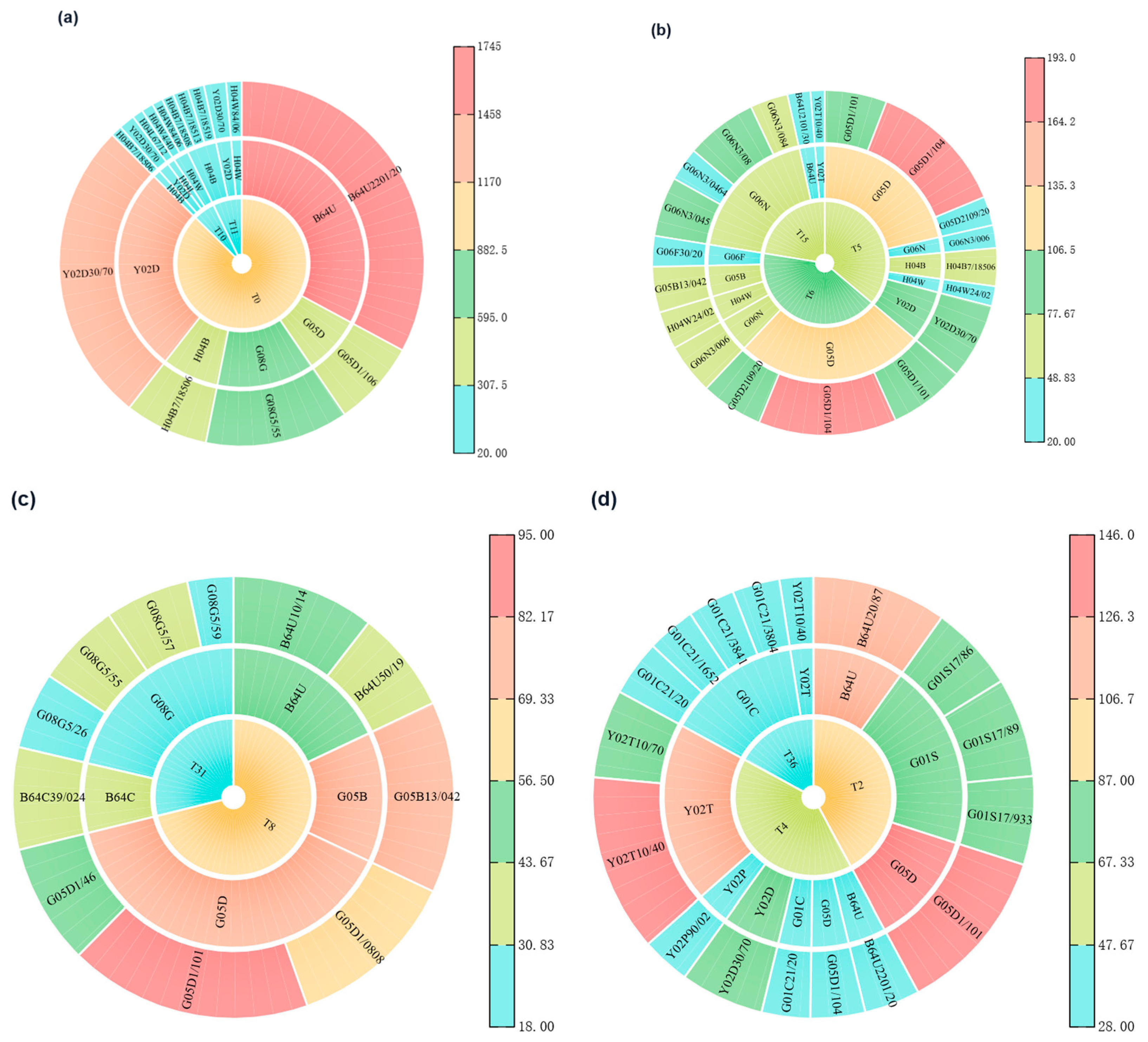
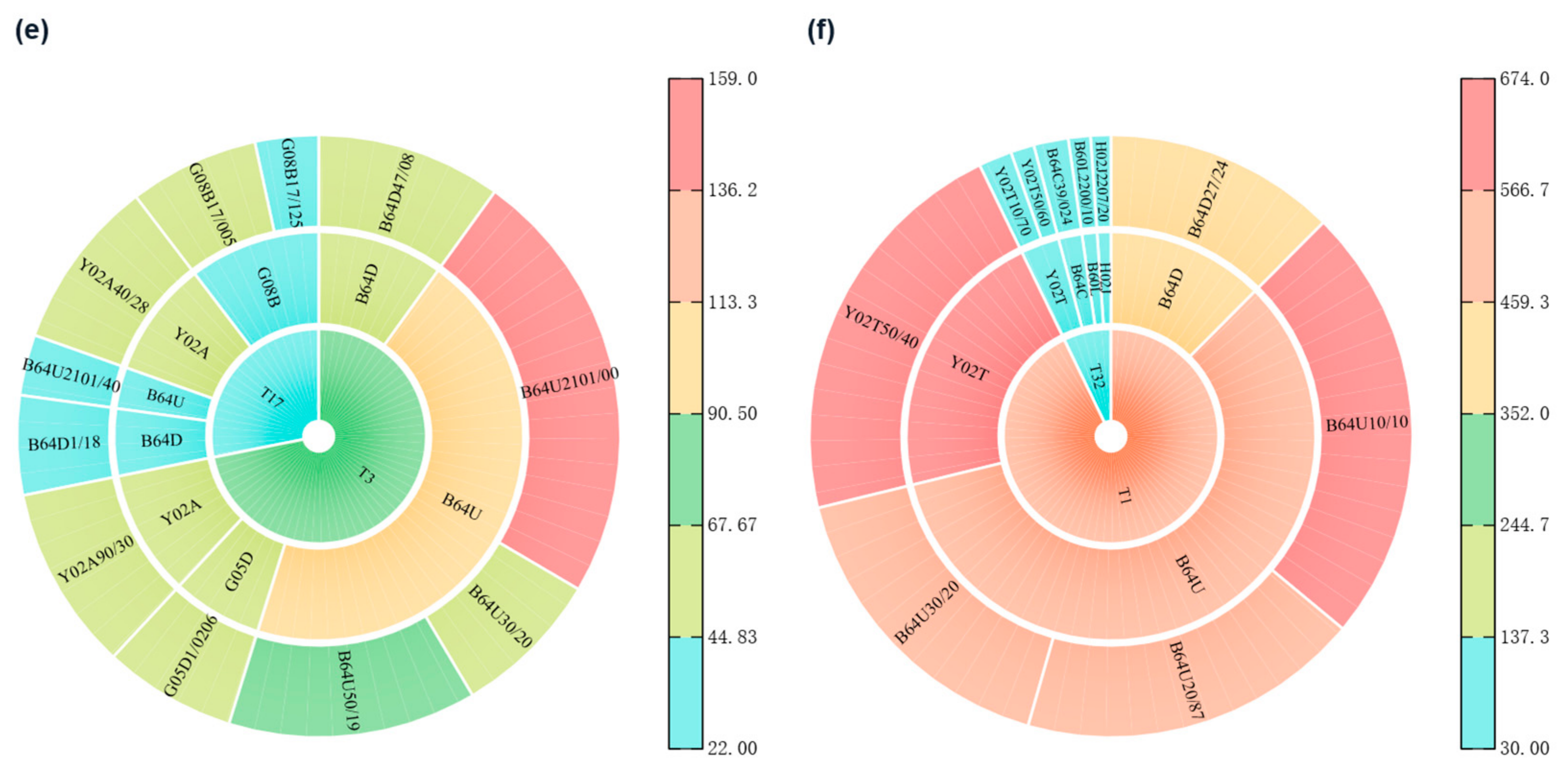
To identify the underlying technical components of high-potential technology topics, this study counted and interpreted the high-frequency CPC codes within each topic. The analysis identified specific technical areas associated with prospective civil UAV development at the micro level. The results are shown in Figure 8.
Figure 8.
CPC composition of selected civil UAV technology topics: (a) communication systems; (b) deep learning deployment and swarm control; (c) flight control; (d) airborne equipment; (e) specialized operations; and (f) airframe structures and power systems. In each sunburst chart, the inner ring identifies the selected topic codes, the middle ring shows CPC subclasses, and the outer ring shows detailed CPC groups or subgroups; the scale beside each panel encodes the frequency of the corresponding CPC codes.
In communication systems (Figure 8a), T0, T10, and T11 frequently include Y02D30/70 (reducing energy consumption in communication networks) and H04B7/18506 (airborne communication links). T0 and T11 also contain H04W84/06, H04B7/18513, and H04B7/18508, which relate to airborne or satellite communication networks. These distributions suggest that energy efficiency and satellite-supported connectivity are important technical directions for low-altitude communication systems.
For swarm control and deep learning deployment (Figure 8b), T5 and T6 include G05D1/104 (multi-aircraft control), G05D1/101 (cooperative position or heading control), and H04B7/18506 (inter-aircraft communication). Codes such as G05B13/042 and G06F30/20 further indicate the roles of adaptive control and simulation. In T15, G06N3/08 and G06N3/0464 relate to neural-network learning, while B64U2101/30 links the topic to UAV imaging applications. These codes reflect the technical basis for coordinated flight and learning-based perception.
Flight control systems (Figure 8c) emphasize aircraft stability and flight management. T8 includes G05B13/042 (adaptive control), G05D1/0808 (attitude control), and G05D1/46 (position or heading control). In T31, G08G5/55, G08G5/26, and G08G5/59 correspond to navigation assistance, aircraft–ground information exchange, and operations within predefined flight areas. These results indicate that fundamental control functions remain important alongside integrated flight-management capabilities.
Airborne equipment (Figure 8d) combines platform energy management, navigation, and sensing. In T4, Y02T10/40 and Y02T10/70 relate to engine management and energy storage, while G05D1/104 and G01C21/20 are associated with formation control and navigation computation. For T2 and T36, codes including G01S17/86 and G01C21/3841 indicate sensor fusion, localization, and mapping. These patterns highlight the complementary roles of intelligent platforms and LiDAR-enabled SLAM technologies.
Specialized operations (Figure 8e) are represented by T3 (amphibious UAVs) and T17 (forestry UAVs). Y02A90/30, G08B17/005, and B64D1/18 relate to water-resource assessment, forest-fire applications, and the release of materials from aircraft, respectively. These codes reflect the adaptation of UAV technologies to specific operational environments, including water-related missions and fire prevention or suppression.
In airframe structures and power systems (Figure 8f), Y02T50/40 and B64U20/87 correspond to aeronautical lightweighting and UAV structural design, while B64U30/20 and B64D27/24 concern rotors and propulsion-unit arrangements. Power-system codes Y02T10/70, Y02T50/60, and H02J2207/20 relate to energy storage, efficient propulsion, and charging or discharging. These results highlight the continuing importance of lightweight structures and efficient energy systems.
4. Conclusions
4.1. Main Findings
This study integrates LLM-enhanced BERTopic, semantic–intensity-coupled evolution analysis, and SA-LSTM forecasting to investigate civil UAV technology topics, evolutionary pathways, and future trends.
Compared with ARIMA, KNN, SVM, and a standard LSTM, SA-LSTM achieved the best overall performance across MAE, RMSE, and R2.
Based on 61,715 screened civil UAV invention patent records from the PatSnap global patent database, of which 59,217 patent texts were used for topic modeling, the main findings are as follows:
(1) Civil UAV technologies comprise 30 technology topics grouped into nine technology categories: communication systems, flight control systems, airborne equipment, swarm control, airframe structures, specialized operations, deep learning deployment, ground infrastructure, and power systems.
(2) Three developmental stages of civil UAV technology were identified for the period 2005–2024, together with four major evolutionary directions: from single-UAV stability control to swarm intelligence, from lithium batteries to hydrogen-based energy and automated energy replenishment, from point-to-point links to a networked low-altitude ecosystem, and from simple operations to applications across diverse scenarios.
(3) The forecasts show uneven growth across civil UAV technology categories. The broader pattern points to intelligent coordination, networked connectivity, and greener power systems. Low-altitude communication networks, swarm control, and emerging power systems have relatively strong projected growth, whereas flight control and airframe structures grow more steadily. The latter remain important for networked operations, large-scale deployment, and traffic management in high-density airspace.
4.2. Implications for Civil UAV R&D
First, the findings suggest continued development of foundational aircraft technologies alongside increasing emphasis on intelligent coordination, networked operation, and diversified energy provision. Enterprises should therefore sustain investment in core aircraft technologies while selectively developing complementary capabilities in autonomy, connectivity, and energy support. Their long-term R&D priorities should reflect the development trajectories of these capabilities and their fit with existing technological strengths.
Second, the evolutionary pathways indicate an expansion from individual aircraft development toward integrated operational systems encompassing communication networks, energy provision, and ground infrastructure. Enterprises should therefore define their roles within these systems, identifying capabilities to develop internally and complementary support to secure through industry partnerships. When selecting partners and sequencing investment and deployment, firms should assess the availability and compatibility of communication, energy, and ground-support systems. These decisions should be guided by the overall operational system’s ability to support intended missions.
Third, application-related patents indicate a progression from basic data acquisition toward integrated technological solutions designed for sector-specific operational processes. Governments should therefore strengthen coordination between departments responsible for technological innovation and those overseeing downstream industries. These departments should jointly assess sectoral operational requirements and align R&D support with application priorities across industries. Their shared policy objectives should include supporting the adaptation of UAV technologies to different operational contexts and facilitating cross-industry technology diffusion.
4.3. Research Limitations and Future Directions
Three limitations should be noted.
First, the analysis relies on patent data, which capture applied and engineering-oriented innovation relatively well but provide less information on basic research and institutional change. Academic publications, industry reports, and policy documents would therefore be useful complementary sources. Combining these sources could provide a fuller account of civil UAV technology development.
Second, although SA-LSTM performs well on the reported metrics, its internal decision process remains difficult to interpret, which limits its use in practical decision analysis. Furthermore, the 2025–2029 forecasts extrapolate patterns in patent-derived technology intensity from 2005–2024, and uncertainty may increase over the multi-year forecasting horizon. Patent publication lags and unforeseen changes in technological development, market demand, and regulations may also affect the projected trajectories. Since prediction intervals were not estimated in this study, the forecasts should be interpreted as potential development directions rather than precise future outcomes. Future work could test Transformer or graph neural network models and combine them with knowledge graphs to map relationships among technological elements and identify key evolutionary paths and potential directions more clearly. Rolling-origin evaluation and prediction-interval estimation could also be explored to assess the robustness of multi-year forecasts.
Third, the analysis treats civil UAV technology as an aggregate system, although application domains differ in their technical requirements and development paths. Future studies could examine representative domains separately, for example, by tracing the evolution of technology pathways in specific application domains or using patent landscape analysis to decompose key technologies in greater detail. Such analyses would provide more specific evidence for firms’ technology selection and related decisions.
Author Contributions
Conceptualization, X.Z. and X.C.; methodology, X.Z. and X.C.; software, X.C.; validation, X.C. and F.L.; formal analysis, X.C.; investigation, P.Z.; data curation, X.C. and P.Z.; writing—original draft preparation, X.Z. and X.C.; writing—review and editing, X.Z., X.C., P.Z. and F.L.; supervision, X.Z.; funding acquisition, X.Z. All authors have read and agreed to the published version of the manuscript.
Funding
This research was funded by the Tianjin Transportation Science and Technology Development Program, grant number 202662, and the 2026 General Research Program of the China Society of Logistics and the China Federation of Logistics and Purchasing, grant number 2026CSLKT3-436. The funders had no role in the study design; data collection, analysis, or interpretation; manuscript preparation; or the decision to publish the results.
Institutional Review Board Statement
Not applicable.
Informed Consent Statement
Not applicable.
Data Availability Statement
The raw data supporting the conclusions of this article will be made available by the authors on request.
Acknowledgments
During the preparation of this manuscript, the authors used DeepSeek-V4-Pro (DeepSeek AI) as an auxiliary generative artificial intelligence tool in the topic-modeling workflow to support semantic refinement and the generation of preliminary topic labels. For each BERTopic cluster, the model received structured inputs consisting of the top 10 core keywords selected using class-based term frequency–inverse document frequency (c-TF-IDF) and maximum marginal relevance (MMR), together with representative patent abstracts exhibiting the highest cosine similarity to the cluster. The generated outputs were treated only as candidate labels. The authors independently reviewed each output against the source keywords and representative abstracts, revised them where necessary, and determined all final topic labels. DeepSeek-V4-Pro was not used for patent text embedding, dimensionality reduction, topic clustering, selection of the final clustering configuration, quantitative indicator calculation, technology evolution analysis, forecasting, statistical evaluation, interpretation of the results, formulation of conclusions, or verification of references. All AI-assisted outputs were critically reviewed and validated by the authors, who take full responsibility for the accuracy, integrity, and final content of the manuscript.
Conflicts of Interest
The authors declare no conflicts of interest.
Abbreviations
The following abbreviations are used in this manuscript:
| Abbreviation | Full Term |
| BERTopic | Bidirectional Encoder Representations from Transformers Topic Modeling |
| CPC | Cooperative Patent Classification |
| c-TF-IDF | Class-based Term Frequency-Inverse Document Frequency |
| IPC | International Patent Classification |
| LLM | Large Language Model |
| MMR | Maximum Marginal Relevance |
| SA-LSTM | Self-Attention Long Short-Term Memory |
| UAV | Unmanned Aerial Vehicle |
References
- Butilă, E.V.; Boboc, R.G. Urban traffic monitoring and analysis using unmanned aerial vehicles (UAVs): A systematic literature review. Remote Sens. 2022, 14, 620. [Google Scholar] [CrossRef] [Scilit]
- Park, K.; Ewing, R. The usability of unmanned aerial vehicles (UAVs) for pedestrian observation. J. Plan. Educ. Res. 2022, 42, 206–217. [Google Scholar] [CrossRef] [Scilit]
- Shakhatreh, H.; Sawalmeh, A.H.; Al-Fuqaha, A.; Dou, Z.; Almaita, E.; Khalil, I.; Othman, N.S.; Khreishah, A.; Guizani, M. Unmanned aerial vehicles (UAVs): A survey on civil applications and key research challenges. IEEE Access 2019, 7, 48572–48634. [Google Scholar] [CrossRef] [Scilit]
- Sun, X.; Wang, S.; Zhang, X.; Wandelt, S. LAERACE: Taking the policy fast-track towards low-altitude economy. J. Air Transp. Res. Soc. 2025, 4, 100058, Correction in J. Air Transp. Res. Soc. 2025, 5, 100092. https://doi.org/10.1016/j.jatrs.2025.100092. [Google Scholar] [CrossRef] [Scilit]
- Zhou, Y. Unmanned aerial vehicles based low-altitude economy with lifecycle techno-economic-environmental analysis for sustainable and smart cities. J. Clean. Prod. 2025, 499, 145050. [Google Scholar] [CrossRef] [Scilit]
- World Intellectual Property Organization. WIPO Guide to Using Patent Information; World Intellectual Property Organization: Geneva, Switzerland, 2022. [Google Scholar] [CrossRef]
- Mathys & Squire LLP. Number of Drone Patents Filed Worldwide Jumps 16% in Past Year. 2024. Available online: https://www.mathys-squire.com/insights-and-events/news/number-of-drone-patents-filed-worldwide-jumps-16-in-past-year/ (accessed on 21 July 2026).
- Kim, D.H.; Lee, B.K.; Sohn, S.Y. Quantifying technology–industry spillover effects based on patent citation network analysis of unmanned aerial vehicle (UAV). Technol. Forecast. Soc. Change 2016, 105, 140–157. [Google Scholar] [CrossRef] [Scilit]
- Wang, H.; Zhao, H.; Zhang, J.; Ma, D.; Li, J.; Wei, J. Survey on unmanned aerial vehicle networks: A cyber physical system perspective. IEEE Commun. Surv. Tutor. 2020, 22, 1027–1070. [Google Scholar] [CrossRef] [Scilit]
- World Intellectual Property Organization. WIPO Technology Trends Technical Annex: Future of Transportation in the Air; World Intellectual Property Organization: Geneva, Switzerland, 2025. [Google Scholar] [CrossRef]
- Federal Aviation Administration. Pilot/Controller Glossary: Basic with Change 1, 2 and 3. 2026. Available online: https://www.faa.gov/air_traffic/publications/atpubs/pcg_html/index.html (accessed on 21 July 2026).
- Hashim, H.A. Advances in UAV avionics systems architecture, classification and integration: A comprehensive review and future perspectives. Results Eng. 2025, 25, 103786. [Google Scholar] [CrossRef] [Scilit]
- Hossain, N.U.I.; Lutfi, M.; Ahmed, I.; Akundi, A.; Cobb, D. Modeling and analysis of unmanned aerial vehicle system leveraging Systems Modeling Language (SysML). Systems 2022, 10, 264. [Google Scholar] [CrossRef] [Scilit]
- Tsay, M.-Y.; Liu, Z.-W. Analysis of the patent cooperation network in global artificial intelligence technologies based on the assignees. World Pat. Inf. 2020, 63, 102000, Correction in World Pat. Inf. 2022, 71, 102137. https://doi.org/10.1016/j.wpi.2022.102137. [Google Scholar] [CrossRef] [Scilit]
- Abbas, A.; Zhang, L.; Khan, S.U. A literature review on the state-of-the-art in patent analysis. World Pat. Inf. 2014, 37, 3–13. [Google Scholar] [CrossRef] [Scilit]
- Choi, C.; Park, Y. Monitoring the organic structure of technology based on the patent development paths. Technol. Forecast. Soc. Change 2009, 76, 754–768. [Google Scholar] [CrossRef] [Scilit]
- Ernst, H. Patent information for strategic technology management. World Pat. Inf. 2003, 25, 233–242. [Google Scholar] [CrossRef] [Scilit]
- Trajtenberg, M.; Henderson, R.; Jaffe, A. University versus corporate patents: A window on the basicness of invention. Econ. Innov. New Technol. 1997, 5, 19–50. [Google Scholar] [CrossRef] [Scilit]
- Wang, B.; Liu, S.; Ding, K.; Liu, Z.; Xu, J. Identifying technological topics and institution-topic distribution probability for patent competitive intelligence analysis: A case study in LTE technology. Scientometrics 2014, 101, 685–704. [Google Scholar] [CrossRef] [Scilit]
- Tseng, Y.-H.; Lin, C.-J.; Lin, Y.-I. Text mining techniques for patent analysis. Inf. Process. Manag. 2007, 43, 1216–1247. [Google Scholar] [CrossRef] [Scilit]
- OECD. OECD Patent Statistics Manual; OECD: Paris, France, 2009. [Google Scholar] [CrossRef] [Scilit]
- Fontana, R.; Nuvolari, A.; Verspagen, B. Mapping technological trajectories as patent citation networks: An application to data communication standards. Econ. Innov. New Technol. 2009, 18, 311–336. [Google Scholar] [CrossRef] [Scilit]
- Zhou, H.; Dai, J.; Chen, X.; Hu, B.; Wei, H.; Cai, H.H. Understanding innovation of new energy industry: Observing development trend and evolution of hydrogen fuel cell based on patent mining. Int. J. Hydrogen Energy 2024, 52, 548–560. [Google Scholar] [CrossRef] [Scilit]
- Liu, Z.; Xiang, X.; Feng, J. Tracing evolutionary trajectory of charging technologies in electric vehicles: Patent citation network analysis. Environ. Dev. Sustain. 2024, 26, 12789–12813. [Google Scholar] [CrossRef] [Scilit]
- Mariani, M.S.; Medo, M.; Lafond, F. Early identification of important patents: Design and validation of citation network metrics. Technol. Forecast. Soc. Change 2019, 146, 644–654. [Google Scholar] [CrossRef] [Scilit]
- Garechana, G.; Río-Belver, R.; Bildosola, I.; Cilleruelo-Carrasco, E. A method for the detection and characterization of technology fronts: Analysis of the dynamics of technological change in 3D printing technology. PLoS ONE 2019, 14, e0210441. [Google Scholar] [CrossRef] [Scilit] [PubMed]
- Pölzlbauer, G.; Auer, E. Applied patent mining with topic models and meta-data: A comprehensive case study. World Pat. Inf. 2021, 67, 102065. [Google Scholar] [CrossRef] [Scilit]
- Wang, Z.; Chen, J.; Chen, J.; Chen, H. Identifying interdisciplinary topics and their evolution based on BERTopic. Scientometrics 2024, 129, 7359–7384. [Google Scholar] [CrossRef] [Scilit]
- Jeon, E.; Yoon, N.; Sohn, S.Y. Exploring new digital therapeutics technologies for psychiatric disorders using BERTopic and PatentSBERTa. Technol. Forecast. Soc. Change 2023, 186, 122130. [Google Scholar] [CrossRef] [Scilit]
- Grodal, S.; Krabbe, A.D.; Chang-Zunino, M. The evolution of technology. Acad. Manag. Ann. 2023, 17, 141–180. [Google Scholar] [CrossRef] [Scilit]
- Li, Y. Research on high-value patent prediction method based on technology component mapping network. IEEE Access 2025, 13, 137129–137138. [Google Scholar] [CrossRef] [Scilit]
- Zhou, X.; Zhang, Y.; Porter, A.L.; Guo, Y.; Zhu, D. A patent analysis method to trace technology evolutionary pathways. Scientometrics 2014, 100, 705–721. [Google Scholar] [CrossRef] [Scilit]
- Huang, L.; Hou, Z.; Fang, Y.; Liu, J.; Shi, T. Evolution of CCUS technologies using LDA topic model and Derwent patent data. Energies 2023, 16, 2556. [Google Scholar] [CrossRef] [Scilit]
- Liu, J.; Zhang, Y.; Shi, T.; Huang, L. Evolutionary path analysis of policies and technologies in China’s hydrogen industry: An LDA-Word2Vec approach. Energy Sources Part B Econ. Plan. Policy 2025, 20, 2579814. [Google Scholar] [CrossRef] [Scilit]
- Liu, Y.; Wan, F. Unveiling temporal and spatial research trends in precision agriculture: A BERTopic text mining approach. Heliyon 2024, 10, e36808. [Google Scholar] [CrossRef] [Scilit] [PubMed]
- Yao, J.; Liu, W.; Bi, K. The global knowledge evolution of carbon capture, utilization, and storage technology: A network analysis of patent mining. IEEE Trans. Eng. Manag. 2025, 72, 2234–2252. [Google Scholar] [CrossRef] [Scilit]
- Lee, C. A review of data analytics in technological forecasting. Technol. Forecast. Soc. Change 2021, 166, 120646. [Google Scholar] [CrossRef] [Scilit]
- Gausemeier, J.; Fink, A.; Schlake, O. Scenario management. Technol. Forecast. Soc. Change 1998, 59, 111–130. [Google Scholar] [CrossRef] [Scilit]
- Choi, C.; Kim, S.; Park, Y. A patent-based cross impact analysis for quantitative estimation of technological impact: The case of information and communication technology. Technol. Forecast. Soc. Change 2007, 74, 1296–1314. [Google Scholar] [CrossRef] [Scilit]
- Wu, Y.; Ji, Y.; Gu, F. Identifying firm-specific technology opportunities in a supply chain: Link prediction analysis in multilayer networks. Expert Syst. Appl. 2023, 213, 119053. [Google Scholar] [CrossRef] [Scilit]
- Park, I.; Yoon, B. Technological opportunity discovery for technological convergence based on the prediction of technology knowledge flow in a citation network. J. Informetr. 2018, 12, 1199–1222. [Google Scholar] [CrossRef] [Scilit] [PubMed]
- Kwon, K.; Jun, S.; Lee, Y.-J.; Choi, S.; Lee, C. Logistics technology forecasting framework using patent analysis for technology roadmap. Sustainability 2022, 14, 5430. [Google Scholar] [CrossRef] [Scilit]
- Cho, Y.; Han, Y.J.; Hwang, J.; Yu, J.; Kim, S.; Lee, C.; Lee, S.; Yi, K.P. Identifying technology opportunities for electric motors of railway vehicles with patent analysis. Sustainability 2021, 13, 2424. [Google Scholar] [CrossRef] [Scilit]
- Chang, S.-H. Technical trends of artificial intelligence in standard-essential patents. Data Technol. Appl. 2020, 55, 97–117. [Google Scholar] [CrossRef] [Scilit]
- Feng, S.; An, H.; Li, H.; Qi, Y.; Wang, Z.; Guan, Q.; Li, Y.; Qi, Y. The technology convergence of electric vehicles: Exploring promising and potential technology convergence relationships and topics. J. Clean. Prod. 2020, 260, 120992. [Google Scholar] [CrossRef] [Scilit]
- Xiang, M.; Fu, D.; Lv, K. Identifying and predicting trends of disruptive technologies: An empirical study based on text mining and time series forecasting. Sustainability 2023, 15, 5412. [Google Scholar] [CrossRef] [Scilit]
- Hou, J.; Tang, S.; Zhang, Y. A novel technology life cycle analysis method based on LSTM and CRF. Scientometrics 2024, 129, 1173–1196. [Google Scholar] [CrossRef] [Scilit]
- Chang, Z.-X.; Guo, W.; Wang, L.; Shao, H.-Y.; Zhang, Y.-R.; Liu, Z.-H. Forecasting and analyzing technology development trends with self-attention and frequency enhanced LSTM. Adv. Eng. Inform. 2025, 64, 103093. [Google Scholar] [CrossRef] [Scilit]
- Grootendorst, M. BERTopic: Neural topic modeling with a class-based TF-IDF procedure [Preprint]. arXiv 2022, arXiv:2203.05794. [Google Scholar] [CrossRef] [Scilit]
- Reimers, N.; Gurevych, I. Sentence-BERT: Sentence embeddings using Siamese BERT-networks. In Proceedings of the 2019 Conference on Empirical Methods in Natural Language Processing and the 9th International Joint Conference on Natural Language Processing (EMNLP-IJCNLP), Hong Kong, China, 3–7 November 2019; pp. 3982–3992. [Google Scholar] [CrossRef] [Scilit]
- McInnes, L.; Healy, J.; Saul, N.; Großberger, L. UMAP: Uniform manifold approximation and projection. J. Open Source Softw. 2018, 3, 861. [Google Scholar] [CrossRef] [Scilit]
- Campello, R.J.G.B.; Moulavi, D.; Sander, J. Density-based clustering based on hierarchical density estimates. In Advances in Knowledge Discovery and Data Mining; Pei, J., Tseng, V.S., Cao, L., Motoda, H., Xu, G., Eds.; Lecture Notes in Computer Science; Springer: Berlin/Heidelberg, Germany, 2013; pp. 160–172. [Google Scholar] [CrossRef] [Scilit]
- Carbonell, J.; Goldstein, J. The use of MMR, diversity-based reranking for reordering documents and producing summaries. In Proceedings of the 21st Annual International ACM SIGIR Conference on Research and Development in Information Retrieval; ACM: New York, NY, USA, 1998; pp. 335–336. [Google Scholar] [CrossRef] [Scilit]
- Khandelwal, T. Using LLM-based approaches to enhance and automate topic labeling [Preprint]. arXiv 2025, arXiv:2502.18469. [Google Scholar] [CrossRef] [Scilit]
- Lin, Y.; Wang, X.; Yang, J.; Wang, S. Core technology topic identification and evolution analysis based on patent text mining—A case study of unmanned ship. Appl. Sci. 2024, 14, 4661. [Google Scholar] [CrossRef] [Scilit]
- Hochreiter, S.; Schmidhuber, J. Long short-term memory. Neural Comput. 1997, 9, 1735–1780. [Google Scholar] [CrossRef] [Scilit] [PubMed]

Disclaimer/Publisher’s Note: The statements, opinions and data contained in all publications are solely those of the individual author(s) and contributor(s) and not of MDPI and/or the editor(s). MDPI and/or the editor(s) disclaim responsibility for any injury to people or property resulting from any ideas, methods, instructions or products referred to in the content. |
© 2026 by the authors. Licensee MDPI, Basel, Switzerland. This article is an open access article distributed under the terms and conditions of the Creative Commons Attribution (CC BY) license.