


Abstract
Although single individuals represent a significant portion of the population and are more motivated in their adoption of Dating Applications (DAs), their experiences in relation to psychological well-being remain inadequately explored. Grounded in attachment theory, this study investigates the psychological impact of DAs use among single individuals, specifically how it interacts with self-representation and coping strategies, and how these constructs may be associated with depressive symptoms. We build upon the conceptualization of DAs as a “psychological amplifier”, hypothesizing and empirically testing how their use may intensify pre-existing associations between self-concept and mental health outcomes via coping strategies. Data from 2124 Italian singles (704 DA users, 1420 non-users) were investigated using a moderated mediation model, holding self-representation (using the Internal Working Model of Self—IWMSelf) as the exogenous variable, avoidant coping strategies as the mediator, depressive symptoms as the outcome, and DAs usage as the moderator. The negative indirect association between a positive IWMSelf and avoidant coping was more pronounced for users (b = −0.32) than non-users (b = −0.22), with DAs usage exerting a moderating effect. Similarly, avoidant coping’s positive association with depressive symptoms was stronger for users (b = 0.36) compared to non-users (b = 0.28). Finally, the significant moderated mediation model confirmed this amplification (b = −0.056). These findings supported the hypothesized amplification effect (index of moderated mediation: b = −0.056, 95% CI −0.098, −0.016), providing initial empirical evidence for DA use functioning as a psychological amplifier and contributing to understanding the complex interplay between digital platforms and mental health, emphasizing the critical need for a psychologically informed approach to online intimacy.
1. Introduction
Nowadays, singlehood is recognized as a multifaceted construct reflecting various conditions, primarily the status of being unpartnered and not involved in a committed romantic relationship [1]. Although single individuals are even more prevalent in the general population, singlehood remains a relatively underexplored subject within the social sciences [2].
Research on intimate and familial life predominantly concentrates on various forms of relationships—such as marriage, cohabitation, living apart together (LAT), same-sex partnerships, and polyamorous relationships—and their respective phases, including union formation, family formation, separation, and repartnering. Nonetheless, data focusing on the concept of singlehood and life as a single individual are scant.
As a result, singlehood is frequently addressed indirectly and often perceived negatively, characterized as an absence in contrast to marriage or cohabitation, and as a transitional state preceding, interspersed between, or succeeding the familial events that constitute the life course [3].
1.1. Internal Working Models and Psychological Well-Being
The way single individuals navigate their status and their search for connection is deeply rooted in early relational experiences, as conceptualized by Attachment Theory [4]. According to this framework, early interactions with caregivers shape the development of Internal Working Models (IWMs), which are stable cognitive representations of the self and significant others [4,5]. These models encompass specific patterns of behavior and affect when navigating relationships [6,7].
IWMs consist of two distinct but related components: the model of the Self, concerning beliefs about one’s own worthiness of love and support, and the model of Others, concerning expectations about the availability and responsiveness of significant others [8,9]. The positive or negative nature of IWMs, both in partnered and single individuals, can either serve as a reservoir of resilience through adaptive self-beliefs or, conversely, constitute a risk factor for major psychiatric symptomatology when characterized by feelings of unworthiness or distrust [3,10,11,12,13].
The formation of insecure IWMs may lead to the internalization of negative self-schemas that are associated with individuals being more vulnerable to depressive symptoms [14,15,16,17], especially during potential relational stressors [6,18]. As singles navigate the pressures of modern dating, a substantial portion of them utilizes social platforms like dating applications (DAs) to seek connection; this unique digital environment may represent a context that heightens the influence of pre-existing vulnerabilities on mental health.
The interplay between IWMs and digital dating behaviours emerges as a critical domain to understand depressive symptoms, particularly for individuals characterized by a negative view of the Self, as expressed by anxious attachment patterns [19,20,21].
1.2. Coping Strategies in the Hyper-Evaluative Environment of Dating Apps
One of the primary mechanisms through which IWMs may be associated with mental health is represented by the formation of specific coping strategies, defined as the cognitive and behavioral efforts made to handle the internal and external pressures during stressful situations. While attachment styles represent stable relational orientations, coping strategies are the functional responses to specific stressors.
In this scenario, individuals with insecure IWMs—regardless of whether their attachment style is anxious or avoidant—often lack effective emotion regulation skills. Consequently, they are more prone to adopt avoidant coping strategies (e.g., denial, self-distraction, behavioral disengagement) rather than approach-oriented strategies [22,23,24,25].
In singlehood, effective coping strategies may protect from emotional distress or the reinforcement of negative self-beliefs that may arise from negative dating outcomes [24,26]. Conversely, maladaptive coping strategies fail in this task, thereby increasing depressive symptomatology [25,26,27].
1.3. The Dual-Nature of Dating Apps: Validation vs. Vulnerability
This dynamic between IWMs and coping is especially pertinent within the DAs context [13] where several mechanics of interaction—such as frequent evaluation, rejection potential, and social comparison—may trigger high-stress feedback loops that could reinforce maladaptive cognitive biases [10,28,29].
Expanding on this dual nature, the interplay between IWMs and DA use is multifaceted. On one hand, these platforms may be used to seek external validation, which can momentarily improve mood states [30,31]. On the other hand, the ambiguity characterizing digital romantic engagements [32], may serve as a reinforcement mechanism for preexisting negative IWM of Self and maladaptive interpersonal expectations and consequent psychological distress [18,33].
In this context, the lack of reciprocal interest or the comparison with idealized profiles [33,34] are often interpreted as evidence of personal unworthiness [35]. This dynamic may trigger hypervigilance around rejection, maintaining depressive cognitions and reinforcing stress-responsive coping patterns [10,36].
Following this perspective, DAs, initially considered by individuals as a secure place to meet potential partners, may instead represent a context that exacerbates psychological risks for vulnerable individuals.
1.4. Study Aims and Hypotheses
Given these complex interactions—between pre-existing vulnerabilities (IWMs), behavioural responses (coping), and a hyper-evaluative environment (DAs)—a clearer understanding of the underlying mechanisms is needed. While the literature has established links between DA use and psychological well-being [34,37,38], the specific mechanisms connecting these factors remain less clear. The specific role that coping strategies play in the link between insecure IWMs and depression, particularly in the realm of digital dating among singles, remains largely understudied.
In the present study, we want to test whether DAs may function as a “psychological amplifier”. While previous literature has theorized that these digital environments may exacerbate pre-existing vulnerabilities [18,32], we aim to provide the first formal empirical test of this dynamic on a large-scale sample. This conceptualization posits that these platforms intensify both adaptive and maladaptive pathways linking stable traits (e.g., insecure IWMs) to outcomes like depression through context-specific coping strategies.
Therefore, we propose the following hypotheses: (H1) Coping strategies mediate the association between IWMs of the Self and depressive symptoms. (H2) The strength of this mediation process is moderated by DA use. Specifically, we aim to assess whether the association from IWMs to coping (path a) and the association from coping to depression (path b) differs significantly between individuals who use DAs and those who do not.
2. Materials and Methods
2.1. Participants and Procedure
The data for the present investigation were obtained from a large-scale, cross-sectional research project conducted in Italy during the country’s first national COVID-19 lockdown [39,40]. Data were collected between 7 April 2020 and 4 May 2020 through an anonymous, web-based survey hosted on a dedicated website. The recruitment process was conducted through widespread promotion on social media, radio broadcasts, and national newspapers.
The study protocol was granted ethical approval by its institutional ethics committee, and all participants digitally signed written informed consent before starting the survey. Only individuals who explicitly self-identified as ‘Single’ (i.e., not currently involved in any form of romantic or stable relationship) were included in the present study. Participants reporting to be in a relationship, cohabiting, or married were excluded. This resulted in a final cohort of 2124 individuals.
2.2. Measures
2.2.1. Relationship Questionnaire
The Relationship Questionnaire (RQ) consists of 4 items in which participants express their level of agreement with descriptions of each attachment pattern (secure, dismissing, preoccupied, and fearful) using a 7-point Likert scale [8]. The test–retest reliability of these prototype ratings was high, with adequate coefficients (0.74–0.88) in both English [41] and the Italian version [42]. To determine the IWMs of self and others, the scoring adhered to the method suggested by Bartholomew and Griffin [9]. Specifically:
- The Model of Self (indicating self-worth) was calculated as: (Secure + Dismissing) − (Fearful + Preoccupied). A positive score indicates a more positive self-view (low anxiety).
- The Model of Other (indicating interpersonal trust) was calculated as: (Secure + Preoccupied) − (Fearful + Dismissing). A positive score indicates a more positive view of others (low avoidance).
The interplay of negative and positive IWMs of Self and Other can be utilized to ascertain specific attachment patterns. For instance, a positive IWMSelf combined with a positive IWMOther indicates a secure attachment, whereas a negative IWMSelf paired with a positive IWMOther suggests a preoccupied attachment.
2.2.2. Brief Coping Orientation to Problems Experienced
The Brief COPE (Coping Orientation to Problems Experienced) inventory is a short version of the initial 52-item COPE inventory. Consisting of 28 items across 14 subscales, it measures coping responses used by individuals when they experience stress [43]. It has strong internal consistency, with Cronbach’s alpha coefficients from 0.70 to 0.89 [44], similar to Italian validation [45]. Meyer proposed that scores may be differentiated into two general coping strategies: Avoidant Coping (denial, substance use, venting, behavioural disengagement, self-distraction and self-blame), which is more closely related to mental health issues such as depression, and Approach Coping (active coping, positive reframing, planning, acceptance, seeking emotional support, and seeking informational support), which is more strongly related to psychological well-being [27].
2.2.3. Patient Health Questionnaire
The Patient Health Questionnaire (PHQ-9) is a 9-item questionnaire, widely used for assessing the frequency and severity of depressive symptoms over the past two weeks. Scoring ranges from 0 to 27, and a cutoff score > 10 has been reported to reflect an increased likelihood of clinically significant depression. Validation studies showed high reliability, with Cronbach’s alpha values > 0.8, and high construct validity [46]. Also, the Italian validated version of the questionnaire reported adequate reliability and validity [47,48].
2.3. Statistical Analysis
All statistical analyses were conducted using R, Version 4.5.0 [49]. Preliminary analyses were performed to examine the data and test for group differences. The distributions of all continuous study variables were assessed for normality by examining skewness and kurtosis values, with values between −1 and +1 considered indicative of an approximately normal distribution. To explore differences based on participants’ self-perceptions, comparisons between DA users and non-users were conducted using Welch t-tests and Cohen’s d for the effect size on continuous study variables, and using the chi-square (χ2) test of independence, with Cramer’s V as the effect size, for categorical variables. For all statistical tests, the alpha level for significance was set at p < 0.05.
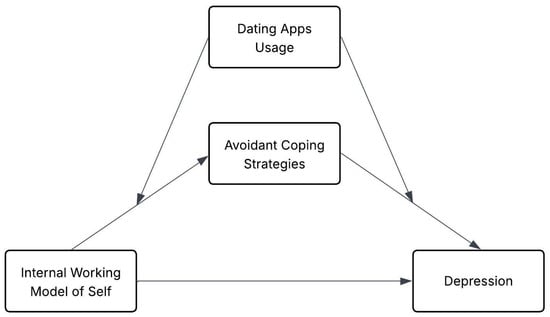
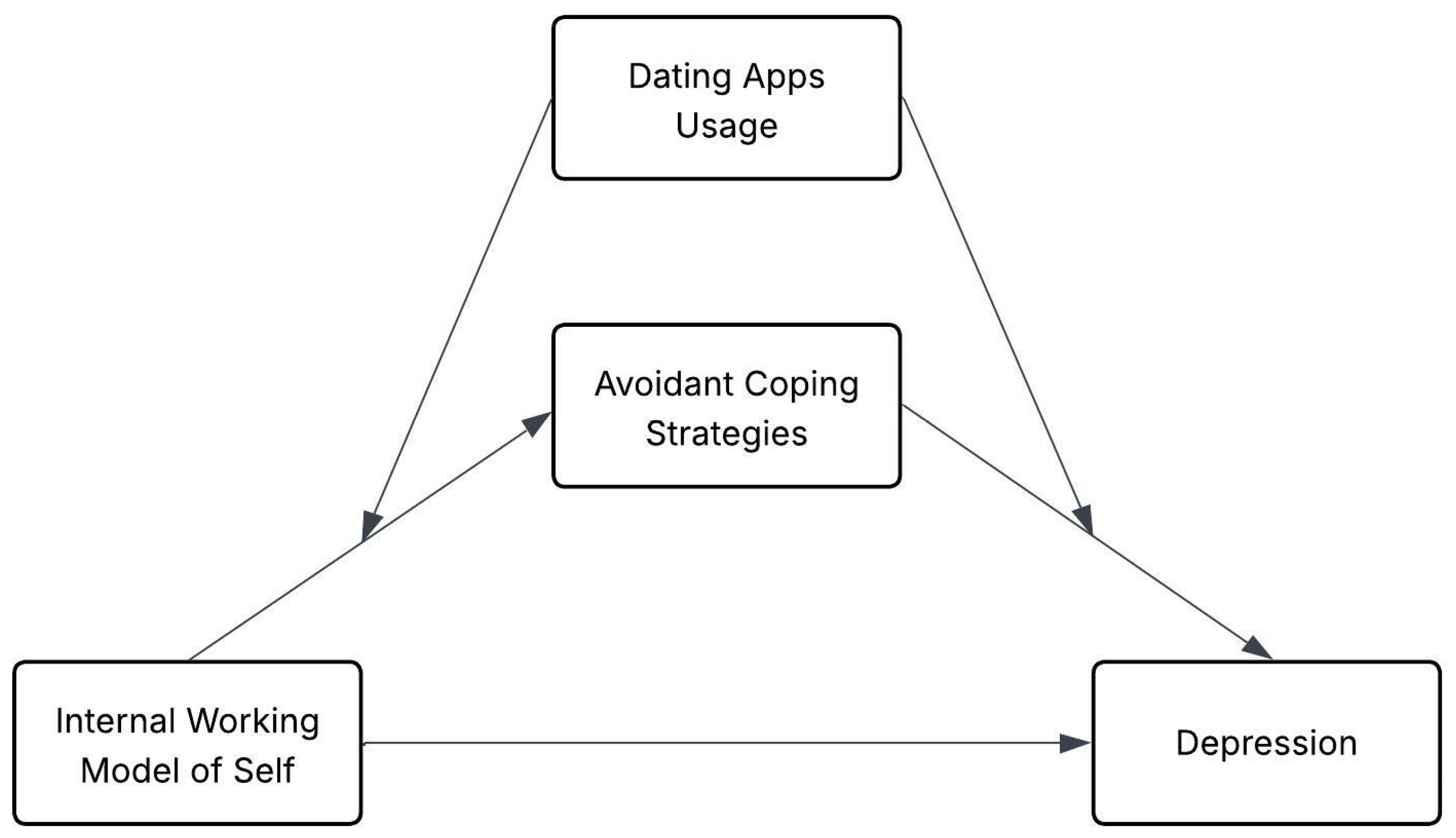
To test the study’s central hypothesis, a moderated mediation analysis was conducted using the PROCESS procedure for R [50,51]. Based on the theoretical framework of attachment theory [4,52], which posits IWMs as stable, early-formed traits preceding situational coping responses, a Hayes’ Model 58 was designed to determine whether the indirect effect of the IWMSelf (X) on depression (Y) through avoidant coping (M) was conditional upon DA use (W).
This model (Figure 1) tests whether the mediation pathway is moderated by examining the influence of the moderator (dating app use) on the two pathways that comprise the indirect effect: path a (the effect of the self-model on avoidant coping) and path b (the effect of avoidant coping on depression). The continuous predictor (self-model) and mediator (avoidant coping) were mean-centered prior to the analysis. Gender, age, sexual orientation, education and being in psychotherapy were included in all regression models as covariates to control for their potential influence.
Figure 1.
The proposed Moderated Mediation Model. This path diagram illustrates the hypothesized mediating role of avoidant coping (M) in the relationship between the internal working model of the self (X) and depression (Y), with the indirect pathway being moderated by dating app usage (W).
The significance of the moderated mediation was formally tested using the Index of Moderated Mediation [53], which quantifies the difference between the conditional indirect effects for dating app users and non-users. A robust bootstrapping procedure with 5000 resamples was used to generate all confidence intervals for the conditional indirect effects and the index. A 95% bootstrap confidence interval for this index that does not contain zero indicates that the indirect effect’s strength differs significantly between the two groups, providing statistical support for moderated mediation.
3. Results
Table 1 reports the demographic and psychological comparison between DA users (N = 704) and Non-Users (N = 1420). In terms of demographic traits, DAs users were more likely to be male, non-heterosexual and graduated compared to non-users, with all differences being statistically significant (p < 0.001) and with small effect sizes (Cramer’s ϕ ranging from 0.097 to 0.214). There were no significant differences found in age and in the percentage of individuals undergoing psychotherapy.
Table 1.
Demographic characteristics of study variables and comparison between DA users and non-users.
Moreover, DA users reported significantly higher levels of preoccupied attachment (p = 0.002), depression (p = 0.018), avoidant coping (p = 0.011) and lower levels of IWMSelf (p = 0.007) compared to non-users, with small effect sizes (Cohen’s d ranging from 0.103 to 0.141). No significant differences were found between the groups for secure, dismissing, or fearful attachment styles and IWMOther.
Zero-order correlation on study sample highlighted negative correlations between IWMSelf and both avoidant coping (r = −0.288, p < 0.001) and depression (r = −0.355, p < 0.001), and positive correlation between avoidant coping and depression (r = 0.402, p < 0.001).
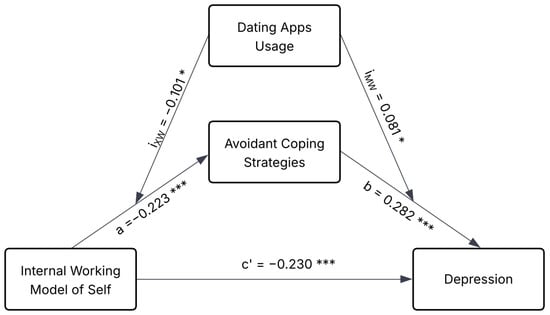
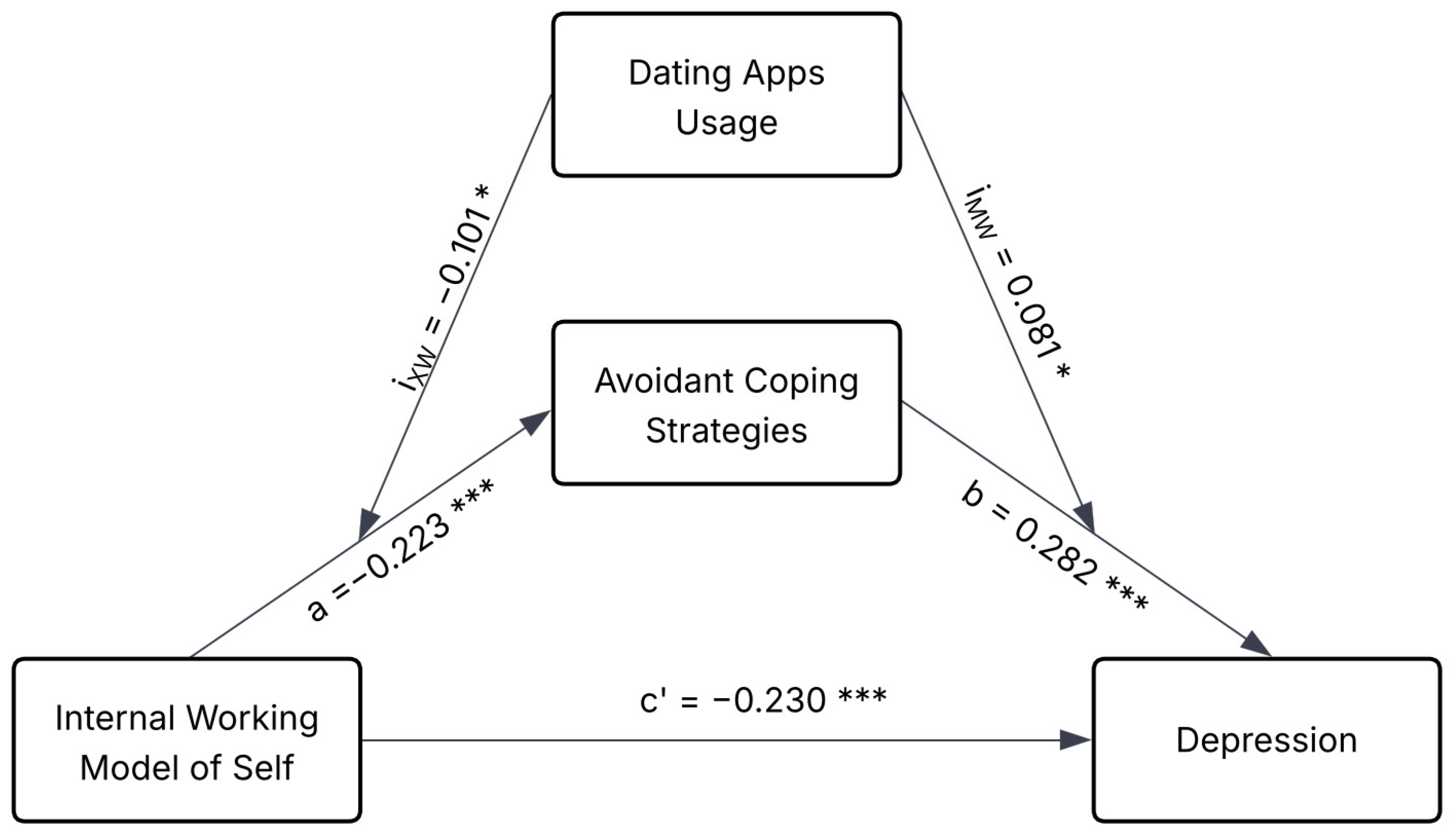
Figure 2 shows all the results of the hypothesized moderated mediation model. All the covariates were found to be significant predictors of depression in the model (p < 0.001). The analysis first revealed that the path “a” (IWMSelf → avoidant coping) was significantly moderated by DA use (b = −0.10, p < 0.05). The negative association between a positive IWM of the self and avoidant coping was significantly stronger for DAs users (b = −0.32, p < 0.001) than for non-users (b = −0.22, p < 0.001). In the same way, the path “b” (avoidant coping → depression) was also significantly moderated by DA use (b = 0.08, p < 0.05). The positive association between avoidant coping and depression was significantly stronger for DA users (b = 0.36, p < 0.001) than for non-users (b = 0.28, p < 0.001).
Figure 2.
Unstandardized path coefficients of the Moderated Mediation Model. Note. N = 2124, * p < 0.05. *** p < 0.001; iXW = Interaction term between IWM of Self and Dating Apps Usage; iMW = Interaction term between Avoidant Coping and Dating Apps Usage.
The conditional indirect effects were significant for both DAs non-users (b = −0.063, 95% CI [−0.084, −0.045]) and users (b = −0.119, 95% CI [−0.159, −0.085]). The 95% CI for the index of moderated mediation did not contain zero (b = −0.056, 95% CI [−0.098, −0.016]), indicating that the indirect effect was significantly stronger for DA users compared to non-users.
Finally, the direct effect of the IWMSelf on depression was significant (b = −0.23, p < 0.001), indicating that a positive self-model is associated with lower depression regardless of avoidant coping strategies (Table 2).
Table 2.
Path coefficients for direct and conditional indirect effects.
4. Discussion
The current research aimed to clarify the intricate interaction between attachment, coping, and depressive symptoms in single people, with a specific emphasis on the moderating role of DA use. Our results suggest that although a negative self-image may represent a core vulnerability for depression in single individuals [3,16,17], DAs may function as a ‘psychological amplifier’ that strengthens the pre-existing association between an individual’s self-concept and their mental health outcomes in both directions: strengthening the link between positive self-concept and adaptive coping or the association between negative self-views and maladaptive coping. The moderated mediation model provides statistical evidence for this dynamic, revealing that the relationship between an individual’s self-perception and their coping strategies is significantly stronger for DA users. This intensification can manifest in a cycle of distress for those with a negative self-concept and maladaptive coping strategies, but can also strengthen the link between a positive self-perception, effective coping, and overall well-being.
Our findings thus initially replicate the central role of an individual’s IWMSelf in the context of depressive symptoms. The significant direct effect of IWMSelf on depression, along with the strong negative zero-order correlation highlights that a negative perspective on oneself is a robust and direct risk factor for psychological distress, regardless of coping or DA use. Attachment theory provides a strong basis for understanding this link, suggesting that early life experiences shape fundamental beliefs about one’s self-worth. These beliefs then become a core belief influencing mental health outcomes throughout the lifespan [4,14,17,52]. In addition, our findings are consistent with the theoretical expectation that a negative IWMSelf would be strongly linked to increased use of avoidant coping strategies, a relationship well established in the literature [22,23,25].
Although this fundamental relationship is not novel, its importance appears amplified in the context of DAs. Literature suggests that these platforms may represent hyper-evaluative spaces where individuals are exposed to a steady stream of fast and stereotypical judgments [33,54]. This environment is especially risky for those high in rejection sensitivity—a tendency to anxiously anticipate, easily perceive, and overreact to rejection [55]—which itself is a product of insecure attachment [35,56].
The evidence that DA users reported significantly higher levels of preoccupied attachment, avoidant coping, depression and a more negative IWMSelf compared to non-users could represent a psychological paradox. Individuals with a preoccupied attachment style, characterized by a strong desire for intimacy and high levels of rejection sensitivity, are frequently attracted to online dating, under the assumption that it provides a safer space in which to present their “true self” [57,58]. However, for an individual with preoccupied attachment, potential experiences such as non-matches, unanswered messages, or ghosting are likely not interpreted as neutral data points but rather as confirmation of their deeply held beliefs of being unworthy or unlovable [55,56,59]. Hence, this potential paradox could be interpreted as a form of maladaptive regulation attempt.
The central finding of this study is represented by the significant moderated mediation, which demonstrates that the entire indirect pathway from IWMSelf to depression through avoidant coping is significantly stronger for DA users compared to non-users. This evidence indicates that DAs are not merely a passive venue for dating but an active environmental context that interacts with the relationship between attachment patterns and mental health outcomes.
4.1. Dating Apps as a ‘Psychological Amplifier’
The architecture of DAs, characterized by an overwhelming number of choices, low accountability, and the normalization of ambiguous disengagement strategies [36,60], creates a context where direct communication may be perceived as riskier, making avoidance appear as a more accessible strategy [18,19]. Consistent with our evidence, users with secure IWMSelf appear to be equipped to navigate this environment, potentially using approach coping strategies (e.g., optimism) to seek meaningful connections rather than merely alleviating loneliness [61,62]. By fostering supportive interactions, DAs may thus nurture a sense of security, encouraging users to build deeper and empathic relationships [52,63].
At the same time, the negative association between avoidant coping and depression was also significantly stronger for DA users. In a face-to-face situation, avoiding someone who may be a potential romantic partner could be a discrete, one-time occurrence. Conversely, on DAs this occurs within the context of perceived higher partner availability, perpetual social comparison, and confusing feedback loops. We interpret this finding as suggesting that avoidant coping in this digital space prevents the user from processing frequent rejection-type experiences. Consequently, unresolved negative affect may accumulate, particularly in singlehood [64]. This process aligns with the concept of “dating app burnout”—a chronic stress syndrome involving emotional exhaustion, cynicism, and perceived inefficacy. This burnout state is itself a strong predictor of depression and anxiety [56,65].
Together, these moderated pathways describe a potential feedback cycle. For vulnerable individuals with low self-esteem, the hyper-evaluative and ambiguous context of DAs may reinforce the tendency to adopt avoidant coping [66]. These strategies, being ineffective and harmful in that environment, may contribute to worsening depressive symptoms [29]. However, our findings also suggest a potentially positive cycle. Individuals with a strong, positive IWMSelf may use DAs with more adaptive, approach-based coping strategies, such as seeking meaningful connections. The supportive interactions and emotional regulation fostered by these strategies can nurture a sense of security and encourage healthier relationships. In this way, the DA environment can also serve to reinforce a positive self-concept and psychological well-being [62].
This amplification effect parallels the mechanics described in the recent literature on the “gamification of romance” [32], which argues that DA′s architecture-incorporating variable-ratio reward schedules and progression dynamics [67]—may transform the deeply human pursuit of intimacy into a form of relationshopping [54], where potential partners are often evaluated through commodified profiles. While our study did not directly measure these design features, this theoretical framework offers a plausible explanation for our findings. Specifically, it suggests that the DA environment creates a rejection-salient context [32,68] that is fundamentally opposed to the vulnerability required for healthy attachment [69]. This misalignment helps explain why DAs appeared particularly challenging for individuals with pre-existing insecurities in our model, while those with a strong self-concept remained less exposed to these potential maladaptive dynamics.
Finally, while our preliminary analysis showed no significant differences in age or psychotherapy attendance between DA users and non-users, the finding that age, gender, sexual orientation, educational status, and attendance at psychotherapy were significant predictors of depressive symptoms within our model is coherent with existing literature. This outcome further supports the importance of incorporating these variables as covariates to control for their influence on depression.
4.2. Limitations and Directions for Future Research
Several limitations of the present study should be acknowledged. First, the cross-sectional design does not allow for causal inference, although our theoretically informed model offers a solid foundation for future longitudinal investigation. Second, our measurement of DA use was binary (User vs. Non-user). We did not assess usage intensity, frequency, or specific motives (e.g., relationship-seeking vs. casual sex vs. entertainment). As noted by recent literature, different motives can lead to different psychological outcomes [57]. Third, as acknowledged in the discussion, the specific mechanisms used to interpret the amplification effect (e.g., gamification features, ghosting) were not operationalized as specific variables in our survey. Consequently, the link between DA architecture and the observed psychological outcomes remains theoretical and warrants direct empirical verification in future studies. Finally, it is important to acknowledge that data were gathered during the peculiar psychosocial environment of the first COVID-19 national lockdown. While the prevalence of DA use in our sample (33.14%) aligns with existing percentages reported in the literature [62], the profound social isolation and situational distress likely influenced baseline levels of depression, as well as the reliance on digital socialization. Consequently, the observed “amplification effect” might be partially context-specific, and its generalizability should be further verified in a post-COVID scenario.
Future research could investigate beyond a binary indicator of DA use, including more nuanced measures of engagement (e.g., frequency, duration, reasons for use, rates of rejection, etc.). Lastly, theoretical extension of the model to other key variables, including rejection sensitivity, social comparison, and loneliness, would offer a fuller account of the psychological processes of digital dating.
5. Conclusions
This study provided empirical evidence suggesting that the relationship between an individual’s core IWMSelf and mental health is significantly associated with the digital environment in which they pursue feelings of connectedness. DAs in singlehood appear to be more than neutral tools; they are social contexts associated with a strengthening of previously established vulnerabilities or psychological resources. The structure of the DAs has the potential to be associated with either an undesirable self-perception and an intensified depressive experience, or a more desirable self-perception and a heightened sense of well-being, depending on whether it instils a dependency on maladaptive or adaptive coping strategies. These findings indicate the very real necessity of researchers, clinicians, and platform builders collectively outlining an augmented, critical and psychologically aware understanding of the way technology creates the inherently human search for intimacy in the age of the internet.
Author Contributions
Conceptualization, D.M. and G.R.; methodology, D.M. and T.B.J.; validation, D.M. and T.B.J.; formal analysis, D.M.; investigation, G.R.; data curation, D.M. and A.S.; writing—original draft preparation, D.M., T.B.J. and G.R.; writing—review and editing, L.C., A.S., G.C., E.A.J. and E.L.; visualization, E.L.; supervision, E.A.J. and E.L. All authors have read and agreed to the published version of the manuscript.
Funding
This research received no external funding.
Institutional Review Board Statement
The study was conducted in accordance with the Declaration of Helsinki and approved by the Ethics Committee of the University of Rome Sapienza (protocol code 0000593/2020, 10 July 2020).
Informed Consent Statement
Informed consent was obtained from all subjects involved in the study.
Data Availability Statement
The raw data supporting the conclusions of this article will be made available by the authors on request.
Conflicts of Interest
The authors declare no conflicts of interest.
Abbreviations
The following abbreviations are used in this manuscript:
| IWMSelf | Internal Working Model of Self |
| IWMOther | Internal Working Model of Other |
| DAs | Dating Apps |
References
- Kislev, E. Singlehood as an Identity. Eur. Rev. Soc. Psychol. 2024, 35, 258–292. [Google Scholar] [CrossRef] [Scilit]
- DePaulo, B.M.; Morris, W.L. TARGET ARTICLE: Singles in Society and in Science. Psychol. Inq. 2005, 16, 57–83. [Google Scholar] [CrossRef] [Scilit]
- Pepping, C.A.; MacDonald, G.; Davis, P.J. Toward a Psychology of Singlehood: An Attachment-Theory Perspective on Long-Term Singlehood. Curr. Dir. Psychol. Sci. 2018, 27, 324–331. [Google Scholar] [CrossRef] [Scilit]
- Bowlby, J. A Secure Base: Parent-Child Attachment and Healthy Human Development; Basic books: New York, NY, USA, 2008. [Google Scholar]
- Mikulincer, M.; Shaver, P.R. Attachment in Adulthood: Structure, Dynamics, and Change; Guilford Publications: New York, NY, USA, 2007; p. 578. [Google Scholar]
- Gaylord-Harden, N.K.; Taylor, J.; Campbell, C.L.; Kesselring, C.M.; Grant, K.E. Maternal Attachment and Depressive Symptoms in Urban Adolescents: The Influence of Coping Strategies and Gender. J. Clin. Child Adolesc. Psychol. 2009, 38, 684–695. [Google Scholar] [CrossRef] [Scilit]
- Hazan, C.; Shaver, P. Romantic Love Conceptualized as an Attachment Process. J. Personal. Soc. Psychol. 1987, 52, 511–524. [Google Scholar] [CrossRef]
- Bartholomew, K.; Horowitz, L.M. Attachment Styles among Young Adults: A Test of a Four-Category Model. J. Personal. Soc. Psychol. 1991, 61, 226–244. [Google Scholar] [CrossRef]
- Griffin, D.W.; Bartholomew, K. Models of the Self and Other: Fundamental Dimensions Underlying Measures of Adult Attachment. J. Personal. Soc. Psychol. 1994, 67, 430–445. [Google Scholar] [CrossRef]
- Lenton-Brym, A.P.; Santiago, V.A.; Fredborg, B.K.; Antony, M.M. Associations Between Social Anxiety, Depression, and Use of Mobile Dating Applications. Cyberpsychology Behav. Soc. Netw. 2021, 24, 86–93. [Google Scholar] [CrossRef] [Scilit]
- Rossi, R.; Jannini, T.B.; Socci, V.; Pacitti, F.; Rossi, A.; Di Lorenzo, G. Role of Attachment Style in the Association between Childhood Adversities and Non-Suicidal Self-Injury among Young Adults: A Multigroup Structural Equation Study. Gen. Psych. 2025, 38, e101277. [Google Scholar] [CrossRef] [Scilit]
- Rossi, R.; Jannini, T.B.; Ciocca, G.; Cipriani, C.; Socci, V.; Pacitti, F.; Di Lorenzo, G. Attachment and Resilience as Mediators or Moderators in the Relationship between Trauma and Psychotic-like Experiences. Schizophr. Res. 2023, 258, 36–44. [Google Scholar] [CrossRef] [Scilit]
- Sumter, S.R.; Vandenbosch, L.; Ligtenberg, L. Love Me Tinder: Untangling Emerging Adults’ Motivations for Using the Dating Application Tinder. Telemat. Inform. 2017, 34, 67–78. [Google Scholar] [CrossRef] [Scilit]
- Khan, F.; Fraley, R.C.; Young, J.F.; Hankin, B.L. Developmental Trajectories of Attachment and Depressive Symptoms in Children and Adolescents. Attach. Hum. Dev. 2020, 22, 392–408. [Google Scholar] [CrossRef] [Scilit]
- Rajkumar, R.P. Comorbid Depression and Anxiety: Integration of Insights from Attachment Theory and Cognitive Neuroscience, and Their Implications for Research and Treatment. Front. Behav. Neurosci. 2022, 16, 1104928. [Google Scholar] [CrossRef] [Scilit]
- Spruit, A.; Goos, L.; Weenink, N.; Rodenburg, R.; Niemeyer, H.; Stams, G.J.; Colonnesi, C. The Relation Between Attachment and Depression in Children and Adolescents: A Multilevel Meta-Analysis. Clin. Child Fam. Psychol. Rev. 2020, 23, 54–69. [Google Scholar] [CrossRef] [Scilit]
- Tong, G. The Relationship Between Attachment and Depression. In 2019 5th International Conference on Humanities and Social Science Research (ICHSSR 2019); Atlantis Press: Dordrecht, The Netherlands, 2019; pp. 127–132. [Google Scholar] [CrossRef] [Scilit]
- Liang, Y.; Liu, X.; Zhang, H.; Wang, Y.; Zhong, L. A Moderated Mediation Model of Avoidance Attachment and Depression among Chinese Online Daters: A Social Enhancement Perspective. Acta Psychol. 2025, 258, 105282. [Google Scholar] [CrossRef] [Scilit]
- Chin, K.; Edelstein, R.S.; Vernon, P.A. Attached to Dating Apps: Attachment Orientations and Preferences for Dating Apps. Mob. Media Commun. 2019, 7, 41–59. [Google Scholar] [CrossRef] [Scilit]
- Coffey, J.K.; Bond, D.K.; Stern, J.A.; Van Why, N. Sexual Experiences and Attachment Styles in Online and Offline Dating Contexts. Int. J. Sex. Health 2022, 34, 665–678. [Google Scholar] [CrossRef] [Scilit]
- Spielmann, S.S.; MacDonald, G.; Maxwell, J.A.; Joel, S.; Peragine, D.; Muise, A.; Impett, E.A. Settling for Less out of Fear of Being Single. J. Personal. Soc. Psychol. 2013, 105, 1049–1073. [Google Scholar] [CrossRef] [Scilit]
- Wei, M.; Heppner, P.P.; Mallinckrodt, B. Perceived Coping as a Mediator between Attachment and Psychological Distress: A Structural Equation Modeling Approach. J. Couns. Psychol. 2003, 50, 438–447. [Google Scholar] [CrossRef] [Scilit]
- Aldao, A.; Nolen-Hoeksema, S.; Schweizer, S. Emotion-Regulation Strategies across Psychopathology: A Meta-Analytic Review. Clin. Psychol. Rev. 2010, 30, 217–237. [Google Scholar] [CrossRef] [Scilit]
- Vanhalst, J.; Luyckx, K.; Teppers, E.; Goossens, L. Disentangling the Longitudinal Relation Between Loneliness and Depressive Symptoms: Prospective Effects and the Intervening Role of Coping. J. Soc. Clin. Psychol. 2012, 31, 810–834. [Google Scholar] [CrossRef] [Scilit]
- Orzechowska, A.; Bliźniewska-Kowalska, K.; Gałecki, P.; Szulc, A.; Płaza, O.; Su, K.; Georgescu, D.; Gałecka, M. Ways of Coping With Stress Among Patients With Depressive Disorders. J. Clin. Med. 2022, 11, 6500. [Google Scholar] [CrossRef] [Scilit]
- Palacios, J.; Acosta-Beltrán, D.B.; Acevedo-Ibarra, J.N. How Important Are Optimism and Coping Strategies for Mental Health? Effect in Reducing Depression in Young People. Psychiatry Int. 2024, 5, 532–543. [Google Scholar] [CrossRef] [Scilit]
- Meyer, B. Coping with Severe Mental Illness: Relations of the Brief COPE with Symptoms, Functioning, and Well-Being. J. Psychopathol. Behav. Assess. 2001, 23, 265–277. [Google Scholar] [CrossRef] [Scilit]
- Rochat, L.; Bianchi-Demicheli, F.; Aboujaoude, E.; Khazaal, Y. The Psychology of “Swiping”: A Cluster Analysis of the Mobile Dating App Tinder. J. Behav. Addict 2019, 8, 804–813. [Google Scholar] [CrossRef] [Scilit]
- Cruz, G.V.; Aboujaoude, E.; Rochat, L.; Bianchi-Demicheli, F.; Khazaal, Y. Online Dating: Predictors of Problematic Tinder Use. BMC Psychol. 2024, 12, 106. [Google Scholar] [CrossRef] [Scilit]
- Sharabi, L.L.; Caughlin, J.P. What Predicts First Date Success? A Longitudinal Study of Modality Switching in Online Dating. Pers. Relatsh. 2017, 24, 370–391. [Google Scholar] [CrossRef] [Scilit]
- Strubel, J.; Petrie, T.A. Love Me Tinder: Body Image and Psychosocial Functioning among Men and Women. Body Image 2017, 21, 34–38. [Google Scholar] [CrossRef] [Scilit]
- Nader, K. The Gamification of Dating Online. Theoria 2025, 91, e12549. [Google Scholar] [CrossRef] [Scilit]
- Thomas, M.F.; Binder, A.; Stevic, A.; Matthes, J. 99 + Matches but a Spark Ain’t One: Adverse Psychological Effects of Excessive Swiping on Dating Apps. Telemat. Inform. 2023, 78, 101949. [Google Scholar] [CrossRef] [Scilit]
- Bowman, Z.; Drummond, M.; Church, J.; Kay, J.; Petersen, J.M. Dating Apps and Their Relationship with Body Image, Mental Health and Wellbeing: A Systematic Review. Comput. Hum. Behav. 2025, 165, 108515. [Google Scholar] [CrossRef] [Scilit]
- Downey, G.; Feldman, S.I. Implications of Rejection Sensitivity for Intimate Relationships. J. Personal. Soc. Psychol. 1996, 70, 1327–1343. [Google Scholar] [CrossRef]
- Timmermans, E.; Hermans, A.-M.; Opree, S.J. Gone With the Wind: Exploring Mobile Daters’ Ghosting Experiences. J. Soc. Pers. Relatsh. 2020, 38, 783–801. [Google Scholar] [CrossRef] [Scilit]
- Blanco, J.; Osinaga, A.M.; Mendoza, R.J.; Navales, K.J.; Rayla, N.A.; Yapo, F.C.; Evangelista, C.B.; Torrero, K.A.; Tus, J. The Self-Esteem, Loneliness, and Psychological Well-Being of Online Dating App Users: A Mixed Method Study. Psychol. Educ. A Multidiscip. J. 2024, 22, 82–107. [Google Scholar] [CrossRef]
- Ciocca, G.; Fontanesi, L.; Robilotta, A.; Limoncin, E.; Nimbi, F.M.; Mollaioli, D.; Sansone, A.; Colonnello, E.; Simonelli, C.; Di Lorenzo, G.; et al. Hypersexual Behavior and Depression Symptoms among Dating App Users. Sexes 2022, 3, 298–307. [Google Scholar] [CrossRef] [Scilit]
- Mollaioli, D.; Sansone, A.; Ciocca, G.; Limoncin, E.; Colonnello, E.; Di Lorenzo, G.; Jannini, E.A. Benefits of Sexual Activity on Psychological, Relational, and Sexual Health During the COVID-19 Breakout. J. Sex. Med. 2021, 18, 35–49. [Google Scholar] [CrossRef] [Scilit]
- Sansone, A.; Mollaioli, D.; Ciocca, G.; Colonnello, E.; Limoncin, E.; Balercia, G.; Jannini, E.A. “Mask up to Keep It up”: Preliminary Evidence of the Association between Erectile Dysfunction and COVID-19. Andrology 2021, 9, 1053–1059. [Google Scholar] [CrossRef] [Scilit]
- Ligiéro, D.P.; Gelso, C.J. Countertransference, Attachment, and the Working Alliance: The Therapist’s Contribution. Psychother. Theory Res. Pract. Train. 2002, 39, 3–11. [Google Scholar] [CrossRef]
- Barone, L. (Ed.) La Valutazione Dell’attaccamento Adulto: I Questionari Autosomministrati, 1st ed.; Collana Di Psicologia Clinica e Psicoterapia; Cortina: Milano, Italy, 2007. [Google Scholar]
- Carver, C.S. You Want to Measure Coping but Your Protocol’ Too Long: Consider the Brief Cope. Int. J. Behav. Med. 1997, 4, 92–100. [Google Scholar] [CrossRef] [Scilit]
- Rodrigues, F.; Figueiredo, N.; Rodrigues, J.; Ferreira, R.; Hernández-Mendo, A.; Monteiro, D. A Comprehensive Review and Bifactor Modeling Analysis of the Brief COPE. Inquiry 2022, 59, 00469580221108127. [Google Scholar] [CrossRef] [Scilit]
- Conti, L. Repertorio Delle Scale Di Valutazione in Psichiatria; Società Editrice Europea di Nicodemo Maggiulli: Firenze, Italy, 2000. [Google Scholar]
- Kalkbrenner, M.T.; Ryan, A.F.; Hunt, A.J.; Rahman, S.R. Internal Consistency Reliability and Internal Structure Validity of the English Versions of the Patient Health Questionnaire-9 and the Generalized Anxiety Disorder-7: A Psychometric Synthesis. Meas. Eval. Couns. Dev. 2023, 56, 124–137. [Google Scholar] [CrossRef] [Scilit]
- Mazzotti, E.; Fassone, G.; Picardi, A.; Sagoni, E.; Ramieri, L.; Lega, I.; Camaioni, D.; Aheni, D.; Pasquini, P. The Patient Health Questionnaire (PHQ) for the Screening of Psychiatric Disorders: A Validation Study versus the Structured Clinical Interview for DSM-IV Axis I (SCID-I). Ital. J. Psychopathol. 2003, 9, 235–242. [Google Scholar]
- Bolgeo, T.; Di Matteo, R.; Simonelli, N.; Dal Molin, A.; Lusignani, M.; Bassola, B.; Vellone, E.; Maconi, A.; Iovino, P. Psychometric Properties and Measurement Invariance of the 7-Item General Anxiety Disorder Scale (GAD-7) in an Italian Coronary Heart Disease Population. J. Affect. Disord. 2023, 334, 213–219. [Google Scholar] [CrossRef] [Scilit]
- R Core Team. R: A Language and Environment for Statistical Computing; R Foundation for Statistical Computing: Vienna, Austria, 2025. [Google Scholar]
- Hayes, A.F.; Rockwood, N.J. Conditional Process Analysis: Concepts, Computation, and Advances in the Modeling of the Contingencies of Mechanisms. Am. Behav. Sci. 2020, 64, 19–54. [Google Scholar] [CrossRef] [Scilit]
- Hayes, A.F. Introduction to Mediation, Moderation, and Conditional Process Analysis: A Regression-Based Approach, 3rd ed.; Methodology in the social sciences; The Guilford Press: New York, NY, USA, 2022. [Google Scholar]
- Mikulincer, M.; Shaver, P.R. Attachment in Adulthood: Structure, Dynamics, and Change, 2nd ed.; The Guilford Press: New York, NY, USA, 2016. [Google Scholar]
- Hayes, A.F. An Index and Test of Linear Moderated Mediation. Multivar. Behav. Res. 2015, 50, 1–22. [Google Scholar] [CrossRef] [Scilit]
- Heino, R.D.; Ellison, N.B.; Gibbs, J.L. Relationshopping: Investigating the Market Metaphor in Online Dating. J. Soc. Pers. Relatsh. 2010, 27, 427–447. [Google Scholar] [CrossRef] [Scilit]
- Huang, Y.-T.; Gong, A.-D. Too Vulnerable to Resist: Problematic Use of Dating Apps Associated with Social Appearance Anxiety, Social Interaction Anxiety, and Rejection Sensitivity. Comput. Hum. Behav. 2025, 165, 108566. [Google Scholar] [CrossRef] [Scilit]
- Lenton-Brym, A.P.; Monson, C.M.; Spaniol, J.; Shoychet, G.; Hernandez, K.M.; Antony, M.M. Negative Affect Following Dating Application Use Is Predicted by Social Anxiety Symptoms and Match Rate. Cyberpsychology Behav. Soc. Netw. 2024, 27, 807–814. [Google Scholar] [CrossRef] [Scilit]
- Timmermans, E.; Alexopoulos, C. Anxiously Searching for Love (Among Other Things): Attachment Orientation and Mobile Dating Application Users’ Motives and Outcomes. Cyberpsychology Behav. Soc. Netw. 2020, 23, 447–452. [Google Scholar] [CrossRef] [Scilit]
- Vera Cruz, G.; Aboujaoude, E.; Rochat, L.; Bianchi-Demichelli, F.; Khazaal, Y. Finding Intimacy Online: A Machine Learning Analysis of Predictors of Success. Cyberpsychology Behav. Soc. Netw. 2023, 26, 604–612. [Google Scholar] [CrossRef] [Scilit]
- Coduto, K.D.; Lee-Won, R.J.; Baek, Y.M. Swiping for Trouble: Problematic Dating Application Use among Psychosocially Distraught Individuals and the Paths to Negative Outcomes. J. Soc. Pers. Relatsh. 2020, 37, 212–232. [Google Scholar] [CrossRef] [Scilit]
- Pancani, L.; Mazzoni, D.; Aureli, N.; Riva, P. Ghosting and Orbiting: An Analysis of Victims’ Experiences. J. Soc. Pers. Relatsh. 2021, 38, 1987–2007. [Google Scholar] [CrossRef] [Scilit]
- Hobbs, M.; Owen, S.; Gerber, L. Liquid Love? Dating Apps, Sex, Relationships and the Digital Transformation of Intimacy. J. Sociol. 2017, 53, 271–284. [Google Scholar] [CrossRef] [Scilit]
- Castro, Á.; Barrada, J.R. Dating Apps and Their Sociodemographic and Psychosocial Correlates: A Systematic Review. Int. J. Environ. Res. Public Health 2020, 17, 6500. [Google Scholar] [CrossRef] [Scilit]
- Bahadir-Yilmaz, E.; Şahin, E. The Effects of Irrational Romantic Relationship Beliefs and Experiences in Close Relationships on Dating Violence of Nursing and Midwifery Students. Perspect. Psychiatr. Care 2022, 58, 1232–1238. [Google Scholar] [CrossRef] [Scilit]
- Thomas, M.F.; Binder, A.; Matthes, J. The Agony of Partner Choice: The Effect of Excessive Partner Availability on Fear of Being Single, Self-Esteem, and Partner Choice Overload. Comput. Hum. Behav. 2022, 126, 106977. [Google Scholar] [CrossRef] [Scilit]
- Sharabi, L.L.; Feldt, P.A.V.; Ha, T. Burnt Out and Still Single: Susceptibility to Dating App Burnout Over Time. New Media Soc. 2024, 28, 169–190. [Google Scholar] [CrossRef] [Scilit]
- Degen, J.L.; Kleeberg-Niepage, A. Coping With Mobile-Online-Dating Fatigue and the Negative Self-Fulfilling Prophecy of Digital Dating. SN Soc. Sci. 2025, 5, 12. [Google Scholar] [CrossRef] [Scilit]
- Tong, S.T.; Hancock, J.T.; Slatcher, R.B. Online Dating System Design and Relational Decision Making: Choice, Algorithms, and Control. Pers. Relatsh. 2016, 23, 645–662. [Google Scholar] [CrossRef] [Scilit]
- Cicchirillo, V.J.; Hendricks Salopek, A.; Ham, J. Quest for Connection: Motives and Gamified Approaches to Continued and Compulsive Dating App Engagement. Atl. J. Commun. 2025, 33, 667–682. [Google Scholar] [CrossRef] [Scilit]
- Bandinelli, C.; Bandinelli, A. What Does the App Want? A Psychoanalytic Interpretation of Dating Apps’ Libidinal Economy. Psychoanal. Cult. Soc. 2021, 26, 181–198. [Google Scholar] [CrossRef] [Scilit]

Disclaimer/Publisher’s Note: The statements, opinions and data contained in all publications are solely those of the individual author(s) and contributor(s) and not of MDPI and/or the editor(s). MDPI and/or the editor(s) disclaim responsibility for any injury to people or property resulting from any ideas, methods, instructions or products referred to in the content. |
© 2026 by the authors. Licensee MDPI, Basel, Switzerland. This article is an open access article distributed under the terms and conditions of the Creative Commons Attribution (CC BY) license.