


Abstract
This article studies how narrativity, performativity and visuality are employed in Shakespeare comics: single-volume adaptations of individual Shakespeare plays in comic book, graphic novel or manga form. The cases studied include two Classics Illustrated titles (Julius Caesar, Hamlet), two No Fear Shakespeare Graphic Novels (Hamlet, Macbeth) and the Manga Classics Macbeth. These are all geared towards older children, but like most comics they can be enjoyed by readers of all ages. In discussions framed by adaptation theory and research on children’s editions of Shakespeare, I study how verbal content such as paraphrase, captions in text boxes and original Shakespearean verse interact with visual elements in these comics, and I argue that the legibility, aesthetic interest and reader engagement engendered by Shakespeare comics emerge primarily from their multimodal narrative design—which has literary, dramatic and visual arts qualities—whilst paraphrasing the verbal language is less effective. Scholarship on Shakespearean prose retellings for older children identifies cultural assumptions that underlie this genre of adaptation and demonstrates how narrative has been used to reinscribe problematic moral stances, worldviews and a form of bardolatry. Comics’ visual–verbal narrative design enables reinterrogations of the canon through comparing several Shakespeare comics. I show how the manner in which framing devices, drawing styles, character designs and settings interact and interblend with the verbal content, thus determining how Shakespeare comics create meaning, and how they help us reassess Shakespeare’s position in culture. At the same time, the conspicuous co-authorship seen in Shakespeare comics, between text, textual adaptation, mise-en-page and visual art, contributes towards subverting the notion of Shakespeare as singular genius.
1. Introduction
The No Fear Shakespeare graphic novel edition of Macbeth, illustrated by Hoshine (2008), presents a verbal text that alternates between modern paraphrase and original wording. The mixture of verbal styles can be seen from the opening scene as the First Witch asks, ‘When shall we three meet again? In thunder, lightning, or in rain?’, a familiar question with a less familiar response: ‘When the turmoil of battle is complete. When one side has won, and the other has lost.’ (Hoshine 2008, p. 2; emphasis added).
It seems that the illustrator has used as his manuscript the two-column SparkNotes ‘No Fear’ version of Macbeth (SparkNotes Editors 2003), which has the original text on the left and the ostensibly more accessible modern paraphrase on the right. Most of the time, the modern text is preferred. The quoted passage exemplifies how ‘Shakespearean language and poetics are typically understood as obstacles to comprehension and therefore largely set aside’ in adaptations for young readers (Marchitello 2003, p. 182). Since comics tend to be viewed as a young person’s medium (though they are of course not only for children), paraphrase of this kind might be expected to occur frequently. From the first Shakespeare adaptations, comics have both abbreviated and reshuffled Shakespeare’s verse, but ‘elimination, sometimes wholesale’ (p. 182) is not in fact the dominant trend. Several of the most prominent and bestselling Shakespeare comics, including many series explicitly aimed at a young readership, tend to use the original language, usually with some abridgement.1 My contention is that Shakespeare comics can make Shakespeare accessible—on a social and cultural level, as well as the level of parsing plot and language—without needing to resort to verbal paraphrase, because the multimodal, verbal–visual form of comics makes Shakespeare legible in manner akin to, but also radically different from, film and theatre.
In principle, there is nothing wrong with verbal paraphrase, but as the quoted example demonstrates, it is not easy to produce high-quality rewritten Shakespearean dialogue, and in comics adaptation it is at any rate not necessary. This article considers the visual–verbal affordances of comics and how they distribute words and images, it asks how narrative (didactic) control functions in comics, and it studies how their visual imagery interacts with, explains or interrogates verbal imagery. Covering an instructively broad temporal and generic range, as well as signally different approaches to the play-text, the comics studied here include a fairly recent, full-text manga adaptation of Macbeth (Manga Classics 2018: Chan and Choy 2018), two largely paraphrased No Fear Shakespeare graphic novel adaptations of Macbeth and Hamlet (SparkNotes/Spark Publishing: Babra 2008; Hoshine 2008) and the older, heavily abridged Classics Illustrated Julius Caesar (Kiefer 1950) and Hamlet (Blum 1952).
The unique multimodal and multi-authored form of comics adaptation sets it apart from other types of ‘retelling’ (broadly understood) for older children and young teenagers.2 The earliest Shakespeare comics display traces of the traditions that underpin nineteenth- and early twentieth-century adaptations of ostensible adults’ literature remade for children, but more recent examples choose other approaches. This difference aside, all these Shakespeare comics reconfigure the plays in manners that increase legibility, enable interrogation of the Shakespeare canon’s cultural authority, and highlight medium-specific traits of the plays and comics. I will demonstrate this by investigating the behaviour of verbal text throughout the abovementioned titles, with a special focus on techniques and devices that explain or clarify potentially challenging concepts or arcane verbal content.
Analyses of children’s literature are often seen in terms of adult interventions. ‘By the mid eighteenth century’ writes M.O. Grenby, ‘the expectation had become general that all children, regardless of their social class or gender, should read and have access to books’ (Grenby 2011, p. 256), but the access was often strictly regulated by adults (p. 220). Books were sometimes read under adult supervision, using techniques recommended by pedagogical manuals, such as the use of marginalia (pp. 227–28). Grenby documents that there was a great deal of literature especially adapted for children, such as Charles and Mary Lambs’ Tales from Shakespeare (1807), but, crucially, he also notes that when reading for entertainment rather than instruction, children preferred books written for adults (Grenby 2011, p. 286). As I will show, adult control, pedagogic approaches and a blurring of the line between children’s and adult culture are also relevant themes in a discussion of Shakespeare comics.
The main issue, however, is that of language. Shakespearean adaptation is conditioned (but not determined), says Douglas Lanier, by multiple factors, including medium-specific concerns and notions about the target audience (Lanier 2017, p. 299). He identifies a socially and institutionally influenced preference for Shakespeare’s (original) language over his plots: ‘[t]he reigning assumption […] has been that the source of Shakespeare’s greatness is to be identified with the verbal particularities of his scripts, which we as scholars are obliged to cherish, explicate and place in historical context. The appeal to Shakespeare’s original language, an appeal conducted from a variety of perspectives, has provided Shakespearean scholarship of the last century its distinctive cultural authority.’ (Lanier 2014, p. 21).3
The reductive preference Lanier describes and critiques, is apparently reflected in the attitudes of authors, educators and other arbiters of children’s literature as well. Erica Hateley identifies a conflict in the field of children’s Shakespeare, between ‘competing logics of Shakespeare’s derivative entertainment value (plots) and Shakespeare’s distinct genius available for educational value (language)’ (Hateley 2009, p. 3). Laura Tosi has highlighted the fact that for many adapters, such as Edith Nesbit, retelling the plays meant concentrating far more on the plot than on Shakespeare’s words. (Tosi 2014, p. 246), but there is an implicit hierarchy of value at work here: reading for the plot is to remain a child, and true education and cultivation are possible only through engaging with Shakespeare’s verse. In this conception, the only acceptable excuse for beginning with the plots rather than the verse is supposedly to see Shakespeare retold for young readers as a first step on the way to more detailed acquaintance with his oeuvre (Marchitello 2003, pp. 181, 183), in preparation for what Hateley describes as ‘an idealised and imagined future agency’ (p. 9; see also Tosi 2014, p. 247).
The centrality of Shakespeare’s language is also connected to the ‘Shakespeare myth’—the romanticised idea of Shakespeare as literary genius: ‘the patriarch of liberal-humanist culture’ and the implicit ‘proto-modern subject’. This author-myth, claims Hateley, provides prose retellings for children with a stability and coherence that ostensibly guarantees the integrity of the text, but in a way that reinscribes patriarchal cultural mechanisms (Hateley 2009, p. 9). Fidelity to the author and to the sanctity of the text is thus fraught with ‘politically motivated’ regulations of the child reader’s mind and body (Hateley 2009, p. 14). Fidelity is problematic, in other words, when it presupposes a hierarchy of cultural value (Hateley 2009, pp. 8–9). Lanier also criticises ‘the ideal of absolute fidelity … [which…] serves to establish a hierarchy of degrees of deviation from the source that too quickly become recoded as aesthetic evaluations: the farther from the source, the worse the adaptation.’ Paradoxically, however, ‘without some degree of fidelity, there can be no adaptation. Resemblance to the source is certainly not the only quality an adaptation might have … [b]ut every adaptation must be shown to have some degree of fidelity to a source for it to count as an adaptation.’ (Lanier 2014, p. 296).
The irony in all of this is that Shakespeare’s plays are generally understood to be ambiguous, complex and (subtly) critical of authority. Logically, then, an adaptation that is ‘faithful’ to a Shakespeare play should reproduce its ambiguities and subversive qualities. But as Hateley’s and Lanier’s work indicates, ‘fidelity’ can instead function as a mechanism that preserves the social status quo. Indeed, if ‘fidelity’ was understood as something that maintains the critical edge of the plays, adaptation scholars might take less issue with it. Ambiguity therefore cannot be taken for granted and reproducing it can be challenging within the framework of children’s literature. It is difficult to explain, ‘especially in the case of inexperienced readers, … what in the Shakespearean text is (intentionally) left ambiguous or obscure.’ (Tosi 2020, p. 1).
Replacing Shakespeare’s verse with modern paraphrase is not problematic because it erases a ‘culturally important’ text or because it foregoes ‘fidelity’, but because it reduces the impact and potential of juxtaposing a very specific kind of verbal text with comics visuality. Without this text, comics lose the ability to explain or amplify, to undercut or lampoon, to question or even to highlight ambiguity, which in comics is much more ably stated visually than through verbal paraphrase. In short, the way language is framed in Shakespeare comics requires the issues addressed by Lanier, Marchitello, Hateley and Tosi to be investigated anew.4
Unlike a prose retelling, language in comics is modulated by the composite formal nature of the medium. Comics have a special tripartite aesthetic and narrative identity that sets them apart from other forms. These three strands create meaning through internal interaction and through intertextual connections with other media (see Myklebost 2025b, pp. 3–4, 161–85, 196, 199, 209).
Firstly, traits such as having words printed on pages that you must read and turn to follow a plot tend to align comics with literary narratives (hence ‘graphic novel’). Secondly, comics’ representation of human figures with facial expressions and gestural language, who talk and perform actions, creates a dramatic (or cinematic) association; as in a play, most of the text in a comic book is speech. Thirdly, the pictorial elements of comics tie them to the visual arts, from woodcuts to oil on canvas, as well as graphic satire and political cartoons.
To be precise, comics are a medium of their own: they are not novels, theatre plays, films or paintings, or a mere amalgamation of these forms, but they relate to them intertextually, intermedially and structurally. As a result, this formal trinity affects what takes place when comic books, graphic novels and manga are used to adapt texts from other media, such as in this case, plays by William Shakespeare.
The comic book is a twentieth-century medium; any comic-book adaptation of Shakespeare is by necessity modernised, in many epistemic respects fundamentally different from the plays as published and performed in the sixteenth and seventeenth centuries, and from prose and picture-book adaptations for children. In addition to this automatic and unavoidable difference, Shakespeare comics can also be marked by creative and practical (institutionally conditioned) choices that either highlight or subdue the generic and historical distance between a play in an Elizabethan playhouse and a play printed as panels, drawings and speech bubbles on paper. Modernising the language is one such choice, but in the majority of cases, the most striking changes take place in the visual dimension, where there are fewer preconceived notions about ‘fidelity’ and ‘correct’ representation, and more of a tradition for innovation, as seen also on the stage (e.g., Peter Brook) or on film (e.g., Joel Cohen).
Whatever is done to Shakespeare’s language in the process of comics adaptation, it must fulfil a function within a literary–dramatic–visual matrix. This is not to say that the language must harmonise with it; on the contrary, juxtaposition, contrast and counterpoint are legitimate and effective narrative devices.5 Nor is it to say that retaining Shakespeare’s verse automatically ensures ‘good’ adaptations. It is to say, however, that the way language is framed in Shakespeare comics strongly influences how it is read and the degree to which it can be deciphered. In my first close readings, I examine how one type of language (speech) is modulated by another type of language (narrative captions).
2. Narrative and Thematic Control
Shakespearean plays famously ‘hold a mirror up to nature’, allowing different worldviews and ideas to come into conflict, in a process that spurs audiences and readers to contemplate and debate the moral and philosophical issues the plays appear to address. This polyphonic openness is often subdued in editions for children. Tosi, for example, finds that the use of narrators in Victorian prose retellings of Shakespeare ‘occasionally coerces’ the young reader ‘into reading and understanding the plays in the right way, implicitly agreeing with the narrator’s suggested interpretations’ (Tosi 2020, p. 3).6 As literary–dramatic–visual conduits of adaptation, comics are capable of retaining ‘dramatic’ ambiguity, but should they prefer to exert more control, in a ‘literary’ mode (the inverted commas are crucial here), this too is within their power.
The first English-language Shakespeare comics to be published, in the Classics Illustrated (CI) series of famous literary works in comic book form (1941–1968), were explicitly directed at young readers, and they exercise a higher degree of narrative control than many subsequent Shakespeare comics. The series includes five Shakespearean works: Julius Caesar (#68 1950), A Midsummer Night’s Dream (#87, 1951), Hamlet (#99 1952), Macbeth (#128, 1953) and Romeo and Juliet (#134, 1955).
As the name Classics Illustrated suggests, these comics appear to see themselves as supplements to ‘real’ books. In the 1950s, much criticism was directed at the alleged negative influence of comics on young minds, and the CI comic books therefore came equipped with a concluding caption to each story, encouraging the child reader to acquaint themselves with ‘the original, obtainable at your school or public library’ (which is also a convention in much older prose retellings; see Marchitello 2003, p. 183). As a result, each story is retrospectively—and apologetically—cast as inadequate. Attempting to be respectable and pedagogically sound, these early Shakespeare comics are earnest in their attempts at historical accuracy and in including as many famous speeches as possible (see Roper 2011, p. 44). The language is Shakespearean English, set out as iambic pentameter, but heavily abridged. Despite featuring large chunks of Shakespearean verse, then, the CI Shakespeare adaptations ultimately imply that they are just stepping stones on the way to a fuller and more mature understanding of Shakespeare. As such, they seem to conform entirely to the picture painted by Hateley and others, where reading Shakespeare is a process of maturation into a certain ideology of adulthood.
Partially to make up for the loss of information and partially to pedagogically control the narrative, the CI comics make frequent use of captions. Unlike later Shakespeare comics, which are almost devoid of any text that is not speech, the captions used in the CI series add a ‘literary’ omniscient narrator to the mix. Compared to earlier prose retellings, the degree of narrative control is necessarily lesser in 1950s Shakespeare comics, where the role of the captions is largely to fill in information about basic physical movements and other actions. In Julius Caesar, for example, captions tend to announce to the reader that ‘A clock struck three’ (Kiefer 1950, p. 12) or that ‘A servant came up to them’ (p. 15). And yet, the fact that the captions use the past tense recasts the story as history—as something that has happened in the past or ‘once upon a time’. Indeed, the narrative captions come to function as an authoritative frame within which all the visually and verbally represented actions and speeches take place, something which transforms the feeling of the text from the ‘now’ of theatre (where, in print, stage directions are in the present tense) to the ‘then’ of historic or fictional past. Despite being very largely visual, the CI Julius Caesar almost feels more told than shown, the literary form perhaps less novel and more fairy story.
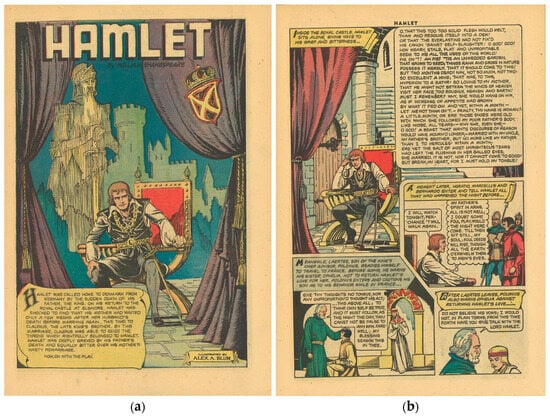
The presence of narrative control is even more prominent in subsequent adaptations, such as Hamlet. Due to the extensive length of the play, the CI Hamlet (with art by Alex Blum) is additionally abbreviated and uses more and lengthier captions than the earlier Roman play. The comic book opens with an image of Hamlet sitting on a gilded chair (Figure 1a), with a synoptic caption that reads as follows:
Hamlet was called home to Denmark from Germany by the sudden death of his father, the King. On his return to the royal castle at Elsinore, Hamlet was shocked to find that his mother had waited only a few weeks before marrying again … [sic] this time to Claudius, the late king’s brother. By this marriage, Claudius was able to seize the throne which rightfully belonged to Hamlet. Hamlet was deeply grieved by his father’s death and equally bitter over his mother’s hasty remarriage.Now, on with the play!
Figure 1.
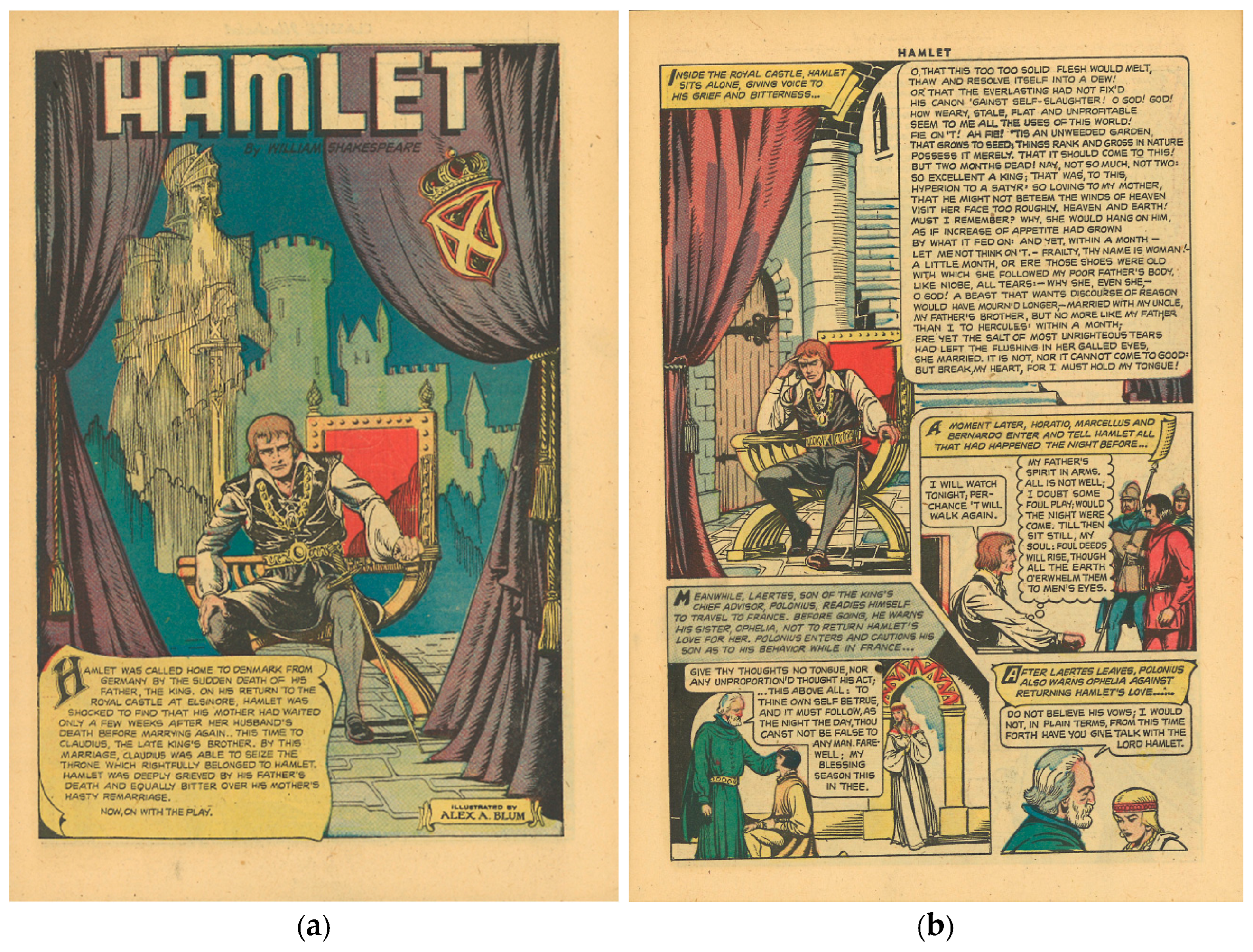
Classics Illustrated Hamlet: (a) opening page; (b) ‘O, that this too too solid flesh’. Classics Illustrated No. 99 Hamlet, illustration by Alex A. Blum, TM and © First Classics, Inc., https://www.classicsillustratedbooks.com.
In the CI Hamlet, the past tense is used only for this first caption (up until ‘Now’), but authorial narrative intervention is frequent throughout. Several pages later, the protagonist’s ‘O, that this too too solid flesh would melt’ speech (Figure 1b) is delivered from the same gilded chair, introduced by a caption that reads ‘Inside the royal castle, Hamlet sits alone, giving voice to his grief and bitterness …’ (p. 7). The speech itself is set out in a large rectangular word balloon, with space for complete lines in iambic pentameter.
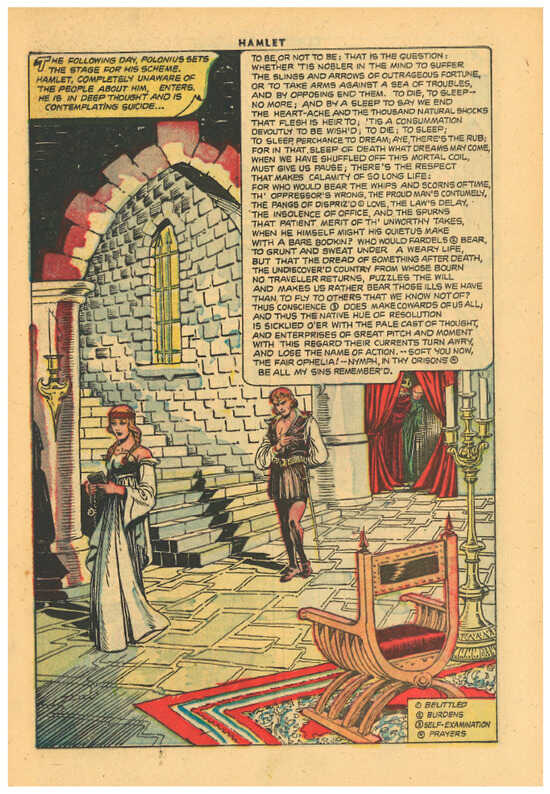
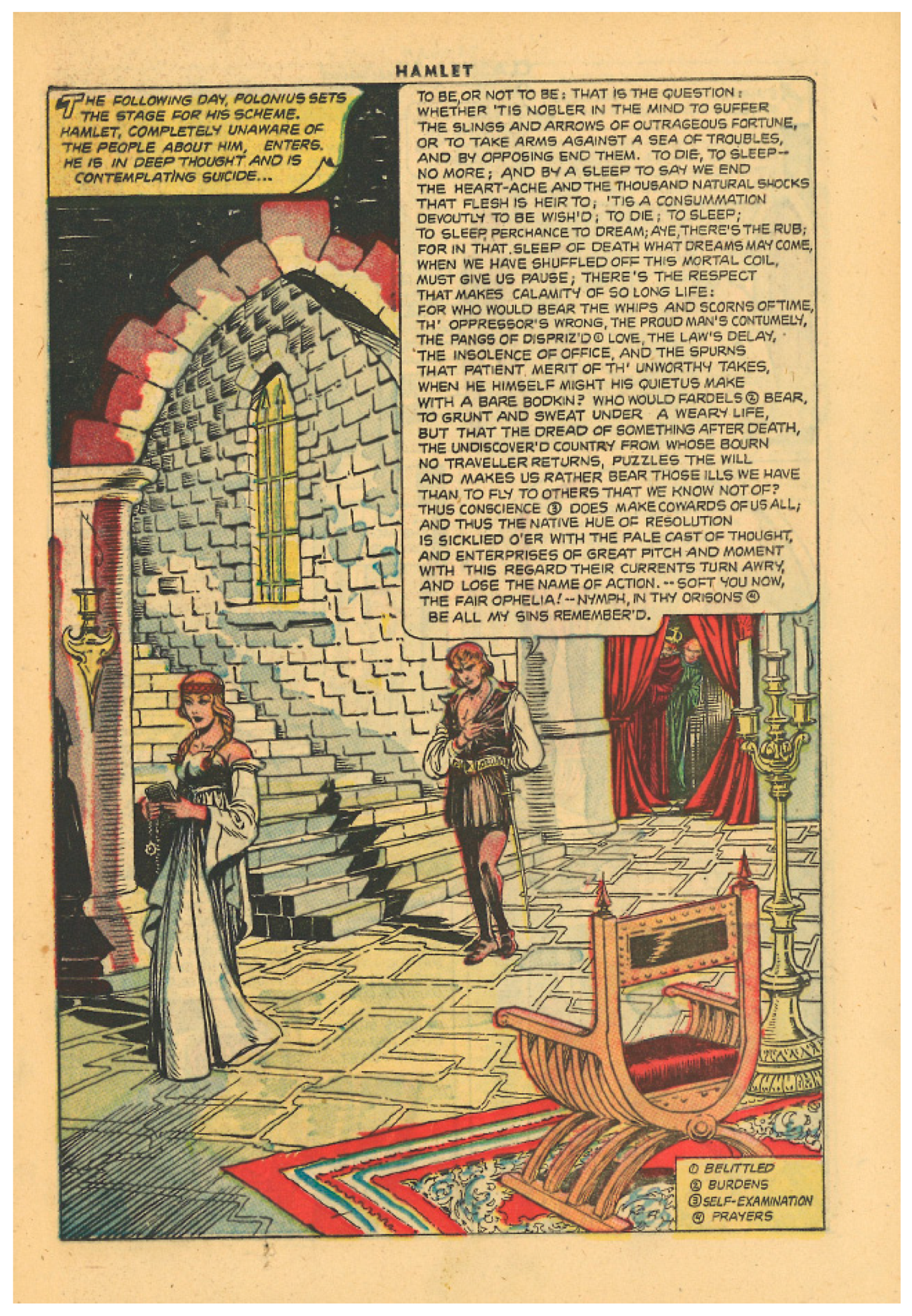
These two examples establish a pattern where the captions tell the reader how to interpret what they see and read, but they are minor interventions compared to the text box that appears a few pages later, when Hamlet delivers his most famous speech, ‘To be or not to be’, in a massive speech bubble (Figure 2). Here, the introductory caption states that, ‘The following day, Polonius sets the stage for his scheme. Hamlet, completely unaware of the people about him, enters. He is in deep thought and is contemplating suicide’. (Blum 1952, p. 13; emphasis added). Not only do the captions delimit the meaning of the words; the well-known critical issue of whether Hamlet knows that he is not alone and the extent to which he is baiting Claudius and Polonius is also brushed aside. The CI Hamlet presents a protagonist whose contemplation of suicide, the afterlife, and right and wrong is straightforward and unambiguous. Or, to put it another way, the ambiguity and range of possibilities inherent in the speech go against the grain of the pithy assurances of the caption. It flattens the reading of the speech as a sceptical, philosophical exploration of death as a theme.7 This demonstrates how ostensible fidelity, in this case the inclusion of most of the original wording, does not automatically generate exact replication, but rather delimits ambiguity. At the same time, the delivery of such a long speech in a single word balloon significantly halts the reading rhythm, decreases immersion and heightens artificiality—which may not be wholly negative, as I will discuss in the conclusion.
Figure 2.
Classics Illustrated Hamlet. ‘To be or not to be’. Classics Illustrated No. 99 Hamlet, illustration by Alex A. Blum, TM and © First Classics, Inc., https://www.classicsillustratedbooks.com.
In this scene, the CI Hamlet exhibits visual–verbal desync. There is a loose and permissive relationship between time and image in comics, but in examples such as the two famous speeches represented in the Classics Illustrated Hamlet, the comic begins to resemble an illustrated book. Cramming the whole ‘To be or not to be’ speech into one word balloon on a single page—a single pronouncement rather than a series of interlocking but distinct metaphors, claims and questions—means that Hamlet does not get to emote, move around or act; the verbal contents do most of the heavy lifting. In other scenes, however, the relationship between words and images is exactly reversed. At the comic’s mid-point, a whole double-page spread is devoted to the moment where Hamlet sees his father’s ghost in his mother’s bedchamber, but only a few words of dialogue are included (Blum 1952).8 The act of putting the long ‘to be’ speech in a single speech bubble is not merely a necessity of spatial economics, then, but a deliberate choice, and verisimilitude may not be the goal.
In an analysis of Hamlet’s soliloquy in multiple comics, Marion D. Perret observes that its abstract language resists visual treatment: ‘Abstractions, by definition, are non-representational, and the metaphors that compound thoughts and suggest emotional depths underlying the philosophizing do not make the artist’s task easier’ (Perret 2001, p. 124). Just because something resists visual treatment, however, does not mean it cannot be subject to such treatment, and neither metaphor nor abstraction are alien to visual language, as artists from William Blake to William Holman Hunt have evidenced. The next section studies how visualisation works in Shakespeare comics.
3. Visual–Verbal Interchanges, ‘Footnotes’ and Metaphors
Word, image and conventional framing devices such as panels work together to produce meaning in comics, and there is a growing scholarship that addresses the particularities of signification in a Shakespearean context (see, for example, Casey and Christopher 2024; McConnell 2014; Myklebost 2025b; Perret 2001; or Roper 2011). Building on such research, this section of the article investigates how visual elements are made to explain or engage with (abstract) meaning in editions explicitly designed for younger readers.
Faced with the task of reconfiguring Shakespeare’s play-texts in a panel-based visual–verbal format, the adapter must make a series of choices. First, unless there is enough room to produce an unabridged graphic edition, it becomes necessary to make cuts to speeches, characters list and subplots. Next come decisions such as how many panels to devote to a sequence, which moments in that sequence to depict, which facial expressions and gestures are best suited to the words, which type of ‘shot’ to employ (long shot, mid-shot, over-the-shoulder, close-up, or something more unusual), and so on. Many people may be involved in the process. Sometimes a textual editor performs the initial abbreviation of the play-text, before subsequent changes are made by a graphic artist. Several graphic adaptations have a separate scriptwriter/adapter, as well as colourists, typesetters, cover artists, designers, editors and so on. Some artists and scriptwriters have the benefit of high page counts, large page sizes, and colour, whilst others must operate within narrower confines. Visible traces of these processes move the reader’s mind away from theatrical interpretation towards something which more profoundly questions the notion of who the author might be and of what Hamlet’s or Macbeth’s substance consists.
The interaction between words, panels, text boxes, speech bubbles, and drawings is central to how comics work in general and as adaptations. Words in comics are not just verbal information, but visual signposts that fulfil a function within the mise-en-page. The placement of speech bubbles vis-à-vis pictorial elements provides reading pathways across the page and may thus be made to highlight or subdue as appropriate (see Groensteen 2007, pp. 75–79). Legibility is determined by the distribution of words, framing devices and pictorial content and how these elements amalgamate on the comics page. This multimodal mixture can help readers understand the words, which is arguably preferable to replacing them with other words. As I will show, many Shakespeare comics tend to present Shakespearean narratives ‘dramatically’, through dialogue, soliloquy and visual material, without using narrative in captions.
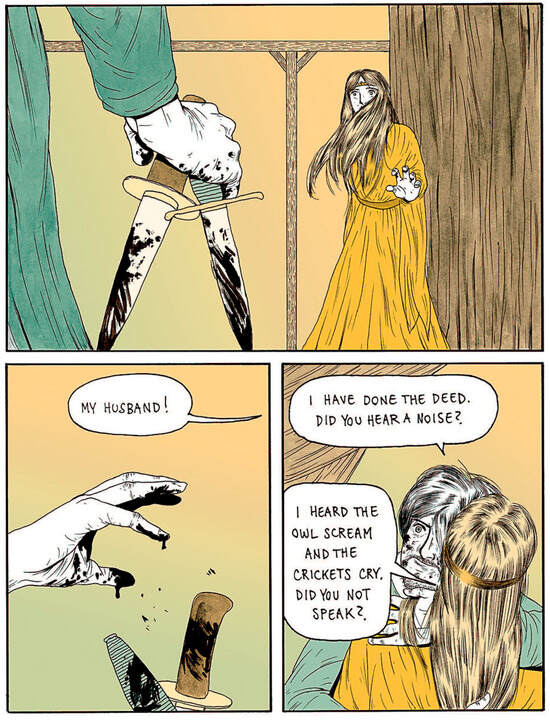
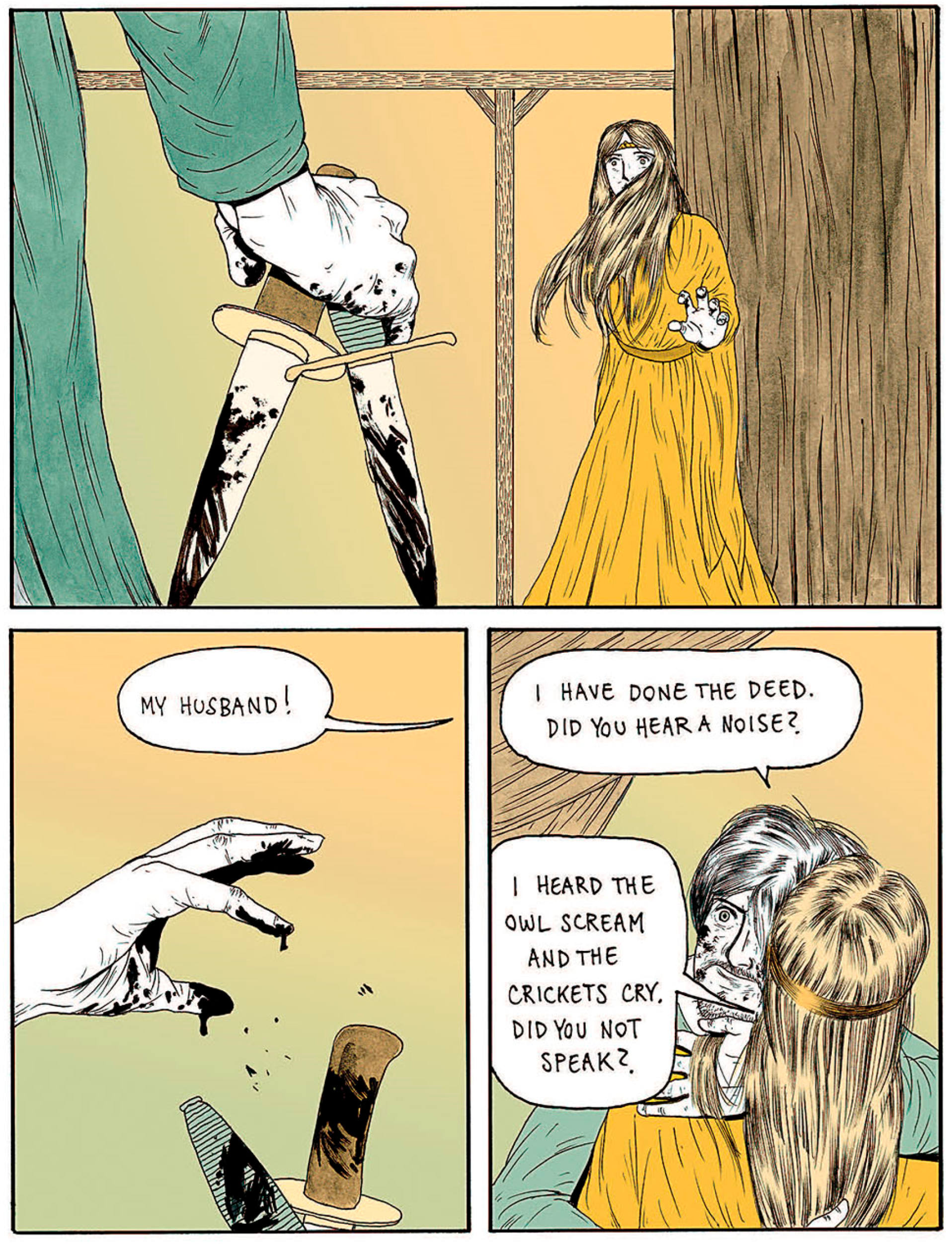
Mixed verbal styles notwithstanding, the No Fear Shakespeare Macbeth provides several instructive examples of how the relationship between words and pictures can be handled. One particularly striking sequence is the return of Macbeth to Lady Macbeth after the killing of Duncan (Act 2, scene 2; Figure 3 and Figure 4). The first panel (Hoshine 2008, p. 53) needs no words to explain both what has taken place and the gravity of the deed, given the instantly affective foregrounding of the bloodied daggers and rendering of Lady Macbeth’s body language. In the ensuing panels, the word count increases in a gradual shift from stunned silence to verbal reaction. The comic still uses a mixture of original wording and modern paraphrase, but here the deft multimodal, visual–verbal handling of the material transcends the verbal clunkiness. The depiction of physical intimacy demonstrates a fine-tuned reading of the marital idiom amid exceptional circumstances: as a visual treatment of the scene, this is as moving as any performance of the play, or indeed any cinematic adaptation.
Figure 3.
From Macbeth: No Fear Shakespeare Graphic Novel. © 2008 SparkNotes, reprinted with permission of SparkNotes, p. 53. Art by Ken Hoshine.
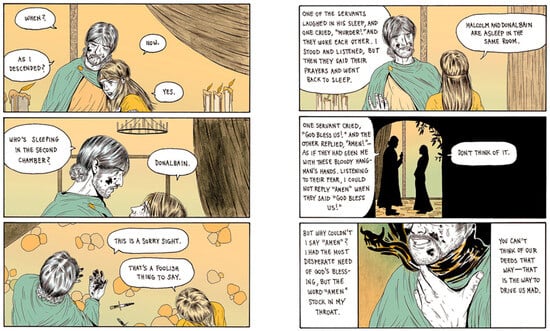
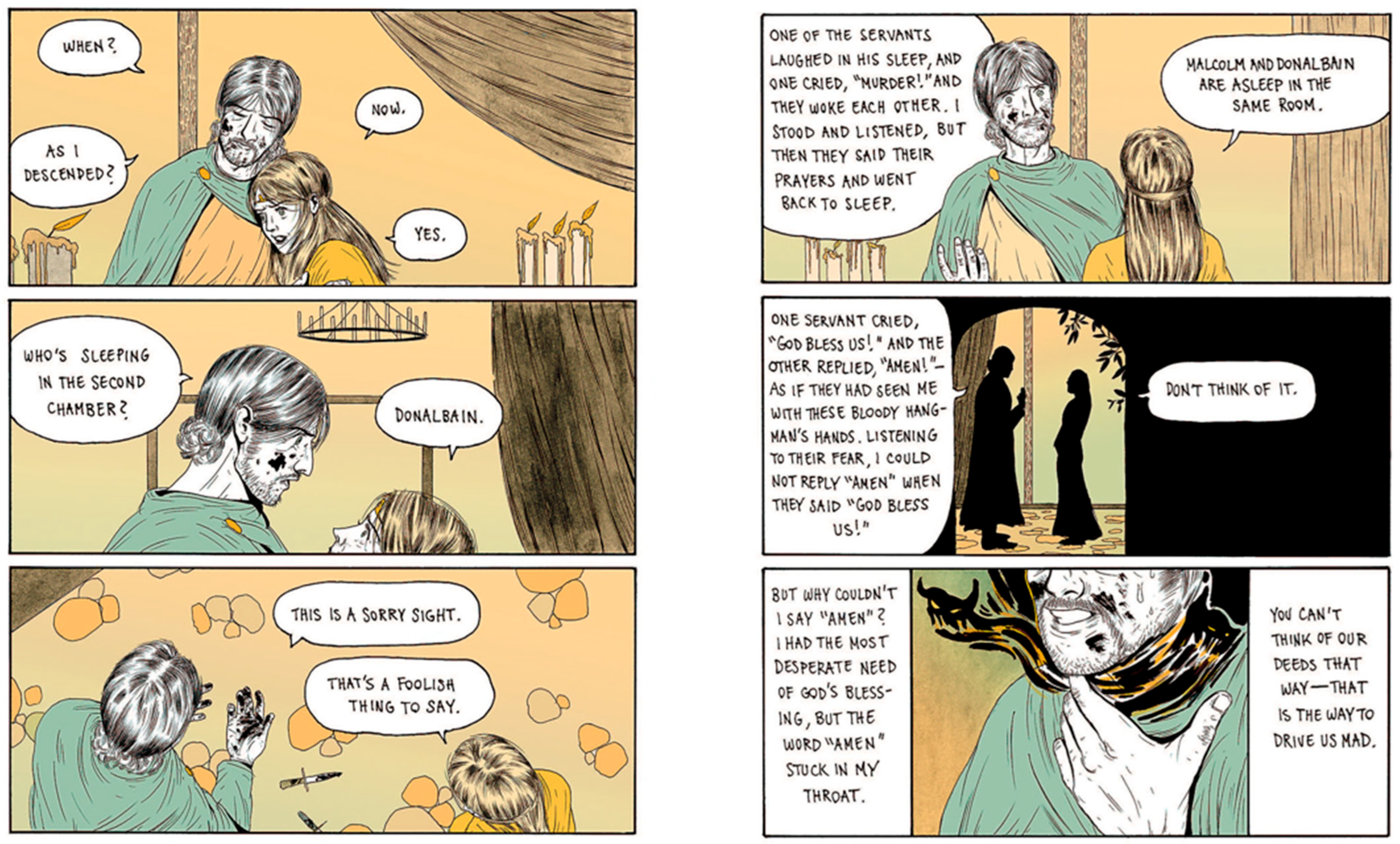
Figure 4.
From Macbeth: No Fear Shakespeare Graphic Novel. © 2008 SparkNotes, reprinted with permission of SparkNotes, pp. 54–55. Art by Ken Hoshine.
The visual language employed at this particular point borrows from the codes of film. Affect is generated through stances and facial expressions, elements are highlighted depending on their proximity to an imaginary camera lens, the framing appears to cut off parts of the actors’ bodies, and even the shape of the panels somewhat resembles cinematic widescreen or letterbox formats (especially noticeable in Figure 4). But, as the sequence continues, the images become less mimetic and more symbolic or emblematic, as flashbacks begin to merge with the present moment within each panel. When the word ‘amen’ sticks in Macbeth’s throat (p. 55; Figure 4), a demonic, wispy smoke seems to ensnare his neck, and when he complains of hearing a voice crying ‘sleep no more’, the art depicts Duncan sleeping peacefully among stars and clouds, as in a children’s good-night picture book, with a bloody dagger hovering symbolically in the foreground (p. 56). Mixtures and transitions of this kind, which shift between diegetic/naturalistic and extra-diegetic/conceptual combinations of words and images, are typical of how comics handle (some version of) Shakespeare’s language (see Myklebost 2025b, pp. 163–85). I will look at two more examples.
The Canadian publisher Manga Classics has issued a series which is similar to the much older Classics Illustrated in how it adapts well-known literary works. It focuses especially on nineteenth-century novels by authors such as Jane Austen, Charles Dickens, Bram Stoker and Mark Twain. The series includes six Shakespeare titles: Macbeth (2018), Romeo and Juliet (2018), A Midsummer Night’s Dream (2018), Hamlet (2019), Othello (2021) and King Lear (2025). These differ from most other Shakespeare comics through their high page count (the thickest volume, Hamlet, is 464 pages); through containing both original, unabridged texts, as well as simplified paraphrases (in separate editions); and through presenting the plays as apparently authentic manga that are read from right to left (but which are nonetheless aimed at a Western, anglophone audience and are made legible within that culture). The space available to the adaptors, who are Crystal S. Chan (scripts), Po Tse (art, the Dream) and Julien Choy (art, all other plays), means that the density of the verbal weave can be accompanied by equally detailed visuals, thus making for a greater degree of synchronisation than the much older Classics Illustrated Shakespeare comics.9
Among the many possibilities afforded by the generous dimensions of the Manga Classics books, the creators have decided to equip the speeches with visual metaphors of various kinds, in what are known as insets. As Margaret M. Roper has demonstrated, the ‘Shakespearean inset’ (a concept devised by Francis Berry) maps onto comics via Groensteen’s notion of the ‘comics inset’ (Roper 2011, pp. 126–35; Berry 1965, p. 4; Groensteen 2007, pp. 85–91). In Shakespeare-on-stage the effect is produced verbally and applies to moments where a speech takes the audience momentarily to a different space and time. Examples include the Hostess’s account of Falstaff’s death in Henry V 2.3 or Mercutio’s description of Queen Mab in Romeo and Juliet 1.4.
In comics, and especially in manga, an inset is a composition that presents two simultaneous modes of signification: action, speech and so on takes place in the ‘foreground’, while more symbolic or conceptual information is imparted in the ‘background’, sometimes in panels inside panels (Groensteen 2007, p. 86).10 The ‘foregrounded’ visual elements, which are diegetic, overlap the extra-diegetic elements in the ‘background’ (I use inverted commas because ‘background’ elements are occasionally placed in the foreground).
The different orders of visuality can be made to interact with one another and/or with the words in numerous ways. Other comics and manga that use similar techniques often employ them obliquely, such that the relationship between symbolic and mimetic visual elements and the speeches requires a greater degree of interpretative involvement from the reader. The Manga Classics series, though, tends to use insets as visual footnotes, with the aim of explaining meaning rather than engendering more complex meaning. And yet, as we will see, the effect of mixing words and pictures tends to produce a surfeit of signification almost by default.
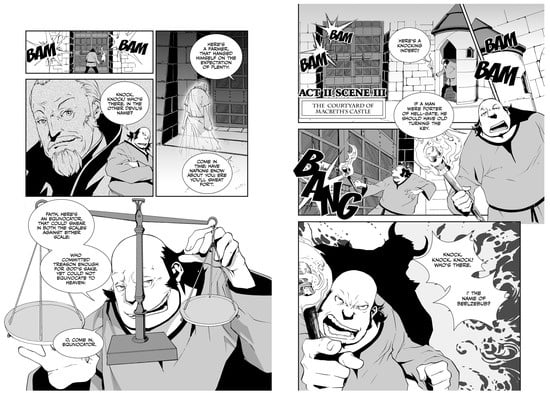
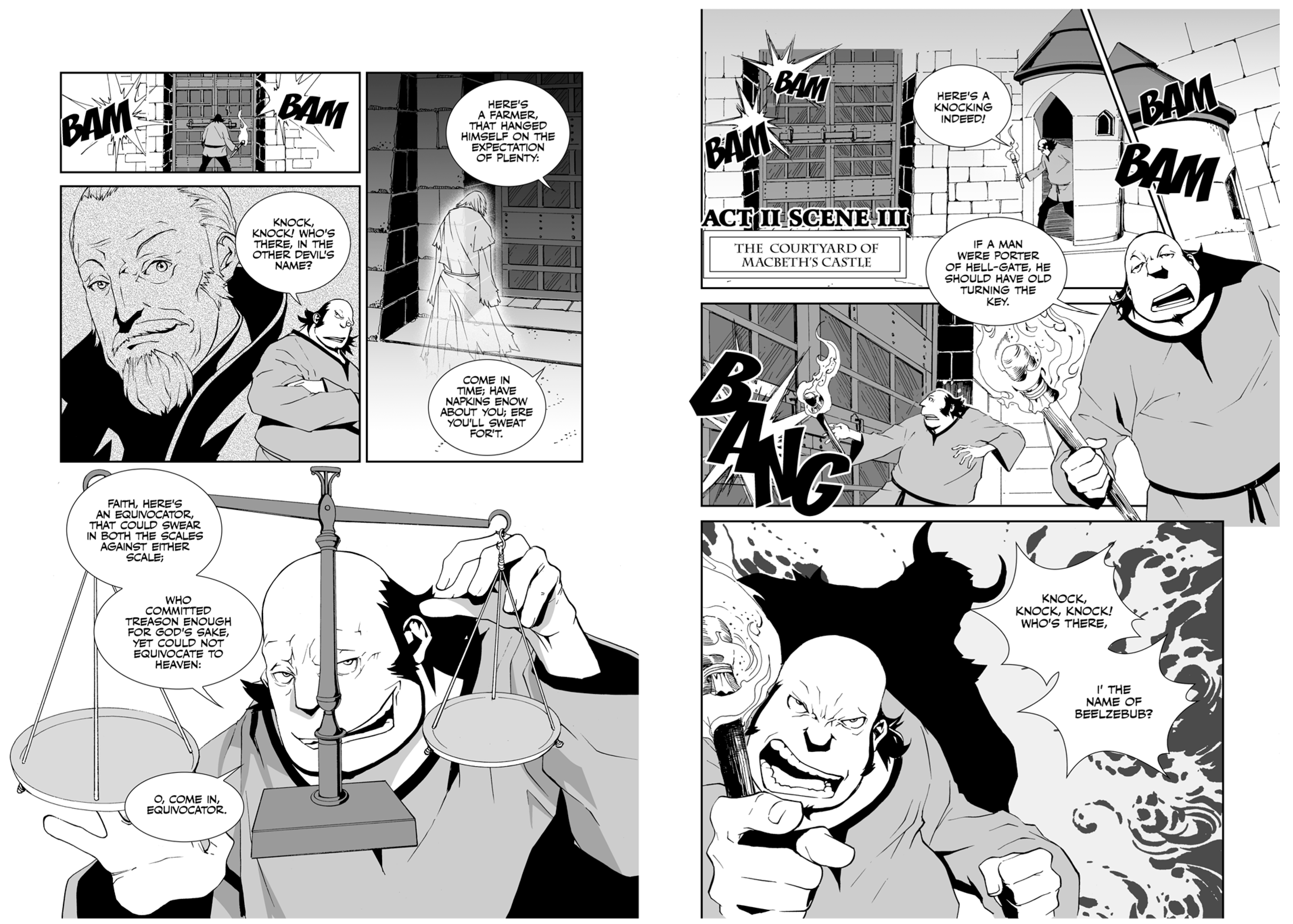
Due to its highly specific topicality, the porter scene in Macbeth regularly causes grief for modern adaptors and directors. The porter’s dark jokes are obscure and the context remote. There is no way for the Manga Classics Macbeth to explain any of the references in this scene in writing, as its only verbal content besides the speeches is very basic ‘stage directions’ that describe the setting (e.g., ‘The courtyard of Macbeth’s castle’, p. 114).
Figure 5 reproduces pages 114–15 (read from right to left). The scene begins by introducing the porter, whose occupation is made clear by his exiting the porter’s hut next to the castle entrance. The first couple of panels are in a mimetic mode, depicting the porter, his torch and the castle gate. In the third panel, the silhouette of a devil appears behind the porter to illustrate the line about ‘the name of Beelzebub’. On the next page, the ‘farmer who hanged himself on the expectation of plenty’ is shown as a translucent figure outside the gate: a ghost. Then, the ‘other devil’ is depicted in the background as a man with a goatee, wearing a cape, while an illustration of a pair of scales hover in front (i.e., not in the background) of the porter as he speaks of the equivocator ‘that could swear in both the scales against either scale’.
Figure 5.
Manga Classics Macbeth pp. 114–15. Art by Julien Choy. With permission by Manga Classics.
The degree to which these insets explain what the words are saying varies. The silhouette of a devil apparently does very little that the words are not already doing. Scott McCloud would call this a duo-specific panel, ‘where both words and pictures send essentially the same message’ (McCloud 2006, p. 153). Regarding the ghost of the farmer, his placement helps bring home the notion that the Porter is addressing persons outside the gate, and that the persons in question may be deceased. The inset image of the ‘other devil’ is notable, since it is based on a painting of Shakespeare’s possible reference, the Jesuit priest and ‘equivocator’ Henry Garnet, who was executed for not sharing what knowledge he might have had about the Gunpowder Plot of 1605. In McCloud’s terms, this may be designated as an interdependent combination, ‘where words and pictures go hand in hand to convey an idea that neither could convey alone’ (McCloud 2006, p. 155). An online image search for Garnet brings up the portrait that the image is based on, which is not contemporary, but painted by an unknown artist to commemorate Garnet’s memory half a century after his death. It is extremely unlikely that any reader of this manga would see the image and instantly recognise that the ‘other devil’ in the text might be Garnet (his name is not included). They would, however, realise that the ‘other devil’ could be a specific person, thus imbuing the porter’s words with concrete denotative qualities which may otherwise have been skimmed past. As such, the effect is not that of a footnote, but more like underscoring the words or placing a pointing manicule in the margins, suggesting that something is important without saying exactly how or why.
The cumulative effect of these panels (and later ones; the sequence continues for another page or two) is worth noting. While the devil’s outline in the third panel seemingly does little on its own, it emphasises the satanic or demonic aspects of this scene and of the play as a whole. Thus, as well as having a local function, it connects to words and images found elsewhere in the manga. The fact that the farmer is depicted as a ghost suits the dark theme whilst implying that all the persons described are dead, that they, like Banquo will be later, are revenants. Despite the apparently straightforward literalness of some of the illustrations, matters here are semiotically dense without being exactly difficult.
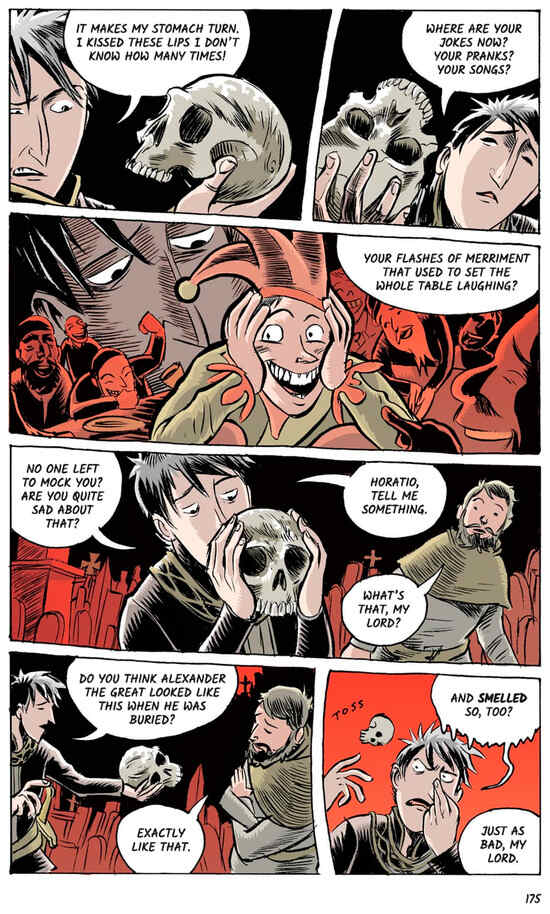
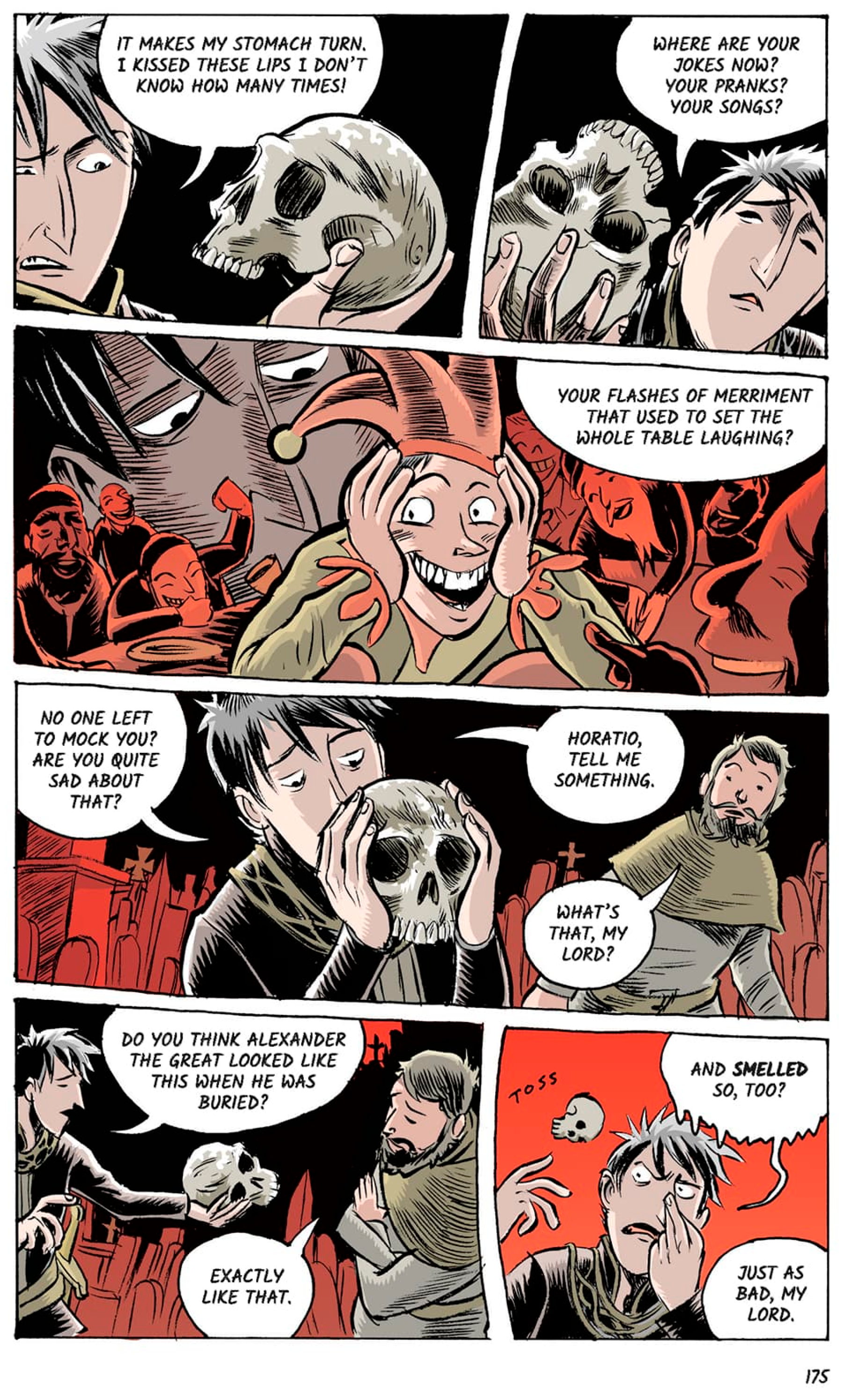
The next and final example (Figure 6) also addresses the presentation of a morbid topic within a Shakespeare comic. Hamlet’s obsession with death comes to the fore throughout the play, but perhaps most famously in the gravedigger scene, where Hamlet contemplates Yorick’s skull, his own childhood and the vanity of all things. Despite all that is stated explicitly in words, there is still space for an illustrator to interpret the scene and produce visual effects that explain or expand its broader sense. In the No Fear Shakespeare Graphic Novels Hamlet (Babra 2008), the illustrator, takes advantage of the fact that sequences in comics contain elements that are simultaneously visible (instead of one after the other as in a film) to juxtapose an image of Yorick whilst still alive in the past (panel 3) with an image of his skull (always a memento mori) in the present moment (panel 4). The emotional and intellectual stimuli of the images are produced both by the similarity of composition and the contrast between the content: the visual elements are laid out in the same manner, with the crucial distinction that in the first image, Yorick holds his head in his own hands, while in the second, his naked skull is cradled gently in the hands of Hamlet.
Figure 6.
From Hamlet: No Fear Shakespeare Graphic Novel. © 2008 SparkNotes, reprinted with permission of SparkNotes, p. 175. Art by Neil Babra.
In this sequence, distinctions between ‘foreground’ and inset ‘background’ elements blur and transform in meaningful ways. The image in panel three is filled with happy, cavorting people, but the joy is undercut by the presence of Hamlet’s melancholy and apparently humongous visage in the background, which turns into a normally scaled human head in the fourth panel. The effect is strengthened by the playing-card-like mirroring in the second panel, between Yorick’ skull (upside down, dead) and Hamlet’s face (right side up, alive) and the darkly comic bathos of the final panel, where Hamlet pinches his nose, snaps out of his reverie, and tosses the skull over his shoulder. The visual eloquence on display here surpasses the verbal paraphrase, nicely delineating and exploring challenging concepts such as memory and awareness of one’s own mortality.
Shakespeare was himself occupied with producing sophisticated verse that would still be intelligible to everyone in the audience. This was presumably achieved in part through visible stage business, but also through linguistic means. A well-known example is found in Macbeth, where the Latinate and unfamiliar-sounding ‘these my hands will rather,/the multitudinous seas incarnadine’ is followed by the more Anglo-Saxon ‘making the green one, red’ (2.2.63-4)—the second phrase parsing the first. The power of comics’ visuality to carry across the tenor of a scene or a line is comparable. Ideas as well as actions are communicated through a visual language that both imitates and undercuts the verbal language: it both explains and questions the words.
The visual frame is more important, therefore, than the exact nature of the wording, but this does not entirely render moot the question of what kind of language—paraphrase or original verse—works best in Shakespeare comics. The insistently prominent qualities of the visual narrative tend to produce critically polysemous results when appearing in conjunction with Shakespeare’s ‘original’ wording (abridged, modernised). The words and the sentiments that they express are not most effectively challenged or interrogated through rewriting, but through their framing in a specific kind of visual medium.
Some Shakespeare comics designed for (older) children are perhaps products of the cynical calculation that Shakespeare is obligatory reading in schools—thus, there will be a (perceived) market for simplified paraphrase—but most Shakespeare comics I have studied are characterised by an earnest and obvious desire to affirm the narrative and symbolic capabilities of comics through serious engagement with a rich and complex source material. Whether Shakespeare comics have ‘cultural value’ (of course they do) or whether they function as initiations into adult culture is perhaps not that important at the end of the day. What makes these comics attractive is the visual–verbal weave.
Maybe Shakespearean adaptation has been used for social conditioning and raising children into a version of adult culture, and these processes are admittedly bound up with the acquisition of cultural capital (see Hateley 2009, pp. 11–12). But it should also be remembered that Shakespeare’s works make up a rewarding reading matter which affords aesthetic pleasure and intellectual stimulation. To experience Shakespeare can also be a privilege, but access to this privilege is not limited by verbal legibility alone. Shakespeare is also inaccessible due to cultural encoding on many levels: because Shakespeare ‘belongs’ to the middle and upper classes, because Shakespeare ‘belongs’ to an intellectual and cultural elite, and because Shakespeare is presumably boring, old-hat, irrelevant, beyond any scope of interest.
Shakespeare comics do not ‘make Shakespeare relevant’—a meaningless phrase—but they make Shakespeare accessible on a cultural level by situating the language and narratives in a medium that has distinct cultural connotations. In addition to providing verbal–visual legibility, then, comics also provide socio-cultural legibility, a sense that the play (any play) is within reach. A child reader does not need to ‘evolve’ from reading a Shakespeare comic to the ‘real thing’, because any Shakespeare comic of substance is already a ‘real thing’.
4. Conclusions
This article has explored questions surrounding legibility and paraphrase in visual–verbal Shakespearean narratives against a background of cultural value and status, with a focus on the role of the language in retellings of Shakespearean stories. It has considered Marchitello’s assertion that ‘Shakespearean language and poetics are typically understood as obstacles to comprehension [in editions for young readers] and therefore largely set aside’ (Marchitello 2003, p. 182), as well as Hateley, Lanier and Tosi’s work on Shakespeare as a representative of certain values, and how his perceived greatness is often connected to his ‘verbal peculiarities’ (Lanier 2014, p. 21). I have contended that when language is framed within the visual–verbal, sequential medium of comics, many issues associated with narrative retellings for younger readers are potentially subverted or circumvented.
As my readings have demonstrated, comics and manga have the obvious advantage vis-à-vis purely verbal versions of being able to directly and immediately show the reader which character is talking at any given time, what physical actions (kissing, stabbing, crying, smiling) are taking place when there is no clear reference in the text, within what settings events happen, where characters are placed in the spaces and in relation to one another, and so on. There are countless little ways in which comics can accentuate, clarify, direct focus, explain or generate affect through combining words with pictures.11 Narrative in comics is not just multimodal, but also semiotically dense. Despite this, Shakespeare comics rarely feel overdetermined. They also make it clear that what they show is what they choose to show, because they want to do things in a certain way.
The conspicuous aesthetic identity of comics emerges from their critical and creative engagements with the text and the basic fact that these engagements are adaptations. Erica Hately argues in favour of studying appropriations rather than adaptations, i.e., texts that do not just offer the plot of the playtext, but, as she says, a ‘model’ for how to read it. An appropriation, in her conception, is an ‘intertextual usage that establishes a dialogue of interpretation to some critical end’ (Hateley 2009, p. 15). It is difficult to imagine, however, the existence of a comics adaptation that merely reproduces the plot. In my view, adaptations such as the ones studied in this article inescapably ‘appropriate’ Shakespeare (as Hateley defines it) as a matter of course. Indeed, the case that apparently seeks ‘fidelity’, the Classics Illustrated Hamlet (Blum 1952), is somehow the most radically strange and artificial, displaying the most starkly accentuated relationship between replication and deviation.
That these adaptations are so to speak co-authored is evident in all four cases, a fact which may be utilised to interrogate Shakespeare’s cultural position as a near-sacrosanct author figure. Even when ‘fidelity’ is highlighted, such as on the back cover of the Manga Classics edition of Macbeth—“Featuring the FULL, ORIGINAL TEXT of Shakespeare’s brutal Scottish tragedy” (Chan and Choy 2018, n.p.; all-caps and underlining in original)—the visual material that has been juxtaposed with the words speaks clearly of historical, formal and cultural difference, by virtue of being a ‘manga Macbeth’. In other cases, the co-creatorship is explicit within the paratext, such as on the back cover of the No Fear Shakespeare Hamlet, where it is claimed that ‘the artist Neil Babra re-creates Shakespeare’s classic play’ (Babra 2008; emphasis added)—a statement that pays homage to Shakespeare’s perceived status whilst at the same time undermining it. Shakespeare is great, but not inimitable.
These comics are not quite Shakespeare’s alone, and the fact that they are comics and not stage performances, films, printed play-texts or prose retellings is equally evident. The medium-specific way comics reconfigure the plays is itself instructive (Hutcheon 2013, pp. 33, 123). Comics emerge as a product of the twentieth century, a medium that ultimately stands apart from printed or performed renaissance playhouse fare. Just as in the example where Yorick’s living face both resembles and contrasts his bare skull (Figure 6), the difference of comic-book Shakespeare adaptation may be as important as anything else, because it is precisely this différance, this conspicuous formal divergence from the source material, that empowers comics to not just explain Shakespeare (a process which could only ever be incomplete), but to explicitly and implicitly question the canon and embody it at the same time.
In their introduction to Shakespeare and Comics: Negotiating Cultural Value, Jim Casey and Brandon Christopher reject the narrative that Shakespeare and comics ought to be ‘placed in opposition to each other, with comics cast as the unworthy, corrupting influence on the elevated Shakespeare’ (Casey and Christopher 2024, pp. 2–3). Instead, they argue that ‘the long history of comics creators’ engagements with Shakespeare constitutes a negotiation between these apparently disparate cultural entities rather than a confrontation’ (p. 3). As the readings presented in this article will have demonstrated, negotiations between comics and Shakespeare can be very fruitful indeed. These negotiations continue outside the illustrator’s studio, in the social realm, in education and in academia.
Funding
This research received no external funding.
Institutional Review Board Statement
Not applicable.
Informed Consent Statement
Not applicable.
Data Availability Statement
There is no data set associated with this study.
Conflicts of Interest
The author declares no conflicts of interest.
Notes
| 1 | By ‘original language’, I mean texts with modernised, consistent spelling and orthography, as in an Arden or New Cambridge Shakespeare edition. Examples of titles that use the original language (with or without abbreviation) include the 14 volumes in the widely read Manga Shakespeare series by selfmadehero (2007–2009) and the Oval Projects/Can of Worms graphic novels from the 1980s. The Classical Comics (2007–2009) series and the recent Manga Classics (2018–) series appear in multiple editions, enabling the reader to choose between original and simplified texts. Abridgement, for its part, is extremely common in films and stage versions, and rarely provokes general negative reactions. |
| 2 | The question of age range is too much bound up with nationality, language, class background, and individual interest and ability, to be precisely defined. The comics under scrutiny all imply a younger readership (what I call ‘older children’, following Marion Perret), though they can be enjoyed by readers of any age. See Perret (2004, p. 73). |
| 3 | An example of a scholar who values the language is Michael Albright. This article is sympathetic to his conviction that students in search of modern ‘translations’ of Shakespeare’s English ‘run the risk of disenfranchising themselves to find what they already know: language that is easy to understand.’ It does not share his worry that ‘one of the world’s most enduring cultural and literary icons may end up becoming misidentified as a grandiose wordsmith, “full of forms, figures, shapes, objects.”’, devoid of ‘sound, meaning, history, and value.’ (Albright 2020, p. 15). |
| 4 | My use of frame is loosely based on Jonathan Culler’s conception of a frame as something that actively determines meaning rather than merely forming a context of ‘what is already known’. Here, it is a form of literary criticism performed through adaptation. See Culler (1988, ix). |
| 5 | For a discussion of word and image in Shakespearean comics adaptation, see Perret (2001). |
| 6 | For more on the policing of children’s reading, see, e.g., Tosi (2014), as well as Grenby (2011, pp. 119 and 254–66). |
| 7 | For a related discussion of other Shakespearean comics captions, see Perret (2004, pp. 74–75). |
| 8 | For a discussion of how time is represented on this page, see Myklebost (2025b, pp. 47–49). For a discussion of the bedchamber scene, see Myklebost (2025a). |
| 9 | Western manga readership is considerable, and the codes of the medium are largely known to anglophone readers. Still, the Manga Classics adaptations eschew many typical devices of Japanese manga, such as using a nosebleed to signal sexual arousal, or a snot bubble to indicate that someone is asleep. For a detailed account of ‘Japanese Visual Language’, see Cohn (2013, pp. 153–71). |
| 10 | Groensteen introduces the inset as a panel within a panel, but immediately adds that similar effects can be achieved in any number of ways: ‘There can be no question of establishing a complete catalogue of these procedures in all their variations, as the narrative strategies and the rhetorics of authors can be renewed and modified ad libitum.’ (p. 86). |
| 11 | The graduate students I teach always agree with the claim that comics’ visuality is an aid to understanding. |
References
- Albright, Michael Andrew. 2020. Modern, Yet ‘full of Forms, Figures, Shapes, objects’: The Trouble with Translating Shakespeare’s English into English. Early Modern Culture Online 7: 1–18. [Google Scholar] [CrossRef] [Scilit]
- Babra, Neil. 2008. No Fear Shakespeare Graphic Novels: Hamlet. By William Shakespeare. New York: Spark Publishing. [Google Scholar]
- Berry, Francis. 1965. The Shakespeare Inset: Word and Picture. London: Routledge. [Google Scholar]
- Blum, Alex. 1952. Classics Illustrated #99 Hamlet. New York: Gilberton. [Google Scholar]
- Casey, Jim, and Brandon Christopher, eds. 2024. Introduction: What’s Shakespeare to comics, or comics to Shakespeare? In Shakespeare and Comics: Negotiating Cultural Value. London: Bloomsbury-Arden. [Google Scholar]
- Chan, Crystal S., and Julien Choy. 2018. Manga Classics Macbeth. Richmond Hill: Manga Classics. [Google Scholar]
- Cohn, Neil. 2013. The Visual Language of Comics: Introduction to the Structure and Cognition of Sequential Images. London: Bloomsbury. [Google Scholar]
- Culler, Jonathan. 1988. Framing the Sign: Criticism and its Institutions. Norman: University of Oklahoma Press. [Google Scholar]
- Grenby, Matthew O. 2011. The Child Reader 1700–1840. Cambridge: Cambridge University Press. [Google Scholar]
- Groensteen, Thierry. 2007. The System of Comics. Translated by Bart Beaty, and Nick Nguyen. Jackson: University of Mississippi Press. [Google Scholar]
- Hateley, Erica. 2009. Shakespeare in Children’s Literature: Gender and Cultural Capital. Abingdon: Routledge. [Google Scholar]
- Hoshine, Ken. 2008. No Fear Shakespeare Graphic Novels: Macbeth. By William Shakespeare. New York: Spark Publishing. [Google Scholar]
- Hutcheon, Linda. 2013. A Theory of Adaptation, 2nd ed. Abingdon: Routledge. [Google Scholar]
- Kiefer, Henry. 1950. Julius Caesar. By William Shakespeare. New York: Gilberton. [Google Scholar]
- Lanier, Douglas. 2014. Shakespearean Rhizomatics: Adaptation, Ethics, Value. In Shakespeare and the Ethics of Appropriation. Edited by Alexa Huang and Elizabeth Rivlin. New York: Palgrave Macmillan. [Google Scholar]
- Lanier, Douglas. 2017. Afterword. In Shakespeare/Not Shakespeare. Edited by Christy Desmet, Natalie Loper and Jim Casey. New York: Palgrave Macmillan. [Google Scholar]
- Marchitello, Howard. 2003. Descending Shakespeare: Toward a Theory of Adaptation for Children. In Reimagining Shakespeare for Children and Young Adults. Edited by Naomi J. Miller. Abingdon: Routledge. [Google Scholar]
- McCloud, Scott. 2006. Understanding Comics. New York: HarperCollins. [Google Scholar]
- McConnell, Russell H. 2014. Graphic Drama: Reading Shakespeare in the Comics Medium. Ph.D. dissertation, University of Western Ontario, London, ON, Canada. Available online: https://ir.lib.uwo.ca/etd/2047 (accessed on 4 December 2025).
- Myklebost, Svenn-Arve. 2025a. Comics, Manga, Graphic Novels, and Shakespeare. In The Palgrave Encyclopedia of Global Shakespeare. Cham: Palgrave-Macmillan. [Google Scholar]
- Myklebost, Svenn-Arve. 2025b. Shakespeare Comics: Art, Time and Character. Edinburgh: Edinburgh University Press. [Google Scholar]
- Perret, Marion D. 2001. ‘And Suit the Action to the Word’: How a Comics Panel Can Speak Shakespeare. In The Language of Comics: Word and Image. Jackson: University Press of Mississippi. [Google Scholar]
- Perret, Marion D. 2004. Not Just Condensation: How Comic Books Interpret Shakespeare. College Literature 31: 72–93. [Google Scholar] [CrossRef] [Scilit]
- Roper, Margaret M. 2011. Shakespeare and Contemporary Adaptation: The Graphic Novel. Ph.D. dissertation, University of Birmingham, Birmingham, UK. [Google Scholar]
- SparkNotes Editors. 2003. Macbeth: No Fear Shakespeare. New York: SparkNotes. [Google Scholar]
- Tosi, Laura. 2014. ‘But It’s the Story We Like’—King Lear for Children: From Drama to Narrative. Children’s Literature 42: 246–74. [Google Scholar] [CrossRef] [Scilit]
- Tosi, Laura. 2020. The Narrator as Mediator and Explicator in Victorian Retellings of Shakespeare for Children. Cahiers Victoriens et Édouardiens 92: 1–16. [Google Scholar]
Disclaimer/Publisher’s Note: The statements, opinions and data contained in all publications are solely those of the individual author(s) and contributor(s) and not of MDPI and/or the editor(s). MDPI and/or the editor(s) disclaim responsibility for any injury to people or property resulting from any ideas, methods, instructions or products referred to in the content. |
© 2026 by the author. Licensee MDPI, Basel, Switzerland. This article is an open access article distributed under the terms and conditions of the Creative Commons Attribution (CC BY) license.