


Abstract
This article examines the role of Shakespearean adaptations in comics through the case of Italian artist Gianni De Luca (1927–1991), focusing on his Trilogia Shakespeariana (The Tempest, Hamlet, Romeo and Juliet), originally published in the children’s magazine Il Giornalino in the mid-1970s. Situating the analysis within adaptation studies and comics theory, the paper adopts the rhizomatic model proposed by Deleuze and Guattari, as further developed in Shakespeare studies by Douglas Lanier, alongside Homi K. Bhabha’s concept of the “Third Space.” Through this theoretical framework, Shakespeare is interpreted not as a fixed cultural source but as a dynamic network of adaptations that circulate across media and cultural boundaries. The study combines historical contextualization of Italian comics in the 1970s with close formal analysis of De Luca’s visual strategies, particularly his use of the page as a theatrical stage and his rejection of conventional panel-based sequentiality. These techniques enable a hybrid form of storytelling that merges theatrical spatiality with the language of comics. The article argues that De Luca’s trilogy represents a unique site of cultural negotiation between so-called “high” and “low” culture, demonstrating how Shakespeare functions as a generative node within a broader rhizomatic system. In this sense, the trilogy exemplifies comics’ potential as a medium for both aesthetic experimentation and cultural mediation.
1. Introduction
Gianni De Luca’s (1927–1991) Trilogia Shakespeariana (“Shakespearean Trilogy”: The Tempest, Hamlet, Romeo and Juliet), originally published in the Catholic children’s magazine Il Giornalino in the mid-1970s, is quite a unique experiment in the Italian landscape of comics. Working within a publication that one would expect to favour simplified, accessible storytelling, De Luca instead produces a body of work of striking formal and artistic complexity. De Luca, in fact, deliberately eschews cultural bipartition altogether, rather than using Shakespeare to elevate the perceived status of comics. As Casey and Christopher argue, “the long history of comics creators’ engagements with Shakespeare constitutes a negotiation between these apparently disparate cultural entities rather than a confrontation” (Casey and Christopher 2024, p. 3). De Luca’s trilogy is a clear example of such negotiation: standing at the crossroads between the mass-market Catholic context of publication and his avant-garde experimentation, his work constitutes a “Third Space”, a concept coined by Bhabha (1994), where the theatricality of the Elizabethan stage and the formal language of comics intersect and mutually transform each other. Therefore, by focusing on De Luca’s work through the double lenses of rhizomatic theory and adaptation studies, this paper argues that his trilogy represents a unique point of convergence between high-art experimentation and mass-market children’s literature. Through his particular storytelling, De Luca allows young readers to read Shakespeare in an original way, both by visualizing the stage on the comics’ page and by representing the Bard and his canon not as a static cultural product of the past, but as a living narrative that intersects Elizabethan theatre and the capabilities of the “ninth art”.
2. Shakespeare in Comics
Adaptations based on the Shakespearean canon begin to appear during the Golden Age of Comics, namely in the mid-1940s. Before that period, an important precedent is to be found in an early 19th-century collection entitled Shakespeare Illustrated: Life’s but a Walking Shadow (1824–25), which consists of line and dot illustrations representing Shakespearean scenes. For Catherine E. Thomas, this can be considered a form of early comics as it “possess[es] key elements of narrative structure […] and [is] an exemplar of how this drawing style conveys meaning” (Thomas 2024, pp. 13–14). During the Golden Age of Comics, one of the most prominent publications was the American series Classics Illustrated, which adapted numerous works of world literature into comic book issues between 1941 and 1971. Within this series, Shakespeare served a specific purpose: to elevate the cultural value of comics. The adaptation of Julius Caesar in 1951, for instance, was described by editor Albert Kanter as “incontrovertible evidence of the seriousness of his [Kanter’s] publication’s purpose” (Jones 2011, p. 111). This perspective reflects an early, hierarchical notion of the Bard as an instrument for upward cultural mobility, aimed at “heightening” the perceived lower status of comics. As Hutcheon and O’Flynn argue, this strategy of reinforcing the binary between high and low culture by leveraging canonical authors was a tactic already employed in the early days of cinema, through the reference to such figures as Shakespeare and Dante Alighieri (Hutcheon and O’Flynn [2006] 2013, p. 91).
Nevertheless, such a rigid division has progressively been questioned, and Shakespeare himself has played a crucial role in this cultural shift. Seminal works such as Alan Moore’s V for Vendetta (1982–1985), Art Spiegelman’s Maus (1991), and Marjane Satrapi’s Persepolis (2000–2003) have shown that comics can sustain complex narratives and engage with historical and ideological materials, in ways comparable to novels and other forms of so-called “high culture”. Therefore, rather than simply “heightening” a supposedly lowbrow literature, Shakespearean adaptations demonstrate the rhizomatic nature of the Bard’s narratives (Lanier 2002): by circulating across media boundaries, the latter create new “third spaces” of artistic experimentation, where the distinctions between “high” and “low” culture become totally blurred. As a result, academic interest in the field has grown, alongside the adoption of comic books and graphic novels as teaching material (Maynard 2012; Myklebost 2025b). For instance, the British publisher Classical Comics presents different Shakespearean adaptations in its catalogue, each offered in multiple reading levels: Original, Plain, and Quick Text. These versions are often accompanied by teaching resource packs, presenting the comic book as a sophisticated tool for literary engagement in the classroom and as a medium that promotes accessibility without necessarily reducing interpretative complexity. As a further example of these pedagogical practices, Field-Pickering (2003) discusses the “Shakespeare Steps Out” project, organized by the Folger Shakespeare Library in 1996 and implemented in several public elementary schools in the District of Columbia. Among the educational materials provided to participating schools were comic-book adaptations such as Von’s Macbeth: The Folio Edition (1982) and Oscar Zarate’s Othello: The Illustrated Edition (1994), differently received by students in different classrooms, as Field-Pickering reports. This case study suggests that, by the beginning of the twenty-first century, comics had begun to acquire greater legitimacy within educational settings, where they were employed not merely as recreational reading materials but as effective mediators of Shakespearean texts for young readers.
Unsurprisingly, the production of Shakespearean comics has considerably expanded since its earliest publications. Beyond Classical Comics, the Bard remains a constant presence in the comics medium thanks to such works as Neil Gaiman’s The Sandman (1988–1996), which incorporates an adaptation of A Midsummer Night’s Dream into the narrative of the god of dreams, while also featuring Shakespeare himself as a character. A similar strategy can be found in Kill Shakespeare (2010–2011) by Anthony Del Col and Conor McCreery, where Shakespeare’s characters are brought together in a quest to confront—and ultimately kill—their creator. The Bard’s cultural capital is such that Shakespeare has also become a prominent presence within the Japanese manga tradition through series such as Manga Classics and Shakespeare Manga, both of which offer manga adaptations of plays including Hamlet, Macbeth, and Romeo and Juliet. Within the Italian context, moreover, alongside De Luca’s magnum opus, numerous adaptations of the Shakespearean canon have been produced for readers of all ages, including children, as exemplified by the Disney parodies published in the Italian Mickey Mouse magazine Topolino, featuring softened plots for young readers.
Presenting Shakespeare to children is by no means a recent phenomenon. Evidence of Shakespearean adaptations for young audiences can be traced back to the early nineteenth century. The first notable example is Charles and Mary Lamb’s Tales from Shakespeare (1807), a work in which Shakespeare’s plays are retold in narrative form by a narrator who, by appropriating the thoughts and words of the various characters, succeeds in unifying their different perspectives (Tosi 2020). The educational purpose of such texts, which primarily serve to introduce the Bard to children so that they may become acquainted with a shared cultural heritage (Müller 2013a, p. 1), is reflected in their emphasis on plot rather than on Shakespeare’s poetic language, which may pose an obstacle because of its complexity (Marchitello 2003, p. 182). The adaptations discussed above likewise tend to focus primarily on the narrative dimension of Shakespeare’s works. While certain iconic expressions that have entered the cultural imagination—such as Hamlet’s “To be or not to be”—are often retained, they are generally reworked and contextualized in ways that provide young readers with the interpretative tools necessary to understand them. Shakespearean comic-book adaptations follow a similar logic, all the more so because comics offer only a limited space for verbal expression within captions and speech balloons. As a result, language must be carefully calibrated in comics as too much text can hinder the smooth, readable flow that is typical of the medium. According to Müller (2013b), the hybrid nature of comics, combining the verbal and the visual, renders the medium particularly well suited to the adaptation of dramatic texts. Müller argues that comics possess an intrinsically theatrical quality, as their sequential structure enables them to recreate on the page both the spatial and temporal dimensions of performance (Müller 2013b, p. 96). It comes as no surprise, then, that De Luca chooses to focus on the representability of the Shakespearean text on the page through the means offered by the medium.
Having introduced this historical overview, the following sections will first establish a theoretical framework that brings together Shakespeare and comics, framing the Bard as a “Third Space” where cultural importance is negotiated in the light of Deleuze and Guattari’s concept of rhizome. Then, it will focus on the seminal Italian case of author Gianni De Luca (1927–1991). For this analysis, I will take into account the version of the “Shakespearean Trilogy” issued by Italian publisher NPE in 2019 under the Italian title of Trilogia Shakespeariana.1
3. Shakespeare and the Rhizome
Building on Douglas Lanier’s rhizomatic model for Shakespearean adaptation (Lanier 2002, 2014), this section establishes the theoretical framework that forms the basis of the following analysis. Philosophers Gilles Deleuze and Félix Guattari first introduced the concept of rhizome in their work A Thousand Plateaus: Capitalism and Schizophrenia (1980), borrowing it from botany (Deleuze and Guattari, [1980] 2005). In a literary and philosophical context, rhizomes are “without beginning or end. More abstractly, they are not even three-dimensional objects, but figured more as points on a plane. The result is an emphasis on becoming and difference that mitigates any sense of social or aesthetic hierarchy” (Iyengar 2023, p. 34). Rather than treating the Shakespearean text as a stable source or origin, rhizomatic thinking foregrounds its fundamentally adaptational nature, that is, as a product embedded in performance processes, as a text ever in transit between manuscript, theatrical, and print cultures. Within this model, Shakespeare functions as one node within a broader network of cultural production, and each adaptation becomes a new point of orientation within that network.
This rhizomatic dynamic is particularly evident in the history of Shakespeare’s relationship with popular culture and mass media. As Lanier observes, “Shakespeare’s appearances in pop culture typically involve interplay between two cultural systems, high and popular culture, that operate in parallel realms, with distinct bodies of reference, institutional frameworks, aesthetic standards, and modes of constructing cultural authority” (Lanier 2002, p. 16). Cinema offers the clearest illustration of this process: from early prestige adaptations such as Cukor’s Romeo and Juliet (1936) to the 1990s reinterpretations mainly aimed to a younger audience, such as Baz Luhrmann’s Romeo+Juliet (1996) and Gil Junger’s 10 Things I Hate About You (1999), to even more indirect retellings such as Spielberg’s most recent version of West Side Story (2021), which in turn is a remake of the eponymous musical that reimagines the story of Romeo and Juliet in 1950s New York. Shakespearean plots have been continuously reshaped to fit contemporary contexts while remaining recognisable within the broader cultural imagination. There is, therefore, a close connection between Shakespeare, films and comics, as these three elements interact with one another:
The graphic novel format offers Shakespeare an extension of the project nineties film pursued, the recalibration of Shakespearean cultural authority to fit the demands of youth culture, and in such a way that the resulting production also meets the needs of the educational market. Shakespeare offers the graphic novel the opportunity to demonstrate the format’s capacity to handle complex, serious material.(Lanier 2010, p. 112)
It could be argued, then, that Shakespeare functions as a ‘Third Space’—in the sense established by Bhabha (1994)—at the intersection between high and popular culture. As Croci (2016) notes in relation to the graphic novel medium, this Third Space “becomes productive and not a legacy one must disown: at the same time, the bond with the artistic and literary tradition is not limited to revivals with an informative purpose, but it modifies the source text, suggesting alternative readings and dissenting interpretations” (Croci 2016, p. 128). If adaptation is understood as an “act of creation” (Hutcheon and O’Flynn [2006] 2013, p. 8), Shakespeare acts as the catalyst through which the adapter executes their own vision. As will be demonstrated, this is precisely the case with Gianni De Luca, who utilized the comic book medium as a site for experimentation, hybridizing images and written word to create another kind of Third Space.
4. Comics in Italy in the 1970s
To understand the scope of the innovation introduced by Gianni De Luca to the world of comics, it is first necessary to understand the publishing context in which the author operated in Italy during the 1970s. When considering the relationship between comics and Italy, several names immediately come to mind: series such as Tex, Topolino, Corto Maltese, Diabolik, Martin Mystère, Dylan Dog, and many others highlight the Italian expertise in this art. The 1970s, in particular, were a period in which the medium was experiencing its “golden age” in Italy. The positions taken by intellectuals such as Elio Vittorini and Umberto Eco (Barbieri [2009] 2014, pp. 121–22), who reflected on the richness and possibilities of comics, undoubtedly paved the way for the diffusion of the medium in the country. In his essay “Reading Steve Canyon”, included in the collection Apocalittici e integrati (“Apocalypse Postponed”), Eco deconstructs the page of the eponymous comic book, analyzing each individual panel in detail. From this reading, he extracts the fundamental elements of both the script and the visual representation, identifying “the elements of an iconography which, even when it draws on stereotypes already realized in other fields (such as cinema), does so through graphic means specific to the ‘genre’” (Eco [1964] 2017, p. 145, my translation)2. With this statement, Eco highlights one of the key strengths of comics: their ability to adapt characteristics from other media, such as the cinematic shot, into their own medial form, thus creating a unique hybrid and intermedial expression.
In this context, Linus magazine, published from 1965, hosted artists who revolutionized the art form, such as Guido Crepax, Sergio Toppi, and Dino Battaglia, alongside American and European stories like Popeye and Charlie Brown, two universally recognized cornerstones of comics literature. Due to its variety of voices and themes, Linus represents one of the first examples of comics aimed at an adult public with a sophisticated cultural background, consequently elevating the medium to a product of “high culture.” As Barbieri states, “Linus showcases the best of American and European production, spanning yesterday and today, bridging the world of comics with present-day political and cultural issues foremost” (Barbieri [2009] 2014, p. 122, my translation)3. On the other hand, we find magazines such as Il Corriere dei Piccoli (also known as Corrierino) or Catholic Il Giornalino, which featured stories containing moral teachings for a younger audience, with censorship playing a significant role in the publishing process. One of the most notable changes within the Italian context introduced in Il Corrierino was the use of captions instead of speech balloons. These captions narrated the story and included dialogue in rhyming eight-syllable verses, a stylistic choice meant to “elevate” the medium and to counter criticisms that portrayed comics as a form of literature distracting young readers from more serious texts (Castaldi 2017, p. 79). It is worth mentioning, however, that narrative captions were not a novelty, since many comics already used them as a substitute for balloons. Some examples are the Swedish 91: an Karlsson (1932) and the American Prince Valiant (1937) and Little Nemo in Slumberland (1905).
Il Giornalino was launched in 1924 and published by the Catholic Edizioni San Paolo. As Rima notes:
It cannot be denied that the Catholic press could be considered a ghetto, with sometimes mortifying limitations and well-defined boundaries to be respected (images and language had to be sweetened, as they were also suitable for pre-adolescent readers; the conveyed message could not be negative; the layout had to be immediately understandable).(Rima 2018, p. 3)
It may be suggested that it was precisely due to the influence of the Catholic Church within the world of comics that, in post-war Italy, no censorship law comparable to the American Comics Code Authority or the British Harmful Publications Act was ever enacted; after all, the stories published were already softened. Moreover, Italy had already experienced its own period of comic book censorship under Fascism, with measures such as the ban on specific works and the “Italianizing” of character names. Curiously enough, such censorship did not extend to stories featuring Mickey Mouse and his friends, as extensively noted by Gadducci et al. (2020).
During the “Years of Lead” (Anni di piombo, 1960–1980), a period of Italian history marked by far-right and far-left terrorism, comics also became an important instrument through which political parties could exercise their power. As Castaldi points out,
The Church and the center-right majority party Democrazia Cristiana (DC) were eager to exploit the influence the medium had on younger readers. On the other side of the political barricade, […] the Italian Communist Party (PCI), in a desperate effort to contrast the monopoly established by the Catholics on the market, unsuccessfully attempted to rally support for a ban on comics on grounds of their potentially damaging influence on the minds of young readers.(Castaldi 2017, p. 81)
Catholic culture established a monopoly within the mass-market print for children. By the end of the 1970s, for example, Il Giornalino was the best-selling children’s magazine with a circulation of 172.000 copies (Mattioni 2025, p. 83). Moreover, the periodical presented almost exclusively Italian productions (Castaldi 2017, p. 81), which allowed many comic writers and illustrators to be published on those pages. In this sense, Il Giornalino can be considered a key step in the development of the Italian comics school (Mattioni 2020, p. 165) and a breeding ground for such artists as Massimo Mattioli. For Il Giornalino, Mattioli created the character of Pinky, a pink rabbit whose adventures were aimed at a young public. Together with Stefano Tamburini, he later founded the periodical Cannibale (“cannibal”), a cornerstone of adult comics in Italy (Castaldi 2010, pp. 54–55).
Given these premises, unlike Linus, Il Giornalino aimed at a larger public and could not easily deal with adult themes or radical artistic experimentation, which typically characterized it as a product of “lowbrow” culture. Nevertheless, Gianni De Luca’s “Shakespearean Trilogy” represents a strange exception: the collection of his work is within a lowbrow magazine, yet he stands as an avant-gardist due to his rigorous artistic research. This exception is further reinforced by Shakespeare’s own status as an emblem of high culture at the time.
Gianni De Luca started to work in 1946 for the magazine Il Vittorioso, published by Anonima Veritas Editrice, before passing to Il Giornalino in 1953. This collaboration lasted until his death in 1991 (Rima 2018). His most important works for this magazine are the crime series Il commissario Spada (1970–1982) and the “Shakespearean Trilogy” (1975, 1976). Although the texts were written by author Sigma (pseudonym for Raoul Traverso), this trilogy is usually attributed to De Luca due to his innovative techniques in representing scenes in comics, which totally subvert the semiotics of the medium and have completely obscured the scriptwriter’s contribution.
To American authors and scholars, such as Eisner ([1985] 2018) and McCloud (1994), the minimal unit of meaning in comics is the panel, which can include many other elements such as pictures, balloons, captions, and onomatopoeias. In his “Shakespearean Trilogy”, De Luca tries to subvert these principles, experimenting with new ways to represent time and space on the page; he does so by attempting to recreate a sequentiality of movement through the reiteration of figures (Lo Bianco 2008, p. 226) By making the characters move across a single panel that occupies the entire page, a “splash page”, De Luca virtually reproduces the movement of an actor on stage, therefore “recreating a spatial and temporal perception closer to [theatre]” (Fois 2018, p. 24). If we look at the title of Eisner’s essay, Comics & Sequential Art, it is possible to notice the immediate relationship between the medium and sequentiality. For this reason, McCloud describes comics as “juxtaposed pictorial and other images in deliberate sequence, intended to convey information and/or to produce an aesthetic response in the viewer” (McCloud 1994, p. 9).
Thus, the issue of sequentiality is undoubtedly significant. However, as Kelp-Stebbins (2020) points out, the European school, primarily represented by the Franco-Belgian tradition, has explored various formal and semiotic aspects of comics, thereby revealing the limitations of the aforementioned definitions: “[…] insistence on the spatial component of the comics page does not discount the function of the sequence between panels; rather, it compels attention to the interplay between temporal and spatial reading models” (Kelp-Stebbins 2020, p. 77). Furthermore, Gravett (2008) observes that the issue of sequentiality already played an important role in early comics such as Winsor McKay’s Little Nemo in Slumberland (1905), and in famous bandes dessinées such as Tintin au Tibet (1959). In particular, Gravett highlights how the idea of the reiteration of characters and backgrounds can be related to the notion of multiple exposure present in photography, which allows the reproduction of movement through the presentation of single frames within one single page (Gravett 2008). Therefore, an exclusive focus on sequentiality restricts the study of the multiple components that structure the page—elements examined by several European theorists such as Thierry Groensteen, Jan Baetens, Hugo Frey, Pascal Lefèvre, and Benoît Peeters, among others. These scholars have broadened the critical horizon, emphasizing that understanding comics cannot be limited to considering sequentiality alone; rather, it must encompass a broader reflection on the spatial organization of the page, the interactions between text and image, and the structures of reading. The European approach, therefore, suggests that reading a comic book is not merely a linear progression from one panel to the next but a more complex experience in which the reader navigates the page’s space, identifying relationships, visual echoes, and structural patterns that transcend a strictly sequential narrative. This expanded perspective is crucial for a more comprehensive understanding of De Luca’s work.
5. Gianni De Luca and Shakespeare
The “Shakespearean Trilogy” by Gianni De Luca consists of three works: The Tempest (1975), Hamlet (1976), and Romeo and Juliet (1976). As previously noted, the version here examined is the one published by NPE in 2019. This edition is presented entirely in black and white, whereas its original publication in Il Giornalino featured a full-colour palette. This editorial choice raises a number of questions. While NPE also publishes comics in colour, it tends to reprint works by major artists such as Gianni De Luca and Dino Battaglia in black and white. As Jan Baetens argues, the decision to print in monochrome or polychrome is not determined solely by authorial intent, but also involves economic considerations, since producing a black-and-white comic is significantly less expensive than a colour edition. This cost-efficiency proves particularly advantageous for smaller publishers operating with limited budgets (Baetens 2011, pp. 111–12). The result, in this case, is nonetheless an elegant volume that allows us to appreciate the precision and detail of De Luca’s linework.
De Luca’s main experimentation lies in his treatment of the comics page as a theatrical stage, where the movements of the characters are represented as if they were actors performing onstage. Further pushing to its limits some of the formal experiments introduced in Il commissario Spada, in the trilogy De Luca wants to create a narrative where “spatial and temporal unity is conveyed through the overall continuity of the representational space, while the passage of time is evoked by the repeated appearance of characters accompanied by their dialogue” (Barbieri [2008] 2010, p. 109, my translation)4. Barbieri points out that De Luca already wanted to introduce more complex narrative devices in Il Commissario Spada, including, for example, parallel narrative strands and reality alternation. However, he avoided these solutions as the readership of Il Giornalino might have found such narrative structures disorienting. By contrast, these experimental techniques were already appreciated by the readers of Linus, particularly through the work of Guido Crepax (Barbieri [2008] 2010, p. 104).
The multiple representation of figures within a single spatial framework, however, is not entirely unprecedented in the history of art. Piero della Francesca’s Legend of the True Cross, for example, unfolds a narrative across different tableaux (Carrier 2000, p. 48), in a way that recalls the sequential logic of comics, albeit distributed across a unified pictorial cycle. Similarly, Sandro Botticelli represents the entirety of Canto XVIII of the Comedy within a single image, depicting the progression of Dante and Virgil through the Malebolge by reiterating their figures multiple times within the same visual field. Through this device, Botticelli is able to convey both spatial movement and temporal succession simultaneously, guiding the viewer’s gaze across the eighth circle of Hell as the two poets encounter its various sinners and punishments (Cuccolini 2008, pp. 259–60). Looking further back, Gravett points out a similar strategy used in an illustration of a fourteenth-century manuscript of the Roman de la Rose (Gravett 2008). Finally, Myklebost (2025a) also points to Nude Descending a Staircase, No 2 (1912) by Marcel Duchamp, as further testimony of how sequential movement is represented in art and as a possible inspiration for De Luca (Myklebost 2025a, p. 52). All these examples show how the image condenses what is originally a linear narrative into a synchronic visual composition, anticipating, in certain respects, the narrative strategies later developed within the language of comics.
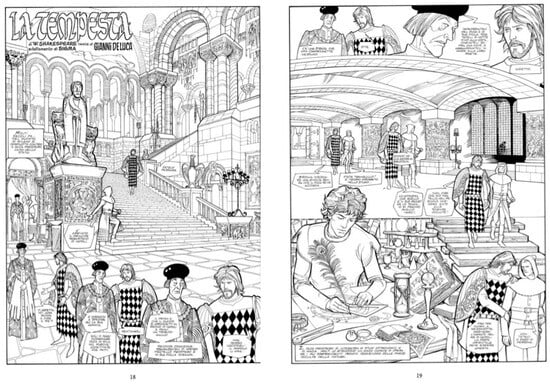
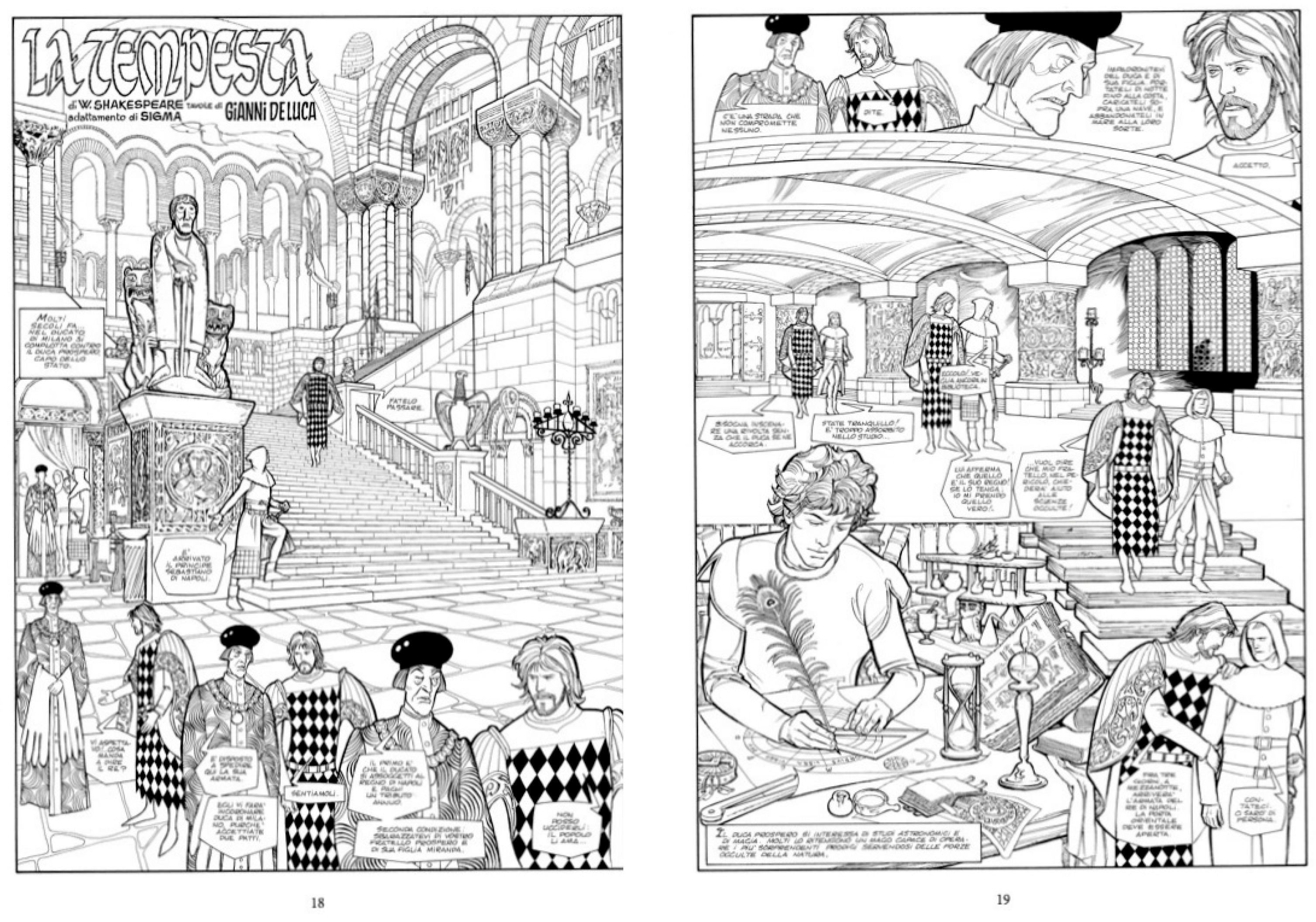
In his “Shakespearean Trilogy”, De Luca adopts, whether consciously or through an instinctive recovery of classical visual grammar, the aforementioned narrative strategies, representing the characters’ movement within the expansive space of the splash page/double splash page. In the first adaptation, The Tempest, this experimental approach alternates with more traditional sequential panel structures. Nevertheless, even in these instances, De Luca eschews the canonical rules of comic book fragmentation; rather than utilizing the “blank space” or gutter to signify temporal transitions, he employs architectural and natural elements within the illustration to demarcate narrative sequences (Gravett 2008; Rima 2018). This technique is immediately evident in the opening pages of the adaptation (Figure 1), where the environment itself dictates the pace of the reading.
Figure 1.
Gianni De Luca. La Tempesta—Trilogia Shakespeariana. ©Edizioni NPE (2019), pp. 18–19. (De Luca 2019).
In this double-page splash, it is worth noting that the comic book’s opening does not match the beginning of the Shakespearean text. While in the latter the scene opens in medias res with the tempest conjured by Prospero striking the ship that carries his brother Antonio and the Neapolitan court, De Luca and the adaptor, Sigma, choose instead to represent the events preceding the main plot, which in the source text are disclosed by Prospero to Miranda in Act I, Scene 2. Set within the halls of the Duchy of Milan, the scene depicts Antonio conspiring with Sebastian, brother to King Alonso of Naples, against Prospero. The setting in the ducal palace immediately showcases De Luca’s signature technique: Antonio and Sebastian approach from different directions, the former descending a long staircase and the latter entering through a doorway. Their converging trajectories create a V-shaped composition that guides the reader’s eye toward the center of the page, where the plot begins to thicken. Consequently, their dialogue progresses as they advance toward the reader through a visual zoom that shifts from full-body shots to medium shots.
The subsequent page recedes from this level of experimentation; nonetheless, its artistic execution remains unconventional for the medium. The vaulted ceilings in the central panel function as dividers between the upper panel, which continues the zoom on the characters, moving from medium shots to close-ups, and the lower one. This final panel depicts the characters once again, this time Antonio and a servant, traversing the space through the reiteration of their figures. From a distance, they observe Prospero absorbed in his studies. The reader’s perspective is aided by a panel showing the Duke working with instruments reminiscent of alchemy, symbolizing his interest in the occult arts, and by a caption stating: “Duke Prospero is interested in astronomical studies and magic. Many consider him a wizard capable of performing the most surprising wonders by using the occult forces of nature” (De Luca 2019, p. 19, my translation)5.
By choosing to depict these antecedents, the authors employ the “Show, Don’t Tell” technique, which invites creators to “avoid dull, abstract, or cliché-ridden summaries and provide rich, specific, vividly rendered details” (Zwicky 2021, p. 897). Indeed, in a hybrid medium such as comics, representing a backstory through pure textual narration would lose its impact; the authors may choose to narrate through images, bringing to life scenes that, in the original play, are only evoked thouugh character dialogue. Furthermore, presenting the story in chronological order allows the reader to grasp the cast’s characteristics and form an attachment to the protagonists. Conversely, it could be argued that such a linear narrative fails to fully capture the power of the original text’s opening, which immediately engages the audience through its in medias res start and the striking imagery of the storm. However, in a medium where physical space imposes strict narrative limits, necessitating a fixed number of pages, authors must find clever solutions to overcome these constraints. Consequently, the choice made by Sigma and De Luca does not detract from the Shakespearean source; rather, it seeks to evoke the settings and character traits for a specific audience—the young readers of Il Giornalino—without distorting their essence or diminishing their significance.
While The Tempest serves as an initial exercise in spatial continuity, De Luca’s subsequent works, Hamlet and Romeo and Juliet, mark the zenith of his formal experimentation. Myklebost observes that De Luca’s Hamlet draws inspiration from “John Philip Kemble in the role, but unbuttoned in a louche 1970s manner, and blonde like Laurence Olivier” (Myklebost 2025a, p. 52). Theatre and cinema might have been also the inspiration for the artist in the depiction of Romeo and Juliet, both of whom heavily resemble Leonard Whiting and Olivia Hussey in Franco Zeffirelli’s Romeo and Juliet (1968). In these adaptations, the artist moves beyond the mere reorganization of the page to challenge the very representation of the characters’ essence and their temporal perception. From the inaugural pages of Hamlet, this shift is exemplified by the apparition of the King’s ghost, who seems to be composed of innumerable white dots, a technique reminiscent of Seurat’s pointillism. As pointed out by Padovani (2024), such a technique was first introduced in comics by De Luca’s contemporary artist Franco Caprioli, who made use of it virtually in all of his production (Padovani 2024, p. 6). Thus, it can be suggested that De Luca might have been influenced by Caprioli in his use of such a technique in the ghost’s representation. The ethereal figure projected against the nocturnal sky creates a game of lights and shadows, suggesting a celestial composition of stardust and cosmic matter that visually translates the supernatural ‘otherness’ of the ghost, resulting in an opposing monochromatism to the moonless night sky (Vidaurre Arenas 2022, p. 58). De Luca further deepens this stylistic fragmentation when dealing with memory: the narrative of the King’s murder is told within a flashback composed of six panels designed to emulate stained-glass windows. This shift functions as a deliberate semiotic boundary, effectively isolating the past within a distinct visual register that contrasts sharply with the present.
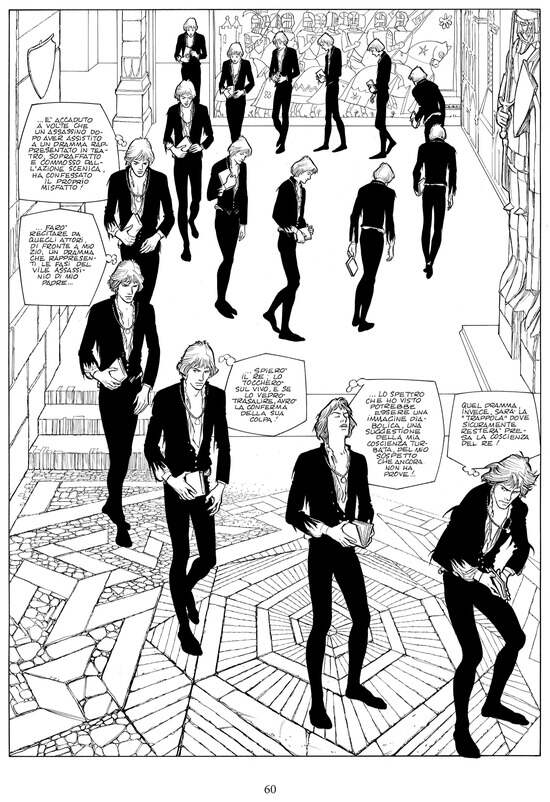
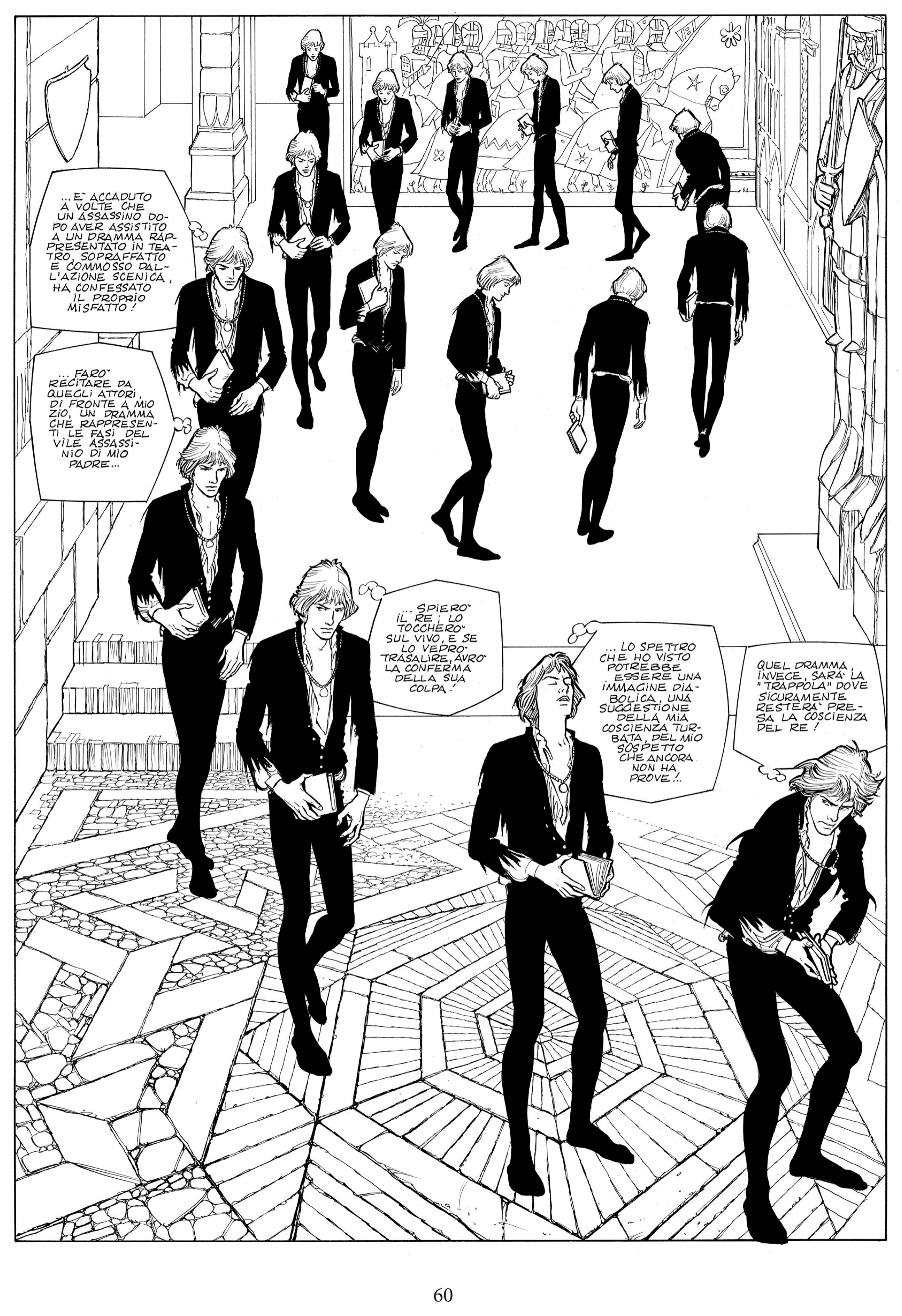
Another scene that deserves praise is the rendition of Act II, Scene 2 (vv. 577–594). In this splash page (Figure 2), Hamlet is pictured walking in a circle at the top of the page before traversing the space from top left to bottom right: he enters the room and begins walking in a space decorated with scenes of war painted on the walls and a statue of an armored warrior. The environment seems somehow to reflect Hamlet’s state of mind, since he is preparing to engage in a psychological war against his father’s murderer. At the same time, however, as Myklebost points out, the chivalric scene here portrayed shows the knights moving in the opposite direction to Hamlet. This underscores a contrast which is not only physical, but also metaphoric, as the prince is the antithesis of chivalric ideals: while the latter are based on courtesy to women and action over words, Hamlet is rude to them and prefers words over action (Myklebost 2025a, p. 54).
Figure 2.
Gianni De Luca. Amleto—Trilogia Shakespeariana. ©Edizioni NPE (2019), p. 60. (De Luca 2019).
Furthermore, Hamlet walking in a circle objectifies his uncertainty in an elegant way: the first thought balloon appears only once the character exits the loop, implying that it is up to the reader to decide when that recursive movement ends (Rima 2018, p. 14; Myklebost 2025a, p. 54). The physical movement, thus, mirrors the movement of thought, creating a connection between action and mind (Lo Bianco 2008, p. 229). This choice is not merely decorative but represents a radical reinterpretation of the reader’s role through what the author called a ‘junction-jolly pose’. As De Luca explained in an interview with his daughter Laura:
You can choose whether to prefer that, in the loop of the nine, the path is completed only once, or that it is obsessively repeated. In that spot, in fact, there are no speech balloons. There is a pose that acts as a junction-jolly. A double reading. We can assume that Hamlet retraces his steps, continuing to turn on himself indefinitely, or that he finally breaks away, changing direction and advancing towards us (De Luca, quoted in Rima 2018, my translation)6.The interview can be read on (Fumettologica 2015)
Therefore, it is up to the reader to choose when to conclude Hamlet’s uncertainty. De Luca allows us to decide how long Hamlet must walk in circles before engaging in his thoughts about unveiling his uncle’s actions, making the loop in which he stands “a visual metaphor of indecision” (Myklebost 2025a, p. 54). At the same time, even the background seems to change. When he starts to express his inner thoughts, he departs from the war-like scene and enters a new space dominated by geometric shapes on the floor. Although geometry usually suggests order, here it represents a sense of chaos, as there is no logical scheme in the depiction of these shapes. This visual chaos reflects Hamlet’s own fragmented mind, which chooses to rely on subterfuge instead of directly confronting his enemy. Geometrical figures dominate the picture, not only in the representation of the floor, but in the very structure of the page as a whole, thanks to the reading sense from top left to bottom right, the opposing walking trajectories of Hamlet and the knights in the chivalric scene, the circle which develops into a “serpentine ‘S’ shape” (Gravett 2008).
Given that Il Giornalino was primarily intended for a child readership, this page constitutes a remarkable display of intellectual sophistication. If one considers that the implied reader of such a publication “is a child who is supposed to recognize the importance of Shakespeare and is supposed to enjoy reading his stories in a shortened or ‘simplified’ version, long before he or she can read the source texts or is allowed to see the plays staged” (Tosi 2020), it can be inferred that De Luca deliberately constructs a dual level of interpretation within this page. On the one hand, young readers may enjoy the narrative without dwelling on the symbolic dimension of the image, while still grasping the central conflict of the plot and the motivations of the characters. On the other hand, adult readers can not only engage with these narrative elements but also perceive Hamlet’s inner conflict and establish connections with the source text, with which they are presumably already familiar. Once again, the comic book emerges as an unusual intersection between highbrow and lowbrow culture: its artistic execution reflects a sustained effort to balance theatre and comics, as well as spatial and temporal dimensions. However, due to the Catholic context of the magazine, the text loses part of its dramatic intensity, as elements that are potentially problematic from a moral perspective, such as the ambiguity surrounding Ophelia’s death, are significantly reduced, thereby reinforcing a more explicitly didactic reading of the play (Scatasta 2008, p. 245). Both Hamlet and The Tempest, in this sense, tend toward a more Manichean characterization, reducing the ambiguity that is central to Shakespeare’s original works.
Finally, in Romeo and Juliet, De Luca’s experimentation reaches its most accomplished form. While The Tempest and Hamlet still incorporate some pages structured according to a more conventional comics layout, Romeo and Juliet is composed entirely of twenty-four double splash pages, in which characters move freely across a continuous, stage-like space. Within these compositions, architectural elements such as roads, walls, and palace pillars take on a structuring function, effectively replacing the traditional gutter and delineating shifts between scenes when necessary. As a result, all the formal strategies observed thus far (spatial continuity, the reiteration of figures, and the integration of movement within a single visual field) find their fullest development in this work.
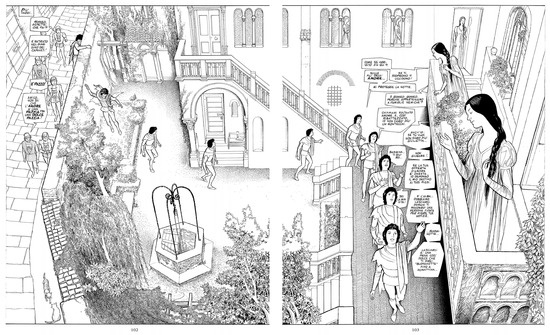
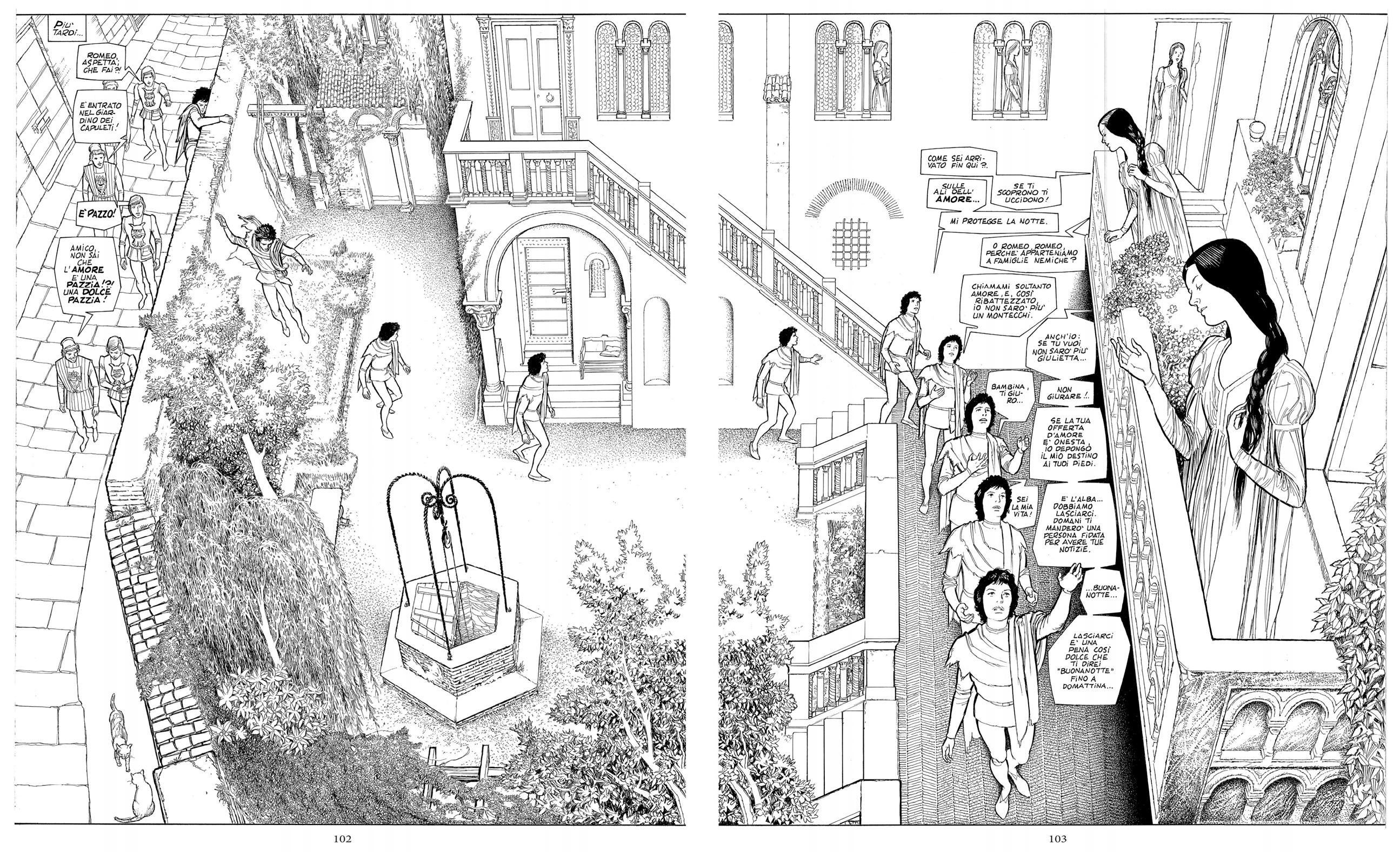
This approach is particularly evident in the well-known “Balcony Scene” (Act II, Scene 2). The double-page composition (Figure 3) is organised into three distinct spatial zones: the street on the left, the Capulets’ garden, and Juliet’s balcony above. The action begins in the upper-left section, where Romeo, Mercutio, and Benvolio are walking along the street. Romeo then climbs the wall separating the public space from the private domain of the Capulets and enters the garden, while his two friends continue moving outside, reflecting on Romeo’s love. As he advances through the scene, Juliet is first glimpsed at a window before appearing on the balcony, where Romeo eventually awaits her. The elevated point of view allows the reader to grasp the entire spatial configuration at once, while the framing remains constant throughout the sequence. Within this fixed perspective, the reiteration of the figures becomes a key narrative device: rather than fragmenting the action, it sustains and gradually intensifies the dramatic tension (Barbieri [2008] 2010, p. 107). Given that the encounter between the two lovers is one of the most iconic moments in Shakespeare’s canon, each step in Romeo’s progression, as well as Juliet’s gradual appearance, contributes to building anticipation toward the climactic exchange of their dialogue.
Figure 3.
Gianni De Luca. Romeo e Giulietta—Trilogia Shakespeariana, ©Edizioni NPE (2019), pp. 102–3. (De Luca 2019).
6. Gianni De Luca as a Third Space
The analysis conducted thus far positions De Luca’s “Shakespearean Trilogy” as a seminal work within the landscape of Italian comics, mainly for its formal innovation and aesthetic complexity, which results in the integration of theatrical spatiality into the comic book medium. Despite an ideological framework that may occasionally appear overtly biased to a Shakespearean scholar, the trilogy stands as a significant example of intermediality, as it fosters a dynamic interplay between diverse artistic disciplines: from sequential art to theatre, from psychology to painting. De Luca’s rigorous investigation into movement and sequencing underscores the transformative potential of the medium, as it reinterprets canonical narratives under a new guise, thereby allowing the audience to engage with these stories as if for the first time. Considering Deleuze and Guattari’s theory of the rhizome, what De Luca achieves can be seen less as a tracing of a pre-existing narrative than as the construction of a map, open to multiple pathways and interpretative possibilities. In this sense, Shakespeare functions not as a stable source but as one node within a broader network of cultural production.
Nevertheless, De Luca has yet to achieve the international recognition his oeuvre warrants. It is plausible to argue that, had he not confined his production almost exclusively to the Catholic magazine Il Giornalino, he would be recognized as a pivotal figure in the development of the ‘ninth art’, alongside masters such as Will Eisner, Jack Kirby, and Moebius. In a revealing interview with his daughter Laura regarding his technical prowess and limited mainstream fame, the artist succinctly expressed a total lack of interest in such accolades (De Luca, quoted in Rima 2018). This raises the question of the trilogy’s cultural categorization: does it belong to the ‘lowbrow’ context of Il Giornalino or to the ‘highbrow’ tradition of avant-garde comics? The evidence suggests it occupies neither and both simultaneously: rather than resolving the tension between these categories, it sustains it as a productive site of negotiation. De Luca dismantled these traditional boundaries the moment he introduced radical artistic experimentation into a medium typically relegated to juvenile entertainment. His case invites a broader reassessment of the role Shakespeare plays in facilitating a dialogue between seemingly disparate cultural traditions.
In this sense, the context of Il Giornalino should not be considered as a limitation, but rather as a foundational element of De Luca’s trilogy. The constraints imposed by the Catholic magazine (Manichean reading, young readership, mass-market format) are the very conditions that make his avant-garde style significant. Such an experiment, in fact, would have been expected in adult magazines as Linus; however, the same experiment published in a magazine like Il Giornalino becomes an artistic statement. De Luca’s pursuit of his ever-growing stylistic research within those boundaries is the reason why the trilogy can be considered a Third Space, one that mediates between experimentation and children’s accessibility, between the Shakespearean canon and popular culture.
Therefore, the trilogy invites a broader reconsideration of how cultural value operates in comics. De Luca’s work demonstrates that innovation is not the exclusive prerogative of ‘highbrow’ publications, and that Shakespeare’s narratives, read through a rhizomatic lens, can convey meaning not only in the Anglophone mainstream sphere, but also in national traditions and popular contexts where English is not the primary language, and that exploit their specificities (political issues, cultural debate) to create products that deserve international recognition. With the recent English translation of the trilogy by Passenger Press (2023), De Luca and his art might now reach the international readership they have long deserved.
Funding
This research received no external funding.
Institutional Review Board Statement
Not applicable.
Informed Consent Statement
Not applicable.
Data Availability Statement
No new data were created or analyzed in this study. Data sharing is not applicable to this article.
Conflicts of Interest
The author declares no conflict of interest.
Notes
| 1 | The “Shakespearean Trilogy” was translated in English in 2023 by Ronan Paterson, in a volume published by Italian Passenger Press. The edition presents all three adaptations by De Luca along with an introduction by Paul Gravett. |
| 2 | “In questa pagina noi abbiamo individuato] gli elementi di una iconografia che, anche quando rimanda a stereotipi realizzatisi già in altri ambienti (ad esempio il cinema), lo fa con strumenti grafici proprii al ‘genere’” (Eco [1964] 2017, p. 145). |
| 3 | “Linus ospita il meglio della produzione americana ed europea, di ieri e di oggi, legando l’immaginario del fumetto a quello delle problematiche del presente, vita politica e culturale prima di tutto” (Barbieri [2009] 2014, p. 122). |
| 4 | “[L’idea di De luca è allora quella di portare all’estremo le sue invenzioni precedenti, e giocare il racconto teatral-fumettistico su una serie di scene temporalmente unitarie, senza divisioni in vignette, in cui] l’unità spaziale e temporale sarà segnalata dall’unità complessiva dello spazio della rappresentazione, mentre lo scorrere del tempo verrà evocato dalla comparsa ripetuta dei personaggi, accompagnati dai dialoghi” (Barbieri [2008] 2010, p. 109). |
| 5 | “Il duca Prospero si interessa di studi astronomici e di magia. Molti lo ritengono un mago capace di operare i più sorprendenti prodigi servendosi delle forze occulte della natura” (De Luca 2019, p. 19). |
| 6 | “Puoi scegliere se preferire che, nell’occhiello del nove, il percorso sia compiuto una volta sola, oppure che venga ossessivamente ripetuto. In quel punto, infatti, non ci sono nuvolette. C’è una posa che fa da svincolo-jolly. A doppia lettura. Possiamo presumere che Amleto torni sui suoi passi, continuando a girare su stesso all’infinito, oppure che si sganci definitivamente, cambiando direzione e avanzando verso di noi.” (De Luca, quoted in Rima 2018). |
References
- Baetens, Jan. 2011. From Black & White to Color and Back: What Does It Mean (not) to Use Color? College Literature 3: 111–28. [Google Scholar] [CrossRef] [Scilit]
- Barbieri, Daniele. 2010. Il tempo coeso di Gianni De Luca. In Il pensiero disegnato. Saggi sulla letteratura a fumetti europea. Edited by Sergio Rossi. Roma: Coniglio Editore, pp. 100–11. First published 2008 in De Luca: Il disegno pensiero. Edited by Hamelin Associazione Culturale. Bologna: Black Velvet Editrice, pp. 203–19. [Google Scholar]
- Barbieri, Daniele. 2014. Breve Storia Della Letteratura a Fumetti. Roma: Carocci. First published 2009. [Google Scholar]
- Bhabha, Homi K. 1994. The Location of Culture. London and New York: Routledge. [Google Scholar]
- Carrier, David. 2000. The Aesthetics of Comics. Pennsylvania: The Pennsylvania State University Press. [Google Scholar]
- Casey, Jim, and Brandon Christopher. 2024. Introduction: What’s Shakespeare to Comics, or Comics to Shakespeare? In Shakespeare Comics: Negotiating Cultural Value. Edited by Jim Casey and Brandon Christopher. London: The Arden Shakespeare, pp. 1–10. [Google Scholar]
- Castaldi, Simone. 2010. Drawn and Dangerous. Italian Comics of the 1970s and 1980s. Jackson: University Press of Mississippi. [Google Scholar]
- Castaldi, Simone. 2017. A Brief History of Comics in Italy and Spain. In The Routledge Companion to Comics. Edited by Frank Bramlett, Roy T. Cook and Aaron Meskin. New York and London: Routledge, pp. 79–87. [Google Scholar]
- Croci, Daniele. 2016. Cultura per parole e immagini: Il graphic novel. In Introduzione ai Cultural Studies—UK, USA, e paesi anglofoni. Edited by Nicoletta Vallorani. Roma: Carocci, pp. 125–46. [Google Scholar]
- Cuccolini, Giulio C. 2008. Da Botticelli a De Luca. In De Luca: Il disegno pensiero. Edited by Hamelin Associazione Culturale. Bologna: Black Velvet Editrice, pp. 257–63. [Google Scholar]
- Deleuze, Gilles, and Felix Guattari. 2005. A Thousand Plateaus—Capitalism and Schizophrenia. Edited and Translated by Brian Massumi. Minneapolis: University of Minnesota Press. First published 1980. [Google Scholar]
- De Luca, Gianni. 2019. Trilogia Shakespeariana. Eboli: Edizioni NPE. [Google Scholar]
- Eco, Umberto. 2017. Apocalittici e Integrati—Comunicazioni di massa e teorie della cultura di massa. Milano: Bompiani. First published 1964. [Google Scholar]
- Eisner, Will. 2018. Comics & Sequential Art: Principles and Practices from the Legendary Cartoonist. New York: Norton. First published 1985. [Google Scholar]
- Field-Pickering, Janet. 2003. Shakespeare Steps Out: The Primacy of Language in Inner-City Classrooms. In Reimagining Shakespeare for Children and Young Adults. Edited by Naomi J. Miller. London and New York: Routledge, pp. 207–16. [Google Scholar]
- Fois, Eleonora. 2018. ‘A King of Infinite Space’: Shakespearian Spaces between Stage and Comics. Between, VIII 15: 1–33. [Google Scholar]
- Fumettologica. 2015. Gianni De Luca, nato con la matita [Intervista]. Available online: https://fumettologica.it/2015/01/gianni-de-luca-intervista/5/ (accessed on 8 June 2026).
- Gadducci, Fabio, Leonardo Gori, and Sergio Lama. 2020. Eccetto Topolino—Lo Scontro Culturale tra Fascismo e Fumetti. Eboli: Edizioni NPE. [Google Scholar]
- Gravett, Paul. 2008. Gianni De Luca and Hamlet: Thinking Outside the Box. Available online: https://paulgravett.com/articles/article/gianni_de_luca_hamlet (accessed on 8 June 2026).
- Hutcheon, Linda, and Siobhan O’Flynn. 2013. A Theory of Adaptation. New York: Routledge. First published 2006. [Google Scholar]
- Iyengar, Sujata. 2023. Shakespeare and Adaptation Theory. London: Bloomsbury. [Google Scholar]
- Jones, William B., Jr. 2011. Classics Illustrated: A Cultural History. Jefferson: McFarland & Co. [Google Scholar]
- Kelp-Stebbins, Katherine. 2020. Reading Spaces—The Politics of Page Layout. In The Oxford Handbook of Comic Book Studies. Edited by Frederick Luis Aldama. Oxford: OUP, pp. 75–93. [Google Scholar]
- Lanier, Douglas M. 2002. Shakespeare & Modern Popular Culture. Oxford: OUP. [Google Scholar]
- Lanier, Douglas M. 2010. Recent Shakespeare Adaptation and the Mutations of Cultural Capital. Shakespeare Studies 38: 104–13. [Google Scholar]
- Lanier, Douglas M. 2014. Shakespearean Rhizomatics: Adaptation, Ethics, Value. In Shakespeare and the Ethics of Appropriation. Edited by Alexa Huang and Elizabeth Rivlin. New York: Palgrave Macmillan, pp. 21–40. [Google Scholar]
- Lo Bianco, Fabrizio. 2008. La nobiltà del movimento in De Luca. In De Luca: Il disegno pensiero. Edited by Hamelin Associazione Culturale. Bologna: Black Velvet Editrice, pp. 221–35. [Google Scholar]
- Marchitello, Howard. 2003. Descending Shakespeare: Toward a Theory of Adaptation for Children. In Reimagining Shakespeare for Children and Young Adults. Edited by Naomi J. Miller. London and New York: Routledge, pp. 180–89. [Google Scholar]
- Mattioni, Ilaria. 2020. I periodici per ragazzi dell’Azione cattolica. In Formare coscienze mature. L’impegno educativo dell’Azione cattolica in centocinquant’anni di storia. Edited by Piepaolo Trani and Paolo Trionfini. Roma: Fondazione Apostolicam Actuositatem, pp. 151–71. [Google Scholar]
- Mattioni, Ilaria. 2025. Carosello e la banda del Giornalino: Dal fumetto alla TV e ritorno. Rivista di Storia dell’Educazione 12: 77–85. [Google Scholar]
- Maynard, Amy Louise. 2012. How Comics Help to Teach Shakespeare in Schools. Asiatic 2: 96–109. [Google Scholar]
- McCloud, Scott. 1994. Understanding Comics. New York: HarperCollins Publisher. [Google Scholar]
- Müller, Anja. 2013a. Introduction: Adapting Canonical Texts in and for Children’s Literature. In Adapting Canonical Texts in Children’s Literature. Edited by Anja Müller. London: Bloomsbury, pp. 1–8. [Google Scholar]
- Müller, Anja. 2013b. Shakespeare Comic Books: Visualizing the Bard for a Young Audience. In Adapting Canonical Texts in Children’s Literature. Edited by Anja Müller. London: Bloomsbury, pp. 95–111. [Google Scholar]
- Myklebost, Svenn-Arve. 2025a. Shakespeare Comics: Art, Time and Character. Edinburgh: Edinburgh University Press. [Google Scholar]
- Myklebost, Svenn-Arve. 2025b. Teaching Shakespearean Comic Book Adaptations. Cahiers Élisabéthains: A Journal of English Renaissance Studies 1: 59–78. [Google Scholar] [CrossRef] [Scilit]
- Padovani, David. 2024. Franco Caprioli: Perché calmare il mare non si può. In Letteratura di mare. Eboli: Edizioni NPE. [Google Scholar]
- Rima, Matteo. 2018. Quando la pagina è un palcoscenico: I graphic novels shakespeariani di Gianni De Luca. Between, VIII 15: 1–28. [Google Scholar]
- Scatasta, Gino. 2008. William Shakespeare, Gianni De Luca e il Bubble-Gum. In De Luca: Il disegno pensiero. Edited by Hamelin Associazione Culturale. Bologna: Black Velvet Editrice, pp. 237–49. [Google Scholar]
- Thomas, Catherine E. 2024. Delineating Comics: Shakespeare Illustrated and the Question of Narrative Productive. In Shakespeare Comics: Negotiating Cultural Value. Edited by Jim Casey and Brandon Christopher. London: The Arden Shakespeare, pp. 13–27. [Google Scholar]
- Tosi, Laura. 2020. The Narrator as Mediator and Explicator in Victorian and Edwardian Retellings of Shakespeare for Children. Cahiers victoriens et édouardiens 92. [Google Scholar] [CrossRef] [Scilit]
- Vidaurre Arenas, Carmen Vitaliana. 2022. Hamlet en la versión de Gianni De Luca. CuCo, Cuadernos de cómic 18: 50–72. [Google Scholar] [CrossRef] [Scilit]
- Zwicky, Jan. 2021. Show, Don’t Tell. Theoria 4: 897–912. [Google Scholar]
Disclaimer/Publisher’s Note: The statements, opinions and data contained in all publications are solely those of the individual author(s) and contributor(s) and not of MDPI and/or the editor(s). MDPI and/or the editor(s) disclaim responsibility for any injury to people or property resulting from any ideas, methods, instructions or products referred to in the content. |
© 2026 by the author. Licensee MDPI, Basel, Switzerland. This article is an open access article distributed under the terms and conditions of the Creative Commons Attribution (CC BY) license.